Introduction
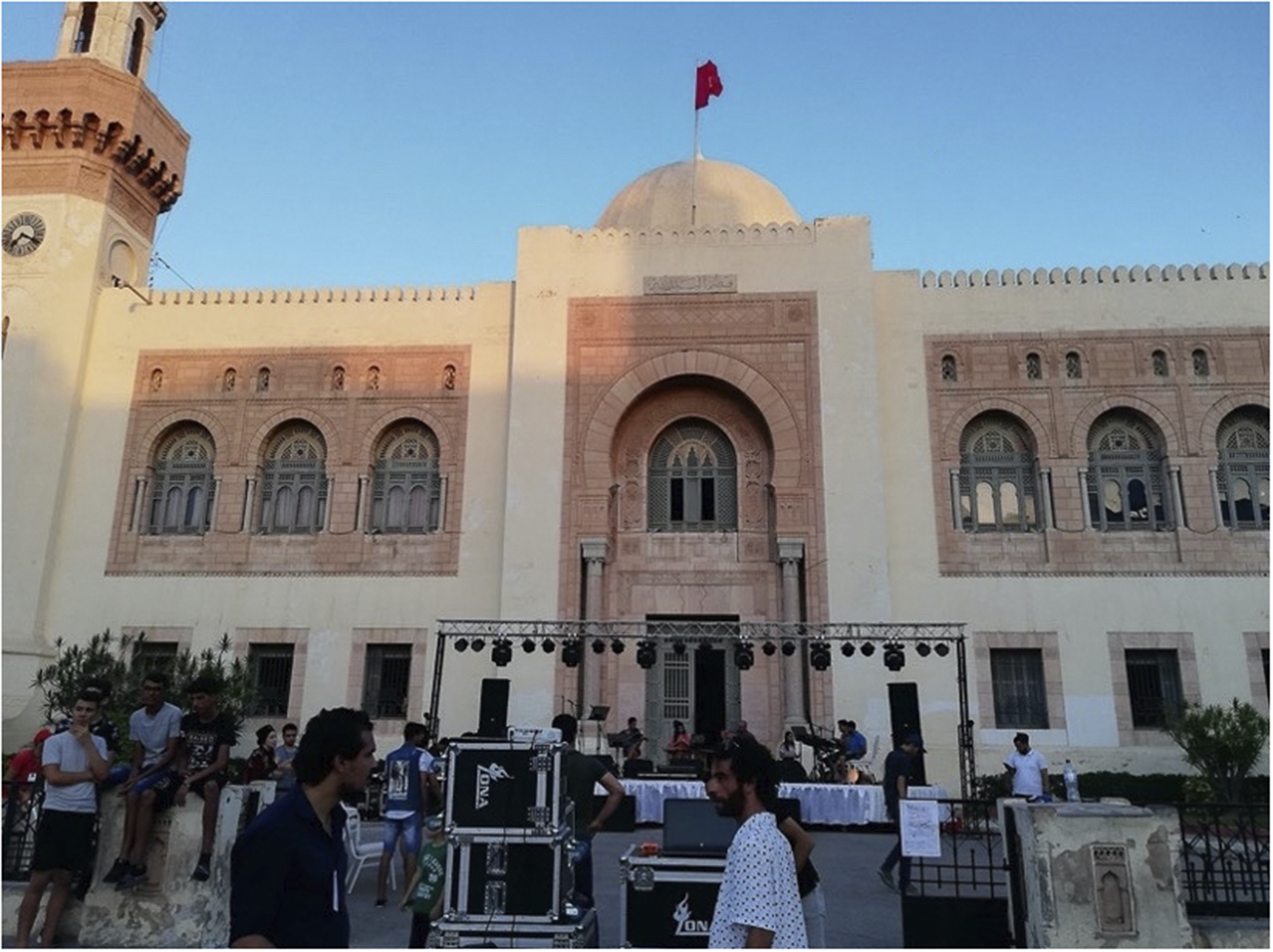
Standing in the main bustling centre of downtown Sfax, Tunisia, the Belediya building is monumental and stylised by an orientalist façade—a vivid backdrop for an outdoor concert. The clock tower reads five o’clock. As the sun descends, the stage is still under construction. Workers are replacing stage lights that blew from an overvoltage at the initial plug-in. Chairs for the audience are still in stacks to the sides of the stage. I realise that the five o’clock sound check with the Tunisian and Libyan musicians will have to wait. Most of them are dressing and preparing themselves for the concert at the Hotel Thyna, just a stone’s throw away from the belediya. I send a group text to update them on setup issues and push back the sound check. Then, I look up at the belediya and absorb the moment.
This municipal building or qaṣr al-baladiyya (“City Hall”) in formal Arabic now houses the Archaeological Museum of Sfax (Figure 1). Our musical collaborative had managed to secure the belediya as a dramatic backdrop for the outdoor concert. It was an obvious choice, in some respects. The orientalist assemblage of arabesque arches, wooden-latticed doors and windows, and grandiose entryway recalls a sophisticated and historised past. These architectural shapes would correspond to tonight’s concert of maluf music (mā’lūf; in French, malouf), a North African genre that is said to derive from al-Andalus, or medieval Muslim Spain, and performed today across eastern Algeria, Tunisia, and Libya.Footnote 1 Ironically, the belediya is ersatz orientalist architecture, designed by French colonialists in the early 20th century. Authenticity makes strides with a certain kind of forgetfulness.
Qaṣr al-baladiyya (“City Hall”) or belediya. Sfax, Tunisia. 12 July 2019. Photo by author.

I turn my back on the belediya and face the busy street traffic churning around a large fountain. A number of spill-out cafés flank the roundabout, and there is heavy pedestrian traffic beyond. People are already sitting on the fountain’s tiled edges, awaiting whatever event this stage setup will bring. I look beyond the fountain to the city folk ambling along the cent metres. This “one hundred meters” of pedestrianised space proceeds away from the belediya to another imposing structure of downtown Sfax: the great walls of the madīna qadīma or “Old City.” Built by the 9th-century Aghlabid dynasty, the fortified walls are truly old and demarcate space in a modern Arabised city unlike any other structure. The view from the belediya—across the open square and fountain, and through the pedestrianised path leading to the monumental Aghlabid Old City walls—comprises layers of architectural remembrances. Comparatively, this musical event will also represent such layers of history but in sound, rhythm, musical repertoire, and performance practice. Most importantly, the event will feature a transnational group of musicians, demonstrating maluf as a diverse yet shared musical tradition.
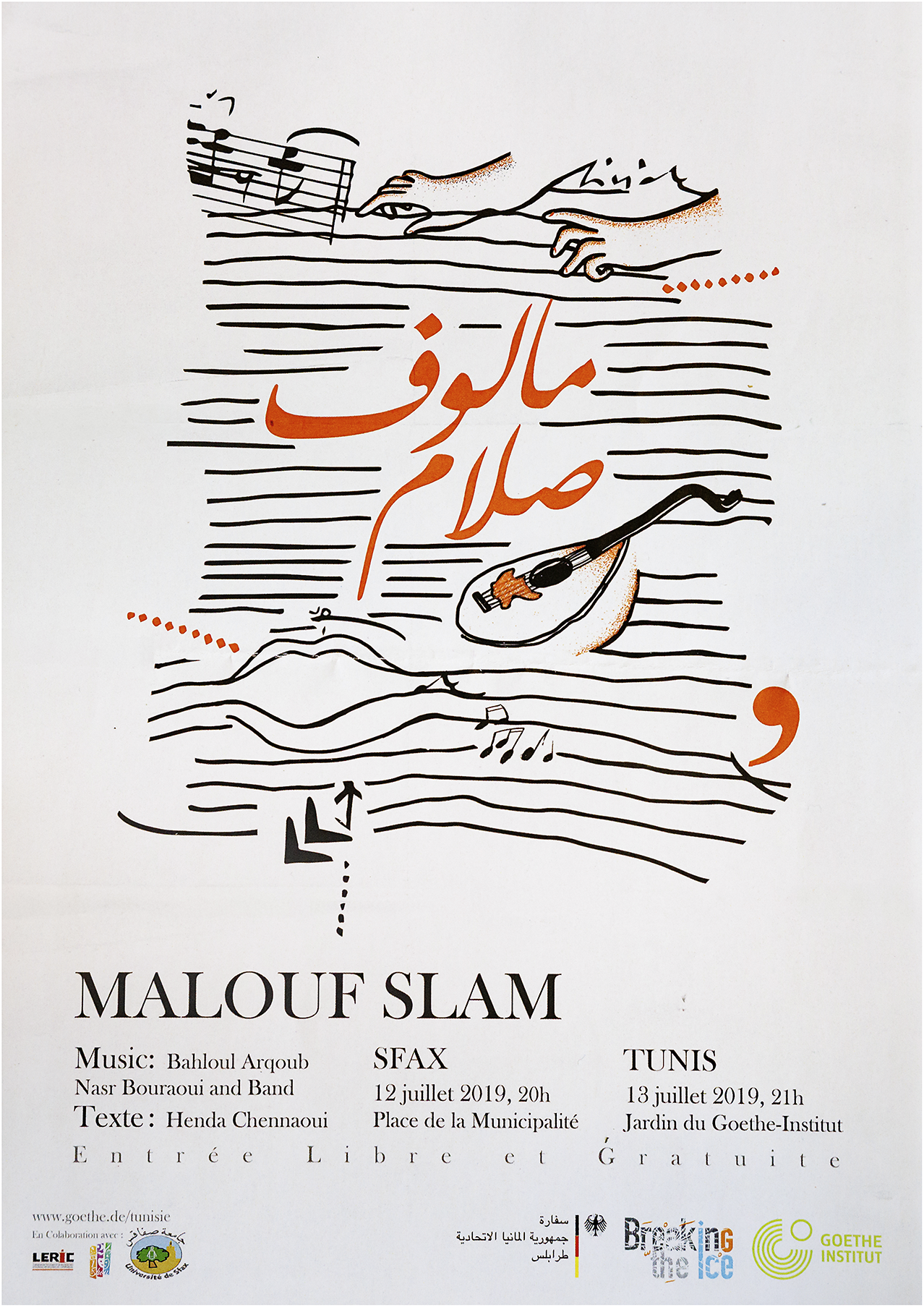
Our free, outdoor, and reimagined maluf concert is a rare experience for audiences. Tonight, just seven kilometres out from the belediya on Sidi Mansour Road at the large Outdoor Amphitheater, the virtuosic and highly esteemed Tunisian maestro Zied Gharsa is giving a more conventional maluf concert. The Amphitheater is the seasonal, summer location in Sfax to hear famous celebrities, and I am sure the Gharsa concert will be a good one. But our collaborative event will offer folks a more accessible event, and one that innovates familiar maluf songs. Anyone who happens in the public square tonight is welcome to participate. Here, maluf will inhabit common downtown spaces. Even the event’s Arabic title مالوف صلام (transliterated in English as “Maluf Slam” or in French as “Malouf Slam”) is an uncommon way of mediating this type of scene. The title reconfigures maluf as a somewhat spontaneous and innovative “poetry slam” rather than a fixed-form musical performance. The event’s media poster attempted to project these innovations (Figure 2). The standard lines of musical notation are broken between musical and poetic iconography to signify the experimental aspects of the event.
Media poster for “Malouf Slam” concerts, listing the lead singers, poets, and event details. Audience members had “free admission” (entrée libre et gratuite) to the events. Created by “Breaking The Ice” media team. Photo by Brian Powers.

After this performance in Sfax, the musicians and leadership team of the “Maluf Slam Collaborative” will travel to Tunis and perform the same concert at the Goethe Institute. The Goethe leadership team had programmed this event to be the evening’s highlight of “Summerfest,” an annual outdoor event to celebrate the progress of students after a year of language study. Goethe’s planning team desired a youthful and fresh event that would be “off the beaten path” in terms of local conventions.Footnote 2 Just like the Sfaxian concert, this one would also be free to the public. But unlike Sfax, the Goethe building—gated and outside of the city centre and Tunis’s Old City—would not offer city folks, pedestrians, and café dwellers the same access as the centralised belediya had.
During both events, music and poetry flowed for over an hour and a half. In Sfax, there were some thirty or forty audience chairs set out directly in front of the stage and belediya; but dozens of listeners chose instead to mingle on the front sidewalk or sit around the fountain in the centre of the open square. Interviews conducted during the evening demonstrated that there was real excitement in the Sfaxian crowd.Footnote 3 Several listeners described the event as “beautiful” (taḥfūna), and others were pleased with the event’s free admission and outdoor accessibility. One audience member noted, “Maluf Slam is a new thing, ‘high/elite art in the street’ (fann rāqī fī shār‘a)!” Moreover, many listeners were thrilled that it was happening in Sfax. As the second-largest city in Tunisia known more for its industrial prowess than artistic merits, Sfax had culture too.
In Tunis, the audience was vastly different. Young, fashionable adults—even cosmopolitan by virtue of their burgeoning proficiency in German language and culture—populated the event. Some sang along to familiar maluf songs; some socialised; others seemed despondent. In both venues, a member of our collaborative, trained as a scenographer, projected multi-coloured laser lights on the façades of the belediya and archways of the Goethe Institute in response to the performance. The light spectacle heightened the concert’s experience. Maluf Slam musicians told me that the light show created a great “mood” or jaww for the event. The Maluf Slam Collaborative was not a state-run venture, despite its dependence on a state-sanctioned and state-archived musical repertoire. Taking place outside of conventional venues and including an innovative multi-national program, Maluf Slam was a unique event for all participants, both on and off the stage.
Transnationalism within Shared Musical Traditions
The Maluf Slam Collaborative was a multinational cooperative composed of Libyan and Tunisian musicians, poets, and artists; German, American, and Tunisian project managers; Tunisian associations and academic organizations; and German stakeholders who met in Tunisia for one week in July 2019 to create, rehearse, and perform public concerts of Tunisian and Libyan maluf music. There were several innovative aspects of Maluf Slam, such as in the use of outdoor space or in putting on these events free of charge to the public, as narrated above. But the central objective of the events—and the focus of this article—was in the specific collaboration between Tunisian and Libyan musicians in the transnational music tradition of maluf.
Today, maluf music is widely considered a nationalised expression in eastern Algeria, Tunisia, and Libya (Guettat Reference Guettat2000; Davila Reference Davila2012:785). However, the aim of the Maluf Slam Collaborative was not to rehash the nation-state repertoires. Rather, the project sought to bring together Tunisian and Libyan musicians to explore the intensity of mutuality within the tradition. Although this vast repertoire of poetic texts, melodies, musical forms, and comportment are understood to be shared, my conversations with musicians and pedagogues in Tunisia over 2018–2019 revealed an uneven reality: people valorised the musical connectedness between Algeria and Tunisia more than between Libya and Tunisia. The Maluf Slam Collaborative came about to locate the pulse of the shared tradition between Libya and Tunisia.
And more than simply catalogue such comparisons and differences that appear, for example, in song repertoires or in performance etiquette, my research interests query mutuality itself: can events—such as Maluf Slam—give insight into the cultural movement of music within a shared, transnational tradition? How can an ethnographic look at the processual features of such transnational collaborative events reveal the contours of cultural geographies, such as “Tunisian” and “Libyan,” and what is at stake for people who use these assemblages of meaning? It is not just the fact that aspects of maluf are shared, truly, across wide spaces of North Africa; but it is also that these shared aspects settle differently. Maluf has come to mean a variety of things to participants even as the tradition is acknowledged as “shared” transnationally. In 2016, for example, Sfax emphasised this mutuality by celebrating its nomination as the UNESCO-Arab League Capital of Arab Culture with a number of maluf concerts involving Algerian, Libyan, Tunisian and even Moroccan musicians (Sfax 2016 n.d.).Footnote 4 Events such as this emphasise maluf’s role in celebrating connectedness across North Africa.
With the Maluf Slam Collaborative, my aim was to document and analyse the fine-grained process of collaboration itself, noting the textures of both connectedness and difference. But unlike other research that focuses on musical collaboration across highly divergent music cultures (e.g., Bayley Reference Bayley, Clarke and Doffman2017; Goldstein Reference Goldstein, Davis and Oberlander2021), Maluf Slam musicians shared a musical tradition that had been apportioned by nation-state governments only in the recent past. Thus, it was reasonable to assume that during the planning stages of the collaborative, the events might reveal non-national formations that are important—if not paramount—to the endurance of the maluf tradition as shared. That potential reordering of the institutions and forces which support transnational traditions is a contribution to understanding the role and limitations of nationalism today.
Transnationalism is hardly a new analytical frame for understanding human interaction in the world; but many argue that it is still a dynamic analytical frame for observing human communities as shared, blended, or globalised repositories of diversity and heterogeneity. Today, the word “transnational” in public usage and even in scholarship appears matter-of-fact and commonplace. Cultural phenomena are simply “transnational,” in that they travel or are shared across nation-state boundaries. This adjectival usage is simplistic and folds in complex and multilayered aspects of movement as well as the various intensities of mutuality and difference that occur. By its name, transnationalism centres the nation-state as one of the most consequential geographies for people’s lives today; but instead of assuming its importance—and perhaps overexaggerating its forces—transnationalism analyzes boundaries and borders as emergent and ever porous in order to explore spaces and geographies beyond the nation-state (Khagram and Levitt Reference Khagram, Levitt, Khagram and Levitt2008:5). Consequently, national identity is not singular or even the most defining aspect of human identity. Nationalisms work beside—and also subservient to—other effective and substantial identity formations and materialist networks. In much the same way as the globalization literature, transnationalism asserts the persistence of cultural movement; but unlike the global, this frame is scaled down and less totalizing.
For many scholars of music and culture, that preoccupation to trace movement—rather than explain “culture” as a static or fixed object—has only grown in importance over recent decades, especially after the globalization literature of the 1990s. The number of study areas that contribute to understanding transnationalism is vast and beyond the scope of this article.Footnote 5 Countless studies in the areas of migration, diaspora, cultural transmission, (re)mediation, circulation, and global flows contribute important perspectives which are often evidenced by the movement of transnational agents, actors, and objects.Footnote 6 In such studies, scholars not only document ideas, expressions, and objects that travel across nation-states; but they also describe the force, directionality, speed, and channeling effects of that movement.
Studies of music in the Mediterranean region have consistently demonstrated the importance of transnational identities and networks that supersede the nation-state.Footnote 7 In his book Performing Al-Andalus, Jonathan Shannon describes a transnational “cultural imaginary” that is built on a past expressed through present musical practices in Syria, Morocco, and Spain. “What unites these diverse cases,” Shannon argues, “is the role of the cultural imagination in constructing narratives of community and collective memories that allow participants to envision, in often contradictory ways, what life in the new Mediterranean can be like” (Reference Shannon2015:21). That “new Mediterranean” is one that is not borderless (without nation-states) but porous and open in surprising ways.
Nadia Kiwan’s work with Moroccan musicians at an annual music festival in Casablanca offers a similar but localised take on Mediterranean transnationalism. Rather than describing a wide scale of geographic mobility, such as with Shannon’s work, Kiwan writes about the multiplicities of local and global networks represented within the urban festival by the Moroccan performers. Even though the festival is largely a nationalised event, her research effectively demonstrates an “alternative nationalism” at work on stage that is both a product of Morocco and other geographies simultaneously (Reference Kiwan2014). Shannon and Kiwan demonstrate that even though nation-state formations are significant to Mediterranean histories and identities, they are also peripheral to more important networks of identity and signification.
Inside and outside of the Mediterranean, transnationalism continues to resonate as a pivotal frame to perceive and study lived experience. In the ethnographic details of Maluf Slam, the persistence of maluf as a shared and differentiated transnational musical tradition reveals forces, nuanced identities, and non-national geographies that provide a richer understanding of North African people and their lifeways. First, I will give a broad context of the project’s formation by narrating in detail the creation and development of the collaborative. Then, when the musicians gather to prepare the concert, I will lean in closer into the discussions of song repertoires, melodies, and musical genealogies in order to analyze some of the forces that wield transnational maluf traditions. Specifically, I will discuss how the use of musical modes and a lineage of Sufism are two significant forces that continue to create maluf with capacities to connect people across nation-states and also to differentiate the same. These comments give insights into the developing story of North Africans themselves.
The Creation and Development of the Maluf Slam Collaborative
The creation of the collaborative informally began in October 2019, when I contacted Mirco Keilberth, one of the Tunis-based directors of the artistic and dynamic group called “Breaking The Ice” (hereafter: BTI). BTI’s work fascinated me. The collective first began as a Facebook group called “Local Libya.com” which functioned as an Arabic-English language journal on localised stories from the streets of Tripoli. New recipes. Neighbourhood chess tournaments. A woman making food art with cakes. People planting trees in an area south of the city of Misrata—fifty kilometres east of Tripoli. These grassroots stories were some of the first to be disseminated by the Facebook group, under the leadership of Keilberth, a journalist for German, French, and English-speaking international newsprint. He was mostly covering stories about the on-going political destabilization of Libya after the events of 2011. But “Local Libya.com” was an attempt to cover a different kind of story. Contrary to the constant stream of war narratives inside Libya, these stories sought to generate narratives on cultural topics of everyday life, outside the scope of violence, militias, and political parties. These alternative perspectives would promote a re-evaluation of Libyan culture as well as present ordinary citizens behind a fog of war. The point was not to change public opinions about reigning militias, revolving governments, or election fervour. Rather, the writers wanted to better society by offering a platform for artists, musicians, and culture-brokers to exhibit their creativity, collaborate on new projects, and curate Libyan representation (Keilberth, interview, 19 January Reference Keilberth2019). Within two years, the Facebook group had 50,000 followers online, a sign of success for the organisers.
Libyans have consistently travelled to Tunisia, and vice versa, long before the events of 2011. But 2011 sparked a more intensive migration. With the increasing instability in Libya from 2011, voluntary and involuntary Libyan migrants flooded Tunisia causing unprecedented political, social, and economic challenges. Keilberth, Tunisian–Libyan Henda Chennaoui, and Tunisian Tayeb Henchir began to notice that “silence” had developed within the Tunisian public sphere in response to these changes. Instead of open dialogue and the acceptance of cultural differences, this silence cultivated prejudice against the Libyan migrants.Footnote 8 They reorganised their efforts and formed كسر حاجز الصمت (kasar ḥājiz al-ṣamt; Breaking the Silence Barrier), which eventually became “BTI.” From a base in Tunis, this growing initiative emphasised the need to open public spaces to address these prejudices and the growing misperceptions of the Libyan migrants by their Tunisian hosts. BTI chose to confront this silence by providing cultural platforms of expressive culture as a way of engaging discrimination and bigotry and creating a more welcoming space for difference.
BTI’s first public event featured visual artists and occurred on 5 May 2018, in the artful building Quinze (15) on the side street of Rue Oum Kalthoum, just off the bustling Place de Barcelone and main Tunis train terminal. The group also began working with musicians, such as the Libyan rock band Nonexistent, the Tunisian alternative music duo Yuma, and Tripoli-based musicians Fuad al-Gritli and “Bendirman” Muhammad al-Naas. BTI was clearly forging unique, public events around traditional artforms and presenting expressions beyond the concepts that had historically defined a North African religious citizen. When I visited their second Dawāya art exhibition in October 2018, it seemed that the open and cosmopolitan environment of Tunis was a helpful place to reconceptualise Libyan art for the urban Tunisian public, while also providing a rare and timely opportunity for Libyan artists themselves to unfurl non-normative expressions.
Developing the Concept of Maluf Slam
When Keilberth and I first met, we discussed a BTI summer event that would bring together both Tunisian and Libyan musicians that perform maluf. Such an event would fit the objectives of BTI’s social engagement and also provide an ethnographic pulse of maluf for North African and international researchers. However, BTI normally did events that mostly presented modern art with progressive social stances. As a nationalised expression, usually presented for middle to upper-class audiences, and often performed in indoor concert venues with staid embodiment and traditional attire, maluf was not the first choice for an exciting summer festival. It became clear in our conversations that to receive sponsorship for a summer event, the maluf events needed to have an avant-garde edge to excite a larger audience. A conventionally staged maluf concert would not suffice. A more unconventional approach was needed to present maluf as an accessible performance repertoire for a variety of modern audiences.
The collaboration between Tunisian and Libyan artists would attempt to break traditional music structures of maluf that have been codified through state-sponsored programs. The event would also take place in outdoor, accessible urban spaces and feature men and women instrumentalists. Musicians would be encouraged to don elegant but simple black attire rather than the ornamented and traditional robes often worn in maluf performances. Additionally, spoken poetry inserted between song sets would heighten the artistry of maluf. Thus, the idea behind a poetry “slam” nestled comfortably beside maluf as a potential title for our collaboration. Henda Chennaoui, a leader in BTI and a modern poet in her own right, took up this position of the poet and engaged these themes by creating spoken narratives on two of the musicians involved in the collaboration. To be honest, the final result of our “Maluf Slam” collaboration did not resemble a “slam,” in terms of the North American tradition of spoken, freely expressed, emotive, progressive, and seemingly impromptu poetry. However, the name “Maluf Slam” was proposed for its ability to communicate an old-new expression of maluf. The title stuck, and we drafted proposals to acquire sponsorship.
Building the Maluf Slam Collaborative
From past events, BTI had financial connections with several cultural and political institutions in the capital Tunis, namely with the Goethe Institute of Tunis which was known for supporting events with a flair to push cultural norms by exploring human diversity. Our brief one-and-a-half-page proposal described Maluf Slam as an outdoor, non-traditional maluf concert, highlighting Tunisian—specifically, Sfaxian—and Libyan musicians, along with the participation of poets and light scenographers. Three objectives of the event further elucidated the imagined dynamic of the show:
Firstly, the [Maluf Slam] events intend to connect civil society, media and cultural activists in Tunis and in Sfax leading to a more informed, networked, and cultured citizen engagement. This is a critical point since Tunis as a capital and its government as an arbiter of taste tend to dominate and define regional expressions in the arts.
Secondly, an original re-telling of maluf history and song with modern-day poetry will provide an ideological shift for audiences as maluf is often performed in a classical manner on national stages. Breaking the Ice Maluf Slam means to “de-context” this specific art of storytelling, [as] changing venue and accessibility distinctly alters the experience of performed music. This new experience is a resource for citizens, artists, and other cultural catalysts.
Thirdly, Maluf Slam provides a rare platform for musicians in the Tunisian South and Libyan West to collaborate on their shared traditions and reimagine a musical future with fewer borders. (Holton and Keilberth Reference Holton and Keilberth2019)
Perhaps it was the second point that made the most difference to some of our soon-to-be Tunisian collaborators. In a Facebook post after the Sfax concert, the One-Two-Show Association who had organised the venue, summarised the Maluf Slam objectives in their own words: “This artistic concert aims to make culture available [tamlīk al-thaqāfa] to everyone and create a cultural dynamic outside official structures [al-uṭur al-rasmiyya].”Footnote 9
The Goethe Institute accepted our proposal, and we began to assemble social infrastructure. Ghassen ‘Azaiez, a Tunisian musician and professor in the anthropology of music at the Higher Institute of Music in Sfax, joined the BTI team to assist in this process. The University of Sfax, along with the Sfax-based Laboratoire d’Études et de Recherches Interdisciplinaries et Comparées (Laboratory for Interdisciplinary and Comparative Studies and Research), joined the collaborative as formal sponsors, supporting the academic pursuits of the project. Tunisian representative Ketata Khalil from the High Commission of Culture in Sfax advised us on how to obtain permission for an outdoor concert in Sfax and also provided rehearsal space in the “Little Theater” at the High Commission. The High Commission of Culture in Sfax organised another rehearsal space for us at the local Complexe des Jeunes (Youth Facility), beside the busy port of Sfax. The well-resourced One-Two-Show Association, directed by Sfaxian Noureddine Adalet, agreed to manage the concert production in Sfax; and the Goethe Institute handled the production in Tunis. The German Embassy of Tunis came to our aid as well with modest funding for additional costs. We slowly built this network over the first several months of 2019, aiming to put on Maluf Slam later in July.
The musicians of Maluf Slam were chosen by ‘Azaiez and myself in consultation with people mainly within the Sfaxian music scene. Privileging a Sfaxian network, ‘Azaiez and I built a team of instrumentalists willing to collaborate with Libyan musicians; experiment musically within the maluf repertoire; and, consequently, pursue alternative presentations of maluf. Our intrepid group solidified:

These instrumentalists had all been trained through the Tunisian university music system, the pre-eminent place to learn maluf. Mabruki and Boukedi were still registered students at the Higher Institute of Music in Sfax in first-year and third-year studies, respectively. Moreover, two of the musicians, both ‘Affes and Essalama Essefi, had recently earned their doctorates in musicology from Tunisian institutions. Hergafi, based in Sfax, was in demand as a percussionist for weddings, festivals, and other staged performances throughout the year.
The ensemble lacked the strong melodic instruments of violin or nay (end-blown flute); and, most importantly, Libyan instrumentalists had not been included at this point. We were delighted to have Libyan violinist Abdullah ‘Araybi join the collaborative. I had first met ‘Araybi in Libya, when I was teaching music at the University of Tripoli. It was not simply his excellent musicianship and nationality that seemed to balance our small ensemble. It was also his family lineage. ‘Araybi is the son of the late musician, composer, and maestro Hasan ‘Araybi (1933–2009), who is often remembered as the father of modern Libyan maluf. Thus, having one of his sons, Abdullah, in our project was a particular honour for the collaborative and solidified pivotal parts of the modern maluf narrative for Tunisians and Libyan audience members.
With the instrumentalists chosen, we turned our attention to, arguably, the most important aspect of maluf performances: the singers. Typically, the singing of a maluf performance is directed by a lead singer (munshid or raddīd)Footnote 10 and a chorus (munshidīn or raddāda/raddīda). Lead singers are pivotal in selecting texts for performance, choosing melodic modes, and managing the instrumental and vocal performers on stage. The munshid is often called a shaykh (master or learned one), designating an individual—most often a male—educated in the religious and/or scholarly sciences. A shaykh is often one who accepts this position upon memorization of the Qur’an, the most prominent holy book for Muslims. The art and practice of Qur’anic memorization is relevant for maluf song texts also, as the munshid is responsible for drawing from their large mental reserves to make specific selections for a performance. In short, a munshid can make or break a maluf performance, depending on their competence in memorization, style of singing, aptitude in performing melodic embellishments, abilities in leading an ensemble, and charismatic stage presence to captivate listeners.
The collaborative decided to hire both a Libyan and Tunisian munshid for Maluf Slam. In 2014, I had first met Shaykh Bahlul Abu al-Arqub on a music teaching team, which traveled from Tripoli to the University of Misrata (Libya) on Saturdays and give back-to-back music lessons all day. Libyan musicians said that Shaykh Bahlul was always ready to sing a line of poetry; moreover, they said his voice was unmatched in its purity of tone. He and I discussed the project’s objectives, and—with excitement—he agreed to be our principal munshid for the program. For a Tunisian munshid, our team accepted Nasr Ali Bouraoui.Footnote 11 As a younger, up-in-coming artist in Sfax, and a graduate from the Higher Institute of Music in Sfax, Nasr Ali had just decided to transition his career from weddings to the festival stage—a decision that signalled to Tunisian musicians a desire to move from the public performance of popular music to that of art music. Ultimately, it was a decision in his journey to claim authenticity as a “classical” musician.Footnote 12 Nasr Ali graciously accepted the project. It was an opportunity for him to work with veteran maluf musicians, as well as closely collaborate with the venerable and experienced Shaykh Bahlul.
After the two lead singers were hired, a small chorus was also necessary for maluf-style performances. Shaykh Bahlul brought two Libyan munshidīn with him: Mohammad Marzuki and Mohammed Mgarief. These singers had been performing with Shaykh Bahlul for some time as apprentices in maluf. In fact, many times during the concert week, I observed Shaykh Bahlul, as the master musician, take these two apprentices into an added layer of confidence to instruct them about texts or melodies, to describe important musical relationships in the program, or to test their knowledge about Andalusi history and the overall repertoire of maluf. Shaykh Bahlul and Nasr Ali agreed that no more munshidīn were necessary for the program due to the common styles of maluf singing between Tunisia and Libya. And so, these four singers finalised the vocal section of our collaborative.
Our musical team was set with six Tunisians and four Libyans spread across instrumental and vocal sections. The inclusion of two women on stage as a poet and a Master of Ceremonies brought the gender ratio of men:women to 5:2—a small but significant sign of diversity and innovation on a public maluf stage.Footnote 13 Thus, with key supporters and musicians in place, the social infrastructure of the Maluf Slam Collaborative was built. It was now time to develop a musical program and implement the concerts.
Designing and Implementing Maluf Slam Concerts
The collaborative officially began when the two lead munshidīn Shaykh Bahlul and Nasr Ali met for the first time on Tuesday, 9 July. Artistic directors Ghassan ‘Azaiez and I were present to facilitate. One day before the first full ensemble rehearsal, and four days before the first public performance in Sfax, this meeting focused on the method and materials for putting on the collaborative program. The shared aspects of maluf were so emphatic during this meeting that within the first five minutes, the munshidīn had agreed upon a program design; selected two maluf songs to feature that were shared between the countries; and determined that the melodic modes of maluf—that is, the complex musical structures that shape the entire repertoire—were close enough between Libya and Tunisia for a meaningful collaboration. In fact, they chose to organise the concert around these melodic modes which warrants further discussion later in this article. They decided that the program would follow an unconventional but collaborative design. Tunisian and Libyans would each present specialised repertoire during the event but also join together in three moments to perform songs shared between the traditions.
After this first meeting, the collaboration was off to a great start. Soon, the rest of the Libyan musicians arrived in Tunisia, and rehearsals began. On Wednesday morning, the complete collaborative met in Sfax at the Complexe des Jeunes (Youth Facility). Introductions were made, instruments tuned, the general concert format explained, and then, the playing started. Shaykh Bahlul began leading Libyan songs, and Nasr Ali followed with Tunisian ones. Of all the Maluf Slam moments, this rehearsal was the most difficult. The differing leadership styles of Shaykh Bahlul and Nasr Ali created visible angst in the group. Most of the repertoire for the program was set after this first rehearsal, but the dynamic in the collaborative was unsettled. The following day, the collaborative met at the “Little Theatre,” located on the third floor of the regional Commission for Cultural Affairs, an artistic space managed by the Tunisian Ministry of Culture. Each munshid took a turn to rehearse their songs, and the nearly three-hour rehearsal ended with a communal lunch.
After a siesta, the third and final rehearsal took place at five o’clock in the afternoon, in my rented residence. The BTI team had hoped that this last rehearsal before the first show would be more than just a concert run-through. A project built on shared heritage implied a certain cultivation of relationships between the musicians on stage. The wide rectangular living and dining space comfortably held all nine ensemble members, six BTI team members, and a few other visitors; and the dynamics of a lived-in home seemed to soften the more professional edge from the morning’s rehearsal. The instrumentalists arrived first and rehearsed the opening piece composed by the ‘ud player, Bacem ‘Affes. The space was already humming with energy and excitement when the vocalists arrived.
It was in this final rehearsal that the collaborative solidified the poetry aspect of the “slam.” In order to highlight the truly interactive and evolved nature of the program, poet Henda Chennaoui decided to feature two of the musicians by writing original narratives about their musical lives. She would recite these narratives on stage between the concert’s musical segments. She chose (Libyan) Shaykh Bahlul and percussionist (Tunisian) Khaoula Essalama Essefi. She first delivered her poetic narratives during this rehearsal, and the ensemble was pleased. The narratives functioned as a reflexive statement on the ensemble’s brief but intense journey together over a few days. Maluf divided as “Tunisian” and “Libyan” emphasised musical differences, sedimented in nation-state narratives of heritage formation with specific institutional support germane to each country. And yet, these two narratives demonstrated that musicians had similar musical knowledge, training, and experiences which enabled the collaborative to build a concert program together across those differences. In the end, Henda’s poetic narratives became a critical part of the concert, connecting for audiences the textures of past and present within a wider sweep of a regional maluf history. On that positive note, the collaborative concluded rehearsals. We anticipated the next day’s public performance beside the evocative belediya in Sfax, and the Saturday performance in Tunis at the Goethe Institute.
Investigating Mutuality and Difference
The Maluf Slam Collaborative generated a great deal of conversation, virtual media, and realia, particularly around the concerts on 12–13 July 2019. From a marketing perspective, Maluf Slam was billed as a presentation of musical differences between Tunisian and Libyan musicians. But that perspective of difference was based on the premise that the maluf tradition was deeply shared between the nation-states. This section investigates a few salient points of mutuality and difference that manifested during the events; and in turn, these points give contour to the qualities of transnationalism within maluf. First, musical modes—the musical building blocks of the maluf repertoire—enabled musical collaboration between Maluf Slam participants across diverse repertoires. In contrast, disagreements around foregrounding Sufism during the performances revealed substantial distinctions within maluf’s transnational presence. The aspects of musical modes and Sufism reveal contrasting forces at work in the contemporary movement of maluf between people and places and demonstrate the complexity of transnational objects and processes.
Considering Maluf and Musical Modes
As previously mentioned, the two lead vocalists or munshidīn for Maluf Slam fully framed the concert within the first five minutes of their initial meeting. It was the musical modes that enabled this mutuality. Emphasizing the formative role that modes have in connecting musicians might seem obvious to those with experience in musics from the Arab world. Musical modes have been foundational to expressive cultures across the Mediterranean region for centuries. But where the literature and pedagogy of modes typically focuses on the musical structure and theory, Maluf Slam demonstrated the crucial capacity modes have to link people across differences.Footnote 14 Highlighting modes in this way builds upon past scholarship by demonstrating how the structuring of musical objects enables specific non-musical relations.Footnote 15 Arguably, these non-musical potentials are a primary reason for the centuries-long transmission of musical modes. In the case of Maluf Slam, modes effectuated personal working relationships across practices and repertoires. And by these connections, mutuality emerged from regional diversity to build transnational expression.
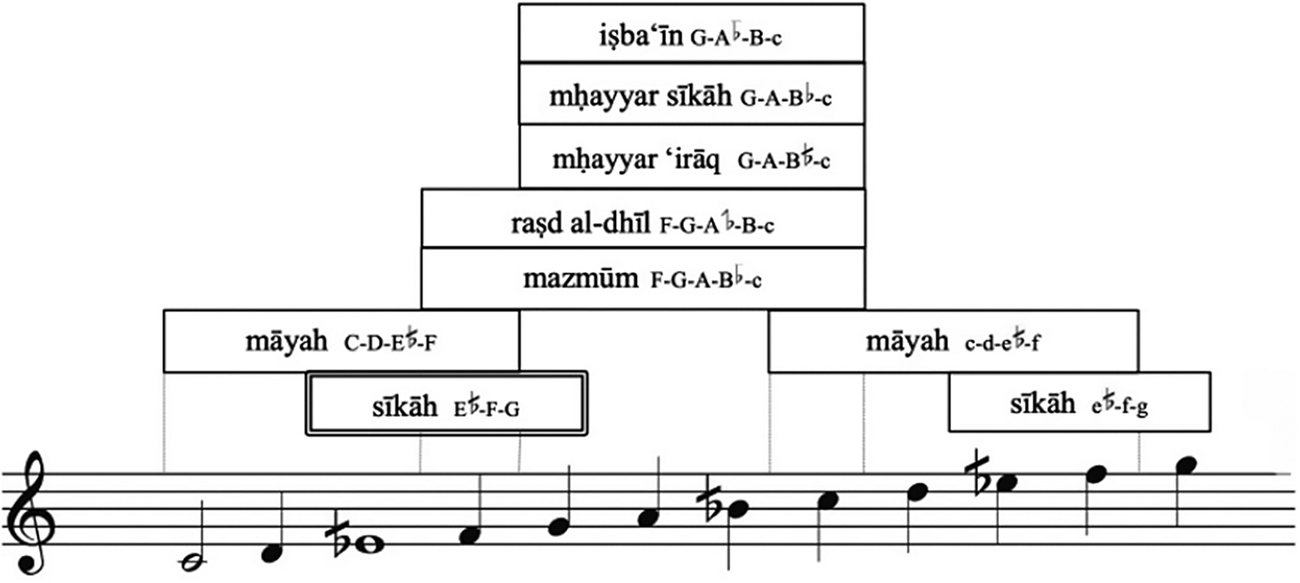
Maluf’s melodic repertoire is built on musical structures called the ṭubū‘ (plural; ṭab‘ in the singular). The most common translation is “modale” in French-language publications on North African music (D’Erlanger Reference D’Erlanger1949; Guettat Reference Guettat1980:115; Gharbi, interview, 23 April Reference Gharbi2019), which corresponds to “mode” in the English language. During the 20th century, the conventional method of diagramming a ṭab‘, or [musical] mode, is on the lines and spaces of the European musical notation system, whereby musical tones sequentially ascend and/or descend, as if on the steps of a ladder.Footnote 16 This laddered representation is similar to how musicians and theorists notate scales in Western music. However, in practice, a musical mode is much more than a laddered scale.
In brief, musical modes are the result of smaller groupings (pl. ajnās, sing. jins) of often three to five notes, which reoccur in the repertoire and have some hierarchy of importance between the groupings. That hierarchy forms an overall network of ajnās that work together to manifest one musical mode. Maluf musicians have special names for each grouping, as well as for the mode itself. Such appellations are more than a taxonomic way of keeping track of a complex musical system. These names also imply certain intonations, special measurements between notes in that grouping, and characteristic musical phrases that are associated with that grouping, again, as demonstrated in practice within the repertoire.
Figure 3 illustrates the Tunisian mode of al-sīkāh (ṭab‘ al-sīkāh)—one of the modes the Maluf Slam munshidīn chose for performances. al-Sīkāh here is a laddered, ascending scale, following the way it was presented to me by Tunisian music educators at the Higher Institute of Music in Sfax (Lajmi 2018–2019; Gharbi, interview, 15 August Reference Gharbi2019). I have expanded these ethnographic notes in this diagram to include written documentation by Tunisian music scholars (Guettat Reference Guettat2000:367; Snoussi Reference Snoussi2004:57; Gharbi Reference Gharbi2013:115).
Musical mode of al-sīkāh (ṭab‘ al-sīkāh). Reproduced from Holton Reference Holton2022:64.

The vertical dotted lines with their corresponding boxes break apart the ascending scale to reveal how maluf musicians perform smaller ajnās in practice. Each jins has a name and together, form a comprehensive network called al-sīkāh, which is also the name of the most important base jins in this network. That grouping is double-boxed in the figure above on the fundamental note of E half-flat, emphasised by a stemless whole-note.Footnote 17 For the musicians of Maluf Slam, talking modes with such ajnās structures and diagrams is shop talk—the jargon of their profession; and during Maluf Slam, this jargon enabled the musicians to quickly sift through the extensive and diverse maluf repertoires from Tunisia and Libya and decide on a general musical framework for the events.
Notably, even when there are differences between modal systems, these structures still enable collaboration. For example, Tunisians transmit 13 traditional (taqlidiyya) modes associated with maluf,Footnote 18 and Libyans transmit nine.Footnote 19 There are a few variances between these two systems, and Maluf Slam musicians checked these variances during the collaboration. For example, the Tunisian munshid Nasr Ali asked Shaykh Bahlul if the Libyan mode of al-ḥusayn (الحُسَين) was in fact the same as the Tunisian mode of al-ḥsīn (الحْسِين), both based on the fundamental note D. The difference in name resides not in the spelling of the Arabic word but in how the word is voweled. Shaykh Bahlul confirmed the equivalency, and they ended up choosing this mode as one of the musical features for Maluf Slam.
The munshidīn also chose the F-based mode of al-mazmūm in their collaboration and always referred to it by this Tunisian name and not the corresponding Libyan name of al-muḥayyar. Interestingly, the Libyan name never came up in the discussions that I witnessed. Perhaps due to his extensive past experiences working with other North African Andalusi musicians, Shaykh Bahlul already knew that these two names described similar musical practices and repertoires and did not raise the issue with Nasr Ali. He seamlessly used al-mazmūm in conversation but, in an aside to me, affirmed that the Libyan al-muḥayyar was the same mode.
These differences appeared anodyne when Maluf Slam musicians created and rehearsed the program. However one difference in terminology caught my attention throughout the week. Shaykh Bahlul preferred calling the maluf modes “maqāmāt”—the plural name for musical modes that derive from the Eastern Mediterranean, such as in Egypt and Syria, and further east in present-day Iraq—rather than “ṭubū‘.” Contrastingly, Nasr Ali and the Tunisian musicians consistently used ṭubū‘ to describe the modes of Maluf Slam. Even though these differences in basic terminology did not cause confusion or impede the collaboration, I would argue that variation still indicates alterity and nuanced orientations.
In state-sponsored university music schools in Tunisia, musicians bifurcate the ṭubū‘ and the maqāmāt as distinct subjects in the formal curriculum (Holton Reference Holton2022). In Sfax, for example, music students study each modal system in separate lessons every week for three years to earn their degree. This schedule seems to be in contradistinction to Tunisian music scholar and statesman Salah Mahdi’s notion of enfolding the ṭubū‘ into the language of maqāmāt, as reported in Ruth Davis’ research on Tunisian maluf (Davis Reference Davis2004:10–12, 40n13; also see Mahdi Reference Mahdi1982, Reference Mahdi1999). However prevalent that Mahdi thought the use of the term “maqāmāt” was within Tunisia, it is not the entire story. From Tunisian scholar Mahmud Guettat’s use of the term ṭubū‘ in his publications (Reference Guettat1980, Reference Guettat2000) that were contemporary with Mahdi; to Libyan scholar Abdullah al-Sibaei’s first use of maqāmāt (Reference al- Sibaei2001) and then revision to ṭubū‘ (Reference al- Sibaei2009), it is clear that despite the similarities between the ṭubū‘ and maqāmāt, the bifurcation is also meaningful. As a term of difference, ṭubū‘ defines maluf and localised music traditions that express North African and Andalusi identities. The “maqāmāt,” on the other hand, build musical repertoires that tend to express pan-Arab identities. As a member of Arab-heritage states, Tunisia also participates in these expressions of identity. But by the pedagogical and discursive division of modal system names, Tunisian musicians are encouraged to conceptualise musical practice as geographical, split between a North African and a wider Arab genealogy. In other words, specific structures of music theory assemble to ideas of personhood, community, and place. In their discursive use of ṭubū‘ and maqāmāt, Tunisian musicians index a precise pedagogical system that attempts to orient participants to the specialties (khuṣūṣiyāt) of their North African and Andalusi ways-of-being, as well as a semblance of Arabness, respectively.
According to ethnomusicologist Philip Ciantar, maqāmāt is the proper term that Libyan musicians use for musical modes, whereas the term ṭubū‘ is “sometimes employed for maqām[āt] in the folk music domain” (34). Thus, the terms are not interchangeable but signal different musical genres or experiences. This point was somewhat confirmed by the Libyan munshidīn’s sole use of maqāmāt throughout the process of Maluf Slam, as maluf is not considered a folk genre. But rather than linking the use of ṭubū‘ to folk music, Shaykh Bahlul said that he preferred the term maqāmāt in order to simply the jargon across places (Abu al-Arqub, interview, 14 July Reference Abu al-Arqub2019).
Analysing the musical modes of maluf in Tunisia and Libya, comparatively, provokes questions related to how cultural objects expand, shrink, consolidate, and/or dilute as they circulate across divergent geographies. Transnational narratives by default tend to emphasise imbrication. However, those overlapping materials, expressions, and practices cannot hide nuanced differences that gesture to the persistence of cultural movement even in shared traditions. The movement of maluf through nationalist systems of pedagogy in the last century shows maluf’s dependence on the traditional musical modes but also the potential of divergent orientations to how maluf expresses identity. The next aspect of maluf’s relationship with Sufism will further elucidate these divergences.
Considering Maluf and Sufism
Maluf’s associations with Sufism, the mystical branch of Islam, is a second significant aspect of analysis that arose during the Collaborative. When the munshidīn first met, the conversation was mostly about choosing the musical modes and repertoire that would undergird the concert. Of the three modes selected for the program, it was the mode of al-sīkāh that seemed to be a challenge for Tunisian munshid Nasr Ali, in terms of choosing the Tunisian contribution. Libyan Shaykh Bahlul encouraged him to choose songs from the Sufi repertoire. There was noticeable tension. Without any further discussion, Nasr Ali ended up choosing a non-religious song in the mode of al-sīkāh. On the other hand, the Libyan contributions to the al-sīkāh section of the concert would be expressly related to Sufi experience and ritual.
Even though the preservation of maluf in the recent past was due in part to Sufi confraternities and their ecstatic rituals—often called a ḥaḍra in the singular (Jankowsky Reference Jankowsky2021:27n1)—Libyan and Tunisian musicians today do not agree on how to inflect this lineage in their performances. During the first full ensemble rehearsal, Shaykh Bahlul began to teach the Libyan set of al-sīkāh songs. To start the session, he and the two other Libyan munshidīn led the ensemble through an improvised, call-and-response refrain on the word Allāh, the Arabic name for divinity. At the end of this chorus, Shaykh Bahlul seamlessly transitioned to singing the song “Ṭala‘a-l-badru ‘alaynā.” Tunisian musicians were surprised. Known as a popular Arab religious song originating from the Gulf region but sung across the Muslim world, this song is neither Libyan nor maluf; and some of the Tunisian musicians argued against its use in Maluf Slam. The Allāh refrain, coupled with “Ṭala‘a-l-badru ‘alaynā,” was a clear reference to the Sufi ḥaḍra, which was deemed inappropriate by the Tunisians. I was not privy to all of the debate around Shaykh Bahlul’s song choices. But, in the end, the collaborative kept both the refrain and song in the program as a Libyan contribution. Those who disagreed had folded to Shaykh Bahlul. The awkwardness of this song choice for a maluf performance in Tunisia became clearer to me when, later in the week during the performance in Sfax, I overheard an audience member say with a slightly exasperated tone: “What?! Are we in a Sufi ḥaḍra now?” Apparently, underneath the connectedness of North African maluf, there were striking degrees of difference.
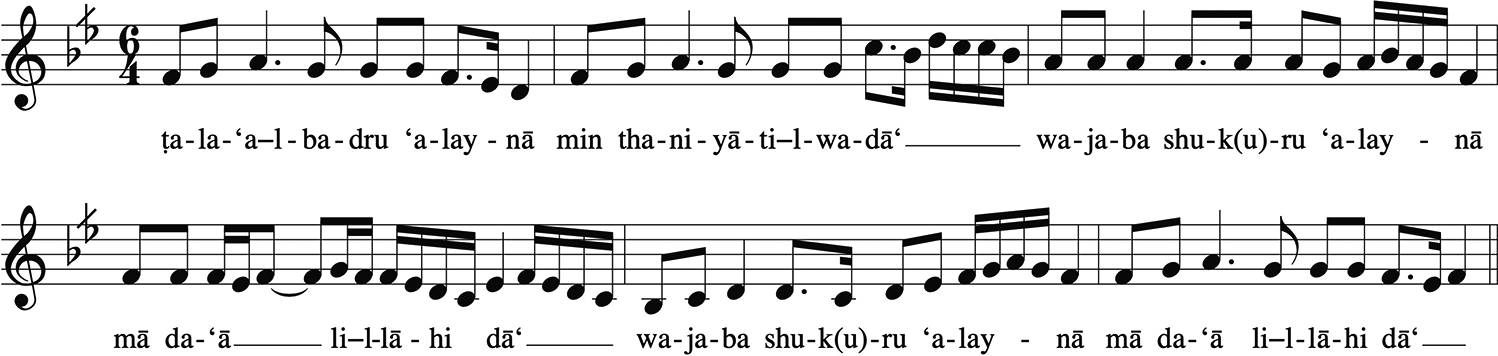
Seeking understanding, I sat with Shaykh Bahlul and asked about his choices. He first admitted to me that “Ṭala‘a-l-badru ‘alaynā”—as conventionally sung, following the Gulf version in al-sīkāhFootnote 20—is technically not maluf. The Tunisian musicians had been right all along. But what they had not realised was that the same text is included in the Libyan maluf repertoire but in a musical mode other than al-sīkāh. Shaykh Bahlul had chosen the Gulf version of Maluf Slam because of its popularity with a largely non-Libyan audience. In Figure 4, both melodic versions of this song are given:

Gulf version in the mode of al-sīkāh. Transcribed from the Maluf Slam concert in Sfax, Tunisia (12 July 2019).

Libyan version in the mode of al-muḥayyar (Abu al-Arqub, interview, 14 July Reference Abu al-Arqub2019).
Texts and transcriptions of “Ṭala‘a-l-badru ‘alaynā.”

The fact that maluf musicians continue to set older texts to new melodies is not surprising. Contrafactum is a standard practice in textually rich musical traditions (Falck and Picker Reference Falck and Picker2001; Reynolds Reference Reynolds2021:181–2); and Philip Ciantar’s study of Libyan maluf clearly documents a similar process of exchange in how musicians create new text through adapting and substituting older texts (Reference Ciantar2012: 51–3). It is insightful how Shaykh Bahlul’s choices reveal a potentially more extensive repertoire in Libyan maluf than in Tunisia. Shaykh Bahlul explained that in Libya’s past, certain texts went through a process of acceptance by shaykh-s before they could be included in the maluf repertoire. This process had to do with checking a text against a criteria of “morality” (akhlāq). At times, they simply extracted certain words from the text that they considered immodest or amoral and replaced them with sanctioned words. At other times, they added an appropriate phrase at the beginning of a text, such as dedicating the song to Allāh or to the Prophet Muhammad. This discursive act sanctioned the entire text (interviews, 8 April Reference Abu al-Arqub2015, 14 July Reference Abu al-Arqub2019). In the case of “Ṭala‘a-l-badru ‘alaynā,” the text was already in an acceptable older form of Arabic poetry called qaṣīda, and the lyrics purportedly described an honourable topic—the joyous welcome of the Prophet Muhammad to Medina on 1 A.H. / 622 C.E. So, despite the fact that the text originated from the Gulf region, the style and content of the text was consistent with a morality espoused by Libyan Islamic leaders. The text was included in the maluf repertoire and set to a new melody in a musical mode consistent with Libyan maluf (Reference Ciantar2012:50). Shaykh Bahlul used the term istibdāl or “replacement.” Social values determine textual replacement, and this creative process has enabled Libyan musicians to incorporate a variety of texts into their practice of maluf that are not included in the Tunisian maluf repertoire.
Additionally, for Shaykh Bahlul to pair “Ṭala‘a-l-badru ‘alaynā” with a call-and-response refrain that elicits Sufi ritual suggests that, in Libya, maluf is still associated with Sufi practices; whereas, in Tunisia, this association is not expected on public stages. Simply put, the disagreement in repertoire demonstrates that Libyan traditional maluf is closer to Sufi organizations today than the Tunisian tradition—a broad point somewhat evidenced in the literature. Tunisia’s prominent participation in the pivotal 1932 Cairo Congress on Arab Music and the subsequent founding of the secular Rashidiyya Institute in 1934 to transmit and preserve Tunisian maluf music, effectively drew a version of maluf out of and away from Sufi organizations (Davis Reference Davis1997; Mustaysir Reference al-Mustaysir2014). The suppression of most Sufi organizations in Tunisia immediately after independence in 1956 contributed to further devitalizing maluf from these organizations, especially in the capital Tunis (Jones Reference Jones, Danielson, Marcus and Reynolds2002:521). Looking back, modern social forces in Tunisia remade maluf into a staged, notated, standardised, and relatively homogenous tradition across the country and foregrounded this type of secularised maluf publicly.
But Libyan history diverges markedly on these points. Libya was the only North African country not to attend the 1932 Congress, due to Italian colonial fascists occupying their land at the time and not to a lack of musical expertise and virtuosity (Mahdi Reference Mahdi1978:11; Ciantar Reference Ciantar2012:72). And the post-1932 momentum that spurred the creation of secular institutes such as the Rashidiyya in Tunis did not occur in Libya until the late 1970s (Ciantar Reference Ciantar2012:22). Shaykh Bahlul’s insistence on not separating maluf from its Sufi roots tells an alternative story of modern maluf in Libya—one that maintains maluf’s associations with Sufism, despite opposition to Sufi organizations from Libyan governmental authorities in the 1980s (Ciantar Reference Ciantar2012:46–7). Maluf Slam demonstrated the sustained importance that Libyan maluf masters still place on the connection between maluf and Sufism—a connection that seemed lost on the Tunisian participants of the Collaborative. This point of difference in maluf’s shared history between the nation-states of Algeria, Tunisia, and Libya deserves a great deal of further investigation. But at the least, the persistence of the Libyan munshidīn to publicly maintain maluf’s links to Sufism gestures to a wide ideological gap within maluf’s transnational practices, even as that connectedness is celebrated on festival stages.
Closing Remarks
The Maluf Slam Collaborative was an artistic collective whose planning and execution took the good part of one year. Each participant, leader, and stakeholder acted in their own capacities for the common objective of exploring the shared, transnational musical tradition of maluf between Tunisia and Libya. What can be gleaned by attending to the movement of musical objects across spaces and times within transnational music traditions? How might these insights reorient understandings of the people and the places that cultivate them?
Unique to the transnational framing in this article is the fact that the case study has to do with a music tradition shared across near borders—a relatively smaller scale of mobility. Maluf, as a shared musical tradition across eastern Algeria, Tunisia, and Libya, presents an opportunity to investigate how shared traditions within various nation-states maintain commonality even as they diverge and become distinct. Multidirectional cultural movement can overlap and parallel. In the case of Maluf Slam, the very structures of the music—called the ṭubū‘ and/or maqāmāt—enabled social cohesion and cultural play, a point that is not readily apparent in the literature on musical modes. Beyond the notations and scales, musical modes are capable and effective materials to connect people across time and place. Emphasizing this type of connective flow through musical practice shows how people conceptualise expressive culture rigorously to support the work of making meaning with others. It is a harnessing or channelling of an object’s mobility for creating and maintaining socialities. The musical modes of maluf provided both musical and social cohesion for the Tunisian and Libyan musicians. The seemingly impermeable geographies of the nation-state were destabilised and superseded in moments of Maluf Slam by such actions and valuations.
But these events also reveal the complexities of mobile objects within shared traditions. The connectedness fostered by the musical modes, for example, did not hide the fact that in their use of nuanced discourse, the Tunisian and Libyan musicians had differing genealogies of transmission and education which, in turn, produced various understandings of identity. Indexing Sufism—or not—in Maluf Slam demonstrated a substantial difference that highlights the varied experiences of secularism and modernism that North Africans have experienced particularly across the 20th and 21st centuries.
The Maluf Slam Collaborative offers a glimpse into the inner workings of an old and valued music tradition, shared, now, across modern political boundaries. Nation-states have legitimated such traditions as valued expressions for their citizens; but in performance, these legitimacies are negotiated and reveal the materials and non-national structures that remain dynamic forces for the making of geographies. Attending to these spaces of difference and mutuality will continue to demonstrate the value and constraints of transnational traditions.
Acknowledgements
This research was supported by the American Institute of Maghrib Studies and the Chancellor’s Fellowship from the University of California in Santa Barbara. The author is grateful to each member of the Maluf Slam Collaborative for their committed involvement to this project and their inspiring artistry. The author also thanks Martha Sprigge for comments on an earlier version of this article, and two anonymous reviewers for their helpful suggestions.