


Colombia has been one of the Latin American countries in which right-wing political forces have been consistently strongest. A long history of armed conflict both thwarted the consolidation of left-leaning democratic forces and gave preeminence to ideologically centrist, pragmatic, and/or right-leaning politicians. Indeed, the twenty-first century has been one in which national politics has been dominated by representatives of the right and the center right, until the electoral victory of leftist Gustavo Petro who became president in 2022. The most important figure of the contemporary Colombian right, Álvaro Uribe, was a hugely popular president between 2002 and 2010 and went on to establish the most important right-wing party, the Centro Democrático (CD). Uribe was central to his defense minister and heir apparent, Juan Manuel Santos, winning the presidency in 2010, though Santos later turned his back on Uribe. Still a formidable force after the Santos presidency, the CD and Uribe’s blessing brought Ivan Duque to power for the period 2018–2022. Given the preeminence of the right, and in particular the crucial importance of Uribe and Uribismo as a political identity in Colombian politics until recently (Albarracín et al., Reference Albarracín, Gamboa, Milanese, Borges, Lloyd and Vommaro2024; Gamboa, Reference Gamboa2019), at first glance it might appear puzzling that a strong far right has not yet emerged as an organized force. This is in sharp contrast to other countries like Brazil and Chile where the contemporary far right has gained prominence with good electoral performances, varying levels of organization, and even presidential victories.
Is there a far right in Colombia? To what extent are far-right ideas present in Colombian politics today, and what are their prospects going forward? Given the internal conflict, a militaristic and anti-guerrilla right has been historically strong and dominant in Colombia. At the same time, cultural and socioeconomic issues that have been politicized in other countries by a radicalized right have not dominated the national political agenda. Instead, many such issues have been discussed in the judicial arena – particularly through the Constitutional Court’s progressive rulings. Presently, Colombia lacks an organized far-right party, but this should not be taken to mean that far-right ideas are not relevant to understanding present and future political dynamics. We rely on the framework presented in the introductory chapter of this volume to analyze the extent to which contemporary far-right ideas are espoused by key figures in the Colombian political elite.
In the first section we introduce the outlines and ideological concerns of the Colombian right, as necessary context. In the second and third sections we analyze the speeches, interviews, and social media presence of two key figures in recent right-wing electoral politics, Álvaro Uribe and Rodolfo Hernández, to explore the extent to which they can be understood as exponents of the contemporary far right. Former president Uribe is the waning patriarch and Hernández was the wild-card presidential candidate in whom right-wing forces invested their hopes to beat leftist Petro in 2022. We argue that neither should be understood as exponents of the contemporary far right, though – as we will show – some far-right ideas can be identified in their discourse at different points, with varying degrees of coherence. The seeds of the contemporary far right are to be found elsewhere: in leaders embedded among established parties and emerging in their shade.
In the fourth section we focus on the ideas and discourse of Colombia’s most prominent far-right politician: Maria Fernanda Cabal. Cabal, senator (2022–2026) for the CD political party, is a key personality in regional far-right circles. Domestically, she straddles two worlds: a personal brand that emphasizes her radicalism and deliberately reaches out to Latin American and Hispanic far-right networks, while being part of a political party which is not far right “in the contemporary sense.” We explore the evolution of Cabal’s discourse as a congress member, and identify an inflection point toward greater radicalization and moral conservatism starting in 2020, coinciding with her more active involvement in international far-right networks. In closing, we analyze the prospects of the Colombian far right in light of current political dynamics, the fragmented nature of the party system, and the dynamics of the 2026 presidential campaign.
As this book shows, the contemporary far right in Latin America has some important commonalities with far-right forces in other regions, but also its own distinctive characteristics. The case of Colombia is interesting because, though no formal far-right electoral vehicle exists at present, the right has been historically strong, and, for example, former president Alvaro Uribe led the way for the punitivist approach that the regional contemporary far right so strongly favors. At the same time, Uribe himself does not neatly fit the contemporary far-right label: he does not deny climate change, he is not anti-immigration, and moral conservatism (though sometimes present in his discourse, especially in recent years) has not been at the center of his concerns. Cabal, the Colombian politician that most neatly fits the label of Latin American far right, is fueled in no small part by the visibility and ideas provided to her by a dense network of international connections with like-minded figures. The human and organizational ties binding and driving the spread of far-right ideas in Latin America seems a particularly important dimension. We should keep in mind both domestic and transnational dynamics as we seek to understand the evolution of the radical right.
8.1 The Colombian Right’s Midlife Crisis
In Colombian politics today, two forces can be seen as exemplifying the two ideological opposites of the spectrum: to the left, the Pacto Histórico, a young left-wing coalition of parties and grassroots movements led by current president, Gustavo Petro, and to the right, the CD, an established political party led by the former president, Uribe. We begin by describing the ideas and players that are central to the Colombian right, to better understand the context. There are, surely, other political parties aside from the CD which can be located to the right – including the Partido Conservador, Movimiento Independiente de Renovación Absoluta (MIRA), Colombia Justa y Libres (see Montilla et al., Reference Montilla, Liendo, Barrero, Barrero and Richard2020) – but Uribe and his party have been the pivot and the purveyors of ideological coherence at the national level.
Colombia’s decades-old civil war included several armed leftist guerrillas, which not only hindered the consolidation of a democratic left – until recently – but also configured right-wing forces whose main distinguishing feature from the center and the center left was the opposition to any negotiation with these armed actors. Uribismo and the CD built and thrived on that division, which lent the Colombian right some particularities when compared to other Latin American countries, as the cleavage was not rooted in socioeconomic or cultural inequality but rather in a hawkish approach to the internal conflict (the stance defended and built up by Uribismo) against those who favored negotiations with the armed guerrillas (the approach that centrist leaders from traditional parties and the incipient center left advocated). Until recently, the right’s ideological message has been unified and consistent. Wills Otero (Reference Wills Otero, Luna and Rovira Kaltwasser2014) summarizes the key ideas of that message as follows: a militaristic, confrontational, and warlike discourse that prioritized security, coupled with a welfarist social approach. Gutiérez Sanin (2020) also highlights the decided emphasis on militarized security, and on building trust and security for business and investors.
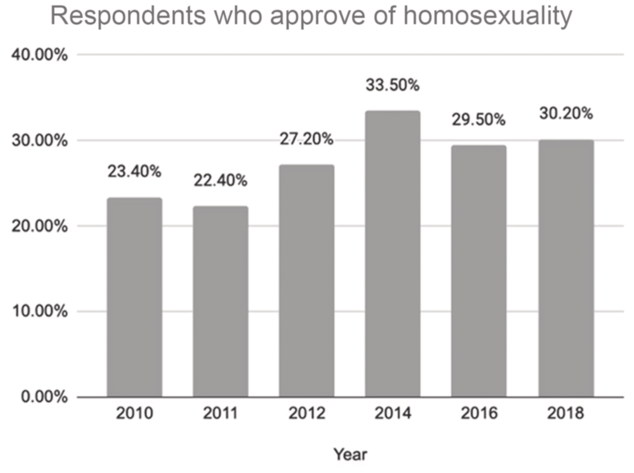
The lack of overtly leftist governments meant that the right did not have to resort to rejecting progressive government reforms as their electoral strategy, at least until Petro’s victory in 2022. In other words, Colombia is not a case in which the radicalization of the right might be explained as a backlash to leftist cultural or economic policies. Interestingly, Colombia’s comparatively progressive legal framework guaranteeing access to abortion, LGBTQ+ rights, and generous enforcement of socioeconomic rights is associated with the liberal jurisprudence of its Constitutional Court. The Court itself has suffered backlash for its activist profile, and certainly these issues have at times been the subject of strong controversy and organized attempts to punish the Court and roll back its progressive rulings (Botero, Reference Botero, Falleti and Parrado2018). However, it is worth noting that, for example, a majority of Colombians support abortion rights and, as Figure 8.1 (Panel A) shows, the proportion has only increased in recent years. The country is much more conservative with regard to attitudes toward the LGBTQ+ population, though overall those numbers have also improved in recent years (see Figure 8.1, Panel B). In any case, the judicial route for the expansion of those rights, and the continued relevance of the internal conflict and its associated violence, meant that the politicization of cultural issues, while not absent, has not been at center stage of party politics and national electoral politics.
Percentage who justify abortion and percentage who approve of homosexuality in Colombia
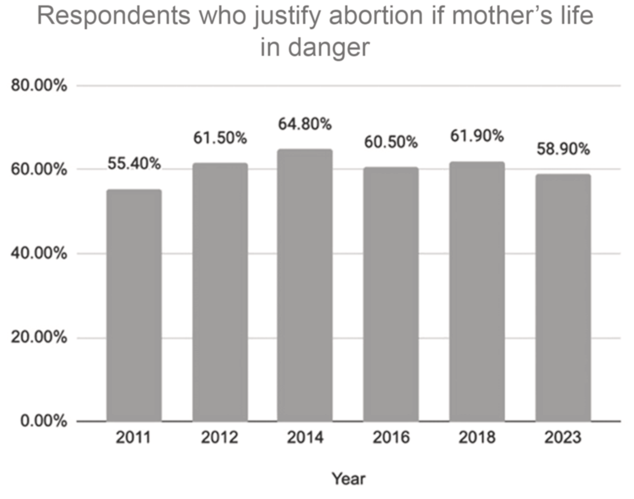
Figure 8.1a Long description
The chart displays the percentage of respondents who justify abortion when the mother's life is in danger. It reveals significant fluctuation in approval for life-saving abortion. Support began at 55.40% in 2011, which follows 61.50% in 2012, 64.80% in 2014, 60.50% in 2016, 61.90% in 2018, and 58.90% in 2023. This represents a notable increase, despite some intermediate decreases.
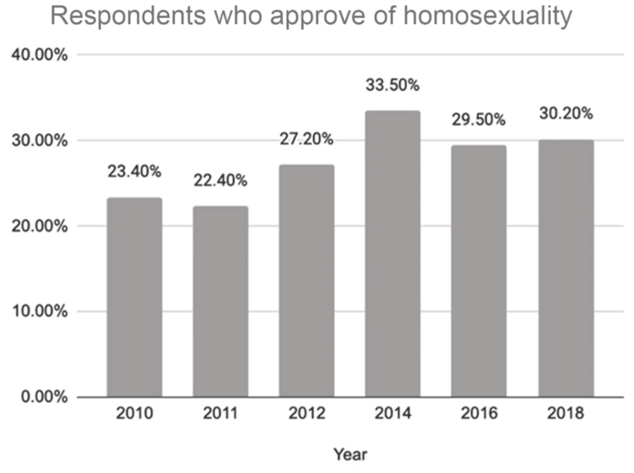
Figure 8.1b Long description
The chart shows the percentage who approve of homosexuality. It shows a more positive trend for LGBTQ+ acceptance. Approval of homosexuality started at 23.40% in 2010, dropped to 22.40% in 2011, gradually increased to 27.20% in 2012, and to 33.50% in 2014, then declined to 29.50% in 2016 and to 30.20% in 2018. Overall, this reflects a net increase of nearly 8 percentage points in approval over the surveyed period.
Starting around 2020, it became clear that the Colombian right was undergoing a midlife crisis as Uribismo – once its defining political identity and binding agent – and the CD – its organizational muscle – have both weakened. The old focus on a militarized approach to the internal conflict, which used to articulate the CD’s program and dominated their messaging, showed signs of having worn too thin following President Santos’ successful peace negotiations with the Fuerzas Armadas Revolucionarias de Colombia (FARC). The demobilization of this guerrilla in 2016 created more political space for left-leaning political actors, eliminated the FARC as the main enemy, and allowed for redistributive and social justice concerns to emerge in political debates, ultimately leading to the election of Colombia’s first leftist and progressive president, Petro (Botero et al., Reference Botero, García-Montoya, Otero-Bahamón and Londoño-Mendez2023). Thus, when the FARC ceased to exist formally, the right’s main physical and ideological foe all but vanished.Footnote 1 Though some might have predicted that the FARC’s transformation into a political party after their demobilization would have meant that the communist scare remained relevant, the reality is that as a political party, the FARC (now known as Partido Comunes) is extremely small, faced considerable difficulties appealing to the Colombian public or fostering new leaderships, and failed to consolidate its own electoral base (Rettberg & Martínez, Reference Rettberg and Martínez2023).
Additionally, during the government of Iván Duque (2018–2022), Uribe’s heir, there was an increase in organized violence in urban and rural areas, which evidenced a difficulty for the right wing to respond to the new dynamics of crime and violence. Faced with profound changes in the electorate’s priorities and leftist forces consolidating under Petro’s leadership, right-wing parties struggled mightily to adjust their messaging and strategy to this new reality in which security challenges remain, but the old messaging frames focusing exclusively on the guerrilla threat were (and remain) insufficient to Colombian voters.
In terms of the party itself, the CD’s process of institutionalization brought its own challenges. Over the years, in order to grow, the party sacrificed ideological coherence (Gutiérrez Sanín, Reference Gutiérrez Sanín2020), broadened its message, and saw its electoral base shrink (Albarracín et al., Reference Albarracín, Gamboa, Milanese, Borges, Lloyd and Vommaro2024). More recently, key figures within the party vie for control as Uribe’s popularity decreases and right-wing leaders emerge outside the CD’s own fold. Once upon a time the CD reigned supreme and was virtually synonymous with Colombia’s right. Starting in 2020, Uribe and the CD’s leadership continue to be important, but right-wing forces have fragmented, and new leaders emerge.
8.2 Álvaro Uribe: The Waning Patriarch
Although the contemporary far right does not have its own electoral vehicle in Colombia, certain political figures have played at different times with ideas and elements of the contemporary far right in Latin America, as defined by Rovira Kaltwasser in this volume. In this section we analyze the relationship between the patriarch of the Colombian right, Álvaro Uribe, Uribismo, and far-right ideas. We show that though Uribe has defended and espoused some ideas that are key to the right and to the contemporary far right – namely, his mano dura (hawkish) stance and illiberal attitudes toward democracy. However, unlike more straightforward far-right contemporaries such as Javier Milei, Jair Bolsonaro, or José Antonio Kast, Uribe cannot be fully understood as a full-fledged contemporary far-right politician, particularly because one of the key shared characteristics of such parties and figures in Latin America is their moral conservatism, which was not central to Uribe’s discourse historically and has only begun to center it in recent years. To better understand Uribe’s importance and the evolution of his discourse, we need to analyze it over time.
As the defining figurehead of the contemporary Colombian right, Uribe’s political trajectory and his discourse can be broken down into three periods: presidency (2002–2010), opposition senator (2014–2018), and the latest phase in which he plays the role of a backstage advisor and is less prominent, though not totally absent, from the public arena (2021–2025).
Starting with his first presidential bid in 2002, in which Uribe became a national figure running for the presidency on an outsider platform (deftly distancing himself from his prior membership of the Liberal Party), the hallmark of his politics was quickly apparent: a defense of a mano dura approach to Colombia’s internal conflict. In his staunch defense of the military and his punitivist discourse, Uribe was in many ways the precursor of present-day mano dura politicians throughout the region.
Although previous presidents used authoritarian security policies to try to rein in the growing internal conflict, Uribe’s government was the first to focus so heavily on the armed forces and on a military victory against guerrillas, both in discourse and in policies. His first presidential campaign and presidency revolved around a single main political goal: “to defeat through military force outlawed armed groups and to recover the legitimate monopoly on the use of force for the government,” as Wills Otero (Reference Wills Otero, Luna and Rovira Kaltwasser2014, p. 206) sums it up. His first government plan read: “The President shall direct public order as befits a democratic society in which the public force respects the popularly elected rulers. In the Presidency I will be the first soldier of the Nation, dedicated day and night to recover the tranquility of all Colombians.”Footnote 2 The public policy that materialized these goals, known as seguridad democrática (democratic security), intensified military action against guerrillas and decimated the FARC but also resulted in grave human rights violations, ranging from illegal wiretapping of Supreme Court justices to extrajudicial killings of citizens who were wrongly presented by the armed forces as neutralized guerrilla fighters in order to increase body counts.
The dramatic rise in violence in the last decade of the twentieth century created an internal crisis and facilitated Uribe’s rise to power. The internal conflict included confrontations between and among left-wing guerrillas, paramilitary forces, drug cartels, and military forces, with innocent civilians bearing the worst part. Uribe’s discourse emphasized the need for military victory over guerrillas and singled them out as enemies of the whole nation. Starting from his own experience with the FARC – his father was killed by this guerrilla in 1983 – Uribe often connects with audiences by making the case that he suffered the same way many Colombians suffered: “I grew up in the coffee-growing region of Antioquia, I opened my eyes to the world in the midst of that political violence, and I have lived through so much violence in the Colombian countryside.”Footnote 3
Uribe’s staunch defense of the military connects with a specific tradition of right-wing politics in Colombia present to this day: anti-communism, or, in Uribe’s own term, the rejection of “Castro-Chavismo.” Anti-communism is part of the historical bloodline of the Colombian right, one that intensified during the Cold War (Trejos Rosero, Reference Trejos Rosero2011). The anti-communist doctrine was central during his presidency: Uribe argued that guerrillas lacked political legitimacy, and he stressed that Colombia was fighting “narco-terrorism,” not undergoing a civil war. His rejection of communist guerrillas linked with his condemnation of Castro-Chavismo when he was elected to the Senate in 2014, and again in 2018, thus becoming the leader of the opposition to President Santos.
In 2013, Uribe founded the CD, a political party built around defending his legacy, and one that would go on to be very successful. Senator Uribe and the CD focused their messaging and campaigning on opposing the government by attacking the peace negotiations with the FARC, relying on rhetoric that directly alluded to Castro-Chavista tropes like the need to prevent “the country from being handed over to Castro-Chavismo and becoming a replica of Maduro’s tyranny.”Footnote 4 During the massive wave of protests that started in late 2019, in keeping with this anti-communist tradition, in a November 15 tweet Uribe referred to protesters as vandals sent by Maduro.
Uribe’s resolute support of the armed forces never wavered, despite proven links between members of the military and paramilitary forces resulting in human rights violations like those in the Operación Orión (Operation Orion) carried out in Medellín in October 2002. Orion stands as the biggest urban military operation in Colombia’s history; it was intended to strike and weaken the guerrillas’ control of Comuna 13, on the city’s outskirts. The operation was carried out jointly by army units and police special forces, and it involved coordination between the national government and the mayor’s office. According to paramilitary chief “Don Berna,” paramilitary units collaborated with government agents in this operation: they participated in raids and acted as informants, providing information that was used to accuse civilians of being guerrilla collaborators.Footnote 5 Inhabitants of Comuna 13 were tortured to obtain intelligence, illegally detained, or disappeared.Footnote 6 When faced with criticisms about this operation during a press conference, Uribe in turn accused his critics of “never criticizing terrorist groups in Medellín, but rather criticizing Operación Orión.”Footnote 7
Cas Mudde (Reference Mudde2019) argues that one characteristic that clearly distinguishes parties and leaders that are part of the extreme right in Europe is their antidemocratic stance. In contemporary Latin America, some radical leaders at both extremes of the ideological spectrum have exhibited an utter lack of democratic commitment: Maduro and Ortega preside over authoritarian Venezuela and Nicaragua, but the region has also witnessed a long string of right-wing military dictatorships, so this characteristic is less useful as a benchmark. As president, Uribe himself sent mixed signals with regard to his democratic commitment. In Uribe’s first government program, we find no overt attacks on democratic foundations. Some of his words and actions while in office indicate otherwise: many consider his referendum initiative to cut the size of Congress an attack on that institution. As president, his discourse straddled democratic and anti-democratic rhetoric; the latter was evident in his forceful verbal attacks on members of the opposition and his insistence on Colombia striving toward becoming an “Estado de opinión.” In his view, “Estado de Opinión” was a more advanced stage of the “Estado de derecho” (rule of law) in that public opinion (majoritarianism) stood beyond and above the judiciary and many democratic institutions (Montoya Brand, Reference Montoya Brand2010). Beyond rhetoric, Uribe engaged in a number of practices during his presidency that indicate that he had authoritarian and illiberal tendencies, including wiretapping justices and verbally and forcefully attacking the judiciary (Gamboa, Reference Gamboa2022). At the same time, Uribe had a major moment of democratic restraint when, after trying to push through a referendum that would have allowed him to run for a second reelection, he respected the Constitutional Court’s ruling declaring the referendum unconstitutional and effectively barring him from seeking a third term. As a senator, and in recent years, Uribe has carefully played up his democratic credentials, rejecting the far-right label and explicitly clarifying that he defends democracy.Footnote 8
The latest stage in Uribe’s public trajectory began in 2020 when he resigned from the Senate. He quit when the Supreme Court of Justice ordered his detention as part of a legal inquiry that had started in 2012 in which he was accused of witness tampering. The resignation sought to avoid the former president being investigated by that tribunal, which has jurisdiction over lawmakers, and instead transfer his process to the Fiscalía (Attorney General’s Office), which at that time was headed by someone friendly to him. Aside from the advancement of that legal process – which began to suggest there was evidence to indicate Uribe could have been implicated in wrongdoingFootnote 9 – the stormy and unpopular ending of his protege Duque’s presidency was another reason for Uribe to have maintained a low profile. After being the defining figure of Colombian politics for decades, the great patriarch began to lose wider appeal. In 2022 Uribe hit his lowest approval ratings since 1996 with a mere 19 percent. Throughout 2023, the first year of Petro’s government, he played a loyal and democratic opposition role, stating that he did not want to “polarize” the country and promising to “work to contribute to make Petro’s government a government of social democracy.”Footnote 10 Meanwhile, the CD lost electoral clout. For example, from having the largest groups of senators with thirty-two seats in 2018, in the 2022 elections the party won only half that number of seats (sixteen). Within the party, infighting grew.
Uribe’s waning years coincided with the growing domestic and regional backlash against minority rights, particularly LGBTQ+ rights. Some important figures in the CD (for example, Senator Maria Fernanda Cabal, see Section 8.4 below) and in other right-wing parties openly cater to precisely the sociocultural far-right issues, such as opposition to abortion and LGBTQ+ rights, which Uribe never placed at the center of his political agenda while he was president or senator. While not a sexual diversity champion himself, at landmark moments such as the Constitutional Court ruling that legalized same-sex unions, Uribe opted for a middle path, declaring that “[while] in the name of respect for intimacy, the homosexual couple relationship must be respected, [the Court should have] found a way to respect homosexual intimacy without equating these couples to heterosexual marriage.”Footnote 11 At the same time, Uribe himself has occasionally used the rhetoric of gender ideology for electoral purposes, particularly in recent years. Also in 2016, he was a key figure in the campaign led by the CD urging people to vote no on the plebiscite to approve the Havana Peace Accords (Botero, Reference Botero2017). In some areas of the country, part of the strategy to stir the No vote was to claim that the gender perspective in the peace accords threatened traditional marriage and Colombia’s legal system (Corredor, Reference Corredor, Payne, Zulver and Escoffier2023). He argued on Twitter against “gender ideology” in sex-ed programs for children, citing the conservative mantra of keeping kids’ education in the hands of parents, not the state.Footnote 12
Yet Uribe has not, thus far, consistently expressed the vitriolic hate of sexual minorities that has fueled openly homophobic politicians in other countries in which US “culture wars” and radicalization on sociocultural issues have completely taken hold of the political agenda. He was and remains a punitivist, an anti-communist, and a staunch defender of the military – a combination that justified some of the worst human rights violations and illiberal actions during his presidency. Clearly Uribe held and still holds radical right-wing views, but the lack of a nativist component to his discourse, the fact that anti-LGBTQ+ issues are not his linchpin and the very wide coalition he built with ideologically diverse politicians make his classification as far right in the contemporary sense of the term murky. Uribe did not and does not at present follow the radical-right playbook that fuels Bolsonaro, Kast, or Abascal. That niche belongs to other leaders within and adjacent to the CD. In this, Uribe (and Uribismo) resemble Fujimori (and Fujimorismo) in Perú (see Meléndez, Reference Meléndez, Luna and Rovira Kaltwasser2014): both leaders and their supporters built a discourse that solidified the right in their respective countries in contexts of internal conflict, which does not automatically make them an integral part of the contemporary far right.
8.3 Rodolfo Hernández
The 2022 presidential race brought Rodolfo Hernández, the runner up against Gustavo Petro, briefly to the center stage of Colombian politics. In stark contrast to presidential races in other Latin American countries such as Argentina’s in 2023 or Brazil’s in 2022, the far right did not figure prominently in the 2022 Colombian race. A common mistake was to label Hernández as a representative of the far right. As we will show in this section, calling him the “tropical Trump” is catchy, but misleading. As a presidential candidate Hernández did not turn to politicizing the themes that are central to other far-right leaders in Latin America. Once the presidential race was over, he vanished from politics. Many hoped he would use his electoral capital to organize the opposition to Petro’s government. Instead, he stepped aside from public life until his death from cancer in late 2024.
When the campaign for the presidential election began in earnest in January 2022, Rodolfo Hernández was relatively unknown, at least on the national level. Hernández had a long trajectory as a successful construction businessman and was famous in the Santander department (where he had been mayor of the capital city, Bucaramanga, between 2016 and 2019) but he had held no other elected or public office, nor was he backed by any political party. Known as the King of Tik Tok, he ran an extremely successful and small-scale campaign that relied heavily on WhatsApp and social media (Piñeiro-Rodriguez et al., 2024) and a simple anti-corruption message: “no stealing, no lying, no betraying.” As Barrenechea and Otero-Bahamón (Reference Barrenechea, Otero-Bahamón, Petro and Hernández2023) argue, the newcomer populist–who lacked a fully formed program of government – successfully appealed to voters on the right but also to a wide cross-section of centrists and undecideds who were anti-establishment and ready for change, just not Petro’s leftist brand of change. Within a matter of weeks, he rose meteorically in the polls and came second in the first round of voting in May 2022, leaving in his wake a trail of hopefuls, many of whom were renowned and experienced career politicians.
Hernández was often perceived as a right-wing candidate, which is inaccurate. When he became Petro’s sole opponent as the presidential race headed to the runoff, Hernández also became, by default, the right’s preferred choice, which is a different matter. Upon making it to the runoff, he was quickly claimed by the candidate of the center-right coalition, Federico Gutiérrez, and by most high-profile leaders and congress members of the right, as the ideal choice for the presidency. Note that Hernández explicitly stated that he did not accept any alliances or endorsements: the day after the first round he announced on social media: “I am grateful for the support anyone is willing to offer, but my only alliance is with the Colombian people.” That same day, he had a viral Twitter thread that began: “Don’t be fooled: here are twenty ways in which I am different from Uribismo.” The thread included references to respecting LGBTQ+ rights, the right to protest, and support for the legalization of marihuana. Furthermore, as we saw previously, the defining feature of the Colombian right is its hawkish stance with regard to the solution to the armed conflict. In contrast, Hernández openly supported the peace agreement in his program, a position in which he was consistent across interviews and social media posts. Support for a military solution to the armed conflict figured nowhere in any of his communications.
Indeed, Hernández was hard to locate in the left–right ideological spectrum, or as a defender of any other thick ideology. He is better understood as a pure populist, without an accompanying thick ideology that gave content to his anti-corruption discourse (Zanotti & Botero, Reference Zanotti and Botero2023). His central message revolved around criticizing politicians as corrupt and politiqueros and presenting himself as the person who stood ready to balance the checkbook, implement austerity, and stop the stealing. Corruption was the single most common theme in all his interventions and social media (Gamboa et al., Reference Gamboa, Botero and Zanotti2024). A review of his (thin) program and few interviews suggests an eclectic mix of positions and often underspecified policy proposals which, as a whole, did not fall squarely in the right or the left.
Another fact that contributed to Hernandez sometimes being wrongly perceived as a right-wing politician, and more specifically as far right, were the too common and misleading comparisons between him and Donald Trump. The catchy “Tropical Trump” moniker was an easy shortcut that many, especially the international press, used during the last stretch of the campaign to try to make sense of a duel between two anti-establishment populists, Petro and Hernández, that few analysts foresaw. As Zanotti and Botero (Reference Zanotti and Botero2023) show, this comparison to Trump is misleading: though they are both populists and share some background characteristics, where Trump’s nativism makes him a good example of populist radical right, nativism was not central to Rodolfo Hernández’s project. The politicization of migrant minorities has not been that common in contemporary Latin America as it is usually indigenous and other minorities (like LGBTQ+) who are othered (Zanotti & Roberts, Reference Zanotti and Roberts2021). In Colombia, nativism of the contemporary variety would entail stigmatizing Venezuelan migrants in particular. When he was mayor of Bucaramanga, Hernández made news with xenophobic remarks with regard to Venezuelan migrant women.Footnote 13 However, nowhere in his proposed program of government or throughout his presidential campaign did he stoke fears of massive migration waves, claimed that he would work to stop the migrant influx, or presented migrants as dangerous. If anything, he was open in his wish to reestablish diplomatic relations with Venezuela, which President Duque had ended.
Moreover, there is no evidence that Hernández’s political project included opposing minority rights, in particular, LGBTQ+ rights. Indeed, in his program Hernández spoke favorably of defending the rights of this group and he went out of his way to clearly and decidedly present himself as an LGBTQ+ ally during the campaign. On June 2, 2022, for example, he tweeted: “This pride month I want you to rest assured that in my government the rights of the LGBTQ+ community will be guaranteed. There is no possibility of unity while discrimination persists.”
Though Hernández cannot be accurately classified as right or radical right, in our review of his presidential campaign interventions and materials we identified occasional references to Castro-Chavismo, especially as election day neared. Though rare, we document this for transparency. In the final two weeks of the campaign, when Petro and Hernández were neck and neck in most polls, Hernández began to refer to Petro as Castro-Chavista, a turn of phrase that was new to the campaign and stood in contrast with his declarations prior to the first round of voting, according to which he would vote for Petro if he did not make it to the run-off himself. The Castro-Chavista accusations were made in a televised interview with Jaime Bayly, filmed in Miami just a few days before the election.Footnote 14 It is worth mentioning that these remarks stand in isolation from the usual tone of the campaign, in which he attacked Petro, but did not turn to the Castro-Chavista claim.
Hernandez’s rise to national politics was as meteoric as it was fleeting. After taking the presidential campaign by storm, winning over 10 million votes, and occupying the Senate seat offered to runners-up in the presidential election, many expected Hernandez to step up as opposition leader and use the electoral momentum to strengthen his political movement. Instead, he quit the Senate just two months into the new congressional term. After the presidential elections, Hernández did not devote any effort to buttressing his political movement or choosing and publicly anointing a political heir. His health declined as he faced corruption charges and withdrew from public life. He died of cancer in late 2024, without even attempting to capitalize on the millions of votes that almost won him the presidency.
8.4 Seeds of the Far Right: Maria Fernanda Cabal and Company
Though the contemporary far right has not yet come to be a political force with national reach in Colombia, some far-right ideas and leaders can be found. Enrique Gómez, heir of one of the most conservative families and leader of the small Movimiento de Salvación Nacional (National Salvation Movement), with confessed affinity for the international far right, was a presidential hopeful in 2022, and was elected to the Senate in early 2026. In the 2023 regional elections, pastor Jaime Andrés Beltrán was elected mayor after branding himself “Bucaramanga’s Bukele,” tough on crime and denouncing gender ideology. The far-right figure with the greatest national projection is Senator María Fernanda Cabal of the CD party. Cabal is a frequent participant in regional far-right circles but, in domestic terms, her status is mixed, since she is part of a political party, the CD, which is not far right.
Born into a landowning family in the city of Cali, Cabal’s early political career took off alongside that of her husband, José Félix Lafaurie, a leader of the national cattle rancher association (Federación Colombiana de Ganaderos, FEDEGAN). She worked in the Attorney General’s Office as director of international affairs, appointed by Mario Iguarán, attorney general during the presidency of Álvaro Uribe. She resigned from this position after publicly questioning a prosecutor’s decision to link sixty-nine military personnel to the investigation of the massacre perpetrated by paramilitaries in the village of San José de Apartadó.Footnote 15 After leaving the Attorney General’s Office, Cabal created the Colombia Ganadera Foundation (FUNDAGAN), the social arm of FEDEGAN. In 2014, she was elected to the House of Representatives for Bogotá, running for the CD, at that time a new party. According to journalist Laura Ardila,Footnote 16 Uribe had offered Lafaurie a spot on the party’s list to the Senate, but Lafaurie proposed that his wife, who wanted to enter electoral politics, take it in his stead. Cabal was not satisfied with being placed in the twenty-seventh slot on the Senate list, and she took on the challenge of leading the list for the House of Representatives for Bogotá. She won. Since entering electoral politics, Cabal has been one of the most radical figures of the CD. We reviewed her Twitter (now X) profile, her legislative bills, and public interviews: we find – particularly starting in 2020 – evidence of strong affinity with the Iberian and Latin American far right. Cabal herself has linked her success to connecting with people who support her for “saying things in public which they themselves do not dare [to say].”Footnote 17
From early on in her political career, Cabal has presented herself as an heir and defender of Uribismo, capitalism, emphasizing punitivism, support for the armed forces, and the “iron fist” approach of the former president Uribe. For example, in 2016, during a public forum in the context of the campaign that her party led to promote the No vote in the plebiscite to ratify the Peace Agreement with the FARC, she stated “the Army are not pink ladies, the Army is a lethal combat force that goes in to kill. It does not go in to ask questions.”Footnote 18 She is also a determined advocate of more expansive legal carry legislation – in Colombia, legal carry of weapons for civilians is limited to handguns with strict permits.
She has also stood out as explicitly anti-left from the beginning of her career. When she was a representative to the House, she made headlines for posting on Twitter, following the death of writer Gabriel García Márquez, that he was “in hell” given his closeness to Fidel Castro.Footnote 19 Statements such as “everything that the left touches, rots”Footnote 20 (Cabal, 2023a) are illustrative of her usual repertoire. In a public debate, Cabal equated citizen protests to a guerrilla attack financed by drug traffickers.Footnote 21 This is another recurrent strategy in her anti-left rhetoric: by associating the left with criminal actors, she delegitimizes it and denies it standing as a valid interlocutor. Like Uribe, and as is common in the contemporary far right, she often described Petro and his co-partisans as communists, using this word as an insult. For example, in late 2024, she derided the government for rising utility costs in Colombia’s Caribbean in her X profile by saying: “Inept communists. The only thing they are good at is promoting class warfare, hate, and resentment. Governing is not their strong suit.”Footnote 22
Another characteristic of Cabal’s political discourse throughout her career has been the revisionism of history associated with the Colombian armed conflict and her criticism of human rights. During the peace negotiations between the Santos government and the FARC, she harshly criticized these efforts for leading to a rewriting of history by the guerrillas. Likewise, she was critical of the institutions that emerged as a result of the Havana Peace Accords, describing the Truth Commission and the Special Jurisdiction for Peace as co-opted by Marxism and the extreme left. These criticisms of efforts to bring justice and memory to human rights abuses in Colombia share some common threads with criticisms that Javier Milei and Jair Bolsonaro have made of efforts to promote memory and justice following military dictatorships in their respective countries.
Moral conservatism is central to Cabal’s public discourse. Throughout her political career, she has attacked advances in rights and guarantees for the LGTBQ+ population and has been critical of gender ideology and what she calls “the gay lobby.” On several occasions the senator has clarified that she has nothing against homosexuals, but what bothers her ideological indoctrination indoctrination. In our review of interviews and on her social media profiles we find that she has opposed same-sex marriage from the start. In March 2014, for example, in a debate with other candidates to the House of Representatives, she stated that she was against the political participation of FARC members following their demobilization, against abortion, and against same-sex marriage. In her Twitter profile she clarified, in March of that same year, that “marriage is the basis of the family, a fundamental pillar of society. It cannot be equated with a homosexual union.”Footnote 23 More recently, in response to a campaign launched by the President’s Office to celebrate pride month in June 2023, she countered: “one does not celebrate diverse sexual tastes.”Footnote 24
Cabal has been making statements stigmatizing the LGBTQ+ population since she became a politician. In contrast, her skeptical stance on climate change – another common trait among Latin American far-right leaders – is more recent. For example, on her X profile, a platform in which she is very active, we only found mentions of climate change starting in 2022, the year Petro became president. Since environmental concerns are central to Petro’s political agenda, the rise in Cabal mentions of climate change are probably not a mere coincidence: it is likely that she found in this topic a strategic area in which to differentiate herself from him and criticize him. Without denying its existence, Cabal considers climate change part of a questionable agenda promoted by an international leftist minority, as she recently explained in an interview, where she also makes derogatory allusions to gender issues:
This [Petro’s presidency] is another Santos government, with a much more communist leftist bent, something that Santos does not care about, because Santos belongs to the Colombian revolutionary elite that enjoys sitting at the table with globalist meta-capitalist elite, a few families of madmen […] They sell us a lot of crazy talk of inclusive language … They sell us perversion … They normalize perversion … this is what are known as “modern degenerates.” They make the abnormal normal, but they do not do the same with their families […] It is the same 2030 agenda that pushes all those climate change theories that freak people out […] and then Colombia, which emits practically nothing, is practically schizophrenic.Footnote 25
For her, climate change is a secondary problem paid far too much attention by Petro’s government. Anti-immigration stances have also not been (so far, at least) central to her discourse. In her public appearances and social media, we found some very occasional allusions to Venezuelan illegal migrants, though, in general, the main theme was her calling for solidarity with the Venezuelan people facing a criminal dictatorship.
Cabal admires and draws inspiration from far-right leaders and movements in the Americas and Europe. She publicly praises Vox, Giorgia Meloni, José Antonio Kast, and Donald Trump. This is not just cheap talk: the senator has made decided efforts in recent years to connect with regional and Ibero-American far-right networks. In February 2020, Cabal joined the Foro Madrid, an international alliance of representatives and parties of the Hispanic far right. Foro Madrid is an initiative of the Disenso Foundation, a think tank created by Vox. Disenso has as one of its objectives promoting “coordination between personalities from Latin America and Spain for the development of projects and ideas.”Footnote 26 The founding document of the Foro is the “Madrid Charter,” a manifesto that delegitimizes left-wing governments in the Americas, declaring that they are “under the umbrella of the Cuban regime and initiatives such as the São Paulo Forum and the Puebla Group, which infiltrate the centers of power to impose their ideological agenda.”Footnote 27 Cabal is listed as a signatory of the manifesto alongside Milei and Kast.
Between 2021 and 2023, Vox invested €5 million in the Disenso foundation, which, as González (Reference González2023) explains, has been “a powerful platform for its [VOX’s] deployment in Latin America.” In February 2022, Senator Cabal represented the most radical wing of the CD at the first regional meeting of the Foro Madrid which took place in Bogotá, organized by VOX, with Javier Milei and Ernesto Araújo (Bolsonaro’s former minister of foreign relations) in attendance. In her interventions during the Bogotá event, Cabal spoke of social movements, from environmentalists to LGTBQ+, as follows: “When class struggle fails them […] and they realize that social classes are not agents of change, then they turn to the tribalization of society. [The turn] to embracing the gay, indigenous, black, environmental, and human rights movements as just causes and they pervert them, because everything about them is perverted.”Footnote 28
Following the Foro Madrid event, Cabal became an assiduous participant in regional far-right networking events. A few months after the Foro Madrid she was a guest of Eduardo Bolsonaro (Jair Bolsonaro’s son) in a virtual event streamed through multiple platforms. In March 2023, she visited the Peruvian Congress, invited by Fundación Disenso together with VOX deputy Rocío Monasterio and Hermann Tertsch, member of the European Parliament. In May 2023, she was invited by Santiago Abascal, leader of VOX, to give a speech during a campaign event in Guadalajara (Spain).
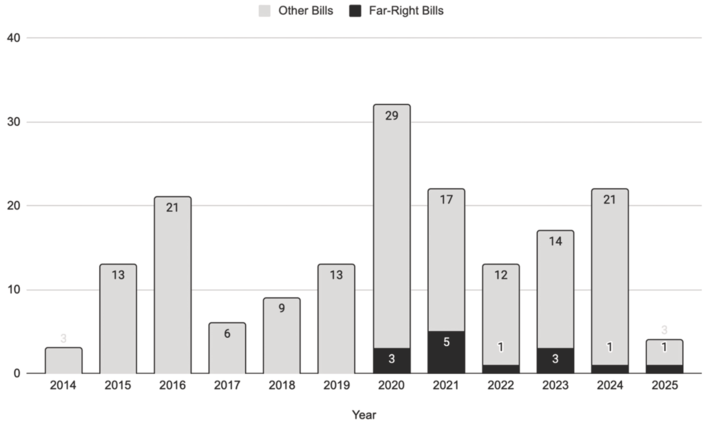
Cabal’s increased networking with regional and international far-right leaders and organizations since 2020 coincides with a shift in her discourse that brought her political messaging and her proposals closer to the topics that are near and dear to the Latin American far right. Certain topics have been important to her from the beginning of her career in Congress (punitivism, anti-communism) but other issues – particularly those associated with what Mayka and Smith (Reference Mayka and Smith2021) refer to as “sexuality politics” – have gained prominence in her repertoire more recently, coinciding with her increased networking with the far right. We can see this very clearly if we analyze her legislative proposals. Relying on Congreso Visible’s public database of legislative bills and their floor trajectories, we reviewed all the bills that Cabal has authored or coauthored since she entered Congress in 2014, and classified them according to themes (see Figure 8.2).
Bills authored or co-authored by Maria Fernanda Cabal (2014–2025).
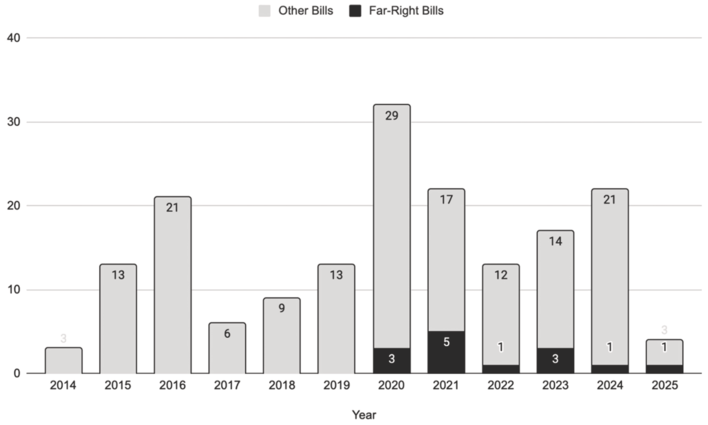
Figure 8.2 Long description
The horizontal axis of the bar chart represents the timeline, divided by legislative periods or years, while the vertical axis shows the quantity of bills proposed.
The chart displays her legislative activity patterns across different periods, revealing no far-right-themed bills produced between 2014 and 2019, and very few produced between 2020 and 2025. The values are 3 each in 2020 and 2023, 5 in 2021, and 1 each in 2022, 2024, and 2025. In contrast, other bills show a higher volume of production with the peak value of 29 in 2020.
During her time as a representative (2014–2018) and then as a senator (2018–2026), she has authored or coauthored 175 bills in total. In her decade in Congress, Cabal has penned fourteen bills individually. During this time, she has taken an interest in a wide range of topics, from cultural commemorations, promoting the agricultural sector, pensions, education, social security, to school lunches. We reviewed the content of all the Cabal bills, to ascertain when and with what insistence she proposed to legislate on topics that are close to those of the Latin American far right. We classified bills as far right if they touched on the following issues: moral conservatism, anti-migration, punitivism, climate denialism, anti-left, and/or aggressively pro-market. As Figure 8.2 shows, we can see that between 2014 and 2019 no bill that Cabal authored or signed qualifies thematically as aligning with the themes of the contemporary far right.
However, starting in 2020, there is a clear change, and these themes begin to appear in her legislative work (see black area in Figure 8.2). For example: In 2020 she proposed a bill to ban abortion (decriminalized in Colombia following a Constitutional Court rulingFootnote 29) and another one that would impose life sentences on those found guilty of femicide (the Colombian constitution forbids life sentences). In 2021 she introduced another life sentence bill, but this time as punishment for those convicted of corruption, and she also introduced a bill to expand legal carry. In 2023 two of her legislative initiatives aligned directly with similar initiatives against “gender ideology” in the United States: one bill sought to combat “child indoctrination” in public schools (directly referencing similar legislative efforts in more than eighteen state-level legislatures in the US) and another that would prohibit gender reassignment treatments and surgeries for minors. None of the fourteen bills we classified as far right were approved. Cabal began to put forth contemporary far-right ideas and proposals in Congress in 2020 – and that is also the year when, as we already discussed, Cabal began to appear more consistently in international forums and far-right events. If these trends are indicative, we can expect the supply of such initiatives and discourse to continue. Cabal’s active participation in regional and international far-right fora, her trajectory, as well as the growing alignment of her discourse with that of other regional far-right leaders make her, at least so far, the most prominent leader of the contemporary far right in Colombia.
8.5 Conclusion: Looking Ahead, What Future for the Colombian Far Right?
The future of the far right in Colombia is uncertain: at the time of writing there is no organized political party or movement. Maria Fernanda Cabal is the most seasoned and clearly identifiable far-right figure of national import, but she is part of a political party that is not fully far right and which she does not control. In the short and medium term, we see four possible paths for the Colombian far right: (1) far-right ideas and far-right politicians continue to come and go within and outside existing parties (as candidates, mayors, congress members, local politicians), but neither a far-right leader nor a far-right party consolidate as a dominant electoral force at the national level; (2) the CD transforms into a far-right party from within; (3) a new, distinct, far-right political party rises up; or (4) a far-right personalist leader emerges in national politics, outside the confines of an institutionalized electoral vehicle.
Before discussing these four paths, we want to highlight three key contextual features that shape them. First, the flexibility of Colombia’s multiparty system, which is moving toward greater fragmentation (Wills Otero, Reference Wills Otero2023). As Colombia entered a new presidential campaign in 2026, flexible electoral rules allow multiple hopefuls to run for the highest office with or without the backing of an existing political party. At the time of writing, the thirty-plus political parties were in negotiations to define who their candidates would be, often through informal and changing procedures. A new unified party was attempting to consolidate itself to the left, while the CD (as we chronicled) had several aspiring candidates, none of whom polled above 8 percent in favorability. Outside established political parties, fifteen people aspired to run for the presidency, backed by citizen support campaigns (an option explained in more detail below). Flexibility creates fluidity and different opportunities for personalist leaders within such a system.
Second, this fragmented party system is also one in which partisan identities are not only fragmented, but they have little hold among the electorate, plus a huge swath of voters do not have strong ideological attachments. A 2025 Cifras y Conceptos national survey found that 53 percent of respondents were not attached to any political party and the remaining 47 percent were split among more than nine collectives, with no single party claiming over 15 percent. As for ideological placement, the vast majority of survey respondents locate themselves to the center. The Americas Barometer LAPOP national representative surveys carried out between 2004 and 2018 asked respondents to state which extreme they felt closest to (1 being left and 10 being right); the average response hovered around the center with 5.4 at its most left-leaning in 2018 and 6.6 at its most right-leaning in 2004. Cifras y Conceptos polls between 2020 and 2023 still located the average Colombian at the center, with the percentage of people clearly identifying to the right averaging 20 percent for the years 2020, 2021, and 2023 and to the left at 22 percent. In 2025, the same poll showed left wing identification at 25 percent, center at 40 percent, and right wing at 27 percent. Both the absence of strong party identification and the existence of a significant portion of self-identified centrists signal the existence of a large chunk of persuadable voters who could potentially move in different directions. In that sense, a significant portion of the support toward Cabal or other popular right-wing figures does not necessarily stem from a strong ideological identity but more from the anti-Petro label. As Tufano points out, although that identification possesses a right-wing connotation, it lacks consistency.Footnote 30
Third, it matters how the Petro government wraps up its term. In other Latin American countries, the right has radicalized and strengthened as an electoral strategy in response to the left focusing on economic redistribution and certain cultural agendas once in power. As the Petro government enters its final legislative year, its ambitious reform agenda has seen some victories (like successfully passing the reform to the pension system), but it has also been toned down, voted down, and/or delayed given the governing party’s lack of a congressional majority and governance difficulties. Its progressive policies have generated backlash, particularly among the more radical elements of the right (including Cabal; see Restrepo, Reference Restrepo2024), but as Petro’s term ends and the 2026 presidential campaign begins, it is not cultural issues that dominate the national agenda and take priority among right-wing forces. Instead, it is the worsening violence due to criminal actors – including the assassination of Miguel Uribe Turbay, a CD senator and presidential hopeful – and the lower court decision that found Alvaro Uribe guilty of bribery and procedural fraud, sentencing him to twelve years under house arrest, a decision that was revoked. Uribe’s popularity had been decreasing in recent years, but he remains the kingmaker among right-wing forces, and this episode has once again thrown him into the limelight. His co-partisans have found a unifying battle cry in criticizing this legal challenge, and presenting it as politically motivated lawfare.
In this chapter we have shown that in Colombia, at present, there is no strong far-right party or leadership with nationwide electoral appeal – not in the form and with the policy concerns that the contemporary Latin American far right shares. Though the Colombian far right has comparatively low electoral strength, crucially, the traditional right is strong and far-right ideas and sympathizers do exist. Maria Fernanda Cabal has been the key figure thus far, but other political leaders sympathize and rely on rhetoric that evokes and celebrates leaders like Bolsonaro, Javier Milei, and Nayib Bukele. At the subnational level, new figures are emerging, such as “the Bukele of Bucaramanga,” mayor Beltrán. Beltrán’s run for a mayorship was backed by a coalition that included two small right-wing parties, Colombia Justa y Libre and Movimiento de Salvación Nacional, as well as the more traditional and larger Partido de la U. We are likely to see more of those figures and coalitions at the subnational level going forward.
A second possible path for Colombia’s far right is that the CD transforms into a radical right party from within. This appears unlikely at the moment: for Cabal to lead that transformation, she would have to become the party’s, and the right’s, presidential candidate, a feat that necessitates her receiving the support of her co-partisans as well as Uribe’s endorsement. She announced her intent to run for president in 2023, just a year into Petro’s presidency. When she first tried to become the party’s nominee in 2022, the selection process (a combination of surveys and Uribe’s approval) ended up favoring more centrist politicians, just as in 2026. She is one of the staunchest critics of the incumbent party and its leader, President Petro, but she does not appear as frontrunner among public opinion, nor was she the party’s choice for the presidency in 2026. While Uribe remains the party’s leader, that transformation from within has to go through him. However, although close to Uribe, Cabal is not his natural heir, nor is she primus inter pares.
The genesis of a separate far-right party, the third possible path, did not happen in time for the 2026 presidential campaign. Though the requirements for creating parties have relaxed considerably in Colombia in recent years, building a party is a long-term, costly option: it requires resources, cadres, and significant human and organizational effort. Crucially, there is little need to put in that effort, as presidential races offer the perfect opportunity for a different option. As noted earlier, the country’s electoral rules generate an opening for any citizen to enter the presidential competition without necessarily having the support of a political party. This route opens a fourth pathway for a far-right leader: running for office with the support of a one-time citizen-backed petition. Candidates may run for office without the backing of a political party if they can certify before the National Registrar’s Office that their bid is supported by a given percentage of lawful voters in their electoral district, an option known as “candidaturas por firmas.” This is an increasingly common choice for mayors, governors, and presidential candidates, who can take advantage of the additional time frame allowed by the electoral authority to collect such support (in the form of physical signatures) as a way to start campaigning early and, in doing so, improve their visibility (Basset & Franco, Reference Basset, Franco, Barrero and Richard2020).Footnote 31 As of August 2025, forty-eight people had declared their intent to run for the presidency in this manner, the highest number since a new Constitution created this option in 1991. Fifteen ultimately fulfilled the requirements: in 2022, six citizen-backed candidates competed in the primaries.
A citizen-backed political campaign could be the ideal way for a personalist far-right leadership to emerge, without the support, or the constraints, of an institutionalized party. This is also an option for candidates within established parties – they may step aside from their party briefly or run a signature-gathering drive in parallel. While in theory this was an option for Cabal, in practice her poor performance in early polls meant it was not realistic.
Further to the right of Cabal, two personalist outsiders intending to run without a party could do so under a far-right banner: journalist Vicky Davila and criminal lawyer and influencer Abelardo de la Espriella. A seasoned journalist, Dávila developed even greater name recognition and notoriety when she was named director of Semana magazine in 2020. Dávila led the transformation of Colombia’s most traditional investigative journalism magazine into a powerful online right-wing news portal. She announced her intention to seek the presidency in early 2025. In all major voting intention polls conducted in the first half of 2025, Dávila was the leader among right-wing candidates. De La Espriella, who has represented Uribe in several legal proceedings and has close ties to the CD, announced his intention to seek the presidency through a signature collection campaign later on, in July 2025, and rose steadily in the polls, eventually overtaking Dávila.
Are Dávila or De La Espriella representatives of the contemporary Latin American far right? Davila’s interviews and declarations as a candidate suggest she welcomes far-right ideas and is open to far-right regional influences. Semana’s coverage, and Dávila personally, have been unrelenting critics of the Petro presidency, and this anti-Petro identity is her political hallmark. Dávila identifies as anti-Petro and right wing, but beyond that, she shirks more specific ideological labels and is a mixed bag in terms of her discourse. She shares the commitment of the Colombian right to the armed forces and is a critic of peace negotiations with guerrillas and armed actors. She has been a consistent defender of Bukele’s authoritarian policies, arguing that Colombia could benefit from mega prisons that follow the Salvadoran model.Footnote 32At the same time, she has distanced herself from discussing culturally conservative issues, and has even defended the constitutionalization of abortion and trans people’s struggle for self-identification.Footnote 33 In eluding the far-right label, but embracing some of its themes, Dávila wanted to strike a delicate balance that has proven difficult for Cabal: she wanted to appeal to both radical and center-right voters. This balancing act was also evident in her choice of economic advisors: representing the far right, Axel Kaiser (advisor to Javier Milei) and Daniel Raisbek (leading advocate of libertarianism in Colombia); representing the more traditional Uribista right, Lisandro Junco (former head of the taxing authority under Ivan Duque) and Juan Andres Bernal (former president of one of Colombia’s biggest investments groups).
De la Espriella was not trying to strike a balance or appeal to the center right. Like Dávila, he is furiously anti-Petro and anti-left, but his public persona and presentation evoke military themes, using a rhetoric that openly invited the physical elimination of leftist sympathizers and/or the use of violence toward them. He is also a punitivist, and a supporter of far-right regional leaders. Like Dávila, neither abortion nor LGBTQ rights are central to his pitch, though he has stated on social media his opposition to the initiative to decriminalize abortion.Footnote 34 In sum, the seeds of the far right are evident in both Dávila’s and De la Espriella’s push for the presidency. It remains to be seen whether these candidates enter into an alliance with other right-wing forces and or continue alone. As their political aspirations evolve, either could easily come to fully embrace the far-right label if political strategy suggests it would be beneficial – perhaps following a similar path to the one Manuel Melendez maps for Nayib Bukele in this volume (Chapter 4).
Colombia, like many other Latin American countries, faces a crisis of democratic representation and a deep disenchantment of the electorate with institutions and democratic processes. The 2022 presidential elections were the perfect manifestation of that deep discontent, with two populist finalists – Petro and Hernández – who exploited that void and outflanked traditional parties, including the traditional right (Barrenechea & Otero Bahamón, 2025). In an increasingly polarized context, the conditions might be fertile ground for the seeds of the far right to take root.

 Open access