





1. Introduction
Technological obsolescence has historically posed a risk to the preservation of electroacoustic music. This is especially true for pieces intended for real-time performance that are composed, notated or otherwise bound to a process afforded by an electronic device. Electroacoustic compositions produced in the studio and fixed on physical or digital media require preservation strategies such as storage, audio restoration, or digitisation, whereas live electroacoustic works additionally demand the preservation of the ‘ability to perform, study, and re-interpret the same work over and over again’.Footnote 1 Summermood (1981), composed by Antonio Russek for bass flute and live electronics, exemplifies these preservation challenges.
Although the piece calls for the use of a digital delay line with a capacity for 512 ms, the graphic score uses ad hoc graphic notation for bass flute with notations specific to the now obsolete DeltaLab DL-4 digital delay unit. Similarly, a flute contact microphone manufactured by Barcus BerryFootnote 2 was used during the composition process and performance, becoming central to the tonal quality of the flute’s amplified signal into the delay unit. In addition, Marielena Arizpe, the flutist for whom the piece was written, retired due to an accident-related injury in 1996.Footnote 3 With no published score or notes on how to interpret the graphic notation nor its technical requirements, the only way to listen to Summermood currently is the two existing studio recordings.Footnote 4
Concerns over documenting live electronic music have existed since at least 1968, when Hugh Davies catalogued over 5000 electroacoustic compositions from around the world, noting the emergence of ‘live electronic music’Footnote 5 without proposing a preservation method. More recently, models such as the Centro di Sonologia Computazionale’s Multilevel Dynamic Preservation (MDP) demonstrate robust strategies for time-based works, though such approaches are not implemented in Mexico, where institutions like Fonoteca Nacional remain primarily equipped to archive sound recordings rather than live performance processes.
This paper aims to reassemble Antonio Russek’s Summermood (1981) through archival research, interviews and score analysis, and to argue for its historical and musical significance as part of Mexico’s electroacoustic legacy. By situating the work within international developments in live electronics, this study also considers how Summermood contributed to the field and might be revitalised for modern performance, ensuring its continued relevance in both scholarly and performance contexts.
2. Mexico’s electroacoustic legacy
The history of electronic music in Mexico has received some scholarly attention linking its origins to early experiments with stridentism, microtonalism and the player piano compositions of Conlon Nancarrow,Footnote 6 tracing the introduction of modern compositional forms such as musique concrète, the use of oscillators or ‘mixed music’Footnote 7 combining voice or instruments with electronics. Other studies cast a wider net situating Mexican electroacoustic and computer music practices within a broader Latin American framework.Footnote 8 Similar to Hugh Davies’s work in the International Electronic Music Catalog, in the year 2000 Alejandra Odgers compiled a list of Mexican electroacoustic compositions noting the elements needed to programme or perform them.Footnote 9 While these studies have become foundational for researchers and in some ways they intersect, they are constrained by a scarcity of primary sources, scores, recordings and other documentation with which scholars must contend. As a result, in-depth work has been a challenge, making it so that historiography remains broad, imprecise and underdeveloped. Mexico’s early period of electroacoustic music during the 1960s is not well documented and unlikely to be recovered. Many of the early compositions were treated as provisional or studies and thus discarded or recorded over.
In this regard, it is difficult to situate Summermood as the first Mexican composition to be written for an electronically modified acoustic instrument in real time. During the 1970s, after Mexico’s first electronic music laboratory opened its doors, live performances with the laboratories equipment including a Buchla 100 system and a Moog 1c were made, but sparse accounts and documentation make it unclear whether there was any live processing of instruments or voice. In the above-mentioned article tracing the origins of ‘mixed music’ in Mexico, Gonzalo Macías published a chronological list of Mexican compositions implementing some type of electronic resource.Footnote 10 While the list is not exhaustive, Summermood appears as the first to feature ‘electronic transformation’.Footnote 11 This indicated that even if it was not the first, it may be the earliest work that could be recovered for study and performance. Macías’s article makes an important contribution to the field by publishing a documented history of mixed music, aiding in a proper categorisation of work by Mexican composers, that could otherwise be grouped erroneously with other electroacoustic pieces.
In the 2001 article Electro-acoustic music, Simon Emmerson and Dennis Smalley make important distinctions about live electronic music. Early uses of the Theremin and Ondes Martenot are considered electronic precursors, while John Cage’s Imaginary Landscape series from 1939 to 1952 is stated as pioneering the use of electronic devices in the concert platform. Emmerson and Smalley also define ‘mixed music’ as combining instrumental and vocal performance with fixed media. These explorations also opened the sonic possibilities of acoustic instruments through extended techniques. The article describes live electronic music that ‘used devices that changed the spectral characteristics (filtering, ring modulation, flanging and phasing), spatial positioning (panning) and sound envelope shapes, as well as echo and delay systems (based at that time on tape), which made possible the superposition and repetition of material’.Footnote 12 There are no records indicating Mexican composers worked with live processing of instruments or voice during the 1960s. Mexico’s earliest example of electroacoustic composition is Carlos Jimenez Mabarak’s scoring of the ballet El paraíso de los ahogados (Tlalocan) commissioned by dancer and choreographer Guillermina Bravo in 1960.Footnote 13 While it was ‘performed’ live, it was composed for tape using concrete material recorded by Jimenez Mabarak with the technical assistance of José Raúl Hellmer. This composition would be played as fixed media with Hellmer at the controls.Footnote 14 As stated earlier, the 1960s saw an increase in works for tape or mixed music. This was a result of guest lectures and concerts in Mexico by figures such as Jean-Etienne Marie, Karlheinz Stockhausen and Andrews Llewyn-Richter. Very few of these pieces from the 1960s have been preserved or documented, impeding any type of aesthetic lineage between more documented works from the 1970s. The majority of these works were realised either in composers’ homes or at Radio UNAM with the assistance of engineer Rodolfo Sánchez Alvarado.Footnote 15 Limited technological infrastructure within Mexico’s institutions and more distinct lines drawn between composer and engineer made experimenting with electronics a rarified space. By the end of the 1960s, the majority of composers who experimented with electronics abandoned the medium and shifted their focus towards other forms. By the end of the 1970s, with the advent of more accessible electronic instruments produced by companies such as Buchla, Moog and ARP, Mexico saw the emergence of electronic music practices outside institutional walls. Antonio Russek can be situated within this new cohort of artists engaged with sound, spatialisation and acoustics.
3. Russek and Arizpe as collaborators
Antonio Russek was born in 1957, around the time when musique concrète was being introduced into Mexico’s music institutions. By the time he came of age and was ready to enrol in university, the voltage-controlled modular synthesiser had not only been developed, but had also seen a second wave of companies, such as Aries and Serge, offering more affordable do-it-yourself options. His interest in science and art came at an early age for Russek, which ranged from chemistry experiments to installing his father’s hi-fi audio system at home. He also learned how to play saxophone and piano, but never pursued formal music studies.
In the early 1970s, Russek moved from his hometown in the northern city of Torreón to the capital, Mexico City. Although his goal was to study chemistry and physics at the newly established Universidad Autónoma Metropolitana, he also set up a home studio where he produced experimental sound pieces using a reel-to-reel tape recorder and test oscillators. By the 1980s, he built a modular synthesiser using Aries and Serge modules, which he used to compose and perform electronic pieces in Mexico’s prestigious Foro Internacional de Música Nueva (FIMN) while also composing work for contemporary dance, musical theatre, film, radio and television. As demand for Russek’s work grew, he continued to expand his studio’s capabilities. Such was the case of the Deltalabs DL-4 digital delay he obtained, which became a central component for Summermood’s composition and live performance. Russek’s proximity to the FIMN is central to how his and Arizpe’s paths converged.
Russek made his first appearance at the FIMN in 1981 with Introspecciones, a multichannel work created with his newly completed modular synthesiser. The FIMN, which is still held to this day, was designated as a way for Mexican composers, performers and scholars to present new work on an international stage. Manuel Enriquez, one of Mexico’s strongest proponents of Mexican musical avant-garde, ran the festival, infusing it with his own sense of cosmopolitanism by booking acts from his wide-reaching international network. In the prologue to Iracema de Andrade’s recent book documenting Enriquez’s tenure as the festival’s director, Aurelio Tello states that Mexico was one of the places in the world where an ideal space was created to showcase the concerns of creators who made musical composition, above all, a territory of encounter with sound as the primary source of composition and of musical work.Footnote 16 This environment was an ideal space for the collaboration between Russek and Arizpe to emerge.
Marielena Arizpe is a Mexican flutist who pioneered the use of extended techniques in Mexico. In 1996, an accident that almost ended her life forced her to end her performance career and close that chapter of her artistic life. During her active period, she was an important part of the Mexican contemporary music scene, collaborating with composers such as Mario Lavista and Gerhard Muench and part of Cuarteto Da Capo. Her research interests were focused on creating a unified notation system for extended techniques, which she spent time studying and documenting. Like many Mexican composers and performers of the time, Arizpe spent time abroad studying. In the 1970s, she studied under Robert Aitken and James Galway and did collaborative work with Robert Dick during his time at IRCAM. Arizpe also spent time as a researcher and lecturer at Carnegie Mellon in 1988 as a Fullbright Scholar, where she met flutists such as Pierre Yves-Artaud and Roberto Fabbriciani.
As a flute player, Arizpe was embedded in a transnational network of performers, composers and researchers working to streamline and codify the techniques and notation systems that were emergent at the time. Her research, performance and pedagogy were interrupted after her early retirement, but Summermood reflects an important moment in Arizpe’s career where her research and performance intersected with Russek’s innovative approach to live electronics. Arizpe has stated that her approach to composition was working closely with composers who have included Mario Lavista, Gerhard Muench and Rodolfo Halfter to embody the essence of the piece.Footnote 17 This inextricably tied the pieces she performed to her interpretative style, including Summermood. Consequently, the piece presents particular challenges for performers today, both due to the obsolescence of the DL-4 and to Arizpe’s retirement, which left her interpretive style largely undocumented outside her own performances. To understand how their complementary approaches intersected in performance, it is useful to explore the process by which Summermood was composed and realised.
4. Crafting Summermood
Russek and Arizpe’s profiles made it possible to explore an innovative use of a digital delay line as a real-time modifier of extended techniques for the bass flute. From an electroacoustic perspective, this includes timbral, spatial and temporal effects. In notes written to accompany the graphic score, which were never published, Russek stated that his intention was to ‘explore the timbric [sic] and harmonic possibilities of the instrument; to discover the expression qualities of the performer; and to offer a stereophonic perspective from a single sound source’.Footnote 18 Pointing to the exploration of sounds and colours, which Russek translated into multiphonics, overtones and unconventional articulations on the bass flute. This was made possible due to the way in which the delay unit used to compose the piece, the DeltaLab DL-4, allowed for a range of effects, including discrete echoes, doubling and thickening, comb filtering, the Haas effect, flanging and feedback processing, as well as time-based modulation for subtle pitch shifts and vibrato, all clearly documented in the manual.Footnote 19 Russek approached the flute from an acoustic perspective, requiring the placement of the contact microphone inside the flute’s neck joint for its proximity to the lip plate and embouchure hole. This choice of microphone was also helpful in avoiding feedback when performing live.
4.1. Theme
Thematically, Russek describes Summermood as a ‘lyrical piece’Footnote 20 exploring emotional states that may be experienced by a woman throughout the seasons. Although this theme is mentioned as a guiding idea, the work primarily unfolds through timbral exploration, extended techniques and electronic processing. Arizpe has stated that she does not recall this theme nor it being central to the realisation of the piece. Russek further states that although the score provides a space for the performer to make creative decisions, the notation generally corresponds to specific performance instructions. In the composer’s notes inspected for this article, a Spanish and English version exist, with varying degrees of detail. The English version states that the initial part of the composition process relied on Arizpe demonstrating different techniques until a final version of the piece was completed.
4.2. Collaborative process
The process of composing Summermood resulted from a series of sessions between Russek and Arizpe in his studio. According to the hand-drawn graphic score (Figure 1) signed and dated by Russek, Summermood was completed in June 1981. It premiered that same month on the 25th, during Universidad Autónoma Metropolitana’s (UAM) contemporary music series (Jornadas de Música Contemporanea), featuring performances by Arizpe and Lavista. Shortly after the FIMN in April, Russek and Arizpe began to work on the new composition that would become Summermood.
Summermood – Complete Graphic Score, Antonio Russek, 1981.

Living within walking distance of each other allowed them to work closely and consistently, spending about a month developing the piece. As noted earlier, Arizpe was accustomed to working closely with composers, especially those interested in working with extended techniques. During a conversation with Arizpe, she expressed the importance of getting to know the composer and the vision behind the composition to ensure that the performer fully embodies the ideas behind the piece.Footnote 21 For Arizpe, the key to a good performance is the time spent working alongside the composer. Russek has stated that he was also moved by Arizpe’s work with Mario Lavista. After hearing Canto del Alba and Lamento, he felt challenged to compose a work that could stand alongside them. This likely influenced his adoption of Lavista’s collaborative ethos. Ana Alonso-Minutti describes his compositional method as one that ‘challenged modernist notions of both ‘the composer’ and the composer’s ‘work’.Footnote 22 While this compositional method is mainly attributed to Lavista, Arizpe had applied a similar collaborative approach with other composers, and she brought that experience to the creation of Summermood. Up until this point in his career, Russek had not composed a piece specifically for a performer, but his experience collaborating in other disciplines, such as contemporary dance and theatre, aligned well with Arizpe’s collaborative approach.
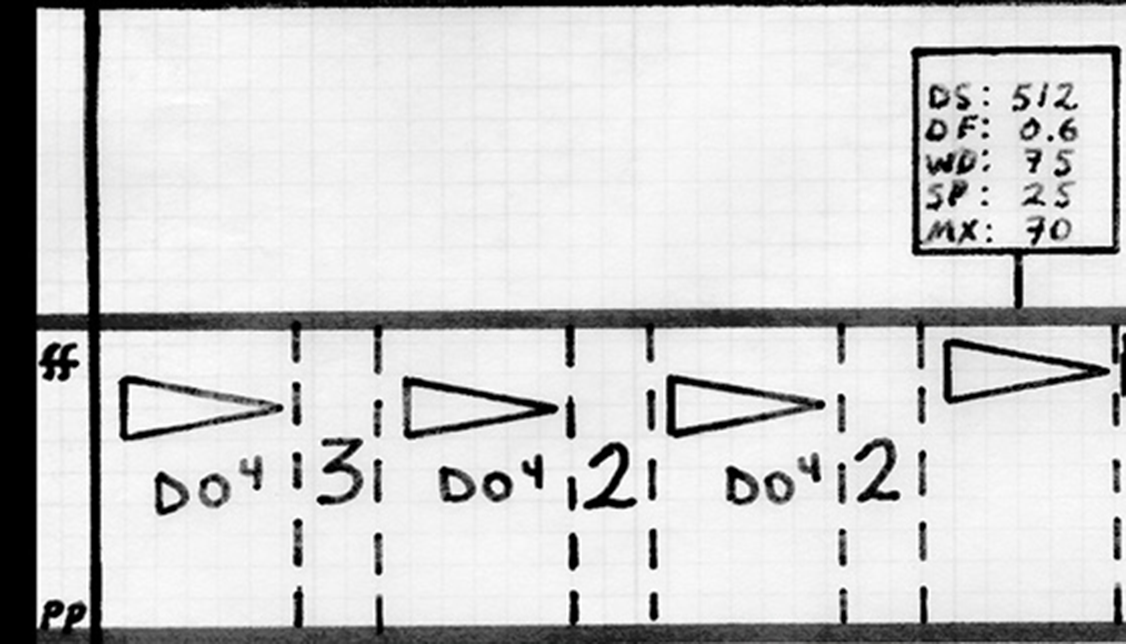
During their work sessions, Russek and Arizpe listened and took notes in real time on the timbral and time-based effects that the DL-4 produced with the amplified flute. As previously stated, Russek had recently composed and performed Introspecciones using a modular synthesiser he constructed. Composing with a modular synthesiser involves adjusting parameters, such as pitch, envelope settings and modulation, and documenting each setting for the desired sonic outcomes. Similarly, Russek treated Arizpe’s playing as a sound source that could be processed electronically in real time and noted accordingly. Throughout his career, Russek elaborated diagrams, templates and drawings to accompany his performances. For Summermood, he employed a hybrid score that included a graphic notation system for the flute with indications for the setting changes on the DL-4 (Figure 2). Arizpe, Russek and eventually Lavista memorised the piece, rendering the graphic score unnecessary, which may have contributed to its never being published.
Summermood score excerpt, combining graphic notation for the flute with indications for DL-4 delay settings.
4.3. Extending the techniques
The use of a microphone in combination with the DL-4 expanded the flute’s sonic palette beyond the possibilities achievable through Arizpe’s acoustic performance alone. This extension initiates from the amplification phase of the signal chain. In order to affix the contact microphone to the crown of the head joint, Arizpe replaced the standard cork situated within the head joint. This operation required particular care, as the cylindrical structure of the flute makes the tube highly susceptible to denting if the cork is displaced improperly. Notably, this intervention did not alter the conventional technique of flute performance: the microphone was designed with an integrated cork that ensured a complete seal of the head joint, thereby allowing the performer to play without modification to embouchure or technical approach.
The contact microphone required a preamp, which output a ¼” line-level signal. Using a mixer, the piece could be presented with one channel carrying the amplified direct sound of the flute, while a second channel routed the signal through a delay line. This setup allowed a stereo or sometimes quadraphonic field to be created from a single instrumental source. The work remained flexible across diverse venues and amplification systems. Russek’s compositional goal of transforming a single sound into a spatialised, multi-layered texture positioned Summermood as a pioneering work within Mexico’s new music circuit and connected it closely to the international flute and live-electronics repertoire of the time.
Although only preceded by a few works such as Michael Manion’s Constellations (1974) for flute and live electronics,Footnote 23 Summermood can also be situated within a broader lineage of new and experimental music with electronics from the 1960s to the early 1970s. Mario Davidovsky’s Synchronisms No. 1 (1962) was among the first works for flute and tape. Similarly, Karlheinz Stockhausen’s Solo (1966) explored the interaction between a soloist and live electronics. A piece that has close kinship to Summermood is Simon Emmerson’s Spirit of ’76 (1976), for flute and accelerating tape delay. Written for flutist Kathryn Lukas. Emmerson employed a 64-second delay that would gradually shorten to 4 seconds. This piece has since been migrated into a MAX/MSP patch.Footnote 24 Salvatore Sciarrino’s All’aure in una lontananza (1967) introduced whistle tones and air sounds inside the flute, techniques that Russek and Arizpe would also explore. In Mexico, Mario Lavista’s Canto del Alba (1971) employed flute with amplification.Footnote 25 Summermood was developed in dialogue with both national and international experiments in live electronics and extended techniques. Although the period of activity when it was performed, roughly 1981 to 1987, was not well documented, programmes, articles and personal records show that it was performed in various Mexican venues and internationally in MontrealFootnote 26 and Madrid.Footnote 27 Its integration of extended techniques with live electronics, such as percussive nail sounds amplified through a contact microphone, remains singular and ahead of its time within this historical context. The score itself reflects these technological and timbral concerns.
In Russek’s graphic notation, events are represented by symbols denoting specific timbral configurations. Duration is suggested through the length of lines, while the relationship of isolated versus combined signs distinguishes between single timbres and timbral complexes or rapid alternations of extended techniques. Transitions are specified through the placement of graphics: the absence of silence indicates legato, while abrupt changes are clearly marked. Dynamics are conveyed by vertical placement, with forte at the top of the page and piano at the bottom, and rests are represented with dotted lines measured in seconds or fractions of seconds. This system resonates with other electroacoustic notations of the period, such as Pauline Oliveros’s graphic scores or Mauricio Kagel’s experimental symbols, which sought to capture timbral processes and performer actions beyond the limits of traditional notation.
Russek described the piece as characterised by a rhythmic but non-periodic structure that resists metric regularity while maintaining internal coherence. Short lyrical fragments, such as the recurring do–do–mi gesture, suggest a connection to tonal reference, which is always subordinated to timbral transformation. Russek himself described the piece as evoking ‘female animic [sic] states’,Footnote 28 a phrase that points to an expressive discourse rooted in subjectivity and emotive interpretation by the performer. But Arizpe was not aware of such references on Summermood. Footnote 29 The bass flute’s spectral profile, with its deep resonance and larger capacity for percussive effects, in contrast to the C flute or piccolo, amplifies the percussive extended techniques such as key clicks, tongue strikes and even nail sounds, contributing to a sonic palette that oscillates between lyrical and raw sounds. Central to the realisation of Summermood was Arizpe’s role as someone deeply immersed in the exploration of extended techniques and improvisation. Her high technical ability, cultivated through close collaborations with composers like Mario Lavista, Gerhard Muench and Rodolfo Halffter, enabled her to adapt seamlessly to Russek’s compositional approach. Russek’s process preserved a framework for rhythmic and pitch development while integrating Arizpe’s experimental input, making performer–composer collaboration not just a practical necessity but a structural principle of the work itself. The intimate internal logic of the piece and the ad hoc language devised by Russek require detailed notes for anyone interested in studying or performing Summermood (Figure 3). As the graphic score relies on precise instructions, referring to highly specific methods of combining flute extended techniques, such as directing air inside the instrument with teeth, keys and embouchure sealed, while inhaling or exhaling as instructed.
Summermood score excerpt, indicating ‘air inside the flute between teeth; keys and embouchure sealed, inhale or exhale as indicated’.

Likewise, the DL-4’s specific topology would necessitate either obtaining the original unit or interpreting its notated settings on a different device or technology. The term ‘reassembling’ in the title is used here in analogy with approaches in media art preservation, often referred to as ‘reactivation’, in which a work is reconstructed or updated to ensure its continued performance and relevance.Footnote 30 As stated earlier, the DL-4 could be used with very short delay times, from 0.25 ms for comb filtering and flanging effects, up to 512 ms for long echoes. These longer echoes, much more pronounced than those possible with analogue delays of the time, are particularly noticeable on percussive sounds such as Arizpe’s bursting breath, tongue clicks and key presses throughout the piece. If viewed in parallel, both the flute and the delay unit were treated in a similar fashion, exploring their ranges and how those created new timbral and spatial outcomes. A description of a migration project for Summermood’s delay line using Miller Puckette’s Null Piece and Reality Check, Footnote 31,Footnote 32 can be found in the PdMaxCon25 proceedings.Footnote 33
5. Summermood at the Vanguard
After the piece premiered, the graphic score became unnecessary, as Arizpe, Russek and sometimes Lavista memorised it. Neither Russek nor Arizpe used this notation in future compositions or performances. However, a few years later, Arizpe revisited the score to illustrate how composers have used extended techniques in their works. In an article published in 1984 in the music periodical Pauta titled Las Voces de Flauta, Footnote 34 Arizpe presents an overview of the origins and evolution of the flute and discusses multiphonics, a technique that generates two or more tones from a monophonic instrument. In her article, she cites Russek’s notation system as an example of a novel approach to obtaining multiphonics from the flute. Although Russek and Arizpe never collaborated after Summermood, its historical significance lies in its collaborative process, its technological and performative complexity and its place in Mexican electroacoustic music history. The year following the composition of Summermood witnessed a notable surge of works for flute and electronics in Mexico, suggesting that Russek and Arizpe’s collaboration anticipated and perhaps helped prompt a larger exploration. In 1982 alone, Juan Arturo Brennan composed Eolo, a piece for bass flute and electronics,Footnote 35 Guillermo Dávalos wrote Diálogo for flute and magnetic tape,Footnote 36 and Carol McQuire created Pieza del Sol for flute and echo chamber.Footnote 37 These works help to situate Summermood as part of the pioneering developments in electroacoustic practices, placing Mexico in dialogue with, and at times ahead of, contemporary experimental practices involving new technologies, graphic notation and extended flute techniques.
Several factors have limited the continued performance of Summermood by Arizpe or subsequent generations of flutists. Only two audio recordings exist, with limited online availability, and the graphic score and accompanying notes were never officially published. The score uses Russek’s unique symbols for extended techniques on the bass flute and specifies knob and switch settings for the now-discontinued DeltaLab DL-4 Digital Delay unit. Performance also requires a contact microphone at the embouchure hole, an uncommon practice in flute performance. Additional instructions and a folder of process notes exist but are not currently accessible. Together, these technical, notational and collaborative requirements have constrained the work’s realisation.
Despite these barriers, Summermood remains a landmark in the development of Mexican electroacoustic music. Composed during a period of artistic flourishing, centred on new institutions such as the FIMN, the piece exemplifies collaborative innovation through extended techniques, graphic notation and live electronic processing. Its historical importance is further amplified by the broader social and political climate of late 1970s and early 1980s Mexico, where the lingering effects of the Dirty War, refracted through Cold War ideologies, both constrained and complicated the milieu in which composers and performers operated at national and international levels.
6. Preservation, reassembly and legacy
Building on over two years of archival research, interviews and fieldwork, this study examines Summermood’s historical, technical and notational elements. The analysis integrates archival study, media archaeology and documentation of electronic and instrumental practices, including the DL-4 delay unit and Russek’s notation system. This approach highlights how the piece functioned in its original performance context and clarifies the challenges involved in realising it today.
By addressing both historical and technical aspects, the study situates Summermood within broader discussions of digital preservation, reinterpretation and legacy in experimental music, using the term ‘reassembling’ to describe the careful documentation and examination of its complex components. This analysis also connects to larger research interests regarding Mexico’s electroacoustic legacy, addressing a key work with complex archival requirements from a period in which some primary sources remain recoverable, in contrast to the 1960s, when much has been lost.
Competing interests
The authors have been involved in the performance and reconstruction of Antonio Russek’s Summermood. This is disclosed for transparency, but the authors declare no financial or personal competing interests.



 Open access

