


Introduction
Before the pass the great mass of Tomaros begins to rise up on the left, and the way to Dodona winds under its flanks. It passes first through a narrow, winding valley which lies crushed under the outlying masses of the mountain. The massif rises up in splendidly bare and sweeping terraces to a towering ridge which is crowned by horns. The pilgrim’s mind is stunned by the greatness of the landscape scale and by his own smallness. He is made to feel a power far grander than his own, and that power is entirely of the earth, enclosing him, restricting his freedom of movement, directing him with an insistent pressure. The way is narrow, but the whole curve of the passage leads him on. As he moves forward, the mountains begin at once to recede and to soar higher before, as, in a beautifully rhythmic curve, a long valley opens out before him. (…) it is in the center of horns, along the near face of the hillock, that the buildings of the sanctuary are placed. The temenos extends forward into the valley, and its propylon is so calculated as to occur at the exact spot from which no further hills of any kind can be seen beyond the hill itself; it is thus totally open under the sky, and the release which began at the head of the valley is now complete. (…) First of all, they are organized as an arc, and it is clear what that arc accomplishes: it forms in plan a semicircle which complements the semicircle in elevation which is the valley shape, and it faces southward in order to do so. In this way a circle is completed, the circle of earth and sky, the globe of the world. Secondly, it is only because the temple and its treasuries are irregularly spaced and oriented along their arc that they have the power so to complete the valley shape and to act in it as well. If they formed a precise arc they would lose individuality and freeze on it, a tight shape in a big valley.Footnote 1
These lines, written by Vincent Scully in 1962, pose the main question of this volume: can we reconstruct the experience of a pilgrim who travelled to Dodona?Footnote 2 Scully’s description is perhaps too literary, his approach too close to Romanticism. There are constant references to symbolic elements, such as horns, linked to ancient features of Greek culture dating back as far as Minoan times. On the other hand, he takes into account important aspects, such as the route, the weather conditions and the lie of the land. Accordingly, the intention of this essay is to provide a framework that allows for examining this matter more precisely: to this end, I argue, a phenomenological approach is required, and I turn to this first.
Using a Phenomenological Approach
Phenomenology is a complex system of analysis with multiple branches: as Thomas Ryba explains, it is ‘a method of entry into the inner, historically conditioned, self-understanding of religions in order to provide structural descriptions and explanations of religious experiences, concepts, doctrines, myths, ethics, rituals, and institutions’.Footnote 3 Phenomenology of religion has been part of both philosophical and religious-studies approaches, with the result that the term can be used to describe a diverse range of methods.Footnote 4 In this essay, the methodology employed is narrowly connected to landscape archaeology. The latter considers landscape not only in its physical sense but also as an entity connected to human existence, activity and dimensions: experiential, social, emotional. Landscape archaeology, which has gained popularity in the last decades in history, anthropology, archaeology and religious studies,Footnote 5 studies how people visualized the world and the ways they engaged with one another across space. It argues that landscape is not just mere scenery in which humans live; it needs to be contextualized within the human sphere, according to historical conditions and related issues such as gender, age or class.Footnote 6 This approach, more specifically, aims to reconstruct the experiences of people within their environments. It requires delving into our understanding of symbolism and the different methods of communication in the group or society, as a means to recognize behavioural patterns and to extract conclusions concerning how these collectives and their mentality were structured.Footnote 7 The study of this symbolic dimension has been recognized as an underused tool for the interpretation of Greek religion.Footnote 8 Wherever there is human activity, the landscape is deliberately constructed and modified for different purposes, guiding people’s movement and attention. From a collective perspective, each community gives a specific meaning, or meanings, to everything they use, make, build or see. This meaning rests on the variety of aspects that characterize such a group in all areas of its activity. Therefore, for this approach to be used effectively, it is essential to have a deep knowledge of this community.
This raises two potential criticisms. The first is that phenomenology does not consider the agency of individuals: according to its theories, a person does not participate in choosing to act as they do but is simply guided by social structure and customs.Footnote 9 Perhaps we can sidestep this by arguing that we can consider individual experience. But this, in turn, leads to a second question: the difficulty – or even impossibility – of proving that the aspects analysed correspond to a type of reasoning that existed in the past.Footnote 10 In other words, can we really feel and think the same way as a person who lived two millennia ago?
In response, we can argue that the human body and its biological perception system remain the same, independent of culture and period.Footnote 11 Nevertheless, we have to admit that discerning the thoughts and reasonings of ancient societies and their members to such a deep degree is far from straightforward – their circumstances were completely different to ours – and the result of this approach, it can be argued, takes us into the realm of subjectivity – both that of the historian and that of his subject.Footnote 12 Indeed, phenomenology has been criticized because many subjective interpretations are not sustainable by the evidence.Footnote 13 Besides, there are studies that prove that the same activity is perceived differently by different members of the same group.Footnote 14 Every experience of every person we study is thus unique, which suggests that we cannot apply a phenomenological approach to an individual level and expect to reconstruct the entire process. And yet, in response to this, we can still argue that, as Felipe Criado Boado and Victoria Villoc Vázquez explain, there is a sort of transcultural subjectivity whose subjective proximity to our own can allow us to understand it.Footnote 15 By being aware of it, and using this approach carefully, it is possible to recognize certain common patterns of behaviour that indicate particular reasoning and perception. In the case of Dodona, we may be able to trace patterns of behaviour that help us to understand the reasons why people visited the sanctuary, as we will see below.
If we are to adopt this phenomenological approach, there is a series of concepts that we need to define. The first concerns the conception of space and time, which nowadays is completely different to that of ancient societies or, indeed, of more recent ones. We live in a technological era. Communications with far-flung regions are now a daily reality and distance is no longer measured in time.Footnote 16 For example, when Dionysius of Halicarnassus refers to the trip of the hero Aeneas and his men to Dodona, to consult the oracle, he says that it took them two days – dianusantes ēmerōn duein – to reach the site from the harbour of Ambracia.Footnote 17 This is a one-hour drive for us today, which shows to what extent our circumstances have changed.
It is necessary to clarify the meaning of perception, too. This concept does not refer just to how we see something but more specifically to the ways in which we feel and process it with all our senses.Footnote 18 Always following our own experience and intuition, we interpret and understand what we observe.Footnote 19 Landscapes transmit memories. When we see a landscape, even if it is new to us, our mind automatically assimilates and processes it according to previous experiences. In other words, we make comparisons and classify what we observe. John Paul Eberhard explains this idea with his example of the Washington National Cathedral: as soon as you enter the building, your brain connects memory systems – of past visits or visits to similar places – with the perceptual categorization formed by the images that are sent to your visual cortex.Footnote 20 In other words, our mind interprets what we see, hear, smell, touch or taste, in terms of past experiences. Even if we have those interactions with a new thing, we perceive it according to our own classification, which is based on what we have previously lived.
Approaching Dodona Phenomenologically
The possibility of reconstructing the perception of a single individual has been ruled out, or at least the attempt to recreate the entire pilgrimage activity of just a single person. This does not mean that we are not going to use documentation with information regarding the experiences of specific people. This essay will make use of the epigraphic and literary evidence connected to Dodona, which will allow us to obtain data about specific individuals. The lamellae from Dodona provide plenty of data concerning the topics of the consultation. Based on this information, the following pages will offer snippets of their stories, so as to give a sense of what their experiences were like, and to try to reconstruct the activity and process of being a pilgrim in this place. In some cases, it will be beneficial to compare other pilgrimages and religious travels in different cultures and periods, since such parallels can help to elaborate on more fragmentary or otherwise incomplete evidence.
In this context, the writing of Aelius Aristides is very useful. This second-century-CE orator wrote a work entitled Sacred Tales – Hieroi Logoi – a sort of diary of his visits to different sanctuaries all around the Mediterranean. Aristides, a hypochondriac, suffered for years from different illnesses. The gods, primarily Asklepios and Apollo, appeared to him in dreams and commanded him to go to shrines and follow their remedies to find a cure. Throughout his essay, the orator describes his experiences, his divine visions and his visits to holy places. Thanks to this, Aristides provides a very personal point of view of pilgrimage to religious sites.
Since he attended healing sanctuaries, Dodona was never his destination, at least from what is recorded in the Sacred Tales. Nevertheless, this source can be helpful for our understanding of pilgrimage and visits to sanctuaries. The following episode serves as an example: during one of his stays in Pergamon, following a dream, he walked near the statue of Telesphoros – one of the children of Asklepios – trying to get a remedy for his illness. He began to talk with Asklepiakos, a priest, about his dream. The priest suddenly realized that some other pilgrim had deposited an ointment in front of the statue of Hygieia. He brought that salve to Aristides, and as soon as the orator used it, his pain ceased.Footnote 21 This episode is useful for a modern researcher interested in the experience of pilgrimage to Pergamon for at least three reasons: first, it offers a brief description of a section of the sanctuary, suggesting where certain statues stood; it also suggests how the priests operated within the sanctuary; and, finally, it indicates the ways that Aristides specifically interacted with this environment. The use of material that contains fragments of personal experiences can help us to discern the interplay that pilgrims to Dodona might have had with the space where they were and the different elements that shaped them. This interplay could be affected by a series of factors that this essay will explore: factors that we can study from a collective perspective. Although in some cases the information we can gather comes from individual experiences, such as that of Aristides, it is possible to include them within the communal approach.Footnote 22
There is another issue to consider. Travelling to Dodona – and to any other sanctuary – implied not only a physical, but also symbolic, separation. Pilgrims left their place of origin and the specifics of their journey, even when it was brief, determined the way in which they experienced the trip. Following a route, reaching the destination, accomplishing a mission, and returning home created a particular relationship between them and the environments that they encountered. Pilgrims experienced the process, focusing on aspects that others not heading for the sacred place did not.Footnote 23 An example from modern-day visits to the cathedrals of Melbourne and Bendigo in Australia can help to clarify this observation. As Maureen Griffiths shows in her study, visitors to these sorts of places can be divided among those seeking a religious experience, those whose main motivation is to see world’s heritage, and those for whom the religious connotation is totally irrelevant, who are more interested in the architecture or other features of the site.Footnote 24 In this sense pilgrims, understood as a sector within the broader group of religious visitors – hence different from non-religious ones – perceive their visit in a completely different way from those whose attention is more focused on architectural characteristics.
Time is the final aspect we need to have in mind when carrying out this study. This analysis will focus primarily on the sanctuary according to the reconstruction of the site that we can see in Figure 2.1, which shows a reconstruction of Dodona in the middle of the third century during the Hellenistic period, before the Aetolian attack that the sanctuary suffered during the so-called ‘Social War’ (220–217).Footnote 25
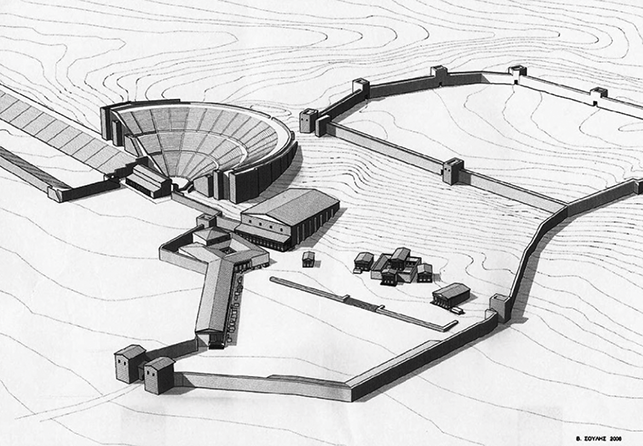
By the mid-third century BCE, Dodona had most of the buildings and structures that have been excavated in recent times – except for the basilica, erected in Christian times – and monuments like the theatre or the stoas undoubtedly conditioned the perception of the site by its visitors.
But while this is the main focus of this essay, it is important to remember that this image represents a mere snapshot of the history of the sanctuary, which developed over centuries. Dodona’s activity as a religious site spanned from at least the eighth century to Late Antiquity.Footnote 26 The place began its existence as an open-air shrine and gradually incorporated votive offerings, temples, altars and other structures. It is essential not to lose sight of this fact: this long process transformed the perception of the site by its visitors; as the landscape of Dodona went through different phases, it may have affected the experience of pilgrims differently. A later section of this essay will extend the approach to other periods of the lifetime of Dodona, and delve into the way changes in a sacred landscape such as new constructions can alter our perception and experience.
This chapter brings all these elements together to contribute to a phenomenological analysis of pilgrimage to Dodona and shows how we can apply this knowledge to better understand the experiences of ancient pilgrims when they visited the site. Before drawing conclusions, this study will consider first visibility and movement, then motivation (e.g., the reasons why people travelled to Dodona): three factors that played an essential role in the experience of visiting the place.
Visibility and Movement
The location of sacred sites is paramount. They often display special features that impress the human eye and evoke feelings of amazement and mystery.Footnote 27 This is one of the reasons why a cult place can be different to a mundane site. Visibility is a key factor when dealing with sacred spaces, as a way to focus on objective elements rather than aspects whose subjectivity reduces the strength of these kinds of studies.Footnote 28 One of the most remarkable moments of the pilgrimage to Dodona was the arrival at the site. The characteristics of the valley of Tcharacovitsa played a significant role, as can be observed in the passage from Scully. As pilgrims approached the sanctuary, the visibility of certain elements will likely have helped to shape their experience.
The sacred area of Dodona is located just to the south of a hillock, on which a fortified acropolis stood since the fourth century. For this reason, those approaching the sanctuary from the north would not see the sacred space until almost arriving there. This is one of the most solid arguments deployed in favour of considering the southern entrance to Dodona as the main one. It can be appreciated in Figure 2.1, a reconstruction of the sanctuary in the mid-third century. For those approaching Dodona from the south, that is, from the bottom of the valley, or from the southeast – after crossing the mountain pass in the vicinity of the modern-day village of Ampelia – the experience of arriving was even more impressive, owing to the fact that the city was clearly visible from afar.Footnote 29 The first building to heave into view would have been the large theatre, whose first construction phase belongs to the beginning of the third century. As they approached the sanctuary, other structures would have begun to be discernible. The movement of the pilgrim, therefore, contributed to their dynamic process of perceiving the sacred landscape.Footnote 30
This then introduces the distribution of the buildings in the sacred space, which was hardly ever random at any religious site. Their placement depended on their specific function and the symbolic meaning of both the sanctuary and the buildings themselves. The building of a theatre provides a good example. In general, across the Greek world, theatres were built so that they took advantage of the slope of the hill, and their orientations were certainly a decisive aspect.Footnote 31 We may assume that if the northern route to Dodona had been the main one, the theatre would have been built on the other side of the hill.
I turn next to the space inside the walls of the sanctuary. These walls delimited the area that formed the temenos of the shrine, thus stressing the sacred character of the elements that were within. Once pilgrims had passed through the southern entrance, they encountered an open-air area in the middle, flanked by two stoas, which contributed to creating a perception of depth. They were lined by a series of statues on pedestals of different kinds. In front of the visitors, slightly higher up thanks to the gradient of the embankment,Footnote 32 there was an ensemble of buildings. According to conventional theories, these were temples, with Building E1, the Hiera Oikia, the temple of Zeus Naios, at the very centre. Nowadays, however, some scholars suggest other possible functions for some of these building, such as treasuries, archives or dining halls.Footnote 33 They tend to face the central open area between both the stoas, where no remains of buildings have been found. On the one hand, at first sight, the other important buildings of the Hellenistic period, to wit, E2 and O-O1 – supposedly the bouleuterion and prytaneionFootnote 34 – occupy more secondary positions. On the other hand, they were the first buildings that visitors using the western entrance would have seen, after passing by the theatre and the stadium. The funnel-shape of this entrance offered them a panoramic view of a wider space: that is, specifically, the sacred area of the site. The movement of pilgrims was a pivotal factor in their experience of visiting a sanctuary, since, depending on their location and route, they were offered different views of the place.Footnote 35
Mobility played a major role in processions and rituals in sacred spaces owing to the experiences and sensations to which it gave rise. The interaction between the body and the surroundings was involved in the process of moving throughout a place. We can find a good example in the Spartan sanctuary of Artemis Orthia. Here, there was an open space surrounded by statues where rituals were performed.Footnote 36 A simple glance at Dodona in Figure 2.1 is enough to see that the sanctuary also had this kind of open-air area, encircled and delimited by a series of structures. If this space was truly empty, it would have been used for religious practices and other purposes. During the performance, both the open-air space and the elements surrounding it could have affected the perception of participants and attendants.
In these areas, pilgrims could also see displays of memorials of individuals or civic activities. As already observed, the stoas were lined with statues. In the area of the purported temples, next to the bouleuterion, there were indeed more life-size honorific statues apparently depicting real people, always dressed for war, whose remarkable feats deserved perennial commemoration.Footnote 37 The collective bodies that dedicated statues did not seek only to glorify those represented in sculpture but also to enhance the identity of their communities.Footnote 38 A three-fold purpose can be distinguished: the memory of the individual depicted (the dedicatee), the reinforcement of collective identity (the dedicant) and the delineation of the place (the landscape). To these should be added plaques and stelae recording activities that had taken place here, mainly manumissions and grants of privileges,Footnote 39 as well as claims of bonds with the Molossians, the ethnos that lived in the region where Dodona is located.Footnote 40 All this material will have formed an ensemble that conditioned the perceptions of pilgrims when entering the sanctuary. That perception varied, however, depending on the reason why each visitor had travelled to Dodona; I will turn to this question next.
Motivation
When people arrive at a place, they tend to focus their attention on those elements that are more closely linked to their expectations and past experiences. As Eberhard notes: ‘Which objects and/or which sensory systems you give particular attention to depends on your personal “value system” – a system established during past events that seemed important to the brain, such as a loud noise, a flash of light, a sudden pain, or a major emotional response to a place’.Footnote 41 In light of this, I suggest that the multiple functionality of Dodona gave rise to different experiences depending on the objective of the pilgrimage and the visit per se. People travelled to Dodona for many reasonsFootnote 42 – some of which will be described later – which all involved interacting with the sanctuary’s different elements and had their peculiarities.
It is important to underscore an additional aspect linked to this process. Individual ritual practices, such as privately consulting the oracle, were different from the collective sort, and both were performed at Dodona. Collective ritual practices connected all those participating in them, and the religious rites were designed to shape their feelings and reactions.Footnote 43 We may add other possible aspects, such as hierarchy, gender and age, which could have influenced the perceptions of the individuals forming the group.
The Oracle
The oracle was the main reason for visiting Dodona. In both Greek and Roman literature, the importance of the site is always associated with it.Footnote 44 So, it seems likely that the vast majority of pilgrims who made the journey did so to consult Zeus Naios and Dione about their concerns. This implies that their perception would have focused on the place in which the oracle was located, namely, the temple of Zeus with the sacred oak. As already noted, the Hiera Oikia occupied a central place in the ensemble of the sanctuary’s temenos. When visitors passed through the southern entrance, they came face to face with the temple. The oak was supposedly located inside the peribolos, the sacred enclosure of the complex, which might have been built in ca. 350–325 and which formed a circuit of walls measuring 13 × 11.80 m.Footnote 45
The remarkable number of preserved lead tablets with questions and a few replies is valuable evidence that gives us a hint of the influence and attraction of Dodona. The questions have been classified by most scholars in two groups: private and public, that is, from individuals or from collectives – communities, ethne, poleis.Footnote 46 Only 32 of the 4,216 texts published in DVC seem to belong to the second group, although those that do not preserve the identity of the consultant have been tagged as private by default.Footnote 47 According to Pierre Bonnechere, around 10 per cent of the total might have been public.Footnote 48
The Naia Festival
Apart from the oracle, the agonistic contests of the Naia also attracted people from all over the Greek world.Footnote 49 Conventionally, epigraphic and literary evidence seemed to prove the existence of this festival from the third century BCE until at least the third century CE. Material evidence from the site, however, suggests that it is likely to have been celebrated – in some form – in earlier times, perhaps since at least the end of the fifth century. Literary accounts and bronze offerings from the site indicate that dramatic and musical contests were held, so it may be that these early events were more regional in scope. Eventually, the Naia incorporated athletic events.Footnote 50 In this way, at some point the festival began to attract visitors from other regions of Greece, as epigraphical evidence shows.Footnote 51 The festival was probably held every four years.Footnote 52
In the case of athletes, they would have had only one thing on their minds on arrival: whether they were going to win or not. Besides, they would have also competed on behalf of their communities, some of whose members surely accompanied them. Those aiming to participate in the Naia festival would have focused their attention on the buildings in which the contests were held, chiefly the theatre and the stadium. The epigraphic sources provide useful information on the celebration of athletic (pentathlon, wrestling, pankration, boxing, etc.) and artistic (drama and music) contests.Footnote 53 The existence of the stadium confirms that the classical race also formed part of the Naia festival.
It warrants noting that this celebration also entailed the arrival of a significant number of spectators and, of course, merchants. During the festival, the sanctuary became an important place for the exchange of ideas and knowledge.Footnote 54 People from different regions met here. There would be plenty of occasions for symposia and other events that would promote conversations about different topics and issues. The transmission of information strengthened bonds among individuals from distant territories, who could benefit each other thanks to these contacts. It also made possible the development and spread of cultural advances, such as new techniques in arts and crafts by means of the offerings deposited, or intellectual meetings in banquets. In this way, whereas consulting the oracle may be considered as having been, for the most part, a more solitary activity, the Naia festival attracted people from far and wide. Therefore, the latter likely gave rise to a collective experience. Either participating in the Naia or just attending it meant being part of a common event, sharing the feelings and excitement that the festival generated.Footnote 55
Processions and Theoria
Dodona, as all ancient Greek sanctuaries, was a destination for processions or pompai. To make these rituals easier, a path, usually called a Sacred Way, was often constructed, connecting a sanctuary with its neighbouring centre.Footnote 56 Processions were imbued with powerful symbolic connotations relating to almost every aspect – who participated and who did not, the route chosen or the kind of objects displayed are just a few examples.Footnote 57 Such an event also united members of the community that participated, expressing civic values, local pride and identity.Footnote 58
Sources occasionally contain useful information that allows us to reconstruct some of these events. In the case of Dodona, direct evidence is scarce, but there is enough to confirm that there were interregional processions. For example, thanks to the literary sources, we know that the Boeotians had the tradition of sending a tripod – a ritual known as the tripodephoria – to Dodona every year. The apparent reason for this was that they had killed one of the three peleiades (‘doves’ as the priestesses of the sanctuary were known) in ancient times, partly because they were suspicious of her and partly because she had ordered them to commit a sacrilege to secure good luck. They killed the priestess in a pyre or in a cauldron of boiling water.Footnote 59 The ruling stated that the culprits would not be executed, but that thenceforth the Boeotians would be obliged to deposit a tripod at the Epirote shrine every year.Footnote 60 Although these Boeotian tripods have yet to be discovered, some fragments of a tripod, dedicated by the city of the Lechoians, have been unearthed.Footnote 61 A relatively small group of people would have participated in this kind of pilgrimage because of the great distances involved.
Hyperides, an Athenian politician and orator from the fourth century, introduces another sort of pilgrimage when he refers to a theoria sent to Dodona by Athens for the worship of Dione, surely not long before 330.Footnote 62 A theoros could serve as a representative of a polis or community in a sacred space. This delegate could attend a festival, consult an oracle, make dedications or announce the festival of his own community. By extension the term theoria can denote a festival itself, a spectator at a festival, an embassy to a sanctuary or the journey to and from a sanctuary.Footnote 63 This theoria by the Athenians included the celebration of an expensive sacrifice and the adornment of the cult statue of Dione. The orator reports that Olympias, probably the regent of the Molossian kingdom at the time, forbade them to perform it, even when it was precisely the oracle of Dodona, who had requested them to do so.
Epigraphy provides information about other theoroi sent to Dodona and received by the theorodokoi, the officials in charge of acting as hosts. One example is Pantaleon, a theorodokos appointed at Dodona in the late third century. He was responsible for receiving a theoria delegation that came from Delphi. We know this from a stele found in the Phocian sanctuary that enumerates the names of theorodokoi at their locations.Footnote 64 The area of the sanctuary of Dodona where the members of the theoria likely performed the pertinent rituals included the open-air space in the heart of the sanctuary. This faced the temples and treasures to the north; it was flanked by the two stoas to the east and west, and was closed by the walls of the site to the south. This ensemble created an enclosure with a relatively large area.
Manumissions and the Granting of Rights and Privileges
The communities of the territory where Dodona is located had this sanctuary as their meeting venue for several official activities. Initially, this role was limited to the ethnos of the Molossians, with a kingdom that controlled part of the hinterland of Epirus. With the passage of time, throughout the fourth and third centuries, the larger political entity that eventually took the form of the Epirote koinon in 232 entailed the arrival of more Epirote communities to Dodona.Footnote 65
Most of the activities that took place here consisted of upgrading the status of certain individuals, one of the best-known being manumission – for example, being released from slavery. The attendants included the slave, the master, witnesses and officials. For the manumitted, the sanctuary would come to symbolize a new stage in their lives, where their life as slaves ended and a new phase started.Footnote 66 In the material sphere, manumissions were recorded on bronze plaques or stone stelae, which were then publicly displayed. At least two pieces of this kind were found inside the bouleuterion in the campaign of Reference Dakaris1969, directed by Sotirios Dakaris.Footnote 67 In one of them, the person that gained their freedom was called Deinon.Footnote 68 The other one registers the manumission of a woman, Agathokleia, who was also called Europia.Footnote 69 Both of them date to the period of the Epirote koinon, that is, between 232 and 167. These texts also follow the classical arrangement of information: first, they mention the main magistrates of the confederation, the strategos and the prostates – this creates a way of dating the document (for the ancients as well as for modern readers). Then, the documents list the names of the people who participated in the ceremony. Based on the location of these two inscriptions, it can be assumed that these kinds of documents were distributed on the walls of other buildings, such as the stoas.Footnote 70
The granting of citizenship and other privileges – mainly proxenia (hospitality ties between a citizen and a foreign individual, whereby the former hosted the latter), ateleia (exemption from all taxes) and enteleia (being granted all the rights) – involved a similar process in which the status of the recipient changed. As before, the location of the plaques or stelae on which they were recorded is still uncertain. Based on the appearance of a stele just north of the basilica and Building Θ,Footnote 71 plus an inscription near the temple of Zeus,Footnote 72 they may have been placed in the same areas as the manumissions, although due to the nature of the privileges granted, which were of higher status, they would probably have occupied a more visible position.
The honorific statues placed in the sacred enclosure of Dodona also contributed to the symbolic construction of the Dodonaean landscape and enhanced its political dimension. The purpose of these sculptures was to endure over time and to legitimize the position of the people mentioned in their inscriptions, usually the ruling class. Some visitors who saw them would have had a special and personal experience due to a connection that they could have with the individuals represented in the statues or mentioned in the inscriptions that accompanied them. For example, the Epirote koinon dedicated an honorific statue to the Thesprotian Milon, son of Sosandros. The reason was his virtue and benevolence towards themselves.Footnote 73 The contemplation of this dedication would be noteworthy for the genos of Milon, but actually not only for them. Members of the community of this person, in this case the Thesprotians, would also have a similar feeling, for someone who represented their community had performed deeds worthy of an honorary statue in the most sacred space of Epirus. Or perhaps the opposite impression, in case they felt jealous or envious of Milon being granted such kind of privileged position.
Effort and Returning Home
Although rather overwritten, the passage from Scully at the beginning of this chapter describes the effort required to reach the sanctuary. This was certainly important. In Arcadia, for example, ascending to the top of the mountain, where the sanctuary of Zeus Lykaios stood, formed part of the ritual.Footnote 74 Aristides also refers to the difficulties that he had during some of his trips to healing sanctuaries.Footnote 75 It was a technique he employed to highlight the value of those travels, for his health would get better after his sufferings. The route taken, therefore, contributed to constructing the symbolic space where the pilgrimage ended, as well as the pilgrimage itself.
Pilgrimages, however, did not end once individuals had made that effort, reached their destination and fulfilled their objective. They still had to make the return journey. During this trip, apart from the effort that is implied, they would share their personal experiences with others, as they did when arriving home, experiences which continually developed as they were recounted. This exchange of experiences could have also motivated other people to follow the same steps and visit the oracle.Footnote 76 Consequently, this may have prompted more people to consult Zeus Naios and Dione about their problems. These pilgrimages themselves, and the subsequent transmission of these experiences, therefore, contributed to the symbolic construction of the sanctuary.Footnote 77 Dodona, with all the sensations and feelings that it evoked, was shaped by the combination of all the different aspects of the pilgrimage, including the return journey.
Regrettably, there are no descriptions by individuals of their experience of consulting Zeus Naios and Dione. An alternative source of information on the sharing of a religious experience in a Greek sanctuary, although not in an oracular context, is the iamata in EpidaurusFootnote 78 and their homologues in Lebena, Crete.Footnote 79 Both Asklepieia had on-site inscriptions about individuals who had visited the site for different ailments or health conditions. Although technically these testimonies refer mostly to healings in the sanctuaries, at the same time they seem to have been intended to facilitate a kind of sharing of experience among visitors. Some of these episodes imply a return home and a second trip to the shrine, as we can infer, for example, from LiDonnici B11, where we learn of Andromache of Epirus, who visited Epidaurus because she had problems getting pregnant. After sleeping at the sanctuary, the woman went back home and had a child with her husband, Arybbas. The recording of this story may have taken place once Andromache had returned to Epidaurus to deliver the news.Footnote 80
The absence of testimonies from Dodona consultants regarding their return home is partly compensated for by the presence of other types of information associated with other activities, such as the Naia festival. Some of the testimonies of the different contests that took place during the festival come precisely from inscriptions in which the champions listed the victories that they had achieved during their lives. That is the case, for example, for the above-mentioned Kallistratos, son of Philothales, who lived in the third century. The inscription that records his athletic deeds was found in Sikyon. From this text we can infer that Kallistratos was a natural, born champion. When he competed as child (pais) he won boxing and pankration contests in festivals all over the Greek world, such as the Basileia, Lykaia, Isthmia, Panathenaia and the Naia. Later, as an adult (andras) he was also the champion in the same sort of competitions in the Isthmia and the Nemea, among others.Footnote 81 For Kallistratos, as for the other athletes and artists who won a victory at the Naia, the pilgrimage to Dodona would be a lasting memory, in some cases also recorded in public for posterity.Footnote 82
Time and Change
In the foregoing, aspects of the experience of visiting the sanctuary of Dodona have been analysed, largely over the Hellenistic period. As I have noted above, the passage of time will have affected the shrine and experiences of pilgrimage to it. During the history of Dodona, its monumentalization brought about major changes in its landscape. The aforementioned buildings making up the sacred space of the sanctuary were erected mainly between the fourth and second centuries.Footnote 83 Before the fourth century Dodona was essentially an open-air sanctuary, with almost no permanent structures. According to the sources, the most significant elements in Dodona at the time included the sacred oak and the cauldrons on tripods associated with it.Footnote 84 This implies that the experiences of pilgrims travelling to Dodona in the Archaic period and during most of the Classical age would have been very different. Apart from other natural elements, the focus of attention was always the tree.
This connection with nature was preserved, despite the sanctuary’s monumentalization. To some extent, Dodona did not lose that bond and its landscape seems to have maintained its original features. Vibius Sequester, a late-Empire writer who catalogued famous geographical spots, mentioned the woods of Dodona.Footnote 85 This is in line with more ancient accounts that refer to the sanctuary’s natural environment, such as those of Pindar and Hesiod, although these writers mention only vast meadows.Footnote 86 In any case, I concur with Bonnechere, who suggests that Dodona was located in an alsos, a sacred grove.Footnote 87 As shown in Figure 2.1, the number of buildings was certainly limited, as was their size, except for the theatre. This could mean that, whereas in its origins Dodona was a purely open-air sanctuary, the subsequent construction of buildings was carried out in such a way that, thanks to its natural features, the experience of pilgrims who visited the place for the different reasons described above still retained its archaic connotations.
Conclusions
Everybody saw the same sanctuary, the same buildings and the same votive offerings. Each individual, however, perceived and interpreted them in a personal and unique way; and there are, as I have discussed, significant difficulties in evoking these individual experiences and perceptions. At the same time, however, there is evidence from certain group activities that can help us to reconstruct experiences and feelings that were shared by the pilgrims to this site.
This case study has attempted to provide a framework that combines elements that could offer such an objective insight, including evidence for the visibility of the site and movement of pilgrims, alongside another aspect that provides a more personal aspect – the motivation of pilgrims. Literature, especially archaeology and epigraphy, has made it possible to get access to specific information regarding these issues. There are, nevertheless, some aspects that this essay has not analysed, such as the influence of age and gender on the pilgrimage phenomenon,Footnote 88 and I hope that this study may prove the beginning of further research.

 Open access