


At mid-century, Britain was ‘the great economic power of the nineteenth-century world’, a truly ‘global power in command of a world-system’.1 And that economic power rested on, was indeed synonymous with, military power. As Nathan K. Hensley writes, ‘The notion that power speaks its presence most clearly in the act of killing suggests that while imperial power takes many forms … the paradigmatic form of empire, though far from the only one, is military violence’, whether manifested in actual conflict or the ‘sublimated, potential violence of metropolitan peacetime’.2 The recent victories in Crimea and India had exposed a horrified nation to the cost of being able to trade prosperously with the rest of the world and to maintain control over territories and key land and sea routes. This chapter looks at how the military was viewed specifically in 1859, in the aftermath of two major conflicts and in the face of new European hostilities, and how Britain attempted to reconcile a deep cultural affiliation with a national martial identity with evidence of its own atrocities, and indeed weaknesses.
In her seminal study, Britons, Forging the Nation, 1707–1837, Linda Colley writes that Britain was ‘an invention forged above all by war’.3 But what does this mean in a year that saw Britain evade involvement in the primary conflict of 1859, in part because of the repercussions of its participation in the Crimean War and its ongoing response to the Indian Uprising. Was Britain in this year rather ‘forged’ by its military failings? And is warfare another aspect of British life that finds its pre-eminence in the past? We will see later in the chapter how military, political, literary, and social evidence realises an affiliation with the idea of conflict that, even though it looks to the past, articulates not so much war’s originary, founding status, but its association with concepts of Britishness designed to underpin its imperial endeavours and maintain European prestige.
Britain’s Martial Identity
Britain’s fighting forces offer a dynamic form of collective identity, whilst usefully not precluding the possibility of individual heroism, such as that of the Duke of Wellington and more recently the recipients of the Victoria Cross. The award, inaugurated after the Crimean conflict, was a means of both recognising the bravery of individual modern-day soldiers and grandiloquently aligning their heroics to those of Classical figures:
Each act of valour for which the cross was awarded was as fine as any of those old classical deeds which are still taken as the culminating points of human bravery and endurance … When Sergeant-Major John Grieve, of the Second Dragoons, rescued an officer during the heavy cavalry charge at Balaclava, he did only what he thought to be his common duty: Castor and Pollux, Orestes and Pylades, and all the rest of the typical devoted, did no more.4
‘How the Victoria Cross Was Won’ was inspired by an exhibition of portraits of twenty-two holders of the Victoria Cross by the English artist Louis William Desanges. His previous work had mainly been society portraits, but now, ‘cloyed by his own beauties’, he is attempting ‘to storm public attention into admiration of his powers, as a painter of stern historic events’.5 The Art Journal and the Standard acknowledged a more generous intention behind the works and recounted some of the deeds and ‘chivalrous transactions’ from the Crimea which were depicted.6 For the Art Journal, the paintings were ‘highly interesting, and may prove sources of delight to thousands of visitors’,7 including crucially those non-commissioned officers and privates of regiments quartered in London to whom Desanges had sent invitations to inspect the paintings ‘every evening for two hours, free of charge, from eight until ten p.m.’8
The enablers of war were also celebrated in February. William Armstrong, the inventor of the Armstrong gun, ‘from the mouth of which have proceeded the strongest arguments that have ever as yet been advanced to disarm an adversary’, was awarded a knighthood for giving the patents of his new field gun to the government.9 And popular fiction often featured the figure of the fighting man. Proby’s The Dennes of Daundelyonn features the ‘frank, soldier-like … gentlemanly, quiet’ ‘Colonel Arden, of the Bengal Army’, recently returned from India (III, p. 164), and the back pages of this novel include four pages of adverts for ‘New Works on India and the East’ which are dominated by military accounts of the recent conflicts in India, including W. Edwards’s Personal Adventures during the Indian Rebellion’, The Chaplain’s Narrative of the Siege of Delhi, by the Rev. J. W. E. Rotton, Chaplain to the Delhi Field Force, and Colonel George Bourchier’s Eight Months’ Campaign against the Bengal Sepoys.
Throughout the year, military metaphors were also applied to women: the actor Charles Kean adopted one when speaking of the support given him by his wife, Ellen Tree: ‘Amidst the complicated duties of management, the director of a theatre, like the general of an army, requires the assistance of an efficient staff. Mrs Kean has been my first aide-de-camp, and never had commander one more able and more indefatigable’.10 The military metaphor was used by Mrs Beeton in describing the position of the mistress of the house as ‘the Commander of [the domestic] Army’, and as one whose ‘spirit will be seen through the whole establishment’,11 and by David Masson in describing women writers’ incursions into fiction: ‘the Novel … was the first fortress in the territory of literature which the women seized … because the men, being absent elsewhere, had left it weakly garrisoned … but they also did the duty of the garrison better than the men who had been left in it’ (Masson, p. 179). With the exception of Beeton, the lightly ironised quality of these observations serves to undercut much of the recognition that they might seem to profess.
But despite the ubiquity of the military as a form of reference, a kind of navigational aid, the army itself was not in a good state. Acknowledged deficiencies in the organisation and administration of the Crimean War, followed closely by the extended conflict in India which only drew to a close in 1859, had left British land forces significantly depleted at a time when closer contact with war itself, enabled by eye-witness accounts, and supplemented by the sight of war veterans on the streets, brought home to British citizens the horrendous cost of conflict, not all of which was inflicted by enemy combatants. In May, Harriet Martineau published England and Her Soldiers, a detailed set of proposals for reforming the health and well-being of the British army through better organisation of sanitary arrangements, nutrition, and the supply chain. Martineau had been working on England and Her Soldiers for the previous few months with Florence Nightingale, whose expertise lay behind the detailed arguments of the book. Nightingale was a recluse at this time, suffering from ill health that prevented her more public participation in the debates about army conditions, yet she still held a prominent part in people’s cultural memories of the Crimea: she was the subject of one of a series of books on Notable Women: Stories of Their Lives and Characteristics. A Book for Young Ladies, whose author is careful to walk a fine line between celebrating Nightingale’s pioneering work and confirming her ‘grace and propriety’.12
England and Her Soldiers made publicly available Nightingale’s findings in Notes on matters affecting the health, efficiency, and hospital administration of the British Army: founded chiefly on the experience of the late war, which she had previously provided privately to the Secretary of State for War in 1858.13 Both texts contained Nightingale’s famous Rose Diagram (‘Diagram of the Causes of Mortality in the Army in the East’), which proved devastatingly clearly that ‘the casualties of actual conflict [in the Crimea were] a mere trifle in comparison with mortality from preventible disease’.14 They described the suffering of wounded and dying men, languishing in hospitals for want of the food and supplies which were often lying forgotten just a few miles away, and which were of as little use as if they had never left England, and appealed explicitly to ‘the English people’ (p. vi), not to the military authorities and ministers who had done so little to remedy the soldiers’ situation. The solutions were simple: better hygiene and nutrition, temperance in the wards, and provision for men’s leisure hours in the shape of well-stocked libraries and club rooms. These provisions would make army service a more attractive prospect for a better class of men, and, they argued, would thereby directly improve the defence of the nation. Martineau acknowledges that ‘the world is full of war-like propensities at present’ and that ‘no nation can feel secure of a term of peace, long or short’ (p. 270), hence the urgent need to secure a healthy and sustainable land force.
An attempt to reform the army had begun in 1856 with the establishment of a ‘Royal Commission Appointed to Inquire into the System of Purchase and Sale of Commissions in the Army’, prompted by the difficulties of the Crimean conflict and the perception that a ‘promotion system based mainly upon seniority, favour, and money to the detriment of merit, aptitude, and professional knowledge’ could not prosper.15 In the nineteenth century, most promotions were achieved by purchase in a system that overlooked talent in the interests of financial and institutional incentives. In this system, a soldier vacating his position could sell his rank to an eligible junior officer; should the next junior officer in line for promotion not be able to pay, the chance would go to someone who could.16 Sir Charles Trevelyan was an outspoken critic of the purchase system, bringing to that debate the concerns for the extension of opportunities to all eligible candidates and the desire for professionalisation that were determining his parallel efforts to reform the Civil Service. However, the purchase system would not be abolished until 1871, when it became undeniable that trained officers were capable of achieving greater success.17
This issue informs the depiction of Arthur Donnithorne, who is a Captain in the Loamshire Militia. At his coming-of-age celebrations: ‘Arthur had put on his uniform to please the tenants, he said, who thought as much of his militia dignity as if it had been an elevation to the premiership. He had not the least objection to gratify them in that way: his uniform was very advantageous to his figure’ (II, p. 210). Stefanie Markovits suggests that Arthur’s attention to his dress, like that of Vanity Fair’s George Osborne, is indicative of his period: ‘Before the [Crimean] war, the stereotypical soldier was an aristocratic fop. After it, he was a military man.’18 Chronologically, this works of course for Eliot, and the recent debate about purchased commissions informs her picture too: ‘The commission of 1857, in reporting on this evil, declared that purchase, while discouraging poor men from entering the service, attracted “idle young men, who, having money at their disposal, regard the Army as a fashionable past-time for a few years of leisure, and bring with them habits of expense and dissipation.”’19
The contemporary military framework allowed a reader in 1859 to see Arthur’s faults as more substantive than those of misguided youth, emphasising their being based in the assumptions belonging to his cultural and social position.
Two of the earliest descriptions of Adam Bede himself liken him to a soldier: as he surveyed his work, Adam ‘had the air of a soldier standing at ease’ (I, p. 3), and a stranger described his first sight of Adam thus: ‘I met as fine a young fellow as ever I saw in my life, about half an hour ago, before I came up the hill – a carpenter, a tall, broad-shouldered fellow with black hair and black eyes, marching along like a soldier. We want such fellows as he to lick the French’ (I, p. 23). Yet Adam Bede is broadly unsympathetic to the army: Adam makes considerable financial sacrifices to buy his brother Seth out of his military service, and, despite his own promising physique, Adam does not serve, preferring to use his skills and ingenuity in perfecting domestic appliances rather than licking ‘the French’. For Seth and Adam, less secure in their social position than Arthur, to join the army was to risk their respectability. Historians have garnered evidence to disprove Wellington’s repellent description of the rank-and-file soldiers as drawn from ‘the very scum of the earth’,20 but nonetheless to join the army was potentially to invite the suspicion that a man had lost any other means of making his living; for the aspirational Adam, this would have been a disgraceful slur. Eliot’s novel evidences a movement discernible in 1859 which rejects the idealisation of the fighting man, in the face of the threats of war from across the Channel, and despite the enthusiasm with which the usually historical figure of the soldier was hailed.
Italy
In a letter to her cousin’s wife, Harriet Martineau writes, ‘The time serves well for the appearance of my book’:
I hope you & yours have not been made anxious by this foolish panic about invasion & a secret alliance against us. It really makes one ashamed of one’s countrymen, who pique themselves on being so ‘practical’, to see how their fancy & credulity run away with them … our fellow-citizens rush into an absurd panic, & waste a million of money in five days, – & nerve & reputation enough to carry them through half a war. Of all the panics I remember, no one has been so obviously senseless as this. The only good results that I see are that we shall get our defences brought up to the proper point.21
Martineau was referring to the war commencing in Italy, and the attendant fears of a French invasion of Britain which, though unlikely, were being sedulously stoked. Despite the strong public and political sympathy with Italy and its people, Punch’s poem ‘Keep It Dry’, addressed to John Bull, and its accompanying ‘Large Cut’, that is, full-page, image, demonstrated as early as March that Britain had no intention of going to war (Figure 5.1).
This image was chosen after other possibilities depicting French responsibility for the situation – including Louis Napoleon smoking the pipe of peace whilst sitting on a four-barrel, and a Giant France encouraging ‘Dwarf Sardinia’ to ‘Go in & win, my little man’ (Silver Diary, 17 February) – had been considered and turned down; it was more important to assert British detachment than French calumny. British attempts to bring the warring parties to a peace Congress failed, and Britain could do nothing but watch as Austria declared war. Austria’s initiating hostilities meant that the Conservative party and the Queen were deprived of the possibility of supporting Austria, however tacitly, in the ensuing conflict.23
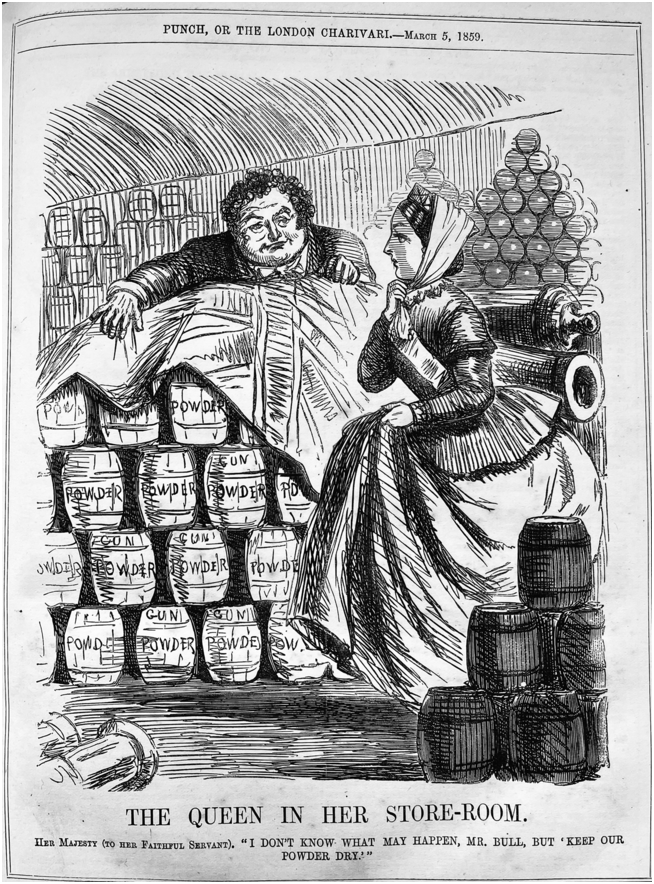
Punch’s reference to Henry V’s ‘band of brothers’ (IV.iii.62) suggests that Britain’s stance was underpinned by historical affiliations, and cultural memory. The cartoon was an early indication that in this instance British fighting would be done in Parliament, and on the stage rather than on Italian battlefields. As the cartoon also shows, the main focus of the conflict for most political observers in Britain was the activity of the French, and not the fate of the Italians. The relationship between England and France was very unstable during the 1850s: despite their being allies during the Crimean conflict and fighting alongside each other in China (see subsequent discussion), hostilities between the two countries had re-emerged when Britain was suspected of involvement in Felice Orsini’s plot to assassinate Napoleon III in January 1858. This hostility fed the belief that France’s readiness to support Italy’s claims for self-determination indicated the beginning of a movement for greater European dominance, and potentially for an invasion of Britain.
This conflict was one of the dominant public events of the year, and political and quasi-military responses to it would, as we will see, have far-reaching consequences. However, before looking at those responses, it is helpful to examine the terms of British sympathy for Italy, which was very largely inspired by ideas of Italian culture and history derived from the Romantic period.
Italy was at the heart of British cultural life, evidenced by the Prince of Wales’s taking a trip there in January, even as fears of war broke out. The Royal Italian Opera performed Rossini’s La Gazza Ladra at Covent Garden and La Sonnambula at Drury Lane, as the company expanded its operations from Covent Garden to Drury Lane, where it intended to run ‘play-house-prices Opera’.24 Covent Garden would rely on its aristocratic audiences, while Drury Lane was expected to pull in ‘the general public’ by putting on Italian operas. The Theatre Journal feared that audiences might soon tire of Verdi and that the theatre would have to ‘resort to the standard operas of Mozart, Rossini, and the lighter fare of Donizetti and Bellini’, and the Saturday Review worried that the dissolution of parliament and ‘the prospect of war prices and gloomy forebodings of additional taxation all tend to make people reluctant to spend their money in amusements’, but the Italian Opera was thriving.25 The burgeoning war brought ‘the fullest audience that has attended the theatre this season’, and they responded enthusiastically to a display that ‘was more than usually brilliant, so fresh, so cheerful, and so full of military spirit’.26
Italy also featured prominently in the annual exhibition of the Royal Academy, which opened at the start of May. Two ‘fine Italian heads by Leighton’ caught Queen Victoria’s eye (Journal, 10 May) as they did the Athenaeum’s critic:
His heads of Italian women this year are worthy of a young old master, – so rapt, anything more feeling, commanding or coldly beautiful we have not seen for many a day. Pavonia (32) is the most regal of them all … Mr. Leighton has admirably caught the Italian complexion in all its tints, down even to the languid sepia tint under the eyes … This is real painting.27
John Ruskin’s reviews of a handful of the many Italian-themed paintings at the Royal Academy summer exhibition were informed by his extensive knowledge and love of the country. He finds that John Brett’s ‘Val d’Aosta’ celebrates ‘landscape painting with a meaning and a use’ in a review which both includes and excludes the viewer from Ruskin’s personal experience:
For the first time in history … the power of visiting a place, reasoning about it, and knowing it, just as if we were there … standing before this picture is just as good as standing on that spot in Val d’Aosta … and in some degree pleasanter, for it would be very hot on that rock to-day, and there would probably be a disagreeable smell of juniper plants growing on the slopes above.
‘England and Italy. Painted in the Val d’Arno, 1859’, by Mrs J. B. Hays was used by Ruskin to compare the English and Italian nations as he sees them:
An English boy, however luxuriously bred, has usually twenty times the firmness in his face that the Italian one has. Italian boys are beautiful – full of vitality and roguery; lazy, and on the whole, well fed, wherever I have seen them. There is more misery of an outward and physical kind in a couple of London back-streets than in a whole Italian town. Mental degradation, not physical suffering, constitutes the slavery of Italy; both constitute that of England. Italian slavery is infinitely grander than ours. The souls of Italy at least need iron bars to bind them; ours need only the threads of purses.
Though his picture of Italy is far from flattering, it is a means through which Ruskin can berate the depraved soul of materialist England.28
As such, it reflects a harsher emerging scrutiny: to ‘know Italy as she really is’, was to drag ‘down into deeper degradation than we care to confess the ideal we are all willing to cherish of the country that has given to modern civilization the highest examples of genius in painting, poetry, and sculpture’, wrote the reviewer of Mabel Sharman Crawford’s Life in Tuscany in the British Quarterly Review.29 And it is that ideal that England was eager to support. Italy was, for Ruskin, as for Matthew Arnold, Gladstone, and many of their contemporaries, a state which was idealised even in its hardships, picturesque even though impoverished, and embodying a time-honoured aesthetic worth protecting.
For Matthew Arnold, the self-esteem of the Italian rests on ‘knowing the figure which his nation makes in history; by considering the achievements of his nation in war, government, arts, literature, or industry’.30 The comparison of ‘an eminent past with an abject present’ determines national identity for Arnold, be it Italy’s, France’s, or England’s. In ‘The Elections and the War’, Fraser’s Magazine describes Italy as ‘that classic soil, the ancient land of heroes and statesmen, the refuge of literature, the nursery of the arts’;31 and in the Quarterly Review, Gladstone acknowledged the cultural debt to Italy which lay behind his assertion that as ‘a race [they are] much more advanced’ than the ‘glaringly inferior’ Austrians who largely rule the Italian Peninsula.32 Having recently travelled through the country on his way back from the Ionian Islands, where he had been governor, and met Cavour on his journey,33 Gladstone was well informed about the situation of the Italians themselves, and seriously concerned about that, and not just the balance of power within Europe, which was other British politicians’ primary concern. Whilst Gladstone found it difficult to justify specifically French intervention, he recognised that the Italians’ overwhelming desire for independence ‘is inseparably associated with the hope of relief from political servitude and from heavy practical grievance’ (p. 549), and even likened their situation in relation to Austria to that ‘which the Negro in America holds to the rest of the community’ (p. 551). Liberty was one of the key words of the Italians’ demands, and fuelled French justification of their intervention on behalf of Italy (p. 528), as well as external suspicion of their support. It was also one of the most prominent terms of the year, whether highlighted by Mill’s work, or lingering more anxiously in the collective memory of the French Revolution.
Gladstone insisted that England should recognise its own moral obligations but that it did so best through maintaining an armed neutrality, through keeping ‘our moral and material force entire and unimpaired, to stand wholly clear of any selfish interest, to urge on this side and on that the claims of reason and justice’ (p. 563). Unable to defend Austria’s actions or to assist Louis Napoleon ‘without the fear of promoting piracy’ (p. 563), England had to stand on the sidelines and try to ensure that Italy’s long-term sustainability, as well as any short-term gains it might make, were looked to. Gladstone regretted that Britain was ‘unhappily saddled, in this agony of the fate of Europe, with the discussion of a domestic question of organic change’ (p. 564), that is, an election which has none of the urgency, or indeed the public appetite, for change that was evident in Italy.
Italy’s past was overwhelmingly the aspect of the country that British commentators celebrated and sought to protect, but tourism, war, and the picturesque mingle uncomfortably in accounts of Italy in 1859. One effect of celebrating Italy’s past was to stymie the very art for which Italy was renowned in the first place. Rather than creating new and vigorous art, Florentine painters now consumed their time with the trade of copying paintings for tourists who wished to hang reproductions on their walls at home. As Oliphant writes: ‘What business have you to come here, you comfortable well-to-do tourists, to murder the souls of these poor Italians (as Mr Ruskin would say) by making them work all their lives out copying for you? Can you not see with half an eye how the soul evaporates out of the picture as the work goes on?’34
‘Italy’ had a stable, long-standing currency and resonance for the British, which formed an acknowledged part of its collective imaginative and cultural consciousness. Italy’s historical legacy seems often to have comprised a set of unchanging national characteristics which lack the ability to evolve into something more modern and productive. Even in the reporting of the onset of revolution and military action, there is a reluctance to give up on time-honoured models of Italy and its people. For instance, the largely peaceful fall of Florence in the summer was, Oliphant reported, ‘more like a popular festa than anything else’ (Autobiography, p. 71).
Arriving there in early 1859, Oliphant and her family took rooms in the Via Maggio in Florence, ‘a deep street of high houses on the other side of the Arno’, and ‘as unfavourable a spot as we could have chosen’.35 The road runs from the Arno up to Piazza San Felice, just in front of the Pitti Palace, where the Brownings lived. Oliphant’s general disappointment is recorded in ‘A Week in Florence’: ‘Dante’s Florence’ is ‘the inconceivable city, the home of the imagination, that place which people set out to discover wherever they travel to, but never find’ (p. 583), perhaps because Florence is characterised primarily by ‘the calm of a perfect Past’ (p. 601), and is ‘pervaded by the memory of those men of the past, and by their enthusiasm and admiration for those lovely everlasting monuments of art which were new in their days, and are shrines and places of pilgrimage to us’ (p. 589). The tourist trade diminished the vitality of Florence and its people, specifically those ‘big, large-limbed, well-looking, – nay, honest-looking lads’ (p. 586) whom Oliphant saw: ‘those lounging lads, of better size and looks than the soldiers who form so large a portion of every crowd in this place’ (p. 594). They provided a poignantly stark contrast with Oliphant’s diary account of her ailing husband at this time: ‘I have the clearest vision of him sitting close by the little stove in the corner of the room, wrapped up, with a rug upon his knees, and saying nothing’ (The Autobiography of Margaret Oliphant, p. 70).
The problem of these beautiful, wasteful, young men is one of the animating principles behind Oliphant’s two-part story, ‘Felicita’, which was set in Florence. Its recently orphaned heroine, Felicia, is the daughter of an Italian father and English mother, who travels to Florence to live with her aunt. ‘Felicita’ is a tale of an enervated Italy, and a reflection of Oliphant’s own response to the country, which had promised comfort for her family in its fragile state. Felicia describes in great detail the shortcomings of the once noble house in which she lives, the faded penury of her aunt, the darkness of the Florentine alleys bounded by towering palazzi, and the carefree life of the lazily charming male cousin with whom Felicia – ‘at heart an English girl’36 – somewhat improbably falls in love. Various romantic complications are happily managed, but less easily resolved is Angelo’s suitability. In the eyes of Felicia, he is simply not English enough because, as she tells him: ‘you are of no use cousin; you ought to be so different. Had you been born an Englishman, you would have been busy all day long – labouring, exercising your faculties, helping on the work of the world. Every man in England is trained to do that, and knows it is his duty’ (p. 202).
In Angelo are found the faults of the country:
It was the young man’s fortune to belong to a nation caressed and admired and flattered out of everyday existence. If Angelo was idle, he was no more idle than his country; if Angelo contented himself with those barren amusements which stood in the place of life and happiness, he did but what all Italy was doing … Italy, like Angelo, did her best to content the higher part of her with the past.
Angelo comes to accept this analysis, declaiming, ‘Ah, shall we never have anything but a past!’37 There is no sense in Oliphant’s story that an oppressive Austrian regime may have been holding Italy back but rather that Angelo and his country’s predicament rests with their entrapment in the past, and with the English tourists who come to find and celebrate whilst ossifying the country’s present.
Felicia gives Angelo five years to prove himself before she will agree to marry him. At the end of that time, Felicia has returned to England to be a companion-housekeeper to a young English woman she met in Florence. One day, Angelo appears out of the blue, ‘five years older, a Sardinian soldier, though a Tuscan poor gentleman, with a beard and a captain’s commission and her Britannic Majesty’s Crimean medal upon his breast’ (p. 294). The lounging Italian has proved himself by enlisting and fighting for the sake of his lover in the Crimean War. And it is this experience, Angelo suggests, that will come to the aid of his own beleaguered country now: ‘some time or other the rulers in our country will learn at last to know that men who are good for little else are very good for soldiers: and that people who may not work will fight’ (p. 294). This moment is the culmination of the story’s critique of Italian masculinity, and of the ways in which an ‘English’ zeal for reform, work, and military duty is allowed productively to inform and improve on that masculinity. The further elision of that masculinity and the fight for independence position England and its military example somewhat disingenuously as both guardian and exemplar of the freedom and reform being sought in Italy, without Britain’s having to involve itself directly in fighting. The decision to maintain a wary neutrality necessitated this kind of highly mediated participation and a barely recognised admission that Britain was at best a spectator in the theatre of war.
The Rifle Volunteers
On 27 April, John Blackwood apologised to George Eliot for not having written to her sooner because he ‘was interrupted by the conclusive War News and could do nothing but look at maps and discuss and think of the contingencies for the rest of the day’ (III, p. 58). Just a few days later, The Times reported that Austrian troops had already commenced ‘a vigorous offensive movement’ into Piedmont.38 The war’s progress was widely reported, and Britain quickly began to feel its effects. After an initial panic at the end of April, stock markets recovered, but business was down across a range of other sectors, as were orders for manufactured goods, and trading in raw materials. As The Times’ ‘State of Trade’ report on Birmingham noted on 9 May, ‘All the stagnation from which the trade of this district is suffering is attributable entirely to the war.’39 Seven banks across Europe failed that month. Some businesses of course were able to take advantage of the situation, such as the publishers who released books of Italian maps so that the war could be followed more easily from British armchairs. Bradbury and Evans’s The Seat of War by Charles Knight was reportedly ‘the best book of reference for information respecting the seat of war’.40 Looking back in October, William Gladstone opined that ‘one inevitable characteristic of modern war is, that it is associated throughout … with a vast and most irregular formation of commercial enterprise … The political economy of war is one of its most commanding aspects’.41
News of the Italian war appeared alongside reports of the various hustings and polls being held to return members of parliament to Westminster, though politicians recognised that, as the Home Secretary Thomas Sotheron-Estcourt put it on 3 May, ‘domestic questions, interesting as they were, faded into comparative insignificance by reason of the dreadful war which was at this moment impending over Europe’. He expounded on the duties of Britain in this context:
Our first duty was to do our best to part the combatants; our second, to be well prepared to repel aggression. (Cheers.) There were those who called themselves exclusively the friends of peace – who told us that it was enough for a great country like Great Britain to hold its hands and take care to give no offence. (Cries of ‘So it is,’ and ‘Bosh!’) He said that he who held those opinions was the man whose property would be first taken from him; and that, living as we did with angry passions all around us, there was only one course by which we could hope to preserve our independence, our property, our lives, and all that we hold dear, and that was to be well prepared, not for aggression, but for defence.
Unable and unwilling to enter the field of battle, and having failed to engineer a diplomatic solution, Britain turned instead to another mode of involvement in the emerging story of the day. Sotheron-Estcourt continued: ‘[if] there were any gallant spirits ready to enroll themselves in rifle corps or similar volunteer bodies the Government would be glad to receive assurance of their willingness to do so, and … would be glad to afford them countenance and goodwill’.
The Conservatives were seeking to capitalise on popular anti-French feelings in a country particularly prone to vulnerability, given its newly acute awareness of the efforts needed to maintain its global position. The Tories sought to position themselves as the party that could represent both national protection and a responsible but carefully neutral interest in the European situation whilst assuaging the public’s feeling that some response should be made to the ongoing Italian situation. The answer was found in the emerging Volunteer movement, which was designed to repel French aggressors, whom it was suggested, not very realistically, might take advantage of Britain’s depleted condition after fighting in India and the Crimea. The Volunteers enabled a form of proleptic, military participation, and an assertion of defensive rather than overtly aggressive anti-French feeling. The Volunteer movement was promoted by Tennyson in The Times on 9 May:
THE WAR
In a poem whose repetitions echo, though less poignantly, the repeated refrains of ‘The Charge of the Light Brigade’ five years earlier, Tennyson presents the Volunteer movement as giving a pretext for men to participate in the story of the day, and to express their enthusiasm for their country in ways other than those enabled by the agitation for reform or through commerce. Indeed, he explicitly diverts men’s thoughts from reform in the face of the greater (manufactured) threat of the ‘despot’, Louis Napoleon. The fact that the men would be a Volunteer force, and not a conscripted fighting force like France’s, was important. Elizabeth Barrett Browning was appalled at Tennyson’s intervention, writing to Ruskin that ‘England has done terribly ill, ignobly ill, which is worse. That men of all parties should have spoken as they have [in encouraging anti-French feeling] proves a state of public morals lamentable to admit. What – not even our poets with clean hands? Alfred Tennyson abetting Lord Derby?’44
As early as 5 May, Darwin was congratulating his son William on joining the Cambridge rifle club: ‘I think it very proper that every man shd. learn the use of arms to defend himself or country at a crisis’ (Correspondence of Charles Darwin, p. 293). The Cambridge club was championed as one of the earliest and best-organised examples of the Volunteer movement. It had been established by Hans Busk, a Cambridge graduate and deputy lieutenant of Middlesex. In Rifle Volunteers: How to Organize and Drill Them, he celebrates the enthusiasm of ‘that noble body, the University of Cambridge’, which within a few days had raised subscriptions of ‘nearly a thousand pounds’ for its Rifle Club.45 This Club, along with Oxford’s equivalent, and the large towns which are now ‘stirring themselves’, will ‘enable us to treat with scorn the bluster of the most quarrelsome of French swaggerers’ and will mean that ‘we should hear no more insulting talk across the Channel about “our existing by French sufferance” – “holding our country only until it suited our neighbours to annex it”’ (p. 2). French swagger, not Italian liberty, is the concern here.
However, despite the apparent urgency of the political situation, the Volunteer movement was not open to all: individual Rifle Clubs and Volunteer Corps each had their own set of rules, and subscription rates and the cost of uniforms effectively meant that they could only be joined by the middle classes and above. The Cambridge club had an entrance fee of 10s. 6d and an annual fee of one guinea. And the working classes were not really welcome:
No association of the kind can be said to possess the elements of success, in which any attempt may be made to amalgamate different classes. The laboring man feels shy and embarrassed when admitted temporarily to a pretended equality with his superiors, who, on the other hand, feel a degree of repugnance to wearing the same uniform as their humble dependent, and admitting him to unwonted familiarity.
Some working men were recruited from the Working Men’s Colleges by a group including Thomas Hughes, author of Tom Brown’s School Days (1857) and the cleric F. D. Maurice, a favourite of Queen Victoria’s, who became the corps’ chaplain, but they were an exception.46 This is not the type of egalitarian cross-class connection envisaged by George Howard.
The importance of the Volunteer movement lies as much in its being an exclusively male social enterprise as in its being a military movement. Whilst giving detailed drill instructions and advice about rifles, Busk suggests that men might carry out target practice within their own homes by using caps in their rifles, shooting at targets placed on the wall, and at candles to see if they could be put out. The Rules and List of Members of the South Middlesex Rifle Volunteers speaks of converting its headquarters, Beaufort House, Walham Green, into ‘a convenient and comfortable Club, consisting of Library, Dining Room, &C.’47 A new large room will be built where, during the winter months, Drill will be taught and which in summer will be converted into a ‘large Refreshment and Lecture Room’. The men could also do Gymnastics, play cricket, and were assured that the hours for drill ‘will be arranged, as far as possible, to suit the convenience of Members’ (pp. 3–4).48 At the same time, new subscription clubs, ‘finely graded according to status and income’ (p. 128), like the Rifle Clubs, were being established. Mrs Beeton was to recognise the threat of such clubs in the Preface to her Book of Household Management: ‘Men are now so well-served out of doors – at their clubs, well-ordered taverns, and dining-houses, that in order to compete with the attractions of these places, a mistress must be thoroughly acquainted with the theory and practice of cookery, as well as be perfectly conversant with all the other arts of making and keeping a comfortable home.’49 Men might have valued their comfort, but it did not necessarily have to be found in the home. And for some men, the Rifle Clubs’ function as aggressively virile antidotes to, even destroyers of, the home was perhaps every bit as important as their ostensible function in defending the nation, especially as they were not actually called on to fight in 1859.
That the patriotic virility of the Volunteers was not taken as seriously by others as by themselves is suggested by Edward Stirling’s The Rifle Volunteers: Riflemen! Riflemen! Riflemen Form!, which opened in June at the Adelphi Theatre. This bewilderingly slight piece concerned its heroine’s attempts to persuade her father to allow her to marry his clerk by suggesting that if she could prove that the Volunteers of the present day were as brave as those of 1800 (when her father enlisted to defend the country against Bonaparte), she should be allowed to marry straightaway. Kate Lawrence took twelve young women, dressed them in Rifle Corps uniforms, and drilled them before her father, who was so impressed that he agreed to Kate’s marriage. The Observer described the play as a ‘sketch without any plot’, produced ‘for the purpose of ventilating many well-worn but eminently patriotic sentiments, on the subject of our proud position and national courage in the event of invasion’. It also combined heroism with young womanhood in ‘showing some dozen young women in very pretty rifle dresses’.50 The play ends with Kate’s quoting Tennyson’s ‘The War’, and enjoining ‘Gentlemen, I hope you will all become riflemen’ before the chorus of female Volunteers breaks into ‘Rule Britannia’ and the curtain drops.51
The piece combined humour and a standard romance plot with contemporary concerns: the play opens with Kate’s reading about troops crossing the Ticino river in Italy, as the French had at the end of May, and reflecting contradictorily and in terms that invoke both Colley and contemporary politicians:
Our heads are all turned more or less with this military fever. Our quiet town is turned upside down with it. Ah, war’s like inoculation, it rapidly extends. Heaven keep us out of it, say I – peace and commerce are the natural bulwarks of Britain – not that we ever objected to a taste of war when forced on us – the blood of the old Sea Kings flows in our veins clear and strong as ever.
In the guise of ‘Sampson Strong’ of the ‘Grenadier Company Volunteer Rifles’, Kate described how the Volunteers carried out ‘ten hours practice at the target, five hundred paces – a new recreation to young men of the present day’ and invoked the metaphor of the racetrack to describe the state of British manhood: ‘like race horses, we are all bone and muscle, eyes of hawks, hearts of iron – make ready, present, fire, and down drops our man’ (p. 9). The play suggested that theatre could engineer the belligerent enthusiasms of the nation.
Awareness of the theatre of war, its performativity, and its questionable entertainment value were all reinforced in this very slight production. But the presence of women dressed as Volunteers should not go unnoticed as we seek better to understand the peculiarities of a usually confidently belligerent nation finding itself unwilling and unable to take part in a major European conflict. It’s difficult to conceive of women dressed as soldiers enjoining men to sign up to fight in the Crimean or Indian conflicts: the seriousness of the fighting ahead would have precluded comic appropriation. This, along with the easy alignment of women with military costume, uniform, and metaphors, and the prominence of performativity in 1859, suggests an undermining of traditional depictions of the fighting man, or perhaps a tacit acknowledgement that the performance of militarism was almost as important as military readiness itself in a year when the army could not engage in war in Europe.
The Theatre of War
Though mostly organised by district, rifle corps also brought together men who were in the same profession, such as the Corps of Artist Volunteers, which included Dante Gabriel Rossetti, the recently married William Morris, Ford Madox Brown, Frederic Leighton, John Millais, William Holman Hunt, G. F. Watts, and Edward Burne-Jones. They were:
an unlikely line-up, parading thro’ London in their uniforms of grey and silver. Morris was not a malleable soldier, tending to turn right when commanded to turn left, then invariably apologising to the comrade he found himself facing … William Richmond, Honorary Secretary of the Corps, remembered it as being ‘supremely comical’. But unlike Rossetti, Morris was conscientious in attending drills and camps.52
This corps in particular underlines the essential performativity of Volunteers’ relationship to warfare; their military endeavours were at best a simulacrum of war and were echoed throughout the country in the summer of 1859. Tom Taylor’s new work, The House or the Home, which opened at the Adelphi Theatre on May 16, has General Witherington and Mrs Wardour discuss the latter’s son:
MRS. W. It is quite time he should have something like real employment. I can’t tell you how I dread his setting into that slough of despond – the life of the regular London lounger – his day divided between the club, the corner, and the ring – his evenings between the coulisses and the smoking-room – his best literature, the last French novel – his highest philosophy, indifference – a Chesterfield, without his elegance – a Rochefoucauld, minus his wit.
GENERAL. A frightful picture of the young men of the present day, but too true – too true!53
An approximation to war was needed to do away with the languor of a life epitomised by ‘the last French novel’, and this the Volunteers might provide.54
Theatre was an important component of contemporary cultural life, and a useful social barometer. Hence, it is no surprise to see the phrase ‘the theatre of war’ in frequent use in the summer of 1859. It’s used by Lord John Russell in the House of Commons when describing British efforts to curtail fighting in Italy: ‘It appears to me that it is the bounden duty of Her Majesty’s Government, as far as they can properly do so, to consult with other Governments which are neutral in order to prevent the theatre of war from extending’.55 And, though usually claiming to take little notice of current events, Thomas Carlyle moved into the theatrical arena when he wrote to his brother on 14 July:
I feel far more interested about Norse Fables, of a genuine nature, than about these theatrical facts as they are called of the Biggest Servant of the devil that there now is with a title ‘Emperor’ stolen or inherited! That is indeed very strange news, that of the Austrians and the Scoundrel: but I take it to be only the beginning of the game.
Four days later, he wrote to his friend and collaborator Joseph Neuberg of the ‘so-called French Emperor’ that ‘among human mountebankeries of a sanguinary and atrocious nature I have seen none more disgusting, – none surer of a bad end, if I have any weather-wisdom’ (Carlyle, Letters, p. 155). Carlyle consigns the Emperor to the shallow trumperies of the stage, whilst failing to recognise that it was in this space that Britain’s engagement with the Italian war was essentially being played out.
Charles Kean caught the mood of the country with a new production of Henry V, in which he created a literal ‘theatre of war’ which articulated a belligerent patriotism based on past successes against France and authorised the perpetuation of anti-French sentiment even at a moment when many recognised a common sympathy with Italy. Kean (son of the pre-eminent tragedian, Edmund) was best known for the attention to historical detail of the Shakespeare productions that he had been mounting at the Princess’s Theatre in central London since 1850. The military spectacles that he orchestrated in Henry V were greeted both as theatrical phenomena and as welcome reminders of historical British valour. The Saturday Review remarked: ‘Mr Kean puts upon his stage the finest historical spectacle ever witnessed … His siege of Harfleur is the first genuine battle ever seen on theatrical boards – a noisy, blazing, crowding, smoking reality, that appeals to all the senses at once’ (my italics).56
It was in such scenes that Kean excelled: the Weekly Dispatch noted that Kean produced this scene, ‘in a manner that renders this incident the crowning feature of the play, and the most extraordinary picture of such a struggle which we believe the stage has ever witnessed’.57 The ‘reality’ of the spectacle, its alleged ‘authenticity’, was attested to in every review of the production though the scenes could not have conveyed the actual bloody horrors of war. This verisimilitude was part of the rhetoric of Kean’s theatre, but the translation of that rhetoric into responses to action was revealing of contemporary awareness of the language of war.58 The Leader wrote of the siege of Harfleur that it invoked thoughts of Malakhof,59 an 1855 Crimean battle, when the French and English troops fought side by side to defeat the Russians, and the French sustained heavy losses. William Howard Russell’s famous reports from the Crimea in The Times united the spectacle of battle and the arousal of patriotic response in a way emulated by Kean as he created his own newly calibrated ‘theatre of war’. To underline this, Kean interpolated a tableau between acts 4 and 5 that showed a triumphant Henry returning to London to be greeted with ‘the Mayor and Aldermen in scarlet’; ‘trumpets, clarions, and horns’; ‘innumerable boys, representing angels, arrayed in white’ singing to the King; more boys ‘decked with celestial gracefulness’ showering the king with gold minae; and “a chorus of most beautiful virgin girls, elegantly attired in white, singing with timbrol and dance’.60 Working with the words of an ‘anonymous Chronicler, who was an eye-witness of the events he describes’(p. 85), Kean allows an appealing opportunity for national celebration and theatrical spectacle to dominate over diligent observation of Shakespeare.
The metaphor is one which Kean wielded in the interests of poetry and national pride, writing in the preface to his acting edition of Henry V:
I have been actuated by a desire to present some of the finest poetry of our great dramatic master, interwoven with a subject illustrating a most memorable era in English history. No play appears to be better adapted for this two-fold purpose than that which treats of Shakespeare’s favourite hero, and England’s favourite king – Henry the Fifth.
The period thus recalled is flattering to our national pride; and however much the general feeling of the present day may be opposed to the evils of war, there are few amongst us who can be reminded of the military renown achieved by our ancestors on the fields of Crecy, Poitiers, and Agincourt, without a glow of patriotic enthusiasm.61
A token recognition of ‘the evils of war’ cannot detract from the desire to be reminded of military renown at a period when it needed to be re-stated. Employing the name of Shakespeare, Kean staged a play that, like the Volunteer movement, acted as a proxy for actual fighting, substituting performative engagement, and the consolidation of a shared British identity through being part of an audience, for becoming part of a battalion.
Kean’s editing of the play for performance and a preface that insisted on the importance of the person of the King showed how determined he was to conjure an exemplar suited to the moment of 1859, and to the contemporary rhetoric of heroism. Kean concentrated the motive for war on Henry and his energies, and omitted many of the Archbishop of Canterbury and the Bishop of Ely’s speeches in the first act. Attention is firmly placed on Henry as the determining national leader, and isolated hero. Further cuts remove all controversy from this conquering figure: mention of his attitude to England (‘We never valued this poor seat of England’) during the ‘wilder days’ (I.ii.268–70) of his youth is removed, and the virtual disappearance of Nym, Bardolph, Pistol, and Mistress Quickly from the play ensures that no scandal lingers about him. Kean also cuts the chiding references to the ‘thousand widows’ and the mothers who will lose their sons as a result of the Dauphin’s mocking gift of tennis balls. The speech was perhaps too painful in the light of recent losses to the country, as might be the play’s later lines concerning ‘those that leave their valiant bones in France,/ Dying like men, though buried in your dunghills’ (IV.iii.98–99), which were also omitted. There was no injunction to ‘stiffen the sinews, conjure up the blood,/Disguise fair nature with hard-favoured rage … [to] Dishonour not your mothers; now attest/ That those whom you called fathers did beget you!’ (III.i.7–8, 22–23). Kean sacrificed extraordinary poetry in the interest of creating a king whose victories were to be achieved without the articulation of rage, scorn, or any base feeling. Needless to say, his threatening speech to the governor of Harfleur was substantially cut and contains no reference to the ‘fresh fair virgins’ and ‘flowering infants’ who might be the victims of English wickedness and ‘hot and forcing violation’ (III.iii.14–22), words which spoke to war’s perpetual horrors and the atrocities being carried out that summer by Papal troops in Perugia.62 Henry’s address to his nobles is deleted whilst his injunctions to the ‘good yeomen,/ Whose limbs were made in England’ (III.i. 25–26), are kept. Kean’s Henry was a man of the people. Like Adam Bede, he was a figure devoid as far as possible of brutality and the trappings of status, leading through nobility of character rather than threat and the power of royal command. This king had necessarily to be the people’s favourite, one who persuades, rather than coerces.
Kean’s choice of Henry V for his final revival enabled him and his theatre to participate centrally in the urgencies of that moment. As Kean’s biographer John Cole wrote:
The records of that warlike age, the campaigns in France, make the hearts of Englishmen swell; and are well recalled when a restless neighbour, armed to the teeth, is evidently in search of an antagonist, anywhere, on any pretext; and when constant alarms warn us to be on our guard, and prepared in case of unprovoked attack. The remembrance of past heroism is a wholesome spur to national pride, a sound guarantee for the future.
The production taught that in the past lay the seeds of future prosperity, albeit mediated through both Shakespeare’s selective account and a subsequent careful process of editing and excisions not mentioned by Cole.
Kean’s retirement later that year confirms theatre’s being embedded within a matrix of political, military, and social control. A farewell banquet was organised by his old Etonian contemporaries, and the Chairman of the evening was the Duke of Newcastle, a late replacement for the original host, the Earl of Carlisle, who had been called away to become Viceroy of Ireland.63 Also present were Gladstone and many other eminent men: of the twenty-six names listed by The Times, eight are titled, ten are MPs, and three are senior military figures. They celebrated Kean’s having elevated the character of the contemporary stage, and with it the character of the people. The Chairman declared:
In the days of ancient Greece the drama was one of the most efficient instruments for forming the character of that remarkable people. If it were not exactly the same at this moment, the drama was an index to the social status of a people … Honour then to the man who had raised the stage to what it was … a gigantic instrument of education, a means of instructing the young, and edifying as well as amusing those of mature age.64
Theatre was acknowledged as part of the regime of social control in which the organisers of the evening were themselves involved. Kean was celebrated for his art, but he was revered for the achievements which aligned his work with that of the men who had gathered to celebrate him: the work of social management and order, of the exercise of an ‘influence over the passions of men’ (‘Banquet’, p. 9). This had been recognised in reviews of Henry V, which celebrated particularly Kean’s ability to manage his company, as would a General:
Your supernumerary is not, generally speaking, the most intelligent or the most imaginative of mankind; he is as unlike as possible to Shakespeare’s ‘muse of fire that would ascend the brightest heaven of invention’ … There they were, those lusty Englishmen, rapt in attention, swelling with enthusiasm; ready to shed tears of devotion, and yet we know perfectly well that they all understood little and cared less about what they heard and saw, and that the mind they exhibited belonged exclusively to Mr Charles Kean, comparable to Krishna, when, as Indian legend tells us, he became sixteen thousand individuals at once.
The comment appropriates a Hindu deity whilst celebrating Kean’s managing men in a style akin to those Eton contemporaries who had gone into the Empire and to Ireland, enjoining physical obedience in the national interest with no care for indigenous racial and cultural loyalties. Theatre could advertise these power-plays more effectively than other media.
Punch uses the ‘theatre of war’ to record the end of European hostilities in July:
CLOSING OF THE THEATRE OF WAR
OUR readers – that is, everybody – will rejoice, we think, to hear that a new farce having lately been accepted by the Managers, it is announced that this theatre is closed till further notice. In consequence of their production of this peace, the (field-)pieces which have recently been brought out at the Theatre have, by order of the Management, for the present been withdrawn. The new peace, the plot of which is taken from the French, is called The Peace of Villafranca, or The Patched-up Treaty. It is a peace of serious interest, though some critics regard it in the nature of a farce. After the tragedy of The Campaign, any peace, however frivolous, is an agreeable relief; and we trust that the accepted peace may have a good long run.66
The Treaty of Villafranca came as a profound shock to champions of Italy, and it was at best a partial victory which failed to secure significant gains for Italy.67 But the heavy losses recently recorded on both sides in the battle of Solferino, where 24,350 French and allied soldiers were killed or wounded, along with 38,650 Austrian troops, was a palpable consideration, along with the French lack of appetite for further bloodshed.68 The Times reports from Paris:
It is certain that the fact of a suspension of hostilities has diffused more real satisfaction among the public than anything that has occurred for a long time. The national amour propre is naturally flattered by the success which has attended the French arms, though at so tremendous a cost of life; but the joy with which the hope of the war soon coming to an end is hailed surpasses any such feeling.69
The theatre of war became a complex and broadly experienced reality in 1859, and the theatre itself became, as Punch’s satire and Kean’s banquet recognised, a directive arm of political stewardship, as well as a model of political engagement that did much to bring the underpinning assumptions of war home to Britain and embed them within daily experience. Theatre and culture normalised the military practices that were the foundation of British prosperity whilst simultaneously calling into question their efficacy and revealing the extent to which they needed a willing audience to believe in them.
Military Barbarism
Whilst they did not fight in Italy, British soldiers were involved in limited instances of active combat in 1859, including, in June, the so-called Pig War, which erupted on the San Juan Islands between Vancouver and the American mainland when a pig owned by an Irish settler ate the potatoes being grown by an American settler, and was subsequently shot. When the men involved could not settle the dispute amicably, and it looked as though the American might be arrested, American settlers on the island called for military protection, and by 20 August 400 American troops had arrived on the strategically significant islands, along with ‘a battery of eight 32-pounders’.70 The press called for the Americans’ ‘insolent swagger’ to be countered by more than ‘a pacific bearing, almost amounting to Quakerism’, from the British.71 The potential for fighting was quickly defused, but the Lloyd’s journalist expresses frustration that Britain’s concern with Italy had led it to neglect the welfare of ‘great English communities’ in Canada and British Columbia which needed their support, and writes of how, ‘We prefer to dabble in French and Italian politics … and to get up monster sympathetic meetings, at which stump orators may perorate on the hardship of exile and the necessity for subscriptions’. In the end, the dispute took over thirteen years to settle, and the only casualty in all that time was the pig.
In India, the final conflicts in the Uprising were being played out following the British Government’s taking over military responsibilities from the East India Company in 1858. Following the Uprising, ‘it became axiomatic that the number of British soldiers in India must never be less than half the strength of the Indian army: even with a reduced sepoy army, that meant a far larger contingent than in pre-Mutiny days’ (John Darwin, p. 55). The Times’ ‘Military and Naval Intelligence’ columns throughout 1859 record the hundreds of soldiers moving between Britain and India – both the invalids returning, and soldiers leaving for the sub-continent: ‘The whole of the powerful draught will leave England in the most perfect state of military efficiency, reinforced to the maximum war strength – namely 120 gunners, 100 drivers, and 30 non-commissioned officers, forming a total of 3,000 men’. Another ship transported 3,000 barrels of ammunition.72 As the situation in India calmed in the summer, hundreds of wives and children were also dispatched to join the soldiers with gifts of £1 each for women, and 10s for children.73 However, ‘none but industrious women and those of good character [were] allowed to go’, as ‘On joining their husbands in India they will be employed in various duties connected with the regiments which are now undertaken by the troops, who are thus withdrawn from their usual military duties to the prejudice of the service’.74 Women are made to secure the peace and export a form of British domestication that enables and underpins commercial and political dominance.
Some regiments leaving India in May were diverted to Malta to shore up the island’s defences, but more were urgently needed in China, where relations with the West were extremely hostile. (Ben Wilson notes Chinese glee at the early successes of rebellious Indian soldiers (p. 267).) They were needed in order to secure the Tianjin trade treaty, which had been agreed in 1858 by the eighth Lord Elgin, described by The Times as ‘a Plenipotentiary, a conqueror, and a discoverer’.75 He arrived back in the UK in May 1859, having agreed another treaty with the Japanese on the way; treaties at this period were described by John Darwin as ‘imposed at the bayonet’s point’ (p. 56). In June, a joint English–French–American expedition under the command of Admiral James Hope sought to force its way up the Peiho river to secure more trading routes with the huge cities on its banks, but ‘on a sudden batteries, supplied by a Mongol force, of apparently 20,000 men, were unmasked, and opened a destructive fire’.76 Three ships were lost, and 464 men were killed or wounded. Admiral Hope, himself seriously injured, came increasingly to be blamed for the incident. It was felt that the Westerners’ sense of their ‘high courage’ and skilful seamanship had induced a ‘rash confidence’ and ‘entire disregard of military principles’ which, The Times suggests, meant that Admiral Hope did not take his enemy as seriously as he would have done a French or Russian opponent; had he done so, ‘the disaster could not have occurred’ (16 September, p. 6). But this insight did not prevent The Times from being scathing about the ‘barbarian’ Chinese. There is no recognition that the English and French forces, with some support from the United States, were simply outfought and outmanoeuvred. China had, the paper argued, to be taken seriously, lest the West should have to abandon ‘our trade, our commerce, our connexions, and our colonies in half the habitable globe’.
In the East, British and French forces fought together in ways not then possible in Europe, in part because of trading interests but also because outside Europe, an enemy could be constructed against whom Western allies could unite. It took a considerable time for reports to reach the UK from China and Africa before the development of a more extensive telegraph system cut communication times from months to weeks or days. In 1859, the gap in time between events occurring and their becoming known in Britain made for a political outlook permanently alert to the possibility of retrospect, and to an awareness of experiences overlapping unevenly in time, which rendered simultaneity a curiously deferred possibility. The communications lag shaped the world of 1859 as absolutely as did its travel systems and other forms of infrastructure, and led to a striking complication in the Europe-based articulation of Anglo-French relations. Whilst Britain was agonising, disapprovingly, on the sidelines of the Italian conflict in June, in China, French and British soldiers were engaged in fighting the Chinese, but this was only reported in the UK three months later. As Lord Greville might wryly note, Britain’s difficulties in the region were not ‘diminished by the fact of being connected with, and therefore more or less dependent on the French’,77 but they were nonetheless dependent.
Relations between China and the West remained tense following the Peiho Massacre, as it quickly became known. Speculation was rife about the cause of the battle, with The Times suggesting that the Commander in Chief of the Pechelee province, the conservative Mongol Prince Sung Ko Lin Sin, rebuilt and strengthened his forts and defences in order to prevent the passage of Western ambassadors and emissaries up the Peiho and the ratification of the Tientsin treaty. Lloyd’s Weekly Newspaper carried the official Chinese account of events, which stressed how the ‘barbarians’ strove to force a passage up the river and how the Chinese were compelled to try to defend their positions. The report stressed the arrogance of the Westerners, their unwillingness to engage with the Chinese except by force, and their sanguinary eagerness for battle.78 As we have seen in On Liberty, J. S. Mill had written dismissively about the Chinese people and had justified ‘Despotism’ as ‘a legitimate mode of government in dealing with barbarians, provided the end be their improvement, and the means justified by actually effecting that end’ (p. 23). However, in Chinese accounts of this episode, the ‘barbarian’ slur was turned on the British; a key justification of Empire, that it managed the division between civilised and non-civilised communities, was exposed as a fiction.79
Further evidence of this could be seen in the state of the standing army in Britain, where desertion was a frequent event, and The Times reported that ‘the infliction of the lash is of almost daily occurrence at Woolwich’.80 In October, a number of recruits had been convicted of attempted desertion at Woolwich barracks, and their brutal punishment was fifty lashes, eighty-four days imprisonment, and being branded with the letter D. When one young recruit named Davis had his shirt stripped off, it was seen that his back was covered ‘with a mass of large, red, inflated boils, which bled profusely at every stroke, and reddened the ground underneath his feet’, as had the guillotine in a recent instalment of A Tale of Two Cities. The punishment continued despite his cries and screams, which were so ‘lamentable … that officers and men swooned away at the sickening spectacle, and had to be carried into the open air. One officer and upwards of 20 non-commissioned officers and men long in the service fainted’.
The case of Davis, which was severe in its consequences – he was still hospitalised over a month later – drew a horrified public’s attention to the difficulties of maintaining a standing army, which was ironic, given the popularity of the Volunteer forces, and to the brutalised state of military discipline, to the detriment, it was felt, of national honour and prestige. As Punch put it: ‘It must be confessed that, in the way of flogging, the British Army outstrips every other army in the world. It is too bad that the British Soldier, who never allows the enemy to see his back, should be called upon to exhibit it to his own countrymen!’81 It was perhaps shocking to find the barbarism attributed to vilified enemies meted out to soldiers at home, and certainly, as Punch recognises, qualifies the imagined status of the admirable British military hero, and his commanders. The situation was degrading to the nation as a whole, and out of line with humane improvements elsewhere: ‘Recollect the lash was once thought absolutely necessary in madhouses, but now its employment has given place to humane treatment, and the substitute had proved effectual.’82
The once great British army now risked becoming a depleted source of shame and of the barbarism that had previously confidently been ascribed to enemies in China and India: alongside the ‘tombs, memorials, stones and their inscriptions, and tablets which are affixed to the walls of European churches [which] marked for the English the martyrdom, sacrifice and ultimate triumphs of military and civilians whose death made sacred, to the Victorian Englishman, their rule’,83 the legacy of the Indian Uprising mutated as more information became known about the atrocities that both sides committed. Evidence of appalling British brutality against the elderly, women, and children ‘was quantitatively much worse and scarcely less restrained’ (Wilson, p. 281) than the details of the slaughter of women and children by Indian troops. The economic advantages of the Empire were substantial, and if trade and new technologies could be foisted on India at the point of an Enfield rifle then the British could also believe themselves to be, as part of the central practice that Edward Said identified as Orientalism, the bringers of modernity. That this sits so jarringly with a national, domestic mind-set so indebted to, and imbued with, customs and the practice of looking back, suggests that the aggressive acquisition and proliferation of an Empire was necessary to Britain’s being able to see itself as simultaneously also a leading exponent of a global economy when that modernity could not find such a readily available stage in a domestic setting.
Idylls of the King
The violent cost of building a burgeoning Empire gives further insight into how we might better understand the period’s overwhelming concern with exemplary masculinity, and it is in the mediaeval period that some readers believed they had found such a characteristic. One of the best-selling volumes of the year was Tennyson’s Idylls of the King, the first four books of which (‘Lancelot and Elaine’, ‘Guinevere’, ‘Enid’, and ‘Merlin and Vivien’) were published in July to great acclaim. The poems’ greatest champion was Gladstone. He had heard Tennyson read ‘Guinevere’ in June, which he recorded in his diary as ‘A memorable time’, and plunged into the rest of the Idylls as soon as they came out:
14 [July]. Th. Read Tennyson’s Idylls.
17. S. Read Guinevere – twice or thrice over & with much emotion. Also other parts of the Idylls.
18. M. Read Tennyson: who has grasped me with strong hand.
13 August ‘Read Tennyson, Tennyson, Tennyson’.84
Gladstone wrote to Whitwell Elwin, the editor of the Quarterly Review, that Tennyson’s ‘late work has laid hold of me with a power that I have not felt, I ought to say not suffered, for many years’ (Diaries, p. 410). Tennyson was not alone: the historian, Lord Macaulay, now living in retirement due to ill health, wrote in his diary for 11 July: ‘The Duke of Argyll called, and left me the sheets of a forthcoming poem of Tennyson. I like it extremely – notwithstanding some faults, extremely. The parting of Lancelot and Guinevere, her penitence, and Arthur’s farewell, are all very affecting. I cried over some passages’.85
Gladstone did not find Tennyson a great war poet and indeed felt that modern war was essentially inimical to poetry as it was:
a vast and most irregular form of commercial enterprise … The political economy of war is now one of its most commanding aspects […it] destroys every rule of public thrift […and] is therefore the greatest feeder of that lust of gold which we are told is the essence of commerce … In its moral operation it more resembles, perhaps, the finding of a new gold-field, than anything else.
These considerations preface and in some measure frame Gladstone’s subsequent readings of the Idylls and Arthur’s ‘enormous capacity for violence’ which Clinton Machann argues is inherent in his status as both ‘mythic hero’ and ‘Victorian gentleman’.86 This blending of contemporary characteristics with the framework of an older story is akin to Kean’s editing of Henry V, and it seems specifically to be the recourse to modern war and violence that needs to be ameliorated by absorption within the justificatory fabric of the past. But Gladstone goes further: Tennyson’s voice, he wrote in his generous and extensive review, was needed to ‘harmonise this new draught of external power and activity with the old and more mellow wine of faith, self-devotion, loyalty, reverence, and discipline’, and the means by which he could do this was via the ‘Romance of the Round Table’.87 The romance was both national and universal, and ‘human in the largest and deepest sense’ (p. 468) though Gladstone swiftly moves beyond the human to recognise in Tennyson’s King a Christ-like transcendence.
It is ‘Guinevere’, which tells of the Queen’s retreat to the convent at Almesbury and of Arthur’s visit to her before he goes to fight his last battle, which for Gladstone marked ‘the highest point which the poetry of our age has reached’ (p. 474). He goes on to say that within this book are ‘two most noble speeches of the King. They are indeed hard to describe. They are of a lofty, almost an awful severity; and yet a severity justified by the transcendent elevation which the poet had given to the character of Arthur’ (p. 476). Nowhere, he continues, was there, in the history of letters, ‘a nobler and more overpowering conception of man as he might be than in the Arthur of this volume’ (p. 477). In these speeches we find the essence of the greatness that Gladstone sought:
Arthur takes it upon himself, Christ-like, to forgive the erring wife whom he still loves. Gladstone writes that Tennyson ‘enables the puny hand to lay hold on what is vast, and brings even coarseness of grasp into a real contact with what is subtle and ethereal’, thus ‘rais[ing] the character and the hopes of the age and the country which have produced it […and] mak[ing] a sensible addition to the permanent wealth of mankind’ (pp. 480, 485).
It should be said that not all contemporary readers shared Gladstone’s view of Arthur. J. M. Ludlow in the first number of Macmillan’s Magazine felt that it was a ‘serious mistake to have represented Arthur free from self-reproach at the last … His forgiveness is too self-righteous’, especially as he had ‘sacrificed his wife to his ideal Round Table, and the discovery ought well-nigh to overwhelm him’, but nonetheless he finds in Tennyson an ‘essentially great Christian poet’, and an important voice for the youth of the day.88
Arthur is represented as heroic here, not because of his fighting prowess itself – indeed, he is an old man depleted by battle and about to face his final defeat – but because his proximity to battle, and a life spent fighting, has brought him into constant proximity with death and self-sacrifice, which for Gladstone is a precondition for greatness. Tennyson and Gladstone extract from the oppositional state that Hegel had argued was necessary for a virtuous, vigorous modern nation, ‘a deeper, broader, and more manly view of human character, life, and duty’ (p. 468), which Gladstone celebrated as an essential part of exemplary modern masculinity.89 Such a view might account for the poems’ great popularity and sits well with memorial tablets, but it accorded much less well with the emerging reality of soldiers’ lives, the extraordinary violence needed to maintain control overseas, and indeed discipline within the army itself.
Ruskin wrote of the Idylls to Tennyson in a scrupulously lukewarm letter, ‘It seems to me that so great power ought not to be spent on visions of things past, but on the living present. For one hearer capable of feeling the depth of this poem I believe ten would feel a depth quite as great if the stream flowed through things nearer the hearer.’90 Ruskin was demanding a modern realism of the sort being practised by George Eliot, and misses the point that Tennyson enables Gladstone and other readers to continue to hold on to belief in the heroic despite contemporary evidence to the contrary. The ever-present propensity of 1859 to turn to the past is nowhere more poignant nor more jarring than in its celebrating mythic, or indeed historical, fighting men.

 Open access