

Introduction
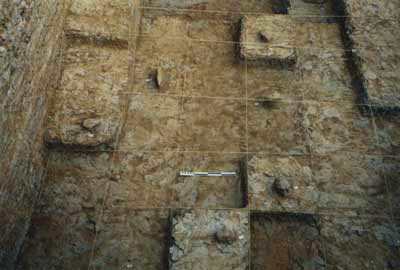
Upper Palaeolithic artefact horizons.

Attirampakkam forms one of the classic sites in the history of Indian Palaeolithic archaeology. Discovered by the British geologist Robert Bruce Foote in 1863 (Reference FooteFoote 1866), it was sporadically investigated for over a century (Reference KrishnaswamiKrishnaswami 1938; I.A.R 1965-67). Significant conceptual developments in Indian prehistory and Quaternary studies had their origin in research at this site, which was also characterised as a type-site of the Acheulian handaxe-based 'Madras Industries'. Situated in the Kortallayar river basin, Tamil Nadu, Attirampakkam (13° 13' 50" N and 79° 53' 20" E; 37.75 m AMSL) is one of numerous Lower and Middle Palaeolithic sites in the region (Pappu 2002). At present, gullies and rain rills erode tools over an area of around 50,000m².
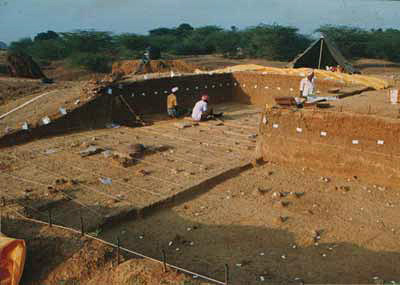
Our ongoing excavations (1999-2002) aim at establishing the nature of hominid activities at the site, the environmental context of the site, and the age of the assemblages. These discoveries will be situated within the broader regional setting and would be able to contribute towards the study of early hominid behaviour during the Middle and Late Pleistocene in South Asia. The site was mapped (contour intervals of 1 m), and five test-trenches (4m² each; maximum depth of 7.30m), a step-trench (12 x 1m), and five trenches (144m²) were excavated.
Acheulian tools in laminated clays.

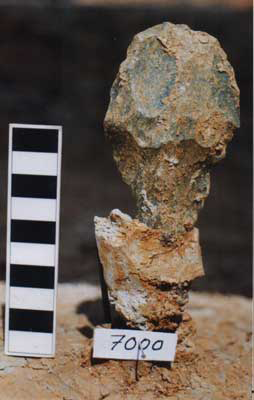
Excavations have revealed a multicultural site with stratified Lower, Middle and Upper Palaeolithic deposits in well-preserved primary contexts. A significant discovery was that of Acheulian artefacts in a 4 m thick deposit of laminated clays (Layer 6; 2.96-6.90 m in test trench T3), which were previously assigned to a Lower Cretaceous formation, and which our studies now show to be Pleistocene in age. The presence of Acheulian artefacts in clay beds, indicative of a palaeofloodplain situation, represents a new ecological habitat to be identified in the Indian Palaeolithic. Acheulian artefacts, mainly handaxes, are of quartzites, which are not available locally. The paucity of debitage and cores indicate that early hominids brought largely finished tools to the site, possibly to exploit water, game and plant resources.
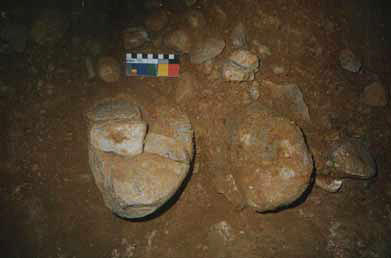
An Acheulian living floor was exposed 3.6 m below the surface with large boulder cores, artefacts and debitage found in association with a set of animal footprints, the first of their kind to be documented in South Asia. These comprise a set of 17 round impressions (diameter of 15-20 cm) and a set of hoof-prints, which are being studied. Palaeomagnetic measurements indicate an age of the Acheulian within the Brunhes-Matuyama chronology of 730 ka.
Acheulian handaxe embedded vertically in clays.

The clays were rapidly buried under ferrugionous gravel beds (up to 1m thick), containing Middle Palaeolithic artefacts. The site was subsequently abandoned, a phase marked by archaeologically sterile clayey-silts (Layers 3 and 4). These are capped by a ferricrete containing tools indicative of an Upper Palaeolithic horizon (Layer 2; average 0.20 m thick). Artefacts are of fine-grained quartzites. This horizon also yielded calcrete root casts, extensive animal burrows, possible post-holes and two conjoinable tools. A sterile clayey-silt (Layer 1) overlies this. Microliths, medieval potsherds and bricks have been noted on the surface.
The discovery of three fossil teeth is significant, as fossils are rare at Indian Lower and Middle Palaeolithic sites. These include an upper molar of Bovini, possibly representing Bubalus (water buffalo) or Bos; a lower molar of Equus sp., and a left lower molar, Caprinae or Boselaphini (Boselaphus : nilgai). These indicate at least three different fossil species suggestive of an open and wet landscape.
Attirampakkam is unique in providing an opportunity to study transitions through time, and changing hominid adaptive strategies over the Pleistocene, with assemblages preserved in a largely primary context. Ongoing attempts to date the site using palaeomagnetic measurements, ESR, U/Th techniques, palaeobotanical studies and studies related to molecular biology are in progress, and will yield new evidence on the South Asian Palaeolithic.
Large Acheulian cores, hammerstones and tools in ferruginous gravels.