

Introduction
Binary gender division has long been accepted as a defining feature of the European Bronze Age and taken to be a sign of a growing interconnection between communities across the continent (e.g. Childe, Reference Childe1930; Treherne, Reference Treherne1995; Kristiansen & Larsson, Reference Kristiansen and Larsson2005; Robb & Harris, Reference Robb and Harris2018). Recent findings of genetic similarity deriving from migrations across Europe have only reinforced this vision (Olalde et al., Reference Olalde, Brace, Allentoft, Armit, Kristiansen and Booth2018) and binary gender dynamics are seen as both integral to migratory motivations and their result (e.g. Kristiansen et al., Reference Kristiansen, Allentoft, Frei, Iversen, Johannsen and Kroonen2017). The power relations underlying this division have received sustained critique in recent years (e.g. Brück & Fontijn, Reference Brück, Fontijn, Fokkens and Harding2013; Frieman et al., Reference Frieman, Teather and Morgan2019), but many critiques of male-dominated power relations are similarly situated within a binary understanding of gender (e.g. Brück, Reference Brück2006; Lull et al., Reference Lull, Rihuete-Herrada, Risch, Bonora, Celdrán-Beltrán and Fregeiro2021).
In this article, I return to the heart of the issue—the existence, universality, and implications of the gender binary itself. The analysis focuses on two regions on the north-western periphery of Europe: Ireland and Scotland. Here, ‘region’ describes the UK nation of Scotland and the island of Ireland, containing Northern Ireland (part of the UK) and Ireland (an independent country). For economic, political, and geographic reasons, both tend to feature in the background of discussions of the European Bronze Age, despite being far from ‘marginal’ in Chalcolithic and Bronze Age contexts, as copper exports from south-western Ireland make clear (O'Brien, Reference O'Brien2004). Both areas have complex burial practices that challenge us to consider whether such idiosyncrasies represent ‘noise’, to be smoothed over in our grand narratives of the development of gender in Europe, or variability in social dynamics that puts the relevance of metanarratives into question. The latter would have dramatic implications for our ability to speak of a unified Bronze Age in Europe, while the former would significantly strengthen our understanding of trade, exchange, and migration bringing cultural and social similarity across the continent.
Gender Binaries in the European Bronze Age
The centrality of binary gender to Bronze Age social models is exemplified by Robb and Harris's (Reference Robb and Harris2018) recent contrast between a largely binary and stable Bronze Age perception of gender and the contextual and relational understanding of gender they argue prevailed in the Neolithic. The binary mode of gender in the Bronze Age is illustrated by striking examples from pictorial rock art and burials. The picture is, however, complicated in both cases. Figures in rock carvings frequently appear with male genitalia, and this motif has been linked to masculinities connected with warriorhood, travel, and exchange (e.g. Kristiansen & Larsson, Reference Kristiansen and Larsson2005; Bevan, Reference Bevan, Skoglund, Ling and Bertilsson2015; Horn, Reference Horn, Bergerbrant and Wessman2017). Yet, this need not be a straightforward presentation of binary identities (Nordbladh & Yates, Reference Nordbladh, Yates, Bapty and Yates1990); there are very few reliable images of female bodies and most rock art figures in Scandinavia (some 75 per cent) have no visible sex markers (Horn, Reference Horn, Bergerbrant and Wessman2017). Furthermore, since these traditions only appear in certain areas (Iberia, northern Italy, and southern Scandinavia), they may not represent pan-European norms.
Cemeteries, on the other hand, are widespread, and examples of binary orientations and/or grave good associations split between male and female bodies are well documented. Recent evidence shows this extended to children's graves at Franzhausen in Austria (Rebay-Salisbury et al., Reference Rebay-Salisbury, Bortel, Janker, Bas, Pany-Kucera and Salisbury2022). However, such cemeteries are temporally diverse: Copper Age examples in Hungary and Bulgaria (e.g. Sofaer Derevenski, Reference Sofaer Derevenski2000; Krauß et al., Reference Krauß, Schmid, Kirschenheuter, Abele, Slavchev and Weninger2017) predate Early Bronze Age cases in Austria or Denmark by at least a millennium. For intervening periods and places, the patterns are far more complicated. Moreover, there has been no systematic investigation of gender across the continent and the validity of projecting a gender model from disparate evidence remains to be tested. This is particularly pertinent given noticeable differences in settlement form, nucleation, and daily practices, for example in the uneven distribution of wool technology (Haughton et al., Reference Haughton, Sørensen and Bender Jørgensen2021).
Nevertheless, striking examples of gender binaries set the norm in the literature, and these have been mapped onto a picture of male-dominated hierarchical chiefdoms based on heroic travel and/or violence (Treherne, Reference Treherne1995; Kristiansen & Larsson, Reference Kristiansen and Larsson2005) seen across Europe, e.g. in Britain (Needham et al., Reference Needham, Lawson and Woodward2010), Scandinavia (Kristiansen, Reference Kristiansen and Sjögren2006), Iberia (Lull et al., Reference Lull, Rihuete-Herrada, Risch, Bonora, Celdrán-Beltrán and Fregeiro2021), Germany (Meller, Reference Meller2019), or Hungary (Earle et al., Reference Earle, Ling, Uhnér, Stos-Gale and Melheim2015). The picture evokes medieval analogies, as exemplified by models of female exogamy to secure alliances (e.g. Frei et al., Reference Frei, Villa, Jørkov, Allentoft, Kaul and Ethelberg2017; Mittnik et al., Reference Mittnik, Massey, Knipper, Wittenborn, Friedrich and Pfrengle2019). This model prevails despite heavy criticism of its modern underpinnings (e.g. Brück & Fontijn, Reference Brück, Fontijn, Fokkens and Harding2013) and recognition of power structures centred on women, as in Lull and colleagues’ (Reference Lull, Rihuete-Herrada, Risch, Bonora, Celdrán-Beltrán and Fregeiro2021) argument for powerful women within El Argar communities in eastern Spain. Alternative understandings of relational personhood have been hugely important in recognizing gender change over an individual's life-course and variation within predefined categories (e.g. Brück, Reference Brück2004, Reference Brück2006, Reference Brück2019; Appleby, Reference Appleby2011; Fowler, Reference Fowler2013), but these approaches often maintain an underlying binary division in order to discuss identities (see, for example, Brück's (Reference Brück2006: 86; Reference Brück2019: 227–29) account of dowries). The same is true for critiques identifying powerful women. Recently, these underpinnings have begun to be questioned. Frieman and colleagues (Reference Brück2019: 161) provide a compelling alternative. In their speculative retelling, the famous ‘elite’ burial from Egtved in Denmark becomes a community's attempt to force a queer body to fit within the confines of binary expectation.
It is in this spirit that I reconsider our gendered assumptions, in this case in regions on the Bronze Age periphery. Like elsewhere in Europe, research in Ireland and Scotland has been much influenced by expectations of binary gender, despite overwhelming evidence for variety in funerary practice. The only binary burial patterns in Britain are confined to small areas at the onset of Beaker settlement (c. 2500–2000 cal bc), including parts of northeast Scotland (Shepherd, Reference Shepherd, Allen, Gardner and Sheridan2012), though other areas of Scotland maintained divergent funerary traditions (Wilkin, Reference Wilkin2011). In Ireland, burials were not binary at all and display ‘bewildering variety’ (Waddell, Reference Waddell1990: 1). Nevertheless, some work on social organization in Ireland has presupposed male-dominated elites (e.g. McSparron, Reference McSparron2020: 15) or accepted them by reference to the European Bronze Age (e.g. Mount, Reference Mount1997). Binary connotations are suggested for items such as necklaces or bronze razors (e.g. Kavanagh, Reference Kavanagh1991; Sheridan et al., Reference Sheridan, Jay, Montgomery, Pellegrini, Wilson, O'Sullivan, Scarre and Doyle2013), but they occur in very few graves and convincing sex associations remain to be proven, particularly in Ireland.
To investigate this question, I focus on burials from Earlier Bronze Age Ireland and Scotland (broadly c. 2500–1500 cal bc), covering the (putative) Chalcolithic period and Early Bronze Age, when the burial record is at its richest. I first explore broad themes through statistical analyses of the corpus, before contrasting these with more detailed case studies, because purely statistical studies produce very similar accounts of gender in different periods and fail to engage with the local scale at which gender was perceived and contested (Haughton, Reference Haughton2018). By reflecting on specific presentations of gender on the edge of continental Europe, I aim to investigate the validity of the assumption that binary gender perspectives prevailed throughout the European Bronze Age.
Population Overview
While recognized as separate entities (following e.g. Butler, Reference Butler1993), sex and gender are routinely conflated by the methods of gender archaeology (Sofaer & Sørensen, Reference Sofaer, Sørensen, Tarlow and Nilsson Stutz2013). This has produced an uncritical expectation and acceptance of modern binary gender categories (Ghisleni et al., Reference Ghisleni, Jordan and Fioccoprile2016; Haughton, Reference Haughton2018; Frieman et al., Reference Frieman, Teather and Morgan2019; Bickle, Reference Bickle2020), supressing in-category difference (Alberti, Reference Alberti and Nelson2006; Ghisleni et al., Reference Ghisleni, Jordan and Fioccoprile2016) and change over the life-course (Appleby, Reference Appleby2011). I understand binary, ‘physical’ sex as a modern way of classifying bodies rooted in scientific, post-Enlightenment worldviews. While a body's sex is sometimes archaeologically identifiable by osteological analysis, this does not necessarily reflect an intelligible category for that person when alive (Stratton, Reference Stratton2016; Black Trowel Collective, 2021). Thus, I use ‘male’/‘female’ to refer to modern categories rather than prehistoric realities. Instead of assuming this binary division, analysis must examine the range of possibilities for different bodies and ask whether these converge with modern understandings of sex. If they do not, then gender does not adhere to a strong binary division. Thus, while my statistical overview focuses, by necessity, on sex, I do not presuppose that sex will be a meaningful social category and I offer an open-minded discussion of case studies to explore occurrences of bodily variation and difference.
Funerary practice involves engagement with and response to the corpse and thus evokes the personhood of the deceased (Haughton, Reference Haughton2018; Brownlee, Reference Brownlee2020). This evocation is political; some people may be excluded from personhood (Eriksen, Reference Eriksen2017) and idealized presentations of the deceased are offered (Frieman et al., Reference Frieman, Teather and Morgan2019). Thus, gender is performed in burials (sensu Butler, Reference Butler1990), but the possibilities are always materially constrained (Barad, Reference Barad2003), in this case by the physicality of the corpse and the community's understanding of bodies. Gender norms, such as those manifested in burials, are never perfectly performed (Butler, Reference Butler1990); each performance re-enacts or recalls norms, rather than reproducing them, and may highlight their lack of fit. Thus, burials can be sites of reflection and spark change. Crucially, this occurs at an interpersonal level, between the gathered community and the bodily interactions in which they engage. Gender, too, is felt and understood interpersonally. It is these interpersonal negotiations and contestations that are revealed in burials rather than the gender identity of the deceased. Thus, it is important to consider the local context of burial actions (Haughton, Reference Haughton2018), as the case studies below show.
My analysis used osteological reports published since 1990 to provide a conservative estimate of consistent levels of accuracy in determinations (e.g. Meindl et al., Reference Meindl, Lovejoy, Mensforth and Carlos1985) and the elimination of significant earlier bias (e.g. Weiss, Reference Weiss1972). For example, the proportion of subadults identified in the present dataset was fifty per cent higher than in previous studies based on older determinations (Haughton, Reference Haughton2021). Legacy data were included where recent osteological analysis had been conducted, notably through the National Museum of Ireland's excellent presentation of previously unpublished material (Cahill & Sikora, Reference Cahill and Sikora2011). The dataset comprises 555 burials, representing a minimum of 810 people (438 from Ireland, 372 from Scotland) from 212 sites (Figure 1). The main findings, based on Haughton (Reference Haughton2020), are summarized here; note that the Culduthel burials (see case study below) were not included in the statistical analyses as they were conducted before Parker Pearson et al. (Reference Parker Pearson, Sheridan, Jay, Chamberlain, Richards and Evans2019) was published.
Distribution of sites in the database, with key sites labelled.

There was no significant difference in burial rite or grave form between the sexes (Table 1). Stone-lined cist graves are often taken as a marker of status (e.g. Mount, Reference Mount1997), though this has been undermined by a related analysis demonstrating that children were significantly more likely to be buried in a cist in Ireland (Haughton, Reference Haughton2021). Average cist sizes were similar in Ireland, but in Scotland male bodies were buried in larger cists than female bodies (average floor size: 0.66:0.46 m2). Single burial, another suggested marker of status (e.g. Mount, Reference Mount1997), was much more common in Scotland, but there was no significant difference between sexes. Bodies buried in Ireland were significantly more likely to be male (outnumbering female bodies by 2:1; Table 1); a similar pattern in Scotland was less pronounced and may be a result of the comparative ease of identifying male sex markers. The picture is further clouded by large quantities of human remains with no osteological sex attribution. This is due to the frequency of cremation, poor preservation in some areas, and deposition of partial remains.
Summary demographic and burial type data. ‘Male’/‘Female’ include certain and probable cases; p-values derive from chi-square tests of these burials. Sample sizes vary due to excavation or taphonomic factors.

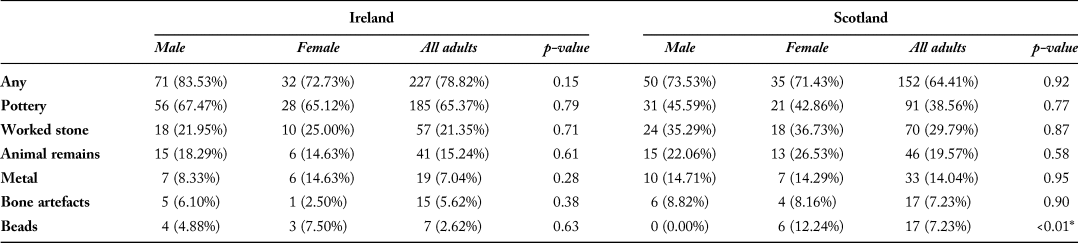
There was no strong patterning among the grave goods either (Table 2). The frequency of the most common artefact, pottery, was most strongly influenced by location. Two thirds of adults, both male and female, received pottery in Ireland; in Scotland, the figure was less than half for both. Many grave goods were so infrequent that further interpretation is unwise.
Summary grave good associations. ‘Male’/‘Female’ include certain and probable cases; p-values derive from chi-square tests of these burials. Sample sizes vary due to excavation or taphonomic factors.
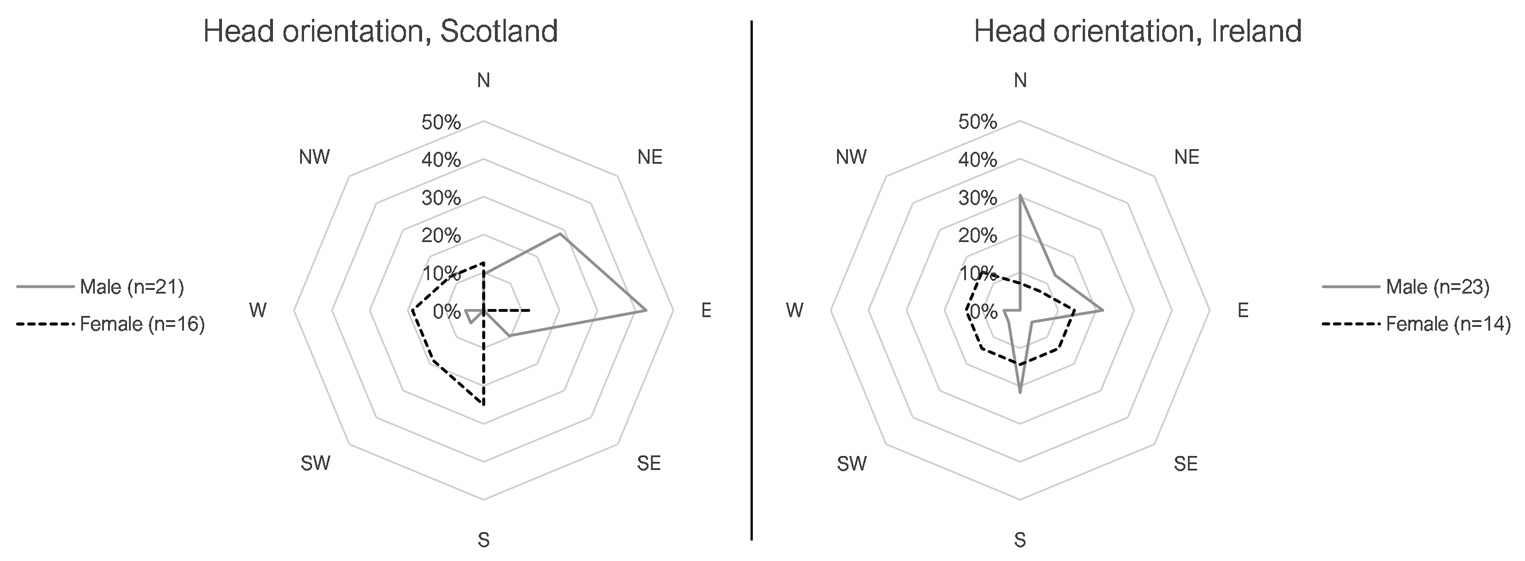
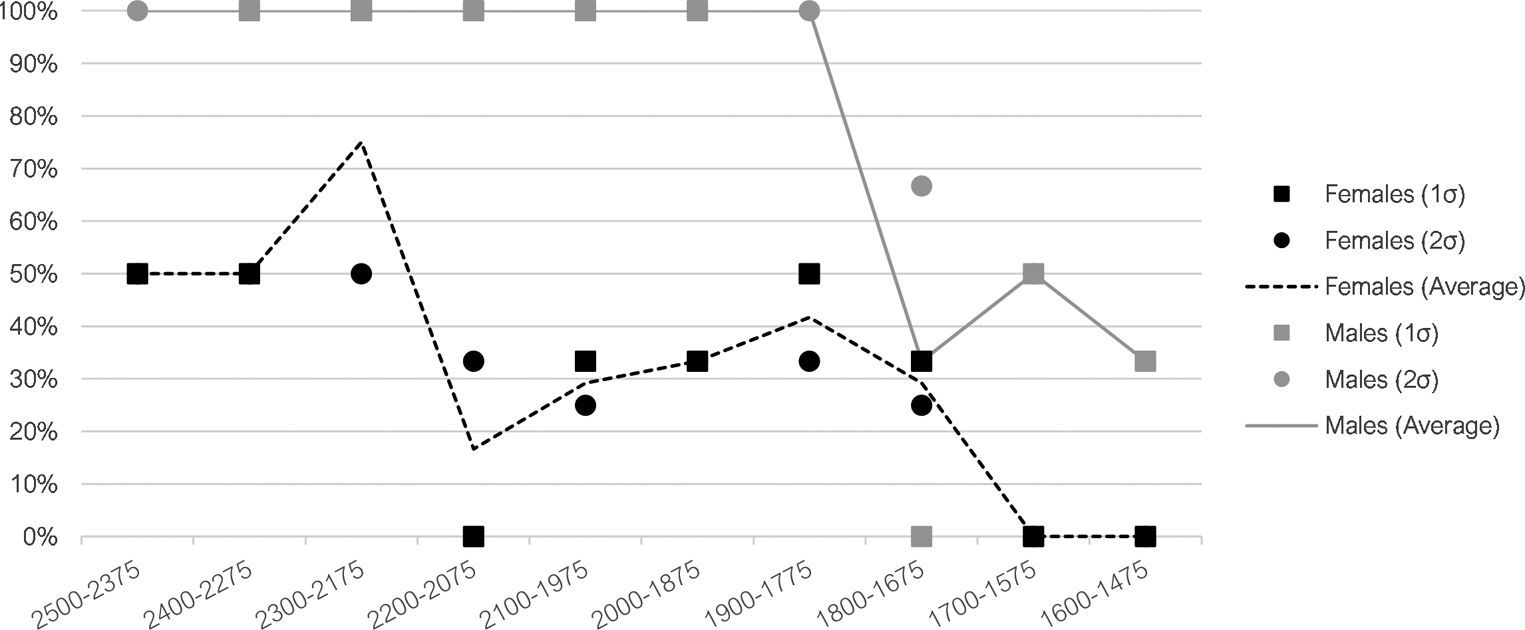
Body orientation showed interesting divergences (Table 1; Figure 2). In Ireland, the data show little evidence of strong trends. In Scotland, the data align with Shepherd's (Reference Shepherd, Allen, Gardner and Sheridan2012) findings: male inhumations lying on their left-hand side, with the head oriented to the east, and female bodies often oriented to the west; the evidence for laying them on their right-hand side is equivocal. When viewed over time, the pattern becomes clearer: Figure 3 represents the frequency of left-hand-sided burial over time—with burials counted as members of the group if their radiocarbon date falls within the given time range. This crude method gives equal weighting to all years covered by a date estimate and hence Figure 3 is not a true representation of change over time, but rather reflects a broad sequence. Nevertheless, it helps establish that all male bodies with early radiocarbon dates in Scotland in this dataset were buried on their left, but that, from the outset, there was no corresponding pattern of burying female bodies on their right-hand side.
Radar charts depicting orientation of heads in inhumations.
Relative frequency of burial on the left-hand side over time in Scotland, showing dates modelled at 1 and 2 sigma.
The bodies in the dataset do not fall into neat groups. While male adults may be laid out in a common way in Scotland, this was not binary as it was not matched by a corresponding ‘female’ trend. Moreover, the trend loses strength over time. As for Ireland, there is little evidence of binary difference. I shall therefore turn to the scale of lived experience to assess whether trends not identified at the macro-scale can be detected locally.
Vignettes from Funerary Practice
Scotland: Inverness group
A series of dispersed burials around Inverness provides an interesting example of the early Beaker tradition in northeast Scotland (Figure 4). I focus here on two subgroups: Culduthel and Holm Mains Farm.
Location of burials in the Inverness group.
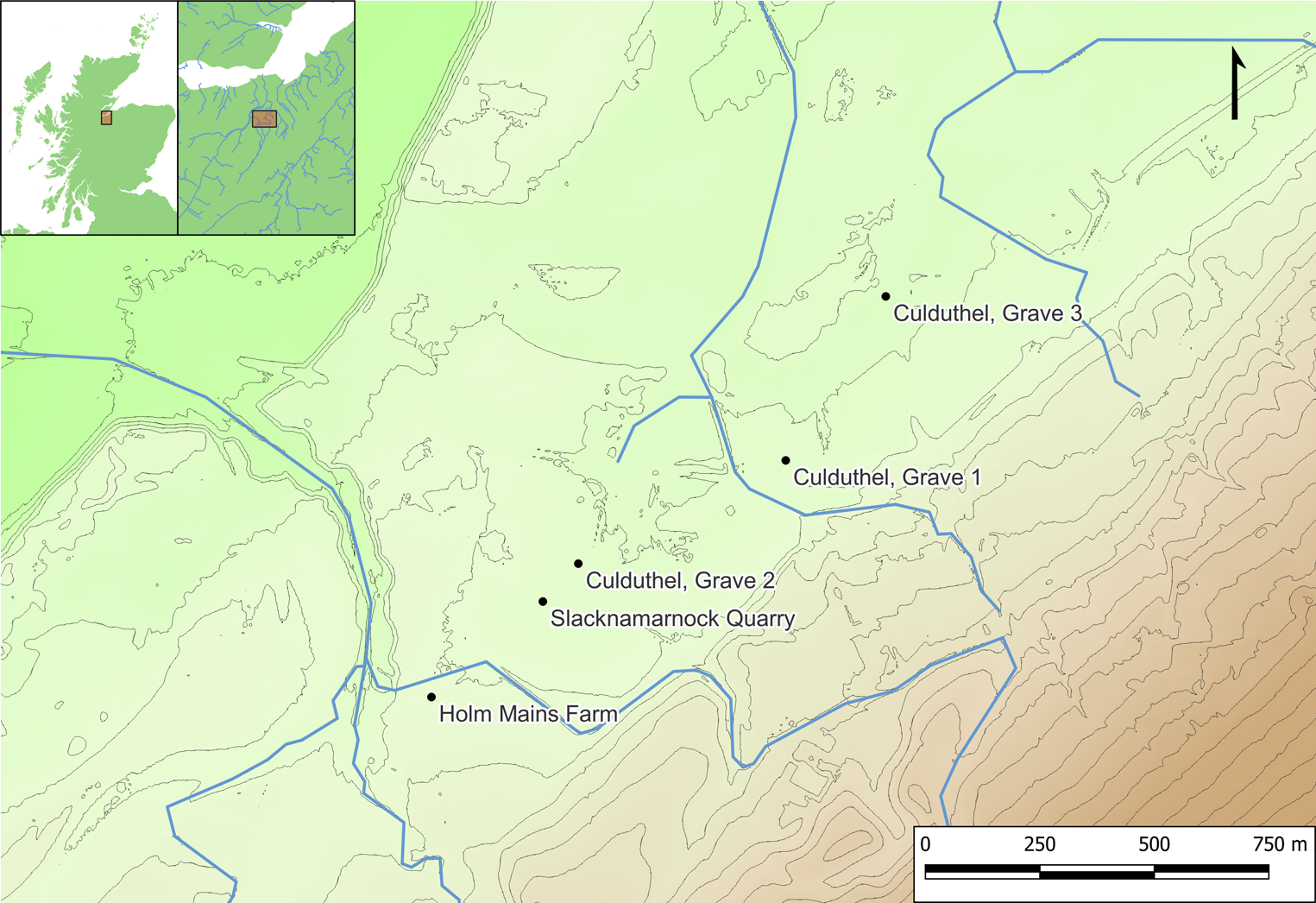
Three cist burials were found around Culduthel, south of Inverness. Two were exemplars of the Beaker tradition, matching Shepherd's (Reference Shepherd, Allen, Gardner and Sheridan2012) orientation patterns and with unusual artefact associations (Parker Pearson et al., Reference Parker Pearson, Sheridan, Jay, Chamberlain, Richards and Evans2019). Culduthel 3 contained a crouched adult male accompanied by a Beaker vessel, an amber bead, a stone wristguard with four gold-capped copper studs, a bone toggle, and eight flint arrowheads. Culduthel 1, c. 420 m to the southwest, contained a young adult female lying on her back, with legs flexed on the right-hand side. A boat-shaped jet fastener and over 500 jet beads lay across and behind the pelvis and hands, suggesting a belt or girdle. A bronze awl was recovered near the head, and a flake of Arran pitchstone, recovered in sieving, may have come from the grave fill. In contrast, Culduthel 2, some 500 m southwest of Culduthel 1, contained an unaccompanied crouched inhumation, on its left-hand side, which has not been the subject of recent osteological analysis.
Southwest of Culduthel, a pair of cist burials, 80 m distant from each other, were excavated at Holm Mains Farm (Headland Archaeology, 2007). Grave 1, aligned northsouth, contained an adult male lying on the left-hand side, accompanied by a Beaker vessel, ten chert tools, a small barbed-and-tanged arrowhead, and part of an ovicaprid humerus. A larger, broken barbed-and-tanged arrowhead was recovered from the cist's pebbled floor. Grave 2, badly damaged by ploughing, was aligned northeast–southwest and contained a young adult male, lying on the left-hand side, accompanied by a Beaker vessel similar to that of Grave 1. Radiocarbon dates suggest that both males were buried at the same time or nearly so (Grave 1: 2280–2030 cal bc (OxA V-2166-41); Grave 2: 2290–2030 cal bc (OxA V-2166-42), both at 95% probability; Sheridan et al., Reference Sheridan, Parker Pearson, Jay, Richards, Curtis, McAdam and Milburn2007: 199).
These burials conform to the sex-based patterns established for Beaker burials in the area, although the furnishing of two graves at Culduthel is unusually elaborate. Stable isotope analysis indicates that these individuals are unlikely to have come from the Scottish Highlands or the eastern coast (Parker Pearson et al., Reference Parker Pearson, Sheridan, Jay, Chamberlain, Richards and Evans2019: 395): strontium isotopic data indicates a basaltic origin, perhaps in western Scotland or northern Ireland, for the male, while combined oxygen and strontium data suggest that the female lived most of her life outside the Scottish Highlands.
Holm Mains Farm also emphasizes the importance of in-category difference. There, emphasis was placed on the relations between two males, inviting comparison of the form of the graves, roughly similar orientations, and similar Beaker pottery designs; they were, however, also set apart in physical space and in the quantity of grave goods accompanying them.
Scotland: Sketewan, Balnaguard, Perth and Kinross
Unlike in the Inverness area, burial activity at Sketewan, further south in Perthshire, was concentrated on a developing funerary monument. The site's long and complex history (Mercer & Midgley, Reference Mercer and Midgley1997) includes Food Vessel and Collared Urn use (c. 2000–1500 cal bc) with further activity in the Middle Bronze Age. Burial practice here thus post-dates that around Inverness and can be reconstructed as follows (see Figure 5). Initially, a central pyre was used for cremations and six cist graves containing washed cremated bone were constructed. Then, a ring-cairn was erected around the pyre, covering some of the cists (Graves 4, 5, 7, and possibly 3). A seventh cist (Grave 1) cut the pyre, after its first use but before its final use, and was subsequently covered with a small cairn. Later, the ring-cairn was ‘infilled’ to create a single cairn. South of that cairn, six pit burials (Graves 8–13) were then established. A cremation burial (Grave 14) was set in the fabric of the ring-cairn; its location and lack of cist associates it with the post-ring-cairn burials.
Simplified plan of the major phases of the cemetery at Sketewan, Perth & Kinross (redrawn using data from Mercer & Midgley, Reference Mercer and Midgley1997: figs. 9, 11, 17, and 20). Phase One central cairn omitted for clarity.
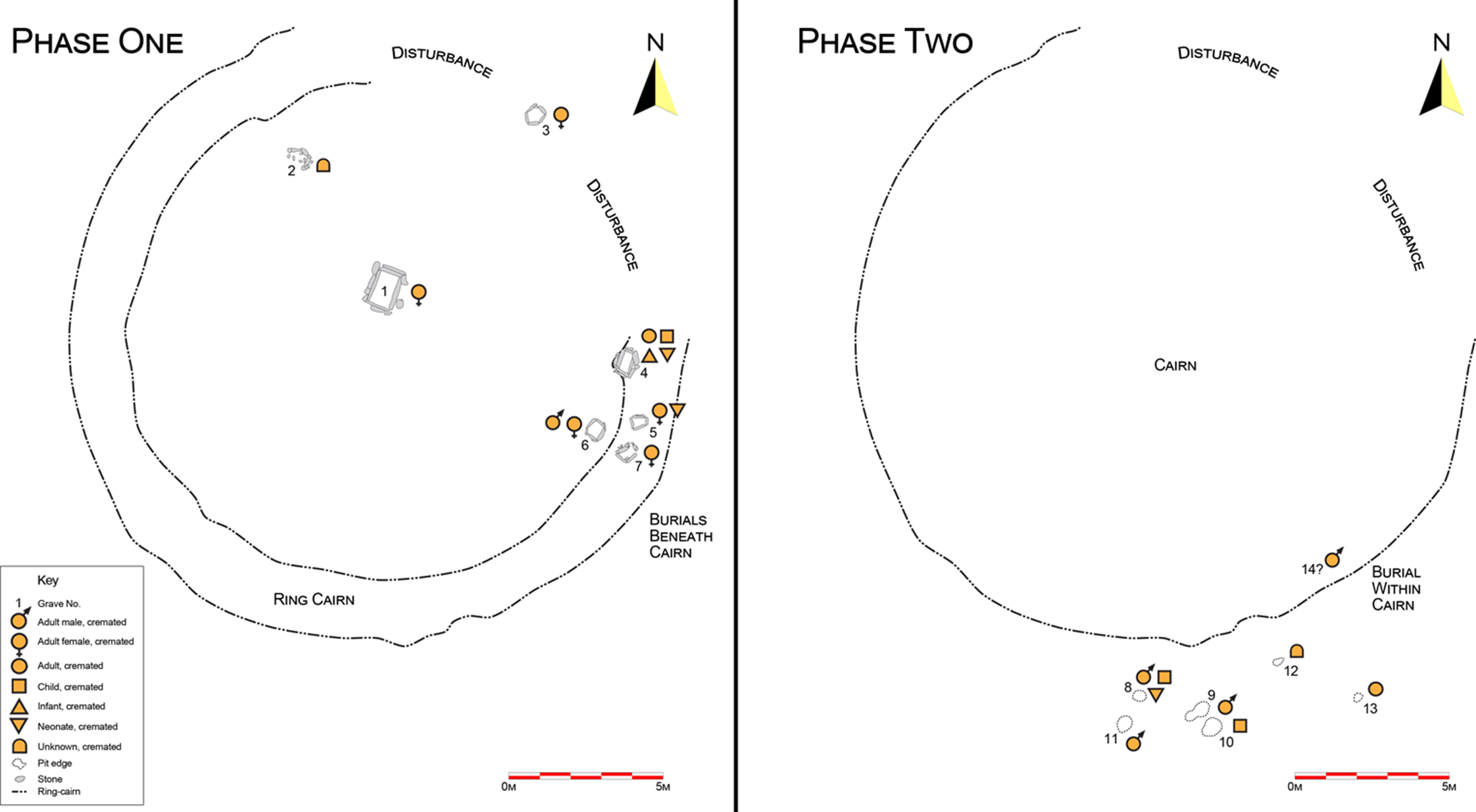
In a database, the picture appears balanced: five females, five males, and few grave goods. There is, however, a clear spatial patterning which seems to reflect chronological difference. The early burials (1–7; Phase 1 on Figure 5) mostly contained female bodies. While the sex of the occupant of Grave 2 is unknown, in Grave 4 a pre-term infant or foetus was one of three subadults, strongly suggesting that the adult accompanying them was a pregnant female. Only Grave 6 contained a probable male adult, alongside a probable female. After the construction of the ring-cairn, the picture is radically different: of five adults, at least four were probably male (Phase 2 on Figure 5).
The Sketewan evidence suggests a shift over time, from a space that was associated with the burial of female adults and children to a space for burying male adults and children. This was accompanied by a marked change in funerary practice (the pyre was blocked, cists were no longer built) and the complete remodelling of the physical space (the cairn was constructed). Grave 6 may represent the moment of transition, bringing male and female together in the grave; alternatively, the male individual may have had an identity or group association more commonly held by those with female bodies. Thus, Grave 6 cautions us—evidence suggesting binary gender may be more appealing as it fits our expectations, but alternative ways of reading this evidence remain.
Ireland: Kilcroagh, Co. Antrim
Four cremation burials were uncovered during farm work at Kilcroagh in Co. Antrim, and excavated by the landowner. The spatial relationship between the graves is unknown (Williams et al., Reference Williams, Wilkinson and Magee1991–92) but the presence of Cordoned Urns in three graves places them in the later Early Bronze Age (c. 1730–1500 cal bc). The urns from Graves 1 and 2 were excavated under laboratory conditions and the remains from all four graves analysed (Table 3). Graves 1 and 2 each contained the remains of two individuals (a male and a female in each case) and artefacts such as segmented faience beads and bronze objects, including at least one razor-knife. Gendered associations have been suggested for such finds, i.e. razor-knives for males (e.g. Kavanagh, Reference Kavanagh1991) and beads for females (e.g. Sheridan et al., Reference Sheridan, Jay, Montgomery, Pellegrini, Wilson, O'Sullivan, Scarre and Doyle2013). Decontextualized, it might be tempting to interpret these as examples of grave goods reflecting the masculine and feminine identities of the paired deceased, but the sequence of activity contradicts this.
Grave contents from Kilcroagh, Co. Antrim.
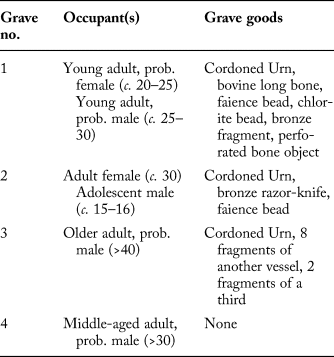
The artefacts from Grave 1 accompanied the deceased on the pyre. Green staining only on the female bones suggests that the fragmentary bronze object was associated with this body on the pyre (Williams et al., Reference Williams, Wilkinson and Magee1991–92: 52–54). The human remains and artefacts were then collected and buried with the urn inverted over them.
By contrast, the artefacts in Grave 2 were unburnt. The human remains were mixed and crushed before deposition; they were largely those of an adult female, with only a small proportion from an adolescent male (Williams and colleagues (Reference Williams, Wilkinson and Magee1991–92: 50) state that the adolescent was identified osteologically as male, though this is not mentioned in the osteological report on p. 54). The remains were then placed in an urn and ‘capped’ with a deposit of pyre debris and an unburnt segmented bead. A razor-knife stood vertically within the cremated bone, hilt upwards, suggesting that it had been pushed down into the deposited cremated remains. Therefore, the faience bead and the razor-knife were not directly associated with the bodies, and the razor-knife played an active role in funerary proceedings. Thus, the grave goods seem to have referenced graveside activity and relationships with the dead (see Brück, Reference Brück2019) rather than fixed identities and possessions.
The two graves evoke one another in the combination of bodies and grave goods but the sequence of action was clearly different. The repeated combination of male and female may hint at complementarity, but it would be impossible to sustain this argument on this evidence alone. In fact, the clear social differentiator here was age: children are absent from the graves altogether.
Ireland: Ballybrennan, Co. Westmeath
The site at Ballybrennan, Co. Westmeath, is located in a densely packed Bronze Age funerary landscape. Four cist graves were excavated separately there in the 1940s and the human remains were recently re-analysed by the National Museum of Ireland (Hartnett & Prendergast, Reference Hartnett, Prendergast, Cahill and Sikora2011).
The four graves contained: (1) a child; (2) a middle-aged adult female; (3) two adult males; and (4) an adult male. Graves 2 and 4 also contained an infant's femur each, which belong to a wider pattern of idiosyncratic, local treatment of children's remains (see Haughton, Reference Haughton2021). It seems that at Ballybrennan neither sex nor age were barriers to burial. Infant femora, whatever their significance, were an appropriate inclusion in burials with a female or a male, and in both cases matched the rite afforded to the adult—inhumation in Grave 2, cremation in Grave 4. The grave goods provide little evidence for differentiation (for details, see Hartnett & Prendergast, Reference Hartnett, Prendergast, Cahill and Sikora2011), although the two burials containing males had pottery while the other two did not.
Three important points emerge at Ballybrennan: first, although only four graves were excavated, local trends in practice arise, in this case relating to infant femora. Second, in the broad range of funerary treatment, it is infants that were treated in particular ways; no themes in adult treatment are evident. Third, the two rites are juxtaposed: Grave 3 features cremated remains laid over the knees of an inhumation. This was also encountered at neighbouring Conranstown (Raftery, Reference Raftery, Cahill and Sikora2011), just 6 km north-northwest of Ballybrennan, where an inhumation was accompanied by a portion of cremated frontal bone. As at Ballybrennan, the two bodies were male. It may be relevant here to think of the creation or augmentation of difference between bodies through funerary treatment.
Discussion
The examples presented above suggest that the funerary practice of some communities was strongly influenced by the biological sex of the deceased while in other groups the bodies’ sex appears not to have been a determining factor. In the following, the glimpses offered by the vignettes are combined with an overview to expand our understanding of conceptions of gender and social organization.
Gender in Earlier Bronze Age Scotland
Binary gender has been argued for Bronze Age Scotland based on burial orientations in the northeast (Shepherd, Reference Shepherd, Allen, Gardner and Sheridan2012) and gendered associations of metalwork and beads or jewellery for grave goods (Sheridan & Shortland, Reference Sheridan and Shortland2003). Here, a more nuanced picture emerges, namely: (i) the previously recognized burial orientation pattern was not strictly binary; (ii) there is little evidence for material culture marking gendered identities; (iii) some cemeteries were explicitly concerned with the embodied sex while others were not; and (iv) in-category variation was present.
The Beaker-associated trend for burying male bodies on their left-hand side early in the period was not matched by a corresponding trend among female bodies. If this practice reached Scotland with Beaker-related migration, it may reflect a specific masculine identity, social role, or cosmological identity, rather than a distinction from women or a feminine identity. The migration itself is often understood as a solely masculine undertaking (e.g. Kristiansen et al., Reference Kristiansen, Allentoft, Frei, Iversen, Johannsen and Kroonen2017). While this might suggest that male incomers brought gendered practices, not matched among local communities, isotopic analyses reveal a general level of mobility among most Beaker burials in Britain, including Culduthel (Parker Pearson et al., Reference Parker Pearson, Sheridan, Jay, Chamberlain, Richards and Evans2019). At Culduthel, at least one person may have come from Ireland, where Beaker burial was unknown, which suggests that incomers were not treated according to the rites of their homeland. Instead, the community followed a locally adapted tradition, perhaps reflecting a gender ideal that was deliberately (re)appropriated or altered by its assimilation into the local context.
Material culture categories did not adhere to biological sexes. Metal artefacts did not vary between different adult categories. Neither were beads an exclusively feminine marker; an amber bead accompanied a male burial at Culduthel 3 and a necklace accompanied a child at West Water Reservoir (Hunter, Reference Hunter2000), for instance. Even if beads were mainly placed with female bodies, they are very rare in graves. While most communities did not use grave goods to stress sex difference, the biological sex of the deceased could be a strong structuring principle for burial practice, as at Sketewan. On the other hand, the contemporary cremation cemetery at Dunure Road, South Ayrshire, offered no hint of a division between adult bodies (Haughton, Reference Haughton2018). Thus, a binary understanding of adult bodies was important in some places and times, but not in others. Neither do I suggest that, where an identity conformed to a biologically male body, it did so in a totalizing way. At Holm Mains Farm, similarities between two burials were stressed in ways that must have invited comparison for the gathered mourners. While they may have shared an identity category, which may or may not have been ‘masculine’, the differences between their presentation in the grave both create and stress differences between them.
Gender in Earlier Bronze Age Ireland
In Ireland, I found little evidence for binary gender; and old theories, such as a link between metal and masculinity (e.g. Kavanagh, Reference Kavanagh1991; Mount, Reference Mount1997), did not stand up to the evidence gathered in overview and in detail at Kilcroagh. Neither did the case studies suggest an important or rigid understanding of gender as binary. Elsewhere in the dataset some hints appear: the four earliest burials at Edmondstown, Co. Dublin, were all of adult males, a situation reminiscent of that at Sketewan, while at Ballynacarriga, Co. Cork, the site seemed to have a particular association with female and subadult bodies, and perhaps pregnancy (see Haughton, Reference Haughton2021: 371–73).
The case studies revealed the repeated pairing of particular types of body. At Kilcroagh, a male/female pairing was repeated in Graves 1 and 2; other cases of pairing in the dataset include two graves at Keenoge, Co. Meath (Mount & Buckley, Reference Mount and Buckley1997). Here, Grave 5 contained the remains of a young adult female accompanied by a skull fragment from an older adult male, while Grave 13 contained an older adult male accompanied by a fragment of a female's pelvis. In both graves, cremated remains from a third person were also present. The juxtaposition of older adult male and (potentially young) adult female does not seem random, particularly given the frequency of local patterns at other sites, such as the infant femora at Ballybrennan. Even if coincidental, it suggests a community drawing on a shared repertoire that links these bodies as appropriate for comingling in the grave. Crucially, the cremated bone suggests a tripartite grouping of bodies, and perhaps identities, that should form this metaphorical assemblage. The paired cremated and inhumed male bodies at Ballybrennan and Conranstown may similarly draw on common metaphors. Rather than referencing a male/female binary, they are treatments appropriate for comingling bodies. Here, the community seems to have been concerned with difference, creating it through the burial rite, though whether that adhered to sex, age, or some other category is unclear. In Britain, human bone was often curated for several generations prior to deposition with articulated burials (Brück & Booth, Reference Brück and Booth2022). If that were also the case here, these patterns might demonstrate an ongoing connection with specific embodied identities of the deceased rather than an understanding of human bone as remnants of generic ancestors. Crucially, this is in line with Brück and Booth's (Reference Brück and Booth2022) argument that bones were usually curated for one to three generations, when stories of the deceased might still be remembered.
These instances reveal subtle, contextual understandings of body differentiation within the funerary sphere. There may have been places and times in which certain bodies were more appropriate, though this need not imply a coinciding differentiation in lived ‘social roles’ or identities for most people. Gender here is ‘loose’, emerging in interactions with bodies, with no sense that actions were heavily prescribed. In some contexts, as in commingled cremation deposits (e.g. Tomfarney, Co. Wexford, at least seventeen individuals), body types may even have been wholly irrelevant. Perhaps this was also the case in living contexts: gender sometimes had a role to play in structuring interactions, while at other times the concern was to differentiate between adults and subadults, or to erase difference altogether. The creation of difference by funerary rite, as at Ballybrennan and Conranstown, further hints at situational differences in life, perhaps brought about through physical interactions with those bodies. In other words, aspects of bodily identity in these societies seem contingent and relational; they were formed by reference to one another at a local scale.
Conclusion
Scale is at the heart of this article; when should the grand narrative be visible in the archaeological record and how much ‘noise’ can it accommodate while maintaining its usefulness? I outline three interpretive possibilities here, each a conceivable response to the detected trends.
First, is the evidence itself defective? Binary gender may have been a strong feature across the European Bronze Age, but this may not, for various reasons, be perceptible in the burial record. It is possible for burial practice to erase lived difference; indeed, this seems to have occurred in the commingled Early Bronze Age grave at Tomfarney. Most communities, however, seem to have been concerned with marking social difference. Subadults were routinely treated differently in Ireland (Haughton, Reference Haughton2021), as seen at Ballybrennan, thus if communities were concerned with binary gendered identities at burial, they would have been capable of articulating that. In Scotland, at Sketewan, the biological sex of the deceased seems important, but this was not the case at most other cemeteries. At the very least, this implies that the content and importance of (binary) gender could radically differ between communities in the same region. This localized difference in presentations of the body, distinct from that practised by other European communities, cannot be written off as an evidential poverty of the periphery.
Second, binary gender identities might have appeared gradually through the Bronze Age in Ireland and Scotland. From this perspective, Sketewan might represent an early flourishing of an idea that would later grow. However, the evidence suggests the opposite: a consistent early treatment for male bodies in Scotland goes out of fashion, and there is no growing density of binary cemeteries in later centuries; Sketewan is somewhat unusual. In Ireland, there is simply nothing to suggest the growth of binary gender, despite the fact that communities were actively engaged in depositing bones from particular categories of body (e.g. infant femora), creating difference through funerary rite and repeating the metaphorical associations of body-type combinations. Much later, in Iron Age Europe, significant differences in gendered practices seem to have existed between communities (Pope, Reference Pope2021), further disproving any sense of a growing ossification of binary gender over time.
Third, we must admit that we are yet to understand how important and widespread binary gender was in the European Bronze Age. There are certainly striking examples from some areas which strongly suggest binary understandings in particular communities (e.g. Sofaer Derevenski, Reference Sofaer Derevenski2000; Rebay-Salisbury et al., Reference Rebay-Salisbury, Bortel, Janker, Bas, Pany-Kucera and Salisbury2022), but other places lack such evidence. The beginning of the Bronze Age clearly did not bring static and ‘stable’ gender (contra Robb & Harris, Reference Robb and Harris2018: 133) to either Scotland or Ireland. The migrations and genetic turnover that accompanied the spread of metallurgy (e.g. Olalde et al., Reference Olalde, Brace, Allentoft, Armit, Kristiansen and Booth2018) cannot be associated with the growth of social interconnection, at least not as far as the local practice and performance of gender is concerned.
The practices revealed in this study are neither arbitrary differences nor noise to be ironed out in the grand narrative. The Scottish and Irish examples speak of small-scale societies which, while certainly in contact with one another and the rest of Europe, maintained their own traditions and potentially had divergent understandings of gender. Given large differences in the forms of settlement, burial, artefact traditions, as well as access to resources, we should be open to the idea that, although the Bronze Age saw increased exchange and long-distance mobility, it does not necessarily entail similarity in social organization and perceptions of sexuality and the body.
It is time to question the usefulness of a grand narrative that cannot account for practice in regions as large as Ireland and Scotland. Significant local performance and adaption of gendered practice must have taken place, and these small-scale societies seem to have frequently come to different understandings. This cannot simply be subsumed by a larger story of gender binaries. We must be led by the evidence, and it is critical to realize that there is no dearth of it here—these communities engaged in mortuary practice which both responded to and sometimes literally created bodily difference, but the differences stressed were locally specific and rarely suggest a binary understanding of gender. Instead of a grand narrative, we must recognize locally variable and culturally contingent gender practices. From the evidence available, the Bronze Age was a dynamic period in which gender could be fundamentally different from the entrenched, hegemonic binaries that we are used to deconstructing today.
Acknowledgements
This work was supported by the Arts and Humanities Research Council (UK), Jesus College, Cambridge, the Isbel Fletcher Garden Fund, and the Department of Archaeology, University of Cambridge. The article was completed while supported by the European Research Council under grant number 853356. I would like to thank Marie Louise Stig Sørensen, Joanna Brück, and Neil Wilkin for many highly productive discussions, and Marie Louise and Jo for reading an earlier draft of this article. Comments from three anonymous reviewers and the Editor greatly helped clarify the argument.


 Open access

