


Introduction
Since its genesis, the Internet has produced great benefits by revolutionizing the way people interact with the world, enabling access to a vast amount of information and exponentially increasing the possibilities for communication. However, there is increasing evidence that not everyone uses this technology appropriately, something which, together with rapid advances in device portability, can lead to Internet addiction, also known as Problematic Internet Use (PIU), an issue that is becoming a major source of concern in many developed countries (Kuss et al., Reference Kuss, Griffiths and Binder2013). Different definitions of PIU have been proposed, but all agree that it involves excessive, disproportionate, or inappropriate use of the Internet that causes distress, is time consuming, and impedes functioning in important areas of life, with this behavior continuing despite these negative consequences (Barke et al., Reference Barke, Nyenhuis and Kröner-Herwig2014). Andrade et al. (Reference Andrade, Scatena, Bedendo, Enumo, Dellazzana-Zanon, Prebianchi, De Lara Machado and De Micheli2020) recently defined PIU as a series of behaviors related to loss of control, intense desire, and emotional instability caused by lack of access to the Internet. PIU is considered an addictive behavior that, like other addictions, directly affects the user’s behavior by increasing impulsivity and loss of control (Van Ouytsel et al., Reference Van Ouytsel, Van Gool, Walrave, Ponnet and Peeters2016).
The prevalence of PIU is still unclear, mainly due to two reasons: first, a consensus has not yet been reached on the diagnostic criteria for PIU or its definition (Spada, Reference Spada2014); and second, being a relatively recent problem, few epidemiological studies have been carried out to date on this subject. Studies conducted in the general population show that between 0.7% and 1% of the population engage in PIU (Aboujaoude et al., Reference Aboujaoude, Koran, Gamel, Large and Serpe2006; Bakken et al., Reference Bakken, Wenzel, Götestam, Johansson and Oren2009), although these figures increase considerably when the adolescent population is analyzed separately. Specifically, data show that in that population, the prevalence of PIU in Europe is between 1% and 9% (Kaltiala-Heino et al., Reference Kaltiala-Heino, Lintonen and Rimpelä2004; Pallanti et al., Reference Pallanti, Bernardi and Quercioli2006; Siomos et al., Reference Siomos, Dafouli, Braimiotis, Mouzas and Angelopoulos2008; Villella et al., Reference Villella, Martinotti, Di Nicola, Cassano, La Torre, Gliubizzi, Messeri, Petruccelli, Bria, Janiri and Conte2011), in the Middle East it is between 1% and 12% (Canan et al., Reference Canan, Ataoglu, Nichols, Yildirim and Ozturk2010; Ghassemzadeh et al., Reference Ghassemzadeh, Shahraray and Moradi2008) and in Asia it is between 2% and 18% (Cao & Su, Reference Cao and Su2007; Ko et al., Reference Ko, Yen, Yen, Lin and Yang2007; Ni et al., Reference Ni, Yan, Chen and Liu2009; Park et al., Reference Park, Kim and Cho2008). For their part, studies carried out with university students in England and China report prevalence rates of 18.3% and 11.3%, respectively (Niemz et al., Reference Niemz, Griffiths and Banyard2005; Li et al., Reference Li, Xu, Chai, Wang, Li, Zhang, Lu, Ng, Ungvari, Mei and Xiang2018). Using all these data, Pan et al. (Reference Pan, Chiu and Lin2020) recently examined 700,000 subjects from 113 different epidemiological studies, finding that the prevalence rate is around 7%.
Despite the limited number of studies on this topic, research conducted so far coincides in indicating that PIU is closely associated with anxiety and depression disorders and stress (Bernardi & Pallanti, Reference Bernardi and Pallanti2009; Paulino et al., Reference Paulino, Mesquita, Fraga, Gomes and Madeira2023), eating disorders (Hinojo-Lucena et al., Reference Hinojo-Lucena, Aznar-Díaz, Cáceres-Reche, Trujillo-Torres and Romero-Rodríguez2019), behavioral problems (Ko et al., Reference Ko, Yen, Chen, Yeh and Yen2009), ADHD (Carli et al., Reference Carli, Durkee, Wasserman, Hadlaczky, Despalins, Kramarz, Wasserman, Sarchiapone, Hoven, Brunner and Kaess2013), and social phobia (Yen et al., Reference Yen, Ko, Yen, Wu and Yang2007). Specifically, depression and anxiety are the disorders that have been most frequently associated most often with PIU (Li et al., Reference Li, Lau, Mo, Su, Tang, Qin and Gross2017; Malak & Khalifeh, Reference Malak and Khalifeh2018). In this sense, studies show that people who engage in PIU display 10 times more depressive symptoms and 7 times more anxiety symptoms than people who do not (Andrade et al., Reference Andrade, Scatena, Bedendo, Enumo, Dellazzana-Zanon, Prebianchi, De Lara Machado and De Micheli2020), and that, inversely, some psychopathologies may aggravate PIU symptoms (Dahl & Bergmark, Reference Dahl and Bergmark2020).
It should be noted that the terms “Internet addiction” and “problematic Internet use” are used in the literature to refer to the same problem. Although many authors use the term Internet addiction, this pathology has not yet been included in diagnostic manuals. Regardless of whether or not excessive Internet use is accepted as an addiction or problematic behavior, several authors have recognized the need to assess the prevalence and psychosocial consequences of this behavior (Anderson et al., Reference Anderson, Steen and Stavropoulos2017; Restrepo et al., Reference Restrepo, Scheininger, Clucas, Alexander, Salum, Georgiades, Paksarian, Merikangas and Milham2020).
Regarding the instruments used for its measurement, the growing interest in exploring PIU has led to a proliferation of tools designed to assess this construct. According to the systematic review carried out by Laconi et al. (Reference Laconi, Rodgers and Chabrol2014), at that time there were already more than 40 questionnaires designed to assess PIU, although most of them had only been used a few times and lacked validation studies. The authors concluded that one of the most important problems in terms of the validity of these instruments was the lack of a single definition of PIU and the variety of theoretical frameworks underpinning the different scales. Specifically, three theoretical frameworks prevail: one based on behavioral addictions, equating PIU to disorders such as pathological gambling; one based on substance use disorder; and one based on the cognitive–behavioral approach. The questionnaire validated in this study, the Generalized Problematic Internet Use Scale-2 (GPIUS-2), is located within this third framework and is one of the most recent questionnaires showing the most promising results. Unlike other instruments that focus on specific online activities (e.g., gaming, social networking, or shopping), the GPIUS-2 assesses general maladaptive patterns of Internet use—such as preoccupation, compulsive behavior, mood regulation, and negative consequences—regardless of the particular content or activity involved. It was designed to assess the cognitive and behavioral aspects of PIU and its consequences (Caplan, Reference Caplan2010) and has been widely used and adapted to different languages and cultures, including Mexican (Gámez-Guadix et al., Reference Gámez-Guadix, Villa-George and Calvete2012), Spanish (Gámez-Guadix et al., Reference Gámez-Guadix, Orue and Calvete2013), Italian (Fioravanti et al., Reference Fioravanti, Primi and Casale2013), German (Barke et al., Reference Barke, Nyenhuis and Kröner-Herwig2014), Portuguese (Pontes et al., Reference Pontes, Caplan and Griffiths2016), French (Laconi et al., Reference Laconi, Kaliszewska-Czeremska, Tricard, Chabrol and Kuss2018), Polish, Japanese (Yoshimura et al., Reference Yoshimura, Shibata, Kyuragi, Kobayashi, Aki, Murai and Fujiwara2022), Argentinian (Stover et al., Reference Stover, Fernández Liporace and Castro Solarno2023), and Turkish (Caner-Yıldırım & Yıldırım, Reference Caner-Yıldırım and Yıldırım2023).
Some of these adaptations focus exclusively on younger age groups, whereas others encompass the majority of the population (except very old people). Caplan’s original version proposes a model comprising five first-order factors (Preference for Online Social Interaction, Mood Regulation, Negative Outcomes, Cognitive Preoccupation, and Compulsive Internet Use) and one second-order factor called Deficient Self-regulation (made up of the Cognitive Preoccupation and Compulsive Internet Use factors). In Table 1, we refer to this configuration as the “original model.” As shown also in that table, in some adaptations the internal configuration of the test varies, with some validation studies confirming the model proposed by Caplan (Barke et al., Reference Barke, Nyenhuis and Kröner-Herwig2014; Gámez-Guadix et al., Reference Gámez-Guadix, Villa-George and Calvete2012, Reference Gámez-Guadix, Orue and Calvete2013), others proposing a four factor first-order model, grouping the items of the two factors (Cognitive Preoccupation and Compulsive Internet Use) that in the original model make up the second-order factor (Deficient Self-regulation) into a single factor (Fioravanti et al., Reference Fioravanti, Primi and Casale2013; Laconi et al., Reference Laconi, Kaliszewska-Czeremska, Tricard, Chabrol and Kuss2018; Pontes et al., Reference Pontes, Caplan and Griffiths2016), others adding modifications such as a global factor or correlated errors between various items, and finally some that propose models with configurations that differ greatly from the original model. In general, both the original version and the adaptations have obtained excellent reliability and validity indices. Table 1 presents the psychometric properties and characteristics of the samples used in the validation processes of both the original instrument developed by Caplan (Reference Caplan2010) and the versions adapted to different languages and cultures (see Table 1).
Psychometric properties of the original version and other language adaptations of the GPIUS-2

Note: POSI = Preference for Online Social Interaction; MR = Mood Regulation; NO = Negative Outcomes; CIU = Compulsive Internet Use; CP = Cognitive Preoccupation; DSR = Deficient Self-Regulation.
a Alpha calculated from the combined sample (online + in person).
b Median and interquartile range are presented.
c Chi2/df is presented.
It should be noted that there is controversy regarding whether there are gender differences in PIU. In studies conducted using GPIUS-2, some authors have observed that boys have higher levels of compulsive Internet use and suffer to a greater extent than girls from its negative outcomes (Bernal-Ruiz et al., Reference Bernal-Ruiz, Rosa-Alcázar, González-Calatayud and Rosa-Alcázar2017). However, others report no gender differences (Caner-Yıldırım & Yıldırım, Reference Caner-Yıldırım and Yıldırım2023; Costa et al., Reference Costa, Patrão and Machado2019) or observe higher levels of PIU among girls (Machimbarrena et al., Reference Machimbarrena, González-Cabrera, Ortega-Barón, Beranuy-Fargues, Álvarez-Bardón and Tejero2019). With regard to age, fewer studies have examined differences between adolescents and adults, and those that do often include only young adults in their adult samples. Moreover, findings are not consistent. Some studies suggest a higher prevalence of PIU among younger individuals compared to older adults (e.g. Bakken et al., Reference Bakken, Wenzel, Götestam, Johansson and Oren2009), while others have found mixed patterns depending on narrower age brackets. For example, Kaltiala-Heino et al. (Reference Kaltiala-Heino, Lintonen and Rimpelä2004) reported lower levels of problematic Internet use in the youngest adolescents (age 12), whereas Ni et al. (Reference Ni, Yan, Chen and Liu2009) found higher prevalence among university students over the age of 21. Other studies have reported no significant differences across age groups, although this may be due to the restricted age range of their samples (e.g., Ko et al., Reference Ko, Yen, Yen, Lin and Yang2007; Niemz et al., Reference Niemz, Griffiths and Banyard2005; Villella et al., Reference Villella, Martinotti, Di Nicola, Cassano, La Torre, Gliubizzi, Messeri, Petruccelli, Bria, Janiri and Conte2011).
Given that we are addressing a novel problem that requires numerous studies to establish the prevalence, consequences, and risk and protective factors that can determine its development, as well as to evaluate interventions designed to prevent and/or reduce these behaviors, it is vital to have valid and reliable PIU measurement tools in the first language of the respondents. Therefore, the present study aims to adapt the GPIUS-2 to Basque and examine the psychometric properties of the adapted version in a Basque-speaking population. Additionally, it seeks to explore potential gender differences in problematic Internet use. Given the inclusion of both adolescents and adults in the sample, and the lack of conclusive evidence regarding age-related differences in previous research, the study also includes a comparative analysis to examine whether PIU levels differ between these two age groups.
Method
Participants
Two samples were used in the study; the first (Sample 1) comprised 283 adults (56.5% female, 43.1% male and 1 participant identified as nonbinary) aged 18–62 years (M = 28.0 and SD = 10.2), and the second (Sample 2) comprised 943 adolescents (52.0% female, 47.8% male, two participants identified as nonbinary and two more who did not want to indicate their gender) aged 11–16 years (M = 13.6 and SD = 1.2). In all cases, participants spoke Basque as their first language or had a level equivalent to C1 of the Common European Reference Framework for Languages.
Instruments
Basque version of the GPIUS-2. This questionnaire comprises 15 items that are rated on a Likert-type scale ranging from 1 (Definitely disagree) to 7 (Definitely agree) and are grouped into four factors: Preference for Online Social Interaction, Mood Regulation, Negative Outcomes, and Deficient Self-regulation. This last factor is a second-order one comprising Cognitive Preoccupation and Compulsive Internet Use.
Internet Addiction Test (IAT; Spanish adaptation by Puerta-Cortés et al., Reference Puerta-Cortés, Carbonell and Chamarro2012). This questionnaire comprises 20 items (e.g., “How often does your job performance or productivity suffer because of the Internet?” and “How often do you find that you stay online longer than you intended?”) that are rated on a 6-point Likert-type scale ranging from 0 (Not applicable) to 5 (Always). The overall scores range from 0 to 100. The IAT was designed as a unidimensional instrument in which each item contributes equally to the total score, and although some previous studies suggest that the factor structure of the instrument is not entirely clear (Jelenchick et al., Reference Jelenchick, Becker and Moreno2012), in this study we chose to use the original (unidimensional) formulation. In the present study, the internal consistency of the scale scores was high (McDonald’s omega = .93).
Depression, Anxiety, and Stress Scales—Abbreviated form (DASS-21, Spanish adaptation by Bados et al., Reference Bados, Solanas and Andrés2005). This questionnaire comprises 21 items grouped into three factors: Depression (for example, “I couldn’t seem to experience any positive feeling at all”); Anxiety (for example, “I was aware of dryness of my mouth”); and Stress (for example, “I found it hard to wind down”) rated on a 4-point Likert-type scale ranging from 0 (Did not apply to me at all) to 3 (Applied to me very much or most of the time). In the present study, the internal consistency indices (McDonald’s omega) were .83, .91, and .86, respectively, for the Anxiety, Depression, and Stress dimensions.
Procedure
The translation and cultural adaptation of the GPIUS-2 was carried out following a standardized process to ensure semantic, linguistic, and contextual equivalence between the Basque version and the original scale. In the first phase, two people with a high command of both languages and experts in instrument adaptation translated the instrument into Basque independently and then agreed on the first Basque version. This first version was translated back into English by two other people (working independently) who also had a high command of both languages. These two people then agreed on a single English version that was sent to the original author so that he could compare the items of this version with the originals and evaluate their semantic equivalence. Finally, the four people who participated in the translation phase analyzed the Basque version, paying close attention to the appropriateness of the vocabulary and grammatical forms used for the target population. Once the preliminary Basque version was available, it was administered through a cognitive interview to a pilot sample of 8 people to determine whether it was appropriate for the target population and to obtain evidence of validity based on the response process.
For the adolescent sample, secondary schools were randomly selected from an official list of all schools offering compulsory secondary education in the Basque Autonomous Community. The selection process considered the province in which each school was located to ensure territorial representativeness. Of all the centers contacted that responded to our invitation, half agreed to participate, which allowed us to reach an adequate sample size and ensure that all provinces were represented in the study. An informative meeting was held with the staff of each participating school, and parental informed consent forms were distributed. Parental consent rates ranged from 89% to 94%, except in one school where the rate was 56%. Among students with parental consent, over 95% completed the questionnaire, and nonparticipation was primarily due to student absence on the day of data collection. For the adult sample, participants were recruited through an online survey disseminated via institutional mailing lists, social media, addiction-related organizations, and gaming community networks and so no precise response rate could be determined due to the open dissemination method. As mentioned in the Participants section, the Basque version of GPIUS-2 was administered to two independent samples. Sample 1 completed the questionnaire online, together with the Spanish versions of IAT and DASS21; sample 2 completed the questionnaire in person during school hours and in paper format, as part of a larger battery of instruments. Finally, GPIUS-2 was readministered to a subsample of 80 students after a 30-day interval.
The study was approved by the ethics committee of the University of the Basque Country/Euskal Herriko Unibertsitatea and all participants signed an informed consent form prior to participating.
Data Analysis
First, descriptive analyses of the items were performed (means, standard deviations, discrimination indices for each item, skewness, and kurtosis), followed by internal consistency analyses (reliability indices of scales and subscales using the omega index), dimensionality, and gender invariance (confirmatory factor analysis). In all cases, the diagonally weighted least squares (DWLS) estimator was used due to the ordinal nature of the data. The fit of the model was evaluated using the TLI, CFI, SRMR, and RMSEA indices. The cutoff values for an acceptable fit are TLI and CFI ≥ 0.90; and RMSEA and SRMR ≤0.08 (Hu & Bentler, Reference Hu and Bentler1999). Measurement invariance was assessed through a sequence of nested models: configural, metric, and scalar. Given that the DWLS estimator does not support χ2 difference testing via conventional likelihood ratio tests, model comparisons were based on changes in approximate fit indices. Invariance was considered supported when the decrease in the Comparative Fit Index (ΔCFI) was ≤.010, the increase in the Root Mean Square Error of Approximation (ΔRMSEA) was ≤.015, and the increase in the Standardized Root Mean Square Residual (ΔSRMR) was ≤.030 for metric invariance and ≤ .010 for scalar invariance, following recommendations by Chen (Reference Chen2007) and Rutkowski and Svetina (Reference Rutkowski and Svetina2014). A means comparison was then carried out using the nonparametric Mann–Whitney U test to identify statistically significant differences between men and women and between age groups (adolescents versus adults) in the scores obtained in the Basque version of the GPIUS-2. The effect sizes associated with this mean differences were calculated using the r index. Finally, to determine the convergent validity, we analyzed correlations between the scores obtained on the scale and subscales of the GPIUS-2 and the IAT, and to determine the validity of associations with other variables, we analyzed the relationships between the GPIUS-2 and DASS-21 scores. Percentiles were calculated for the total sample to facilitate the interpretation of raw scores. Data for the adult sample were collected using an online forced entry e-survey, which means that there were no missing data in the DASS-21 and IAT questionnaires. The percentage of missing values in the 15 variables of the GPIUS-2 ranged between 0% (for more than 96% of the sample) and 13%. In total, only 47 of the 1226 records (3.9%) were incomplete with respect to GPIUS-2. Incomplete variables were imputed by means of multiple imputation with 100 imputed datasets using the “mice” package (van Buuren & Groothuis-Oudshoorn, Reference van Buuren and Groothuis-Oudshoorn2011). For comparison, we also performed the same analysis on a subset of complete cases. All analyses were performed using R Version 4.2.3 (R Core Team, 2023). The CFAs were performed using the “lavaan.mi” package (Jorgensen & Rosseel, Reference Jorgensen and Rosseel2025).
Results
Item Analysis
As shown in Table 2, the mean item scores (response range 1–7) ranged from 1.57 to 3.50, with standard deviations between 1.27 and 2.00. Skewness indices were less than 3.0 in all cases and kurtosis indices were less than 6.0, values that can be considered unproblematic in terms of the normality of the scores (Kline, Reference Kline2005). Regarding discrimination indices, all items had values greater than 0.30 (range = 0.32–0.73; median = 0.62).
Descriptive statistics of the items in the GPIUS-2 questionnaire
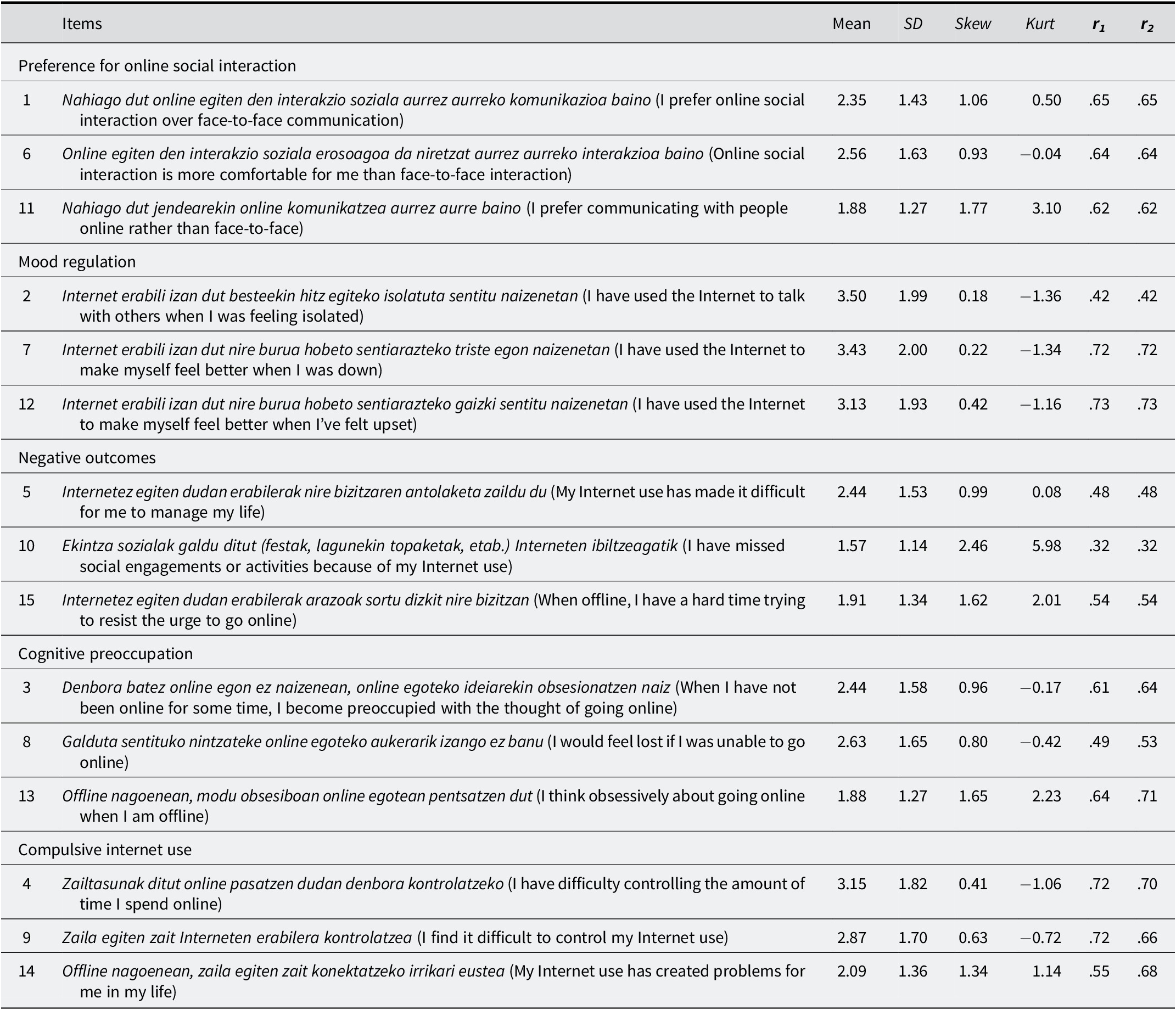
Note: The statements are in Basque and the original English version is given in parentheses; r1 = corrected item-total correlation Model 2; r2 = corrected item-total correlation Model 3.
Finally, the temporal stability study revealed strong correlations between the scores obtained in the first and second applications in all dimensions of the GPIUS-2 (Spearman correlations with values between .59 and .65).
To assess the internal consistency of the four dimensions identified in the final model, McDonald’s omega coefficients were calculated. The results showed good reliability for all four factors: Preference for Online Social Interaction (ω = .79), Mood Regulation (ω = .82), Negative Outcomes (ω = .68), and Deficient Self-Regulation (ω = .81). These values indicate that the subscales can be interpreted independently with satisfactory internal consistency.
Study of the Internal Structure and Gender and Age Invariance. Confirmatory Factor Analysis
As evident from the values presented in Table 3, both the original five-factor model with one second-order factor (Model 2) and the four-factor model (Model 3) were found to have adequate fit.
Results of the confirmatory factor analysis for the three models

Note: RMSEA = Root Mean Square Error of Approximation; CI = Confidence Interval; CFI = Comparative Fit Index; TLI = Tucker-Lewis Index; SRMR = Standardized Root Mean Square Residual.
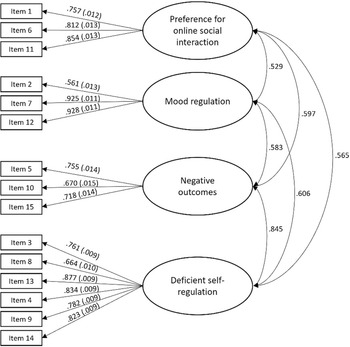
The factor loadings of the items on their respective factors were adequate in all the models analyzed. Specifically, these standardized loadings ranged between .45 and .86 in Model 1; and between .56 and .93 in Models 2 and 3. However, Model 3 was chosen mainly because of the high similarity between items from the Cognitive Preoccupation and Compulsive Internet Use factors and their extremely high factor loadings on Deficient Self-regulation (.99 and .93, respectively).
Finally, Figure 1 shows the standardized factor loadings of each item, together with their standard errors and the correlations between the dimensions of Model 3.
Model 3 standardized factor loadings, standard errors, and between-factor correlations.

The baseline model (Model 3) showed satisfactory fit to the data and was therefore used as the basis for the configural invariance models, which maintained the same number of factors and pattern of fixed and free parameters, but without imposing equality constraints across gender or age groups.
Gender Invariance
Regarding gender, the configural model showed good fit (see Table 4). This model was used as the reference for evaluating more restrictive models. The metric model, which constrained the factor loadings to be equal across gender, also showed good fit. The changes in CFI, RMSEA, and SRMR were within acceptable limits (ΔCFI = −0.001, ΔRMSEA = 0.000, ΔSRMR = 0.002), indicating metric invariance across genders. The scalar model, which imposed additional constraints on item thresholds, also fit the data well and differences in CFI, RMSEA, and SRMR were within acceptable limits (ΔCFI = 0.000, ΔRMSEA = −0.011, ΔSRMR = 0.000), suggesting that average item scores can be validly compared between men and women.
Measurement invariance models for Model 3, by gender and age

Note: M3 = Model 3; df = degrees of freedom; CFI = Comparative Fit Index; RMSEA = Root Mean Square Error of Approximation; SRMR = Standardized Root Mean Square Residual; ΔCFI = CFI change; ΔRMSEA = RMSEA change; ΔSRMR = SRMR change.
Age Invariance
Regarding age groups, the configural model also showed good fit (see Table 4). The metric model, which constrained factor loadings, also demonstrated good fit, with all changes within acceptable limits (ΔCFI = 0.001, ΔRMSEA = 0.002, ΔSRMR = 0.004), indicating metric invariance across adolescents and adults. The scalar model, which added constraints on item thresholds, also fit well and differences in CFI, RMSEA, and SRMR were within acceptable limits (ΔCFI = 0.001, ΔRMSEA = −0.010, ΔSRMR = −0.002), supporting valid comparisons of item scores between adolescents and adults.
Gender and Age Differences in PIU
As very few people identified themselves as nonbinary, gender differences were examined in terms of male and female categories. Statistically significant differences were found only in the Preference for Online Social Interaction dimension, but with a very small effect size. In the case of age, statistically significant differences were also found but with a small effect size in Preference for Online Social Interaction and Deficient self-regulation (see Table 5).
Average ranges and results of comparisons between gender and age groups

Note: Group 1 = men and Group 2 = women for the upper section of the table; Group 1 = adults and Group 2 = adolescents for the lower section. IQR = interquartile range. All scores are on the same Likert scale 1–7.
Convergent Validity and Relationship with Other Variables
Regarding convergent validity, a strong positive correlation was observed between GPIUS-2 scores and the total score for IAT, except in the case of Preference for Online Social Interaction, where the correlation was moderate. In terms of the link between PIU and anxiety, depression, and stress, moderate positive correlations were observed between these three variables and the total GPIUS-2 score. Of the GPIUS-2 subscales, Mood Regulation was the dimension that correlated most strongly with these variables (see Table 6).
Spearman correlations between GPIUS-2 scores and anxiety, depression, and stress levels

Note: ***p < .001; **p < .01; *p < .05.
Norm-referenced Framework with Raw Score Distributions and Percentiles
Table 7 shows the percentiles derived from the total sample (including both adults and adolescents). Thus, we can see that a person who obtained a total scale score of 58 would fall within the 90th percentile, indicating a high level of problematic internet use (Table 7).
Percentile for the total sample

Note: Pc = Percentile.
Discussion
To adapt the GPIUS-2 instrument to the Basque language, the present study conducted an in-depth analysis of its internal structure, as the different adaptations carried out to date have failed to reach a clear consensus concerning this matter. Consequently, in the present study, we conducted CFAs on three different models using the DWLS estimator (the estimator used for ordinal variables). Since the general fit values were similar for all models analyzed, the decision was made to select the preferred model based on factor loadings, the magnitude of the associations between factors, and the theoretical model underlying this construct. The four first-order factor model (i.e., the one that considers the second-order factor Deficient Self-regulation of the original model as a first-order factor) was therefore chosen for two reasons: firstly, because in Model 2 (model with the original structure), the factor loadings of the first-order factors Cognitive Preoccupation and Compulsive Internet Use on the second-order factor were extremely high (.99 and .93, respectively); and secondly, because of the similarity between the items forming the two first-order factors. These were the main reasons for opting for a more parsimonious model that, instead of including five first-order factors and one second-order factor, included only four first-order factors. This model was found to be invariant with respect to gender and age groups. The small effect size found when studying the differences regarding gender and age indicate that males and females as well as adolescents and adults can be studied as a single group.
Regarding internal consistency, reliability analyses revealed that the Basque version of the GPIUS-2 is a reliable instrument with subscale reliability indices ranging from .68 to .82. These values coincide with those of the original version (Caplan, Reference Caplan2010) and with many adapted versions (Barke et al., Reference Barke, Nyenhuis and Kröner-Herwig2014; Fioravanti et al., Reference Fioravanti, Primi and Casale2013; Gámez-Guadix et al., Reference Gámez-Guadix, Villa-George and Calvete2012; Gámez Guadix et al., Reference Gámez-Guadix, Orue and Calvete2013; Laconi et al., Reference Laconi, Kaliszewska-Czeremska, Tricard, Chabrol and Kuss2018; Pontes et al., Reference Pontes, Caplan and Griffiths2016). Furthermore, all items were found to have an adequate discrimination index (>.30), a relevant aspect considering that, in most cases, the number of items for each dimension is low, suggesting that all items provide relevant information about the measured construct. It is worth mentioning that in the Basque adaptation, the reliability value for the global scale was under 0.60, suggesting that the total score may not be entirely consistent. Furthermore, given that neither the original model nor the four-factor model are global factor models, we believe that it is better to use the subscale scores rather than the total score. However, we opted to use the total score in our correlation analysis with the IAT and DASS-21 scales because other adaptation studies have done so. In this sense, as in our study, French (Laconi et al., Reference Laconi, Kaliszewska-Czeremska, Tricard, Chabrol and Kuss2018), Italian (Fioravanti et al., Reference Fioravanti, Primi and Casale2013), German (Barke et al., Reference Barke, Nyenhuis and Kröner-Herwig2014), Portuguese (Pontes et al., Reference Pontes, Caplan and Griffiths2016), Japanese (Yoshimura et al., Reference Yoshimura, Shibata, Kyuragi, Kobayashi, Aki, Murai and Fujiwara2022), and Polish (Probierz et al., Reference Probierz, Galuszka and Galuszka2020) adaptations also explore the convergent validity of GPIUS-2 by analyzing associations with scores obtained in the IAT, finding consistent results in all cases, with positive and (mostly) strong correlations. Specifically, in our study, the correlations between the total IAT score and the GPIUS-2 factors were moderate for the Preference for Social Interaction Online factor and very strong for the remaining factors. This indicates that although the constructs measured in the IAT and the GPIUS-2 are different, there is nevertheless an important link between them. We also found a moderate positive correlation between scores for Mood Regulation, Negative Outcomes, and Deficient Self-regulation in the GPIUS-2 and anxiety and stress, indicating that PIU is associated with high scores in these psychological disorders. These data are consistent, at least to some extent, with those observed in the Portuguese (Pontes et al., Reference Pontes, Caplan and Griffiths2016) and the Polish adaptations (Probier et al., Reference Probierz, Galuszka and Galuszka2020), which analyzed the association between the total GPIUS-2 score and depression, anxiety, and stress, as well as with the results obtained in other more recent studies that also focus on this relationship (Andrade et al., Reference Andrade, Scatena, Bedendo, Enumo, Dellazzana-Zanon, Prebianchi, De Lara Machado and De Micheli2020; Awan et al., Reference Awan, Aamir, Diwan, Ullah, Pereira-Sanchez, Ramalho, Orsolini, de Filippis, Ojeahere, Ransing, Vadsaria and Virani2021; Li et al., Reference Li, Lau, Mo, Su, Tang, Qin and Gross2017; Malak & Khalifeh, Reference Malak and Khalifeh2018). Thus, although PIU is a relatively new problem, the data obtained in different studies suggest that it is closely linked to several symptoms associated with anxious-depressive psychopathologies, a finding that highlights the importance of being able to measure PIU in both future research and the clinical, educational, and occupational fields. Currently, different professionals are working on interventions (mainly based on cognitive behavioral therapies) aimed at reducing the consequences of PIU, although most have been implemented to date only in adults, meaning that there is still a lack of studies corroborating their effectiveness in the adolescent population (see the meta-analysis by Andrade et al., Reference Andrade, Di Girolamo Martins, Scatena, Lopes, de Oliveira, Kim and De Micheli2023).
While the vast majority of our participants were indeed adolescents, the inclusion of an adult sample represents one of the strengths of the present study, as it allowed us to explore potential age-related differences in PIU within the same cultural and linguistic context. Although some studies suggest that PIU may be more prevalent among adolescents than adults, the available evidence is mixed and limited by methodological variability. Furthermore, although the questionnaires were administered to the adult sample online and the use of different administration formats for each sample may be considered a limitation, we believe that this is not the case here. Although the face-to-face format allows doubts to be cleared up and many aspects of the environment to be controlled—something we believe is necessary in the case of adolescents—this is not so important in the adult population. In this sense, some studies claim that online administration does not alter the reliability and validity of the instruments used in the adult population, since no differences have been observed between participants who respond to the same questionnaire using the online and face-to-face formats (Riva et al., Reference Riva, Teruzzi and Anolli2003).
The norm-referenced framework developed in this study allows raw scores to be transformed into an interpretable metric (percentiles) that reflects an individual’s relative position within the reference population. However, these scores should be interpreted with caution, as the sample used—particularly the adult subsample—is not large enough to establish diagnostic cut-off points.
Finally, the generalizability of our findings should also be considered with caution. Although the adolescent sample was regionally representative, it was not strictly probabilistic, and the adult sample was recruited through convenience sampling. Moreover, the adult sample size, while adequate for testing the proposed model, was relatively modest given the complexity of the structure. Future studies should aim to replicate these findings using larger and more diverse adult samples to ensure the robustness and generalizability of the results. Nonetheless, the GPIUS-2 has been widely used and adapted in diverse cultural and linguistic contexts—including Japanese, Turkish, French, Polish, Portuguese, Spanish, and German—consistently yielding good reliability and validity indices (e.g., Laconi et al., Reference Laconi, Kaliszewska-Czeremska, Tricard, Chabrol and Kuss2018; Yoshimura et al., Reference Yoshimura, Shibata, Kyuragi, Kobayashi, Aki, Murai and Fujiwara2022). While the internal structure has shown some variation across studies, the instrument has repeatedly proven useful for assessing problematic Internet use from a cognitive–behavioral perspective.
Conclusions
Thus, we can conclude that the Basque adaptation of the GPIUS-2 shows good reliability and validity evidence and constitutes a useful tool for assessing problematic Internet use among Basque-speaking adolescents and adults. Its availability in a minority language fills an important gap and provides new opportunities for both research and clinical practice in this population.
Data availability statement
The dataset and the adapted scale are available in the OSF repository: (https://osf.io/749tu/?view_only=20bc9b1612ae48fc8670d7942dbd4bca).
Acknowledgements
The authors of the present research are grateful to the GPIUS-2 original author Scott E. Caplan for providing us the original items of the scale and for giving us permission and advice for the adaptation of GPIUS-2 Scale.
Author contribution
Conceptualization: J.A., O.G., N.B., A.G.; Data curation: J.A., O.G.; Formal analysis: J.A., O.G., N.B.; Funding acquisition: N.B.; Investigation: J.A., O.G., N.B., A.G.; Methodology: J.A., O.G., N.B., A.G.; Project administration: J.A., O.G., N.B., A.G.; Resources: J.A., O.G., N.B., A.G.; Software: J.A., O.G.; Supervision: N.B., A.G.; Validation: J.A., O.G., N.B., A.G.; Visualization: J.A., O.G., N.B., A.G.; Writing – original draft: J.A., O.G., N.B., A.G.; Writing – review & editing: J.A., O.G., N.B., A.G.
Funding statement
This research was funded by the Basque Government, grant number IT1493–22.
Competing interests
None.




 Open access

