1 INTRODUCTION
At least one in five planetary nebulae host a close binary central star with an orbital period of ~1 d or less (Bond Reference Bond, Kastner, Soker and Rappaport2000; Miszalski et al. Reference Miszalski, Acker, Moffat, Parker and Udalski2009). These binaries have passed through the poorly understood common envelope phase of binary stellar evolution (Ivanova et al. Reference Ivanova2013). The binary fraction of planetary nebulae is expected to be considerably higher if binary interactions are a dominant formation channel (De Marco Reference De Marco2009). Binary central stars with intermediate orbital periods of several days to years may contribute another 23–27% towards the binary fraction (Nie, Wood, & Nicholls Reference Nie, Wood and Nicholls2012), but it is unclear whether the small number of discoveries made so far (Van Winckel et al. Reference Van Winckel2014; Jones et al. Reference Jones, Van Winckel, Aller, Exter and De Marco2017; Miszalski et al. Reference Miszalski2018) signify the existence of a substantial population of intermediate period binaries. We are systematically searching for this population (Miszalski et al. Reference Miszalski2018) with the High Resolution Spectrograph (HRS, Bramall et al. Reference Bramall2010, Reference Bramall2012; Crause et al. Reference Crause2014) on the Southern African Large Telescope (SALT, Buckley, Swart, & Meiring Reference Buckley, Swart and Meiring2006; O’Donoghue et al. Reference O’Donoghue2006). Further details of the scientific motivation behind the survey can be found in Miszalski et al. (Reference Miszalski2018).
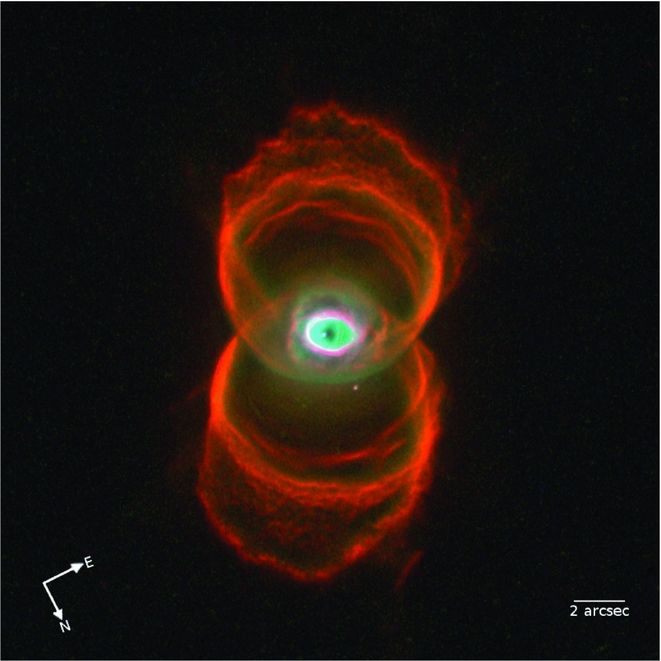
Included in our survey is the young planetary nebula MyCn 18 (PN G307.5−04.9, Mayall & Cannon Reference Mayall and Cannon1940), also known as the Etched Hourglass Nebula. The bipolar appearance of MyCn 18 (Figure 1; Sahai et al. Reference Sahai1999) is the result of an eponymous hourglass-shaped nebula inclined 38° to the line of sight (Dayal et al. Reference Dayal2000; O’Connor et al. Reference O’Connor2000; Clyne et al. Reference Clyne2014). MyCn 18 exhibits several features for which binary interactions are the preferred formation mechanism, yet no evidence has been found supporting the presence of a binary companion. These features include polar outflows or jets (Bryce et al. Reference Bryce, López, Holloway and Meaburn1997; O’Connor et al. Reference O’Connor2000), a central star position offset up to 0.2 arcsec from the geometric centre, and its bipolar morphology with a narrow waist (Sahai et al. Reference Sahai1999; Clyne et al. Reference Clyne2014). MyCn 18 has often been compared against bipolar nebulae around low and high mass evolved stars. It is particularly notable for its intriguing nested hourglass structure (Sahai et al. Reference Sahai1999; Clyne et al. Reference Clyne2014) that closely resembles the nebular remnant of SN 1987A (e.g. Burrows et al. Reference Burrows1995; Sugerman et al. Reference Sugerman, Crotts, Kunkel, Heathcote and Lawrence2005), the symbiotic nebula Hen 2-104 (Corradi & Schwarz Reference Corradi and Schwarz1993; Corradi et al. Reference Corradi, Livio, Balick, Munari and Schwarz2001; Santander-García et al. Reference Santander-García2008; Clyne et al. Reference Clyne2015), and Hb 12 which may be a young PN or possibly a symbiotic nebula (Hsia, Ip, & Li Reference Hsia, Ip and Li2006; Kwok & Hsia Reference Kwok and Hsia2007; Vaytet et al. Reference Vaytet2009; Clark et al. Reference Clark, López, Edwards and Winge2014). There are also strong similarities with bipolar and hourglass nebulae around several luminous blue variables (e.g. García-Segura et al. Reference García-Segura, Langer, życzka and Franco1999; Smith, Bally, & Walawender Reference Smith, Bally and Walawender2007; Gvaramadze & Menten Reference Gvaramadze and Menten2012; Taylor et al. Reference Taylor2014). Based on these rich connections to several bipolar nebulae, resolving the unknown binary status of MyCn 18 is an important step towards further understanding how bipolar nebulae form.
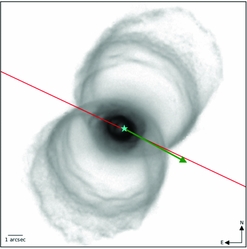
Hubble Space Telescope colour-composite image of MyCn 18 (Sahai et al. Reference Sahai1999) made from F658N (red), F656N (green), and F502N (blue) filters. Image credit: Raghvendra Sahai and John Trauger (JPL), the WFPC2 science team, and NASA.
This paper is structured as follows. Section 2 presents SALT HRS radial velocity monitoring observations of MyCn 18. We clarify the spectral class of the central star in Section 3.1, followed by a description of our radial velocity measurements in Section 3.2. We demonstrate the significant periodic variability of these measurements in Section 3.3 that prove the binary nature of MyCn 18. Section 3.3 also derives the orbital parameters of the binary nucleus. We discuss our results in Section 4 in the context of formation scenarios concerning MyCn 18 and other post-CE PNe. We conclude in Section 5.
2 SALT HRS OBSERVATIONS
Multiple observations of the nucleus of MyCn 18 were taken with SALT HRS (Bramall et al. Reference Bramall2010, Reference Bramall2012; Crause et al. Reference Crause2014), a dual-beam, fibre-fed échelle spectrograph enclosed in a vacuum tank within an insulated, temperature controlled enclosure in the spectrograph room of SALT (Buckley et al. Reference Buckley, Swart and Meiring2006; O’Donoghue et al. Reference O’Donoghue2006). The medium resolution (MR) mode of HRS was used to obtain spectra covering 3 700– 8 900 Å with resolving powers R = λ/Δλ of 43 000 and 40 000 for the blue and red arms, respectively. During an observation a second fibre, separated at least 20 arcsec from the science fibre, simultaneously observes the sky spectrum. Both object and sky spectra are interleaved on the separate blue (2 k × 4 k) and red (4 k × 4 k) CCDs. Regular bias, ThAr arc lamp, and quartz lamp flat field calibrations are taken as part of SALT operations.
Table 1 presents a log of the 26 HRS MR observations of MyCn 18 in addition to the radial velocity measurements described in Section 3.2. Basic processing of the data was performed by pysalt (Crawford et al. Reference Crawford2010) before a pipeline based on the midas packages echelle (Ballester Reference Ballester1992) and feros (Stahl, Kaufer, & Tubbesing Reference Stahl, Kaufer, Tubbesing, Guenther, Stecklum and Klose1999) developed by A. Y. Kniazev (Kniazev, Gvaramadze, & Berdnikov Reference Kniazev, Gvaramadze and Berdnikov2016) reduced the data and distributed the data products. The blue spectra which do not feature prominent sky emission lines were not sky subtracted and the red arm spectra were sky subtracted. The small angular size of MyCn 18 and the fibre fed design of HRS precluded the subtraction of nearby nebula emission. The order-merged spectra were converted to a logarithmic wavelength scale using iraf before heliocentric radial velocity corrections were added using the velset task of the rvsao package (Kurtz & Mink Reference Kurtz and Mink1998).
Observation log of SALT HRS spectra of MyCn 18 and radial velocity measurements. The Julian day represents the midpoint of each exposure and the radial velocity measurements were made from stellar N III λ4634.14 Å and nebular He I λ4921.93 Å (see Section 3.2).

3 ANALYSIS
3.1. Spectral classification
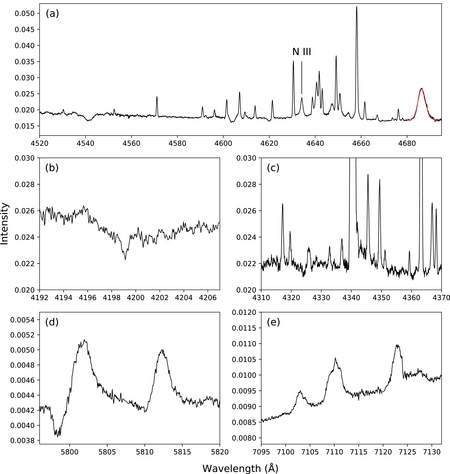
The spectral classification of the central star of MyCn 18 is unclear in the literature. An Of(H) classification was made based on an unpublished spectrum (Méndez Reference Méndez, Michaud and Tutukov1991) and more recently a rare H-deficient Of(C) classification was made by Lee et al. (Reference Lee, Stanghellini, Ferrario and Wickramasinghe2007) that requires a spectrum ‘dominated by strong C emissions’ (Méndez Reference Méndez, Michaud and Tutukov1991). We created an average blue and red spectrum after shifting all HRS spectra to the rest frame of N iii λ4634 Å using the measurements in Table 1 (see Section 3.2), iraf and the rvsao package (Kurtz & Mink Reference Kurtz and Mink1998). Relevant portions are displayed in Figure 2 which includes a Gaussian fit to He ii λ4686 Å with a full-width at half-maximum (FWHM) of 3.83± 0.03 Å made using the lmfit package (Newville et al. Reference Newville2016). The data do not support an Of(C) classification as the only prominent C emission features belong to C iv λ4658, 5801, 5812 Å. The C iv λ4658 Å emission line is heavily contaminated in our spectrum by nebular [Fe iii] emission (Tsamis et al. Reference Tsamis, Barlow, Liu, Danziger and Storey2003).
Relevant portions of the average SALT HRS spectrum of the nucleus of MyCn 18. (a) He ii λ4540 and λ4686 Å, the latter overlaid with a Gaussian fit (red line, see text). Marked is the N iii λ4634 Å line used to determine radial velocities. (b) He ii λ4200 Å, (c) Hγ 4340 Å, (d) C iv 5801, 5812 Å, (e) N iv λ7103, 7109, 7111, 7123, 7127, and 7129 Å.
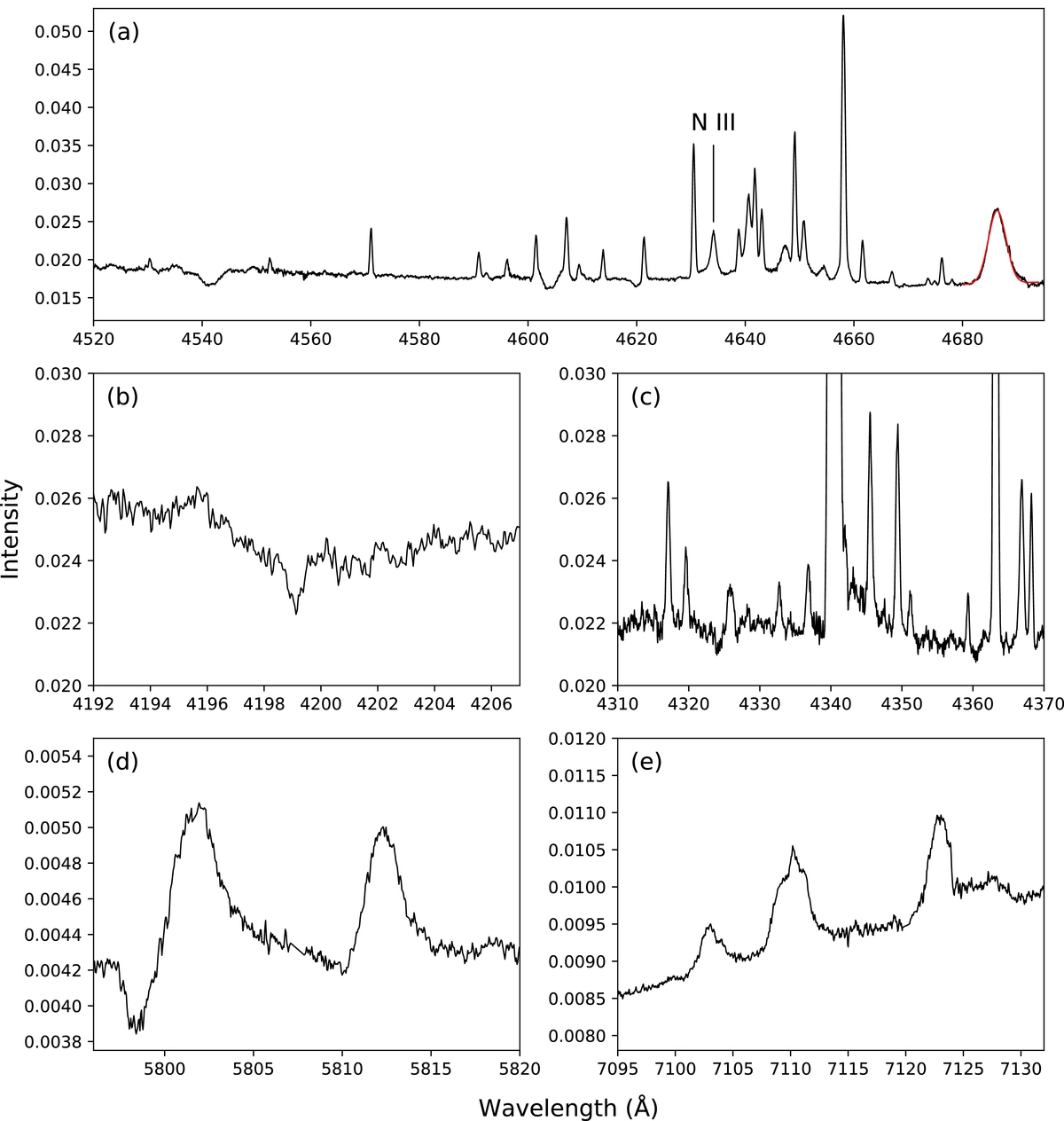
The spectrum exhibits characteristics of both Of and Of-WR stars (Méndez, Herrero, & Manchado Reference Méndez, Herrero and Manchado1990). According to the classification scheme for these stars (Méndez et al. Reference Méndez, Herrero and Manchado1990), features supporting an Of classification include the narrow He ii λ4686 Å emission (FWHM < 4.0 Å) and mildly blueshifted He ii λ4540 Å absorption (−12.5 ± 0.7 km s−1), whereas supporting an Of-WR classification there is no absorption at Hγ (possibly with a red wing of emission) and blueshifted He ii λ4200 Å more than −50 km s−1 (−52.1 ± 0.7 km s−1). We favour an Of(H) classification based on the FWHM of He ii λ4686 Å and strong similarities with He ii, C iv, and N iv features in the Of(H) central star of M 2–29 (Miszalski et al. Reference Miszalski2011a). The temperature of the central star is not well constrained. Gleizes, Acker, & Stenholm (Reference Gleizes, Acker and Stenholm1989) determined an H Zanstra temperature of 41 kK and an He ii Zanstra temperature of 51 kK based on low-resolution spectra. The stellar He ii emission may have been mistaken for nebular He ii emission in these spectra since the higher quality HRS spectra rule out any He ii nebular emission. Following the example of M 2–29 (Miszalski et al. Reference Miszalski2011a), we therefore adopt instead T eff = 50 ± 10 kK as He ii nebular emission and He i absorption lines are all absent from the HRS spectra.
3.2. RV measurements
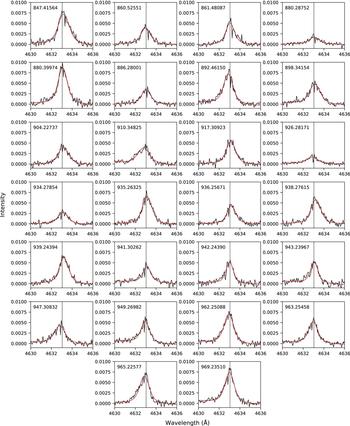
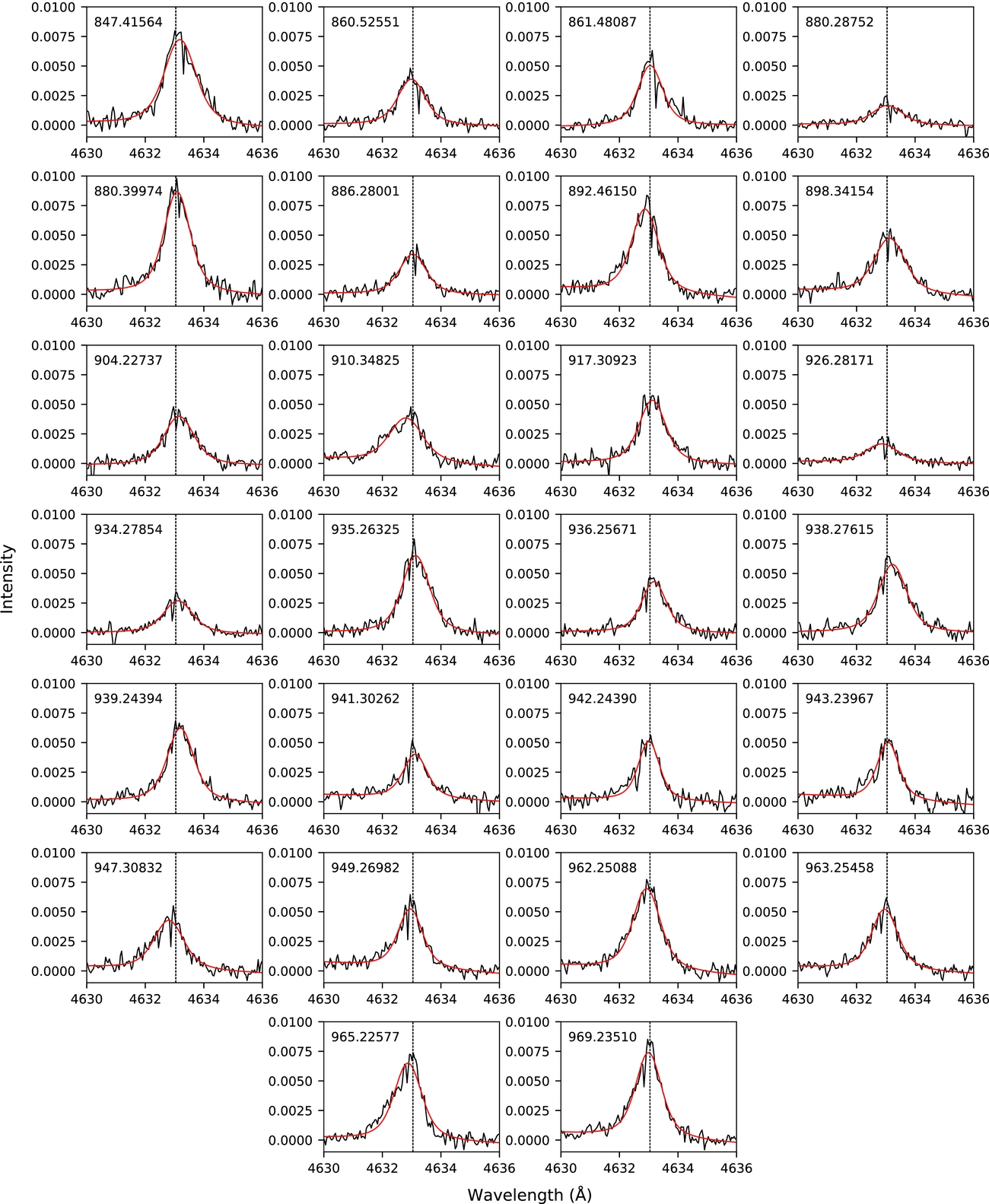
The radial velocity measurements in Table 1 were determined from the stellar emission feature N iii λ4634.14 and the nebular emission line He i λ4921.23. The lmfit package (Newville et al. Reference Newville2016) was used to fit models consisting of a Voigt function and a straight line to N iii and a Gaussian function to He i. The fits to N iii are displayed in Figure 3. Uncertainties in each radial velocity measurement are 1σ uncertainties determined from the standard error in the fit centroid provided by the fitting routine. The average nebular radial velocity of −72.78 ± 0.10 km s−1 agrees well with −71 km s−1 measured from spatio-kinematic modeling (Clyne et al. Reference Clyne2014).
The observed N iii λ4634.14 Å profiles (black lines) were fit with a model composed of a Voigt function and a straight line (red lines). The dashed line represents the expected position of N iii at the systemic heliocentric radial velocity of the nebula of −71 km s−1 (Clyne et al. Reference Clyne2014). Each panel is labelled with the Julian day of each spectrum minus 2 457 000 d.
3.3. Periodic variability and orbital parameters
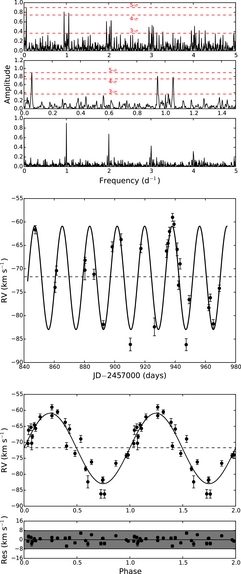
The SALT HRS radial velocity measurements of the nucleus of MyCn 18 exhibit significant variability compared to the stationary nebular emission (Table 1). Period analysis of the radial velocities using a Lomb–Scargle periodogram (Press et al. Reference Press, Teukolsky, Vetterling and Flannery1992) reveals the strongest peak to have a period of 18.15 d, significant at the 5σ level, while other peaks correspond to the 1 − f and 1 + f aliases of this peak (Figure 4). The 18.15 d period was used as the basis for a Keplerian orbit model that was built using a least-squares minimization method applied to the phase-folded data. Figure 4 displays the Keplerian orbit fit overlaid on the radial velocity measurements in time and folded with the orbital period. The observed sinusoidal radial velocity shifts prove the binary nature of MyCn 18.
The binary nature of MyCn 18 revealed by SALT HRS. (Top panel) The Lomb–Scargle periodogram of radial velocity measurements (top two segments). The strongest peak at a 5σ significance level corresponds to the 18.15 d orbital period. The 1 − f and 1 + f aliases are also visible and the lower segment shows the window function. (Middle and bottom panels) Radial velocity measurements displayed in time (middle) and folded with the orbital period (bottom). The solid lines represent the Keplerian orbit fit and the shaded region indicates the residuals are within 3σ of the fit where σ = 2.61 km s−1.
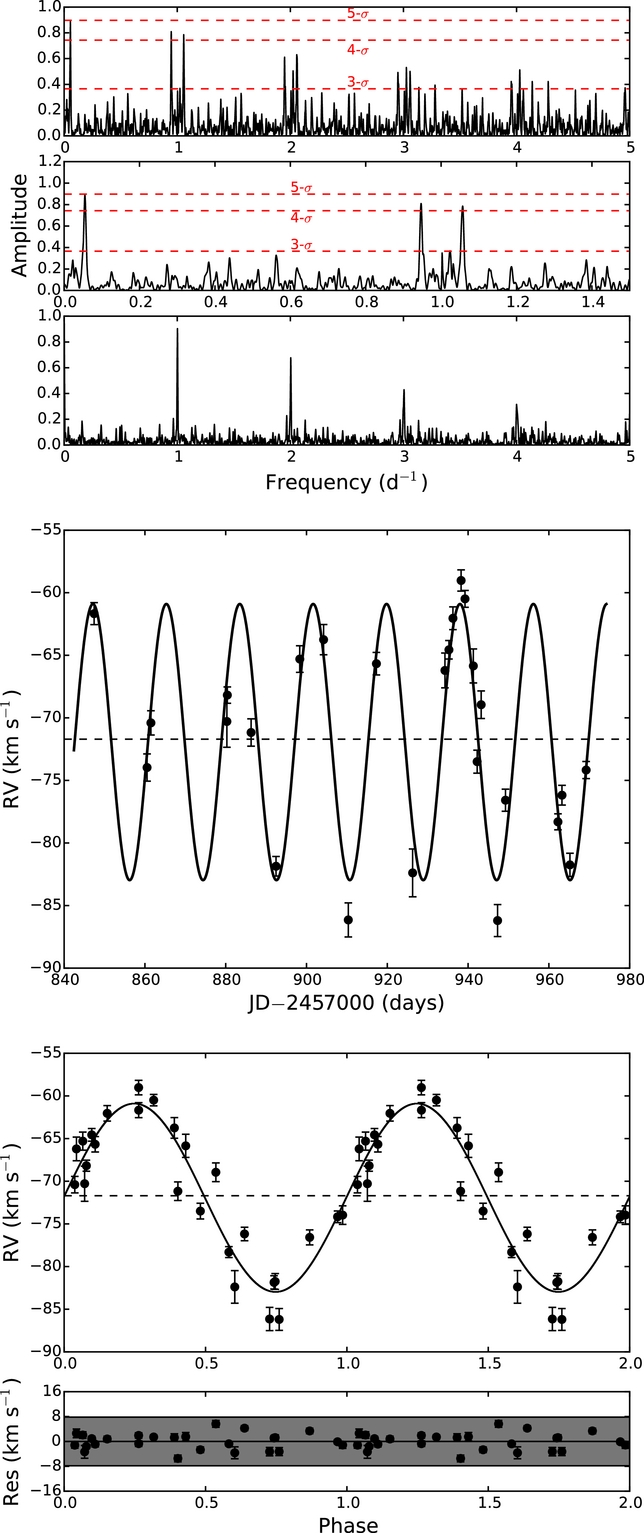
Table 2 presents the orbital parameters of the Keplerian orbit fit determined using Monte Carlo simulations in which the eccentricity was fixed to be zero (for details, see Miszalski et al. Reference Miszalski2018). The systemic velocity of the orbit (V hel = −71.70 ± 0.24 km s−1; V LSR = −65.20 ± 0.24 km s−1) agrees well with the nebular radial velocity of −71 km s−1 (Clyne et al. Reference Clyne2014). This suggests the N iii emission line from the Of(H)-type primary is not significantly disturbed by the stellar wind and traces the motion of the primary.
Orbital parameters of the binary nucleus of MyCn 18.

The estimation of the secondary mass requires some assumptions concerning the orbital inclination i and the primary mass M 1. Spatio-kinematic studies of post-CE PNe have demonstrated that the orbital inclination of the binary central star always matches the inclination determined from analysis of the nebula (Hillwig et al. Reference Hillwig2016). The inclination of MyCn 18 is well determined to be 38° by spatio-kinematic studies (O’Connor et al. Reference O’Connor2000; Clyne et al. Reference Clyne2014), although no estimate of the uncertainty was provided by these studies. We have therefore adopted a nominal error of 5° in the orbital inclination.
The primary mass M 1 is more difficult to constrain with the information available in the literature. Masses may be estimated via comparison with post-AGB evolutionary tracks if the temperature and surface gravity or luminosity are known. Determining the surface gravity is complicated by the strong stellar wind which has likely contaminated the absorption line profiles. We therefore adopt an alternative distance-dependent approach that estimates the luminosity of the central star following Section 9.4.5 of Frew (Reference Frew2008). We adopt a weighted mean distance of 3 092 ± 507 pc, which incorporates distance estimates of 3 342 ± 668 pc (Stanghellini & Haywood Reference Stanghellini and Haywood2010) and 2 750 ± 780 pc (Frew, Parker, & Bojičić Reference Frew, Parker and Bojičić2016), along with an apparent magnitude m V = 14.9 mag (Sahai et al. Reference Sahai1999), T eff = 50 ± 10 kK, and a reddening of A V = 2.63 mag (Tsamis et al. Reference Tsamis, Barlow, Liu, Danziger and Storey2003). We determine using equation (9.13) of Frew (Reference Frew2008) a bolometric correction of −4.48 ± 0.66 mag and an absolute bolometric magnitude of −4.67 ± 0.77, where the error in the latter includes errors in the bolometric correction and absolute magnitude added in quadrature which are themselves dominated by the uncertainties in the temperature and the distance, respectively. This results in log L/L⊙ = 3.76 ± 0.31 which is typical for young central stars of PNe still on the horizontal part of post-AGB evolutionary tracks. Considering the uncertainties in this distance-dependent method, we adopt M 1 = 0.6 ± 0.1 M⊙ after making comparisons with post-AGB evolutionary tracks (Miller Bertolami et al. Reference Miller Bertolami2016). It is unlikely that the mass is above this range as the nebular chemical abundances of MyCn 18 are not consistent with a massive AGB progenitor that has a core mass above ~0.8 M⊙ (García-Hernández et al. Reference García-Hernández2016). This is dependent, however, on whether single star AGB models are applicable to post-CE PNe, which is yet to be determined.
The radial velocity semi-amplitude of K = 11.0 ± 0.3 km s−1, M 1 = 0.6 ± 0.1 M⊙, and i = 38 ± 5° therefore gives a secondary mass of M 2 = 0.19 ± 0.05 M⊙. According to the Teff–radius–mass relation for dwarfs with Z = 0.014 (Bressan et al. Reference Bressan2012; Chen et al. Reference Chen2014), the range of masses and temperatures give an M5V companion with an uncertainty of one spectral class (Rajpurohit et al. Reference Rajpurohit2013). The current orbital separation is 0.124 au or 26.6 R⊙ and the M5V companion has a Roche lobe radius of ~7.5 R⊙. Even if the radius were inflated by ~2–3 times as observed in some post-CE binaries (Afşar & İbanoǧlu Reference Afşar and İbanoǧlu2008), mass transfer via Roche lobe overflow would not be possible. With the aforementioned distance and reddening the M5V companion would be very faint at V > 21 mag (Covey et al. Reference Covey2007), explaining the lack of any secondary features in our spectra. A periodic photometric signal caused by the irradiated atmosphere of the companion may be present with an amplitude of ~0.1 mag (De Marco, Hillwig, & Smith Reference De Marco, Hillwig and Smith2008). No photometric monitoring observations have been reported in the literature, but its detection would be complicated by the bright inner nebula.
4 DISCUSSION
4.1. A classical nova could not have launched the jets of MyCn 18
The system of collimated outflows or jets of MyCn 18 are remarkable as the fastest observed amongst PNe with deprojected velocities of up to 630 km s−1 (Bryce et al. Reference Bryce, López, Holloway and Meaburn1997; O’Connor et al. Reference O’Connor2000; Clyne et al. Reference Clyne2014). The jets were ejected ~1 050 yrs after the main nebula (Clyne et al. Reference Clyne2014). Sahai et al. (Reference Sahai1999) estimated the mass of the knots making up the jet system of MyCn 18 to be ~10−5 M⊙. O’Connor et al. (Reference O’Connor2000) suggested that since classical nova (CN) ejecta have similar masses and kinematics, it may be that a CN was responsible for producing the jet system of MyCn 18. More recently, Soker & Kashi (Reference Soker and Kashi2012) supported the assessment of O’Connor et al. (Reference O’Connor2000) and further commented that the kinetic energy of the jets was too low to have been formed from an intermediate luminosity optical transient (ILOT) event. Clyne et al. (Reference Clyne2014) further speculated on other nova-like formation events, some of which include planetary bodies that may be destroyed. Apart from the knots demonstrating similar mass and velocities to CN ejecta, we emphasise that these hypothetical CN or nova-like scenarios do not have any other observational support. Despite this, these scenarios appear to have been adopted as the de facto explanation for jet formation in MyCn 18 in the literature. As such, it is important to determine whether these hypothetical scenarios are physically compatible with the binary nucleus of MyCn 18. The observed orbital parameters of the binary can be assumed unchanged since the main nebula was ejected at the end of a CE interaction phase. These parameters uniquely enable us to determine whether any CN event could have produced the jet system since the main nebula was ejected.
CNe occur in cataclysmic variables where the short orbital separation allows for mass transfer and accumulation onto the white dwarf leading to a thermonuclear explosion (Warner Reference Warner1995). The time needed for the WD to build up a critical layer of hydrogen depends primarily on the mass of the WD and the accretion rate. While models for novae on degenerate WDs in thermal equilibrium are well developed (e.g. Yaron et al. Reference Yaron, Prialnik, Shara and Kovetz2005), the same cannot be said for pre-WDs that are found in PNe. Supposing accretion and thermonuclear explosions can occur on pre-WDs (which may also have strong winds), which is currently unclear as no models have explored the topic, then in the following, we examine whether a CN could have launched the jets of MyCn 18.
The strictest constraints come from the magnitude of permissible mass transfer rates. In CNe, the primary must have accreted a minimum amount of mass M env ~ 10−5–10−4 M⊙ for a 0.6 M⊙ white dwarf (Yaron et al. Reference Yaron, Prialnik, Shara and Kovetz2005)Footnote 1. Considering that a CN launched jet must have accreted mass over the time span between the main nebula and jet formation (only ~1 050 yrs, Clyne et al. Reference Clyne2014), accreting the above M env requires that the average accretion rate is an implausible  $\dot{M}_\mathrm{acc}\sim 10^{-8}$–10−7 M⊙ yr−1 that cannot be supplied from the M5V companion. Even if the companion were an active M-dwarf, the accretion rate could only reach a maximum of $\dot{M}_\mathrm{acc}\sim 10^{-11}$ M⊙ yr−1 during coronal mass ejections (Mullan Reference Mullan, Pallavicini and Dupree1996; Osten & Wolk Reference Osten and Wolk2015), falling far short of the required rate. The inability to achieve sufficiently high accretion onto the primary from the companion therefore rules out any CN from powering the jets in MyCn 18Footnote 2.
More generally, it is unlikely that CNe are in a position to produce jets in post-CE PNe. Jets are extremely rare in cataclysmic variables (Körding et al. Reference Körding2008, Reference Körding, Knigge, Tzioumis and Fender2011) and are unlikely to account for the large numbers of post-CE PNe with jets. Furthermore, CNe are rarely observed to appear in PNe (e.g. Wesson et al. Reference Wesson2008) and the most promising additional candidates have been reclassified as old nova shells (e.g. Miszalski et al. Reference Miszalski2016; Shara et al. Reference Shara2017). In summary, while it is not completely unexpected for a CN to appear within a PN (e.g. Wesson et al. Reference Wesson2008), they are not expected to routinely form jets and are not common enough to play a significant role in producing jets of post-CE PNe.
4.2. A potential formation scenario for MyCn 18 involving fallback of CE ejecta
The main hourglass nebula with its narrow waist was ejected about 2 700 yr ago (Clyne et al. Reference Clyne2014) likely at the end of a CE interaction phase. Preferential deposition of material in the orbital plane during the CE phase likely had a defining influence in shaping the bipolar nebula (e.g. Sandquist et al. Reference Sandquist, Taam, Chen, Bodenheimer and Burkert1998; Ricker & Taam Reference Ricker and Taam2012; Passy et al. Reference Passy2012). The inner hourglass nebula was ejected around 950 yr later and was closely followed by the jet system 100 yr later (Clyne et al. Reference Clyne2014). The close association in time between the inner hourglass and the jets strongly suggests they were formed from the same reservoir of matter. This matter would likely have been bound to the binary (circumbinary) or either component of the binary. As there could not have been any mass transfer between the binary components (Section 3.3), the most likely source of this matter would be bound material left over from the CE phase (Passy et al. Reference Passy2012; Ricker & Taam Reference Ricker and Taam2012), which simulations suggest can fallback onto the binary or either component to form a disk of a few ~0.1 M⊙ (Kashi & Soker Reference Kashi and Soker2011; Kuruwita, Staff, & De Marco Reference Kuruwita, Staff and De Marco2016). The observed jet velocities (O’Connor et al. Reference O’Connor2000; Clyne et al. Reference Clyne2014) are consistent with being produced by this disk, whether the jets originate near the secondaryFootnote 3, the primary (Blackman & Lucchini Reference Blackman and Lucchini2014), or around both stars. Another more speculative possibility is that a stellar or planetary tertiary companion provides the matter required (e.g. Clyne et al. Reference Clyne2014)Footnote 4.
The self-similarity of the inner hourglass with the main nebula (Clyne et al. Reference Clyne2014) suggests the accreted matter may have formed a second CE (or mini-CE) that would likely lead to the formation of the inner hourglass and jets. Precisely how this process may have occurred in MyCn 18 remains to be determined with the aid of detailed simulations. The process may be similar to that outlined by Soker (Reference Soker2017) in which the formation of a circumbinary disk plays a central role and the jets facilitate the removal of any remaining envelope.
4.3. The offset binary central star position
The Hubble Space Telescope imaging of MyCn 18 revealed the central star position to be offset from the geometric centre of each nebula component (Figure 1, Sahai et al. Reference Sahai1999; Clyne et al. Reference Clyne2014). The largest offset of 0.2 arcsec occurs with respect to the inner hourglass and corresponds to 618 ± 101 au at our adopted distance of 3 092 ± 507 pc. As with the high velocity jets, several scenarios have been hypothesised to explain how this offset was produced in the time between the main nebula was ejected and the jets were launched (~1 050 yr, Clyne et al. Reference Clyne2014). Perhaps the most widely accepted explanation in the literature is that the offset is produced by asymmetric mass loss over long timescales on the AGB (Soker, Rappaport, & Harpaz Reference Soker, Rappaport and Harpaz1998). This scenario appears unlikely to apply as the binary we have discovered has a current orbital separation of 0.124 au or 26.6 R⊙, which is 80–800 times smaller than the expected final separation range of ~10–100 au expected according to this scenario. If indeed the offset was produced during the AGB, we would expect a larger observed offset and especially a larger offset with respect to the main nebula.
An explosive CN or nova-like event causing a ‘kick’ to the binary system to produce the offset has also been suggested by Sahai et al. (Reference Sahai1999) and Clyne et al. (Reference Clyne2014). As we have discussed (Section 4.1), the binary parameters do not allow for a CN or dwarf nova to form during this timeframe. One possibility may be that the material that formed the inner hourglass (see Section 4.2) accreted directly onto the WD and produced a nova-like eventFootnote 5.
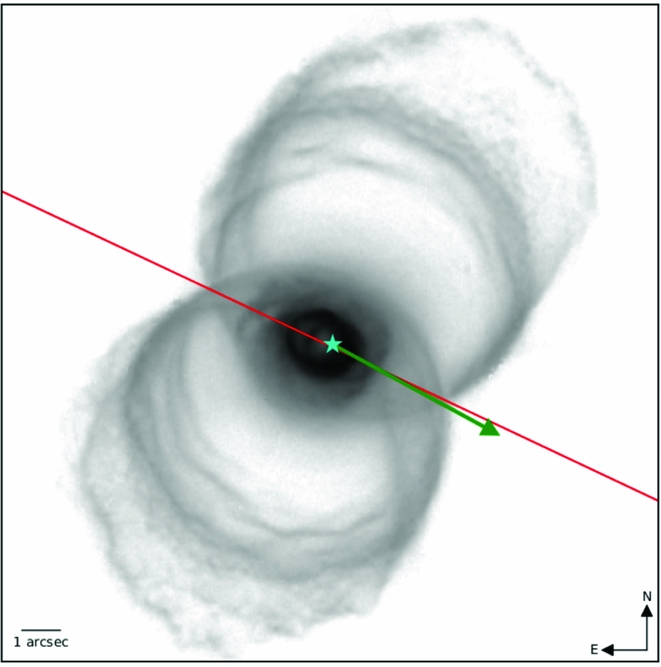
Perhaps, the most promising explanation of the offset could be the proper motion. While Sahai et al. (Reference Sahai1999) found this explanation problematic, we note that the direction of the offset matches the direction of the proper motion (Figure 5) which is μ(α) = −11.0 ± −1.1 milliarcsec yr−1 and μ(δ) = −2.3 ± 1.1 milliarcsec yr−1 (Zacharias, Finch, & Frouard Reference Zacharias, Finch and Frouard2017). This match alone justifies a more thorough investigation than available data permit and is certainly beyond the scope of this paper. We suggest such a study would involve 3D smoothed particle hydrodynamics (SPH) simulations that include a more comprehensive prescription of the 3D geometry and properties of the inner region of MyCn 18Footnote 6 as well as higher quality proper motion data anticipated from the Gaia mission.
Hubble Space Telescope image of MyCn 18 taken with the F656N filter showing the direction of proper motion (green arrow) of the central star (cyan star). The red line represents the minor axis.
4.4. MyCn 18 and other post-CE PNe
The 18.15 d orbital period of MyCn 18 lies between the 16 d orbit of NGC 2346 and the 142 d orbit of NGC 1360 (Miszalski et al. Reference Miszalski2018). It is only the sixth binary central star known with a measured orbital period above 10 d (Miszalski et al. Reference Miszalski2018). Population synthesis models predict large numbers of multiple day post-CE central stars (e.g. Nie et al. Reference Nie, Wood and Nicholls2012), though it is unclear whether this population exists due to a historical tendency towards photometric surveys to find binary central stars (Miszalski et al. Reference Miszalski2018). We will address this question empirically as our ongoing SALT HRS survey progresses, though we can say we have already discovered some new multiple day binaries. The multiple day systems appear to be very rare in the similar population of WD main-sequence binaries that has carefully studied selection effects (Nebot Gómez-Morán et al. Reference Nebot Gómez-Morán2011). If the CE phase operates similarly in central stars and WDMS binaries, then the initial SALT HRS discoveries might suggest multiple day post-CE binaries are more common than previously thought. Individually, multiple day post-CE central stars may be used to improve our understanding of CE population synthesis models (e.g. Davis, Kolb, & Willems Reference Davis, Kolb and Willems2010) and simulations of the CE phase involving wider initial orbital separations (e.g. Iaconi et al. Reference Iaconi2017).
Whether longer orbital periods favour the formation of bipolar PNe like NGC 2346 and MyCn 18 remains unclear and is currently biased by the small sample size of known binaries. The existence of canonical bipolar post-CE PNe with much shorter orbital periods, e.g. M 2–19 (P = 0.67 d, Miszalski et al. Reference Miszalski, Acker, Moffat, Parker and Udalski2009) and Hen 2–428 (P = 0.18 d, Santander-García et al. Reference Santander-García2015), suggests there may be no simple correlation between orbital period and morphology. We also note that the often-cited formation scenario for bipolar PNe with narrow waists like MyCn 18 produces final orbital separations of ~10–100 au (Soker & Rappaport Reference Soker and Rappaport2000), significantly larger than the observed 0.124 au separation of MyCn 18.
MyCn 18 is one of the few post-CE PNe with jets ejected after the CE phase. Jets ejected after the CE phase are less common and less understood than those ejected before the CE phase (Tocknell, De Marco, & Wardle Reference Tocknell, De Marco and Wardle2014). At present, the only other members include NGC 6337 (García-Díaz et al. Reference García-Díaz, Clark, López, Steffen and Richer2009; Hillwig et al. Reference Hillwig, Bond, Afşar and De Marco2010) and NGC 6778 (Miszalski et al. Reference Miszalski2011b; Guerrero & Miranda 2012). Another poorly understood aspect of post-CE PNe are those exhibiting high abundance discrepancy factors (ADF) where abundances measured from optical recombination lines are higher than those derived from collisionally excited lines. Tsamis et al. (Reference Tsamis, Barlow, Liu, Storey and Danziger2004) measured a low ADF (O2 +) of 1.8 in MyCn 18. Sowicka et al. (Reference Sowicka2017) suggested that longer period systems tend to have low measured ADFs based on NGC 5189 (Manick, Miszalski, & McBride Reference Manick, Miszalski and McBride2015; García-Rojas et al. Reference García-Rojas, Peña, Morisset, Mesa-Delgado and Ruiz2012) and IC 4776 (Sowicka et al. Reference Sowicka2017). This depends on the purported 9 d orbital period of the central star of IC 4776 which is not definitive. The orbital period could be much shorter (Sowicka et al. Reference Sowicka2017) and more observations are required before IC 4776 can be meaningfully compared against other post-CE PNe.
5 CONCLUSIONS
We presented SALT HRS échelle observations of the nucleus of the PN MyCn 18, also known as the Etched Hourglass Nebula. Radial velocity measurements from 26 spectra demonstrate a significant periodic variability of 18.15 ± 0.04 d. The data prove the presence of a post-CE binary nucleus in MyCn 18 which has long been suspected of being formed by a binary system. Several scenarios concerning the formation of MyCn 18 in the literature are not compatible with the orbital parameters of the binary nucleus. Our main conclusions are as follows:
• The RV time series measured from the N III λ4634 Å stellar emission feature demonstrated a periodic variability of 18.15 ± 0.04 d at a significance level of 5σ. The orbital period was used as the basis for a circular Keplerian orbit fit with a semi-amplitude of 11.0 ± 0.3 km s−1 and a systemic velocity of −71.70 ± 0.24 km s−1. The latter is in good agreement with the nebula systemic velocity (−71 km s−1, Clyne et al. Reference Clyne2014). Residuals of the Keplerian fit (2.61 km s−1) are relatively high because of the influence of stellar winds in the Of(H) primary whose classification we have clarified based on a deep stacked spectrum.
• Assuming a distance of 3092 ± 507 pc, we estimate the luminosity of the primary to be log L/L⊙ = 3.76 ± 0.31. At T eff = 50 ± 10 kK, we estimate the primary mass to be M 1 = 0.60 ± 0.10 M⊙ and adopt an orbital inclination of i = 38 ± 5° determined from spatio-kinematic studies of the nebula (O’Connor et al. Reference O’Connor2000; Clyne et al. Reference Clyne2014). The mass function derived from our observations then yields a secondary mass of M 2 = 0.19 ± 0.05 M⊙ corresponding to an M5 dwarf with an uncertainty of one spectral class.
• We rule out previous hypotheses that the jet system of MyCn 18 (O’Connor et al. Reference O’Connor2000) formed as the result of a CN explosion. The orbital separation of 0.124 au or 26.6 R⊙ is too large to allow for mass transfer via Roche-lobe overflow. Furthermore, an M5V secondary cannot provide the average accretion rate of $\dot{M}_\mathrm{acc}\sim 10^{-8}$–10−7 M⊙ yr−1 required to accrete the M env ~ 10−5–10−4 M⊙ mass required to form a CN (Yaron et al. Reference Yaron, Prialnik, Shara and Kovetz2005) in the ~1 050 yr timeframe between the main nebula ejection and when the jets are launched (Clyne et al. Reference Clyne2014).
• An alternative formation scenario for MyCn 18 was proposed whereby material from the CE ejection that formed the main nebula, still bound to the binary, settles or falls back to envelop the binary (e.g. Kashi & Soker Reference Kashi and Soker2011; Kuruwita et al. Reference Kuruwita, Staff and De Marco2016). This may have then lead to the formation of the inner hourglass and jets. The exact process in which this occurs remains uncertain and requires detailed simulations, though it could resemble that described by Soker (Reference Soker2017). There may be other mechanisms that contribute to forming MyCn 18, but these must be compatible with the observed binary system.
• We discussed the 0.2 arcsec offset the central star shows with respect to the centre of the inner hourglass. The accepted scenario for producing observable offsets during the AGB (Soker et al. Reference Soker, Rappaport and Harpaz1998) results in orbital separations 80–800 times larger than the observed separation in MyCn 18. The orbital parameters also rule out a CN or nova-like event to provide a ‘kick’ to produce the observed offset (e.g. Sahai et al. Reference Sahai1999; Clyne et al. Reference Clyne2014). We favour the proper motion of MyCn 18 to explain the offset central star, especially since the offset is observed along the minor axis of MyCn 18 in the same direction as the proper motion. Detailed 3D SPH simulations of the motion of MyCn 18 that incorporates anticipated Gaia proper motion data are encouraged to explore this possibility further.
• The discovery of the binary nucleus of MyCn 18 strengthens the long suspected link between bipolar nebulae and interacting binary stars (e.g. Soker & Rappaport Reference Soker and Rappaport2000). Characterising binary stars in bipolar nebulae across a wide variety of stellar masses and orbital separations may help shed light on common physical mechanisms behind the mass-loss histories of bipolar nebulae (e.g. Sugerman et al. Reference Sugerman, Crotts, Kunkel, Heathcote and Lawrence2005). One such common mechanism may be CE evolution, given the strong resemblance between MyCn 18 (a post-CE PN) and the nebular remnant of SN 1987A (a post-CE merger, Morris & Podsiadlowski Reference Morris and Podsiadlowski2009).

ACKNOWLEDGEMENTS
This paper is based on spectroscopic observations made with the Southern African Large Telescope (SALT) under joint South African-Polish programmes 2016-2-SCI-034 and 2017-1-MLT-010 (PI: B. Miszalski). Polish participation in SALT is funded by grant No. MNiSW DIR/WK/2016/07. We are grateful to our SALT colleagues for maintaining the telescope facilities and conducting the observations. B. M. acknowledges support from the National Research Foundation (NRF) of South Africa. This study has been supported in part by the Polish MNiSW grant 0136/DIA/2014/43, and NCN grants DEC-2013/10/M/ST9/00086 and 2015/18/A/ST9/00746. H. V. W acknowledges support from the Research Council of the KU Leuven under grant number C14/17/082. We thank the anonymous referee for a helpful and constructive report. This paper also features observations made with the NASA/ESA Hubble Space Telescope, and obtained from the Hubble Legacy Archive, which is a collaboration between the Space Telescope Science Institute (STScI/NASA), the Space Telescope European Coordinating Facility (ST-ECF/ESA), and the Canadian Astronomy Data Centre (CADC/NRC/CSA). IRAF is distributed by the National Optical Astronomy Observatory, which is operated by the Association of Universities for Research in Astronomy (AURA) under a cooperative agreement with the National Science Foundation. B. M. thanks S. Mohamed for discussions and A. Y. Kniazev for making available his HRS pipeline data products.