

1. Introduction
The prosodic phenomenon called stød in Danish is historically related to the tonal accents in Norwegian and Swedish (Fischer-Jørgensen Reference Fischer-Jørgensen1989:50, Goldshtein Reference Goldshtein2023:22, Riad Reference Riad and Lahiri2003:261). Today, stød is a laryngeal accent realized with non-modal, often creaky phonation in the syllable rime (Grønnum et al. Reference Grønnum, Pharao and Basbøll2020:2, Peña Reference Peña2022:34). Stød is transcribed with [ˀ] after a long vowel, as in sal [ˈsæːˀl]Footnote 1 ‘hall’, or, if the vowel is short, after the following sonorant, as in salt [ˈsælˀt] ‘salt’. As for the distribution of stød, there is a general pattern where words with stress on the ultimate syllable (oxytones) generally have stød—for example, april [aˈpʁiːˀl] ‘April’—and words with stress on the penultimate syllable (paroxytones) generally do not—for example, måned [ˈmɔːnəð] ‘month’ (Grønnum Reference Grønnum2005, Goldshtein Reference Goldshtein2023). However, focusing on this as a categorical pattern might give an overly coarse-grained representation of stød in Danish speakers’ grammar. For example, paroxytones ending in -en [ən], -er [ɐ], or -el [əl] do not always conform to this general pattern. Many of the words in this group exhibit stød despite having stress on the penultimate syllable: pollen [ˈpʰɒlˀən] ‘pollen’, bæver [ˈpɛʊˀɐ] ‘beaver’, and bødel [ˈpøðˀəl] ‘executioner’, for example. The present study explores whether the distribution of other patterns in the lexicon, such as the type of post-tonic syllable in words with stress on the penultimate syllable, affects the assignment of stød.
The acoustic properties of stød are highly variable, even in distinct speech (Grønnum & Basbøll Reference Grønnum, Basbøll, Solé, Beddor and Ohala2007, Grønnum Reference Grønnum, Wolters, Livingstone, Beattie, Smith, MacMahon, Stuart-Smith and Scobbie2015:4, Hansen Reference Hansen2015:7–8). The most common acoustic correlates are a fall in F0 and creakiness. Other acoustic correlates can be decreased intensity or full glottal closure (see Grønnum Reference Grønnum2022 for a recent review). A syllable with stød can have several of these cues, but there is no single cue which is always present. Some instances of stød can even be difficult to detect visually (Peña Reference Peña2022:15). However, instances of stød that are difficult to detect in an acoustic analysis can be easy to detect auditorily (Hansen Reference Hansen2015:5). For spectrograms illustrating syllables with and without stød, see Grønnum & Basbøll Reference Grønnum, Basbøll, Solé, Beddor and Ohala2007 and Grønnum et al. Reference Grønnum, Vazquez-Larruscaín and Basbøll2013.
The realization of stød is variable both within and between speakers (Fischer-Jørgensen Reference Fischer-Jørgensen1989, Hansen Reference Hansen2015). In addition, there is some dialectal variation. In some dialects in Jutland, the mainland part of Denmark, stød can sometimes be realized as a falling tone instead of a creak (Kyst Reference Kyst2008, Rasmussen Reference Rasmussen2025, Schachtenhaufen Reference Schachtenhaufen2022:97, Siem Reference Siem2023). However, Siem (Reference Siem2023) found some indications of laryngealization also in tonal realizations of stød, which could indicate that they are not entirely tonal. Furthermore, stød generally does not occur in the areas south of what is called the ‘stød border’, which cuts across the southern parts of Jutland, Funen, and Zealand, as well as the islands south of Funen and Zealand. In the areas where stød occurs, the distribution can vary. A relevant example for this study is barsel [ˈpaːˀsl] ‘parental leave’ which is pronounced with stød in Copenhagen and without stød in Jutland. For a more detailed description and map, see Heegård Petersen et al. Reference Petersen, Jan, Pharao and Maegaard2021 and Goldshtein Reference Goldshtein2023.
Despite the acoustic variability, stød is perceptually robust (Grønnum Reference Grønnum, Wolters, Livingstone, Beattie, Smith, MacMahon, Stuart-Smith and Scobbie2015, Hansen Reference Hansen2015). As concluded by Fischer-Jørgensen (Reference Fischer-Jørgensen1989:47), ‘the stød seems to be one of the cases where different physiological mechanisms and different acoustic cues may lead to the same perceptual result’. Also, stød is binary as a phonological feature. A syllable is pronounced either with stød or without stød (Hansen Reference Hansen2015:8, Siem Reference Siem2023:39).
In Standard Danish, there is a phonological restriction concerning which syllables can have stød, often referred to as ‘stød basis’ (Hansen Reference Hansen1943, Goldshtein Reference Goldshtein2023). Stød basis is constituted by a syllable containing either a long vowel, or a short vowel followed by a sonorant, and typically also some degree of stress. Thus, for example by [ˈbyːˀ] ‘city’ and hal [ˈhalˀ] ‘hall’ have stød basis whereas ja [ˈjæ] ‘yes’ and kat [ˈkʰæt] ‘cat’ do not. When a syllable loses stress, stød usually disappears as well (Hansen Reference Hansen2015:8). This can be seen for example when comparing the phrase se på [ˈseːˀ ˈpʰɔːˀ] ‘look at/watch’, with stress and stød on both words, with the phrase se på [se ˈpʰɔːˀ] ‘observe’, where se is not stressed and does not have stød.
There are many examples where stød is contrastive, in minimal pairs such as mor [ˈmoɐ] ‘mother’ and mord [ˈmoɐˀ] ‘murder’ or bid [ˈpið] ‘bite (noun)’ and bid [ˈpiðˀ] ‘piece/mouthful’. However, many of the contrastive pairs differ in part of speech (e.g. bed [ˈpɛð] ‘(flower)bed’ and bed [ˈpɛðˀ] ‘bit’ (past tense of bite)), or morphological structure (e.g. tanken (definite form of tanke) [ˈtsaŋkən] ‘the thought’ and tanken (definite form of tank) [ˈtsaŋˀkən] ‘the tank’). In fact, few pairs appear in contexts where they would actually be contrasting (Schachtenhaufen Reference Schachtenhaufen2022:111).Footnote 2 Whether the main function of stød is to be contrastive or not is therefore not clear. According to Basbøll (Reference Basbøll2005), stød is a signal for the second mora in bimoraic ultimate and antepenultimate syllables (Basbøll Reference Basbøll2005). Goldshtein (Reference Goldshtein2023:200) suggests that ‘… stød is a laryngeal word accent assigned by default to the minimal prosodic word’. Another suggestion is that stød can work as a predictive cue for upcoming speech (Hjortdal et al. Reference Hjortdal, Frid and Roll2022). The function of stød, or what it is a signal for, is however beyond the scope of the present study.
Not all syllables with stød basis have stød. For example, mor, bid, bed, and tanken from the contrastive pairs above do not have stød, despite having stød basis. With some exceptions, there is a general pattern where words with stress on the ultimate syllable (oxytones) have stød (e.g. by [ˈbyːˀ] ‘city’, april [aˈpʁiːˀl] ‘April’), and words with stress on the penultimate syllable (paroxytones) do not (e.g. måned [ˈmɔːnəð] ‘month’, kastanje [kʰæˈstænjə] ‘chestnut’; Grønnum Reference Grønnum2005, Goldshtein Reference Goldshtein2023, Høeg Reference Høeg2024). This pattern ‘… has long been seen as the main explanandum for the phonological theories of stød’ (Goldshtein Reference Goldshtein2023:113–14). For example, the distribution of stød in monomorphemic words is explained exclusively by the location of the stressed syllable in a rule formulated by Basbøll (Reference Basbøll2005), which he calls the Non-Stød Principle. The claim is that all syllables with stød basis have stød except penultimate syllables which do not. Instances that do not conform to this general pattern are either explained by means of lexical specification or by underlying structures that conform to the pattern. In approaches such as Basbøll’s, the distribution of stød is seen as categorical. A specific structure, surface or underlying, either always or never has stød, and exceptions are marked with a lexical specification. However, focusing on this as a categorical pattern might give an overly coarse-grained representation of stød in Danish speakers’ grammar.
In the remainder of this introduction, a description of the distribution of stød in words with stress on the penultimate syllable (paroxytones) ending in -en, -er, or ‑el is first given in Section 1.1. Thereafter, underlying monosyllabicity as an explanation for stød in this group of words is discussed in Section 1.2. In Section 1.3, probabilistic phonology is introduced and how it can be applied to stød is discussed. Finally, the research questions and predictions of the present study are presented in Section 1.4.
1.1. Stød in paroxytones ending in -en, -er, or -el
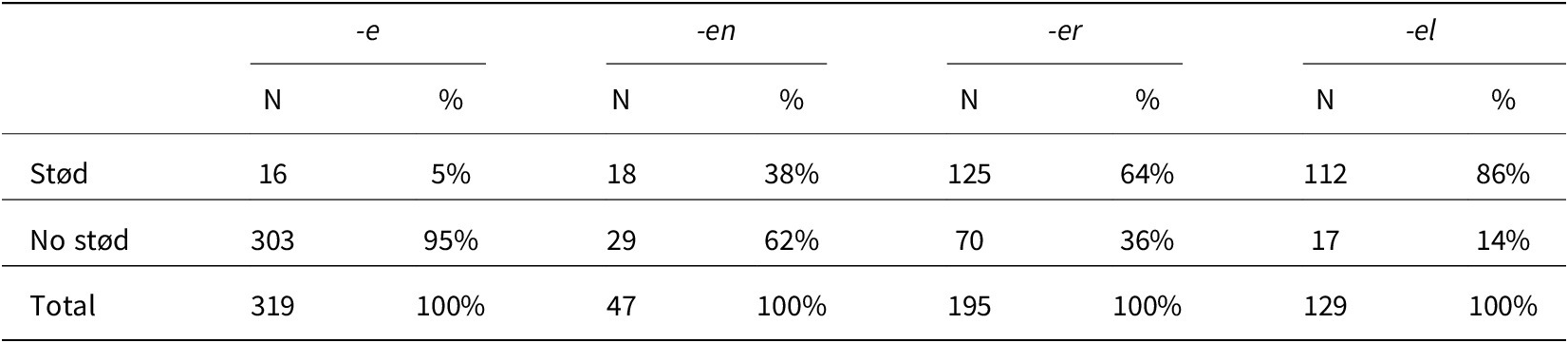
One group of words that does not always conform to the general pattern is paroxytones ending in ‑en [ən], ‑er [ɐ], or -el [əl].Footnote 3 Many of the words in this group exhibit stød despite having stress on the penultimate syllable; for example, pollen [ˈpʰɒlˀən] ‘pollen’, bæver [ˈpɛʊˀɐ] ‘beaver’, and bødel [ˈpøðˀəl] ‘executioner’. However, not all paroxytones that end in -en, -er, or -el have stød. According to a count made by Grønnum (Reference Grønnum2005:227), 86% of words ending in -el have stød, 63% of words ending in -er have stød, and 26% of words ending in -en have stød. Grønnum’s count includes words from all word classes that are not clearly perceived as derived by native speakers, and excludes names and demonyms.
The present study is limited to stød in monomorphemic nouns. Therefore, a new survey of the lexicon including only nouns was made by the author by counting all monomorphemic nouns with stød basis ending in -en, -er, or -el in The Danish dictionary (Det Danske Sprog- og Litteraturselskab 2020), as well as monomorphemic nouns ending in -e for comparison. The nouns’ pronunciations were checked at udtaleordbog.dk (Schachtenhaufen Reference Schachtenhaufen2020) and occurrence of stød was noted for each noun.
Different affixes, both inflectional and derivational, can yield different stød alternations (Basbøll Reference Basbøll2005, Reference Basbøll2014, Goldshtein Reference Goldshtein2023). The (unstressed) derivational suffixes -en, -er (agentive), and -(s)el have the same form as the post-tonic syllables ‑en, ‑er, and ‑el, which makes it necessary to determine when the syllable is a suffix and when it is not.Footnote 4 However, it is not entirely clear which nouns should be counted as derived, and thus excluded from the count. In his treatment of stød in native nouns ending in -en, -er, and ‑el, Jacobsen (Reference Jacobsen1985:106–07) divides the nouns into ‘… those that are (to the native ear) obviously derived from verb infinitives (1), and those that are lexicalized as monomorphemic nouns (2)’. Thus, both Grønnum and Jacobsen rely on native speakers’ intuition to determine which words are derived.
In the present study, the criteria for a noun to be excluded due to being derived are also based on native speaker intuition.Footnote 5 In this count, derivations are defined as words where the stem is known and recognizable from a synchronic perspective. Some examples are råben [ˈʁɔːpən] ‘shouting’ (derived from råbe [ˈʁɔːpə] ‘shout’), løber [ˈløːpɐ] ‘runner’ (derived from løbe [ˈløːpə] ‘run’), and kørsel [ˈkʰøɐˀsl] ‘driving/transport/ride’ (derived from køre [ˈkʰøːɐ] ‘drive’). In these examples, the words from which they are derived are easily identifiable. Nouns that are counted as derived are excluded from the count.Footnote 6 The number of nouns with and without stød for each type of post-tonic syllable can be seen in Table 1.
Distributional frequency of stød in monomorphemic nouns ending in -e, -en, -er, or -el based on a lemma list from The Danish dictionary (Det Danske Sprog- og Littteraturselskab 2020).

1.2. Underlying monosyllabicity
Diachronically, the pattern with stød in some paroxytones that end in -en, -er, or -el is said to have emerged as the result of monosyllables (with stød) becoming disyllabic (Grønnum Reference Grønnum2005:226). When they became disyllabic by epenthesis, the stød remained and spread to similar words that were originally disyllabic (Hansen Reference Hansen1943:32). Over time, the distinction between historically monosyllabic and historically disyllabic words has become less clear.
Several scholars argue that these words should also be seen as monosyllabic in the synchronic grammar (Basbøll Reference Basbøll2005:409–10, Goldshtein Reference Goldshtein2023:159, Hansen Reference Hansen1943:19–20). According to Goldshtein (Reference Goldshtein2023:159), they ‘… are arguably monosyllabic at the stem-level but become disyllabic due to vocalic epenthesis at the word-level’, and Basbøll (Reference Basbøll2005:409–10) assumes that the words of this type that have stød are underlying monosyllables and the words that do not are underlying disyllables.
In the accounts where paroxytones with stød ending in -en, -er, or -el are seen as underlyingly monosyllabic, two tests are suggested to determine if a noun is underlyingly monosyllabic or disyllabic. The first is to look at the plural form. Nouns that are assumed to be underlyingly monosyllabic have disyllabic plural forms; that is, the plural ending does not result in an additional syllable. For example, finger [ˈfeŋˀɐ] ‘finger’ and nummer [ˈnɔmˀɐ] ‘number’ have disyllabic plural forms, fingre [ˈfeŋʁɐ] ‘fingers’ and numre [ˈnɔmʁɐ] ‘numbers’. Nouns that are assumed to be underlyingly disyllabic have trisyllabic plural forms; that is, the plural ending results in an additional syllable (Basbøll Reference Basbøll2005:410). For example, sprinkler [ˈspʁɛŋklɐ] ‘sprinkler’ and hummer [ˈhɔmˀɐ] ‘lobster’ have trisyllabic plural forms, sprinklere [ˈspʁɛŋklɐɐ] ‘sprinklers’ and hummere [ˈhɔmˀɐɐ] ‘lobsters’.
The second way to determine if a noun is underlyingly monosyllabic or disyllabic is to look at its stød behavior in compounds. Words that are assumed to be underlyingly monosyllabic behave like obvious monosyllables in compounds (Goldshtein Reference Goldshtein2023:160). An obvious monosyllable like vin [ˈviːˀn] ‘wine’ does not have stød when it is the initial part of a compound (e.g. in vinkælder [ˈviːnˌkʰɛlɐ] ‘wine cellar’; Goldshtein Reference Goldshtein2025:118). Similarly, the assumed monosyllables finger [ˈfeŋˀɐ] ‘finger’ and nummer [ˈnɔmˀɐ] ‘number’ do not have stød in compounds (e.g. in fingerbøl [ˈfeŋɐˌpøl] ‘thimble’ and nummerplade [ˈnɔmɐˌpʰlæːð] ‘license plate’). Nouns that are underlyingly disyllabic, and which have exceptional stød in simple forms, retain stød in compounds. For example, hummer [ˈhɔmˀɐ] ‘lobster’ has stød in hummerkød [ˈhɔmˀɐˌkʰøð] ‘lobster meat’.
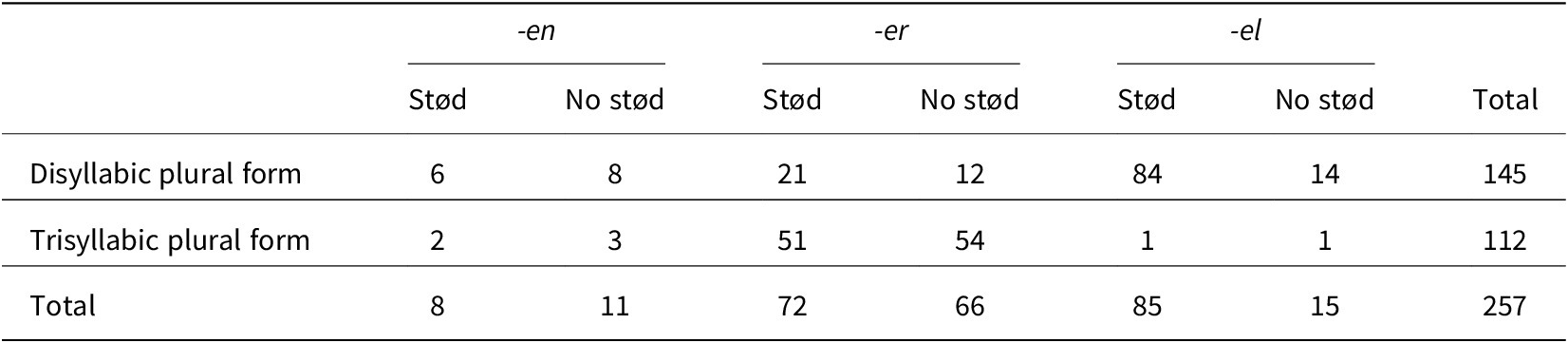
Neither of these tests is entirely reliable, however. According to the first test, nouns with a disyllabic plural form are underlying monosyllables and nouns with a trisyllabic plural form are underlying disyllables. If underlying monosyllabicity is the (synchronic) explanation for stød in these paroxytones, underlying monosyllables should have stød and underlying disyllables should not, and therefore, nouns with a disyllabic plural form should have stød and nouns with a trisyllabic plural form should not have stød. Table 2 shows that many nouns with disyllabic plural forms do indeed have stød. However, the correlation between disyllabic plural form and stød only seems to be convincing for nouns ending in -el. Many nouns ending in -er have stød, despite having trisyllabic plural forms. Also, for example, kedel [ˈkʰeðəl] ‘kettle’ is historically a disyllable, and does not have stød, but it also has a disyllabic plural form, kedler [ˈkʰeðlɐ]. Either plural forms are not a reliable way to determine which nouns are underlying monosyllables, or being an underlying monosyllable is not a reliable explanation for stød in the synchronic grammar.
Distribution of stød in relation to plural forms for nouns ending in -en, -er, or -el Footnote 7.

Of the two suggested tests for underlying monosyllabicity, the second would seem to be the most reliable, because monosyllables with stød in simple forms do not have stød when initial in a compound. Thus, paroxytones ending in -en, -er, or -el that behave in the same way as monosyllables in compounds would be a strong argument that speakers consider them as underlying monosyllables. However, Table 3 shows that most nouns ending in -en, -er, or -el retain stød when initial in a compound. This would mean that very few nouns, and only those ending in -er or -el, are actually underlying monosyllables. There could of course be some instances of lexicalized stød, where stød is retained in all forms, including in compounds, but this would still entail that the second test can only be an argument for underlying monosyllabicity for a few paroxytones with stød.
Stød-behaviour of nouns with stød when initial in a compoundFootnote 8.

The second test might have been more reliable in older varieties of Danish. Brink and Lund (Reference Brink and Lund1975:498) reported a change towards increasing presence of stød in nouns ending in -en, -er, or -el when being the initial part of a compound in the period 1840–1955. This could indicate that the words were underlying monosyllables at some point but have lost this status with time.
Because most of the nouns retain stød when initial in a compound, there are many examples where the two tests do not yield the same result. For example, the words vinter [ˈvenˀtɐ] ‘winter’ and vinkel [ˈveŋˀkəl] ‘angle’ both have disyllabic plural forms, vintre [ˈventʁɐ] ‘winters’ and vinkler [ˈveŋˀklɐ], which would mean that they are underlying monosyllables according to the first test. However, they also have stød when initial in compounds—for example, vinterbad [ˈvenˀtɐˌpæð] ‘winter bath’ and vinkeljern [ˈveŋˀklˌjæɐˀn] ‘angle iron’—which makes them underlying disyllables, according to the second test. Interestingly, the first test results in most nouns ending in -el being underlying monosyllables, but the second test results in most nouns ending in -el being underlying disyllables.
With the above-mentioned arguments in mind, underlying monosyllabicity does not seem to be a reliable explanation for stød in the synchronic grammar. It would, at best, only explain stød in a few paroxytones. The pattern emerged when monosyllables with stød became disyllables. But stød then spread to words that were originally disyllabic, which is a sign that speakers started to generalize stød to words with the same post-tonic syllables. The fact that most of these paroxytones retain stød when initial in a compound, even old monosyllables like vinter, shows that old monosyllables have lost their status as underlying monosyllables with time.
Thus, the pattern where some paroxytones ending in -en, -er, or -el receive stød might have a historical origin, but speakers today are unaware of the historical process. However, the distribution today is not a direct mirror of the historical pattern. For example, nummer from the above examples has a disyllabic plural form and behaves like finger in compounds, but nummer is not a historical monosyllable. Surprisingly few of the monomorphemic nouns ending in -en, -er, or -el are attested historical monosyllables. Of the words in the wordlist—that is, not counting derivations or words without stød basis—two ending in -en, twenty-two ending in -er, and six ending in -el are historical monosyllables according to Det Danske Sprog- og Litteraturselskab (2025a, b).
It could be the case that derivations with the agentive suffix -er and verbal nouns with -en, which are productive in Danish and most often do not have stød, have affected speakers’ tendency to generalize stød to words with the post-tonic syllables -en and -er through time. The derivative suffix -sel, on the other hand, is not productive and not as frequent as -en and -er, and is mostly preceded by syllables with stød. Also, the suffix -sel was previously -sl, that is, not syllabic (Skautrup Reference Skautrup1944:251). This could explain why stød spread to more disyllables ending in -el than to disyllables ending in -en and -er. Furthermore, some of the original monosyllables ending in ‑el have another form today, such as hagel (today hagl [ˈhaʊˀl] ‘hail’) and kringel (today kringle [ˈkʰʁæŋlə] ‘pretzel’)Footnote 9, and other original monosyllables do not have stød basis: for example, aksel [ˈaksəl] ‘axle’ (Skautrup Reference Skautrup1944:251). These changes, as well as potential influences from other word classes or derivations, and other changes in pronunciation that might affect, for example, stød basis, make it difficult to determine why the specific pattern reported in Table 1 is observed, and why the proportion of words with stød increases from -en to -er to ‑el. Moreover, it can be argued that the cause of the pattern is irrelevant when it comes to whether speakers reproduce it (cf. Buckley Reference Buckley2000). The important point is that the pattern is there for speakers to notice.
1.3. A probabilistic approach to stød
An alternative to the explanation where paroxytones with stød are said to be underlying monosyllables is to see the rules or constraints governing stød as gradient rather than categorical. In a probabilistic approach to grammar, ‘[k]nowledge of language should be understood not as a minimal set of categorical rules or constraints, but as a (possibly redundant) set of gradient rules, which may be characterized by a statistical distribution’ (Bod et al. Reference Bod, Hay and Jannedy2003:10). Many studies support this view and show that speakers’ knowledge of language reflects trends in their lexicon (e.g. Albright & Hayes Reference Albright and Hayes2003, Alderete & Finley Reference Alderete and Finley2016, Coetzee & Pater Reference Coetzee and Pater2008, Coleman & Pierrehumbert Reference Coleman, Pierrehumbert and Coleman1997, Ernestus & Baayen Reference Ernestus and Baayen2003, Frisch et al. Reference Frisch, Large and Pisoni2000, Hayes & Londe Reference Hayes and Londe2006, Lau et al. Reference Lau, Clark and Lappin2017, Pierrehumbert Reference Pierrehumbert, Goldstein, Whalen and Best2006, Zuraw Reference Zuraw2000).
Following a probabilistic approach, a rule for assigning stød would have a probability of being applied based on distributional frequencies in the lexicon. If that probability is not equal to 1 (i.e. the rule always applies) or 0 (i.e. the rule never applies), it would have a gradient outcome. For example, if 86% of paroxytones ending in -el have stød, the probability of an unknown paroxytone ending in -el receiving stød would be 0.86 (and the probability of not receiving stød would be 0.14). Thus, there would be a high probability of it receiving stød, but it would not necessarily receive stød.
The results presented in this study align with the probabilistic approach. The participants’ preference for stød in nonce words ending in -en, -er, or -el is gradient and in harmony with distributional frequencies in the lexicon. Thus, this paper argues that stød in paroxytones ending in -en, -er, or -el is not merely a lexicalized diachronic pattern, but part of Danish speakers’ grammatical knowledge. Furthermore, it argues that speakers do not generalize the pattern with no stød in paroxytones to all paroxytones.
The idea that there are different generalizations for different paroxytones is not new. In his treatment of the distribution of stød, Heger (1980) questioned whether there is a single general rule for all paroxytones. He investigated the distribution of stød in a sample from two dictionaries and his own pronunciation of the words in the sample. Based on this survey, he suggested that there might be different rules for different sub-groups of paroxytones, such that speakers would prefer stød in unknown words ending in -er or -el. Kristensen (Reference Kristensen1899:43–44) also argues for different rules for different paroxytones. He argued that Danish speakers’ pronunciation of Latin could indicate what intuitions they had about the assignment of stød. Based on that, he suggested a rule saying that paroxytones ending in -er receive stød, and in exceptional cases even paroxytones ending in -en. He also reasons that there might be a similar rule for -el, even though there are no Latin paroxytones ending in -el. Furthermore, a recent production study with nonce words showed that participants sometimes pronounced paroxytone nonce words ending in -el with stød (Høeg Reference Høeg2024). The study investigated how Danish speakers generalize stød to nonce words with stress on the ultimate, penultimate, or antepenultimate syllable. The study included three paroxytone nonce words ending in -el (of 160 paroxytone nonce words), to which seven of the twelve total responses were pronounced with stød. In comparison, 92% of the paroxytone nonce words ending in -e were pronounced without stød. The study did not include any nonce words ending in -en or -er. This result indicates that speakers generalize stød to unknown words with penultimate stress ending in -el, at least to some extent.
1.4. Research questions and predictions
According to phonological theories of stød such as Basbøll’s (Reference Basbøll2005), the assignment of stød is the same for all monomorphemic paroxytones, regardless of the post-tonic syllable. A probabilistic approach to phonology, on the other hand, would propose that speakers generalize patterns based on their distributional frequencies in the lexicon.
The present study aims to investigate whether Danish speakers’ generalizations for stød are the same for all paroxytones or if the statistical distribution is part of their grammatical knowledge. This is done by testing speakers’ preference for stød or no stød in monomorphemic nonce words ending in ‑en, -er, or -el. A two-alternative forced-choice task was carried out, where participants were asked to choose between pronunciations of nonce words ending in -en, -er, ‑el, or -e with or without stød. Nonce words ending in ‑en, -er, or -el were thus compared to nonce words ending in -e, since monomorphemic words ending in -e are the most common type of disyllable in Danish (Hansen Reference Hansen1943:21) and generally do not have stød (see Table 1).
As in other nonce word studies (e.g. Bennett & Braver Reference Bennett and Braver2020, Berko Reference Berko1958, Coetzee Reference Coetzee2014, Gouskova & Becker Reference Gouskova and Becker2013, Turcsan & Herment Reference Turcsan, Herment, Mompean and Fouz-González2015), it is assumed that nonce words show what generalizations speakers have formed. Nonce words cannot have any lexical specifications and are unknown to the speaker. Therefore, participants’ choice of a pronunciation with or without stød is assumed to reflect their intuitions about stød, which in turn is assumed to reflect their phonological grammar.
According to Pierrehumbert (Reference Pierrehumbert, Bod, Hay and Jannedy2003:180), ‘[t]he grammar is revealed by well-formedness judgments as well as neologisms and borrowings’. A two-alternative forced-choice task can be seen as a form of well-formedness judgement where speakers choose the alternative which they think is most well-formed. If there is a default rule or constraint in the phonological grammar that prohibits stød in paroxytones, this should be reflected in the participants’ responses. In that case, participants should generally prefer pronunciations without stød, without regard to the post-tonic syllable.
By investigating speakers’ preference for stød in this type of nonce words, the study addresses the following research questions:
-
1. Is speakers’ preference for stød in nonce words affected by the type of post-tonic syllable?
-
2. How do speakers’ preferences for stød in nonce words compare to the distribution of stød in the wordlist?
For the first research question, the prediction is that the post-tonic syllable type will have an effect on participants’ preference for stød so that participants prefer stød more often in nonce words ending in -en, ‑er, or -el compared to nonce words ending in -e. This is in contrast to Basbøll’s (Reference Basbøll2005) model, where participants’ preference for stød would be the same regardless of the post-tonic syllable.
For the second research question, the prediction is that participants’ preference for stød will increase in the same direction as the distributional frequencies reported in Table 1. If that is the case, participants’ preference for stød in nonce words ending in -en will be higher than that for nonce words ending in -e, their preference for stød in nonce words ending in -er will be higher than that for nonce words ending in -en, and their preference for stød in nonce words ending in -el will be higher than that for nonce words ending in ‑er. This prediction is based on the findings of the studies mentioned in Section 1.3, which show that speakers’ knowledge of language reflects trends in their lexicon. Furthermore, studies such as Hay et al. Reference Hay, Pierrehumbert, Beckman, Local, Ogden and Temple2004 and Richtsmeier Reference Richtsmeier2011 show that, in the words of Pierrehumbert (Reference Pierrehumbert2016:40), ‘… the productivity of lexical patterns strongly depends on their type frequency, such as the number of different words that display the pattern’. Therefore, it is reasonable to expect that Danish speakers generalize stød for words ending in -en, -er, or -el based on the distribution in Table 1. However, as the count is based on a lemma list from a dictionary, it might not reflect the exact distribution in speakers’ mental lexicons. Jurafsky (Reference Jurafsky, Bod, Hay and Jannedy2003:95) highlights the question of how to estimate prior probabilities from corpora as an unresolved problem. The distribution reported in Table 1 is an idealized assumption of the true underlying frequency. It is not an exact measure of the distribution in speakers’ mental lexicons. However, it does give an indication of the span it might be within.
2. Method
2.1. Participants
In total, fifty-four native speakers of Danish participated in the study. To avoid variation in the data caused by regional differences, the study is limited to Modern Standard Copenhagen, and thus only speakers from the Greater Copenhagen area. Fourteen participants were excluded due to not being from the Greater Copenhagen area. Furthermore, five participants were excluded due to not making a requested recording of themselves reading a sentence in Danish. The remaining thirty-five participants were included in the analysis (eighteen female, fifteen male, two non-binary, mean age = 40, range = 20–73). The participants were recruited through social media, posters with information about the study, and by word of mouth. They were not paid for their participation.
2.2. Stimuli and design
The independent variable post-tonic syllable had four conditions: -en, -er, -el, and -e. There were twelve nonce words in each condition, amounting to forty-eight target items in total. All target items were disyllabic. Some of the target items also contained an onset for the post-tonic syllable. Throughout the remainder of this paper, the stressed syllable refers to everything before -en, -er, -el, or -e in the nonce words. The stressed syllables in the target items were kept constant across conditions, that is, the same twelve stressed syllables were combined with each post-tonic syllable. Each target item was presented with two different pronunciations, one with stød and one without. The target items and their pronunciations can be seen in Table 4.
Target items in each condition with their orthographic representation and the pronunciation with and without stød.

The stressed syllables in the target items were based on the onsets and rimes of stressed syllables of real words ending in -en, -er, or -el. The stressed syllables were split into onset and rime, with some rimes also including an onset for the post-tonic syllable. The onsets and rimes were then combined and selected randomly using a script in Python (version 3.10.6; Van Rossum & Drake Reference Van Rossum and Drake2009). The sampled nonce syllables were checked manually and selected only if they were not a real word, either alone or in combination with one of the post-tonic syllables, or did not resemble a real word. Syllables with the same consonant directly before and after the vowel were also discarded, as well as syllables with a long vowel before /m/, since this only occurs in loan words (Schachtenhaufen, p.c.). Of the sampled syllables fulfilling these criteria, the first five with a short vowel, the first five with a long vowel and the first two with a diphthong were selected.
Eighty filler items with variable vowel length and stress placement were included to distract the participants from the stød–no stød pattern.
To ensure that the participants were cooperating and understood the task, sixteen control items were included. In these control trials, one of the two pronunciations was clearly unacceptable, with a phonotactically illegal initial consonant cluster (/pn/ <bn>, /tsl/ <tl>, /tsn/ <tn>, and /tm/ <dm>).
Each item was recorded with its two different pronunciations by the author, who is a native speaker of Danish. The recordings were made in a sound-attenuated booth with an Audio Technica AT3035 microphone. The volume of the audio files was amplified by 20 db in Audacity (version 3.1.2). No other acoustic properties were artificially manipulated. Since the stimuli were naturally produced with or without stød, rather than manipulated, the acoustic properties were not controlled. The recordings of the target items were checked by three native speakers and re-recorded if necessary. The filler and control items were checked by two native speakers. One native speaker other than the author also checked that the stød was easily detectable in the target items.
The audio files were split into individual short audio files with one nonce word in each. The boundaries of each audio file were trimmed, with approximately 100 ms before and after the nonce word to avoid glitches (Before: min 19 ms, max 188 ms, mean 90 ms; After: min 34 ms, max 323 ms, mean 121 ms). The length of the pause between the audio files depended on which one was played first, which depended on what list the participant received. The mean length of the audio files (including silence before and after in the file) was 716 ms, with the shortest audio file being 506 ms and the longest being 909 ms. The audio files, as well as an overview of all nonce words, are available in the Supplementary Material (File 2: Stimuli).
The items were split into two blocks. Each block contained forty filler items, eight control items, and six target items from each condition, counterbalanced with three trials with stød first and three trials with stød second, resulting in seventy-two trials in each block.
The ordering of the items was fixed and pseudo-randomized. When necessary, the items were reordered based on the following constraints: (i) no consecutive items from the same condition, (ii) no more than two stød items in a row, (iii) no consecutive items with the same presentation order of stød (stød first or stød second), (iv) no identical stressed syllable two times in a row (at least five trials were between identical stressed syllables).
Block order was counterbalanced, and two different versions of each block were created. The different versions contained the same items, but with each item-pair (stød–no stød) in the opposite order from before, and with another ordering of the trials. This resulted in four different lists. Each participant was randomly assigned to a list, such that across participants a given item was equally likely to occur in the first or second block and with stød either first or second in the pair.
2.3. Procedure
The stimuli were presented as a two-alternative forced-choice task, which was built in PsychoPy (version 2024.2.1; Peirce et al. Reference Peirce, Gray, Simpson, MacAskill, Höchenberger, Sogo, Kastman and Lindeløv2019) and run online on Pavlovia.
After a welcome screen with information about the study, the participants were shown a screen giving information about anonymity, participation rights and the handling of data. The participants gave their consent by pressing a button, where they also confirmed that they had read the information. The data collection was performed in accordance with the Swedish Research Council’s Good research practice (2017).
Before starting the trials, the participants had to respond to three screening questions, confirming that they were 18 years or older, had Danish as a native language, and were from the Greater Copenhagen area. Participants were also requested to record themselves reading aloud the sentence Der står en rød bil på gaden ‘There is a red car on the street’. This was to ensure that the participants were indeed native speakers of Danish and did not clearly have another dialect than that of the Greater Copenhagen area.
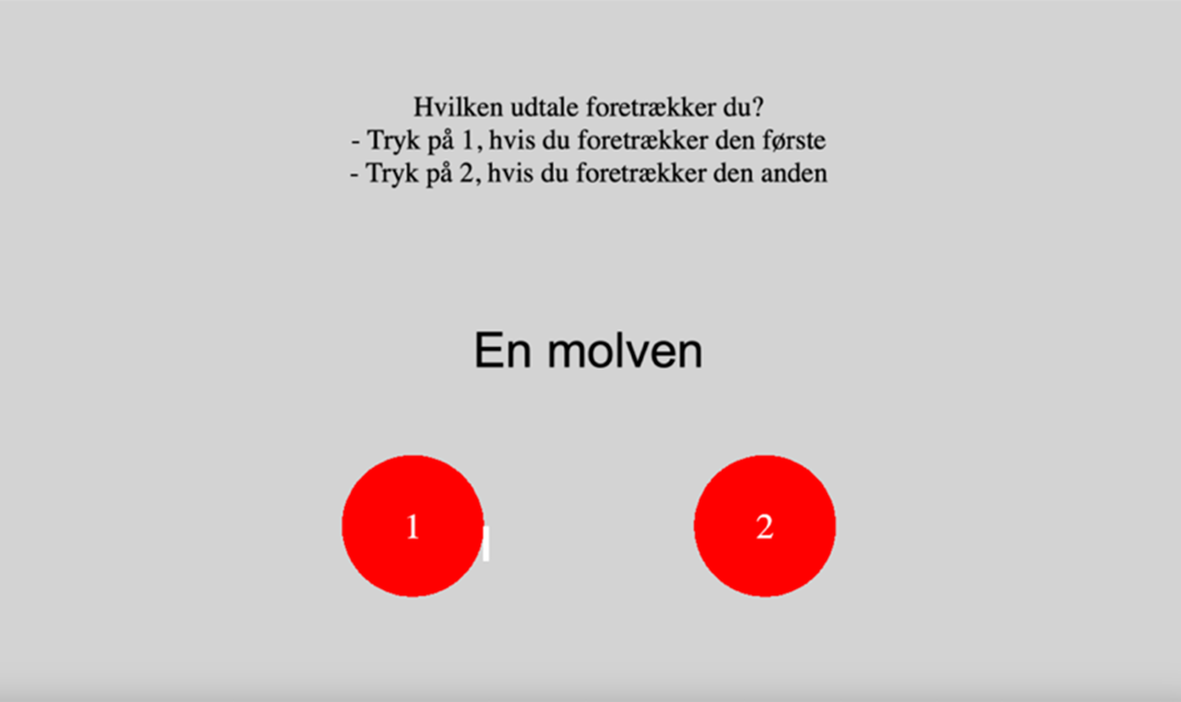
The participants were instructed that they would hear two pronunciations of a nonce word and then should choose which of the pronunciations they preferred by clicking a button: ‘1’ if they preferred the first pronunciation and ‘2’ if they preferred the second pronunciation. Two practice trials preceded the experimental trials. An example from the experimental trials can be seen in Figure 1.
Example of an experimental trial.

An advantage of having participants choose between two pronunciations, rather than a production task, is the fact that other aspects of the pronunciation can be controlled—for example, vowel length and stress. Danish has an opaque orthography, with many inconsistencies between spelling and sound (Elbro Reference Elbro, Joshi and Aaron2006, Juul & Sigurdsson Reference Juul and Sigurdsson2005). Therefore, pronunciations of written stimuli can introduce variation in vowel length, stress placement, or segmental variation. For example, blimpen could be pronounced as [ˈplempən] by some participants and as [ˈplimpən] or [plemˈpʰeːn] by other participants. In a forced-choice task with auditory stimuli, we know that the post-tonic syllable is the only difference between the four conditions, which makes it easier to attribute participants’ choice of stød or no stød to the post-tonic syllable.
The nonce words were presented on the screen with the indefinite article en ‘a’ before them, to make the participants perceive them as nouns, and to avoid that they would perceive the post-tonic syllable -en as a definite article. It should be noted that stød is not represented in Danish orthography. Therefore, the written form should not influence the participants’ preference for stød.
The nonce word was visible on the screen when a trial started, and the first audio file started playing 500 ms later. This gave the participants enough time to read the nonce word before they heard the recordings. That way, the participants could internally generate a pronunciation of the nonce word and match it to what they hear. For each experimental nonce word, the participants listened to two audio files, one in which the nonce word was pronounced with stød and one without stød. The response key was activated 2,300 ms after the trial started. Due to different lengths of the audio files, the second audio file sometimes ended before the response key was activated (List 1–2: max = 180 ms, mean = 50 ms; List 3–4: max = 192 ms, mean = 58) and sometimes after the response key was activated (List 1–2: max = 191 ms, mean = 65 ms; List 3–4: max = 182, mean = 62). In all four lists, the response key was activated before the audio file ended in 58% of the target trials. Despite this, only four participants responded to a target trial before the audio ended, to one trial each, thus four trials in total. The decision to have the response key activated before the second audio file ended in some cases was taken to optimize trial pacing, so as not to make the wait until the response key was activated too long in the trials where the audio file was shorter.
In total, there were 144 trials, split into two blocks. The participants had the option to take a small break between the blocks. Following the two blocks, participants were asked to fill in background information and respond to three questions about the study. The questions were of increasing specificity (what they thought the aim was, if they noticed what the difference between the pronunciations was, and if they noticed that some of the pronunciations differed in occurrence of stød). The questions were used to establish whether the participants had any explicit prior knowledge of stød. Participants were then debriefed, with an explanation of the aim of the study and examples of what stød is.
On average, the study took 17.6 minutes (SD = 15.6, min = 9.5, max = 103).
2.4. Data processing and analysis
The threshold for a participant to be excluded based on the control trials was set to at least 12 correct responses out of 16, which means that the probability of passing control trials by guessing is below 5% (Pieper et al. Reference Pieper, Börner and Kiss2023:18). However, no participant gave an incorrect response to more than one control trial. Only four participants chose an unacceptable pronunciation once.
The four trials that participants responded to before having heard the end of the second pronunciation were excluded. Thus, 1,676 responses were included in the analysis. The button press responses were transformed to the corresponding values for stød (1) or no stød (0), depending on the order in which the audio files were played.
In order to examine whether speakers’ preference for stød in nonce words was affected by the type of post-tonic syllable in the nonce word, a mixed-effects logistic regression model was fit in R (version 2024.04.2; R Core Team 2022) using the glmer function from the lme4 package (version 1.1-3; Bates et al. Reference Bates, Mächler, Bolker and Walker2015). Response (stød) was coded as the dependent variable and post-tonic syllable as the independent variable. The coding scheme was backwards difference coding, which was made using the MASS package (version 7.3-61; Venables & Ripley Reference Venables and Ripley2002). The coding scheme compared each level to the preceding, with -en being compared to -e, -er being compared to -en, and -el being compared to -er. Varying intercepts for the variable participant were included to account for participant-specific effects, such some participants being more likely to prefer stød. Varying intercepts for the variable item were included to account for item-specific effects, such as stød being more preferred for specific items. A model with and without random slopes for participant were compared to a model without random slopes. Removing the random slopes did not significantly worsen the fit of the model. Therefore, slopes were removed from the model. The model structure was thus glmer(Response ~ Condition_dif + (1|Participant_ID) + (1|NonceWord), data = data, family = “binomial”).
A likelihood ratio test was performed using the ANOVA function (R Core Team 2022) to test if there was a significant difference between the model with post-tonic syllable as a fixed effect and a model without it—in other words, whether the post-tonic syllable had an effect on participants’ preference for stød.
In addition, a model was fit to test participants’ stød-awareness post-hoc. The model was similar to the mixed-effects model with pairwise comparisons, but with stød-awareness as the independent variable and with the default treatment coding in R. The model structure was thus glmer(Response ~ Stod_Awareness + (1|Participant_ID) + (1|NonceWord), data = data, family = “binomial”).
The tidyverse package (version, 3.5.1; Wickham et al. Reference Wickham, Averick, Bryan, Chang, McGowan, François, Grolemund, Hayes, Henry, Hester, Kuhn, Pedersen, Miller, Bache, Müller, Ooms, Robinson, Seidel, Spinu, Takahashi, Vaughan, Wilke, Woo and Yutani2019) was used for visualizations and processing of the data. The data file and R-code for the statistical analysis can be found in the Supplementary Material (File 3: Data, File 4: Code).
3. Results
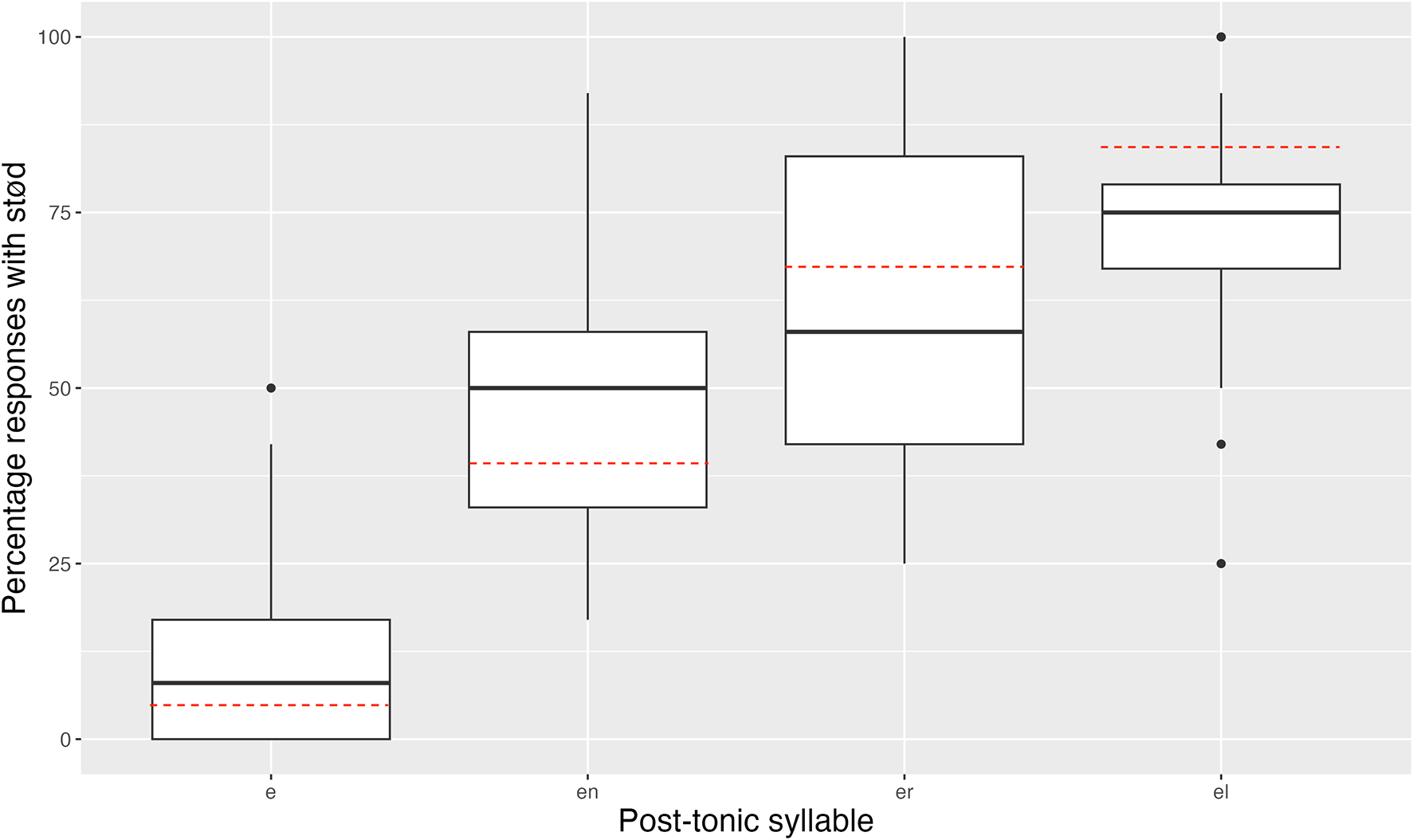
For nonce words ending in -en, participants chose the response with stød 46% of the time, for nonce words ending in -er, participants chose the response with stød 60% of the time and for nonce words ending in ‑el, participants chose the response with stød 71% of the time. In the wordlist (see Section 1.1), 38% of the words ending in -en had stød, 64% of the words ending in -er had stød and 86% of the words ending in ‑el had stød.
The overall effect of post-tonic syllable type was significant. The likelihood ratio test revealed a significant difference between the models with and without post-tonic syllable as a fixed effect ( $ {\chi}^2 $
(3) = 53.71, p < 0.0001). Thus, the post-tonic syllable type had a significant effect on participants’ preference for stød.
$ {\chi}^2 $
(3) = 53.71, p < 0.0001). Thus, the post-tonic syllable type had a significant effect on participants’ preference for stød.
The results for each post-tonic syllable can be seen in Figure 2. From the boxplot, it is clear that participants’ preference for stød in nonce words with the post-tonic syllables -en, -er, or -el differs from nonce words with the post-tonic syllable -e. Furthermore, the mixed-effects model with pairwise comparisons showed significant differences between the post-tonic syllables in the direction predicted by the frequencies in the wordlist for ‑en compared to -e (coef. = 2.12, SE = 0.38, z = 5.55, p < 0.0001) and for ‑er compared to -en (coef. = 0.73, SE = 0.36, z = 2.01, p < 0.05), but not for -el compared to -er (coef. = 0.58, SE = 0.37, z = 1.59, p = 0.1114). Since -en is significantly different from -e, and the estimate for both -er and -el is positive, it follows that -el is also significantly different from -e. Thus, participants’ preference for stød in nonce words ending in -en, -er, and -el is significantly different from their preference for stød in nonce words ending in -e.
Results for the two-alternative forced-choice task, with percentage of responses chosen with stød for each post-tonic syllable. The central line in each box indicates the median. The dashed line indicates the distributional frequency of words with stød in the wordlist.

The size of the boxes and whiskers in Figure 2 shows that there is variation in how often different participants chose responses with stød for the different post-tonic syllables, especially for -en and ‑er. This participant variation can be seen in Figure 3, which shows the proportion of responses with stød for each participant for the four different post-tonic syllables. As can be seen, the proportion of responses with stød is consistently greater for all post-tonic syllables compared to -e. However, the pattern of stød proportions between the other post-tonic syllables is more variable, especially between -er and -el. Interestingly, it is clear that the participants who choose the most responses with stød for nonce words ending in ‑e are not necessarily the ones who choose the most responses with stød for nonce words ending in other post-tonic syllables. For example, 42% of the responses from Participant 25 had stød when the post-tonic syllable was -e, but 75% had stød when the post-tonic syllable was -el, which is the same proportion as Participant 8, who did not have any responses with stød for nonce words ending in -e.
Participant-level results for the two-alternative forced-choice task, with percentage of responses chosen with stød for each post-tonic syllable. The dots indicate the distributional frequency of words with stød in the wordlist.

There was also some variation in how often participants preferred stød for different items. The line graph in Figure 4 shows the proportion of responses with stød for each stressed syllable for the four different post-tonic syllables. As can be seen, participants generally preferred stød less often when the stressed syllable in the nonce words was sværsk and lørk. Also, there were no items where all participants chose the same response.
Item-level results for the two-alternative forced-choice task, with percentage of responses chosen with stød for each post-tonic syllable.

3.1. Testing stød-awareness post-hoc
When asked what they thought was the aim of the study or what the difference between the pronunciations was, twenty (of thirty-five) participants gave a response that included the word ‘stød’, before the concept of stød was explained. This means that these participants were not linguistically naïve and had some explicit knowledge of stød.
To test whether explicit knowledge of stød had an effect on how likely a participant was to choose a pronunciation with stød, a mixed logistic regression model was fit to estimate the effect. Explicit knowledge of stød did not have any significant effect on responses (coef. = –0.15, SE = 0.28, z = –0.55, p = 0.58). However, an anonymous reviewer pointed out that including stød-awareness as an interaction in the model for testing participants’ preference for stød modulated some of the comparisons made by the model. The interaction was significant for the change from -e to -en, but not for -er compared to -en or -el compared to -er.
The participants with explicit knowledge of stød choose the response with stød 8% of the time for nonce words ending in -e, 45% of the time for nonce words ending in -en, 60% of the time for nonce words ending in -er, and 72% of the time for nonce words ending in -el. By comparison, participants without explicit knowledge of stød choose the response with stød 18% of the time for nonce words ending in -e, 48% of the time for nonce words ending in -en, 60% of the time for nonce words ending in -er and 70% of the time for nonce words ending in -el.
4. Discussion
The aim of this study was to investigate whether Danish speakers’ generalizations for stød are the same for all paroxytones by studying their preference for stød in monomorphemic nonce words ending in -en, -er, or -el compared to nonce words ending in -e. It was predicted that post-tonic syllable type would have an effect on participants’ preference for stød such that participants would prefer stød more often in nonce words ending in -en, -er, or -el compared to nonce words ending in -e. It was also predicted that participants’ preference for stød would increase in the same direction as the distributional frequencies from the wordlist. These frequencies gave an order of stød preference which was -e < -en < ‑er < -el.
The results were in line with the first prediction. Post-tonic syllable type had a significant effect on participants’ preference for stød, and the participants preferred stød more often when the post-tonic syllables were -en, -er, or -el, compared to -e. The results were also mostly in line with the second prediction. On average, participants’ preference for stød increased in the direction predicted by the distribution of stød in the wordlist. Only the difference between ‑er and -el failed to reach significance. The results show that the participants’ generalizations for stød are not the same for all paroxytones. Instead, they have different generalizations for paroxytones with different post-tonic syllables.
It has previously been suggested that the occurrence of stød in paroxytones ending in -en, ‑er, or -el was due to them being underlyingly monosyllabic (Basbøll Reference Basbøll2005:409–10, Goldshtein Reference Goldshtein2023:159, Hansen Reference Hansen1943:19–20), as discussed in Section 1.2. It is not possible to say whether the participants perceived the nonce words in this study as underlyingly monosyllabic. However, as was argued in Section 1.2, old monosyllables that are now disyllables seem to have lost their status as underlyingly monosyllabic with time, and many old disyllables also have stød today. Furthermore, underlying monosyllabicity as an argument for stød in paroxytones is mostly proposed to make them fit into a categorical pattern where oxytones have stød and paroxytones do not (cf. Basbøll Reference Basbøll2005). The results of this study show that speakers’ preference for stød is not categorical for nonce words ending in -en, -er, or -el. Therefore, underlying monosyllabicity cannot be a key factor in an analysis of what is part of speakers’ grammar. The pattern is generalized without regard to its original motivation.
In spite of the arguments presented against paroxytones with stød being underlying monosyllables, it remains possible that underlying monosyllabicity plays a role. However, testing this claim is not straightforward. Asking participants to provide plural forms of the nonce words would not provide reliable evidence. It is more likely that they would resort to the most frequent pattern, such as disyllabic plurals when the post-tonic syllable is -el (cf. Table 2). Thus, disyllabic plural forms would not be a reliable way to prove underlying monosyllabicity. A better approach might be to ask participants to choose between a pronunciation with and without stød when the nonce word is the initial part of a compound. This would provide clearer evidence that they perceived it as underlyingly monosyllabic. However, it is also likely that participants would resort to the most frequent pattern if they were to choose between compounds with and without stød on the initial word; that is, they would retain stød (cf. Table 3). This will need to be investigated further in future studies.
Instead of explaining the participants’ behavior as a result of underlying monosyllabicity, the results of the present study are more compatible with a view that the distribution of stød in the lexicon affects the probability of a participant choosing a response with stød. The participants’ preference for stød in the nonce words was generally similar to the distribution of stød in the wordlist. Thus, they largely followed the trends in the lexicon. However, as Alderete and Finley (Reference Alderete and Finley2023:583) point out, ‘… modeling the average of a population of speakers may not reflect any individual’s phonological knowledge’. As was shown in Figure 3, the proportion of responses with stød varies between participants. Nevertheless, the present study does indicate that the participants’ preference for stød is based on distributional frequencies in the lexicon. All participants preferred stød more often when the post-tonic syllable was ‑en, ‑er, or -el, compared to -e Footnote 10 and their preference for stød was generally increasing in the same direction as the distribution in the wordlist. It is also important to note that the lexical frequency from the wordlist is an estimate based on a dictionary and not an exact measure of the distribution in speakers’ lexicons. A dictionary is not an exact measure of speakers’ actual vocabularies. Of course, speakers have different vocabularies (Pierrehumbert Reference Pierrehumbert, Bod, Hay and Jannedy2003:205) and might thus have different distributions in their lexicons. It could also be the case that some of the nouns that were counted as derived, and thus excluded from the count in this study (see Section 1.1), are not perceived as derived by the speakers.
The individual differences observed can be interpreted as the participants showing probabilistic behavior in their responses. As was shown in Figure 3, some participants preferred stød often when the post-tonic syllable was ‑en, ‑er, or -el, and some participants preferred stød less often for nonce words with these post-tonic syllables. Also, it was not always a consistent increase. Some preferred stød more often for nonce words ending in -en compared to nonce words ending in -er and then again more often in nonce words ending in -el. Some participants preferred stød most often for nonce words ending in -er.
That each participant did not pattern with the lexical frequency is to be expected if the assignment of stød is probabilistic, since a probability of something happening does not mean that it will happen with that exact frequency, but the more observations, the closer it is to the true probability (Bod Reference Bod, Bod, Hay and Jannedy2003:14). This might be why the participants’ responses are closer to the lexical frequencies when pooled together. And again, the lexical frequencies based on the wordlist might not be the actual frequency in speakers’ mental lexicons. Thus, it could be the case that the actual distribution of stød in nouns ending in, for example, -el is closer to 71% than to 86%, or somewhere in between.
Some of the individual differences might also be due to some participants not being linguistically naïve. Including an interaction with stød-awareness in the statistical model gave a significant interaction for -en compared to -e, but not for the other comparisons. However, this was likely caused by differences in how often the two groups choose the response with stød when the nonce words ended in -e, and not differences in how often they choose stød for nonce words ending in -en, -er, or -el.
The study is limited to patterns regarding post-tonic syllables and limited to nouns. Other patterns in the lexicon might also affect speakers’ generalizations. For example, participants’ preference for stød in nonce words with the stressed syllables sværsk [ˈsvæɐsk] and lørk [ˈlɶɐk] stands out from nonce words with other stressed syllables. Participants’ preference for stød in these nonce words was generally lower. The two stressed syllables both contained a diphthong, [æɐ] or [ɶɐ], with [ɐ] being the phoneme /r/. The following segment is an obstruent in both stressed syllables. Many monosyllabic words with a short vowel followed by /r/, followed by an obstruent, do not have stød; for example, stærk [ˈstæɐk] ‘strong’. In older varieties of Danish, these words did not have stød basis. The phoneme /r/ was pronounced as [ʁ̥] when it occurred between a short vowel and a voiceless obstruent. Today, post-vocalic /r/ is pronounced as [ɐ]. Therefore, these words have stød basis today, but they are mostly still pronounced without stød (Grønnum Reference Grønnum2005:221–23). It is not possible to say if the lower preference for stød in the nonce words with these stressed syllables might be due to /r/ followed by an obstruent, or due to the nucleus being a diphthong. In order to test this, a design with nonce words containing other diphthongs than [Vɐ] would be necessary.
Another explanation for participants’ lower preference for stød in nonce words with the stressed syllables sværsk and lørk could be the similarity to known words without stød. Three words have the same rime in the stressed syllable and onset in the post-tonic syllable as sværsken, sværsker, and sværskel, which are fersken [ˈfæɐskən] ‘peach’, hersker [ˈhæɐskɐ] ‘ruler’, and tærskel [ˈtsæɐskəl] ‘threshold’. None has stød. The same is the case for lørk, with the similar words ørken [ˈɶɐkən] ‘desert’ and snørkel [ˈsnɶɐkəl] ‘twist/curl’. Both have the same rime in the stressed syllable and onset in the post-tonic syllable, and no stød. The lower preference for stød might be due to analogy with these words. However, even though sværsken, sværsker, and sværskel are all similar to a known word without stød, the proportion of responses with stød is still increasing from sværsken to sværsker to sværskel. Thus, the lower preference for stød in nonce words with sværsk, compared to other nonce words, could be due to influence from similar words, but the effect of the post-tonic syllables is nevertheless present.
Besides nonce words with the syllable sværsk, nonce words with klyb [ˈkʰlyːˀp] are the only ones in the study where there are similar words with all three post-tonic syllables: hyben [ˈhyːˀpən] ‘rosehip’, hyper [ˈhyːˀpɐ] ‘hyper’, and hybel [ˈhyːˀpəl] ‘(often tiny) studio apartment’. Again, participants’ preference for stød increases from klyben to klyber to klybel, despite the real words that have stød.
The remaining nonce words used in the study are similar to one or two words each. [ˈplæːkən] is similar to præken [ˈpʰʁæːkən] ‘sermon’Footnote 11, but not to any words ending in -er or -el. Såpen [ˈsɔːpən] is similar to våben [ˈvɔːˀpən] ‘weapon’ and åben [ˈɔːpən] ‘open’, but not to any words ending in -er Footnote 12 or -el. The only word with the same rime in the stressed syllable and the same post-tonic syllable as molver [ˈmɒlvɐ] and rålver [ˈʁɒlvɐ] is revolver [ʁæˈvɒlˀvɐ] ‘revolver’, but the similarity is smaller due to the pre-tonic syllable.
Blimpel [ˈplempəl] is similar to vimpel [ˈvemˀpəl] ‘pennant’ and simpel [ˈsemˀpəl] ‘simple’, byngel [ˈpøŋəl] is similar to slyngel [ˈsløŋˀəl] ‘scoundrel’ and yngel [ˈøŋˀəl] ‘offspring’, and dretel [ˈtʁæːˀtəl] is similar to spatel [ˈspæːˀtəl] ‘spatula’, but none of them are similar to any words ending in -en or -er. That these nonce words only have similar words ending in -el, which all have stød, could be speculated to have caused the higher preference for stød for nonce words ending in -el. However, the nonce words sviltel [ˈsviltəl] and blakel [ˈplæːkəl], are not similar to any words ending in -el, but they still have the highest proportion responses with stød compared to when the post-tonic syllable is -e, -en, or -er.
Hoker [ˈhoːˀkɐ] is similar to poker [ˈpʰoːˀkɐ] ‘poker’ and joker [ˈjoːˀkɐ] ‘joker (the playing card)’, but not to any words ending in -en or -el. The spike in responses with stød for hoker might be due to this. However, there is no spike in responses with stød for svilter [ˈsvilˀtɐ], which, like hoker, is similar to two words with stød ending in -er, ilter [ˈilˀtɐ] ‘hot-tempered’ and filter [ˈfilˀtɐ] ‘filter’, and not to any words ending in -en or -el. It can only be speculated whether the spike in stød responses for hoker is just random variation, or if the lack of a similar spike in stød responses for svilter is because the onset is differing by two phonemes instead of one.
It cannot be denied that the occurrence of stød in similar words, or other phonological properties of the nonce words, might have influenced the participants’ preference for stød. If speakers are sensitive to statistical patterns in the distribution of stød in the lexicon, as this study suggests, it would be expected that other patterns can affect speakers’ preference for stød as well. How, or if, the occurrence of stød in similar words, with more similarities than just the post-tonic syllable, affects participants’ preference for stød, and whether participants are thinking of specific similar words when choosing their responses, is a topic for future research.
Another pattern which might affect participants’ preference for stød is suffixes with the same form as the post-tonic syllables. As mentioned in Section 1.1, different suffixes, both inflectional and derivational, can yield different stød alternations (Basbøll Reference Basbøll2005, Reference Basbøll2014, Goldshtein Reference Goldshtein2023), and some derivational and inflectional suffixes have the same form as these post-tonic syllables. However, if the participants perceived the nonce words as morphologically complex, it is not clear if this would influence them towards higher or lower preference for stød. For example, -en can be the definite suffix for nouns and it mostly occurs with stød in the preceding syllable, but -en can also be a derivational suffix which mostly occurs with no stød in the preceding syllable. Both are productive, but the definite suffix is the most frequent. However, the nonce words were preceded by the indefinite article en ‘a’ when shown on the screen to avoid that the nonce words ending in -en were perceived as containing the definite article suffix -en, as well as making participants perceive the nonce words as nouns. Therefore, the possibility that participants perceived the nonce words as containing the definite article suffix -en or the plural suffix -er is less likely. The participants could have perceived the nonce words as containing the derivational suffixes -en or -er, but in that case, it would be expected that they would prefer stød less often, since these suffixes are mostly preceded by a syllable without stød. Thus, even if participants sometimes perceived the nonce words as containing the derivational suffixes -en or -er, this would not explain why they prefer stød more often when the post-tonic syllable is -en or -er compared to when the post-tonic syllable is -e. How these suffixes affect speakers’ preference for stød should be investigated further in future studies, with a design that primes participants to perceive these syllables as specific suffixes.
It should be emphasized that the claim in this study is not that speakers’ preference for stød is based on some property of the post-tonic syllables themselves, or the segments in the post-tonic syllables or their sonority; that is, it is not phonetically motivated. The present study argues that the pattern happens to exist because there was a time when monosyllables with stød became disyllabic, and stød was generalized to other words with the same post-tonic syllables. While speakers today are unaware of this historical process, they are sensitive to the resulting patterns and generalize them probabilistically to novel contexts.
The results of this study are in line with previous studies which show that speakers’ knowledge of language reflects trends in their lexicon (see Section 1.3). For example, in their study of phonotactic generalizations in English and Arabic, Frisch et al. (Reference Frisch, Large, Zawaydeh, Pisoni, Bybee and Hopper2001:176) conclude that ‘… the phonotactic constraint in Arabic is more complex than a traditional all-or-nothing constraint, as it is probabilistic and lexically-based’. In the same vein, the present study shows that the constraint or rule that governs the assignment of stød is not all-or-nothing, either.
Traditionally, the distribution of stød in Danish has been characterized as categorical in nature. The purpose has been to formulate a phonological rule that is as economic as possible, by focusing on the general pattern with stød in oxytones and no stød in paroxytones. However, the data reported here demonstrate that the participants’ generalizations are not the same for all paroxytones. Stød is therefore not exclusively conditioned by the location of the stressed syllable in monomorphemic words, as suggested by Basbøll (Reference Basbøll2005). The results of the present study suggest that a categorical-rule approach cannot predict how speakers actually generalize stød. Stød is not governed solely by categorical rules.
5. Conclusion
The present study has shown that the post-tonic syllables -en, -el, and ‑er affect Danish speakers’ preference for stød in monomorphemic nonce words. The results show that speakers’ generalizations for stød in monomorphemic words are not the same for all paroxytones and are thus more fine-grained than previously assumed. Consequently, stød is not exclusively conditioned by the location of the stressed syllable in monomorphemic words, as suggested by Basbøll (Reference Basbøll2005). Instead, the results support the idea that the assignment of stød is probabilistic and can be based on distributional frequencies in the lexicon. It also shows that speakers’ preference for stød, at least in paroxytones ending in ‑en, -er, or -el, is gradient rather than categorical. As Alderete and Finley (Reference Alderete and Finley2023:566) point out, different gradient constraints (or rules) are ‘… likely to be a part of the speaker’s grammatical knowledge, rather than artifacts of historical residue or random variation’. In the same vein, paroxytones with stød ending in -en, -er, or -el are not just historical residue from when they were monosyllables. Speakers today are not aware of the historical process that led to the emergence of this pattern, but they are sensitive to the resulting patterns and generalize them probabilistically to novel contexts. The pattern is part of their grammatical knowledge. In order to develop more empirically robust phonological models of stød, it is necessary to take probability and non-categorical patterns like this into account.
Supplementary material
The supplementary material for this article can be found at http://doi.org/10.1017/S2642182826000073.
-
• File 1: Wordlist
A list of Danish words with stress on the penultimate syllable ending in -e, -en, -er, or -el. The list contains information about which words are considered to be derivations, occurrence of stød, underlying syllabicity according to the two tests described in Section 1.2, pre-stress syllables, and other relevant comments. The list only includes nouns with stød basis. The list is based on a lemma list from Det Danske Sprog- og Litteraturselskab 2020.
-
• File 2: Stimuli
A zip-file containing a list with all nonce words used in the study (target, filler, and control) as well as recordings of these nonce words.
-
• File 3: Data
Data file used for the statistical analysis. The file only contains data from the target items.
-
• File 4: Code
R-code for statistical analysis and visualization of the data.
Acknowledgments
I would like to thank Ruben Schachtenhaufen, Yonatan Goldstein and Christophe Zerakitsky Vies for valuable comments on the recordings of the nonce words, Johannes Albertus Zandhuis for writing a code to randomly assign lists to participants, and Tomas Riad and Linda R. Wheeldon for helpful comments and discussion at various stages of the project. I also thank Chigusa Kurumada and participants at the 2024 workshop on research skills at Stockholm University for insights and comments on the experimental design, and the audiences at PPDK2024 in Copenhagen and FiNo 2025 in Oslo for their insightful comments. Finally, I want to thank the two anonymous PDA reviewers and the editor, Laura McPherson, for their valuable comments which much improved both the content and the presentation of the paper.
Data availability statement
The data are available in the supplementary files.
Competing interests
The author declares none.
Funding disclosure statement
The author received no financial support for the research, authorship, and/or publication of this article.
Ethics statement
The data collection was performed in accordance with the Swedish Research Council’s Good Research Practice (2017).




 Open access

