

Introduction
At the dawn of independences in Africa and Asia, the quantification of societies was integral to modern state programs, understood here as transformative programs oriented toward measurable social progress that was presumed to benefit the population.Footnote 1 This kind of public intervention was made possible through statistics, which, despite their partial and exclusionary representations, made societies “legible.”Footnote 2 Drawing on the approach of James Scott and Timothy Mitchell, this paper adopts a critical look on what can be described as statistical modernity in Algeria during the late French colonial period and early independence. I seek to identify biases and blind spots in successive conceptualizations of labor emigration from Algeria to France, as well as discrepancies between the declared objectives of state programs and their actual achievements. To do so, I take a broad chronological sweep, highlighting the continuities, without overstating them, between the academic knowledge on emigration produced in 1950s colonial Algeria and the 1969 Algerian Ministry of Labor’s planning model. In this way, I document a specific aspect of the emergence of development as a project and a frame of reference for newly independent states.Footnote 3
Focusing on Algeria as a country of departure, this paper argues that the issuance of exit permits to male emigrants functioned as an indirect form of resource distribution. This mechanism was in line with North African socialist experiments in social justice and social protection in the 1960s.Footnote 4 The 1969 turning point in emigration planning specifically addressed regionalism and regional inequalities, which Algerian officials, like their Libyan, Moroccan, and Tunisian counterparts, saw as colonial legacies and actively sought to counter.Footnote 5 A leading role in this effort was played by the Algerian Ministry of Labor and Social Affairs, despite the fact that it was often described as “the domain of the Kabyles.”Footnote 6 This search for a more regional-balanced emigration planning was made more delicate by the inertia of emigration, structured around village networks, as well as by the historically positive portrayal of Kabyle workers by colonial authorities.Footnote 7 Kabylia, a mountainous region east of Algiers, provided half of the emigrants to France after 1962.Footnote 8 Emigration to France increased from 250,000 to 500,000 between 1954 and 1965, and reached 900,000 in 1976. It gradually spread to other regions including the Aurès, the Highlands, and the Oases.Footnote 9 Part of this diversification resulted from the government’s decision to encourage it through statistical planning, which continued until the state regulation of labor emigration ceased in September 1973.
I first review the evolutionist and regionalist biases of knowledge production about emigration to France during the 1950s. In late colonial Algeria, scientific reports presupposed a single, universal path toward social development. They portrayed Kabylia as ahead on this trajectory, and felt that emigration from this region should therefore be encouraged; more generally, these sources wrongly interpreted the departure of Algerians as a direct consequence of population growth. I then examine how the Algerian Ministry of Labor and Social Affairs promoted emigration as an object of national development policy in the mid-1960s, drawing on sources including the first national seminar on emigration in 1966, the first census, also in 1966, ministry documentation, and the doctoral thesis of the deputy director of emigration from 1965 to 1971. Finally, I examine the statistical data used to plan emigration, and analyze the Algerian state’s limited information capacities. I show that some Algerian officials were aware of these limitations and sought to cope with them. From their perspective, the emphasis on demography in the planning model did not reflect a colonial Malthusian view, which treated population growth solely as a problem; instead, it reflected the desire of policymakers to dissociate emigration from its old regional dynamics, in the absence of an agreed upon way of measuring unemployment.
Emigration through the lens of a nascent colonial statistical apparatus
Before independence, the statistical apparatus developed very unevenly in Algeria, depending on the population being studied.Footnote 10 Its foundation in the division between “Europeans” and “Muslims” produced a hierarchical, compartmentalized system of knowledge organized by race, religion, and place of residence.Footnote 11 In the hinterland, the colonial state had only a vague picture of the population through civil registries and identity documents. It relied on a loose administrative network, in contrast to the “nodal points of colonial authority” in the coastal cities and district capitals.Footnote 12
This dualism strongly affected the accuracy and quality of data, which thus was difficult to use as a basis for action. After 1945, the administrative category of “French Muslims” continued to reflect an essentialist perception of Algerians by civil servants of the General Government of Algeria (GGA). Like colonial experts in this period, their preoccupation with customs, so-called Muslim psychology, and colonial demographics hindered the emergence of a vision of society stratified by occupation, class, or socioeconomic resources.Footnote 13
Such culturalist representations were also present in the sociology of emigration, particularly in Algeria, where emigrants were categorized by geographic origin and presumed work abilities. In the 1950s, emigration to France remained poorly understood—a paradox given its scale and longevity: Algeria was the only French colony experiencing a massive emigration to the metropole, which had begun in the late nineteenth century. Sociological and statistical knowledge both reinforced and institutionalized ignorance by generating supposedly objective representations of the workforce, a recurring pattern in colonial contexts.Footnote 14 Aligned with modernization theory, these accounts framed migration to France as a positive step in the “evolution” of Algerians toward Western civilization and the market economy.
Limited knowledge on emigration
There are several practical reasons for the inaccuracy of colonial statistics on emigration. First of all, the movements of “French Muslims from Algeria” between metropolitan France and the colony were recorded by four different administrative bodies between 1936 and 1955, each with its own measurement conventions.Footnote 15 Moreover, these surveys were suspended during the Second World War. They also suffer from a general methodological bias inherent in estimating migration on the basis of counts of arrivals and departures between France and Algeria, which was the most common method.Footnote 16
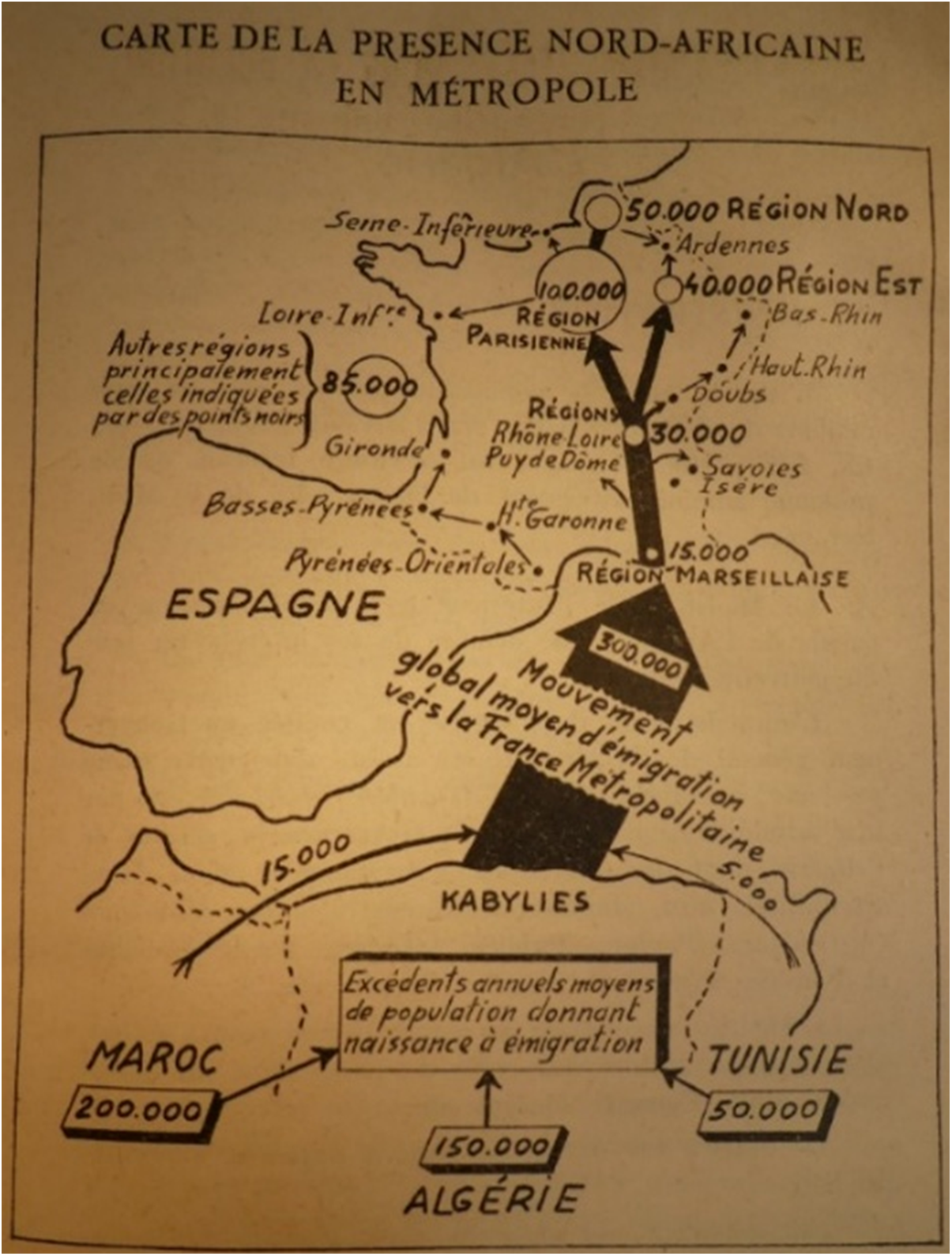
These blind spots resulted in the dissemination of a wide range of figures on emigration. In 1949, the French Ministry of the Interior counted 194,800 Algerians in metropolitan France, while the Office national d’immigration (attached to the Ministry of Labor) put the figure at 170,000, and the Office de l’Algérie (representing the GGA in Paris) put it at 250,000. Researchers at the University of Algiers also disagreed: Jean-Jacques Rager’s dissertation cites the “administrative figure” of 180,000, whereas Luc Muracciole estimated it to be between 250,000 and 300,000.Footnote 17 According to specialists, emigration remained “at the edge of our knowledge,”Footnote 18 which left the field open to many stereotypes about “Muslims” and “Algerians.” Although thousands of Algerians travelled to Tunisia and Morocco every year,Footnote 19 the idea of an uncontrollable invasive movement, directed exclusively toward France continued to spread (Document 1). This was probably due to the fact that Algerians, as colonial French citizens, could no longer be blocked from entering metropolitan France after 1947. The resulting rise in emigration coincided with elite anxieties about the “alarming demographic pressure in Algeria,” at a time when the nationalist movement was gaining momentum.Footnote 20
Guide de l’action sociale au bénéfice des Nord-Africains, [1954] (ANOM/9333/81).
The field of research that can be called “North African sociology” was deeply shaped by the colonial situation.Footnote 21 Through renewed terms and concepts, it nevertheless extended the paternalistic anthropological discourse of the 1930s on the inferiority of colonized peoples and the “duty of the conqueror.”Footnote 22 Experts in the service of the General Government explicitly denied the link between emigration and colonization; rather, they regarded emigration as a consequence of health improvements and population growth supposedly brought about by French rule.Footnote 23 Most of their studies therefore attributed Algerian emigration primarily to demographic growth, which was considered the decisive factor.
This reductionist view, characteristic of the 1950s, paradoxically stemmed from an awareness of the limitations of the available population statistics. In 1955, Jacques Breil, an administrator at the Institut national de la statistique et des études économiques (INSEE) with ten years of experience in Algeria, acknowledged the progress of recent decades, but condemned the census data on the “Muslim population” as deeply biased.Footnote 24 Moreover, an average census district in Algeria could contain twice as many inhabitants as its equivalent in mainland France.Footnote 25 The situation was also very serious in small communes and remote districts (communes mixtes, inhabited by Algerians), where a single enumerator was often responsible for counting several thousand inhabitants.
A narrow regionalist and evolutionist interpretation
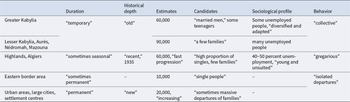
For qualitative records, specialists had to rely on essentialist and imprecise reports provided by commune-level administrators. By doing so, they perpetuated common regionalist and evolutionist interpretations of emigration. In his 1953 survey, for instance, Robert Montagne distinguished between the “highly organized” Kabyle emigration—supposedly limited to married men—and that of other regions, where it was presumed that the formerly nomadic but recently settled inhabitants acted in a “gregarious” fashion (Table 1).Footnote 26 Jean-Jacques Rager repeated the same prejudices, noting the “change in customs,” as well as in demography, that could result from the “acceleration of emigration”:
Clothing is becoming more Westernized, the old superstitions [such as] the “sleeping child” [i.e., pregnancies lasting more than nine months] are disappearing. Often, too, the authority of the old family father is undermined, the idea that schooling is necessary is gaining ground, the doctor is replacing the marabout [local religious figure], and forced marriage is on the decline. But [emigration] does not lead to a reduction in the number of births.Footnote 27
Emigration by area
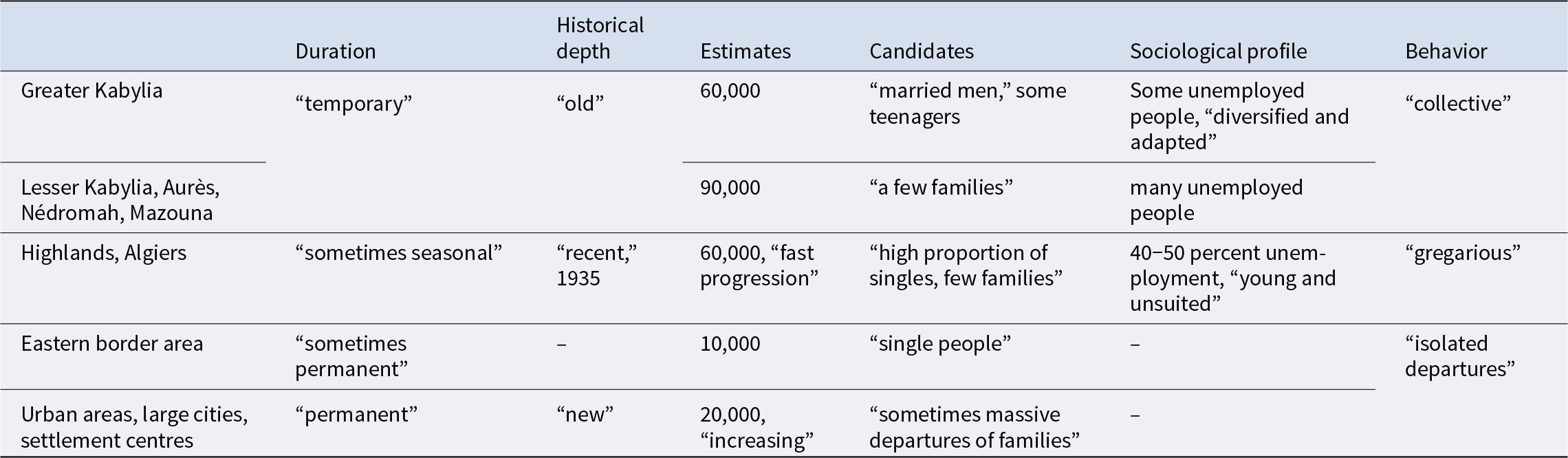
Source: Made by the author, from Robert Montagne, Étude sociologique de la migration des travailleurs musulmans d’Algérie en Métropole (Paris: Ministre de l’Intérieur, Direction des affaires algériennes, 1954).
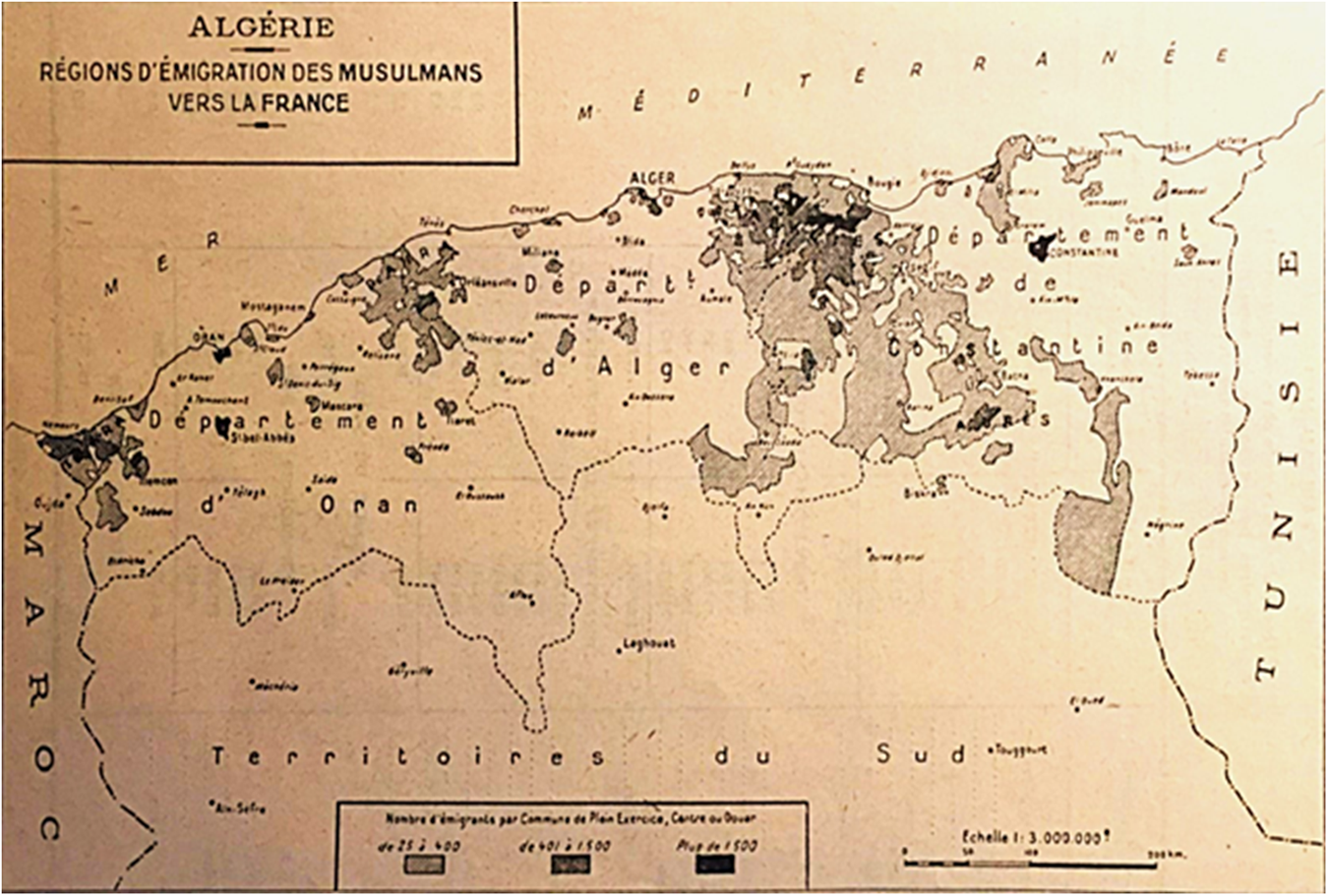
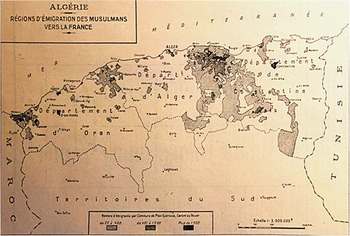
Rager did not shy away from a regionalist reading (Document 2), but he also developed a comprehensive approach to macroeconomic metrics. On the basis of figures from post offices and local authorities, he estimated remittances from emigrants to their Algerian families at almost 35 billion francs annually, which, according to him, supported two million people.Footnote 28 Neglecting family emigration, Rager reinforced the idea that labor emigration constituted a source of subsistence for Algeria. His studies, often cited by the GGA, carried strong political implications. As early as 1953, Maxime Champ, head of the Direction du travail (the Labor Department) in the GGA, deemed it dangerous to intervene in a “natural phenomenon that would break down the framework within which we sought to limit it.”Footnote 29 Many members of the Algerian Assembly (the colony’s parliament) also saw this “emigration of hunger” as the result of a population surplus and argued for a laissez-faire approach.Footnote 30
Map of emigration regions in 1949.
In fact, colonial officials were ambivalent about emigration, viewing it as a nuisance, but also as the lesser evil in the face of threats to the colonial order. At the same time, they timidly framed the underemployment of Algerians as a public issue requiring action. For instance, debates in the Algerian Assembly from November 24 to 26 1954, after the uprising, recommended opening up work sites, or chantiers de chômage,Footnote 31 which had previously been used to slow down emigration from certain rural regions. Most local authorities, however, did not implement such measures.
At the beginning of the war of independence (1954–1962), unemployment and emigration were still perceived by colonial rulers as two sides of the same problem, namely, the explosive population growth. Algerian nationalists were outraged by these views. According to Moustapha Ferroukhi, a member of the Algerian Assembly, the “colonial regime” remained the “main cause of emigration” due to “racism as the basis for wage-setting” and discriminatory labor legislation.Footnote 32 Going against mainstream opinions, he directly linked emigration to unemployment. He denounced the official count of 110,000 unemployed people in 1950 as a gross underestimate, and criticized the lack of action from the colonial authorities.Footnote 33
Although these misconceptions persisted until the end of French rule, colonial expertise on emigration informed only one initiative, the creation of the Office algérien de la main-d’œuvre (OFAMO) in December 1955. Set up in a modernizing spirit, the Office was assigned the tasks of “collecting and classifying all information concerning workforce needs” in Algeria and especially France, and “organizing the movement and relocation of workers.”Footnote 34 This project was hampered, however, by the slowness of administrative services, coupled with increased police controls on emigrating workers, leading to the Office ceasing activities in 1956, and subsequently being dissolved. Emigration continued to be peripheral in the Constantine Plan of 1958.Footnote 35 It was not until the 1960s that the independent state established a large-scale project for monitoring emigration.
Planning emigration
Algerian independence in 1962 was immediately followed by an economic depression and persistently high unemployment, with more than two million people out of work. Following early post-independence experience, Houari Boumediene’s presidency, beginning in 1965, further cemented development as a national priority, fostering the emergence of a statist, populist, and socialist imaginary.Footnote 36 State intervention increasingly relied on statistics, enabling informed action and reinforcing the perception of such intervention as modern. As new leaders took the measure (in the strict sense of the word) of socio-economic phenomena, emigration gradually came to be perceived as a means of regulating employment and ensuring a certain level of well-being for the population.
The calculability of emigration
As early as October 1962, Bachir Boumaza, the Algerian minister of labor, announced the creation of the Office national de la main-d’œuvre (ONAMO) to “combat underemployment” and record the regional distribution of unemployed people.Footnote 37 In addition to controlling emigration, the decree of November 29, 1962 officially establishing the Office assigned it the responsibility of developing a modern statistical state: the decree recommended “centralizing all statistical information from the various competent departments or bodies,” “promoting a rational policy for the placement of workers” and “studying the important problem of worker emigration.”Footnote 38
The emigration statistics collected by ONAMO initially received little attention from the Ministry of Labor and Social Affairs (MTAS). In 1964, a first Franco-Algerian agreement on labor migration was signed, drastically limiting emigration opportunities. A few months after, the Revue algérienne du travail, published by the MTAS, devoted four pages to emigration statistics. Men applying for permission to leave for France were all counted as “national workers,” without further distinction.Footnote 39 Three years later, ONAMO’s role remained limited to this accounting function.Footnote 40 This was to be expected within the bilateral framework in force, which systematically gave the final say on the number of Algerian candidates entering its territory to the French state. However, the space allocated to migration figures in the MTAS periodical increased considerably, with forty pages devoted them in its 1967 volume, including numerous graphs and tables, providing a clearer picture by place of departure and destination, and by the age, family situation, education, qualifications, and health of the applicants. The authors also reflected critically on the limitations of the available data.Footnote 41
As the prospect of a new Franco-Algerian agreement approached, governmental discussions began about the criteria for selecting candidates for labor emigration. These discussions were led by Abdelkader Belkhodja, who joined the MTAS in 1965 and participated in several Franco-Algerian meetings as deputy director of emigration. Building on his work as a social adviser for the French municipality of Gennevilliers (1952–1965), he took charge of the census of emigrants and the study of migration.Footnote 42 Due to internal conflicts and staff shortages, he became the sole official responsible for this dossier until 1969. Four years were enough for him to lay the foundations for the systematic planning of emigration.
The National Seminar on Emigration, held in Algiers from August 8 to 13, 1966, gave Belkhodja the opportunity to present his views to the Front de Libération Nationale (FLN), the sole political party, and to the Amicale des Algériens en Europe (AAE), whose mission was to maintain political and cultural ties with emigrants. As the sole representative of the MTAS, Belkhodja played a leading role in the seminar, along with Mohamed Laïd Debzi, the president of the Algerian Association for Demographic, Economic, and Social Research (AARDES), a research center attached to the Ministry of Finance and Planning.Footnote 43 Belkhodja and Debzi, both authors of sociological articles on the family, demography, and emigration, together formed the preparatory committee.Footnote 44 Their introductory report led the chair of the seminar, FLN member Habib Djafari, and the participants to recognize that the nature of migration was “essentially demographic” and that understanding it better would require systematic study.Footnote 45
During the seminar, Debzi and Belkhodja bridged the political and academic spheres. They promoted conceptual frameworks from the social sciences as a possible basis for future emigration policy. The summary report of the seminar, which was voted on by all participants, was particularly ambitious and interventionist on this point. Using a Third-Worldist rhetoric, it recommended planning emigration as a way of “contribut[ing] to the reduction of unemployment” (estimated at one million) and “solv[ing] the problems of hunger.” It also situated the issue of emigration in relation to broader macroeconomic and social considerations. The report noted that remittances from workers abroad (estimated at one billion dinars per year) constituted “a source of income for a very large rural population,” slowing the “exodus to the cities” and at the same time stabilizing the “balance of payments” with the outside world. It concluded by stressing that “the imperatives of organized and planned development mean that emigration must be considered an economic necessity for some time to come.”Footnote 46
From a long-term perspective, this seminar advanced a conception of emigration as a phenomenon the state could quantify, predict, and regulate. It imbued emigration with what the political scientist Timothy Mitchell calls a “character of calculability”—that is, viewing facts through the lens of a scientific ideal of precision and univocality, which tends to “transform the world into an arithmetical problem, … [fixed] in a mathematical formula.”Footnote 47 The same dynamic underpinned the 1969 emigration plan.
Emigration in the development equation
Although rarely mentioned, it is plausible that some Algerian officials were reluctant to encourage large-scale emigration partly because they feared that the very social phenomenon of emigration abroad could give rise to a political opposition beyond their control.Footnote 48 Things changed following the seminar of 1966, when planners regarded emigration as a catalyst for development, and instituting an emigration policy as an act of sovereignty. In 1968, an article in the Revue algérienne du travail argued that male labor emigration could, despite the social disruption it caused, relieve unemployment. With pragmatism, its author recommended a necessary, but temporary, form of “exile”:
Our demographic situation, its evolution and the pace of our economic growth condemn us to tolerate the emigration of some of our nationals to other countries for some time to come. Under no circumstances should [it] be considered a constant in our employment policy. It is a fact that we have inherited from the colonial past; our objective is to gradually absorb this emigration and then to create the necessary conditions to allow our expatriate brothers to return to their homeland.Footnote 49
Drawing on statistics and social sciences, the late 1960s planners of emigration carefully scrutinized the selection of workers departing for France. Under the authority of the Ministry of Labor, they sought to apply their own planning process, similarly to the Ministry of Finance and Planning in other economic sectors. An exceptional opportunity was presented by the signing of a new Franco-Algerian agreement in October 1968, which put the MTAS in charge of organizing the emigration of 35,000 workers annually for the next three years—double the average of the 16,000 authorizations per year from 1964 to 1968.Footnote 50 This new level of authorized emigration led MTAS officials to consider 1969 as the true beginning of a national emigration policy.Footnote 51
Before 1969, the usual method for distributing emigration permits had provoked tensions. A single labor inspector, the head of the Labor and Employment Department in MTAS, set the number of emigrants allocated to each region.Footnote 52 In 1969, Abdelkader Belkhodja, the deputy director of emigration, objected, and proposed instead to distribute exit permits according to a formula which he later detailed in his 1975 doctoral dissertation. He retrospectively defends this planning by arguing that remittances should benefit “underprivileged regions” and stimulate economic activity in them.Footnote 53 Moreover, diversifying the regions of origin would “mitigate the disadvantages of emigration” and make it “easier to absorb” when the time will come to reintegrate “the mass of Algerian workers currently abroad.” Ultimately, Belkhodja argued that workers should use migration as a training opportunity, especially if they came from the industrializing south, where the workforce was less skilled.Footnote 54
Belkhodja proposed “three objective criteria” that should determine a region’s priority for emigration: (1) its population, (2) the number of “residents absent abroad” (RAE) recorded in the 1966 census, and (3) the number of emigration applications recorded in employment agencies. By the end of 1969, the distribution method was based on these variables. To ensure a fair allocation of emigration permits, Belkhdoja assigned each variable a different coefficient:
1) In Belkhodja’s view, “Unemployment and underemployment” were problems “common” to all regions, whereas “demographic pressure,” the first variable, was not. It was therefore “undoubtedly the factor which, par excellence, legitimizes a migratory movement.” He assigned it a coefficient of 3.
2) The second variable is characteristic of “regions traditionally deprived in terms of resources and employment.” Because of underreporting in rural areas, Belkhodja assigned it a coefficient of only 2.
3) The applications for exit permits (i.e., workers’ cards) submitted between 1964 and 1969 formed the last variable. They were not very representative, since employment agencies considered it pointless—rightly, according to Belkhodja—to register people who had no chance of seeing their application succeed. A coefficient of 1 was assigned to this variable.Footnote 55
Following Belkhodja’s formula, the MTAS then distributed 35,000 workers’ cards, valid for a departure to France. The hierarchy of variables suggests an equation something like the following (where x denotes the number of permits allocated to a given locality):
 \begin{equation*}x\, = 36,000*\frac{{3\frac{{local\,population}}{{national\,population\,}} + 2\frac{{local\,RAE}}{{national\,RAE\,}} + \frac{{local\,applications}}{{national\,aplications}}}}{6}.\end{equation*}
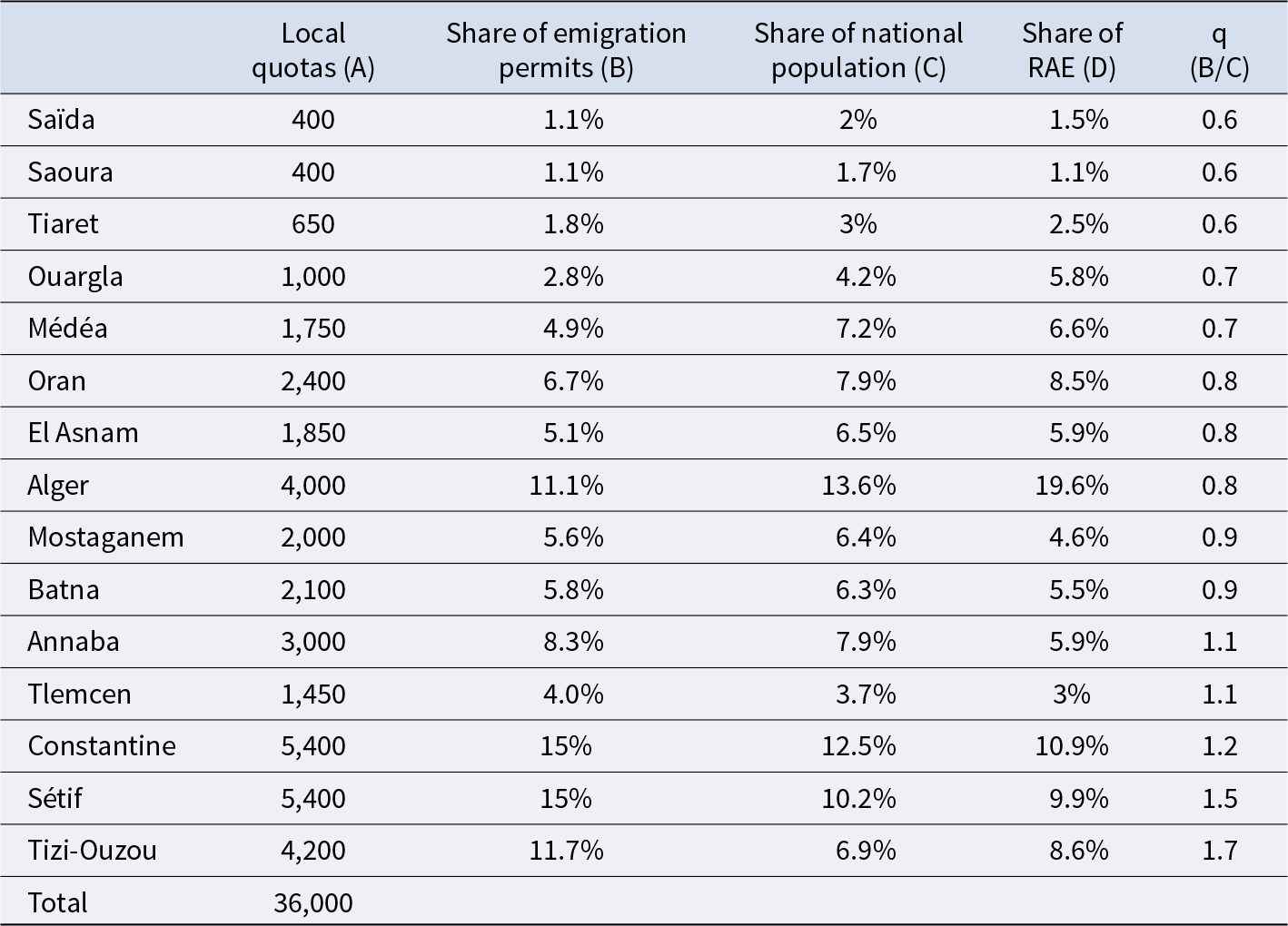
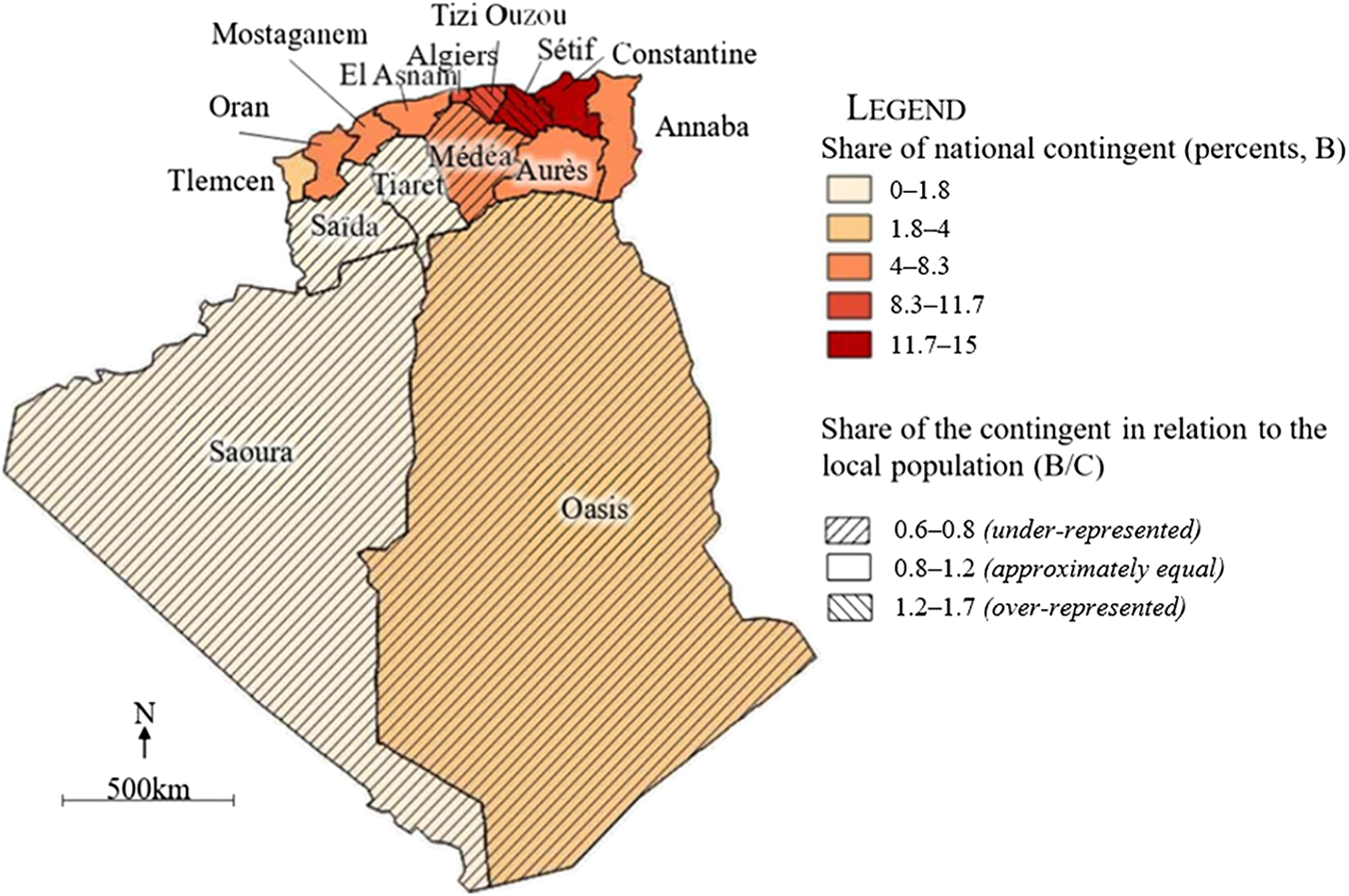
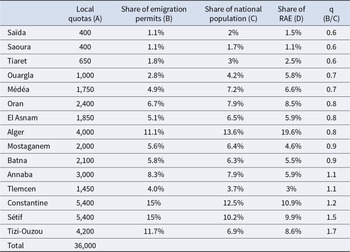
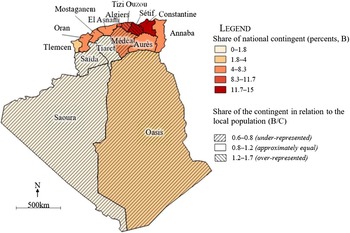
The available sources allow us to observe the distribution pattern at the regional level of the wilayas (Table 2). As a result of application of the above equation, the wilayas that received high quotas relative to their population were primarily those that had strong migratory flows and a high number of applications. This was particularly true for Tizi-Ouzou, Sétif, and Constantine. Conversely, the wilayas with the lowest quotas were in the south—the so-called “disadvantaged” regions (déshéritées), which had not experienced significant emigration, such as Ouargla, Saïda, and Saoura (Bechar) (Map 1).
Distribution of emigration permits among the 15 wilayas, 1969
Source: Made by the author, based on MTAS, Rapport: L’émigration algérienne; and Commissariat national au recensement de la population, Données rapides sur la population algérienne (April 1967).
Legend: this table puts the quota allotted to the different wilayas (B) into perspective. The quotient (q) shows the changes induced by the equation with respect to a hypothetical distribution based on the census population alone. With q = B/C, it measures the impact of variables 2 (RAE) and 3 (applications for emigration permits). It shows the difference compared to a situation where B = C and q = 1.
For example, the quota allocated to the wilaya of Tizi-Ouzou is 1.7 times higher than that which would be allocated if it were determined solely on the basis of its population (q). The quota allocated to the wilaya of Saïda is 0.6 times less than it would be if only its population (q) were taken into account.
These results seem to go against what might be expected from following Belkhodja’s recommendations. An explanation consistent with available sources is that regions with an early history of emigration might have been even more overrepresented before 1969. Besides, as we will see now, it seems that Belkhodja’s formula was used in ways that do not entirely align with his arguments. Indeed, the formula had the advantage of generating an automated distribution based on stable indicators, which likely helped foster consensus among both local and national administrative actors.
Distribution of emigration permits among the 15 wilayas, 1969. Made by the author.
The allocation of departures and its demographic focus
A questionable aspect of Belkhodja’s argumentation is its emphasis on population, which determined half of the number of exit permits allocated to each region. Did this reflect the view, widespread at the time, that a high birth rate hindered development?Footnote 56 Notwithstanding Belkhodja’s opinions on the Algerian birth rate, or the debate on contraception and family planning, my survey reveals that these ideas had little impact on the allocation process. Rather, it is likely that the Ministry of Labor accepted the focus on population in the 1969 formula because of the lack of alternative indicators and the low level of confidence in local employment statistics.
A demographic reading of emigration?
Belkhodja argued in his 1975 dissertation that emigration was due to “demographic growth out of all proportion to the existing productive apparatus.”Footnote 57 Moreover, his political engagements suggest that he was sensitive to the efforts of policymakers to “one day create more jobs than births.”Footnote 58 In April 1966, in particular, he became involved in a debate on demographic planning. With Debzi and a group of civil servants and health professionals, he issued a memorandum for decisionmakers entitled “The Imperatives of Family Planning in Algeria.” As the first national census was drawing to a close, the document likened Algeria’s rate of natural increase to a “demographic cauldron.”Footnote 59 It reiterated the need for family planning, citing initiatives in other Muslim countries such as Pakistan, Tunisia, Turkey, and Egypt.Footnote 60
Belkhodja’s views on Algerian demography, nonetheless, bore little relation to emigration planning. Like many senior civil servants at the time, the deputy director may have personally favored the emigration of married men for its limiting effect on births.Footnote 61 However, none of the MTAS documentation mentions these considerations, and the 1969 emigration planning did not take population dynamics into account. On the contrary, the success of this planning model lay in the use of stable population figures to justify an allocation of resources that helped defuse tensions between Algeria’s different regions.
After the war, divisions among nationalists often mirrored geographical divisions. Various institutions, including the army, sought to ensure equal representation of regional FLN networks, which did not all have the same reputation for commitment.Footnote 62 The promotion of so-called “disadvantaged” regions also regularly featured on the national agenda. Aurès and Kabylia, the areas most devastated by the war, were the first beneficiaries of the “special programs” begun in 1965.Footnote 63 A few years later, the number of regions benefiting from these programs expanded, as special councils of ministers met with local officials to develop plans addressing regional economic and infrastructural inequalities.Footnote 64
This aid was linked to decentralization, promoted by the 1967 Municipal Code and the 1969 Wilaya Code, both of which introduced local elections. From 1967 onwards, the annual conferences of the 676 presidents of the Communal People’s Assemblies (Assemblées populaires communales, the Algerian republic’s equivalent to mayors) were an important channel for expressing social demands. As in other Arab states, these conferences encouraged a vision of development sidelining class identities;Footnote 65 however, they also provided a forum to voice grievances to the government, the most prominent of which was unemployment, sparking a political debate about emigration. During the conference held from February 5 to 8, 1968, the presidents from the wilaya of Tiaret noted the “unfavorable natural conditions” and the “scarce water resources” they faced, and requested that a share of emigration permits be reserved for “disadvantaged regions.”Footnote 66
In this context, Belkhodja’s formula for distributing emigration permits likely met the demands of the communal leaders, demands that were firmly anchored in the political evolution of Algeria post-independence. The introduction of the formula was part of a broader national effort to promote regional equity. It bore little resemblance to the previous territorial turn in French development planning in 1958, which sought to tackle the issue of uneven spatial development between France and its Algerian departments.Footnote 67
The administrative and statistical capacity of the Algerian state
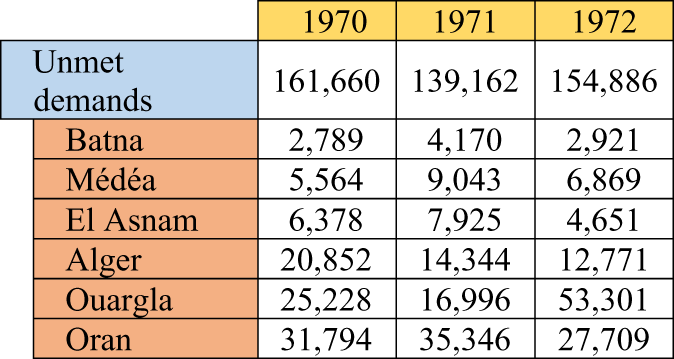
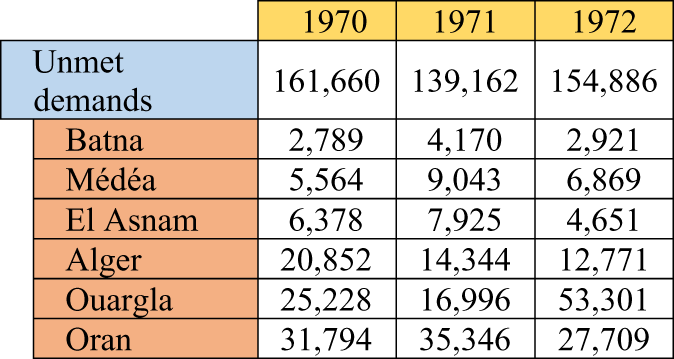
If we now turn to the MTAS agents, it appears that the use of a population-based allocation formula probably helped overcome fragmented data, as well as a low level of confidence in local statistics. Indeed, figures for underemployment were too heterogeneous to accurately capture socio-economic realities. For example, some municipalities counted the “indigent” rather than the unemployed, while other local institutions did not.Footnote 68 Even at the wilaya level alone, the number of registered job-seekers varied considerably, even among those with comparable populations (see Ouargla, Médéa, Batna, and El Asnam in Document 3). Moreover, the variations recorded between 1970 and 1972 could not be explained solely by unemployment dynamics. While the national unemployment rate steadily increased, the measured fluctuations necessarily reflected measurement inconsistencies.
Unmet individual demands for employment in different manpower agencies and at the national level, 1970–1972.
A focus on MTAS documentation further shows that its agents deeply objected to the highly fragmented state of unemployment data few after the introduction of the 1969 planning model. For instance, a 1973 study accused wilayas of falsifying data to secure additional funding. It cited as evidence the fact that their 1972 survey recorded 616,687 unemployed individuals—four times higher than the Ministry’s figure.Footnote 69 Meanwhile, authors of the Revue algérienne du travail continued to use the 1966 census estimate of unemployment as a reference point. Unlike other figures, this estimate of 870,000 counted as unemployed any (young) man over the age of 14 who had previously held a “gainful occupation.”Footnote 70
The absence of a commonly accepted statistical indicator of employment and unemployment emerged as an issue within the MTAS. Mohamed Nabi, the director of the training division, lamented this as early as 1971. In the ministerial periodical, he strongly rejected “blaming the birthrate,” that is, endorsing the view that the “ever-increasing” population was responsible for unemployment. He therefore called for the strengthening of data collection and for a “more comprehensive and accurate periodic analysis of all data, in particular statistical information on employment, unemployment, and underemployment, which is essential for action by … public authorities.”Footnote 71 In another report, the Employment Department also regretted the “lack of harmonization of methodologies and statistical information” from one ministry to another—which was probably unavoidable, given the many actors involved at different stages of economic planning.Footnote 72
What matters here is that MTAS officials took a critical and reflexive view of the limited statistical capacities of the Algerian state, which were directly linked to the legitimacy of the different services producing figures.Footnote 73 Few officials asserted themselves as strongly as those in charge of the 1966 census. For this census, 25,000 agents were mobilized, and nearly two years were devoted to preparations for it and to the subsequent data processing. For Abdelaziz Bouisri, director of the National Population Census Office, this operation, a titanic one for a young state at the end of a seven-year decolonization conflict, achieved one essential objective: establishing a record of human losses and displacements and determining the official population of each locality. The further collection of socio-economic statistics inevitably took a back seat to this fundamental task, which was crucial for allocating resources and jobs to the departments and municipalities, as well as addressing high-priority administrative tasks.Footnote 74
Finally, the role assigned to population data in emigration planning illustrates broader trends in the Algerian statistical state. It shows that demographic data was a key factor in allocating resources among regional services. It also highlights the general priority given in the early decade of independence to the collection of basic information on population. The second variable in the formula proposed by Belkhodja for the allocation of emigration permits, the number of residents absent abroad (RAE), also derived from the 1966 census. For the Division of Emigration and Labor Movement, figures for RAEs provided only an imperfect measure of labor emigration, as they took into account only male emigrants who still visited their Algerian homes and sent letters to their families, but it recognized the temporary necessity of relying on such figures. In 1971, its agents noted their intention to “supplement the available information with a view to the next four-year plan,” scheduled for 1974.Footnote 75
Conclusion
Between the mid-1960s and the early 1970s, emigration policy in Algeria became closely tied to a developmentalist framework. As the state increasingly developed instruments for measuring social phenomena, coordinating civil servants, and regulating planning, the Ministry of Labor and Social Affairs carved out its role in this process and promoted its own vision of emigration planning without direct oversight from the Ministry of Finance and Planning or influence from foreign expertise. From 1969 onward, the allocation of exit permits to France was determined by a formula that distributed them among local employment agencies. The examination of the figures raises questions about whether this attempt at regional diversification was effective. It nevertheless illustrates significant autonomy in both conceptualization and practice, and the determination to exert state control over emigration flows that could not be easily aligned with the official industrializing objectives in state planning.Footnote 76
More broadly, this paper seeks to show that development policies in postcolonial contexts relied on “complex, contingent initiatives” that were “conceptualized and engaged with by a variety of … people,” and were not always “fundamentally derivative of Western ideas and practices.”Footnote 77 It also advocates for a nuanced understanding of statistical modernity, which recognizes the ability of actors to engage with it through reflexive and critical practices. Algeria’s 1969 emigration planning formula focused on demography in much the same way as late colonial experts did when explaining emigration. This apparent continuity, however, does not imply that colonial legacies dominated the construction of a modern Algerian statistical state. Although the designer of this formula was deeply engaged in debates on Algerian demography and committed to its study, many of his colleagues remained wary of treating demography as the sole guide in emigration planning. The model succeeded primarily because it enabled a more equitable allocation of emigration permits across regions than before, despite the absence of reliable unemployment statistics.
Acknowledgements
My sincere thanks go to the two anonymous reviewers, as well as Chikouna Cissé, Annick Lacroix, Laure Piguet, Lea Renard, Ian Drummond, and Sylvain Blanchon. AI (ChatGPT and DeepL) was carefully used to improve style and expressions in English.


 Open access

