

Introduction
Globally, suicide is a leading cause of death, claiming more than 700,000 lives annually (World Health Organisation 2021). In young people aged 15–29 years, it ranks as the fourth most common cause of death (Hughes et al. Reference Hughes, Horowitz, Ackerman, Adrian, Campo and Bridge2023). This is a significant problem among university students; in Ireland, 63% of students reported having contemplated suicide, and 10% reported having attempted suicide (Dooley et al. Reference Dooley, O’Connor, Fitzgerald and O’Reilly2019). This has been reflected in a number of studies with the high rates of hospital-presenting self-harm in females aged 15–19 and males aged 20–24 in Ireland (McMahon et al. Reference McMahon, Keeley, Cannon, Arensman, Perry, Clarke, Chambers and Corcoran2014; Griffin et al. Reference Griffin, McMahon, McNicholas, Corcoran, Perry and Arensman2018). The transition from adolescence to adulthood, spanning ages 18–25, is not only a critical developmental period but also a time when many mental health disorders first emerge, including depression, anxiety, eating disorders and substance use disorders (Wood et al. Reference Wood, Crapnell, Lau, Bennett, Lotstein, Ferris, Kuo and Halfon2018). Various factors such as academic pressures, life transitions, financial strains, relationships and social media use can significantly affect students’ mental health (Campbell et al. Reference Campbell, Blank, Cantrell, Baxter, Blackmore, Dixon and Goyder2022).
Consequently, there has been a surge in demand for student counselling services. A qualitative study of counsellors in Ireland highlighted significant increase in the volume and severity of cases in recent years (Harrison & Gordon, Reference Harrison and Gordon2021). To address these challenges, Ireland’s Higher Education Authority (HEA) developed the National Student Mental Health and Suicide Prevention Framework as part of the national suicide prevention strategy, ‘Connecting for Life’ (Department of Health 2015; Surdey et al. Reference Surdey, Byrne and Fox2022). This framework outlines the importance of using evidence-based interventions for students accessing student counselling services, leading to the introduction of Collaborative Assessment and Management of Suicidality (CAMS) training for staff (Fox et al. Reference Fox, Byrne and Surdey2020).
CAMS is a therapeutic framework focused on collaboratively assessing and managing suicidality (Jobes, Reference Jobes2012, Reference Jobes2023). The process begins with the Suicide Status Form (SSF), which helps both the therapist and client understand the individual’s unique experience of suicidality, including their reasons for living and dying. A personalised treatment plan is then developed to address the underlying distress, build coping strategies and specifically target patient-defined suicidal drivers. Previous research on CAMS outlines that, through structured sessions, CAMS focuses on tracking suicidal thoughts, reducing risk factors and fostering emotional resilience until the individual has resolved the suicidal crisis. A more nuanced view on CAMS, however, states that CAMS is theoretically agonistic, meaning that counsellors can adopt or abandon any specific therapeutic orientation. Instead, the clinician uses their own theoretical framework to address the suicidal drivers once they have been identified. Similarly, it acknowledges that while some individuals may reach a point where they no longer experience suicidal thoughts, others might still have ideation but are able to manage or cope with it effectively in oppose to completely resolving it. Studies have shown that CAMS significantly reduces suicidal ideation and improves mental well-being by treating the root causes of distress rather than simply managing symptoms (Jobes, Reference Jobes2012; Galavan, Reference Galavan2017). Randomised controlled trials have shown that CAMS can be effective after six to eight sessions. These trials have shown significant reductions in suicidal ideation, increased hope and overall decreased levels of distress, even when compared to other treatment methods in adult populations (Jobes et al. Reference Jobes, Comtois, Gutierrez, Brenner, Huh, Chalker, Ruhe, Kerbrat, Atkins, Jennings, Crumlish, Corona, Connor, Hendricks, Schembari, Singer and Crow2017; Swift et al. Reference Swift, Trusty and Penix2021).
Despite the CAMS framework showing effectiveness in inpatient and outpatient settings, there is limited research on the effectiveness of CAMS among university students. In one correlational study, the SSF was administered to students reporting suicidal thoughts, with significant reductions in all SSF ratings from pre-treatment to post-treatment (Jobes et al. Reference Jobes, Jacoby, Cimbolic and Hustead1997). In another correlational study, initial SSF ratings showed improvements in both symptom distress and suicidal ideation over the study period (Jobes et al. Reference Jobes, Kahn-Greene, Greene and Goeke-Morey2009). In a randomised trial, CAMS was associated with significant reductions in depression and suicidal ideation and hopelessness compared to treatment as usual (Pistorello et al. Reference Pistorello, Jobes, Gallop, Compton, Locey, Au, Noose, Walloch, Johnson, Young, Dickens, Chatham and Jeffcoat2021). Overall, these findings indicate the effectiveness of CAMS in reducing suicide risk for student populations.
Understanding the implementation of the CAMS framework is essential for gaining deeper insight into its structure and functionality. Previous research has primarily examined the effectiveness of CAMS in reducing suicidal ideation, yet its implementation in student counselling services remains underexplored. Understanding how evidence-based interventions are adopted, delivered and sustained in real-world settings requires a focus on implementation science (Westerlund et al. Reference Westerlund, Nilsen and Sundberg2019). Interventions often face challenges when applied in different contexts, either due to intervention failure or implementation failure (Proctor et al. Reference Proctor, Silmere, Raghavan, Hovmand, Aarons, Bunger, Griffey and Hensley2011). To address these challenges, this study applies the Reach, Effectiveness, Adoption, Implementation and Maintenance (RE-AIM) framework to explore the experiences of Irish higher education counselling staff in implementing CAMS, providing insight into the factors that influence its successful integration into student mental health services.
Method
Study design
This study examined the implementation of the CAMS framework within counselling services in Irish higher education institutions (HEIs) using a mixed-methods design. Quantitative and qualitative data were collected and analysed separately and then integrated narratively. At the time of recruitment, more than 237 student counselling staff had taken part in the CAMS training. This training was not mandated. The CAMS framework training involved participants initially familiarising themselves with CAMS materials, attending an initial training and then follow-up sessions in which participants could bring and discuss CAMS cases. A survey gathered insights from counselling staff on their experiences with the implementation of the CAMS framework. Semi-structured interviews with a subgroup of survey respondents further explored the implementation of the CAMS framework in these services.
RE-AIM framework
The study was guided by the RE-AIM framework (Glasgow et al. Reference Glasgow, Harden, Gaglio, Rabin, Smith, Porter, Ory and Estabrooks2019). The ‘reach’ dimension assessed the number of individuals receiving CAMS treatment relative to those at risk and overall service attendees. ‘Effectiveness’ measured CAMS’s impact on reducing suicidal risk and any related outcomes. ‘Adoption’ determined the extent of CAMS use across services, while ‘implementation’ assessed delivery consistency. Finally, ‘maintenance’ examined CAMS integration into ongoing care for students at risk of suicide.
Survey
Survey tool
The survey was structured according to the RE-AIM framework and focused on gathering information on the implementation of the CAMS framework within counselling services. The survey included both closed and open-ended questions.
Demographic and professional information: The survey gathered data on the following: age, role, years working, affiliated institution and professional training received.
Activity data for the service: Data was collected on the number of individuals who accessed services over the previous 12 months, the number who presented with suicidal risk and the number treated using the CAMS framework.
Implementation outcomes: Acceptability, appropriateness and feasibility of the CAMS framework were assessed using the short versions of the Acceptability of Intervention Measure (AIM), Intervention Appropriateness Measure (IAM) and Feasibility of Intervention Measure (FIM) (Proctor et al. Reference Proctor, Silmere, Raghavan, Hovmand, Aarons, Bunger, Griffey and Hensley2011; Weiner et al. Reference Weiner, Lewis, Stanick, Powell, Dorsey, Clary, Boynton and Halko2017). Each measure consists of four items on a 5-point Likert scale (1 = completely disagree to 5 = completely agree). Each measure has a total scoring range of 4–20, with a higher score indicating greater acceptability, appropriateness and feasibility. Previous research in a large population has indicated excellent validity (α = 0.85, 0.91, 0.89) and reliability (α = 0.83, 0.87, 0.88) for the AIM, IAM and FIM, respectively (Weiner et al. Reference Weiner, Lewis, Stanick, Powell, Dorsey, Clary, Boynton and Halko2017). The survey also assessed the participants’ satisfaction with the CAMS training and their confidence in working with suicidal clients.
Recruitment of participants
Survey data were collected using Qualtrics (Qualtrics 2018). All counselling service staff working in HEIs were invited to take part in the research study. Participants were excluded if they had not completed CAMS training. Study information was circulated via the Psychological Counsellors in Higher Education Ireland network mailing list in addition to all heads of service circulating the study information to staff in their own service. Recruitment took place between 12 September and 31 December 2023.
Data analysis
The quantitative survey data were descriptively analysed using SPSS Statistics version 26 (IBM SPSS Software, 2024). Open-ended questions were analysed using a thematic analysis approach, whereby participant responses were read and line coded. Line codes were then developed into categories and themes. Themes were then cross-checked with the findings from qualitative interviews, where a significant overlap was identified.
Semi-structured interviews
Recruitment
To explore the findings of the survey further, all respondents were asked if they would like to participate in a follow-up semi-structured interview. A subgroup of respondents agreed, and anyone who opted in to be contacted for an interview was invited to take part (n = 10). All interviews were conducted using Microsoft Teams. To ensure consistency, all interviews were conducted by a single trained qualitative researcher using a semi-structured topic guide.
Data collection
The topic guide was guided first by the RE-AIM framework and second by preliminary findings of the survey. Topics explored the impact of CAMS training on participants’ knowledge and confidence, including skill development and preparedness to manage consultations involving suicidal individuals. It also covered experiences with and recommendations for implementing the CAMS framework in student counselling services. Interviews were digitally recorded using Microsoft Teams and transcribed verbatim. Interviews lasted between 20 and 40 minutes.
Data analysis
The interview data were analysed using thematic analysis, as outlined by Braun and Clarke (Reference Braun and Clarke2006), which involves six steps (Braun & Clarke, Reference Braun and Clarke2006). One author (GP) transcribed all interviews and then read and familiarised themselves with the data set. Once familiar, the initial data were coded and transferred to a coding sheet where themes and sub-themes linking the different codes were identified. A second author (SOC) reviewed the themes, and any disagreements were resolved following a discussion between authors (GP and SOC) before final themes were refined and reported in the analysis. Data analysis ran concurrently with data collection, allowing emerging themes to be further explored in subsequent interviews.
Ethical considerations
This research received ethical approval from the Social Research and Ethics Committee in University College Cork (Log no. 2023-103). Informed consent was obtained from all survey and interview participants using an online survey.
Results
Survey findings
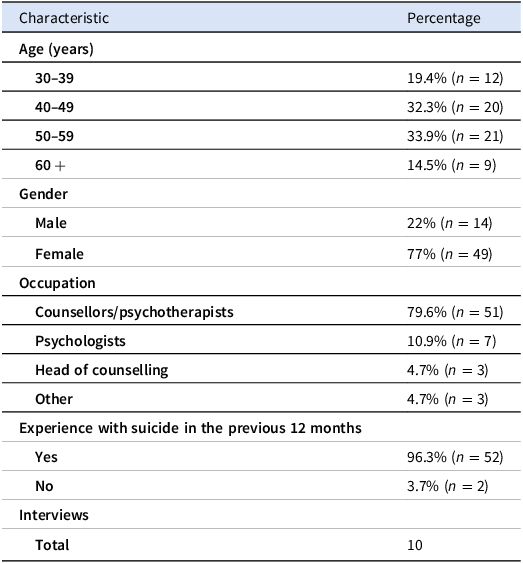
At the time of recruitment, 237 staff members working in counselling services in Ireland had been trained in CAMS, of whom 64 completed the survey (27% response rate) and 10 participants took part in a semi-structured interview. Participants represented at least 14 HEIs, and 14 participants did not report on the institution in which they were working. To understand the characteristics of the survey respondents, please see Table 1. All participants confirmed they had engaged with CAMS training. The majority of participants (n = 47; 75.8%) had reported to have received another formal training in suicide and self-harm assessment or prevention, including ASIST (n = 34; 72.3%), SafeTALK (n = 30; 63.8%), Understanding Self-harm (n = 18; 38.3%), STORM Skills Training (n = 10; 21.3%), local induction training (n = 8; 17%) and Connecting for People Training (n = 1; 2.1%).
Sample characteristics

Participants were asked to estimate the number of individuals who accessed their services in the past 12 months. On average, 123 individuals (SD = 62.2) attended a student counsellor in the previous 12 months. Among those who responded, 96% reported encountering at least one individual presenting with suicidal risk (M = 26, SD = 39.5). Of these cases, approximately 44% were treated using the CAMS framework, with respondents reporting using an average of 6.8 sessions (SD = 3.3) per individual.
Most respondents (91%) to the survey reported that they found the training beneficial and had ‘definitely’ or ‘somewhat’ incorporated it into their management of suicidal patients (47% ‘definitely’, 44% ‘somewhat’ and 9% ‘not at all’). The majority (n = 52; 88.1%) of survey respondents reported that they observed CAMS to have had a positive effect on suicidal students. A smaller proportion (10.2%) believed it had no effect, while 1.7% reported a negative effect.
Overall, the acceptability (M = 15.5; SD = 3.3; score range 4–20), appropriateness (M = 15.01; SD = 3.7; score range 4–20) and feasibility (M = 14.8; SD = 3.6; score range 4–20) of the CAMS framework were rated highly among participants. Two-thirds of participants agreed that CAMS met their approval and that CAMS is a good match for student counselling services.
Almost all participants reported being satisfied with CAMS training, with most participants subsequently incorporating CAMS into their practice. CAMS was reported to have made a difference in how participants manage students who present with suicidal ideation or behaviours. Despite this, when using CAMS in the previous 3 months, 55.2% of survey respondents reported to have encountered an obstacle.
Similarly, participants reported high levels of confidence following CAMS training, in the following areas: compassionately engaging with a patient with suicidal thoughts (M = 89.6; SD = 11.9), calmly and confidently engaging with a patient with suicidal thoughts (M = 87.9; SD 12.2), developing a safety plan (M = 87.6; SD = 12.4) and providing assessment and management to suicidal patients (M = 75; SD = 25.2).
Qualitative interview findings
There were three main themes identified from interview data: diverse approaches to implementation, the value of CAMS in practice and challenges in implementing CAMS. These themes were underpinned by five sub-themes including the importance of a clear framework, common and direct language, collaborative nature, a lack of time resources and buy-in, and CAMS is not a one-size-fits-all approach.
Diverse approaches to implementation
There was a notable variation in how staff members across different services experienced and implemented the CAMS framework. Implementation of CAMS was influenced by factors such as organisational resources, service delivery models and the scope of practice within each service. In well-resourced services, CAMS was embedded at all levels of care, with a stepped-care approach that allowed for both initial screening and escalated intervention if needed.
‘We’ve implemented it as a team at every level of the service. We operate a stepped-care model of service delivery. We have a psychologist assistant screening students, we have self-care or self-help groups, workshops, counselling, extended counselling and the next step is a referral to specialised services’. (Participant One)
Several participants described integrating the CAMS framework within their therapeutic practice, which facilitated a solid foundation for risk assessment and counselling.
‘The complementary way we can bring [CAMS] into the therapeutic work that it’s not segmented, we talk about risk over here, then we move into counselling, the two are beautifully brought together’. (Participant Four)
Other services selectively incorporated different elements of the CAMS framework, tailoring its use to levels of risk or student needs. Some participants adapted CAMS to fit their service, which emphasised key aspects of the framework that could be practically integrated.
‘We’ve incorporated section A into the screening of all students regardless of whether they’re suicidal or not…then I do the full CAMS with students who hit a particular level of risk’. (Participant Ten)
In settings where the full CAMS protocol could not be implemented, participants reported using CAMS as a reference tool, providing flexibility in applying certain principles based on the needs of their students.
‘All the clinicians are trained in it, it’s not mandated, but it is definitely recommended that we use it as a reference point and modify it as we see fit’. (Participant Seven)
‘We have the support within our team of look, this is how we’re implementing the tool, we find ways that we can use it, in other counselling sectors, it can be used in another way but within the HEI sector, we’re trying to cut the cloth to the measure and still get the benefit’. (Participant Nine)
For some clinicians, CAMS was a mental framework that guided their approach to student risk management, although not explicitly applied in every case. One participant noted:
‘It would be my go-to when a student is presenting risk, but I always hold it in mind even around risk and intent…. it’s informing my thinking around how I manage risk as its initial and how I view it’. (Participant Six)
The value of CAMS in practice
The importance of a clear framework
CAMS provided participants with a structured framework to assess suicidal risk and organise sessions, adding a layer of confidence and competence to their practice. Before CAMS training, some participants reported feeling anxious when working with high-risk clients, with one admitting they were ‘a bit more scared of the whole presentation if somebody was highly suicidal’ (Participant Three). The structured approach of CAMS helped address this, offering a way to break down the elements of suicidality and make them more manageable. As one participant noted, CAMS allowed them to ‘find different components so that the thing is less shapeless, and there is a strategic way to deal with their suicidality’ (Participant Five).
Many participants expressed how CAMS created a sense of containment for both staff and students, offering a more stable structure for managing risk. This approach helped reduce the sense of abandonment often experienced by students who are ‘passed from service to service or person to person’, fostering a stronger therapeutic relationship (Participant Two). Several participants underscored this benefit; one participant noted that students ‘feel more heard and held in that frame, there’s a holding in that that works really, really well’ (Participant Eight).
Common and direct language
The CAMS framework is practical and direct, enabling staff to address suicidality succinctly and without hesitation. Previously, some staff had to devise their own ad hoc assessments, which could take several sessions. CAMS, in contrast, provided a concrete, clear process that made it easier to ask essential questions and gather critical information, creating space for students to share their experiences without it feeling like a ‘dry Q&A’ (Participant Four).
‘It’s important that counsellors are aware of how to talk about suicide and not shy away from it, that’s something that the CAMS framework gives you is a very clear way to talk about suicide, to ask very specific questions’ (Participant seven).
Participants highlighted how CAMS provided a structured approach to exploring critical constructs associated with suicidality. One participant noted that using direct and quantifiable questions, such as rating feelings on a numerical scale, facilitated deeper and more meaningful conversations with clients. This structured questioning was seen as instrumental in uncovering nuanced aspects of the client’s experience, thereby enhancing the therapeutic dialogue.
‘You might ask more about the burdensomeness, loneliness, all those constructs that are really important, asking directly on a scale, it gets you deeper into conversation’. (Participant Three)
Collaborative nature
A collaborative approach to addressing suicidality was seen as essential by many participants, allowing staff and students to work together to develop a plan.
‘It’s collaborative, that the student is very involved in the process and gets to set their own boundaries around it’. (Participant Nine)
This approach offered students a safe space to ‘tell their story around it’ and to view their experiences both measurably and personally, feeling supported rather than directed. CAMS helped clients understand how suicidality is part of their narrative, which fostered a sense of ownership and reduced the perception of clinicians as authoritative figures.
‘It’s really engaging the person to see that it’s not me as the expert telling you, you should do this, or you shouldn’t do that – it’s very much focused and respectful of the student’. (Participant Eight)
Challenges in implementing CAMS
A lack of time, resources and ‘buy-in’
Some staff found integrating CAMS into their practice difficult due to a mismatch between the CAMS framework and available funding and resources. Many counselling services could not offer the full (12-session) CAMS protocol due to limited time and funding yet also faced restrictions in adapting the framework. This inflexibility left some questioning its feasibility within their practice.
‘CAMS is designed to get to a resolution… but this is a goal that is not achievable… while the student is with us within the six sessions’. (Participant Five)
Others mentioned that CAMS’s recommended intake duration (an hour and a half) and repeated follow-ups are to be ‘quite inhibiting’ and incongruent with the way their service is provided, at times leading to adaptations due to time constraints.
‘We might deliver the assessment in two sections, not in one longer section because we do not have the time to allocate to that…if you make too many adaptations and you cannot stand by its evidence base’. (Participant Ten)
CAMS is not a one-size-fits-all approach
Some participants stated that CAMS did not suit every student, particularly those who preferred open conversation over structured assessments. For a few, the paperwork and structured approach felt overly formal or impersonal, leading them to disengage from the process.
‘There will always be a rarity where a student doesn’t like paperwork and just wants to talk’. (Participant Six)
Similarly, participants discussed how levels of risk for individuals with borderline personality disorder (BPD) can remain consistently high; this complicated the CAMS process, which aims to guide clients towards a resolution. As one participant explained, individuals with BPD may ‘have very few reasons to live… they know [their risk factors] so well, it is a part of them’. In such cases, seeing these factors ‘in black and white’ was observed to be reinforcing their distress.
Student counselling staff within Irish HEIs come from diverse professional backgrounds, with varying qualifications and training. Those with a psychology background were generally more comfortable using psychometric tools and structured assessment forms. For counsellors, integrating such tools into the therapeutic space was more difficult.
‘A lot of counsellors were struggling with bringing a form into the space and how to do that in a way that holds the relationship with the client but gets the nuts and bolts of the assessment done’. (Participant One)
Some participants expressed discomfort with how the structured nature of CAMS contradicted their existing training and therapeutic approaches. One commented:
‘Sometimes it feels so formulaic that somebody with a basic psychological background could carry it out. The downside is that somebody with a lot of experience or coming from a humanistic person-centred approach would say that that’s not how I integrate with someone or get to know them’. (Participant Two)
Maintaining CAMS in Practice
All participant interviews highlighted the need for additional training, support and supervision when using CAMS in practice. Many participants found it difficult to integrate CAMS into a short-term counselling service whilst adhering to the evidence base.
‘If there were training to helps us use [CAMS] to the full, more effectively, I would be happy if we could tease out these issues and find a way to use that more effectively’. (Participant Five)
While another noted that regular top-up trainings are required to keep up to date with CAMS training.
‘The only thing I would like is that extra layer of checking back in, even if it was once a year of training’. (Participant Three)
Discussion
This mixed-methods study explored student counselling staff members’ experiences of implementing the CAMS framework in Irish HEIs. While participants generally reported positive experiences, about half of the sample faced challenges with CAMS over the prior 3 months. Follow-up interviews provided additional depth to the survey findings, identifying three overarching themes and five sub-themes that captured counsellors’ implementation experiences. Unique insights included individual adaptations for integrating CAMS into a short-term counselling model and counsellors’ increased confidence in working with suicidal students.
CAMS provided a clear structured framework that increased clinicians’ confidence in assessing and managing suicidal risk, consistent with previous research, which reported that training in CAMS had a positive effect on clinicians’ practice and confidence (LoParo et al. Reference LoParo, Florez, Valentine and Lamis2019). This could be attributed to the structure of the CAMS framework, allowing staff to work with students to break down the different aspects of suicidality, making the topic more approachable (Murray et al. Reference Murray, Gallagher and Galavan2020; Fogarty et al. Reference Fogarty, Houghton, Galavan and O’Súilleabháin2023). The appreciation for the CAMS framework’s direct language, which allows for efficient communication with students, facilitating smoother referrals was not limited to this study (Galavan, Reference Galavan2017). A core benefit of CAMS is its collaborative nature, which allows students to actively participate in their treatment plan (Jobes, Reference Jobes2023), which can contribute to strengthening the therapeutic relationship (Fogarty et al. Reference Fogarty, Houghton, Galavan and O’Súilleabháin2023).
Some of the challenges identified by participants highlight the difficulties of implementing CAMS in a third-level counselling setting, where time, resources and individual preferences can impact on its effectiveness. Student counselling services in Ireland are short-term and generally include six sessions. CAMS was originally designed to reduce or resolve suicidality over a series of sessions. Previous research shows that suicidality can be effectively treated by four to eight sessions (Pistorello et al. Reference Pistorello, Jobes, Gallop, Compton, Locey, Au, Noose, Walloch, Johnson, Young, Dickens, Chatham and Jeffcoat2021); however, some participants in this study felt that six sessions were not sufficient. A new perspective on the CAMS framework by Jobes expands CAMS from a crisis-focused assessment model into a holistic therapeutic journey, with less of a focus on resolving suicidal ideation (Jobes, Reference Jobes2023). Additionally, some participants in our study generally did not find the CAMS framework to be appropriate for use with individuals presenting with BPD. While they reported that various elements of CAMS were helpful when working with other patient populations, this was not their experience with clients diagnosed with BPD. This may be down to a number of reasons such as clinical limitations; however, other studies such as Pisterello et al. have also reported CAMS to be less effective for students presenting with more complex BPD features (Pistorello et al. Reference Pistorello, Jobes, Gallop, Compton, Locey, Au, Noose, Walloch, Johnson, Young, Dickens, Chatham and Jeffcoat2021). However, research on the compatibility of CAMS with BPD patients is necessary before a conclusion is drawn.
Some participants perceived CAMS to be a poor fit with their preferred therapeutic orientations, suggesting that CAMS was more suited to those more comfortable with psychometrics in opposed to more person-centred approaches. However, CAMS is designed to be integrated within a wide range of therapeutic modalities (Jobes, Reference Jobes2012), and such perceptions may indicate a training need rather than a flaw in the framework. The CAMS approach may differ from clinicians’ usual ways of working and thus require an adjustment in practice in oppose to rejection.
A notable finding in this study is the variation in how the CAMS framework was implemented, with some participants modifying or selectively using certain parts rather than adhering to the full protocol. This highlights the potential of the CAMS framework for adaption; however, it raises an important question about fidelity to the evidence base. The CAMS framework is designed as an evidence-based intervention, described by Jobes as a ’step-by-step process’, which aims to resolve suicidality (Jobes, Reference Jobes2015). Using certain steps instead of a clear structure may not be supported by the same evidence base.
This study has several strengths. The mixed-methods design, which integrates quantitative survey data with qualitative insights from interviews, provides a clear understanding of the implementation of the CAMS framework in student counselling services across Ireland. Its national scope enhances its relevance and applicability across HEIs. The study relies on self-reported data, potentially introducing bias, such as participants overreporting positive experiences or underreporting challenges. Additionally, with a 27% survey response rate among CAMS-trained clinicians, the generalisability of the findings is limited. For instance, clinicians with more favourable attitudes or higher confidence in CAMS may have been more likely to respond, introducing potential response bias. Earlier editions of the CAMS framework have been perceived as being rigidly structured around 12 sessions. Future training could use CAMS as a flexible, brief intervention that can support individuals in learning to live with ongoing suicidality. While this study has identified several barriers to implementation, we have not been able to formally explore the relatively low uptake of CAMS in this setting. Future research should further explore health professionals’ decision-making in the use of CAMS in addition to the application of alternative approaches. Additionally, experiences from students could provide a clearer picture of the implementation of the CAMS framework.
The findings highlight several implications for practice. Staff generally have a strong foundation in suicide-specific skills and find the CAMS framework beneficial for enhancing their toolkit, enabling direct communication and improving collaboration with clients and colleagues. However, fidelity to the CAMS protocol is variable, influenced by resource availability and support for implementation; therefore, further research is needed to explore the impact of these adaptations. Increased resourcing and staff buy-in could ensure smoother implementation in student counselling services.
Competing interests
The authors declare none.
Ethical standard
The authors assert that all procedures contributing to this work comply with the ethical standards of the relevant national and institutional committee on human experimentation and with the Helsinki Declaration of 1975, as revised in 2008. Informed consent was obtained from all participants for the survey and interviews.
Financial support
This work was supported by the HEA.

 Open access

