

INTRODUCTION
Despite concerted efforts to stem the environmental crisis, biodiversity continues to decline around the globe (Butchart et al., Reference Butchart, Walpole, Collen, Strien, van Scharlemann and Almond2010). Protected areas are identified as the most powerful strategy for biodiversity conservation in the world and more particularly in the tropics (Chape et al., Reference Chape, Spalding and Jenkins2008; Saout et al., Reference Saout, Hoffmann, Shi, Hughes, Bernard, Brooks, Bertzky, Butchart, Stuart, Badman and Rodrigues2013). Nonetheless, such areas are under increasing human threat and are expected not only to conserve wildlife, but also to achieve various social and economic objectives (Watson et al., Reference Watson, Dudley, Segan and Hockings2014). Consequently, for more than two decades, conservation practitioners have been looking for viable alternatives to strict protectionism in order to reconcile human development with biodiversity conservation (Andrade & Rhodes, Reference Andrade and Rhodes2012; Brooks et al., Reference Brooks, Waylen and Mulder2013).
It has been widely argued that the effective management of protected areas requires collaborative approaches including the participation of local communities (Pimbert & Pretty, Reference Pimbert, Pretty, Ghimire and Pimbert1997; Brooks et al., Reference Brooks, Waylen and Mulder2013; Child, Reference Child2013). This ‘new conservation’ paradigm (Hulme & Murphree, Reference Hulme and Murphree1999) encompasses a wide range of approaches such as community-based natural resource management, buffer zones, indigenous or extractive reserves, participatory0 development, joint natural resource management and integrated conservation and development projects (Berkes, Reference Berkes2007; Horwich & Lyon, Reference Horwich and Lyon2007; Ruiz-Mallén et al., Reference Ruiz-Mallén, Schunko, Corbera, Rös and Reyes-García2015). Nonetheless, these approaches all assume an understanding of the values and perspectives of local communities as well as their incorporation into management and have two broadly recognized, interlinked objectives: wildlife conservation and local development (Berkes, Reference Berkes2004; Mace, Reference Mace2014). The concept of community-based conservation (CBC) has resulted in real enthusiasm among conservation practitioners, academics and funders, and billions of dollars have been devoted to its implementation (Brockington & Scholfield, Reference Brockington and Scholfield2010). Nevertheless, CBC faces many criticisms from both biologists and social scientists, as many experiments in it have been unsuccessful or at least have not been as beneficial as expected (e.g. Kellert et al., Reference Kellert, Mehta and Lichtenfeld2000; Dressler et al., Reference Dressler, Büscher, Schoon, Brockington, Hayes, Kull, McCarthy and Shrestha2010; Noe & Kangalawe, Reference Noe and Kangalawe2015; Larson et al., Reference Larson, Conway, Krafte, Hernandez and Carroll2016). This is particularly true for tropical countries in which the efficiency of CBC has been widely questioned (e.g. Roe et al., Reference Roe, Nelson and Sandbrook2009; Tole, Reference Tole2010; Rasolofoson et al., Reference Rasolofoson, Ferraro, Jenkins and Jones2015).
Although the labels ‘community’ and ‘participation’ have been greatly emphasized because of the positive political images they convey (Hulme & Murphree, Reference Hulme and Murphree1999), CBC projects on the ground mainly suffer from a lack of conceptualization and design (Cleaver, Reference Cleaver1999; Spiteri & Nepalz, Reference Spiteri and Nepalz2006; Brooks et al., Reference Brooks, Waylen and Mulder2013b; Gatiso et al., Reference Gatiso, Vollan, Vimal and Kühl2017). This paper argues that the failure of community participation mostly stems from the lack of a common perception and understanding of the concept among the stakeholders involved in biodiversity conservation. Indeed, ‘community participation’ can be interpreted in different ways with different implications for practical implementation (Kumar, Reference Kumar2005; Ruiz-Mallén et al., Reference Ruiz-Mallén, Schunko, Corbera, Rös and Reyes-García2015). A major issue here remains the positioning of local communities ‘on the continuum from manipulating participation for the achievement of externally identified project goals to the empowerment of the actors to define such goals themselves’ (Campbell & Vainio-Mattila, Reference Campbell and Vainio-Mattila2003, p. 420). Therefore, this study poses the following questions: in what exactly do the stakeholders involved in nature conservation want the community to participate and to what extent? What does community participation in nature protection mean?
We analyse the perceptions of different national park stakeholders regarding community participation in nature protection in Ivory Coast, Cameroon, Congo Republic, Democratic Republic of the Congo and Uganda. Drawing on both quantitative and qualitative analysis of a single open question survey administered with 86 respondents, we first describe the differences and commonalities in the participants’ answers. We then link such answers to the social profiles of the participants according to different variables. We discuss the implications of our results for the implementation of community participation in the context of tropical African national parks.
METHODS
Context of the study
We mainly focused on six tropical national parks in Ivory Coast (Taï), Cameroon (Campo Ma'an), Congo Republic (Odzala-Kokoua), Democratic Republic of the Congo (Salonga and Virunga) and Uganda (Bwindi). Between March 2015 and February 2016, we conducted 86 semi-structured interviews (for an average time of 1 hour) with staff members of national park authorities and their partners (i.e. local and international non-governmental organizations (NGOs), governmental organizations, private companies and research institutes).
Interviews
For the purpose of this study, at the end of each interview, one single question was asked: ‘What does community participation in nature protection mean for you?’ Respondents were requested to give a short and concise answer in approximately 1 minute. We did not intervene during their answer. We deliberately selected an open question rather than one with predefined categories of answers. Indeed, the aim of this study was not only to assess the preferences of the participants, but also their knowledge and awareness regarding the concept of community participation. According to this, the way people answered the question, their digressions, argumentation and the vocabulary and concepts they used were considered parts of the results. Although most of the interviews were conducted face to face, six of them were done via web calls. Interviews were recorded and transcribed. Fifty-four interviews were conducted in French and thus translated into English. This translation was conducted by a single person according to a conservative approach of the words used and of the sentence structures. The interviews are available in Appendix S1 (available online).
Study area
Although the selected parks vary in governance and geopolitical context, they also face similar socio-ecological issues. In these tropical areas, the main threats to habitats and wildlife are related to natural resources extraction (mining, logging, etc.), poaching (commercial or domestic), agricultural encroachments and disease (e.g. Ebola) (Craigie et al., Reference Craigie, Baillie, Balmford, Carbone, Collen, Green and Hutton2010; Junker et al., Reference Junker, Blake, Boesch, Campbell, Toit and du Duvall2012; Tranquilli et al., Reference Tranquilli, Abedi-Lartey, Abernethy, Amsini, Asamoah and Balangtaa2014). Bwindi and Taï national parks are managed by the governmental authorities while the management of Campo Ma'an and Salonga national parks is supported by partnerships between the state authorities and some international NGOs. Virunga and Odzala-Kokoua are managed by a foundation following a public–private partnership. In each of the considered parks, the field activities are mostly organized through the departments of ‘law enforcement’, ‘research and monitoring’ and ‘local community development’ (Vimal, Reference Vimal2017). The local communities living around these national parks are highly dependent on natural resources. In some of these areas, the human density is among the highest in the world (Sanderson et al., Reference Sanderson, Malanding, Levy, Redford, Wannebo and Woolmer2002).
Participant profiles
The core of the participants were directly and daily connected to national park management. All other interviewees were involved in African biodiversity conservation with privileged connections and partnerships with national parks. The interviewees lived in different countries including Ivory Coast (17%), Cameroon (16%), Congo Republic (12%), Democratic Republic of the Congo (26%), Uganda (14%) and others (15%). The majority of the interviewees were men (77%) and only 28% of them were expatriates. Moreover, while most of the interviewees were educated to postgraduate level (64%), 19% were educated to undergraduate level (bachelor's degree) and 17% had not been to university. While a significant portion of the respondents were working in governmental organizations (48%), the remaining were working in research institutes (12%) and other organizations such as NGOs or private companies (40%). Respondents were classified as workers including rangers, field team leaders and assistants (20%), researchers (12%) and managers such as heads of service, directors and project managers (69%). Appendix S2 provides the details of the social profiles reported for each participant.
Data processing
We coded and classified each interview according to the patterns of answers it contained. Different elements were found in the participants’ answers. We mainly identified five non-exclusive categories of answers (Table 1). Three of them encompassed answers focusing more on ‘what is community participation?’: community supports, community implements and community decides. The two other categories included elements of answers related more to ‘how might the community be willing to participate?’: providing benefits to the community and sensitizing community. Some other elements of answers relating to ‘why should the community participate?’ were also identified.
Percentages of participants’ answers according to the different categories of answers. The sum of the percentages is greater than 100% as some answers involved more than one category of answers.
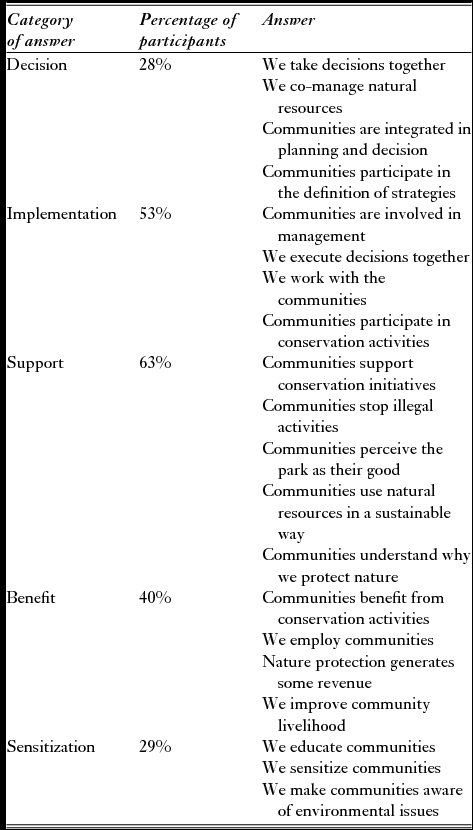
Appendix S2 shows how each of the interviews was classified. Categories are not exclusive as several answers can be found for each interview. One interview (Interview 49) has not been classified into any of the categories of answers. Table 1 presents the details of each category per type of answer, as well as the proportion of participants concerned as part of our results. Our analysis mainly focuses on the elements of answers related to ‘what is community participation?’. According to the three categories of answers identified (support, implementation and decision), we defined a degree of empowerment proposed by each interviewee. The ‘low empowerment’ degree corresponds to answers proposing exclusively that communities should support nature protection. The ‘medium empowerment’ degree encompasses answers proposing that communities should implement conservation and that they should optionally support conservation, but not that they should participate in decision-making. The ‘high empowerment’ degree was affiliated with answers mentioning that the community should participate in the decision-making process and also optionally be involved in the support and implementation of conservation.
Analysis
We analysed the correlations between the answers of the participants and their social profiles. The significant effect of the variables on the degree of empowerment proposed by the participants was tested using two approaches. First, we ran a simple chi-squared test in order to independently analyse the effect of each variable on the frequency distribution of the answers. Second, we ran generalized linear mixed models (GLMMs; Baayen et al., Reference Baayen, Davidson and Bates2008) in order to test for the effect of each variable, holding the effects of the other variables constant. Due to the small size of our sample (n = 86), rather than constructing a single model to predict the three degrees of empowerment, we constructed two models. In the first one (Model 1), we compared the high degree of empowerment with the combination of medium and low levels of empowerment; and in the second one (Model 2), we compared the low level of empowerment with the combination of medium and high levels of empowerment. The effects of the variables on the categories of answers related to ‘how could the community participate in nature conservation?’ was tested independently for each category of answers using a GLMM as well (Model 3 and Model 4).
For each of the models (Models 1–4), the full models included gender, expatriation, education, organization and position in the organization as fixed effects and country as a random effect. Due to the absence of the answers proposing a high degree of empowerment (Model 1) for non-graduate respondents, we merged them with those with bachelor's degrees and compared the responses with those with postgraduate levels of education. In all four models, as the categories of answers (i.e. the dependent variables) were binary (‘0’ or ‘1’), we fitted the models using a binomial error structure and logit link function (McCullagh & Nelder, Reference McCullagh and Nelder1989). The models were fitted in R (version 3.3.0; R Core Team, Reference Core Team2014) using the function glmer of the R package lme4.
In addition to this quantitative approach, we explored the words, concepts and ideas contained in the interviews. The software IRAMUTEQ was used to produce a word cloud (Fig. 1) and support such exploration.
Word cloud based on the 86 interviews.

RESULTS
Overall description of the answers
Beyond the words ‘community’ and ‘participation’, the most cited words were ‘park’, ‘conservation’, ‘involve’, ‘forest’, ‘local’, ‘management’, ‘activity’, ‘person’ and ‘population’. Words such as ‘work’, ‘support’, ‘understand’, ‘interest’, ‘development’, ‘resource’, ‘benefit’ or ‘heritage’ were relatively less frequently used (Fig. 1).
While 95% of the participants gave answers related to what community participation means to them, 58% and 34% of them also gave elements of answer related more to ‘how could the community participate?’ and ‘why should the community participate?’ respectively.
Regarding the proper definition of ‘what does community participation mean?’ three main answers can be identified (Table 1). Sixty-three percent of the participants mentioned that communities should support conservation activities. This category encompasses answers focusing on the perceptions and behaviours of local communities and can be illustrated by the following quotation: ‘So, this completely means that they can understand that they have the duty to keep their natural but as well cultural heritage’ (Interview 46). Fifty-three percent mentioned that communities should participate in the implementation of conservation activities. This category includes answers highlighting the need for the proactive participation of communities and their integration into conservation activities. It can be illustrated by the following quotation: ‘Community participation, it's really that communities can be integrated into protected areas management, be trained, give assistance for the collection of data and for different existing projects’ (Interview 2). Finally, 28% of the participants mentioned that communities should participate in the decisions regarding nature protection. This category includes answers focusing on co-management, planning and strategy definition such as: ‘I think it is really an integration of communities into decision-making related to the management of natural resources of protected areas for example’ (Interview 13). Five percent of the interviews were not classified into any of these categories.
While 30% of the participants mentioned that communities should only support nature protection (low empowerment), 37% mentioned their participation in the implementation of conservation action, as well as their optional support but not their participation in decision-making (medium empowerment). Finally, 28% mentioned that communities should participate in decision-making and also optionally be involved in the implementation and support of conservation activities (high empowerment).
Regarding the elements of answers focusing more on ‘how’ communities could be willing to participate, 40% of the participants mentioned the need to provide some benefits to the communities (Table 1). The following quotation illustrates such an answer: ‘We involve communities in conservation in the following ways: most communities living next to the park get direct benefits from the park’ (Interview 64). Another 29% stressed the need to educate communities and to raise their awareness (Table 1): ‘The community participation, it's mainly about education and the realism that people can change their behaviour’ (Interview 79). This ‘education’ was often orientated towards an understanding of the importance of the park: ‘It is important for NGOs like us to build an awareness, awareness for the communities, that they understand the importance of the park’ (Interview 74).
Different arguments were given by some participants to justify community participation. The most frequent was that conservation could not be successful without the participation of the community: ‘We cannot do conservation without the population’ (Interview 36). Other respondents proposed that communities must participate because they rely on natural resource preservation: ‘If today we speak about nature conservation, it is first of all for humans. Humans are at the centre of everything’ (Interview 22). These types of answers, however, were rarely mobilized without mentioning one or more of the five categories described above.
Effects of the social profiles
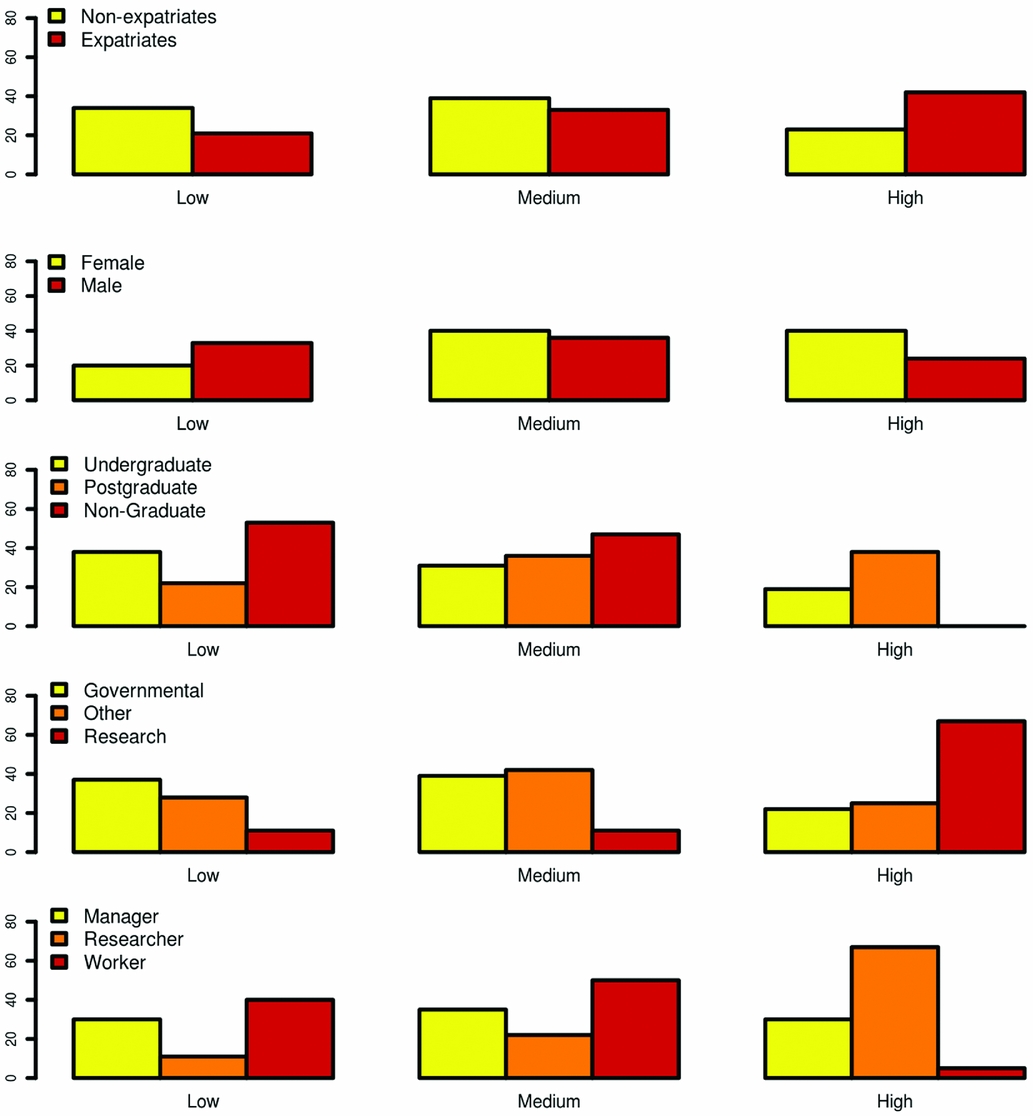
The participants’ answers were distributed according to the degree of empowerment of the community they proposed and in relation to their social profiles (Fig. 2). Expatriates tended to talk more frequently about a medium or a high degree of empowerment, while non-expatriates focused more on low and medium levels of empowerment. Similarly, although 50% of both men and women proposed a medium level of empowerment, women more often proposed a high level of empowerment and men a low level of empowerment (Fig. 2). Non-graduates more often gave a definition of participation restricted to ‘support’ than undergraduates and postgraduates and never proposed a high level of empowerment of communities through their participation in decision-making (Fig. 2). The majority of interviewees belonging to research institutes proposed a high level of empowerment, although governmental organizations or private companies and NGOs (‘others’) more often proposed low and medium levels of empowerment (Fig. 2). Although managers’ answers were balanced between the three degrees of empowerment, the workers rarely proposed a high level of empowerment. In contrast, researchers rarely defined the participation of communities via their support only (low empowerment), but rather most of the time proposed to involve them in decision-making (high empowerment).
Distribution (%) of the participants according to the different degrees of empowerment (low, medium and high) they proposed and in relation to their social profiles.
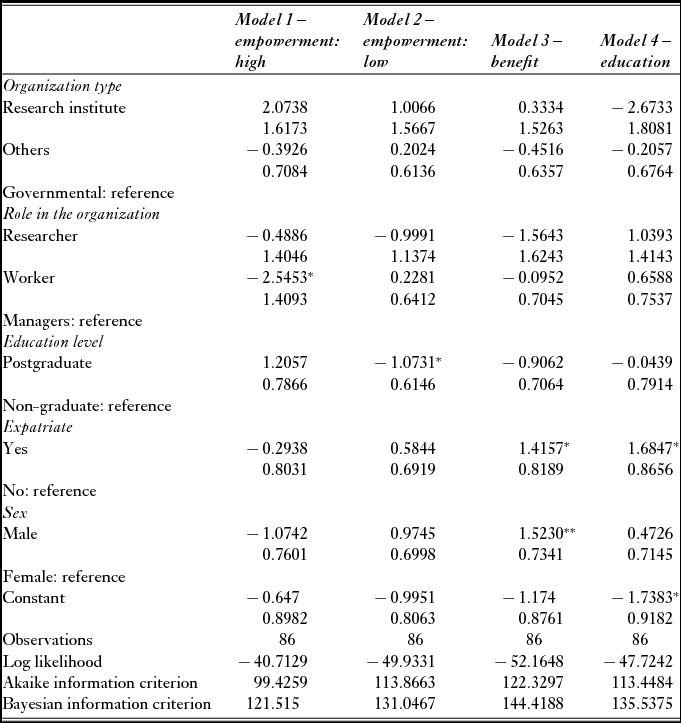
Statistically, the answers vary according to the social profiles for the variables ‘education’ (χ2 = 11.047, p = 0.02604, df = 4), ‘organization’ (χ2 = 9.5221, p = 0.04929, df = 4) and ‘position’ (χ2 = 11.592, p = 0.02066, df = 4). GLMM regression results (Table 2) show that workers were less likely to associate community participation with a high degree of empowerment compared to others (GLMM = –1.806, p < 0.1). On the other hand, respondents with postgraduate education were less likely to associate community participation with a low degree of empowerment compared to respondents with lower education (GLMM = 1.746, p < 0.1). Regarding the ‘how could the community participate?’ question, expatriates were more likely to talk about benefit sharing and sensitization than non-expatriates (GLMM = 1.729, p < 0.1; GLMM = 1.946, p < 0.1). Further, men were more likely to stress the importance of benefit sharing than women (GLMM = 2.075, p < 0.05).
Detailed results of the four generalized linear mixed models. *p < 0.1; **p < 0.05.
DISCUSSION
Our results reveal the absence of a clear and shared definition of community participation in nature protection among the stakeholders involved in the national parks. We showed that part of the variation observed in the participants’ answers can be explained by their social profiles.
The aim of this study was to provide a global picture of the perceptions of different stakeholders involved in African tropical national parks regarding community participation. Another study would be needed to assess in more detail how such perceptions vary from one national park to another according to complex interactions between the historical, cultural and environmental constraints specific to each area. Furthermore, this work relied on a single open question that required a short and concise answer. We acknowledge that such an approach has limitations. For instance, people with less spontaneity may be disadvantaged in comparison to those with a higher capacity to give a holistic answer in a limited time. Furthermore, some participants might not have fully understood the question and their answers could have been slightly different with additional precision in the question. Nonetheless, this approach allowed us both to avoid driving the opinions of the participants with predefined categories of answers and to assess whether they had a straight and clear definition of community participation. It highlighted the hesitation of the respondents and the stability of their knowledge regarding the topic of interest. From this point of view, the difficulties of the participants in answering our question, as well as the heterogeneity and richness of their answers, clearly show the lack of a stable definition of community participation in nature protection. Indeed, rather than expressing a definition through a succinct and straight discourse, the participants were providing answers focusing on ‘what’ community participation is, ‘why’ communities should be participating in it and ‘how’ they could be involved. It seems that rather than indicating what community participation in nature protection means, the interviewees answered more broadly according to what came to mind when thinking about the interaction between local people and nature. Indeed, answers such as, ‘It is that communities can benefit from conservation activities’ (Interview 13), or, ‘Well, first it is something important because those communities live in the forest’ (Interview 31), illustrate that the participants had difficulties in focusing on the definition and rather sidestepped it by talking about related issues. Such observations mainly raise the complexity of the targeted issue, which notably stems from the existence of bi-directional interdependencies between ‘how to get people involved’ and ‘what it ultimately means’. Indeed, although ‘providing benefits’ or ‘raising awareness’ clearly belong more to strategies to get local people involved, the relationships between ‘participating in decision-making’, ‘implementing conservation’ and ‘supporting conservation’ remain complex and unclear (see also Adams & Hulme, Reference Adams and Hulme2001; Campbell, Reference Campbell2005). For instance, the following quotation illustrates that one could consider that involving the local communities is not only an end in itself, but also a way to get their support: ‘We involve them, first of all, in order that they understand the usefulness, the usefulness of biodiversity” (Interview 19). Similarly, the fact that people understand and support conservation can increase their willingness to participate in conservation decisions and their implementation.
Overall, our results highlight the gap between theory and practice regarding community participation in natural resources management. Indeed, although the need to empower communities has been clearly promoted over the last decade (Berkes, Reference Berkes2004; Reed, Reference Reed2008; Brooks et al., Reference Brooks, Waylen and Mulder2013), only 30% of the participants in our study mentioned that communities should participate in the decisions related to nature protection (high empowerment). By contrast, another 30% defined community participation exclusively as communities’ acceptance of conservation policies and their friendly behaviours towards natural resources (low empowerment). Furthermore, the majority of participants tended to clearly separate ‘the conservationists’ from ‘the communities’, ‘us’ from ‘them’, the ‘protectors’ from the ‘users’ of nature (but see Mutanga et al., Reference Mutanga, Muboko and Gandiwa2017). Such a binary vision is also reflected through the ways in which people consider the geopolitical space of conservation. There is the protected area as an area for nature conservation and there is the neighbouring population: ‘They are our neighbours, the direct neighbours that have an eye on resources that are in the park’ (Interview 49). Consequently, despite the fact that many interviewees claimed that communities are ‘the owners and the good guardians of parks and forests’ (Interview 45), this separation implicitly disqualified communities from being part of a socio-ecosystem and having rights to manage it (see also Hulme & Murphree, Reference Hulme and Murphree1999). It distributes responsibilities to both parts: conservationists as managers of nature and communities as users. This might partly explain why many participants talked about benefits and education when describing community participation: it is a duty of the parks and of the actors of conservation to provide benefits to and to educate the local population, and consequently the latter must participate in protecting nature. Such participation, however, is logically often limited to an understanding, a simple support or, optionally, an involvement in the implementation of conservation actions, but rarely in the decisions preceding this. From this point of view, answers proposing a high level of empowerment but simultaneously maintaining a distinct barrier between community and conservation can reveal a paradox and open up a potential gap between the willingness to empower communities and its practical implementation (Vimal & Mathevet, Reference Vimal and Mathevet2011; Vimal et al., Reference Vimal, Mathevet and Michel2013).
National park governance in tropical Africa always relies on stakeholders with various priorities, interests, perceptions and knowledge (Adams & Hutton, Reference Adams and Hutton2007). Our study shows that non-graduate people, those belonging to governmental organizations and/or those employed as workers tended to propose a lower level of empowerment, while people with postgraduate studies, those belonging to research institutes and/or those employed as researchers more often proposed a higher degree of empowerment. Within this polarization, undergraduate people, those belonging to NGOs or private companies and/or those employed as managers occupy an intermediary position, giving answers focusing on a medium level of empowerment or at least a more balanced level between the three categories. Such results mainly suggest that the different degrees of empowerment proposed by different actors depend on their relationships to the space of conservation as a driver of the inclusion or exclusion of local communities. Indeed, people limiting the local communities’ participation to a single support are in interaction with the field realities on a permanent basis. They identify themselves with nature protection and their answers are influenced by their daily experience of national park management. They mostly suggest doing better what is already being done without changing the power relationships. In contrast, people proposing more empowerment are more detached, both physically and morally, from nature conservation activities. Their answers rely on a broader range of experiences and on a strong theoretical background. They tend to think beyond the traditional framework of conservation in Africa and propose innovative solutions that consider the community as ‘part of the conservation team’ (Interview 28).
CONCLUSION
Our results have important implications for biodiversity conservation in tropical Africa. Although community participation was recognized as fundamental, the absence in the national parks of a shared and clear definition among the conservation actors involved questions the practical implementation of this concept and can partly explain the failures previously reported. Indeed, if perceptions have normative implications for action (Feindt & Oels, Reference Feindt and Oels2005; Hajer & Versteeg, Reference Hajer and Versteeg2005), the existence of contested views on ‘what actually does the participation of communities in nature conservation mean?’ has the potential for contradictory, non-coherent and unsynchronized implementations.
Conservation success in tropical national parks is highly dependent on the capacity of different stakeholders to work together and define common, coherent and powerful management (Vimal, Reference Vimal2017). Overall, our results reveal diverging views between an elite that is benevolent but probably disconnected from field realities, and workers who are ultimately in charge of the implementation of conservation policies and are driven by a more polarized relationship to communities. Successful implementation of community participation does not require a top-down imposition of its conceptualization. Rather, conservation stakeholders must work together in a constructive way to articulate different truths. Increasing mediation is needed in order to collectively think about and implement community participation as a core element of park management.
ACKNOWLEDGEMENTS
We are particularly grateful to all the staff of the national parks and their partners for their contributions and willingness to participate in the interviews. We thank Roger Mundry, Hjalmar Kuehl and Marie Chandelier for their support in the analysis.
FINANCIAL SUPPORT
This project was funded by the Robert Bosch Foundation and hosted by the German Centre for Integrative Biodiversity (iDiv) and the Max Planck Institute for Evolutionary Anthropology.
CONFLICT OF INTEREST
None.
ETHICAL STANDARDS
None.
Supplementary material
To view supplementary material for this article, please visit https://doi.org/10.1017/S0376892917000583



