





1 Introduction
1.1 Setup
Let E be an elliptic curve over $ {\mathbb F}_p $
of characteristic
$ {\mathbb F}_p $
of characteristic $ p> 3 $
given by the Weierstrass equation as follows, with coefficients in
$ p> 3 $
given by the Weierstrass equation as follows, with coefficients in ${\mathbb F}_p$
:
${\mathbb F}_p$
:
 $$\begin{align*}y^2=x^3+ax+b. \end{align*}$$
For any integer $n\geq 0$
, define the nth division polynomial
$n\geq 0$
, define the nth division polynomial $\psi _n\in {\mathbb F}_p[x,y]$
as follows:
$\psi _n\in {\mathbb F}_p[x,y]$
as follows:
 $$ \begin{align*} \psi_0 &= 0, \quad \psi_1 = 1, \quad \psi_2 = 2y, \cr \psi_3 &= 3x^4 + 6a x^2 + 12b x - a^2, \cr \psi_4 &= 4y(x^6 + 5a x^4 + 20b x^3 - 5a^2 x^2 - 4abx - 8b^2 - a^3), \end{align*} $$
with subsequent polynomials given by
 $$ \begin{align*} \begin{split} \psi_{2n+1}=\psi_{n+2}\psi_n^3-\psi_{n+1}^3\psi_{n-1},\quad n\geq2, \cr \psi_{2n}\psi_2=\psi_n(\psi_{n+2}\psi_{n-1}^2-\psi_{n-2}\psi_{n+1}^2),\quad n\geq 3, \end{split} \end{align*} $$
for more details, see [Reference Silverman15, Exercise 3.7], combined with the discussion in [Reference Silverman15, Chapter III.1].
Denote by $ E({\mathbb F}_p) $
the group of points on
$ E({\mathbb F}_p) $
the group of points on $ E $
defined over
$ E $
defined over $ {\mathbb F}_p $
. We can interpret each
$ {\mathbb F}_p $
. We can interpret each $\psi _n$
as a rational function on
$\psi _n$
as a rational function on $E({\mathbb F}_p)$
. The multiplication of
$E({\mathbb F}_p)$
. The multiplication of $P \in E$
by n is given as a rational map by
$P \in E$
by n is given as a rational map by
 $$ \begin{align*} [n](P) &= \Bigg( \frac{x(P)\psi_n^2(P) - \psi_{n-1}(P)\psi_{n+1}(P)}{\psi_n(P)^2}, \cr & \qquad \qquad \frac{\psi_{n-1}(P)^2\psi_{n+2}(P) - \psi_{n-2}(P)\psi_{n+1}(P)^2}{4y(P)\psi_n(P)^3} \Bigg). \end{align*} $$
It is well known that
 $$ \begin{align*} \psi_{m+n}(P)&\psi_{m-n}(P)\psi_r^2(P)\cr & =\psi_{m+r}(P)\psi_{m-r}(P)\psi_n^2(P)-\psi_{n+r}(P)\psi_{n-r}(P)\psi_m(P)^2 \end{align*} $$
for any integers $m>n>r$
, see, for example, [Reference Silverman15, Exercise 3.7(g)]. It turns out that
$m>n>r$
, see, for example, [Reference Silverman15, Exercise 3.7(g)]. It turns out that $\psi _n(P)$
is periodic, and the period could be as large as
$\psi _n(P)$
is periodic, and the period could be as large as $(p-1) \operatorname {ord} P$
, where
$(p-1) \operatorname {ord} P$
, where $\operatorname {ord} P \ge 3$
is the order of P in the group
$\operatorname {ord} P \ge 3$
is the order of P in the group $ E({\mathbb F}_q) $
, see [Reference Silverman14, Corollary 9] (which also addresses the case
$ E({\mathbb F}_q) $
, see [Reference Silverman14, Corollary 9] (which also addresses the case $\operatorname {ord} P = 2$
).
$\operatorname {ord} P = 2$
).
Let $\chi $
be a multiplicative character of
$\chi $
be a multiplicative character of ${\mathbb F}_p^{*}$
of a small order. We consider the sequence
${\mathbb F}_p^{*}$
of a small order. We consider the sequence $\chi (\psi _n(P))$
, where of course we set
$\chi (\psi _n(P))$
, where of course we set $\chi (0)=0$
. Then
$\chi (0)=0$
. Then $\chi (\psi _n(P))$
is periodic, whose period can be much smaller (see Section 2) compared to the period of
$\chi (\psi _n(P))$
is periodic, whose period can be much smaller (see Section 2) compared to the period of $\psi _n(P)$
. For points
$\psi _n(P)$
. For points $P\in E({\mathbb F}_p)$
of large orders, Shparlinski and Stange [Reference Shparlinski and Stange13] have obtained nontrivial estimates for the character sums of the form
$P\in E({\mathbb F}_p)$
of large orders, Shparlinski and Stange [Reference Shparlinski and Stange13] have obtained nontrivial estimates for the character sums of the form
 $$ \begin{align*} \sum_{1\le n\le N} \chi(\psi_n(P)), \end{align*} $$
for quadratic characters $\chi $
of
$\chi $
of ${\mathbb F}_p$
, and obtained a nontrivial bound provided
${\mathbb F}_p$
, and obtained a nontrivial bound provided $p^{1/2+\varepsilon }\le N\le \operatorname {ord} P$
, for some fixed
$p^{1/2+\varepsilon }\le N\le \operatorname {ord} P$
, for some fixed $\varepsilon> 0$
.
$\varepsilon> 0$
.
Studying the character values $\chi (\psi _n(P))$
has implications for understanding the distribution of rational points on elliptic curves over
$\chi (\psi _n(P))$
has implications for understanding the distribution of rational points on elliptic curves over $\mathbb {Q}$
. More specifically, let
$\mathbb {Q}$
. More specifically, let $E/\mathbb {Q}$
be an elliptic curve given by an integral Weierstrass equation, and let
$E/\mathbb {Q}$
be an elliptic curve given by an integral Weierstrass equation, and let $P \in E(\mathbb {Q})$
be a non-torsion integral point with everywhere good reduction (see [Reference Bhakta, Loughran, Rydin Myerson and Nakahara2, Section 5.1] for an example). We can write the points
$P \in E(\mathbb {Q})$
be a non-torsion integral point with everywhere good reduction (see [Reference Bhakta, Loughran, Rydin Myerson and Nakahara2, Section 5.1] for an example). We can write the points $nP \in E(\mathbb {Q})$
in lowest terms as
$nP \in E(\mathbb {Q})$
in lowest terms as
 $$\begin{align*}nP = \left( \frac{a_{nP}}{d_{nP}^2}, \frac{b_{nP}}{d_{nP}^3} \right), \end{align*}$$
where $d_{nP} \in \mathbb {N}$
and
$d_{nP} \in \mathbb {N}$
and $\gcd (a_{nP} b_{nP}, d_{nP}) = 1$
. Then [Reference Ayad1, Theorem A] or [Reference Verzobio18, Proposition 3.4] implies that
$\gcd (a_{nP} b_{nP}, d_{nP}) = 1$
. Then [Reference Ayad1, Theorem A] or [Reference Verzobio18, Proposition 3.4] implies that $d_{nP} = |\psi _n(P)|$
, where
$d_{nP} = |\psi _n(P)|$
, where $\psi _n$
is the nth division polynomial associated with
$\psi _n$
is the nth division polynomial associated with $E/{\mathbb Q}$
. Consequently, at least for even Dirichlet characters
$E/{\mathbb Q}$
. Consequently, at least for even Dirichlet characters $\chi $
of prime modulus p, we study
$\chi $
of prime modulus p, we study $\chi (d_{nP})$
, that is, the distribution of
$\chi (d_{nP})$
, that is, the distribution of $d_{nP} \bmod p$
. See also some related discussions in [Reference Bhakta, Loughran, Rydin Myerson and Nakahara2, Section 6].
$d_{nP} \bmod p$
. See also some related discussions in [Reference Bhakta, Loughran, Rydin Myerson and Nakahara2, Section 6].
In this article, we study the correlation between the character values $\chi (\psi _n(P))$
and various multiplicative functions. More precisely, for a given point
$\chi (\psi _n(P))$
and various multiplicative functions. More precisely, for a given point $P\in E({\mathbb F}_p)$
, we study the twisted sums of the form
$P\in E({\mathbb F}_p)$
, we study the twisted sums of the form
 $$\begin{align*}S_{f,\chi,P}(N) = \sum_{1 \leq n\leq N} f(n)\chi(\psi_n(P)), \end{align*}$$
where f is a suitable multiplicative function.
1.2 Main results
1.2.1 Preliminaries
Twists of trace functions with suitable multiplicative functions have been studied by Korolev and Shparlinski [Reference Korolev and Shparlinski10]. A key ingredient of their study involves a certain correlation property (see [Reference Korolev and Shparlinski10, Corollary 4.2]) of trace functions. Building upon the work of Shparlinski and Stange [Reference Shparlinski and Stange13], we first show in Lemma 2.4 that our function $\chi (\psi _n(P))$
also enjoys similar properties.
$\chi (\psi _n(P))$
also enjoys similar properties.
Throughout the whole article, we set $\chi $
to always denote a multiplicative character on
$\chi $
to always denote a multiplicative character on ${\mathbb F}_p^{*}$
of order d, and
${\mathbb F}_p^{*}$
of order d, and
 $$ \begin{align} R=d \operatorname{ord} P. \end{align} $$
For $ n \geq 1 $
and
$ n \geq 1 $
and $ \nu \geq 1 $
, let
$ \nu \geq 1 $
, let $ \tau _{\nu }(n) $
denote the
$ \tau _{\nu }(n) $
denote the $ \nu $
-fold divisor function, defined as
$ \nu $
-fold divisor function, defined as
 $$\begin{align*}\tau_{\nu}(n) = \sum_{n_1n_2 \dots n_{\nu} = n} 1, \end{align*}$$
where the sum runs over ordered $ \nu $
-tuples
$ \nu $
-tuples $ (n_1, n_2, \ldots , n_{\nu }) $
of positive integers such that
$ (n_1, n_2, \ldots , n_{\nu }) $
of positive integers such that $ n_1n_2 \dots n_{\nu } = n $
. In other words,
$ n_1n_2 \dots n_{\nu } = n $
. In other words, $ \tau _{\nu }(n) $
is the coefficient of
$ \tau _{\nu }(n) $
is the coefficient of $ n^{-s} $
in the Dirichlet series
$ n^{-s} $
in the Dirichlet series
 $$\begin{align*}\zeta(s)^v = \sum_{n=1}^\infty \tau_{\nu}(n) n^{-s}. \end{align*}$$
1.2.2 A general bound
For any fixed $C\geq 1$
, let us recall the well-known estimate from [Reference Iwaniec and Kowalski9, Equation (1.80)]
$C\geq 1$
, let us recall the well-known estimate from [Reference Iwaniec and Kowalski9, Equation (1.80)]
 $$ \begin{align} \sum_{1\leq n\leq N}\tau_{\nu}(n)^{C}\ll N(\log N)^{\nu^{C}-1}, \end{align} $$
where the implied constants depend on $\nu $
and C.
$\nu $
and C.
The function $\tau _{\nu }(n)$
is multiplicative and also satisfies
$\tau _{\nu }(n)$
is multiplicative and also satisfies
 $$ \begin{align} \tau_{\nu}(mn) \le \tau_{\nu}(m)\tau_{\nu}(n) \qquad \text{for all } m,n \in {\mathbb N}. \end{align} $$
These properties follow, for example, from the description of $\tau _\nu $
at products of prime powers given in [Reference Iwaniec and Kowalski9, Equation (1.25)].
$\tau _\nu $
at products of prime powers given in [Reference Iwaniec and Kowalski9, Equation (1.25)].
We say that a multiplicative function $f : {\mathbb N} \to {\mathbb C}$
is a
$f : {\mathbb N} \to {\mathbb C}$
is a $\tau _{\nu }$
-bounded multiplicative function if
$\tau _{\nu }$
-bounded multiplicative function if $|f(n)|\le \tau _{\nu }(n)$
for all
$|f(n)|\le \tau _{\nu }(n)$
for all $n \in {\mathbb N}$
. We refer the reader to [Reference Mangerel11, Sections 1.2 and 1.3] for examples of various
$n \in {\mathbb N}$
. We refer the reader to [Reference Mangerel11, Sections 1.2 and 1.3] for examples of various $\tau _{\nu }$
-bounded multiplicative functions. Analogous to [Reference Korolev and Shparlinski10, Theorem 2.2], we have the following result.
$\tau _{\nu }$
-bounded multiplicative functions. Analogous to [Reference Korolev and Shparlinski10, Theorem 2.2], we have the following result.
Theorem 1.1 Fix $0<\varepsilon \le 1/2$
and an integer
$0<\varepsilon \le 1/2$
and an integer $\nu \ge 1$
. Assume that
$\nu \ge 1$
. Assume that
 $$ \begin{align} R\ge p^{1/2+\varepsilon}. \end{align} $$
For any integer N satisfying
 $$ \begin{align} p^{1/12}R^{5/6+\varepsilon}\le N\le R, \end{align} $$
and any $\tau _{\nu }$
-bounded multiplicative function
$\tau _{\nu }$
-bounded multiplicative function $f(n)$
, we have
$f(n)$
, we have
 $$\begin{align*}|S_{f,\chi,P}(N)| \ll N \frac{(\log \log R)^{\nu}}{\log R}, \end{align*}$$
where the implied constant may depend on $\varepsilon ,\nu ,$
and d.
$\varepsilon ,\nu ,$
and d.
Note that (1.5) enforces (1.4). Moreover, Remark 2.5 and the proof of Theorem 1.1 together show that, for any quadratic character $\chi $
, the same bound for
$\chi $
, the same bound for $S_{f,\chi ,P}(N)$
holds, but rather over the extended range
$S_{f,\chi ,P}(N)$
holds, but rather over the extended range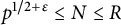 $p^{1/2+\varepsilon } \leq N \leq R$
.
$p^{1/2+\varepsilon } \leq N \leq R$
.
1.2.3 A power saving for certain $1$
-bounded f
$1$
-bounded f

Throughout the whole article, we say that a multiplicative function $f : {\mathbb N} \to {\mathbb C}$
is a
$f : {\mathbb N} \to {\mathbb C}$
is a $1$
-bounded multiplicative function if
$1$
-bounded multiplicative function if $|f(n)|\le 1$
for all
$|f(n)|\le 1$
for all $n \in {\mathbb N}$
. In particular, a
$n \in {\mathbb N}$
. In particular, a $1$
-bounded multiplicative function is the same as a
$1$
-bounded multiplicative function is the same as a $\tau _1$
-bounded multiplicative function.
$\tau _1$
-bounded multiplicative function.
When f is a Dirichlet character, we get a power saving compared to the trivial bound in certain ranges of R. More precisely, we prove the following estimate.
Theorem 1.2 Let R be as in (1.1), and assume that
 $$ \begin{align} R\geq p^{1/2}\exp(2.1\log p/\log \log p). \end{align} $$
Then, for any fixed Dirichlet character $\psi $
and any integer
$\psi $
and any integer $1\leq N\leq R$
, we have
$1\leq N\leq R$
, we have
 $$ \begin{align*} |S_{\psi,\chi,P}(N)| \ll p^{1/12}R^{5/6}(\log R)(\log \log R)^{1/3}, \end{align*} $$
where the implied constant may depend on d and $\psi $
.
$\psi $
.
One can easily note from the argument in Section 3.3 that the weaker condition (1.6) does not work in Theorem 1.1.
Furthermore, we study the sums twisted by $f=\mu ^2$
, where as usual,
$f=\mu ^2$
, where as usual, $\mu $
denotes the Möbius functions, and obtain a power saving in certain ranges. For this, we study certain Type-I sums associated with
$\mu $
denotes the Möbius functions, and obtain a power saving in certain ranges. For this, we study certain Type-I sums associated with $\chi (\psi _n(P))$
, as done for the proof of [Reference Shao, Shparlinski and Wijaya12, Theorem 1.1], and prove the following estimate.
$\chi (\psi _n(P))$
, as done for the proof of [Reference Shao, Shparlinski and Wijaya12, Theorem 1.1], and prove the following estimate.
Theorem 1.3 Let R and $\varepsilon $
be as in (1.4). Then for any integer
$\varepsilon $
be as in (1.4). Then for any integer $1\leq N\leq R$
, we have
$1\leq N\leq R$
, we have
 $$ \begin{align*} \left|S_{\mu^2,\chi,P}(N)\right|&\ll N^{1/2}p^{1/24}R^{5/12}(\log R)^{3/2}(\log \log R)^{1/6}\cr &\qquad\qquad+Np^{-\varepsilon/2}\exp((\log 2+o(1))\log R/\log \log R), \end{align*} $$
where the implied constant may depend on d and $\varepsilon $
.
$\varepsilon $
.
It is evident from the proof of Theorem 1.3 that a slightly weaker condition on R can also be imposed. However, this comes at the expense of a weaker bound in the second term of the estimate. Furthermore, the same argument applies for estimating $S_{\mu ^{(k)}, \chi , P}$
, where
$S_{\mu ^{(k)}, \chi , P}$
, where $\mu ^{(k)}$
denotes the characteristic function of k-free numbers.
$\mu ^{(k)}$
denotes the characteristic function of k-free numbers.
To understand the strengths of Theorems 1.2 and 1.3 compared to Theorem 1.1, at least for $1$
-bounded multiplicative functions, consider the range of N in (1.5). Certainly, within this range, both theorems save a power compared to the trivial bounds. In fact, over this range of N, we have a simplified estimate
$1$
-bounded multiplicative functions, consider the range of N in (1.5). Certainly, within this range, both theorems save a power compared to the trivial bounds. In fact, over this range of N, we have a simplified estimate
 $$ \begin{align*}|S_{\mu^2,\chi,P}(N)|\ll Np^{-\varepsilon/4},\end{align*} $$
where again, the implied constant may depend on d and $\varepsilon $
.
$\varepsilon $
.
1.2.4 An estimation over smooth numbers
We begin by recalling that a positive integer n is called y-smooth if $P(n) \le y$
, where
$P(n) \le y$
, where $P(n)$
denotes the largest prime divisor of n. For
$P(n)$
denotes the largest prime divisor of n. For $2 \le y \le N$
, we denote by
$2 \le y \le N$
, we denote by $\mathcal {S}(N,y)$
the set of y-smooth integers up to N. As usual, denote
$\mathcal {S}(N,y)$
the set of y-smooth integers up to N. As usual, denote $\Psi (N,y) =\sharp \, \mathcal {S}(N,y)$
.
$\Psi (N,y) =\sharp \, \mathcal {S}(N,y)$
.
Let $\Psi _y$
denote the characteristic function of y-smooth numbers. Clearly,
$\Psi _y$
denote the characteristic function of y-smooth numbers. Clearly, $\Psi _y$
is multiplicative, and we are interested in the sum
$\Psi _y$
is multiplicative, and we are interested in the sum
 $$ \begin{align*}S_{\Psi_y,\chi,P}(N) = \sum_{n \in \mathcal{S}(N,y)} \chi(\psi_n(P)),\end{align*} $$
which admits the trivial upper bound $|S_{\Psi _y,\chi ,P}(N)| \le \Psi (N,y)$
.
$|S_{\Psi _y,\chi ,P}(N)| \le \Psi (N,y)$
.
For various estimates of $\Psi (N,y)$
in various ranges of y, the reader may refer to [Reference Granville4, Reference Harper6–Reference Hildebrand and Tenenbaum8]. In this article, we use the following estimate, stated in a form that is adequate for our purposes. For some
$\Psi (N,y)$
in various ranges of y, the reader may refer to [Reference Granville4, Reference Harper6–Reference Hildebrand and Tenenbaum8]. In this article, we use the following estimate, stated in a form that is adequate for our purposes. For some $\alpha (N,y)$
, it is well known that
$\alpha (N,y)$
, it is well known that
 $$ \begin{align} \Psi(N,y) = N^{\alpha(N,y) + o(1)}, \end{align} $$
provided that $y \le N$
and
$y \le N$
and $y \to \infty $
; which, for example, follows from [Reference Hildebrand and Tenenbaum7, Theorem 1], also mentioned in [Reference Shao, Shparlinski and Wijaya12, Section 1.3]. Here,
$y \to \infty $
; which, for example, follows from [Reference Hildebrand and Tenenbaum7, Theorem 1], also mentioned in [Reference Shao, Shparlinski and Wijaya12, Section 1.3]. Here, $\alpha (N,y)$
satisfies
$\alpha (N,y)$
satisfies
 $$ \begin{align} \alpha(N,y) = (1+o(1))\frac{\log(1 + y/\log N)}{\log y}. \end{align} $$
See [Reference Hildebrand and Tenenbaum7, Theorem 2] for a more precise asymptotic formula for $\alpha (N,y)$
.
$\alpha (N,y)$
.
In particular, it is certainly useful to note the following facts:
-
• If
$\log y / \log \log N \to \infty $
, then
$\alpha (N,y) = 1 + o(1)$
. -
• If
$y = (\log N)^K$
for some fixed
$K \ge 1$
(i.e., the case of very smooth numbers), then
$\alpha (N,y) = 1 - \frac {1}{K} + o(1)$
, which also reflects the sparsity of very smooth numbers.


Theorem 1.4 Let R be as in (1.6), and $1\leq N\leq R$
be any integer. Then for any
$1\leq N\leq R$
be any integer. Then for any $N\ge y\ge (\log N)^{\frac {3+\sqrt {5}}{2}}$
, we have
$N\ge y\ge (\log N)^{\frac {3+\sqrt {5}}{2}}$
, we have
 $$ \begin{align} |S_{\Psi_y,\chi,P}(N)| \ll y^{1/2} p^{\frac{1}{24(\alpha+2)}} R^{\frac{5}{12(\alpha+2)}} N^{-\gamma} \Psi(N,y) N^{o(1)}, \end{align} $$
where
 $$ \begin{align*}\alpha=\alpha(N,y),\quad \mathrm{and}\quad\gamma=\frac{\alpha^2+\alpha-1}{2(\alpha+2)}, \end{align*} $$
and the implied constant in (1.9) may depend on d.
The condition on y in Theorem 1.4 is needed, because the estimate is meaningful when $\gamma> 0$
, that is, when
$\gamma> 0$
, that is, when $\alpha (N, y)> \frac {\sqrt {5} - 1}{2}$
. Furthermore, we obtain a power saving in (1.9), provided that N is in the range
$\alpha (N, y)> \frac {\sqrt {5} - 1}{2}$
. Furthermore, we obtain a power saving in (1.9), provided that N is in the range
 $$\begin{align*}N^{\alpha^2 + \alpha - 1}> p^{1/12} R^{5/6 + \varepsilon}, \quad \text{for some } \varepsilon > 0.\end{align*}$$
In fact, since $N\le R$
and
$N\le R$
and $R\ll p$
, we must then need that
$R\ll p$
, we must then need that $\alpha ^2+\alpha>23/12$
, that is, we need
$\alpha ^2+\alpha>23/12$
, that is, we need $\alpha>0.972$
, in other words,
$\alpha>0.972$
, in other words, $y\ge (\log N)^{35.72}$
.
$y\ge (\log N)^{35.72}$
.
In particular, when $\log y/\log \log N \to \infty $
, we have
$\log y/\log \log N \to \infty $
, we have $\alpha =1+o(1)$
, and in that case, we have a cleaner estimate of the form
$\alpha =1+o(1)$
, and in that case, we have a cleaner estimate of the form
 $$ \begin{align*}|S_{\Psi_y,\chi,P}(N)|\ll y^{1/2}p^{1/72}R^{5/36}N^{-1/6+o(1)}\Psi(N,y),\end{align*} $$
which is certainly nontrivial in the range $N\gg y^3p^{1/12}R^{5/6+3\varepsilon }$
, for some
$N\gg y^3p^{1/12}R^{5/6+3\varepsilon }$
, for some $\varepsilon>0$
, and also saves a power compared to the trivial bound. However, again since
$\varepsilon>0$
, and also saves a power compared to the trivial bound. However, again since $N\le R$
, we need
$N\le R$
, we need $y\ll R^{1/18-\varepsilon }p^{-1/36}$
.
$y\ll R^{1/18-\varepsilon }p^{-1/36}$
.
1.3 Notations
Throughout this article, as usual, the notations $U = O(V)$
and
$U = O(V)$
and $U \ll V$
are equivalent to
$U \ll V$
are equivalent to $|U|\le c V$
for some positive constant c, which may depend on d (order of
$|U|\le c V$
for some positive constant c, which may depend on d (order of $\chi $
), integer
$\chi $
), integer $\nu $
, parameter
$\nu $
, parameter $\varepsilon>0$
, and q (modulus of the Dirichlet character
$\varepsilon>0$
, and q (modulus of the Dirichlet character $\psi $
).
$\psi $
).
Furthermore, we write $U^{o(1)}$
for any quantity V, which for any
$U^{o(1)}$
for any quantity V, which for any $\delta> 0$
satisfies
$\delta> 0$
satisfies $|V| \le C(d,\nu ,q, \delta ) U^{\delta }$
, with some constant
$|V| \le C(d,\nu ,q, \delta ) U^{\delta }$
, with some constant $C(d,\nu ,q, \delta )$
that may depend on
$C(d,\nu ,q, \delta )$
that may depend on $d,\nu ,q,$
and
$d,\nu ,q,$
and $\delta $
. In particular, the property
$\delta $
. In particular, the property $U^{o(1)} \cdot U^{o(1)} = U^{o(1)}$
makes some of the estimates more compact.
$U^{o(1)} \cdot U^{o(1)} = U^{o(1)}$
makes some of the estimates more compact.
We use $\tau (n)$
to denote the number of positive integer factors of an integer
$\tau (n)$
to denote the number of positive integer factors of an integer $n\ne 0$
and use
$n\ne 0$
and use $\varphi (n)$
to denote the Euler function.
$\varphi (n)$
to denote the Euler function.
We denote ${\mathbf {\,e}}_R(n) = \exp (2 \pi i n/R)$
. Finally, we use
${\mathbf {\,e}}_R(n) = \exp (2 \pi i n/R)$
. Finally, we use $\sharp \, {\mathcal S}$
to denote the cardinality of a finite set
$\sharp \, {\mathcal S}$
to denote the cardinality of a finite set ${\mathcal S}$
, and throughout the rest of the article, we write
${\mathcal S}$
, and throughout the rest of the article, we write $\sum \limits _{n\leq N}$
to denote the summation over integers
$\sum \limits _{n\leq N}$
to denote the summation over integers $1 \leq n\leq N$
.
$1 \leq n\leq N$
.
2 Character sums with division polynomials
2.1 Preliminary
In this section, we establish the key results involving the division polynomials, which are needed for proving the results stated in Section 1.2.
As usual, for any $\Psi \in {\mathbb F}_p(E)$
, we define
$\Psi \in {\mathbb F}_p(E)$
, we define
 $$\begin{align*}\deg \Psi=\sum_{\substack{P\in E(\overline{{\mathbb F}_p})\cr \nu_P(\Psi)>0}} \nu_{P}(\Psi), \end{align*}$$
where $\nu _{P}(\Psi )$
is the multiplicity of P as a zero of
$\nu _{P}(\Psi )$
is the multiplicity of P as a zero of $\Psi $
(and thus this is a finite sum over all zeros of
$\Psi $
(and thus this is a finite sum over all zeros of $\Psi $
).
$\Psi $
).
Let us again recall R from (1.1). Note that [Reference Shparlinski and Stange13, Lemma 3.1] for $s=d$
implies that the sequence
$s=d$
implies that the sequence $\chi (\psi _n(P))$
is periodic with a period dividing R, as long as
$\chi (\psi _n(P))$
is periodic with a period dividing R, as long as $\operatorname {ord} P\geq 3$
. Recall the following estimate from [Reference Bhakta and Shparlinski3, Lemma 2.3].
$\operatorname {ord} P\geq 3$
. Recall the following estimate from [Reference Bhakta and Shparlinski3, Lemma 2.3].
Lemma 2.1 Let $\chi $
be any non-principal multiplicative character of
$\chi $
be any non-principal multiplicative character of ${\mathbb F}_p^{*}$
, and R be as in (1.1). Assume that
${\mathbb F}_p^{*}$
, and R be as in (1.1). Assume that $\Psi $
is not a nontrivial power of a function in
$\Psi $
is not a nontrivial power of a function in $\overline {{\mathbb F}_p(E)}$
. Then, we have the following estimate uniformly over
$\overline {{\mathbb F}_p(E)}$
. Then, we have the following estimate uniformly over $a\in {\mathbb Z:}$
 $$ \begin{align*}\left|\sum_{n\leq R} \chi(\Psi(nP)){\mathbf{\,e}}_R(an)\right|\ll \deg \Psi \cdot \sqrt{p},\end{align*} $$
where the implied constant may depend on d.
We also need the following lemma to show that the functions of our requirements satisfy the condition of Lemma 2.1.
Lemma 2.2 Let $m_1,m_2,n_1,n_2$
be positive integers satisfying
$m_1,m_2,n_1,n_2$
be positive integers satisfying
 $$ \begin{align} \gcd(m_1n_1,m_2n_2)=\gcd(m_1n_2,m_2n_1). \end{align} $$
Suppose further that
 $$ \begin{align} m_1 \neq m_2 \quad \text{and} \quad n_1 \neq n_2. \end{align} $$
Then, the function
 $$ \begin{align*}\Psi(Q)=\psi_{m_1n_1}\cdot \psi_{m_2n_2}\cdot \psi_{m_1n_2}^{-1}\cdot \psi_{m_2n_1}^{-1}(Q)\end{align*} $$
is not a nontrivial power of any function in $\overline {{\mathbb F}_p(E)}$
.
$\overline {{\mathbb F}_p(E)}$
.
Proof For any integer h, note that $\psi _h$
has
$\psi _h$
has $h^2-1$
simple zeros (see [Reference Silverman15, Exercise III.3.7]).
$h^2-1$
simple zeros (see [Reference Silverman15, Exercise III.3.7]).
Clearly, then the product $\psi _{m_1n_1} \cdot \psi _{m_2n_2}$
has
$\psi _{m_1n_1} \cdot \psi _{m_2n_2}$
has
 $$ \begin{align*}(m_1n_1)^2+(m_2n_2)^2-2\gcd(m_1n_1,m_2n_2)\end{align*} $$
many simple zeros, and $\gcd (m_1n_1,m_2n_2)-1$
many zeros of multiplicity
$\gcd (m_1n_1,m_2n_2)-1$
many zeros of multiplicity $2$
. Similarly,
$2$
. Similarly, $\psi _{m_1n_2} \cdot \psi _{m_2n_1}$
has
$\psi _{m_1n_2} \cdot \psi _{m_2n_1}$
has
 $$ \begin{align*}(m_1n_2)^2+(m_2n_1)^2-2\gcd(m_1n_2,m_2n_1)\end{align*} $$
many simple zeros, and $\gcd (m_1n_2,m_2n_1)-1$
many of zeros of multiplicity
$\gcd (m_1n_2,m_2n_1)-1$
many of zeros of multiplicity $2$
.
$2$
.
In particular, if $\Psi =G^{\nu }$
for some
$\Psi =G^{\nu }$
for some $\nu \geq 2$
and
$\nu \geq 2$
and $G\in \overline {{\mathbb F}_p(E)}$
, then
$G\in \overline {{\mathbb F}_p(E)}$
, then
 $$\begin{align*}\widetilde{\Psi}=\Psi \cdot \psi^{2}_{m_1n_2}\cdot \psi^{2}_{m_2n_1} \end{align*}$$
has the property that each zero of $\widetilde {\Psi }$
has multiplicity at least two. Therefore, each simple zero of
$\widetilde {\Psi }$
has multiplicity at least two. Therefore, each simple zero of $\psi _{m_1n_1} \cdot \psi _{m_2n_2}$
must also be a simple zero of
$\psi _{m_1n_1} \cdot \psi _{m_2n_2}$
must also be a simple zero of $\psi _{m_1n_2} \cdot \psi _{m_2n_1}$
, and vice versa. Therefore, the total number of simple zeros for both
$\psi _{m_1n_2} \cdot \psi _{m_2n_1}$
, and vice versa. Therefore, the total number of simple zeros for both $\psi _{m_1n_1}\cdot \psi _{m_2n_2}$
and
$\psi _{m_1n_1}\cdot \psi _{m_2n_2}$
and $\psi _{m_1n_2} \cdot \psi _{m_2n_1}$
coincides. We get a contradiction due to the imposed conditions at (2.1) and (2.2).
$\psi _{m_1n_2} \cdot \psi _{m_2n_1}$
coincides. We get a contradiction due to the imposed conditions at (2.1) and (2.2).
To establish the main result of this section, we need one more ingredient from [Reference Shparlinski and Stange13, Lemma 3.2], which demonstrates an almost multiplicative nature of $\chi (\psi _n(P))$
.
$\chi (\psi _n(P))$
.
Lemma 2.3 Let $\chi $
be a multiplicative character. Then for any integers
$\chi $
be a multiplicative character. Then for any integers $m,n,$
we have
$m,n,$
we have
 $$\begin{align*}\chi(\psi_{mn}(P))=\chi(\psi_m(nP))\chi(\psi_n(P))^{m^2}. \end{align*}$$
2.2 Correlations of character values
Lemma 2.4 Let R be as in (1.6), and $1\leq N\leq R$
be any integer. Then, for any distinct primes
$1\leq N\leq R$
be any integer. Then, for any distinct primes $\ell _1,\ell _2\leq R$
, we have
$\ell _1,\ell _2\leq R$
, we have
 $$ \begin{align*}\left|\sum_{n \leq N} \chi(\psi_{\ell_1n}(P))\overline{\chi(\psi_{\ell_2n}(P))}\right|\ll \max\{\ell_1,\ell_2\}p^{\frac{1}{12}}R^{5/6}(\log R)(\log \log R)^{1/3},\end{align*} $$
where the implied constant may depend on d.
Proof Let a be an integer. Denote
 $$ \begin{align*}S_{\ell_1,\ell_2}(a)=\sum_{n \leq R} \chi(\psi_{\ell_1n}(P))\overline{\chi(\psi_{\ell_2n}(P))}{\mathbf{\,e}}_R\left(an\right).\end{align*} $$
For a parameter L to be determined later, we consider the set of integers
 $$ \begin{align*}\mathcal{R}_{d}=\left\{1\leq r \leq L:~r\equiv 1 \pmod d,\ \gcd(r,\ell_1\ell_2R)=1\right\}.\end{align*} $$
Clearly by the same argument as in the proof of [Reference Bhakta and Shparlinski3, Lemma 2.4], we have
 $$ \begin{align*}\sharp\,{\mathcal R}_{d} \ge \frac{\varphi(\ell_1\ell_2 R)(L-1)}{d\ell_1\ell_2 R}-\tau(\ell_1\ell_2 R). \end{align*} $$
Since $\tau (\ell _1\ell _2R)\ll \tau (R)$
and
$\tau (\ell _1\ell _2R)\ll \tau (R)$
and $\ell _1,\ell _2\leq R$
, by the standard estimates of the functions
$\ell _1,\ell _2\leq R$
, by the standard estimates of the functions $\tau (n)$
and
$\tau (n)$
and $\varphi (n)$
(see [Reference Hardy and Wright5, Theorems 317 and 328], for instance), we have
$\varphi (n)$
(see [Reference Hardy and Wright5, Theorems 317 and 328], for instance), we have
 $$ \begin{align} \sharp\,{\mathcal R}_{d} \gg \frac{L}{\log \log R}, \end{align} $$
provided that
 $$ \begin{align} L \ge \exp(0.7 \log p/\log \log p). \end{align} $$
Let us now set
 $$ \begin{align*}W = \sum_{r\in {\mathcal R}_{d}} \sum_{n\leq R} \chi(\psi_{ \ell_1 r n}(P))\overline{\chi(\psi_{\ell_2 r n}(P))} {\mathbf{\,e}}_R(ar n).\end{align*} $$
Since each $r\in {\mathcal R}_{d}$
is co-prime to R, it is clear that
$r\in {\mathcal R}_{d}$
is co-prime to R, it is clear that
 $$ \begin{align} S_{\ell_1,\ell_2}(a)=\frac{1}{\sharp\,{\mathcal R}_d} W. \end{align} $$
Applying Cauchy–Schwarz combined with Lemma 2.3, we get
 $$ \begin{align} \begin{aligned} |W|^2 &\leq R \sum_{n\leq R} \left|\sum_{r\in {\mathcal R}_{d}}\chi(\psi_{\ell_1 r n}(P))\overline{\chi(\psi_{\ell_2 r n}(P))} {\mathbf{\,e}}_R(ar n)\right|^2\\ &= R \sum_{n\leq R} \left|\sum_{r\in {\mathcal R}_{d}}\chi(\psi_{\ell_1 r }(nP))\overline{\chi(\psi_{\ell_2 r }(nP))}\chi(\psi_n(P))^{\ell_1^2-\ell_2^2} {\mathbf{\,e}}_R(ar n)\right|^2\\ &= R \sum_{n\leq R} \left|\sum_{r\in {\mathcal R}_{d}}\chi(\psi_{\ell_1 r }(nP))\overline{\chi(\psi_{\ell_2 r }(nP))} {\mathbf{\,e}}_R(ar n)\right|^2\\ &\le R \sum_{r_1, r_2 \in {\mathcal R}_{d}}\left|\sum_{n \leq R} \chi(\varPsi_{r_1,r_2}(nP)) {\mathbf{\,e}}_R(a(r_1 - r_2)n)\right|, \end{aligned} \end{align} $$
where $\varPsi _{r_1,r_2}\in {\mathbb F}_p(E)$
is given by the following:
$\varPsi _{r_1,r_2}\in {\mathbb F}_p(E)$
is given by the following:
 $$ \begin{align*}\varPsi_{r_1,r_2}(Q)= \psi_{\ell_1 r_1}(Q)\cdot \psi_{\ell_2 r_2}(Q)\cdot \psi_{\ell_2 r_1}^{-1}(Q)\cdot \psi_{\ell_1 r_2}^{-1}(Q).\end{align*} $$
Clearly, we have
 $$\begin{align*}\deg \varPsi_{r_1,r_2} \ll (L\cdot \max\{\ell_1,\ell_2\})^2. \end{align*}$$
Now, for any $r_1\neq r_2\in {\mathcal R}_{d}$
, we have
$r_1\neq r_2\in {\mathcal R}_{d}$
, we have
 $$ \begin{align} \gcd(\ell_1 r_1,\ell_2 r_2)=\gcd(r_1,r_2)=\gcd(\ell_1r_2,\ell_2r_1). \end{align} $$
Therefore, Lemma 2.2 shows that $\varPsi _{r_1,r_2}$
is not a nontrivial power of any
$\varPsi _{r_1,r_2}$
is not a nontrivial power of any $G\in \overline {{\mathbb F}_p(E)}$
. Applying Lemma 2.1 to the inner sum in (2.6) for each non-diagonal terms
$G\in \overline {{\mathbb F}_p(E)}$
. Applying Lemma 2.1 to the inner sum in (2.6) for each non-diagonal terms $r_1\neq r_2$
, and trivially estimating the contributions from the diagonal terms
$r_1\neq r_2$
, and trivially estimating the contributions from the diagonal terms $r_1=r_2$
, we obtain
$r_1=r_2$
, we obtain
 $$ \begin{align*} |W|^2& \leq R^2 \sharp\, {\mathcal R}_d+R \sum_{r_1 \neq r_2 \in {\mathcal R}_d}\left|\sum_{n\leq R} \chi(\Psi_{r_1,r_2}(nP)) {\mathbf{\,e}}_R(a(r_1 - r_2)n)\right|\cr &\ll R^2 \sharp\, {\mathcal R}_d+R(\sharp\, {\mathcal R}_d)^2 \cdot \deg \varPsi_{r_1,r_2}\cdot \sqrt{p}\cr &\ll R^2 \sharp\, {\mathcal R}_{d}+R(\sharp\, {\mathcal R}_d)^2 (L\cdot \max\{\ell_1,\ell_2\})^2\cdot \sqrt{p}. \end{align*} $$
In particular, (2.3) and (2.5) imply that
 $$ \begin{align*} |S_{\ell_1,\ell_2}(a)|\ll R L^{-1/2}(\log \log R)^{1/2}+R^{1/2}L\max\{\ell_1,\ell_2\}p^{1/4}. \end{align*} $$
The proof concludes, choosing $L=R^{1/3}p^{-1/6}(\log \log R)^{1/3}$
(clearly L satisfies (2.4) because of the condition (1.6)), and by the completing technique as in [Reference Iwaniec and Kowalski9, Section 12.2].
$L=R^{1/3}p^{-1/6}(\log \log R)^{1/3}$
(clearly L satisfies (2.4) because of the condition (1.6)), and by the completing technique as in [Reference Iwaniec and Kowalski9, Section 12.2].
Remark 2.5 Following the proof of Lemma 2.4, one observes that the assumption $\ell _1,\ell _2 \le R$
is in fact unnecessary. It was imposed only to justify the estimate
$\ell _1,\ell _2 \le R$
is in fact unnecessary. It was imposed only to justify the estimate
 $$\begin{align*}\frac{\phi(\ell_1\ell_2R)}{d\ell_1\ell_2R} \gg \frac{1}{\log\log(\ell_1\ell_2R)} \gg \frac{1}{\log\log R}. \end{align*}$$
If, however, one of $\ell _1$
or
$\ell _1$
or $\ell _2$
exceeds R, the same conclusion continues to hold; simply because we have
$\ell _2$
exceeds R, the same conclusion continues to hold; simply because we have $1-\frac {1}{\ell }\ge 1/2$
for any prime
$1-\frac {1}{\ell }\ge 1/2$
for any prime $\ell $
. For simplicity of exposition, we have stated Lemma 2.4 under the condition
$\ell $
. For simplicity of exposition, we have stated Lemma 2.4 under the condition $\ell _1,\ell _2 \le R$
, as this is the only case required in the proof of Theorem 1.1.
$\ell _1,\ell _2 \le R$
, as this is the only case required in the proof of Theorem 1.1.
Moreover, if both $\ell _1,\ell _2$
are odd, and
$\ell _1,\ell _2$
are odd, and $\chi $
is quadratic, then just by Lemmas 2.1 and 2.3, we immediately have
$\chi $
is quadratic, then just by Lemmas 2.1 and 2.3, we immediately have
 $$ \begin{align*}\left|\sum_{n \leq N} \chi(\psi_{\ell_1n}(P))\overline{\chi(\psi_{\ell_2n}(P))}\right|\ll (\max\{\ell_1,\ell_2\})^2p^{1/2}(\log R).\end{align*} $$
Due to (1.4), of course, the bound above is better than Lemma 2.4, as long as $\ell _1,\ell _2$
are fixed.
$\ell _1,\ell _2$
are fixed.
Remark 2.6 If we take $m_1,m_2\leq R$
to be two distinct positive integers. Then, by the same argument in the proof of Lemma 2.1, we have the following weaker estimate:
$m_1,m_2\leq R$
to be two distinct positive integers. Then, by the same argument in the proof of Lemma 2.1, we have the following weaker estimate:
 $$ \begin{align*} \left|\sum_{n \leq N} \chi(\psi_{m_1n}(P))\overline{\chi(\psi_{m_2n}(P))}\right|\ll \max\{m_1,m_2\}p^{\frac{1}{12}}R^{5/6}(\log R)^{4/3}. \end{align*} $$
In particular, we have
 $$ \begin{align} \left|\sum_{N\le n \leq 2N} \chi(\psi_{m_1n}(P))\overline{\chi(\psi_{m_2n}(P))}\right|\ll \max\{m_1,m_2\}p^{\frac{1}{12}}R^{5/6}(\log R)^{4/3}. \end{align} $$
The reason for the weaker bound is that the identity (2.7) does not necessarily hold, unless $r_1,r_2$
are primes. In that case,
$r_1,r_2$
are primes. In that case, ${\mathcal R}_d$
is essentially a set of primes, and we then have to argue as in the proof of [Reference Shparlinski and Stange13, Theorem 5.1], where the argument does not allow us to replace the factor
${\mathcal R}_d$
is essentially a set of primes, and we then have to argue as in the proof of [Reference Shparlinski and Stange13, Theorem 5.1], where the argument does not allow us to replace the factor $(\log R)^{1/3}$
by
$(\log R)^{1/3}$
by $(\log \log R)^{1/3}$
.
$(\log \log R)^{1/3}$
.
Following the argument in the remark above, we also have the following estimate for any m:
 $$ \begin{align} \left|\sum_{n \leq N} \chi(\psi_{m n}(P))\right|\ll m p^{\frac{1}{12}}R^{5/6}(\log R)^{4/3}. \end{align} $$
In fact, one can get here $(\log R)(\log \log R)^{1/3}$
instead of
$(\log R)(\log \log R)^{1/3}$
instead of $(\log R)^{4/3}$
. This is because
$(\log R)^{4/3}$
. This is because $\psi _{mr_1}\cdot \psi _{mr_2}^{-1}$
is not a power of any function in
$\psi _{mr_1}\cdot \psi _{mr_2}^{-1}$
is not a power of any function in $\overline {{\mathbb F}_p}(E)$
for any integers
$\overline {{\mathbb F}_p}(E)$
for any integers $r_1\neq r_2$
.
$r_1\neq r_2$
.
However, the dependence of m in (2.9) would be too restrictive for us to prove Theorem 1.3. To overcome that obstacle, we use Lemma 2.3 to get a sum associated with the point $mP\in E({\mathbb F}_p)$
(see Lemma 2.8 below). To handle the extra twisting factors
$mP\in E({\mathbb F}_p)$
(see Lemma 2.8 below). To handle the extra twisting factors $\chi (\psi _m(P))^{n^2}$
arising from Lemma 2.3, we first need the following estimate, which essentially generalizes both [Reference Bhakta and Shparlinski3, Lemma 2.4] and [Reference Shparlinski and Stange13, Theorem 5.1].
$\chi (\psi _m(P))^{n^2}$
arising from Lemma 2.3, we first need the following estimate, which essentially generalizes both [Reference Bhakta and Shparlinski3, Lemma 2.4] and [Reference Shparlinski and Stange13, Theorem 5.1].
Lemma 2.7 Let q and $1\leq k\leq q$
be any two fixed integers, and R be as in (1.6). Then for any integer
$1\leq k\leq q$
be any two fixed integers, and R be as in (1.6). Then for any integer $1\le N\leq R$
, we have
$1\le N\leq R$
, we have
 $$ \begin{align*}\left|\sum_{\substack{n\leq N\\ n\equiv k \pmod q}} \chi (\psi_n(P))\right| \ll p^{1/12}R^{5/6}(\log R)(\log \log R)^{1/3},\end{align*} $$
where the implied constant may depend on d.
Proof For a suitable parameter L, consider the set of integers
 $$ \begin{align*}\mathcal{R}_{d,q}=\{r<L:r \equiv 1\pmod {dq},\ \gcd(r,R) = 1\},\end{align*} $$
where again, d is the order of $\chi $
.
$\chi $
.
Since $q,d$
are both fixed, by the same argument as in the proof of [Reference Bhakta and Shparlinski3, Lemma 2.4], we have
$q,d$
are both fixed, by the same argument as in the proof of [Reference Bhakta and Shparlinski3, Lemma 2.4], we have
 $$ \begin{align*}\sharp\,{\mathcal R}_{d,q} \gg \frac{L}{\log \log R},\quad \mathrm{provided~that}\quad L \ge \exp(0.7 \log p/\log \log p). \end{align*} $$
Then, for any $r\in \mathcal {R}_{d,q}$
,
$r\in \mathcal {R}_{d,q}$
,
 $$ \begin{align*}\sum_{\substack{n\leq R\\ n\equiv k \pmod q}} \chi(\psi_{n}(P))e_R(an)=\sum_{\substack{n\leq R\\ n\equiv k \pmod q}} \chi(\psi_{nr}(P))e_R(anr).\end{align*} $$
In particular, the desired sum is bounded by $\frac {1}{\sharp \, \mathcal {R}_{d,q}}\cdot |W_k|$
, where
$\frac {1}{\sharp \, \mathcal {R}_{d,q}}\cdot |W_k|$
, where
 $$ \begin{align*}W_k = \sum_{r \in \mathcal{R}_{d,q}}~\sum_{\substack{n\leq R\\ n\equiv k \pmod q}} \chi(\psi_{nr}(P))e_R(anr).\end{align*} $$
By Cauchy–Schwarz and Lemma 2.3, we have
 $$ \begin{align*} |W_k|^2 &\le R \sum_{n\leq R}\left|\sum_{r \in \mathcal{R}_{d,q}} \chi(\psi_{r n}(P))e_R(ar n)\right|^2\\ &=R\sum_{n\leq R}\left|\sum_{r \in \mathcal{R}_{d,q}} \chi(\psi_{r}(nP))\chi(\psi_n(P))e_R(a r n)\right|^2\\ &= R\sum_{n\leq R}\left|\sum_{r \in \mathcal{R}_{d,q}} \chi(\psi_{r}(nP))e_R(a r n)\right|^2\\ &\le R \sum_{r_1,r_2 \in \mathcal{R}_{d,q}}\left|\sum_{n\leq R} \chi(\psi_{r_1}\cdot \psi_{r_2}^{-1}(nP))e_R(a(r_1-r_2) n)\right|. \end{align*} $$
From this point, we proceed exactly as in the proof of [Reference Bhakta and Shparlinski3, Lemma 2.4], applying the completing technique from [Reference Iwaniec and Kowalski9, Section 12.2] to conclude.
Now, we are ready to weaken the dependence of m in (2.9).
Lemma 2.8 Let R and $\varepsilon $
be as in Theorem 1.1, and
$\varepsilon $
be as in Theorem 1.1, and $m\leq R$
be any positive integer satisfying
$m\leq R$
be any positive integer satisfying $(m,R)\leq p^{\varepsilon /2}$
. Then for any integer
$(m,R)\leq p^{\varepsilon /2}$
. Then for any integer $1\leq N\leq R$
, we have
$1\leq N\leq R$
, we have
 $$ \begin{align*}\left|\sum_{n\leq N} \chi(\psi_{mn}(P))\right|\ll p^{1/12}R^{5/6}(\log R)(\log \log R)^{1/3},\end{align*} $$
where the implied constant may depend on d and $\varepsilon $
.
$\varepsilon $
.
Proof By Lemma 2.3, we can rewrite the sum as
 $$\begin{align*}\left|\sum_{n\leq N} \chi(\psi_n(mP))\chi(\psi_m(P))^{n^2}\right| \ll \sum_{k \leq d} \left| \sum_{\substack{n \leq N \cr n \equiv k \pmod{d}}} \chi(\psi_n(mP)) \right|. \end{align*}$$
Now, applying Lemma 2.7 to each of the inner sums with $q = d$
, and noting that
$q = d$
, and noting that
 $$\begin{align*}\operatorname{ord}(mP) = \frac{\operatorname{ord}(P)}{(m, \operatorname{ord}(P))} \geq p^{1/2 + \varepsilon/2}, \end{align*}$$
the proof follows, because $mP$
satisfies (1.6) for any
$mP$
satisfies (1.6) for any $p>C(\varepsilon )$
, where
$p>C(\varepsilon )$
, where $C(\varepsilon )>0$
is some constant depending only on
$C(\varepsilon )>0$
is some constant depending only on $\varepsilon $
.
$\varepsilon $
.
3 Proof of Theorem 1.1
Let us recall the sum of our interest
 $$ \begin{align*} S_{f,\chi,P}(N) = \sum_{n\leq N} f(n)\chi(\psi_n(P)), \end{align*} $$
where $N,\chi ,$
and f be as in Theorem 1.1.
$N,\chi ,$
and f be as in Theorem 1.1.
To estimate the sum, we closely follow the approach outlined in [Reference Korolev and Shparlinski10]. Let $2 \leq x < y \leq N$
be parameters to be chosen appropriately, and consider the interval
$2 \leq x < y \leq N$
be parameters to be chosen appropriately, and consider the interval $I = (x, y]$
. We then split the sum according to whether the indices have no prime factors in I, or have at least one prime factor in I, and estimate each contribution separately.
$I = (x, y]$
. We then split the sum according to whether the indices have no prime factors in I, or have at least one prime factor in I, and estimate each contribution separately.
To make the splitting more systematic, denote ${\mathcal A}_{r}(N, I)$
the set of integers
${\mathcal A}_{r}(N, I)$
the set of integers $1\leq n \leq N$
with exactly r prime factors (counted with multiplicities) in I. Note that
$1\leq n \leq N$
with exactly r prime factors (counted with multiplicities) in I. Note that ${\mathcal A}_{r}(N,I)=\emptyset $
for any
${\mathcal A}_{r}(N,I)=\emptyset $
for any $r\gg \log N$
. Therefore, we can write
$r\gg \log N$
. Therefore, we can write
 $$ \begin{align} S_{f, \chi,P}(N) = \sum_{r\ll \log N} U_{f,r}(N,I), \end{align} $$
where we denote
 $$ \begin{align*}U_{f,r}(N,I)=\sum_{n\in {\mathcal A}_r(N, I)} f(n)\chi(\psi_n(P)).\end{align*} $$
For the rest of this section, we abuse the notation by writing $U_r$
in place of
$U_r$
in place of $U_{f,r}(N,I)$
.
$U_{f,r}(N,I)$
.
3.1 Treatment for
$U_0$

The fundamental lemma of combinatorial sieve [Reference Tenenbaum17, Theorem 4.4] shows that the set ${\mathcal A}_{0}(N,I)$
is small when x and y are widely separated parameters. However, we need an estimate for the sum of
${\mathcal A}_{0}(N,I)$
is small when x and y are widely separated parameters. However, we need an estimate for the sum of $\tau _{\nu }$
-bounded functions over this small set. We simply use the following estimate, readily available from [Reference Korolev and Shparlinski10, Equations (8-2) and (8-3)]:
$\tau _{\nu }$
-bounded functions over this small set. We simply use the following estimate, readily available from [Reference Korolev and Shparlinski10, Equations (8-2) and (8-3)]:
 $$ \begin{align} |U_{0}|\ll N \exp\left(-\frac{\log N}{4\log x}\right) (\log N)^{\frac{\nu^2-1}{2}}+\frac{N(\log N)^{\nu-1}}{(\log y)^{\nu}}(\log x)^{\nu}. \end{align} $$
A similar analysis could also be found in [Reference Sun16, Lemma 2.2].
3.2 Treatment for
$U_r$
for
$r>0$


We can split the sum $U_r$
as
$U_r$
as
 $$ \begin{align*}U_r = U_{r,1} + U_{r,2},\end{align*} $$
where $U_{r,1}$
denotes the contribution from the integers
$U_{r,1}$
denotes the contribution from the integers $n \in {\mathcal A}_r(N,I)$
whose prime divisors from the interval I all appear with multiplicity one. The remaining contribution, coming from integers where at least one prime divisor from I appears with multiplicity at least two, is denoted by
$n \in {\mathcal A}_r(N,I)$
whose prime divisors from the interval I all appear with multiplicity one. The remaining contribution, coming from integers where at least one prime divisor from I appears with multiplicity at least two, is denoted by $U_{r,2}$
.
$U_{r,2}$
.
Note that the sums $U_{r,2}$
are much easier to handle, as crudely using the submultiplicative property of
$U_{r,2}$
are much easier to handle, as crudely using the submultiplicative property of $\tau _{\nu }(n)$
from (1.2) and (1.3) for
$\tau _{\nu }(n)$
from (1.2) and (1.3) for $C=1$
, we have
$C=1$
, we have
 $$ \begin{align} \begin{aligned} \left|\sum_{r\ll \log N} U_{r,2}\right| &\leq \sum_{\substack{x< \ell\leq y\\ \ell~\mathrm{prime}}}~\sum_{1\leq s \leq \frac{N}{\ell^{2}}} \left|f(\ell^2 s)\right|\leq \sum_{\substack{x< \ell\leq y\\ \ell~\mathrm{prime}}} \tau_{\nu}(\ell^{2}) \sum_{1\leq s \leq \frac{N}{\ell^{2}}} \tau_{\nu}(s)\cr &\ll N (\log N)^{\nu-1}\sum_{\substack{x< \ell\\ \ell~\mathrm{prime}}} \frac{\tau_{\nu}(\ell^{2})}{\ell^2}\ll \frac{N(\log N)^{\nu-1}}{x \log x}. \end{aligned} \end{align} $$
3.2.1 Estimating
$U_{r,1}$

Denote ${\mathcal A}^{\prime }_r(N,I)$
be the set of integers that appear as an index in the sum
${\mathcal A}^{\prime }_r(N,I)$
be the set of integers that appear as an index in the sum $U_{r,1}$
. Note that any
$U_{r,1}$
. Note that any $n\in {\mathcal A}^{\prime }_r(N,I)$
has exactly r representations of the form
$n\in {\mathcal A}^{\prime }_r(N,I)$
has exactly r representations of the form $n = \ell m$
, where the prime
$n = \ell m$
, where the prime $\ell \in I$
, and integer
$\ell \in I$
, and integer $m\in {\mathcal A}^{\prime }_{r-1}(N/\ell ,I)$
, with
$m\in {\mathcal A}^{\prime }_{r-1}(N/\ell ,I)$
, with $\gcd (m,\ell )=1$
. Due to the multiplicativity of f, we can write
$\gcd (m,\ell )=1$
. Due to the multiplicativity of f, we can write
 $$ \begin{align*}U_{r,1}=r^{-1}\sum_{\ell \in I}~f(\ell)~\sum_{\substack{m\in {\mathcal A}^{\prime}_{r-1}(N/\ell,I)\cr{\mathrm{gcd}}(m, \ell) = 1}} f(m)\chi(\psi_{\ell m}(P)).\end{align*} $$
Now, dividing $I=(x,y]$
into
$I=(x,y]$
into $K=O(\log y)$
many dyadic intervals
$K=O(\log y)$
many dyadic intervals $I_k=(x_k,y_k]$
for
$I_k=(x_k,y_k]$
for $k=0,1,\ldots , K$
, as in [Reference Korolev and Shparlinski10, Equation (7-7)], we can write
$k=0,1,\ldots , K$
, as in [Reference Korolev and Shparlinski10, Equation (7-7)], we can write
 $$ \begin{align} U_{r,1}=\sum_{k=0}^{K} V_{k,r}, \end{align} $$
where
 $$ \begin{align*} V_{k,r}&=r^{-1}\sum_{\ell\in I_k}~f(\ell)~\sum_{\substack{m\in {\mathcal A}^{\prime}_{r-1}(N/\ell, I)\cr{\mathrm{gcd}}(m, \ell) = 1}} f(m)\chi(\psi_{\ell m}(P))\cr &=r^{-1}\sum_{\substack{m\in {\mathcal A}^{\prime}_{r-1}(N/x_k, I)}}~f(m)~\sum_{\substack{\ell \in I_k\cap (1,N/m] \cr{\mathrm{gcd}}(m, \ell) = 1}} f(\ell) \chi(\psi_{\ell m}(P)). \end{align*} $$
Note that $|f(m)|\le \tau _{\nu }(m)$
, and for each
$|f(m)|\le \tau _{\nu }(m)$
, and for each $m\in {\mathcal A}^{\prime }_{r-1}(N/x_k,I),$
there exists at most r many
$m\in {\mathcal A}^{\prime }_{r-1}(N/x_k,I),$
there exists at most r many $\ell \in I_k$
for which
$\ell \in I_k$
for which $\gcd (m,\ell )\neq 1$
. Therefore, applying (1.2) with
$\gcd (m,\ell )\neq 1$
. Therefore, applying (1.2) with $C=1$
, we can write
$C=1$
, we can write
 $$ \begin{align} V_{k,r}\ll r^{-1}W_{k,r}+N(\log N)^{\nu-1}x_k^{-1}, \end{align} $$
where
 $$ \begin{align*} W_{k,r}=\sum_{m\in {\mathcal A}^{\prime}_{r-1}\left(N/x_k,I\right)}\tau_{\nu}(m)\left|\sum_{\ell \in I_k\cap (1,N/m]}f(\ell)\chi(\psi_{\ell m}(P))\right|. \end{align*} $$
Crudely, summing over $m\leq N/x_k$
and applying Cauchy–Schwarz, we have
$m\leq N/x_k$
and applying Cauchy–Schwarz, we have
 $$ \begin{align*} |W_{k,r}|^2&\leq Nx_k^{-1}(\log N)^{\nu^2-1} \sum_{m \leq N/x_k} \left| \sum_{\ell \in I_k \cap (1,N/m]} f(\ell)\, \chi(\psi_{\ell m}(P)) \right|^2 \cr &\leq Nx_k^{-1}(\log N)^{\nu^2-1} \sum_{\ell_1,\,\ell_2 \in I_k} \left| \sum_{m \leq N/{\max\{x_k,\, \ell_1,\, \ell_2\}}} \chi(\psi_{\ell_1 m}(P))\, \overline{\chi(\psi_{\ell_2 m}(P))} \right|, \end{align*} $$
where we are using above that $|f(\ell _1)f(\ell _2)|= O(1)$
, and the estimate from (1.2) for
$|f(\ell _1)f(\ell _2)|= O(1)$
, and the estimate from (1.2) for $C=2$
.
$C=2$
.
At this point, our argument deviates from the proof of [Reference Korolev and Shparlinski10, Theorem 2.1]. Instead of using [Reference Korolev and Shparlinski10, Corollary 4.2], we appeal to Lemma 2.4 to estimate the inner sums above for $\ell _1\neq \ell _2$
. Note that (1.4) implies (1.6) for any
$\ell _1\neq \ell _2$
. Note that (1.4) implies (1.6) for any $p>C(\varepsilon )$
, where
$p>C(\varepsilon )$
, where $C(\varepsilon )>0$
is some constant depending only on
$C(\varepsilon )>0$
is some constant depending only on $\varepsilon $
. Moreover, we estimate the contributions from
$\varepsilon $
. Moreover, we estimate the contributions from $\ell _1=\ell _2$
trivially, and get
$\ell _1=\ell _2$
trivially, and get
 $$ \begin{align*} \begin{aligned} \left|W_{k,r}\right|^2&\ll \left(N x_k^{-1}\left(y_kNx_k^{-1}+y^3_k p^{\frac{1}{12}}R^{5/6+o(1)}\right)\right)(\log N)^{\nu^2-1}\cr &\ll \left(N^2x_k^{-1}+Nx_k^2 p^{\frac{1}{12}}R^{5/6+o(1)}\right)(\log N)^{\nu^2-1}. \end{aligned} \end{align*} $$
Consequently, we deduce the following estimate from (3.4) and (3.5):
 $$ \begin{align} \begin{aligned} U_{r,1}&\ll r^{-1}\sum_{k=0}^{K}(W_{k,r}+rN(\log N)^{\nu-1}x_k^{-1})\cr &\ll r^{-1} \left( Nx^{-1/2} + y N^{1/2} p^{\frac{1}{24}}R^{5/12+o(1)}\right)(\log N)^{\frac{\nu^2-1}{2}}+N(\log N)^{\nu-1}x^{-1}. \end{aligned} \end{align} $$
3.3 Concluding the proof
From (3.1), we have
 $$ \begin{align*} S_{f, \chi,P}(N)&\ll \sum_{\substack{r\ll \log N \cr r \neq 0}} |U_{r,1}|+\left|\sum_{\substack{r\ll \log N \cr r\neq 0}} U_{r,2}\right|+|U_{0}|. \end{align*} $$
Let us choose the parameters
 $$ \begin{align*}x=(\log R)^{\nu^2+3},\quad \mathrm{and} \quad y=R^{\varepsilon/4}.\end{align*} $$
From (3.6), we have
 $$ \begin{align*} \sum_{\substack{r\ll \log N \cr r \neq 0}}|U_{r,1}|&\ll \frac{N} {\log R}+y N^{1/2} p^{\frac{1}{24}}R^{5/12+o(1)}\ll \frac{N}{\log R}, \end{align*} $$
where the last inequality is due to the condition (1.5).
From (3.3), we have
 $$ \begin{align*}\left|\sum_{\substack{r\ll \log N\\ r\neq 0}} U_{r,2}\right|\ll \frac{N(\log N)^{\nu-1}}{x \log x}\ll \frac{N}{\log R}.\end{align*} $$
The proof is now complete, as (3.2) implies $|U_0|\ll \varepsilon ^{-\nu }N\frac {(\log \log R)^{\nu }}{\log R}.$
4 A power saving with certain twists
4.1 Proof of Theorem 1.2
To prove this, we do not quite follow the techniques of the previous section; rather, we simply apply Lemma 2.7. Suppose that $\psi $
is a Dirichlet character modulo q. Then, we can write
$\psi $
is a Dirichlet character modulo q. Then, we can write
 $$ \begin{align*} S_{\psi,\chi,P}(N)=\sum_{k\leq q}\psi(k)\sum_{\substack{n\leq N\\ n\equiv k \pmod q}} \chi(\psi_{n}(P)). \end{align*} $$
The proof follows, immediately applying Lemma 2.7 to each of the q many inner sums.
4.2 Proof of Theorem 1.3
Let us first write
 $$ \begin{align*}S_{\mu^2,\chi,P}(N) = \sum_{d\leq N^{1/2}} \mu(d)\sum_{n\leq N/d^2}\chi(\psi_{d^2n}(P)).\end{align*} $$
Then, we can split the sum as
 $$ \begin{align} S_{\mu^2,\chi,P}(N)=T_{1}+T_{2}, \end{align} $$
where we denote
 $$ \begin{align*}T_{1}= \sum_{\substack{d\leq N^{1/2}\cr\gcd(d,R)\leq p^{\varepsilon/4}}} \mu(d)\sum_{n\leq N/d^2}\chi(\psi_{d^2n}(P)),\quad T_2=S_{\mu^2,\chi,P}(N)-T_1.\end{align*} $$
To estimate $T_1$
, first we split
$T_1$
, first we split $T_1$
into
$T_1$
into $\log N$
many type I sums of the form
$\log N$
many type I sums of the form
 $$ \begin{align*}S(D,N)=\sum_{\substack{D\leq d<2D\\ \gcd(d,R)\leq p^{\varepsilon/4}}} \mu(d)\sum_{n\leq N/d^2}\chi(\psi_{d^2n}(P)).\end{align*} $$
As for any such d above, we have $\gcd (d^2,R)\leq p^{\varepsilon /2}$
, Lemma 2.8 implies that
$\gcd (d^2,R)\leq p^{\varepsilon /2}$
, Lemma 2.8 implies that
 $$ \begin{align} |S(D,N)|\ll Dp^{1/12}R^{5/6}(\log R)(\log \log R)^{1/3}. \end{align} $$
Estimating rather trivially, we also have
 $$ \begin{align} |S(D,N)|\ll N/D. \end{align} $$
In particular, choosing $D_0$
such that
$D_0$
such that
 $$ \begin{align*}D_0^2p^{1/12}R^{5/6}(\log R)(\log \log R)^{1/3}=N,\end{align*} $$
and applying (4.2) for $D\le D_0$
, and (4.3) for
$D\le D_0$
, and (4.3) for $D\ge D_0$
, we finally derive
$D\ge D_0$
, we finally derive
 $$ \begin{align*}|T_1|\ll N^{1/2}p^{1/24}R^{5/12}(\log R)^{3/2}(\log \log R)^{1/6}.\end{align*} $$
On the other hand, we have
 $$ \begin{align*} \begin{aligned} |T_2|&=\left|\sum_{\substack{d\leq N^{1/2}\cr\gcd(d,R)> p^{\varepsilon/4}}} \mu(d)\sum_{n\leq N/d^2}\chi(\psi_{d^2n}(P))\right|\le \sum_{\substack{d\leq N^{1/2}\cr\gcd(d,R)> p^{\varepsilon/4}}} \sum_{n\leq N/d^2}~1.\cr &\le N\sum_{\substack{d\le N^{1/2}\cr \gcd(d,R)>p^{\varepsilon/4}}}\frac{1}{d^2} + \sharp\,\{d\le N^{1/2}:\gcd(d,R)>p^{\varepsilon/4}\}. \end{aligned} \end{align*} $$
To bound the first term above, note that if $\gcd (d,R)>p^{\varepsilon /4}$
, then there exists a divisor
$\gcd (d,R)>p^{\varepsilon /4}$
, then there exists a divisor $g\mid R$
with
$g\mid R$
with $g>p^{\varepsilon /4}$
such that
$g>p^{\varepsilon /4}$
such that $g\mid d$
. In particular, we have
$g\mid d$
. In particular, we have
 $$\begin{align*}\sum_{\substack{d\le N^{1/2}\cr \gcd(d,R)>p^{\varepsilon/4}}}\frac{1}{d^2} \le \sum_{\substack{g\mid R\\ g>p^{\varepsilon/4}}} \sum_{\substack{d\le N^{1/2}\cr g\mid d}}\frac{1}{d^2} \ll \sum_{\substack{g\mid R\\ g>p^{\varepsilon/4}}}\frac{1}{g^2} \ll \frac{\tau(R)}{p^{\varepsilon/2}}, \end{align*}$$
where $\tau (R)=\tau _{1}(R)$
denotes the number of divisors of R.
$\tau (R)=\tau _{1}(R)$
denotes the number of divisors of R.
On the other hand, we also have
 $$ \begin{align*} \sharp\,\{d\le N^{1/2}:\gcd(d,R)>p^{\varepsilon/4}\} &\le \sum_{\substack{g\mid R\\ g>p^{\varepsilon/4}}} \sharp\,\{d\le N^{1/2}: g\mid d\}\ll \frac{N^{1/2}\tau(R)}{p^{\varepsilon/4}}. \end{align*} $$
Therefore, we derive
 $$ \begin{align} |T_2|\ll \frac{N\tau(R)}{p^{\varepsilon/2}}+\frac{N^{1/2}\tau(R)}{p^{\varepsilon/4}}. \end{align} $$
Note that if $N<p^{\varepsilon /2}$
, then the desired estimate at Theorem 1.3 holds trivially, as
$N<p^{\varepsilon /2}$
, then the desired estimate at Theorem 1.3 holds trivially, as $R\ge p^{1/2}$
by (1.4). Hence, we may assume that
$R\ge p^{1/2}$
by (1.4). Hence, we may assume that $N\ge p^{\varepsilon /2}$
. Consequently, from (4.4), we obtain
$N\ge p^{\varepsilon /2}$
. Consequently, from (4.4), we obtain
 $$ \begin{align*}|T_2|\ll Np^{-\varepsilon/2}\exp((\log 2+o(1))\log R/\log \log R),\end{align*} $$
where we use the well-known bound for $\tau (R)$
(see [Reference Hardy and Wright5, Theorem 317]). The proof now follows from (4.1).
$\tau (R)$
(see [Reference Hardy and Wright5, Theorem 317]). The proof now follows from (4.1).
5 Proof of Theorem 1.4
5.1 Preliminaries
5.1.1 Smooth numbers in a smaller range
We first need the following estimates.
Lemma 5.1 Let $\alpha =\alpha (N,y)$
be as in (1.8). For any
$\alpha =\alpha (N,y)$
be as in (1.8). For any $1\le L\le N$
, we have
$1\le L\le N$
, we have
 $$ \begin{align} \Psi(N/L,y) \ll \frac{1}{L^{\alpha}} \Psi(N,y),\quad \mathrm{and} \end{align} $$
 $$ \begin{align} \Psi(L, y) \ll L^{\alpha}N^{o(1)}. \end{align} $$
Proof For (5.1), see [Reference Harper6, Section 2]. To prove (5.2), simply note that
 $$ \begin{align} \Psi(L, y) \ll \left(\frac{L}{N}\right)^{\alpha}\Psi(N,y)= L^{\alpha}N^{o(1)}, \end{align} $$
where, of course, we are using (1.7) for the last equality.
5.1.2 A decomposition of large smooth numbers
Let $L_0 \leq N$
be a parameter to be chosen later. Note that any
$L_0 \leq N$
be a parameter to be chosen later. Note that any $n\in {\mathcal S}(N,y)$
with
$n\in {\mathcal S}(N,y)$
with $n> L_0$
can be uniquely written as
$n> L_0$
can be uniquely written as
 $$ \begin{align*}n = \ell m,\quad \mathrm{with}\quad L_0<\ell \le P(\ell)L_0 \quad \mathrm{and}\quad p(m) \geq P(\ell),\end{align*} $$
where $P(\ell )$
denotes the largest prime factor of
$P(\ell )$
denotes the largest prime factor of $\ell $
and
$\ell $
and $p(m)$
denotes the smallest prime factor of m. Indeed, one can obtain such a decomposition by arranging all the prime factors of n as
$p(m)$
denotes the smallest prime factor of m. Indeed, one can obtain such a decomposition by arranging all the prime factors of n as $p_1\le p_2\le \cdots \le p_K$
, and keep collecting the numbers
$p_1\le p_2\le \cdots \le p_K$
, and keep collecting the numbers $p_1,p_1p_2,\ldots $
, until we reach a number
$p_1,p_1p_2,\ldots $
, until we reach a number $\ell $
that just crosses
$\ell $
that just crosses $L_0$
. See also [Reference Shao, Shparlinski and Wijaya12, p. 9].
$L_0$
. See also [Reference Shao, Shparlinski and Wijaya12, p. 9].
To show the uniqueness of the decomposition, write $n = p_1 \dots p_K$
with
$n = p_1 \dots p_K$
with $p_1 \le p_2 \le \cdots \le p_K$
. Then
$p_1 \le p_2 \le \cdots \le p_K$
. Then $\ell $
must be of the form
$\ell $
must be of the form $p_1 \dots p_S$
and m of the form
$p_1 \dots p_S$
and m of the form $p_{S+1} \dots p_K$
for some
$p_{S+1} \dots p_K$
for some $S \le K$
. Now, the condition
$S \le K$
. Now, the condition $L_0 \le \ell \le P(\ell )L_0$
implies
$L_0 \le \ell \le P(\ell )L_0$
implies
 $$\begin{align*}L_0 \le p_1 \dots p_S \qquad \text{and} \qquad p_1 \dots p_{S-1} < L_0. \end{align*}$$
Hence, S is uniquely determined by $L_0$
, which proves the uniqueness of the decomposition.
$L_0$
, which proves the uniqueness of the decomposition.
Then, we can write
 $$ \begin{align*}S_{\Psi_y,\chi,P}(P)=\sum_{\substack{L_0 < \ell \leq P(\ell) L_0 \cr \ell \in {\mathcal S}(N, y)}} \, \sum_{\substack{m \in {\mathcal S}(N/\ell, y) \cr p(m) \geq P(\ell)}} \chi(\psi_{\ell m}(P)) + O(L_0).\end{align*} $$
5.2 Concluding the proof
Note that the range of $\ell $
is given by
$\ell $
is given by $(L_0,yL_0]$
. After the dyadic partition of this range, we see that there is some
$(L_0,yL_0]$
. After the dyadic partition of this range, we see that there is some $L \in (L_0, yL_0]$
such that
$L \in (L_0, yL_0]$
such that
 $$ \begin{align} S_{\Psi_y,\chi,P}(P) \ll U \log N + L_0, \end{align} $$
where
 $$ \begin{align*}U= \sum_{\substack{L < \ell \leq \min\left\{P(\ell)L_0, 2L\right\} \cr \ell \in {\mathcal S}(N, y)}} \, \sum_{\substack{m \in S(N/\ell, y) \cr p(m) \geq P(\ell)}} \chi(\psi_{\ell m}(P)).\end{align*} $$
We now argue exactly as in the proof of [Reference Shao, Shparlinski and Wijaya12, Theorem 1.3], and obtain
 $$ \begin{align*} \begin{aligned} U^2 \ll & (\log N)^2 \Psi(L,y) \cr &\quad\quad\times \sum_{q \leq y} \, \sum_{m_1,m_2 \in {\mathcal S}(N/L,y)} \left| \sum_{L/q < \ell \le 2L/q} \chi(\psi_{q\ell m_1}(P)) \overline{\chi(\psi_{q\ell m_2}(P)} \right|. \end{aligned} \end{align*} $$
For the rest of the proof, we set $\alpha = \alpha (N,y)$
. Following the same argument as in [Reference Shao, Shparlinski and Wijaya12], the contribution
$\alpha = \alpha (N,y)$
. Following the same argument as in [Reference Shao, Shparlinski and Wijaya12], the contribution $Y_1$
from the diagonal terms with
$Y_1$
from the diagonal terms with $m_1=m_2$
is
$m_1=m_2$
is
 $$ \begin{align*} Y_1&\ll (\log N)^2 \Psi(L,y) \sum_{q \leq y} \Psi(N/L, y) L/q\\ &\ll L N^{-\alpha} \Psi(N,y)^2 N^{o(1)}, \end{align*} $$
where the inequality above follows combining (5.1) and the first inequality in (5.3), and also recalling that $\log y\le \log N=N^{o(1)}$
.
$\log y\le \log N=N^{o(1)}$
.
To estimate the contribution $Y_2$
from the non-diagonal terms
$Y_2$
from the non-diagonal terms $m_1\neq m_2$
, we apply (2.8) instead of [Reference Shao, Shparlinski and Wijaya12, Lemma 2.2], and obtain
$m_1\neq m_2$
, we apply (2.8) instead of [Reference Shao, Shparlinski and Wijaya12, Lemma 2.2], and obtain
 $$ \begin{align*} Y_2 & \ll (\log N)^2 \Psi(L,y)\cdot y \Psi(N/L, y)^2\cdot N/L\cdot p^{\frac{1}{12}}R^{5/6+o(1)} \cr & \ll y p^{1/12}R^{5/6} L^{-(\alpha+1)} \Psi(N,y)^2 N^{1+o(1)}, \end{align*} $$
where the last inequality follows by combining both parts of Lemma 5.1.
In particular, recalling that $L_0<L\le yL_0$
, we have
$L_0<L\le yL_0$
, we have
 $$ \begin{align*}U^2& \ll Y_1 + Y_2 \le (LN^{-\alpha} + yp^{1/12}R^{5/6}L_0^{-(\alpha+1)}N) \Psi(N,y)^2 N^{o(1)} \cr & \le y(L_0N^{-\alpha} + p^{1/12}R^{5/6}L_0^{-(\alpha+1)}N) \Psi(N,y)^2 N^{o(1)}. \end{align*} $$
Choosing $L_0 = p^{\frac {1}{12(\alpha +2)}} R^{\frac {5}{6(\alpha +2)}}N^{\frac {\alpha +1}{\alpha +2}}$
, we derive
$L_0 = p^{\frac {1}{12(\alpha +2)}} R^{\frac {5}{6(\alpha +2)}}N^{\frac {\alpha +1}{\alpha +2}}$
, we derive
 $$ \begin{align*}U \le y^{1/2} p^{\frac{1}{24(\alpha+2)}} R^{\frac{5}{12(\alpha+2)}}N^{\frac{1-(\alpha^2+\alpha)}{2(\alpha+2)}} \Psi(N,y) N^{o(1)}.\end{align*} $$
Hence, (5.4) gives
 $$ \begin{align*} S_{f_{y},\chi,P}(N)&\ll y^{1/2} p^{\frac{1}{24(\alpha+2)}} R^{\frac{5}{12(\alpha+2)}}N^{\frac{1-(\alpha^2+\alpha)}{2(\alpha+2)}} \Psi(N,y) N^{o(1)}\cr &\qquad\qquad\qquad\qquad+p^{\frac{1}{12(\alpha+2)}} R^{\frac{5}{6(\alpha+2)}}N^{\frac{\alpha+1}{\alpha+2}}. \end{align*} $$
Setting $\gamma =\frac {\alpha ^2+\alpha -1}{2(\alpha +2)}$
, we have
$\gamma =\frac {\alpha ^2+\alpha -1}{2(\alpha +2)}$
, we have $\alpha -2\gamma =\frac {\alpha +1}{\alpha +2}$
, and hence we finally deduce
$\alpha -2\gamma =\frac {\alpha +1}{\alpha +2}$
, and hence we finally deduce
 $$ \begin{align*} |S_{f_{y},\chi,P}(N)| &\ll y^{1/2} p^{\frac{1}{24(\alpha+2)}} R^{\frac{5}{12(\alpha+2)}} N^{-\gamma} \Psi(N,y) N^{o(1)} \cr &\qquad\qquad\qquad\qquad + p^{\frac{1}{12(\alpha+2)}} R^{\frac{5}{6(\alpha+2)}} N^{\alpha - 2\gamma}. \end{align*} $$
If $p^{\frac {1}{24(\alpha +2)}} R^{\frac {5}{12(\alpha +2)}}> N^{\gamma }$
, then the stated bound at (1.9) is trivial. So, let us assume that
$p^{\frac {1}{24(\alpha +2)}} R^{\frac {5}{12(\alpha +2)}}> N^{\gamma }$
, then the stated bound at (1.9) is trivial. So, let us assume that $p^{\frac {1}{24(\alpha +2)}} R^{\frac {5}{12(\alpha +2)}}\le N^{\gamma }$
. In this case, the second term above is dominated by the first term because
$p^{\frac {1}{24(\alpha +2)}} R^{\frac {5}{12(\alpha +2)}}\le N^{\gamma }$
. In this case, the second term above is dominated by the first term because $\Psi (N,y)N^{o(1)}=N^{\alpha }$
, and the proof concludes.
$\Psi (N,y)N^{o(1)}=N^{\alpha }$
, and the proof concludes.
Remark 5.2 Following the arguments in Section 3.3, the main bottleneck in improving Theorem 1.1 lies in the estimation of $U_0$
in (3.2). Note that the integers in the set
$U_0$
in (3.2). Note that the integers in the set ${\mathcal A}_0(N,I)$
can be written as products of the form
${\mathcal A}_0(N,I)$
can be written as products of the form
 $$\begin{align*}(\textit{x}-{\rm smooth}) \times (\textit{y}-{\rm rough}). \end{align*}$$
This structure suggests that one might attempt to adapt the approach used in the proof of Theorem 1.4. However, as one may anticipate, complications arise for the integers whose x-smooth parts are small.
Remark 5.3 Consider the classical function $r_0(n)$
, the characteristic function of integers that are sums of two squares. It is well-known (see [Reference Tenenbaum17, p. 98, Equation (4.90)], for instance) that
$r_0(n)$
, the characteristic function of integers that are sums of two squares. It is well-known (see [Reference Tenenbaum17, p. 98, Equation (4.90)], for instance) that
 $$\begin{align*}\sum_{n \leq N} r_0(n) \ll \frac{N}{(\log N)^{1/2}}. \end{align*}$$
Following the argument used in the proof of Theorem 1.1, one can easily deduce that
 $$ \begin{align} |S_{r_0,\chi,P}| \ll \frac{N}{(\log N)^{1/2}} \cdot \frac{\log \log R}{\log R}, \end{align} $$
where R and $\varepsilon $
be as in (1.4), and the implied constant in (5.5) may depend on d and
$\varepsilon $
be as in (1.4), and the implied constant in (5.5) may depend on d and $\varepsilon $
.
$\varepsilon $
.
Moreover, the same saving compared to the trivial estimate likely holds for many other multiplicative functions, supported sparsely on the integers and taking values in the intervals $[0,1]$
.
$[0,1]$
.
Acknowledgments
The author is grateful to Igor E. Shparlinski for suggesting this project, and to Alina Ostafe and Igor E. Shparlinski for their valuable support and suggestions at various stages of this work. The author also sincerely thanks the referee for a careful reading of the manuscript and for many helpful suggestions, and thanks Jitendra Bajpai and Simon L. Rydin Myerson for helpful comments.


 Open access

