




Introduction
Old Dongola (18.223056, 30.743889; ca. 242 masl) is located in the Letti Basin area between the Third and Fourth cataracts on the eastern bank of the Nile river, within what is today Northern Province, Sudan. Originally named “Tungul” or “Toungoul” ( ) in Old Nubian, Old Dongola functioned as the capital of the Kingdom of Makuria from the ca. 5th/6th c. CE through 14th c. CE; comprising a territory spanning ca. 1,000,000 km2 by the 7th c. CE, Old Dongola waned as a seat of power by the 14th c. CE with Mamluk invasion from Egypt and subsequent rise of the Funj Sultanate in the 16th c. CE (Fushiya Reference Fushiya2021; Obłuski Reference Obłuski2021). In 1365 CE the royal court moved to a place in the north called Daw with Old Dongola transitioning into the so-called Kingdom of Dongola (Godlewski Reference Godlewski2013b, 135–136, 2014; Łajtar Reference Łajtar2013, Reference Łajtar2020; Nasreldein Reference Nasreldein2024; Obłuski Reference Obłuski2021; Żurawski Reference Żurawski, Jakobielski and Scholz2001). Remaining an important minor polity under the Funj Sultanate, the demise of the Kingdom of Dongola has been linked with 18th c. CE invasions associated with the Shaiqiya, with the last King of Dongola having left Old Dongola in the 1780s (Obłuski Reference Obłuski2021, 6; Nasreldein Reference Nasreldein2024, 53).
Being ca. 200 ha in size by the 10th–12th c. CE, during its medieval period apogee along with being the capital of Makuria and a key cultural center, Old Dongola also played an important role within the Makurian church, being the seat of a bishopric and the site of at least two monasteries (Łajtar Reference Łajtar2002, 165–166; Obłuski 2019, 38–46, Reference Obłuski2021; Obłuski et al. Reference Obłuski, Herbich and Ryndziewicz2022, 260). Since 1964 the site of Old Dongola has been under continuous excavation by the Polish Centre of Mediterranean Archaeology of the University of Warsaw (PCMA UW), working in collaboration with the National Corporation for Antiquities and Museums of Sudan (NCAM). Numerous site features have been identified in the process, including churches, monasteries, residential structures, as well as Christian and Muslim cemeteries (Fushiya Reference Fushiya2021; Godlewski Reference Godlewski2013b; Jakobielski Reference Jakobielski, Jakobielski and Scholz2001a; Michałowski Reference Michałowski1966; Obłuski and Dzierzbicka Reference Obłuski and Dzierzbicka2021, Reference Obłuski and Dzierzbicka2022; Żurawski Reference Żurawski1995, Reference Żurawski1996, Reference Żurawski1997, Reference Żurawski1999a, Reference Żurawski, Jakobielski and Scholz2001) (Figure 1).
Location of Old Dongola (left) and features of the Old Dongola site (right), showing the location of the monastery on Kom H in relation to the citadel and Graves 1–6 in the adjacent Christian cemetery.

The Monastery on Kom H at Old Dongola
Kom H is located along the northern edge of the agglomeration of site aspects at Old Dongola, comprising an area of ca. 1.2 ha. It is here that one of at least two monasteries in Old Dongola, the other being the monastery on Kom D, was identified (Obłuski Reference Obłuski2019). The periphery wall of the monastery, including several towers, is constructed of mudbrick. Identified components of the Kom H monastery include: a monastic courtyard, a church, service buildings and industrial areas related to various functions, storage areas, a kiln, the sanctuary/hermitage (kellion) of Saint Anna, as well as two annex spaces to the southwest and northwest outside the walls (Obłuski Reference Obłuski2019, 38–46). Two possible affiliations for the monastery on Kom H have been proposed: the “Monastery of the Holy Trinity” (Jakobielski Reference Jakobielski2008) and the “Monastery of St. Anthony the Great” (Godlewski Reference Godlewski2013b), though further evidence is needed to substantiate any claims regarding the name of this monastery.
The Northwest Annex and Crypts 1–3
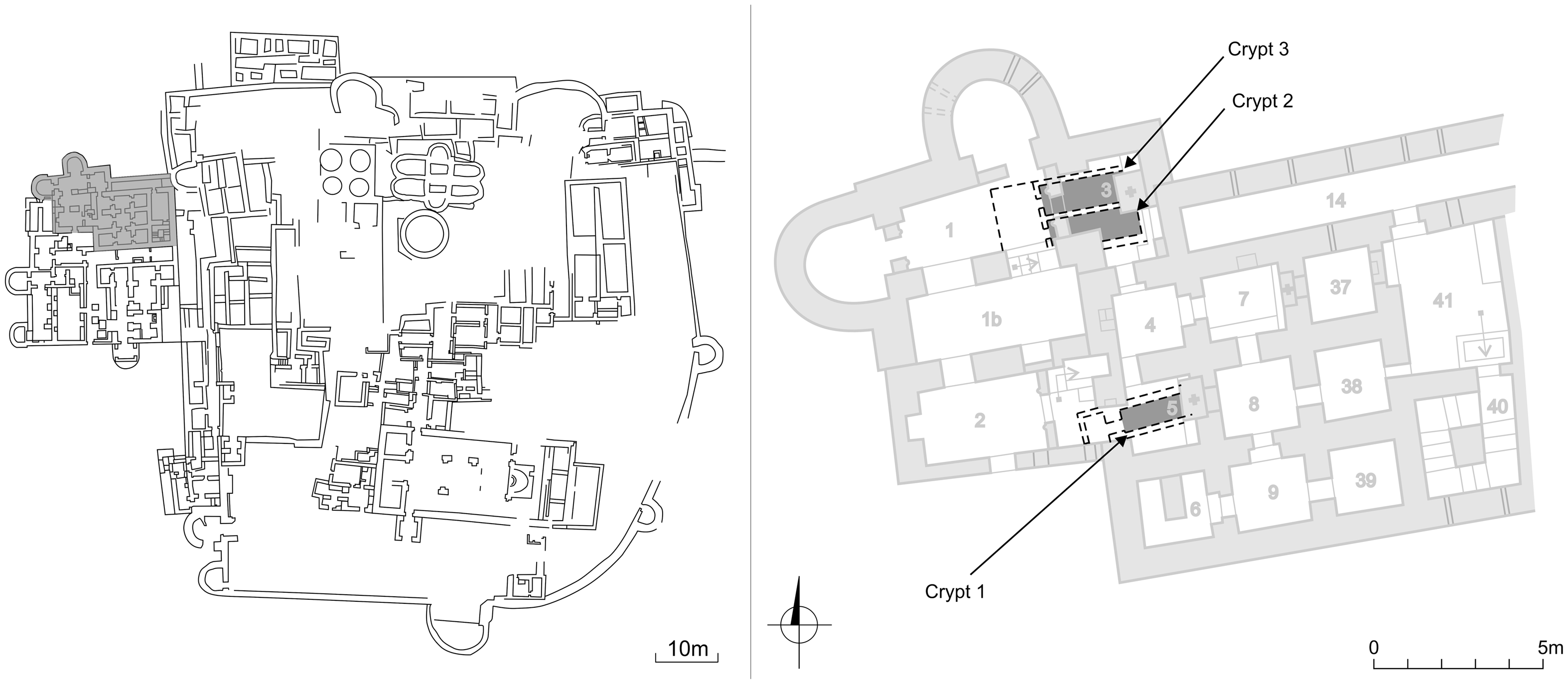
The Northwest Annex, constructed of mudbrick and comprising 40 rooms, abuts the northeastern corner of the monastery, clearly attesting to its later construction. This facility evidently functioned from the 10th to the end of the 13th or even to the beginning of the 14th c. CE (Godlewski Reference Godlewski, Godlewski, Dzierzbicka and Łajtar2018; Jakobielski Reference Jakobielski, Jakobielski and Scholz2001b; Obłuski Reference Obłuski2019). The interior of the annex is decorated with wall paintings depicting both biblical scenes and members of Nubian society (Figure 2). It is within the Northwest Annex where Crypts 1–3 are located. The purpose of the Northwest Annex remains unclear, though Żurawski (Reference Żurawski1999a) has proposed that this space may have functioned as a xenodocheion (i.e., a place for travellers, pilgrims, and possibly the sick) potentially at the direction of Georgios, who was archbishop of Dongola from ca. 1063 until his death in 1113 CE, or following his death (Łajtar Reference Łajtar2002; Obłuski Reference Obłuski2019, 42; Żurawski Reference Żurawski and Emmel1999b, Reference Żurawski2012, Reference Żurawski2014).
Plan of the Monastery on Kom H with the area of Crypts 1–3 highlighted in gray (left; drawing D. Dzierzbicka) with inset of Northwest Annex and Crypts 1–3 (right; drawing W. Godlewski, M. Puszkarski, updated S. Maślak; after Jakobielski and Scholz Reference Jakobielski and Scholz2001).

In 1993 a crypt was identified underneath the floor of B.I.SW.1 in the doorway area between Room 2 and Room 5 of what was originally Building NW.I. This crypt was identified with Georgios given the presence of an epitaph above the crypt attesting to the death of Georgios in 1113 CE, resulting in B.VI.1, in what was ultimately designated Building B.VI [H.NW.B.VI], being referred to as the Commemorative Chapel of Archbishop Georgios (Jakobielski Reference Jakobielski1994; Godlewski Reference Godlewski2013a, Reference Godlewski, Godlewski, Dzierzbicka and Łajtar2018). Though Georgios is believed to have been placed within this crypt following his death in 1113 CE, it is not clear if the crypt was already in use by that time. In 1994, two additional crypts were located nearby in Room 1A, below the doorway area joining Rooms 1A and 3, within what would come to be referred to as Building B.VII [H.NW.B.VII], being reported by Żurawski (Reference Żurawski1996, 126) as below the haikal of the northern commemorative chapel (Jakobielski Reference Jakobielski1994, Reference Jakobielski1995; Żurawski Reference Żurawski1995). Jakobielski (Reference Jakobielski1995, 87) proposes that these later two tombs were likely utilized in the 13th c. CE or later. Godlewski (Reference Godlewski, Godlewski, Dzierzbicka and Łajtar2018) places construction of the chapel in the period after the first raid of the Mamluk invasion in 1276 CE. In support of this inference, Godlewski (Reference Godlewski, Godlewski, Dzierzbicka and Łajtar2018, 57) additionally notes the identification of an inscription in the mausoleum commemorating the visit of high-ranking officials in 1276–1277 CE (Łajtar and van der Vliet Reference Łajtar and van der Vliet2017, 36–38) as well as destruction of the superstructures of graves located near the Northwest Annex.
Żurawski (Reference Żurawski1999a) reports that the Crypt of Georgios, Crypt 1, was initially opened at the end of the 1993 field season, though the burials were not excavated at this time. Based on the observation of multiple burials in each of the three crypts examined, Żurawski (Reference Żurawski1999a) proposes that these crypt burial spaces were re-used over time, with burials being introduced over an extended period. In a broader assessment of burials associated with the Monastery on Kom H, Żurawski (Reference Żurawski1999a) records these three crypts as Grave Nos. 26, 27, and 28, though they are herein referred to as Crypt 3, 2, and 1 respectively, following the designations established during excavations carried out between 2009 and 2012 (Godlewski et al. Reference Godlewski, Mahler and Czaja-Szewczak2012; Mahler et al. Reference Mahler, Godlewski, Danys-Lasek and Czaja2015). Crypts 2 and 3 were evidently built preceding the chapel-like room located directly above them (Żurawski Reference Żurawski1999a). The plaster coated vaulted interior surface of Crypt 1 is covered with extensive texts in Greek and Coptic; detailed epigraphic documentation of these texts is presented by Łajtar and van der Vliet (Reference Łajtar and van der Vliet2017). Similar coating or texts were not present in Crypts 2 and 3.
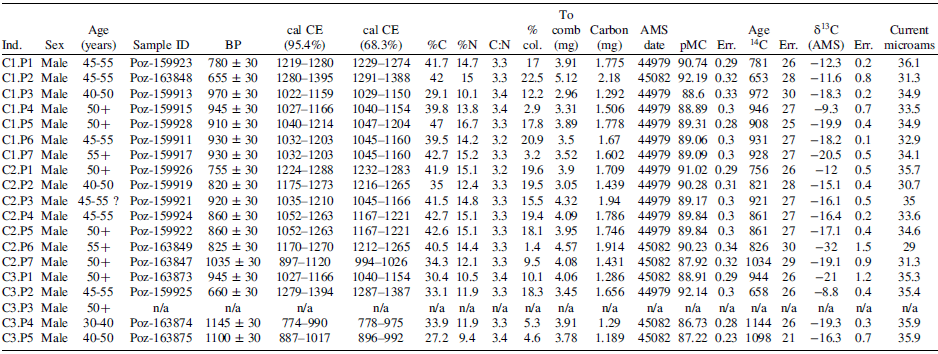
Anthropological assessment of the buried individuals identified seven adult male individuals (Table 1) aged between 40–55+ years old within Crypt 1; seven adult male individuals aged between 40–55+ years old in Crypt 2; and five adult male individuals, as well as an isolated skull fragment of a sixth adult individual of undeterminable sex, in Crypt 3, four of whom were aged more than 40 years old and one individual who was between 30–40 years old (Godlewski et al. Reference Godlewski, Mahler and Czaja-Szewczak2012; Mahler et al. Reference Mahler, Godlewski, Danys-Lasek and Czaja2015). Sex estimation was performed according to the morphological methods compiled by White (Reference White2000, 362–371), Piontek (Reference Piontek1996, 127–141), and Buikstra and Ubelaker (Reference Buikstra and Ubelaker1994: 16–21) with the morphological assessment of the pelvis deemed the most reliable. When undertaking sex estimation, the method of Phenice (Reference Phenice1969) was given precedence to all other methods. Age-at-death was assessed using a variety of macroscopic methods. When possible, the results of the following characteristics were taken into account: dental attrition, using the tables by Lovejoy (Reference Lovejoy1985, 49–50); pubic symphyseal face changes, using the scale presented by Brooks and Suchey (Reference Brooks and Suchey1990), after Buikstra and Ubelaker (Reference Buikstra and Ubelaker1994, 23–24); degeneration of the auricular surface of the ilium, using the methods presented by Meindl, Lovejoy and colleagues (Lovejoy et al. Reference Lovejoy, Meindl, Pryzbeck and Mensforth1985; Meindl and Lovejoy Reference Meindl, Lovejoy and Iscan1989), after White (Reference White2000, 355–359); and degree of obliteration of cranial sutures using the methods presented in Buikstra and Ubelaker (Reference Buikstra and Ubelaker1994, 32–35) and Meindl and Lovejoy (Reference Meindl and Lovejoy1985).
Results of femur bone collagen AMS radiocarbon dating of individuals interred in Crypts 1–3 on Kom H at Old Dongola, Sudan.

Medieval Makurian burials do not typically contain grave goods or personal items, reducing the possibility of establishing temporality through relative dating (see Adams Reference Adams1977, 1998; Welsby Reference Welsby2002). Though numerous small finds were recovered, including personal wooden crosses; ceramics, namely amphorae fragments and lamps; leather; and textiles, some of which were made in part of silk with gold threading and multiple dyed colors, there was no clear basis upon which to establish the chronology of these three crypts, nor the periods of deposition for the respective individuals found within the three crypts (Czaja Reference Czaja, Godlewski, Dzierzbicka and Łajtar2018; Godlewski et al. Reference Godlewski, Mahler and Czaja-Szewczak2012). There are however contextual dates that can be derived from some of the finds. A fragment of a base of an amphora embedded in a levelling layer covering the lower three burials in Crypt 3 was dated to the 12th c. CE. According to the assessment of Włodzimierz Godlewski this vessel belonged to the original furnishing of Crypt 3 (Mahler et al. Reference Mahler, Godlewski, Danys-Lasek and Czaja2015, 359–360). Moreover, in Crypt 2, in association with the uppermost graves, several fragments of a silk textile with gold covered thread ornament typical of 12th c. CE tiraz fabrics produced in Egypt were found (Godlewski et al. Reference Godlewski, Mahler and Czaja-Szewczak2012, 356). Judging from these finds it can be inferred that these crypts were in use at least until the 12th c. CE. The identified epitaph recording the death of Archbishop Georgios in 1113 CE further corroborates this timeframe and provides the only relatively solid dating for Crypt 1. Given the presence of this epitaph, it is ostensibly likely that Georgios was the first to be interred within Crypt 1, though this inference remains unsubstantiated. No other recorded dates are available for Crypts 1–3. Accordingly, AMS radiocarbon dating of the burials within Crypts 1–3 was undertaken in order to establish the temporal relationship between these three crypts, the associated chronologies of the burials interred within each crypt, and more broadly to situate Crypts 1–3 within the contextual chronologies of the Northwest Annex, the Kom H monastery complex, and the wider Old Dongola sociotemporal landscape.
Methods
Following collection of bone samples at Old Dongola, bone collagen for radiocarbon dating was prepared in the Faculty of Archaeology at the University of Warsaw under the laboratory direction of Dr. Rafał Fetner. Samples were collected from 19 individuals interred within Crypts 1–3; sample collection was not possible from the isolated skull (Individual 6) in Crypt 3. Samples were initially cleaned using a wire brush to remove surficial contaminants before collagen was extracted following the method of Longin (Reference Longin1971): samples were demineralized in 0.3 mol HCl and subsequently rinsed thrice with ultrapure water before heating at 70°C for 48 hr in dilute HCl (pH 3). Samples were then filtered using Ezee-filter™ separators (Elkay, UK) and freeze-dried for 48 hr. Samples were weighed following cleaning and after freeze-drying to assess %collagen preservation in dry bone.
CO2 was produced through sample combustion in quartz tubes sealed under vacuum, together with CuO and Ag wool, at 900°C for over 10 hours. The obtained gas (CO2 + water vapor) was dried in a vacuum line before being reduced with hydrogen (H2), using 2 mg of Fe powder as a catalyst. The resultant mixture of carbon and iron was then pressed into an aluminium holder. Standards for use in the sample run, 14C background (coal) and standard (Ox-II), were prepared in the same manner (see Czernik and Goslar Reference Czernik and Goslar2001).
AMS 14C measurements were conducted in the Laboratory of the Adam Mickiewicz University (AMU) in Poznań as part of a cooperation between Poznań Radiocarbon Laboratory and the AMS 14C Laboratory at AMU, as regulated by the Agreement between the Foundation of the A. Mickiewicz University and the A. Mickiewicz University. A Compact Carbon AMS (produced by: National Electrostatics Corporation, USA) was utilized to assess 14C in the sample analysed (see Goslar et al. Reference Goslar, Czernik and Goslar2004). The measurement was performed by comparing intensities of ionic beams of 14C, 13C and 12C measured for each sample and for standard samples (i.e., modern standards of Oxalic Acid II and standard of 14C-free carbon “background”). In each AMS run, 30–33 samples of unknown age are measured, alternated with measurements of 3–4 samples of modern standard and 1–2 samples of background (coal).
Taking into account correction for isotopic fractionation, conventional 14C age was calculated according to Stuiver and Polach (Reference Stuiver and Polach1977), utilizing the ratio 13C/12C measured by AMS simultaneously with the ratio 14C/12C. Uncertainty of the calculated 14C age was determined using uncertainty implied from counting statistics along with the spread (standard deviation) of partial 14C/12C results, whichever is bigger. Additionally, uncertainties of 14C/12C measured on standard samples are taken into account; 1-σ uncertainty of the reported conventional 14C age is the best estimate of the total uncertainty of measurement.
Calibration was performed in reference to IntCal20, the most recent 14C calibration curve (Reimer et al. Reference Reimer, Austin, Bard, Bayliss, Blackwell, Bronk Ramsey, Butzin, Cheng, Edwards, Friedrich, Grootes, Guilderson, Hajdas, Heaton, Hogg, Hughen, Kromer, Manning, Muscheler, Palmer, Pearson, van der Plicht, Reimer, Richards, Scott, Southon, Turney, Wacker, Adolphi, Büntgen, Capano, Fahrni, Fogtmann-Schulz, Friedrich, Köhler, Kudsk, Miyake, Olsen, Reinig, Sakamoto, Sookdeo and Talamo2020). Moreover, Bayesian modelling was applied to take into account stratigraphical relations within the crypts (Bayliss Reference Bayliss2015; Bayliss et al. Reference Bayliss, van der Plicht, Bronk Ramsey, McCormac, Healy, Whittle, Whittle, Healy and Bayliss2011; Bronk Ramsey Reference Bronk Ramsey2009; Hamilton and Krus Reference Hamilton and Krus2018). Calibration of 14C age and Bayesian chronological modelling was performed using OxCal ver. 4.4 (2021) (Bronk Ramsey Reference Bronk Ramsey2009).
Preservation of collagen was assessed according to DeNiro (Reference DeNiro1985) and Schoeninger et al. (Reference Schoeninger, Moore, Murray and Kingston1989), with ideal C:N values being between 2.9–3.6 and %collagen being >5%. In instances where C:N was suitable but %collagen was <5%, samples were retained as previous research has demonstrated viability of samples with %collagen in the order of 1% (see Hu et al. Reference Hu, Ambrose and Wang2006; Van Klinken Reference Van Klinken1999). At various points herein “C” and “P” have been utilized as abbreviations for noting individuals interred within Crypts 1–3 on Kom H. For example, person 3 from Crypt 1 would be abbreviated as C1.P3, while person 7 from Crypt 2 would be abbreviated as C2.P7, and so forth.
Results
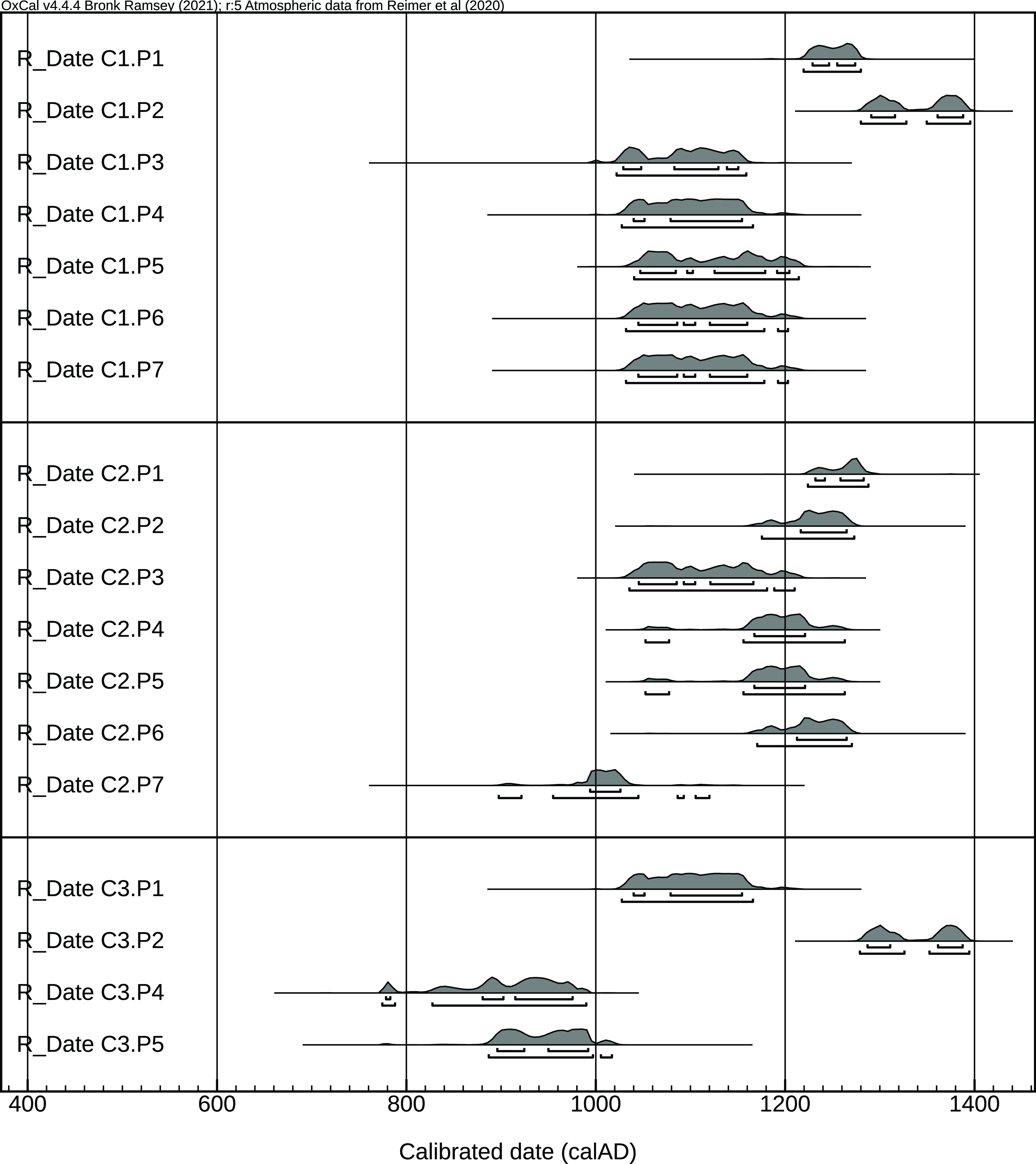
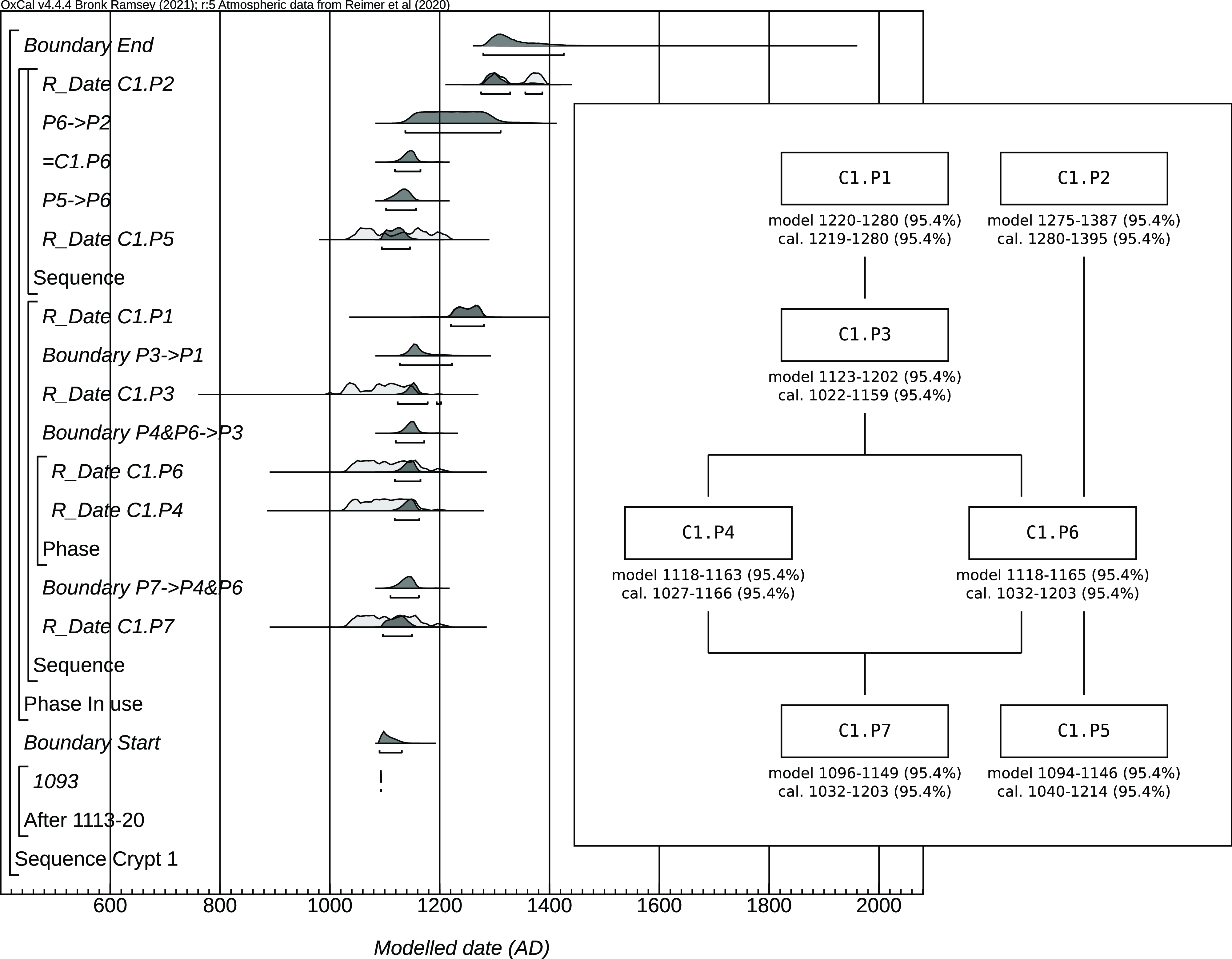
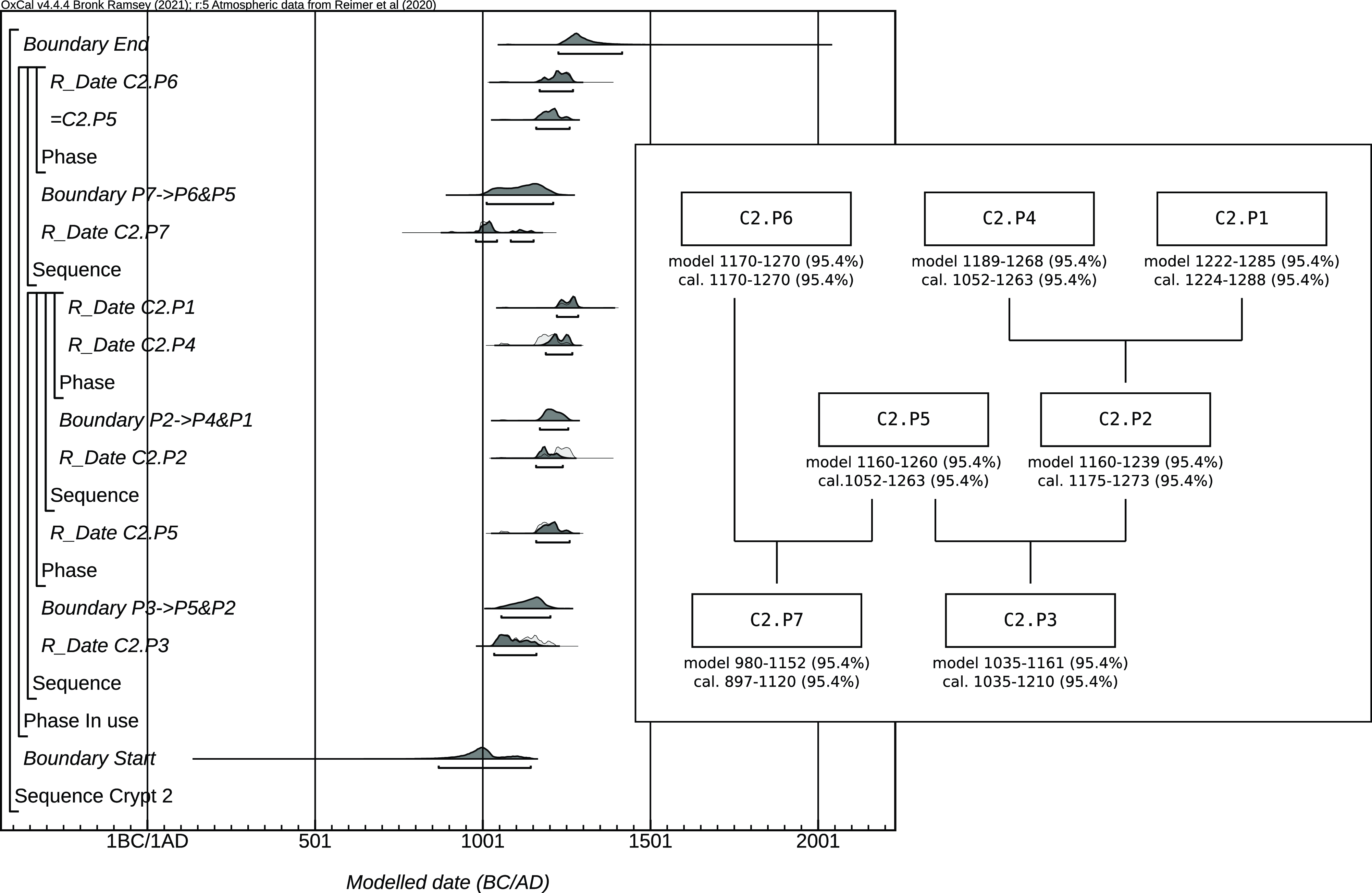
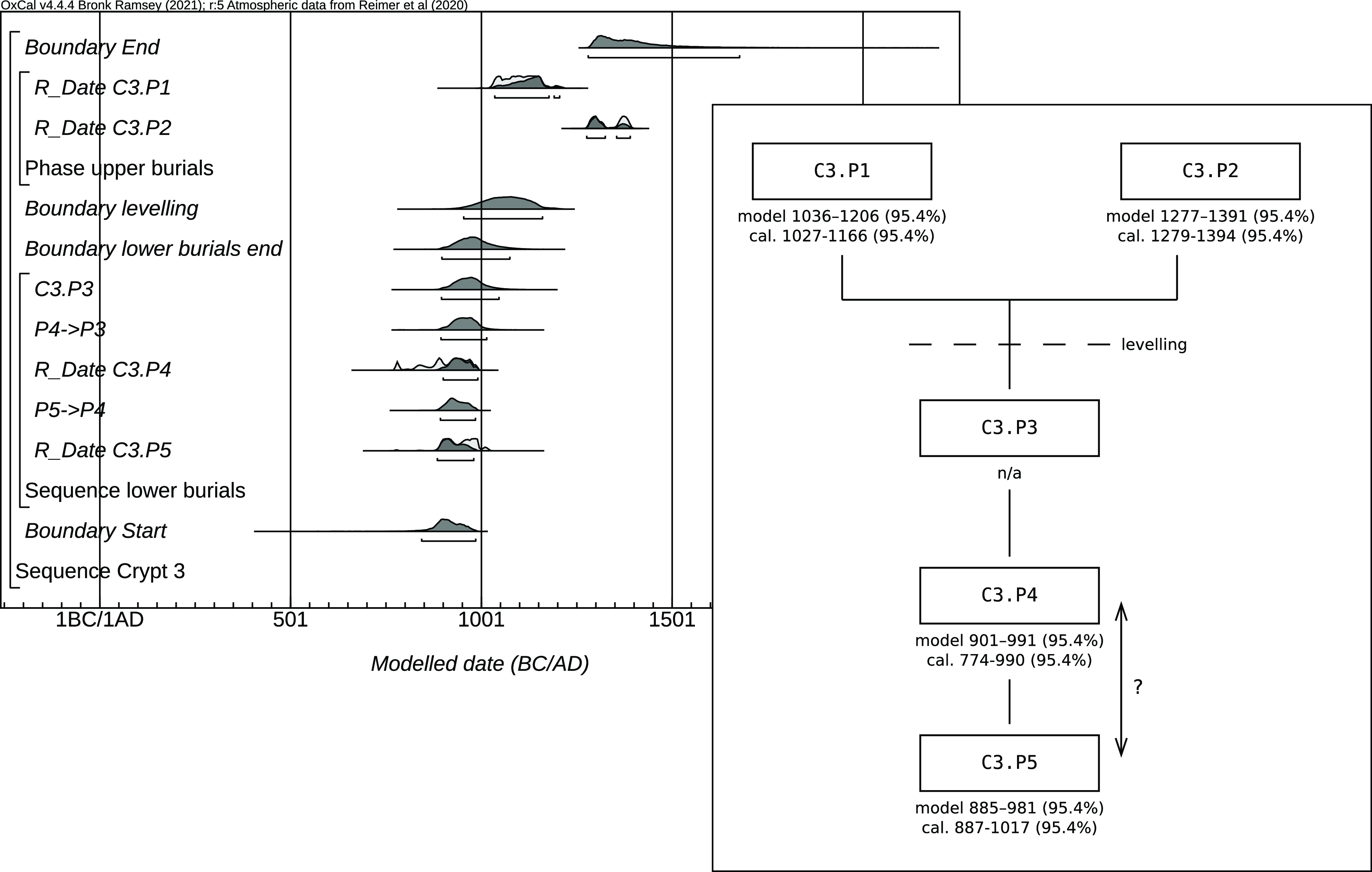
Of the 19 samples collected, collagen extraction was only possible for 18 of the individuals, with insufficient preservation inhibiting collagen extraction from Individual 3 from Crypt 3; collagen from all 18 individuals was suitably preserved for analysis based on C:N and %collagen values (Table 1). From the 18 individuals for which collagen extraction was possible, returned 95.4% probability radiocarbon dates span from 774–990 cal CE (1145 ± 30 BP, Poz-163874 [Crypt 3, Individual 4]) to 1280–1395 cal CE (655 ± 39 BP, Poz-163848 [Crypt 1, Individual 2]), a possible maximum cal CE range of 621 years (Figure 3). Within Crypt 1, radiocarbon dates span from 1022–1159 cal CE (970 ± 30 BP, Poz-159913 [Individual 3]) to 1280–1395 cal CE (655 ± 39 BP, Poz-163848 [Individual 2]), a possible maximum cal CE range of 373 years (Figure 4); within Crypt 2 dates span from 897–1120 cal CE (1035 ± 30 BP, Poz-163847 [Individual 7]) to 1224–1288 cal CE (755 ± 30 BP, Poz-159926 [Individual 1]), a possible maximum cal CE range of 391 years (Figure 5); and within Crypt 3 from 774–990 cal CE (1145 ± 30 BP, Poz-163874 [Individual 4]) to 1279–1394 cal CE (660 ± 30 BP, Poz-159925 [Individual 2]), a possible maximum cal CE range of 620 years (Figure 6).
Calibrated dates for radiocarbon dates (n=18) from Crypts 1–3 using OxCal ver. 4.4 (2021) (Bronk Ramsey Reference Bronk Ramsey2009); r:5; Atmospheric data from Reimer et al. (Reference Reimer, Austin, Bard, Bayliss, Blackwell, Bronk Ramsey, Butzin, Cheng, Edwards, Friedrich, Grootes, Guilderson, Hajdas, Heaton, Hogg, Hughen, Kromer, Manning, Muscheler, Palmer, Pearson, van der Plicht, Reimer, Richards, Scott, Southon, Turney, Wacker, Adolphi, Büntgen, Capano, Fahrni, Fogtmann-Schulz, Friedrich, Köhler, Kudsk, Miyake, Olsen, Reinig, Sakamoto, Sookdeo and Talamo2020).

14C model – using OxCal ver. 4.4 (2021) (Bronk Ramsey Reference Bronk Ramsey2009); r:5; Atmospheric data from Reimer et al. (Reference Reimer, Austin, Bard, Bayliss, Blackwell, Bronk Ramsey, Butzin, Cheng, Edwards, Friedrich, Grootes, Guilderson, Hajdas, Heaton, Hogg, Hughen, Kromer, Manning, Muscheler, Palmer, Pearson, van der Plicht, Reimer, Richards, Scott, Southon, Turney, Wacker, Adolphi, Büntgen, Capano, Fahrni, Fogtmann-Schulz, Friedrich, Köhler, Kudsk, Miyake, Olsen, Reinig, Sakamoto, Sookdeo and Talamo2020) – and stratigraphic relations of burials in Crypt 1.

14C model – using OxCal ver. 4.4 (2021) (Bronk Ramsey Reference Bronk Ramsey2009); r:5; Atmospheric data from Reimer et al. (Reference Reimer, Austin, Bard, Bayliss, Blackwell, Bronk Ramsey, Butzin, Cheng, Edwards, Friedrich, Grootes, Guilderson, Hajdas, Heaton, Hogg, Hughen, Kromer, Manning, Muscheler, Palmer, Pearson, van der Plicht, Reimer, Richards, Scott, Southon, Turney, Wacker, Adolphi, Büntgen, Capano, Fahrni, Fogtmann-Schulz, Friedrich, Köhler, Kudsk, Miyake, Olsen, Reinig, Sakamoto, Sookdeo and Talamo2020) – and stratigraphic relations of burials in Crypt 2.

14C model – using OxCal ver. 4.4 (2021) (Bronk Ramsey Reference Bronk Ramsey2009); r:5; Atmospheric data from Reimer et al. (Reference Reimer, Austin, Bard, Bayliss, Blackwell, Bronk Ramsey, Butzin, Cheng, Edwards, Friedrich, Grootes, Guilderson, Hajdas, Heaton, Hogg, Hughen, Kromer, Manning, Muscheler, Palmer, Pearson, van der Plicht, Reimer, Richards, Scott, Southon, Turney, Wacker, Adolphi, Büntgen, Capano, Fahrni, Fogtmann-Schulz, Friedrich, Köhler, Kudsk, Miyake, Olsen, Reinig, Sakamoto, Sookdeo and Talamo2020) – and stratigraphic relations of burials in Crypt 3.

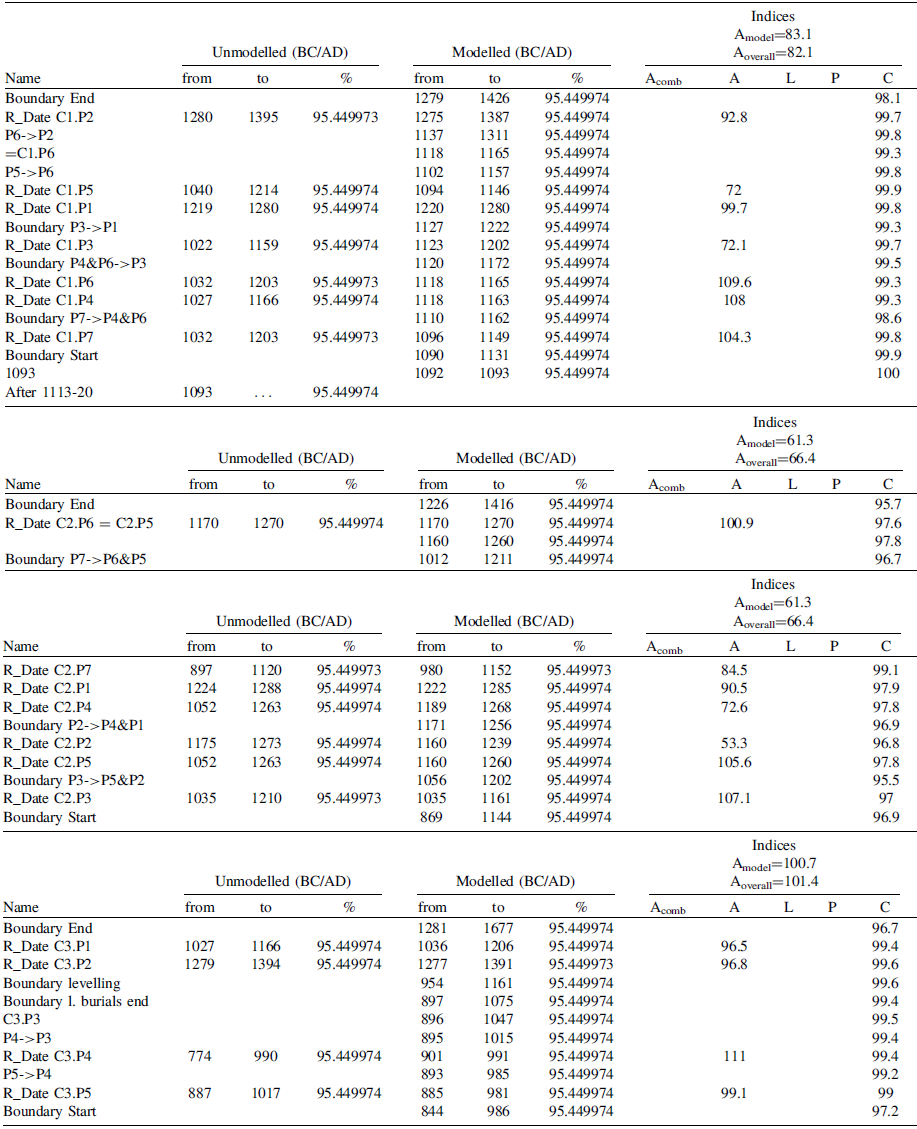
Stratigraphic relations between burials within Crypts 1 and 3 (Godlewski et al. Reference Godlewski, Mahler and Czaja-Szewczak2012, 346, 349; Mahler et al. Reference Mahler, Godlewski, Danys-Lasek and Czaja2015: their Fig. 7) were relatively clear and the resulting chronological models based on them (Figures 4 and 6) remain in good agreement with the 14C dates (Table 2). The Amodel index obtained for the model of Crypt 1 is above 80 and amounts to 100.7 for Crypt 3. Such good agreement is not the case, however, for Crypt 2 for which the Amodel index of 61.3 only barely crosses the 60 threshold required for the model to be of acceptable consistency (Bronk Ramsey Reference Bronk Ramsey1995, 427–428; Hamilton and Krus Reference Hamilton and Krus2018, 192). This is mainly due to the poor agreement between a calibrated date of 1175–1273 CE (95.4% probability) obtained for C2.P2 and that of 1052–1263 CE (95.4% probability) obtained for C2.P4, which according to stratigraphy was later than C2.P2.
Bayesian modelled chronology of burials in Crypts 1–3 on Kom H – using OxCal ver. 4.4 (2021) (Bronk Ramsey Reference Bronk Ramsey2009); r:5; Atmospheric data from Reimer et al. (Reference Reimer, Austin, Bard, Bayliss, Blackwell, Bronk Ramsey, Butzin, Cheng, Edwards, Friedrich, Grootes, Guilderson, Hajdas, Heaton, Hogg, Hughen, Kromer, Manning, Muscheler, Palmer, Pearson, van der Plicht, Reimer, Richards, Scott, Southon, Turney, Wacker, Adolphi, Büntgen, Capano, Fahrni, Fogtmann-Schulz, Friedrich, Köhler, Kudsk, Miyake, Olsen, Reinig, Sakamoto, Sookdeo and Talamo2020).

Discussion
The results of AMS radiocarbon dating clearly demonstrate the broad contemporality of Crypts 1–3 on Kom H at Old Dongola (Figure 3). The returned dates have also demonstrated that these three crypts were utilized for widely different spans of time, bringing forth additional questions about crypt use.
Numerous burials have been documented and excavated to date at and around the site of Old Dongola, including the transitional period cemetery at adjacent Jebel Ghaddar (Żurawski and El-Tayeb Reference Żurawski and El-Tayeb1994), within the Christian cemetery (Stark Reference Stark2022; Żurawski Reference Żurawski1997), in association with the citadel (Stark Reference Stark, Obłuski and Dzierzbicka2021), the sanctuary of Anna (Mahler Reference Mahler2015), the monastery on Kom H (Godlewski et al. Reference Godlewski, Mahler and Czaja-Szewczak2012; Mahler et al. Reference Mahler, Godlewski, Danys-Lasek and Czaja2015), and various churches (see Dzierżykray-Rogalski et al. Reference Dzierżykray-Rogalski, Jakobielski and Michałowski1975; Dzierżykray-Rogalski and Promińska Reference Dzierżykray-Rogalski, Promińska, Leclant, Vercoutter and Berger1978; Gazda Reference Gazda2005, Reference Gazda2008; Promińska Reference Promińska1979, Reference Promińska and Bonnet1994). Such burial contexts illuminate the development and diversity of burial locales and approaches to burial at the Makurian capital. However, aside from Crypts 1–3 on Kom H, as discussed herein, only a handful of other burials excavated from contexts at Old Dongola have thus far been directly radiocarbon dated. From bioarchaeological exploration of the large Christian cemetery adjacent to the Kom H monastery, four radiocarbon dates of relevance to the present discussion have thus far been completed from bone collagen (Stark Reference Stark2022: their Table 3). Dates with 95.4% probability from these burials range from 1455 ± 30 BP (568–650 cal AD, Poz-137841 [Sample 85]) to 1275 ± 30 BP (665–822 cal AD, Poz-126743 [Sample 42]), placing their deposition much earlier than the individuals analyzed from Crypts 1–3 on Kom H. Such earlier dated burials further demonstrate that the Christian cemetery developed in tandem with the earliest medieval developments at Old Dongola and reflect a component of the medieval history of Old Dongola, which would also ultimately come to include the monastery and Crypts 1–3 on Kom H.
Within the broader contextualization of Kom H as a distinct space at Old Dongola, the radiocarbon dates of individuals analyzed from Crypts 1–3 only partially overlap with the first series of radiocarbon dates reported for Kom H at Old Dongola by Dzierzbicka and Danys (Reference Dzierzbicka and Danys2021), who focus on refining the ceramic phasing chronology at Kom H based on recovered artifacts from Courtyard A of the monastery, a service area utilized in part for storage and food processing as well as deliveries to the monastery. Results of the study presented by Dzierzbicka and Danys (Reference Dzierzbicka and Danys2021) place the phased use of Courtyard A on Kom H primarily from the mid-11th through 14th c. CE, a period at the terminal end of the Kom H complex in general. Fifteen of the individuals interred within Crypts 1–3 in the Northwest Annex would have been alive, with an additional two individuals quite possibly also having lived in this era and likely played an important role within the monastic community and the Makurian church hierarchy (see Derda and Łajtar Reference Derda and Łajtar2019; Łajtar Reference Łajtar2024). Only two individuals, Individuals 4 and 5 interred in Crypt 3, were in all likelihood alive in the period before Courtyard A was in use.
Though AMS radiocarbon dates are now available for seven individuals interred within Crypt 1 on Kom H, the so-called Crypt of Georgios, the question of which of these individuals was Georgios remains unclear. Among the burials within Crypt 1, returned 95.4% probability radiocarbon dates for Individuals 3–7 all span the period including 1113 CE, when Georgios is known to have died according to the epitaph associated with Crypt 1 (see Łajtar Reference Łajtar2002). Only Individuals 1 and 2 in Crypt 1 are unlikely to have been Georgios, returning post 13th c. CE dates well after the death of Georgios. Even if the lower 68.3% probability assessment ranges of returned radiocarbon dates are considered (Table 1), this would not exclude any other individuals from consideration. As all seven individuals in Crypt 1 are 40–55+-year-old males, use of age and/or sex differentiation also does not further narrow which of Individuals 3–7 may have been the eponymous Georgios.
The dates from Crypt 1 indicate that the five chronologically earliest burials (i.e., C1.P7 to C1.P3) took place there in relatively short intervals. Judging from the stratigraphical relations within the crypt (Figure 4) individuals numbered from C1.P4 to C1.P7 according to the model died most probably no later than in 1165 CE or perhaps no later than in 1185 CE if we take into account crude bone collagen turnover rates of ca. 20 years for the femurs (Hedges et al. Reference Hedges, Clement, Thomas and O’Connell2007: 815) for which both age-related and individual variability must also be kept in mind (Hedges et al. Reference Hedges, Clement, Thomas and O’Connell2007; Matsubayashi and Tayasu Reference Matsubayashi and Tayasu2019; Parfitt Reference Parfitt2002, Reference Parfitt2004). Moreover, if we follow the supposition that the first individual interred in Crypt 1 was bishop Georgios himself the terminus post quem for all burials within this crypt must have been 1113 CE (Łajtar Reference Łajtar2002). Hence, according to the model there were at least four consecutive burials within the very same spot between 1113 CE and 1185 CE with 95.4% probability. If we use the same collagen turnover rates for all individuals buried within the crypt no more than two other burials were added there within the next century at least —according to model dates, the minimal timespan between C1.P6 and C1.P2 amounts to 110 years—and the last one followed within the subsequent hundred years. Taking the 95.4% probability intervals of the 14C dates into account, the tradition of the place and probably also its use as a commemorative complex evidently survived into the end of the 13th c. CE at least and possibly even well into the 14th c. CE, hence within the period when Dongola was gradually transitioning from Christianity to Islam (Obłuski Reference Obłuski2021, 5).
The earliest dates from Crypt 2 and the model constructed (Figure 5) support the interpretation according to which the northern commemorative complex of the Northwest Annex was constructed and used before the death of Georgios in 1113 CE (Jakobielski Reference Jakobielski, Jakobielski and Scholz2001b, 148, 155) and contradicts the conclusion reached by Godlewski (Reference Godlewski, Godlewski, Dzierzbicka and Łajtar2018, 57) that the northern commemorative complex, Building B.VII, was constructed after the first Mamluk raid in 1276 CE. The 14C analysis of a fragment of charcoal associated with incense burning in front of the superstructure of Grave 12, located northwest of Crypts 1–3 on Kom H (Żurawski 1996, 133, Reference Żurawski1999a, 242) returned a date of 930±60 BP (Gd–11194), 995–1225 cal CE with 95.4% probability. This date, although originally interpreted by mistake as giving the terminus ante quem for the construction of this complex, corresponds well with the dates obtained from Crypts 1–3 (n.b., this charcoal date was calibrated for the current paper using OxCal v4.4 (2021) by Bronk Ramsey; r:5; Atmospheric data from Reimer et al. (Reference Reimer, Austin, Bard, Bayliss, Blackwell, Bronk Ramsey, Butzin, Cheng, Edwards, Friedrich, Grootes, Guilderson, Hajdas, Heaton, Hogg, Hughen, Kromer, Manning, Muscheler, Palmer, Pearson, van der Plicht, Reimer, Richards, Scott, Southon, Turney, Wacker, Adolphi, Büntgen, Capano, Fahrni, Fogtmann-Schulz, Friedrich, Köhler, Kudsk, Miyake, Olsen, Reinig, Sakamoto, Sookdeo and Talamo2020)). Inferring, following Łajtar (Reference Łajtar2002, 161) in this regard, that the Northwest Annex was extended by Georgios and the rebuild that created the northern commemorative complex took place in the end of the 11th c. CE or at the beginning of 12th c. CE (Jakobielski Reference Jakobielski, Jakobielski and Scholz2001b, 155), the first burials in the complex might have occurred there well after he became a bishop in 1063 CE, which is to say within the chronological boundaries of burials C2.P7 and C2.P3, the earliest burials within this crypt.
In the case of Crypt 3, thanks to the 14C dates, we have a clear indication that the vault collapse and subsequent levelling that might have occurred sometime after individual C3.P3 was buried happened most probably at the time Crypts 2 and 3 were incorporated into the commemorative complex of the Northwest Annex (Jakobielski Reference Jakobielski, Jakobielski and Scholz2001b, 148, 155). Therefore, individuals C3.P4, C3.P5, and most likely also C3.P3 for whom 14C dating was not possible, should not be interpreted in connection with the complex. According to Godlewski there is no feature observable in the structure of Crypt 3 that would suggest reconstruction or repairs to its vault (Mahler et al. Reference Mahler, Godlewski, Danys-Lasek and Czaja2015, 365). It seems, however, unlikely that the large blocks of mudbricks bounded by mortar covering the lower group of burials (Mahler et al. Reference Mahler, Godlewski, Danys-Lasek and Czaja2015: their Fig. 5) would be deliberately put inside the crypt through the small entrance just to level the ground in preparation for new inhumations.
If the reasoning concerning the moment of incorporation of Crypts 2 and 3 into the northern commemorative complex is valid, beyond more narrowly defining the use of Crypts 1–3 within the broader temporal landscape of Old Dongola site occupation, the radiocarbon dating of individuals from these three crypts also provides further substantiation for the extended use of the Northwest Annex, quite possibly into the 14th c. CE. Such findings support the proposed general chronological horizon of use, as established through archaeological means, for this Kom H component (Godlewski Reference Godlewski, Godlewski, Dzierzbicka and Łajtar2018; Jakobielski Reference Jakobielski, Jakobielski and Scholz2001b). Along with the radiocarbon dates presented by Dzierzbicka and Danys (Reference Dzierzbicka and Danys2021), which did not extend past the late-13th c. CE at their maximum range.
The inability to radiocarbon date Individual 3 from Crypt 3 (C3.P3) introduces an uncertainty in regard to the use of this burial space and the levelling episode that separated the lower burials from the upper ones (see Mahler et al. Reference Mahler, Godlewski, Danys-Lasek and Czaja2015). That episode most probably must have occurred before this crypt was incorporated into the northern commemorative complex of the Northwest Annex. Taking the lower earlier graves into account, Crypt 3 was evidently utilized for the longest among the three crypts analysed. The extended period of use for burials within this crypt might have been facilitated in part due to the vault collapse. The debris from the vault collapse might have discouraged the individuals responsible for incorporating Crypt 3 into the Northwest Annex from removing the debris and as a result also the three burials below the debris, the presence of which may or may not have been evident. It may, perhaps, have been more efficient for them to simply level the ground inside before the introduction of subsequent burials into the crypt which would have by then been within the commemorative complex. In the case of Crypt 2, in which the vault did not collapse, earlier burials possibly present in this location may have been exhumed and reburied elsewhere when the crypt was ultimately incorporated into the commemorative complex, though such a potentiality remains unclear. Conversely, Crypt 1 was constructed after the room above was built (Żurawski Reference Żurawski1999a, 235) and was quite likely not used before the death of Georgios in 1113 CE, this supposition, however, remains speculative.
So far only one of the individuals interred in the Northwest Annex is known to us by name and rank, being Archbishop Georgios, whose epitaph is provided from a funerary stela set in a wall above Crypt 1, lending credence to the interment of this individual therein. We cannot, however, be 100% certain that Georgios was in fact buried in Crypt 1, though judging from the exceptional decoration inside Crypt 1 and the funerary stela above it, his burial therein is very likely. So far, the identification of the remains of Georgios himself has proved impossible, though it has been possible to narrow the likelihood down to two individuals, being stratigraphically the earliest burials within Crypt 1 (see Godlewski et al. Reference Godlewski, Mahler and Czaja-Szewczak2012). Unfortunately, the 14C dates obtained for individuals C1.P5 and C1.P7 gave almost exactly the same readings and the Bayesian modelling did not provide any additional insight regarding temporal differences between these two individuals.
Beyond the question of identifying the individual likely to be Archbishop Georgios, the remaining 18 individuals buried in Crypts 1–3 within the Northwest Annex to the monastery on Kom H are anonymous to us. However, by the commemorative character of the two complexes within which Crypts 1–3 are located, we can infer the likely relatively high status of at least 15 of the individuals within the monastic and/or broader Old Dongola community (i.e., excluding the three individuals below the Crypt 3 vault collapse layer).
The dynamics of Crypts 1–3, both internally and between the three crypts, are such that in the absence of further documentary substantiation beyond the epitaph of Georgios, the archaeological record and by extension the radiocarbon dating presented herein remain the only sources of extant data available to contextualise these burials. When the extensive and monumental archaeological record of Old Dongola, documented to date through sixty years of excavations, is considered in conjunction with insights from broader, though limited, epigraphic and textual accounts of the importance of Old Dongola as the capital of Makuria and the seat of a bishopric it remains evident that this site was the locality of great populational and social complexity (Fushiya Reference Fushiya2021; Jakobielski and Scholz Reference Jakobielski and Scholz2001; Łajtar Reference Łajtar2024; Vantini Reference Vantini1975). At the same time, much remains to be identified and understood. Regionally, interactions between Makuria and surrounding territories in Nubia, namely adjacent Alwa and before integration into Makuria during the ca. 7th c. CE the northern Kingdom of Nobadia, as well as broader interactions with neighbouring Egypt (Welsby Reference Welsby2002; Wipszycka Reference Wipszycka2009) and Ethiopia (Crawford Reference Crawford1958; Kelly Reference Kelly2020), both of which had significant Christian populations with a broader commonality of traditions, including monasticism, during this timeframe, bring forth numerous questions still in need of further addressing in regard to interconnectivity between these and other regions.
Al-Mas’udi (d. 956 CE) and al-Baghdadi (d. 1338 CE) note that travelling overland along the Nile the distance from Aswan to Old Dongola was 40 days, while Al-Maqrīzī (1364–1442 CE) proposes 50 days instead (Łajtar Reference Łajtar2013; Vantini Reference Vantini1975, 138, 335–336, 606–607). Regardless of the duration, the fact that a timeframe to get to Old Dongola is stated by multiple authors in antiquity further highlights the prominence of Old Dongola as an important and widely known locality. Questions about movement and connectivity with Trans-Saharan, Eastern Desert, nomadic populations, and broader regionality also come into play at Old Dongola (Cooper Reference Cooper2020; Eger et al. Reference Eger, Karberg and Lohwasser2019; Magnavita et al. Reference Magnavita, Dangbet and Bouimon2019; Welsby Reference Welsby2002). Developing along the banks of the Nile in direct proximity to the terminus of the Wadi Howar, a known travel and trade route connecting into Darfur and Trans-Saharan networks beyond, Old Dongola was not only a socio-politically important locality but also a centrally located node along multifold travel and trade routes (Khan Reference Khan2024; Kröpelin Reference Kröpelin2007; Levtzion and Hopkins Reference Levtzion and Hopkins2000; Vantini Reference Vantini1975). While dating of the individuals interred within Crypts 1–3 most directly attests to the floruit of these individuals, it also more broadly provides a positional basis for the development of these crypts in relation to the Kom H complex which in itself attests to the development and maintenance of a significant monastic community, one of only very few documented to date in Nubia (see Obłuski Reference Obłuski2019), and the position of that community within the larger social fabric of the overall Old Dongola community and the positioning of such within the broader regional landscape of medieval Nubia and beyond.
Conclusions
The results of radiocarbon dating from 18 individuals interred in Crypts 1–3 on Kom H at Old Dongola have helped to illuminate the use chronology of each of these three crypts, the related temporality between these three proximate crypts of ostensibly similar function, as well as the broader chronology of the development and expansion of structural components on Kom H, namely in relation to use of the Northwest Annex. Such evidence, along with that previously established for ceramic chronology on Kom H by Dzierzbicka and Danys (Reference Dzierzbicka and Danys2021) has helped to refine insights about structure use on Kom H and life at Old Dongola. Moreover, such data also contribute to broader regional chronologies in regard to burial and cemetery space use in medieval Nubia, an aspect of medieval Nubian history that remains temporally challenging to define across periods given the general absence of grave goods. These novel radiocarbon dates also provide a useful basis of comparisons for ongoing examinations of burial contexts in the large adjacent medieval Christian cemetery at Old Dongola along with other burial contexts at the site. It is hoped that ongoing burial archaeology at Old Dongola will allow for additional radiocarbon dates of individuals which would help to further refine the nature of burial processes and cemetery space utilisation at the capital of medieval Makuria.
Supplementary material
To view supplementary material for this article, please visit https://doi.org/10.1017/RDC.2025.10136
Acknowledgments
Radiocarbon dating of individuals from Crypts 1–3 on Kom H at Old Dongola was facilitated through the IDUB Archaeoriental Studies and Microgrant programmes of the University of Warsaw. Funding for Old Dongola research has been provided in part through the University of Warsaw, the Qatar-Sudan Archaeological Project (Mission No. QSAP 31), an ERC Starting Grant for the “Urban Metamorphosis of the Community of a Medieval African Capital City” (UMMA) project (Grant agreement ID: 759926), and an ERC Consolidator Grant for the “Afropolis Tungul. Urban biography of a cosmopolitan African capital” (Afropolis Tungul) project (Grant agreement ID: 101089151). Research at Old Dongola is conducted by the Polish Centre of Mediterranean Archaeology of the University of Warsaw (PCMA UW) in collaboration with the National Corporation for Antiquities and Museums of Sudan (NCAM). The authors would like to acknowledge in particular Zaki Ed-Din Mahmoud, Habab Idriss Ahmed, Saddam Hassan, Elgazafi Yousif Eshag, and Mahmoud El-Tayeb for their guidance as well as the broader Ghaddar, Sudan community within which researchers lived during field work. The technical direction and assistance in sample preparation and analysis by Dr. Rafał Fetner and Dr. Tomasz Goslar are greatly appreciated.
Data availability statement
All data are presented herein and, in the case of OxCal code utilized, through a supplementary file.
Competing interests
The authors declare that they have no known competing financial interests or personal relationships that could have appeared to influence the work reported in this paper.
Funding statement
Radiocarbon dating funding has been provided through the IDUB Archaeoriental Studies and Microgrant programmes of the University of Warsaw. Funding for Old Dongola research has been provided in part through the University of Warsaw, the Qatar-Sudan Archaeological Project (Mission No. QSAP 31), an ERC Starting Grant for the “Urban Metamorphosis of the Community of a Medieval African Capital City” (UMMA) project (Grant agreement ID: 759926), and an ERC Consolidator Grant for the “Afropolis Tungul. Urban biography of a cosmopolitan African capital” (Grant agreement ID: 101089151). Funding sources for this research did not have any input to the design, data collection, or article generation based on the data collected.



 Open access

