


Introduction
Recently, a growing body of research has recognized how emotions positively shape the quality of work life and improve workplace performance. This attention to emotional regulation and management has led to a focus on the construct of Compassion at Work (CAW) (Pradhan et al., Reference Pradhan, Jandu, Hati and Panda2024). CAW has become increasingly crucial to promoting organizational well-being and performance (Aboul-Ela, Reference Aboul-Ela2017; Nielsen et al., Reference Nielsen, Lindhardt, Näslund‐Koch, Frandsen, Clemensen and Timmermann2025).
Compassion at Work is a dynamic process that involves recognition of another’s suffering and a feeling of empathic concern that ultimately results in action to alleviate that suffering (Kanov et al., Reference Kanov, Maitlis, Worline, Dutton, Frost and Lilius2004). Compassion is thus an active and continuous process that requires individuals to be attuned to the emotional states of those around them, to connect with their experiences, and to take meaningful actions to support them (Worline & Dutton, Reference Worline and Dutton2017a). These aspects are essential to building a supportive work environment where workers feel considered and valued (Benevene et al., Reference Benevene, Buonomo and West2022).
Several studies show that cultivating a compassionate work environment leads to positive outcomes, such as increased employee engagement, team performance, organizational commitment, and general well-being (Ali et al., Reference Ali, Islam, Ali and Raza2021; Buonomo et al., Reference Buonomo, Pansini, Cervai and Benevene2022; Lilius et al., Reference Lilius, Worline, Maitlis, Kanov, Dutton and Frost2008).
A key area where compassion plays an impactful role is in leadership (Salminen‐Tuomaala & Seppälä, Reference Salminen‐Tuomaala and Seppälä2022).
Within organizations, a specific leadership type can shape work practices and people management and, in turn, radically affect how employees interact with each other (Benevene et al., Reference Benevene, Dal Corso, De Carlo, Falco, Carluccio and Vecina2018).
Compassionate leaders actively engage with their followers’ needs, offering emotional support and practical assistance (Atkins & Parker, Reference Atkins and Parker2012). These leaders create environments that promote psychological safety, trust, and mutual respect, facilitating authentic responses and the employees’ personal and professional growth (Vogus et al., Reference Vogus, McClelland, Lee, McFadden and Hu2021). At the same time, compassionate leaders are committed to advancing their organizations efficiently and productively (Hougaard et al., Reference Hougaard, Carter and Hobson2020).
This theoretically demonstrates a precise alignment between CAW principles and leadership, where leaders’ compassionate behaviors enhance relational dynamics and organizational outcomes (Östergård et al., Reference Östergård, Kuha and Kanste2024). Despite the growing interest in compassionate leadership, several issues regarding its measurement and conceptualization must be addressed.
First, although existing tools attempt to capture the facets of compassionate leadership, as observed by Pansini, Buonomo, D’Anna, and Benevene (Reference Pansini, Buonomo, D’Anna and Benevene2024), they present some limitations. For instance, the tool developed by Shuck et al. (Reference Shuck, Alagaraja, Immekus, Cumberland and Honeycutt‐Elliott2019) assesses six dimensions—empathy, presence, integrity, authenticity, dignity, and responsibility—derived inductively through qualitative interviews with managers. While this approach captures meaningful aspects of compassionate leadership, the scale was not developed from a pre-existing theoretical framework, which raises questions about its conceptual consistency and theoretical grounding (Pansini, Buonomo, D’Anna, & Benevene, Reference Pansini, Buonomo, D’Anna and Benevene2024).
In contrast, the scale proposed by Sansó et al. (Reference Sansó, Leiva, Vidal‐Blanco, Galiana and West2022) is based on West’s (Reference West, Galiana and Sansó2019) model, offering a theoretically grounded structure that includes four dimensions: attending, understanding, empathy, and helping. The instrument was developed as a leader self-report scale and validated with a sample of healthcare personnel involved in end-of-life care (not specifying whether participants held leadership roles). As such, the scale demonstrates a clear fit for compassionate leadership in the healthcare sector. Although this self-report measure provides valuable insights into how individuals perceive their compassionate attitudes, it carries the inherent risk of self-report bias, as leaders may unintentionally overestimate their actions or misinterpret how these are perceived by others. Moreover, the theoretical model underlying this scale includes cognitive components such as understanding the cause of the other’s distress (West, Reference West, Galiana and Sansó2019), which may be difficult to assess reliably from a follower’s perspective. For these reasons, we chose not to adapt existing tools into a hetero-evaluative format, but rather to develop a new scale.
To address the aforementioned issues, we introduce a hetero-evaluative instrument grounded in a robust and widely recognized theoretical model of CAW (Kanov et al., Reference Kanov, Maitlis, Worline, Dutton, Frost and Lilius2004). This model offers a coherent conceptual framework for operationalizing compassionate leadership behaviors in various organizational sectors. Additionally, an alternative approach that captures compassionate leadership from the perspective of followers is needed. Thus, this new scale seeks to capture an objective and context-sensitive understanding of leaders’ compassionate actions by shifting the focus from the self-perceptions of leaders to the behaviors observed by followers. Indeed, followers are the direct recipients of leaders’ behaviors, and their perceptions are crucial to understanding how compassion is enacted in practice. This follower-based perspective allows for a more accurate and context-sensitive assessment of compassionate leadership in organizational settings. Our aim was also to contribute to the field by offering a behavior-based perspective that operationalizes compassion through concrete, situationally activated actions rather than a general disposition.
Second, theoretically, it is unclear whether compassionate leadership should be considered a distinct leadership or managerial style or a set of behaviors that leaders enact (Ramachandran et al., Reference Ramachandran, Balasubramanian, James and Al Masaeid2024). A growing body of research adopts a behavior-based approach to studying compassionate leadership, referring to it as compassionate leadership behavior (e.g., Krause et al., Reference Krause, Rousset and Schäfer2023; Shuck et al., Reference Shuck, Alagaraja, Immekus, Cumberland and Honeycutt‐Elliott2019; Wei et al., Reference Wei, Zhu and Li2016). Compassion is inherently a reactive response to others’ suffering or distress (Strauss et al., Reference Strauss, Taylor, Gu, Kuyken, Baer, Jones and Cavanagh2016). However, in daily workplace dynamics, such distress is not present in every interaction or situation (Shuck et al., Reference Shuck, Alagaraja, Immekus, Cumberland and Honeycutt‐Elliott2019). Consequently, leaders’ compassionate behaviors are context-dependent, emerging when they encounter followers’ troubles or challenges. Framing compassionate leadership in terms of behaviors reflects this reality: it is not about a leader’s traits but rather about their responses in moments of distress. It is also crucial to recognize that workplace suffering is not confined to dramatic or traumatic events; it often includes more common experiences, such as stress and interpersonal conflicts, which can significantly impact individual and team performance (Dutton et al., Reference Dutton, Lilius, Kanov and Schuman2007). This highlights the need for tools that capture compassionate responses as they emerge within organizational interactions. A tool capable of capturing leaders’ responses to common yet impactful forms of workplace distress rather than dramatic or clinical forms of suffering. To address this conceptual need, our scale aims to operationalize compassionate leadership as a set of behaviors. This framing allows for a more dynamic and realistic assessment of compassionate leadership in organizational realities. In other words, a key contribution of this study lies in adopting a behavior-based approach to compassionate leadership, emphasizing the specific actions leaders take in response to employees’ needs.
Overall, the study of compassionate leadership is still in its early stages of development. Currently, few studies have employed a quantitative approach to explore its effects on employees’ personal and work-related outcomes (e.g., Eldor, Reference Eldor2018; Pansini, Buonomo, & Benevene, Reference Pansini, Buonomo and Benevene2024; Shuck et al., Reference Shuck, Alagaraja, Immekus, Cumberland and Honeycutt‐Elliott2019). In this context, robust measures are essential to establish a common conceptual foundation. The existing body of research remains limited and fragmented within the literature, highlighting the need for a comprehensive and reliable framework for measuring it (Ramachandran et al., Reference Ramachandran, Balasubramanian, James and Al Masaeid2024).
The current study aims to fill the previous gaps by developing and validating a new scale assessing compassionate leadership behaviors called the Compassion at Work—Leadership Behaviors Inventory (CAW-LBI).
To effectively measure compassionate leadership in organizations, the CAW-LBI is based on classical compassion theories, specifically the model proposed by Kanov et al. (Reference Kanov, Maitlis, Worline, Dutton, Frost and Lilius2004). This model, widely recognized in the literature, provides a comprehensive framework for understanding how compassion is enacted in leadership. Its strength lies in both theoretical robustness and practical relevance in organizational settings. Utilizing it added methodological rigor to our scale, enabling us to assess compassion based on a solid theoretical foundation (Dutton et al., Reference Dutton, Workman and Hardin2014; Kanov et al., Reference Kanov, Maitlis, Worline, Dutton, Frost and Lilius2004). Second, compassionate leadership should be evaluated not just from the viewpoint of the “givers” (leaders) but also from the perspective of the “receivers” (followers). Measuring compassionate leadership from leaders and followers is critical, as discrepancies often arise between leaders’ self-perceptions and followers’ impressions (Ramachandran et al., Reference Ramachandran, Balasubramanian, James and Al Masaeid2024). So, developing a follower-assessed tool is crucial to capturing a more accurate representation of leadership in practice. A further strength of the CAW-LBI is that it operationalizes compassionate leadership through a clear set of observable behaviors: noticing when team members show signs of strain or distress (e.g., changes in performance or mood), acknowledging these difficulties by expressing understanding and legitimizing employees’ experiences, and responding with concrete forms of support, such as adjusting workloads or providing resources. By focusing on these behaviors rather than general attitudes or values, the scale allows for a concrete representation of leadership in practice. Finally, to enhance the generalizability and practical utility of our measure, we aim to validate it in two national samples (Italy and Spain), thereby testing its relevance across different organizational and cultural settings. While these contexts are not radically distinct, cross-cultural validation represents an important step toward developing a flexible and broadly applicable instrument.
In summary, this work addresses the growing need to promote leadership behaviors that support well-being and positive relationships within organizations. The CAW-LBI aims to contribute significantly to research and practice by offering a robust scale for understanding the follower perspective. Given the growing importance of well-being and interpersonal relationships, the CAW-LBI serves as an effective tool for assessing and encouraging compassionate leadership practices, fostering a more empathetic and inclusive workplace.
The following sections provide a comprehensive description of the topics of Compassion at Work and Compassionate Leadership. In addition, we present the development of the CAW-LBI, focusing on the theoretical model underlying the questionnaire, the item development process, and an overview of two validation studies.
Compassion and Compassion at Work (CAW)
In psychological literature, Compassion can be defined as the feeling that arises when witnessing another’s suffering, accompanied by a genuine desire to alleviate it (Goetz et al., Reference Goetz, Keltner and Simon-Thomas2010). It is characterized by concern for others’ distress and the motivation to help (Goetz et al., Reference Goetz, Keltner and Simon-Thomas2010). Rather than a single emotion, compassion represents a multidimensional process that integrates cognitive, affective, and motivational components. It involves an awareness of suffering, emotional resonance, and intentional action—recognizing another’s pain, feeling moved by it, and being motivated to respond (Gilbert & Van Gordon, Reference Gilbert and Van Gordon2023). Unlike other feelings or prosocial behaviors, compassion is specifically elicited by the perception of another’s suffering and is activated only in the presence of such distress (Goetz et al., Reference Goetz, Keltner and Simon-Thomas2010; Strauss et al., Reference Strauss, Taylor, Gu, Kuyken, Baer, Jones and Cavanagh2016). However, some conceptual overlap between empathy and compassion often leads to confusion. Empathy refers to the ability to perceive and understand another person’s emotional state and to resonate with it (Decety & Jackson, Reference Decety and Jackson2004). It allows individuals to share or comprehend others’ feelings, fostering emotional connection and perspective-taking. Compassion, however, represents a broader and more complex response: it not only entails empathic understanding but also introduces a motivational component—the genuine desire to alleviate another’s suffering through intentional action (Goetz et al., Reference Goetz, Keltner and Simon-Thomas2010; Singer & Klimecki, Reference Singer and Klimecki2014). While empathy enables individuals to feel with others, compassion involves feeling for others and taking steps to reduce their distress. In other words, empathy provides the emotional and cognitive foundation upon which compassion builds, whereas compassion extends beyond empathic resonance by transforming it into purposeful, prosocial behavior oriented toward care and support (Gilbert, Reference Gilbert2015).
Similarly, there is also some conceptual confusion between compassion and prosocial behavior, as both are often linked to helping others. Prosocial behaviors refer to voluntary actions intended to benefit others—such as helping, sharing, comforting, or cooperating—regardless of the underlying motivation (Eisenberg et al., Reference Eisenberg, VanSchyndel and Spinrad2016). While compassion often gives rise to prosocial behaviors, the two constructs are not equivalent (Luberto et al., Reference Luberto, Shinday, Song, Philpotts, Park, Fricchione and Yeh2018). Prosocial behavior describes the observable act of helping, regardless of the underlying motivation—it may stem from social norms, reciprocity, moral obligation, or even self-interest (Batson & Shaw, Reference Batson and Shaw1991). Compassion, by contrast, is a specific affective and motivational state that emerges in response to another’s suffering and aims to alleviate it (Goetz et al., Reference Goetz, Keltner and Simon-Thomas2010). In this sense, compassion can be viewed as a motivational antecedent of prosocial behavior: it represents the inner impulse that leads to caring actions, while prosocial behavior reflects the external expression of that impulse (Gilbert, Reference Gilbert, Workman, Reader and Barkow2020; Karnaze et al., Reference Karnaze, Bellettiere and Bloss2022; Luberto et al., Reference Luberto, Shinday, Song, Philpotts, Park, Fricchione and Yeh2018). Taken together, these distinctions clarify that compassion represents a unique construct, characterized by its specific affective and motivational orientation toward alleviating others’ suffering.
In recent years, compassion has attracted growing attention in organizational research, given its potential to foster well-being, strengthen interpersonal relationships, and enhance performance at work (Dutton et al., Reference Dutton, Workman and Hardin2014; Ko & Choi, Reference Ko and Choi2019; Worline & Dutton, Reference Worline and Dutton2017a, Reference Worline, Dutton, Seppälä, Simon-Thomas, Brown, Worline, Cameron and Doty2017b). CAW is essential for contemporary organizations. It encompasses how members identify and react to each other’s distress or suffering (Baluku et al., Reference Baluku, Kizito, Balikoowa and Namale2025). Such actions foster a culture rooted in altruism and mutual support (Barghouti et al., Reference Barghouti, Guinot and Chiva2023), which are vital for promoting health and well-being within the organization (Boyatzis et al., Reference Boyatzis, Smith and Beveridge2013). Kanov et al. (Reference Kanov, Maitlis, Worline, Dutton, Frost and Lilius2004) outlined three related elements that characterize compassion in the workplace: noticing, which refers to recognizing others’ suffering cognitively; feeling, which indicates an emotional bond with the individual’s pain; and responding, which involves taking specific actions to ease suffering. Subsequently, Atkins and Parker (Reference Atkins and Parker2012) enhanced this framework, highlighting that responding to suffering is not instinctive but involves appraising processes that determine how and when to act.
CAW is particularly relevant because it occurs as a response to a wide range of personal and work-related factors. Sources of distress can stem from individual events, such as bereavement or health problems, or organizational challenges, including internal conflicts, sudden changes in structure, or a lack of social support (Dutton et al., Reference Dutton, Workman and Hardin2014).
This link between suffering and the workplace is also reflected in Strauss et al.’s (Reference Strauss, Taylor, Gu, Kuyken, Baer, Jones and Cavanagh2016) definition, which identifies five essential components of compassion: (1) recognizing suffering, (2) understanding its universality, (3) feeling empathy for those who suffer, (4) tolerating the negative emotions aroused by others’ suffering, and (5) being motivated to take action to alleviate that suffering. Later research empirically validated this conceptualization (Gu et al., Reference Gu, Cavanagh, Baer and Strauss2017, Reference Gu, Baer, Cavanagh, Kuyken and Strauss2020).
Thus, compassion extends beyond being an individual trait; it represents an evolving interpersonal process, whose path depends on how givers and receivers of support interact (Dutton et al., Reference Dutton, Workman and Hardin2014).
In the organizational context, compassionate actions can be expressed in various ways, involving different forms of support, such as instrumental and emotional support. Instrumental support entails offering tangible resources such as financial assistance, time concessions for recovery, and personalized working arrangements (Dutton et al., Reference Dutton, Workman and Hardin2014). Emotional support often manifests through comforting actions like holding hands, giving hugs, or verbally showing concern and solidarity (Dutton et al., Reference Dutton, Worline, Frost and Lilius2006; Lilius et al., Reference Lilius, Worline, Maitlis, Kanov, Dutton and Frost2008). The positive effects of compassion are crucial when the compassion giver is a leader or supervisor (Eldor, Reference Eldor2018; Shuck et al., Reference Shuck, Alagaraja, Immekus, Cumberland and Honeycutt‐Elliott2019). Leaders can offer four main types of support: emotional, instrumental, informational, and evaluative. Emotional support consists of providing empathy and understanding for employees’ emotional needs. Instrumental support includes practical actions such as offering resources or direct assistance to solve problems. Informational support refers to sharing knowledge, tips, and helpful advice to improve work. Evaluative support involves providing constructive feedback to help employees improve their performance (West, Reference West2021).
Employees can find compassion in the workplace from three primary sources: coworkers, supervisors, and the larger organization (Lilius et al., Reference Lilius, Worline, Maitlis, Kanov, Dutton and Frost2008). Compassion displayed by any of these actors strengthens employees’ emotional connections and boosts engagement (Eldor & Shoshani, Reference Eldor and Shoshani2016; Pradhan et al., Reference Pradhan, Jandu, Hati and Panda2024). Research shows that receiving CAW is linked to several positive outcomes, such as employee positive emotions and life satisfaction, affective commitment, and job performance (Buonomo et al., Reference Buonomo, Pansini, Cervai and Benevene2022; Chu, Reference Chu2016, Reference Chu2017; Ko, Choi, et al., Reference Ko, Choi, Lee, Kim, Kim and Kang2022; Trzeciak et al., Reference Trzeciak, Mazzarelli and Booker2019). Receiving the supervisor’s compassion immediately impacts the employee and fosters a broader positive influence, as it legitimizes compassion within the organization (Worline & Dutton, Reference Worline, Dutton, Seppälä, Simon-Thomas, Brown, Worline, Cameron and Doty2017b).
Compassion evolves from an interpersonal interaction to a collective endeavor encompassing the whole organization, fostering cohesion and resilience (Guinot et al., Reference Guinot, Miralles, Rodríguez-Sánchez and Chiva2020). Lilius et al. (Reference Lilius, Worline, Dutton, Kanov and Maitlis2011) identified seven daily practices that promote collective compassion. These include celebrating the achievements of others, collaborating on decision-making, and supporting each other with tasks. Such practices initiate a positive cycle of compassion, fostering strong employee relationships and building relational resources that boost cooperation.
Organizations that adopt such practices create a compassionate climate at group and organizational levels (Nolan et al., Reference Nolan, Diefendorff, Erickson and Lee2022). Compassion creates cohesion within groups, strengthening mutual trust, a crucial element in effectively and collaboratively addressing organizational challenges (Benevene et al., Reference Benevene, Buonomo and West2022). In this way, CAW cultivates a positive cycle of mutual support and reciprocity, promoting a healthier, more inclusive, and productive workplace.
Despite the growing interest in the field of CAW, the domain of compassionate leadership (which will be described in the following section) remains comparatively underexplored. First, CAW literature has mapped processes and contexts (e.g., Dutton et al., Reference Dutton, Workman and Hardin2014; Lilius et al., Reference Lilius, Worline, Dutton, Kanov and Maitlis2011), but it has less frequently specified the discrete, observable behaviors through which compassion is enacted in leader–follower interactions—particularly in the responding phase, where decisions regarding resource allocation and work redesign are made (Dutton et al., Reference Dutton, Workman and Hardin2014; Worline & Dutton, Reference Worline, Dutton, Seppälä, Simon-Thomas, Brown, Worline, Cameron and Doty2017b). Second, measurement has predominantly relied on either dispositional assessment of leadership or self-reported evaluations (Pansini, Buonomo, D’Anna, & Benevene, Reference Pansini, Buonomo, D’Anna and Benevene2024), which may fail to capture how compassionate actions are actually perceived by those who receive them. Given the episodic nature of compassion (Pansini, Buonomo, & Benevene, Reference Pansini, Buonomo and Benevene2024) and the central role of leaders in legitimizing and mobilizing support (Eldor, Reference Eldor2018; Worline & Dutton, Reference Worline, Dutton, Seppälä, Simon-Thomas, Brown, Worline, Cameron and Doty2017b), advancing the field requires behaviorally anchored, follower-assessed approaches that capture how compassion is noticed, acknowledged, and enacted in everyday work. This framework provides the conceptual bridge to our focus on compassionate leadership and compassionate leadership behaviors in the next sections.
Compassionate Leadership
Compassionate leadership is a relatively new construct characterized by several definitions and interpretations that reflect its complexity. Although there is no unified consensus, several contributions outline its basic contours, highlighting the altruistic values and emotional competencies that define it (Östergård et al., Reference Östergård, Kuha and Kanste2024).
Oruh et al. (Reference Oruh, Mordi, Dibia and Ajonbadi2021) suggest that compassionate leadership is based on acts of love, care, and altruism. This approach gives employees a sense of purpose and meaning within the organizational context. Salminen-Tuomaala and Seppälä (Reference Salminen‐Tuomaala and Seppälä2022) outline that compassionate leadership practices are based on altruistic values and emotional intelligence. Compassionate leadership is not an inherent quality; rather, it represents a social and evolving concept that can be cultivated through education and personal and professional development. This insight is also confirmed by the study of Paakkanen et al. (Reference Paakkanen, Martela, Hakanen, Uusitalo and Pessi2021), which shows that compassionate skills can be improved through interventions to enhance leaders’ emotional competence.
West et al. (Reference West, Armit, Loewenthal, Eckert, West and Lee2015) and West (Reference West2021) propose a structured definition of compassionate leadership articulated in four main dimensions: attending to employees’ needs, understanding their distress through dialogue, empathizing without being overwhelmed, and helping to alleviate suffering. Compassionate leaders actively intervene, providing emotional support and practical help.
Ramachandran et al. (Reference Ramachandran, Balasubramanian, James and Al Masaeid2024), in their literature review, identify six key dimensions of compassionate leadership: (1) empathy, related to the ability to understand the emotions of others; (2) openness and communication, fostering a culture of transparency; (3) mental well-being and health, protecting the well-being of employees; (4) inclusiveness, involving employees in decision-making processes; (5) integrity, acting with ethical and transparent behavior; and (6) respect and dignity, valuing the contribution of every member of the organization.
Finally, compassionate leadership also differs from other leadership approaches, such as servant leadership. While both emphasize care, humility, and concern for others, servant leadership primarily focuses on empowering and developing followers through service-oriented values (Liden et al., Reference Liden, Wayne, Meuser, Hu, Wu and Liao2015). Compassionate leadership, by contrast, is specifically activated in response to others’ suffering and centers on recognizing, understanding, and alleviating distress in the workplace (de Zulueta, Reference de Zulueta2015; Worline & Dutton, Reference Worline, Dutton, Seppälä, Simon-Thomas, Brown, Worline, Cameron and Doty2017b).
Overall, from these perspectives, compassionate leadership encompasses traits and behaviors that include love, care, integrity, empathy, and responsibility. This creates a workplace where employee well-being is central to organizational dynamics, and leaders significantly contribute to motivating and positively influencing both personal and organizational growth.
Compassionate Leadership Behaviors
Recently, studies on compassionate leadership have shifted toward a behavioral perspective, emphasizing leaders’ specific actions to convey compassion within organizations (e.g., Krause et al., Reference Krause, Rousset and Schäfer2023; Shuck et al., Reference Shuck, Alagaraja, Immekus, Cumberland and Honeycutt‐Elliott2019). This approach is essential for understanding compassionate leadership as a concept that extends beyond the leader’s intentions or values, manifesting in observable and measurable actions.
Pioneering studies on compassion, which analyze collective compassion based on interviews with employees, have found that leaders’ empathetic and intentional behaviors are critical in promoting compassion in response to times of personal suffering, such as the loss of a family member or domestic violence (Lilius et al., Reference Lilius, Worline, Dutton, Kanov and Maitlis2011).
Focusing on compassionate leadership research, Shuck et al. (Reference Shuck, Alagaraja, Immekus, Cumberland and Honeycutt‐Elliott2019) identified six key dimensions of compassionate leadership: integrity, empathy, accountability, authenticity, presence, and dignity. These leaders’ compassionate actions influence employees’ daily work experiences, demonstrating that compassion is a routine practice as well as a crucial intervention during crises.
In this sense, compassionate leaders are vital for legitimizing the role of compassion in organizations and integrating it into everyday practices (Worline & Dutton, Reference Worline, Dutton, Seppälä, Simon-Thomas, Brown, Worline, Cameron and Doty2017b).
Worline and Dutton (Reference Worline, Dutton, Seppälä, Simon-Thomas, Brown, Worline, Cameron and Doty2017b) focused on leadership “moves” which are actions leaders take regarding individuals who are suffering or those striving to alleviate that suffering. These moves encompass: Making space for the expression of suffering; Creating felt presence; Countering the effects of power; Directing attention of others to suffering; Infusing attention to suffering into routines; Legitimizing suffering and compassion; Sense-giving through rituals and stories; Shaping followers’ emotions through emotional contagion; Shaping the quality of interpersonal connections; Shaping the emotional culture; Modeling compassionate action; Catalyzing resources to alleviate suffering. Overall, these moves impact how suffering is recognized, how compassion is expressed, and how compassionate actions are facilitated.
As highlighted, leaders’ ability to show compassion requires a process of self-cultivation, which involves continuous self-reflection and personal development. This enables leaders to manage organizational well-being and promote collective growth effectively (Wei et al., Reference Wei, Zhu and Li2016). Compassionate behaviors can also generate paradoxes within hierarchical structures, where leaders must balance empathy with power dynamics. Although such tensions exist, compassionate leadership still facilitates an environment of support and well-being for employees (Krause et al., Reference Krause, Rousset and Schäfer2023).
However, research on compassionate leadership still lacks a clear processual perspective. Whereas CAW has been conceptualized as a dynamic process involving noticing, feeling, and responding to others’ suffering (Kanov et al., Reference Kanov, Maitlis, Worline, Dutton, Frost and Lilius2004), compassionate leadership is still predominantly framed in dispositional terms—as if certain leaders were inherently “compassionate” (Ramachandran et al., Reference Ramachandran, Balasubramanian, James and Al Masaeid2024). So, compassion is not a stable trait but something that is activated in response to specific situations (Atkins & Parker, Reference Atkins and Parker2012; Dutton et al., Reference Dutton, Worline, Frost and Lilius2006). By the same logic, compassionate leadership should be understood and operationalized not as an inherent trait, but as a set of situational behaviors. Building on CAW theory (Kanov et al., Reference Kanov, Maitlis, Worline, Dutton, Frost and Lilius2004), this study adapts the original framework of noticing, feeling, and responding to leadership dynamics. Building on this, this study seeks to address two critical gaps: a conceptual gap, by operationalizing compassionate leadership as a situational response with a specific process rather than a dispositional attribute; and a methodological gap, by moving beyond self-report approaches and capturing these behaviors from the followers’ perspective.
Development of Compassion at Work—Leadership Behaviors Inventory (CAW-LBI)
This study introduces the CAW-LBI, a new instrument for measuring compassionate leadership behaviors in organizational contexts.
CAW Model—Kanov et al. (Reference Kanov, Maitlis, Worline, Dutton, Frost and Lilius2004)
The CAW model proposed by Kanov et al. (Reference Kanov, Maitlis, Worline, Dutton, Frost and Lilius2004) represents a fundamental theoretical framework for understanding compassionate responses within organizations. This model was developed to explain how employees recognize and respond adaptively to the suffering of others. According to the model, CAW is conceived as a process with three distinct phases: noticing, feeling, and responding.
Noticing refers to observing and recognizing distress among colleagues or team members. This stage is crucial, as in the absence of an adequate perception of others’ distress, no process of compassion can be activated (Kanov et al., Reference Kanov, Maitlis, Worline, Dutton, Frost and Lilius2004). Noticing involves conscious and intentional attention to the other’s well-being. At the same time, it requires subtle observational skills, as signs of distress are not always explicit (Atkins & Parker, Reference Atkins and Parker2012; Kanov et al., Reference Kanov, Maitlis, Worline, Dutton, Frost and Lilius2004). For example, a leader who can notice minimal behavioral variations—such as a drop in enthusiasm, an apparent disconnect, or an increase in errors—shows a level of sensitivity that facilitates the identification of the team’s hidden needs (Kanov et al., Reference Kanov, Maitlis, Worline, Dutton, Frost and Lilius2004; West, Reference West2021). In this sense, noticing constitutes a necessary condition through which a leader can choose to respond.
Feeling refers to a process of emotional connection with another’s suffering, often described as “suffering with” the other person. This stage requires an empathic response where the compassionate individual recognizes and internalizes the suffering, fostering a genuine desire to alleviate that distress. This emotional reaction, known as empathic concern, focuses on the other person’s well-being and stems from awareness of their vulnerability (Atkins & Parker, Reference Atkins and Parker2012; Kanov et al., Reference Kanov, Maitlis, Worline, Dutton, Frost and Lilius2004). In this context, a leader can feel their followers’ suffering or frustration without becoming overwhelmed by emotion, allowing them to provide support effectively (Benevene et al., Reference Benevene, Buonomo and West2022).
Responding refers to any action to alleviate pain or help them cope effectively. Acting plays a vital role in expressing compassion, setting it apart from similar emotions such as empathy (Goetz et al., Reference Goetz, Keltner and Simon-Thomas2010). However, taking concrete actions to alleviate pain is not always feasible. While feeling compassion, certain circumstances or limitations may prevent direct intervention. Even in these situations, compassion can manifest as emotional closeness or moral support, maintaining its role as a “social force” that encourages interaction and fosters solidarity among organizational members (Kanov et al., Reference Kanov, Maitlis, Worline, Dutton, Frost and Lilius2004). Leaders can support in different ways, but their actions must be practical and suited to the specific context (West, Reference West2021).
While we largely adopted this model, we replaced the “Feeling” dimension with “Acknowledging.” According to the Self-Determination Theory (SDT) (Deci & Ryan, Reference Deci, Ryan, Van Lange, Kruglanski and Higgins2012), leaders who recognize their employees’ perspectives and emotions play a key role in fulfilling basic psychological needs (Deci et al., Reference Deci, Olafsen and Ryan2017). This acknowledgment supports employees’ internalization of values and enhances intrinsic motivation (Forner et al., Reference Forner, Jones, Berry and Eidenfalk2021). Our adjustment reflects the view that leaders should recognize followers’ emotional states but are not always required to empathize fully. Acknowledging followers’ experiences can often be more practical and effective than directly feeling their emotions, allowing leaders to validate struggles while maintaining focus and remaining action-oriented. Research shows that emotional acknowledgment—through recognizing and verbalizing others’ emotions—strengthens interpersonal trust within the workplace. By connecting with employees’ emotional states, leaders demonstrate care and concern, which helps build a solid relational foundation. Acknowledging negative emotions is particularly effective, as it requires more effort and risk, thus increasing trust (Yu et al., Reference Yu, Berg and Zlatev2021). Therefore, acknowledging involves active, visible recognition of the follower’s experience, signaling that their distress is genuine and deserving of attention. This approach fosters trust and psychological safety, where employees feel heard and respected (Worline & Dutton, Reference Worline, Dutton, Seppälä, Simon-Thomas, Brown, Worline, Cameron and Doty2017b; Yu et al., Reference Yu, Berg and Zlatev2021).
We chose to include “Acknowledging” over other dimensions that might be involved in the process of compassion, such as “Sense-making.” This last refers to the active situation interpretation, where individuals try to understand the experience of suffering and thoughtfully assess how to respond fittingly and effectively (Dutton et al., Reference Dutton, Workman and Hardin2014). Sense-making is essential for building a cohesive and responsive organizational culture, but remains an internal and reflective process, making it challenging to assess from a third-party perspective. In other words, sense-making is a more abstract process than acknowledging who implies a direct and observable behavior. Thus, acknowledging is a more suitable dimension for measuring compassionate leadership behaviors, as it provides a concrete response perceived by followers.
In psychological terms, the shift from “Feeling” to “Acknowledging” can be linked to a well-established distinction between affective empathy and cognitive empathy in the literature (Shamay-Tsoory, Reference Shamay-Tsoory2011). Affective empathy is the automatic sharing of another person’s emotional state, often accompanied by visceral or unconscious reactions. Cognitive empathy, by contrast, entails the capacity to recognize, understand, and mentally represent another’s emotional experience—without necessarily feeling it oneself (Reniers et al., Reference Reniers, Corcoran, Drake, Shryane and Völlm2011).
In the context of leadership, this latter form of empathy appears particularly relevant. Leaders are not always expected—or even required—to experience others’ emotions as their own, but they are expected to understand and acknowledge them in ways that are respectful, attuned, and relationally meaningful (Rubin et al., Reference Rubin, Munz and Bommer2005). Acknowledging, in this sense, represents a cognitively empathic behavior that is visible and assessable, especially from a follower’s perspective.
This distinction also echoes key aspects of emotional intelligence in leadership (Goleman, Reference Goleman1998), particularly the ability to perceive emotions accurately, understand their meaning, and manage interpersonal dynamics accordingly (Sadri, Reference Sadri2012). Acknowledging followers’ emotions without becoming emotionally overwhelmed is one such competency—it allows leaders to remain emotionally available, yet focused and action-oriented.
Rather than minimizing the emotional dimension, acknowledging reframes it through an interpersonal lens, where emotional recognition—a key aspect of cognitive empathy—is expressed relationally, through verbal and nonverbal cues of recognition and validation (Rubin et al., Reference Rubin, Munz and Bommer2005). This does not exclude emotional involvement but translates it into observable and assessable behaviors by followers—making it a meaningful and measurable component of compassionate leadership.
While acknowledging might appear adjacent to noticing, it represents a qualitatively distinct phase in the compassion process. Noticing refers to the perceptual awareness of distress, whereas Acknowledging involves engaging with that awareness, validating it explicitly, and responding relationally (Atkins & Parker, Reference Atkins and Parker2012). Thus, this form of emotional recognition reflects a deeper level of interpersonal involvement of the followers and signals that their emotional experience has been recognized and respected.
Although our adaptation modifies the original label of “Feeling,” we maintain conceptual alignment with the Kanov et al. (Reference Kanov, Maitlis, Worline, Dutton, Frost and Lilius2004) model by capturing the core function of this phase—connecting emotionally with another’s suffering—in a form that is both practical and observable within workplace leadership dynamics. We acknowledge this is a theoretical refinement, driven by the need to measure compassion behaviors as perceived by followers.
Item Generation
To generate the items for this scale, we adopted a deductive method and top-down approach (Gehlbach & Brinkworth, Reference Gehlbach and Brinkworth2011; Morgado et al., Reference Morgado, Meireles, Neves, Amaral and Ferreira2017): we carried out a comprehensive review of the theories, models, and existing measures related to CAW with a particular focus on how compassion manifests in leadership practices. This theoretical foundation guided us in identifying relevant dimensions for measuring compassionate leadership behaviors. We based our work on Kanov et al.’s (Reference Kanov, Maitlis, Worline, Dutton, Frost and Lilius2004) model, which incorporates compassion into specific, observable dimensions. This aspect is especially crucial when creating a hetero-evaluative scale, where followers must significantly discern and assess the leader’s behaviors while minimizing bias.
The initial pool of items for the CAW-LBI was collaboratively developed by three authors and refined through iterative discussions among the co-authors. This consensus-based item generation or collaborative item development approach involves regular meetings where team members suggest, evaluate, and refine items, ensuring they align with the theoretical framework (DeVellis & Thorpe, Reference DeVellis and Thorpe2021; Hinkin, Reference Hinkin1995). We started by defining the dimensions of Kanov et al.’s (Reference Kanov, Maitlis, Worline, Dutton, Frost and Lilius2004) model, and each author separately generated items for each dimension. We discussed and refined the items each week, systematically revising them until we reached a consensus.
The items were originally written in Italian, then translated into English, and reviewed by an academic and practitioner with expertise in compassionate leadership. Through this expert consultation, we further clarified the concept of compassionate leadership behaviors and refined several key aspects. For example, the leader as “my immediate manager” was labeled; additional items or subscales that might alter the focus were excluded; a 5-point Likert scale was adopted to accurately capture levels of agreement (from 1 = Strongly disagree, 5 = Strongly agree) in respondents, where higher scores indicate stronger engagement in compassionate leadership behaviors.
This peer-review process resulted in the scale’s final version, which consists of 18 items covering three dimensions: noticing, acknowledging, and responding. Each dimension includes six items: four regular items and two reverse-coded items to reduce response bias. In the CAW-LBI, we elected the term “inventory” as it collects a structured range of behaviors rather than measuring a single dimension or general trait (e.g., Posner & Kouzes, Reference Posner and Kouzes1988). This approach allows for evaluating concrete compassionate leadership aspects such as noticing, acknowledging, and responding.
Finally, to ensure accuracy and cultural relevance across linguistic contexts, we used a back-translation process supported by a native English-speaking expert. This ensured that the conceptual meaning and language of the items remained consistent throughout the translation process.
Studies Description
Overall, we conducted two validation studies.
The first study focused on the Italian version of the CAW-LBI, following the methodological guidelines of Boateng et al. (Reference Boateng, Neilands, Frongillo, Melgar-Quiñonez and Young2018) to ensure scale robustness. We prioritized testing the dimensionality and validity of the scale.
Firstly, we conducted an exploratory factor analysis (EFA) to identify the underlying factor structure of the scale, ensuring that the dimensions of noticing, acknowledging, and responding were properly represented (DeVellis & Thorpe, Reference DeVellis and Thorpe2021). Next, we performed a confirmatory factor analysis (CFA) to test whether the data fit the model identified in the EFA. This combination of EFA and CFA is standard in scale validation to ensure the theoretical structure aligns with the empirical data (Worthington & Whittaker, Reference Worthington and Whittaker2006). Additionally, we included four validated scales to assess the correlation with our measure (e.g., the Compassionate Leaders Behavior Index CLBI; Shuck et al., Reference Shuck, Alagaraja, Immekus, Cumberland and Honeycutt‐Elliott2019).
Finally, an ancillary nomological analysis was performed to examine further how the CAW-LBI relates to theoretically relevant constructs (Kock et al., Reference Kock, Berbekova, Assaf and Josiassen2024). In line with previous research, compassionate leadership has been positively associated with employee engagement (Eldor, Reference Eldor2018; Shuck et al., Reference Shuck, Alagaraja, Immekus, Cumberland and Honeycutt‐Elliott2019). At the same time, the literature shows that receiving compassion from one’s supervisor is positively related to job performance (Chu, Reference Chu2016; Hur et al., Reference Hur, Moon and Rhee2016), and also specifically to task and contextual performance (Aboul-Ela, Reference Aboul-Ela2017; Ko & Choi, Reference Ko and Choi2019) and psychological capital (Ko & Choi, Reference Ko and Choi2019; Ko, Ryu, & Choi, Reference Ko, Ryu and Choi2022). Accordingly, we expected that:
The three CAW-LBI dimensions correlate positively with work engagement, task and contextual performance, and psychological capital.
In the second study, we extended the validation process to a Spanish-speaking sample. One of the authors translated the CAW-LBI into Spanish in collaboration with three Spanish researchers. This collaborative process ensured that items were culturally relevant to the Spanish workplaces.
To maintain conceptual accuracy, we also conducted a back-translation process, where the Spanish version was translated back into Italian to ensure consistency in meaning across both languages. For the statistical analysis, we applied CFA only, as the EFA had already established a stable factor structure in the Italian context. CFA was sufficient for this subsequent validation, allowing us to test whether the factor structure identified in the first study held up across a different linguistic and cultural population (Brown, Reference Brown2015). This approach aligns with best practices in cross-cultural validation, where an EFA is typically performed only in the initial study, and CFA is used in later validations to confirm the structure (Hair et al., Reference Hair, Black, Babin, Anderson and Tatham2010).
We conducted a measurement invariance analysis to ensure that the CAW-LBI operates equivalently across the Italian and Spanish contexts. This step is critical in cross-cultural research to confirm that the scale works consistently across different groups, allowing for meaningful comparisons (Vandenberg & Lance, Reference Vandenberg and Lance2000). Establishing invariance ensures that any observed differences reflect true variations in compassionate leadership behaviors rather than measurement bias (Cheung & Rensvold, Reference Cheung and Rensvold2002). We tested measurement invariance between the Italian and Spanish samples to ensure compassionate leadership was similarly interpreted in both cultures. Research shows that compassion may assume diverse meanings depending on cultural context, emphasizing different aspects of social interconnectedness, group harmony, and emotional regulation (Koopmann-Holm et al., Reference Koopmann-Holm, Bruchmann, Fuchs and Pearson2021). Hertenstein et al. (Reference Hertenstein, Keltner, App, Bulleit and Jaskolka2006) emphasize that although common elements exist, the expression of compassion differs across cultures. Therefore, performing invariance analysis is crucial to ensure the comparability of data gathered in various cultural contexts.
The following sections present the two validation studies in depth.
STUDY 1
Method
Participants and Procedures
The first validation study involved two independent samples of Italian workers.
The first sample consisted of 203 participants, with ages ranging from 19 to 60 years (M = 32.5, SD = 8.92). Regarding gender distribution, 56.2% of the sample were women, and 43.8% were men. The participants were employed across a variety of occupational sectors such as healthcare (26.1%), no-profit (5.1%), education and research (19.6%), public and government (4%), service (14.1%), consulting (18.1%), and private firms (13%).
The second sample included 228 workers aged between 19 and 65 (M = 33.3, SD = 8.56). The gender distribution was similar to the first sample, with 57% women and 43% men. These participants also represented a wide range of occupational sectors, including healthcare (17%), no-profit (16%), education and research (8%), public and government (9%), service (13%), consulting (12.5%), and private firms (24.5%). The two samples were reasonably balanced for gender. They shared similar demographic characteristics, aiming to support the generalizability of the findings across different worker profiles.
An additional sample was involved to test the nomological analysis. The third sample consisted of 126 employees working in the service sector. Of these, 65.9% were men and 34.1% were women. Participants’ ages ranged from 22 to 66 years (M = 43.48, SD = 11.26).
A snowball sampling technique was employed to ensure the scale’s applicability across various organizational contexts. This method helped to reach a diverse range of participants from different sectors, enhancing the generalizability of the findings.
The study adhered to the Declaration of Helsinki and received approval from the Ethics Committee of LUMSA University (protocol code 11/2021 on 9 June 2021). Participation was voluntary, and data were collected through an online questionnaire. All participants provided informed consent before taking part in the study. They were fully informed about the study’s purpose, procedures, and the measures taken to ensure the anonymity and confidentiality of their responses. They were also informed that their participation was voluntary and that they could withdraw at any time without any consequences. Data access was restricted to the research team, ensuring no information was shared with their superior, thereby reducing potential social desirability bias.
Instruments
In addition to the CAW-LBI, the following measures were selected based on their theoretical relationships, whether positive or negative, with the CAW-LBI.
Compassion at Work—Leadership Behaviors Inventory (CAW-LBI).
Our scale assesses three dimensions of compassionate leadership: noticing, acknowledging, and responding. The first version of the scale was developed with 18 items, with six items for each dimension. Each dimension was constructed to include four regular items and two reverse-scored items.
Noticing: This dimension measures employees’ perceptions of their supervisor’s ability to perceive their states. An example item is, “My supervisor gets my moods even if I don’t tell him about them.”
Acknowledging: This dimension measures employees’ perceptions of their supervisor’s emotional engagement and acknowledgment of work-related issues. An example item is, “My supervisor shows his closeness to our work issue.”
Responding: This dimension measures employees’ perceptions of their supervisor’s actions in response to their needs and difficulties. An example item is, “When he sees us in trouble, my supervisor participates to solve the situation.”
All items were answered on a 5-point Likert scale (1 = Strongly disagree; 5 = Strongly agree). Appendix shows the item and response scale wording in Italian.
The Compassionate Leader Behavior Index (CLBI) (Shuck et al., Reference Shuck, Alagaraja, Immekus, Cumberland and Honeycutt‐Elliott2019 ).
The CLBI is a multidimensional tool designed to evaluate six key aspects of leadership through 24 items: empathy, integrity, presence, dignity, authenticity, and accountability. The CLBI allows general employees to assess and provide feedback on various characteristics of their leaders. Each item is rated on a 5-point Likert scale (1 = Strongly disagree; 5 = Fully agree). The example items are “My leader understands my perspective,” and “My leader can be trusted to be honest with me.”
In this study, the CLBI has a reliability coefficient (α) of .98 for the general score and between .92 and .95 for each specific domain.
Servant Leadership Scale (SL-7) (Liden et al., Reference Liden, Wayne, Meuser, Hu, Wu and Liao2015 ).
The SL-7 (Liden et al., Reference Liden, Wayne, Meuser, Hu, Wu and Liao2015) is the short version of the Servant Leadership Scale (SL-28). While the SL-28 is a multidimensional measure encompassing seven factors, the SL-7 is a unidimensional measure that retains the solid psychometric properties of the original scale. Servant leadership prioritizes serving followers’ needs before one’s own, emphasizing ethical behavior. An example item is, “I would seek help from my leader if I had a personal problem.” Responses are rated on a 7-point Likert scale (1 = Strongly disagree; 7 = Strongly agree). In this study, Cronbach’s alpha for the SL-7 is .91.
The SL-7 was included to test the discriminant validity of the CAW-LBI.
Authoritarian Leadership and Abusive Supervision (AL and AS) (Schmidt, Reference Schmidt2008 ).
We adopted two subscales from the Toxic Leadership Scale (Schmidt, Reference Schmidt2008). The AL subscale assesses a leader’s absolute authority and control over subordinates, demanding unquestioning obedience from him/her. This subscale consists of six items; an example item is “Will ignore ideas that are contrary to his/her own.” The AS subscale measures the leaders’ display of hostile verbal and nonverbal behaviors. This subscale consists of seven items; an example item is “Tells subordinates they are incompetent.” In this study, Cronbach’s alpha values for the AL and AS subscales were .84 and .93, respectively. Responses are rated on a 6-point Likert scale (1 = Strongly disagree; 7 = Strongly agree). These two subscales were selected as they capture the controlling and hostile dimensions of toxic leadership most relevant to the study. Representing the conceptual opposite of compassionate leadership, they were included to test the discriminant validity of the CAW-LBI.
Ultra-short Work Engagement Scale (UWES-3) (Schaufeli et al., Reference Schaufeli, Shimazu, Hakanen, Salanova and De Witte2017).
The UWES-3 (Schaufeli et al., Reference Schaufeli, Shimazu, Hakanen, Salanova and De Witte2017) captures the core components of engagement—vigor, dedication, and absorption—through statements such as “At my work, I feel bursting with energy.” Responses were given on a 7-point Likert scale (0 = Never; 6 = Always). In the present study, Cronbach’s alpha was .83. In this study, UWES-3 was used for nomological analysis.
Psychological Capital Questionnaire (PCQ-12) (Luthans et al., Reference Luthans, Avolio, Avey and Norman2007).
Psychological Capital (PsyCap) assesses four positive psychological resources through 12 items: hope, efficacy, resilience, and optimism. An example item is “I feel confident helping to set targets/goals in my work area.” Participants responded on a 6-point Likert scale (1 = Strongly disagree; 6 = Strongly agree). Cronbach’s alpha for the total scale was .88. In this study, the PCQ-12 was used for nomological analysis.
Task Performance (TP) and Contextual Performance (CP) (Koopmans et al., Reference Koopmans, Bernaards, Hildebrandt, van Buuren, van der Beek and de Vet2014).
We adopted two subscales from the Individual Work Performance Questionnaire (IWPQ; Koopmans et al., Reference Koopmans, Bernaards, Hildebrandt, van Buuren, van der Beek and de Vet2014). TP reflects an employee’s ability to perform their core job responsibilities. An example item is “I managed to plan my work so that it was done on time.” Cronbach’s alpha for this subscale was .78.
CP refers to discretionary behaviors, such as helping colleagues and showing initiative. An example item is “I took on extra responsibilities.” Cronbach’s alpha for this subscale was .83.
All items were rated on a 5-point Likert scale (0 = Never; 4 = Always). Following Koopmans et al. (Reference Koopmans, Bernaards, Hildebrandt, van Buuren, van der Beek and de Vet2014), task and contextual performance were analyzed as separate but related dimensions of individual work performance. In this study, the TP and CP scales were used for nomological analysis.
Data Analysis
This study utilized a cross-validation approach, employing analytical methodologies widely adopted in prior research (e.g., Barría-González et al., Reference Barría-González, Postigo, Pérez-Luco, Henríquez-Mesa and García-Cueto2023; Valtorta et al., Reference Valtorta, Vezzoli, Mari, Durante and Volpato2024). The first sample (N = 203) was used to analyze the dimensionality of the CAW-LBI through EFA. The second sample (N = 228) was performed to confirm the internal structure obtained in the exploratory approach using CFA. This methodology adheres to the established guideline that instrument validation requires a minimum of 10 participants per item (Nunnally, Reference Nunnally and Wolman1978), ensuring an adequate sample size for robust statistical analysis.
Exploratory factor analysis was conducted using JAMOVI version 2.3.21. The extraction method employed was Principal Axis Factoring (PAF), with Promax rotation applied to allow for correlated factors consistent with theoretical expectations in psychological research (Fabrigar et al., Reference Fabrigar, Wegener, MacCallum and Strahan1999). PAF was selected due to its suitability for identifying latent constructs based on shared variance among items, which aligns with the theoretical purpose of the study and the development of a new scale (Howard, Reference Howard2016). Additionally, PAF is also one of the most widely used extraction methods in psychological research (Goretzko et al., Reference Goretzko, Pham and Bühner2021). Factor scores were estimated using the regression method, as typically implemented in JAMOVI. Preliminary analyses included the Kaiser–Meyer–Olkin (KMO) test with measures of sampling adequacy (MSA) and Bartlett’s test of sphericity to assess the data’s suitability for factor analysis. Parallel analysis and scree plot were applied to determine the number of factors to be retained. First, a parallel analysis with 1,000 random correlation matrices was conducted, comparing the eigenvalues from the data with those obtained from random datasets of the same size (Horn, Reference Horn1965). Second, factors were selected based on loadings with an absolute value greater than .30.
CFA was conducted on the second sample using JAMOVI version 2.3.21 to validate the factor structure obtained from the EFA. The type of association matrix subjected to analysis was the correlation matrix. The extraction method employed was the Maximum Likelihood (ML) method, which is appropriate for normally distributed data and provides robust parameter estimates. Several fit indices were utilized to evaluate the model fit. The Chi-square test (χ2) assessed the model’s overall fit. While a non-significant χ2 value suggests a good fit, this test is sensitive to sample size, meaning that a small sample may fail to detect actual discrepancies. In contrast, a large sample may detect even trivial discrepancies (Schumacker & Lomax, Reference Schumacker and Lomax2016). The Comparative Fit Index (CFI) and Tucker–Lewis Index (TLI) were considered, with values above .90 indicating a good fit and values above .95 indicating an excellent fit (Hu & Bentler, Reference Hu and Bentler1999). The Root Mean Square Error of Approximation (RMSEA) was also reported, with values below .08 indicating an acceptable fit; the 90% confidence interval of RMSEA was also included. The Standardized Root Mean Square Residual (SRMR) was also examined, with values below .08 indicating a good fit (Kline, Reference Kline2023). Furthermore, the Akaike Information Criterion (AIC) and the Bayesian Information Criterion (BIC) were reported to compare model fit, with lower values indicating a better fit (Burnham & Anderson, Reference Burnham and Anderson2004).
Following the factor structure examination, descriptive statistics (including mean, standard deviation, skewness, and kurtosis) and the discrimination index (corrected item-total correlation) were calculated for the CAW-LBI’s nine final items. Reliability for the overall scale and the three subscales—Noticing, Acknowledging, and Responding—was assessed using Cronbach’s alpha and McDonald’s Omega. A Cronbach’s α and McDonald’s ω value of .70 or higher was considered acceptable for internal consistency reliability (Nunnally & Bernstein, Reference Nunnally and Bernstein1994).
To assess the convergent and discriminant validity of CAW-LBI with other variables, Pearson correlations were computed with the CLBI (Shuck et al., Reference Shuck, Alagaraja, Immekus, Cumberland and Honeycutt‐Elliott2019) and SL-7 (Liden et al., Reference Liden, Wayne, Meuser, Hu, Wu and Liao2015) scales, as well as with the subscales of AL and AS (Schmidt, Reference Schmidt2008). Positive correlations with the CLBI would indicate good convergent validity (Raykov & Marcoulides, Reference Raykov and Marcoulides2011). In contrast, negative or absent correlations with the AL and AS subscales would indicate good discriminant validity. Convergent and discriminant validity were further evaluated using average variance extracted (AVE), composite reliability (CR), and the Fornell–Larcker Criterion. An AVE greater than .50 and a CR greater than .70 indicate adequate convergent validity (Fornell & Larcker, Reference Fornell and Larcker1981). Regarding the Fornell–Larcker Criterion, the square root of the AVE of each construct should be higher than the construct’s highest correlation estimates between constructs (Fornell & Larcker, Reference Fornell and Larcker1981). As in previous validation studies (e.g., Podsakoff & MacKenzie, Reference Podsakoff and MacKenzie1994; Yeo & Frederiks, Reference Yeo and Frederiks2011; Zappalà & Toscano, Reference Zappalà and Toscano2020), nomological validity was assessed through bivariate correlations between the CAW-LBI and theoretically related constructs (engagement, task performance, contextual performance, and psychological capital).
Results
An EFA was conducted on the 18 items of the CAW-LBI scale. In the EFA, a factor loading cutoff of .30 was applied, and loadings below this value were not displayed. The analysis revealed that the first four items were loaded on both factors 1 and 3, while the remaining items were predominantly loaded on factor 1. Additionally, all reverse-scored items were loaded on factor 2, suggesting the presence of a potential method effect due to the reverse scoring. To address this issue, the reverse-scored items were removed, and a second EFA was performed on the remaining 12 items. EFA showed a clear three-factor structure, with each factor consisting of four items (Table 1). The first factor explained 24.7% of the variance, the second factor explained 24.5%, and the third factor explained 22.4% of the variance. The sum of squared loadings for each factor was calculated to determine the total variance explained by the three factors, which was 71.6%. The factor correlations ranged from .744 to .787. Bartlett’s test of sphericity (χ2 (66) = 2059, p < .001) was significant. The overall KMO measure was .930, indicating excellent sampling adequacy, with individual MSAs values ranging from .899 to .972. Parallel analysis and scree-plot suggest a clear three-factor structure after removing reverse-scored items, reducing potential method effects. The first factor represents compassionate responding behaviors (RESPONDING), the second factor represents acknowledgment toward others noticing others’ suffering (ACKNOWLEDGING), and the third factor represents noticing others’ suffering (NOTICING). These indices collectively provided a comprehensive evaluation of the model’s goodness of fit, confirming the robustness of the factor solution identified in the EFA.
Factor saturations

Table 1. Long description
The table is organized into two main sections: first E F A item and second E F A item. Each section lists items in the leftmost column, followed by columns for Factor 1, Factor 2, Factor 3, and Unicity. In the first E F A item section, NOTICING1 has loadings of point four nine five on Factor 1, point four one eight on Factor 3, and point three zero six for Unicity. NOTICING2 has point four zero nine on Factor 1, point four one four on Factor 3, and point four zero five for Unicity. NOTICING3 has point five five seven on Factor 1, point four four seven on Factor 3, and point three two seven for Unicity. NOTICING4 has point four nine one on Factor 1, point four eight three on Factor 3, and point three seven three for Unicity. RNOTICING5 loads point five six one on Factor 2 and point five nine one for Unicity. RNOTICING6 loads point six eight five on Factor 2 and point three nine three for Unicity. ACKNOWLEDGING1 loads point eight one two on Factor 1 and point two nine eight for Unicity. ACKNOWLEDGING2 loads point eight nine two on Factor 1 and point two seven eight for Unicity. ACKNOWLEDGING3 loads point seven three four on Factor 1 and point three nine zero for Unicity. ACKNOWLEDGING4 loads point seven six zero on Factor 1 and point two eight nine for Unicity. RACKNOWLEDGING5 loads point six six six on Factor 2 and point four six three for Unicity. RACKNOWLEDGING6 loads point six eight one on Factor 2 and point four one eight for Unicity. RESPONDING1 loads point seven seven nine on Factor 1 and point three two eight for Unicity. RESPONDING2 loads point eight zero three on Factor 1 and point three two zero for Unicity. RESPONDING3 loads point eight four seven on Factor 1 and point two one eight for Unicity. RESPONDING4 loads point six eight eight on Factor 1 and point four eight eight for Unicity. RRESPONDING5 loads point eight seven two on Factor 2 and point two seven nine for Unicity. RRESPONDING6 loads point eight six nine on Factor 2 and point two seven seven for Unicity. The second E F A item section begins with NOTICING1, which loads point seven zero seven on Factor 3 and point two nine five for Unicity. NOTICING2 loads point eight one four on Factor 3 and point three four eight for Unicity. NOTICING3 loads point six two nine on Factor 3 and point three two seven for Unicity. NOTICING4 loads point eight three eight on Factor 3 and point three zero eight for Unicity. ACKNOWLEDGING1 loads point seven eight six on Factor 2 and point two five one for Unicity. ACKNOWLEDGING2 loads point seven zero one on Factor 2 and point two seven seven for Unicity. ACKNOWLEDGING3 loads point eight nine seven on Factor 2 and point two six three for Unicity. ACKNOWLEDGING4 loads point six three five on Factor 2 and point two five seven for Unicity. RESPONDING1 loads point six five one on Factor 1 and point two nine eight for Unicity. RESPONDING2 loads point nine seven eight on Factor 1 and point one six four for Unicity. RESPONDING3 loads point seven nine one on Factor 1 and point one five eight for Unicity. RESPONDING4 loads point five five seven on Factor 1 and point four six eight for Unicity. The extraction method was Principal Axis Factorization with Promax rotation, and parallel analysis determined the number of factors to retain.
Note: The extraction method “Principal Axis Factorization” was used in combination with a “Promax” rotation. A parallel analysis was conducted to determine the number of factors to retain.
The initial CFA on the 12 selected items from the EFA revealed a good model fit, with the following indices: CFI = .983, TLI = .978, SRMR = .0219, and RMSEA = .0613 (90% CI [.0417, .0804]). The AIC and BIC values for this model were 6155 and 6289, respectively. The χ2 (51) = 94.7, p < .001. However, the upper bound of the RMSEA confidence interval exceeded .08, indicating a potential issue with the model’s fit.
To further improve the model, the items that showed low loadings in the EFA (NOTICING3, FEELING4, and RESPONDING4) were removed. The refined 9-item scale showed improved fit indices: CFI = .992, TLI = .989, SRMR = .0175, and RMSEA = .0501 (90% CI [.0127, .0794]). For the 9-item model, χ2 (24) = 37.7, p = .037, suggesting an adequate fit. Although the Χ2 is sensitive to sample size, a decrease in conjunction with fewer degrees of freedom suggests an improvement in model fit. The difference between the two models (Δχ2 = 57.0, Δdf = 27) supports the decision to remove the three items, as the 9-item scale shows a better fit to the data. Additionally, the AIC and BIC values were 4680 and 4783, respectively, indicating a better fit compared to the 12-item scale.
Overall, the 9-item model represents the most balanced solution, combining excellent fit indices with a clear factorial structure and adequate item representation for each dimension. The item reduction resulted in a more parsimonious and statistically robust measure of compassionate leadership behaviors.
An intermediate 11-item model was tested by removing RESPONDING4, fit indices are available in the supplementary materials.
Table 2 shows the descriptive statistics (mean, standard deviation, skewness, and kurtosis) and item-total correlation obtained for the CAW-LBI 9-item scale. The skewness and kurtosis values are adequate (oscillating between −2 and + 2) (George & Mallery, Reference George and Mallery1999), and the item-total correlations demonstrate strong internal consistency ranging from .69 to .86.
Descriptive statistics and discrimination index

Table 2. Long description
The table contains nine rows, each representing a different item about immediate manager behavior, and six columns. The columns are labeled Item, M, S D, Skewness, Kurtosis, and Item-Total correlation. The items are: 1. My immediate manager senses when I have difficulties at work (N O T I C I N G 1) with M 3.24, S D 1.14, skewness minus point three four nine, kurtosis minus point seven eight five, item-total correlation point seven five two. 2. My immediate manager understands my moods even if I do not tell him or her about them (N O T I C I N G 2) with M 3.01, S D 1.16, skewness minus point one one two, kurtosis minus point eight three four, item-total correlation point six eight four. 3. My immediate manager notices how I react if an issue arises at work (N O T I C I N G 4) with M 3.51, S D 1.06, skewness minus point eight three zero, kurtosis minus point zero five four, item-total correlation point six nine zero. 4. My immediate manager can put him or herself in the employees’ shoes when they have an issue (A C K N O W L E D G I N G 1) with M 3.15, S D 1.23, skewness minus point two two five, kurtosis minus point zero two four, item-total correlation point seven eight nine. 5. My immediate manager shows his closeness to our work-related issue (A C K N O W L E D G I N G 2) with M 3.32, S D 1.13, skewness minus point three seven zero, kurtosis minus point six two seven, item-total correlation point eight four six. 6. My immediate manager has a welcoming attitude toward people experiencing difficulties at work (A C K N O W L E D G I N G 3) with M 3.40, S D 1.21, skewness minus point four seven two, kurtosis minus point six seven zero, item-total correlation point eight one three. 7. When he or she cannot actively intervene, my immediate manager can find the right words to support me (R E S P O N D I N G 1) with M 3.23, S D 1.18, skewness minus point three one six, kurtosis minus point seven seven four, item-total correlation point eight three three. 8. When he or she sees us in trouble, my immediate manager participates to solve the situation (R E S P O N D I N G 2) with M 3.37, S D 1.20, skewness minus point four eight nine, kurtosis minus point six three zero, item-total correlation point eight two six. 9. When we are in pain due to work issues, my immediate manager supports us in finding effective solutions (R E S P O N D I N G 3) with M 3.32, S D 1.19, skewness minus point four eight four, kurtosis minus point six nine two, item-total correlation point eight six three. The note at the bottom defines M as mean and S D as standard deviation.
Note: M = Mean; SD = Standard Deviation
Regarding the scale’s internal reliability, the CAW-LBI showed excellent reliability (Cronbach’s α = .95 and McDonald’s ω = .95), including for the subscales (α ranged between .86 and .93, and ω ranged between .86 and .93) (Table 3). Additionally, CR and AVE showed good reliability and convergent validity (Table 3).
Convergent validity and reliability

Table 3. Long description
The table has five columns. The first row lists the constructs from left to right as CAW-LBI, Noticing, Acknowledging, and Responding. The first column lists metrics vertically as Alpha, Omega, AVE, and CR. For Alpha, values are point nine five for CAW-LBI, point eight six for Noticing, point nine one for Acknowledging, and point nine three for Responding. For Omega, values are point nine five for CAW-LBI, point eight six for Noticing, point nine one for Acknowledging, and point nine three for Responding. For AVE, only CAW-LBI has a value of point six six eight, with the other cells blank. For CR, only CAW-LBI has a value of point nine five four, with the other cells blank. AVE is defined as Average Variance Extracted and CR as Composite Reliability.
Note: AVE = Average Variance Extracted; CR = Composite Reliability
Convergent validity was also demonstrated by high positive Pearson correlations between the CAW-LBI and all dimensions of the CLBI, ranging from .646 to .750 (p < .001). Additionally, the CAW-LBI showed strong positive correlations with the SL-7 (r = .664, p < .001). For discriminant validity, there were negative correlations with AL (r = −.379, p < .001) and AS (r = −.555, p < .001) (see Table 4). Although the values reported a high correlation, their negativity may support the scale’s discriminant validity (Henseler et al., Reference Henseler, Ringle and Sarstedt2015).
Convergent and discriminant validity

Table 4. Long description
The table consists of ten rows and five columns. The first column lists item codes: CLBI1, CLBI2, CLBI3, CLBI4, CLBI5, CLBI6, SL–7, AS, and AL. The next four columns are labeled CAW-LBI, Noticing, Acknowledging, and Responding. For each item, the corresponding cell contains a correlation coefficient with three asterisks, indicating significance at p less than point zero zero one. The coefficients for CLBI1 are point seven five zero, point six five three, point six eight five, and point seven one four. For CLBI2, values are point six eight seven, point five eight nine, point six one eight, and point six six nine. For CLBI3, values are point seven zero zero, point six one one, point six five three, and point six five zero. For CLBI4, values are point six six six, point five five nine, point six two zero, and point six four zero. For CLBI5, values are point six four six, point five four seven, point five nine nine, and point six one eight. For CLBI6, values are point six eight two, point six zero nine, point six one zero, and point six four six. For SL–7, values are point six six four, point five six six, point six one nine, and point six three zero. For AS, values are negative point five five five, negative point three eight one, negative point five eight six, and negative point five three nine. For AL, values are negative point three seven nine, negative point two four two, negative point four four four, and negative point three four two. All coefficients are marked with three asterisks. The table note clarifies that one asterisk indicates p less than point zero five, two asterisks indicate p less than point zero one, and three asterisks indicate p less than point zero zero one.
Note: * p < .05, ** p < .01, *** p < .001
To further analyze discriminant validity, the Fornell–Larcker Criterion was applied. The square root of the AVE for each dimension exceeded the correlations with the other two dimensions, satisfying the Fornell–Larcker criterion (see Table 5).
Fornell–Larcker Criterion for CAW-LBI

Table 5. Long description
The table is a 3 by 3 correlation matrix with both rows and columns labeled Noticing, Acknowledging, and Responding. Diagonal cells display the square root of AVE for each construct: Noticing 0.818, Acknowledging 0.880, Responding 0.912. Off-diagonal cells show inter-construct correlations: Noticing–Acknowledging 0.707, Noticing–Responding 0.706, Acknowledging–Responding 0.830. The diagonal values are higher than the corresponding off-diagonal values in each row and column, supporting discriminant validity. The note below the table defines square root AVE as Average Variance Extracted.
Note: √AVE = AVE square root Average Variance Extracted.
Finally, to assess the nomological validity of the CAW-LBI, correlations were computed between the total scale, its three dimensions, and theoretically related constructs. Table 6 shows that the total CAW-LBI score was significantly and positively related to work engagement (r = .297, p < .01), task performance (r = .308, p < .01), contextual performance (r = .287, p < .01), and psychological capital (r = .474, p < .01). The three subdimensions also showed positive and significant associations with these variables, with correlations ranging from .226 to .506. These results confirm our hypothesis and provide support for the nomological validity of the CAW-LBI.
Correlations between CAW-LBI and other variables, related to nomological validity (N = 126 employees)

Table 6. Long description
The table has five columns. The first column lists CAW-LBI subscales and total: Noticing, Acknowledging, Responding, and CAW-LBI. The next four columns, from left to right, are Work engagement, Task performance, Contextual performance, and Psychological capital. For Noticing, correlations are point two two six (single asterisk), point two eight nine (double asterisk), point two six nine (double asterisk), and point four three five (double asterisk). For Acknowledging, values are point three one five (double asterisk), point three zero two (double asterisk), point two six nine (double asterisk), and point four eight zero (double asterisk). For Responding, values are point two nine five (double asterisk), point three three two (double asterisk), point three zero nine (double asterisk), and point five zero six (double asterisk). For CAW-LBI total, values are point two nine seven (double asterisk), point three zero eight (double asterisk), point two eight seven (double asterisk), and point four seven four (double asterisk). Single asterisk indicates p less than point zero five, double asterisk indicates p less than point zero one. All correlations are positive and statistically significant.
Note: * p < .05, ** p < .01
Brief Discussion
In Study 1, we developed and validated the CAW-LBI, a new tool evaluating employees’ perceptions of their leaders’ compassionate behaviors at work, using a sample of Italian workers. The exploratory and confirmatory factor analyses revealed a robust three-factor structure—Noticing, Acknowledging, and Responding—consistent with Kanov et al.’s (Reference Kanov, Maitlis, Worline, Dutton, Frost and Lilius2004) theoretical model of compassion. Notably, all fit indices showed that the 9-item model provided a more parsimonious and better-fitting solution compared to the initial model. The scale demonstrated excellent psychometric properties, including high internal consistency and good convergent and discriminant validity. Specifically, the CAW-LBI showed positive correlations with related leadership measures, such as the CLBI, and negative correlations with scales assessing AL and AS. Additionally, the positive correlations between the CAW-LBI and theoretically related constructs—such as work engagement, task and contextual performance, and psychological capital—provide further evidence that the scale behaves consistently with prior research, supporting its nomological validity. Overall, these findings support the CAW-LBI as a reliable and valid tool for assessing compassionate leadership behaviors in organizational contexts. Additionally, the results provide preliminary evidence of the scale’s applicability across different sectors, further reinforcing its potential for broad use in diverse organizational settings.
Study 2
Method
Participants and Procedures
The Spanish sample used for the cross-cultural validation of the CAW-LBI scale consisted of Spanish workers (N = 225) aged between 21 and 66 years, with a mean age of 33.5 years (SD = 9.38). The gender distribution was balanced, with 48.5% men and 51.6% women. Participants were employed across various organizational sectors such as healthcare (10.67%), education and research (15.11%), public and government sector (11.11%), service (24.44%), legal, finance and HR consulting (10.67%), and private firms (28%). Mean workplace experience in the current workplace: 5.8 years (SD = 6.98).
Consistent with the first validation study, a snowball sampling technique was utilized to ensure the scale’s applicability across various organizational contexts. The same rigorous data collection procedures were followed. This included adhering to ethical standards, ensuring participants’ anonymity and confidentiality, and obtaining informed consent. As in the first study, participation was voluntary, with data collected through an online questionnaire. The research team maintained exclusive access to the data, minimizing potential biases and safeguarding the participants’ privacy.
Instruments
The measures used in Study 1 were also administered to Spanish workers in Study 2. Cronbach’s α for these measures was as follows: .98 for the CLBI (Shuck et al., Reference Shuck, Alagaraja, Immekus, Cumberland and Honeycutt‐Elliott2019), with subscale alphas ranging between .89 and .95; .94 for the SL-7 (Liden et al., Reference Liden, Wayne, Meuser, Hu, Wu and Liao2015); .88 for AL and .91 for AS (Schimdt, Schmidt, Reference Schmidt2008). Regarding the CAW-LBI, the Appendix shows the item and response scale wording in Spanish.
Data Analysis
In this second study, we replicated the first study validation procedures, applying them to the Spanish workers’ sample. CFA was carried out to validate the factor structure obtained from the first study (Brown, Reference Brown2015). The extraction method used was Maximum Likelihood (ML), appropriate for normally distributed data, and the correlation matrix was used as the association matrix. Model fit was evaluated using several indices: Chi-square, Comparative Fit Index (CFI) (>.95), Tucker–Lewis Index (TLI) (>.95), Root Mean Square Error of Approximation (RMSEA) (<.08), and Standardized Root Mean Square Residual (SRMR) (<.08) (Kline, Reference Kline2023). The Akaike Information Criterion (AIC) and the Bayesian Information Criterion (BIC) were also reported for model comparison (Burnham & Anderson, Reference Burnham and Anderson2004). As in the previous study, these fit indices were compared to determine whether the 9-item model provided a better fit than the 12-item model.
Following the factor structure confirmation, descriptive statistics (mean, standard deviation, skewness, and kurtosis) and the discrimination index (corrected item-total correlation) were calculated for the scale items. Reliability analyses were performed using Cronbach’s α and McDonald’s ω, with values of .70 or higher indicative of acceptable internal consistency (George & Mallery, Reference George and Mallery1999).
Pearson correlations were performed with relevant scales to assess convergent and discriminant validity, mirroring the procedure used in the first study. Convergent validity was further examined using AVE and CR, with cut-offs of >.50 for AVE and > .70 for CR (Henseler et al., Reference Henseler, Ringle and Sarstedt2015). Discriminant validity was evaluated using the Fornell–Larcker Criterion, ensuring that the square root of the AVE for each construct exceeded its correlations with other constructs in the model (Fornell & Larcker, Reference Fornell and Larcker1981).
Finally, building on previous research (e.g., Valtorta et al., Reference Valtorta, Vezzoli, Mari, Durante and Volpato2024), we conducted a Multi-Group Confirmatory Factor Analysis (MG-CFA) to verify that the scale provided consistent responses across different cultural contexts. The MG-CFA was performed in three stages to assess measurement invariance between the Italian and Spanish samples. This covariance-based modeling approach evaluates the equivalence of a measurement model across groups, commonly referred to as measurement invariance (Byrne et al., Reference Byrne, Shavelson and Muthén1989). In the first stage, configural invariance was tested to determine whether the factor structure was similar across groups. Configural invariance was considered adequate if the RMSEA value fell between .08 and .10, indicating an acceptable model fit (Vandenberg & Lance, Reference Vandenberg and Lance2000). In the second stage, metric invariance was assessed by constraining the factor loadings to be equal across groups, which allowed for the comparison of correlation coefficients between the groups. Finally, in the third stage, scalar invariance was tested by constraining item intercepts to be equal across groups. Both metric and scalar invariances were deemed satisfactory if the changes in absolute value in CFI were smaller than .01, and changes in RMSEA were smaller than .015 between models (Chen, Reference Chen2007; D’Urso et al., Reference D’Urso, De Roover, Vermunt and Tijmstra2022).
All analyses, except for the MG-CFA, were conducted using Jamovi version 2.3.21. The “lavaan” package in R was performed for MG-CFA.
Results
In the first validation study conducted on the Italian sample, CFA demonstrated a better fit for a three-factor model. Building on the findings of Study 1, which identified the 9-item version of the CAW-LBI as the most parsimonious structure, the Spanish validation exclusively tested this 9-item model through CFA. The model showed a good overall fit to the data (CFI = .986, TLI = .979, SRMR = .019, RMSEA = .0688, 90% CI [.042, .0959]). Although the upper bound of the RMSEA confidence interval slightly exceeds the conventional cutoff of .08, the point estimate remains below this threshold, indicating an acceptable model fit. These results support the adequacy of the three-factor structure—Noticing, Acknowledging, and Responding—in the Spanish context and confirm the factorial stability and cross-cultural robustness of the CAW-LBI.
For transparency and completeness, alternative factorial solutions (i.e., 11- and 12-item models examined in preliminary analyses) are reported in the Supplementary Materials.
After confirming that the 9-item with a three-factor structure was the best fit, we conducted an item analysis (see Table 7). The mean scores for each item ranged from 3.05 to 3.46, with standard deviations reflecting reasonable variability among responses. The skewness and kurtosis values for all items fall within the range of −2 to +2, which is generally considered acceptable for normality (George & Mallery, Reference George and Mallery1999). This indicates that the data for each item are approximately normally distributed. Moreover, the item-total correlations, which range from .717 to .876 show strong correlations between each item and the overall scale, supporting the scale’s internal consistency.
Item analysis and discrimination index

Table 7. Long description
The table contains six columns labeled Item, M, S D, Skewness, Kurtosis, and Item-Total Correlation. The nine rows, from top to bottom, are NOTICING1, NOTICING2, NOTICING4, ACKNOWLEDGING1, ACKNOWLEDGING2, ACKNOWLEDGING3, RESPONDING1, RESPONDING2, and RESPONDING3. For NOTICING1, M is 3.05, S D is 1.21, Skewness is minus point one nine six, Kurtosis is minus one point zero five seven, Item-Total Correlation is point seven one seven. For NOTICING2, M is 3.05, S D is 1.32, Skewness is minus point one five eight, Kurtosis is minus one point two one three, Item-Total Correlation is point seven two eight. For NOTICING4, M is 3.46, S D is 1.27, Skewness is minus point six one zero, Kurtosis is minus point six eight two, Item-Total Correlation is point seven six zero. For ACKNOWLEDGING1, M is 3.12, S D is 1.34, Skewness is minus point two two two, Kurtosis is minus one point one five one, Item-Total Correlation is point eight zero nine. For ACKNOWLEDGING2, M is 3.34, S D is 1.30, Skewness is minus point four five two, Kurtosis is minus point nine zero seven, Item-Total Correlation is point eight seven six. For ACKNOWLEDGING3, M is 3.32, S D is 1.33, Skewness is minus point four four one, Kurtosis is minus one point zero one two, Item-Total Correlation is point eight five five. For RESPONDING1, M is 3.24, S D is 1.26, Skewness is minus point three five eight, Kurtosis is minus point nine two nine, Item-Total Correlation is point eight five two. For RESPONDING2, M is 3.28, S D is 1.29, Skewness is minus point four three four, Kurtosis is minus point nine one seven, Item-Total Correlation is point eight two seven. For RESPONDING3, M is 3.45, S D is 1.27, Skewness is minus point five seven five, Kurtosis is minus point seven eight six, Item-Total Correlation is point eight four five. The table note defines M as Mean and S D as Standard Deviation.
Note: M = Mean; SD = Standard Deviation
The CAW-LBI internal reliability was satisfactory. The overall scale demonstrated excellent internal consistency, with both Cronbach’s α and McDonald’s ω coefficients reaching .95. The subscales also exhibited strong reliability, with alpha and omega values high for all three subscales, respectively: Noticing (.84), Acknowledging (.93), and Responding (.92). The CR (.973) also indicates good internal reliability.
The convergent and discriminant validity of the CAW-LBI scale was assessed through Pearson correlations with the CLBI (Shuck et al., Reference Shuck, Alagaraja, Immekus, Cumberland and Honeycutt‐Elliott2019), SL-7 (Liden et al., Reference Liden, Wayne, Meuser, Hu, Wu and Liao2015), AL, and AS scales (Schmidt, Reference Schmidt2008).
First, the CAW-LBI and its subscales showed strong positive correlations with the corresponding subscales of the CLBI and SL-7, with correlations ranging from .662 to .799 (p < .001). These strong correlations suggest that the CAW-LBI measures constructs similar to those assessed by the CLBI and SL-7, thereby supporting the scale’s convergent validity (Table 8). Additionally, for CAW-LBI, the AVE was .693, which indicates convergent validity.
Convergent and discriminant validities

Table 8. Long description
Column headers from left to right are CAW-LBI, Noticing, Acknowledging, and Responding. Row labels from top to bottom are CLBI1, CLBI2, CLBI3, CLBI4, CLBI5, CLBI6, SL-7, AL, and AS. For CLBI1, values are point seven nine nine triple asterisk, point seven three three triple asterisk, point seven five seven triple asterisk, and point seven five zero triple asterisk. For CLBI2, values are point seven six one triple asterisk, point six seven nine triple asterisk, point seven three four triple asterisk, and point seven one eight triple asterisk. For CLBI3, values are point seven eight four triple asterisk, point seven zero three triple asterisk, point seven five two triple asterisk, and point seven four one triple asterisk. For CLBI4, values are point seven one seven triple asterisk, point six four six triple asterisk, point six eight two triple asterisk, and point six eight zero triple asterisk. For CLBI5, values are point seven eight nine triple asterisk, point seven zero seven triple asterisk, point seven four five triple asterisk, and point seven five eight triple asterisk. For CLBI6, values are point seven seven six triple asterisk, point seven two seven triple asterisk, point six nine eight triple asterisk, and point seven five one triple asterisk. For SL-7, values are point seven two nine triple asterisk, point six seven three triple asterisk, point seven zero six triple asterisk, and point six six two triple asterisk. For AL, values are minus point two eight four triple asterisk, minus point two one zero double asterisk, minus point two nine seven triple asterisk, and minus point two eight three triple asterisk. For AS, values are minus point four zero one triple asterisk, minus point three four four triple asterisk, minus point four one six triple asterisk, and minus point three six zero triple asterisk. Asterisks indicate significance: one asterisk for p less than point zero five, two asterisks for p less than point zero one, three asterisks for p less than point zero zero one. Abbreviations: AL is Abusive Supervision, AS is Authoritarian Leadership, CAW-LBI is Compassion at Work Leadership Behaviors Inventory, CLBI1 is Empathy subscale, CLBI2 is Integrity subscale, CLBI3 is Presence subscale, CLBI4 is Dignity subscale, CLBI5 is not defined in the note, CLBI6 is Accountability subscale, SL-7 is Servant Leadership.
Note: *p < .05, **p < .01, ***p < .001
AL = Abusive Supervision; AS = Authoritarian Leadership; CAW-LBI = Compassion at Work Leadership Behaviors Inventory; CLBI1 = Empathy subscale; CLBI2 = Integrity subscale; CLBI3 = Presence subscale; CLBI4 = Dignity subscale; CLBI6 = Accountability subscale; SL-7 = Servant leadership.
On the other hand, the CAW-LBI and its subscales displayed negative correlations with the AL and AS scales, which ranged from −.210 to −.416 (p < .001). The negative correlations indicate that the CAW-LBI captures constructs distinct from those measured by the AL and AS scales, providing evidence of the scale’s discriminant validity (Table 8).
In line with Fornell–Larcker Criterion, we verified discriminant validity among the three dimensions of the CAW-LBI by comparing the square root of the AVE of each dimension with its correlations with the other dimensions. As shown in Table 9, each dimension’s √AVE was higher than its correlations with the others, confirming adequate discriminant validity in the Spanish sample as well.
Fornell–Larcker Criterion

Table 9. Long description
The table consists of three rows and three columns labeled Noticing, Acknowledging, and Responding. Diagonal cells from top left to bottom right contain the square root AVE values: Noticing 0.797, Acknowledging 0.880, Responding 0.912. Off-diagonal cells show inter-construct correlations: Noticing and Acknowledging 0.771, Noticing and Responding 0.795, Acknowledging and Responding 0.859. The note below clarifies that square root AVE refers to the Average Variance Extracted.
Note: √AVE = AVE square root Average Variance Extracted
Finally, Table 10 presents the results of the MG-CFA evaluating the CAW-LBI measurement invariance in two worker groups: Italian (N = 228) and Spanish (N = 225). The invariance analysis was conducted across three levels:
-
1. Configural Invariance: the fit indices for configural invariance were excellent, with CFI of .989 and RMSEA of .060. These results indicate that the factor structure was adequately equivalent across the Italian and Spanish samples, suggesting that in both samples, the constructs were comparably interpreted without any constraints applied to the model.
-
2. Metric Invariance: when factor loadings were constrained to equality across the Italian and Spanish groups, the CFI remained unchanged at .989, and the RMSEA slightly improved to .058. The fact that the change in CFI (ΔCFI = .000) is within the acceptable cut-off (<.01), and the minimal change in RMSEA (ΔRMSEA = .002) falls below the recommended cut-off (<.015), provides strong evidence of metric invariance. This confirms that the relationships between items and their underlying latent factors are comparable between the two groups, allowing for meaningful comparisons of factor loadings across the Italian and Spanish samples.
-
3. Scalar invariance: at the scalar invariance level, where both factorial loadings and intercepts were constrained to be equal between groups, CFI decreased slightly to .986 (ΔCFI = .003) and RMSEA increased to .062 (ΔRMSEA = −.004). These minimal changes fall well within the recommended cut-offs, indicating that scalar invariance is robust. This suggests that both the relationships between the items and latent factors, as well as the item intercepts, are equivalent across the two cultural groups, enabling meaningful comparisons of latent means. Overall, the results demonstrate that the CAW-LBI scale remains consistent in its measurement properties across the Italian and Spanish samples. The fit indices stability across all three levels of invariance testing provides strong evidence of the scale’s cross-cultural robustness, allowing for valid comparisons of latent constructs between the two cultural groups.
CAW-LBI measurement invariance

Table 10. Long description
From top to bottom, the first row lists column headers: Type of Invariance, C F I, R M S E A, delta C F I, delta R M S E A. The second header row indicates that the data pertains to Country. The first data row, Configural, shows C F I point nine eight nine, R M S E A point zero six zero, with delta C F I and delta R M S E A blank. The Metric row lists C F I point nine eight nine, R M S E A point zero five eight, delta C F I point zero zero zero, delta R M S E A point zero zero two. The Scalar row presents C F I point nine eight six, R M S E A point zero six two, delta C F I point zero zero three, delta R M S E A negative point zero zero four. The note below clarifies that Country refers to the Italian sample N equals two hundred twenty-eight and the Spanish sample N equals two hundred twenty-five.
Note: Country refers to the Italian sample (N = 228) and the Spanish sample (N = 225).
Final Discussion
This study presents the CAW-LBI, a new instrument designed to measure compassionate leadership behaviors as perceived by employees. Based on validation studies conducted in Italian and Spanish work contexts, our analysis confirmed the CAW-LBI’s strong psychometric properties, including its reliability, dimensional structure, and cross-cultural applicability.
The three-factor structure of compassionate leadership behaviors—Noticing, Acknowledging, and Responding—aligns well with the theoretical model proposed by Kanov et al. (Reference Kanov, Maitlis, Worline, Dutton, Frost and Lilius2004), highlighting the relevance of compassionate behaviors in leadership. Notably, a 9-item structure emerged as the best-fitting solution compared to the initial 18-item model. While all fit indices were excellent in the Italian validation, the second study also displayed strong results despite the upper bound of the RMSEA confidence interval being slightly higher than desirable. Findings also support our decision to replace the “Feeling” dimension with “Acknowledging.” This last dimension better captures observable leadership behaviors in which leaders recognize and legitimize followers’ experiences without necessarily mirroring their emotions. This adjustment ensures that the CAW-LBI accurately measures compassionate leadership behaviors, especially as perceived by followers, making “Acknowledging” a critical component of compassionate leadership in practice. Furthermore, the scale demonstrated high convergent validity, as evidenced by positive correlations with established leadership measures, such as CLBI (Shuck et al., Reference Shuck, Alagaraja, Immekus, Cumberland and Honeycutt‐Elliott2019) and SL-7 (Liden et al., Reference Liden, Wayne, Meuser, Hu, Wu and Liao2015). At the same time, negative correlations with authoritarian and abusive leadership styles (Schmidt, Reference Schmidt2008) highlight its discriminant validity, showing that compassionate leadership operates distinctly by fostering positive, supportive relationships in contrast to more controlling and bossy styles. The CAW-LBI also exhibited excellent internal consistency and reliability, with Cronbach’s α and McDonald’s ω values exceeding .90 in both cultural contexts. These findings comprehensively demonstrate that the CAW-LBI is theoretically robust and applicable across diverse organizational and cultural settings. Considering cross-cultural validation, measurement invariance in the Italian and Spanish samples further confirmed that the scale operates consistently in both contexts, ensuring that compassionate leadership behaviors can be reliably compared across different cultural environments without bias. Regarding the cross-cultural aspect, although Italy and Spain share several cultural traits associated with Mediterranean societies, there are notable differences in terms of organizational structures and management practices (Perlitz & Seger, Reference Perlitz and Seger2004), as well as in their institutional responses to labor and welfare challenges (Guillén & Pavolini, Reference Guillén, Pavolini, Taylor-Gooby, Leruth and Chung2017). These differences reinforce the relevance of cross-national comparisons, even within culturally related contexts. Establishing factorial invariance between these two countries provides a solid starting point for cross-cultural validation, ensuring that the instrument captures compassionate leadership consistently across similar but not identical cultural settings. Notably, confirming the structure across culturally related contexts allows researchers to establish a shared cultural baseline, which is a necessary and methodologically sound step before extending the validation to more culturally distant groups (Milfont & Fischer, Reference Milfont and Fischer2010). This initial step lays the groundwork for future comparisons with more culturally distant contexts.
Compared to existing measures, the CAW-LBI adds a significant contribution by integrating a robust theoretical foundation with a hetero-valuative evaluation based on followers’ experience. Grounding the scale in Kanov et al.’s (Reference Kanov, Maitlis, Worline, Dutton, Frost and Lilius2004) model ensures conceptual clarity and alignment with established frameworks, while the hetero-evaluative perspective enhances the realism and practical relevance of the assessment, capturing how compassionate leadership is experienced by employees. This combination allows for a more accurate and context-sensitive assessment of compassionate leadership behaviors.
Additionally, the CAW-LBI’s concise 9-item structure enhances usability while maintaining strong psychometric properties. Its validation across diverse occupational sectors supports the scale’s broader applicability across specific organizational settings.
Therefore, methodologically, the validation of a heterovaluative instrument based on followers’ perceptions supports the idea that compassion, as a relational process, should be assessed through the recipient lens. Moreover, the excellent fit of the short 9-item model on two national samples reinforces the feasibility of capturing complex relational constructs with concise instruments, opening up possibilities for large-scale application in organizational research and practice. This also highlights the importance of developing behavior-focused measures that allow cross-contextual comparisons while maintaining conceptual rigor.
After examining the psychometric results of the CAW-LBI, it is important to reflect on the broader implications of compassionate leadership. Unlike more traditional leadership styles, it involves the process of recognition and response to followers’ challenges and well-being. This focus aligns with recent shifts in leadership theory, which increasingly prioritizes relational dynamics and well-being at work (Inceoglu et al., Reference Inceoglu, Thomas, Chu, Plans and Gerbasi2018). A valuable contribution of this study is the adoption of a behavior-based approach to compassionate leadership, focusing on specific actions that leaders take in response to the needs of their employees. By operationalizing these aspects into the dimensions of noticing, acknowledging, and responding, we aim to move the focus from abstract leadership traits or styles to tangible actions that can be observed and measured. This behavioral approach provides a practical framework for understanding how compassionate leadership manifests in day-to-day organizational life.
Therefore, from a conceptual viewpoint, our results support a refinement in the theorization of compassionate leadership. Rather than being understood as a generalized leadership style or stable dispositional trait, our findings confirm that compassion can be decomposed into a sequence of discrete, situationally activated behaviors—Noticing, Acknowledging, and Responding—each with its relational function. This behavioral approach aligns with emerging theoretical trends that emphasize leadership as enacted through context-specific practices, rather than through enduring personality profiles. The fact that followers can reliably detect and evaluate these distinct compassionate aspects suggests that compassion, as expressed in leadership, is less about a persistent emotional state and more about the leader’s ability to attune to others’ needs and respond appropriately. This behavioral framing is useful for theoretical development and practical application, as it allows future research to examine how these actions relate to specific outcomes in the workplace.
In particular, testing the effects of compassionate leadership behaviors on indicators such as engagement, psychological safety, team functioning, or turnover intentions could help clarify its contribution to organizational effectiveness across different contexts.
Furthermore, the lack of quantitative studies on compassionate leadership represents a significant gap in the current literature. Most research adopted qualitative approaches and predominantly focused on the effects of compassionate leadership in healthcare settings where the need for compassion is explicit (Ramachandran et al., Reference Ramachandran, Balasubramanian, James and Al Masaeid2024).
By validating the CAW-LBI across a broader range of workers in various occupational settings, our study extends the scope of the findings and prompts the question of whether compassionate leadership is equally effective in environments where suffering is less pronounced and visible. Workplace challenges such as stress, conflict, or burnout, though less apparent in some contexts, still significantly affect employee well-being and performance (Harms et al., Reference Harms, Credé, Tynan, Leon and Jeung2017). Exploring whether compassionate leadership can address these issues not only in healthcare settings is critical to extending its applicability to a wider range of organizational contexts. From a theoretical perspective, our study contributes to the recent discussion about the relevance of compassionate leadership across diverse contexts. The effectiveness of compassionate leadership depends on various factors, including the specific organizational culture within each organization. Leadership and culture are in a reciprocal and synergistic relationship in which organizational culture may influence how effectively compassionate leadership is perceived and enacted (de Zulueta, Reference de Zulueta2015). Compassionate behaviors may not be easily incorporated in performance-based or competitive contexts, focusing more on results than relational dynamics (Frost & Robinson, Reference Frost and Robinson1999). In contrast, compassionate leadership behaviors may be more naturally embraced by aligning with broader organizational values and more collaborative or well-being-oriented cultures (Harms et al., Reference Harms, Credé, Tynan, Leon and Jeung2017). Understanding how compassionate leadership interplays with several organizational cultures could provide valuable insights into its adaptability and potential benefits in different sectors.
Limits
Despite the strengths of this comprehensive research, several limitations must be mentioned. First, the sample size, although sufficient for the analyses conducted, limits the generalizability of the results to larger populations. Future studies with larger and more diverse samples would help confirm the robustness of CAW-LBI in various organizational settings. Second, as with any self-reported measure, there is always the potential for response bias, in which participants may overestimate or underestimate their experiences. Although efforts have been made to mitigate this, such bias can still affect the results. In addition, the lack of test–retest reliability analysis means that we cannot yet assess the stability of the CAW-LBI over time. Future research should address this by examining the instrument’s temporal consistency, which would provide further confirmation of its reliability. Moreover, this study did not examine the potential positive outcomes associated with compassionate leadership. Future studies could extend these findings by evaluating compassionate leadership’s positive outcomes, possibly exploring its potential effects at multiple organizational levels, including aspects such as well-being, team performance, and organizational climate. This could provide a more comprehensive understanding of how compassionate leadership affects individual well-being, team dynamics, and overall organizational performance. Finally, although the CAW-LBI validation with several occupational contexts is a significant step forward, we have not conducted direct comparisons between groups. A comparative analysis could have provided more in-depth insights into the diverse impacts of compassionate leadership in various sectors. Moreover, with a larger sample size, it would be possible to test for measurement invariance across different organizational types, further strengthening the generalizability of our findings.
Conclusions
The present study validated the CAW-LBI in Italy and Spain, demonstrating its robustness across cultural contexts and emphasizing that compassionate leadership is not a static style but a dynamic set of responses—Noticing, Acknowledging, and Responding—activated by specific work situations. The hetero-evaluative nature of the CAW-LBI provides a unique perspective on how compassionate leadership is experienced by employees, capturing behaviors across various organizational settings. This adaptability makes the CAW-LBI a valuable tool for examining compassionate leadership in diverse sectors, even in environments where distress may be subtle but still impacts employee well-being and organizational performance. The scale enables researchers and practitioners to explore compassionate leadership’s role in fostering healthier, more effective workplace cultures. While this study confirms the CAW-LBI’s robustness and cross-cultural applicability, further research is essential to test its generalizability across different organizational contexts. Future studies should also investigate how compassionate leadership influences employee well-being and work-related outcomes—such as employee engagement, job satisfaction, and productivity—and how it can be adapted to diverse organizational needs without compromising effectiveness.
Supplementary material
The supplementary material for this article can be found at http://doi.org/10.1017/SJP.2026.10037.
Data availability statement
All data generated or analyzed during this study are included in this published article or in the supplementary materials. Further information must be personally requested from the corresponding author.
Author contribution
Conceptualization: all authors; data curation: M.P., F.O.; formal analysis: M.P., I.B.; methodology: M.P.; supervision: P.B, I.B.; writing—original draft: M.P.; writing—review and editing: M.P.
Funding statement
This research received no external funding.
Competing interests
The authors declare no potential conflicts of interest.
Appendix
Compassion at Work Leadership Behaviors Inventory (CAW-LBI)—Spanish and Italian versions
Instrucciones: Responda las siguientes preguntas indicando en qué medida está de acuerdo o en desacuerdo con la forma en que la afirmación describe a la persona que usted identifica como su líder. / Istruzioni: Risponda alle seguenti domande indicando in che misura sei d’accordo o in disaccordo con il modo in cui l’affermazione descrive la persona che identifichi come tuo leader.
(Instructions: Please answer the following questions by indicating the extent to which you agree or disagree with how the statement describes the person you identify as your leader).

Table A1. Long description
From left to right, the first column header is ‘Strongly disagree’ with translations in Spanish ‘Muy en desacuerdo’ and Italian ‘Molto in disaccordo’, and the number 1 below. The second column is ‘Disagree’ with Spanish ‘En desacuerdo’ and Italian ‘In disaccordo’, and the number 2 below. The third column is ‘Neither agree, nor disagree’ with Spanish ‘Ni de acuerdo, ni en desacuerdo’ and Italian ‘Nè d’accordo, nè in disaccordo’, and the number 3 below. The fourth column is ‘Agree’ with Spanish ‘De aucuerdo’ and Italian ‘D’accordo’, and the number 4 below. The fifth column is ‘Strongly agree’ with Spanish ‘Muy de acuerdo’ and Italian ‘Molto d’accordo’, and the number 5 below. All columns are aligned horizontally.
Notar/Notare (Noticing)
Mi jefe directo intuye cuando tengo dificultades en el trabajo (NOTICING1).
Il mio capo intuisce quando ho un difficoltà sul lavoro (NOTICING1).
Mi jefe directo capta mis estados de ánimo, aunque no se los cuente (NOTICING2).
Il mio capo coglie i miei stati d’animo anche se non gliene parlo (NOTICING2).
Mi jefe directo se da cuenta de cómo reacciono si surge un problema en el trabajo (NOTICING3).
Il mio capo si accorge di come reagisco se si presenta un problema sul lavoro (NOTICING3).
Reconocer/Riconoscere (Acknowledging)
Mi jefe directo se pone en el lugar de los empleados cuando tienen un problema (ACKNOWLEDGING1).
Il mio capo si sa mettere nei panni dei dipendenti quando hanno un problema (ACKNOWLEDGING1).
Mi jefe directo muestra su cercanía en los problemas laborales (ACKNOWLEDGING2).
Il mio capo manifesta la sua vicinanza nei problemi di lavoro (ACKNOWLEDGING2).
Mi jefe directo tiene una actitud acogedora con las personas que tienen dificultades en el trabajo (ACKNOWLEDGING3).
Il mio capo ha un atteggiamento accogliente verso le persone che vivono una difficoltà al lavoro (ACKNOWLEDGING3).
Responder/Rispondere (Responding)
Cuando la acción no es posible, mi jefe directo sabe encontrar las palabras adecuadas para apoyarme (RESPONDING1).
Quando non è possibile intervenire fattivamente, il mio capo sa trovare le parole giuste per sostenermi (RESPONDING1)
Cuando nos ve en dificultades, mi jefe directo interviene para resolver la situación (RESPONDING2).
Quando ci vede in difficoltà, il mio capo interviene per risolverne la situazione (RESPONDING2).
Cuando estamos preocupados por un asunto de trabajo, mi jefe directo nos apoya en la búsqueda de soluciones eficaces (RESPONDING3).
Quando siamo in pena per questioni di lavoro, il mio capo ci supporta nell’individuare soluzioni efficaci (RESPONDING3).
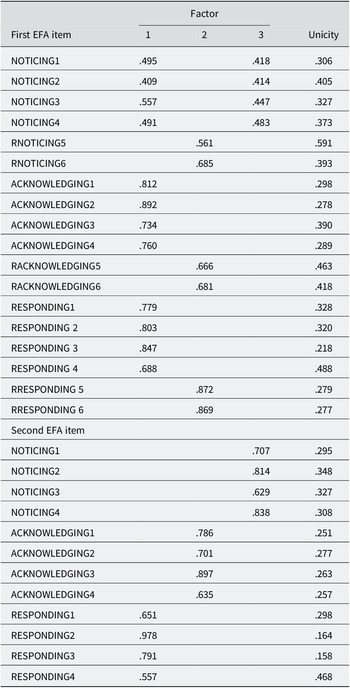
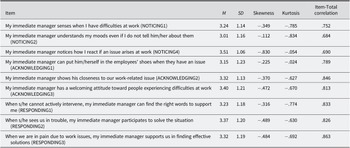


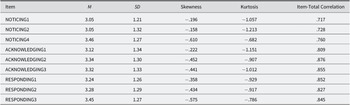


 Open access

