





1 Introduction
Iterated Prikry forcing was first introduced by Magidor [Reference Magidor11] in his seminal “study on identity crises” to produce a model of ZFC in which the least measurable cardinal is strongly compact. The rough idea is to iteratively singularize each cardinal $\alpha $
in some set of measurable cardinals
$\alpha $
in some set of measurable cardinals $\Delta $
using the Prikry forcing associated with a normal measure on
$\Delta $
using the Prikry forcing associated with a normal measure on $\alpha $
.
$\alpha $
.
Ben-Neria [Reference Ben-Neria1] was the first to notice that if Magidor’s construction is carried out over the core model K, then the normal ultrafilters of the forcing extension can be classified in terms of the normal ultrafilters of K. Recently, Ben-Neria’s work was substantially extended and generalized by Kaplan [Reference Kaplan9], who showed, most significantly, that the classification could be carried out even when the ground model is not the core model.
This paper is focused on the special case of Magidor’s construction in which the set of measurable cardinals $\Delta $
to be singularized is discrete in the sense that it does not contain any of its limit points. In this restricted setting, the forcing can be viewed as a product of Prikry forcings which we will refer to as the Magidor product. For discrete Magidor products, Kaplan’s theorem can be stated as follows:
$\Delta $
to be singularized is discrete in the sense that it does not contain any of its limit points. In this restricted setting, the forcing can be viewed as a product of Prikry forcings which we will refer to as the Magidor product. For discrete Magidor products, Kaplan’s theorem can be stated as follows:
Theorem 1.1 (Kaplan).
Suppose G is V-generic for a Magidor product of Prikry forcings on a discrete set $\Delta \subseteq \kappa $
. Then every normal measure U on
$\Delta \subseteq \kappa $
. Then every normal measure U on $\kappa $
in V generates a normal ultrafilter
$\kappa $
in V generates a normal ultrafilter $U^*$
in
$U^*$
in $V[G]$
. Moreover
$V[G]$
. Moreover $j_{U^*}\restriction V =i\circ j_U$
, where i is an iterated ultrapower of
$j_{U^*}\restriction V =i\circ j_U$
, where i is an iterated ultrapower of $V_U$
.
$V_U$
.
Here and below,
 $$\begin{align*}j_U :V \to V_U\end{align*}$$
denotes the ultrapower of the universe of sets by U.
This paper addresses the question of whether Theorem 1.1 can be generalized to ultrafilters U that are not normal. Although we do prove a slight generalization of Kaplan’s result to a collection of measures we call mild (see 3.8), the more surprising contribution of this paper is a negative answer to the general question: we show in Section 4 that in the context of Theorem 1.1, a $\kappa $
-complete ultrafilter U on
$\kappa $
-complete ultrafilter U on $\kappa $
can extend in unexpected ways after a Magidor product of Prikry forcings. In particular, the filter generated by U in the forcing extension is not an ultrafilter. Moreover, these unexpected extensions answer several natural questions in the theory of ultrafilters.
$\kappa $
can extend in unexpected ways after a Magidor product of Prikry forcings. In particular, the filter generated by U in the forcing extension is not an ultrafilter. Moreover, these unexpected extensions answer several natural questions in the theory of ultrafilters.
For example, recall that Kunen’s inconsistency theorem states that there is no nontrivial elementary embedding from the universe of sets to itself. Suppose U is a countably complete ultrafilter, and let $V_U$
be the ultrapower of the universe of sets by U. Can there be a nontrivial elementary embedding from
$V_U$
be the ultrapower of the universe of sets by U. Can there be a nontrivial elementary embedding from $V_U$
to itself? By [Reference Goldberg7, Theorem 3.3, Theorem 4.29], the answer is no if
$V_U$
to itself? By [Reference Goldberg7, Theorem 3.3, Theorem 4.29], the answer is no if $V = \text {HOD}$
or if U is
$V = \text {HOD}$
or if U is $\kappa ^+$
-complete where
$\kappa ^+$
-complete where $\kappa $
is extendible. Nevertheless, we answer the question positively assuming the consistency of a measurable limit of measurable cardinals:
$\kappa $
is extendible. Nevertheless, we answer the question positively assuming the consistency of a measurable limit of measurable cardinals:
Theorem 1.2. It is consistent with ZFC that for some normal ultrafilter U, there is an elementary embedding from $V_U$
to itself.
$V_U$
to itself.
We then consider the question of ultrafilters with the same ultrapower. Suppose U and W are countably complete ultrafilters such that $V_U = V_W$
. Must U and W be isomorphic (that is, Rudin–Keisler equivalent)? Woodin observed that the answer is no [Reference Goldberg7, Theorem 3.1], though again this is true if
$V_U = V_W$
. Must U and W be isomorphic (that is, Rudin–Keisler equivalent)? Woodin observed that the answer is no [Reference Goldberg7, Theorem 3.1], though again this is true if $V = \text {HOD}$
. We consider the weaker question: must there exist
$V = \text {HOD}$
. We consider the weaker question: must there exist $X\in U$
and
$X\in U$
and $Y\in W$
with
$Y\in W$
with $|X| = |Y|$
? Again, we show the answer is no after a discrete Magidor product of Prikry forcings, assuming the consistency of a limit of measurable cardinals of measurable cofinality:
$|X| = |Y|$
? Again, we show the answer is no after a discrete Magidor product of Prikry forcings, assuming the consistency of a limit of measurable cardinals of measurable cofinality:
Theorem 1.3. It is consistent with ZFC that there are countably complete uniform ultrafilters U and W on distinct cardinals such that $V_U = V_W$
.
$V_U = V_W$
.
Recall that the Ultrapower Axiom (UA) [Reference Goldberg6] states that for any two countably complete ultrafilters $U,W$
, there are
$U,W$
, there are $W'\in V_U$
and
$W'\in V_U$
and $U'\in V_{W}$
such that
$U'\in V_{W}$
such that $W'$
is a countably complete ultrafilter in
$W'$
is a countably complete ultrafilter in $V_U$
,
$V_U$
, $U'$
is a countably complete ultrafilter in
$U'$
is a countably complete ultrafilter in $V_W$
,
$V_W$
, $(V_U)_{W'}=(V_W)_{U'}$
and
$(V_U)_{W'}=(V_W)_{U'}$
and $j_{W'}\circ j_U=j_{U'}\circ j_W$
. The Weak Ultrapower Axiom (Weak UA) is the same statement, omitting the requirement that
$j_{W'}\circ j_U=j_{U'}\circ j_W$
. The Weak Ultrapower Axiom (Weak UA) is the same statement, omitting the requirement that $j_{W'}\circ j_U=j_{U'}\circ j_W$
.
$j_{W'}\circ j_U=j_{U'}\circ j_W$
.
The conclusions of the previous theorems are incompatible with UA by [Reference Goldberg7, Theorem 5.2]. Therefore UA typically becomes false after performing a discrete Magidor product of Prikry forcings. Nevertheless, starting from a model of UA containing no measurable cardinals $\delta $
of Mitchell order
$\delta $
of Mitchell order $2^{2^\delta }$
, our main technical result (Theorem 5.7) yields a classification of the lifts of
$2^{2^\delta }$
, our main technical result (Theorem 5.7) yields a classification of the lifts of $\kappa $
-complete ultrafilters on
$\kappa $
-complete ultrafilters on $\kappa $
to the forcing extension.
$\kappa $
to the forcing extension.
This classification suffices to show in certain cases that Weak UA holds in the forcing extension. This answers a question of the second author [Reference Goldberg6, Question 9.2.4], assuming there is a measurable limit of measurable cardinals:
Theorem 1.4. The Weak Ultrapower Axiom does not imply the Ultrapower Axiom.
The above results follow from our main technical theorem which is an analysis of all possible extensions of $\kappa $
-complete ultrafilters over
$\kappa $
-complete ultrafilters over $\kappa $
whose ultrapower can be factored into a finite iterated ultrapower by normal ultrafilters. The following consequence gives a sense of what this classification entails:
$\kappa $
whose ultrapower can be factored into a finite iterated ultrapower by normal ultrafilters. The following consequence gives a sense of what this classification entails:
Theorem 1.5. Suppose that $W\in V$
is a
$W\in V$
is a $\kappa $
-complete ultrafilter over
$\kappa $
-complete ultrafilter over $\kappa $
that can be factored into a finite iteration of normal ultrafilters. Let G be V-generic for a discrete Magidor product of Prikry forcings. Then in
$\kappa $
that can be factored into a finite iteration of normal ultrafilters. Let G be V-generic for a discrete Magidor product of Prikry forcings. Then in $V[G]$
, W extends to at most countably many countably complete ultrafilters.
$V[G]$
, W extends to at most countably many countably complete ultrafilters.
Moreover, if $W^*$
is an extension of W, then
$W^*$
is an extension of W, then $j_{W^*}\restriction V=i\circ e\circ j_W$
, where
$j_{W^*}\restriction V=i\circ e\circ j_W$
, where $e:V_W\rightarrow N$
is a finite external iteration of
$e:V_W\rightarrow N$
is a finite external iteration of $V_W$
by normal measures and i is an internal iterated ultrapower of N by normal measures.
$V_W$
by normal measures and i is an internal iterated ultrapower of N by normal measures.
The previous theorem also gives a sense in which our classification generalizes Kaplan’s result.
This paper is organized as follows:
-
• In Section §2 we prove some preliminary results regarding ultrapowers and the discrete Magidor product.
-
• In Section §3 we study the complete iteration by a sequence of normal measures and how it relates to the restriction of an ultrapower of the generic extension to the ground model.
-
• In Section §4 we describe an ultrafilter which has many extensions to the generic extension of the discrete Magidor product and characterize its extensions. Also, we provide the example of a nonrigid ultrapower.
-
• In Section §5 we prove our characterization of lifts of ultrafilters to the generic extension by the discrete Magidor product.
-
• In Section §6 we prove some applications of our characterization: a model of weak UA which fails to satisfy UA, and an example of the same ultrapower by ultrafilters on different cardinals.
-
• In Section §7 we present some related open problems.
2 Preliminaries
2.1 Derived ultrafilters and commuting squares
Let P be a transitive model of set theory and let U be a (possibly external) P-ultrafilter over a set $X\in P$
.Footnote
1
We will always assume that U is countably complete; namely, for any countable
$X\in P$
.Footnote
1
We will always assume that U is countably complete; namely, for any countable $\mathcal {A}\subseteq U$
,
$\mathcal {A}\subseteq U$
, $\bigcap \mathcal {A}\neq \emptyset $
. Denote by
$\bigcap \mathcal {A}\neq \emptyset $
. Denote by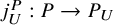 $j^P_U:P\to P_U$
the ultrapower of P by U using functions
$j^P_U:P\to P_U$
the ultrapower of P by U using functions $f:X\to P$
in P. We will suppress the superscript P from
$f:X\to P$
in P. We will suppress the superscript P from $j^P_U$
whenever there is no ambiguity. Since U is countably complete,
$j^P_U$
whenever there is no ambiguity. Since U is countably complete, $P_U$
is well-founded and we identify
$P_U$
is well-founded and we identify $P_U$
with its transitive collapse.
$P_U$
with its transitive collapse.
Let $j:P\to Q$
be an elementary embedding of transitive models of set theory,
$j:P\to Q$
be an elementary embedding of transitive models of set theory, $X\in P$
, and
$X\in P$
, and $a\in j(X)$
. The P-ultrafilter on X derived from j and a is the set
$a\in j(X)$
. The P-ultrafilter on X derived from j and a is the set
 $$ \begin{align*}U=\{A\in P(X)\cap P\mid a\in j(A)\}\end{align*} $$
(The underlying set X is typically suppressed.) It is well known that U is a P-ultrafilter and that the map $k:P_U\to Q$
defined by
$k:P_U\to Q$
defined by $k([f]_U)=j(f)(a)$
is the unique elementary embedding mapping
$k([f]_U)=j(f)(a)$
is the unique elementary embedding mapping $[id]_U$
to a such that
$[id]_U$
to a such that $k\circ j_U=j$
. The following generalization of this fact will be used implicitly in many calculations below:
$k\circ j_U=j$
. The following generalization of this fact will be used implicitly in many calculations below:
Lemma 2.1 (Shift lemma).
Suppose $i:P\rightarrow Q$
is an elementary embedding, W is a Q-ultrafilter over a set in
$i:P\rightarrow Q$
is an elementary embedding, W is a Q-ultrafilter over a set in $\operatorname {\mathrm {rng}}(i)$
and
$\operatorname {\mathrm {rng}}(i)$
and $U=i^{-1}[W]$
. Then the embedding
$U=i^{-1}[W]$
. Then the embedding $k:P_U\rightarrow Q_W$
defined by
$k:P_U\rightarrow Q_W$
defined by $k([f]_U)=[i(f)]_W$
is well-defined and elementary. Moreover, it is the unique embedding mapping
$k([f]_U)=[i(f)]_W$
is well-defined and elementary. Moreover, it is the unique embedding mapping $[id]_U$
to
$[id]_U$
to $[id]_W$
such that the following diagram commutes:
$[id]_W$
such that the following diagram commutes:

Proof. Note that U is the P-ultrafilter derived from $j_W\circ i$
and
$j_W\circ i$
and $[id]_W$
. Moreover, k is the associated factor map, and the lemma follows.
$[id]_W$
. Moreover, k is the associated factor map, and the lemma follows.
Suppose $i : M\to N$
is an elementary embedding and
$i : M\to N$
is an elementary embedding and $X\subseteq N$
. Then
$X\subseteq N$
. Then $\operatorname {\mathrm {Hull}}^N(i[M]\cup X)$
denotes
$\operatorname {\mathrm {Hull}}^N(i[M]\cup X)$
denotes $\{i(f)(s) : s\in X^{<\omega }, f\in M\}$
. This is the smallest elementary substructure of N containing
$\{i(f)(s) : s\in X^{<\omega }, f\in M\}$
. This is the smallest elementary substructure of N containing $i[M]\cup X$
.
$i[M]\cup X$
.
Lemma 2.2. Suppose that D is a P-ultrafilter, $j:P\rightarrow M$
,
$j:P\rightarrow M$
, $j':P_D\rightarrow M'$
, and
$j':P_D\rightarrow M'$
, and $k:M\rightarrow M'$
is such that
$k:M\rightarrow M'$
is such that $M'=\operatorname {\mathrm {Hull}}^{M'}(\operatorname {\mathrm {rng}}(k)\cup \operatorname {\mathrm {rng}}(j'))$
and the following diagram commutes:
$M'=\operatorname {\mathrm {Hull}}^{M'}(\operatorname {\mathrm {rng}}(k)\cup \operatorname {\mathrm {rng}}(j'))$
and the following diagram commutes:

Then if $D'$
is the M-ultrafilter derived from k and
$D'$
is the M-ultrafilter derived from k and $j'([id]_D)$
,
$j'([id]_D)$
, $M_{D'}=M'$
,
$M_{D'}=M'$
, $k=j_{D'}$
, and
$k=j_{D'}$
, and $[id]_{D'} = j'([id]_D)$
.
$[id]_{D'} = j'([id]_D)$
.
Proof. Note that there is a factor map $k':M_{D'}\rightarrow M'$
defined by
$k':M_{D'}\rightarrow M'$
defined by $k'([f]_{D'})=k(f)(j'([id]_D))$
such that
$k'([f]_{D'})=k(f)(j'([id]_D))$
such that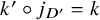 $k'\circ j_{D'}=k$
. To see that
$k'\circ j_{D'}=k$
. To see that $k'$
is onto, we have
$k'$
is onto, we have
 $$ \begin{align*} M'&=\operatorname{\mathrm{Hull}}^{M'}(\operatorname{\mathrm{rng}}(k)\cup\operatorname{\mathrm{rng}}(j'))\\ &=\operatorname{\mathrm{Hull}}^{M'}(\operatorname{\mathrm{rng}}(k)\cup \operatorname{\mathrm{rng}}(j'\circ j_D)\cup\{j'([id]_D)\})\\ &=\operatorname{\mathrm{Hull}}^{M'}(\operatorname{\mathrm{rng}}(k)\cup\{j'([id]_D)\})\subseteq \operatorname{\mathrm{rng}}(k')\end{align*} $$
Since $k'$
is an isomorphism of transitive models,
$k'$
is an isomorphism of transitive models, $k'$
is the identity. Also
$k'$
is the identity. Also $[id]_{D'} = k'([id]_{D'}) = j'([id]_D)$
, proving the lemma.
$[id]_{D'} = k'([id]_{D'}) = j'([id]_D)$
, proving the lemma.
Corollary 2.3. If $k:M\rightarrow M'$
,
$k:M\rightarrow M'$
, $M'=\operatorname {\mathrm {Hull}}^{M'}(\operatorname {\mathrm {rng}}(k)\cup \{a\})$
, and
$M'=\operatorname {\mathrm {Hull}}^{M'}(\operatorname {\mathrm {rng}}(k)\cup \{a\})$
, and $a\in k(X)$
for some
$a\in k(X)$
for some $X\in M$
, then
$X\in M$
, then $M_D=M'$
and
$M_D=M'$
and $k=j_D$
where D is the M-ultrafilter over X derived from a and k and
$k=j_D$
where D is the M-ultrafilter over X derived from a and k and $[id]_D = a$
.
$[id]_D = a$
.
Proof. This is a special case of the previous lemma where $j=id$
and
$j=id$
and $j'$
is the factor embedding.
$j'$
is the factor embedding.
2.2 Iterations and products of Prikry-type forcings
Iterations and products of Prikry-type forcings
We define the Magidor support iteration  associated with a sequence of names
 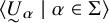 where
where $\Sigma \subseteq \kappa $
is a set of measurable cardinals.
$\Sigma \subseteq \kappa $
is a set of measurable cardinals.
Definition 2.4 [Reference Magidor11, Reference Gitik4].
The forcing $\mathbb {P}_\alpha $
is defined inductively for each
$\mathbb {P}_\alpha $
is defined inductively for each $\alpha \leq \kappa $
: a condition p belongs to
$\alpha \leq \kappa $
: a condition p belongs to $\mathbb {P}_\alpha $
if it is a function p with
$\mathbb {P}_\alpha $
if it is a function p with $\operatorname {\mathrm {dom}}(p)=\alpha $
such that:
$\operatorname {\mathrm {dom}}(p)=\alpha $
such that:
-
1. for every $\beta <\alpha $
,
$p\restriction \beta \in \mathbb {P}_\beta $
.
$\beta <\alpha $
,
$p\restriction \beta \in \mathbb {P}_\beta $
. -
2. for every
$\beta <\alpha $
, , where is trivial unless
$\beta \in \Sigma $
, in which case is a normal ultrafilter over
$\beta $
and is a
$\mathbb {P}_\beta $
-name for the usual Prikry forcingFootnote
2
from [Reference Prikry13]. -
3. there is a finite set
$b_p$
such that for every
$\beta \in \alpha \setminus b_p$
, .


 , where
  is trivial unless
 is a normal ultrafilter over
 is a
is a 
 from [

 .
.We define $p\leq q$
iff for every
$p\leq q$
iff for every $\beta <\alpha $
,
$\beta <\alpha $
, $p\restriction \beta \Vdash _{\mathbb {P}_\beta }p(\beta )\leq q(\beta )$
. Also define
$p\restriction \beta \Vdash _{\mathbb {P}_\beta }p(\beta )\leq q(\beta )$
. Also define $p\leq ^* q$
iff for every
$p\leq ^* q$
iff for every $\beta <\alpha $
,
$\beta <\alpha $
, $p\restriction \beta \Vdash _{\mathbb {P}_\beta }p(\beta )\leq ^* q(\beta )$
.
$p\restriction \beta \Vdash _{\mathbb {P}_\beta }p(\beta )\leq ^* q(\beta )$
.
Magidor [Reference Magidor11, §2] originally defined his forcing so that for a condition $p\in \mathbb {P}_\alpha $
, and
$p\in \mathbb {P}_\alpha $
, and $\beta \in \Sigma \cap \alpha $
,
$\beta \in \Sigma \cap \alpha $
, 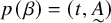 . where $t^p_\beta $
is a finite sequence of ordinals and
$t^p_\beta $
is a finite sequence of ordinals and  is a
is a $\mathbb {P}_\beta $
-name such that
$\mathbb {P}_\beta $
-name such that  . A straightforward inductive argument shows that this is a dense set of conditions in the forcing defined above.
A set of ordinals $\Delta $
is called discrete if it contains none of its accumulation points; that is, for every
$\Delta $
is called discrete if it contains none of its accumulation points; that is, for every $\alpha \in \Delta $
,
$\alpha \in \Delta $
, $\sup (\Delta \cap \alpha )<\alpha $
. In particular,
$\sup (\Delta \cap \alpha )<\alpha $
. In particular, $\Delta $
is an extremely thin nonstationary set, and so are all its restrictions to
$\Delta $
is an extremely thin nonstationary set, and so are all its restrictions to $\alpha <\sup (\Delta )$
; similarly, if
$\alpha <\sup (\Delta )$
; similarly, if $\Delta \subseteq \kappa $
is discrete, then for every
$\Delta \subseteq \kappa $
is discrete, then for every $\kappa $
-complete ultrafilter U over
$\kappa $
-complete ultrafilter U over $\kappa $
,
$\kappa $
, $\kappa \notin j_U(\Delta )$
. Note that if
$\kappa \notin j_U(\Delta )$
. Note that if $\kappa $
is the least measurable limit of measurable cardinals, then the set of measurables below
$\kappa $
is the least measurable limit of measurable cardinals, then the set of measurables below $\kappa $
is discrete.
$\kappa $
is discrete.
Notation 2.5. For the rest of this section, we fix a discrete set $\Delta \subseteq \kappa $
of measurable cardinals and a sequence
$\Delta \subseteq \kappa $
of measurable cardinals and a sequence $\vec {U}={\langle } U_\alpha \mid \alpha \in \Delta {\rangle }$
such that
$\vec {U}={\langle } U_\alpha \mid \alpha \in \Delta {\rangle }$
such that $U_\alpha $
is a normal measure of Mitchell order
$U_\alpha $
is a normal measure of Mitchell order $0$
over
$0$
over $\alpha $
.
$\alpha $
.
We will consider the Magidor iteration associated to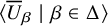 ${\langle } \overline {U}_\beta \mid \beta \in \Delta {\rangle }$
where
${\langle } \overline {U}_\beta \mid \beta \in \Delta {\rangle }$
where $\overline {U}_\beta $
is a
$\overline {U}_\beta $
is a $\mathbb {P}_\beta $
-name for the filter generated by
$\mathbb {P}_\beta $
-name for the filter generated by $U_\beta $
in
$U_\beta $
in $V^{\mathbb {P}_\beta }$
(see Proposition 2.7(2)).
$V^{\mathbb {P}_\beta }$
(see Proposition 2.7(2)).
Remark 2.6. Since the set $\Delta $
is discrete, a Magidor support here is always going to be nonstationary. Hence the forcing above inherits the properties of both the nonstationary and Magidor support iterations of Prikry-type forcings on the set
$\Delta $
is discrete, a Magidor support here is always going to be nonstationary. Hence the forcing above inherits the properties of both the nonstationary and Magidor support iterations of Prikry-type forcings on the set $\Delta $
.
$\Delta $
.
Proposition 2.7.
-
1.
$\mathbb {P}_\kappa $
is
$\kappa ^+$
-cc. -
2. If
$\alpha \in \Delta $
,
$U_\alpha $
generates a normal ultrafilter in
$V^{\mathbb {P}_\alpha }$
.


Item $(2)$
follows from Lévy-Solovay. For the proof of
$(2)$
follows from Lévy-Solovay. For the proof of $(1)$
see [Reference Magidor11, 4.4].
$(1)$
see [Reference Magidor11, 4.4].
Proposition 2.8. The set of conditions $p\in \mathbb P_\kappa $
such that for every
$p\in \mathbb P_\kappa $
such that for every $\beta \in \Delta $
,
$\beta \in \Delta $
, $p(\beta ) = \check {q}$
for some
$p(\beta ) = \check {q}$
for some $q\in Pr(U_\beta )$
is
$q\in Pr(U_\beta )$
is $\leq $
-dense in
$\leq $
-dense in $\mathbb {P}_\kappa $
.
$\mathbb {P}_\kappa $
.
Proof. Let $p\in \mathbb {P}_\kappa $
be a condition, and without loss of generality, assume that for each
$p\in \mathbb {P}_\kappa $
be a condition, and without loss of generality, assume that for each $\beta \in \Delta $
,
$\beta \in \Delta $
,  , where $t_\beta \in [\beta ]^{<\omega }$
. For
$t_\beta \in [\beta ]^{<\omega }$
. For $\beta \in \Delta $
, define
$\beta \in \Delta $
, define $p^*(\beta )=(t_\beta ,A^*_\beta )$
by setting
$p^*(\beta )=(t_\beta ,A^*_\beta )$
by setting  . A Lévy-Solovay-like argument shows that $p^*\in \mathbb {P}_\kappa $
, and this is clearly a direct extension of p.
$p^*\in \mathbb {P}_\kappa $
, and this is clearly a direct extension of p.
If $p \in \mathbb P_\alpha $
belongs to the dense set of the previous proposition, for
$p \in \mathbb P_\alpha $
belongs to the dense set of the previous proposition, for $\beta \in \Delta \cap \alpha $
, we denote by
$\beta \in \Delta \cap \alpha $
, we denote by $(t^p_\beta ,A^p_\beta )$
the unique
$(t^p_\beta ,A^p_\beta )$
the unique $q\in Pr(U_\beta )$
such that
$q\in Pr(U_\beta )$
such that $p(\beta ) = \check {q}$
.
$p(\beta ) = \check {q}$
.
Definition 2.9. The Magidor support product  consists of all functions p such that $\operatorname {\mathrm {dom}}(p) = \Delta $
,
$\operatorname {\mathrm {dom}}(p) = \Delta $
, $p(\alpha )\in \textit {Pr}(U_\alpha )$
, and
$p(\alpha )\in \textit {Pr}(U_\alpha )$
, and $\{\alpha \in \Delta : p(\alpha ) \leq ^* 1\}$
is cofinite.
$\{\alpha \in \Delta : p(\alpha ) \leq ^* 1\}$
is cofinite.
By the previous proposition, we obtain the following corollary:
Corollary 2.10 (Magidor). $\mathbb {P}_\kappa $
is forcing equivalent to the Magidor support product
$\mathbb {P}_\kappa $
is forcing equivalent to the Magidor support product  .
.
We shall often treat $\mathbb {P}_\kappa $
as if it were the product
$\mathbb {P}_\kappa $
as if it were the product 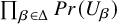 .
.
As usual in iterated forcing, one can construct factor forcings $\mathbb P_{[\alpha , \beta )}\in V^{\mathbb P_\alpha }$
such that
$\mathbb P_{[\alpha , \beta )}\in V^{\mathbb P_\alpha }$
such that $\mathbb P_\alpha * \mathbb P_{[\alpha , \beta )} \cong \mathbb P_\beta $
. This works in general for the Magidor iteration (and other iterations of Príkry-type forcings), but in the discrete case considered here, the factor forcing takes a simpler form: it is forcing equivalent to the Magidor product
$\mathbb P_\alpha * \mathbb P_{[\alpha , \beta )} \cong \mathbb P_\beta $
. This works in general for the Magidor iteration (and other iterations of Príkry-type forcings), but in the discrete case considered here, the factor forcing takes a simpler form: it is forcing equivalent to the Magidor product  . (One can use compute this forcing in V or $V^{\mathbb P_\alpha }$
; the former factor forcing is dense in the latter.) We also define
$V^{\mathbb P_\alpha }$
; the former factor forcing is dense in the latter.) We also define  , etc.
Lemma 2.11 (Prikry Lemma).
For every $p\in \mathbb {P}_\kappa $
, and every sentence
$p\in \mathbb {P}_\kappa $
, and every sentence $\sigma $
in the forcing language for
$\sigma $
in the forcing language for $\mathbb {P}_\kappa $
, there is
$\mathbb {P}_\kappa $
, there is $p^*\leq ^* p$
such that
$p^*\leq ^* p$
such that $p^*{}||{} \sigma $
.
$p^*{}||{} \sigma $
.
2.3 On ground model ultrafilters that generate ultrafilters in the extension
In this subsection, we provide a version of Theorem 1.1 which provides slightly more information in the context of discrete sequences of measures.
Definition 2.12. Suppose $\lambda $
is a measurable cardinal and
$\lambda $
is a measurable cardinal and $\Sigma \subseteq \lambda $
is unbounded. A
$\Sigma \subseteq \lambda $
is unbounded. A $\lambda $
-complete ultrafilter U over
$\lambda $
-complete ultrafilter U over $\lambda $
is called
$\lambda $
is called $\Sigma $
-mild if there is a function
$\Sigma $
-mild if there is a function $f:\lambda \rightarrow \lambda $
such that
$f:\lambda \rightarrow \lambda $
such that
 $$ \begin{align*}[id]_U\leq j_U(f)(\lambda)<\min(j_U(\Sigma)\setminus\lambda)\end{align*} $$
Note that if U is a normal measure with $\Sigma \notin U$
, then U is
$\Sigma \notin U$
, then U is $\Sigma $
-mild. Also, every
$\Sigma $
-mild. Also, every $\Sigma $
-mild ultrafilter is a p-point.
$\Sigma $
-mild ultrafilter is a p-point.
Theorem 2.13. If U is a $(\Delta \cap \lambda )$
-mild ultrafilter over a cardinal
$(\Delta \cap \lambda )$
-mild ultrafilter over a cardinal $\lambda \notin \Delta $
, then U generates a
$\lambda \notin \Delta $
, then U generates a $\lambda $
-complete ultrafilter in
$\lambda $
-complete ultrafilter in $V^{\mathbb P_\kappa }$
.
$V^{\mathbb P_\kappa }$
.
Proof. Let $G\subseteq \mathbb P_\lambda $
be V-generic. Note that it suffices to show that U generates an ultrafilter in
$G\subseteq \mathbb P_\lambda $
be V-generic. Note that it suffices to show that U generates an ultrafilter in $V[G]$
, because the factor forcing
$V[G]$
, because the factor forcing $\mathbb P_{[\lambda ,\kappa )}$
does not add subsets to
$\mathbb P_{[\lambda ,\kappa )}$
does not add subsets to $\lambda $
since
$\lambda $
since $\lambda \notin \Delta $
.
$\lambda \notin \Delta $
.
By Gitik and Kaplan [Reference Gitik and Kaplan5, Prop. 2.6 and Prop. 2.7], since $\lambda $
and
$\lambda $
and $\lambda ^+$
remain regular in
$\lambda ^+$
remain regular in $V[G]$
, it suffices to prove that
$V[G]$
, it suffices to prove that $j_U[G]$
decides all statements of the form
$j_U[G]$
decides all statements of the form $[id]_U\in j_U(\dot {A})$
, where
$[id]_U\in j_U(\dot {A})$
, where $\dot {A}$
is a
$\dot {A}$
is a $\mathbb {P}_\kappa $
-name for a subset of
$\mathbb {P}_\kappa $
-name for a subset of $\lambda $
. Given such a name
$\lambda $
. Given such a name $\dot {A}$
, we may assume that it is a
$\dot {A}$
, we may assume that it is a $\mathbb {P}_\kappa \restriction \lambda $
-name.
$\mathbb {P}_\kappa \restriction \lambda $
-name.
Let us work in $V_U[G]$
. Let
$V_U[G]$
. Let $\dot {A}_0$
be the
$\dot {A}_0$
be the $\mathbb {P}_{(\lambda ,j_U(\lambda ))}$
-name obtained from
$\mathbb {P}_{(\lambda ,j_U(\lambda ))}$
-name obtained from $j_U(\dot {A})$
. By the Prikry property, there is a condition
$j_U(\dot {A})$
. By the Prikry property, there is a condition $q\leq ^* 1_{\mathbb {P}_{(\lambda ,j_U(\lambda ))}}$
such that
$q\leq ^* 1_{\mathbb {P}_{(\lambda ,j_U(\lambda ))}}$
such that $q \ ||\ "[id]_U\in \dot {A}_0"$
and therefore there is
$q \ ||\ "[id]_U\in \dot {A}_0"$
and therefore there is $p\in G$
such that
$p\in G$
such that
 $$ \begin{align*}p\Vdash q \ || \ "[id]_U\in j_U(\dot{A})."\end{align*} $$
In other words, $(p,q) \ || \ "[id]_U\in j_U(\dot {A})"$
. Let us show that there is
$(p,q) \ || \ "[id]_U\in j_U(\dot {A})"$
. Let us show that there is $p'\in G$
such that
$p'\in G$
such that $j_U(p')\leq (p,q)$
. Fix a sequence
$j_U(p')\leq (p,q)$
. Fix a sequence $\langle A_\gamma : \gamma \in j_U(\Delta )\cap (\lambda ,j_U(\lambda )\rangle \in V_U$
such that for all
$\langle A_\gamma : \gamma \in j_U(\Delta )\cap (\lambda ,j_U(\lambda )\rangle \in V_U$
such that for all $\gamma \in \operatorname {\mathrm {dom}}(q)$
,
$\gamma \in \operatorname {\mathrm {dom}}(q)$
, $q(\gamma ) = (\emptyset ,A_\gamma )$
. Let
$q(\gamma ) = (\emptyset ,A_\gamma )$
. Let

represent q in $j_U$
where
$j_U$
where  is the function representing $\lambda $
in
$\lambda $
in $V_U$
.
$V_U$
.
Let us proceed with a density argument. Let $p\in \mathbb {P}_\kappa $
. We shrink p in the interval
$p\in \mathbb {P}_\kappa $
. We shrink p in the interval $[\gamma _0,\lambda )$
, where
$[\gamma _0,\lambda )$
, where $\gamma _0=\max (b_p\cap \lambda )+1$
. For
$\gamma _0=\max (b_p\cap \lambda )+1$
. For $\gamma \geq \gamma _0$
,
$\gamma \geq \gamma _0$
, $\gamma \in \Delta \cap \lambda $
, define
$\gamma \in \Delta \cap \lambda $
, define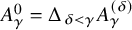 $A^0_\gamma =\Delta _{\delta <\gamma }A^{(\delta )}_\gamma $
. Moreover, given that f witnesses that U is
$A^0_\gamma =\Delta _{\delta <\gamma }A^{(\delta )}_\gamma $
. Moreover, given that f witnesses that U is $(\Delta \cap \lambda )$
-mild, if
$(\Delta \cap \lambda )$
-mild, if $f(\sup (\Delta \cap \gamma ))\geq \gamma $
we let
$f(\sup (\Delta \cap \gamma ))\geq \gamma $
we let $A^*_\gamma =A^0_\gamma \setminus \sup (\Delta \cap \gamma )$
and if
$A^*_\gamma =A^0_\gamma \setminus \sup (\Delta \cap \gamma )$
and if $f(\sup (\Delta \cap \gamma ))<\gamma $
we let
$f(\sup (\Delta \cap \gamma ))<\gamma $
we let
 $$ \begin{align*}A^*_\gamma=A^0_\gamma\setminus \max\{ f(\sup(\Delta\cap\gamma)),\sup(\Delta\cap\gamma)\}.\end{align*} $$
We shrink p so that $A^p_\gamma \subseteq A^*_\gamma $
for
$A^p_\gamma \subseteq A^*_\gamma $
for $\gamma \in \Delta \setminus \gamma _0$
, and by genericity we can find such a
$\gamma \in \Delta \setminus \gamma _0$
, and by genericity we can find such a $p^*\in G$
such that
$p^*\in G$
such that $p^*\leq p$
. Then
$p^*\leq p$
. Then $j_U(p^*)\restriction \lambda =p^*\leq p$
and
$j_U(p^*)\restriction \lambda =p^*\leq p$
and $j_U(p^*\restriction [\lambda ,\kappa ))\leq j_U(p\restriction [\lambda ,\kappa ))$
. For
$j_U(p^*\restriction [\lambda ,\kappa ))\leq j_U(p\restriction [\lambda ,\kappa ))$
. For $\gamma \in j_U(\Delta )\cap [\lambda ,j_U(\kappa ))$
, we note that
$\gamma \in j_U(\Delta )\cap [\lambda ,j_U(\kappa ))$
, we note that $\lambda \notin j_U(\Delta )$
by our assumption that
$\lambda \notin j_U(\Delta )$
by our assumption that $\lambda \notin \Delta $
and
$\lambda \notin \Delta $
and $\Delta $
is discrete. We need to argue that
$\Delta $
is discrete. We need to argue that $A^{j_U(p^*)}_\gamma \subseteq A_\gamma $
. Denote by
$A^{j_U(p^*)}_\gamma \subseteq A_\gamma $
. Denote by

Then by definition, $A_{[id]_U,\gamma }=A_\gamma $
for every
$A_{[id]_U,\gamma }=A_\gamma $
for every $\gamma \in j_U(\Delta )\cap [\lambda ,j_U(\lambda ))$
. If
$\gamma \in j_U(\Delta )\cap [\lambda ,j_U(\lambda ))$
. If $\gamma =\min (j_U(\Delta )\setminus \lambda )$
, then
$\gamma =\min (j_U(\Delta )\setminus \lambda )$
, then $j_U(f)(\sup (j_U(\Delta )\cap \lambda ))=j_U(f)(\lambda )\geq [id]_U$
and we have
$j_U(f)(\sup (j_U(\Delta )\cap \lambda ))=j_U(f)(\lambda )\geq [id]_U$
and we have
 $$ \begin{align*}A^{j_U(p^*)}_\gamma\subseteq\Delta_{\beta<\gamma}A_{\beta,\gamma}\setminus j_U(f)(\lambda)+1\subseteq A_{[id]_U,\gamma}=A_\gamma.\end{align*} $$
If $\gamma>\min (j_U(\Delta )\setminus \lambda )$
, then
$\gamma>\min (j_U(\Delta )\setminus \lambda )$
, then $\sup (j_U(\Delta )\cap \gamma )\geq \min (j_U(\Delta )\cap \gamma )\geq [id]_U$
, hence we still have
$\sup (j_U(\Delta )\cap \gamma )\geq \min (j_U(\Delta )\cap \gamma )\geq [id]_U$
, hence we still have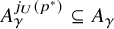 $A^{j_U(p^*)}_\gamma \subseteq A_\gamma $
. It follows that
$A^{j_U(p^*)}_\gamma \subseteq A_\gamma $
. It follows that $j_U(p^*)\leq p^\smallfrown q$
as wanted.
$j_U(p^*)\leq p^\smallfrown q$
as wanted.
The discreteness of the set $\Delta $
is essential here; without it, even
$\Delta $
is essential here; without it, even $0$
-order normal measures might not generate ultrafilters. We give an example of this behavior due to Ben-Neria in Example 3.9.
$0$
-order normal measures might not generate ultrafilters. We give an example of this behavior due to Ben-Neria in Example 3.9.
Example 2.14. In Section 4.1, we will give an example where U does not generate an ultrafilter in $V[G]$
even though
$V[G]$
even though $[id]_U<\min (j_U(\Delta )\setminus \kappa )$
. Hence the assumption regarding the existence of the function f cannot be removed in Theorem 2.13.
$[id]_U<\min (j_U(\Delta )\setminus \kappa )$
. Hence the assumption regarding the existence of the function f cannot be removed in Theorem 2.13.
Note that if $[id]_U$
is below the first
$[id]_U$
is below the first $M_U$
-Ramsey cardinal (for example) above
$M_U$
-Ramsey cardinal (for example) above $\lambda $
, then U is
$\lambda $
, then U is $\Delta $
-mild. Moreover, by the counterexample of Section 4.1,
$\Delta $
-mild. Moreover, by the counterexample of Section 4.1, $[id]_U$
being below the first
$[id]_U$
being below the first $M_U$
-measurable cardinal does not suffice for U to be
$M_U$
-measurable cardinal does not suffice for U to be $\Delta $
-mild, or even for U to generate an ultrafilter in
$\Delta $
-mild, or even for U to generate an ultrafilter in $V[G]$
.
$V[G]$
.
3 The complete iteration
One aspect of understanding the lifts $\overline W$
of an ultrafilter W to a generic extension
$\overline W$
of an ultrafilter W to a generic extension $V[G]$
is to analyze the factor map
$V[G]$
is to analyze the factor map $k : V_W\to j_{\overline W}^{V[G]}(V)$
defined by
$k : V_W\to j_{\overline W}^{V[G]}(V)$
defined by $k([f]_W)=[f]_{W^*}^{V[G]}$
. In the case of a generic extension by an iteration of Prikry forcings, the factor map can often be described in terms of the complete iteration:
$k([f]_W)=[f]_{W^*}^{V[G]}$
. In the case of a generic extension by an iteration of Prikry forcings, the factor map can often be described in terms of the complete iteration:
Definition 3.1. Let $\vec {U}={\langle } U_\delta \mid \delta \in \Delta {\rangle }$
be a sequence such that
$\vec {U}={\langle } U_\delta \mid \delta \in \Delta {\rangle }$
be a sequence such that $U_\delta $
is a normal measure on
$U_\delta $
is a normal measure on $\delta $
and
$\delta $
and $\Delta $
is any set of measurables. Let us define, by transfinite recursion, the complete iteration associated with the sequence
$\Delta $
is any set of measurables. Let us define, by transfinite recursion, the complete iteration associated with the sequence $\vec U$
. This will be an iterated ultrapower of V denoted by
$\vec U$
. This will be an iterated ultrapower of V denoted by
 $$ \begin{align*}{\langle} N_\alpha, i^{(\vec{U})}_{\alpha,\beta}\mid \alpha\leq\beta\leq \theta{\rangle}\end{align*} $$
starting with $N_0 = V$
. Simultaneously, we will define sets of ordinals
$N_0 = V$
. Simultaneously, we will define sets of ordinals ${\langle } s^\alpha _\delta \mid \delta \in i_{0,\alpha }(\Delta ){\rangle }$
starting with
${\langle } s^\alpha _\delta \mid \delta \in i_{0,\alpha }(\Delta ){\rangle }$
starting with $s^0_\delta = \emptyset $
for all
$s^0_\delta = \emptyset $
for all $\delta \in \Delta $
.
$\delta \in \Delta $
.
For $\alpha < \theta $
, let
$\alpha < \theta $
, let $W_\alpha = i_{\alpha }(\vec {U})_{\delta _\alpha }$
where
$W_\alpha = i_{\alpha }(\vec {U})_{\delta _\alpha }$
where $\delta _\alpha \in i_\alpha (\Delta )$
is the minimal
$\delta _\alpha \in i_\alpha (\Delta )$
is the minimal $\delta $
such that the set
$\delta $
such that the set $s^\alpha _\delta $
is finite. Let
$s^\alpha _\delta $
is finite. Let $N_{\alpha +1} = (N_\alpha )_{W_\alpha }$
, and let
$N_{\alpha +1} = (N_\alpha )_{W_\alpha }$
, and let $i_{\alpha ,\alpha +1}:N_\alpha \rightarrow N_{\alpha +1}$
be the ultrapower embedding associated with
$i_{\alpha ,\alpha +1}:N_\alpha \rightarrow N_{\alpha +1}$
be the ultrapower embedding associated with $W_\alpha $
. Define
$W_\alpha $
. Define
 $$ \begin{align*}s^{\alpha+1}_\beta=\begin{cases} \emptyset & \beta\in i_{\alpha+1}(\Delta)\setminus i_{\alpha,\alpha+1}[\Delta]\\ s^\alpha_{\delta_\alpha}\cup\{\delta_\alpha\} & \beta=i_{\alpha,\alpha+1}(\delta_\alpha)\\ s^\alpha_\beta & o.w.\end{cases}.\end{align*} $$
At limit steps $\rho $
, we take the direct limits of the embeddings and let
$\rho $
, we take the direct limits of the embeddings and let $s^\rho _\beta =\bigcup \{ s^\alpha _{\beta '}\mid \alpha <\rho , i_{\alpha ,\rho }(\beta ')=\beta \}$
for every
$s^\rho _\beta =\bigcup \{ s^\alpha _{\beta '}\mid \alpha <\rho , i_{\alpha ,\rho }(\beta ')=\beta \}$
for every $\beta \in i_{\rho }(\Delta )$
. The sequence
$\beta \in i_{\rho }(\Delta )$
. The sequence ${\langle } s^\theta _\alpha \mid \alpha \in i_{0,\theta }(\Delta ){\rangle }$
is called the sequence of sets of indiscernibles associated with the complete iteration of
${\langle } s^\theta _\alpha \mid \alpha \in i_{0,\theta }(\Delta ){\rangle }$
is called the sequence of sets of indiscernibles associated with the complete iteration of $\vec U$
.
$\vec U$
.
We usually omit the superscript $\vec {U}$
from
$\vec {U}$
from $i^{\vec {U}}$
, and we denote
$i^{\vec {U}}$
, and we denote $\theta $
by
$\theta $
by $\infty $
when the length of the iteration does not play a significant role.
$\infty $
when the length of the iteration does not play a significant role.
For example, if $\Delta $
consists of a single measurable cardinal, then the complete iteration is simply the
$\Delta $
consists of a single measurable cardinal, then the complete iteration is simply the $\omega ^{\text {th}}$
iterated ultrapower of the only normal measure in
$\omega ^{\text {th}}$
iterated ultrapower of the only normal measure in $\vec {U}$
, and the sequence of sets of indiscernibles consists of the corresponding sequence of iteration points.
$\vec {U}$
, and the sequence of sets of indiscernibles consists of the corresponding sequence of iteration points.
Proposition 3.2. Let $i:V\rightarrow N$
be the complete iteration of
$i:V\rightarrow N$
be the complete iteration of $\vec {U}$
, where
$\vec {U}$
, where $\operatorname {\mathrm {dom}}(\vec {U})=\Delta $
is discrete. Then:
$\operatorname {\mathrm {dom}}(\vec {U})=\Delta $
is discrete. Then:
-
1. For every
$\alpha $
,
$\delta _{\alpha +1}=i_{\alpha ,\alpha +1}(\delta _\alpha )$
. -
2. For each
$\gamma \in \Delta $
, there is a unique
$\alpha =\alpha (\gamma )$
such that
$\delta _\alpha =\gamma $
. -
3. For each
$\gamma \in \Delta $
,
$i_{0,\alpha }(\gamma )=\gamma $
, and
$i(\gamma )=i_{\alpha ,\alpha +\omega }(\gamma )$
, where
$\alpha =\alpha (\gamma )$
.




Proof. For $(1)$
, we have that
$(1)$
, we have that $i_\alpha (\Delta )\cap \delta _\alpha $
is bounded in
$i_\alpha (\Delta )\cap \delta _\alpha $
is bounded in $\delta _\alpha $
, and therefore
$\delta _\alpha $
, and therefore
 $$ \begin{align*}i_{\alpha+1}(\Delta)\cap i_{\alpha,\alpha+1}(\delta_\alpha)=i_\alpha(\Delta)\cap \delta_\alpha.\end{align*} $$
Hence every $\delta \in i_{\alpha +1}(\Delta )\cap i_{\alpha ,\alpha +1}(\delta _{\alpha })$
has been used infinitely many times and
$\delta \in i_{\alpha +1}(\Delta )\cap i_{\alpha ,\alpha +1}(\delta _{\alpha })$
has been used infinitely many times and $\delta _{\alpha +1}\geq i_{\alpha ,\alpha +1}(\delta _\alpha )$
. By definition of
$\delta _{\alpha +1}\geq i_{\alpha ,\alpha +1}(\delta _\alpha )$
. By definition of $\delta _\alpha $
, equality must hold.
$\delta _\alpha $
, equality must hold.
For $(2)$
and
$(2)$
and $(3)$
, fix any
$(3)$
, fix any $\gamma \in \Delta $
, then
$\gamma \in \Delta $
, then $\gamma $
is measurable, it is routine to show inductively on
$\gamma $
is measurable, it is routine to show inductively on $\beta $
, if
$\beta $
, if $\delta _\beta <\gamma $
, then
$\delta _\beta <\gamma $
, then $i_{0,\beta }(\gamma )=\gamma $
. Since the sequence
$i_{0,\beta }(\gamma )=\gamma $
. Since the sequence $\delta _\alpha $
is strictly increasing, and since
$\delta _\alpha $
is strictly increasing, and since $\Delta $
is discrete, after less than
$\Delta $
is discrete, after less than $\gamma $
-many steps of the iteration we reach a stage
$\gamma $
-many steps of the iteration we reach a stage $\alpha $
, such that
$\alpha $
, such that $\gamma =\delta _\alpha $
. This means that the measure
$\gamma =\delta _\alpha $
. This means that the measure $i_{0,\alpha }(\vec {U})_\gamma $
was not used before stage
$i_{0,\alpha }(\vec {U})_\gamma $
was not used before stage $\alpha $
, and every previous measure was used infinitely many times already. By
$\alpha $
, and every previous measure was used infinitely many times already. By $(1)$
,
$(1)$
, $\delta _{\alpha +n}=i_{\alpha ,\alpha +n}(\gamma )$
, for every
$\delta _{\alpha +n}=i_{\alpha ,\alpha +n}(\gamma )$
, for every $n<\omega $
. At stage
$n<\omega $
. At stage $\alpha +\omega $
we get:
$\alpha +\omega $
we get:
 $$ \begin{align*}i_{\alpha,\alpha+\omega}(i_{0,\alpha}(\Delta))=[i_{0,\alpha}(\Delta)\cap\gamma]\cup i_{\alpha,\alpha+\omega}(i_{0,\alpha}(\Delta)\setminus \gamma)\end{align*} $$
So the minimal element which can potentially be applied now is $i_{\alpha ,\alpha +\omega }(\gamma )$
, however, we have already used this measurable
$i_{\alpha ,\alpha +\omega }(\gamma )$
, however, we have already used this measurable $\omega $
-many times, so by the definition of the complete iteration we must go to the next element which makes the critical point of
$\omega $
-many times, so by the definition of the complete iteration we must go to the next element which makes the critical point of $i_{\alpha +\omega ,\theta }$
greater than
$i_{\alpha +\omega ,\theta }$
greater than $i_{\alpha ,\alpha +\omega }(\gamma )$
. We conclude that
$i_{\alpha ,\alpha +\omega }(\gamma )$
. We conclude that $i_{\alpha +\omega ,\theta }(i_{\alpha ,\alpha +\omega }(\gamma ))=i_{\alpha ,\alpha +\omega }(\gamma )$
and therefore
$i_{\alpha +\omega ,\theta }(i_{\alpha ,\alpha +\omega }(\gamma ))=i_{\alpha ,\alpha +\omega }(\gamma )$
and therefore $i(\gamma )=i_{\alpha ,\alpha +\omega }(\gamma )$
as wanted. Also we see that for every
$i(\gamma )=i_{\alpha ,\alpha +\omega }(\gamma )$
as wanted. Also we see that for every $\alpha $
,
$\alpha $
,
 $$ \begin{align*}i(\Delta)=i_{0,\alpha}(\Delta)\cap \delta_\alpha\cup\{i_{\alpha,\alpha+\omega}(\delta_\alpha)\}\cup i(\Delta)\setminus i_{\alpha,\alpha+\omega}(\delta_\alpha)\\[-35pt]\end{align*} $$
Definition 3.3. Given a sequence of sets of ordinals $\vec {s}={\langle } s_\alpha \mid \alpha \in \Delta {\rangle } $
, each of order type
$\vec {s}={\langle } s_\alpha \mid \alpha \in \Delta {\rangle } $
, each of order type $\omega $
, we associate a filter
$\omega $
, we associate a filter $G_{\vec {s}}$
on
$G_{\vec {s}}$
on $\mathbb {P}_\kappa $
consisting of all conditions p such that for each
$\mathbb {P}_\kappa $
consisting of all conditions p such that for each $\alpha $
,
$\alpha $
, $t^p_\alpha $
is an initial segment of
$t^p_\alpha $
is an initial segment of $s_\alpha $
and
$s_\alpha $
and $s_\alpha \setminus t^p_\alpha \subseteq A^p_\alpha $
.
$s_\alpha \setminus t^p_\alpha \subseteq A^p_\alpha $
.
Suppose $i : M \to N$
is elementary,
$i : M \to N$
is elementary, $\mathbb {P}\in M$
is a poset, and
$\mathbb {P}\in M$
is a poset, and $G\subseteq i(\mathbb P)$
is N-generic. Then
$G\subseteq i(\mathbb P)$
is N-generic. Then
 $$\begin{align*}\operatorname{\mathrm{Hull}}^{N[G]}(i[M]\cup \{G\}) = \{i(\tau)_G : \tau\in M^{\mathbb P}\}.\end{align*}$$
Then $\operatorname {\mathrm {Hull}}^N(i[M]\cup \{G\})$
is the smallest elementary substructure of
$\operatorname {\mathrm {Hull}}^N(i[M]\cup \{G\})$
is the smallest elementary substructure of $N[G]$
containing
$N[G]$
containing $i[M]\cup \{G\}$
. That it is an elementary substructure can be proved by verifying the Tarski-Vaught criterion using the Fullness Lemma in forcing; see [Reference David Hamkins and Evan Seabold8, Corollary 25] for a different approach using Boolean ultrapowers.
$i[M]\cup \{G\}$
. That it is an elementary substructure can be proved by verifying the Tarski-Vaught criterion using the Fullness Lemma in forcing; see [Reference David Hamkins and Evan Seabold8, Corollary 25] for a different approach using Boolean ultrapowers.
Lemma 3.4. Let $\vec {U}$
be a sequence of normal measures on a discrete set
$\vec {U}$
be a sequence of normal measures on a discrete set $\Delta $
with
$\Delta $
with $\sup (\Delta )=\kappa $
. Let
$\sup (\Delta )=\kappa $
. Let $i=i_{0,\theta }:V\rightarrow N$
be the complete iteration of V by
$i=i_{0,\theta }:V\rightarrow N$
be the complete iteration of V by $\vec {U}$
, and
$\vec {U}$
, and $\vec {s}={\langle } s^\theta _\alpha \mid \alpha \in i(\Delta ){\rangle }$
be the sequence of sets of indiscernibles, and let
$\vec {s}={\langle } s^\theta _\alpha \mid \alpha \in i(\Delta ){\rangle }$
be the sequence of sets of indiscernibles, and let $G = G_{\vec s}$
. Then the following hold:
$G = G_{\vec s}$
. Then the following hold:
-
1. G is N-generic for
$i(\mathbb {P}_\kappa )$
. -
2. If p is a pure condition then
$i(p)\in G$
. -
3.
$N[G] = \operatorname {\mathrm {Hull}}^{N[G]}(i[V]\cup \{G\})$
. -
4.
$N[G]$
is closed under
$\delta $
-sequences where
$\delta = \min (\Delta )$
.


Proof. The genericity of G is due to Fuchs [Reference Fuchs3]. For the second item, if p is pure, then by induction we can prove that for every $\xi \leq \theta $
,
$\xi \leq \theta $
,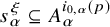 $s^\xi _\alpha \subseteq A^{i_{0,\alpha }(p)}_\alpha $
. This implies in particular that
$s^\xi _\alpha \subseteq A^{i_{0,\alpha }(p)}_\alpha $
. This implies in particular that $s^\theta _\alpha \subseteq A^{i(p)}_\alpha $
, as wanted. Suppose this was true for
$s^\theta _\alpha \subseteq A^{i(p)}_\alpha $
, as wanted. Suppose this was true for $\xi $
, since
$\xi $
, since $i_{\xi ,\xi +1}$
is the ultrapower by the normal
$i_{\xi ,\xi +1}$
is the ultrapower by the normal $W_\xi $
on
$W_\xi $
on $\delta _\xi $
, and
$\delta _\xi $
, and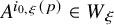 $A^{i_{0,\xi }(p)}\in W_\xi $
, we conclude that
$A^{i_{0,\xi }(p)}\in W_\xi $
, we conclude that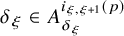 $\delta _\xi \in A^{i_{\xi ,\xi +1}(p)}_{\delta _\xi }$
. Since below
$\delta _\xi \in A^{i_{\xi ,\xi +1}(p)}_{\delta _\xi }$
. Since below $\delta _\xi $
, things do not change, we get that
$\delta _\xi $
, things do not change, we get that $s^{\xi +1}_{i_{\xi ,\xi +1}(\delta _\xi )}\subseteq A^{i_{\xi ,\xi +1}(p)}_{\delta _\xi }$
. Note that above
$s^{\xi +1}_{i_{\xi ,\xi +1}(\delta _\xi )}\subseteq A^{i_{\xi ,\xi +1}(p)}_{\delta _\xi }$
. Note that above $\xi $
, all the sequences are empty at this stage of the iteration.
$\xi $
, all the sequences are empty at this stage of the iteration.
For the third item, let $H = \operatorname {\mathrm {Hull}}^{N[G]}(i[V]\cup \{G\})$
. To establish that
$H = \operatorname {\mathrm {Hull}}^{N[G]}(i[V]\cup \{G\})$
. To establish that $H = N[G]$
, we will show that
$H = N[G]$
, we will show that $N\subseteq H$
. Then
$N\subseteq H$
. Then $H = N[G]$
since
$H = N[G]$
since  and
and $N\cup \{G\}\in H$
.
$N\cup \{G\}\in H$
.
Let $S = \bigcup \vec {s}$
, the set of critical points of the complete iteration. Then S is itself discrete and the set of accumulation points
$S = \bigcup \vec {s}$
, the set of critical points of the complete iteration. Then S is itself discrete and the set of accumulation points $\text {acc}(S)$
equals
$\text {acc}(S)$
equals $\text {acc}(i(\Delta ))$
. Since every element of N is of the form
$\text {acc}(i(\Delta ))$
. Since every element of N is of the form $i(f)(\kappa _1,...,\kappa _m)$
for some
$i(f)(\kappa _1,...,\kappa _m)$
for some $f:[\kappa ]^m\rightarrow V$
, where
$f:[\kappa ]^m\rightarrow V$
, where $\kappa _1,...,\kappa _m\in S$
, it suffices to prove that
$\kappa _1,...,\kappa _m\in S$
, it suffices to prove that $S\subseteq H$
. In turn, it suffices to prove that
$S\subseteq H$
. In turn, it suffices to prove that $i(\Delta )\subseteq H$
, since any element in S is a Prikry point associated with one of the elements of
$i(\Delta )\subseteq H$
, since any element in S is a Prikry point associated with one of the elements of $i(\Delta )$
and therefore is definable from G and
$i(\Delta )$
and therefore is definable from G and $i(\Delta )$
in
$i(\Delta )$
in $N[G]$
.
$N[G]$
.
Suppose towards contradiction that $\zeta $
is the minimal element of
$\zeta $
is the minimal element of $i(\Delta )$
not in H. Since
$i(\Delta )$
not in H. Since $i(\Delta )$
is discrete,
$i(\Delta )$
is discrete, $\gamma =\sup (i(\Delta )\cap \zeta )<\zeta $
. Note that
$\gamma =\sup (i(\Delta )\cap \zeta )<\zeta $
. Note that $\gamma \notin H$
, since otherwise easily
$\gamma \notin H$
, since otherwise easily $\zeta \in H$
. It follows that
$\zeta \in H$
. It follows that $\gamma \in \text {acc}(i(\Delta ))$
since otherwise
$\gamma \in \text {acc}(i(\Delta ))$
since otherwise $\gamma \in i(\Delta )$
, and hence
$\gamma \in i(\Delta )$
, and hence $\gamma \in H$
by the minimality of
$\gamma \in H$
by the minimality of $\zeta $
. Note that
$\zeta $
. Note that $\gamma \subseteq H$
. Note that
$\gamma \subseteq H$
. Note that $\gamma \notin S$
since S is discrete and
$\gamma \notin S$
since S is discrete and $ \gamma \in \text {acc}(i(\Delta ))\subseteq \text {acc}(S)$
. Therefore
$ \gamma \in \text {acc}(i(\Delta ))\subseteq \text {acc}(S)$
. Therefore $\gamma =i(f)(\kappa _1,...,\kappa _m)$
for some
$\gamma =i(f)(\kappa _1,...,\kappa _m)$
for some $\kappa _1,...,\kappa _m<\gamma $
and so
$\kappa _1,...,\kappa _m<\gamma $
and so $\gamma \in H$
, which is a contradiction.
$\gamma \in H$
, which is a contradiction.
The final item follows from the previous one using the standard proof that the ultrapower of V by a $\delta $
-complete ultrafilter is closed under
$\delta $
-complete ultrafilter is closed under $\delta $
-sequences. (In fact, one can view
$\delta $
-sequences. (In fact, one can view $N[G]$
as a Boolean ultrapower of V and apply [Reference David Hamkins and Evan Seabold8, Theorem 28].) Fix a
$N[G]$
as a Boolean ultrapower of V and apply [Reference David Hamkins and Evan Seabold8, Theorem 28].) Fix a $\delta $
-sequence of elements
$\delta $
-sequence of elements $\langle x_\alpha \mid \alpha < \delta \rangle \subseteq N[G]$
. By the previous item, each
$\langle x_\alpha \mid \alpha < \delta \rangle \subseteq N[G]$
. By the previous item, each $x_\alpha $
is the interpretation of some
$x_\alpha $
is the interpretation of some $i(\tau _\alpha )$
via G. Note that
$i(\tau _\alpha )$
via G. Note that
 $$ \begin{align*}{\langle} i(\tau_\alpha)\mid \alpha<\delta{\rangle}=i({\langle} \tau_\alpha\mid \alpha<\delta{\rangle})\restriction\delta\in N.\end{align*} $$
Therefore ${\langle } x_\alpha \mid \alpha <\delta {\rangle }\in N[G]$
.
${\langle } x_\alpha \mid \alpha <\delta {\rangle }\in N[G]$
.
The following proposition shows that any ultrafilter used in the complete iteration gives rise to an elementary embedding of the target model of the complete iteration.
Proposition 3.5. If $i=i_{0,\theta } : V\to N$
is the complete iteration V by
$i=i_{0,\theta } : V\to N$
is the complete iteration V by $\vec U$
,
$\vec U$
, $\vec s$
is the associated sequence of sets of indiscernibles, and U is an ultrafilter on
$\vec s$
is the associated sequence of sets of indiscernibles, and U is an ultrafilter on $\delta $
applied at some stage of the complete iteration, then
$\delta $
applied at some stage of the complete iteration, then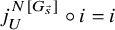 $j_U^{N[G_{\vec s}]}\circ i = i$
and
$j_U^{N[G_{\vec s}]}\circ i = i$
and $j_U^{N[G_{\vec s}]}(\vec s\hspace {.05cm}) = \vec {s}\setminus \{\delta \}$
.
$j_U^{N[G_{\vec s}]}(\vec s\hspace {.05cm}) = \vec {s}\setminus \{\delta \}$
.
Proof. We first consider the special case that $\delta $
is the least element of the domain of
$\delta $
is the least element of the domain of $\vec {U}$
. Note that
$\vec {U}$
. Note that $j_U^{N[G_{\vec s}]} = j_U^V\restriction N[G_{\vec s}]$
because
$j_U^{N[G_{\vec s}]} = j_U^V\restriction N[G_{\vec s}]$
because $N[G_{\vec s}]$
is closed under
$N[G_{\vec s}]$
is closed under $\delta $
-sequences. Therefore
$\delta $
-sequences. Therefore
 $$\begin{align*}j_U^{N[G_{\vec s}]} \circ i = j_U\circ i = j_U(i)\circ j_U = i^U\circ j_U\end{align*}$$
where $i^U : V_U\to N$
denotes the complete iteration of
$i^U : V_U\to N$
denotes the complete iteration of $V_U$
by
$V_U$
by $j_U(\vec U)$
. By the definition of the complete iteration,
$j_U(\vec U)$
. By the definition of the complete iteration, $i^U\circ j_U = i$
, which proves that
$i^U\circ j_U = i$
, which proves that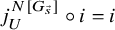 $j_U^{N[G_{\vec s}]}\circ i = i$
. Similarly,
$j_U^{N[G_{\vec s}]}\circ i = i$
. Similarly, $j_U^{N[G_{\vec s}]}(\vec s)$
is the sequence of sets of indiscernibles associated with the complete iteration of
$j_U^{N[G_{\vec s}]}(\vec s)$
is the sequence of sets of indiscernibles associated with the complete iteration of $V_U$
by
$V_U$
by $j_U(\vec U)$
, which is
$j_U(\vec U)$
, which is $\vec {s}\setminus \{\delta \}$
.
$\vec {s}\setminus \{\delta \}$
.
To prove the claim in general, suppose U is the ultrafilter used at stage $\alpha $
of the complete iteration. Then
$\alpha $
of the complete iteration. Then $i = i_{\alpha \infty }\circ i_{0\alpha }$
where
$i = i_{\alpha \infty }\circ i_{0\alpha }$
where $i_{0\alpha } : V\to N_\alpha $
is an initial segment of the complete iteration V by
$i_{0\alpha } : V\to N_\alpha $
is an initial segment of the complete iteration V by $\vec U$
and
$\vec U$
and $i_{\alpha \infty } : N_\alpha \to N$
is the complete iteration of
$i_{\alpha \infty } : N_\alpha \to N$
is the complete iteration of $N_\alpha $
by
$N_\alpha $
by $\vec W = i_{0\alpha }(\vec U)\restriction [\delta ,\infty )$
. Let
$\vec W = i_{0\alpha }(\vec U)\restriction [\delta ,\infty )$
. Let $\vec s^{\hspace {.07cm}0\alpha }$
denote the sequence of sets of indiscernibles associated with
$\vec s^{\hspace {.07cm}0\alpha }$
denote the sequence of sets of indiscernibles associated with $i_{0\alpha }$
and let
$i_{0\alpha }$
and let $\vec s^{\hspace {.07cm}\alpha \infty }$
denote the sequence of sets of indiscernibles associated with
$\vec s^{\hspace {.07cm}\alpha \infty }$
denote the sequence of sets of indiscernibles associated with $i_{\alpha \infty }$
. Then
$i_{\alpha \infty }$
. Then $G_{\vec s^{\hspace {.04cm}0\alpha }}\times G_{\vec s^{\hspace {.04cm}\alpha \infty }} = G_{\vec s}$
.
$G_{\vec s^{\hspace {.04cm}0\alpha }}\times G_{\vec s^{\hspace {.04cm}\alpha \infty }} = G_{\vec s}$
.
The special case of the claim proved above, applied in $N_\alpha $
to U and
$N_\alpha $
to U and $\vec W$
, implies that
$\vec W$
, implies that $j_U^{N[G_{\vec s^{\hspace {.04cm}\alpha \infty }}]}\circ i_{\alpha \infty } = i_{\alpha \infty }$
and
$j_U^{N[G_{\vec s^{\hspace {.04cm}\alpha \infty }}]}\circ i_{\alpha \infty } = i_{\alpha \infty }$
and $j_U^{N[G_{\vec s^{\hspace {.04cm}\alpha \infty }}]}(\vec s^{\hspace {.07cm}\alpha \infty }) = \vec s^{\hspace {.07cm}\alpha \infty }\setminus \{\delta \}$
. This yields the full claim almost immediately, except that we have to verify that
$j_U^{N[G_{\vec s^{\hspace {.04cm}\alpha \infty }}]}(\vec s^{\hspace {.07cm}\alpha \infty }) = \vec s^{\hspace {.07cm}\alpha \infty }\setminus \{\delta \}$
. This yields the full claim almost immediately, except that we have to verify that $j_U^{N[G_{\vec s^{\hspace {.04cm}\alpha \infty }}]}$
is the restriction of
$j_U^{N[G_{\vec s^{\hspace {.04cm}\alpha \infty }}]}$
is the restriction of $j_U^{N[G_{\vec s}]}$
to
$j_U^{N[G_{\vec s}]}$
to $N[G_{\vec s^{\hspace {.04cm}\alpha \infty }}]$
. But
$N[G_{\vec s^{\hspace {.04cm}\alpha \infty }}]$
. But $j_U^{N[G_{\vec s}]} = j_U^{N[G_{\vec s^{\hspace {.04cm}0\alpha }}\times G_{\vec s^{\hspace {.04cm}\alpha \infty }}]}$
, which extends
$j_U^{N[G_{\vec s}]} = j_U^{N[G_{\vec s^{\hspace {.04cm}0\alpha }}\times G_{\vec s^{\hspace {.04cm}\alpha \infty }}]}$
, which extends $j_U^{N[G_{\vec s^{\hspace {.04cm}\alpha \infty }}]}$
by the proof of the classical Lévy-Solovay theorem [Reference Lévy and Solovay10].
$j_U^{N[G_{\vec s^{\hspace {.04cm}\alpha \infty }}]}$
by the proof of the classical Lévy-Solovay theorem [Reference Lévy and Solovay10].
3.1 The canonical extension of an ultrafilter
Suppose that in V, W is a $\kappa $
-complete ultrafilter on a set X. Using a construction due to Mitchell [Reference Mithcell12], we will define a
$\kappa $
-complete ultrafilter on a set X. Using a construction due to Mitchell [Reference Mithcell12], we will define a $\kappa $
-complete
$\kappa $
-complete $V[G]$
-ultrafilter
$V[G]$
-ultrafilter $W^*\in V[G]$
extending W. (The extension
$W^*\in V[G]$
extending W. (The extension $W^*$
is essentially due to Magidor; it is the construction of
$W^*$
is essentially due to Magidor; it is the construction of $W^*$
using complete iterations that is due to Mitchell.)
$W^*$
using complete iterations that is due to Mitchell.)
Let $j : V\to M$
be the ultrapower embedding associated with W. Let
$j : V\to M$
be the ultrapower embedding associated with W. Let ${\mathbb {Q}} = \mathbb P_{>\kappa }$
, so that
${\mathbb {Q}} = \mathbb P_{>\kappa }$
, so that $j(\mathbb P_\kappa )$
can be naturally identified with
$j(\mathbb P_\kappa )$
can be naturally identified with $\mathbb P_\kappa \times {\mathbb {Q}}$
. To lift j to
$\mathbb P_\kappa \times {\mathbb {Q}}$
. To lift j to $V[G]$
, one might try to produce an M-generic H on
$V[G]$
, one might try to produce an M-generic H on ${\mathbb {Q}}$
such that
${\mathbb {Q}}$
such that $j[G]\subseteq G\times H$
. If
$j[G]\subseteq G\times H$
. If $\Delta $
is unbounded in
$\Delta $
is unbounded in $\kappa $
, however, no such M-generic H can exist in
$\kappa $
, however, no such M-generic H can exist in $V[G]$
: the ordinal
$V[G]$
: the ordinal $\delta = \min (j(\Delta )\cap (\kappa ,j(\kappa )))$
has uncountable cofinality in
$\delta = \min (j(\Delta )\cap (\kappa ,j(\kappa )))$
has uncountable cofinality in $V[G]$
, so in
$V[G]$
, so in $V[G]$
, there is no cofinal
$V[G]$
, there is no cofinal $\omega $
-sequence in
$\omega $
-sequence in $\delta $
.
$\delta $
.
Instead, we will produce an inner model N and an elementary embedding $i: M\to N$
such that there is an N-generic filter H on
$i: M\to N$
such that there is an N-generic filter H on $i({\mathbb {Q}})$
with
$i({\mathbb {Q}})$
with $i\circ j[G]\subseteq G\times H$
. Then by the Silver lifting criterion,
$i\circ j[G]\subseteq G\times H$
. Then by the Silver lifting criterion, $i\circ j$
lifts to an elementary embedding from
$i\circ j$
lifts to an elementary embedding from $V[G]$
to
$V[G]$
to $N[G\times H]$
.
$N[G\times H]$
.
Let $i : M \to N$
be the complete iteration of M via the sequence
$i : M \to N$
be the complete iteration of M via the sequence $j(\vec U)\restriction (\kappa ,j(\kappa ))$
. Let
$j(\vec U)\restriction (\kappa ,j(\kappa ))$
. Let $\vec s$
be the sequence of sets of indiscernibles associated with the complete iteration, and let
$\vec s$
be the sequence of sets of indiscernibles associated with the complete iteration, and let $G_{\vec s}$
be the associated N-generic filter on
$G_{\vec s}$
be the associated N-generic filter on $i({\mathbb {Q}})$
(Definition 3.3).
$i({\mathbb {Q}})$
(Definition 3.3).
Note that G is an $N[G_{\vec {s}}]$
-generic filter on
$N[G_{\vec {s}}]$
-generic filter on $\mathbb P_\kappa $
, and so by the Product Lemma,
$\mathbb P_\kappa $
, and so by the Product Lemma, $G\times G_{\vec {s}}$
is an N-generic filter on
$G\times G_{\vec {s}}$
is an N-generic filter on $\mathbb P_\kappa \times {\mathbb {Q}}$
. We must verify that
$\mathbb P_\kappa \times {\mathbb {Q}}$
. We must verify that $i\circ j[G]\subseteq G\times G_{\vec {s}}$
. For each
$i\circ j[G]\subseteq G\times G_{\vec {s}}$
. For each $p\in \mathbb P_\kappa $
,
$p\in \mathbb P_\kappa $
, $j(p)$
has the form
$j(p)$
has the form $(p,q)$
where
$(p,q)$
where $q\in {\mathbb {Q}}$
is a pure condition, or in other words, a direct extension of
$q\in {\mathbb {Q}}$
is a pure condition, or in other words, a direct extension of $1_{\mathbb {Q}}$
, and therefore
$1_{\mathbb {Q}}$
, and therefore $i\circ j(p) = (p,i(q))$
. For every pure condition
$i\circ j(p) = (p,i(q))$
. For every pure condition $q\in {\mathbb {Q}}$
,
$q\in {\mathbb {Q}}$
, $i(q)$
belongs to H, by Lemma 3.4. Hence
$i(q)$
belongs to H, by Lemma 3.4. Hence $i\circ j(p)=(p,i(q))\in G\times G_{\vec {s}}$
.
$i\circ j(p)=(p,i(q))\in G\times G_{\vec {s}}$
.
By the Silver lifting criterion, let $j^* : V[G]\to N[G\times G_{\vec {s}}]$
be the unique lift of
$j^* : V[G]\to N[G\times G_{\vec {s}}]$
be the unique lift of $i\circ j$
such that
$i\circ j$
such that $j^*(G) = G\times G_{\vec {s}}$
.
$j^*(G) = G\times G_{\vec {s}}$
.
Definition 3.6. The canonical extension of W to $V[G]$
is the
$V[G]$
is the $V[G]$
-ultrafilter
$V[G]$
-ultrafilter $W^*$
on X derived from
$W^*$
on X derived from $j^*$
using
$j^*$
using $i([\text {id}]_W)$
.
$i([\text {id}]_W)$
.
Note that $W^*$
is
$W^*$
is $\kappa $
-complete in
$\kappa $
-complete in $V[G]$
since it is derived from
$V[G]$
since it is derived from $j^*$
, which has critical point at least
$j^*$
, which has critical point at least $\kappa $
.
$\kappa $
.
The next proposition shows $N[G\times G_{\vec {s}}] = V[G]_{W^*}$
and
$N[G\times G_{\vec {s}}] = V[G]_{W^*}$
and $j^* = j_{W^*}$
.
$j^* = j_{W^*}$
.
Proposition 3.7. Suppose W is a $\kappa $
-complete ultrafilter and
$\kappa $
-complete ultrafilter and $W^*$
is the canonical extension of W to
$W^*$
is the canonical extension of W to $V[G]$
. Then
$V[G]$
. Then $j_{W^*}\restriction V = i\circ j_W$
where
$j_{W^*}\restriction V = i\circ j_W$
where $i : V_W\to N$
is the complete iteration of
$i : V_W\to N$
is the complete iteration of $V_W$
associated with
$V_W$
associated with $j_W(\vec U)\restriction (\kappa ,j_W(\kappa ))$
. Moreover,
$j_W(\vec U)\restriction (\kappa ,j_W(\kappa ))$
. Moreover, $j_{W^*}(G)=G\times G_{\vec {s}}$
where
$j_{W^*}(G)=G\times G_{\vec {s}}$
where $\vec {s}$
is the sequence of sets of indiscernibles associated with the complete iteration.
$\vec {s}$
is the sequence of sets of indiscernibles associated with the complete iteration.
Proof. The proposition follows from Corollary 2.3 once we show that
 $$ \begin{align*}N[G\times G_{\vec{s}}]=\operatorname{\mathrm{Hull}}^{N[G\times G_{\vec{s}}]}(i\circ j_W[V]\cup \{G, G_{\vec{s}},i([id]_W)\}).\end{align*} $$
This in fact implies directly that $j_{W^*}=j^*$
. To see the above, applying the third item of Lemma 3.4 inside of M, we see that
$j_{W^*}=j^*$
. To see the above, applying the third item of Lemma 3.4 inside of M, we see that
 $$ \begin{align*}N[G_{\vec{s}}]=\operatorname{\mathrm{Hull}}^{N[ G_{\vec{s}}]}(i\circ j_W[V]\cup \{G_{\vec{s}},i([id]_W)\}).\end{align*} $$
Then we finish by noting that being a forcing extension of $N[G_{\vec {s}}]$
,
$N[G_{\vec {s}}]$
, $N[G\times G_{\vec {s}}]$
is the hull (in itself) of
$N[G\times G_{\vec {s}}]$
is the hull (in itself) of $N[G_{\vec {s}}]\cup \{G\}$
.
$N[G_{\vec {s}}]\cup \{G\}$
.
In the case that W is $\Delta $
-mild, Theorem 2.1.3 shows that
$\Delta $
-mild, Theorem 2.1.3 shows that $W^*$
is the unique extension of W in
$W^*$
is the unique extension of W in $V[G]$
and therefore Proposition 3.7 can be used to analyze the ultrapower of the ultrafilter generated by W in the generic extension. This is a slight generalization of Kaplan’s theorem stated in the introduction. Although this is just the combination of Theorem 2.1.3 and Proposition 3.7, we record it for future use.
$V[G]$
and therefore Proposition 3.7 can be used to analyze the ultrapower of the ultrafilter generated by W in the generic extension. This is a slight generalization of Kaplan’s theorem stated in the introduction. Although this is just the combination of Theorem 2.1.3 and Proposition 3.7, we record it for future use.
Corollary 3.8. Let W be a $\Delta $
-mild ultrafilter in V and let
$\Delta $
-mild ultrafilter in V and let $G\subseteq \mathbb {P}_\kappa $
be V-generic. In
$G\subseteq \mathbb {P}_\kappa $
be V-generic. In $V[G]$
, W generates its own canonical extension
$V[G]$
, W generates its own canonical extension $W^*$
and
$W^*$
and $j_{W^*}\restriction V=i\circ j_W$
, where
$j_{W^*}\restriction V=i\circ j_W$
, where $i : V_W\to N$
is the complete iteration of M associated with
$i : V_W\to N$
is the complete iteration of M associated with $j(\vec U)\restriction (\kappa ,j(\kappa ))$
. Moreover,
$j(\vec U)\restriction (\kappa ,j(\kappa ))$
. Moreover, $j_{W^*}(G)=G\times G_{\vec {s}}$
where
$j_{W^*}(G)=G\times G_{\vec {s}}$
where $\vec {s}$
is the sequence of sets of indiscernibles associated with the complete iteration.
$\vec {s}$
is the sequence of sets of indiscernibles associated with the complete iteration.
We now give Ben-Neria’s counterexample to normal measures generating ultrafilters after (nondiscrete) Magidor iterations.
Example 3.9. Suppose $\kappa $
is a measurable cardinal of Mitchell order
$\kappa $
is a measurable cardinal of Mitchell order $2$
,
$2$
, $\Delta $
is the set of all measurable cardinals less than
$\Delta $
is the set of all measurable cardinals less than $\kappa $
, and
$\kappa $
, and $G\subseteq \mathbb P_\kappa $
is V-generic for the Magidor iteration.
$G\subseteq \mathbb P_\kappa $
is V-generic for the Magidor iteration.
Take any normal measure $U_1$
over
$U_1$
over $\kappa $
of Mitchell order 1 in the ground model. Ben-Neria [Reference Ben-Neria1, Notation 2.3] defines an ultrafilter
$\kappa $
of Mitchell order 1 in the ground model. Ben-Neria [Reference Ben-Neria1, Notation 2.3] defines an ultrafilter $U_1^\times $
as the projection of
$U_1^\times $
as the projection of $U_1^*$
by the function
$U_1^*$
by the function $d : \Delta \to \kappa $
mapping each measurable cardinal in
$d : \Delta \to \kappa $
mapping each measurable cardinal in $\Delta $
to the least element of its corresponding Príkry sequence.
$\Delta $
to the least element of its corresponding Príkry sequence.
By Ben-Neria [Reference Ben-Neria1, Proposition 2.1], $U_1^\times $
is a normal measure in
$U_1^\times $
is a normal measure in $V[G]$
. Let
$V[G]$
. Let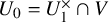 $U_0=U_1^\times \cap V$
, so that
$U_0=U_1^\times \cap V$
, so that $U_0$
is a normal ultrafilter in V by [Reference Gitik and Kaplan5]. Also
$U_0$
is a normal ultrafilter in V by [Reference Gitik and Kaplan5]. Also $U_0$
must be of order
$U_0$
must be of order $0$
(and in particular
$0$
(and in particular $U_0 \neq U_1$
): otherwise, d would be a finite-to-one regressive function defined
$U_0 \neq U_1$
): otherwise, d would be a finite-to-one regressive function defined $U_1^\times $
-large set.
$U_1^\times $
-large set.
Consider the ultrafilter $U_0^*$
. Then
$U_0^*$
. Then $U_0^*$
is a normal ultrafilter [Reference Ben-Neria1, 2.1] in
$U_0^*$
is a normal ultrafilter [Reference Ben-Neria1, 2.1] in $V[G]$
and we claim that
$V[G]$
and we claim that $U_0^*\neq U_1^\times $
, which yields two distinct extensions of
$U_0^*\neq U_1^\times $
, which yields two distinct extensions of $U_0$
to normal ultrafilters in
$U_0$
to normal ultrafilters in $V[G]$
. Indeed, since
$V[G]$
. Indeed, since $U_1$
is of order
$U_1$
is of order $1$
, the set
$1$
, the set $\Delta $
of measurables below
$\Delta $
of measurables below $\kappa $
is in
$\kappa $
is in $U_1$
, and therefore, by definition
$U_1$
, and therefore, by definition $d[\Delta ]\in d_*(U_1)=U_1^\times $
. On the other hand, as
$d[\Delta ]\in d_*(U_1)=U_1^\times $
. On the other hand, as $U_0$
is of order
$U_0$
is of order $0$
,
$0$
, $d[\Delta ]\notin U_0^*$
: otherwise,
$d[\Delta ]\notin U_0^*$
: otherwise, $\kappa $
must appear in the Príkry sequence in
$\kappa $
must appear in the Príkry sequence in $V[G]_{U_0^*}$
associated to some element of
$V[G]_{U_0^*}$
associated to some element of $j_{U_0^*}(\Delta )$
, but by Proposition 3.7, the elements of these Príkry sequences are critical points in the complete iteration of
$j_{U_0^*}(\Delta )$
, but by Proposition 3.7, the elements of these Príkry sequences are critical points in the complete iteration of $V_{U_0}$
;
$V_{U_0}$
; $\kappa $
cannot be such a critical point since
$\kappa $
cannot be such a critical point since $\kappa $
is not measurable in
$\kappa $
is not measurable in $V_{U_0}$
. Hence
$V_{U_0}$
. Hence $U_1^\times \neq U_0^*$
.
$U_1^\times \neq U_0^*$
.
3.2 Mitchell’s lemma
Next, we prove a variation of Mitchell’s lemma from [Reference Mithcell12], which gives an analysis of ultrapowers of canonical lifts within complete iterates of V that is a key part of the proof of our classification results in Section 5.2. The idea is to take a sufficiently complete ultrafilter W and a complete iteration $i : V \to N$
and analyze the ultrapower embedding associated to the canonical extension of
$i : V \to N$
and analyze the ultrapower embedding associated to the canonical extension of $i(W)$
to
$i(W)$
to $N[G_{\vec s}]$
, where
$N[G_{\vec s}]$
, where $\vec s$
is the sequence of sets of indiscernibles. It turns out that this embedding is simply the restriction to
$\vec s$
is the sequence of sets of indiscernibles. It turns out that this embedding is simply the restriction to $N[G_{\vec s}]$
of the ultrapower embedding
$N[G_{\vec s}]$
of the ultrapower embedding $j_W : V\to V_W$
.
$j_W : V\to V_W$
.
Let $\vec {U}$
be a sequence of normal measures on a discrete set
$\vec {U}$
be a sequence of normal measures on a discrete set $\Delta \subseteq \kappa $
. Let
$\Delta \subseteq \kappa $
. Let $i=i_{0,\infty }:V\rightarrow N$
be the complete iteration of V by
$i=i_{0,\infty }:V\rightarrow N$
be the complete iteration of V by $\vec {U}$
, and
$\vec {U}$
, and $\vec {s}={\langle } s^\infty _\alpha \mid \alpha \in i(\Delta ){\rangle }$
be the associated sequence of sets of indiscernibles, and let
$\vec {s}={\langle } s^\infty _\alpha \mid \alpha \in i(\Delta ){\rangle }$
be the associated sequence of sets of indiscernibles, and let $G = G_{\vec s}$
.
$G = G_{\vec s}$
.
Lemma 3.10 (Mitchell).
Suppose that W is a $\kappa $
-complete ultrafilter. Then
$\kappa $
-complete ultrafilter. Then
 $$\begin{align*}j_{i(W)^*}^{N[G_{\vec s}]} = j_{W}\restriction N[G_{\vec{s}}].\end{align*}$$
Moreover, the canonical factor map $k:N_{i(W)}\to j_{i(W)^*}(N)$
is given by the complete iteration of
$k:N_{i(W)}\to j_{i(W)^*}(N)$
is given by the complete iteration of $N_{i(W)}$
by
$N_{i(W)}$
by $i(j_W(\vec {U}))\restriction (\kappa , j_W(\kappa ))$
.
$i(j_W(\vec {U}))\restriction (\kappa , j_W(\kappa ))$
.
Proof. By replacing $\kappa $
with the completeness of W, we may assume that
$\kappa $
with the completeness of W, we may assume that $\kappa $
is a measurable cardinal, and in particular that
$\kappa $
is a measurable cardinal, and in particular that $\kappa $
is strongly inaccessible.
$\kappa $
is strongly inaccessible.
We first note the bottom rectangle in Figure 1 commutes; this is just by the usual formula $j_{i(W)}\circ i = i \circ j_W$
.
$j_{i(W)}\circ i = i \circ j_W$
.
Mitchell’s diagram.

Second, we note that for the same reason the quadrangle with vertices V, N, $j_W(N)$
, and
$j_W(N)$
, and $V_W$
also commutes, using here that
$V_W$
also commutes, using here that $j_W(\vec {U})\restriction \kappa =\vec {U}$
and therefore
$j_W(\vec {U})\restriction \kappa =\vec {U}$
and therefore
 $$\begin{align*}j_W(i) = i^{j_W(\vec U)} = i_{\kappa,\infty}^{j_W(\vec U)}\circ i\end{align*}$$
For ease of notation, for any $j : V\to M$
obtained by composing arrows in the diagram, let
$j : V\to M$
obtained by composing arrows in the diagram, let $\vec {U}^M = j(\vec U)$
. (The fact that this is well-defined follows from the commutativity we have established.)
$\vec {U}^M = j(\vec U)$
. (The fact that this is well-defined follows from the commutativity we have established.)
The commutativity established in the previous paragraphs allows us to show that
 $$\begin{align*}j_W\restriction N = j_{i(W)^*}^{N[G_{\vec {s}}]}\restriction N\end{align*}$$
To prove this, we first observe $i^{\vec {U}^{N_{i(W)}}\restriction (\kappa ,\infty )} = i_{\kappa ,\infty }^{\vec U^{V_W}},$
by the definition of the complete iteration: since
$i^{\vec {U}^{N_{i(W)}}\restriction (\kappa ,\infty )} = i_{\kappa ,\infty }^{\vec U^{V_W}},$
by the definition of the complete iteration: since $i_{0\kappa }^{\vec U^{V_W}} = i\restriction V_W$
, which embeds
$i_{0\kappa }^{\vec U^{V_W}} = i\restriction V_W$
, which embeds $V_W$
into
$V_W$
into $N_{i(W)}$
,
$N_{i(W)}$
, $i_{\kappa ,\infty }^{\vec U^{V_W}}$
is the complete iteration of
$i_{\kappa ,\infty }^{\vec U^{V_W}}$
is the complete iteration of $\vec U^{N_{i(W)}}$
restricted to measures above
$\vec U^{N_{i(W)}}$
restricted to measures above $\kappa $
.
$\kappa $
.
Then by Proposition 3.7,
 $$\begin{align*}j_{i(W)^*}^{N[G_{\vec {s}}]}\restriction N = i^{\vec U^{N_{i(W)}}\restriction (\kappa,\infty)} \circ j_{i(W)} = i_{\kappa,\infty}^{\vec U^{V_W}}\circ j_{i(W)}\end{align*}$$
By the commutativity facts established in the first two paragraphs, $j_W\restriction N$
and
$j_W\restriction N$
and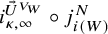 $i_{\kappa ,\infty }^{\vec U^{V_W}}\circ j_{i(W)}^N$
agree on
$i_{\kappa ,\infty }^{\vec U^{V_W}}\circ j_{i(W)}^N$
agree on $i[V]$
. Moreover
$i[V]$
. Moreover $j_W\restriction N$
and
$j_W\restriction N$
and $i_{\kappa ,\infty }^{\vec U^{V_W}}\circ j_{i(W)}^N$
agree on
$i_{\kappa ,\infty }^{\vec U^{V_W}}\circ j_{i(W)}^N$
agree on $\kappa $
, both being the identity there. Since
$\kappa $
, both being the identity there. Since $N = \operatorname {\mathrm {Hull}}^N(i[V]\cup \kappa )$
, it follows that
$N = \operatorname {\mathrm {Hull}}^N(i[V]\cup \kappa )$
, it follows that $j_W\restriction N = j_{i(W)^*}^{N[G_{\vec {s}}]}\restriction N$
as claimed.
$j_W\restriction N = j_{i(W)^*}^{N[G_{\vec {s}}]}\restriction N$
as claimed.
Next, to show that $j_{i(W)^*}^{N[G_{\vec {s}}]} = j_W\restriction N[G_{\vec s}]$
, it now suffices to prove that these two embeddings agree on
$j_{i(W)^*}^{N[G_{\vec {s}}]} = j_W\restriction N[G_{\vec s}]$
, it now suffices to prove that these two embeddings agree on $G_{\vec s}$
. By elementarity,
$G_{\vec s}$
. By elementarity, $j_W(G_{\vec s})$
is equal to the generic associated to the sequence
$j_W(G_{\vec s})$
is equal to the generic associated to the sequence $j_W(\vec s)$
of sets of indiscernibles coming from the complete iteration of
$j_W(\vec s)$
of sets of indiscernibles coming from the complete iteration of $V_W$
by
$V_W$
by $j_W(\vec U)$
. But
$j_W(\vec U)$
. But $j_{i(W)^*}(G_{\vec s})$
is equal to the same thing, by the “moreover” clause of Proposition 3.7 and calculations similar to the previous paragraph.
$j_{i(W)^*}(G_{\vec s})$
is equal to the same thing, by the “moreover” clause of Proposition 3.7 and calculations similar to the previous paragraph.
Corollary 3.11. Suppose $\lambda \notin \Delta $
is a measurable cardinal and W is a
$\lambda \notin \Delta $
is a measurable cardinal and W is a $\lambda $
-complete ultrafilter on
$\lambda $
-complete ultrafilter on $\lambda $
. Then
$\lambda $
. Then $j_{i(W)^*}^{N[G_{\vec s}]}=j_W\restriction N[G_{\vec {s}}]$
.
$j_{i(W)^*}^{N[G_{\vec s}]}=j_W\restriction N[G_{\vec {s}}]$
.
Proof. By the previous lemma, it suffices to consider the case that $\lambda < \sup \Delta $
. Also, the previous lemma implies that
$\lambda < \sup \Delta $
. Also, the previous lemma implies that $j_{\overline {i}(W)^*}^{\overline {N}[G_{\vec t}]} = j_W\restriction \overline {N}[G_{\vec t}]$
where
$j_{\overline {i}(W)^*}^{\overline {N}[G_{\vec t}]} = j_W\restriction \overline {N}[G_{\vec t}]$
where $\overline i : V\to \overline N$
is the complete iteration of
$\overline i : V\to \overline N$
is the complete iteration of $\vec U$
restricted to measures below
$\vec U$
restricted to measures below $\lambda $
and
$\lambda $
and $\vec t$
is the associated sequence of sets of indiscernibles.
$\vec t$
is the associated sequence of sets of indiscernibles.
Note however that $\overline i( W) = i(W)$
, and by Lemma 3.4 applied in
$\overline i( W) = i(W)$
, and by Lemma 3.4 applied in $\overline N[G_{\vec t}]$
,
$\overline N[G_{\vec t}]$
, $N[G_{\vec s}]$
is an inner model of
$N[G_{\vec s}]$
is an inner model of $\overline N[G_{\vec t}]$
that is closed under
$\overline N[G_{\vec t}]$
that is closed under $\lambda $
-sequences in
$\lambda $
-sequences in $\overline N[G_{\vec t}]$
. It follows that
$\overline N[G_{\vec t}]$
. It follows that
 $$\begin{align*}j_{i(W)^*}^{N[G_{\vec s}]} = j_{\overline i(W)^*}^{\overline N[G_{\vec t}]}\restriction N[G_{\vec s}] = j_W\restriction N[G_{\vec s}],\end{align*}$$
which proves the corollary.
3.3 Normal measures and the complete iteration
In our classification of lifts of ultrafilters under the discrete Magidor product we will have to classify the possible extensions of the point-wise images of a normal ultrafilter under the complete iteration. The next lemmas will be used for that purpose. The tail filter on an ultrafilter $\rho $
is the filter generated by the sets
$\rho $
is the filter generated by the sets $\{(\alpha ,\rho )\mid \alpha <\rho \}$
.
$\{(\alpha ,\rho )\mid \alpha <\rho \}$
.
Lemma 3.12. If $i : M\to N$
is an elementary embedding,
$i : M\to N$
is an elementary embedding, $U\in M$
is a normal ultrafilter on
$U\in M$
is a normal ultrafilter on $\delta $
, and
$\delta $
, and $N = \operatorname {\mathrm {Hull}}^N(i[M]\cup i(\delta ))$
, then
$N = \operatorname {\mathrm {Hull}}^N(i[M]\cup i(\delta ))$
, then $F \cup i[U]$
generates
$F \cup i[U]$
generates $i(U)$
where F denotes the tail filter on
$i(U)$
where F denotes the tail filter on $i(\delta )$
.
$i(\delta )$
.
Proof. Let $X\in i(U)$
. Since
$X\in i(U)$
. Since $N=\operatorname {\mathrm {Hull}}^N(i[M]\cup i(\delta ))$
, there is
$N=\operatorname {\mathrm {Hull}}^N(i[M]\cup i(\delta ))$
, there is $f\in M$
and
$f\in M$
and $\eta <i(\delta )$
such that
$\eta <i(\delta )$
such that $X=i(f)(\eta )$
. Changing f if needed, we may assume that
$X=i(f)(\eta )$
. Changing f if needed, we may assume that $f:\delta \rightarrow U$
. Let
$f:\delta \rightarrow U$
. Let $A^*=\Delta _{\alpha <\delta }f(\alpha )$
, then by the normality assumption
$A^*=\Delta _{\alpha <\delta }f(\alpha )$
, then by the normality assumption $A^*\in U$
. It follows that
$A^*\in U$
. It follows that $i(A^*)\setminus \eta +1\subseteq i(f)(\eta )=X$
, and therefore X is in the filter generated by
$i(A^*)\setminus \eta +1\subseteq i(f)(\eta )=X$
, and therefore X is in the filter generated by $F\cup i[U]$
.
$F\cup i[U]$
.
Lemma 3.13. Suppose $i : M\to N$
is the complete iteration of
$i : M\to N$
is the complete iteration of $\vec U$
,
$\vec U$
, $\delta = \min (\operatorname {\mathrm {dom}}(\vec U))$
, and
$\delta = \min (\operatorname {\mathrm {dom}}(\vec U))$
, and $\eta \leq i(\delta )$
. Let
$\eta \leq i(\delta )$
. Let $X = \operatorname {\mathrm {Hull}}^N(i[M]\cup \eta )$
, let
$X = \operatorname {\mathrm {Hull}}^N(i[M]\cup \eta )$
, let $k : \overline N\to N$
be the inverse of the transitive collapse of X, and let
$k : \overline N\to N$
be the inverse of the transitive collapse of X, and let $\overline i = k^{-1}\circ i$
. Let
$\overline i = k^{-1}\circ i$
. Let $n \leq \omega $
be least such that
$n \leq \omega $
be least such that $\eta \leq i_{0n}(\delta )$
. Then
$\eta \leq i_{0n}(\delta )$
. Then $\overline {i} = i_{0n}$
and
$\overline {i} = i_{0n}$
and $k = i_{n\infty }$
.
$k = i_{n\infty }$
.
Proof. Let $M_n$
be the (transitive)
$M_n$
be the (transitive) $n^{\text {th}}$
-iterate of M in i, namely
$n^{\text {th}}$
-iterate of M in i, namely $i_{n,\infty }:M_n\rightarrow N$
, and
$i_{n,\infty }:M_n\rightarrow N$
, and $i_{0,n}:M\rightarrow M_n$
. We claim that
$i_{0,n}:M\rightarrow M_n$
. We claim that $X=i_{n,\infty }[M_n]$
, from which it follows via uniqueness that
$X=i_{n,\infty }[M_n]$
, from which it follows via uniqueness that $i_{n,\infty }=k$
and therefore
$i_{n,\infty }=k$
and therefore $\overline {i}=k^{-1}\circ i=i_{0,n}$
. Indeed, any
$\overline {i}=k^{-1}\circ i=i_{0,n}$
. Indeed, any $x\in X$
has the form
$x\in X$
has the form $i(f)(\xi )$
for some
$i(f)(\xi )$
for some $\xi <\eta \leq i_{0,n}(\delta )$
. Each such ordinal can be represented using
$\xi <\eta \leq i_{0,n}(\delta )$
. Each such ordinal can be represented using $\delta ,i_{0,1}(\delta ),...,i_{0,n-1}(\delta )$
and therefore we may assume that
$\delta ,i_{0,1}(\delta ),...,i_{0,n-1}(\delta )$
and therefore we may assume that $x=i(f)(\delta ,i_{0,1}(\delta ),...,i_{0,n-1}(\delta ))$
since the critical point of
$x=i(f)(\delta ,i_{0,1}(\delta ),...,i_{0,n-1}(\delta ))$
since the critical point of $i_{n,\infty }$
is
$i_{n,\infty }$
is $i_{0,n}(\delta )$
, we have that
$i_{0,n}(\delta )$
, we have that
 $$ \begin{align*}x=i_{n,\infty}(i_{0,n}(f)(\delta,i_{0,1}(\delta),...,i_{0,n-1}(\delta)))\in \operatorname{\mathrm{rng}}(i_{n,\infty})\end{align*} $$
The other inclusion is similar.
Lemma 3.14. Suppose $i : M\to N$
is an elementary embedding
$i : M\to N$
is an elementary embedding $\delta $
is a regular cardinal, and
$\delta $
is a regular cardinal, and $\delta \leq \eta < i(\delta )$
is such that
$\delta \leq \eta < i(\delta )$
is such that $\eta \in i(C)$
for every closed unbounded set
$\eta \in i(C)$
for every closed unbounded set $C\subseteq \delta $
in M. Let
$C\subseteq \delta $
in M. Let $X = \operatorname {\mathrm {Hull}}^N(i[M]\cup \eta )$
, let
$X = \operatorname {\mathrm {Hull}}^N(i[M]\cup \eta )$
, let $k : \overline N\to N$
be the inverse of the transitive collapse, and let
$k : \overline N\to N$
be the inverse of the transitive collapse, and let $\overline i = k^{-1}\circ i$
. Then
$\overline i = k^{-1}\circ i$
. Then $\overline i(\delta ) = \eta $
.
$\overline i(\delta ) = \eta $
.
Proof. Since $k^{-1}$
is just the transitive collapse, it suffices to prove that there are no ordinals
$k^{-1}$
is just the transitive collapse, it suffices to prove that there are no ordinals $\alpha \in X$
between
$\alpha \in X$
between $\eta $
and
$\eta $
and $i(\delta )$
. Let
$i(\delta )$
. Let $\alpha \in X$
be below
$\alpha \in X$
be below $i(\delta )$
. Then by
$i(\delta )$
. Then by $\alpha =i(f)(\xi )$
for some
$\alpha =i(f)(\xi )$
for some $\xi <\eta $
. We may assume that
$\xi <\eta $
. We may assume that $f:\delta \rightarrow \delta $
. Let
$f:\delta \rightarrow \delta $
. Let $C_f\subseteq \delta $
be the club of closure points of f. Then the assumption of the Lemma,
$C_f\subseteq \delta $
be the club of closure points of f. Then the assumption of the Lemma, $\eta \in i(C_f)$
, namely,
$\eta \in i(C_f)$
, namely, $\eta $
is a closure point of
$\eta $
is a closure point of $i(f)$
. Since
$i(f)$
. Since $\xi <\eta $
,
$\xi <\eta $
, $\alpha =i(f)(\xi )<\eta $
. Hence no ordinal in X is between
$\alpha =i(f)(\xi )<\eta $
. Hence no ordinal in X is between $\eta $
and
$\eta $
and $i(\delta )$
.
$i(\delta )$
.
A filter on $\rho $
extending the tail filter on
$\rho $
extending the tail filter on $\rho $
is called fine.
$\rho $
is called fine.
Lemma 3.15. Suppose M is a transitive model of set theory, $i : M \to N$
is the complete iteration of
$i : M \to N$
is the complete iteration of $\vec U$
in M, U is a normal M-ultrafilter on
$\vec U$
in M, U is a normal M-ultrafilter on $\delta $
, where
$\delta $
, where $\delta $
is the minimal element in
$\delta $
is the minimal element in $\operatorname {\mathrm {dom}}(\vec {U})$
, and
$\operatorname {\mathrm {dom}}(\vec {U})$
, and $\tilde {U}$
is a fine N-ultrafilter on an ordinal
$\tilde {U}$
is a fine N-ultrafilter on an ordinal $\eta \leq i(\delta )$
extending
$\eta \leq i(\delta )$
extending $\{i(A)\cap \eta : A\in U\}$
. Then one of the following holds:
$\{i(A)\cap \eta : A\in U\}$
. Then one of the following holds:
-
•
$\{i_{0n}(\delta )\}\in \tilde {U}$
for some
$n < \omega $
, -
•
$\tilde {U} = i_{0n}(U)$
for some
$n \leq \omega $
.
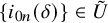


Proof. If $\eta = \nu + 1$
is a successor ordinal, then since
$\eta = \nu + 1$
is a successor ordinal, then since $\tilde {U}$
is fine,
$\tilde {U}$
is fine, $\{\nu \}\in \tilde {U}$
. In that case, for every
$\{\nu \}\in \tilde {U}$
. In that case, for every $A\in U$
,
$A\in U$
, $\nu \in i(A)$
. Note that since the critical point of
$\nu \in i(A)$
. Note that since the critical point of $i_{\omega ,\infty }$
is greater than
$i_{\omega ,\infty }$
is greater than $i_{0,\omega }(\delta )$
,
$i_{0,\omega }(\delta )$
, $i_{0,\omega }(A)=i(A)$
. Since
$i_{0,\omega }(A)=i(A)$
. Since $i_{0,\omega }$
is the
$i_{0,\omega }$
is the $\omega ^{\text {th}}$
iterate of the normal measure
$\omega ^{\text {th}}$
iterate of the normal measure $U_\delta $
, the only seeds for a normal ultrafilter in
$U_\delta $
, the only seeds for a normal ultrafilter in $i_{0,\omega }$
are the
$i_{0,\omega }$
are the $i_{0,n}(\delta )$
’sFootnote
3
, hence
$i_{0,n}(\delta )$
’sFootnote
3
, hence $\nu = i_{0n}(\delta )$
for some
$\nu = i_{0n}(\delta )$
for some $n < \omega $
.
$n < \omega $
.
Now assume that $\eta $
is a limit ordinal. Since
$\eta $
is a limit ordinal. Since $\tilde {U}$
is fine, every set in
$\tilde {U}$
is fine, every set in $\tilde {U}$
is unbounded in
$\tilde {U}$
is unbounded in $\eta $
. It follows that for every closed unbounded set
$\eta $
. It follows that for every closed unbounded set $C\subseteq \delta $
in M,
$C\subseteq \delta $
in M, $i(C)\cap \eta $
is unbounded in
$i(C)\cap \eta $
is unbounded in $\eta $
, and therefore if
$\eta $
, and therefore if $\eta < i(\delta )$
, then
$\eta < i(\delta )$
, then $\eta \in i(C)$
. Let
$\eta \in i(C)$
. Let $X = \text {Hull}^N(i[M]\cup \eta )$
, let
$X = \text {Hull}^N(i[M]\cup \eta )$
, let $k : \overline N\to N$
be the inverse of the transitive collapse of X, and let
$k : \overline N\to N$
be the inverse of the transitive collapse of X, and let $\overline i = k^{-1}\circ i$
.
$\overline i = k^{-1}\circ i$
.
Note that $\overline i : M\to \overline N$
,
$\overline i : M\to \overline N$
, $\overline N = \text {Hull}^{\overline N}(\overline i[M]\cup \eta )$
, and
$\overline N = \text {Hull}^{\overline N}(\overline i[M]\cup \eta )$
, and $\overline i(\delta ) = \eta $
by Lemma 3.14
Footnote
4
. Lemma 3.12 implies that
$\overline i(\delta ) = \eta $
by Lemma 3.14
Footnote
4
. Lemma 3.12 implies that $F\cup \overline {i}[U]$
generates
$F\cup \overline {i}[U]$
generates $\overline {i}(U)$
, where F denotes the tail filter on
$\overline {i}(U)$
, where F denotes the tail filter on $\eta $
. Since
$\eta $
. Since $\tilde {U}$
is fine,
$\tilde {U}$
is fine, $F\subseteq \tilde {U}$
, and
$F\subseteq \tilde {U}$
, and $\overline i[U]=\{i(A)\cap \eta : A\in U\}\subseteq \tilde {U}$
. Since
$\overline i[U]=\{i(A)\cap \eta : A\in U\}\subseteq \tilde {U}$
. Since $F\cup \overline {i}[U]$
generates
$F\cup \overline {i}[U]$
generates $\overline i(U)$
, it follows that
$\overline i(U)$
, it follows that $\overline i(U)\subseteq \tilde {U}$
.
$\overline i(U)\subseteq \tilde {U}$
.
By Lemma 3.13, there is some $n \leq \omega $
such that
$n \leq \omega $
such that $\overline i = i_{0n}$
and
$\overline i = i_{0n}$
and $k = i_{n\infty }$
. Since
$k = i_{n\infty }$
. Since $k = i_{n\infty }$
and
$k = i_{n\infty }$
and $\eta \leq \operatorname {\mathrm {crit}}(k)$
, we have
$\eta \leq \operatorname {\mathrm {crit}}(k)$
, we have $P(\eta )\cap \overline N = P(\eta )\cap N$
, and therefore using the maximality of ultrafilters and the fact that
$P(\eta )\cap \overline N = P(\eta )\cap N$
, and therefore using the maximality of ultrafilters and the fact that $\overline i(U)\subseteq \tilde {U}$
, we obtain
$\overline i(U)\subseteq \tilde {U}$
, we obtain $\overline i(U) = \tilde {U}$
. Since
$\overline i(U) = \tilde {U}$
. Since $\overline i = i_{0n}$
, we have
$\overline i = i_{0n}$
, we have $\tilde {U} = \overline i(U) = i_{0n}(U)$
, which proves the lemma.
$\tilde {U} = \overline i(U) = i_{0n}(U)$
, which proves the lemma.
4 Some ultrafilters in the discrete Magidor extension
Throughout this section, we fix a measurable cardinal $\kappa $
, a discrete set of measurable cardinals
$\kappa $
, a discrete set of measurable cardinals $\Delta \subseteq \kappa $
such that
$\Delta \subseteq \kappa $
such that $\sup (\Delta )=\kappa $
, a sequence
$\sup (\Delta )=\kappa $
, a sequence $\vec U = \langle U_\delta : \delta \in \Delta \rangle $
of normal ultrafilters
$\vec U = \langle U_\delta : \delta \in \Delta \rangle $
of normal ultrafilters $U_\delta $
on
$U_\delta $
on $\delta $
, and a V-generic filter G on the discrete Magidor product
$\delta $
, and a V-generic filter G on the discrete Magidor product $\mathbb P_\kappa $
associated with
$\mathbb P_\kappa $
associated with $\vec U$
. This section is devoted to showing that Kaplan’s theorem (Corollary 3.8) does not generalize to arbitrary
$\vec U$
. This section is devoted to showing that Kaplan’s theorem (Corollary 3.8) does not generalize to arbitrary $\kappa $
-complete ultrafilters on
$\kappa $
-complete ultrafilters on $\kappa $
.
$\kappa $
.
4.1 An ultrafilter with infinitely many extensions
In this subsection, we exhibit a $\kappa $
-complete ultrafilter W on
$\kappa $
-complete ultrafilter W on $\kappa \times \kappa $
that, in
$\kappa \times \kappa $
that, in $V[G]$
, has infinitely many distinct extensions to
$V[G]$
, has infinitely many distinct extensions to $\kappa $
-complete ultrafilters.
$\kappa $
-complete ultrafilters.
Before we do this, let us make some general comments on where ultrafilters in $V[G]$
come from. Let
$V[G]$
come from. Let $\tilde {W}$
be a
$\tilde {W}$
be a $V[G]$
-ultrafilter. Then
$V[G]$
-ultrafilter. Then $\tilde {W}$
is uniquely determined by the following three ingredients:
$\tilde {W}$
is uniquely determined by the following three ingredients:
-
•
$j_{\tilde {W}}^{V[G]}\restriction V$
, the restricted ultrapower embedding -
•
$j_{\tilde {W}}(G)$
, the image generic -
•
$[\text {id}]_{\tilde {W}}$
, the seed


The first two ingredients determine $j_{\tilde {W}}^{V[G]}$
and given that
$j_{\tilde {W}}^{V[G]}$
and given that $[\text {id}]_{\tilde {W}}=a$
, we can recover
$[\text {id}]_{\tilde {W}}=a$
, we can recover $\tilde {W}$
as the ultrafilter derived from
$\tilde {W}$
as the ultrafilter derived from $j_{\tilde {W}}^{V[G]}$
and a.
$j_{\tilde {W}}^{V[G]}$
and a.
Note that an arbitrary list of ingredients need not form a recipe for cooking up a genuine $V[G]$
-ultrafilter. Suppose one is given an elementary embedding
$V[G]$
-ultrafilter. Suppose one is given an elementary embedding $j : V\to M$
, an M-generic filter H on
$j : V\to M$
, an M-generic filter H on $j(\mathbb P_\kappa )$
and a point
$j(\mathbb P_\kappa )$
and a point $a\in M$
. When is there a
$a\in M$
. When is there a $V[G]$
-ultrafilter
$V[G]$
-ultrafilter $\tilde W$
whose restricted ultrapower is j, image generic is H, and seed a? It is easy to see this is the case if and only if the following hold:
$\tilde W$
whose restricted ultrapower is j, image generic is H, and seed a? It is easy to see this is the case if and only if the following hold:
-
•
$j[G]\subseteq H$
. -
•
$M\subseteq \operatorname {\mathrm {Hull}}^{M[H]}(j[V]\cup \{H,a\})$
.


We use here Corollary 2.3 which sets up an equivalent condition for an embedding $k:V[G]\rightarrow M$
being an ultrapower embedding by some
$k:V[G]\rightarrow M$
being an ultrapower embedding by some $V[G]$
-ultrafilter
$V[G]$
-ultrafilter $\tilde {W}$
.
$\tilde {W}$
.
Let us turn to the description of the ultrafilter W with infinitely many extensions to $V[G]$
. We start with any normal ultrafilter D on
$V[G]$
. We start with any normal ultrafilter D on $\kappa $
. For each
$\kappa $
. For each $\alpha < \kappa $
, let
$\alpha < \kappa $
, let
 $$\begin{align*}\delta(\alpha) = \min (\Delta\setminus \alpha)\end{align*}$$
and let
 $$\begin{align*}W = \sum_{D} U_{\delta(\alpha)}\end{align*}$$
In other words, a set $A\subseteq \kappa \times \kappa $
belongs to W if and only if for D-almost all
$A\subseteq \kappa \times \kappa $
belongs to W if and only if for D-almost all $\alpha $
, for
$\alpha $
, for $U_{\delta (\alpha )}$
-almost all
$U_{\delta (\alpha )}$
-almost all $\beta $
,
$\beta $
, $(\alpha , \beta )\in A$
. The well-known general analysis of sums of ultrafilters yields the following lemma (see, e.g., [Reference Goldberg6, 3.5.7]):
$(\alpha , \beta )\in A$
. The well-known general analysis of sums of ultrafilters yields the following lemma (see, e.g., [Reference Goldberg6, 3.5.7]):
Lemma 4.1. Let $\delta = \min (j_D(\Delta )\setminus \kappa )$
and let
$\delta = \min (j_D(\Delta )\setminus \kappa )$
and let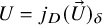 $U = j_D(\vec U)_\delta $
. Then
$U = j_D(\vec U)_\delta $
. Then $V_W = (V_D)_U$
,
$V_W = (V_D)_U$
, $j_W = j_U\circ j_D$
, and
$j_W = j_U\circ j_D$
, and  .
.
A $V[G]$
-ultrafilter
$V[G]$
-ultrafilter $\tilde {W}$
given by the three ingredients extends W if there is an elementary embedding
$\tilde {W}$
given by the three ingredients extends W if there is an elementary embedding $k:V_W\rightarrow j_{\tilde {W}}(V)$
such that the restricted ultrapower
$k:V_W\rightarrow j_{\tilde {W}}(V)$
such that the restricted ultrapower $j^{V[G]}_{\tilde {W}}\restriction V$
is equal to
$j^{V[G]}_{\tilde {W}}\restriction V$
is equal to $k\circ j_W$
and k maps
$k\circ j_W$
and k maps $[id]_W$
to
$[id]_W$
to $[id]_{\tilde {W}}$
.
$[id]_{\tilde {W}}$
.
The first lift is the canonical extension $W^*$
(see Definition 3.6), whose three ingredients are
$W^*$
(see Definition 3.6), whose three ingredients are $i^W\circ j_W, \ G\times G_{\vec {s}^{\hspace {0.04 cm}W}}$
and
$i^W\circ j_W, \ G\times G_{\vec {s}^{\hspace {0.04 cm}W}}$
and $(\kappa ,\delta )$
. Here
$(\kappa ,\delta )$
. Here
 $$\begin{align*}i^W : V_W\to N\end{align*}$$
is the complete iteration of $V_W$
by
$V_W$
by $j_W(\vec U)\restriction (\kappa ,j_W(\kappa ))$
. (Note that the critical point of
$j_W(\vec U)\restriction (\kappa ,j_W(\kappa ))$
. (Note that the critical point of $i^W$
is above
$i^W$
is above $\delta $
.)
$\delta $
.)
To define a noncanonical lift of W, we will absorb $j_U$
into the complete iteration
$j_U$
into the complete iteration $i^D$
. Formally, let
$i^D$
. Formally, let $i^D : V_D\to N'$
be the complete iteration of
$i^D : V_D\to N'$
be the complete iteration of $V_D$
via
$V_D$
via $j_D(\vec U)\restriction (\kappa ,j_D(\kappa ))$
. Since U is the first ultrafilter used in the complete iteration of
$j_D(\vec U)\restriction (\kappa ,j_D(\kappa ))$
. Since U is the first ultrafilter used in the complete iteration of $j_D(\vec U)\restriction (\kappa ,j_D(\kappa ))$
, it is easy to see that
$j_D(\vec U)\restriction (\kappa ,j_D(\kappa ))$
, it is easy to see that $N' = N$
and
$N' = N$
and
 $$\begin{align*}i^D=i^W\circ j_U.\end{align*}$$
Let $\Delta ^N=i^D(\Delta )$
, and let
$\Delta ^N=i^D(\Delta )$
, and let $\vec s^{\hspace {0.07 cm}D} = \langle s^D_\alpha : \alpha \in \Delta ^N\setminus \kappa \rangle $
be the associated sets of indiscernibles. By Proposition 3.7, letting
$\vec s^{\hspace {0.07 cm}D} = \langle s^D_\alpha : \alpha \in \Delta ^N\setminus \kappa \rangle $
be the associated sets of indiscernibles. By Proposition 3.7, letting $D^*$
be the canonical extension of D,
$D^*$
be the canonical extension of D, $j_{D^*}^{V[G]} \restriction V = i^D\circ j_D$
and
$j_{D^*}^{V[G]} \restriction V = i^D\circ j_D$
and $j_{D^*}^{V[G]}(G) = G \times G_{\vec s^{\hspace {0.04 cm}D}}$
.
$j_{D^*}^{V[G]}(G) = G \times G_{\vec s^{\hspace {0.04 cm}D}}$
.
Observe that
 $$\begin{align*}i^W\circ j_W = i^W\circ j_U\circ j_D = i^D\circ j_D\end{align*}$$
Similarly, letting $\vec s^{\hspace {0.07 cm} W} = \langle s^W_\alpha : \alpha \in \Delta ^N\setminus \kappa \rangle $
denote the associated sequence of sets of indiscernibles and
$\vec s^{\hspace {0.07 cm} W} = \langle s^W_\alpha : \alpha \in \Delta ^N\setminus \kappa \rangle $
denote the associated sequence of sets of indiscernibles and $\delta ^* = i^D(\delta )$
, we have
$\delta ^* = i^D(\delta )$
, we have
 $$\begin{align*}s^D_{\alpha} = \begin{cases} s^W_\alpha &\text{if }\alpha\neq \delta^*\\ s^W_{\delta^*}\cup \{\delta\}&\text{if }\alpha = \delta^*\end{cases}\end{align*}$$
It follows that $j_{D^*}\neq j_{W^*}$
since
$j_{D^*}\neq j_{W^*}$
since
 $$\begin{align*}j_{W^*}(G) = G \times G_{\vec s^{\hspace{0.04 cm}W}} \neq G\times G_{\vec s^{\hspace{0.04 cm}D}} = j_{D^*}(G)\end{align*}$$
yet
 $$\begin{align*}V[G]_{W^*} =N[G \times G_{\vec s^{\hspace{0.04 cm}W}}]=N[G \times G_{\vec s^{\hspace{0.04 cm}D}}]=V[G]_{D*}.\end{align*}$$
Now let $W'$
be the
$W'$
be the $V[G]$
-ultrafilter on
$V[G]$
-ultrafilter on $\kappa \times \kappa $
derived from
$\kappa \times \kappa $
derived from $j_{D^*}$
using
$j_{D^*}$
using $(\kappa ,\delta )$
. Then by Corollary 2.3
$(\kappa ,\delta )$
. Then by Corollary 2.3 $j_{W'} = j_{D^*}$
. To see that
$j_{W'} = j_{D^*}$
. To see that $W'$
lifts W, we note that
$W'$
lifts W, we note that $j_{D^*}\restriction V=i^D\circ j_W=i^W\circ j_W$
and again
$j_{D^*}\restriction V=i^D\circ j_W=i^W\circ j_W$
and again $i^W(\kappa ,\delta )=(\kappa ,\delta )$
. So the three ingredients of
$i^W(\kappa ,\delta )=(\kappa ,\delta )$
. So the three ingredients of $W'$
are
$W'$
are $i^W\circ j_W, G\times G_{\vec s^{\hspace {0.04 cm}D}}$
, and
$i^W\circ j_W, G\times G_{\vec s^{\hspace {0.04 cm}D}}$
, and $(\kappa ,\delta )$
. As we noted above,
$(\kappa ,\delta )$
. As we noted above, $j_{D^*}(G)\neq j_{W^*}(G)$
and it follows that
$j_{D^*}(G)\neq j_{W^*}(G)$
and it follows that $W' \neq W^*$
.
$W' \neq W^*$
.
Thus we have constructed two distinct $V[G]$
-ultrafilters extending W: the canonical one, and another that is Rudin-Keisler equivalent to
$V[G]$
-ultrafilters extending W: the canonical one, and another that is Rudin-Keisler equivalent to $D^*$
. Are these the only extensions? As the title of this subsection suggests, the answer is no and there are infinitely many more, falling into two countably infinite families: the first generalizing
$D^*$
. Are these the only extensions? As the title of this subsection suggests, the answer is no and there are infinitely many more, falling into two countably infinite families: the first generalizing $W'$
and the second generalizing
$W'$
and the second generalizing $W^*$
. We begin with the generalizations of
$W^*$
. We begin with the generalizations of $W'$
, which are a bit easier to describe as they are all Rudin-Keisler equivalent to
$W'$
, which are a bit easier to describe as they are all Rudin-Keisler equivalent to $D^*$
. Let
$D^*$
. Let $\langle \delta _n \rangle _{n < \omega }$
be the increasing enumeration of
$\langle \delta _n \rangle _{n < \omega }$
be the increasing enumeration of $s^D_{\delta ^*}$
, the set of indiscernibles associated with
$s^D_{\delta ^*}$
, the set of indiscernibles associated with $\delta ^*$
in the complete iteration of
$\delta ^*$
in the complete iteration of $V_D$
.
$V_D$
.
Definition 4.2. Let $W^1_n$
be the
$W^1_n$
be the $V[G]$
-ultrafilter derived from
$V[G]$
-ultrafilter derived from $j_{D^*}^{V[G]}$
using
$j_{D^*}^{V[G]}$
using $(\kappa ,\delta _n)$
.
$(\kappa ,\delta _n)$
.
The reason this forms an extension of W is that we can represent $i^W\circ j_W$
differently. It is a well-known fact that
$i^W\circ j_W$
differently. It is a well-known fact that $j_{U^{n+1}}=j_{j_{U^n}(U)}\circ j_{U^n}=(j_{U^n}\restriction V_U)\circ j_U$
. Therefore
$j_{U^{n+1}}=j_{j_{U^n}(U)}\circ j_{U^n}=(j_{U^n}\restriction V_U)\circ j_U$
. Therefore
 $$ \begin{align*} i^W\circ j_W&=i^D\circ j_D\\ &= i_{n+1,\theta}^D\circ j_{U^{n+1}}\circ j_D\\ &=i_{n+1,\theta}^D\circ (j_{U^n}\restriction V_U)\circ j_U\circ j_D\\ &=i_{n+1,\theta}^D\circ (j_{U^n}\restriction V_U)\circ j_W \end{align*} $$
Once again it is not hard to see that Corollary 2.3 can be applied here to conclude that for every $n<\omega $
,
$n<\omega $
,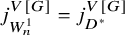 $j^{V[G]}_{W^1_n}=j^{V[G]}_{D^*}$
and
$j^{V[G]}_{W^1_n}=j^{V[G]}_{D^*}$
and $[\text {id}]_{W^1_n} = (\kappa ,\delta _n)$
. In other words, the three ingredients that determine
$[\text {id}]_{W^1_n} = (\kappa ,\delta _n)$
. In other words, the three ingredients that determine $W^1_n$
are
$W^1_n$
are $i^D_{n+1,\theta }\circ j_{U^n}\restriction M_U\circ j_W$
,
$i^D_{n+1,\theta }\circ j_{U^n}\restriction M_U\circ j_W$
, $G\times G_{\vec {s}^{\hspace {0.03 cm}D}}$
, and
$G\times G_{\vec {s}^{\hspace {0.03 cm}D}}$
, and $(\kappa ,\delta _n)$
. Note that
$(\kappa ,\delta _n)$
. Note that $i^D_{n+1,\theta }(j_{U^n}(\kappa ,\delta ))=(\kappa ,j_{U^n}(\delta ))=(\kappa ,\delta _n)$
and therefore
$i^D_{n+1,\theta }(j_{U^n}(\kappa ,\delta ))=(\kappa ,j_{U^n}(\delta ))=(\kappa ,\delta _n)$
and therefore $W^1_n$
lifts W. All the
$W^1_n$
lifts W. All the $W^1_n$
’s are distinct as they are derived from the same normal ultrapower embedding (i.e., they are Rudin-Keisler equivalent) using different seeds.
$W^1_n$
’s are distinct as they are derived from the same normal ultrapower embedding (i.e., they are Rudin-Keisler equivalent) using different seeds.
We now turn to the second family of extensions of W: the generalizations of $W^*$
, which will be denoted by
$W^*$
, which will be denoted by $W^0_n$
. We specify the ultrafilter
$W^0_n$
. We specify the ultrafilter $W^0_n$
by listing the three ingredients first. As in the case of
$W^0_n$
by listing the three ingredients first. As in the case of $W^1_n$
, the restricted ultrapower embedding associated with
$W^1_n$
, the restricted ultrapower embedding associated with $W^0_n$
is
$W^0_n$
is $i^D\circ j_D$
and the seed is
$i^D\circ j_D$
and the seed is $(\kappa ,\delta _n)$
. The difference is in the image generic: we will have
$(\kappa ,\delta _n)$
. The difference is in the image generic: we will have $j_{W^0_n}(G) \neq G\times G_{\vec s^{\hspace { 0.04 cm}D}}$
. Instead,
$j_{W^0_n}(G) \neq G\times G_{\vec s^{\hspace { 0.04 cm}D}}$
. Instead,
 $$\begin{align*}j_{W^0_n}(G) = G\times G_{\vec s^{\hspace{.04cm}n}}\end{align*}$$
where $\vec s^{\hspace {.07cm}n}$
is the sequence of sets of indiscernibles obtained from
$\vec s^{\hspace {.07cm}n}$
is the sequence of sets of indiscernibles obtained from $\vec s^{\hspace {.07cm}D}$
by removing the ordinal
$\vec s^{\hspace {.07cm}D}$
by removing the ordinal $\delta _n$
from
$\delta _n$
from $s^D_{\delta ^*}$
; that is,
$s^D_{\delta ^*}$
; that is, $s^{n}_{\delta ^*} = s^D_{\delta ^*}\setminus \{\delta _n\}$
and for
$s^{n}_{\delta ^*} = s^D_{\delta ^*}\setminus \{\delta _n\}$
and for $\alpha> \delta ^*$
,
$\alpha> \delta ^*$
, $s^n_\alpha = s^D_\alpha $
.
$s^n_\alpha = s^D_\alpha $
.
It is not entirely obvious that there is an extension of W to a $V[G]$
-ultrafilter that has this restricted ultrapower embedding, image generic, and seed. To show that
$V[G]$
-ultrafilter that has this restricted ultrapower embedding, image generic, and seed. To show that $W^0_n$
exists, we need to prove that there is an elementary embedding
$W^0_n$
exists, we need to prove that there is an elementary embedding $\ell : V[G]\to N[G\times G_{\vec s^{\hspace {.04cm}n}}]$
extending
$\ell : V[G]\to N[G\times G_{\vec s^{\hspace {.04cm}n}}]$
extending $i^W\circ j_W$
such that
$i^W\circ j_W$
such that $\ell (G) = G\times G_{\vec s^{\hspace {.04cm}n}}$
and
$\ell (G) = G\times G_{\vec s^{\hspace {.04cm}n}}$
and
 $$ \begin{align} N[G\times G_{\vec s^{\hspace{.04cm}n}}] = \text{Hull}^{N[G\times G_{\vec s^{\hspace{.03cm}n}}]}(\ell\big[V[G]\big]\cup \{(\kappa,\delta_n)\}) \end{align} $$
Then by Corollary 2.3, $\ell =j_{W^0_n}$
where
$\ell =j_{W^0_n}$
where $W^0_n$
is the
$W^0_n$
is the $V[G]$
-ultrafilter on
$V[G]$
-ultrafilter on $\kappa \times \kappa $
derived from
$\kappa \times \kappa $
derived from $\ell $
using
$\ell $
using $(\kappa ,\delta _n)$
.
$(\kappa ,\delta _n)$
.
To show that $\ell $
exists, let
$\ell $
exists, let $U_n$
denote the n-th iterate
$U_n$
denote the n-th iterate $j_{U^n}(U)$
of U, and note that
$j_{U^n}(U)$
of U, and note that $U_n$
is an
$U_n$
is an $N[G_{\vec s^{\hspace {.04cm}D}}]$
-ultrafilter on
$N[G_{\vec s^{\hspace {.04cm}D}}]$
-ultrafilter on $\delta _n$
, although
$\delta _n$
, although $U_n$
is not an element of
$U_n$
is not an element of $N[G_{\vec s^{\hspace {.04cm}D}}]$
. By Lévy-Solovay,
$N[G_{\vec s^{\hspace {.04cm}D}}]$
. By Lévy-Solovay, $U_n$
generates an
$U_n$
generates an $N[G\times G_{\vec s^{\hspace {.04cm}D}}]$
-ultrafilter
$N[G\times G_{\vec s^{\hspace {.04cm}D}}]$
-ultrafilter $U_n^*$
and
$U_n^*$
and $j_{U_n^*}\restriction N[G_{\vec s^{\hspace {.04cm}D}}]=j_{U_n}^{N[G_{\vec s^{\hspace {.04cm}D}}]}$
. We will set
$j_{U_n^*}\restriction N[G_{\vec s^{\hspace {.04cm}D}}]=j_{U_n}^{N[G_{\vec s^{\hspace {.04cm}D}}]}$
. We will set
 $$ \begin{align}\ell = j_{U_n^*}\circ j_{D^*}\end{align} $$
By Proposition 3.5 applied in $V_D$
,
$V_D$
,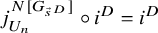 $j_{U_n}^{N[G_{\vec s^{\hspace {.04cm}D}}]}\circ i^D = i^D$
, and therefore
$j_{U_n}^{N[G_{\vec s^{\hspace {.04cm}D}}]}\circ i^D = i^D$
, and therefore
 $$\begin{align*}\ell\restriction V=j_{U_n^*}\circ j_{D^*}\restriction V=(j_{U^*_n}\restriction N[G_{\vec s^{\hspace{.04cm}D}}])\circ (i^D\circ j_D)=i^D\circ j_D.\end{align*}$$
Namely $\ell $
extends
$\ell $
extends $i^D\circ j_D$
; moreover, Proposition 3.5 ensures that
$i^D\circ j_D$
; moreover, Proposition 3.5 ensures that $j_{U_n}(G_{\vec s}) = G_{\vec s^{\hspace {.04cm}n}}$
, and combiniting with Proposition 3.7 we have that
$j_{U_n}(G_{\vec s}) = G_{\vec s^{\hspace {.04cm}n}}$
, and combiniting with Proposition 3.7 we have that
 $$\begin{align*}\ell(G) = j_{U^*_n}(j_{D^*}(G))=j_{U^*_n}(G\times G_{\vec s})= G\times G_{\vec s^{\hspace{.04cm}n}}.\end{align*}$$
This verifies that $\ell $
has the correct restricted embedding and image generic.
$\ell $
has the correct restricted embedding and image generic.
Finally, we verify (1). Let $H = \text {Hull}^{N[G\times G_{\vec s}]}(\ell \big [V[G]\big ]\cup \{\kappa ,\delta _n\})$
. Since
$H = \text {Hull}^{N[G\times G_{\vec s}]}(\ell \big [V[G]\big ]\cup \{\kappa ,\delta _n\})$
. Since $N[G\times G_{\vec s}] = V[G]_{D^*}$
, we have
$N[G\times G_{\vec s}] = V[G]_{D^*}$
, we have
 $$\begin{align*}N[G\times G_{\vec s}] = \text{Hull}^{N[G\times G_{\vec s}]}(j_{D^*}\big[V[G]\big]\cup \{\kappa\})\end{align*}$$
To show $N[G\times G_{\vec {s}}] = H$
, it therefore suffices to show that
$N[G\times G_{\vec {s}}] = H$
, it therefore suffices to show that $j_{D^*}\big [V[G]\big ]$
is contained in H. For this, since
$j_{D^*}\big [V[G]\big ]$
is contained in H. For this, since $j_{D^*}\restriction V = \ell \restriction V$
, it is enough to show that
$j_{D^*}\restriction V = \ell \restriction V$
, it is enough to show that $j_{D^*}(G)\in H$
. But
$j_{D^*}(G)\in H$
. But $j_{D^*}(G) = G\times G_{\vec s}$
is definable from
$j_{D^*}(G) = G\times G_{\vec s}$
is definable from $\ell (G) = G\times G_{\vec s^{\hspace {.04cm}n}}$
and
$\ell (G) = G\times G_{\vec s^{\hspace {.04cm}n}}$
and $\delta _n$
,as, roughly speaking,
$\delta _n$
,as, roughly speaking, $G_{\vec s}= G_{\vec s^{\hspace {.04cm}n}}\cup \{\delta _n\}$
. Since
$G_{\vec s}= G_{\vec s^{\hspace {.04cm}n}}\cup \{\delta _n\}$
. Since $j_{D^*}(G)$
is definable from parameters in H, it belongs to H.
$j_{D^*}(G)$
is definable from parameters in H, it belongs to H.
Remark 4.3. Note that we defined the extension $W^0_n$
essentially by removing a single ordinal from
$W^0_n$
essentially by removing a single ordinal from $\vec s^{\hspace {.04cm}D}$
, to obtain
$\vec s^{\hspace {.04cm}D}$
, to obtain $\vec {s}^{\hspace {.04cm}n}$
. One might be tempted to define other similar extensions of W, instead using sequences
$\vec {s}^{\hspace {.04cm}n}$
. One might be tempted to define other similar extensions of W, instead using sequences $\vec {t}$
obtained by removing more elements of
$\vec {t}$
obtained by removing more elements of $\vec {s}^{\hspace {.04cm}n}$
. But in fact, using such a sequence
$\vec {s}^{\hspace {.04cm}n}$
. But in fact, using such a sequence $\vec {t}$
in our specification of the three ingredients that constitute a lift of W would be fallacious, because these ingredients do not correspond to any ultrafilter in
$\vec {t}$
in our specification of the three ingredients that constitute a lift of W would be fallacious, because these ingredients do not correspond to any ultrafilter in $V[G]$
. The reason is that removing any element of
$V[G]$
. The reason is that removing any element of $\vec {s}^{\hspace {.04cm}D}$
other than
$\vec {s}^{\hspace {.04cm}D}$
other than $\delta _n$
makes Equation (1) above false.
$\delta _n$
makes Equation (1) above false.
We note the following theorem, which follows from the foregoing analysis of $W^0_1$
:
$W^0_1$
:
Theorem 4.4. In $V[G]$
, for any normal ultrafilter F on
$V[G]$
, for any normal ultrafilter F on $\kappa $
, there is a nontrivial elementary embedding from
$\kappa $
, there is a nontrivial elementary embedding from $V[G]_{F}$
to itself.
$V[G]_{F}$
to itself.
Proof. By Kaplan’s theorem (Corollary 3.8), $F = D^*$
for some normal ultrafilter D of V. As above, let
$F = D^*$
for some normal ultrafilter D of V. As above, let $U = j_D(\vec U)_{\delta ^*}$
and let
$U = j_D(\vec U)_{\delta ^*}$
and let $U^*$
be the
$U^*$
be the $V[G]_{D^*}$
-ultrafilter generated by U. Then
$V[G]_{D^*}$
-ultrafilter generated by U. Then $(V[G]_{D^*})_{U^*}=V[G]_{D^*}$
, and so
$(V[G]_{D^*})_{U^*}=V[G]_{D^*}$
, and so $j_U : V[G]_{D^*}\to V[G]_{D^*}$
is a nontrivial elementary embedding.
$j_U : V[G]_{D^*}\to V[G]_{D^*}$
is a nontrivial elementary embedding.
4.2 Classifying the extensions of W
In this section, we prove the special case of our classification of ultrafilters in $V[G]$
for the ultrafilter
$V[G]$
for the ultrafilter $W = \sum _{D}U_{\delta (\alpha )}$
.
$W = \sum _{D}U_{\delta (\alpha )}$
.
Theorem 4.5. If $\overline {W}$
is a countably complete
$\overline {W}$
is a countably complete $V[G]$
-ultrafilter extending W, then
$V[G]$
-ultrafilter extending W, then $\overline {W} = W^i_n$
for some
$\overline {W} = W^i_n$
for some $i\in \{0,1\}$
and
$i\in \{0,1\}$
and $n < \omega $
.
$n < \omega $
.
This proof contains most of the key ideas of the classification and avoids some notational difficulties involved in propagating the result to arbitrary ultrafilters.
Proof. Let $\overline {W}$
be an extension of W to a
$\overline {W}$
be an extension of W to a $V[G]$
-ultrafilter. Since
$V[G]$
-ultrafilter. Since $\overline {W}$
extends W, the Rudin-Keisler projection
$\overline {W}$
extends W, the Rudin-Keisler projection

of $\overline {W}$
using
$\overline {W}$
using  extends D, where
  denotes the projection to the first coordinate. By Kaplan’s theorem (Corollary 3.8), it follows that
  must be equal to $D^*$
. Therefore there is an elementary embedding
$D^*$
. Therefore there is an elementary embedding $k : V[G]_{D^*} \to V[G]_{\overline W}$
such that
$k : V[G]_{D^*} \to V[G]_{\overline W}$
such that $k\circ j_{D^*} = j_{\overline W}$
and
$k\circ j_{D^*} = j_{\overline W}$
and $k(\kappa ) = \kappa $
.
$k(\kappa ) = \kappa $
.
Note that $[\text {id}]_{\overline W} = (\kappa ,\overline \delta )$
for some ordinal
$[\text {id}]_{\overline W} = (\kappa ,\overline \delta )$
for some ordinal $\overline {\delta }>\kappa $
. Let
$\overline {\delta }>\kappa $
. Let $\eta $
be the least ordinal such that
$\eta $
be the least ordinal such that $k(\eta )> \overline \delta $
and let
$k(\eta )> \overline \delta $
and let $\overline {U}$
denote the
$\overline {U}$
denote the $V[G]_{D^*}$
-ultrafilter on
$V[G]_{D^*}$
-ultrafilter on $\eta $
derived from k using
$\eta $
derived from k using $\overline {\delta }$
. By Corollary 2.3,
$\overline {\delta }$
. By Corollary 2.3, $k=j_{\overline {U}}$
and
$k=j_{\overline {U}}$
and $[id]_{\overline {U}}=\overline {\delta }$
.
$[id]_{\overline {U}}=\overline {\delta }$
.
Claim 4.6. For some $n < \omega $
,
$n < \omega $
, $\overline \delta = \delta _n$
and either
$\overline \delta = \delta _n$
and either $\overline {U} = U_n^*$
or
$\overline {U} = U_n^*$
or $\{\delta _n\}\in \overline U$
, so
$\{\delta _n\}\in \overline U$
, so $\overline U$
is principal.
$\overline U$
is principal.
Here $U_n^*$
is defined as in the paragraph preceding (2). Granting this claim, it is easy to see that either
$U_n^*$
is defined as in the paragraph preceding (2). Granting this claim, it is easy to see that either $\overline W = W^0_n$
or
$\overline W = W^0_n$
or $\overline W = W^1_n$
. Indeed if
$\overline W = W^1_n$
. Indeed if $\{\delta _n\}\in \overline {U}$
then
$\{\delta _n\}\in \overline {U}$
then $j_{\overline {U}}$
is the identity and
$j_{\overline {U}}$
is the identity and $j_{\overline {W}}=j_{D^*}$
. Then
$j_{\overline {W}}=j_{D^*}$
. Then $\overline {W}$
is derived from
$\overline {W}$
is derived from $j_{D^*}$
using
$j_{D^*}$
using $(\kappa ,\delta _n)$
which is by definition the ultrafilter
$(\kappa ,\delta _n)$
which is by definition the ultrafilter $W^0_n$
. If
$W^0_n$
. If $\overline {U}=U^*_n$
, then
$\overline {U}=U^*_n$
, then $\overline {W}$
is derived from
$\overline {W}$
is derived from $j_{U^*_n}\circ j_{D^*}$
using
$j_{U^*_n}\circ j_{D^*}$
using $(\kappa ,\delta _n)$
, which is by definition
$(\kappa ,\delta _n)$
, which is by definition $W^0_n$
.
$W^0_n$
.
To prove the claim, we analyze the N-ultrafilter $\tilde {U} = \overline {U}\cap N$
. We will show that for some n, either
$\tilde {U} = \overline {U}\cap N$
. We will show that for some n, either $\tilde U = U_n$
or
$\tilde U = U_n$
or $\{\delta _n\}\in \tilde U$
. The claim then follows since in either case,
$\{\delta _n\}\in \tilde U$
. The claim then follows since in either case, $\tilde U$
generates an
$\tilde U$
generates an $N[G\times G_{\vec s}]$
-ultrafilter.
$N[G\times G_{\vec s}]$
-ultrafilter.
The analysis of $\tilde U$
is an application of Lemma 3.15 in the case
$\tilde U$
is an application of Lemma 3.15 in the case $M = V_D$
and
$M = V_D$
and $i=i^D$
, which implies that either
$i=i^D$
, which implies that either $\tilde {U}$
has the desired form or else
$\tilde {U}$
has the desired form or else $\tilde {U} = i^D_{0\omega }(U)$
. But the latter cannot occur, because
$\tilde {U} = i^D_{0\omega }(U)$
. But the latter cannot occur, because $\tilde {U}$
extends to a countably complete
$\tilde {U}$
extends to a countably complete $V[G]_{D^*}$
-ultrafilter (namely,
$V[G]_{D^*}$
-ultrafilter (namely, $\overline U$
), whereas
$\overline U$
), whereas $i^D_{0\omega }(U)$
does not since
$i^D_{0\omega }(U)$
does not since $i^D_{0\omega }(\delta )$
has countable cofinality in
$i^D_{0\omega }(\delta )$
has countable cofinality in $V[G]_{D^*}$
.
$V[G]_{D^*}$
.
4.3 Some other ultrafilters
We describe a slight variant of the classification from the previous section when the second ultrafilter in the sum does not come from the image of $\vec U$
. We start with any normal ultrafilter D on
$\vec U$
. We start with any normal ultrafilter D on $\kappa $
. For each
$\kappa $
. For each $\alpha < \kappa $
, let
$\alpha < \kappa $
, let
 $$\begin{align*}\delta(\alpha) = \min (\Delta\setminus \alpha)\end{align*}$$
and let $Z_{\delta (\alpha )}\neq U_{\delta (\alpha )}$
be a normal measure on
$Z_{\delta (\alpha )}\neq U_{\delta (\alpha )}$
be a normal measure on $\delta (\alpha )$
.Footnote
5
Let
$\delta (\alpha )$
.Footnote
5
Let
 $$\begin{align*}W = \sum_{D} Z_{\delta(\alpha)}\end{align*}$$
Again, one lift of W is the canonical extension $W^*$
.
$W^*$
.
In this case there is no analog of the ultrafilter $W'$
considered in Section 4.1 since
$W'$
considered in Section 4.1 since $Z=[\alpha \mapsto Z_{\delta (\alpha )}]_D$
cannot be absorbed into
$Z=[\alpha \mapsto Z_{\delta (\alpha )}]_D$
cannot be absorbed into $i^D$
: the first ultrafilter applied in
$i^D$
: the first ultrafilter applied in $i^D$
is
$i^D$
is $U\neq Z$
.
$U\neq Z$
.
However, we still have the analogues of the ultrafilters $W^0_n$
. Indeed, let us specify the ultrafilter
$W^0_n$
. Indeed, let us specify the ultrafilter $W^0_n$
in this case by listing the three ingredients. The major difference is the restricted ultrapower embedding associated with
$W^0_n$
in this case by listing the three ingredients. The major difference is the restricted ultrapower embedding associated with $W^0_n$
, which is no longer equal to
$W^0_n$
, which is no longer equal to $i^W\circ j_W$
. Instead, the restricted ultrapower embedding is
$i^W\circ j_W$
. Instead, the restricted ultrapower embedding is $i^{j_{U^n}(j_W(\vec {U}))}\circ j_{U^n}\circ j_W$
and the seed is
$i^{j_{U^n}(j_W(\vec {U}))}\circ j_{U^n}\circ j_W$
and the seed is $(\kappa ,\delta _n)$
where as before
$(\kappa ,\delta _n)$
where as before $\delta _n = j_{U^n}(\delta )$
. The image generic: we will have
$\delta _n = j_{U^n}(\delta )$
. The image generic: we will have $j_{W^0_n}(G) = G\times G_{\vec s^{\hspace {.04cm}n}}$
where
$j_{W^0_n}(G) = G\times G_{\vec s^{\hspace {.04cm}n}}$
where $\vec s^{\hspace {.07cm}n}$
is defined as follows: let
$\vec s^{\hspace {.07cm}n}$
is defined as follows: let $\vec {r}$
be the sequence of sets of indiscernibles obtained by the complete iteration of
$\vec {r}$
be the sequence of sets of indiscernibles obtained by the complete iteration of $j_{U^n}(j_W(\vec {U}))$
and let
$j_{U^n}(j_W(\vec {U}))$
and let $\vec {s}^{\hspace {.07cm}n}$
be the sequence obtained by adding
$\vec {s}^{\hspace {.07cm}n}$
be the sequence obtained by adding $\delta _0,\dots ,\delta _{n-1}$
to
$\delta _0,\dots ,\delta _{n-1}$
to $\vec {r}$
.
$\vec {r}$
.
The proof that these three ingredients constitute a valid lift of W is as in the previous sections, as is the proof that the ultrafilters $W^0_n$
exhaust all lifts of W to
$W^0_n$
exhaust all lifts of W to $V[G]$
.
$V[G]$
.
5 Classification of ultrafilters in the Magidor extension
Let $\Delta $
be a discrete set of measurable cardinals with supremum
$\Delta $
be a discrete set of measurable cardinals with supremum $\kappa $
, and let
$\kappa $
, and let $\vec U = \langle U_\alpha : \alpha \in \Delta \rangle $
be a sequence of normal measures
$\vec U = \langle U_\alpha : \alpha \in \Delta \rangle $
be a sequence of normal measures $U_\alpha $
on
$U_\alpha $
on $\alpha $
. Our goal in this section is to classify the extensions of sums of normal ultrafilters to
$\alpha $
. Our goal in this section is to classify the extensions of sums of normal ultrafilters to $V[G]$
where
$V[G]$
where $G\subseteq \mathbb P_\kappa $
is V-generic for the Magidor iteration of
$G\subseteq \mathbb P_\kappa $
is V-generic for the Magidor iteration of $\vec U$
. We begin with Section 5.1 by defining a family of extensions of a given sum of normal ultrafilters and analyzing the relationship between their ultrapowers. Then in Section 5.2, we show that this family exhausts all extensions of the sum.
$\vec U$
. We begin with Section 5.1 by defining a family of extensions of a given sum of normal ultrafilters and analyzing the relationship between their ultrapowers. Then in Section 5.2, we show that this family exhausts all extensions of the sum.
5.1 Extensions of an iterated sum of normal ultrafilters
Definition 5.1. Let M be a transitive model of set theory.
-
• A finite iteration of M is a sequence
$(D_m : m < n)$
such that for each
$m < n$
,
$D_m$
is a
$M_{D_0,\cdots , D_{m-1}}$
-ultrafilter. -
• Let
$M_m = M_{D_0,...,D_{m-1}}$
and
$j_{m_0m_1}:M_{m_0}\to M_{m_1}$
be the iterated ultrapower embedding
$j_{D_{m_0}...D_{m_1-1}}$
. -
• An iteration is internal if for each
$m < n$
,
$D_m\in M_{m}$
. -
• An iteration is normal if for each
$m<n$
,
$D_m$
is a
$M_m$
-normal ultrafilter on
$\delta _m$
and
$\delta _0<\delta _1<...<\delta _{n-1}$
.


We say that an iteration $(D_0,...,D_{n-1})$
is below an ordinal
$(D_0,...,D_{n-1})$
is below an ordinal $\gamma $
if for each
$\gamma $
if for each $m<n$
,
$m<n$
, $D_m$
is an ultrafilter on
$D_m$
is an ultrafilter on $\delta _m < j_{D_0,...,D_{m-1}}(\gamma )$
.
$\delta _m < j_{D_0,...,D_{m-1}}(\gamma )$
.
Definition 5.2. The sum of a normal iteration $(D_0,\dots ,D_{n-1})$
, denoted
$(D_0,\dots ,D_{n-1})$
, denoted $\Sigma (D_0,\dots ,D_{n-1})$
, is the unique ultrafilter W on
$\Sigma (D_0,\dots ,D_{n-1})$
, is the unique ultrafilter W on $\kappa ^n$
such that
$\kappa ^n$
such that $j_W = j_{D_0,...,D_{n-1}}$
and
$j_W = j_{D_0,...,D_{n-1}}$
and $[\text {id}]_{W} = (\delta _0,\delta _1,\dots ,\delta _{n-1})$
, where
$[\text {id}]_{W} = (\delta _0,\delta _1,\dots ,\delta _{n-1})$
, where $\kappa $
is least such that
$\kappa $
is least such that $(D_0,\dots ,D_{n-1})$
is below
$(D_0,\dots ,D_{n-1})$
is below $\kappa $
.
$\kappa $
.
The following theorem [Reference Goldberg6, Theorems 5.3.8 and 5.3.13] explains why it is natural to consider such sums in our classification:
Theorem 5.3 (UA).
Assume that there is no cardinal $\kappa $
with
$\kappa $
with $o(\kappa )=2^{2^\kappa }$
. Then every countably complete ultrafilter is Rudin-Keisler equivalent to the sum of a normal iteration.
$o(\kappa )=2^{2^\kappa }$
. Then every countably complete ultrafilter is Rudin-Keisler equivalent to the sum of a normal iteration.
Fix an internal iteration $(D_0,...,D_{n-1})$
of normal ultrafilters. Our plan is to classify all extensions of
$(D_0,...,D_{n-1})$
of normal ultrafilters. Our plan is to classify all extensions of $\Sigma (D_0,\dots , D_{n-1})$
to
$\Sigma (D_0,\dots , D_{n-1})$
to $V[G]$
where
$V[G]$
where $G\subseteq \mathbb P_\kappa $
is V-generic. The first step is to define a countable family
$G\subseteq \mathbb P_\kappa $
is V-generic. The first step is to define a countable family $\{\Sigma (D_0,\dots , D_{n-1})^u_x\}_{u,x}$
of extensions of
$\{\Sigma (D_0,\dots , D_{n-1})^u_x\}_{u,x}$
of extensions of $\Sigma (D_0,\dots , D_{n-1})$
, associated to some finite parameters
$\Sigma (D_0,\dots , D_{n-1})$
, associated to some finite parameters $u,x$
.
$u,x$
.
Let d be the set of $m \leq n$
such that
$m \leq n$
such that $\delta _m\in j_{0m}(\Delta )$
, and let
$\delta _m\in j_{0m}(\Delta )$
, and let $d'$
be the set of
$d'$
be the set of $m\in d$
such that
$m\in d$
such that $D_m = j_{0m}(\vec U)_{\delta _m}$
.
$D_m = j_{0m}(\vec U)_{\delta _m}$
.
We will associate to each $u : d'\to \{0,1\}$
and
$u : d'\to \{0,1\}$
and $x : d\to \omega $
a countably complete extension of
$x : d\to \omega $
a countably complete extension of $\Sigma (D_0,\dots ,D_{n-1})^u_x$
of
$\Sigma (D_0,\dots ,D_{n-1})^u_x$
of $\Sigma (D_0,\dots ,D_{n-1})$
. Let us briefly explain the role of these parameters in terms of the three ingredients that determine the extension
$\Sigma (D_0,\dots ,D_{n-1})$
. Let us briefly explain the role of these parameters in terms of the three ingredients that determine the extension $\overline {W} = \Sigma (D_0,\dots ,D_{n-1})^u_x$
. (The “three ingredients” framework is introduced Section 4.1.) Note that the seed
$\overline {W} = \Sigma (D_0,\dots ,D_{n-1})^u_x$
. (The “three ingredients” framework is introduced Section 4.1.) Note that the seed $[id]_{\overline {W}}$
has the form
$[id]_{\overline {W}}$
has the form $( \tilde {\delta }_0,\dots ,\tilde {\delta }_{n-1})$
. The number
$( \tilde {\delta }_0,\dots ,\tilde {\delta }_{n-1})$
. The number $u(\delta _m)\in \{0,1\}$
will determine whether or not
$u(\delta _m)\in \{0,1\}$
will determine whether or not $\tilde {\delta }_m$
is a Príkry point in the image generic
$\tilde {\delta }_m$
is a Príkry point in the image generic $j_{\overline {W}}(G)$
. The number
$j_{\overline {W}}(G)$
. The number $x(\delta _m) < \omega $
determines how many Príkry points are below
$x(\delta _m) < \omega $
determines how many Príkry points are below $\tilde {\delta }_m$
in the first Príkry sequence above
$\tilde {\delta }_m$
in the first Príkry sequence above $\tilde {\delta }_m$
.
$\tilde {\delta }_m$
.
By recursion on $m\leq n$
, we define a
$m\leq n$
, we define a $V[G]$
-ultrafilter
$V[G]$
-ultrafilter $\overline {W}_m=\Sigma (D_0,\dots ,D_{m-1})^u_x$
extending
$\overline {W}_m=\Sigma (D_0,\dots ,D_{m-1})^u_x$
extending $W_m=\Sigma (D_0,\dots ,D_{m-1})$
. We will also define an external iteration
$W_m=\Sigma (D_0,\dots ,D_{m-1})$
. We will also define an external iteration $(E_0,E_1,...,E_{m-1})$
of
$(E_0,E_1,...,E_{m-1})$
of $V_{W_m}$
below
$V_{W_m}$
below $\delta _m$
whose well-founded last model
$\delta _m$
whose well-founded last model $P_m$
completely iterates into
$P_m$
completely iterates into $j_{\overline {W}_m}^{V[G]}(V)$
. More precisely,
$j_{\overline {W}_m}^{V[G]}(V)$
. More precisely,
-
• Let
$e_m:V_{W_m}\rightarrow P_m$
be the iterated ultrapower by
$(E_0,...,E_{m-1})$
. -
• Let
$i^{P_m}:P_m\rightarrow N_m$
be the complete iteration of
$P_m$
by
$e_m(j_{W_m}(\vec {U}))$
above
$\kappa $
.


We will maintain that the following hold:
-
•
$N_m=j_{\overline {W}_m}(V)$
-
•
$j_{\overline {W}_m}\restriction V=i^{P_m}\circ e_m\circ j_{W_m}$
-
•
$i^{P_m}\circ e_m([id]_{W_m})=[id]_{\overline {W}_m}$


This ensures, in particular, that the ultrafilter $\overline {W}_m$
lifts
$\overline {W}_m$
lifts $W_m$
.
$W_m$
.
Fix $m < n$
and assume that we have already defined
$m < n$
and assume that we have already defined $\overline {W}_m$
and the associated external iteration
$\overline {W}_m$
and the associated external iteration $(E_0,...,E_{m-1})$
satisfying the bullets above. We will define
$(E_0,...,E_{m-1})$
satisfying the bullets above. We will define $\overline {W}_{m+1}$
and
$\overline {W}_{m+1}$
and $E_{m}$
and show in Claim 5.5 that our recursive hypotheses are maintained.
$E_{m}$
and show in Claim 5.5 that our recursive hypotheses are maintained.
Let $i:V_{W_m}\rightarrow N_m$
be the composition
$i:V_{W_m}\rightarrow N_m$
be the composition $i^{P_m}\circ e_m$
. We will define an
$i^{P_m}\circ e_m$
. We will define an $N_m$
-ultrafilter
$N_m$
-ultrafilter $\tilde {D}_m$
extending
$\tilde {D}_m$
extending
 $$\begin{align*}\{i(A)\cap \eta : A\in D_m\}\end{align*}$$
for some $\eta \leq i(\delta _m)$
. The ultrafilter
$\eta \leq i(\delta _m)$
. The ultrafilter $\tilde {D}_m$
will generate a
$\tilde {D}_m$
will generate a $V[G]_{\overline W_m}$
-ultrafilter, which we denote by
$V[G]_{\overline W_m}$
-ultrafilter, which we denote by $D_m^{u,x}$
, and we will set
$D_m^{u,x}$
, and we will set $\overline {W}_{m+1}= \Sigma (\overline W_m,D_m^{u,x})$
. Therefore in the end we will have
$\overline {W}_{m+1}= \Sigma (\overline W_m,D_m^{u,x})$
. Therefore in the end we will have $\overline {W}_{n} = \Sigma (D_0^{u,x},\dots ,D_{n-1}^{u,x})$
.
$\overline {W}_{n} = \Sigma (D_0^{u,x},\dots ,D_{n-1}^{u,x})$
.
If $m \notin d$
,
$m \notin d$
,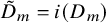 $\tilde {D}_m = i(D_m)$
and
$\tilde {D}_m = i(D_m)$
and $E_m$
is the principal
$E_m$
is the principal $P_m$
-ultrafilter concentrated at
$P_m$
-ultrafilter concentrated at $e_m(\delta _m)$
.
$e_m(\delta _m)$
.
Now suppose $m \in d$
, in which case
$m \in d$
, in which case $\tilde {D}_m$
will depend on u and x. Define
$\tilde {D}_m$
will depend on u and x. Define $E_m$
to be the external ultrafilter
$E_m$
to be the external ultrafilter $e_m(j_{W_m}(\vec {U})_{\delta _m})^{x(m)}$
. For each
$e_m(j_{W_m}(\vec {U})_{\delta _m})^{x(m)}$
. For each $\beta $
less than the length of the complete iteration of
$\beta $
less than the length of the complete iteration of $P_m$
, let
$P_m$
, let $\delta ^\beta _m = i_{0\beta }^{P_m}(e_m(\delta _m))$
and
$\delta ^\beta _m = i_{0\beta }^{P_m}(e_m(\delta _m))$
and $D^\beta _m = i_{0\beta }^{P_m}(e_m(D_m))$
.
$D^\beta _m = i_{0\beta }^{P_m}(e_m(D_m))$
.
Let $\alpha $
be the first stage of the complete iteration of
$\alpha $
be the first stage of the complete iteration of $P_m$
such that
$P_m$
such that $\operatorname {\mathrm {crit}}(i_{\alpha \alpha +1}^{P_m}) = \delta ^\alpha _m$
. If
$\operatorname {\mathrm {crit}}(i_{\alpha \alpha +1}^{P_m}) = \delta ^\alpha _m$
. If $m\in d'$
and
$m\in d'$
and $u(m)=1$
, let
$u(m)=1$
, let $\tilde {D}_m$
be the principal ultrafilter concentrated at
$\tilde {D}_m$
be the principal ultrafilter concentrated at $\delta ^{\alpha +x(m)}_m$
. Otherwise, let
$\delta ^{\alpha +x(m)}_m$
. Otherwise, let $\tilde {D}_m = D^{\alpha +x(m)}_m$
.
$\tilde {D}_m = D^{\alpha +x(m)}_m$
.
We have $\{i(A)\cap \eta : A\in D_m\}\subseteq \tilde {D}_m$
where
$\{i(A)\cap \eta : A\in D_m\}\subseteq \tilde {D}_m$
where
 $$ \begin{align*}\eta =\begin{cases} i(\delta_m) & \text{if } m\notin d\\ \delta^{\alpha+x(m)}_m+1 & m\in d' \text{ and } u(m)=1\\ \delta^{\alpha+x(m)}_m & \text{otherwise} \end{cases}\end{align*} $$
Claim 5.4. $\tilde {D}_m$
generates a
$\tilde {D}_m$
generates a $V[G]_{\overline W_m}$
-ultrafilter
$V[G]_{\overline W_m}$
-ultrafilter $D^{u,x}_m$
Proof. The proof is by cases. In the first case when $m\notin d$
we appeal to Theorem 2.13. In the second case, when
$m\notin d$
we appeal to Theorem 2.13. In the second case, when $m\in d'$
and
$m\in d'$
and $u(m)=1$
,
$u(m)=1$
, $\tilde {D}_m$
is principal and therefore trivially generates a
$\tilde {D}_m$
is principal and therefore trivially generates a $V[G]_{\overline {W}_m}$
-ultrafilter. In the last case,
$V[G]_{\overline {W}_m}$
-ultrafilter. In the last case, $\tilde {D}_m$
is a
$\tilde {D}_m$
is a $\gamma $
-complete
$\gamma $
-complete $N_m$
-ultrafilter on
$N_m$
-ultrafilter on $\gamma = \delta ^{\alpha +x(m)}_m$
, so it generates an ultrafilter by Lévy-Solovay.
$\gamma = \delta ^{\alpha +x(m)}_m$
, so it generates an ultrafilter by Lévy-Solovay.
Finally, define
 $$ \begin{align*}\overline{W}_{m+1} = \Sigma(\overline W_m,D_m^{u,x}).\end{align*} $$
To complete the induction, we must prove the following claim:
Claim 5.5. $N_{m+1}=j_{\overline {W}_{m+1}}(V)$
,
$N_{m+1}=j_{\overline {W}_{m+1}}(V)$
, $ j_{\overline {W}_{m+1}}\restriction V=i^{P_{m+1}}\circ e_{m+1}\circ j_{W_{m+1}}$
, and
$ j_{\overline {W}_{m+1}}\restriction V=i^{P_{m+1}}\circ e_{m+1}\circ j_{W_{m+1}}$
, and $ i^{P_{m+1}}\circ e_{m+1}([id]_{W_{m+1}})=[id]_{\overline {W}_{m+1}}.$
Proof. We consider the three cases. For the first case, assume $m\notin d$
. Let
$m\notin d$
. Let $G_m$
be the
$G_m$
be the $N_m$
-generic filter given by the sequence of sets of indiscernibles associated with the complete iteration
$N_m$
-generic filter given by the sequence of sets of indiscernibles associated with the complete iteration $i^{P_m}$
. By the induction hypothesis,
$i^{P_m}$
. By the induction hypothesis, $V[G]_{\overline {W}_m}=N_m[G\times G_m]$
. By definition, in this case,
$V[G]_{\overline {W}_m}=N_m[G\times G_m]$
. By definition, in this case, $\tilde {D}_m = i(D_m)$
. Let
$\tilde {D}_m = i(D_m)$
. Let $D^*_m$
be the
$D^*_m$
be the $N_m[G_m]$
-ultrafilter generated by
$N_m[G_m]$
-ultrafilter generated by $\tilde {D}_m$
.
$\tilde {D}_m$
.
The case that $m\notin d$
.
$m\notin d$
.

Note that by Lévy-Solovay,
 $$\begin{align*}j_{D^{u,x}_m}\restriction {N_m[G_{m}]} = j_{D^*_m}^{N_m[G_{m}]}\end{align*}$$
The key point is that
 $$ \begin{align} j^{N_m[G_m]}_{D^*_m}\restriction N_m=j_{D^0_m}\restriction N_m\end{align} $$
To see this, let $\alpha $
be the least ordinal such that
$\alpha $
be the least ordinal such that $\operatorname {\mathrm {crit}}(i^{P_m}_{\alpha ,\alpha +1})>e_m(\delta _m)$
and consider the model
$\operatorname {\mathrm {crit}}(i^{P_m}_{\alpha ,\alpha +1})>e_m(\delta _m)$
and consider the model $N_{m,\alpha }[G_m\restriction \delta ^0_m]$
. Note that
$N_{m,\alpha }[G_m\restriction \delta ^0_m]$
. Note that $G_m\restriction \delta ^0_m$
is
$G_m\restriction \delta ^0_m$
is $N_{\alpha ,m}$
-generic for a forcing which has smaller cardinality than the critical point of the embedding
$N_{\alpha ,m}$
-generic for a forcing which has smaller cardinality than the critical point of the embedding $i_{\alpha ,\infty }^{P_m}$
. So by the Lévy-Solovay argument,
$i_{\alpha ,\infty }^{P_m}$
. So by the Lévy-Solovay argument, $i^{P_m}_{\alpha ,\infty }$
lifts to an embedding
$i^{P_m}_{\alpha ,\infty }$
lifts to an embedding $i^*_{\alpha ,\infty }:N_{m,\alpha }[G_m\restriction \delta ^0_m]\to N_m[G_m\restriction \delta ^0_m]$
. It is easy to see that
$i^*_{\alpha ,\infty }:N_{m,\alpha }[G_m\restriction \delta ^0_m]\to N_m[G_m\restriction \delta ^0_m]$
. It is easy to see that $i^*_{\alpha ,\infty }$
is the complete iteration of
$i^*_{\alpha ,\infty }$
is the complete iteration of $N_{m,\alpha }[G_m\restriction \delta ^0_m]$
via the canonical lift of the sequence
$N_{m,\alpha }[G_m\restriction \delta ^0_m]$
via the canonical lift of the sequence $i^{P_m}_{0\alpha }(e_m(\vec U))\restriction (\delta ^0_m,\infty )$
. Moreover
$i^{P_m}_{0\alpha }(e_m(\vec U))\restriction (\delta ^0_m,\infty )$
. Moreover $N_m[G_m]$
is the generic extension of the final model of this iteration by the filter obtained from the associated sequence of sets of indiscernibles. Therefore we can apply Lemma 3.4 in
$N_m[G_m]$
is the generic extension of the final model of this iteration by the filter obtained from the associated sequence of sets of indiscernibles. Therefore we can apply Lemma 3.4 in $N_{m,\alpha }[G_m\restriction \delta ^0_m]$
to conclude that
$N_{m,\alpha }[G_m\restriction \delta ^0_m]$
to conclude that $N_m[G_m]$
is closed under
$N_m[G_m]$
is closed under $\delta ^0_m$
-sequences from
$\delta ^0_m$
-sequences from $N_{m,\alpha }[G_m\restriction \delta ^0_m]$
.
$N_{m,\alpha }[G_m\restriction \delta ^0_m]$
.
Note that
 $$ \begin{align} j_{D^\alpha_m}\circ i^{P_m}_{0,\alpha}=i^{P_{m+1}}_{0,\alpha}\circ j_{D^0_m} .\end{align} $$
This follows once we prove that $i^{P_{m+1}}_{0,\alpha }=i^{P_m}_{0,\alpha }\restriction P_{m+1}$
. This is a routine induction on
$i^{P_{m+1}}_{0,\alpha }=i^{P_m}_{0,\alpha }\restriction P_{m+1}$
. This is a routine induction on $\beta \leq \alpha $
using that
$\beta \leq \alpha $
using that $\operatorname {\mathrm {crit}}(j_{D^0_\alpha })$
is greater than all the measurable cardinals appearing in the iteration
$\operatorname {\mathrm {crit}}(j_{D^0_\alpha })$
is greater than all the measurable cardinals appearing in the iteration $i^{P_m}_{0,\alpha }$
.
$i^{P_m}_{0,\alpha }$
.
By Mitchell’s lemma (Lemma 3.10) applied in $P_m$
with
$P_m$
with $W=D^0_m$
,
$W=D^0_m$
,
 $$\begin{align*}j^{N_{m,\alpha}[G_m\restriction \delta^0_m]}_{D^*_m}=j_{D^0_m}\restriction N_{m,\alpha}[G_m\restriction \delta^0_m].\end{align*}$$
Since $N_m[G_m]$
is closed under
$N_m[G_m]$
is closed under $\delta ^0_m$
-sequences from
$\delta ^0_m$
-sequences from $N_{m,\alpha }[G_m\restriction \delta ^0_m]$
, this implies that
$N_{m,\alpha }[G_m\restriction \delta ^0_m]$
, this implies that
 $$ \begin{align} j^{N_{m}[G_m]}_{D^*_m}= j^{N_{m,\alpha}[G_m\restriction \delta^0_m]}_{D^*_m}\restriction N_m[G_m] = j_{D^0_m}\restriction N_m[G_m]\end{align} $$
which proves (3).
By definition of $e_{m+1}$
,
$e_{m+1}$
, $e_{m+1}= e_m\restriction V_{W_{m+1}}$
ensuring that
$e_{m+1}= e_m\restriction V_{W_{m+1}}$
ensuring that
 $$ \begin{align*}j_{D_m^0}\circ e_m=e_{m+1}\circ j_{D_m}.\end{align*} $$
Also, $i^{P_{m+1}} = j_{D^0_m}(i^{P_m})$
. We have
$i^{P_{m+1}} = j_{D^0_m}(i^{P_m})$
. We have
 $$\begin{align*}j_{D_m^{u,x}} \circ i^{P_m} = j_{D^*_m}^{N[G_{m}]}\circ i^{P_m} = j_{D^0_m}\circ i^{P_m} = i^{P_{m+1}} \circ j_{D^0_m}^{P_m}\end{align*}$$
Moreover
 $$\begin{align*}j^{P_m}_{D^0_m}\circ e_m = e_{m+1}\circ j_{D_m}\end{align*}$$
Combining these equations, we get
 $$ \begin{align*} i^{P_{m+1}}\circ e_{m+1}\circ j_W &= i^{P_{m+1}} \circ e_{m+1} \circ j_{D_m}\circ j_{W_m} \\ &= i^{P_{m+1}}\circ j^{P_m}_{D^0_m}\circ e_m\circ j_{W_m} \\ &= j_{D_m^{u,x}}\circ i^{P_m} \circ e_m \circ j_{W_m} \\ &= j_{D_m^{u,x}}\circ j_{\overline W_m}\restriction V \\ &= j_{\overline W_{m+1}}\restriction V \end{align*} $$
To finish the case $m\notin d$
, by the normality of
$m\notin d$
, by the normality of $D^{u,x}_m$
,
$D^{u,x}_m$
, $[id]_{D^{u,x}_m}$
is the ordinal
$[id]_{D^{u,x}_m}$
is the ordinal $\beta $
over which
$\beta $
over which $D^{u,x}_m$
is an ultrafilter. On the other hand,
$D^{u,x}_m$
is an ultrafilter. On the other hand, $i^{P_{m+1}}(e_{m+1}(\delta _m))=i^{P_{m+1}}_{0,\alpha }(e_{m}(\delta _m))=\beta $
. Hence
$i^{P_{m+1}}(e_{m+1}(\delta _m))=i^{P_{m+1}}_{0,\alpha }(e_{m}(\delta _m))=\beta $
. Hence $i^{P_{m+1}}(e_{m+1}([id]_{W_{m+1}})=[id]_{\overline {W}_{m+1}}$
.
$i^{P_{m+1}}(e_{m+1}([id]_{W_{m+1}})=[id]_{\overline {W}_{m+1}}$
.
Next consider the case where $m\in d'$
and
$m\in d'$
and $u(m)=1$
. By definition
$u(m)=1$
. By definition $\tilde {D}_m$
is
$\tilde {D}_m$
is $p_{\delta _m^{\alpha +x(m)}}$
, the principal ultrafilter concentrated at
$p_{\delta _m^{\alpha +x(m)}}$
, the principal ultrafilter concentrated at $\delta _m^{\alpha +x(m)}$
. The following diagram commutes:
$\delta _m^{\alpha +x(m)}$
. The following diagram commutes:
The commutativity of the second square from the bottom is proved as in Equation 4. The only other part of the diagram whose commutativity is not immediate is

where  and
and  is the $\alpha ^{\text {th}}$
stage of the complete iteration of
$\alpha ^{\text {th}}$
stage of the complete iteration of  by
by $e_m(j_{W_{m+1}}(\vec {U}))$
above
$e_m(j_{W_{m+1}}(\vec {U}))$
above $\kappa $
.
$\kappa $
.

This commutativity is true since

We include some details on how to show  . For this, we use that
  . Since $E_m\in P_m$
, we can use Kunen’s commuting ultrapowers lemma, as it appears in Woodin’s [Reference Hugh Woodin14, Lemma 3.30], to conclude that
$E_m\in P_m$
, we can use Kunen’s commuting ultrapowers lemma, as it appears in Woodin’s [Reference Hugh Woodin14, Lemma 3.30], to conclude that
 $$\begin{align*}j_{i^{P_m}_{0,\alpha}(E_m)}^{N_{m,\alpha}} = j_{E_m}^{P_m}\restriction N_{m,\alpha}.\end{align*}$$
(We apply Woodin’s lemma in $P_m$
with
$P_m$
with $j = i_{0,\alpha }^{P_m}$
and
$j = i_{0,\alpha }^{P_m}$
and $E = E_m$
. Note that some of the generality of Woodin’s lemma is not necessary here since j is definable over
$E = E_m$
. Note that some of the generality of Woodin’s lemma is not necessary here since j is definable over $P_m$
rather than generic.)
$P_m$
rather than generic.)
Since $j_{\overline {W}_{m+1}}=j_{\overline {W}_m}$
then the commutativity of the diagram in Figure 3 can be used to deduce that
$j_{\overline {W}_{m+1}}=j_{\overline {W}_m}$
then the commutativity of the diagram in Figure 3 can be used to deduce that
 $$ \begin{align*}j_{\overline{W}_{m+1}}\restriction V=j_{\overline{W}_m}\restriction V=i^{P_{m}}\circ e_{m}\circ j_{W_{m}}=i^{P_{m+1}}\circ e_{m+1}\circ j_{W_{m+1}}.\end{align*} $$
In particular,
 $$ \begin{align*}N_{m+1}=N_m=j_{\overline{W}_m}(V)=j_{\overline{W}_{m+1}}(V)\end{align*} $$
Finally, we show that $i^{P_{m+1}}\circ e_{m+1}([id]_{W_{m+1}})=[id]_{\overline {W}_{m+1}}$
. By the induction hypothesis it suffices to show that
$i^{P_{m+1}}\circ e_{m+1}([id]_{W_{m+1}})=[id]_{\overline {W}_{m+1}}$
. By the induction hypothesis it suffices to show that $i^{P_{m+1}}(e_{m+1}(\delta _m))=\delta ^{\alpha +x(m)}_m$
:
$i^{P_{m+1}}(e_{m+1}(\delta _m))=\delta ^{\alpha +x(m)}_m$
:

 $$ \begin{align*}=i^{P_{m+1}}_{\alpha,\infty}(j_{i^{P_m}_{0,\alpha}(E_m)}(i_{0,\alpha}^{P_m}(e_m(\delta_m))=i^{P_{m+1}}_{\alpha,\infty}(\delta^{\alpha+x(m)}_m)=\delta^{\alpha+x(m)}_m.\end{align*} $$
The case that $u(m)=1$
.
$u(m)=1$
.

Finally consider the case where where either $m\in d\setminus d'$
or
$m\in d\setminus d'$
or $m\in d'$
but
$m\in d'$
but $u(m)=0$
. Let
$u(m)=0$
. Let $\ell $
be the restriction to
$\ell $
be the restriction to $N_m$
of the ultrapower embedding of
$N_m$
of the ultrapower embedding of $N_{m,\alpha +x(m)}$
by
$N_{m,\alpha +x(m)}$
by $D^{\alpha +x(m)}_{m}$
. Note that the bottom part of the diagram in Figure 4 is identical to the bottom part of the diagram in Figure 3 and in particular it commutes. In fact the whole diagram commutes and the key to that is that the embedding
$D^{\alpha +x(m)}_{m}$
. Note that the bottom part of the diagram in Figure 4 is identical to the bottom part of the diagram in Figure 3 and in particular it commutes. In fact the whole diagram commutes and the key to that is that the embedding $\ell $
is the restriction to
$\ell $
is the restriction to $N_m$
of
$N_m$
of $j^{N_m[G_m]}_{D^*}$
where
$j^{N_m[G_m]}_{D^*}$
where $D^*$
is the
$D^*$
is the $N_m[G_m]$
-ultrafilter generated by
$N_m[G_m]$
-ultrafilter generated by $D^{\alpha +x(m)}_m$
. The justification for this is as in Equation 5. The commutativity of the rest of the diagram is a straightforward verification, and the remainder of the proof of the claim in this case is then identical to the previous part.
$D^{\alpha +x(m)}_m$
. The justification for this is as in Equation 5. The commutativity of the rest of the diagram is a straightforward verification, and the remainder of the proof of the claim in this case is then identical to the previous part.
The case where $u(m)\neq 1$
.
$u(m)\neq 1$
.

This completes the proof, but let us note here that in the case where $m\in d'$
we obtain
$m\in d'$
we obtain
 $$ \begin{align*}N_{m+1}=j_{\overline{W}_{m+1}}(V)=j_{\overline{W}_m}(V)=N_m.\end{align*} $$
This is because in this case $N_{m+1,\alpha }=N_{m,\alpha +x(m)+1}$
. Moreover,
$N_{m+1,\alpha }=N_{m,\alpha +x(m)+1}$
. Moreover,
 $$ \begin{align}V[G]_{\overline{W}_{m+1}}=N_{m+1}[G\times G_{m+1}]=N_{m}[G\times G_{m}]=V[G]_{\overline{W}_m}\end{align} $$
Indeed $G_m$
and
$G_m$
and $G_{m+1}$
differ by exactly one ordinal since they are given the sequences of sets of indiscernibles associated with essentially the same complete iterations (see also Proposition 3.5).
$G_{m+1}$
differ by exactly one ordinal since they are given the sequences of sets of indiscernibles associated with essentially the same complete iterations (see also Proposition 3.5).
Lemma 5.6. Fix an internal iteration $(D_0,...,D_{n-1})$
of normal ultrafilters, let d and
$(D_0,...,D_{n-1})$
of normal ultrafilters, let d and $d'$
be as in the paragraph following Theorem 5.3. Suppose that
$d'$
be as in the paragraph following Theorem 5.3. Suppose that $d=d'$
and fix
$d=d'$
and fix $u : d\to \{0,1\}$
and
$u : d\to \{0,1\}$
and $x : d\to \omega $
. Let
$x : d\to \omega $
. Let $\overline W=\sum (D_0,...,D_{n-1})^{u}_x$
. Then in
$\overline W=\sum (D_0,...,D_{n-1})^{u}_x$
. Then in $V[G]$
there is an internal iteration
$V[G]$
there is an internal iteration $(F_0,...,F_{\ell -1})$
of normal ultrafilters such that
$(F_0,...,F_{\ell -1})$
of normal ultrafilters such that $V[G]_{\overline {W}}=V[G]_{F_0,...,F_{\ell -1}}$
.
$V[G]_{\overline {W}}=V[G]_{F_0,...,F_{\ell -1}}$
.
Proof. An easy induction using the definition of $\sum (D_0,...,D_{n-1})^{u}_x$
in the case
$\sum (D_0,...,D_{n-1})^{u}_x$
in the case $d=d'$
. Note that in the case that
$d=d'$
. Note that in the case that $m\notin d$
,
$m\notin d$
, $D^{u,x}_m$
is an internal normal ultrafilter of
$D^{u,x}_m$
is an internal normal ultrafilter of $V[G]_{\overline {W}_m}$
. If
$V[G]_{\overline {W}_m}$
. If $m\in d$
then
$m\in d$
then $m\in d'$
by our assumption and
$m\in d'$
by our assumption and $V[G]_{\overline {W}_m}=V[G]_{\overline {W}_{m+1}}$
which follows by Equation 6 if
$V[G]_{\overline {W}_m}=V[G]_{\overline {W}_{m+1}}$
which follows by Equation 6 if $u(m)=0$
or since
$u(m)=0$
or since $D^{u,x}_m$
is principal in the case that
$D^{u,x}_m$
is principal in the case that $u(m)=1$
.
$u(m)=1$
.
5.2 Classifying the extensions of sums of normals
In this section, we classify the extensions to $V[G]$
of sums of normal ultrafilters; that is, ultrafilters of the form
$V[G]$
of sums of normal ultrafilters; that is, ultrafilters of the form $\Sigma (D_0,...,D_n)$
. As expected, the proof is by induction on n. Recall that given a finite iteration
$\Sigma (D_0,...,D_n)$
. As expected, the proof is by induction on n. Recall that given a finite iteration $(D_0,...,D_n)$
, we define
$(D_0,...,D_n)$
, we define $d=d(D_0,...,D_n)$
as the set of all
$d=d(D_0,...,D_n)$
as the set of all $m\leq n$
such that
$m\leq n$
such that $\delta _m\in j_{0,m}(\Delta )$
and
$\delta _m\in j_{0,m}(\Delta )$
and $d'=d'(D_0,...,D_n)$
as the set of
$d'=d'(D_0,...,D_n)$
as the set of $m\in d$
such that
$m\in d$
such that $D_m=j_{0,m}(\vec {U})_{\delta _m}$
.
$D_m=j_{0,m}(\vec {U})_{\delta _m}$
.
Theorem 5.7. Let $\overline {W}$
be a countably complete
$\overline {W}$
be a countably complete $V[G]$
-ultrafilter extending
$V[G]$
-ultrafilter extending $\Sigma (D_0,...,D_n)$
. Then
$\Sigma (D_0,...,D_n)$
. Then $\overline {W} = \Sigma (D_0,...,D_n)^u_x$
for some
$\overline {W} = \Sigma (D_0,...,D_n)^u_x$
for some $u:d'\rightarrow \{0,1\}$
and
$u:d'\rightarrow \{0,1\}$
and $x:d\rightarrow \omega $
.
$x:d\rightarrow \omega $
.
Remark 5.8. It is clear from the construction of the $V[G]$
-ultrafilters
$V[G]$
-ultrafilters $\Sigma (D_0,...,D_n)^u_x$
in Section 5.1, that these are all countably complete extensions of
$\Sigma (D_0,...,D_n)^u_x$
in Section 5.1, that these are all countably complete extensions of $\Sigma (D_0,...,D_n)$
. Hence Theorem 5.7 is a full characterization of the countably complete extensions of
$\Sigma (D_0,...,D_n)$
. Hence Theorem 5.7 is a full characterization of the countably complete extensions of $\Sigma (D_0,...,D_n)$
.
$\Sigma (D_0,...,D_n)$
.
Proof. We follow a similar argument to the one in Theorem 4.5. Suppose inductively that we have classified the extensions of $W_m=\Sigma (D_0,...,D_{m-1})$
and let us classify the extensions of
$W_m=\Sigma (D_0,...,D_{m-1})$
and let us classify the extensions of $W_{m+1}=\Sigma (D_0,...,D_{m})$
. Let
$W_{m+1}=\Sigma (D_0,...,D_{m})$
. Let $\overline {W}_{m+1}$
be an ultrafilter on
$\overline {W}_{m+1}$
be an ultrafilter on $\kappa ^{m+1}$
extending of
$\kappa ^{m+1}$
extending of $W_{m+1}$
to a
$W_{m+1}$
to a $V[G]$
-ultrafilter. Note that
$V[G]$
-ultrafilter. Note that $[\text {id}]_{\overline W_{m+1}} = (\overline \delta _0,...\overline \delta _m)$
for some increasing sequence of ordinals. Therefore there is a factor map
$[\text {id}]_{\overline W_{m+1}} = (\overline \delta _0,...\overline \delta _m)$
for some increasing sequence of ordinals. Therefore there is a factor map $k:V_{W_{m+1}}\rightarrow j_{\overline {W}_{m+1}}(V)$
such that
$k:V_{W_{m+1}}\rightarrow j_{\overline {W}_{m+1}}(V)$
such that $j_{\overline {W}_{m+1}}\restriction V=k\circ j_{W_{m+1}}$
and
$j_{\overline {W}_{m+1}}\restriction V=k\circ j_{W_{m+1}}$
and $k([id]_{W_{m+1}})=[id]_{\overline {W}_{m+1}}$
.
$k([id]_{W_{m+1}})=[id]_{\overline {W}_{m+1}}$
.
Since $\overline {W}_{m+1}$
extends
$\overline {W}_{m+1}$
extends $W_{m+1}$
,
$W_{m+1}$
,  extends $W_m$
where
$W_m$
where  denotes the projection to the first m-coordinates. By the induction hypothesis, it follows that
  must be equal to $\overline {W}_m=\Sigma (D_0,...,D_{m-1})^{u'}_{x'}$
for some
$\overline {W}_m=\Sigma (D_0,...,D_{m-1})^{u'}_{x'}$
for some $u',x'$
. Therefore there is an elementary embedding
$u',x'$
. Therefore there is an elementary embedding $\ell : V[G]_{\overline {W}_m} \to V[G]_{\overline W_{m+1}}$
such that
$\ell : V[G]_{\overline {W}_m} \to V[G]_{\overline W_{m+1}}$
such that $\ell \circ j_{\overline {W}_m} = j_{\overline W_{m+1}}$
and
$\ell \circ j_{\overline {W}_m} = j_{\overline W_{m+1}}$
and $\ell ([id]_{\overline {W}_m}) =(\overline \delta _{0},...,\overline \delta _{m-1})$
.
$\ell ([id]_{\overline {W}_m}) =(\overline \delta _{0},...,\overline \delta _{m-1})$
.
Let $\eta $
be the least ordinal such that
$\eta $
be the least ordinal such that $\ell (\eta )> \overline \delta _m$
and let
$\ell (\eta )> \overline \delta _m$
and let $\overline {U}$
denote the
$\overline {U}$
denote the $V[G]_{\overline {W}_m}$
-ultrafilter on
$V[G]_{\overline {W}_m}$
-ultrafilter on $\eta $
derived from
$\eta $
derived from $\ell $
using
$\ell $
using $\overline {\delta }_m$
. By Corollary 2.3,
$\overline {\delta }_m$
. By Corollary 2.3, $\ell =j_{\overline {U}}$
and
$\ell =j_{\overline {U}}$
and $[id]_{\overline {U}}=\overline {\delta }_m$
. Let
$[id]_{\overline {U}}=\overline {\delta }_m$
. Let $e_m, i^{P_m},N_m$
be defined as before (after Theorem 5.3) for
$e_m, i^{P_m},N_m$
be defined as before (after Theorem 5.3) for $\overline {W}_m=\Sigma (D_0,..,D_{m-1})^{u'}_{x'}$
, and denote by
$\overline {W}_m=\Sigma (D_0,..,D_{m-1})^{u'}_{x'}$
, and denote by $i_\alpha =i_{0,\alpha }^{P_m}\circ e_m:V_{W_n}\rightarrow N_m$
and let
$i_\alpha =i_{0,\alpha }^{P_m}\circ e_m:V_{W_n}\rightarrow N_m$
and let $i=i_{0,\infty }=i^{P_m}\circ e_m$
. Let
$i=i_{0,\infty }=i^{P_m}\circ e_m$
. Let $\tilde {U} = \overline {U}\cap N_m$
, then there is a factor map
$\tilde {U} = \overline {U}\cap N_m$
, then there is a factor map $k_{\tilde {U}}:(N_{m})_{\tilde {U}}\rightarrow j_{\overline {W}_{m+1}}(V)$
such that
$k_{\tilde {U}}:(N_{m})_{\tilde {U}}\rightarrow j_{\overline {W}_{m+1}}(V)$
such that $j_{\overline {U}}\restriction N_m=k_{\tilde {U}}\circ j_{\tilde {U}}$
and
$j_{\overline {U}}\restriction N_m=k_{\tilde {U}}\circ j_{\tilde {U}}$
and $k_{\tilde {U}}([id]_{\tilde {U}})=\overline {\delta }_m$
. Then the following diagram commutes:
$k_{\tilde {U}}([id]_{\tilde {U}})=\overline {\delta }_m$
. Then the following diagram commutes:
The decomposition of $j_{\overline {W}_{m+1}}$
.
$j_{\overline {W}_{m+1}}$
.

We claim that $i[D_m]\subseteq \tilde {U}$
. To see this, let
$i[D_m]\subseteq \tilde {U}$
. To see this, let $X\in D_m$
, then
$X\in D_m$
, then
 $$ \begin{align*} [id]_{D_m}\in j_{D_m}(X)&\Rightarrow \overline{\delta}_m\in k(j_{D_m}(X))\\ &\Rightarrow k_{\tilde{U}}([id]_{\tilde{U}})\in k_{\tilde{U}}(j_{\overline{U}}(i(X)))\\ &\Rightarrow [id]_{\tilde{U}}\in j_{\overline{U}}(i(X)) \Rightarrow i(X)\in \tilde{U} \end{align*} $$
Next we will prove that $\tilde {U}$
is equal to one of the following ultrafilters:
$\tilde {U}$
is equal to one of the following ultrafilters:
-
•
$i(D_m)$
. -
•
$p_{\delta ^{\alpha +n}_{m}}$
for some
$n<\omega $
. -
•
$D^{\alpha +n}_{m}$
for some
$n<\omega $
.


Once we prove the above, it will follow that $\tilde {U}$
is the ultrafilter that was denoted by
$\tilde {U}$
is the ultrafilter that was denoted by $\tilde {D}_m$
which by the previous part generates the ultrafilter
$\tilde {D}_m$
which by the previous part generates the ultrafilter $D^{u,x}_m$
in
$D^{u,x}_m$
in $V[G]_{\overline {W}_m}$
. Hence
$V[G]_{\overline {W}_m}$
. Hence $\overline {U}=D^{u,x}_m$
for an appropriate extension of
$\overline {U}=D^{u,x}_m$
for an appropriate extension of $u',x'$
to
$u',x'$
to $u,x$
determined by the value of
$u,x$
determined by the value of $\tilde {U}$
. This will end the proof as by definition,
$\tilde {U}$
. This will end the proof as by definition,
 $$ \begin{align*}\overline{W}_{m+1}=\Sigma(\overline{W}_m,\overline{U})=\Sigma(\overline{W}_m,D^{u,x}_m)=\Sigma(D_0,...,D_m)^{u}_x\end{align*} $$
Let $\alpha $
be the first stage of the iteration such that the critical point of
$\alpha $
be the first stage of the iteration such that the critical point of $i^{P_m}_{\alpha ,\infty }$
is at least
$i^{P_m}_{\alpha ,\infty }$
is at least $i_{\alpha }(\delta _m)$
. We will show that
$i_{\alpha }(\delta _m)$
. We will show that $i^{P_m}_{\alpha ,\infty }[i_{\alpha }(D_m)]\subseteq \tilde {U}$
. Note that every generator of
$i^{P_m}_{\alpha ,\infty }[i_{\alpha }(D_m)]\subseteq \tilde {U}$
. Note that every generator of $i_\alpha $
is less than
$i_\alpha $
is less than $i_{\alpha }(\delta _m)$
; this follows from our choice of
$i_{\alpha }(\delta _m)$
; this follows from our choice of $\alpha $
and the fact that
$\alpha $
and the fact that $e_m$
is an iteration of ultrafilters on cardinals below
$e_m$
is an iteration of ultrafilters on cardinals below $\delta _m$
. Similarly,
$\delta _m$
. Similarly, $i_\alpha $
is continuous at
$i_\alpha $
is continuous at $\delta _m$
and therefore
$\delta _m$
and therefore $i_\alpha [D_m]$
generates
$i_\alpha [D_m]$
generates $i_\alpha [D_m]\cup F$
, where F is the tail filter on
$i_\alpha [D_m]\cup F$
, where F is the tail filter on $i_\alpha (\delta _m)$
. Applying Lemma 3.12 we conclude that
$i_\alpha (\delta _m)$
. Applying Lemma 3.12 we conclude that $i_\alpha [D_m]$
generates
$i_\alpha [D_m]$
generates $i_\alpha (D_m)$
. Since
$i_\alpha (D_m)$
. Since $i[D_m]\subseteq \tilde {U}$
it follows that
$i[D_m]\subseteq \tilde {U}$
it follows that $i^{P_m}_{\alpha ,\infty }[i_\alpha (D_m)]\subseteq \tilde {U}$
.
$i^{P_m}_{\alpha ,\infty }[i_\alpha (D_m)]\subseteq \tilde {U}$
.
We first consider the case where $m\notin d$
, meaning
$m\notin d$
, meaning $\delta _m\notin j_{0,m}(\Delta )$
. Hence
$\delta _m\notin j_{0,m}(\Delta )$
. Hence $\operatorname {\mathrm {crit}}(i^{P_m}_{\alpha ,\infty })>i_{\alpha }(\delta _m)$
. It follows that
$\operatorname {\mathrm {crit}}(i^{P_m}_{\alpha ,\infty })>i_{\alpha }(\delta _m)$
. It follows that $\tilde {U}=i_\alpha (D_m)=i(D_m)$
.
$\tilde {U}=i_\alpha (D_m)=i(D_m)$
.
Now suppose that $m\in d$
, namely
$m\in d$
, namely $\delta _m\in j_{0,m}(\Delta )$
. The analysis of
$\delta _m\in j_{0,m}(\Delta )$
. The analysis of $\tilde U$
is an application of Lemma 3.15 in the case
$\tilde U$
is an application of Lemma 3.15 in the case $M = N^m_{\alpha }$
,
$M = N^m_{\alpha }$
, $i=i^{P_m}_{\alpha ,\infty }$
and the ultrafilter
$i=i^{P_m}_{\alpha ,\infty }$
and the ultrafilter $i_\alpha (D_m)$
which is a normal ultrafilter on
$i_\alpha (D_m)$
which is a normal ultrafilter on $i_\alpha (\delta _m)$
, the minimal ordinal in the remaining part of the complete iteration
$i_\alpha (\delta _m)$
, the minimal ordinal in the remaining part of the complete iteration $i^{P_m}_{\alpha ,\infty }$
as computed in
$i^{P_m}_{\alpha ,\infty }$
as computed in $N_{m,\alpha }$
. We conclude that either
$N_{m,\alpha }$
. We conclude that either $\tilde {U}$
has the desired form or else
$\tilde {U}$
has the desired form or else $\tilde {U} = i_{\alpha +\omega }(D_m)$
. But the latter cannot occur, because
$\tilde {U} = i_{\alpha +\omega }(D_m)$
. But the latter cannot occur, because $\tilde {U}$
extends to a countably complete
$\tilde {U}$
extends to a countably complete $V[G]_{\overline {W}_m}$
-ultrafilter (namely,
$V[G]_{\overline {W}_m}$
-ultrafilter (namely, $\overline U$
), whereas
$\overline U$
), whereas $i_{\alpha +\omega }(D_m)$
does not since
$i_{\alpha +\omega }(D_m)$
does not since $i_{\alpha +\omega }(\delta _m)$
has countable cofinality in
$i_{\alpha +\omega }(\delta _m)$
has countable cofinality in $V[G]_{\overline {W}_{m}}$
.
$V[G]_{\overline {W}_{m}}$
.
6 Applications
Our first application resolves the problem of whether Weak UA is equivalent to UA (see [Reference Goldberg6, Question 9.2.4]).
Lemma 6.1. Assume that the Mitchell order is linear on normal ultrafilters, and that for every $\sigma $
-complete ultrafilter U there is an internal iteration of normal ultrafilters
$\sigma $
-complete ultrafilter U there is an internal iteration of normal ultrafilters $(D_0,...,D_{n-1})$
such that
$(D_0,...,D_{n-1})$
such that $V_U=V_{D_0,...,D_{n-1}}$
. Then Weak UA holds.
$V_U=V_{D_0,...,D_{n-1}}$
. Then Weak UA holds.
Proof. Granting the linearity of the Mitchell order on normal measures, [Reference Goldberg6, Prop. 2.3.13] states that the Ultrapower Axiom for normal ultrafilters holds. It is then not hard to show that the Ultrapower Axiom holds for internal (finite) iterations of normal ultrafilters (see, e.g., the proof [Reference Goldberg6, Prop. 8.3.43]). By the second assumption of the lemma, this suffices to compare (without commutativity) every two ultrapowers of $\sigma $
-complete ultrafilters.
$\sigma $
-complete ultrafilters.
Lemma 6.2. Suppose that the Mitchell order is linear in V and that each normal ultrafilter of $V[G]$
is generated by an ultrafilter of V. Then the Mitchell order is linear in
$V[G]$
is generated by an ultrafilter of V. Then the Mitchell order is linear in $V[G]$
.
$V[G]$
.
Proof. Let $U,W\in V[G]$
be distinct normal measures on a cardinal
$U,W\in V[G]$
be distinct normal measures on a cardinal $\kappa $
. Let
$\kappa $
. Let $U_0=U\cap V$
and
$U_0=U\cap V$
and $W_0=W\cap V$
. Then
$W_0=W\cap V$
. Then $U_0,W_0\in V$
generate
$U_0,W_0\in V$
generate $U,W$
respectively and therefore they are distinct normal measures in V. Suppose without loss of generality that
$U,W$
respectively and therefore they are distinct normal measures in V. Suppose without loss of generality that $U_0\triangleleft W_0$
, and let
$U_0\triangleleft W_0$
, and let $k:M^V_{W_0}\rightarrow j_W(V)$
be the factor map. The critical point of k is greater than
$k:M^V_{W_0}\rightarrow j_W(V)$
be the factor map. The critical point of k is greater than $\kappa $
(since both are
$\kappa $
(since both are $W_0$
and W are normal). It follows that
$W_0$
and W are normal). It follows that $U_0\subseteq k(U_0)\in j_W(V)\subseteq M_W$
. Since
$U_0\subseteq k(U_0)\in j_W(V)\subseteq M_W$
. Since $V[G]$
and
$V[G]$
and $M_W$
have the same subsets of
$M_W$
have the same subsets of $\kappa $
,
$\kappa $
, $k(U_0)$
also must generate
$k(U_0)$
also must generate $U\in M_W$
.
$U\in M_W$
.
Corollary 6.3 (UA).
Assume GCH and that $\kappa $
is the least measurable limit of measurables. Let
$\kappa $
is the least measurable limit of measurables. Let $\vec {U}$
be the sequence of normal measures on all the measurables below
$\vec {U}$
be the sequence of normal measures on all the measurables below $\kappa $
. Let G be V-generic for
$\kappa $
. Let G be V-generic for $\mathbb {P}_\kappa $
. Then
$\mathbb {P}_\kappa $
. Then $V[G]\models \text {weak UA}+\neg \text {UA}$
.
$V[G]\models \text {weak UA}+\neg \text {UA}$
.
Proof. By [Reference Goldberg6, 2.3.1], in V the Mitchell order is linear and since every normal ultrafilter in $V[G]$
is generated by a ground model normal measure, the previous lemma can be used to infer that the Mitchell order is linear in
$V[G]$
is generated by a ground model normal measure, the previous lemma can be used to infer that the Mitchell order is linear in $V[G]$
. Therefore by Lemma 6.1, it remains to prove that every ultrapower by a
$V[G]$
. Therefore by Lemma 6.1, it remains to prove that every ultrapower by a $\sigma $
-complete ultrafilter in
$\sigma $
-complete ultrafilter in $V[G]$
is equal to an ultrapower by a sum of normals. Let
$V[G]$
is equal to an ultrapower by a sum of normals. Let $U\in V[G]$
be a
$U\in V[G]$
be a $\sigma $
-complete ultrafilter. Since
$\sigma $
-complete ultrafilter. Since $\kappa $
is the least measurable in
$\kappa $
is the least measurable in $V[G]$
, U is
$V[G]$
, U is $\kappa $
-complete there. By [Reference Gitik and Kaplan5],
$\kappa $
-complete there. By [Reference Gitik and Kaplan5], $U_0=U\cap V$
is a
$U_0=U\cap V$
is a $\kappa $
-complete ultrafilter on
$\kappa $
-complete ultrafilter on $\kappa $
in V, and by Theorem 5.3, Lemma 5.6, and Theorem 5.7, we obtain
$\kappa $
in V, and by Theorem 5.3, Lemma 5.6, and Theorem 5.7, we obtain $V[G]_U=V[G]_W$
where W is the sum of a finite iteration of normal ultrafilters.
$V[G]_U=V[G]_W$
where W is the sum of a finite iteration of normal ultrafilters.
To see that UA fails in $V[G]$
, note that in
$V[G]$
, note that in $V[G]$
, by Theorem 4.4, there is an ultrapower M of the universe that admits a nontrivial elementary embedding
$V[G]$
, by Theorem 4.4, there is an ultrapower M of the universe that admits a nontrivial elementary embedding $k: M \to M$
. This would be impossible if UA held in
$k: M \to M$
. This would be impossible if UA held in $V[G]$
. The reason is that assuming UA, by [Reference Goldberg7, Thm. 5.2] there is at most one elementary embedding
$V[G]$
. The reason is that assuming UA, by [Reference Goldberg7, Thm. 5.2] there is at most one elementary embedding $j : V[G]\to M$
. Therefore
$j : V[G]\to M$
. Therefore $k\circ j = j$
, and so by a standard lemma on the Rudin–Keisler order (proved, e.g., in [Reference Goldberg7, Cor. 4.29]), k would be the identity.
$k\circ j = j$
, and so by a standard lemma on the Rudin–Keisler order (proved, e.g., in [Reference Goldberg7, Cor. 4.29]), k would be the identity.
We note that the GCH assumption can be replaced by an argument using UA to show that no new V-measures appear in the extension.
Our final application is to a natural question. Can two countably complete uniform ultrafilters on distinct cardinals have the same ultrapower? That is, given such ultrafilters $U_0,U_1$
, can
$U_0,U_1$
, can $V_{U_0}$
be equal to
$V_{U_0}$
be equal to $V_{U_1}$
? One obstruction is the following:
$V_{U_1}$
? One obstruction is the following:
Proposition 6.4. Suppose that $U_0$
and
$U_0$
and $U_1$
are countably complete uniform ultrafilters on regular cardinals
$U_1$
are countably complete uniform ultrafilters on regular cardinals $\kappa _0$
and
$\kappa _0$
and $\kappa _1$
, and assume
$\kappa _1$
, and assume $V_{U_0} = V_{U_1}$
. Then
$V_{U_0} = V_{U_1}$
. Then $\kappa _0 = \kappa _1$
.
$\kappa _0 = \kappa _1$
.
Proof. Since $j_{U_0}$
and
$j_{U_0}$
and $j_{U_1}$
are elementary embeddings from V into the same inner model, we can appeal to a theorem of Woodin [Reference Goldberg7, Theorem 3.4] to obtain that
$j_{U_1}$
are elementary embeddings from V into the same inner model, we can appeal to a theorem of Woodin [Reference Goldberg7, Theorem 3.4] to obtain that $j_{U_0}\restriction \text {Ord} = j_{U_1}\restriction \text {Ord}$
. Assume without loss of generality that
$j_{U_0}\restriction \text {Ord} = j_{U_1}\restriction \text {Ord}$
. Assume without loss of generality that $\kappa _0 \leq \kappa _1$
. Then since
$\kappa _0 \leq \kappa _1$
. Then since $U_1$
is uniform on
$U_1$
is uniform on $\kappa _1$
,
$\kappa _1$
, $j_{U_1}$
is discontinuous at
$j_{U_1}$
is discontinuous at $\kappa _1$
. It follows that
$\kappa _1$
. It follows that $j_{U_0}$
is discontinuous at
$j_{U_0}$
is discontinuous at $\kappa _1$
. Since
$\kappa _1$
. Since $\kappa _1$
is regular and
$\kappa _1$
is regular and $j_{U_0}$
is discontinuous at
$j_{U_0}$
is discontinuous at $\kappa _1$
, we cannot have
$\kappa _1$
, we cannot have $\kappa _0 < \kappa _1$
by [Reference Goldberg6, Lemma 2.2.34]. Therefore
$\kappa _0 < \kappa _1$
by [Reference Goldberg6, Lemma 2.2.34]. Therefore $\kappa _0 = \kappa _1$
.
$\kappa _0 = \kappa _1$
.
The following example shows that the assumption above that $\kappa _0$
and
$\kappa _0$
and $\kappa _1$
are regular cardinals is necessary. It also demonstrates one of the complications arising in the attempt to extend our results on extensions of
$\kappa _1$
are regular cardinals is necessary. It also demonstrates one of the complications arising in the attempt to extend our results on extensions of $\kappa $
-complete ultrafilters on
$\kappa $
-complete ultrafilters on $\kappa $
to arbitrary countably complete ultrafilters.
$\kappa $
to arbitrary countably complete ultrafilters.
For the remainder of the paper, let $\lambda $
be a measurable cardinal and let
$\lambda $
be a measurable cardinal and let $\kappa>\lambda $
denote the least limit of measurable cardinals of cofinality
$\kappa>\lambda $
denote the least limit of measurable cardinals of cofinality $\lambda $
. Let
$\lambda $
. Let $\Delta $
denote the set of measurable cardinals strictly between
$\Delta $
denote the set of measurable cardinals strictly between $\lambda $
and
$\lambda $
and $\kappa $
, and let
$\kappa $
, and let $\vec U : \Delta \to V$
assign to each such measurable cardinal a normal ultrafilter. Finally, let
$\vec U : \Delta \to V$
assign to each such measurable cardinal a normal ultrafilter. Finally, let $\mathbb P_\kappa $
be the discrete Magidor product of Prikry forcings associated with
$\mathbb P_\kappa $
be the discrete Magidor product of Prikry forcings associated with $\vec U$
and let
$\vec U$
and let $G\subseteq \mathbb P_\kappa $
be V-generic.
$G\subseteq \mathbb P_\kappa $
be V-generic.
Lemma 6.5. If D is a normal ultrafilter on $\lambda $
, then
$\lambda $
, then $j_D^{V[G]}\restriction V = i\circ j_D$
where
$j_D^{V[G]}\restriction V = i\circ j_D$
where $i : V_D\to N$
is the complete iteration of
$i : V_D\to N$
is the complete iteration of $V_D$
by
$V_D$
by $j_D^V(\vec U)\restriction (\kappa ,j_D^V(\kappa ))$
. Moreover
$j_D^V(\vec U)\restriction (\kappa ,j_D^V(\kappa ))$
. Moreover $j_D^{V[G]}(G) = (G\cap V_D)\times G_{\vec s}$
where
$j_D^{V[G]}(G) = (G\cap V_D)\times G_{\vec s}$
where $\vec s$
is the sequence of sets of indiscernibles associated with the complete iteration of
$\vec s$
is the sequence of sets of indiscernibles associated with the complete iteration of $j_D^V(\vec U)\restriction (\kappa ,j_D^V(\kappa ))$
.
$j_D^V(\vec U)\restriction (\kappa ,j_D^V(\kappa ))$
.
Proof. Note that $G\cap V_D$
is
$G\cap V_D$
is $V_D$
-generic on
$V_D$
-generic on $\mathbb P_\kappa (j_D(\vec U)\restriction \kappa )$
, and therefore by the Mathias criterion and Lemma 3.4,
$\mathbb P_\kappa (j_D(\vec U)\restriction \kappa )$
, and therefore by the Mathias criterion and Lemma 3.4,
 $$\begin{align*}H = (G\cap V_D)\times G_{\vec s}\end{align*}$$
is N-generic on $i\circ j_D(\mathbb P_\kappa )$
. Moreover, if
$i\circ j_D(\mathbb P_\kappa )$
. Moreover, if $p\in G$
, then
$p\in G$
, then $j_D^V(p)\restriction \kappa \in G\cap V_D$
and
$j_D^V(p)\restriction \kappa \in G\cap V_D$
and $j_D^V(p)\restriction (\kappa ,j_D(\kappa ))$
is a pure condition, and so
$j_D^V(p)\restriction (\kappa ,j_D(\kappa ))$
is a pure condition, and so $i(j_D^V(p))\in (G\cap V_D)\times G_{\vec s}$
. It follows that
$i(j_D^V(p))\in (G\cap V_D)\times G_{\vec s}$
. It follows that $i\circ j_D : V \to N$
lifts to an elementary embedding
$i\circ j_D : V \to N$
lifts to an elementary embedding $j : V[G]\to N[H]$
with
$j : V[G]\to N[H]$
with $j(G) = H$
.
$j(G) = H$
.
To show that $j = j_D^{V[G]}$
it suffices by Corollary 2.3 to show that
$j = j_D^{V[G]}$
it suffices by Corollary 2.3 to show that $N[H] = \operatorname {\mathrm {Hull}}^{N[H]}(j[V[G]]\cup \{\lambda \})$
. Since
$N[H] = \operatorname {\mathrm {Hull}}^{N[H]}(j[V[G]]\cup \{\lambda \})$
. Since $i[V_D] = \operatorname {\mathrm {Hull}}^N(j[V]\cup \{\lambda \})$
, we have
$i[V_D] = \operatorname {\mathrm {Hull}}^N(j[V]\cup \{\lambda \})$
, we have
 $$\begin{align*}i[V_D]\cup \{G_{\vec s}\}\subseteq \operatorname{\mathrm{Hull}}^{N[H]}(j[V[G]]\cup \{\lambda\})\end{align*}$$
and $N[G_{\vec s}]\subseteq \operatorname {\mathrm {Hull}}^{N[H]}(j[V[G]]\cup \{\lambda \})$
by Lemma 3.4 applied in
$N[G_{\vec s}]\subseteq \operatorname {\mathrm {Hull}}^{N[H]}(j[V[G]]\cup \{\lambda \})$
by Lemma 3.4 applied in $V_D$
. Since
$V_D$
. Since $N[H] = N[G_{\vec s}][G\cap V_D]$
and
$N[H] = N[G_{\vec s}][G\cap V_D]$
and $N[G_{\vec s}]\cup \{G\cap V_D\}\subseteq \operatorname {\mathrm {Hull}}^{N[H]}(j[V[G]]\cup \{\lambda \})$
, it follows that
$N[G_{\vec s}]\cup \{G\cap V_D\}\subseteq \operatorname {\mathrm {Hull}}^{N[H]}(j[V[G]]\cup \{\lambda \})$
, it follows that $N[H] = \operatorname {\mathrm {Hull}}^{N[H]}(j[V[G]]\cup \{\lambda \})$
, as desired.
$N[H] = \operatorname {\mathrm {Hull}}^{N[H]}(j[V[G]]\cup \{\lambda \})$
, as desired.
Proposition 6.6. In $V[G]$
, there are countably complete uniform ultrafilters on
$V[G]$
, there are countably complete uniform ultrafilters on $\lambda $
and
$\lambda $
and $\kappa $
with the same ultrapower.
$\kappa $
with the same ultrapower.
Proof. Let D be a normal ultrafilter on $\lambda $
. Let
$\lambda $
. Let $f : \lambda \to V_\kappa $
be the increasing enumeration of
$f : \lambda \to V_\kappa $
be the increasing enumeration of $\vec U$
, and let
$\vec U$
, and let $U = [f]_D$
. Then in
$U = [f]_D$
. Then in $V_D$
, U is a normal ultrafilter on the least measurable
$V_D$
, U is a normal ultrafilter on the least measurable $\gamma> \kappa $
. Finally, let
$\gamma> \kappa $
. Finally, let $W = \Sigma (D,U)$
. Then W is a uniform
$W = \Sigma (D,U)$
. Then W is a uniform $\lambda $
-complete ultrafilter on
$\lambda $
-complete ultrafilter on $\kappa ^2$
.
$\kappa ^2$
.
We claim that there is an extension $W^*$
of W to a uniform
$W^*$
of W to a uniform $\lambda $
-complete
$\lambda $
-complete $V[G]$
-ultrafilter on
$V[G]$
-ultrafilter on $\kappa ^2$
such that
$\kappa ^2$
such that $V[G]_{W^*} = V[G]_D$
.
$V[G]_{W^*} = V[G]_D$
.
We will define $W^*$
as the analog of the canonical lift of W (defined in Section 3.1) to this situation. The restricted ultrapower of
$W^*$
as the analog of the canonical lift of W (defined in Section 3.1) to this situation. The restricted ultrapower of $W^*$
will be the elementary embedding
$W^*$
will be the elementary embedding $i\circ j_W^V $
where
$i\circ j_W^V $
where $i : V_{W}\to N$
is the complete iteration of
$i : V_{W}\to N$
is the complete iteration of $V_W$
by
$V_W$
by $j_W(\vec U)\restriction (\kappa ,j_W(\kappa ))$
. The image generic will be
$j_W(\vec U)\restriction (\kappa ,j_W(\kappa ))$
. The image generic will be $(G\cap V_W) \times G_{\vec t}$
where
$(G\cap V_W) \times G_{\vec t}$
where $\vec t$
is the sequence of sets of indiscernibles associated with the complete iteration of
$\vec t$
is the sequence of sets of indiscernibles associated with the complete iteration of $j_W(\vec U)$
. The seed will just be
$j_W(\vec U)$
. The seed will just be $i([id]_W)$
. These three ingredients uniquely determine
$i([id]_W)$
. These three ingredients uniquely determine $W^*$
, and it is not hard to verify that a
$W^*$
, and it is not hard to verify that a $V[G]$
-ultrafilter
$V[G]$
-ultrafilter $W^*\supseteq W$
with these invariants exists.
$W^*\supseteq W$
with these invariants exists.
Note that the complete iteration of $V_W$
by
$V_W$
by $j_W(\vec U)\restriction (\kappa ,j_W(\kappa ))$
is just the tail of the complete iteration of
$j_W(\vec U)\restriction (\kappa ,j_W(\kappa ))$
is just the tail of the complete iteration of $V_D$
by
$V_D$
by $j_D(\vec U)\restriction (\kappa ,j_D(\kappa ))$
after applying the first measure. Therefore by Lemma 6.5,
$j_D(\vec U)\restriction (\kappa ,j_D(\kappa ))$
after applying the first measure. Therefore by Lemma 6.5, $V[G]_{W^*} = N[(G\cap N)\times G_{\vec t}] = V[G]_D$
, noting that the sequence
$V[G]_{W^*} = N[(G\cap N)\times G_{\vec t}] = V[G]_D$
, noting that the sequence $\vec t$
differs from the sequence
$\vec t$
differs from the sequence $\vec s$
of sets of indiscernibles associated with
$\vec s$
of sets of indiscernibles associated with $j_D(\vec U)\restriction (\kappa ,j_D(\kappa ))$
by just one ordinal.
$j_D(\vec U)\restriction (\kappa ,j_D(\kappa ))$
by just one ordinal.
It remains to show that $W^*$
is a uniform ultrafilter on
$W^*$
is a uniform ultrafilter on $\kappa ^2$
. The reason is that
$\kappa ^2$
. The reason is that $j_{W^*}\restriction V[G]_\kappa = j_D^{V[G]}\restriction V[G]_\kappa $
, while
$j_{W^*}\restriction V[G]_\kappa = j_D^{V[G]}\restriction V[G]_\kappa $
, while $j_{W^*} \neq j_D^{V[G]}$
, the latter following from the fact that
$j_{W^*} \neq j_D^{V[G]}$
, the latter following from the fact that
 $$\begin{align*}j^{V[G]}_D(G) = G\times G_{\vec s}\neq G\times G_{\vec t}= j_{W^*}(G)\end{align*}$$
If $W^*$
were not uniform on
$W^*$
were not uniform on $\kappa ^2$
, then
$\kappa ^2$
, then $W^*$
would be Rudin–Keisler equivalent to an ultrafilter Z on some
$W^*$
would be Rudin–Keisler equivalent to an ultrafilter Z on some $\gamma < \kappa $
derived from
$\gamma < \kappa $
derived from $j_{W^*}$
and some
$j_{W^*}$
and some $\xi < j_{W^*}(\gamma )$
. But then Z is also derived from
$\xi < j_{W^*}(\gamma )$
. But then Z is also derived from $j_D$
and
$j_D$
and $\xi $
, so
$\xi $
, so $W^* \leq _{RK} Z \leq _{RK} D$
. Since D is normal and
$W^* \leq _{RK} Z \leq _{RK} D$
. Since D is normal and $W^*$
is nonprincipal, it follows that D and
$W^*$
is nonprincipal, it follows that D and $W^*$
are Rudin–Keisler equivalent, contrary to the fact that
$W^*$
are Rudin–Keisler equivalent, contrary to the fact that $j_{W^*} \neq j_D^{V[G]}$
.
$j_{W^*} \neq j_D^{V[G]}$
.
7 Problems
We list out a few related problems we did not address:
Question 7.1. Can we characterize all the $\sigma $
-complete extensions of a
$\sigma $
-complete extensions of a $\sigma $
-complete ultrafilter on V after the discrete Magidor product? In particular, are there only countably many extensions?
$\sigma $
-complete ultrafilter on V after the discrete Magidor product? In particular, are there only countably many extensions?
Question 7.2. Can we characterize the $\sigma $
-complete extensions of sums of normals after other types of iterations of Prikry forcing?
$\sigma $
-complete extensions of sums of normals after other types of iterations of Prikry forcing?
Question 7.3. Working over any ground model V, can we find a characterization of all the extensions of a countably complete ultrafilter to a countably complete ultrafilter after the discrete Magidor product?
We conjecture that if $\kappa $
is strongly compact then after a discrete Magidor product below
$\kappa $
is strongly compact then after a discrete Magidor product below $\kappa $
, there is a
$\kappa $
, there is a $\kappa $
-complete V-ultrafilter over
$\kappa $
-complete V-ultrafilter over $\kappa $
which has uncountably many lifts.
$\kappa $
which has uncountably many lifts.
Question 7.4. Is there a forcing that preserves UA and adds a subset X to the least supercompact cardinal $\kappa $
such that
$\kappa $
such that $X\notin V[Y]$
for any
$X\notin V[Y]$
for any $Y\subseteq V$
of cardinality less than
$Y\subseteq V$
of cardinality less than $\kappa $
?
$\kappa $
?
Acknowledgments
The authors would like to thank Eyal Kaplan for many discussions on the subject and Omer Ben-Neria for comments on our first draft. Finally, we would like to express our gratitude to the referee of this paper for many valuable comments and corrections.
Competing interests
The authors have no competing interests to declare.
Funding statement
The first author’s research was supported by the National Science Foundation under Grant No. DMS-2346680.
The second author’s research was supported by the National Science Foundation under Grant No. DMS-2401789.
Ethical standards
The research meets all ethical guidelines, including adherence to the legal requirements of the study country.
Author contributions
The authors contributed equally.


 ’,
’, 
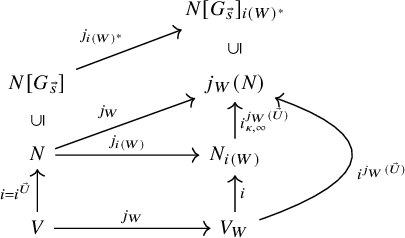
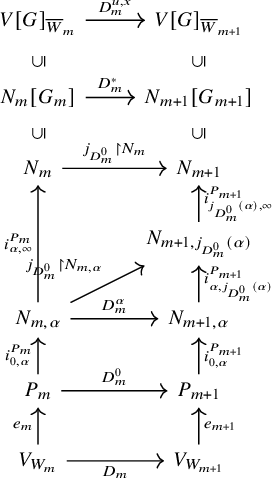

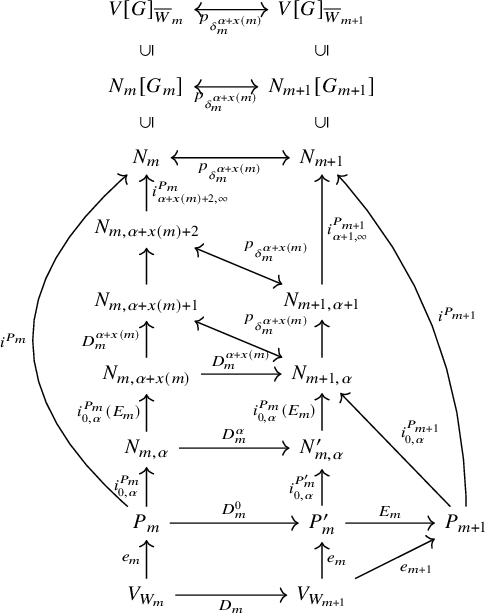

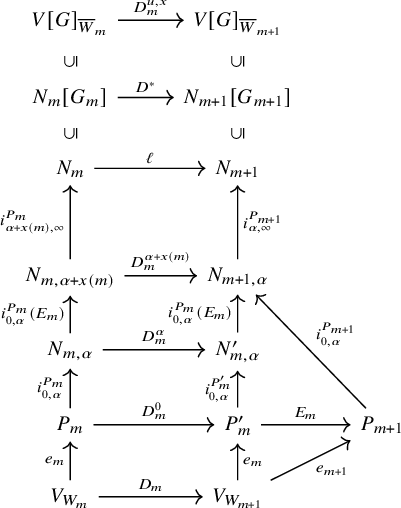

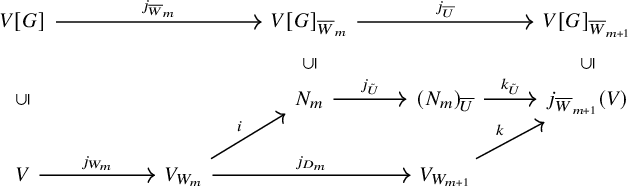


 Open access

