


Introduction
The Coronavirus (COVID-19) pandemic in 2019 caused by the SARS-CoV-2 virus, is responsible for taking the lives of around 7 million people to date. 1 Respiratory viral epidemics and pandemics are often accompanied by bacterial co-infections or followed by secondary bacterial infections. Reference Morris, Cleary and Clarke2 The prevalence of bacterial super infections in COVID-19 was estimated to be around 6%. Reference Lee, Chang and Jung3
Risk factors for these infections included age, male gender, previous antibiotic use, and severity of primary infection. Reference Duan, Wang and Wang4 Corticosteroids, although beneficial in primary infections, were found to increase the risk for superimposed bacterial infections in some studies. Reference Baghdadi, Coffey and Adediran5 Other studies included comorbidities into risk factors such as diabetes mellitus, end-stage renal disease, and hypertension. Reference Rahman, Soh, Sekawi and Zakariah6 There is limited data available on secondary bacterial infections in COVID-19 patients within the lower- and middle-income countries (LMICs). A retrospective study in Pakistan during the early phase of the pandemic found that severe COVID-19 and the use of steroids were associated with secondary bacterial infection. Reference Nasir, Rehman and Omair7
Furthermore, antibiotics are administered empirically to COVID-19 patients for suspected bacterial superinfections, with reported usage exceeding 60%, raising concerns about the emergence of multidrug-resistant organisms. Reference Yang, Li and Qiu8 Therefore, identifying the risk factors and clinical characteristics of patients with secondary bacterial infections in COVID-19 is particularly important in developing countries like Pakistan, where healthcare resources are limited and antimicrobial resistance is a growing concern. In this retrospective study, we aimed to assess and compare the demographics, clinical features, laboratory findings, and microbiological patterns associated with secondary bacterial infections in our population. These insights can support physicians in making more informed therapeutic decisions and highlight the critical need for effective antibiotic stewardship to prevent the further emergence of multidrug-resistant organisms.
Methods
This retrospective observational study was conducted at Aga Khan University Hospital (AKUH) in Karachi, Pakistan. AKUH is a 700-bed, Joint Commission International–accredited major tertiary care facility that played a pivotal role in the national response to the COVID-19 pandemic. The study included clinical data of adult patients aged 18 years or older admitted between May 2020 and April 2022. Patients with a confirmed diagnosis of COVID-19 using PCR or SARS-CoV-2 antigen test were included in the study. Data for this study were obtained from our hospital’s COVID-19 Registry, which was developed using structured information extracted through electronic health records from health information management systems (HIMS). The registry includes comprehensive data for each hospitalized COVID-19 patient, encompassing demographics (age, gender), comorbidities, laboratory parameters at admission, clinical management, in-hospital complications, and outcome measures such as length of stay and in-hospital mortality. The Aga Khan University Hospital Karachi has an antibiotic stewardship program (ASP) since 2018. The ASP incorporates core interventions comprising prospective audits and feedback intervention of prolonged or unnecessary antibiotics (eg, meropenem or vancomycin or ceftriaxone or piperacillin-tazobactam either alone or in combination > 3 d) and prior authorization for restricted antimicrobials (eg, linezolid, tigecycline, IV fosfomycin, caspofungin, colistin) and supplemental interventions include pharmacy-driven IV-to-PO switches, renal/hepatic dose adjustments, dose optimization, and automatic alerts for overlapping spectrum combinations. Patients were classified as having a bacterial infection if they had a positive culture from blood, sputum, or bronchoalveolar lavage, or if their procalcitonin (PCT) level was greater than 5 ng/mL. Patients who did not meet this criterion were classified into the comparison group. Severe illness was defined if patients required noninvasive positive pressure ventilation or mechanical ventilation. Notably, the hospital did not have extracorporeal membrane oxygen, transplant facility, or antivirals other than remdesivir in the duration of the study.
The primary outcome of the study was to identify the risk factors associated with bacterial infections among COVID-19 patients. The secondary outcomes included factors associated with in-hospital mortality and length of stay in the full cohort and in patients who were given antibiotics in the absence of bacterial infections and factors associated with antibiotic prescriptions in patients without bacterial infections. Participants were divided into two groups based on the presence of bacterial infection: Bacterial infection group which included 796 (14%) and patients without bacterial infection including 4 587 (85%) patients. Patients without bacterial infections were further divided into subgroups based on their antibiotic use (Figure 1). Patients’ baseline characteristics including demographics, age, sex, comorbidities, laboratory investigations, hospital care level, length of hospitalization, and in-hospital mortality were recorded.

Figure 1. Study flowchart.
Statistical analysis
All analyses were performed using Python 3.6 and the pandas, numpy, and stats models packages. Descriptive statistics included frequencies and percentages for categorical variables and medians with interquartile ranges for continuous variables. The χ Reference Morris, Cleary and Clarke2 test was used to compare categorical variables and assess statistical significance. For binary outcomes (bacterial infection and in-hospital mortality), both univariate and multivariate logistic regression models were used to estimate associations with key predictors. For the continuous outcome length of hospital stay (LOS), univariate and multivariate negative binomial regression analyses were performed. Results were reported as adjusted Incidence Rate Ratios (aIRRs) and adjusted Odds Ratios (aORs) with corresponding 95% confidence intervals (CIs).
Multivariate models were adjusted for potential confounding and effect modification by including interaction terms in the models including age, gender, comorbid conditions, severity of illness, and complications such as stroke, lactic acidosis, and others. Variables with a P value < .2 in univariate analysis were included in multivariate models. Statistical significance was set at P < .05. Subset analyses were also performed to determine factors associated with mortality and length of stay among patients who received antibiotics in the absence of bacterial infection. A sensitivity analysis was also performed after removing cases defined solely by PCT (ie, keeping only microbiologically confirmed infections).
Results
Of 5383 patients with diagnosis of COVID-19, 796 (17.3%) patients were identified to have either a concomitant or secondary bacterial infection, and 4587 (82.7%) patients did not have bacterial infection. The median age of patients with bacterial infection was 63.5 years (IQR: 53 – 72) compared to a median age of 57 years (IQR: 42 – 68) in patients without bacterial infection. Patients in both groups were predominantly male, with 551 (69.2%) male patients in the bacterial infections group and 2620 (57.1%) male patients in the comparison group. Patients with bacterial infection had a higher in-hospital mortality compared to those without infection (37.06% vs 6.63%; p < .001) (Table 1).
Table 1. Baseline characteristics, laboratory investigations, and clinical outcomes

Abbreviations: IQR = interquartile range; NLR = Neutrophil to lymphocyte ratio; CRP = C-reactive protein; LDH = lactate dehydrogenase; LOS = Length of stay.
Additionally, their hospital stays were notably longer than uninfected patients (Median: 9.0 vs 3.0 d; p < .001). The most frequent pathogens from bronchoalveolar lavage specimens included Klebsiella pneumoniae (n = 86, 20.67%), Acinetobacter spp. (n = 81, 19.47%), and Pseudomonas aeruginosa (n = 80, 19.23%). The distribution of organisms isolated from blood, sputum, and bronchoalveolar lavage (BAL) cultures is shown in Supplementary Figure 1.
Risk factors for bacterial infection in hospitalized patients
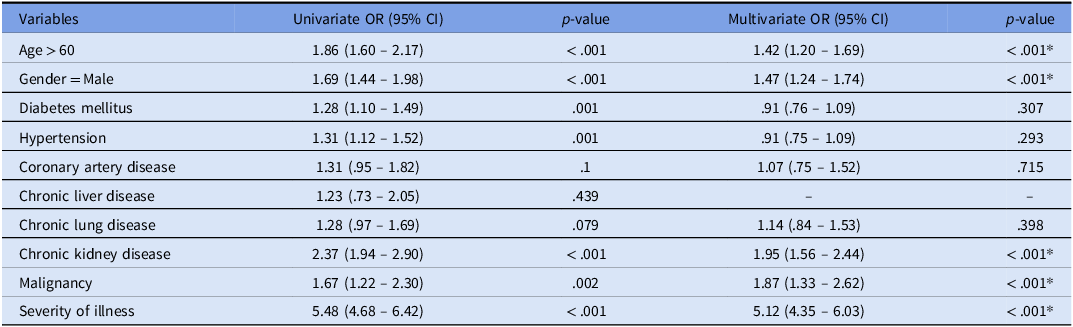
Factors found to be significantly associated with bacterial infection in patients with COVID-19 included severe illness at presentation (aOR: 5.12; 95% CI: 4.35 – 6.03; P value < .001) and co-existing illnesses including presence of hematological or solid tumor malignancy (aOR: 1.87; 95% CI:1.33 – 2.62; P value < .001) and chronic kidney disease (aOR:1.95; 95% CI: 1.56 – 2.44; p < .001). Patient demographics including age (aOR: 1.42; 95% CI: 1.20 – 1.69; P value < .001) and male gender (aOR: 1.47; 95% CI: 1.24 – 1.74; P value < .001) were also identified as significant factors (Table 2). In our cohort, 213 of 796 patients (26.8%) were classified with bacterial infection based solely on PCT > 5 ng/mL. Sensitivity analysis excluding these patients demonstrated that age > 60 (aOR:1.49; 95% CI: (1.24 – 1.80; P value < .001), male gender (aOR: 1.63; 95% CI: 1.35 – 1.97; P value < .001), malignancy (aOR: 1.52; 95% CI: 1.04 – 2.24; P value = .033), and severity of illness (aOR: 5.74; 95% CI: 4.81 – 6.85; P value < .001) remained significant risk factors for bacterial infection (Supplementary Table 1).
Table 2. Factors Associated with Bacterial Infection

* Significant in multivariate analysis.
Abbreviations: ARDS = acute respiratory distress syndrome.
Impact of bacterial infection on clinical outcomes
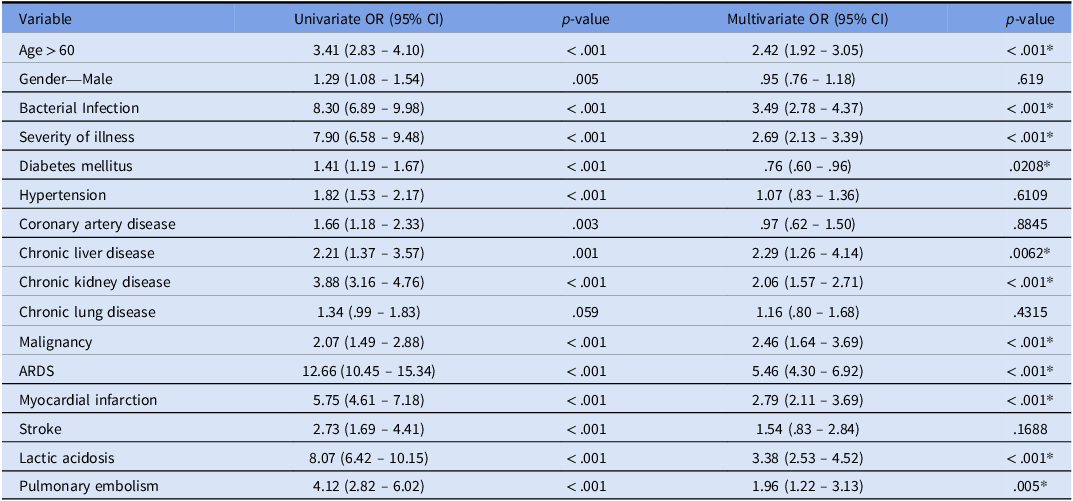
COVID-19 patients with bacterial infection were at greater risk of in-hospital mortality (aOR:3.49; 95% CI: 2.78 – 4.37; p < .001) along with acute respiratory distress syndrome (aOR:5.46; 95% CI: 4.30 – 6.92; p < .001), lactic acidosis (aOR:3.38; 95% CI: 2.53 – 4.52; p < .001), severity of COVID-19 at admission (aOR:2.69; 95% CI: 2.13 – 3.39; p <.001). (Table 3). Factors associated with increased LOS included presence of bacterial infection (aIRR:1.75; 95% CI: 1.61 – 1.89; p < .001), acute respiratory distress syndrome (aIRR:1.50; 95% CI: 1.37 – 1.66; P value < .001), severe COVID-19 at admission (aIRR:1.73; 95% CI:1.61 – 1.89; P value < .001) and pulmonary embolism (aIRR:1.58; 95% CI: 1.31 – 1.90; P value < .001) (Table 4).
Table 3. Factors associated with in-hospital mortality

* Significant in multivariate analysis.
Abbreviations: ARDS = acute respiratory distress syndrome.
Table 4. Factors associated with length of hospital stay

* Significant in multivariate analysis
Abbreviations: ARDS = acute respiratory distress syndrome.
Factors associated with antibiotic use in patients without bacterial infection
Factors associated with antibiotic use in patients without bacterial infection were assessed and it was found that with advanced age (aOR: 1.71; 95% CI: 1.47 – 1.98; p < .001), male sex (aOR: 1.55; 95% CI: 1.35 – 1.76; p < .001) co-morbid conditions including chronic kidney disease (aOR: 1.72; 95% CI: 1.29 – 2.29; p < .001) and severe illness at presentation (aOR: 4.18; 95% CI: 3.29 – 5.31; p < .001) were more likely to be prescribed antibiotics despite not having been deemed to have bacterial infection (Table 5).
Table 5. Univariate and multivariate analysis of factors associated with prescribing antibiotics in patients without bacterial infection

* Significant in multivariate analysis.
Abbreviations: ARDS = acute respiratory distress syndrome.
Outcomes in patients without bacterial infection given antibiotics
Of 4587 patients without bacterial infections, 2820 (61%) patients who received antibiotics were generally older (median age: 61 vs 49 yr) and more likely to be male (62.2% vs 50.9%), compared to 1767 (38%) who didn’t receive antibiotics. The antibiotic treated group in this population also had higher frequency of several comorbidities including hypertension, diabetes mellitus, and coronary artery disease (all p < .01), as summarized in Table 6. The most frequently prescribed antibiotics were piperacillin-tazobactam (n = 1510), followed by ceftriaxone (n=1285) and azithromycin (n = 1109). Patients who received antibiotics had a significantly higher mortality rate (10% vs .6%, p < .001) and experienced longer hospital stays compared to those who did not receive antibiotics.
Table 6. Baseline characteristics, laboratory investigations, and clinical outcomes in patients without bacterial infection

Abbreviations: IQR = interquartile range; ARDS = acute respiratory distress syndrome.
Mortality in patients without bacterial infection given antibiotics
The multivariate analysis found acute respiratory distress syndrome (aOR:6.16; 95% CI: 4.48 – 8.48; p-value < 0.001) to be significantly associated with mortality in patients without bacterial infection (Figure 2). Lactic acidosis (aOR: 3.82; 95% CI: 2.61 – 5.59; p-value < 0.001) and myocardial infarction (aOR:3.04, 95% CI: 2.11-4.37; p-value < 0.001) were also associated with mortality in these patients (Supplementary Table 2).

Figure 2. Factors associated with (a) mortality and (b) length of stay in patients without bacterial infection treated with antibiotics. Legend: red dots represent variables with statistically significant associations.
Length of stay in patients without bacterial infection given antibiotics
Upon multivariate adjustment, severity of illness (aIRR:1.55, 95% CI: 1.41 – 1.71; p-value < 0.001) showed a significant association along with acute respiratory distress syndrome (aIRR:1.52, 95% CI: 1.34 – 1.72; p-value < 0.001), and pulmonary embolism (aIRR:1.65, 95% CI: 1.30 – 2.09; p-value < 0.001) after adjusting for age and co-morbid conditions (Supplementary Table 3).
Discussion
Our study found that the risk of bacterial infection was higher in patients who had severe COVID-19 at the time of admission to hospital, advanced age, male sex, and presence of chronic kidney disease and malignancy as co-morbid conditions. The most common isolated pathogens were Klebsiella pneumoniae, Acinetobacter baumanii, and Pseudomonas aeruginosa. We found that hospitalized COVID-19 patients with bacterial infections were at higher risk of death and had a longer LOS in addition to other factors. Our study also explored the factors associated with antibiotic use in those who were not identified to have bacterial infections. 60% of these patients received antibiotics and included those who were of advanced age, male sex, having co-morbid conditions. Furthermore, in-hospital mortality was higher, and LOS was more prolonged in these patients. Risk factors for death in these patients included ARDS, lactic acidosis, and thrombotic complications such as myocardial infarction, stroke, and pulmonary embolism.
Several studies have reported higher incidence of bacterial co-infections in severe to critical COVID-19 patients Reference Mirzaei, Goodarzi and Asadi9 and poorer outcomes in these patients. Reference Chen, Zhou and Dong10,Reference Gan, Zhang, Sun and Lyu11 This is postulated to be due to weakened immune system and direct injury to respiratory epithelium by the virus. Reference Cox, Loman, Bogaert and O’Grady12 Risk factors have been variably reported from different parts of the world. A study from China reported greater risk in elderly population and patients with severe disease similar to our results though these variables were not found to be statistically significant on multivariate analysis. They similarly found association with longer length of hospitalization. Most studies have reported an association with severity of COVID-19. Reference Bolker, Coe, Smith, Stevenson, Wang and Reed13,Reference Van Laethem, Pierreux, Wuyts, De Geyter, Allard and Dauby14 A study from Spain reported risk factors for bacterial infection to be male sex, obesity, and multi-organ failure as opposed to our study. Reference López-Herrero, Sánchez-De Prada and Tamayo-Velasco15 Female sex was protective for bacterial infection in a study from Germany which is similar to our finding of increased risk of bacterial infections in male patients. Reference Lösslein, Staus, Beisert Carneiro, Wolkewitz and Häcker16
Our study adds to the existing body of literature regarding the association of bacterial infections with adverse clinical outcomes including higher mortality and longer hospitalization which has been globally reported from different studies highlighting the need for prompt identification and treatment. Reference López-Herrero, Sánchez-De Prada and Tamayo-Velasco15–Reference Na, Baek and Baek19 A recent large multicenter study from US has reported bacteremic co-infection to be the greatest risk factor for mortality, intensive care admissions, and mechanical ventilation Reference Patton, Orihuela and Harrod20
Majority of patients were found to have infections with Gram-negative organisms. This is similar to reports from Turkey Reference Iscanli, Aydin and Şaylan17 and Germany Reference Lösslein, Staus, Beisert Carneiro, Wolkewitz and Häcker16 whereas a large study from Spain found Gram-positives to be the most frequent microorganisms notably Streptococcus pneumoniae and Staphylococcus aureus. Reference Moreno-García, Puerta-Alcalde and Letona21 While studies were lacking from LMICs, a study from Indonesia, an upper middle income country reported that the Gram-positive bacteria were predominant pathogens, mainly Staphylococcus aureus, Staphylococcus haemolyticus followed by Gram-negative bacteria Enterobacterales. Reference Ginting, Padmasawitri, Hanum, Nurhayati, Soeroto and Amalia22 In a previous study from our center in the beginning of the pandemic, we had noted increased incidence of infections with Gram-negative organisms Reference Nasir, Rehman and Omair7 which is reflective of our local epidemiology.
Inappropriate antibiotic use during the COVID-19 pandemic has emerged as a major global health concern, with studies showing antibiotic prescribing rates exceeding 70% among hospitalized COVID-19 patients despite bacterial co-infection rates being less than 15%. Reference Rawson, Moore and Zhu23,Reference Langford, So and Raybardhan24 In our study, we found that while 17% were found to have bacterial infection, 60% of the patients hospitalized with COVID-19 who were not found to have a bacterial infection were also administered antibiotics. Studies have reported that this overuse, often driven by diagnostic uncertainty, empirical prescribing practices, and misinformation which were considerably significant issues in LMICs where self-medication and over-the-counter antibiotic access further compounded the problem. Reference Daria and Islam25 Factors associated with antibiotic prescribing in hospitalized COVID-19 patient have been reported from different studies and include advanced age, ICU stay, or need for mechanical ventilation, comorbid conditions such as diabetes mellitus and severe to critical COVID-19 at the time of admission to hospital. Reference Martin, Shulder, Dobrzynski, Quartuccio and Pillinger26–Reference Şencan, Çağ and Karabay28 These are similar to the observations from our study. Interestingly, none of the studies have found antibiotics to be protective of mortality in these patients. Reference Goncalves Mendes Neto, Lo and Wattoo29,Reference Milas, Poncelet, Buttafuoco, Pardo, Lali and Cherifi30 In our study, the mortality was higher, and the length of hospitalization was more prolonged in the patients who got unnecessary antibiotics. This has significant implications for making antibiotic stewardship guidelines and for future pandemic preparation particularly in resource constrained settings.
There is a paucity of data from LMICs regarding antibiotic use during the pandemic, whereas most existing literature is skewed toward high-income settings. Our study helps to fill this knowledge gap and supports evidence-based global health recommendations that are more inclusive and representative. However, there are limitations such as generalizability as our study is a single-center study, and the findings may be applicable to tertiary care centers in LMICs. Furthermore, since this is retrospective data, there may be residual confounding from factors that could not be captured such as differentiating colonization from infection. However, we mitigated that by using a sensitive case definition to not miss anyone with infection. To address any potential misclassification, we also conducted a sensitivity analysis restricting bacterial infection to cases with microbiological confirmation only and excluding those identified by PCT > 5 ng/mL alone. Our findings remained consistent with our initial analysis. In our study, we defined severe illness as requiring noninvasive or mechanical ventilation as an objective marker of significant respiratory compromise. Although narrower than WHO criteria, which include oxygen thresholds, this definition offers a pragmatic approach given the available data and is a clinically meaningful proxy for severe illness. Hence, our findings are most directly applicable to patients requiring advanced respiratory support. Our study did not have detailed data on antibiotic duration (beyond initial prescribing). However, our institution has a well-established Antimicrobial Stewardship Program (ASP) to limit inappropriate or extended antibiotic courses.
Our study findings can be used to tailor antimicrobial stewardship (AMS) programs in tertiary care centers in LMICs as they reflect local prescribing behavior and can inform interventions that will be practical, sustainable, and effective in LMIC settings.
Supplementary material
The supplementary material for this article can be found at https://doi.org/10.1017/ash.2025.10211.
Data availability statement
All data relevant to the study are included in the article.
Author contributions
N.N, N.S.K were involved with study conceptualization. N.N, W.F, Z.N, and N.S.K. were involved with study implementation and management; W.F, Z.N, and N.N. were involved in writing the first draft of manuscript; all authors have read, contributed to and approved the final draft of the manuscript.
Acknowledgements
AKU BI Team Yaseen Jan, Sabikah and Muhammad Ali Nazir, IT Department (Muhammad Adnan), Health Information and Management System (HIMS) (Javeriah Khan), IT Pharmacy (Midhat Akhtar), Student Research Forum (SRF) and medical students involved in data procurement for the AKU COVID-19 Registry. We thank the faculty collaborators from Dept. of Medicine, Dept. of Pathology and Laboratory Medicine, Dept. of Anesthesiology and Dean AKU Medical College for their supervision and support. We thank the patients, caregivers, health care practitioners, and research staff, who contributed data to the AKU COVID-19 Registry.
Funding
No funding was received for this study.
Competing interests
The authors declare no conflict of interest.
Ethics approval
Ethical approval for the study was granted by the Ethics Review Committee of Aga Khan University (ERC Reference No.3650). As the research involved a retrospective analysis of de-identified hospital records, the need for obtaining informed consent was formally waived.




 Open access

