

Siempre se ha visto al negrito loco con su sandía.
(You’ve always seen the crazy little black with his watermelon.)
performer from Sambos con Sentimiento y DevociónThe drums sound and the performers shout: “ZAMBO!” (pronounced “Sambo”). Their voices echo through the stadium filled with thousands of international tourists and local Peruvians who have traveled to Puno, Peru, for La Fiesta de la Virgen de la Candelaria. I sit in the stands among the tourists beneath the scorching sun and struggle to see beyond the media crews. Members of the press stand on the red-and-white track behind silver barriers cordoned off from the stadium’s field area. The field has been converted into a large, gray performance stage. La Fiesta de la Virgen de la Candelaria is one of Peru’s most important yearly media events, and the press stream performances live on national television.
The stadium is so big that the patrons packed in the stands across from me look like flies. I can only see giant Cusqueña bottles, Coca-Cola and Claro billboard signs that drape the walls of the stands. About fifty Italians, Peruvians, and American tourists are seated in my row alone, and locals and patrons in the stands converse in Quechua, French, Italian, and English. “Zambo!” The second shout drowns out the chatter.
I finally see a squadron of performers standing on the performance stage. There are hundreds of dancers and some huddle behind a man carrying a banner, “Sambos con Sentimiento y Devoción” (Sambos with Feeling and Devotion). Zambo is the colonial category for the progeny of a black and indigenous or black and Asian union (Reference WrightWright 1990). Nowadays, it is a term for any racial mixture that emphasizes blackness.Footnote 1 It is also the name of the performance troupe from Lima, Sambos Illimani con Sentimiento y Devoción, whose members stand onstage.Footnote 2 While some performers are the children of Andean migrants who traveled from the province to the capital, group members hail from different parts of Peru. Most of them are racially ambiguous, but none are identifiably black. Today, however, they all claim to be sambos/zambos, and they ready themselves to perform a popular dance called the Danza de Caporales. At this fiesta—a carnivalesque ritual event celebrating both the Virgen de la Candelaria and the Andean Pachamama—impersonation is the order of the day. These performers are therefore authorized to occupy blackness, to take hold of its remnants, and through this act of figurative possession they will enact a scene of African enslavement.
This article focuses on Sambos Illimani’s deployment of blackface in their slave scene primarily because neither blackface nor explicit representations of slavery are typical features of the Danza de Caporales. In this essay, I ask: How does one historicize and critically analyze their deployment of blackface when blackface is so commonly associated with the nineteenth-century US blackface minstrel tradition? This study aims to expand widespread understandings of the form, and I use Sambos’ deployment of blackface to develop the concept of hemispheric blackface. Hemispheric blackface is about the way individual acts of impersonation index and draw from multiple performance traditions in the Americas. In treating Sambos’ incorporation of blackface in the Danza de Caporales as an example of hemispheric blackface, I neither center US blackface minstrelsy nor read their use of blackface in purely nationalist terms. Instead, I ground blackface within an indigenous tradition of masquerade and highlight the ways it has been inflected by other hemispheric performance traditions. In doing so, I underscore the amorphous nature of blackface itself and critically assess the work blackness is made to do in Sambos’ act of impersonation.
The Danza de Caporales is a neo-folkloric dance that was created in 1969 by the brothers of the Estrada family from Chijini—a working-class neighborhood in La Paz, Bolivia. The dance quickly became a hit among young people. It arrived in Peru in the early 1970s and spread rapidly across South America and the globe. As it grew in popularity, its origins became the subject of controversy as Peruvians and Bolivians alike claim to have invented the dance. The caporal, protagonist of the Danza de Caporales, has always been a feature of carnivals acting as the foreman of a dance squad or performance troupe. The dance merges this figure with representations of blackness in a blackface dance known as the Tundique or Tundiki. The Tundique belongs to a tradition of dances in Latin America known as the Baile de los Negritos (Dance of the Little Blacks) (Reference Sánchez-PatsySánchez-Patsy 2006) and also to a pantheon of satirical Andean dances that represent blackness, called negrerías.Footnote 3 Some versions of the Tundique satirize African enslavement and are danced in blackface by mestizo and indigenous people (Reference Maidana RodríguezMaidana Rodríguez 2011). This version typically features a capataz (slave driver) character who represents brutal authority. The capataz is a racially ambiguous figure who may be a black, indigenous, white, or mestizo slave driver of the slave gang. The caporal figure of the Danza de Caporales is a fusion of the capataz character and the foreman of street carnivals. While he is a softer figure of racial ambiguity, like the capataz, the caporal functions as a symbol of power, virility, and prestige.
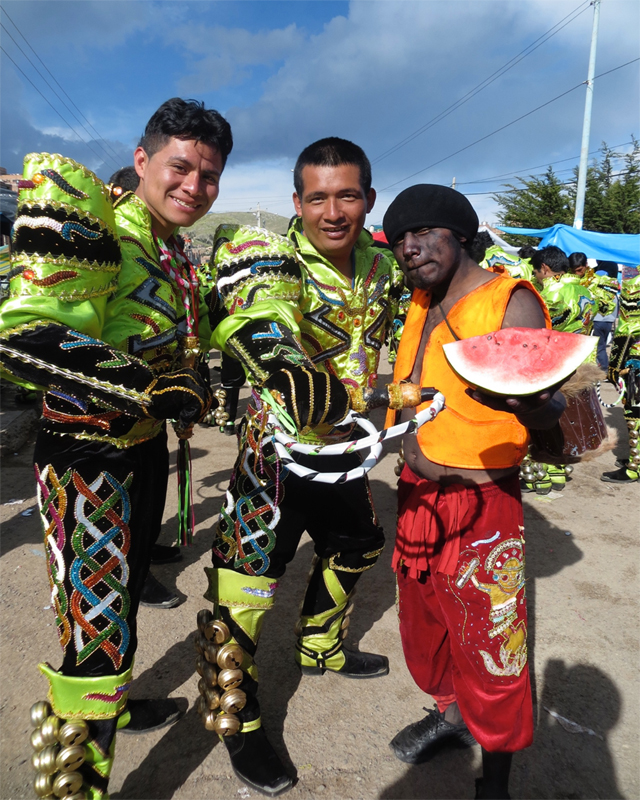
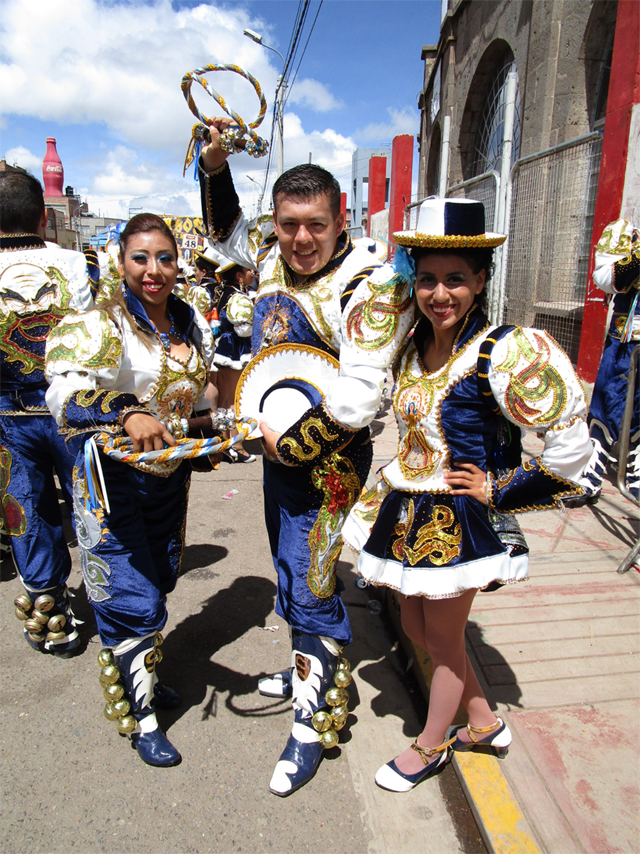
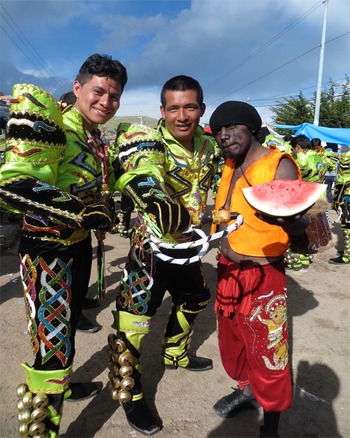
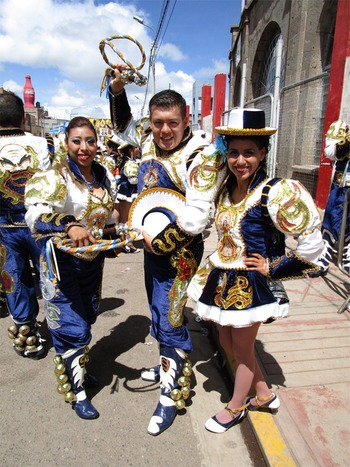
The young performers of Sambos Illimani standing onstage have certainly dressed the part of an imposing authority figure. The men all wear large green vests, black pants, and tall, knee-high boots with rows of gold bells on either side (Figure 1). Their shirt sleeves puff at the shoulders, enlarging the muscles of their arms, and many carry whips in their hands. Scattered among the rows of caporales are female dancers cross-dressed as men, known as las machitas, who act as queer figures of male power. The other women dancers, or caporalas, are sensual femme characters wearing revealing mini-polleras (miniskirts) and high heels, and long trenzas (plaits). They stand together in a large triangle, with eleven lines of caporales and machitas on two sides and rows of caporalas at the tip of the triangle. Together, they look like a thousand soldiers ready to march in a military parade (Figure 2).
Caporales and one of the blackface dancers from the performance troupe Sambos Illimani con Sentimiento y Devoción. Taken by the author at La Fiesta de la Virgen de la Candelaria in 2013.
Caporal, Caporala, and La Machita of Sambos Illimani. Taken by the author at La Fiesta de la Virgen de la Candelaria in 2018.
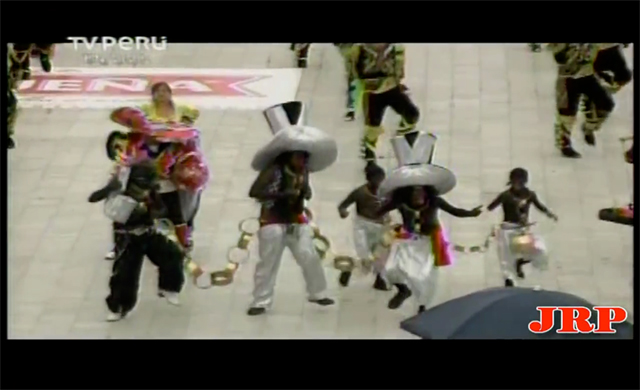
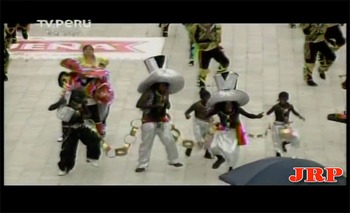
Suddenly, the patrons in the row in front of me burst out laughing as they point at six men covered in black paint standing behind the caporal carrying the banner in the front (Figure 3). Five of them are chained together while another performer stands beside them with a scale on his shoulder and a watermelon in his hand. One wears a blonde Afro wig, and two of them are wearing large silver and black top hats that match their silver pants. There is no racial ambiguity here as these enslaved blackface performers stand directly in front of the other Sambos, who carry whips in their hands. Together, the scene creates a power play between the master or slave driver and the slaves. The blackface figures alongside the racially ambiguous Sambos performers create a juxtaposition between an identifiable blackness and the racially ambiguous bodies that stand in for whiteness, blackness, indigeneity, and racial mixture all at once. Suddenly, the drums start beating faster, trumpets blare, and the cry of “Zambo” shakes the entire stadium. A thousand dancing bodies come to life and the fiesta is alive.
Still of Sambos’ performers dressed in blackface and chained together. From “Caporales con Sentimiento y Devoción 2013,” YouTube video, 7:07, posted by “MycandelariaPuno,” March 3, 2013, https://www.youtube.com/watch?v=5qjYIuRErSg.
The drumbeats boom loudly and the sound of trumpets bursts into the air. There are whistles, screams, claps, and shouts. The rows of caporales suddenly move forward in military style and they sway their hips in unison. The caporales and machitas raise their knees to their chests, then kick high into the air. The cameramen try to run around them but can only film a few squadrons of caporales at a time. There are too many jumping bodies to count.
As this dancing army moves forward, the sounds of the bells on their boots reverberate in our seats and on the stadium floor: Shhhhaaakkka shaakkka! They kick in circular motion and when their feet touch the floor, they lift their shoulders up and down, then skip again to the drum’s one-two beat. The caporales flirtatiously shout: “Hey hey!” The women dancers sensually shake their behinds rapidly, criss-cross their ankles, and screech: “Ooo Ooo!” The men reply with loud barks: “Awoof Awoof! Siempre!” This is an ostentatious display of juvenile bravura.
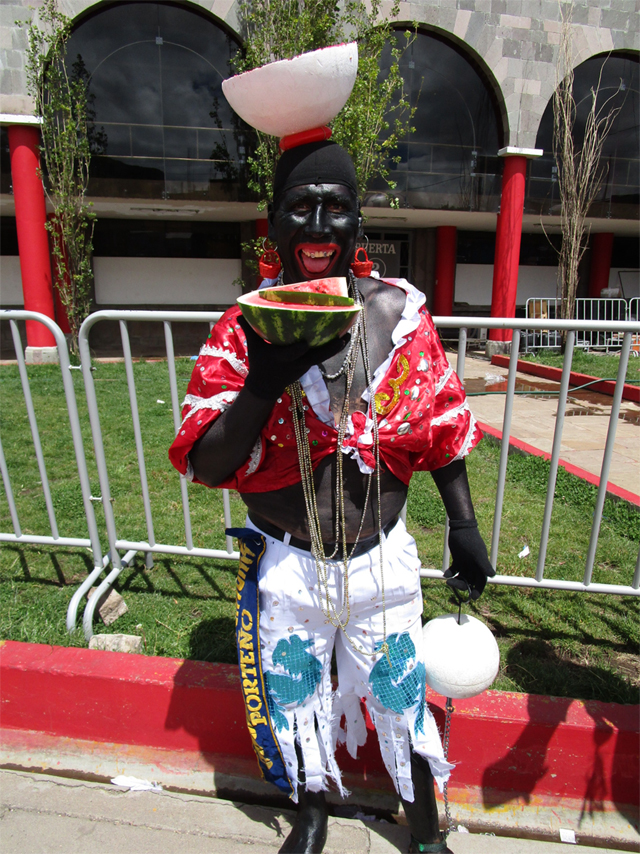
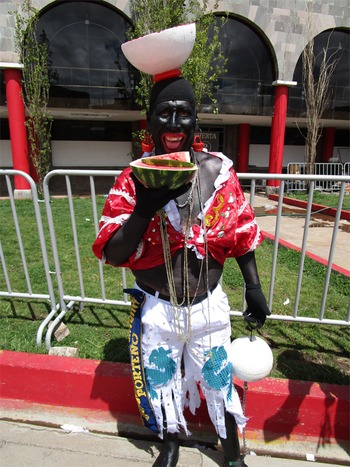
The chained men in blackface dance just ahead of the caporales. The shhakka shakka sound of the caporales’ boots match the sound of chains that clang as the slaves move. From the distance, I can see the giant balls of the silver chains hanging around their necks sway to and fro. Their bright red lipstick gleams as the blackface performers grin wildly and excitedly stomp their feet to the beat. They hop and skip, moving their left feet twice and their right feet twice. The stadium erupts with laughter and applause. As the caporales move forward, they raise their whips above their heads, punch their fists in the air and three or four rows of hundreds of caporales move to encircle the enslaved Africans. The dancing slaves in blackface skip and hop happily to the one-two beat. The American tourists in front of me laugh heartily and one points to an unchained slave carrying his watermelon. Three cameramen surround him. He stomps his feet delightfully, takes his watermelon to his face and bites into it wildly (Figure 4). The laughter and cheers grow louder. The applause and laughter in the stadium boom like roars of thunder and countless voices join to shout: “Zambo!”
Sambos’ Watermelon Man at La Fiesta de la Virgen de la Candelaria, 2018. Photo by the author.
How does Sambos Illimani’s performance help us understand the workings of blackface? What ideas of blackness are animated in their act of impersonation? Blackface is a mode of racial conjuring that is present in performance traditions across the Americas. While it has long been a feature of indigenous traditions of impersonation, most investigations of Andean performance focus primarily on the deployment of the Andean mask (Reference Cánepa KochCánepa Koch 1998, Reference Cánepa Koch2001), and blackface remains understudied. Even though blackface is a part of indigenous performance traditions, it is more common for performers of the Danza de Caporales to briefly incorporate a black mask in theatrical scenes of their performances.Footnote 4 The directors of Sambos Illimani explained to me that the Fiesta de la Virgen de la Candelaria is only one of two special occasions of their yearly performance calendar in which they don blackface.Footnote 5 While all neo-folkloric dances draw from transnational repertoires of representation, I find Sambos’ performance to be so compelling because it references multiple genealogies of blackface from the Americas simultaneously.
I read Sambos’ performance as a part of a network of impersonation that I am calling hemispheric blackface. Hemispheric blackface is about the encounter of various performance traditions of the Americas in individual acts of impersonation. Since blackface is either associated with the nineteenth-century US minstrel tradition or theorized in relation to nationalist discourse in Latin America (Reference LaneLane 2005; Reference RiveroRivero 2005), I use the term “hemispheric” to dislocate blackface from nationalist frames and to attend to the amorphous nature of blackface itself. The creators of the Danza de Caporales, for example, were inspired by Afro-Bolivian performance, the Argentine gaucho, the popular Afro-Cuban image from the mambo craze of the 1950s, and the Catholic tradition of the Baile de los Negritos. Sambos’ performance references this fusion while also riffing on a US minstrel trope. A blackface performance such as this one is hemispheric in that it signifies on the images and tropes that circulate in the transnational web of exchange between the US and Latin America and the Caribbean. In excavating the collision of hemispheric traditions of performance in Sambos’ performance, I uncover how tropes of blackness in the Americas are shared and highlight how blackface performances in the Americas riff on each other to produce meaning. Hemispheric blackface is not a universalizing claim about the function of all blackface representation in the Americas, for meaning is always contingent and contextual. Sambos’ performance is simply one example of how blackface can function as an amorphous trope that fuses multiple hemispheric performance traditions to animate and mobilize a fantasy about blackness. In this study, I argue that their performance enacts a power fantasy that relies on the subjugation of an enslaved black body.Footnote 6
Hemispheric blackface is grounded in two fundamental claims in performance studies: the first is that performances are acts of transfer (Reference TaylorTaylor 2007) that produce and transmit knowledge through “twice-behaved” behavior or restored behavior (Reference Schechner and TurnerSchechner 1985). Restored behavior treats living behavior as strips of film that are revised and reworked. No two performances are exactly alike, and the meaning of each is always co-constructed by practitioners and spectators through their engagement with the devices operating before them (Reference Elam, Elam and KrasnerElam 2001, 5). Performance and cultural studies treat embodied forms and cultural artifacts as epistemic practices that serve both as objects of analysis and as constitutive sites of knowledge production (Reference TaylorTaylor 2007; Reference WestWest 1990; Reference Hall, Morley and ChenHall 1995).Footnote 7 I combine visual and textual analysis with ethnographic methodologies, focusing my analysis on the meaning that is coproduced by spectators and performers during the live performance. So while members of the performance troupe indicated to me that they defined blackface as a US tradition and that their performance was an expression of their admiration, respect for, and fascination with blackness (personal communication, 2013), I am ultimately asking this question: How does blackface—as a central device of racial play—activate and organize the racialized and gendered relations of power that are enacted in embodied form onstage?
The second claim on which hemispheric blackface is grounded is that as performances travel, they shape and impact other performance practice and traditions (Reference TaylorTaylor 2007). That Sambos’ performance took place in Puno, a transborder space shared by Peru and Bolivia, is significant because it captures how blackface as a racial signifier floats across borders, moves through time and space, and is transmitted across traditions of embodied practice. Since conversations about blackface are often centered around the export of US blackface minstrel archetypes to sites of the global South (Reference ColeCole 2001; Reference ThelwellThelwell 2013; Reference HillHill 1992),Footnote 8 blackface is often theorized as moving from the North to the South. While I use hemispheric blackface to place the Americas in a single critical frame, I decenter US minstrelsy as the presumed progenitor for blackface, opting instead to highlight an indigenous blackface tradition. In Sambos’ case, blackface emerges from the syncretism of a European Catholic tradition of impersonation and an indigenous tradition of masquerade in Bolivia known as the Tundique. These traditions predate US blackface minstrelsy, and they have always traveled across national borders to neighboring countries. The Andes region functions as its own site of export because carnivals are mediatized tourist spectacles produced for a global audience, retransmitted via mass media. Blackface therefore enters the global economy of repetition and reproduction via the Andes, and Sambos’ act of (racial) transfer acquires multiple forms of (digital and immediate) “presence.” While the intentions of the local performers will be lost, blackface will continue to produce and acquire new meaning. Sambos’ performance is an instance where blackface emanates from the South outward, is catapulted and retransmitted into a global marketplace, and where another site of the Americas functions as the center of export for blackface tropes.
Defining Blackface
It is indeed true that the term “blackface” has US theatre studies provenance, and for many, the word itself imposes an imperial gaze upon a local practice.Footnote 9 I use the term “blackface” to name a mode of stylizing the body which entails “blacking up” and the exaggeration of lips, hair, and phenotypical features associated with people of African descent. Blackface characters are usually marked by the distortion of black vernacular or the incorporation of malapropisms (Reference LaneLane 2005). Blackface is an act of substitution (Reference RoachRoach 1996), where one stands in for the other. It is a form of cross-racial identification or an act of occupation where one takes figurative possession of the other (Reference HartmanHartman 1997; Reference Lane and Godoy-AnativiaLane and Godoy-Anativia 2008). As a form of impersonation, blackface is rarely contingent on the presence of a direct “original”; it is less concerned with truthfulness and more with pleasure and political efficaciousness (Reference LottLott 2013). Blackface is a game of artifice whereby blackness is made present as racial distortion. It summons blackness as the marker of a racial excess plastered onto the conjurer’s body. In their recognition of the expansion of the form into various cultural and digital realms, theorists define blackface as a racial idiom (Reference LottLott 2013), a lingua franca (Reference Nyong’oNyong’o 2009), a transnational language of race (Reference Chude-SokeiChude-Sokei 2006), and a floating racial signifier (Reference Cole and JohnsonCole 2012). Theorists have also affirmed the global nature of this practice of racial conjuring and the legibility of the tropes itself, and there are studies of blackface in varied sites including Korea (Reference HanHan 2015), South Africa (Reference CoplanCoplan 1985), Japan (Reference YellinYellin 1996), Cuba (Reference LaneLane 2005), Britain (Reference PickeringPickering 2008), and Iran (Reference BaghoolizadehBaghoolizadeh 2012). That Sambos’ blackface performance resonated with a global audience attests to the legibility of blackface tropes in a global arena. When the performer holding a watermelon told me he had always seen a crazy black man with watermelon, I quickly discovered that the watermelon man was not a stock figure of indigenous dances; rather he was emphasizing the ubiquity of the image signaling blackface tropes as racial codes that have global weight. In this context, through hemispheric blackface I expand the meaning of the term affirming this mode of stylizing the body as a global practice.
Following other performance scholars who have placed the Americas in a single analytical frame (Reference LaneLane 2010; Reference TaylorTaylor 2007), I employ the term “hemispheric” in hemispheric blackface to conceptualize the Americas as a meaning-making space. Scholars of hemispheric performance seek to ascertain how the region’s “shared historical experiences of conquest, native genocide, colonialism, slavery, independence wars, nation formation, histories of migration and deterritorialization” have shaped and been informed by performance traditions (Reference LaneLane 2010, 114). Hemispheric blackface is not simply about the ubiquity of global connections (Reference TsingTsing 2005; Reference HerzfeldHerzfeld 2004), but is most concerned with how the region’s particular history of chattel slavery—a history which is not shared globally—is negotiated and imprinted in the realm of artifice. Sambos’ performance marks the convergence of the history of chattel slavery and the symbolic and literal plundering of blackness. Their performance enables us to conceive of acts of impersonation both as archives of racialization and as racial projects through which contemporary process of racial formation are realized and maintained.
Impersonation and the Andean Carnivalesque
Sambos’ act of impersonation is not unusual because Andean fiestas are carnivalesque ritual events where racial and gender transvestism are the order of the day. In indigenous performance traditions, racial humor and masking are central features of all ritual practice (Reference Cánepa KochCánepa Koch 2001), and all racial groups are subject to some form of racial parody (Reference Huerta-Mercado and KochHuerta-Mercado 2001). While carnivals are often seen as sites of social inversion (Reference BakhtinBakhtin 2009), theorists have cautioned against simplistic approaches that define carnival as inherently liberatory or purely as sites of resistance (Reference StamStam 1989; Reference GoldsteinGoldstein 2013) and instead propose to treat them as polysemic sites of contested meaning (Reference GussGuss 2006). Studies of Andean fiestas affirm that they have always been arenas of fierce negotiation of dynamics of power between colonizers, or later, the state and indigenous people (Reference PoolePoole 1990; Reference RockefellerRockefeller 1998).Footnote 10 Following these theorists, I take the Andean fiesta as a site and object of tourism where dynamics of power and processes of globalization and modernization are both negotiated and constituted (Reference Cánepa KochCánepa Koch 2001, 21). The temporary suspension of normative boundaries of race and gender does not magically erase the complex dynamics of power at play at a fiesta.
I also pay close attention to how blackness is being ventriloquized in Sambos’ performance, because Afro-Peruvians have to contend with discrimination and with their social invisibility in Peru (Reference FeldmanFeldman 2006; Reference Golash-BozaGolash-Boza 2011). While black cultural forms enjoy some visibility, Afro-Peruvians themselves have had to fight for social recognition and inclusion.Footnote 11 One factor in their social invisibility is Peru’s racial discourse which centers the tensions between indigenous people from the highlands and whites or mestizos in Lima (Reference De la CadenaDe la Cadena 1998) marginalizing the black populace. Moreover, the state did not conduct a racial census from 1940 to 2017, which furthered the invisibility of Afro-Peruvians. This was an obstacle to black activists seeking to identify and define the needs of the black population and to combat racism. As is common across Latin America,Footnote 12 employers frequently seek candidates with buena presencia (meaning white features), and Afro-Peruvians are stereotyped as fools who cannot think beyond midday (Reference HernándezHernández 2012). Media portrayals of blacks as criminals, buffoons or as unkempt are also commonplace (Reference Becerra, Adekunle and WilliamsBecerra 2013).Footnote 13 For my purposes here, an assessment of how blackness is conjured and ventriloquized illuminates the work blackface does in fixing difference in the performance and in the context of discrimination and black social invisibility in Peru. In what follows, I situate the Danza de Caporales within the Tundique tradition to read blackface as part of an indigenous tradition of performance and to also affirm blackface as a porous form that absorbs transnational images of blackness. I look at the way hemispheric performance traditions have inflected the representation of blackness in Sambos’ dance and then analyze how blackface is used in their performance to mobilize an anti–black power fantasy.
The Tundique: Ventriloquizing Blackness in the Andes
As an Andean traditional dance of impersonation, the Tundique is the perfect example of how blackface functions as a form that fuses multiple traditions. The history of the Tundique is contradictory and nebulous, for the dance has multiple genealogies. It is associated with religious rites, popular culture, music, and carnivalesque representations of enslavement in the Andes. The purpose here is not to engage in what would be a doomed search for an original Tundique but instead to trace how the representation of blackness from a Catholic religious rite of the colonial era has been inflected by multiple performance traditions over time.
The Tundique belongs to the tradition of the Baile de los Negritos, which emerges from Catholic religious rites and the celebration of the figure of the negrito. One of the central stories of the Catholic faith is the story of the three wise men or three kings who visit baby Jesus. Each character represents a nation or race of the world. One of them is a black figure referred to in Bolivia as Balthasar. The representation of Balthasar as a white person in blackface predates Spanish arrival to the Americas and continues today in Spain’s traditional procession known as the Fiesta de Reyes, which occurs in January of each year. During the conquest of the Americas, the colonizers deployed the figure of Balthasar in colonial practices of religious conversion, using Balthasar’s racial difference in the story of the Three Kings as an allegory for the conversion of the racial other (Reference Brewer-García and PattonBrewer-García 2016; Reference KaplanKaplan 1985). Through performances and theatre at Christmas time, colonizers presented a world where everyone—regardless of their ethnic or racial difference—would bow down and worship baby Jesus. Since impersonation of the other was already a central feature of pre-Hispanic performance traditions (Reference Cánepa KochCánepa Koch 1998), the colonizers accommodated some indigenous public rituals and co-opted them as instruments of conversion (Reference PoolePoole 1990). The Spanish tradition of racial cross-dressing in representations of Balthasar was fused with indigenous traditions of masquerade in the colonies. At Christmas time, colonizers often used villancicos navideños (Christmas carols) to proselytize to the native population, and these carols were eventually assimilated into Latin American folklore. In writings about celebrations in Sucre and La Paz, Bolivia from 1913 onward, some of the rhythms and dances associated with these Christmas carols were referred to as chuntunquis (Manuel Rigoberto Paredes cited in Reference Sánchez-PatsySánchez-Patsy 2006). It is believed that the word tundique is an evolution of the word chuntunqui and that it is an imitation of the onomatopoeic “tun-tun” sound of the rhythms associated with the song and dance of the earlier carols. As a blackface tradition embedded in religious practices, the Tundique is a fusion of Spanish and indigenous traditions of masquerade that emerged from the colonial encounter. The tradition has always been characterized by the fusion of different performance traditions.
While it remains common for people in La Paz and Sucre to dance as “negritos tundiques” to celebrate or to represent baby Jesus (Reference Sánchez-PatsySánchez-Patsy 2006), the Tundique has expanded from its earlier religious roots. The term hacer tundique or bailar tundique now refers simply to the act of blacking up, and by the turn of the twentieth century, the Tundique encompassed general imitations of Afro-Bolivian popular dances. In his study of the Afro-Bolivian musical and dance form known as the Saya, Walter Sánchez explains that in the early twentieth century, black dances from the Yungas—the subtropical zone and department of La Paz with a large black population—became increasingly popular. It was common for mestizo people in La Paz to imitate these dances and black up as tundiques (Reference SánchezSánchez 2008, 85). One writer says, “Los hombres de color introducidos en coloniaje en calidad de esclavos, tuvieron varios bailes particulares a sus costumbres y maneras de ser. De éstos, sólo queda el de los tundiques y mururatas que ha llegado a popularizarse tanto que aún los imitan los mestizos con aplauso y embeleso del vulgo” (Manuel Rigoberto Paredes, quoted in Reference SánchezSánchez 2008, 85). (Men of color introduced to the colonies as slaves had various dances which were particular to their customs and ways of being. Of these, only the tundique and mururatas remain and have become so popular that even mestizos imitate them with applause and fascination [translation mine]). The Tundique ceased to simply refer to religious rites and came to be the general term for mestizo or indigenous imitations of black popular forms.
At the time of writing, it remains unclear when the Tundique came to represent African enslavement in Bolivia. Since the term refers to general imitations of blackness, new and varying stories about the origins of the dance frequently emerge. Some contend that the Tundique was historically an Aymara imitation of enslaved blacks who used to work in the mines (Reference Templeman, Whitten and TorresTempleman 1998; Reference Godinez-QuinterosGodinez-Quinteros 2015). It would not be unusual for an Andean dance to represent slavery, for within Andean performance traditions, there is a pantheon of dances known as negrerías in which dancers use impersonation to tell the history of black enslavement. Some theorists and practitioners describe this Tundique as a dance that commemorates the history of enslavement in the Bolivian subtropical zone known as the Yungas. In this version, there is a negra zamba (black woman), slaves, and a cruel capataz acting as the slave driver (Reference Maidana RodríguezMaidana Rodríguez 2011). Others claim the Tundique was an imitation of the Afro-Bolivian Saya dance.Footnote 14 The black activist group Movimiento Cultural Saya Afro-Boliviano, however, is adamant that the Tundique has no relation to the Afro-Bolivian Saya, is not part of the Afro-Bolivian cultural repertoire, and that it was never performed by black people (personal communication, 2017). The notion that the Tundique is an indigenous imitation of black dance or grounded in the actual history of black enslavement remains the subject of contention among local practitioners, activists, and experts in Bolivia and Peru. This controversy notwithstanding, the Tundique is also known as a dance that represents African enslavement in the Andes.
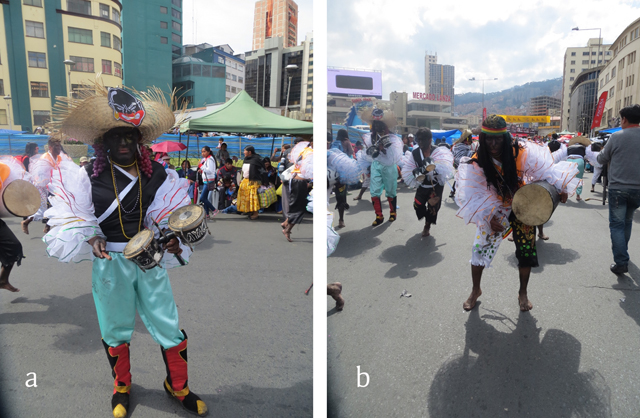
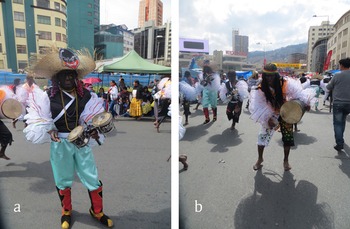
Despite its nebulous origins, the Tundique has remained a popular feature of street carnivals in Bolivia. It represents both the negrito of Catholic religious rites and imitations of popular black dances. The Tundique gradually became more formalized as a dance at carnivals between the 1920s and the 1960s. The dance’s popularity reached its zenith after Bolivia’s National Revolution of 1952. The revolution led to a renewed investment in folklore and in cultural production (Reference SánchezSánchez 2008) and it occasioned the emergence of many performance troupes specializing in the Tundique or negrito dances. The most notable group is Walter Yugar’s folkloric group Centro Tradicional Negritos del Pagador, founded in La Paz on October 12, 1956, which was dedicated to the Baile de los Negritos. As the Tundique dance became more formalized, its blackface representation was quickly inflected by transnational images of blackness. The founding of Yugar’s group, for example, coincided with the rise of Cuban mambo, and the Tundique began to incorporate tropical images of blackness. At the first performance of Negritos del Pagador at the Carnival de Oruru in 1957, they fused images of Afro-Cuban and mambo dancers with carnivalesque representations of the “negrito” from the Black Magus Balthasar. Mimicking the image of the Afro-Cuban dancer, the Negritos del Pagador danced in blackface, painted their lips bright red, wore mambo shirts with guarachas (large, colorful ruffles), and carried small drums in their hands which they beat as they danced (Figure 5). Some would also wear large Afro wigs and adorn their ears with fruits as a reference to the tropical images of Cuba. By the 1960s, women dancers of the Tundique created a new set of characters including a negrita with a baby on her back.Footnote 15 Blackface performers would walk behind a caporal who carried a whip as they all danced and sang. Sometimes performers wore masks, but many times they would simply black up. The blackface representation in the Tundique had now been revamped to accommodate transnational tropical images of blackness circulating the hemisphere. By the 1960s, the Tundique was an amorphous form fusing colonial and modern, local and transnational images of blackness.
Members of the Fraternidad Saya Negritos de Ayacucho performing at La Fiesta de Gran Poder in 2017. This is a modern derivative of the Tundique dance. These images capture the Afro-Cuban influence as the grapes dangle from one performer’s ear, and the sleeves of their shirts have large ruffles associated with Cuban mambo. Photos by the author.
Following the Tundique’s popularity, in the 1960s new musicians dedicated to Andean folklore transformed some of the old rhythms of the villancicos navideños (Christmas carols) into commercial songs, and the Tundique rhythm quickly became a hit. One such example is the song “San Benito” recorded in 1968 by Yayo Jofré of the Bolivian folklorist band los Jairas.Footnote 16 The lyrics of Los Jairas’ song reference Catholic religious rites in that they tell the story of a negra zamba (black woman) dancing the Saya de Tundiqui with her baby and who receives a little bird from Saint Benedict for the Fiesta de los Negritos. While the song conflates the Afro-Bolivian Saya with the Tundique, it maintained the dance’s association with representations of blackness from Catholic religious rites. The song became a local and international hit at the height of the New Song Movement in Latin America.Footnote 17 Los Jairas toured with the movement’s founder, Violeta Parra, and they successfully catapulted the Tundique rhythm and the Pan-Andean sound into the commercial world (Reference CunninghamCunningham 2011). They exported the Tundique beat from Bolivia to other parts of the hemisphere. The song “San Benito” was soon covered by other groups in the region, most notably the Chilean folkloric group Inti-Illimani, and it became a hit in Bolivian street carnivals. Local Bolivian groups including the Banda Pagador de Oruru often covered “San Benito” at the carnival in Oruro in the 1960s. The Estrada family, who would be inventors of the Danza de Caporales, claim to have been inspired by the band’s performance (Reference Sánchez-PatsySánchez-Patsy 2006). They would use the Tundique beat as the foundational rhythm of a new dance called the Danza de Caporales.
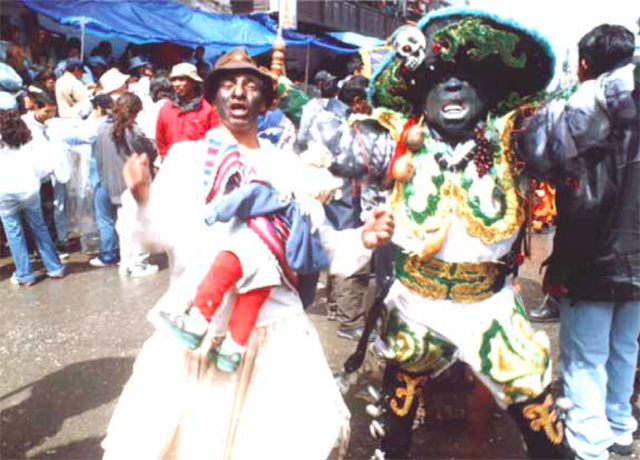
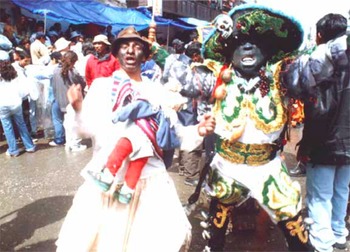
The Tundique emerges from Catholic practices, popular culture, street carnivals, and imitations of black popular forms. Today, representations of slavery and imitations of black people in the Tundique are currently the subject of controversy in Bolivia. In contemporary performances, people represent black people with gorilla masks or they will black up, don chains, and play out a master and slave scene (Figure 6). Afro-Bolivian groups have recently launched a campaign decrying such representations as racist and have called for the prohibition of racist representations in the Tundique. They rightly claim these representations distort the Saya, humiliate black people, and mock black cultural forms (Reference LuizagaLuizaga 2014). That so many fictions of blackness cohere in the Tundique demonstrates how blackface operates as a malleable, floating racial sign that transforms the “negrito” into an open-ended stand-in for Balthasar the Black Magus, baby Jesus, a Cuban “negrito” from the mambo craze, and an enslaved African. As a porous form, blackface representation in the Tundique is the confluence of colonial and contemporary, local and transnational, popular and religious representations of blackness in the hemisphere. This new controversy also underscores how blackface enables the articulation of racist fantasies of blackness and of black subjugation and ultimately produces anti-black racism in a local context.
Male cross-dressed as a black woman with her baby, and a performer wearing a costume mixing the caporal boots with the tropical images from the negrito dance. The photograph was taken at Bolivia’s Carnival de Oruro in 2003. Reproduced by permission of Mauricio Sánchez-Patsy.
The Danza de Caporales and the First Caporal
If the Tundique facilitated the articulation of fantasies of blackness then the Danza de Caporales, as its progeny, marries ideas of blackness to fantasies of male power. The Estrada family from La Paz, Bolivia, had a performance troupe called Urus de Gran Poder that specialized in folkloric dance, including the Tundique, and they invented the Danza de Caporales in 1969. While the entire family played a role in its invention, Victor Estrada is recognized as the main founder. He and his brothers debuted the dance in 1972 at La Fiesta de Gran Poder, and it was an instant hit (Reference Sigl and SalazarSigl 2012). The Estrada brothers propagated various myths about its invention that have since been debunked by scholars. In several interviews before his death, Victor claimed he was inspired to create the Danza de Caporales after observing black people during a trip to Tocaña, a department of La Paz with a large black population. Since Victor’s uncle Alberto Pacheco typically contracted black performers, Victor traveled with him to learn more about black musical traditions including the Saya. In the Saya, a caporal or capataz marks the rhythm with a bell, and Estrada claimed to have been inspired by the town caporal (Reference Mendoza-SalazarMendoza-Salazar 1995). He described this caporal as an older black man who wore a straw hat, large belt, and bells on his boots (Reference Sigl and SalazarSigl and Salazar 2012). Scholars, however, have debunked the notion that the dance is tethered to an actual black man. Instead, they suggest that the caporal emphasizes masculine strength and is a fusion of the carnivalesque images of the negrito, the figure of a capataz (slave driver), and the caporal who typically dances alone when he acts as the foreman or guide of a dance troupe (Reference Sánchez-PatsySánchez-Patsy 2006; Reference Sigl and SalazarSigl and Mendoza Salazar 2012). They read his dictatorial nature in relation to Bolivia’s turn to authoritarianism in the 1950s (Reference Sigl and SalazarSigl and Mendoza Salazar 2012).
The Estrada brothers built on preexisting representations of blackness in carnival to ultimately create an open-ended figure of male power. Theorist Eveline Sigl explains that the caporal symbolizes a violent oppressor and the backwardness of an ethnic or racial other (Reference Sigl and SalazarSigl and Mendoza Salazar 2012, 60). When the Estrada brothers invent the caporal, the figure’s racial difference, however, is hardly obvious. While Tundique and folkloric dances would represent blackness by black masks with African features, neither masking nor blacking up is a feature of the Danza de Caporales. This may be the case because the dance emerged when the Tundique’s popularity was waning, and the comedic negrito simply would not fit the image of an authoritarian male power. The caporal is therefore an authoritarian oppressor of racial ambiguity. His strength and power are conveyed through high kicks, jumps, and the flashing of his whip—all of which I witnessed in Sambos’ performance at the fiesta. He is a military commander of a squad, the exuberant leader of the performance troupe, a mandamás (big boss), or a slave driver whose power was constituted through the enforcement of racial subjugation. He is simultaneously the black or zambo slave driver, the Spanish/white oppressive colonizer, and some performers even claim he is merely Spanish or mestizo. The caporal operates at the intersection of male power and racial difference. He is a subject of double/multiple racial coding acting as an open-ended stand-in for or enforcer of oppressive power.
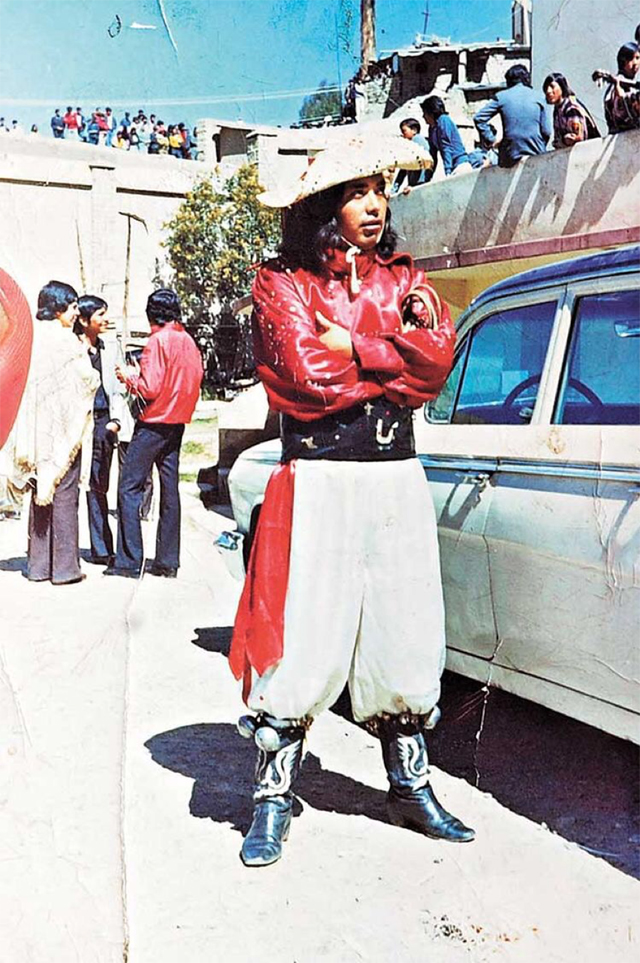
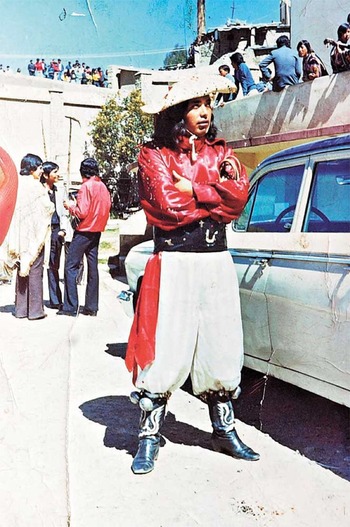
The Danza de Caporales may have emerged from an amalgam of representations of the negrito in the Tundique, but its aesthetic style drew from other traditions in the hemisphere. In the photograph (Figure 7), Victor Estrada poses as the first caporal at the Teatro al Aire Libre in La Paz in 1973. Members of Urus de Gran Poder wore this same costume at the fiesta de Gran Poder in June of that year. When I first saw this image, I was surprised that his outfit looked so much like that of an Argentinian gaucho. In fact, when Urus de Gran Poder debuted their new dance, spectators were so convinced that they were Argentinian gauchos that they referred to them as gauchos troyeros (Alejandro Cañaviri-Estrada, personal communication, February 3, 2018; Reference Sánchez-PatsySánchez-Patsy 2006).Footnote 18 Estrada’s large, black leather cowboy boots have gold stripes, and the top bears two silver bells. He is wearing large, wide, white/silver pants, a black sash across his waist, and bright red, long-sleeved shirt. He wears a hat on his head and he looks off into the distance with his arms crossed. The vibrant aesthetic and the defiant posture in the photograph of Victor Estrada dressed as the first caporal captures the bravado that has come to characterize the dance. The Danza de Caporales consisted of high kicks and displays of athleticism emphasizing masculine virility. This was the image of the macho male sex symbol. Initially, Victor’s sister Lidia Estrada cross-dressed and danced with her brothers in the 1970s, making her the first macha. But the machita character has only really emerged in recent times. For the most part, the Danza de Caporales was imagined as a decidedly masculine space, and the macho aesthetic that inaugurated the first caporal was that of the gaucho—a masculine or cowboy figure epitomizing strength and virility. If the negrito is an amalgam of representations from various colonial and transnational images of blackness circulating in the Americas, then to enwrap the capataz/caporal in the fashion of the Argentinian gaucho adds yet another coordinate to the hemispheric dimensions of the dance.
Victor Estrada, the first caporal. Photo dated 1973 from the family collection of Carlos Estrada. Reproduced by permission of Alejandro Estrada.
Hemispheric blackface is about the interarticulation of constructs of race, gender, and sexuality through performances of impersonation, and a site where transnational images of blackness and masculinity converge. The Danza de Caporales therefore emerges from a variety of traditions including European Catholic rites, indigenous tradition of masquerade, the negrito as baby Jesus or the Black Magus, imitations of Afro-Bolivian performance, Cuban mambo, and the Argentinian gaucho. After Victor Estrada debuted the Danza de Caporales, it took on a life of its own, traveled across the hemisphere, and incorporated new traditions. By 1975, the dance had arrived in Peru. While its blackface origins disappear, as is the case in the performance by Sambos Illimani that I witnessed at the Fiesta de la Virgen de la Candelaria, some performers find ways to represent its Tundique origins and to incorporate other blackface traditions in the hemisphere.
Sambos Illimani and the Watermelon Man at La Fiesta de la Virgen de la Candelaria
When the performer from Sambos Illimani said he had always seen a crazy little black with his watermelon, I initially wondered if the watermelon man was a part of the Tundique tradition, only to discover that it was not. The directors of the troupe explained that they decided to black up to recognize the dance’s Tundique origins, and that the open-ended nature of carnival performances enables participants to incorporate other traditions (Elmer Apaza-Noa, personal communication, 2017). When I inquired about the watermelon man, they claimed it was the idea of one of the participants and they had decided to keep the figure in the dance. The questions I posed have since remained unanswered: Why the association of blackness with the watermelon? Is there a historical relationship between black people and watermelons in Peru? A search for a historical referent of a black man with his watermelon in Peru has yielded no answers. In the absence of a historical referent for the trope in Peru, one can only ask: What exactly is the watermelon man being made to do in this instance? What is his relationship to other representations of blackness in Sambos’ performance?
For those of us familiar with the US blackface minstrel tradition, the blackface figure with his watermelon may easily be read as a riff on the US minstrel Sambo. While hemispheric blackface aims to theorize blackface within the specificity of its historical context, it is a mistake to pretend that indigenous traditions of blackface are somehow isolated from the global reach of US blackface minstrelsy. The very nature of the blackface form is that it travels. Just as the dance incorporates different Latin American traditions, so too does it incorporate US performance practices. Theorist Miguel Becerra (Reference Becerra, Adekunle and Williams2013) has noted how the arrival of minstrel archetypes to Peru impacted representations of black people in popular culture. Sambos Illimani’s incorporation of the watermelon man in a context where this trope has no real historical meaning demonstrates how indigenous blackface traditions absorb and integrate the efficacious tropes of blackness from the South and the North and repackage them to sell in the global marketplace. Their performance exemplifies the encounter of performative idioms within the network of hemispheric blackface. It recycles tropes from different coordinates of the hemisphere, blending two Sambos from the Americas: the Latin American zambo, an intermediate racial archetype, and the infantile US minstrel Sambo, buffoon who carries a watermelon. The irony of the homonym aside, this performance is a moment where the Latin American zambo signifies on the US minstrel Sambo archetype, masquerading as a childlike, infantile buffoon (Reference BoskinBoskin 1988).Footnote 19 In this act of double surrogation (Reference RoachRoach 1996), the US minstrel Sambo and the Latin American zambo stand in for each other, and the audience reads two hemispheric archetypes through a prismatic field of signification. Hemispheric blackface is a site of racial doubles where spectators may read the representation of blackness in one blackface tradition through the valence of another. In these moments, the specific historical context of a given representation will be lost, but the racial sign of blackness will remain legible to the audience. Its legibility is not only grounded in the shared tropes of blackness, but also, in their representation of the enslaved body, they underscore a shared hemispheric history of black enslavement. Therefore, the question at hand is not, Which Sambo is this? but, How is this act of hemispheric doubling producing meaning about blackness in Sambos Illimani’s performance?
Since the Danza de Caporales is a power fantasy, Sambos Illimani stages a scene where power is constituted through racial subjugation. In self-identifying as Sambos, the performers are authorized to live out their own fantasies about blackness and its relationship to slavery. While the performers masquerade under the auspices of a racially ambiguous figure, blackface operates as a differentiating marker between the enslaved black body or the black buffoon, and the racially unmarked slave driver or caporal. So even as everyone proclaims to be “part black” or to be “zambos,” in the performance, blackface sets up a racial hierarchy by way of marking a visible power imbalance between differentially racialized subjects in the performance. For even if they are all sambos, the power fantasy being enacted stages a scene of consensual subjugation whereby black subjects are complicit in their own oppression either as slave drivers or as happy, dancing slaves. Indeed, the presentation of the black buffoon wildly eating his watermelon alongside happy, dancing slaves presents black subjects who are content in their own subjugation. Even with slavery in the backdrop, the black buffoon is impervious to his own pain and engaged in unadulterated fun. As indicated in the quote at the beginning of this essay, the black subject is described as a “negrito loco” or a crazy little black. Here the black subject—configured as a crazy child—is endearing, but ultimately different. His difference lies in his purported craziness, his infantilism, and his capacity to operate outside normative models of behavior. Moreover, if black subjects are imagined as socially invisible in Peru, then blackness becomes visible only to be fixed within the idiom of servitude, and black subjects are complicit in their own oppression. This performance also captures the paradoxes of investing a scene of anti-black violence with humor. For in this performance, the spectacle of black enslavement becomes “funny,” a mere object of entertainment for a global audience. While it is certainly common in Andean performance traditions to represent black enslavement through masking or the donning of chains and to do so humorously, my contention is that unlike other dances, the Danza de Caporales is designed to celebrate the agent of violent oppression. In this instance, racial domination is the apparatus through which the caporal’s power is enacted and through which the dance praises its central protagonist.
Conclusion
In this study, I have developed the concept of hemispheric blackface to illuminate how performance traditions across different geographical coordinates of the hemisphere can converge and be referenced in a single blackface performance. I have done so to decenter the US minstrel tradition and to refrain from reading the origins of the dance in purely nationalist terms. I emphasize instead how blackface functions as an amorphous form that incorporates, recycles, and reworks tropes circulating across the hemisphere. As I have stated, Sambos’ blackface performance maps hemispheric coordinates in its fusion of indigenous, Spanish, Cuban, Argentine, and US traditions of representation. While the performance ought to be understood within its own history, it is not isolated from global images of blackness. That blackface performances in the Andes are always subject to revision and are always moving is in keeping with the way performance itself is theorized as a system of knowledge production. Even as it decenters US blackface minstrelsy as the presumed progenitor of blackface, hemispheric blackface is about the way tropes are shared, reworked, and resignified. It also exemplifies how other sites in the Americas can function as the center of export and innovation for the performance. The global audience of the Fiesta de la Candelaria is but one audience for Sambos Illimani’s performance. The group now has chapters in Ecuador, Chile, and other parts of the Americas. Some chapters use blackface and others do not, but we can be sure that blackface as it emerges from the Tundique will continue to float from one site to another. That blackface was used to mark the enslaved body in the performance shows how blackface can fix blackness within the idiom of servitude. Hemispheric blackface also demonstrates how a shared history of slavery underwrites and connects the presence of black bodies in the Americas.

 Open access

