





1. Introduction
On many occasions, an individual can make decisions on behalf of others in a group, and her choices affect not only her payoff but also that of the others in the group. Examples abound: parents, managers, project team leaders, partners, employers, and politicians. Earlier behavioral/experimental work studied responsibility and decision-making for others using experimental designs, where the money to be risked is given by the experimenter, and there is no post-decision negotiation over the division of the resulting outcome (See Polman & Wu, Reference Polman and Wu2020, for a review). However, in many real-life instances, the resource over which the risky decision is taken is not manna from heaven. In contrast, individuals who belong to the group have taken costly actions and contributed to the production of the joint surplus. Furthermore, in some of these settings, even though an existing contract prescribes who should receive what share of the surplus in the event of dissolution, parties still need to renegotiate.Footnote 1 Some examples that are of particular interest for us are tech startups, partnerships in creative industries (e.g., filmmaking, music), consulting services and law firms, and family businesses. It is easy to see the joint surplus production, asymmetric status, and risky decision-making aspects in these contexts.
Consider two individuals who establish a startup. The actual values of their initial contributions are not fixed due to different types of initial contributions (e.g., the core idea, technical expertise, initial seed funding, complementary skills, or sweat equity). They may structure an asymmetric co-founder equity split based on initial contributions, financial risks, initially expected time commitment, and responsibilities. Suppose one co-founder initially gets 75% of the company and the other co-founder gets 25% of it. They agree to reduce their stakes and contribute 40% (30% from the high contributor and 10% from the low contributor) into the founder stock pool. They will allocate the pool according to the future contributions over time. Now, some investment decisions must be made. Furthermore, assume that after a while, one of the co-founders wants to leave. The initial startup co-founder equity split may not always be considered equitable when they decide to dissolve the company, or when one founder wants to leave prematurely. It could be that the equity is tied to active contributions due to vesting schedules. They may also need to reevaluate the equity split in some cases (e.g., one co-founder took more responsibilities than they initially anticipated or other obligations reduced a founder’s engagement in the business). As such, they may need to renegotiate the division of the company’s net worth.
Does it matter in bargaining (i) who made the decision about the risky prospect and (ii) to what kind of outcome (i.e., success versus failure) that decision led? Answering these questions in a partnership setting will be the main aim of this paper. First of all, we are interested in how the identity of the decision-maker (high or low contributor or exogenous shock) influences the bargaining process and outcomes. Are high contributor and low contributor decision-makers treated differently in negotiations?Footnote 2 Second, we are interested in the influence of the decision made (risky or riskless) and its outcome (good, average, or bad) on bargaining behavior. Is there an outcome bias in negotiations? If so, does it depend on who made the decision?
To answer these questions, we design a two-part laboratory experiment where the first part is composed of four stages. In the first stage, subjects participate in a real-effort task. According to their performance in the task, their contribution to the group project (high = 300 or low = 100) is determined. In the second stage, subjects are matched into pairs, each of which contains one high contributor and one low contributor. In this stage, an investment decision is taken by low (high) contributors in the Low (High) treatment, which determines the final value of the surplus, whereas an exogenous, stochastic shock (a random draw by computer) determines this value in the Exogenous treatment (i.e., the control treatment). The Exogenous treatment resembles real-life situations where an external/stochastic shock changes the value or net worth of the company. The High treatment resembles a variety of real-life situations where the decision authority is assigned based on merit or performance, whereas the Low treatment describes settings where such an authority is assigned to agents with a lower status (e.g., blue-collar worker representatives in German companies (see Budde et al., Reference Budde, Dohmen, Jäger and Trenkle2023)).Footnote 3 In Low and High treatments, a decision-maker can choose between safe and risky options. While the value of the surplus grows 1.25 times the initial value (i.e., from 400 to 500) when the safe option is chosen, it shrinks to half of the initial value (i.e., from 400 to 200) with ½ probability and it grows 2.5 times the initial value (i.e., from 400 to 1,000) with ½ probability when the risky option is chosen. In the Exogenous treatment, each possible outcome (i.e., 200, 500, and 1,000) is realized with 1/3 probability. In the third stage, group members learn the final value of the surplus and are given a fixed amount of time to bargain for a division of the surplus and reach an agreement. In the fourth stage, we elicit subjects’ risk aversion levels using Holt and Laury (Reference Holt and Laury2002) and collect data on some demographic characteristics.
A couple of characteristics define the type of situations we study: (i) relative performances in a task determine members’ contributions to the initial surplus, (ii) the value of the surplus changes throughout the relationship and the cause of change can be exogenous or endogenous, (iii) when the cause of change is endogenous, it is due to one of the group member’s investment decision, (iv) contributions to the surplus based on task performance and investment choice are not easily convertible to each other and their joint presence allows entitlements to evolve, and finally (v) negotiation over the division of the final surplus takes place at the dissolution phase.
A brief presentation of our hypotheses is in order. First, we predict that when the computer determines the final surplus, there is no accountability or responsibility for either participant. Hence, for all possible outcomes of the random draw, we expect agreements to be similar – a compromise between the two focal points present in the environment. Moreover, when the safe option is chosen, we again expect to observe similar agreements as in the control treatment, since opting for a sufficiently high safe choice is perceived as procedurally fair and thus does not justify punishment (Cappelen et al., Reference Cappelen, Konow, Sørensen and Tungodden2013). However, when the risky option is chosen, we expect that decision makers will be rewarded or punished according to the resulting investment outcome (Brownback & Kuhn, Reference Brownback and Kuhn2019; Gurdal et al., Reference Gurdal, Miller and Rustichini2013; König-Kersting et al., Reference König-Kersting, Pollmann, Potters and Trautmann2021). In other words, we expect to see that bargaining agreements will resemble ‘outcome bias’ in that case.
Three main insights emerge from our experimental results. First of all, as predicted, conditional on reaching an agreement, bargaining outcomes are identical (i) across different surplus values in the exogenous treatment and (ii) when the safe investment option is chosen. Second, low contributors are rewarded or punished for their risky investment decisions depending on the outcome of the risky investment, but high contributors are not. In other words, we observe an outcome bias only when low contributors take a risk. Third, we argue that the underlying mechanism behind this asymmetric outcome bias relates to differential entitlements of low and high contributors to make decisions for the group. Evidence from the analysis of bargaining process variables and third parties’ normative judgments regarding who should make the investment decision in the pair and who is more entitled to take a risk on the joint surplus, which we collected in a survey study, is aligned with the proposed mechanism.
To pin down the mechanism behind the asymmetric outcome bias observed in the experiment, we first study the bargaining process. We observe that when the high contributor makes the investment decision and chooses the risky option, there is much less conflict in bargaining. Consequently, on average, agreements are reached faster. When we zoom into opening offers in the case of failed and successful risky investments, we see that the high contributors offer 20% less to low contributors when their risky investment failed (17%) compared to when it succeeded (37%). In other words, it can be argued that high contributors’ different opening offers ignited a bargaining process that later led to asymmetric outcome bias in bargaining outcomes. Second, we also observe differences in the usage of the chatting option under different conditions. In particular, when the risky option is chosen, (i) there are fewer chat message exchanges, (ii) messages are shorter, and (iii) the frequency of pairs who did not use the chatting option is higher in High compared to Low. These observations also suggest that high contributors are perceived to be more entitled to make risky decisions on behalf of the group, and as such, when they do so, subjects reach agreements more easily (e.g., faster and with less discussion).Footnote 4 On the other hand, low contributors’ risk-taking is also accommodated to a certain degree (e.g., it is understandable that they attempt to change the status quo, which is very unfavorable for them), but when they take a risk, it takes more discussions and longer sequences of offer exchanges to reach an agreement, especially when their risky investment fails. Third, we conduct an online survey study to understand third parties’ normative judgments on various aspects of the bargainers’ relationship. In line with the mechanism, we propose to explain asymmetric outcome bias, their responses suggest that they find it more appropriate for high performers (i) to make the investment decision for the pair and (ii) to choose the risky option. An LLM analysis of their open-ended answers to the question about the factors that influenced fair divisions they proposed produces emphasis on keywords such as initial contributions, risk-taking, decision-makers’ roles, and fairness/justice. Finally, different from the findings of the experiment, we observe that the fair distributions proposed by third parties reflect an outcome bias that is independent of the identity of the decision maker. We discuss some of the possible reasons for this difference in the conclusion, but a definitive answer would require further investigation.
This paper contributes to a strand of the bargaining/negotiations literature that studies rich-context bargaining interactions, which can be observed in various organizational and managerial settings. The novelty of our experimental design is threefold: (i) the mutual presence of endogenous surplus production via real-effort and risky decisions, (ii) the possibility of changes in partners’ contributions in the partnership (e.g., low contribution in the initial phase but taking a risk later and growing the joint surplus later), and (iii) the sequentiality of various decisions inherent in a corporate context (e.g., investment following initial value creation). In various partnerships, joint production of initial surplus (e.g., capital), asymmetric status due to differences in contributions (risky or safe), investment decisions, and a dissolution phase are present. Yet, to the best of our knowledge, there has not been any earlier work that experimentally studies negotiation behavior and outcomes.
The paper is organized as follows: Section 2 presents a literature review; Section 3 presents the experimental design and implementation; Section 4 presents our hypotheses; Section 5 presents our experimental findings; Section 6 concludes.
2. Literature review
Our study is related to experimental literature on bargaining games with joint production and on social risk-taking. The aspects of risk-taking on behalf of the group and joint production of the bargaining surplus naturally bring accountability issues into the picture. In what follows, we briefly discuss earlier research and describe our contribution to these lines of work.
In the literature on social risk-taking, there are two players in a group: one active and one passive. The individual’s risk-taking behavior is compared when she is taking a risk just for herself and for the group. In this literature (see Charness & Dufwenberg, Reference Charness and Dufwenberg2006; Charness & Jackson, Reference Charness and Jackson2009; Eijkelenboom et al., Reference Eijkelenboom, Rohde and Vostroknutov2019; Loewenstein, Reference Loewenstein1996; Stone & Allgaier, Reference Stone and Allgaier2008), risky decision-making – be it individual or for the group – takes place in a context that involves money provided by the experimenter (i.e., house money). In our experiment, subjects are grouped into two and they make (unequal) contributions to the group project that are determined by their relative performances. Then, in our experimental treatments, one of them is asked to make a risky decision for the group using the joint surplus they produced with real effort. After the contribution and risky decision-making stages of our experiment, the final value of the joint surplus is shown to the subjects, and they bargain over the distribution of this surplus. Hence, our work is also related to the literature that focuses on bargaining interactions that include a risky decision.
Cappelen et al. (Reference Cappelen, Konow, Sørensen and Tungodden2013) analyze how choosing the risky option or the safe option for the group affects individuals’ bargaining behavior. In their study, subjects are asked to decide between safe and risky options in four different scenarios that are presented randomly. In all scenarios, a risky option has two equally likely outcomes, but the safe option’s value changes across scenarios. While subjects make their decisions in this stage, they know that a distribution stage will follow. Different from their study, we keep the value of the safe option constant across treatments, subjects contribute unequal amounts, and they choose risky or safe options for the jointly produced amount. We also differ in our focus (Cappelen et al., Reference Cappelen, Konow, Sørensen and Tungodden2013 focus on fairness views, whereas we focus on bargaining behavior and outcomes) and various other design choices such as who (high contributor, low contributor, or computer) makes the decision for the group as well as the distribution protocol used – they use a simple dictator game, whereas we use an unstructured bargaining game.
Various scholars experimentally study bargaining interactions where the bargaining surplus is jointly produced prior to bargaining. It has been reported that although the costs associated with contributing to the surplus production are sunk by the time parties come to the negotiation table, they continue to affect the bargaining behavior (see Bolton & Karagözoğlu, Reference Bolton and Karagözoğlu2016; Baranski & Cox, Reference Baranski and Cox2023; Gantner et al., Reference Gantner, Güth and Königstein2001; Gantner et al., Reference Gantner, Horn and Kerschbamer2019; Karagözoğlu, Reference Karagözoğlu, Bolton and Croson2012; Karagözoğlu & Riedl, Reference Karagözoğlu and Riedl2015; Merkel & Vanberg, Reference Merkel and Vanberg2020, among others).Footnote 5 Moreover, when the relative contributions to the surplus are known, the surplus production function is additively separable in individual contributions and deterministic, then the equity criterion guides the behavior and agreements (Gantner et al., Reference Gantner, Güth and Königstein2001; Karagözoğlu & Riedl, Reference Karagözoğlu and Riedl2015; Takeuchi et al., Reference Takeuchi, Veszteg, Kamijo and Funaki2022). Karagözoğlu and Riedl (Reference Karagözoğlu and Riedl2015) report that when the relative performance information is missing and/or the production function does not completely depend on joint performance but also on a stochastic factor, equal division agreements become more prevalent. However, in their setting, the stochastic factor is exogenously imposed.
In many real-life collaborative relationships, agents make risky investments that influence the size of the jointly produced surplus. To the best of our knowledge, this natural setting has not been studied in this burgeoning literature. Our study contributes to the existing literature by answering the following questions: When the bargaining surplus is jointly produced by the bargaining parties via a real-effort task and their contributions are unequal, (1) How does an exogenous, stochastic shock that determines the final surplus value influence the bargaining process and outcomes? (2) Who benefits more from having the decision authority? (3) Is there an accountability effect (i.e., does it matter whether the surplus value was determined exogenously or by one of the bargaining parties’ investment decisions)? (4) Is there an outcome bias in agreements? and (5) If so, does it depend on who made the investment decision?
3. Experimental design and implementation
To answer the questions that we presented in the previous section, we designed an experiment with four stages.Footnote 6 In the first stage, we used a real effort task to determine subjects’ initial contributions to the hypothetical firm and induce asymmetric status. In the second stage, three treatment conditions (one control and two experimental) varied how the final value of the surplus was determined. In the third stage, subjects in each pair bargained over the division of the final surplus. In the final stage, we elicited subjects’ risk aversion by using Holt and Laury (Reference Holt and Laury2002) and collected data on some demographic variables. Further details are presented in the following section:
First Stage (Real-effort task): Subjects participated in a real-effort task, a Trivial Pursuit-type quiz with 30 multiple-choice questions (see Appendix C for the questions we used). Such quizzes have been used as real-effort tasks in many bargaining experiments to induce asymmetric status or assign earned bargaining power (e.g., Clark, Reference Clark1998; Gächter & Riedl, Reference Gächter and Riedl2005, Reference Gächter and Riedl2006; Gantner & Kerschbamer, Reference Gantner and Kerschbamer2016; Hoffman et al., Reference Hoffman, McCabe, Shachat and Smith1994; Karagözoğlu & Riedl, Reference Karagözoğlu and Riedl2015; Sonnegård, Reference Sonnegård1996). We chose a quiz for a real-effort task since the ‘greater knowledge deserves more’ mindset is vividly present in the university environment and, as such, better performance in this task can effectively induce asymmetric status and entitlements.Footnote 7 We chose general knowledge type questions (instead of ones that would require mathematical or strategic reasoning) so that performance in the real-effort task is unlikely to be correlated with cognitive skills or strategic reasoning ability, which may in turn be correlated with bargaining skills (Burks et al., Reference Burks, Carpenter, Goette and Rustichini2009). Each question had five answer choices with only one correct answer. The same set of questions in the same order was used in all sessions. All subjects had 25 seconds to answer each question. Questions that were not answered within the time limit were counted as incorrect. We did not allow incorrect answers to reduce a subject’s performance (or score), so that risk attitudes would not play a role in the real-effort task. Subjects’ performances were calculated as the sum of their correct answers, but they did not learn their exact performances throughout the experiment.Footnote 8 All of this information about the knowledge quiz was presented in the instructions. Subjects knew only that their performances would affect the other stages of the experiment, not how they would affect them. The precise effect of performance was explained to them in detail just before the second stage of the experiment. In this way, we ensured that the subjects’ motivation to do well in the quiz was not influenced by the treatment they received.
Second Stage (Investment decision): At the beginning of the second stage, subjects were anonymously paired.Footnote 9 In each session, there were six pairs. Participants in a pair were only informed about the high performer or low performer, depending on the number of correct answers in the real-effort task. The contribution of the high performer to the company was 300 points, and the contribution of the low performer was 100 points. Therefore, the initial worth of the company was 400 points.Footnote 10 To be clear, contribution was not a choice: Just being the higher (lower) performer in the pair directly implied contributing 300 (100) points.Footnote 11 The second stage differed across treatments. There were three treatments: Exogenous (control treatment), Low (contributor-responsible), and High (contributor-responsible). We varied treatments across subjects and randomized them across sessions.Footnote 12 All treatments are shown in Table 1.
Treatment conditions and number of participants

Table 1 Long description
The table measures the number of sessions and participants for three treatment conditions: Exogenous, Low, and High. Each condition had 6 sessions, with 72 subjects participating in each. This uniform distribution suggests equal exposure across all treatment types, allowing for consistent comparison of outcomes. No variation in session count or participant numbers indicates a controlled study environment, minimizing external variables that could affect results.
In the Exogenous treatment, the final value of the surplus was determined by an exogenous, stochastic factor. Subjects were told that the final value of the surplus would be determined by a random draw: It would be 1,000 points with probability 1/3, 500 points with probability 1/3, and 200 points with probability 1/3. At the end of the second stage, subjects learned the (realized) final value of the bargaining surplus. In Low (High), the low (high) contributor was responsible for making an investment decision. We asked the low (high) contributor whether she would prefer Alternative 1, which leads to a 500-point final surplus value for sure, or Alternative 2, a risky investment, which resulted in a final surplus value of 1,000 points with probability 1/2 and of 200 points with probability 1/2.Footnote 13 At the end of the second stage in Low (High), the alternative chosen by the decision maker was revealed to the other subject in the pair. Both subjects also learned the outcome of the investment decision and the final value of the surplus.
Third Stage (Bargaining): Subjects in each pair anonymously bargained to share the final surplus. If an agreement was reached within five minutes, both subjects earned their agreed shares. If no agreement was reached, they did not earn anything from this stage. We used an unstructured bargaining protocol that allowed the exchange of text messages in addition to numerical offers, and produced a rich data set on process variables, which is known to provide valuable insights about behavior (see Camerer et al., Reference Camerer, Nave and Smith2019; Galeotti et al., Reference Galeotti, Montero and Poulsen2019; Karagözoğlu, Reference Karagözoğlu, Laslier, Moulin, Sanver, Sanver and Zwicker2019). In this stage, subjects could send proposals specifying an amount for themselves and an amount for the other subject in their pair. Subjects could also send one text message (of unlimited length) per proposal. We limited the number of messages per proposal to guarantee that there was no confusion about which proposal was being discussed and that the protocol produced sufficiently many numerical data points for statistical analysis. The bargaining screenshot can be seen in Fig. 1.
Screenshot of the bargaining screen

Fig. 1 Long description
The interface displays a bargaining screen with sections for making and sending new proposals, valid offers and chat message hints. The top section shows the period number, remaining time and a summary of previous contributions. The left section allows users to input new proposal amounts, with buttons to send or accept offers. The right section provides hints for sending chat messages and a table listing offer details, including the period, offer number and amounts for each party. The interface is designed for negotiating the share of firm value between two parties.
Fourth Stage (Risk attitudes and demographics): We elicited subjects’ risk preferences using Holt and Laury’s (Reference Holt and Laury2002) method. Finally, there was a post-experimental questionnaire, where we asked a few socio-demographic questions as well as questions about the real-effort task and bargaining agreements (see Appendix D). Subjects were paid their earnings in private at the end.
The experimental sessions were conducted in March 2022 at the METU-FEAS Behavioral and Experimental Laboratory (BEL), Middle East Technical University. Subjects were recruited by email using the BEL ORSEE database (Greiner, Reference Greiner2015), which consists of undergraduate students. Overall, 216 subjects participated.Footnote 14 There were 18 sessions, and each lasted about 30 minutes with exactly 12 participants. Each subject participated in only one session. All sessions were computerized using z-tree (Fischbacher, Reference Fischbacher2007). Throughout the experiment, payoffs were described in terms of ‘points.’ Twenty points corresponded to one Turkish lira. Subjects earned, on average, 27.24 TL, including a 10 TL participation fee.Footnote 15
4. Hypotheses
In this section, we present our hypotheses on bargaining agreements across treatments under various conditions.Footnote 16
Asymmetric contributions to a joint surplus through a real-effort task are shown to induce asymmetric status and entitlements (see Gächter & Riedl, Reference Gächter and Riedl2005; Karagözoğlu & Riedl, Reference Karagözoğlu and Riedl2015, among others). In the same vein, asymmetric contributions likely led to asymmetric entitlements for high and low contributors in our experiment, which have been shown to translate into payoff differences in bargaining agreements (see Bolton & Karagözoğlu, Reference Bolton and Karagözoğlu2016; Gächter & Riedl, Reference Gächter and Riedl2005; Karagözoğlu & Kocher, Reference Karagözoğlu and Kocher2019).Footnote 17 The power of focal points in experimental bargaining games with multiple equilibria is well documented (see Bolton & Karagözoğlu, Reference Bolton and Karagözoğlu2016; Isoni et al., Reference Isoni, Poulsen, Sugden and Tsutsui2013; Isoni et al., Reference Isoni, Sugden, Zheng, Karagözoğlu and Hyndman2022; Karagözoğlu & Kocher, Reference Karagözoğlu and Kocher2019). Bolton and Karagözoğlu (Reference Bolton and Karagözoğlu2016) formulate a social preference augmented version of the Nash bargaining solution (Nash, Reference Nash1950) along with a model of a concession bargaining game (Zeuthen, Reference Zeuthen1930), both of which accommodate the presence of two competing focal points in the bargaining environment. Their models predict that agreements lie between these focal points. Our experimental setup admits two competing focal points: 75/25 division implied by initial contributions favoring high contributors, and 50/50 division implied by the presence of uncertainties (e.g., concerning exact performances, legitimacy of the default contributions), favoring low contributors. Along these lines, we hypothesize that in all circumstances, average agreements lie between these two focal points. This is summarized in Hypothesis 1.
Hypothesis 1: In all treatments, under any investment alternative chosen, and any final surplus value, conditional on reaching an agreement, the high contributors’ average agreed share will be between 50% and 75% of the bargaining surplus.
The next two hypotheses concern how agreements are affected by various factors. Cappelen et al. (Reference Cappelen, Sørensen and Tungodden2010), Gächter et al. (Reference Gächter, Karagözoğlu and Riedl2022), and Karagözoğlu and Kocher (Reference Karagözoğlu and Kocher2019), among others, report that the changes in the surplus through exogenous factors (i.e., those that are outside the players’ control) do not influence status quo fairness judgments. Along these lines, we hypothesize that when the source of the change in the value of the final surplus is exogenous, agreements will not be affected by the value of the final surplus since neither player can be held accountable for the outcome. This is summarized in Hypothesis 2.
Hypothesis 2: Conditional on reaching an agreement, bargaining outcomes will not be influenced by the final value of the surplus in Exogenous.
The final value of the surplus in the case that the safe investment alternative is chosen may influence subjects’ fairness judgments (see Andersen et al., Reference Andersen, Ertaç, Gneezy, Hoffman and List2011; Banerjee et al., Reference Banerjee, Kothari and Chowdhury2020; Cappelen et al., Reference Cappelen, Konow, Sørensen and Tungodden2013). In our case, 500 points is roughly equal to the certainty equivalent of the lottery induced by the risky investment given by the empirically observed average risk aversion level of our subjects.Footnote 18 As such, we hypothesize that subjects will not blame the one who took the safe option for doing so, as in Cappelen et al. (Reference Cappelen, Konow, Sørensen and Tungodden2013). Likewise, bragging about choosing a sure outcome of 500 points in the presence of a risky bet with an expected payoff of 600 points is unlikely to be observed. Thus, we predict that agreements will not be influenced by the identity of the decision maker when the final surplus is 500 points. This is summarized in Hypothesis 3.
Hypothesis 3: Conditional on reaching an agreement, bargaining outcomes will be the same in all three treatments when the final surplus value is 500.
In High and Low, since the decision maker can be held responsible for the outcome of the investment alternative chosen, we expect to observe reward/punishment mechanisms in the bargaining stage. More precisely, in line with the literature on outcome bias, we expect to see that risky investments that lead to successful/unsuccessful realizations will result in more/less favorable agreements for those who made the decision (see Brownback & Kuhn, Reference Brownback and Kuhn2019; Gurdal et al., Reference Gurdal, Miller and Rustichini2013; König-Kersting et al., Reference König-Kersting, Pollmann, Potters and Trautmann2021). This is summarized in Hypothesis 4.
Hypothesis 4: Conditional on reaching an agreement, if the risky option is chosen and the final value of the surplus is 1,000 (i.e., success), then the decision makers’ agreed share will be higher under High and Low (compared to Exogenous). Similarly, conditional on reaching an agreement, if the risky option is chosen and the final value of the surplus is 200 (i.e., failure), then the decision makers’ agreed share will be lower under High and Low (compared to Exogenous).
5. Results
We group our results into two categories: In subsection 5.1, we analyze how subjects’ shares in bargaining outcomes are affected by treatment variations, the outcome of the risky investment, and subjects’ initial contributions to the bargaining surplus. In subsection 5.2, we analyze the underlying mechanism leading to the results we observe in subsection 5.1 in three different ways: the analysis of bargaining process variables (5.2.1), bargainers’ chat messages (5.2.2), and normative judgments of third parties (5.2.3) in a follow-up survey we conducted. In our statistical analyses, we use Mann-Whitney and Kruskal-Wallis tests to compare the values of variables of interest across treatments, a t-test to test the difference between the value of a variable and a hypothesized value, and Fisher’s exact test to test frequency differences. In our econometric analyses, we use robust OLS. When we have a directional hypothesis, we use one-sided tests/significance levels. In other cases, we use two-sided tests/significance levels.
Before moving to the analysis of bargaining, a few words about the frequency of risky choices are in order. The frequency of risky choice is 63.9% in Low and 61.1% in High (p-value = 0.81).Footnote 19 Hence, low contributors and high contributors did not differ in their frequencies of choosing the risky option. Both low and high contributors chose the risky option more frequently than the safe option (p = 0.048 in Low and p = 0.093 in High, one-sided t-tests). Given that the safe option brings a surplus value of 500, this result is consistent with the certainty equivalent we calculated (511.5) using the risk aversion parameters we elicited.
5.1. Bargaining outcomes
To begin with, the frequency of pairs who disagreed was not different across treatments: Out of 36 pairs in each treatment, 5 pairs in Exogenous, 3 pairs in Low, and 5 pairs in High could not reach an agreement in the five minutes allotted to them. In the remainder of the analysis of agreed shares, we condition on reaching an agreement. As mentioned above, there are two focal points in our bargaining environment, one induced by the equity criterion (due to contribution shares) and the other induced by the equality criterion (due to various uncertainties in the environment). If subjects share the bargaining surplus in proportion to their contributions, the high contributor’s share should be 75%, and the low contributor’s share should be 25%. If they share the resulting bargaining surplus equally, both contributors’ shares should be 50%.
Table 2 shows the high contributors’ average agreed shares by treatment and outcome (risky-successful, 1,000 points; safe, 500 points; and risky-unsuccessful, 200 points). The last column (row) shows p-values of Kruskal-Wallis tests by treatments (outcomes) given the outcome (treatment). We observe that in all treatments and for any value of the bargaining surplus (except for Low – 1,000), the high contributor’s average agreed share is significantly greater than (or equal to) 50% and significantly lower than (or equal to) 75% (p-value is less than 0.05 in all t-test results).Footnote 20 This is summarized in Result 1.
High contributors’ average share from bargaining agreements

Table 2 Long description
The table measures average share contributions from bargaining agreements under different conditions: risky-failure, safe, and risky-successful. In the risky-successful scenario, low contributors have a significantly lower average share of 0.51 compared to exogenous and high contributors, with a p-value of 0.002, indicating statistical significance. In contrast, the exogenous condition shows no significant differences across low, high, and p-value categories, with averages around 0.61 to 0.63. The safe condition also shows no significant differences, with averages ranging from 0.55 to 0.62. The p-value for low contributors in the safe condition is 0.001, suggesting a potential trend, but overall, the most notable finding is the significant difference in the risky-successful scenario.
* Note: p < 0.10, ** p < 0.05, *** p < 0.01.
a If two outliers (high contributors) who agreed to 30% and 42% of the surplus are excluded, this becomes 0.59.
Result 1: In all treatments (Exogenous, Low, and High), under any investment alternative chosen (safe, risky), and any outcome (200, 500, 1,000 points), the high contributors’ average agreed share is between 50% and 75% of the surplus. In other words, Hypothesis 1 is validated.Footnote 21
The first column in Table 2 shows the average agreed share of high contributors in Exogenous, which is 61% for all values of the final surplus (i.e., 200, 500, and 1,000 points). This is summarized in Result 2.
Result 2: High contributors’ average agreed shares in Exogenous are identical across different values of the final surplus. In other words, Hypothesis 2 is validated.
The second row of Table 2 shows high contributors’ average agreed shares when the final surplus is 500 points. As shown in the second row of the last column, high contributors’ average agreed shares do not differ significantly across treatments (p = 0.25). This is summarized in Result 3.
Result 3: High contributors’ average agreed shares are identical across treatments when the final value of the surplus is 500. In other words, Hypothesis 3 is validated.
Result 3 suggests that we do not observe returns to decision-making. This may be because the decision-making task in our experiment was rather simple (e.g., it was choosing between two alternatives where one provided a fixed payoff and the other had just two possible outcomes) and/or the decision-making authority was exogenously assigned to subjects.
When we look at Table 2, we observe a significant difference in the high contributor’s share across different surplus values in Low. However, we do not observe such a difference in High.
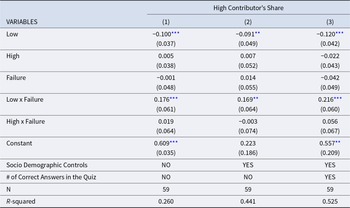
This partially supports Hypothesis 4. When the decision maker is a low contributor, he is rewarded for success and punished for failure. On the other hand, when the decision maker is a high contributor, his agreed share of the final surplus is not affected by the outcome of the risky investment. Our regression results in Table 3 also support this finding.Footnote 22
Regressions for high contributors’ agreed share

Table 3 Long description
The table presents regression results for the high contributor's agreed share, with three models incorporating different variables. Model 1 includes basic variables, Model 2 adds socio-demographic controls, and Model 3 further includes the number of correct quiz answers. The 'Low' variable consistently shows a significant negative impact on the high contributor's share across all models, with coefficients of -0.100, -0.091, and -0.120, respectively. The interaction term 'Low x Failure' is significant and positive in all models, suggesting a mitigating effect of failure when the low contributor makes decisions. Model 3 has the highest R-squared value of 0.525, indicating the best explanatory power. The constant is significant in Models 1 and 3, but not in Model 2. Interpretation should consider the exclusion of data where the final surplus is 500 points.
Note: Robust standard errors are in parentheses.
* p < 0.10, **p < 0.05, ***p < 0.01.
The analysis excludes the data from the pairs where the final surplus is 500 points. The high contributor’s agreed share is a dependent variable. The independent variables are as follows: Low takes the value 1 if data comes from the treatment in which the low contributor makes the investment decision, and High takes the value 1 if data comes from the treatment in which the high contributor makes the investment decision. Reference is Exogenous treatment when the final surplus is 1,000. Failure takes the value 1 when the final value of the surplus is 200 points. Low x Failure and High x Failure are interaction variables. As control variables in Model 2, for each subject in a pair, we use econ (=1 if the subject’s major is economics, = 0 otherwise), age, sex (=1 if male, = 0 if female), monthly disposable income, and risk aversion. Income is a categorical variable: it is equal to 1 if the subject’s monthly income is between 0 and 1,000TL, 2 if the subject’s monthly income is between 1,000TL and 2,000TL, 3 if the subject’s monthly income is between 2,000TL and 3,000TL, and 4 if the subject’s monthly income is more than 3,000 TL. Risk aversion is equal to the subject’s switching point in the Holt-Laury (Holt & Laury, Reference Holt and Laury2002) risk elicitation task. In Model 3, in addition to these control variables, we added the number of correct answers by high contributors and low contributors. Both participants’ characteristics are used as control variables.
According to these results, while low contributors get better deals from bargaining agreements if they are the decision makers in their pair (i.e., in Low) and the final surplus is 1,000, high contributors do not when they are in the same position (i.e., in High and 1,000). When no one is responsible for decision-making, a high contributor’s agreed share is not affected by a failed investment. However, while failed investment affects low contributors’ share when they are decision makers (the sum of the coefficients on Failure and Low x Failure is significantly different from zero, p < 0.01), it does not affect high contributors’ share (the sum of the coefficients on Failure and High*Failure is not significantly different from zero, p = 0.67) when they are the decision maker. In particular, the low contributors’ agreed shares of the surplus decrease (increase) significantly if their risky investment choice turns out to be unsuccessful (successful). The high contributors’ agreed shares are not affected by their decision-maker status or the outcome of their risky choice. These results continue to hold when we include control variables (in Model 2) and even get stronger when we include control variables on subjects’ performances in the real effort task (in Model 3).Footnote 23 These are summarized in Result 4.Footnote 24
Result 4: In comparison to Exogenous, the low contributors’ average agreed share is higher (lower) in Low when their risky investment succeeds (fails). However, the high contributors’ average agreed share is not affected by the outcome of the risky investment in High. In other words, Hypothesis 4 is partially validated (i.e., only in Low).
5.2. Underlying mechanism
The asymmetric treatment effect we reported in Section 5.1 (in Results 4) is worthy of further discussion. Low contributors’ agreed shares are influenced by the outcome of their investments, which is not true for high contributors. This suggests that we observe an asymmetric outcome bias. What could be some reasons behind this observation? We answer this question by resorting to the analysis of bargaining process variables, bargainers’ chat messages, and normative judgments of third parties in a follow-up survey we conducted.
5.2.1. Bargaining process
An advantage of conducting an unstructured bargaining experiment is having access to data on process variables, which can provide insights or explanations that would not have been available in a structured bargaining experiment (see Karagözoğlu, Reference Karagözoğlu, Laslier, Moulin, Sanver, Sanver and Zwicker2019; Camerer et al., Reference Camerer, Nave and Smith2019 for more on this). We resort to bargaining process variables such as initial conflict between first offers, duration (time used until reaching an agreement), time between offers, frequency of fast agreements, and initial conflict between first offers to get further insights.
We now compare some process variables between Low and High to get a better understanding of the underlying mechanism behind the asymmetric outcome bias we observe in bargaining outcomes: the average conflict between first offers (i.e., initial conflict),Footnote 25 the average bargaining duration (until agreement), the frequency of first-minute agreements, and the average time between offers. The rationale behind focusing on these process variables is common: All of these variables have the potential to inform us about the amount of conflict in the bargaining atmosphere and, related to that, the difficulty of reaching an agreement. More precisely, if it is a low-conflict environment, then one would expect initial conflict to be low, bargaining duration to be short, and the frequency of fast agreements to be high.
The numbers from Table 4 show that there was less waiting in between offers, shorter bargaining duration, and more frequent first-minute agreements in High than in Low.Footnote 26 There also seems to be a difference in initial conflict between the two treatments in the predicted direction (i.e., 25.7% > 17.1%), but this difference is not statistically significant. Overall, these observations provide suggestive evidence for the following post-hoc hypothesis: When the high contributor had the decision-making authority, the corresponding bargaining environment was one with less conflict or controversy compared to the case where the low contributor had the decision-making authority. No matter which investment option the high contributor chose, and if he chose the risky one, then no matter what the final outcome was, the parties reached agreements that gave the high performer about the same share of the final surplus. It appears as if both parties acknowledged that high contributors are entitled to make the investment decision to a greater extent since they contributed 75% of the initial surplus. Hence, if and when their investment fails, they were not punished; and if and when their investment succeeds, they did not ask for an extra reward.Footnote 27 Further dissection of the numbers in Table 4 – by comparing Failure-Low versus Failure-High and Success-Low versus Success-High – shows that the differences in Table 4 are mostly due to differences between Failure-Low versus Failure-High (See Appendix B, Table B.1.1). There may not be a categorical opposition to their risky investment decision, possibly because the lottery that the risky investment alternative presents is a reasonable one to take for people with mild levels of risk aversion, which we observe in our sample. That said, low contributors are on thin ice: failure means they risked mostly the other party’s contribution, and even that is gone (i.e., 200 < 300). Hence, the bargaining atmosphere appears to have higher conflict in that case.
Process variables in low and high

Table 4 Long description
The table compares process variables between low and high conditions, focusing on initial conflict, duration, frequency of first-minute agreements, and time between offers. High conditions result in a shorter duration of 140.8 seconds compared to 203.1 seconds in low conditions, with a significant p-value of 0.025. The frequency of first-minute agreements is notably higher in high conditions at 47% versus 5% in low conditions, with a highly significant p-value of 0.003. Initial conflict is lower in high conditions at 17.1% compared to 25.7% in low conditions, though this difference is not statistically significant (p-value 0.293). Time between offers is slightly shorter in high conditions at 20.1 seconds compared to 24.4 seconds in low conditions, with a marginal significance (p-value 0.074). These findings suggest that high conditions may facilitate quicker and more frequent agreements.
* Note: p < 0.10, ** p < 0.05, *** p < 0.01.
In line with our focus here, we exclude the data from the pairs where the final surplus is 500 points.
‘Frequency of first-minute agreements’ is calculated conditional on reaching an agreement.
A hypothesis one can derive from the outcome bias hypothesis is that initial conflict should be higher for lower values of the final surplus than for higher values in both Low and High. When we look at the initial conflict across different values of final surplus values, we observe that it is not significantly different across 200, 500, and 1,000 in High, but it is significantly different across surplus values in Low. In particular, the average initial conflict in 200, 500, and 1,000 points in Low is 34%, 20%, and 18%, respectively (p = 0.027). In other words, when the low contributors made the investment decision and the investment failed, bargaining starts with a higher conflict, which is not the case when the high contributors’ risky investment failed. This observation is, again, in line with the asymmetric outcome bias we reported earlier.
Table 5 shows high and low contributors’ opening offers (in high contributor shares) in High and Low, and for 200 and 1,000 values of the final surplus. ‘Opening offer’ is defined as the first offer made in the pair. Hence, there is only one ‘opening offer’ in the data coming from each pair. Table 5 shows that in High, when the value of the final surplus was 1,000 (200) and high contributors made the opening offer, they asked for 64% (70%) of the surplus (p = 0.65). Hence, high contributors’ opening offers seem not to have been influenced by the outcome of their risky investment. When the value of the final surplus was 1,000 (200), and low contributors made the opening offer, they gave 50% (52%) to high contributors (p = 0.61). Hence, their opening offers also seem not to have been influenced by the outcome of the risky investment.Footnote 28 In Low, the opening offers of high contributors (asking for 83% in the case of failure versus 63% in the case of success) depend on the investment outcome (p = 0.003). This economically and statistically significant difference in opening offers is, arguably, the first sign of asymmetric treatment of HC and LC decision-makers in bargaining. These differences are also reflected in the comparison between initial conflict in two treatments between the cases of success (i.e., 1,000) and failure (i.e., 200): The initial conflict between first offers is significantly different in Low between success and failure (p = 0.023) but not significantly different in High between success and failure (p = 0.455).Footnote 29 Finally, when high contributors made the opening offer, and the value of the final surplus was 200, they asked for 70% in High and 83% in Low (p = 0.049). Although a difference in a similar direction appears for low contributors as well (that is, they asked for 52% in High and 63% in Low), this difference is not significant (p = 0.310). When the value of the final surplus was 1,000, these figures were close both for high (64% versus 63%) and low (50% versus 54%) contributors. In other words, these observations of high and low contributors’ opening offers provide a background story for our findings on agreement terms in these two treatments, that is, agreement terms are subject to outcome bias when low contributors have the decision authority in the pair, but not when high contributors have the decision authority and differences are more emphasized in the case of failed investments.Footnote 30
Opening offers of HC and LC in low and high by surplus value

Table 5 Long description
The table compares the share of surplus claimed by HC and LC when making initial offers in high and low surplus scenarios. In the Low condition, LCs claim 63% of the surplus when they make the initial offer, compared to 83% claimed by HCs. In the High condition, LCs claim 70% of the surplus, while HCs claim 52%. The p-value for the Low condition when HCs make the initial offer is 0.003, indicating statistical significance, while other p-values are not significant. This suggests that in Low conditions, HCs tend to claim a larger share of the surplus compared to LCs, with a significant difference when HCs make the initial offer.
* Note: p < 0.10, ** p < 0.05, *** p < 0.01.
The numbers in the table represent the share that the subject who made the opening offer claimed for him/herself in that offer. For instance, the first row in the last column reads as ‘In Low, when LCs make the opening offer, on average, they claim 63% of the surplus for themselves.’
5.2.2. Bargainers’ chat messages
In our experiment, subjects were allowed to send chat messages to each other. Here, we present some numerical analyses about the subjects’ use of the chatting option. More precisely, we report the average number of chat messages in a pair, the average length of text messages in a pair, and the frequency of pairs that did not use the chatting option (i.e., did not exchange any chat messages). One would expect that in a low-conflict environment (compared to a high-conflict environment), (i) the average number of chat messages is lower, (ii) the average length of chat messages is shorter, and (iii) the frequency of ‘no need to chat’ is higher. Table 6 shows that indeed the average number of chat messages is lower in High than in Low (p = 0.016); the average length of messages is shorter in High than in Low (p = 0.035); and % of pairs that did not exchange any chat messages is higher in High than in Low (p = 0.036). These observations suggest that there was less need to chat about or discuss the division of the surplus in High than in Low. This can be seen as suggestive evidence for a lower conflict environment in High than in Low.
Chatting activity in low and high

Table 6 Long description
The table compares chatting activity between pairs with low and high levels of interaction. Pairs with low chatting activity sent an average of 4 messages, while those with high activity sent 2 messages, with a significant p-value of 0.016. The average length of chat messages was 28.65 words for low activity pairs and 14.14 words for high activity pairs, also showing a significant difference with a p-value of 0.035. Additionally, 26% of low activity pairs had no chatting, compared to 59% of high activity pairs, with a p-value of 0.036. These results suggest that higher chatting activity is associated with fewer and shorter messages, and a higher percentage of pairs with no chatting. The data excludes pairs with a final surplus of 500 points, and the tests used are two-sided Mann-Whitney tests.
* Note: p < 0.10, ** p < 0.05, *** p < 0.01.
In line with our focus here, we exclude the data from the pairs where the final surplus is 500 points.
Tests are two-sided Mann-Whitney tests.
We also analyzed the length of chat messages at the subject level, which also provided a clear picture, consistent with the rest of the analysis: Only when the low contributors made the investment decision and the final value of the surplus was 200 points, the average length of high contributors’ chat messages were significantly greater than that of low contributors’ (for 200 points: 28.65 words versus 14.14 words, p = 0.035). That is, in other conditions, the chatting activity was balanced between the two subjects in a pair, but when the low contributor made the decision, and the investment failed, high contributors wrote significantly longer messages than low contributors did (Table B.1.2 in Appendix B.1 shows all comparisons).
In Appendix B.2.3 and B.2.4, we present results based on chat content, including sentiment analysis across treatments and final surplus values (using an LLM),Footnote 31 as well as the proportion of groups containing blame or brag messages across Low and High treatments and final surplus values, respectively.Footnote 32 According to sentiment analysis, when the final surplus is 500 points, the average sentiment score is close to zero (i.e., neutral) both in Low and High.Footnote 33 When the final surplus is 1,000 points, the average sentiment score is positive for both contributors, but it is higher in High, indicating that participants respond more favorably to success produced by the high contributor. Finally, when the final surplus is 200, the average sentiment score is negative in both treatments, but it is lower (i.e., more negative) in Low, suggesting that participants react particularly unfavorably to low outcomes when they originate from the low contributor’s decision. Along similar lines, the percentage of groups with at least one message with a blame content is significantly higher in Low than in High when the final surplus is 200 points.Footnote 34
5.2.3. Third parties’ normative judgments: a survey study
The mechanism we propose to explain the asymmetric outcome bias observed in our experiment involves differential entitlements to decision authority. Subjects’ perceptions of a fair division of the surplus, decision-making authority, entitlement to decide on behalf of the group, and entitlement to take risks on behalf of the group could have provided valuable insights into the bargaining behavior and outcomes observed in the experiment. However, asking subjects, who are involved in strategic interaction, too many questions about their views and motives has its own problems. Due to these concerns, collecting data on third parties’ views, normative judgments, and predictions of what has happened in the experiment has become a commonly used method in experimental economics (Cappelen et al., Reference Cappelen, Konow, Sørensen and Tungodden2013; Fehr & Fischbacher, Reference Fehr and Fischbacher2004; Konow, Reference Konow2000; Krupka & Weber, Reference Krupka and Weber2013). Along these lines, to pin down the underlying mechanism behind our observations and to gain insights about third parties’ (not participated in the experiment) normative judgments regarding decision-making authority, risk-taking on behalf of the group, and fair division of the initial and final surplus, we conducted an online survey study at the same university in May 2025. In total, 195 subjects participated. We paid 500 Turkish Lira to each of the randomly selected 12 participants.Footnote 35 Below, we first present the structure of the survey study:Footnote 36
1 We explained the experimental design and implementation to our participants in detail.
2 We presented participants with 15 of 30 questions from the general knowledge quiz we had in the experiment so that they could experience what it is like to perform the task in the experiment. This would be important for them to understand participants’ feelings of entitlement or moral property rights in the experiment.
3 We first described the situations that experimental participants went through in three treatments with three different final surplus values. By keeping the order for the final surplus fixed as 200, 500, and 1,000, but controlling the order for who made the investment decision, we asked survey participants the fair share (in terms of percentage) for the high contributor, where the remaining share belonged to the low contributor.
We then asked survey participants their normative judgments about the way initial contributions were determined, decision rights were assigned, and risks were taken. These were all questions that called for answers on a 10-point Likert scale. We also asked questions with open-ended answers on participants’ reasoning or factors that influenced their answers to the above-mentioned questions. Finally, we collected data on the age and gender.
We begin our analysis of third-party opinions by examining their normative judgments about who should serve as the decision-maker in the group. On average, they rated the appropriateness of the low contributor being assigned the decision-making role as 4.05 (10-point Likert scale, 1 = completely inappropriate, 10 = completely appropriate). In contrast, their average appropriateness rating for the high contributor being assigned the decision-making role was 7.25. This difference is statistically highly significant (p < 0.001, Wilcoxon signed-rank test). When the survey respondents were asked which alternative a low and high contributor should choose, 56.4% of them marked the safe alternative as more appropriate for the low contributors, and only 38.4% of them marked the safe alternative as more appropriate for the high contributors. This difference is statistically highly significant according to the two-proportion z-test result (p = 0.0004). Finally, we also asked respondents’ reasoning for the appropriateness level they assigned to high/low contributors’ decision maker status for the group. According to text analysis of their responses conducted by ChatGPT 4.5, out of 187 responses, 162 participants (approximately 86.6%) explicitly supported or justified the high contributor’s right to decide. This strong majority emphasized themes like contribution, risk, and deserved authority. Answers to these questions suggest that third parties have a pretty clear inclination for high contributors to make the investment decision for the group. Furthermore, survey participants seem to think that high contributors are more entitled to take risks than low contributors are. These observations are aligned with the mechanism we propose to explain the asymmetric outcome bias.
Second, we study how third parties evaluate the fair division of the final surplus under each scenario in the experiment. Table 7 shows average fair shares for all treatments and values of the final surplus. In all cases, the share third parties assign to high contributors is larger than 50% and smaller than 75% as parallel with our hypothesis and experimental data. As predicted, the share third parties assign is affected by the final surplus value; in other words, we observe reward for success and punishment for failure in third parties’ fair share assignments, both in Low and High.
The fair share for the high contributor suggested by third parties

Table 7 Long description
The table measures the fair share suggested by third parties for high contributors across different scenarios: risky-failure, safe, and risky-successful. In risky-successful scenarios, the fair share is highest at 0.68, indicating a favorable outcome for high contributors. Risky-failure scenarios have the lowest fair share at 0.54, suggesting less favorable conditions. Safe scenarios show varied results, with fair shares of 0.56 and 0.63, indicating moderate conditions. Comparisons reveal that risky-successful scenarios consistently offer better fair shares than risky-failure scenarios. The data suggests that the type of scenario significantly impacts the fair share for high contributors.
The regression results in Table 8 support the observations in Table 7. Being the decision-maker increases the fair share of the decision-making party when the surplus is 1,000 points: When low contributors make the decision, and the outcome is successful, their fair share increases by 10.1% compared to 1,000 in Exogenous. On the other hand, high contributors see only a 2.8% increase in their fair share when they are in the same position. Both contributors are rewarded for success, as we originally hypothesized for the experiment. That said, the increase in low contributors’ fair shares is larger in magnitude than that of high contributors.
High contributors’ fair shares by third parties

Table 8 Long description
The table measures the impact of various treatment variables on the high contributor's share in two models. In both models, the 'Low' variable significantly decreases the share by 0.101, while 'High' increases it by 0.028. The 'Failure' variable also negatively impacts the share by 0.049. Interaction terms show 'Low x Failure' increases the share by 0.095, whereas 'High x Failure' decreases it by 0.091. Model 2 includes control variables, resulting in a higher R-squared value of 0.101 compared to 0.074 in Model 1, indicating better explanatory power. Both models have 1,170 observations and are clustered at 195 subjects, with robust standard errors noted.
Note 1: Robust standard errors, clustered at the subject level, in parentheses.
* p < 0.10, **p < 0.05, ***p < 0.01.
Note 2: The analysis excludes the data from the pairs where the final surplus is 500 points. The high contributor’s share is a dependent variable. The independent variables are as follows: Low takes the value 1 if data comes from the treatment in which the low contributor makes the investment decision, and High takes the value 1 if data comes from the treatment in which the high contributor makes the investment decision. Reference is exogenous treatment when the final surplus is 1,000. Failure takes the value 1 when the final value of the surplus is 200 points. Low x Failure and High x Failure are the interaction variables. As control variables in Model 2, we use fairmethod, which is the appropriateness level they assigned to the method used for determining initial contributions (1–10); fairinitials is the appropriateness they assigned to initial contributions (from 1 to 10)Footnote 37; gendercode takes the value 1 if the third party’s gender is female, and age.
In the failure condition, being the decision-maker reduces the fair share of the decision-making party in either condition: When low contributors make the decision and the final surplus is 200, the high contributor’s fair share increases by 4.6% (p = 0.014 for the test: Failure + Low x Failure = 0); when high contributors make the decision and the final surplus is 200, their fair share decreases by 13.9% (p < 0.001 for the test: Failure + High x Failure = 0). Both high and low contributors are punished for their failed investments, as we originally hypothesized for the experiment. That said, the decrease in high contributors’ fair shares is larger in magnitude than that of low contributors. The reason for asymmetric reward/punishment in fair shares, which seems to be favoring low contributors, may be related to the fact that survey participants did not find the initial contribution amounts (i.e., 100–300) to be fair.Footnote 38 As such, they may be attempting to ‘correct’ the distribution in favor of low contributors.
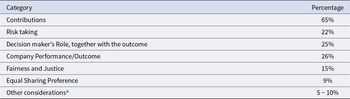
We also asked questions that call for open-ended answers. Participants were asked to explain their motives behind the answers they gave to fair division questions under different scenarios. Then, we prompted LLM to categorize these written answers and find the percentages of each category. You can find the summary in Table 9.
ChatGPT 4.5’s categorization of third parties’ written responses

Table 9 Long description
The table categorizes third-party responses into various themes, with 'Contributions' being the most prominent at 65%. 'Risk taking' accounts for 22%, and 'Decision maker’s Role, together with the outcome' is at 25%. 'Company Performance/Outcome' is slightly higher at 26%. 'Fairness and Justice' and 'Equal Sharing Preference' are less emphasized, at 15% and 9% respectively. 'Other considerations' are aggregated into a single category with a combined frequency of 5-10%, indicating a less significant but varied set of themes. The data suggests a strong focus on contributions, with other categories showing moderate to low emphasis.
a There are several themes here, and the frequencies vary by theme. These themes include the founder’s knowledge or competence, personal values and intuition, and need-based reasoning. The table does not report the frequency for each theme separately; instead, it aggregates them into a single category with a combined frequency of 5–10%.
Subjects’ contributions appear to be the most recurring keyword in these written responses, followed by risk-taking, decision-making role, and the outcome. This is also consistent with bargaining outcomes in the experiment and third parties’ fair share assignments in the survey study, both of which implied more than 50% share of the final surplus for high contributors.
6. Concluding remarks
In various corporate settings, joint surplus production (or value creation) is followed by investment decisions that may involve risk-taking, and some members of the group make decisions that affect both their payoffs and other members’ payoffs. Moreover, due to the incompleteness of their contracts, difficulty of converting various types of contributions to equity shares, or unforeseen contingencies, negotiations, or renegotiations over the distribution of the final surplus may take place. Hence, whether asymmetric status induced by differences in contributions to surplus production and risky decision-making on behalf of the group have important implications for negotiations that follow, are relevant questions. Does the identity of the decision maker influence the bargaining process and outcomes? How does the outcome of a risky investment influence the bargaining process and outcomes? Does the effect depend on the identity of the decision maker? Using a controlled laboratory experiment, the current paper provides answers to these questions.
Our main findings can be summarized as follows: (i) bargaining process and outcomes are influenced by both the identity of the decision maker and the outcome of the risky investment; (ii) high contributors’ agreed share is higher than 50% and similar across investment outcomes and decisions in Exogenous and High; (iii) when low contributors choose the risky investment alternative, they are punished for failure and rewarded for success; (iv) an analysis of various negotiation process variables provides a suggestive evidence for the differential treatment of low contributors’ and high contributors’ decisions: There is more conflict, blame appears more frequently in chat messages, and consequently reaching an agreement took longer when low contributors choose the risky option (and especially if it fails); (v) third parties’ answers to survey questions reveal that high contributors are seen as more entitled to make decisions for the group and more entitled to take risk in these decisions; that said, third parties’ fair share assignments imply that when they take a risk and fail, they should be punished too. Interestingly, this last observation is in line with Hypothesis 4 but in contrast with the results from the experiment. Singling out the exact reason for the contrast may require conducting further experiments, but we conjecture that it could be because roles were exogenously assigned in the experiment, whereas survey participants could reflect their opinion on the ‘who should have the decision authority’ question separately. That is, it could be that, according to third parties, high contributors are the ones who should make the investment decision for the group, and once they decide, they are as accountable as low contributors who make a decision. In the experiment, the decision-making authority is not negotiated. Hence, it could be that the preference in favor of high contributors may be reflected in the only context where they can be reflected: in bargaining.
Our paper contributes to the literature on bargaining experiments with joint production and risk-taking. Our contribution lies in the rich-context bargaining we study, which mimics various real-life aspects of negotiations in organizations (e.g., jointly produced surplus, asymmetric status/entitlements, risky decision making, and the unstructured bargaining protocol) and the questions we can answer thanks to this richness. In particular, the literature has not studied production phases where risky investments can be made using the initial surplus produced with joint effort. The sequentiality between initial value creation and investments that follow was not captured before either. Finally, the joint presence of effort and risk-taking in producing the final surplus in our experiment allows different fairness standards to influence negotiations.
Our findings on the asymmetric outcome bias can be interpreted with reference to formal authority (the right to decide) and real authority (the effective control over decisions) concepts in Aghion and Tirole (Reference Aghion and Tirole1997). As these authors rightly put it, formal authority does not need to entitle its holder real authority. In our experiment, the formal authority is exogenously assigned to low (in Low) or high (in High) contributors. On the other hand, authority may be derived from contributions to an asset or ownership of an asset (Grossman & Hart, Reference Grossman and Hart1986; Hart & Moore, Reference Hart and Moore1990). This latter type of authority entitles the owner the right to make decisions concerning the use of this asset. Thus, it could be argued that high contributors are more likely to have real authority, whereas the low contributors in Low have formal authority. This discrepancy might have reflected itself in how decision makers in Low and High are treated in bargaining: high contributors were able to guarantee a fixed share of the final surplus independent of their decisions and their outcomes, whereas low contributors in Low were assigned the formal authority, but their lack of real authority showed itself in the bargaining stage, where their decisions were treated differently depending on the outcome.
Another message from our findings is about the usefulness of conducting experiments that produce data on process variables (Camerer et al., Reference Camerer, Nave and Smith2019; Karagözoğlu, Reference Karagözoğlu, Laslier, Moulin, Sanver, Sanver and Zwicker2019; Konovalov & Krajbich, Reference Konovalov and Krajbich2023). Our analysis of process variables from the unstructured bargaining game produced a very clear picture (for almost all layers of the bargaining studied), which provided valuable insights and helped us interpret our findings on agreements. Had we used a bargaining protocol that does not produce data on process, we would not have gained these insights.
Our study is not completely free of limitations. First, we refrained from asking too many questions to participants since, during the experiment, this could have influenced their behavior; asking at the end of the experiment, on the other hand, may produce responses that are anchored to actions taken during the experiment. For instance, we did not ask participants their normative beliefs about ‘who is more entitled to make the investment decision or choose the risky option?’ Moreover, we did not collect data on participants’ subjective entitlements (regarding the division of the final surplus) before the bargaining stage. Such data could have strengthened our results by providing a robustness check. That said, our survey study, where we collected data on third parties’ normative judgments about these questions and written responses in the survey, partially serve this role. Second, our hypotheses are not derived from a full-fledged theoretical model, although for some of our hypotheses (1, 2, and 3), we refer to the theoretical model in Bolton and Karagözoğlu (Reference Bolton and Karagözoğlu2016). For the asymmetric outcome bias result, which we reported, we think that a model that contains joint surplus production, Lockean desert, contribution-based (self-servingly biased) fairness norms, integrated into a simple model of bargaining, would be a natural candidate. We believe that such an ambitious exercise belongs to a separate work.
Finally, a rich set of potential research questions emerges from the current work. First, in our experiment, the identity of the decision maker is exogenously fixed at a session level. In various organizational settings where the roles/authority are not pre-assigned by rules and regulations, such assignments may be open for discussion. Hence, it would be interesting to study a setting where subjects in a pair negotiate or discuss who should make the investment decision on behalf of the group. The type of arguments that appear in such a discussion may provide valuable insights. Second, we are not interested in whether disadvantaged status leads to suboptimal (over- or under-) risk-taking behavior in the current paper. As such, our design does not vary the risk-return characteristics of the risky investment. Future work may investigate questions related to (sub)optimal risk-taking and asymmetric status with designs that vary these parameters. Third, it would be interesting to see whether endogenous determination of the decision maker changes bargaining behavior and/or outcomes. Earlier work has shown that outcomes of elected leaders’ decisions are treated differently from the outcomes of randomly assigned leaders’ decisions (Brandts et al., Reference Brandts, Cooper and Weber2015; Reuben & Timko, Reference Reuben and Timko2018). Moreover, elected leaders are more likely to choose a non-selfish policy than appointed leaders (Drazen & Ozbay, Reference Drazen and Ozbay2019). Fourth, studying questions similar to the ones here in a multilateral context, which more closely resemble organizational settings, would be of interest. Finally, related to the previous point, it would be interesting to study differences in the bargaining process across settings where decision authority (who makes the investment decision) and distributive authority (who decides on the distribution of the final surplus) are concentrated in a single hand or multiple hands.
Supplementary material
The supplementary material for this article can be found at https://doi.org/10.1017/eec.2026.10047.
Data availability statement
The replication material for the study is available at the Open Science Framework: https://doi.org/10.17605/OSF.IO/5YMKP.
Acknowledgements
We would like to thank the editor, Marta Serra-Garcia, and two anonymous reviewers for many constructive comments that improved the paper. We would like to thank TÜBİTAK (The Scientific and Technological Research Council of Türkiye) for its support under the grant number 221K329. We would also like to thank workshop/seminar audiences in 7th BEET at Rice University, Busan Workshop in Honor of Youngsub Chun, Corvinus University of Budapest, UC San Diego Rady School of Management, Social Choice and Fair Division Workshop at ITU, Economics Conference at Turkish-German University, 8th BEET at Maastricht University, Tilburg University, Tinbergen Institute Complexity Seminar, 6th Turkish Behavioral and Experimental Economics Workshop at İstanbul Bilgi University, and Mini Workshop on Experimental Economics at Bilkent University for valuable comments and discussions. Finally, we would like to thank Muhammet ali Canşı, Aybüke Dere, Mehmet Tuğsuz, Serkan Karademir, and Enfal Kaan Arısoy for research assistance, and Tara Sylvestre for language editing. Usual disclaimers apply.
Funding statement
The research project that produced this manuscript was funded by TÜBİTAK (The Scientific and Technological Research Council of Türkiye) under the grant number 221K329. The authors do not have any competing interests to disclose.
Ethical standards
Ethics approval was received from the Middle East Technical University, where the experiments and the online survey were conducted. Informed consent forms were collected from the participants.








 Open access

