


Introduction
Research in work and organizational psychology has recognized the importance of employees creating – crafting – their own job to find more meaning in it and improve their psychological experiences (Berg, Wrzesniewski, Grant, Kurkoski, & Welle, Reference Berg, Wrzesniewski, Grant, Kurkoski and Welle2022; Wrzesniewski & Dutton, Reference Wrzesniewski and Dutton2001). Studies have shown that employees who proactively redesign their jobs experience a higher sense of purpose and well-being in what they do, acting like sculptors of their own happiness (Berg et al., Reference Berg, Wrzesniewski, Grant, Kurkoski and Welle2022; Costantini & Weintraub, Reference Costantini and Weintraub2022; Demerouti, Reference Demerouti2014; Lichtenthaler & Fischbach, Reference Lichtenthaler and Fischbach2019; Zhang & Parker, Reference Zhang and Parker2019). Job crafting explicitly captures these proactive changes in employees' jobs, which happen via small alterations and aim to foster better work experiences (Wrzesniewski & Dutton, Reference Wrzesniewski and Dutton2001). Most of the studies conducted to investigate what employees do when they craft their jobs focused on the proactive behaviors through which they do so, with research agreeing that employees either strive to approach more positive stimuli or to avoid negative anticipated states (Bruning & Campion, Reference Bruning and Campion2018; Lichtenthaler & Fischbach, Reference Lichtenthaler and Fischbach2019).
Still, an important component of job crafting is how people think and actively try to reframe Footnote 1 their thoughts regarding their jobs, for example to amplify the importance of aspects that they like and reduce the importance of job characteristics that make them feel bad or negatively influence their job experiences and identities. Indeed, job crafting literature recognizes that job crafting also happens cognitively, that is, in the mind of employees (Wrzesniewski & Dutton, Reference Wrzesniewski and Dutton2001). However, research on cognitive crafting is relatively scarce and has mainly focused on a very general level, investigating how employees think about the purpose and value of their work in general, while leaving largely neglected how people proactively reframe some specific aspects of their job to make more of its positive features and lessen the importance of the perceived threatening ones. Yet, employees' purpose is forged also based on simple work activities and characteristics that jointly shape an overall idea of how fulfilling one's work is (Dhingra, Samo, Schaninger, & Schrimper, Reference Dhingra, Samo, Schaninger and Schrimper2021a), but little is known about these small cognitive changes that may influence individual and organizational outcomes (Dhingra, Schaninger, & Brady, Reference Dhingra, Schaninger and Brady2021b). Hence, understanding how people convince themselves regarding the significance of some work tasks and elements and how this process is linked with enacted behaviors and ensuing outcomes can provide insights to sustain employees' well-being. Against this background, this research aims to examine how employees take the initiative to reframe the demands and resources that constitute their jobs and investigates this proactive cognitive process in the broader framework of different job crafting strategies and work engagement outcomes.
This research contributes to the literature in the following important ways. First, this study contributes to a better understanding of job crafting by addressing its cognitive features that refer to specific work characteristics, i.e., approaching job resources and avoiding hindering job demands. Previous studies investigated the role of cognitive crafting for psychological need satisfaction (Slemp & Vella-Brodrick, Reference Slemp and Vella-Brodrick2013), work quality (Romeo, Yepes-Baldó, Westerberg, & Nordin, Reference Romeo, Yepes-Baldó, Westerberg and Nordin2020), as well as positive meaning and identity in work (Wrzesniewski, LoBuglio, Dutton, & Berg, Reference Wrzesniewski, LoBuglio, Dutton, Berg and Bakker2013). However, the conceptualizations adopted to study such cognitive crafting processes referred mainly to connecting one's work to larger or higher-order outputs (cf. Wrzesniewski & Dutton, Reference Wrzesniewski and Dutton2001), while research suggests that people look for opportunities in their work activities and tasks to be actually contributing to what they believe their purpose is (Dhingra et al., Reference Dhingra, Samo, Schaninger and Schrimper2021a). Beyond considering cognitive crafting as an overarching psychological strategy dealing with how employees change their perceptions of work in general as related to their purpose in life (Geldenhuys, Bakker, & Demerouti, Reference Geldenhuys, Bakker and Demerouti2021), this research focuses on different and more specific cognitive crafting strategies that deal with the re-appraisal of specific features of work, namely, job demands and job resources. In doing so, this research enriches the job crafting literature (Zhang & Parker, Reference Zhang and Parker2019) by acknowledging the differential roles of the components of cognitive crafting for proactivity at work.
Second, by examining the reciprocal relationship between cognitive and behavioral job crafting over time, this research sheds light on the thought-action mechanism through which employees redesign their jobs. Specifically, responding to the recent call for investigating how cognitive crafting may drive subsequent behaviors (Zhang & Parker, Reference Zhang and Parker2019), I investigate how cognitive and behavioral aspects of job crafting are linked to one another across different time points and adopt a quantitative perspective. By examining how different aspects of cognitive crafting are linked with different job crafting behaviors, this research unpacks how job crafting unfolds in the light of its various components (i.e., cognitive and behavioral, approach and avoidance-oriented), contributing knowledge on the process of job crafting formation with important implications for intervention and policy design. To do so, this paper adopts a sensemaking perspective and investigates how the narratives that employees use for themselves regarding the centrality of their work elements are linked to enacted proactive behaviors and contribute to the intentional redesign of work experiences.
Third, this research contributes knowledge on how different employees' proactive strategies help employees stay engaged while facing profound changes in the societal and organizational boundaries of their work, namely during the COVID-19 pandemic. With its effects on how and where work was performed, the pandemic threatened traditional identity-making and identity-sustaining activities, prompting sensemaking processes (Maitlis & Christianson, Reference Maitlis and Christianson2014). This research contributes to the job redesign literature by looking at the mechanisms of how employees proactively managed and constructed their work experiences preserving their own motivation – work engagement – during times of high uncertainty and change, with an original contribution to unpacking the role of different components of cognitive crafting in such a process.
Theory and hypotheses
Job crafting theory posits that people who engage in crafting activities increase the meaningfulness and purpose of their work, eventually enhancing their basic need satisfaction (Geldenhuys, Bakker, & Demerouti, Reference Geldenhuys, Bakker and Demerouti2021; Wrzesniewski & Dutton, Reference Wrzesniewski and Dutton2001). Job crafting refers to the physical and cognitive changes individuals make in the task or relational boundaries of their work (Wrzesniewski & Dutton, Reference Wrzesniewski and Dutton2001). While task and relational crafting refer to initiated changes that imply proactive behavior, such as information seeking or the initiation of new work tasks (Tims, Bakker, & Derks, Reference Tims, Bakker and Derks2012), the cognitive component of crafting involves reframing or redefining one's perceptions of work, even without a change in behaviors (Berg, Dutton, & Wrzesniewski, Reference Berg, Dutton, Wrzesniewski, Dik, Byrne and Steger2013; Wrzesniewski & Dutton, Reference Wrzesniewski and Dutton2001). Specifically, job crafting behaviors refer to employees' actions to increase the job aspects that stimulate personal growth, reduce job demands, or are functional to achieve goals (Bruning & Campion, Reference Bruning and Campion2018; Zhang & Parker, Reference Zhang and Parker2019). Examples are actions through which, on their own initiative, employees add elements in their work tasks to improve work processes, reorganize the tangible elements of work to make it more efficient or effective, or withdraw from tasks to make work less intense. Differently, cognitive crafting refers to employees' active and intentional changes in how they see their tasks and work roles (Zhang & Parker, Reference Zhang and Parker2019).
Cognitive crafting
Traditionally, research has investigated cognitive crafting as a strategy aiming to increase perceived overall significance and meaning in one's work, for example by focusing on connecting one's activities with personal values, on the potential good that might result from one's work, or by linking one's work efforts to the larger output produced by the organization (Wrzesniewski & Dutton, Reference Wrzesniewski and Dutton2001; Wrzesniewski et al., Reference Wrzesniewski, LoBuglio, Dutton, Berg and Bakker2013). While intangible compared to crafting behaviors, preliminary studies show that cognitive crafting is not less important in influencing work meaning, identity, or emotions (Berg, Dutton, & Wrzesniewski, Reference Berg, Dutton, Wrzesniewski, Dik, Byrne and Steger2013). Still, compared to job crafting behaviors, surprisingly little research focused on cognitive crafting and its antecedents/outcomes, especially if considering quantitative research (Zhang & Parker, Reference Zhang and Parker2019). Notably, the role of how employees reframe – or change – the values of different tasks, with specific work elements being revalued and assigned either less importance or greater positivity (Ashforth & Kreiner, Reference Ashforth and Kreiner1999; Unsworth, Mason, & Jones, Reference Unsworth, Mason and Jones2004), has been proposed as potentially relevant in driving subsequent behaviors but largely neglected as for quantitative empirical research (Zhang & Parker, Reference Zhang and Parker2019).
Available research suggests that cognitive crafting may benefit attitudes by changing one's perceptions, but to impact performance such cognition might need to translate into actual behavior (Weseler & Niessen, Reference Weseler and Niessen2016). However, the currently available conceptualizations of cognitive crafting map only partially the reframing processes that deal with specific work characteristics, making it hard to evaluate whether and how cognitive crafting can be a powerful driver of subsequent crafting behaviors. Specifically, existing scales measuring cognitive crafting capture ‘employees’ efforts to recognize the effect of one's work on the success of the organization or community’ (Slemp & Vella-Brodrick, Reference Slemp and Vella-Brodrick2013: 127) or efforts to set a positive mental state at work (Bruning & Campion, Reference Bruning and Campion2018; Zhang & Parker, Reference Zhang and Parker2019Footnote 2), but largely neglect how employees proactively change the value of specific job characteristics. Given that many studies in the job crafting literature focus on job crafting behaviors dealing with the proactive management of job characteristics (Lichtenthaler & Fischbach, Reference Lichtenthaler and Fischbach2019; Zhang & Parker, Reference Zhang and Parker2019) and not with work in general, the lack of a focus on how employees change their perceptions of such work elements strongly limit our knowledge on job crafting overall.
Building on research suggesting that employees can selectively reframe how they perceive specific aspects of their jobs (Ashforth & Kreiner, Reference Ashforth and Kreiner1999; Unsworth, Mason, & Jones, Reference Unsworth, Mason and Jones2004), this study draws on the theoretical prepositions of Zhang and Parker (Reference Zhang and Parker2019) to investigate the role of two different conceptualizations of cognitive crafting, namely approach resources cognitive crafting and avoidance demands cognitive crafting, in the job crafting process. Approach resources cognitive crafting (here also referred to as approach cognitive crafting) refers to employees' efforts to reframe their jobs to gain higher experience of job resources (Zhang & Parker, Reference Zhang and Parker2019), defined as the job aspects that stimulate personal growth and development or are functional in achieving work goals (Bakker & Demerouti, Reference Bakker and Demerouti2007). Differently, avoidance demands cognitive crafting (here also referred to as avoidance cognitive crafting) describes employees' proactive efforts to cognitively reframe their jobs to avoid or diminish the experience or relevance of hindering job demands (Zhang & Parker, Reference Zhang and Parker2019), that is, the job aspects that require sustained physical, emotional, or mental efforts (Bakker & Demerouti, Reference Bakker and Demerouti2007).
Theoretically, these cognitive crafting strategies map two job crafting (cognitive) dimensions, i.e., resource-focused approach crafting and demand-focused avoidance crafting (Bruning & Campion, Reference Bruning and Campion2018; Lichtenthaler & Fischbach, Reference Lichtenthaler and Fischbach2019; Zhang & Parker, Reference Zhang and Parker2019), which are ground in approach-avoidance motivation theory (Elliot, Reference Elliot2006). Specifically, while the former aims for more positive aspects of the work, the latter involves downplaying the importance of demanding job aspects (Zhang & Parker, Reference Zhang and Parker2019). Hence, approach job crafting is about employees' cognitive and behavioral efforts to realize possible gains in motivation, health, and performance. Differently, avoidance job crafting reflects cognitive and behavioral efforts to avoid negative end-states or escape from negative situations (Bruning & Campion, Reference Bruning and Campion2018; Costantini, Demerouti, Ceschi, & Sartori, Reference Costantini, Demerouti, Ceschi and Sartori2021; Elliot, Reference Elliot2006; Lichtenthaler & Fischbach, Reference Lichtenthaler and Fischbach2019). Based on the above, the first part of this research aims at answering the following:
Research question: Can cognitive crafting be conceptualized and assessed in a valid and reliable way as a construct encompassing two dimensions, i.e., approach and avoidance cognitive crafting, targeting job resources and job demands, respectively?
The relationship between cognitive and behavioral job crafting
According to job crafting theory, the job and the work experience are not ‘objective’ but re-created all the time in an effort to boost motivation by altering one's view of work in meaningful ways (Slemp & Vella-Brodrick, Reference Slemp and Vella-Brodrick2013; Wrzesniewski & Dutton, Reference Wrzesniewski and Dutton2001). Such a purposeful rebuilding process entails both cognitive and behavioral aspects (Wrzesniewski & Dutton, Reference Wrzesniewski and Dutton2001), which together shape psychological experiences. Indeed, resting on the idea that perceptions and actions validate one another (Weick, Reference Weick1995), sensemaking research proposes that meaningful experiences are built through an ongoing cycle of interactions between behaviors and cognition. Behaviors constitute the raw material of cognition, representing what is being made sense of, since people make sense of what they are doing while striving for coherence with their past behaviors (Melo, Dourado, & Andrade, Reference Melo, Dourado and Andrade2021; Weick et al., Reference Weick, Sutcliffe and Obstfeld2005). At the same time, people's cognitive processes are used as a reference to guide future actions, with people making sense of a situation which, in turn, drives following actions (Maitlis & Christianson, Reference Maitlis and Christianson2014). Hence, action and cognition are recursively linked, with behaviors creating new sensemaking while simultaneously providing feedback about the sense that has already been created (Maitlis & Christianson, Reference Maitlis and Christianson2014: 84).
Building on a sensemaking framework to understand job crafting, it can be argued that employees start sensemaking processes in the form of job crafting to understand and make sense of their personal situations at work (Maitlis & Christianson, Reference Maitlis and Christianson2014; Wrzesniewski, Dutton, & Debebe, Reference Wrzesniewski, Dutton, Debebe, Kramer and Staw2003). That is, employees construct their realities at work in the flow of their activities and situations, creating meaning through cycles of interpretations and actions (Maitlis & Christianson, Reference Maitlis and Christianson2014; Weick, Reference Weick1995). This implies a recursive link between employees' cognitive reframing of their work characteristics and the job crafting behaviors they enact to shape their work experiences. Hence, employees engage in a selective reframing of how they perceive their job characteristics (Zhang & Parker, Reference Zhang and Parker2019), which prompts job crafting behaviors to shape the work environment they envisioned for themselves. At the same time, job crafting behaviors shape the work environment that employees subsequently seek to understand and cognitively ponder (Melo, Dourado, & Andrade, Reference Melo, Dourado and Andrade2021).
Moreover, in line with current job crafting conceptualizations that recognize a distinction between approach and avoidance job crafting (Bruning & Campion, Reference Bruning and Campion2018; Zhang & Parker, Reference Zhang and Parker2019), it is likely that cognitive and behavioral approach- and avoidance-oriented efforts prompt ensuing actions and thoughts that are consistent with the originating approach or avoidance patterns. This is aligned with cognitive dissonance theory, suggesting that employees strive for consistency in their thought-action patterns (Festinger, Reference Festinger1957). Hence, when employees reframe their work characteristics to seek/highlight their positive aspects, they will enact such thoughts through approach behaviors that make the work environment more resourceful, stimulating, or efficient. Also, by making the environment more resourceful, they will experience positive states prompting them to reframe work by focusing on its positive features (Fredrickson, Reference Fredrickson2001). On the other hand, when employees reframe their work by focusing on diminishing its demanding aspects, such thoughts will be followed by consistent efforts to withdraw from situations characterized by high (perceived) hindering demands. In a similar vein, withdrawal behaviors through which employees step away from unfavorable demands will result in avoidance-oriented reframing efforts, serving employees to diminish the relevance of those same aspects they aimed to reduce and meet their own need for self-consistency (Erez & Earley, Reference Erez and Earley1993).
Overall, while empirical evidence on the link between cognitive and behavioral job crafting is scarce (Melo, Dourado, & Andrade, Reference Melo, Dourado and Andrade2021; Zhang & Parker, Reference Zhang and Parker2019), preliminary research shows that cognitive crafting in the form of perceived overall significance in one's work positively relates to following relational and task crafting (Romeo et al., Reference Romeo, Yepes-Baldó, Westerberg and Nordin2020). Integrating this evidence with the theoretical considerations presented, I propose the following hypotheses:
Hypothesis 1a: Approach cognitive and behavioral job crafting have a positive cross-lagged relationship with one another.
Hypothesis 1b: Avoidance cognitive and behavioral job crafting have a positive cross-lagged relationship with one another.
Job crafting and work engagement
Research on job crafting shows that approach job crafting benefits work engagement (Lichtenthaler & Fischbach, Reference Lichtenthaler and Fischbach2019; Rudolph, Katz, Lavigne, & Zacher, Reference Rudolph, Katz, Lavigne and Zacher2017; Tims et al., Reference Tims, Twemlow and Fong2021), which defines a positive state of mind characterized by high energy, dedication, and absorption during work (Schaufeli, Shimazu, Hakanen, Salanova, & De Witte, Reference Schaufeli, Shimazu, Hakanen, Salanova and De Witte2019). This happens because approach job crafting allows employees to anticipate accomplishment, personal development at work, and the gain of higher resources and motivating job characteristics (Lichtenthaler & Fischbach, Reference Lichtenthaler and Fischbach2019). Moreover, by approaching positive end-states, employees are likely to produce changes not only in their work characteristics but also in their work perceptions and positive emotions, furthering the development of personal resources that help them stay engaged at work (Xanthopoulou, Bakker, & Fischbach, Reference Xanthopoulou, Bakker and Fischbach2013). On the contrary, avoidance job crafting has been found to negatively relate to work engagement (Lichtenthaler & Fischbach, Reference Lichtenthaler and Fischbach2019; Rudolph et al., Reference Rudolph, Katz, Lavigne and Zacher2017). This effect is explained because employees withdrawing from their work requirements do not produce effective changes in the amount of hindering job demands. As a result of such refraining efforts, work becomes even more exhausting as the workload becomes unmanageable and regulatory efforts result in ineffective or even impairing performance (Demerouti, Bakker, & Halbesleben, Reference Demerouti, Bakker and Halbesleben2015; Lichtenthaler & Fischbach, Reference Lichtenthaler and Fischbach2019; Rudolph et al., Reference Rudolph, Katz, Lavigne and Zacher2017). Against this background and based on available research showing that cognitive crafting overlaps with behavioral job crafting in predicting work engagement (Hu, Taris, Dollard, & Schaufeli, Reference Hu, Taris, Dollard and Schaufeli2020), I propose:
Hypothesis 2a: Approach cognitive and behavioral job crafting are positively related to work engagement.
Hypothesis 2b: Avoidance cognitive and behavioral job crafting are negatively related to work engagement.
Moreover, since actions and thoughts are reciprocally related in building meaningful experiences at work (Maitlis & Christianson, Reference Maitlis and Christianson2014), I suggest and investigate a job crafting process where the recursive link between cognition and behaviors helps employees create and re-create interpretations and motivation that help them stay engaged at work. Employees reframing work to highlight the value of its perceived resources will follow up with behaviors that promote new positive work situations, enhancing their work engagement. Similarly, when people start actions – behaviors – to obtain gains in resources or motivation, the positive aspects of one's job will become more central to defining the work experience, eventually sustaining work engagement. On the contrary, when employees reframe their work to lessen the relevance of its stressful work conditions, they will actively withdraw from such aspects, proactively considered marginal, eventually impairing work engagement. Moreover, employees who withdraw from the demanding conditions of their work will tend to evaluate such conditions as of little importance to what they do, resulting in lower work engagement. Accordingly:
Hypothesis 3a: Approach cognitive (behavioral) job crafting mediates the relationship between approach cognitive (behavioral) job crafting and work engagement.
Hypothesis 3b: Avoidance cognitive (behavioral) job crafting mediates the relationship between avoidance cognitive (behavioral) job crafting and work engagement.
The present study
Overall, this research aims to examine how employees take the initiative to reframe the demands and resources that constitute their jobs and how these proactive cognitive strategies are embedded in an overall job crafting process that is linked with work engagement. Specifically, in focusing on cognitive crafting, this research explores employees' thoughts that deal with (i) intentionally distancing from aspects that one does not find pleasant and (ii) intentionally placing higher importance on enriching job features.
This research is composed of two steps: The first step aims at shedding light on the first research question and investigates the factorial structure and reliability of a new instrument to assess the above-mentioned cognitive crafting strategies. The second step tests the hypotheses and sheds light on how different cognitive crafting strategies relate to existing job crafting dimensions, and how the process of redesigning one's job via thoughts and behaviors is linked with work engagement.
Step 1: scale development, factorial structure, and reliability
The first step of the research consisted in developing and investigating the factorial structure, validity, and reliability of a new scale to assess approach resources cognitive crafting and avoidance demands cognitive crafting.
Method
Participants and procedure
Data were collected from a convenience sample of Italian employees (n = 247) invited to participate in the study via e-mail and social networks. Data collection took place online in February 2020, right before the beginning of the COVID-19 pandemic in Italy. Participation was voluntary and employees filled in an anonymous questionnaire including demographic information and the approach and avoidance cognitive crafting scale. Participants (58.8% female) reported a mean age of 36.16 years (SD = 11.93). On average, they worked for about 8.23 years (SD = 8.83) in their current job. The majority of the participants had a full-time permanent contract (49.6%), 9.3% reported a part-time permanent contract, another 9.3% had a fixed-term, full-time contract, 10.6% had a fixed-term, part-time contract, and the remaining reported other forms of working arrangements. Most participants hold a high school diploma (64.9%) or a bachelor's degree (26.2%). Most employees worked in administration (38.8%), wholesale and services (26.5%), manufacturing (13.9%), education (10.4%), engineering (4.6%), and human resources (2.3%).
Measure
Approach and avoidance cognitive crafting were assessed with an initial set of eight items developed to investigate cognitive crafting as for two components – approach resources and avoidance demands cognitive crafting – based on the theoretical conceptualization Zhang and Parker (Reference Zhang and Parker2019) proposed. Wording and conceptualization were discussed with work and organizational psychology experts, including scholars and practitioners, to develop a scale that is theoretically sound, comprehensible, and usable also outside academia. The scholars formulated the first set of items based on the theoretical framework adopted – i.e., approach and avoidance crafting targeting job resources and job demands, respectively – which were subsequently discussed with practitioners (all having at least a master's degree in psychology) to assess the comprehensibility and simplicity of the items. All items were rated on a 5-point scale from (1) never to (5) always. Survey instructions advised the participants to answer the items thinking about their experiences and perceptions in the last month.
Results
Exploratory factor analysis
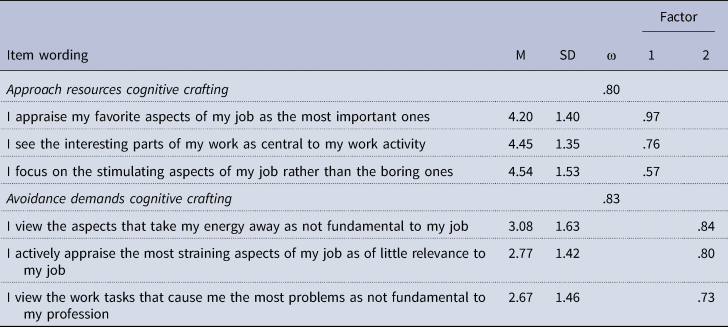
The factorial structure of the cognitive crafting scale was investigated using principal factor analysis with maximum likelihood and oblique rotation in SPSS. Factors with an Eigenvalue >1 and items that loaded .35 or higher on the expected factor (Costello & Osborne, Reference Costello and Osborne2005) were retained, leading to two items deleted based on these criteria. The results, displayed in Table 1, showed that it was possible to distinguish two dimensions of cognitive job crafting, i.e., approach resources cognitive crafting and avoidance demands cognitive crafting. The items, item means, standard deviations, reliabilities, and factor loadings are presented in Table 1.
Step 1: items, descriptive statistics, reliabilities, and factor loadings of the approach and avoidance cognitive crafting scale
Notes. ω = McDonald's omega. Factor loadings >.35 are displayed. Items were translated into English, the original items in Italian are available upon request.
Together, the two factors explained 62.69% of the variance. The first factor (Eigenvalue = 2.97), which explained 37.33% of the variance, is formed by the items for approach resources cognitive crafting (3 items). The second factor (Eigenvalue = 1.46), which explained 25.35% of the variance, is formed by the items measuring avoidance demands cognitive crafting (3 items). The two dimensions had good reliability, specifically, for approach resources cognitive crafting, McDonald's ω (Hayes & Coutts, Reference Hayes and Coutts2020; McDonald, Reference McDonald1999) was = .81; for avoidance demands cognitive crafting McDonald's ω = .83.
Overall, these results provide conceptual support for a two-factor structure of the approach and avoidance cognitive crafting scale. Specifically, they indicate that cognitive crafting can be assessed in a reliable way when it is conceptualized as encompassing approach resources cognitive crafting and avoidance demands cognitive crafting.
Step 2: nomological network of approach and avoidance cognitive crafting
Building on the results from Step 1, Step 2 of this research aimed to further investigate the nomological network of cognitive crafting composed of approach and avoidance-oriented features, investigating how these dimensions relate with other existing cognitive dimensions of job crafting (i.e., general cognitive crafting: Slemp & Vella-Brodrick, Reference Slemp and Vella-Brodrick2013; metacognition: Bruning & Campion, Reference Bruning and Campion2018), with job crafting behaviors, and with work engagement.
Method
Participants and procedure
Employees were recruited via snowball sampling with invitations sent via e-mail and social media (Leighton, Kardong-Edgren, Schneidereith, & Foisy-Doll, Reference Leighton, Kardong-Edgren, Schneidereith and Foisy-Doll2021). Data were collected using internet-based surveys. Participants who agreed to take part in the study (n = 113) were invited to fill in a monthly questionnaire for three consecutive months, i.e., at the end of the first week of October 2020 (Time 1), at the end of the first week of November 2020 (Time 2), and at the end of the first week of December 2020 (Time 3). The first two questionnaires assessed approach resources cognitive crafting and avoidance demands cognitive crafting, and three behavioral job crafting dimensions (i.e., withdrawal, work role expansion, and work organization). Moreover, the first questionnaire also included scales to measure general cognitive crafting, metacognition, and demographic variables. The last questionnaire measured work engagement.
A total of 84 participants (response rate 74%) completed all three surveys. Participants were assured of the confidentiality of their responses, and anonymous surveys were matched by asking participants to take note of a unique code generated by the survey platform at the first time of survey completion, to be inserted each following time they completed the survey. The final sample (54.8% female participants) reported a mean age of 32.08 years (SD = 11.80), ranging from 19 to 57 years. Most participants reported working in the manufacturing sector (39.29%), followed by the tourism and service sector (25%), administrative sector (21.43%), education (5.95%), and others (8.33%). Most participants held a high school diploma (64.3%), and 15.5% held a master's degree or higher. Average work tenure was 8.57 years (SD = 9.90) in the current position, with 54.8% reporting having a permanent, full-time contract, 19% a fixed-term, part-time contract, 10.7% a fixed-term, full-time contract, and the remaining other types of working arrangements.
Measures
All measures were administered in Italian. Scales not available in Italian were translated using the forward-backward translation method (Behling & Law, Reference Behling and Law2000). This procedure involved a professional translator unfamiliar with the items who translated the original scales into Italian. Second, a bilingual speaker back-translated the same items into English. Given that this process did not give rise to significant changes to any of the items, the two concluded that the Italian versions of the scales were consistent with the original ones in meaning. Survey instructions advised the participants to answer the items thinking about their experiences and perceptions in the last month. All measures were rated on a 5-point scale from (1) never to (5) always unless indicated otherwise.
Approach and avoidance cognitive crafting
Approach and avoidance cognitive crafting were assessed at Time 1 and 2 using the new scale presented in Step 1. For approach cognitive crafting, McDonald's ω at Time 1 = .71, and at Time 2 = .84. For avoidance cognitive crafting, McDonald's ω at Time 1 = .77, and at Time 2 = .70.
General cognitive crafting
General cognitive crafting was measured at Time 1 using five items from the scale developed by Slemp and Vella-Brodrick (Reference Slemp and Vella-Brodrick2013). A sample item is ‘I think about how my job gives my life purpose.’ Participants responded on a 6-point scale, ranging from (1) never (6) very often. McDonald's ω = .87.
Metacognition
Metacognition was measured at Time 1 using five items from the scale developed by Bruning and Campion (Reference Bruning and Campion2018). A sample item is ‘I use my thoughts to get me out of a bad mood at work.’ McDonald's ω = .83.
Behavioral job crafting
Job crafting behaviors were measured at Time 1 and 2 with 12 items from the scale developed by Bruning and Campion (Reference Bruning and Campion2018), measuring three types of job crafting behaviors, namely, withdrawal (avoidance-oriented, 3 items, e.g., ‘Work in a way that allows me to avoid bothersome tasks involved in my work’; McDonald's ω at Time 1 = .70 and at Time 2 = .75), work role expansion (approach-oriented, 5 items, e.g., ‘I expand my work by adding activities to my job that ensure the quality of my deliverables’; McDonald's ω at Time 1 and 2 = .88), and work organization (approach-oriented, 4 items, e.g., ‘I create a structure in my work processes’; McDonald's ω at Time 1 = .79, and at Time 2 = .86).
Work engagement
Work engagement was assessed at Time 3 using three items from the ultra-short measure for work engagement developed by Schaufeli et al. (Reference Schaufeli, Shimazu, Hakanen, Salanova and De Witte2019), e.g., ‘At work I feel bursting with energy’ (vigor); ‘I am enthusiastic about my job’ (dedication); and ‘I am immersed in my work’ (absorption). Participants responded on a 7-point scale, ranging from (0) not at all to (6) a very large degree. McDonald's ω = .73.
Results
Preliminary analyses
Before proceeding with hypotheses testing, a series of CFA using Mplus version 8.4 (Muthén & Muthén, Reference Muthén and Muthén1998–2019) was conducted. First, it was investigated whether the dimensions of approach and avoidance cognitive crafting differed from the general cognitive crafting and metacognition existing in the literature. To do so, a model with four factors (approach and avoidance cognitive crafting, general cognitive crafting, and metacognition) was compared with a model in which all items loaded on one single cognitive crafting factor. The four-factor model (χ2 (98) = 151.46, RMSEA = .08; SRMR = .07) fit significantly better than the one-factor model (Δχ2 (6) = 417.55, p < .001), providing support for the conceptual difference between the different dimensions of cognitive crafting. Second, CFA were also performed to examine whether approach and avoidance cognitive crafting and job crafting behaviors could be discriminated at each time point. The same models were estimated at Time 1 and 2; results are presented in Table 2.
Step 2: results from the confirmatory factor analyses
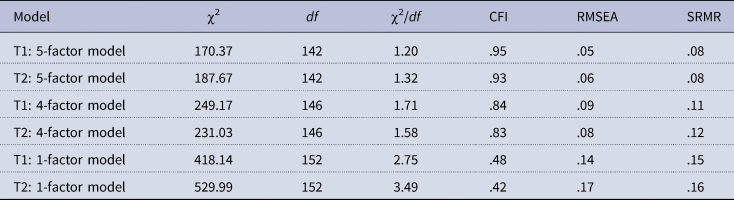
Notes. T = time. In the 4-factor model the two cognitive crafting dimensions collapsed into one single factor.
The first model tested consisted of five latent factors: approach resources cognitive crafting (three items), avoidance demands cognitive crafting (three items), work role expansion (five items), withdrawal (three items), and work organization (four items). This five-factor model showed a good fit to the data at both time points, and all indicators had significant factor loadings (p < .001). The factor loadings of the items of approach resources cognitive crafting ranged from .46 to .62 at Time 1, and from .47 to .82 at Time 2. The factor loadings of the items of avoidance demands cognitive crafting were between .65 and .95 at Time 1, and between .61 and .71 at Time 2.
The second model tested was a four-factor model, where all items measuring different cognitive crafting dimensions loaded on one single factor, and three other latent factors were estimated for the job crafting behaviors. Results showed that the five-factor model fit better than the four-factor model at both time points, Time 1: Δχ2 (4) = 78.82, p < .001; Time 2: Δχ2 (4) = 43.36, p < .001, meaning that the two cognitive crafting dimensions can be discriminated. Finally, a one-factor model was tested, where all items loaded on a single job crafting construct. The five-factor model was significantly better than this one-factor model where all items loaded on one factor, at Time 1: Δχ2 (10) = 247.77, p < .001; Time 2: Δχ2 (10) = 342.32, p < .001. This means that the different factors of cognitive and behavioral job crafting were different and could be discriminated at each time point.
Descriptive statistics
Table 3 presents the means, standard deviations, and correlations among all the study variables. As it can be seen, among the cognitive crafting dimensions considered, avoidance demand was the one less frequently occurring, and it was unrelated to all the other cognitive crafting dimensions.
Step 2: means, standard deviations, and correlations of the study variables
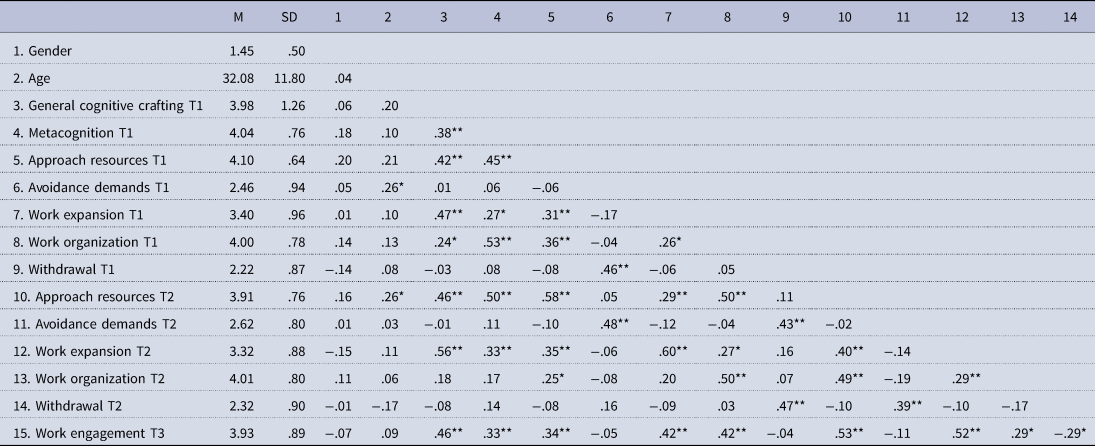
Notes. N = 84. Gender: 1 = female; 2 = male. T = time.
**p < .01; * p < .05.
Hypotheses testing
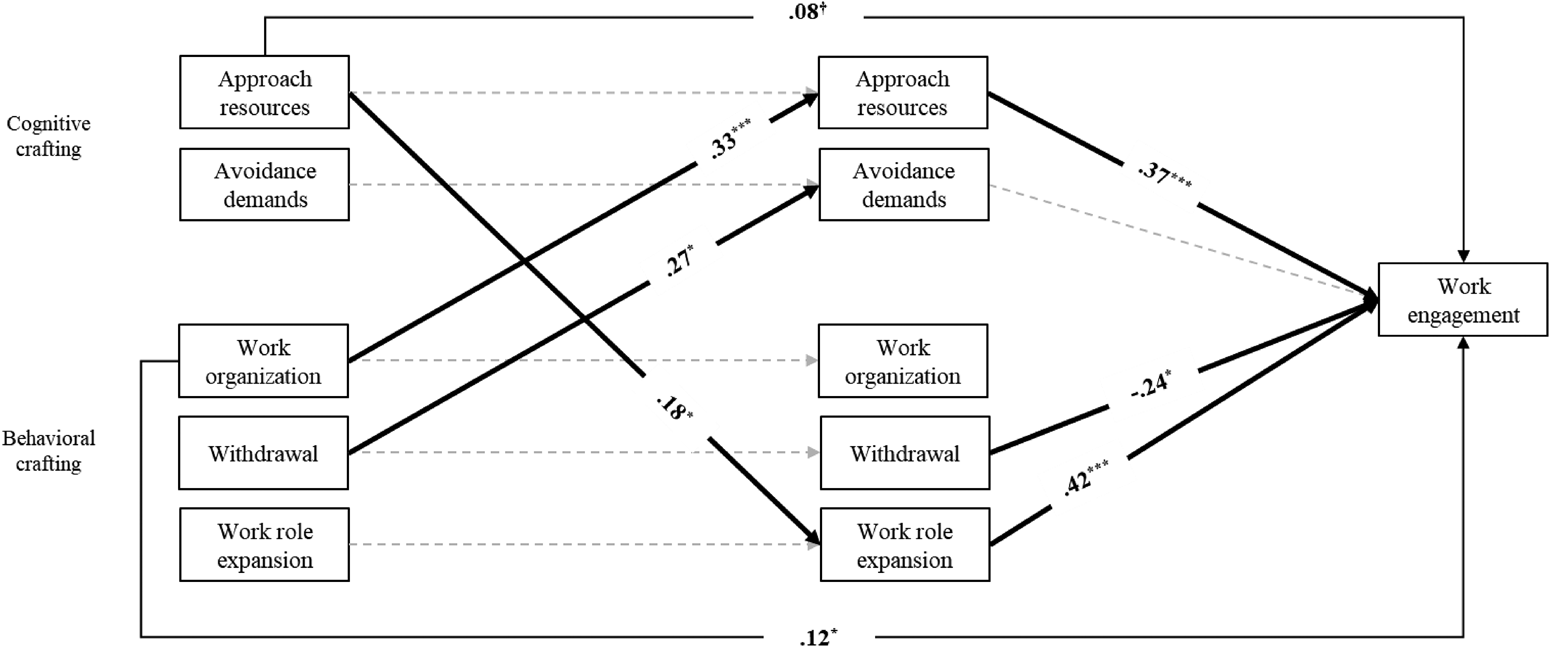
Hypotheses 1–3 were tested in a single path model including autoregressive paths to control for baseline levels for each endogenous variable (Gollob & Reichardt, Reference Gollob, Reichardt, Collins and Horn1991; Hakanen, Schaufeli, & Ahola, Reference Hakanen, Schaufeli and Ahola2008). In the model, I further controlled for age as it was significantly correlated with some job crafting dimensions (Table 3) and modeled cross-lagged relationships and paths from Time 2 variables to Time 3 work engagement. In line with current recommendations on job crafting research, separated observed variables for each job crafting strategy investigated were modeled, allowing to spot differential effects for the distinct strategies adopted (cf. Zhang & Parker, Reference Zhang and Parker2019). The hypothesized model fit well to the data: χ2 (42) = 60.26; CFI = .93; RMSEA = .07; SRMR = .08. Figure 1 shows the model results and displays standardized estimates of the significant relationships found.
Step 2: standardized model results.
Notes. Bold arrows represent significant paths. Standardized significant estimates are displayed. Control variables, related paths, and significant autoregressive coefficients are not displayed for the sake of clarity. The significant indirect effects displayed only refer to those combining different job crafting strategies.
***p ≤ .001, *p ≤ .05, †p ≤ .10.
Hypotheses 1 proposed that cognitive and behavioral job crafting would have shown a positive cross-lagged relationship with one another.
As reported in Table 4, work organization at Time 1 related positively to approach cognitive crafting at Time 2 (β = .32, p < .001), and approach cognitive crafting at Time 1 related positively to work role expansion at Time 2 (β = .25, p = .04). Avoidance cognitive crafting at Time 1 did not relate significantly to withdrawal job crafting behaviors at Time 2, while withdrawal behaviors at Time 1 were significantly related to avoidance cognitive crafting at Time 2 (β = .25, p = .03). These results provide partial support for Hypotheses 1a and 1b.
Step 2: standardized coefficients from path modeling predicting time 2 cognitive and behavioral job crafting
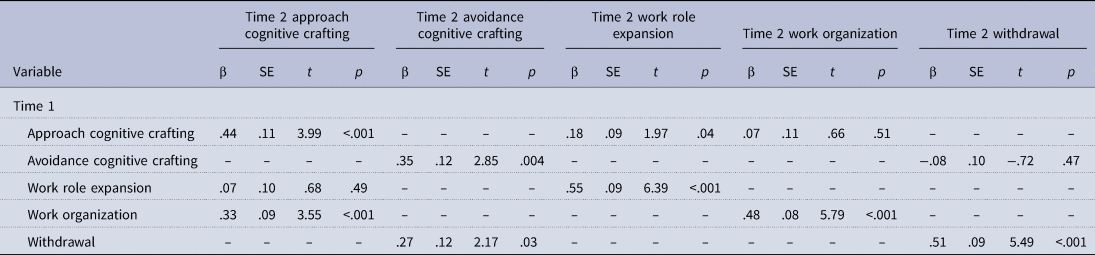
Note. Estimates are standardized, resulting from one overall analysis including the prediction of the different job crafting strategies on work engagement via job crafting.
Hypothesis 2a proposed that cognitive and behavioral approach-oriented job crafting were positively related to work engagement, while Hypothesis 2b proposed that avoidance-oriented job crafting was negatively associated with it.
As it can be seen in Table 5, approach cognitive crafting and work role expansion at Time 2 were both positively related to work engagement at Time 3. On the other hand, withdrawal at Time 2 related negatively to work engagement at Time 3, while cognitively avoiding demands at Time 2 was not significantly related to work engagement at Time 3. Hence, these results provide partial support for Hypotheses 2a and 2b.
Step 2: standardized coefficients from path modeling predicting time 3 work engagement
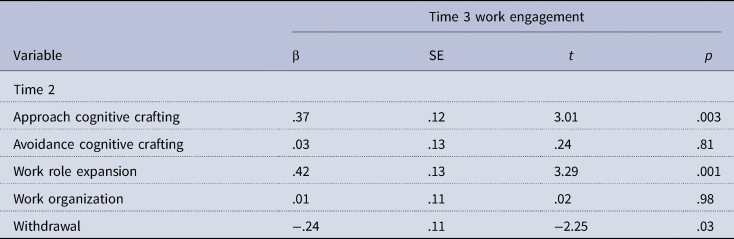
Note. Estimates are standardized, resulting from one overall analysis including the prediction of the different job crafting strategies on work engagement via job crafting.
Hypotheses 3 proposed the mediating role of different dimensions of job crafting in linking behavioral and cognitive job crafting to work engagement.
As reported in Table 6, results from a mediation analysis using bootstrapping (5,000 bootstrap resamples; Preacher & Hayes, Reference Preacher and Hayes2008) with bias-corrected confidence estimates (MacKinnon, Lockwood, & Williams, Reference MacKinnon, Lockwood and Williams2004) confirmed the mediating role of approach cognitive crafting at Time 2 in the relation between work organization at Time 1 and work engagement at Time 3. Differently, work expansion at Time 2 did not significantly mediate the relation between approach cognitive crafting at Time 1 and work engagement at Time 3. In investigating the indirect effects of approach cognitive crafting at Time 1 on work engagement at Time 3, the results showed that approach cognitive crafting at Time 2 significantly mediated the effect of the same variable at Time 1 on work engagement at Time 3. Accordingly, Hypothesis 3a was accepted, and Hypothesis 3b was rejected.
Step 2: standardized indirect effects of job crafting on work engagement
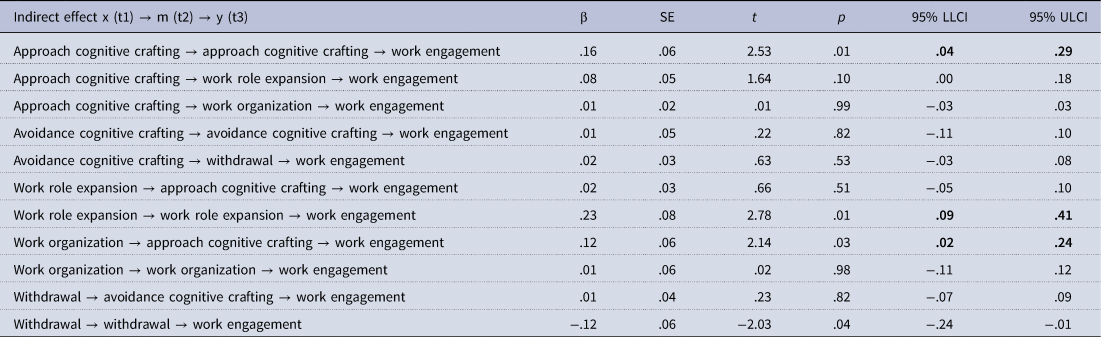
Note. Estimates are standardized, resulting from one overall analysis including the prediction of the different job crafting strategies on work engagement via job crafting. T = time.
95% confidence intervals are based on 5,000 bootstrap resamples. Confidence intervals that do not include zero are in bold.
Discussion
The overarching aim of this research was to provide insights into how employees' efforts to cognitively reframe the value of the elements constituting their work are related and underpin subsequent proactive redesign behaviors and work engagement. Based on three-wave data from a field study, results revealed that employees who reframed their work to highlight the relevance of its perceived resources later reported enriching their jobs and expanding their work roles more often, with benefits for their levels of work engagement over time. Moreover, it was found that employees who enriched their work via concrete behaviors, such as organizing the tangible elements of their tasks, later reported a higher tendency to place greater importance on the enriching features of their jobs, which in turn fostered their work engagement. On the other side, findings showed that cognitively underplaying the relevance of hindering demands resulted from previously enacted withdrawal behaviors at work, and that such a cognitive strategy had no effects on either following proactive behaviors or work engagement.
Theoretical contributions
This research offers some relevant theoretical implications. First, this study advances our understanding of cognitive job crafting by shedding light on how employees reframe the value of specific job characteristics, namely job demands and job resources, via approach- and avoidance-oriented efforts. Rather than considering cognitive crafting as a general idea of how fulfilling one's work in general is, this study extends the conceptualization of cognitive crafting by empirically examining employees' specific efforts referred to the intentional reframing of job demands and resources, a theoretical proposal (cf. Zhang & Parker, Reference Zhang and Parker2019) that has not been empirically tested before. On the one hand, approach cognitive crafting refers to employees' cognitive efforts to reframe their jobs to gain higher experience of job resources. On the other hand, avoidance cognitive crafting denotes employees' efforts to diminish the relevance and role of hindering job demands. This study shows that these cognitive crafting strategies specifically focused on job demands and resources capture aspects of employees' experiences that are different from general cognitive crafting, which have been partially neglected so far. Hence, this study provides insights into the job crafting literature by uncovering different aspects of cognitive crafting that meaningfully capture the unique contribution of intentional reframing thoughts in the job crafting process while differentiating them from general cognitive and behavioral job crafting (Hu et al., Reference Hu, Taris, Dollard and Schaufeli2020).
The importance of differentiating cognitive crafting strategies targeting different job characteristics is further amplified by the results showing that the two forms of cognitive crafting (approach- and avoidance-oriented) are substantially different from one another: in this research, approach cognitive crafting, which focuses on the positive characteristics of the job, is among the most widely used strategies to craft one's job and prompts following positive behaviors. On the opposite, avoidance cognitive crafting represents the least used strategy and seems to be related to inaction or unrelated to behaviors. Overall, these findings are aligned with previous literature on job crafting behaviors (Bakker, Rodríguez-Muñoz, & Sanz Vergel, Reference Bakker, Rodríguez-Muñoz and Sanz Vergel2016; Demerouti & Peeters, Reference Demerouti and Peeters2018; Petrou, Demerouti, Peeters, Schaufeli, & Hetland, Reference Petrou, Demerouti, Peeters, Schaufeli and Hetland2012; Tims, Bakker, & Derks, Reference Tims, Bakker and Derks2012), yet they also offer an original contribution by showing that cognitive efforts to highlight the centrality of positive work features are a key, energizing component of job crafting. By directing their attention toward the positive features of work, individuals improve their awareness of the potential for development and growth at work (Elliot, Reference Elliot2006), thereby enhancing their job experience. Differently, the low occurrence of avoidance cognitive crafting, centered on reducing the relevance of job characteristics perceived as hindering, suggests that employees use this strategy less often, probably in the face of perceived threats. This is consistent with approach-avoidance literature (Elliot, Reference Elliot2006) and with evidence showing that employees who more often reduce their demands are those reporting higher levels of burnout (Lichtenthaler & Fischbach, Reference Lichtenthaler and Fischbach2019).
Second, this research responds to the call for investigating how cognitive and behavioral job crafting are related (Zhang & Parker, Reference Zhang and Parker2019) by adopting a sensemaking perspective that accounts for a bidirectional relationship between cognition and behaviors. Results show that cognitive and behavioral job crafting can feed each other depending on the underlying approach or avoidance motive and the specific behaviors considered. This research shows that employees reframed their work and focused on its positive features when they previously organized, through concrete behaviors, their tangible tasks and work processes. Hence, it seems that the proactive initiation of job redesign through actions improving work organization energizes cognitive efforts to make the positive features of work central to the work experience. This is consistent with previous research suggesting that, by allowing better resource allocation through work organization, employees can benefit from higher resource availability that can be used to make the work environment even more resourceful (Costantini et al., Reference Costantini, Demerouti, Ceschi and Sartori2021; ten Brummelhuis & Bakker, Reference ten Brummelhuis and Bakker2012). On the other side, it was also found that when employees engaged in withdrawal behaviors to actively try to distance themselves from work situations or avoid hindering demands, they later reported more frequent cognitive efforts to diminish the relevance of those job aspects they attempted to avoid through concrete behaviors. These results are aligned with literature highlighting the need for consistency in people's action-thoughts patterns (Festinger, Reference Festinger1957) and enrich approach-avoidance and job crafting literature by providing evidence on the energizing role of behaviors to perpetuate further approach- and avoidance patterns in the form of cognitive reframing.
Focusing on the link from cognition to behaviors, results show that approach cognitive crafting prompts following behaviors to acquire resources that can help employees carry out their tasks – work role expansion. This means that when employees focus on the importance of the positive features of their jobs, such a focus on the positive situational characteristics energizes them to actively promote the realization of new positive situations (Elliot, Reference Elliot2006). However, in contrast to our expectations, avoidance cognitive crafting did not significantly relate to following withdrawal behaviors. Perhaps, employees' cognitive efforts to diminish the relevance of their hindering job demands represent the result of a loss cycle in which employees holding negative affective states withdraw from their work demands (Lichtenthaler & Fischbach, Reference Lichtenthaler and Fischbach2019) and then reframe such demands as nonrelevant in their jobs. Such a cognitive effort seems to induce inaction rather than withdrawal behaviors, probably because of the lack of an underlying motivation and energy to approach positive end-states rather than avoid negative outcomes.
Finally, this research extends the literature on job crafting and work engagement by shedding light on the mechanism through which cognitive and behavioral components of job crafting are linked to work engagement during times of high uncertainty and change. Results show that approach cognitive crafting mediates the effect of work organization on work engagement. This means that the proactive redesign of work processes springs into action a positive orientation that drives employees to highlight the relevance of the positive elements in their work, which prompts higher work engagement. This finding enriches job crafting literature by showing that work organization leads to higher work engagement via approach cognitive crafting, meaning that approach cognitive crafting is an essential component of the job crafting process to translate the value of work organization into higher work engagement. Also, proactively reframing work to gain higher experiences of job resources was found to promote such a positive cognitive orientation over time, with beneficial effects for work engagement. Hence, this cognitive strategy seems beneficial to sustain work engagement also when unrelated to approach behaviors, as it allows to preserve motivation in its own. On the other hand, it was also found that avoidance cognitive crafting was consistently – directly and indirectly – unrelated to work engagement. Previous research investigating the link between avoidance crafting behaviors and work engagement is mixed, with studies showing that avoidance behaviors are either negatively related (see meta-analytic findings: Lichtenthaler & Fischbach, Reference Lichtenthaler and Fischbach2019) or unrelated to it (e.g., Demerouti & Peeters, Reference Demerouti and Peeters2018). In line with such findings, this research shows that cognitive efforts to downplay the relevance of hindering job characteristics are unrelated to work engagement, providing further evidence that focusing on eliminating negative stimuli prevents any effect on the realization of positive outcomes (Elliot, Reference Elliot2006).
Limitations and future research
As follows, I present some limitations of this study and propose some directions for future research that may be useful to enrich our understanding of job crafting.
First, in both steps of this research, the samples were recruited with convenience sampling techniques, sample sizes were modest, and all participants were Italian. While the sampling methods used may enhance the external validity of the findings by increasing the heterogeneity of the sample (Demerouti & Rispens, Reference Demerouti and Rispens2014), future studies may consider using probability sampling methods and involve larger sample sizes, also from different countries, to increase the generalizability of the results and maximize the statistical representativeness of the chosen population.
Second, while the results of this study accounted for the role of age, several other important demographic variables may influence how employees think and choose to craft their work. For example, in this study no information was collected regarding participants' income, socioeconomic status, care responsibilities, and household composition. These aspects, however, may play a role in whether and how one feels the need to reframe the importance of some work aspects, with implications for his/her engagement in the job crafting process and subsequent outcomes. Hence, future research may consider investigating the role of key demographics that are missing in the current study and generally neglected in this research field to shed light on how they affect employees' choices to craft their jobs.
Third, while the study design in Step 2 allowed for the investigation of medium-term processes of job crafting, literature shows that job crafting behaviors fluctuate over days, with effects on ensuing outcomes (cf. Bakker & Oerlemans, Reference Bakker and Oerlemans2019; Costantini et al., Reference Costantini, Ceschi and Oviedo-Trespalacios2022; Lu et al., Reference Lu, Liu, Wu, Wu and Pei2022; Petrou et al., Reference Petrou, Demerouti, Peeters, Schaufeli and Hetland2012; van Hooff & van Hooft, Reference van Hooff and van Hooft2022). It is likely that, just like behaviors, also cognitive components of job crafting fluctuate daily. Accordingly, future studies may consider adapting the scale presented here to investigate daily fluctuations in cognitive crafting and how such changes may relate to following daily behaviors and outcomes.
Fourth, in this study, the focus was on individuals' job crafting processes but neglected the role of boundary conditions that refer to organizational or work characteristics, which in previous studies proved relevant in determining different outcomes of job crafting (e.g., Cheng et al., Reference Cheng, Costantini, Zhou and Wang2022; Demerouti & Peeters, Reference Demerouti and Peeters2018; Wang et al., Reference Wang, Huang and Xie2022). For example, it may be interesting to investigate whether perceived opportunities to craft, the occurrence of specific job characteristics (Wrzesniewski & Dutton, Reference Wrzesniewski and Dutton2001), and specific human resource management systems (Hu et al., Reference Hu, McCune Stein, Mao and Yan2022) have a role in how employees choose to craft their work cognitively in an approach- or avoidance-oriented manner. Hence, future research may investigate the conditions that facilitate or hinder cognitive reframing efforts and their effects on motivational outcomes.
Practical implications
The findings from this study offer implications for practitioners and organizations willing to support employees' well-being at work by leveraging individual proactivity. Consistent with previous research, the current study supports the value of promoting approach job crafting to sustain employees' work engagement (Bruning & Campion, Reference Bruning and Campion2018; Lichtenthaler & Fischbach, Reference Lichtenthaler and Fischbach2019). According to the results from this study, companies willing to increase work engagement should consider investing in interventions that encourage employees' cognitive reframing of their work to generate awareness and highlight the importance of existing job resources as aspects qualifying the work they do. Other effective policies may support employees' proactive job redesign that centers on expanding one's work role by promoting personalization of work tasks and activities. Moreover, organizations willing to support employees' proactivity in terms of individual re-organization of work processes should be aware that such an intervention strategy can have indirect effects on promoting work engagement when coupled with a phase focused on encouraging employees' cognitive reframing of the positive aspects of the job as central to the work activities, as discussed below.
Overall, this study highlights the value of supporting not only behavioral job crafting but also employees' cognitive reframing of the elements of their jobs to gain higher experiences of job resources. This can be done, for example, by implementing interventions focused on increasing employees' awareness of the relevance of job resources via journaling or guided reflection questions. It should be noted, however, that this study shows that the cognitive reframing of the centrality of certain job characteristics can have different effects on work engagement based on whether it promotes approach or avoidance cognitive reframing. Hence, given that this research shows that avoidance cognitive crafting referred to hindering job demands leads to inaction, results from this study warn against the use of reflection exercises that focus on downplaying the relevance of hindering job demands as this may lead to employees' inaction and, eventually, have no effects on either proactivity or work engagement.
From an intervention-design perspective, interventions to support proactivity and work engagement (job crafting interventions or coaching sessions; e.g., Costantini, Demerouti, Ceschi, & Sartori, Reference Costantini, Demerouti, Ceschi and Sartori2020; Kuijpers et al., Reference Kuijpers, Kooij and van Woerkom2020; van den Heuvel, Demerouti, & Peeters, Reference van den Heuvel, Demerouti and Peeters2015; van Wingerden, Bakker, & Derks, Reference van Wingerden, Bakker and Derks2017; Verelst et al., Reference Verelst, De Cooman, Verbruggen, van Laar and Meeussen2021) may benefit from starting by promoting methods and techniques to improve work organization through concrete behaviors – e.g., by supporting the proactive organization of work tools and procedures so that these are clearly laid out, the creation of simple protocols that aid with carrying out tasks in more efficient ways – and, only after, including exercises that focus on cognition and reflection, e.g., on supporting employees' appraisal of the positive features of their work as relevant and central to their jobs.
Conclusions
The present study zoomed into different aspects of cognitive crafting and analyzed employees' intentional reframing of their job characteristics to assign higher importance to job resources and downplay the relevance of costly job demands. Expanding job crafting literature, this study examined how these proactive cognitive strategies are embedded in an overall job crafting process linked with work engagement. Results show that employees' cognitive efforts to highlight the centrality of positive work features are a key component of job crafting, influencing work engagement over time. Importantly, the proactive optimization of work activities leads to higher work engagement by prompting employees to cognitively reframe the relevance of job resources as central to their work. Differently, employees' cognitive efforts to downplay the relevance of hindering job demands are unrelated to ensuing proactive behaviors and work engagement. These findings suggest that how employees think about the features of their work, which has implications for their work engagement levels, is influenced by how they previously redesigned their work via specific proactive behaviors. Hence, it seems that the job crafting process is prompted by action rather than cognition, which nonetheless is an important component to realizing job crafting gains in terms of work engagement.
Conflict of interest
None.


 Open access

