

Upon arriving in the Spanish colony of Peru in 1590, the newly appointed viceroy, García Hurtado de Mendoza, the 5th Marquis of Cañete, faced an intimidating list of issues to address. Among his priorities were some seemingly contradictory goals: maintaining the high levels of silver production that both the Spanish Crown and the emerging world market were coming to depend on, while at the same time protecting the declining Indigenous population whose labor and resources fueled Spanish colonialism in the Andes.Footnote 1 Immediately, the ambitious official set about curbing corruption and shoring up the enforcement of humanitarian laws designed to keep the exploitation of Andean communities within sustainable limits. Huancavelica, a mercury mining settlement in the central Andes, became emblematic of this paradoxical effort when the viceroy issued a decree forbidding night work in the mines there by conscript Andeans.
As the only American source for the mercury required to refine silver at scale, Huancavelica was singularly important to the colonial mining economy and by extension, the Spanish Empire. To maintain production, colonial authorities instituted a labor draft, forcing thousands of Indigenous Andeans into the toxic mercury mines. The exploitation became a constant source of debate in an empire where the mercury mines of Huancavelica were simultaneously, in the words of another viceroy, “the axes on which the wheels of these kingdoms turn” and in the words of a prominent critic, “a public slaughterhouse.”Footnote 2
In this context, the debate over night work in Huancavelica became a window into the negotiations that defined Spanish colonialism in the Andes, where technological advances transformed mining from artisanal to proto-industrial, and Native Andeans from agro-pastoralists to colonial subjects. In the process, Spanish policy forcibly integrated Indigenous peoples into the colonial economy along a spectrum of coercive labor practices, and nowhere was this process more aggressive than in mining centers like Huancavelica. Yet the structure of colonial labor practices was less a product of Spanish policies—either those intended to protect Indigenous actors or those designed to maximize production—than it was an evolving negotiation that included Andean voices alongside those of Spanish miner owners and officials.
Through the examination of debates over night work in the mercury mines of Huancavelica, this article considers the process by which Indigenous Andeans shaped the conditions of their labor by informally negotiating with miners and authorities. As laborers whose activities were both essential and obscured, Indigenous miners often surprised and confounded both paternalistic attempts to protect them and short-sighted efforts to maximize production. In Huancavelica, the deadly conditions around mining and refining contributed to this conversation, becoming a trope deployed but understood differently by Andean laborers, Spanish mine owners and colonial officials. Specifically, Andeans confounded the officials seeking to protect them by opting to work at night, thereby furnishing Spanish miners with reasons to challenge royal regulations. In this way, the debate over 16th century night work and its impact on worker health in colonial Peru sheds light on broader processes of labor force formation and struggles over working conditions that continue to the present day.
Francisco de Toledo, Andean labor, the colonial mining economy, and the crisis of the 1560s
In the Andes, as in other core areas of the emerging Spanish empire, the transition from encounter and conquest to colonial control presented daunting challenges. Drawing on the long precedent of the Reconquista in Early Modern Iberia, Spanish monarchs authorized conquistadors to explore and conquer in the name of the Crown and the Catholic Church.Footnote 3 The arrangement minimized their investment in the New World, but also created its own challenges. Conquistadors like Francisco Pizarro quickly proved more adept at destabilizing Indigenous societies than at creating a functional colonial regime. Following the fall of the Inca Empire, rivalries and greed contributed to a tumultuous period exacerbated by early attempts to impose more direct royal authority.Footnote 4 From the death of the last Inca Atahualpa in 1532 until Francisco de Toledo became viceroy in 1569, the colonial project in the Andes remained precarious, even as the early flow of silver, both pillaged from conquest and produced from mines, demonstrated the value of the region.Footnote 5
The silver deposits at Potosí in modern day Bolivia, officially discovered by an Indigenous man named Diego Gualpa in 1545, proved to be the most important site for the emerging colonial enterprise. Over the next 100 years, the mines in Potosí produced more silver than all the mines in colonial Mexico during the same period.Footnote 6 Initial extraction relied on rich surface deposits, efficient autochthonous technologies and local labor to produce a windfall of silver that enriched conquistadors as well as the Crown.
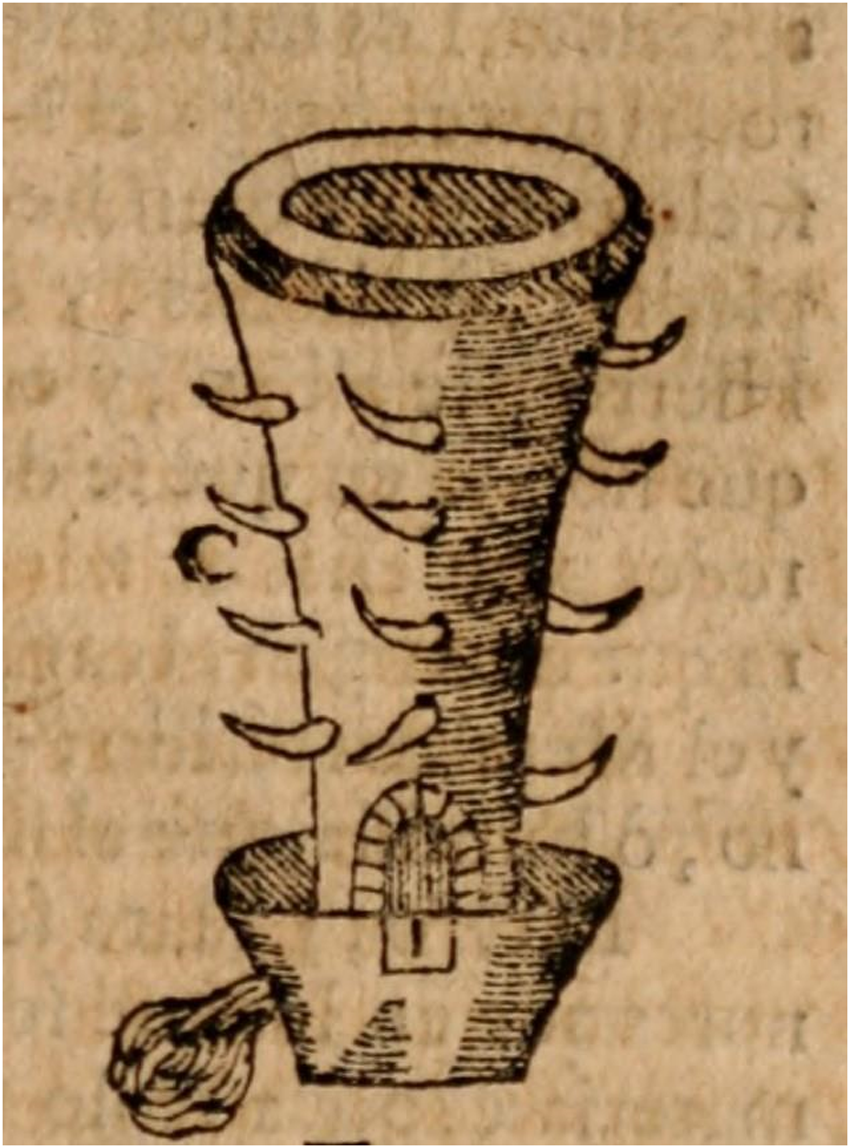
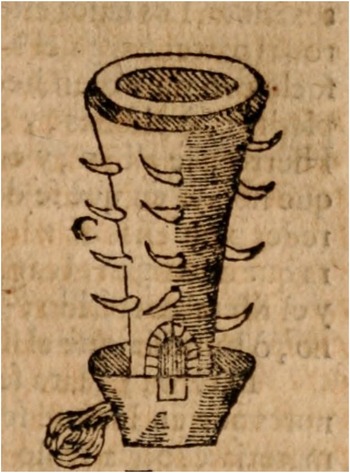
In 1585, Luis Capoche, a Potosí mine and refinery owner as well as important chronicler, provided a detailed description of the technology and expertise of the Andeans who dominated refining in the first three decades after Potosí’s discovery.Footnote 7 Capoche explains how they constructed small furnaces out of stones gathered from mountain ridges. The tower-like structures took advantage of the down drafts common to the area to reach the temperatures required to smelt silver ore, yielding silver that was up to 93 percent pure.Footnote 8 By 1585, a small clay structure with multiple openings replaced the loosely piled rocks, and the furnaces were commonly referred to as a “guayrachina” or a “guaira,” Quechua terms loosely translated as “wind-powered” or “wind.” Figure 1 is drawing of a guaira from the seminal mining manual El Arte de los Metales by Alvaro Alonso Barba first published in 1640.Footnote 9 Barba notes the ongoing if diminished significance of guairas among Indigenous smelters around that time, however the chronicler Pedro de Cieza de Leon wrote in 1553 that clay guairas dated back to the time of the Incas and allowed that empire to extract great quantities of silver from mines throughout the Andes.Footnote 10
This illustration of a guaira is from Alvaro Alonso Barba’s Arte de los metales, published in Madrid in 1640, which is one of the most comprehensive works on mining and metallurgy in the New World. Barba was a resident of Potosí and one of the foremost experts on silver production during the 17th century.
From a colonial perspective, local expertise and technology were a mixed blessing. While they allowed for low-cost silver production, they had two significant drawbacks. First, they worked best on high quality ores, which became increasingly scarce on the surface within the first few decades of exploitation. Second, Andean control of refining could cut into the profitability of colonial mining. Capoche’s account acknowledges this reality:
And all the mines used this means of refining when they discovered rich ore and the Indians possessed all the riches of the kingdom … nor was there any other aid other than the silver that the Indians refined by guaira. And not all the miners had this advantage, because the Indians only did this in the rich mines that had a sure profit.Footnote 11
By the 1560s, the first mining boom in Potosí came to an end. The rich surface deposits were all but exhausted and a lack of reliable labor made subterranean mining impossible. Moreover, it was no longer viable to rely on refining silver primarily using guairas, as ore composition and fuel costs rendered the method unprofitable. These existential challenges to the colonial economy fell on the head of a new viceroy, Francisco de Toledo, who arrived in Lima in 1569. Toledo proved more than able to the task and earned a reputation as “the Solon of Peru” for wide-ranging reforms that reinvigorated the mining economy and established the colonial state on firm footing. Perhaps most importantly, the viceroy brought a new refining technology to Potosí, linked its production to that of Huancavelica, and used the colonial state to channel Indigenous labor into the mining economy.
Mercury, the Mita, and labor conditions at Huancavelica
Toledo’s reforms can be seen as three related efforts. The first dealt with the settlement patterns of Andeans. To count and tax Indigenous Andeans, particularly given the challenging terrain of the world’s second highest mountain range, Toledo ordered Native populations be concentrated, or “reduced,” into settlements that could be more easily observed.Footnote 12 This played an important role in extracting labor and tribute. Second, Toledo sponsored the introduction of a new refining method that functioned on a larger scale with lower fuel costs. Developed in New Spain roughly a decade earlier, the famed “patio process,” named after the large courtyards required to carry it out, substituted mercury and its chemical affinity for silver for the prolonged heating required for smelting.Footnote 13 This process, after various false starts and adaptations, solved the problems of scale and fuel costs that had made guairas impractical and allowed the Potosí mines to enter a new period of incredible productivity.
Finally, to establish a source of reliable, low-cost labor for subterranean mining, Toledo decided to build on the precedent of the Inca Empire and rely on the Andean population. The pre-contact mit’a, a rotational labor draft used by the Inca and drawing on Andean customs of reciprocity, became the basis for Toledo’s colonial mita. The legal and ethical justification for this new labor regime would become a lasting source of debate, even as it became fundamental to the colonial economy for the next two and a half centuries.Footnote 14
Toledo’s reforms effectively linked the prosperity of the colony not only to silver production, but to the mercury that underwrote it. His timing was fortuitous. Only discovered by Europeans in 1563, the mercury deposits of Huancavelica had long been known to Indigenous Andeans, who transported mercury- rich cinnabar from the area as far as the northern Peruvian coast for use as a reddish pigment hundreds of years before the arrival of the Spanish. Production of mercury in the decade before Toledo’s intervention depended not only on initiative of Spanish miners, but on the cooperation of the local Andean communities who provided labor, expertise, and supplies if they found it to be in their interest.Footnote 15 In Huancavelica as in Potosí, Toledo faced challenges supplying reliable labor and securing control of mercury production from Spanish and Andean actors. His reforms would be equally transformative in the mercury mines.
In crucial ways, Toledo used the same model to regularize and increase production in both Huancavelica and Potosí, inserting the colonial state as the mediator between Andean communities and Spanish miners. In Huancavelica, he saw fit to seize the mercury mines from their operators and place them under the ownership of the Crown. Direct administration, however, was deemed too costly. As a result, the mines were leased out to a guild made up of their former owners and operators under contracts that were periodically revised and renewed.Footnote 16 Although this reorganization initiated extensive legal wrangling, some of which outlasted Toledo’s viceregal reign, it proved a workable if imperfect system. Miners lost ownership but retained usufruct rights, access to cost-controlled Andean labor, and a guaranteed if fixed price for their output in exchange for a required quota of mercury. From the perspective of the Crown, Toledo’s state monopoly on the production and transport of mercury potentially ensured a reliable source for the vital ingredient for refining silver, thereby ensuring that royal tax revenues continued to rise.Footnote 17
The key commonality between Huancavelica and Potosí was the institution of forced labor. As in Potosí, Toledo ordered that a Huancavelica mita be established. Toledo stipulated that communities up to forty leagues away from Huancavelica provide one seventh of their male Andean residents for turns serving in the cinnabar mines and refining ovens of the mining center.Footnote 18 The turns lasted one month each, except for February to April when any work that was not indoors or underground was impossible due the torrential rains common during that time of year. Each mitayo laborer received wages of 1 real and 1 tomín per day, as well as 2.5 pounds of meat weekly and measure of corn each month. Viceroy Toledo believed this compensation to be more than generous, as wages in the nearby town of Huamanga were far less.Footnote 19 In addition, mitayos received compensation for time spent in transit to and from the mining center from their communities of origin. Local officials distributed the Andean laborers among the mine operators, requiring that each guild member meet an annual quota of mercury based on their labor allocation. The Crown also set the price per quintal, or hundredweight, of mercury. By 1577, 3,280 Andeans were forcibly rotating in and out of the Huancavelica mines.Footnote 20 The Huancavelica mita was second in size only to that of Potosí, but the work was far more dangerous. The mortality rate among Andean mitayos in Potosí was high enough that the mines gained a reputation for eating men, but in Huancavelica the toxic effects of mercury exposure during mining and refining compounded the dangers usually associated with early modern mining: silicosis, collapses, carbon monoxide poisoning, overwork, etc.Footnote 21
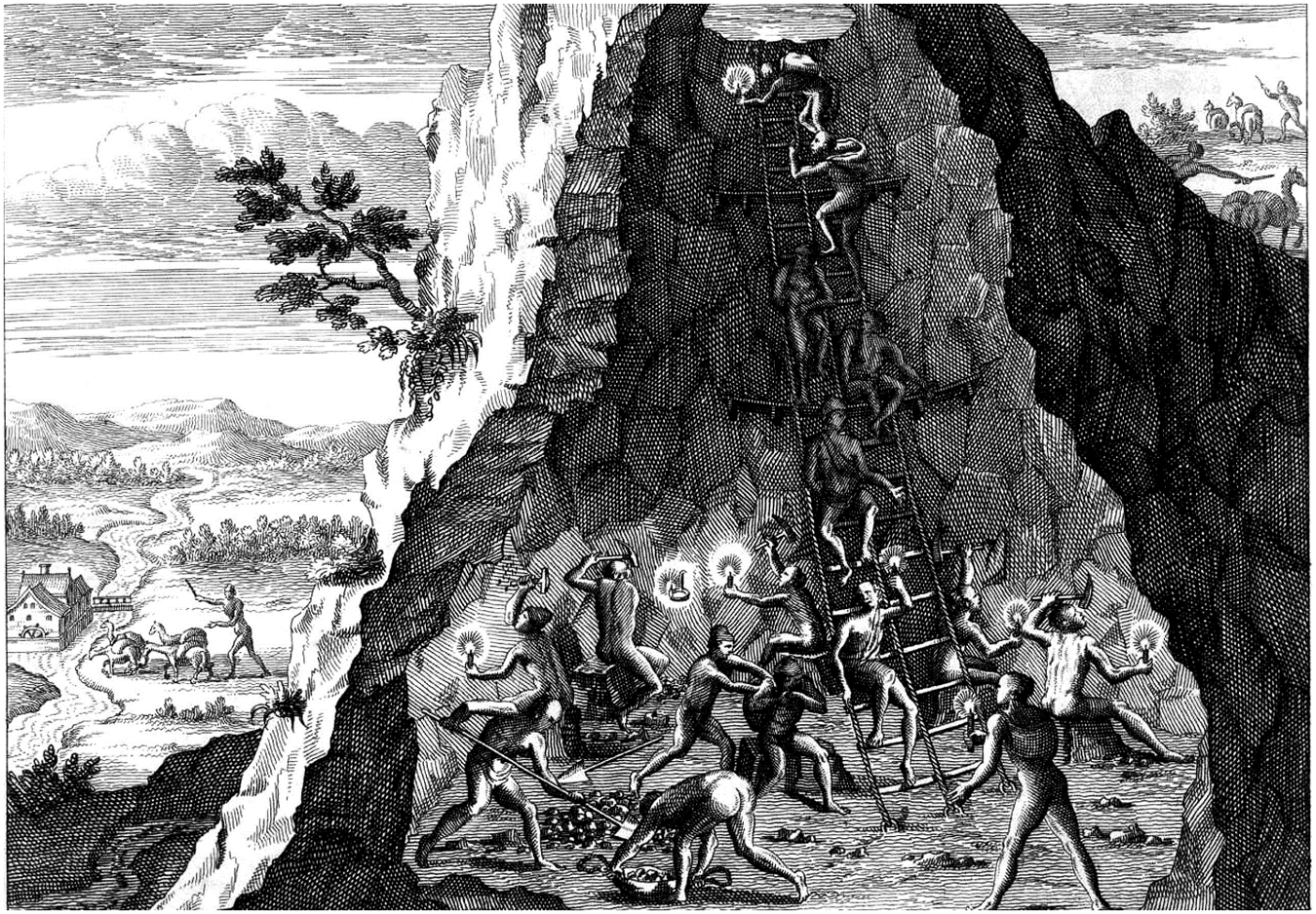
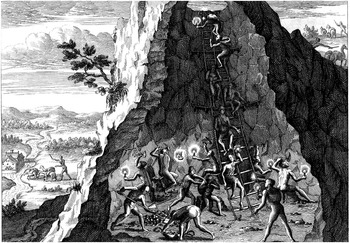
Descriptions of coerced mining labor contributed greatly to the rise of the Black Legend of Spanish colonialism, which portrayed the Spanish as uniquely cruel and abusive to colonial subjects.Footnote 22 Theodor de Bry, a Protestant engraver from Wallonia, included depictions of mining labor in South America among his engravings, despite never having travelled to the New World. Figure 2 is his artistic rendering of labor in Potosí, an image which fails to depict an accurate representation of the labor and landscape of the high Andes, but instead seems intended to convey the exploitation of Indigenous miners. Criticism of the new system was immediate, but the practice proved brutally effective and remarkably durable, persisting despite withering criticism and occasional modification for as long as the Spanish empire lasted in the Andes.Footnote 23
“Mining in Potosí,” an engraving by Theodor de Bry in Historia Americae sive Novi Orbis, 1596.
Capoche, the Potosí mine owner, provides a powerful description of one mining disaster at Potosí that offers insights into the tension between the powerful economic motives behind colonial mining and the imperfect attempts to reconcile material gain with human (Andean) suffering:
And among the sad things that have happened to these people whose memory is fresh, I will tell your Excellency of some so that you will understand the work they suffer through and what this metal costs, so we could well say that it is more blood than metal. And it was the case of the mine they call la Muñiza, in the rich vein, which a Spaniard in company with another brought 56 Indians, with 28 working by day and 28 by night. The mine was dangerous, particularly where they had greatly expanded a gallery, … entering Francisco de Oruño to inspect it, as he was the inspector at the time, knew the risk for the Indians, and ordered work suspended until certain necessary repairs were made for their safety as he required in a formal decree. And the owner of the mine alleged in writing that the repairs were not necessary but that they were motivated by passion against him, because the mine was very secure, appealing and providing certain proceedings. With that these sad people came to perish, because two days later the mine collapsed, taking all twenty-eight Indians below, the ones sent to work at night.Footnote 24
Capoche goes on to relate that when the authorities, women and children went to the site the next morning, they “broke the heavens with their cries and voices.” The bodies of the dead laborers were so deep in the earth they could not be immediately recovered and the families had to wait until the workings reached them.Footnote 25 In the aftermath, he notes that the Spaniard responsible was imprisoned, tried, and eventually fined 8,000 pesos, part to be paid to the Crown and part to the widows of the miners, to be distributed according to the number of children they had.Footnote 26 Nevertheless, this incident demonstrates that despite regulations, including mandated inspections by royal officials and a legal infrastructure designed to enforce consequences against negligent or greedy mine owners, the human toll of mine work was extremely high. Moreover, both critics and advocates of the mita proposed various ways to mitigate the dangers, leading to fierce debates over working conditions, including over nocturnal labor. The debates were particularly intense in Huancavelica, where the conditions bore out its reputation as “la mina de la muerte,” or “the mine of death.”Footnote 27
Labor debates and night work in Huancavelica: A window into colonial labor policy and practice
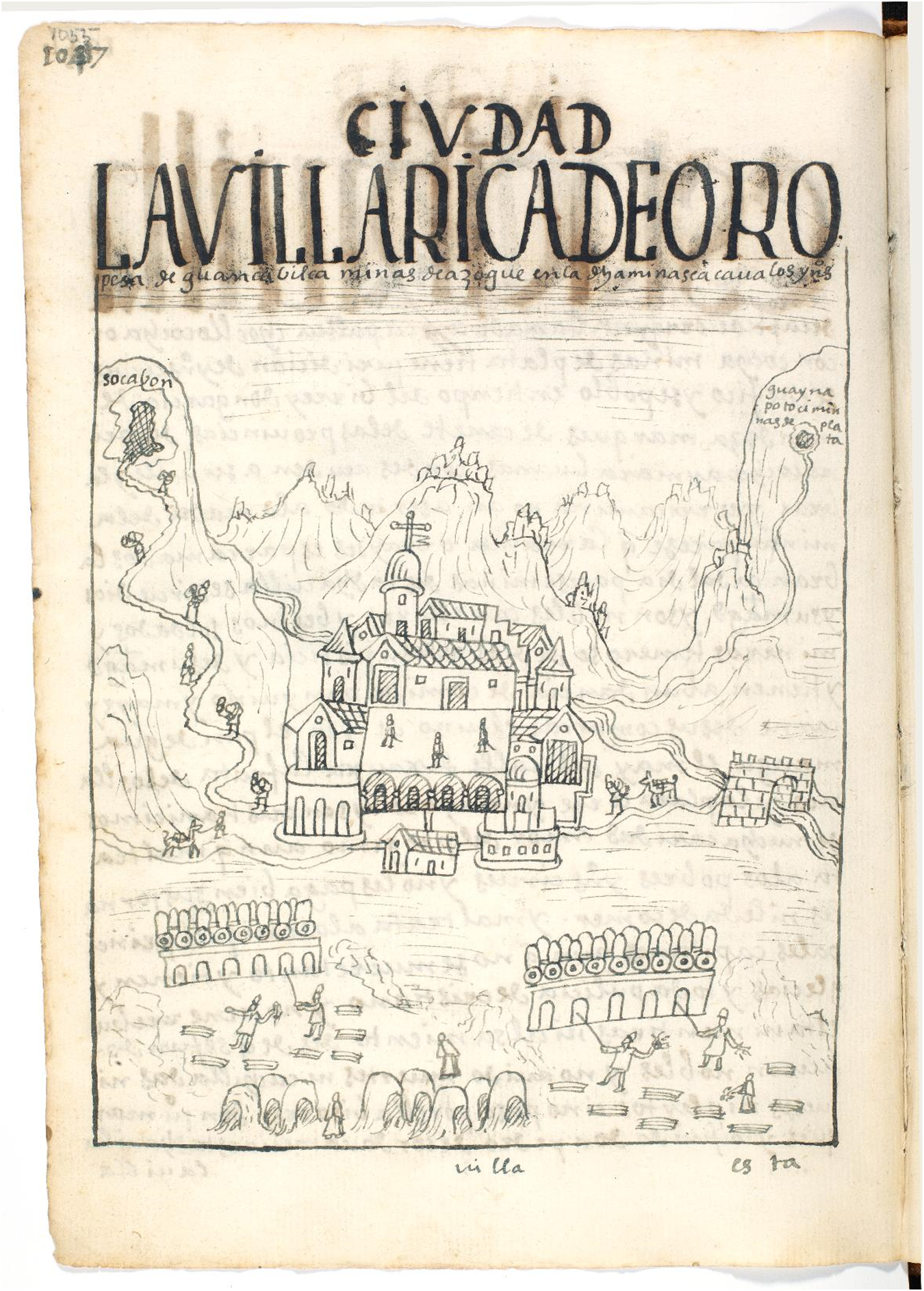
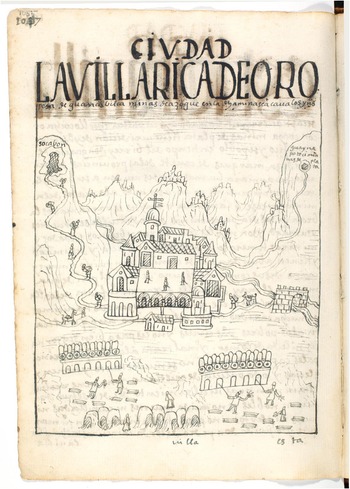
As with all labor-related regulations, night work in the mines became a contentious point of debate in an empire that, at least legally, categorized Indigenous people as subjects of the Crown and therefore protected from slavery and other abuses.Footnote 28 Huancavelica, as perhaps the most infamous mine in the Andes, therefore became an important case where reformers, royal officials, mine operators, and Andean people attempted to justify or mitigate the harmful effects of forced labor, especially at night. Guaman Poma’s illustration of Huancavelica shows the city with the mines on a mountain to the left and the refining ovens in the foreground (Figure 3).Footnote 29 Poma labeled his illustration using the formal name of the town, the Villa Rica of Oropesa de Huancavelica, a name chosen for Toledo’s hometown of Oropesa in Spain, and included the ominous subheading, “… mines of mercury; in the said mines the Indians are finished.”
The image of Huancavelica is taken from Andean Chronicler Guaman Poma de Ayala’s El Primer Crónica y Buen Gobierno first published in 1615. It shows the early ovens on the outskirts of town. Size of the original: ca. 18 × 12 cm. Image courtesy of the Royal Danish Library. Royal Danish Library, GKS 2232 kvart: Guaman Poma, Nueva Corónica y Buen Gobierno (c. 1615), page [1047 [1055]].
In his expansion of the mining economy, Toledo explicitly forbade night work in the mines. Nevertheless, during his tenure he concerned himself more with wages, conditions and legal wrangling over ownership. Not surprisingly, conflicts over night work soon emerged. The conversations were shaped by ongoing debates about the morality of forced mine labor, the impact it had on the health of Indigenous workers, and the economic realities of mercury and silver production at any given time.
For example, just shy of a decade after Toledo’s viceregal reign, Viceroy Garcia Hurtado de Mendoza, who was introduced at the start of the article, felt the need to reiterate the prohibition on night labor. In what might appear as a rare humanitarian moment, he also insisted that any new workings be open-pit mining in the interest of safeguarding Indigenous workers.Footnote 30 This seeming beneficence, however, was calculated yet ineffective. Mine operators continued to disregard the regulation, as demonstrated by renewed efforts to eradicate night work a few years later.
In 1598, the topic of nocturnal labor once again emerged as a subject of debate. This time a new viceroy, Luis de Velasco, the 5th Marquis of Salinas, once again outlawed night work, and established penalties that would make even the most influential mine owner think twice. Velasco warned that if Spanish miners forced Andeans laborers to work at night on anything other than maintenance activities, which were impossible to carry out while extraction was taking place, they would face banishment from the mining center and a fine of 500 pesos.Footnote 31 Velasco seemed committed to his efforts, not least because of the potentially ruinous penalties he put in place, but also because the scope of his labor regulations were intended to relieve Native people from dangerous labor. He required mine operators to provide necessary tools and forbade them from using Andeans to carry ore from the mines to the refining ovens in the valley below. In perhaps his most perceptive proscription, he forbade mine owners from using the same Andean laborers shift after shift in the most hazardous tasks, requiring instead that jobs such as subterranean labor and working in the refining ovens be filled on a rotational basis.Footnote 32 These jobs were either the most physically demanding or the most toxic. Work in the refining ovens, pictured in the foreground of Figure 3, was uniquely dangerous as it exposed workers to volatilized mercury that could quickly accumulate to toxic levels.Footnote 33
Velasco’s actions sparked an immediate response from mine owners, whose testimony painted a much more benign picture of labor in the mines. Tellingly, they framed their argument in favor of nocturnal labor as primarily motivated by concerns to ensure the healthiest working conditions possible. One commented that there was in essence little difference between nocturnal and diurnal mine labor, where the light of day did not penetrate to the subterranean workings.Footnote 34 The same mine owner continued that while some believed it was healthier for Andean laborers to work by day and rest at night, he believed that dividing the workforce into a day and night shift was best. He argued that the “major difficulties of the mines of Guancabelica (sic) are the lack of light and respiration, that are greater while there are more people together working in them, due to the heavy vapor that puts out the lights and causes the lack of respiration.”Footnote 35 In his opinion, having two shifts allowed for safer conditions. The mention of “vapors” that put the lights out is particularly significant, as it seems to be a subtle reference to the carbon monoxide produced by burning of candles and torches. Carbon monoxide is colorless and odorless, so the first sign of its accumulation would have been when the candles began to flicker then go out. Experienced workers at Huancavelica watched for these signs that the gas they called “umpé” had built-up to dangerous levels.Footnote 36 Given the dangers of crowded work below ground, dividing the workforce into day and night shifts seemed a means to mitigate health concerns.
Another argument advanced by the mine operators to prove that night work was less harmful to workers’ health was that it meant less time below ground than on day shifts. One witness, describing the day shift, stated, “they gather first at the miner’s house, and with the sun already up, they are sent to the mine with the manager, who sometimes goes with them, and as there is only one entrance to the mines, they go Slowly; it is 8 in the morning when they begin to work.”Footnote 37 The nightshift was shorter, “beginning work at two or three at night and running until dawn, or before.”Footnote 38 Moreover, with reasonings reminiscent of “open shop” advocacy, miners argued that the viceroy was actually hurting Andean workers with his regulations. They stated that Andeans, “by their own inclination,” preferred working at night because it meant five shifts of work per week instead of six, and that many volunteered to work extra shifts for higher pay.Footnote 39 As evidence, one mine owner stated that sometimes mitayos worked day and night shifts back to back, “because they comfortably traded among them, those that worked in the day and those that worked at night and vice versa … the work of an Indian did not pass four hours by day, and fewer at night.”Footnote 40 The veneer of humanitarian concern is marred somewhat by the concluding comment of one mine owner that mitayos were not as exhausted as the viceroy feared, given that they preferred night shifts that “left them free during the day to gamble and drink.”Footnote 41
Although likely informed by the Spanish miners’ own motives, scholarship on mining centers demonstrates that Indigenous Andeans were more than willing to participate in what were ostensibly exploitative enterprises, often finding means of advancing their own interests, including in the dangerous conditions at Huancavelica.Footnote 42 For example, the persistence of ore theft or scavenging, known by the Quechua term Kajcheo, became an established custom in Potosí, Porco, and other mining centers, allowing Andeans to extract marginal profit from their labor.Footnote 43 In both Potosí and Huancavelica, sources describe laborers remaining in the mining center to sell their labor for higher prices than they received during their mitas, a practice officials failed to eliminate.
The economic motive—earning wages that could be used to pay tribute or purchase goods—does not entirely explain the willingness of Andeans to take on extra shifts or remain as paid laborers after their mita ended. Any attempt to do so requires consideration of Andean culture as much as colonial economics. Indigenous Andeans conceived of health as the result of balanced relationships among humans and between human and other-than-human beings (mountains, rivers, animals).Footnote 44 For Andeans, the interdependence and reciprocal exchange that defined these relationships played as important a role in health as any physical experience.Footnote 45 As in the case with the colonial legal system, therefore, Andean culture shaped the motives and means for Andeans to engage in mining labor in pursuit of individual and collective benefit.Footnote 46
Neither the miners’ complaints nor the possible preferences of Andean workers, however, would have much effect on the viceroy. Velasco was so determined to alleviate the suffering of the Andean peoples that he even considered importing mercury to allow the Huancavelica mines to be closed, a proposal that ultimately failed due to early modern concerns about leaving the supply chain of mercury in the hands of foreign and non-Christian powers in Asia.Footnote 47
Viceroy Velasco seemed to be both particularly committed and uniquely well positioned to make inroads into alleviating the dangers of night work. He, like many prominent Spanish critics, felt that forced labor should not only be necessary but also carefully regulated to remain justifiable on moral grounds. Velasco presided over a moment when Huancavelica had a surprising surplus of mercury in storage, incentivizing a decrease in production, so long as it did not contribute to a deterioration of the mines themselves. Under the circumstances, adding night work did not seem necessary from a production standpoint. Moreover, the prospect faced strong criticism in principle even when deemed necessary. The preeminent Spanish jurist, and one-time governor of Huancavelica, Juan Solorzano Pereira would dedicate an entire section of his work to the conditions in which forced labor in mines was justifiable on legal and moral grounds. Pereira directly referenced his experience with night work in Huancavelica:
… serving as Governor and Inspector of the mercury mines of Huancavelica, I could never agree with the custom that I found established there that some Indians worked in the mines by day, those they called punchaorunas, and others by night, those they called tutarunas. Because although they alleged, that in those concavities, it is always like night, for the light of day does not penetrate them, and they work with candles of tallow, I judged, and judge, that it could not help but be much more bothersome and harmful to the Indians, the night work, and that by this way their health was endangered, and the common privilege, it seems, that nature granted to all men was taken away, giving them the night as compensation for the work of the day, in which sleep, rest, and repose are never taken so comfortably, as serious authors warn.Footnote 48
Yet, despite his commitment and the favorable conditions of the moment, Velasco proved unable to end night work in the mines. The failure may have been a result of the prevailing state of affairs in Huancavelica, where cost-controlled labor and a stable market had facilitated a boom in production: In 1593, Huancavelica had sufficient mercury on hand to supply Potosí and send more than 3,500 quintales (roughly equivalent to 350,000 pounds) to the mines of New Spain.Footnote 49 Even so, mining output was such that the viceroy struggled to deal with overproduction, and more than 15,000 quintales of liquid mercury, poured into leather pouches inside ceramic pots, remained in storage in the town despite considerable losses.Footnote 50 Clearly, the desire to relieve Andeans of night work, if not motivated by overproduction, was at least justifiable based on the economic conditions of the moment. In fact, further attempts to eradicate the practice—in 1610, 1618, 1630, 1668, and 1689—reveal the persistence of night work in the mines throughout at least the 17th century, and in none of those instances was mercury production and supply as robust as in 1598.
Conclusions
The colonial mining economy in the Andes emerged as an engine of early modern globalization.Footnote 51 It was Andean labor, often forced and frequently nocturnal, that produced the silver flow that financed Spanish imperial ambitions and the Catholic Reformation. Despite this reality, voices emerged from the earliest period of conquest and colonization to criticize this state of affairs. The irony of killing new converts through forced labor in Potosí and Huancavelica to finance the revitalization of Catholicism in Europe was not lost on keen observers who argued, in the words of historian Kris Lane, “God’s imagination could not possibly be so limited.”Footnote 52 Nevertheless, forced labor and night work persisted in the most important and deadly mines in the Andes. Although protecting worker health was the stated goal of colonial reformers, mine owners employing Andean labor adopted the same language to argue in favor of night work, while Andean laborers confounded both groups by engaging the mining regime in ways ostensibly motivated by their own cultural perceptions of health. Moreover, the inability to curb the practice of nocturnal labor, even when economic and social conditions were favorable to doing so, demonstrated the powerful allure of wealth generated by labor that is obscured by darkness: subterranean, nocturnal, and at times, both.

 Open access


