

I Introduction
The export-oriented ready-made garments (RMG) sector in Bangladesh has registered a remarkable expansion over the past four decades. From a small base of only around US$ 31 million in 1984, RMG exports had grown to around US$ 30.6 billion by 2018,Footnote 1 accounting for more than 80% of export earnings. Bangladesh is now the second largest exporter of RMG in the world. The story of growth in the manufacturing sector in Bangladesh over the past three decades has been the story of the success of the RMG sector.
It is argued that the growth in exports of the RMG sector in Bangladesh have contributed to economic growth, macroeconomic stability, employment generation (especially female employment), and poverty alleviation. However, despite the successes, there are a number of challenges which raise concerns over the future of this sector. First, with the expansion of the RMG sector in Bangladesh, the export basket has become more and more concentrated. Though Bangladesh has potential in other export-oriented sectors, industries in those sectors have experienced very weak performance. With a highly concentrated export basket and high dependence on a single sector (RMG), Bangladesh remains in a high-risk situation, should there be any negative shock in that sector. Second, the factors that contributed to the growth of the RMG sector are now under pressure. Historically, the RMG sector in Bangladesh flourished for a number of reasons, including favourable policies, government support, and a number of critical political economy factors, which include the generation of sizeable ‘rents’ in this sector through the Multifibre Arrangement (MFA) quotaFootnote 2 (which no longer exists) and the Generalized System of Preferences (GSP)Footnote 3; different forms of subsidies; tax exemptions; the maintenance of a suppressed labour regime; weak factory compliance; and lawful and unlawful businesses relating to RMG by-products. However, the RMG sector in Bangladesh is now facing many challenges with respect to working conditions, labour unrest, technological upgrading and associated employment loss, stiff competition from competitor countries, and pressure from international buyers related to improvement on compliance issues. Third, Bangladesh will graduate from least developed country (LDC) status by 2024, whereupon it will face the challenge of the erosion of preferences in major export destinations, and thus the risk of export loss, especially the loss of RMG exports. Also, the country is seeking to expand its manufacturing base substantially and aims to become an upper middle-income country by 2031. Given these challenges, the fundamental question is whether the ‘RMG-centric’ export model is sustainable.
Therefore, there are genuine reasons to argue that there is a need for a major departure from the ‘RMG-centric’ export model and that the export basket in Bangladesh needs to be diversified. It is argued that export diversification in developing countries like Bangladesh is a necessary condition for sustained and long-term growth of the economy, and for job creation (Ghosh and Ostry, Reference Ghosh and Ostry1994; Bleaney and Greenaway, Reference Bleaney and Greenaway2001; Bertinelli et al., Reference Bertinelli, Salins and Strobl2006; di Giovanni and Levchenko, Reference di Giovanni and Levchenko2006; Hausmann et al., Reference Hausmann, Hwang and Rodrik2007; Hausmann and Klinger, Reference Hausmann and Klinger2006; Hwang, Reference Hwang2006). The current ‘global value chains’ discourse also highlights the importance of export diversification for effective integration into global value chains. While Bangladesh has been able to move away from agricultural exports to manufacturing exports, its export basket still remains highly concentrated around a few low-value manufacturing sector, especially the RMG sector (Mirdha, Reference Mirdha2018). For Bangladesh, it is argued that export diversification will be important for the long-term structural transformation of the economy with respect to shifting from the production of low-value products to high-value products. The long-term structural transformation of the economy requires production to be diversified and complexified, through which transferrable skills and capabilities will be acquired and linkages between sectors will be developed. Such a transformation will help to mitigate the impact of shocks on Bangladesh’s economy. However, despite the fact that export diversification has been an important policy agenda in Bangladesh over the past few decades, the country has achieved limited success in this area. In this context, there is a need to evaluate the so-called ‘RMG model’ of export success.
Against this backdrop, this chapter explores the institutional challenges of export diversification in Bangladesh in the context of the dominant RMG sector. Understanding the reasons behind the lack of success in the diversification of the export basket in Bangladesh requires a better grasp of the critical political economy factors. The major objectives of this chapter are to: (i) evaluate the features of the ‘RMG model’ of export success, and explore the dynamics of the institutional space around the RMG sector in Bangladesh; (ii) understand the sustainability of the ‘RMG-centric’ export model as far as the domestic and global scenarios and the bigger development goals of the country are concerned; and (iii) evaluate the challenges of export diversification in Bangladesh in the context of the dominant RMG sector. This chapter uses available data, conducts, and assesses interviews with key stakeholders to gather their views on institutional challenges related to export diversification and applies relevant political economy analytical tools to understand the successes of and the challenges faced by the RMG sector and the institutional challenges of export diversification in Bangladesh.
II Review of the Literature on Export Diversification
While the importance of export-led growth is generally acknowledged in the empirical literature, it is also commonly highlighted that a large number of developing countries are dependent on a relatively small range of export products. Countries that are commodity-dependent or have a narrow export basket usually face export instability, which arises from unstable global demand. Therefore, studies indicate the need for diversification of the export basket. Ghosh and Ostry (Reference Ghosh and Ostry1994) and Bleaney and Greenaway (Reference Bleaney and Greenaway2001) argued that export diversification usually refers to the move from ‘traditional’ to ‘non-traditional’ exports and can help to stabilise export earnings in the longer run. A diversified bundle of export products provides a hedge against price variations and shocks in specific product markets (Bertinelli et al., Reference Bertinelli, Salins and Strobl2006; di Giovanni and Levchenko, Reference di Giovanni and Levchenko2006). The type of products exported might affect economic growth and the potential for structural change (Hausmann et al., Reference Hausmann, Hwang and Rodrik2007; Hausmann and Klinger, Reference Hausmann and Klinger2006; Hwang, Reference Hwang2006). Diversification provides opportunities to extend investment risks over a wider portfolio of economic sectors, which eventually increases income (Love, Reference Love1986; Acemoglu and Zilibotti Reference Acemoglu and Zilibotti1997; Al-Marhubi, Reference Al-Marhubi2000; Hausmann and Rodrik, Reference Hausmann and Rodrik2003; Hausmann et al., Reference Hausmann, Hwang and Rodrik2007; Hausmann and Klinger, Reference Hausmann and Klinger2006).
There are several channels through which diversification may influence growth. It is therefore essential to make a distinction between horizontal and vertical diversification. Both are positively related to economic growth. Horizontal diversification means the alteration of the primary export mix in order to neutralise the volatility of global commodity prices. Horizontal export diversification benefits an economy by diminishing dependence on a narrow range of commodities that are subject to major price and volume fluctuations. Dawe (Reference Dawe1996) and Bleaney and Greenaway (Reference Bleaney and Greenaway2001) argued that horizontal export diversification may present considerable development benefits as it may lead to well-directed economic planning and also contribute towards investment. Vertical export diversification, on the other hand, refers to finding further uses for existing products or developing new innovations using value-adding activities, such as processing and marketing. By highlighting the role of increasing returns to scale and dynamic spill-over effects, de Piñeres and Ferrantino (Reference de Piñeres and Ferrantino2000) argued that export diversification affects long-run growth. Export may benefit economic growth through generating positive externalities on non-exports (Feder, Reference Feder1983), increased scale economies, improved allocative efficiency and better ability to produce dynamic comparative advantage (Sharma and Panagiotidis, Reference Sharma and Panagiotidis2004). Studies using regressions on cross-sections of countries (Sachs and Warner, Reference Sachs and Warner1995; Gylfason, Reference Gylfason2004; Feenstra and Kee, Reference Feenstra and Kee2004; Agosin, Reference Agosin2007) and panels (de Ferranti et al., Reference de Ferranti, Perry, Lederman and Maloney2002) have proposed that export concentration is associated with slow growth.
The review of the aforementioned literature suggests that though many of the aforementioned cross-country papers suffer from endogeneity problems, as growth also implies structural changes, which, in turn, trigger changes in the composition of exports, economic growth, and its long-term sustainability in developing countries are associated with the diversification of the export structure. Bangladesh, with a highly concentrated export basket, needs to align its efforts for export diversification with strategies for accelerating and sustaining economic growth. As Hausmann and Rodrik (Reference Hausmann and Rodrik2003) argued, there are various uncertainties related to cost in the production of new goods, and therefore, the Government should promote industrial growth and structural transformation by encouraging entrepreneurship, solving information problems to do with innovation, providing infrastructure and other public goods, and providing incentives to motivate entrepreneurs to invest in a new range of activities.
III Overview of the RMG and Overall Export Sector in Bangladesh
The textile and apparel industry is the gateway for many developing countries to enter into the process of industrialisation. The ease of entry into this field and the high wages in developed countries have created favourable conditions for the manufacturing and exportation of textile- and apparel-derived products (Kim et al., Reference Kim, Traore and Warfield2006). There are two reasons behind this: firstly, textiles and apparel are basic items of consumption for all people; and secondly, apparel manufacture is labour-intensive and requires relatively little fixed capital, but it can create substantial employment opportunities. The Asia-Pacific region has become one of the most competitive regions in textile and apparel manufacturing; approximately 50% of textile and apparel products are exported from this region (Kim et al., Reference Kim, Traore and Warfield2006).
RMG exports from Bangladesh have seen a remarkable rise over the past three and half decades. In 1983/84, RMG exports were insignificant, but by 2017/18, they had increased to US$ 30.6 billion. Riding on the growth of RMG exports, the country’s total exports of goods and services also saw a significant rise over the same period, from US$ 0.8 billion to US$ 36.7 billion.Footnote 4
The share of RMG in total exports increased from only 3.9% in 1983/84 to as high as 83.5% in 2017/18. Thus, in recent years, the export basket has become more and more concentrated around RMG exports. It also follows that, despite the impressive economic growth record, the export base and export markets have remained rather narrow for Bangladesh, which is a matter of concern. Despite the policy reforms and various incentives offered, it seems that Bangladesh has failed to develop a diversified export structure.
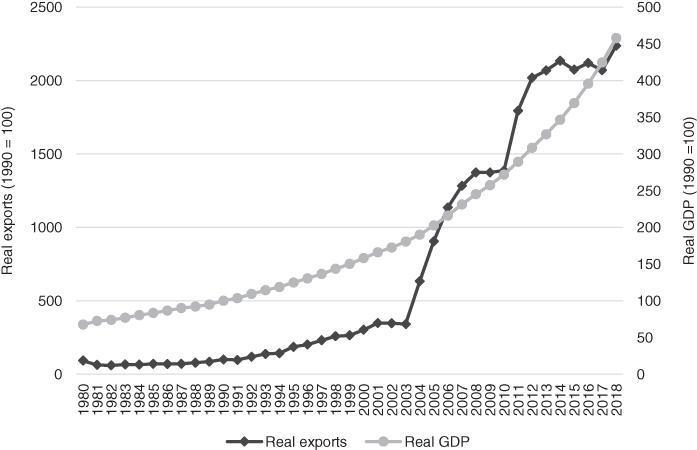
Figure 4.1 presents the evolution of real exports and real GDP considering 1990 as 100. There were two surges: one that followed the end of the MFA in 2004 and one after the global financial crisis in 2008. There has been a rather long stagnation since 2012. There are many reasons for the stagnation in recent years, which include both the demand- and supply-side challenges (which are discussed in Section V). It is also noticeable that the stagnation of export growth since 2012 did not prevent GDP from growing relatively rapidly.Footnote 5 However, it should be mentioned that exports represent around 15% of GDP, and less in value-added.
The evolution of exports and GDP in real terms (1990 = 100).
Bangladesh’s export concentrationFootnote 6 is higher than that of any other country groups. The comparable country groups are LDCs, lower middle-income countries, upper middle-income countries, high-income countries, and countries in South Asia. UNCTAD’s export concentration indicesFootnote 7 show that the marked differences in export concentration between Bangladesh and those of other country groups are noteworthy. Also, one important point to note here is that while other country groups have, in general, experienced declining export concentration indices, Bangladesh’s export concentration indices increased during the period between 1995 and 2016.
A close examination of the composition of the export baskets of Bangladesh and its major competitors, that is China, India, and Vietnam suggests that while Bangladesh’s export basket is highly concentrated around RMG, those of China, India, and Vietnam are fairly diversified.Footnote 8 The higher export concentration in Bangladesh is driven not only by the strong performance of RMG exports but also by the very weak performance of non-RMG exports. The performance of RMG exports since the early 1980s, and especially since 2003, has been quite remarkable.
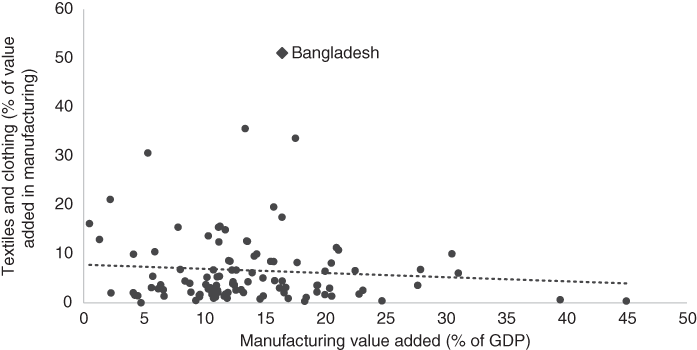
It is also important to note that Bangladesh appears to be an outlier with respect to the share of textiles and clothing in manufacturing value-added. The data for 109 countries from the World Development Indicators of World Bank suggest that Bangladesh has the highest share of textiles and clothing in manufacturing value-added, more than 50%, where the 95th percentile is around 20%. Bangladesh also appears to be a major outlier in the association between textiles and clothing share in manufacturing value-added and manufacturing share in GDP (Figure 4.2).
Bangladesh appears to be a major outlier in the association between textiles and clothing share in manufacturing and manufacturing share in GDP.
Note: Average for 2011–2016.
2011 was an important year due to the change in the double-transformation rule of the European Union (EU) for textiles and apparel (more than 60% of Bangladesh’s RMG exports are exported to the EU) to a single Rules of Origin (ROO) for LDCs. The double-transformation for clothing means that at least two substantial stages of production need to be carried out to confer origin status. For textiles, generally spinning and weaving needs to take place. For clothing, the weaving of fabric and making up into clothing needs to take place (European Commission, 2019). In the textiles and clothing sector, single-stage processing (manufacturing from fabric) has been allowed since 2011, in place of the previous two-stage one (manufacturing from yarn). Earlier, RMG exporters from Bangladesh, under the double-transformation rule, faced major difficulties in meeting the ROO criteria in the EU, due to the lack of supply of locally produced fabrics. In particular, a major part of the woven RMG exports from Bangladesh failed to access the duty-free market in the EU as they were unable to meet the double-transformation ROO.
The surge in exports over the past four decades also resulted in a rising export–GDP ratio. The export–GDP ratio was only around 5.7% in 1972 but increased to 15% in 2017. During this period, the import–GDP ratio also rose significantly, from only 13.7% to 20.3%. One important area of concern is that from 2011, both the export–GDP ratio and import–GDP ratio started to decline. Sluggish private investments is one of the major causes of the decline in the export–GDP ratio in Bangladesh.
The number of RMG factories in Bangladesh has increased quite remarkably since 1984/1985. While in 1984/1985, there were only 384 factories, the number had increased to 5,876 by 2012/2013. After the infamous Rana Plaza incident in 2013,Footnote 9 the number of RMG factories then declined sharply to 4,222 in 2013/2014. In 2017/2018, the number rose again to 4,560. Interviews with relevant stakeholders in the RMG industry suggest that the major structural change that is currently occurring in the RMG industry is the introduction of labour-saving machineries for the kind of jobs which were previously done mostly by low-skilled female workers. This has resulted in substantial gains in productivity in the RMG industry in recent years.
The composition of the RMG export products has also seen a major shift over the past decades. In the early years, the RMG exports from Bangladesh were predominantly woven RMG. In 1992/1993, more than 85% of RMG exports was woven RMG. Over the years, the share of knitwear has increased, and by 2017/2018, woven and knitwear had almost equal shares. The main RMG export items from Bangladesh are shirts, trousers, jackets, T-shirts, and sweaters. While in the initial years, shirts dominated, with more than 50% of the RMG export share, in recent years, the share of shirts has declined to less than 10%, while trousers and T-shirts have been major export items.
It is also important to note that Bangladesh’s RMG export markets are highly concentrated, with the EU and North America being the major destinations. In 2018, around 62.5% of the country’s RMG exports went to the EU, while another 21% was destined for North America. In Europe, the major destinations of Bangladesh’s RMG exports are Germany, the UK, Spain, and France. The major reason behind the EU becoming the dominant destination of RMG exports is the duty-free-quota-free (DFQF) market access in the EU market under the Everything But Arms (EBA) initiative for LDCs.Footnote 10
IV The ‘RMG Model’ of Export Success
A The MFA Regime
The development of Bangladesh’s RMG sector greatly benefited from the international trade regime in textiles and clothing, which, until 2004, was governed by the MFA quotas. In the global market, the quota system restricted competition, led to allocative inefficiency, and slowed the natural shift in comparative advantage from industrial countries to developing countries (Faini et al., Reference Faini, de Melo and Takacs1993). However, it created opportunities for countries like Bangladesh by providing reserved markets, where textiles and clothing items had not been traditional exports. Bangladesh, being an LDC, benefited from the MFA regime in a number of ways. In the EU, there were quotas on non-LDC exporters, but Bangladesh’s RMG items were allowed quota-free access (as well as duty-free treatment under the EU’s GSP scheme). In the US market, Bangladesh was allowed significant annual quota enhancement based on growth performance in the preceding year. This gave Bangladesh’s RMG exporters a secure market in the United States and also allowed them to gain from the quota-rent.Footnote 11
In 1995, the WTO’s Agreement on Textiles and Clothing (ATC) took over from the MFA. By 1 January 2005, the sector was fully integrated into normal GATT rules. In particular, the quotas came to an end, and importing countries were no longer able to discriminate between exporters. The ATC no longer exists: it is the only WTO agreement that had self-destruction built in to it.
B The Genesis of the RMG Industry in Bangladesh
Bangladesh’s RMG industry started its journey in the late 1970s, with the launch of the MFA. A handful of foreign companies, particularly the Korean companies Youngone and Daewoo, invested early in Bangladesh, bringing technical experience, marketing expertise, and a willingness to employ women. This was partly because South Korea had reached the limit of its MFA quota. Bangladesh’s middle managers and workers gained experience at Youngone and then, hired by other companies, spread their knowledge of operating an RMG business.
The late Nurool Quader Khan was the pioneer of the RMG industry in Bangladesh. In 1978, he sent 130 trainees to South Korea, where they learned how to produce RMG. With those trainees, he set up the first factory, Desh Garments, to produce garments for export. At the same time, the late Akhter Mohammad Musa of Bond Garments, the late Mohammad Reazuddin of Reaz Garments, Md. Humayun of Paris Garments, the engineer Mohammad Fazlul Azim of Azim Group, Major (Retd) Abdul Mannan of Sunman Group, M. Shamsur Rahman of Stylecraft Limited, and AM Subid Ali of Aristocrat Limited also came forward and established some of the first RMG factories in Bangladesh. Following in their footsteps, other entrepreneurs established RMG factories in the country.Footnote 12 These people were able to obtain major advantages from the Government, in the form of back to back letters of credit, bonded warehouses, and different forms of subsidies.
As mentioned before, the RMG sector has experienced an exponential growth since the early 1980s. The RMG sector was heavily promoted by all governments because of its remarkable economic performance, which contributed significantly to changing Bangladesh over the past four decades, from being an aid-dependent economy to being a trade-oriented economy.
C The RMG Industry Has Been the Major Beneficiary of Industry and Trade Policies and Export Incentives
After independence in 1971, the Government of Bangladesh nationalised all heavy industries, banks, and insurance companies. As a result of this mass nationalisation programme, by 1972 nationalised units accounted for 92% of the total fixed assets of the manufacturing sector in Bangladesh (Rahman, Reference Rahman and Helliner1994). Private sector participation was severely restricted to medium-sized, small, and cottage industries (Sobhan, Reference Sobhan1990). After the change in political power in 1975, the Government moved away from the nationalisation programme and revised the industrial policy with a view to facilitating a greater role for the private sector (Rahman, Reference Rahman and Helliner1994). Together with the denationalisation and privatisation process, these changing industrial policies led to a situation in which the major thrust was to support the growth of the private sector by amending the exclusive authority of the state in the economy (World Bank, 1989).
During the 1980s, the private sector development agenda became more prominent in industrial policies in Bangladesh. The successful outcome of these policies was the rapid growth of the RMG industry. The New Industrial Policy was put in place in 1982 and was further modified by the Revised Industrial Policy in 1986. These policies also aimed at accelerating the process of privatisation of public enterprises. All these policies involved providing substantial incentives and opportunities for private investment (Rahman, Reference Rahman and Helliner1994). Subsequent industrial policies re-emphasised the leading role of the private sector in the development of industries and clearly stated that the objective was to shift the role of the Government from a ‘regulatory’ authority to a ‘promotional’ entity. The industrial policies also encouraged domestic and foreign investment in the overall industrial development and stressed the importance of developing export-oriented industries.
Raihan and Razzaque (Reference Raihan and Razzaque2007) highlighted that an important element of trade policy reform in Bangladesh has been the use of a set of generous support and promotional measures for exports. These measures have primarily been directed to the RMG sector. While the import liberalisation was meant to correct the domestic incentive structure, in the form of reduced protection for import-substituting sectors, export promotion schemes were undertaken to provide exporters with an environment in which the previous bias against export-oriented investment could be reduced significantly. Important export incentive schemes available in Bangladesh include, among others: subsidised rates of interest on bank loans; duty-free import of machinery and intermediate inputs; cash subsidy; exemption from paying the value-added tax; and rebate on corporate income taxes. Box 4.1 summarises some of the most important incentive schemes that have been put in place in the country since the early 1980s, alongside the expansion of the RMG sector. With the significant reduction in tariff rates in the early 1990s, and the provision of generous support and promotional measures for exports, the anti-export bias declined quite significantly, which helped promote a surge in exports, especially RMG exports, during that period.Footnote 13
Export Performance Benefit (XPB): This scheme was in operation from the mid-1970s to 1992. It allowed the exporters of non-traditional items to cash a certain proportion of their earnings (known as entitlements) at a higher exchange rate of the wage earner scheme (WESFootnote 1). In 1992, with the unification of the exchange rate system, the XPB scheme ceased.
Bonded warehouses: Exporters of manufactured goods are able to import raw materials and inputs without payment of duties and taxes. The raw materials and inputs are kept in bonded warehouses. On the submission of evidence of production for exports, a required amount of inputs is released from the warehouse. This facility is extended to exporters of RMG, specialised textiles (such as towels and socks), leather, ceramics, printed matter, and packaging materials, who are required to export at least 70% of their products.
Duty drawback: Exporters of manufactured products are given a refund of the customs duties and sales taxes paid on the imported raw materials that are used in the production of the goods exported. Exporters are exempted from paying value-added tax as they can obtain drawbacks on the value-added tax they have paid.
Duty-free import of machinery: Import of machineries without payment of any duties, for production in the export sectors.
Back-to-back letters of credits: Allows exporters to open letters of credit for the required import of raw materials against their export letters of credit in such sectors as RMG and leather goods. The system is considered to be one of the most important incentive schemes for the RMG export. Nurul Kader, the pioneer of the RMG industry in Bangladesh, was the inventor of back to back letters of credit.
Cash subsidy: The scheme was introduced in 1986. This facility is available mainly to exporters of textiles and clothing who choose not to use bonded warehouses or duty drawback facilities. Currently, the cash subsidy is 25% of the free on board export value. In recent times, cash subsidies have been offered to agro-product exporters.
Interest rate subsidy: Allows exporters to borrow from banks at lower bands of interest rates of 8–10%, as against the normal 14–16% charge.
Tax holiday: First introduced under the Industrial Policy of 1991–1993, this incentive allows a tax holiday for exporters, after the commencement of exports, for 5–12 years, depending on various conditions.
Income tax rebate: Exporters are given rebates on corporate income tax. Recently, this benefit has been increased: the advance income tax for exporters has been reduced from 0.50% of export receipts to 0.25%.
Retention of earnings in foreign currency: Exporters are now allowed to retain a portion of their export earnings in foreign currency. The entitlement varies in accordance with the local value addition in exportable. The maximum limit is 40% of total earnings, although for low value-added products such as RMG the current ceiling is only 7.5%.
Export credit guarantee scheme: Introduced in 1978 to insure loans in respect of export finance, it provides pre-shipment and post-shipment (and both) guarantee schemes. The principal risks covered include insolvency of the buyers and political restrictions delaying payment. The scheme was undertaken at the initiative of the Export Promotion Bureau and the ministries of commerce, industry, and finance. The scheme encourages exporters to initiate exports of new products and/or to enter new markets through covering the risk of insolvency of buyers and political risks inherent in foreign trade. The scheme also provides a guarantee for bank loans taken by the exporters to meet their financial needs during the production period and between exporting of goods and receiving payment from foreign buyers. Bangladeshi exporters can enjoy credit for a maturity of up to 180 days. Risks covered include insolvency and protracted default. Coverage percentages vary from 75% to 80% in the case of commercial risks, and 95% in the case of political risks.
Special facilities for export processing zones (EPZs)Footnote 2: To promote exports, a number of EPZs are currently in operation. The export units located in EPZs enjoy various other incentives, such as a tax holiday for 10 years, duty-free imports of spare parts, and exemption from value-added taxes and other duties. The major exports from EPZs are RMG.
A close scrutiny of the performance of sectors, apart from RMG, and consultation with the stakeholders of non-RMG sectors, reveal that many of these sectors, though classified as ‘thrust or priority sectors’ in the industrial and export policies, were not able to enjoy the incentives provided in these policies, despite having export potential. Instead, the RMG industry has been the major beneficiary of the incentives and facilities specified in these policies.
D Institutional Space, Political Settlement, and Deals Space Favouring RMG
The RMG sector in Bangladesh grew in an environment of very ‘weak’ institutions (see Chapters 2 and 3). Against the poor quality of institutions, the country became the second largest exporter of RMG in the world. How do we reconcile these two contrasting scenarios? If we look at the well-known institutional indicators (World Governance Indicators (WGI), Doing Business, Transparency International, and Global Competitiveness Index), all refer to the quality of formal institutions. However, in countries like Bangladesh, placed at the lower level of the development spectrum, what governs is a host of informal institutions, and the formal institutions are weak and fragile. Khan’s framework of ‘growth-enhancing institutions’, in contrast to ‘market-enhancing institutions’ (Khan, Reference Khan2012b), elaborates how the role of informal institutions can be critical in developing countries. Some developing countries, especially East and Southeast Asian countries, have been successful in steering unconventional institutions to drive growth. Khan (Reference Khan2012b) further highlights that the success of the RMG industry in Bangladesh was not replicated in any other major sectors, as no rent, such as the RMG industry enjoyed, was available for other sectors. The critical element in the institutional arrangement which allowed the take-off of this industry was the global institutional mechanism with the MFA and favourable domestic factors. The MFA facilitated fortuitous rents on terms that assisted the learning-by-doing that was critical for the RMG sector. With the high quota-rent, the quota utilisation rate for Bangladesh in the US market in 2001–2002 was much higher than the rates of other developing countries (Yang and Mlachila, Reference Yang and Mlachila2007).Footnote 14
Khan (Reference Khan2012b) further points out that the authoritarian clientelism during the early phases of the sector’s take-off allowed the rapid solution of a number of institutional constraints facing the sector, especially in the form of the poor quality of formal institutions. Many of these solutions were ‘unorthodox’ in nature (e.g. back to back letter of credits), and a ‘political settlement’Footnote 15 among the elites in Bangladesh on the RMG industry helped the industry to grow. This ‘political settlement’ was initially based on rent-sharing, and later evolved as the economic interest of RMG business owners coincided with the political interest of governments in terms of employment generation (especially female employment) and poverty alleviation.
As discussed in Chapter 1, the deals environment framework, proposed by Pritchett et al. (Reference Pritchett, Sen, Werker, Pritchett, Sen and Werker2018) relates to the idea of ‘deals space’. Informal institutions, which are prevalent in developing economies, may also take the form of ‘deals’ among the political and economic elites, in contrast to the formal rules guiding the relationship between these actors that exist in advanced countries. Deals can be open (access is open to all) or closed (access is restricted), and they can also be ordered (deals are respected) or disordered (deals are not respected). According to this view, countries are likely to exhibit high growth when deals are open and ordered, and thus deals become closer to formal institutions.
Informal institutions can have two distinct roles with respect to the stages of development. At an early stage of development, if countries can steer informal institutions so that they are ‘growth-enhancing’, as well as ensuring that the ‘deals space’ is more ordered (either open or closed), countries can achieve strong economic growth and also some improvements in the social sector. However, for the transition from a lower to a higher stage of development, whether the country can maintain a high growth rate and achieve further development goals depends on the dynamics of how informal institutions evolve, and whether formal institutions become stronger and functional. Not many developing countries have been able to do this. Certainly, the East Asian and most of the Southeast Asian countries are success stories in using informal institutions efficiently at the early stage of development, as well as achieving some notable successes in the transition to functional formal institutions.Footnote 16
In contrast to many other comparable countries in Asia and Africa at a similar stage of development, and especially in comparison to the LDCs, the country group to which Bangladesh belongs, Bangladesh has been successful in creating some efficient pockets of ‘growth-enhancing’ informal institutions, against an overall distressing picture as regards its formal institutions. The examples of ‘pockets of efficient informal institutions’ in Bangladesh include the well-functioning privileges and special arrangements for the RMG sector.Footnote 17
However, the next question is how did Bangladesh create such ‘pockets of efficient informal institutions’ and make the ‘best’ use of them? The explanations include both historical and political economy perspectives. The 1971 liberation war led to the emergence of an independent Bangladeshi state which for the first time gave unprecedented and enormous independent power to the burgeoning political and economic elites of the Bengali nation. Also, the people, in general, enjoyed some benefits of this power. To a great degree, the entrepreneurial nature of the people of this country is deeply rooted in this feeling of power.Footnote 18 Successful entrepreneurship is seen in the case of the RMG sector. As Bangladesh is not rich in natural resources, elites saw in the RMG sector the basis of the generation of substantial rents (the sources of rents in the RMG sector were discussed earlier in this chapter).
While Khan (Reference Khan2012b) rightly mentions the institutional perspectives behind the growth of the RMG sector, his narrative of the ‘political settlement’ is rather narrow and elite-centric. Khan’s ‘political settlement’ is primarily an ‘elite agreement’, and it overlooks the critical nexus between elites and non-elites within the society. Through large-scale employment generation in the RMG sector and its induced effects of poverty alleviation and female empowerment, the business elites were also able to draw support from both the political elites and non-elites in the society.
Using the lens of the ‘deals space’ of Pritchett et al. (Reference Pritchett, Sen, Werker, Pritchett, Sen and Werker2018), Hassan and Raihan (Reference Hassan, Raihan, Pritchett, Sen and Werker2018) argue that the RMG sector as a whole has enjoyed closed deals, and parts of the closed deals actually have legal and quasi-legal bases (bonded warehouse schemes, cash incentives, statutory regulatory ordinances, etc.), but these tend to be highly exclusive in nature. The ‘state capture’ by the RMG lobbies is manifested in the form of ensuring special privileges for them, and a high presence of RMG businesses among members of parliament. From the perspective of an individual RMG entrepreneur, bypassing the Bangladesh Garments Manufacturing and Exporters Associations (BGMEA) and maintaining bilateral interfaces with the state’s regulatory authority, in relation to duty-free import processes, would be prohibitively costly, in terms of the informal transaction costs that would be incurred and the excessive amount of time the process would entail. Therefore, the ‘deals environment’ became more ‘closed’ and the system became more ‘formal’, through voluntary compliance of individual firms with the BGMEA. Also, the individual firms also saw quite a rapid shift from a relatively disordered deal environment (during the late 1970s and early 1980s)Footnote 19 to an ordered deals environment in the subsequent decades. The transition occurred not only because of government prodding in relation to private sector development (through statist policy inducement) but also largely due to market actors’ strong incentive to ensure their survival and expand in a globally competitive market. The enactment of various beneficial rules and myriad forms of deals benefitting the RMG sector was mainly the outcome of effective demands and skilful negotiations by a sector that is characterised by strong collective action capability, thanks to the economic and political clout it gradually came to possess.
As was pointed out earlier, the RMG sector as a whole enjoys privileges that are quite extraordinary. For instance, the state has delegated the authority over rule enactments and enforcement of these rules to its collective forum BGMEA, as well as to Bangladesh Knitwear Manufacturing Associations (BKMEA). The most prominent power held by these organisations is the power to issue customs certificates – utilisation declarations (UDs) and utilisation permits (UPs)Footnote 20 governing the duty-free importing process. This act by the state tends to blur the distinction between legality and illegality.Footnote 21 In this sense, one can legitimately categorise such privileges as de facto deals, since they are exclusive to this sector and indicate the RMG sector’s ability to generate and preserve a de facto closed deal environment that has allowed it to accrue substantial rent for decades, and also to achieve spectacular economic performance.Footnote 22
Over the decades, RMG owners came to be the most powerful and the best organised business group in Bangladesh. The political power of this group derives from its high contribution to economic growth, close political integration with the state (including parliamentary representation) (Rashid Reference Rashid2008), and the class basis of the owners: former military and bureaucratic officials and the white collar managerial class were the pioneers of RMG sector (Rashid, Reference Rashid2008; Kabeer and Mahmud, Reference Kabeer and Mahmud2004). The political power of the RMG sector is manifested in the extraordinary tax privileges and subsidies that it has enjoyed during the last three decades. These exemptions and financial incentives have not changed over the decades, despite the fact that the sector has witnessed substantial expansion over time.
E Subcontracting in the RMG Industry in Bangladesh
As the industry grew, the need for subcontracting increased. A large factory has a maximum production capacity (e.g. number of shirts per month), even taking into account some allowed overtime. When orders are larger than what can be produced by the business receiving the order, work is subcontracted. This is necessary to balance production capacity and order size. As buyers moved towards wanting to deal with only a few factories, subcontracting became even more important (Cookson, Reference Cookson2017). In recent years, subcontracting has received a bad name. Buyers believe, usually correctly, that factory compliance is not met by subcontractors. The compulsion to demand compliance leads to a reluctance to allow subcontracting. Demands for compliance have many impacts on RMG costs, but a hidden, very significant cost is the difficulty experienced in using subcontracting (Cookson, Reference Cookson2017). In particular, after the Rana Plaza accident in 2013, and the stringent scrutiny by the Accord and Alliance, the number of subcontracting firms declined drastically.Footnote 23
F ‘Political Settlement’ Regarding the Management of the Labour Regime in the RMG Sector
The labour regime in the RMG sector has been managed quite extraordinarily over the past decades. Most workers work in sweatshop conditions. However, the issue only appears in the global media when major fatal accidents occur, like that at the Rana Plaza in 2013. Long working hours, low wages, lack of regular contracts, and systemically hazardous conditions are often reported (Uddin, Reference Uddin2015; Berik and Rodgers, Reference Berik and Rodgers2010). Trade unions, when allowed, are unable to protect their workers. Not all ‘Fundamental’ International Labour Organization (ILO) conventions have been ratified, and their concrete application is far from the norm. The UN Guiding Principles on Business and Human Rights, and the OECD Guidelines for Multinational Enterprises fix good standards of corporate social responsibility for Western brands operating in such countries, but they are not binding and do not provide for sanctions if they are not applied. In practice, they have failed to defend workers’ rights. While there has been growing unrest from workers, which has led to strikes and protests, their main achievement has been some increases in the minimum wage, which remains far below a living wageFootnote 24 (Lu, Reference Lu2016). Also, subcontracting has been used as a way of escaping constraints.
Trade unions are often suppressed, and union organisers intimidated, including physically. Workers claim that some managers mistreat employees involved in setting up unions, or force them to resign (Bhuiyan, Reference Bhuiyan2012; Parry, Reference Parry2016). Some claim they have been beaten up, sometimes by local gangsters who attack workers outside the workplace, and even at their homes. The lack of regular contracts means many workers who are injured in factory fires, and the relatives of those who die, do not receive any compensation because they are not registered as formal employees of the companies and the management therefore does not identify them as their workers. The biggest strength that Bangladesh has over its competitors is its cheap and vast workforce. The minimum wage in Bangladesh in the RMG industry is among the lowest in the top RMG-producing countries (Figure 4.3).
Minimum monthly wage for garment workers in 2018 (measured in US$).

After the inception of an export-oriented RMG sector in 1978, the first wage board, formed in 1984, set a minimum wage for the sector’s workers at Bangladeshi Taka (BDT) 560 a month (Figure 4.4). This shows that the country’s first wage board for fixing the salaries of workers in the garment sector was constituted long after Bangladeshi entrepreneurs ventured into the RMG business, which suggests the weak bargaining power of the workers in this sector. This low minimum wage continued for the next 10 years, despite the erosion of purchasing power due to inflation (Figure 4.4).
Minimum wage in the RMG sector in Bangladesh (BDT).
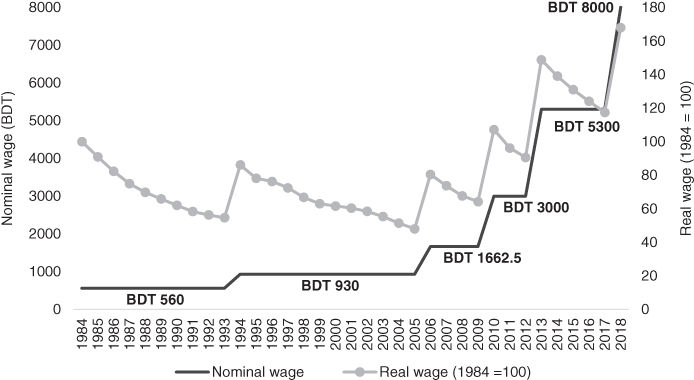
In the following three and half decades, five more wage boards were constituted, at very irregular intervals. The second (in 1994) and third (in 2006) wage boards were established at 10-year and 12-year intervals, respectively. Periodic labour unrest, with the demand for an increase in the minimum wage, led to relatively more frequent revisions of the minimum wage after 2006, and a political settlement evolved as workers became more important for political elites in the political game than in the past. Nevertheless, during the almost four decades of the RMG industry’s existence, the minimum wage in the industry was kept very low. This was done with the support of the state, whoever was in power. Figure 4.5 also suggests that, in real terms, the value of minimum wages declined over time, even in those years when they were kept fixed in nominal terms. The real increase was 60% between 2010 and 2018. More or less the same evolution is found for 2000–2010, but the increase was only 20% in the decade before. Of course, the loss in real terms is due to the infrequency of the wage adjustments.
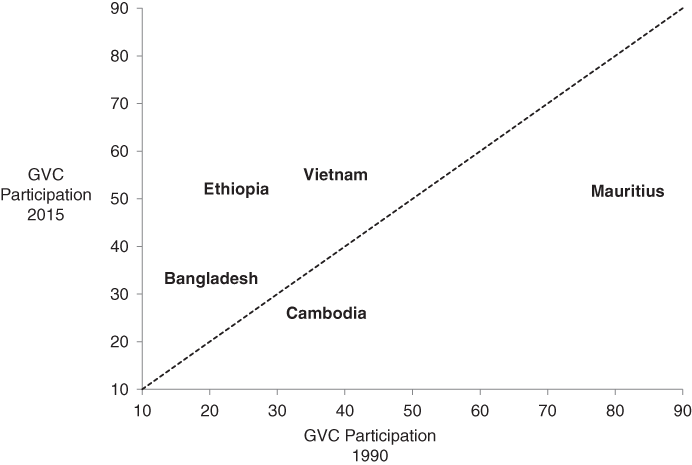
GVC participation: Bangladesh and comparators.
Notes: GVC measures from the EORA MRIO national and global input–output tables covering the period 1990–2015. GVC participation measures are the sum of the backward and forward participation rates expressed as shares of gross exports (see text), excluding double counting of exports when intermediates cross borders multiple times. Points above the 450 indicate an increase in GVC participation over the period.
The minimum wage is set in Bangladesh’s RMG sectorFootnote 25 through a process that involves the Government forming a new minimum wage board for the RMG sector, to formulate a new wage structure for RMG workers. The board is usually led by a senior district judge, as chairman. In addition to representatives from the owners and workers, the board also consists of three independent members. The representatives of owners and workers separately propose a minimum wage for the workers and propose this to the board. After discussions with stakeholders, the board recommends a new wage structure based on the inflation rate, living costs, the country’s economic condition, and strength of the sector as regards paying the settled wage. The wage board then publishes a gazette and gives the workers’ and owners’ representatives a 14-day period in which to appeal if there have any objection to the recommendations. The board finalises the new wage structure taking into consideration the objections of workers’ and owners’ representatives, if there are any. The wage board then passes the wage structure to the Ministry of Labour and Employment, which reviews the proposed wage structure and sends it to the Ministry of Law for vetting. After approval is obtained from the Ministry of Law, the Ministry of Labour and Employment publishes a gazette notification and the new wage structure enters the implementation phase. Once the gazette notification is issued, all export-oriented garment manufacturers are bound to implement the new wage structure in their factories. The new wage structure comes into effect from the date set by the Government.Footnote 26 However, there are allegations that workers’ voices are not heard properly in the wage board as the board includes no ‘true’ representatives of workers.Footnote 27
There also exists a gender wage gap in the RMG industry in Bangladesh. Menzel and Woodruff (Reference Menzel and Woodruff2019), using data from 70 large export-oriented garment manufacturers in Bangladesh, showed that among production workers, women’s wages were 8% lower than those of men. A study by ILO-SANEM (2018), using survey data from 111 RMG factories, also found a similar gender wage gap.
G Poor Factory Compliance and a Weak Regulatory and Monitoring Mechanism
The RMG industry started with small factories as it was easy to set up a small garment factory: one could establish a factory by renting space, buying 50–100 sewing machines, wiring up the factory for electricity, hiring and training the workers, getting a contract for a small order of simple garments, and going to work. Sourcing, pricing, and quality control were learned by doing. The profits were high, and therefore small companies could get established. There was no ban on entry (Cookson, Reference Cookson2017).
Systemic hazardous conditions are a common feature of many factories in this sector. The rapid expansion of the industry led to the adaptation of many buildings that were built for other purposes – residential, for instance – into factories, often without the required permits. Other plants have had extra floors added or have increased the workforce and machinery to levels beyond the safe capacity of the building. Lack of appropriate protective equipment, old and outdated wiring that is at risk of short circuiting (a major cause of fires), and non-existent or outdated fire extinguishing facilities are often reported in these overcrowded workplaces. Fire exits are often deliberately blocked by factory owners, and windows even barred, thus increasing the death toll in accidents (D’Ambrogio, Reference D’Ambrogio2014).Footnote 28 Poor factory compliance persisted for a long time due to a weak regulatory and monitoring mechanism. The Department for Factory Inspection (DIFE), under the Ministry of Labour and Employment, established in 1969, is entrusted with the responsibility for monitoring the compliance of factory conditions. However, due to DIFE’s numerous institutional challenges related to weak capacity, corruption, and a lack of interest from the Government in strengthening DIFE, it failed to perform its duties. After the Rana Plaza accident in 2013, there has been an effort to enhance DIFE’s capacity.Footnote 29
H Rent Generation and Management through RMG By-products
The business of rent generation and management through the RMG by-product jhut (the scrap from clothing items) is an important aspect of the RMG industry. Previously, jhut was a waste product produced by RMG factories, but it has now become a by-product of the industry, since it has commercial value. A newspaper report,Footnote 30 citing the Bangladesh Garment and Textile Waste Exporters Association (BGTEA), highlights that the market size of RMG by-products is over BDT 2,000 crore (around US$ 2.4 billion, equivalent to 1% of GDP). RMG factories in Bangladesh produce over 400,000 tonnes of by-products annually.Footnote 31 The simple scraps of fabric that are a by-product of making RMG generate new jobs, especially for women in the informal sector. Some 150,000 people are currently employed in the informal, small-scale operations of this potentially lucrative sector.Footnote 32
The business of re-using wasted cloth is a three-step process. First, a person, usually a locally influential person, collects the cloth forcibly or via negotiations. Second, it is sold to the re-use or recycling business. Third, the final product is then sold to different consumers and exported. After collection, the process of recycling starts with sorting, which is done by the colour, type, and size of the fabric. Larger scraps of cloth are used to make children’s frocks, skirts, shirts, pyjamas, and sometimes pillow covers. Large scraps of fabric are sold to local traders to make garments for children. Most of these children’s clothes are sold in Bangladesh but some are exported to India. Dhaka’s bedding industry is dependent on jhut. Mattresses, pillows, cushions, and seat stuffing and padding in cars, public buses, and rickshaws use recycled cloth and processed cotton.Footnote 33
Because of the lucrative nature of this business, locally influential people seek to obtain more jhut through influencing either workers or mid-level management of the factories. Many factories have faced unrest resulting from the politics involved in the jhut business.Footnote 34 This high rent from the jhut business, through legal and illegal means, also makes the RMG industry more attractive than any other export-oriented sectors.
V Sustainability Challenges of the RMG-Centric Export Model
A Increased Competition in the Global Market
In recent years, Bangladesh’s share of global RMG exports has increased steadily. In 2012, the share was 4.66%; this had increased to 6.19% by 2017.Footnote 35 The increased share of global RMG exports shows that, despite numerous challenges, Bangladesh’s RMG industry has been able to strengthen its market share at the global level. With the increased share in the world market, in recent years, Bangladesh has become the second largest exporter of RMG in the world. After China, its closest competitors are Vietnam and India. It can be mentioned that, in 2006, Bangladesh ranked sixth on the list of top RMG exporting countries, with a share of only 2.8%.Footnote 36
However, there is also a very high concentration of products in the RMG industry in Bangladesh. An analysis using the Trade MapFootnote 37 data suggests that while, products conforming with the six-digit Harmonised System (HS) code level, the top 10 RMG products account for around 68% of total RMG exports in Bangladesh, for China, India, and Vietnam, the figures are 35.5%, 45.6%, and 42.1%, respectively. Moreover, the top five products account for 53.3% of Bangladesh’s RMG exports, whereas the figures are only 22.7%, 28.7%, and 25% for China, India, and Vietnam, respectively. Another important concern is that Bangladesh’s RMG exports face stiff competition, especially from China and Vietnam. The 16 products conforming with the six-digit HS code level are common among the top 25 RMG products, both in the cases of Bangladesh vs. China and Bangladesh vs. Vietnam. The EU, Bangladesh’s largest export destination, has extended duty-free access to Vietnam, under the EU–Vietnam Free Trade Agreement, which eliminates the competitive edge that Bangladesh had held over Vietnam in RMG exports to the EU market.Footnote 38
B Diversification within RMG and Quality Issues
While Bangladesh’s export basket remains highly concentrated around RMG exports, diversification within the RMG sector remains a big challenge. According to the data from WTO, products conforming with the six-digit HS code level, just 10 RMG products accounted for 70% of the total RMG exports from Bangladesh in 2017/18. Just two products (T-shirts and men’s trousers) accounted for 36% of RMG exports in that year. Most of these are low-value and basic-quality products. According to the Global Sourcing Survey 2018 by AsiaInspection, Bangladesh is still an attractive source of low-cost RMG items.Footnote 39
Attempts within the RMG industry to move up the ladder to high-value and high-quality products have not been very successful. According to IMF (2014), at the four-digit Standard International Trade Classification (SITC) level, only three RMG products have been of higher quality compared to Bangladesh’s major competitors, China, India, and Vietnam, and the advantage Bangladesh has in these three products is marginal.Footnote 40 However, it should be mentioned that while Bangladesh no longer has any duty-free market access or GSP facility in the USA,Footnote 41 presently Bangladesh enjoys a 12% ‘margin of preference’Footnote 42 for its RMG industry under the EU’s EBA initiative (United Nations Department for Economic and Social Affairs (UNDESA, 2019).
C The Segmented RMG Value Chain in Bangladesh
Mercer-Blackman (Reference Mercer-Blackman2016) argues that, ideally, successful structural transformation in Bangladesh should consist of two types of processes at this juncture: (i) diversification away from garments into other manufactures by producing goods that entail increasingly more complex manufacturing processes compared to garments, but that are still similar enough that it is easy for workers and managers to master these processes; or (ii) linking to the fashion industry global production chain and providing increasingly more complex and valuable parts of garments: for example, through increasing involvement in the design process of the garment. If the country chose avenue ‘ii’ – that is, moving up the fashion industry value chain – increasing overall productivity will be very difficult because of the segmented nature of the value chain. It will thus be much easier for Bangladesh to make products that are similar to garments, such as footwear or small appliances, than to begin to understand and master the various aspects of designing and retailing clothes.
Mercer-Blackman (Reference Mercer-Blackman2016) further argues that there are two main reasons why the fashion industry value chain is segmented for Bangladesh. First, the value buyers attribute to clothes – reflected in the price they are actually willing to pay – is the result of a process occurring in a place that is geographically and information-wise very far from Bangladesh, at the retail end, where fashion fads and volatile markets operate in a complicated way. Second, there is a broken link of accountability once the garment is shipped abroad. The sector’s production process is completely decoupled informally from the fast-fashion production process. This segmentation also exacerbates the dissociation between the unit cost of production in Bangladesh and its retail price: factories sometimes send the clothes with the price tag – even the sales price – so they are floor-ready. It is possible to send one box to New York with shirts price-tagged at US$ 50 each and the identical box to rural New Jersey with shirts price-tagged at US$ 5 each. The price is completely independent of the actual cost. As long as the big buyers maintain price-setting power, garment makers have no incentive to upgrade facilities or enhance workers’ skills because race-to-the-bottom, cost-cutting measures will always take precedence, to guarantee a firm’s survival. Moreover, because of the focus on meeting orders on time, firms have little leeway to become more proactive in anticipating buyers’ needs.
Bangladesh’s place at the lower end of the value chain is also related to the fact that RMG factories are predominantly locally owned in Bangladesh. By contrast, in Cambodia, also a large exporter of basic garments, factories are owned mostly by foreign investors. In the case of Bangladesh, local factory owners are economically powerful business persons who have managed to find ways to bypass the institutional weaknesses and inadequate infrastructure, which is difficult for foreign investors. There are also limits on the input side as the industry is dependent on the large-scale import of machinery and raw materials. There is also a lack of sufficient supply of skilled domestic workers to operate sophisticated machinery, let alone maintain it (ADB-ILO, 2016).
D Increased Pressure on Workplace Safety and Compliance
There are concerns with regard to compliance issues and workplace safety in the RMG industry in Bangladesh, and in the last few years, especially after the infamous Rana Plaza accident in 2013, these issues have become critical for the future of this industry (Box 4.2). There is strong international pressure, in the form of the threat of cancelling large preferential treatment in the markets of Western countries, if labour conditions are not improved.Footnote 43 Quality competitiveness is being increasingly prioritised over price competitiveness, and, of course, the quality of a product tends to increase the standard of living of labour being used in the production process. These concerns should be addressed in a positive way, by seeing them as an opportunity to build the industry’s reputation in the global market. This calls for, among many other things, a more careful engagement with labour issues in the RMG industry. In this context, issues like wages, workplace security, fringe benefits, workplace environment, etc. need to be resolved on a priority basis. Current labour practices prevalent in the RMG industry need to be improved in order to make the sector sustainable. The improvement of labour conditions is closely linked to the enhancement of labour productivity. There is equally a need to invest in training workers to move to high-value garment products (i.e. men’s suits, baby garments, lingerie, and sportswear).
Customers:
The 13 May 2013 Accord on Fire and Building Safety in Bangladesh was signed by the IndustriALL Global Union and UNI Global Union trade unions, and more than 180 enterprises, most of them European. The Accord is to run for five years and is aimed at strengthening safety and fire inspections in the textile industry, and improving workers’ health and occupational safety. The Accord provides for the inspection of more than 1,600 factories, the cost of which will be borne by the signatories in proportion to the value of their orders.
North American companies took a separate initiative on 10 July 2013, named the Alliance for Bangladesh Worker Safety. It was launched by a group of 26 North American brands and covers 700 factories. The Alliance is non-binding and less stringent, as regards freedom of association, than the 13 May 2013 Accord.
International Community:
On 8 July 2013 in Geneva, as a response to the Rana Plaza tragedy, the European Commission, the ILO, and the Government of Bangladesh launched the Compact for Continuous Improvements in Labour Rights and Factory Safety in the Ready-Made Garment and Knitwear Industry in Bangladesh. This Compact seeks to improve labour, health, and safety conditions for workers, as well as to encourage responsible behaviour by businesses in the RMG industry in Bangladesh. In particular, it set out a road map for implementing an action plan, including: reforming Bangladeshi labour laws (in particular regarding freedom of association and the right to collective bargaining); recruiting 200 additional factory inspectors by the end of 2013; and improving building and fire safety, by June 2014.
The ILO launched the Better Work Programme for Bangladesh on 23 October 2013. It covered 500 factories and ran for three years. Factory assessments were due to begin during the second quarter of 2014. The programme had been conceived well before the Rana Plaza tragedy.
Bangladeshi Government:
A National Tripartite Plan of Action on Fire Safety and Structural Integrity in the Garment Sector of Bangladesh (NTPA) was adopted on 25 July 2013 by the Bangladeshi Government, manufacturers in the sector (BGMEA and BKMEA), and the local unions. It acts as a platform to coordinate the various projects and initiatives to improve working and safety conditions in the textile industry. On this basis, a Ready-Made Garment Programme, in partnership with the ILO, was approved on 22 October 2013 and will run for three and a half years. The NTPA will inspect the 1,500 factories not due to be inspected under either the Accord or the Alliance.
Rana Plaza Compensation Scheme:
Following the Rana Plaza tragedy, an arrangement was signed on 20 November 2013 and a Donors’ Trust Fund, run by the ILO, was set up. Some US$ 40 million was expected to be collected for distribution among the victims. So far, just less than US$ 18 million has been collected. An advance payment has been made available to injured workers and the families of deceased and missing workers.
A study by ILO-SANEM (2018) suggests that, despite some improvements after the Rana Plaza accident in 2013, there are still unresolved issues related to occupational safety, hours of work and leave, fixing and execution of minimum wage provisions, workplace training, workplace harassment, and gender equality.
E The Evolving Political Settlement on the Labour Regime
After multiple incidents, including the Tazreen fire and the Rana Plaza collapse, Bangladesh came under international scrutiny for its labour practices and safety standards. However, RMG workers in the country are still being paid one of the world’s lowest minimum wages. The success of the fashion industry in the West is built on the ‘exploitation’ of workers from countries like Bangladesh, who struggle every day to survive above the poverty line. The sector’s vision of achieving US$ 50 billion worth of RMG exports by 2021 shows little concern for the well-being of its workers. Oxfam (2017) highlights that for every garment sold in Australia, only 4% of its price goes to the factory workers who made it. Cheap labour is the main factor on which Bangladesh’s RMG industry capitalises when it comes to attracting big retail brands. The RMG sector faced severe labour unrest demanding a wage increase in 2006. Since then, labour unrest has taken place in the sector almost every year. This is threatening the political settlement between the political elite and RMG owners, or at least modifying its conditions.
F Crisis in the Deals Environment of the RMG Sector
Hassan and Raihan (Reference Hassan, Raihan, Pritchett, Sen and Werker2018) argue that despite experiencing massive political and reputational crises (e.g. the Rana Plaza disaster), labour movements for higher wages, intense global pressures for ensuring factory standards, and social compliance and labour’s associational rights, the RMG sector has managed to perform reasonably well. During the previous decades, its high performance, notwithstanding the many domestic challenges the industry faced, was possible due to the combination of close and ordered deals that it enjoyed in the economic domain. In the political domain, a robust and resilient anti-labour elite political settlement (between RMG owners and political elites) across political divides has enabled it to cope with the sustained movements and critiques that it faced from labour, media, and human rights actors, both local and global. This settlement has recently become increasingly vulnerable to both domestic and international pressures as the Government might side with labour if pressures do increase.
In the economic domain, the decades-long closed and semi-closed deals are now being questioned by the state and local and global stakeholders. BGMEA has vigorously protested any such policy reform initiatives. Its political capacity to successfully thwart similar policy initiatives many times in the past has proved the robustness of the hitherto elite political settlement. With the crises the sector is now facing, its continuing high performance and its ambition to grow further will largely depend on the nature of the evolving political settlement and the deals that it will be able to renegotiate with political elites, and also on how and to what extent it will be able to neutralise the de facto national/global reputation of its actors as greedy entrepreneurs, promoters of economic injustice, and violators of labour/human rights.
G Automation in the RMG Sector and Implications for Job Creation
Technological advances associated with automation raises the concern that new technologies will lead to widespread job losses in manufacturing industries in countries like Bangladesh. What is perhaps different now is that new, interconnected digital technologies will likely have a broader and more far-reaching array of abilities, and so the prospect of new kinds of jobs appearing may well be diminished or limited to increasingly sophisticated domains. In addition, new technologies are now not just replacing jobs, they are also enabling the disruption and restructuring of entire industries (Hamann, Reference Hamann2018).
Between 2013 and 2016/2017, manufacturing jobs in Bangladesh declined by 0.8 million. A major part of this was in the RMG industry (Bangladesh Bureau of Statistics, 2018). Increased use of automation also changed the composition of the labour in the RMG sector. Raihan and Bidisha (Reference Raihan and Bidisha2018) show that the RMG factories that were closed down after the Rana Plaza event in 2013 were mostly the ones that were comparatively female labour-intensive. Furthermore, the introduction of labour-saving machinery was speeded up after the Rana Plaza event for the kind of jobs which were previously done mostly by low-skilled female workers, which caused employment loss in respect of female labour. Also, there is a perceived threat of automation to employment, and this affects women disproportionately. Already there is evidence of RMG workers being displaced by automation in Bangladesh.Footnote 44 There are a few applications of automation in important manufacturing industries related to RMG, a few companies have taken steps to implement automation in their operations, and this automation is increasing.Footnote 45
H The Challenges of LDC Graduation
Bangladesh successfully met all three criteria for graduating out of LDC status in the first review in 2018 and in the second review in 2021 and will finally graduate out of LDC status in 2026. Such a graduation carries with it a risk of preferences for Bangladesh being eroded.
UNDESA (2019) argues that Bangladesh would lose access to DFQF arrangements for LDCs, and to simplified ROO reserved for LDCs, with especially important impacts on the RMG sector. In its main market, the EU, Bangladesh would remain eligible for DFQF market access under the EBA scheme for a period of three years after graduation, given the scheme’s ‘smooth transition’ provision. After that, the terms under which it would have access to the EU market would depend on the new GSP regulation, as the current regulation will expire at the end of 2023 (before Bangladesh’s expected graduation date). Under current rules, Bangladesh would in principle have access to the standard GSP, whereby it would face higher but still preferential tariffs. Most of Bangladesh’s RMG exports would face tariffs of 9.6% in the EU under the GSP, which would result in increased competition from Bangladesh’s competitors. Bangladesh’s exports would also have to comply with more stringent ROO to benefit from the GSP than it is required to comply with, as an LDC, to benefit from the EBA. Bangladeshi RMG exports currently benefit from the single transformation rule for LDCs, whereby products qualify for preferential treatment if only one form of product alteration is undertaken in the country, as opposed to the double-transformation rule for non-LDCs, whereby two stages of conversion are required. Despite Bangladesh having had access to the EBA since 2001, it was only after the simplification of the rules in 2011 that the country was able to fully benefit from the preferences, as the country relies significantly on imported inputs, particularly in the case of woven RMG. Woven RMG would be most affected by application of the double-transformation rule.
UNDESA (2019) further argues that no important impacts are expected in the US market, since Bangladesh’s most important products are not covered by an LDC-specific preference scheme. Bangladesh has been suspended from the GSP scheme (including preferential tariffs for LDCs) since 2013 due to labour safety issues. Among other developed country markets, in Canada, Japan, and Australia, the standard GSP does not cover an important part of Bangladesh’s exports, which will face MFN tariffs. Moreover, in some countries, such as Canada and Australia, Bangladesh would no longer be able to use dedicated ROO for LDCs, making it more difficult to benefit from preferences for the tariff lines covered by the standard GSP than it is to use the GSP for LDCs. Among major developing country markets, Turkey, Bangladesh’s largest importer of jute and jute products, has aligned its GSP scheme to that of the EU. In India and China, still relatively small destinations for Bangladesh’s exports but important due to potential and proximity, Bangladesh would no longer benefit from the DFQF treatment reserved for LDCs and would instead export under the Asia-Pacific Trade Agreement (APTA) (for China and India), the South Asian Free Trade Agreement (SAFTA) (in the case of India), and MFN rates.
Raihan (Reference Raihan2019a), using a global dynamic general equilibrium model, suggests that due to the loss of preferences after graduation from LDC status, in the markets of the EU, Canada, Australia, Japan, India, and China, Bangladesh might see a sizeable drop in exports of RMG compared to the business-as-usual scenario. The scenario in the model considers the imposition of MFN tariff on imports from Bangladesh in the markets of the EU, Canada, Australia, Japan, India, and China. According to the model simulation, the drop in RMG exports would be US$ 5.4 billion in 2024 (13.5% of RMG exports), which could further fall to US$ 5.8 billion by 2030 (10.8% of RMG exports).
VI Challenges of the Diversification of Exports in Bangladesh
A Weak Collective Action of Non-RMG Sectors
Future potential export sectors are leather and footwear, agro-processing, electronics, pharmaceuticals, ICT, light engineering, and ship building.Footnote 46 Unlike the RMG sector, these sectors tend to have weak collective action capacity, which is a liability (for a sector as a whole) when operating in a predominantly deals world. This weakness in collective action capacity is perhaps due to the small numbers of firms involved in these sectors. Also, unlike the RMG sector, no ‘accidental rent’ (in the form of the MFA) has enabled any of these sectors to take off in a robust manner, except for the pharmaceutical sector, which has been enjoying such rent for the last few decades (e.g. through the exemption from patent rights under Trade-Related Aspects of Intellectual Property Rights (TRIPS), which will continue until 2033).
B Inadequate Policies and Strategies That Hurt Non-RMG Sectors
Though Bangladesh’s export and import policies are supposed to provide unbiased facilities to all export-oriented sectors, there is an inherent pro-RMG bias in policies and strategies for export diversification in Bangladesh. This is also reflected in a statement by the Md Mosharraf Hossain Bhuiyan, Chairman of the National Board of Revenue, on 3 May 2019: ‘In case of diversification, we will give the same facilities that we are giving to the garment sector this year’. At present, the apparel sector enjoys a host of benefits, including a 4% cash incentive on exports to new destinations, lower corporate tax, and a bonded warehouse facility.Footnote 47 However, as Box 4.3 suggests, there are inherent biases towards the RMG sector in the bonded warehouse facility, and many of these biases are deals-based.
| RMG sector | Leather goods sector |
|---|---|
| Audits take place every two or three years | Annual audits |
| Direct exporters are exempt from annual entitlement process for accessing imported inputs | Annual entitlement process for imported input based on machinery and previous years’ production |
| Utilisation rates used to acquit duty liability set by industry body with industry expertise | Utilisation rates used to acquit duty liability set by customs, with little industry experience |
| Allowed to use multiple premises of bonded warehouses (within 60 kilometres) on a single licence | Allowed to use single premises only |
| Goods may be sent to subcontractors as part of the process | Goods cannot be sent to subcontractors as part of the manufacturing process |
| Not required to house full-time Bond Commissionerate staff on site | Bond Commissionerate station’s full-time staff on site, with licensee required to pay towards their salaries |
The new export policy for fiscal year 2018/2019 to fiscal year 2020/2021, like in the past, also highlights the importance of diversification of the export basket. Leather gets a special focus in the new export policy and the benefits enjoyed by the RMG industry are supposed to be extended to the leather industry. Also, in the new export policy, the number of highest-priority sectors has been raised to 15 from the existing 12, and the number of special development sectors has been raised to 19 from the existing 14. Like in past export policies, the new policy also mentions special benefits, including subsidies and tax benefits, for the priority and special development sectors. This new policy also mentions extending easy term loans and other banking facilities from the Export Development Fund (EDF) of the Bangladesh Bank to export-oriented industries.
However, as already mentioned, though export policies identify ‘thrust’ or ‘priority’ or ‘special development’ sectors with a view to promoting the development of potential export items, many of these sectors are probably not in a position to reap the benefits of the incentives reserved for them. For example, although the Government’s cash incentiveFootnote 48 plays a vital positive role in the export of agro-food processing products, exporters complain about difficulties in gaining access to this subsidy as a result of bureaucratic and other procedural obstacles. Many firms have also complained about the duty drawback system, as the process is cumbersome and bureaucratic in nature and takes a long time to finish (Raihan et al., Reference Raihan, Lemma, Khondker and Ferdous2017c). Also, though the Government has set up the EDF to provide pre-shipment financing for imports of raw materials, and support to exporters of new and non-traditional items, many of the non-RMG sectors have been unable to exploit the benefits of the scheme, and so far, the RMG sector has been the prime beneficiary of this facility. Stringent rules and regulations are identified as the major hindrances shutting out many of the non-traditional export-oriented industries from the Government stimulus package meant for export promotion, diversification, and growth (Rahman, Reference Rahman2015). Also, there are allegations that the EDF only benefits big companies.Footnote 49 Therefore, it seems that before formulating policies and schemes, it is important to undertake sector-specific diagnostic studies so that structural and policy constraints can be identified, in order to devise the most appropriate incentives.
Sattar and Shareef (Reference Sattar and Shareef2019) argue that a proper management of the exchange rate is a critical part of a trade policy geared to superior export performance and high economic growth. Between fiscal year 2012 and fiscal year 2017, the real effective exchange rate (REER) appreciated by nearly 45%, serving as a significant damper on exports. Policymakers in Bangladesh have avoided letting the exchange rate slide for fear of fuelling inflation. The policy of keeping a stable nominal exchange rate has gained support from the RMG sector as it is a big importer of raw materials. As Hussain (Reference Hussain2020) points out: ‘paradoxically, industry leaders (especially the RMG) in Bangladesh have revealed a preference for selective policies time and again. If correcting the overvaluation of the exchange rate through devaluation can produce the same industry specific result as a direct cash subsidy, should they not opt for the former than latter? Do not expect the industry to say yes, because it is in their self-interest to get both. However, when choosing between the two, they insist more on the latter because they do not have to compete with all others to benefit from the devaluation whereas the targeted subsidy is a lock-in for the insiders.’ However, a highly appreciated local currency affects exports from the non-RMG sectors, which are not greatly import-dependent for sourcing their raw materials. Also, the growth in RMG exports, with a ‘managed overvalued exchange rate regime’ leads to a ‘Dutch disease’ phenomenon which affects non-RMG exports.Footnote 50
Sattar (Reference Sattar2019) also shows a systematic anti-export bias in the policy regime affecting export diversification, and which has persisted in recent years. Interestingly, many support measures, such as cash incentives, subsidies on bank interest rates, lower corporate taxes, and bonded warehouse facilities, can offset much of the anti-export bias for the RMG sector. For the non-RMG sectors, such anti-export bias affects their export performance, as these sectors are effectively not the beneficiaries of these support measures, though they should be – as mentioned above.
C An Environment with a High Cost of Doing Business That Disproportionately Affects the Non-RMG Sectors
There are crucial supply-side constraints associated with production and exporting activities faced by business enterprises in Bangladesh. Inefficient ports raise the cost of doing business as ports are plagued by labour problems (such as workers’ strikes), poor management, and lack of equipment. The state of physical infrastructure is weak. Business enterprises are also subject to invisible costs arising from widespread corruption and malpractices. These activities impose direct costs, thus undermining the competitiveness of trading enterprises. Corruption and a conflicting political situation together make the domestic environment business-unfriendly, discouraging new investment in exporting activities, both from local and foreign sources.
In terms of the components of the Global Competitiveness Index of World Economic Forum and Logistic Performance Index of the World Bank, Bangladesh is seriously lagging behind its major competitors, India, China, and Vietnam. It is important to note that though all business enterprises face the aforementioned challenges, special privileges for the RMG sector and different support measures can compensate for many of the costs arising from the poor business environment. The non-RMG sectors are unable to enjoy these compensations.
VII Conclusion
The MFA agreement in 1974 created an opportunity by providing reserved markets for countries like Bangladesh. Despite the absence of proper institutions for the planned development of an RMG-oriented manufacturing sector, a few entrepreneurs moved in. Three key factors explain why the process was self-reinforced over time.
There were rents to be obtained from low wages, and the fact that other Asian countries that could compete with Bangladesh were not yet in that game and were essentially closed (e.g. communist China and Vietnam, or closed India). These countries moved in later. At that time, the main player was South Korea. On the other hand, sub-Saharan African countries were not really in the game as wages in their formal sector were much higher than those in Bangladesh.
The sector is labour-intensive, which attracted the interests of the political elite. Because of this, and despite the poor institutional and doing business context, deals were possible between innovating RMG entrepreneurs and the elite in power, which facilitated the development of the sector. Informal institutions developed. In other words, circumstances were in favour of cooperation being the sole equilibrium of the game between the RMG sector and the political elite.
Economies of scale are limited in the RMG sector, which means that it was difficult to prevent new entrants when the quotas ceased to be binding. This avoided the syndrome of the ‘Big Man’ invested with most of the economic power, as is found in many developing countries exporting primary products, and thus this led to more competition. At the same time, as all firms were sharing the same constraints and facing the same administrative weaknesses, collective action was possible. It led to this impressive list of ‘incentives’ shown in Box 4.1.
As the growth of the RMG sector fed overall growth in the economy (see Annex 2.B of Chapter 2 for a detailed discussion), no need was felt either by the economic or by the political elite to improve formal institutions faster than allowed for by development itself, in the sense of having a well-articulated and implemented industrial policy broader than RMG. It also prevented important aspects of development, such as investment in infrastructure or in education, to take place. It also permitted the exploitation of cheap manpower and the open rejection of formal institutions in defence of labour.
As discussed earlier, despite notable growth in the past decades, the RMG sector in Bangladesh faces a number of challenges, both on the domestic and global fronts. A weak domestic institutional environment also exacerbates these challenges. As the country eyes larger development goals, the sustainability of the ‘RMG-centric’ export model faces serious questions. The analysis in this chapter suggests that the ‘RMG model’ is not a sustainable model, and diversification of the export basket should be considered as a top priority given the overarching development goals of the country.
For effective export promotion in Bangladesh, in addition to export policies similar to those used for RMG, a set of other complementary policies and programmes are critically required. It is also essential to keep in mind that comparative advantage does not necessarily translate into competitive advantage. While Bangladesh has a comparative advantage in producing and exporting many labour-intensive manufacturing products, given weak formal institutions and a domestic environment with a high cost of doing business, such comparative advantages may be seized.
In the discourse relating to policy reforms for export diversification, the political economy perspective is generally ignored and the reform of institutions is largely overlooked. Experience from Bangladesh shows that the dominant export sector (RMG) has become the main beneficiary of different export incentives (both formal and informal), while for other sectors, such schemes appear to be less effective, primarily due to various structural bottlenecks (such as weak overall and sector-specific infrastructure, lack of access to finance, and weak collection action). But, as the RMG sector has been, and to a large extent still is, the strength of Bangladesh’s development, it might become the country’s ‘Achilles hell’ in the future, if it weakens and prevents other manufacturing exports from developing.
Therefore, there is a need for a well-designed and effective industrial policy targeting the emerging dynamic export sectors. In addition, industrial policy needs to address issues of education and skills development in order to facilitate higher capabilities for export diversification, attracting foreign direct investment (FDI), and integrating with the global value chain. Also, institutional reforms should be considered as a key to overall policy reforms targeting larger export response and export diversification. Examples of such institutional reforms include improving the quality of bureaucracy, ensuring property rights, managing corruption, and ensuring contract viability through reduction of the risk of contract modification or cancellation.
This chapter, in the tradition of comparative studies of trade and development (Little, Scott and Scitovsky, Bhagwati and Krueger, and Balassa, among others) is a welcome one for anyone interested in the trade–development–institution nexus. It highlights the difficulty of generalising from the inherent uniqueness brought out in case studies. It also points to the limitations of the lessons to be drawn from cross-country studies. As documented by Ravaillon (Reference Ravaillon2005) in the related trade-and-poverty debate, the case study approach illustrates the necessity to ‘look beyond averages’.
Bangladesh is the success story of a single sector, the RMG sector. It is also an old-fashioned story of success: endowments (an ample pool of low-skill, mostly female, labour) matter. This success story is now facing growing challenges. On the domestic front, there is a strengthening real exchange rate appreciation and a capture of the policy process by the RMG company owners. On the foreign front, there is increased competition from low-wage suppliers (Cambodia, Ethiopia, etc.) and stricter compliance requirements in destination markets following multiple incidents that have hampered the use of subcontracting to balance production capacity and order size. To these, one must add the challenge of shifting production towards higher value-added sectors (domestic value addition in RMG is about 40–50%, while it is estimated in the 80% range for leather, a candidate sector for diversification). This chapter also discusses the difficult obstacles to successful upgrading into the fashion industry.
This chapter describes the genesis of this success story, via the acquisition and mastery of technology in the garment industry by the stay of trainees in South Korea in 1978. Policies, including the long list of export-incentive schemes (see Box 4.1) are well documented. The importance of these incentives squares well with the view that an active government was at the origin of the Asian ‘miracle’, rather than the simple provision of neutral incentives as suggested by the neoclassical recipe.Footnote 51 This chapter offers a narrative of the role of institutions in which informality played, and continues to play, a key role in this success story. It is one in which informal institutions were preponderant in a young country (independence occurred in 1971).
This informality is plausible, perhaps even unavoidable, in a young country with low educational levels, where people were – to use Raihan’s terminology – operating in a ‘deals’ rather than in a ‘rules’ space. In the narrative, deals were initially open (access to all) and ordered (deals are respected), but they then became progressively closed. So, if there is a surprise, it is that the deals space remained open for so long while, as expected, the traditional determinants of comparative advantage (endowments and productivity), accompanied by generous incentives, were the proximate cause of the early surge of the RMG sector.
My remarks seek to place Bangladesh within the landscape of some of the current ‘received wisdom’ on the role of trade and institutions in successful industrialisation strategies. Where does the RMG success story fit in relation to this received wisdom? I focus on four aspects identified as important ingredients during the take-off stages of a country’s industrialisation:
initial conditions;
trade and macro policies;
institutions; and
supply chain trade.
Initial Conditions
The extensive cross-section of literature on growth, trade, and institutions has been unable to provide convincing evidence to confirm two often-cited anecdotal conjectures: that countries with ‘better’ institutions and countries that trade more grow faster; and that countries with better institutions also tend to grow faster. Initial conditions shape the paths of countries’ development. Here, Bangladesh’s high-growth experience has not been accompanied or preceded by the development of formal institutions. To illustrate the importance of initial conditions, contrast the paths of North and South America and those of Bangladesh and Korea.
Taking a long-run view, Engerman and Solokoff (Reference Engerman, Sokoloff and Haber1997) document the diverging paths of the development of institutions in North and South America since the arrival of Europeans. The spread of education and political participation was much slower in the South than in the North, where wealth inequality and rents were lesser, and their subsequent growth paths diverged. Bangladesh and Korea, when they started to industrialise, were both resource-poor and in a post-conflict environment with relatively low inequality. In both, industrialisation started from a low base (in Korea, in 1945 manufacturing production was less than a fifth of its level in 1940).Footnote 52 But Korea, which had started industrialisation in the colonial period (1910–1945) under the Japanese, had a much higher level of education than Bangladesh, where enrolment rates in schools were still in the lowest quintile of countries in 2007.Footnote 53 Ironically, the lower level of education in Bangladesh helped the ‘management’ of labour in the RMG sector, and hence was conducive to deeper specialisation in RMG.
Conditions for the development of formal institutions were far more favourable in Korea than in Bangladesh. Initial differences in educational levels matter for the growth of formal institutions. Together with the growth of formal institutions, this much higher level of human capital must have contributed to the spectacular transition out of RMG and footwear into heavy manufacturing in Korea, and likewise to the persistence of specialisation in the RMG sector in Bangladesh.
Trade and Macro Policies
The stellar performance of RMG in Bangladesh is an indication of an outward-looking development outcome, yet in the outward-looking vs. inward-looking industrialisation debate, Bangladesh only shares some of the policies of outward-looking successes.
On the micro-trade incentives side, Bangladesh still has relatively high tariff and non-tariff protection. Average applied tariffs went down from 58% in 1992 to 22% in 2000, but still stood at 13.9% in 2015. Non-trade barriers (NTBs) are still pervasive, though Bangladesh not being in the UNCTAD database precludes the estimation of ad-valorem equivalent of NTBs. As for the anti-export bias, in this chapter, it is captured by indicators of effective exchange rates for exports and imports, rather than for sales in the domestic and export markets at the individual product level. This better indicator of the whole array of incentives received by the RMG sector would probably show that producing and exporting apparel was more profitable than producing and exporting other manufactures, whereas in Korea during the early stages of exporting, export incentives were quite uniform across all exporting activities (Westphal, Reference Westphal1990, Table 1).
As in outward-looking East Asian countries, export incentives were widespread. The RMG sector ‘enjoyed quite extraordinary privileges’ (p. 26). Progressively, the sector captured export incentives that were de jure available for all. Typically, in outward-looking countries, one sector does not capture all export incentives. For example, in Korea’s export-led industrialisation, a virtual free-trade regime was established for ALL export activities. Neutral policies were available for all established export activities, whereas for infant industries, ‘non-neutral’ special incentives were provided (access to preferential credit, exemptions from taxes) (Westphal, Reference Westphal1990). However, Korean policymakers removed these special incentives when they realised that the so-called HCI (High Chemical Industry) drive had given excessive power to firms in the domestic market.
By contrast, In Bangladesh, the RMG sector progressively captured incentives, in principle available to all. This has been, and continues to be, a hurdle to diversification towards higher value-added activities as incumbents in the RMG sector have, in effect, raised barriers to entry into other potential export activities.Footnote 54 Raihan describes the process of policy capture as one of moving from an open, ordered deals environment to a closed-deal–ordered environment. This ‘raising the cost of rivals’, observed elsewhere, is not particular to a ‘deals’ environment. For example, Djankov et al. (Reference Djankov, La Porta, Lopez-de-Silanes and Shleifer2002) display a positive scatter between an index of corruption and the extent of paperwork. This suggests that politically well-represented groups take advantage of their position to protect their rents by raising barriers to entry to newcomers.
Since in their early phases of development, Asian countries’ exports of textiles and apparel generated rents (perhaps in the 20–40% range under the MFA), Bangladesh stood out, with higher quota utilisation rates under the MFA than other developing countries outside of East Asia (83% fill rate in the US market in 2001/2002 and no quotas in the European Community). Informal institutions operated smoothly in Bangladesh – perhaps aided by the relative homogeneity of the population – to capture these rents. In Korea, productivity-led rises in wages, and the acquisition and mastery of imported technology in manufacturing, led to a rapid shift out of RMG. By contrast, as an LDC, exporting apparel has continued to be profitable for Bangladesh. In the EU and US markets, LDCs still have a 10–15% preferential margin over competitors exporting under Most Favoured Nation (MFN) tariffs (see Brunelin et al. (Reference Brunelin, de Melo and Portugal-Perez2019), Tables A2 and A3). Also, the double transformation rule for textiles and apparel was removed for LDCs in their exports to the EU in 2011. All this contributed to maintaining high profits from RMG exports for Bangladesh, acting as a brake on diversification.
On the macro front, Bangladesh had a competitive real exchange rate, at least until recently, a sign of sound macro policies, a key ingredient observed across successful outward-looking strategies.Footnote 55 Bangladesh also had an ‘export surge’ over the period 1980–2006. The surge took place relatively early on, in 1986, supporting the hypothesis that a relatively long spell of sustained under-valuation of the exchange rate is necessary for exports to take off, to compensate for the information disadvantage that tradeables face relative to non-tradeables.Footnote 56
In conclusion, looking at the incentive side, exchange rate policies were similar to those of the other successful Asian exporters. Export incentives were also widespread. Policy capture by lobbies was typical of those found in weak institutional environments. However, the distinguishing characteristic here is that rents were obtained from export sales rather than from sales in protected domestic markets. This put a lid on the inefficiency associated with rent-seeking activities on domestic markets. The persistence of these rents over a long period also served as a brake on diversification.
An Institution Puzzle?
Raihan argues that Bangladesh’s performance in the RMG sector stands out against its poor ranking on various institutional indicators (Doing Business, Transparency International, and WGI). Doubts are widespread about what is captured by these multi-dimensional institutional indicators, which typically mix policy stances and outcomes.Footnote 57 Early on, in their comments on Kaufmann and Kraay, Devarajan and Johnson (Reference Devarajan and Johnson2008) use the example of Bangladesh to discuss the downside of indicators like the WGI that allow for intercountry comparisons at the cost of not capturing the multifaceted way in which governance affects development in a particular country – the focus of the country case studies in the EDI project. Devarajan and Johnson note that Bangladesh has a ‘vibrant and active civil society that not only delivers services, but provides some accountability to the government’ (p. 32). They also note that the Bangladeshi ‘…people have worked around the country’s governance problem to spur development’ (p. 32). In their remarks, Devarajan and Johnson (Reference Devarajan and Johnson2008) note that ‘…some countries have managed to sustain rapid growth in spite of weak initial governance because of a strong focus on exports, particularly of manufacturing goods’ (p. 35). They conclude that greater efforts should be put into measuring governance more at the local level, both for sectors and for cities.
More recently, in their sample of 10 countries, including Bangladesh, Pritchett et al. show that, at the country level, indicators of institutional quality are only correlated with GDP levels. When it comes to GDP growth, they detect only a weak bivariate correlation with GDP growth at the country level. And they fail completely to detect any correlation between improvements in indicator values of institutions and GDP growth (see their Figure 1.8). For Bangladesh, digging in on the measurement of indicators of institutional quality, one only observes weak improvements in rankings of institutional indicators during the growth acceleration episode of 1995–2010, when per capital GDP grew at an average rate of 3.5% per annum. Bangladesh’s long sustained period of growth in spite of low and slowly evolving rankings on institutional indicator values evidences the limitations of these indicators as predictors of performance.Footnote 58
However, indicators of the quality of formal institutions could contribute to the explanation of the patterns of comparative advantage in manufacturing. In Bangladesh, concentration of the export basket has been on the rise while the values of indices of complexity have been low and falling (Hassan and Raihan, Reference Hassan, Raihan, Pritchett, Sen and Werker2018, Figure 4.4). Nunn and Trefler (Reference Nunn, Trefler, Gopinath, Helpman and Rogoff2014) report cross-country evidence supporting the overall importance of contracting institutions. They show that their indicators of the contract intensity of sectoral production across markets (product market, labour market, and financial markets), when entered interactively with indicators of governance, as captured by the rule of law of Kaufmann and Kraay (Reference Kaufmann and Kraay2008), are all significant determinants of the patterns of revealed comparative advantage. Although these results call for careful interpretation, the governance indicators are as important quantitatively as the traditional indicators of comparative advantage (Heckscher–Ohlin and technology indicators).Footnote 59
Supply Chain Trade Under the ‘RMG-Centric’ Model
In the introduction to this chapter, Raihan points out the importance for success of a diversified export basket, following the adage that ‘you get rich by producing the goods the rich consume’. The argument is that participation in supply chain trade (or global and regional value chains (GVCs and RVCs)) provides new opportunities for developing countries to participate in global trade and to diversify their export baskets (Bangladesh has the most concentrated exports in textiles and apparel among comparators). Without participation in supply chain trade, a country has to be able to produce a complete product before entering a new line of business. The fragmentation of production allows countries to enter a product chain without having to carry out all the stages of production. Supply chain trade can then be a lift for a country to shift rapidly from labour-intensive to capital-intensive, skill-intensive, and information-intensive activities. The World Bank World Development Report of 2020 (World Bank, 2020a) documents the higher growth of countries that have transitioned out of commodities using imported inputs through GVC participation.Footnote 60
When a country’s participation in supply chains is high, foreign imports have a high share in a country’s gross exports (backward participation or ‘upstreamness’) and a high share of its gross exports enter into other countries’ exports (forward participation or ‘downstreamness’). So, to succeed, Bangladesh should strive for a high participation rate in supply chain trade. This has not been the case over the past 25 years, at least relative to comparators. For its level of development, Bangladesh’s GVC participation is low, and Figure 4.5 also shows Bangladesh’s low GVC participation relative to other RMG exporters. In contrast with Ethiopia and Vietnam, Bangladesh (like Cambodia) has not caught up with the sample average of GVC participation during the 25-year period. By contrast, Ethiopia and Vietnam have caught up with the trend, and now have above-average GVC participation for their income level. Both display a positive correlation between supply chain participation and GDP growth, suggesting that participation in GVC trade could have been growth-enhancing for these countries.Footnote 61
It is also mentioned by Melo and Twun (Reference Melo and Twun2020) that compared with Ethiopia and Vietnam, Bangladesh displays vertical industrialisation: a low share of imported intermediates in gross exports and a low share of gross exports entering further processing in destination countries. Also, a low share of Bangladesh exports goes through further processing in the destination countries of Bangladesh exports: a reflection of the RMG-centric model that has delivered final goods (t-shirts, trousers). The domestic vertical specialisation of RMG in Bangladesh has been at the expense of growth in backward integration experienced by competitors, especially Ethiopia.
Connectivity is important for both the physical supply chain of goods, but also effective communication among participants in GVCs, and certainly in any quest to move up the fashion industry. This low GVC participation in the aggregate also holds for the RMG sector since, in textiles and apparel, Bangladesh’s GVC participation is the lowest in the group and has not evolved over the period. GVC participation is also low for wood and paper, a candidate sector for easy diversification (Melo and Twun, Reference Melo and Twun2020).
Compared with these other successful exporters of RMG, Bangladesh has a low participation in supply chain trade. In view of the success of RMG, this low participation seems surprising as most of the literature evidences the productivity gains from a reduction in the tariffs of imported varieties of intermediate inputs (Amiti and Konigs, 2007 for Indonesia and Goldberg et al., Reference Goldberg, Khandewal, Pavcnik and Topalova2010 for India), and most recently from participation in supply chain trade. The incentive system has guaranteed duty-free access to imported inputs for the RMG sector that has also largely bypassed participation in the slicing up of the value chain. Kee (Reference Kee2015) shows that the performance of domestic firms in the RMG sector benefitted from non-pecuniary externalities through contacts with FDI firms. Drawing on a stratified random sample of 10% of domestic firms and 100% of FDI firms in the apparel sector, she shows that firms that shared local suppliers with foreign firms benefitted from significant spillovers. She estimates that from 1999 to 2003, the spillover effects helped explain a quarter of the expanded scope and a third of the productivity gains of domestic firms in the apparel sector. Automation in the RMG sector is increasing. Some factories employ several thousand, mostly unskilled, workers. In the low-end of the garment sector, production runs are long, helping reap economies of scale and economies of scope.
A homogenous population, a stable real exchange rate, incentives that allowed exporters to earn rents on sales abroad rather than on a sheltered domestic market, all contributed to the RMG success. Can Bangladesh replicate this success in other sectors? With a growing number of activities built around networks across several countries, acquiring the necessary mastery of technology will require the competences associated with a functioning education system. As in Korea’s industrialisation, a helpful hand from the government will also be required.
I Introduction
After independence in 1971, the banking industry in Bangladesh started its journey with six nationalised commercial banks (NCBs), three state-owned specialised banks, and nine foreign banks. In the 1980s, the industry achieved significant expansion with the entrance of private banks. Banks in Bangladesh come under two broad categories: scheduled and non-scheduled banks. Banks that have a licence to operate under the Bank Company Act, 1991 (amended in 2013 and in 2018) are termed scheduled banks and banks that are established for specific objectives and operate under the acts that are enacted to meet those objectives are called non-scheduled banks. As at March 2020, there were 60 scheduled and 5 non-scheduled banks in Bangladesh.Footnote 1
Although the direct contribution of the banking sector to the gross domestic product (GDP) of Bangladesh is only around 3% (Bangladesh Bureau of Statistics, 2017), there are a number of avenues through which the banking sector has important implications for economic growth and development in Bangladesh. Despite issues related to weak institutions and governance (which are discussed in this chapter), the banking sector has helped move the major sectors of the economy, that is the ready-made garments (RMG) sector, remittances, and agriculture.Footnote 2 As a result, over the past decades, the country has witnessed a high rate of economic growth, especially in the past decade, when growth was more than 6.5% per annum. There is a paradox in achieving such a consistently high growth numbers amidst the institutional weaknesses in the financial sector. One explanation of this could be found by looking at the distribution of loans by sectors – the RMG sector, as well as certain big industries (mainly the import substituting industries, e.g. cement, steel, textiles), constitute a significant proportion of the loans being disbursed.Footnote 3 With the RMG sector being one of the crucial growth drivers of the economy, weaknesses in the banking sector have not been reflected strongly in terms of growth numbers. It is primarily other export-oriented non-RMG sectors – for example leather, agro-processing, information and communication technology (ICT), and other sectors – which are being affected by such elite capture of loans.Footnote 4
High non-performing loans (NPLs)Footnote 5 in the banking sector reduce the capital of the banking sector, creating a fiscal burden and affecting banks’ profitability and interest rates, and generating an unfavourable impact on overall private sector investment. All these issues are undermining economic and export diversification prospects, as well as future economic growth prospects. With an almost stagnant private investment to GDP ratio of around 22% over the past decade, the high interest rates prevailing in the banking sector are often argued to be one of the crucial obstacles to boosting private investment. In this context, high NPLs constrain banks’ ability to offer loans at lower interest rates, resulting in a high cost of investment.
It is also important to mention that, given the resource constraints, the current trend of significant budgetary allocation for the recapitalisation of inefficient public banks tends to have negative effects on the volume of investment for the development of the country. Also, NPLs have been associated with loan defaulters laundering funds abroad.
The banking sector in Bangladesh suffers from some inherent weaknesses. According to the banking system z-score,Footnote 6 in 2017, Bangladesh scored only 6.7 and ranked 147th out of 179 countries. In 2017, Bangladesh had the lowest z-score among the South Asian countries. The institutional and governance-related challenges in the banking sector in Bangladesh include regulatory and policy capture, political patronage-based governance, provision of incentives through monetary injections to the state-owned banks, and lack of autonomy of the central bank. In this context, the rising NPLs are a manifestation of institutional problems that are prevalent in this sector.
Against this backdrop, this chapter provides an overview of the performance and challenges of the banking sector in Bangladesh by looking at: the structure of the banking sector; different performance indicators of the banking sector related to access, stability, efficiency, and depth; the trend in NPLs; efficiency levels of private banks; and the development implications of the status of the banking sector. This chapter also explores the politics of the banking sector and avenues of governance failures in relation to private commercial banks in Bangladesh. This chapter is organised as follows: Section II reviews relevant literature; Section III provides an overview of the key indicators related to the performance and challenges of the banking sector in Bangladesh; Section IV presents a brief history of the politics of the banking sector; Section V provides an analytical narrative of the governance failure in the banking sector; and, finally, Section VI summarises the findings and offers a few recommendations.
II Review of Literature on the Banking Sector of Bangladesh
In terms of the quantitative indicators for assessing banks’ performance, the existing literature has utilised a number of indicators. For example, one of the important indicators of banks’ performance is the CAMELS ratio, which, as the name suggests, encompasses a number of key performance indicators: capital adequacy, asset quality, management, earning, liquidity, and sensitivity to market risks. Based on the assessment of related indicators of CAMELS, Iqbal et al. (Reference Iqbal, Vankatesh, Jongwanich and Badir2012) concluded that development financial institutions (DFIs)Footnote 7 are in the most vulnerable position, while foreign commercial banks (FCBs)Footnote 8 are in the best situation in Bangladesh.
Nguyen and Ali (Reference Nguyen and Ali2011) highlighted the challenges of the financial sector and commented that the key issue in regard to the financial sector’s challenges is lack of competition and a resulting lack of market discipline. In this connection, the authors emphasised the importance of institutional irregularities – for example excessive government intervention, corruption and political intervention, as well as managerial inefficiencies – as the root causes of different problems. Mansur (Reference Mansur2015) also emphasised the lack of corporate governance of banks, which are closely related to political connections. Although he expressed concern over the skyrocketing numbers of NPLs, he considered NPLs of public banks to be a greater danger to the economy.
While exploring the factors affecting the profitability of banks, Rahman et al. (Reference Rahman, Hamid and Khan2015) found that capital strength (both regulatory capital and equity capital) and loan intensity (captured through liquidity – defined as the ratio of total loans to total assets) have a positive and significant impact, whereas cost-efficiency (ratio of cost to income) and off-balance sheet activities have a negative and significant impact on bank profitability. From a technical point of view, Hossain (Reference Hossain2012), using data of individual banks, applied the Arellano–Bond panel regression method and attempted to explain a relevant yet slightly different issue of the persistency of high interest rate spread. In addition, he also tried to explain the reason behind different interest rate spreads of different banks, despite the financial reform initiatives during the 1990s. According to Hossain, key determinants of the high interest rate spread are high operating costs, NPLs, market power, and segmented credit and deposit markets.
The status of NPLs in the banking sector of Bangladesh since the adoption of a new loan classification and provisioning system in 1990s has been examined by Adhikary (Reference Adhikary2006). The analysis indicates that an alarming amount of NPLs, both in NCBs and in DFIs, along with the practice of maintaining deficient loan-loss provisions, have a negative impact on the overall credit quality in Bangladesh. The author concluded that, though Bangladesh has made progress in ratifying international standards of loan classification and provisioning, the overall management of NPLs is ineffective.
Against the backdrop of the privatisation of NCBs, Beck and Rahman (Reference Beck and Rahman2006) concluded that, to ensure a viable long-term expansion of the financial system, the role of the government is critical and in Bangladesh the Government should play the role of a facilitator, instead of that of an operator. In this context, the authors also recommended that, in addition to divestment from government-owned banks, de-politicisation of the certificating process, and formulation of a market-based bank failure resolution framework, concentrating on intermediation is required for an efficient financial system. Their recommendations also emphasised that the Government should divert from the practice of serving as the implicit guarantee for depositors and owners, and rather start moving towards the practice of involving market participants to monitor and discipline banks. According to the authors, this practice should be extended to other parts of the financial sector, for example micro enterprises and the capital market. However, these suggestions have not been taken into consideration effectively in the financial sector reform process in Bangladesh.
Beck (Reference Beck2008) emphasised the importance of the degree of competition of banks in Bangladesh. According to the author, fragility in the banking sector in Bangladesh in the period reviewed was not related to liberalisation of the sector per se, rather it was connected to regulatory and supervisory issues. Therefore, in order to materialise the benefits of competition, the author saw a need to abide by essential institutional frameworks. Where there is weak institutional framework, according to Beck (Reference Beck2008), unchecked competition can lead to a fragile banking sector. As a remedy, instead of curbing competitive practices, Beck argued that the Government should emphasise improving the institutional environment and opt for an incentive-motivated banking sector. Hossain (Reference Hossain2012) also expressed concern over efficiency and competition in the banking sector and concluded that the reform programmes initiated in the 1990s had not been able to generate this in Bangladesh.
Robin et al. (Reference Robin, Salim and Bloch2017) applied stochastic frontier analysis to bank-level data of Bangladesh for the period 1983–2012, along with data envelopment analysis (DEA), to understand cost-efficiency in the banking sector of Bangladesh. Their analysis revealed the positive impact of financial deregulation on bank costs. They also found that banks’ efficiency could be negatively affected by directors with political connections. Uddin et al. (Reference Uddin, Shahbaz, Arouri and Teulon2014) dealt with the wider issue of development and tried to link financial development with performance in poverty reduction and economic growth for Bangladesh in the period 1975–2011. Their Autoregressive Distributed Lag (ARDL) model, with structural break, established the presence of a long-run relationship among the relevant variables.
III Banking Sector in Bangladesh: Performance and Challenges
A Structure of the Banking Sector
After its independence in 1971, Bangladesh, as part of its socialist economic strategy, nationalised all banks except a few foreign-owned ones. Following this step, the banking sector did not experience any significant changes until the beginning of the 1980s, when, under the Structural Adjustment Program, the Government liberalised the banking sector and allowed the operation of private banks. Although the speed of privatisation of the banking sector was quite slow during the 1980s and 1990s, there was indeed significant expansion of the branches of NCBs. Privatisation of a few NCBs, and later sanctioning of privately owned commercial banks, which has accelerated over the most recent decades, have resulted in the current operation of 42 domestic private commercial banks (PCBs) in Bangladesh.
Although the number of banks did not change drastically until 2013, the percentage share of PCBs in total industry assets increased quite remarkably. While in 2001, the share of PCBs in total industry assets was around 35%, by 2017 it had increased to 67%.Footnote 9 Such an increase in the share of industry assets is not a conundrum as PCBs’ share of deposits in the industry also increased over the same period of time. Therefore, in terms of the structure of banks, PCBs can be considered the dominant type of banks, in terms of the aforementioned important indicators.
B Performance of the Banking Sector
This sub-section provides an overview of the performance of the banking sector of Bangladesh in terms of access, stability, efficiency, and depth. An analysis over time, and comparisons with a few comparable countries, is carried out based on the available data.
Table 5.1 summarises the performance of the banking sector of Bangladesh when all types of banks – that is NCBs, DFIs, PCBs, and FCBs – are taken together, according to some standard ratios describing various aspects of banking activity. Ratios are reported for a few points of time over the last 20 years or so, or when they were available. For the most recent year, they are compared to their value in other Asian countries or to averages over groups of countries at the same level of income (least developed countries) or at a higher level (upper middle-income countries (UMICs)).
| 1996 | 2001 | 2004 | 2010 | Most recent year after 2016 | Comparator countries, most recent year after 2016 | |||||
|---|---|---|---|---|---|---|---|---|---|---|
| India | Sri Lanka | Thailand | LDCs | UMICs | ||||||
| Access | ||||||||||
| Account holders/1,000 adultsFootnote 1 | 248 | 715 | 726 | 1271 | ||||||
| Bank branches/0.1 million peopleFootnote 2 | 6.9 | 8.6 | 14.7 | 11.9 | ||||||
| Stability | ||||||||||
| Liquidity ratioFootnote 3 | 11.7 | 9.71 | 11.8 | 19.2 | 21.2 | |||||
| Capital adequacy ratioFootnote 4 | 6.9 | 4.7 | 7.5 | 8.7 | 10.8 | |||||
| NPL ratio | 31.5 | 31.5 | 17.6 | 7.3 | 11 | 9.5 | 3.4 | 3.1 | ||
| z-score | 11.1 | 5.8 | 9.5 | 6.7 | 15.9 | 14.1 | 7.9 | |||
| Efficiency | ||||||||||
| ROAFootnote 5 | 7.02 | 2.7 | 4.7 | 1.4 | –0.2 | 2.1 | 1.5 | |||
| Returns on equity (ROE)Footnote 6 | 97.1 | 42.7 | 54.3 | 18 | –2.5 | 24.6 | 11.5 | |||
| Bank cost to income ratioFootnote 7 | 26.7 | 33.1 | 37.4 | 50.3 | 50.8 | 54.5 | 43.7 | |||
| Depth | ||||||||||
| Bank credit/ GDPFootnote 8 | 18.9 | 23.9 | 40.8 | 46.8 | 50.1 | 49.5 | 112.5 | |||
1 Based on the available data from www.theglobaleconomy.com/rankings/bank_accounts/. Country comparison is also made based on the available data for comparable countries.
3 The ratio of bank liquid reserves to bank assets is the ratio of domestic currency holdings and deposits with the monetary authorities to claims on other governments, non-financial public enterprises, the private sector, and other banking institutions.
4 The capital adequacy ratio or bank capital to assets ratio is the ratio of bank capital and reserves to total assets. Capital and reserves include funds contributed by owners, retained earnings, general and special reserves, provisions, and valuation adjustments. Capital includes Tier 1 capital (paid-up shares and common stock), which is a common feature in all countries’ banking systems, and total regulatory capital, which includes several specified types of subordinated debt instruments that need not be repaid if the funds are required to maintain minimum capital levels (these comprise Tier 2 and Tier 3 capital). Total assets include all non-financial and financial assets.
5 ROA is a profitability ratio that indicates how much profit a company is able to generate from its assets. In other words, ROA measures how efficient a company’s management is in generating earnings from the economic resources or assets on its balance sheet. ROA is shown as a percentage: the higher the number, the more efficient a company’s management is at managing its balance sheet to generate profits.
6 ROE is a measure of financial performance calculated by dividing net income by shareholders’ equity. Because shareholders’ equity is equal to a company’s assets minus its debt, ROE can be thought of as the return on net assets.
7 Operating expenses of a bank as a share of the sum of net interest revenue and other operating income (see www.theglobaleconomy.com/rankings/bank_cost_to_income/).
8 Domestic credit to private sector by banks refers to financial resources provided to the private sector by other depository corporations (deposit-taking corporations except central banks), such as through loans, purchases of non-equity securities, and trade credits and other accounts receivable that establish a claim for repayment (see www.theglobaleconomy.com/rankings/Bank_credit_to_the_private_sector/).
Looking first at these indicators over time, two opposite evolutions can be observed. On the one hand, accessibility of the banking system to the public has very much increased over the last 15 years, whether in terms of account holders or bank branches. On the other hand, stability and efficiency indicators overall suggest a deterioration over time, except the NPL ratio between 1996 and 2010, an evolution that is discussed in more detail in the next section. On stability, if the liquidity ratio has not changed much, the recent drop in the capital adequacy ratio is worrying as it suggests that the Bangladeshi banking sector would have more difficulty confronting an economic or financial crisis today than was the case in 2010. However, the evolution of the z-score suggests that the probability of the whole banking system defaulting remains low and is even decreasing. On the side of efficiency, however, all indicators show a worsening of the overall performance of Bangladesh’s banking system. Over the recent past, it is possible that this deterioration may be due to a drop in the interest rate, as has been observed in most countries in the world.
A final indicator, which is more macroeconomic in nature, appears in Table 5.1. It is the depth of the financial system, as measured by the ratio of total bank credit to GDP. It is generally the case that economic development goes hand in hand with financial development. This is clearly confirmed in the case of Bangladesh.
Comparing Bangladesh to other countries is made difficult because indicators are not always available for countries at levels of development similar to or just above Bangladesh. Three countries appear in Table 5.1: India and Sri Lanka in South Asia, and Thailand in Southeast Asia. For liquidity, the comparison is also made for the average LDC or UMIC.
If the comparison is unfavourable to Bangladesh for access – when the benchmark is Thailand – and for the liquidity of banks, the results are more ambiguous for the other indicators. The performance of the Indian banking sector in particular does not look better than Bangladesh’s, even with respect to the NPL ratio. It should be emphasised, however, that the inter-comparability of some of these indicators is not granted. For instance, it is well known that the definition of NPL may vary across countries. More important, standard banking indicators are essentially business oriented and may not be good descriptors of the actual economic performance of the banking sector: that is, its contribution to the good functioning of the economy.
The preceding remark applies particularly to the depth indicator in Table 5.1. Bank credit is of a comparable size in Bangladesh as in India or Sri Lanka, but much less than half of what it is in Thailand, which, admittedly, is at a more advanced level of development. Yet, it must be kept in mind that even if two economies extend the same relative volume of bank credit, the overall economic impact of bank lending may be quite different. The quality of loans and their allocation within the economy are of utmost importance. As a matter of fact, it will be seen below that, despite average indicators that are not unduly unfavourable, some aspects of the banking system in Bangladesh are deeply dysfunctional.
A word must be said about the fact that the preceding indicators correspond to very different situations depending on the type of bank that is being considered. Without getting into details, the major difference appears between PCBs and FCBs, with the latter generally performing better than their domestic counterpart, and between private and public commercial banks (and DFIs), with the latter showing a much higher volume of NPLs and a lower capital adequacy ratio than the former.
C Trend in NPLs
NPLs are loans that do not earn any interest income for a certain period of time, and, more importantly, for which there is a lower likelihood of recovery. NPLs are considered to be one of the critical indicators for banks’ financial stability, as well as profitability, and high NPLs can seriously affect banks’ ability to sustain their operation, including the expansion of credit.
High NPLs are historically considered to be a matter of concern for many Bangladeshi banks and, as shown in Figure 5.1, till the late 1990s the proportion of NPLs was alarmingly high, due mainly to high NPLs of NCBs. Since the late 1990s, with a number of regulatory measures in operation, for the NCBs as well as for many of the PCBs, we observe an immediate decline of NPLs to total loan portfolio. However, that trend has been reversed in recent years as the percentage of NPLs to total loans rose to almost 11% by the end of 2019. Whether considering provisions or not, for all four types of banks, sizeable NPLs are observed. In the case of PCBs, although net NPLs on average are quite low, while analysing the loan profile of PCBs we should keep in mind that most of the NPLs in PCBs are held by a few banks, therefore, the average NPLs of PCBs may fail to capture the depth of the issue.
Trend of NPLs as percentage of total loans.
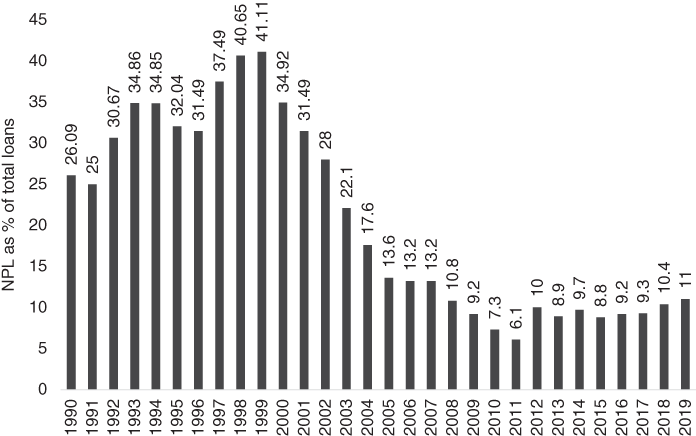
International Monetary Fund (IMF) data show that in September 2019, NPLs as a percentage of the total loans of the banking sector was as high as 12%: the ratios for NCBs and PCBs were around 31.5% and 7.4%, respectively (IMF, 2020). It is therefore evident that, despite the success in reducing the NPLs of NCBs during the 1990s, the problem has returned in recent years. Unlike the 1980s and 1990s, NPLs have turned out to be a problem of PCBs as well, which necessitates further analysis of the issue from a political economy point of view.
A close examination of sector-wise distribution of NPLs reflects that trade and commercial sectors constitute more than 28% of total NPLs in 2018.Footnote 10 The RMG sector alone is found to account for more than 12% of the NPLs (and, in fact, around 27% of the NPLs in the manufacturing sector), followed by other large-scale industries (7.63%). This distributional pattern of NPLs is, however, consistent with the distributional pattern of sector-wise shares of loans. This highlights that important sectors of the economy constitute a significant proportion of NPLs and that weak institutional discipline of the banking sector has also ‘helped’ these sectors to grow.
D Trend in Interest Rates
Figure 5.2 presents the trend in the lending interest rateFootnote 11 and real interest rateFootnote 12 in Bangladesh between 1980 and 2018. In 2018, the interest rate spread in Bangladesh, Sri Lanka, Malaysia, and Thailand was 3%, 2.7%, 1.8%, and 2.9%, respectively. This suggests that the interest rate spread in Bangladesh is not very different from that of other developing countries.
Trend in the lending interest rate, interest rate spread, and real interest rate.
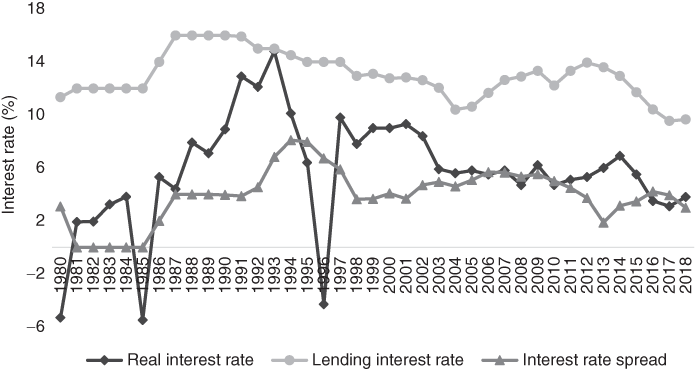
The real interest rate affects financial sector development through its influence on the volume of financial savings and on the cost of capital (McKinnon, Reference McKinnon1973; Shaw, Reference Shaw1973; Fry, Reference Fry1988; Leite and Sundararajan, Reference Leite and Sundararajan1990). As depicted in Figure 5.2, negative or very low interest rates in Bangladesh in the 1980s corresponded typically to a repressed financial system where credit is rationed and allocated in some authoritarian way, or as the result of ‘deals’ among sectors or firms – which is discussed later in this chapter. The two troughs, in 1985 and 1996, were due to inflation surges. After liberalisation of the financial market and a surge in the real rate, due to decelerating inflation with a lending rate still under control, the real rate followed the same declining trend as the nominal rate, because inflation was stabilised – after the accident of 1996. The declining trend of the lending rate also followed an international trend that started in the early 2000s but accelerated after 2008 – for example the declining trend in the yield on US 10-year bonds or on the German Bund.
It may also be noted in Figure 5.2 that the real deposit rate, which corresponds to the gap between the real rate and the interest spread,Footnote 13 has tended towards zero in the recent period. It was high, around 3% on average, throughout the 1990s, shrank in the mid-2000s, and has fluctuated around zero since then.
In 2018, the average real interest rate for Bangladesh, India, Sri Lanka, Malaysia, and Thailand was 3.8%, 5.1%, 6.9%, 4.1%, and 2.7%, respectively. The Bangladesh real interest rate was thus in the lower half of the range defined by these Asian countries.
Despite repeated instructions from the Government (even exhortations by the current, powerful prime minister) to maintain an interest rate spread within 3%, with a 6% deposit rate and 9% lending rate, the banking sector has failed to maintain such a provision.Footnote 14 However, following the strict instructions of the Finance Minister to reduce the lending rate to 9% from 1 April 2020, bankers decided not to offer a deposit rate over 6%.Footnote 15 However, this announcement has led to concern as deposit interest rates have dropped close to the inflation rate,Footnote 16 and also this may decrease banks’ profitability (Hasan, Reference Hasan2020).
E Efficiency of Banks in Bangladesh
The trend and pattern of key economic indicators of the banking sector reveal that the performance of the sector as a whole is not satisfactory, and, except for FCBs, neither NCBs nor PCBs can be considered to have exhibited satisfactory performance in terms of relevant indicators. In this section, we attempt to understand whether the chosen banks (PCBs and FCBs) are performing ‘optimally’ with regard to their assets, income, expenses, and other chosen indicators and to understand the factors behind the ‘sub-optimal’ performance (if any) of certain banks as opposed to others. In this context, from a methodological point of view, we used the DEA,Footnote 17 a statistical tool that is often used to assess the relative efficiency of firms (see Mercan et al., Reference Mercan, Reisman, Yolalan and Emel2003; Debnath and Shankar, Reference Debnath and Shankar2008). In addition, in order to understand the factors behind the relative efficiency of banks, we estimated a panel logit model where we used the efficiency score with other banking sector indicators: most importantly, the components of the CAMELSFootnote 18 rating.
In the analysis of the efficiency of the private banking sector of Bangladesh, we have used the input-orientedFootnote 19 DEA analysis using the CCRFootnote 20 and BCCFootnote 21 models to measure overall technical efficiency (OTE) and pure technical efficiency (PTE), respectively. In the context of the banking sector of Bangladesh, we adopted the intermediation approach for selecting input and output variables, which considers banks as financial intermediaries where banks produce services through the collection of deposits and other liabilities and their application in interest-earning. In this analysis, as input variables we have chosen: (i) total assets; (ii) number of employees; and (iii) sum of deposits and borrowings. As output variables we have included: (i) net interest income; (ii) non-interest income; and (iii) NPLs. Apart from the traditional variables used for the intermediation approach, we have the NPLs variable as a (negative) output variable.Footnote 22 In addition, all the input and output variables except labour are measured in Bangladeshi Taka (BDT) in millions, and we have conducted the analysis from 2015 to 2018, on 44 national and foreign PCBs.
Figure 5.3 presents the distribution of the efficiency scores of the banks calculated using the DEA. It is clear that over the years, the percentage share of banks with an efficiency score of 0.9 and above has declined and the percentage shares of very poorly performing banks (efficiency score below 0.25), poorly performing banks (efficiency scores between 0.25 and 0.49), and moderately performing banks (efficiency scores between 0.5 and 0.74) have increased. In 2018, 55% of the banks had efficiency scores below 0.75. In contrast, only 25% of the banks in 2015 had efficiency scores below 0.75. Most of these low-performing banks are PCBs.
Distribution of the efficiency score of private banks by year.
Note: Total number of private banks = 44.
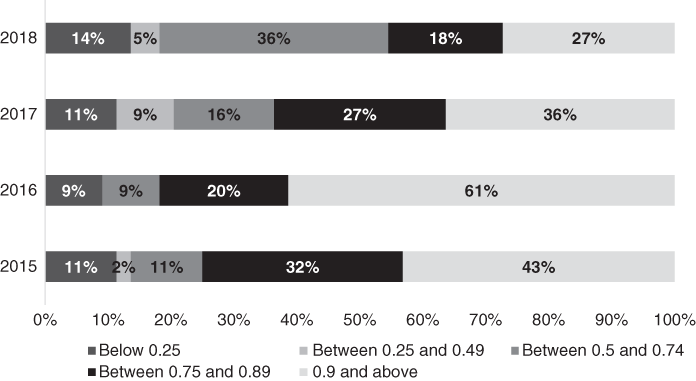
F Development Implications of the Status of the Banking Sector in Bangladesh
The linkage between economic development and the banking sector can be multi-faced and often the indirect linkage can be quite strong too. One of the most important ways in which the banking sector might have an impact on the growth and economic development of a country is through channelling the savings of depositors for the purposes of investment. Despite a persistent high growth rate in Bangladesh for the last decade or so, there has not been much progress in terms of private investment as the ratio of private investment to GDP has remained almost stagnant in recent years. There are concerns that poor governance in the banking sector, including the high amount of NPLs, has restricted banks’ capacity to maintain a narrow interest rate spread and to reduce the lending rate to borrowers. Such a high cost of borrowing and access to finance is generally considered to be one of the key challenges for entrepreneurs in expanding their businesses (see International Finance Corporation (IFC), 2020).Footnote 23
One important area of concern is that the Government’s borrowing from the banking sector has been on an increasing trend over the past few years, which has also been accompanied by an accelerated selling of National Savings certificates (i.e. ‘government bonds’). In FY18, the Government’s borrowing from the banking system increased to as high as BDT 1780.9 billion (around US$ 21.34 billion) – equivalent to 8% of GDP. The increase in the Government’s borrowing from the banking sector risks crowding out credit to the private sector (Rana and Wahid, Reference Rana and Wahid2016; see also the discussion in Chapter 2 of this volume).
It is also important to mention that since the 1980s, the Government has been allocating a significant amount in the annual national budget to subsidising the ailing banking sector, to cover the losses of these banks.Footnote 24 After the initiatives to privatise NCBs in the 1990s, a falling trend was observed in the recapitalisation of banks (NCBs) by the Government; this trend has been reversed in recent years. In FY14, there was a massive surge in the recapitalisation process, which, although it has declined in subsequent years, still since FY17 has been annually as high as BDT 10 billion (around US$ 0.12 billion). The national budget for FY20 allocated BDT 15 billion (around US$ 0.18 billion, equivalent to 0.75% of GDP) to the recapitalisation of NCBs. It is not only the direct monetary expense which is at stake here, this recapitalisation expenditure should also be understood from the viewpoint of opportunity costs to the society. With Government education expenditure being around 2% of GDP and health expenditure less than 0.5% of GDP, and also with a very low tax–GDP ratio of around 9%, the consequence of this massive recapitalisation for development cannot be ignored. The ‘costs’ of poor governance in the banking sector is therefore multi-dimensional and can have long-term implications for the Government’s development initiatives.
In addition to the apparently ‘visible’ macro and fiscal indicators, it is often argued that poor governance of the banking sector is having negative consequences through a number of indirect channels. According to a Washington-based think tank, Global Financial Integrity, the total value gap identified in trade between Bangladesh and all of its trading partners in 2015 was US$ 11.5 billion, which was 19.4% of total trade (Global Financial Integrity, 2020). The gap is between the value of exports reported by Bangladesh exporters and the value of imports reported by importers in importing countries. This estimate puts Bangladesh among the top 30 countries of the world in terms of such trade mis-invoicing data, and third among Asian countries, after Malaysia and India. Though not conclusive, this mis-invoicing is argued to be linked to capital flight from the banking system in the form of NPLs (see Ahmed, Reference Ahmed2019; Haider, Reference Haider2019).
IV Politics of the Banking Sector: A Brief History
The first Awami League regime (1972–1975) instituted a ‘socialistic’ economy whereby banks were nationalised. The authoritarian and later dominant party rule (see Hassan and Raihan, Reference Hassan, Raihan, Pritchett, Sen and Werker2018 for a definition and analysis of dominant party rule) of General Ziaur Rahman–the Bangladesh Nationalist Party (1975–1981) dismantled the ‘socialistic’ system of the previous regime and pursued a market-led economic strategy, but banks remained in the public sector. This period witnessed the rise of state-sponsored capitalism that relied heavily on an aggressive and very liberal industrial loan sanctioning policy for the development of private industries. Regulatory weaknesses, bank officials’ corruption and collusion (with private entrepreneurs), and the regime’s priority to distribute political patronage led to the beginning of the ‘loan default culture’ (see Sobhan and Mahmood, Reference Sobhan and Mahmood1981; Hassan, Reference Hassan2001; Islam and Siddique, Reference Islam and Siddique2010 for case studies of loan defaults. Box 5.1 presents two such cases). The loan sanctioning regime during this period can be characterised as based on largely open deals. Closed deals did exist, but marginally.Footnote 25
Case Study 1: XYZ Private Limited Company
During early 1990s, XYZ (not its real name) company was owned by close relatives of one of the highest-level political leaders in the country. The company was sanctioned BDT 131.4 million (around US$ 3.32 million) by Sonali Bank, a leading NCB. The bank approved a ratio of debt and equity at 70:30, that is 30% of the total investment would be provided by the borrowing company, which was actually provided through bridge financing by another NCB, Uttara Bank. Interestingly, the company pledged the same property as collateral to Uttara Bank that had already been pledged to Sonali Bank, a typical fraudulent practice. According to the conditions specified in the loan agreement, the borrowing company was supposed to deposit to the bank BDT 38 million (around US$ 0.96 million), as part of the equity for financing construction (factory building) and the purchase of industrial machines, but due to special ‘appeal’, the board of directors of the bank permitted the borrower to finance the construction and purchase from their own sources. At the borrower’s ‘request’, the bank either relaxed or simply did not enforce various terms and conditions and standard policies related to term lending. For example, the required cash margin to be deposited was lowered from BDT 23.2 million to BDT 10 million (from US$ 0.59 million to 0.25 million); insurance requirements regarding the project in general, and imported machines in particular, were relaxed to provide special benefits to the borrower; special payments by the bank were made to cover the deficit in equity.
In the tender process (for importing machines), the bank authority rejected the firm which quoted the lowest price and approved the one which was selected by the borrowing company. Changes in all of these policies and conditions were made on a top-priority basis by the board of directors of the bank. Instead of the minimum requirement of a 90-day duration of a sanctioning project (as determined by the government), this particular project was sanctioned in 74 days. XYZ was registered as an export-oriented industry for which it received substantial duty exemptions, but the company actually produced only for the local market. Commenting on the loan repayment behaviour of the company, the Comptroller and Auditor General (CAG) report observed, ‘Although the company is running in full scale, so far the owners have not shown any interest in repaying its bank loans’.
Case Study 2: Bangladesh Match Company
The owner of the company was Ispahani Group, one of the oldest business groups in Bangladesh. The company had been experiencing huge losses and personnel were laid off in 1990. At that time, it owed Rupali Bank (an NCB) BDT 40 million (around US$ 1.16 million). In 1991, the owner decided to close down the company and an arrangement was made with Rupali Bank to pay off the debt in instalments. However, after the 1991 parliamentary election, the Speaker of the fifth parliament wrote a letter to the chairperson of Rupali Bank advising him not to implement the decision to close down the activities or sell them to a third party without receiving clearance from the prime minister. The Speaker apparently intervened on behalf of the trade unions of the particular industry. In 1992, the Speaker wrote another letter to the chairperson of the bank informing him about the prime minister’s decision to re-open the industry. The Speaker also advised the bank authority to provide sufficient funds and other assistance deemed necessary to the owner of the industry. The bank management eventually decided to postpone the decision to close down the industry and also to provide BDT 10 million (around US$ 0.26 million) as cash credit. Although the owner continued to default on the total loan (approximately BDT 66.6 million equivalent to US$ 1.66 million by 1994), the bank authority increased the cash credit limit to BDT 15 million (around US$ 0.37 million). This was done by the direct intervention of the Speaker. In 1995, the owner was actually paid more than the authorised limit (BST 17.5 million equivalent to US$ 0.43 million). Since then, the overdue loan of Bangladesh Match Company continued to accumulate and as at 1998 the amount due was approximately BST 80.5 million (around US$ 1.72 million).
The authoritarian regime of General Ershad (Jatiya Party, 1981–1990) nurtured a ‘robust’ form of crony capitalism through a loan sanctioning process that was largely based on closed deals, in contrast to the previous regime (Hassan, Reference Hassan2001; Hassan and Raihan, Reference Hassan, Raihan, Pritchett, Sen and Werker2018; see Kochanek, Reference Kochanek2003 for evidence on the rampant crony capitalist practices of the Ershad regime). The regime saw an increasing trend of NPLs and further consolidation of the default culture. Yet such a liberal and aggressive loan sanctioning process (with all the features of mal-governance mentioned above) contributed to significant development of industrial entrepreneurship in the country, particularly in the RMG sector. The critical factor here was the continuation of open deals in terms of accessing loans by the private sector. The period also witnessed trade union-centred militant politics related to de-nationalisation of the banks, and an increasing and aggressive stance of civil society and the media towards the default culture and its consequences (Monem, Reference Monem2008; Hassan, Reference Hassan2001).
In terms of the policy regime of the banking sector, the period before 1990 can be broadly considered as one of financial repression (see Raquib, Reference Raquib1999 for an analysis of the policy of financial repression followed by different regimes during the pre-1990 decades). This refers to a bundle of government policies characterised by low real interest rates (see Figure 5.2), with the aim of generating cheap funding for government spending. Also, as low or negative real rates generate excess demand, rationing took place. Some sectors were favoured in the rationing scheme: for instance, state-owned companies, at the expense of the private sector. The objective of successive regimes during this period was to supply cheap money to state-owned enterprises and other priority sectors. Given this broader policy objective, the regimes initiated a banking sector reform during 1980–1990, eschewing reforming the broader policy (financial repression)Footnote 26 and rather focusing on the policy of promoting the licensing of PCBs and the de-nationalisation of NCBs (three NCBs were privatised in 1983/1984 and four PCBs were granted licences to operate in the early 1980s). The reform agenda during this period essentially reflected the existing elite political settlement/equilibrium among political elites and the burgeoning business class, and influential Western donors (led by the IMF, especially in the domains of privatisation, and fiscal and banking sector reform). Such a political settlement effectively excluded organised labour and white collar staff in the public sector, including NCBs. The latter actors resisted the de-nationalisation of banks, as alluded to earlier, but without any success, indicating the robustness of the elite political settlement. The de-nationalisation of the banks and licensing of PCBs also indicated the IMF’s and World Bank’s clout over economic policy decisions during the 1980s, when the country was still largely dependent on external aid or support to finance its development expenditures (see Sobhan, Reference Sobhan1991; Chowdhury, Reference Chowdhury2000).
The ‘competitive democratic’ phaseFootnote 27 saw a further deepening of the default culture (with some fluctuations). The default culture was rampant during the 1990s, saw some improvements during the 2000s, and then again showed a growing trend during the 2010s. The period also witnessed the rise of private sector banksFootnote 28 (numerically as well as a powerful corporate actor), a crisis within private sector banks (weak corporate governance, insiders lending, etc.), and the Government’s attempts to rescue problem banks. Also, a significant development during this period was the deeper involvement of the World Bank in prodding the Government to initiate a comprehensive banking sector reform (that eventually led to the establishment of a Commission in 1997). Though the Banking Companies Act (BCA) 1997 was first enacted in 1991Footnote 29 as part of the Financial Sector Reform Project (FSRP), one of the core demands of the World Bank was the amendment of this act to bring the prevailing standard of prudential and supervisory regulations up to a par with the Basel Committee guidelines. Due to the World Bank’s sustained pressure, the act was finally amended in 1997.
The late 1990s saw a subsequent de facto decline in the power/autonomy of the central bank. Also, there was the emergence of a private sector banking association (Bankers Association of Bangladesh (BAB))Footnote 30 as a powerful actor, leading to its ability to capture policies and especially regulatory policies related to banks – a phenomenon termed state capture in the political economy literature. BAB and other prominent business associations successfully lobbied the political authorities to relax, and in some cases completely reverse, the stricter provisions in the BCA (see Box 5.2).
The Government’s decisions to standardise rules and regulations for better enforcement of credit discipline evoked strong opposition from influential sections of the business community. Opposition intensified in 1997, when the central bank started implementing new credit regulations and, as a consequence, many big business groups were denied loans. The private sector found the BCA (amended in 1997) detrimental to their interests. Immediately after the amendment of the act, the BAB and other prominent business associations (mainly the Federation of Chambers of Commerce and Industries (FBCCI)) started a systematic campaign to further amend or simply do away with some of the stricter rules and regulations. Organised business successfully lobbied the political authorities to relax and in some cases completely reverse the stricter provisions in the BCA (prudential regulations in the loan repayment process). In other cases (the central bank’s supervision over PCBs’ internal management), new provisions remained intact, as formal mandatory laws in the book, but were largely ignored in practice by the market actors. Non-compliance with the rules was possible due to collusive linkages of these actors with the supervisory authorities (bureaucratic or political), at the highest levels of the hierarchy.
During 1990–2000, the competitive democratic phase emphasised market-oriented liberalisation, doing away with or limiting the policies of financial repression of the previous decades, and encouraged more private sector participation in the banking sector (Institute of Governance Studies (IGS), 2011). As part of the first objective, the core reform strategies, formulated and implemented under the World Bank–designed FSRP (initiated during the early 1990s), included, among other things, the gradual deregulation of the interest rate structure, and providing market-oriented incentives for priority sector lending. To realise the second objective, a large number of PCBs were given licences. The major beneficiary of the priority sector lending was the RMG sector.Footnote 31 The predominantly market incentive–based reform, though it led to the development of a wide range of financial products and services (merchant and investment banking, small and medium-sized enterprise and retail banking, credit card and offshore banking, etc.), failed to tackle some key banking sector problems, such as high ratio of NPLs in both NCBs and PCBs and weak enforcement of capital adequacy and other regulatory policies. Also, in dealing with the policies of financial repression, as mentioned before, the reform ended up with credit rationing, and eventually a deteriorating level of credit allocation. For instance, the flow of credit declined over the 1990–1999 period to some of the priority sectors, such as agriculture, and small and cottage industries, and a similar decline was also observed in terms of the relative share of the rural banking system (IGS, 2011). In addition, the introduction of the interest rate flexibility failed to create a competitive environment among NCBs and PCBs. The upshot is that the market fundamentalist approach of the FSRP was largely unsuccessful in achieving the desired objectives of the reform programme, since, given its faith in the market per se, it focused heavily on the deregulation dimension and placed less emphasis on the necessity for broadening/deepening prudential regulation aspects (IGS, 2011).
Such lacunae in the regulatory aspects were emphasised by the Bank Reform Committee (BRC), formed after the termination of the FSRP in 1996, which submitted its recommendations in 1999. The BRC blamed supervisory and regulatory forbearance as one of the core issues behind the problems of the banking sector. The phase of reform initiated during the early 2000s essentially premised its policy prescriptions on these issues identified by the BRC and emphasised risk-based regulations and strengthening of the central bank’s capacity (both supervisory and technical infrastructure-related) to address the banking sector problems. The Central Bank Strengthening Project, initiated in 2003 (part of the stabilisation programme signed with the IMF for 2003–2006), included strengthening of the legal framework, increased research capacity, capacity building in relation to supervisory and prudential regulations, auditing, and the development of automation-related technology. In terms of addressing the default culture, a series of new laws, regulations, and instruments were enacted. To create a competitive environment for the private sector banking strategy, a staged withdrawal of public ownership from the sector was initiated that involves divestment and corporatisation of substantial shareholdings of three publicly owned banks. Increased private sector participation in the sector continued throughout this phase, with licensing of a dozen PCBs. The reform still failed to achieve what it intended to, due to constraints of meta-level political and governance issues (cronyism, de facto political control of the regulatory authority, a political–business elite collusive nexus, etc.). In the beginning of the 2000s, important improvement was noted in terms reduction in NPLs and the NPL ratio stabilised at an order of magnitude below the 40% level reached in the late 1990s. But this trend fizzled out at the end of that decade, and the NPL ratio started to increase from the beginning of the 2010s. The licensing of the PCBs became largely a political patronage distribution mechanism, and ownership predominantly went to individuals with partisan political identities. Many new PCBs came into being despite the central bank’s objections based on an economic rationale (the market saturation of banks being one issue).Footnote 32
Bangladesh’s current regime (2014–) can be termed one of ‘dominant party rule’. This period has seen an acceleration of NPLs and further marginalisation of the central bank (de facto weakening of its authority). Other relevant features of this period are a continuation of the licensing of private banks based on political considerations, deteriorating governance status of the banking sector, further increases in the capture of the state/central bank by private banks – both individually and collectively (associations) – resulting in regulatory capture (laws, rules, loan classification criteria, etc.), entrenchment of crony capitalistic practices by private bank owners, and the emergence of banking sector oligarchies.
The Finance Ministry’s overreach in licensing private banks, under political considerations, without the recommendation of the Bangladesh Bank, not complying with the suggestions of the central bank and influencing the decisions of the autonomous central bank, are a few of the manifestations of policy and regulatory capture and political patronage in the sector.Footnote 33 Though it is an independent regulatory authority, the central bank is unable to completely monitor these banks as they are largely owned by politically influential people.Footnote 34 Some of these banks have been linked to loan scams, aggressive lending, and violations of banking regulations, among other issues, which tends to pose serious threats to the banking sector, according to the central bank’s own assessment.Footnote 35 Table 5.2 presents a summary of the scams in the banking sector in Bangladesh in recent years.
| Banks | Key irregularity | Measures taken |
|---|---|---|
| Sonali, Janata, NCC, Dhaka, Mercantile Bank (2008–2011) | BDT 40.89 million (approximately US$ 0.58 million) bank loan with forged land documents (Dhaka Tribune, 28 August 2013) | On 1 August 2013, Anti-Corruption Commission (ACC) filed cases against Sonali Bank, Fahim Attire, and certain individuals; BDT 10 million (US$ 0.13 million) was given back to Sonali Bank (Dhaka Tribune, 2 August 2013; New Age, 2 August 2013; The Daily Star, 2 August 2013) |
| Basic Bank (2009–2013) | BDT 45,000 million (approximately US$ 604 million) with dubious accounts and companies (The Daily Star, 28 June 2013) | In September 2015, ACC filed 56 cases against 120 people (New Age, 13 August 2018) |
| Sonali Bank (2010–2012) | BDT 35,470 million (approximately US$ 472 million) embezzled by Hall Mark and other businesses (The Daily Star, 14 August 2012) | In October 2012, ACC filed 11 cases against 27 people (Dhaka Tribune, 11 July, 2018) |
| Janata Bank (2010–2015) | BDT 100,000 million (approximately US$ 1.3 billion) appropriated by Crescent and AnonTex (Dhaka Tribune, 3 November 2018) | On 30 October 2018, the Enquiry Committee of Bangladesh Bank submitted a report (Dhaka Tribune, 3 November 2018) |
| Janata Bank, Prime Bank, Jamuna Bank, Shahjalal Islami Bank, Premier Bank (June 2011–July 2012) | BDT 11,750 million (approximately US$ 151 million) by Bismillah group and associates. (The Daily Star, 7 October 2016) | On 3 November 2013, ACC filed 12 cases against 54 people (The Independent, 11 September 2018) |
| AB Bank (2013–2014) | BDT 1,650 million (approximately US$ 21.2 million) (The Daily Star, 12 June 2018) | On 25 January 2018, ACC filed a case against the former chairman and officials of AB Bank (The Daily Star, 12 March 2018) |
| NRB Commercial Bank (2013–2016) | BDT 7,010 million (approximately US$ 90 million) of loan (New Age, 10 December 2017) | On 29 December 2016, the Bangladesh Bank appointed an observer to check irregularities (Dhaka Tribune, 7 December 2017) |
| Banks | Key irregularity | Measures taken |
| Janata Bank (2013–2016) | BDT 12,300 million (approximately US$ 158 million) of loan scam (The New Nation, 22 October 2018) | In October 2018, Thermax requested to reschedule the loan and Janata Bank’s board endorsed it and sent it to the Bangladesh Bank (The Daily Star, 21 October 2018) |
| Farmers Bank (2013–2017) | BDT 5,000 million (approximately US$ 63.7 million) of fund appropriation by 11 companies (The Daily Star, 24 March 2018) | On January 2018, the Bangladesh Bank directed that an audit be conducted. In April 2018, ACC arrested four accused persons (The Independent, 11 April 2018) |
| Bangladesh Bank (5 February 2016) | BDT 6,796 million (approximately US$ 86.6 million) by international cyber hacking from the treasury account of Bangladesh Bank (The Daily Star, 5 August 2017) | On 19 March 2016, the Government formed a three-member investigation committee (The Daily Star, 5 August 2017) |
Historically, there have been many regulations covering the banking sector, especially regarding the entry/exit mechanism of banks and their governing bodies. The BCA has been amended six times since its formation. Recent regulations tend to be strategically done to bolster political control over the governance of these banks, so they can be used to distribute patronages among loyal political elites. These new laws have made changes in directorship positions, triggering a state of confusion among depositors and other stakeholders.Footnote 36
V An Analytical Narrative of the Governance Failures in the Banking Sector
The governance crisis in the banking sector in Bangladesh is not manifested in frequent collapse of banks but in the serious insolvency of some banks. However, these insolvent banks are typically protected from market competition and not allowed to go bankrupt by recapitalising them through government subsidies. During the last few decades, only one bank has collapsed in Bangladesh.Footnote 37 The banking system in Bangladesh is a classic example of what has been known in the banking literature as ‘the walking dead bank syndrome’, characterised by insolvency and undercapitalisation of an important segment of the system (Burki and Perry, Reference Burki and Perry1998). The implications of such government subsidies and other forms of insurance policies are profound in terms of banking sector governance. Such policies also have serious effects on the incentives of the bank management and depositors to demand governance reforms in the banking system.
A Central Bank
Bangladesh Bank, that is the central bank of Bangladesh, tends to be a very weak institution. Due to various formal and informal controls, it actually enjoys only a marginal degree of policy and operational independence. It is de facto subservient to the MOF even in regard to some of the core functions of the central bank, such as regular banking supervision. However, it is not only the formal power that has reduced the independence of the central bank. Governments also tend to act beyond their legal mandates. For instance, existing rules clearly prohibit appointing the Governor or Deputy Governor of the central bank from the government bureaucracy. But these rules have never deterred successive governments (authoritarian and democratic) from appointing members of the civil service to such positions on an ad hoc basis.Footnote 38 The Government has also effectively marginalised the role of the Bangladesh Bank in the decision-making processes related to operational matters and banking sector governance. Though the BCA 1991 empowered the Bangladesh Bank to regulate the country’s banking sector as an autonomous body, the central bank lost its independence after the MOF established its own banking division. An example of the marginalisation of the Bangladesh Bank can be seen from the following quote of a supernumerary professor at the Bangladesh Institute of Bank Management: ‘A few days ago (in November 2017), the central bank turned down proposals for setting up two new private commercial banks. In response, the ministry instructed them to proceed that would allow parties to get licences to set up private banks. How does such an action leave any room for the bank to operate independently?’Footnote 39
In dealing with critical policy issues, such as monetary policy or lending to the Government, and governance issues – for instance, special monitoring of insolvent banks or problems of NPLs of commercial banks – the tendency of the Government has been to bypass the formal approval process of the central bank.Footnote 40 In fact when it comes to governance issues, the Government seems to be more inclined to limit central bank’s authority. An ex-governor of the Bangladesh Bank mentioned: ‘In Bangladesh, there is a “dual” system of control of the banking sector. The state-owned commercial banks and specialised banks, and some statutory banks are controlled by the Bank and Financial Institution Division of the MOF. On the other hand, all private commercial banks, foreign banks, non-bank financial institutions are regulated by the Bangladesh Bank. This “duality” of control has resulted in uncoordinated, often weak, policy measures for the government regulated banks. Bangladesh Bank has serious limitations in enforcing prudential and management norms in these banks, which have made the whole banking sector weak and vulnerable through “domino effect”.’Footnote 41
B Corporate Governance in the PCBs
Unlike NCBs, PCBs are characterised by reasonably efficient internal management. The bank authorities have successfully avoided the problems that plagued NCBs, since high priority was given to minimising administrative costs. Also, competitive salaries and various other performance-related incentives have contributed to greater management efficiency. However, the central problem with PCBs lies in the area of corporate governance. For a better understanding of the problem, we need to go beyond the conventional perspective of corporate governance, which fails to take into consideration the contingent nature of institutions and the political economy settings. The conventional perspective, developed essentially in the context of the UK and USA (‘Anglo-American model’), assumes the following: the existence of widely held firms (i.e. firms with a fairly large number of dispersed shareholders); firms are subject to effective legal and juridical (civil and criminal) constraints; and firms rely on ‘anonymous finance using primarily arm’s-length contracts and third-party intervention through the market for corporate control’ (Berglof and von Thadden, Reference Berglof, von Thadden, Pleskovic and Stiglitz1999). The defining characteristic of such corporate governance is ‘strong managers, weak owners’ (Roe, Reference Roe1994), and the main governance problem is the conflict between self-interested management and the weak dispersed shareholders.
Such a model of corporate governance cannot explain the realities in the developing world. In the latter context, firms are usually family-owned or closely held (i.e. more or less concentrated ownership), legal and juridical constraints are very weak, and close ties between business interests and government is much more common (‘crony capitalism’), resulting in large-scale corporate fraud and theft. Also, the stock market is less salient as an external source of finance, and firms typically raise funds from sources such as business groups (‘channelling resources between its firms’), family, and friends. In some developing countries like Bangladesh, where the banking sector is characterised by large-scale governance failure, NPLs tend to be another major source for raising funds.Footnote 42
The above features also largely characterise the structure of corporate governance of PCBs in Bangladesh. Concretely, PCBs are closely held firms, that is mainly owned by a few large shareholders,Footnote 43 who have strong control over the managers. In that sense, the defining characteristic of the corporate governance of PCBs is (paraphrasing Roe): strong owners, dependent managers (bank management), and very weak outsiders (i.e. stockholders). Consequently, the main corporate governance problem is that there are hardly any effective self-interested countervailing groups to prevent rampant corporate fraud and theft by the bank owners.
In general, the monitoring and supervision of banks are very complex issues involving serious incentive problems and information asymmetry. For instance, depositors may lack necessary incentives to proactively monitor the performance of banks since they have less costly options of withdrawing their deposits if necessary: that is, depositors may vote with their feet if they find the bank is not viable. The incentive problem also arises due to the presence of deposit insurance. For instance, the Deposit Insurance Fund in Bangladesh has largely contributed to depositors’ complacency (regarding gross inefficiency and insolvency of the banks) and consequently has hindered the free play of market mechanisms in disciplining banks, that is the depositors may have little incentive to vote with their feet. Such complacency seems to be also an outcome of the presence of the Government’s explicit guarantees (bailing out of failing banks) and implicit guarantees (regulatory forbearance).Footnote 44 Moreover, depositors tend to lack sufficient information to make a proper evaluation. But even if they have better information, the policy of deposit insurance would reduce the incentive to use that information. There are also collective action problems that severely limit depositors’ activism. In contrast to the small and concentrated groups with high stakes in the system – for instance, the bank owners – numerous depositors, each having a small stake in the banks, tend to be less motivated and consequently less effective in realising collective objectives. The costly process of information collection and the possibility of other depositors free riding on such information are also strong disincentives facing individual depositors in terms of taking individual initiatives to generate information. The point is this: there are important reasons for depositors to delegate the monitoring and supervision role to specialised agencies that will act on their behalf to mitigate collective action problems and reduce information asymmetry and the transaction costs of monitoring. Two forms of agencies are typically available: the formal regulatory institutions (the central bank, for instance) and varieties of countervailing private actors or ‘reputational agents’Footnote 45 with strong incentives to monitor corporate firms.
In Bangladesh, reputational agents have largely failed to represent depositors’ interest by playing the role of an effective monitor of commercial banks. To begin with, there are very few such agents or institutions in Bangladesh relevant to banking sector corporate governance. For example, credit rating agencies, investment analyst firms, and depositor or stockholders associations have yet to emerge in any significant sense. Organised legal activism tends to focus more on environmental, civil, and human rights issues, rather than financial sector mal-governance. The role of auditing and accounting firms has been very perverse, which in effect reinforces rather than mitigates the information asymmetry between banks and depositors, as well as corporate fraud and other opportunistic behaviour of bank management and owners.Footnote 46 An exception, in this regard, has been the print media. In fact, to the extent that a certain degree of transparency and accountability exists in the system, the credit for this can perhaps largely go to actors like the print media. The print media’s role as monitor has been very critical. Media trial (naming and shaming of defaulters, exposure of banking sector-related corporate fraud, etc.) has probably played a more important role than formal judicial and law enforcement processes in ensuring some degree of discipline in regard to powerful bank owners, defaulters, and cronies.Footnote 47
Discussion with bank officials (current and ex) and academics suggest that auditing and accounting firms in Bangladesh have largely failed to play their role of effective monitors of corporate behaviour of commercial banks.Footnote 48 The problem is not a lack of technical competence (although this is low) but mainly bad governance. Whatever formal regulations exist, in practice the auditing and accounting firms do not seem to be subject to any form of accountability. For instance, no legal actions have ever been taken against any auditors by depositors or shareholders. The central bank has never disciplined or disqualified any auditing firms for sloppy work or violations of rules. Given such a weak accountability structure and legal enforcement, a large section of the auditing profession has been involved in blatant violation of corporate rules and ethics, auditing fraud, and collusive corruption with bank management. For instance, auditors collude with bank management to hide irregularities in the records, change loan classification entries and provision for loan losses to conceal loan defaults, and exaggerate the performance of banks by concealing expenses and showing income from interest generated from defaulted loans.Footnote 49 Another problem is the distorted accountability structure, that is executive authorities’ control over the regulatory agencies. For instance, the central bank does not receive audit reports, instead the MOF does. A collusive nexus is much easier to establish in the executive domain of the state than in the central bank.
The most important public source of external restraint has been the central bank, which has the formal supervisory authority over PCBs.Footnote 50 However, experiences in the last two decades (with some variations) suggest that it has largely failed to control such fraudulent practices. The regulatory failure, on the part of the central bank, needs to be explained by relating the corporate governance problem to the larger political–economy settings.
Licences to set up banks in the private sector have mainly been given to politically favoured cronies, most of whom have also been large loan defaulters. The privatisation of Pubali Bank in 1983 is a typical example of this process. The Bank had an estimated value of BDT 3 billion (around US$ 0.12 billion), but during privatisation, it was deliberately undervalued at BDT 160 million (around US$ 6.5 million). The majority of the new owners were already large defaulters (with the same bank), with one of them defaulting in the amount BDT 10 million (around US$ 0.41 million). These bank owners continued to wield political influence over successive democratic regimes. Discussions with senior bankers and recent scanning of print media suggest that the licensing of banks in the private sector (PCBs) over the last decade has also continued to be largely based on corrupt deals and political patronage. For example, several banks that have received licences in past seven to eight years, such as Farmers Bank, NRB Global Bank, and NRB Commercial Bank, suffered a severe liquidity crisis during the 2016/2017 fiscal year. The problem was particularly acute in the case of Farmers Bank, which had to be bailed out by the Government. Prominent economist Wahiduddin Mahmud noted that repeated violations of bank policies led to Farmers Bank’s current dilapidated state. He stated: ‘The influence of politicians has helped them to establish new banks without extensive scrutiny and obtain huge amounts of loans.’Footnote 51
Given the political clout of the owners of PCBs, and the weak rule of law, the central bank has had very little success in enforcing laws and rules against blatant forms corporate fraud and non-compliance of regulations by the bank directors. Based on scanning of print media and discussions with bankers, including current officials and ex-governors and deputy governors of Bangladesh Bank, the following appears to be the case:
(a) Formal regulations clearly specify the autonomy of the management from the board and the roles of the board, chairperson, and managing director, but such regulations are rarely followed by the bank authorities. In most cases, it is the board that actually runs the bank.
(b) The BCA (section 27) prohibits PCBs from making loans to their directors and affiliated concerns, yet insider lending has been widely practised in the banking sector, especially by insolvent banks, leading to a huge accumulation of NPLs. Insider lending takes various forms: lending to firms with which bank owners have links, lending to family members of the owners and pure theft (i.e. the adoption of outright fraudulent strategies). The latter includes the transfer of funds by owners to fictitious accounts, taking loans without adequate collateral, and flouting banking rules. Some of these people are well-known business leaders, influential cronies, and benefactors of major political parties, and they have sufficient political capital to circumvent the central bank’s disciplinary measures (if they are used against them). Their formidable power also indicates those regulatory bodies like the MOF and Parliamentary Committees are to a large extent beholden to their special interests.
(c) Regulatory forbearance with regard to liquidity requirement, loan classification, accounting standards, or capital adequacy can be ensured by bribing or offering lucrative private sector jobs to the senior officials of the MOF.
(d) By using political connections with the MOF, the Parliamentary Standing Committee, or Prime Minister’s Office, one can successfully circumvent regulatory rules and restrictions.
As mentioned earlier, the BCA was first enacted in 1991 as part of the FSRP. The act provided for the licensing, supervision, and regulation of all banks.Footnote 52 The BCA also provided the legal basis for the central bank’s regulatory and supervisory role in the entire banking system. However, the private sector considers the act against its interests. Right after the Act’s amendment, the BAB and other prominent business associations (mainly the FBCCI) began a systematic campaign to further amend or simply end some of the more stringent rules and regulations. Organized business has successfully lobbied the political authorities in recent decades to relax, and in some cases completely reverse, the more stringent provisions in the act (prudential regulations in the process of repaying loans). In other cases (supervision of the central bank over internal management of PCBs), new rules have remained unchanged as compulsory formal laws in the book, but largely ignored by market actors in practice.
Non-compliance with the rules has been possible due to collusive linkages of these actors with the supervisory authorities (bureaucratic or political), at the highest levels of the hierarchy.
VI Summary of Findings and Concluding Observations
This chapter, by deploying both quantitative data and qualitative political economy analysis, has attempted to understand the institutional weaknesses of the banking sector in Bangladesh, while primarily focusing on the institutional loopholes relating to PCBs. Our analysis reveals the following features of the banking sector in this aspect:
While analysing the trend of key banking sector indicators over the past few decades, it appears that Bangladesh has made some important progress in terms of most of the indicators related to access, stability, efficiency, and depth of the banking system. However, the country in general is lagging behind other comparable developing countries in South Asia and Southeast Asia. Also, there has been a sharp rise in NPLs in recent years. High NPLs are considered a matter of concern for many Bangladeshi banks.
Our analysis, based on interviews with key informants, reports published in print media, and other research findings, indicates a number of institutional inefficiencies in the banking sector. One such key institutional weaknesses is the lack of autonomy of the central bank and the influence of the MOF in designing/altering key policies and strategies of the sector.
Our analysis also reveals the weak corporate governance of PCBs, under which PCBs act as closely held firms, that is mainly owned by a few large shareholders, who have strong control over the managers and where there are hardly any effective self-interested countervailing groups to prevent rampant corporate fraud and theft by the bank owners. The symptoms of weak governance have been reflected in frequent cross-lending and insider lending of PCBs based on personal connection/political influence, as well as in the strong influence of board directors in lending decisions. There is a prevalence of political patronage, favouritism and nepotism, crony capitalism, and state capture in the banking sector.
Interestingly, despite such inefficiencies and institutional weaknesses, except in a few cases, we do not observe any massive case of financial sector crackdown or bankruptcy as the Government either directly intervenes with financial support or instructs the central bank and/or NCBs to do so. Such a practice, though safeguarding the interests of depositors and protecting the sector as a whole, does so through large-scale recapitalisation and at the cost of tax payers money.
Sector-wide poor governance and institutional weaknesses, therefore, have weakened the financial base of the banking sector, primarily reflected in terms of inefficiency and NPLs. The consequences of this, among other things, are a high interest rate spread, continued fiscal burden, inefficiency in public spending, and large-scale capital flight, resulting in stagnant private investment, a slow pace of industrialisation, and rising inequality. All such consequences constrain the country’s ability to attain the Sustainable Development Goals and act as an obstacle towards growth performance.
Based on the findings, a number of recommendations can be considered for improved governance and greater efficiency of the sector:
Central bank autonomy: As discussed, one of the key institutional weaknesses of the banking sector in Bangladesh is the lack of autonomy of the central bank in governing the sector. As a consequence, we observe the formulation of policies in an ad hoc manner and not taking required actions against different malpractices of commercial banks. The central bank’s autonomy is therefore the pre-requisite for establishing good governance in the sector. In this context, it is needless to mention that such autonomy must be backed up with prudent management and an efficient workforce.
Modification of the BCA and strict adherence to it: Any amendment of the BCA must be made on the basis of economic considerations and without any political incentive. In addition, the existing act must be modified carefully to address the institutional weaknesses in terms of loan sanction, appointment of directors, penalty of defaulters, permission regarding establishing new banks, etc. A related policy would be to have supplementary policies for the provision of fresh loans where transparency should be the pre-requisite for granting any loan above a certain threshold.
Political commitment to penalise loan defaulters: Given the very high amount of NPLs, especially in recent years, and the political economy considerations behind this, there is no denying the fact that strong political commitment to penalise defaulters is necessary.
This short note accompanies the excellent chapter by Mirza Hassan, Sayema Haque Badisha, Towid Iqram Mahmood, and Selim Raihan on the performance and governance challenges of banks in Bangladesh. In their chapter, the authors compare the bank performance of Bangladeshi banks with banks in neighbouring countries and across different ownership groups within Bangladesh. They also point to serious regulatory and governance challenges within the banking system. In this note, I will complement their cross-country comparison of financial sector development with a discussion of how to interpret different indicators and a benchmarking model. I will also offer a broader discussion of the factors preventing further financial sector deepening in Bangladesh, and I will conclude with some additional proposals for how to overcome the governance challenge in Bangladesh’ financial system.
Financial Sector Development in Bangladesh
An extensive theoretical and empirical literature has pointed to the critical functions of the financial system, including by (i) providing transaction services and thus enabling specialisation of labour; (ii) intermediating funds from savers to entrepreneurs; (iii) assessing investment projects ex-ante and monitoring borrowers ex-post, thus mitigating principal–agent conflicts; (iv) mitigating liquidity risks, allowing savers ready access to funds while enabling long-term investment; and (v) enabling investor cross-sectional and intertemporal risk diversification. An expansive literature has shown a positive relationship between financial development and economic growth, robust to reverse causation and omitted variable bias, and particularly strong in developing countries such as Bangladesh (see Popov, Reference Popov, Beck and Levine2018, for a recent overview).
One key challenge when assessing the relationship between financial development and real sector outcomes, as well as when comparing financial sector development across countries and over time, is how to measure the efficiency and development of a country’s financial sector. While theory points to specific channels and mechanisms, as discussed above, the empirical literature has not been able to map these different functions onto very specific empirical measures. Critically, several of these functions are complementary to each other: for example, the pooling and intermediating of savings goes hand in hand with the screening and monitoring of borrowers. Similarly, pooling and intermediating savings implies liquidity transformation. By offering payment services, banks learn about potential borrowers and thus get better at screening and monitoring them.
In the absence of variables capturing the individual functions of the financial sector, the literature has used crude proxy variables focusing on the size and activity of financial intermediaries and markets, most prominently private credit to GDP, which is the total claims of financial intermediaries on domestic private enterprises and households in an economy, divided by GDP. By capturing the total amount of financial intermediation by regulated intermediaries in the economy, this variable proxies for the total volume of intermediation. The main advantage of this indicator is that it is available for a large cross-section of countries and over longer time periods, as the underlying data (total credit outstanding and GDP) go back until 1960 for many countries. Confidence in the measure is further increased as it is significantly correlated with other indicators of the efficiency of the financial system, available for fewer countries and over shorter time periods, such as interest rate spreads and margins.
While academics have focused mostly on the facilitating role of the financial sector, which consists of mobilising funds for investment and contributing to an efficient allocation of capital in general, policymakers have often focused on financial services as a growth sector in itself, as captured by the contribution of the financial sector to GDP. However, it is important to distinguish between the importance of the financial system within overall value added in an economy and the support that the financial system provides for the real economy. A larger financial system can both support the real economy but also be a burden on the rest of the economy, by, for example, drawing talent away from the real economy (Kneer, Reference Kneer2013a, Reference Kneer2013b). Based on a sample of 77 countries for the period 1980–2007, Beck Degryse, and Kneer (Reference Beck, Degryse and Kneer2014) find that intermediation activities increase growth and reduce volatility in the long run, while an expansion of the financial sector along other dimensions has no long-run effect on real sector outcomes. One specific example is Nigeria, which liberated its financial sector in the late 1980s. Very low entry requirements and the high market premiums that could be earned with arbitrage activities in the foreign exchange markets explained why the number of banks tripled from 40 to nearly 120 in the late 1980s, employment in the financial sector doubled, and the contribution of the financial system to GDP almost tripled. At the same time, however, deposits in financial institutions and credit to the private sector, both relative to GDP, declined (see discussion in Beck, Cull, and Jerome, Reference Beck, Cull and Jerome2005).
Comparing financial sector development across countries and over time is made difficult by different and changing socio-demographic structures. One way to address this challenge is to construct a synthetic benchmark based on a panel regression model of many countries over time (see Barajas et al., Reference Barajas, Beck, Dabla-Norris and Reza Yousefi2013 for further discussion). Among the explanatory variables included in this model are GDP per capita to proxy for demand-side effects, the young and old dependence ratio to proxy for demographic trends, total population to proxy for scale effects, and also year-fixed effects to control for global trends. This regression model makes it possible to predict financial sector indicators, such as private credit to GDP, for each country and year, and to compare it to the actual value. Figure 5.4 shows the actual and predicted value for private credit to GDP for Bangladesh for the years between 2000 and 2016. Strikingly, for all years, the actual value is above (though not by much) the value predicted by the socio-economic characteristics of Bangladesh.
Benchmarking private credit to GDP in Bangladesh.
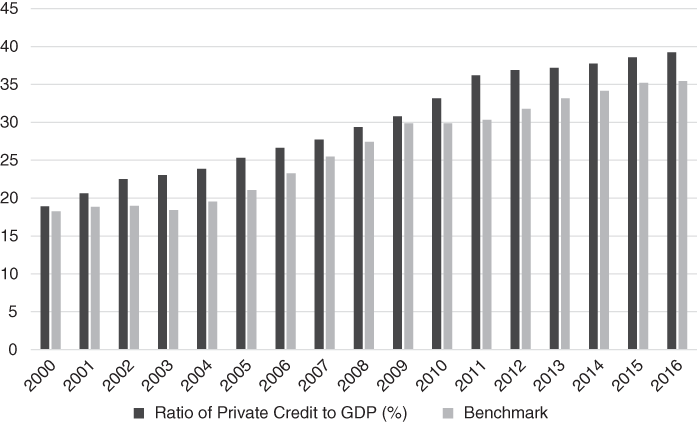
What Drives Financial Sector Development?
Beyond socio-economic characteristics, financial sector development is critically influenced by the macroeconomic environment and the institutional and regulatory framework (see Beck, Reference Beck, Beck and Levine2018 for an in-depth discussion and literature review). I will discuss each in turn.
Bangladesh has a long history of macroeconomic volatility, as illustrated in Figure 5.5. While the inflation rate has been relatively stable (between 5% and 7%) over the past three years, going back further shows variation between 2% and 16%. Given the intertemporal nature of financial contracts, macroeconomic volatility undermines the appetite and willingness of both lenders and borrowers to commit to long-term contracts.
Inflation in Bangladesh (%).
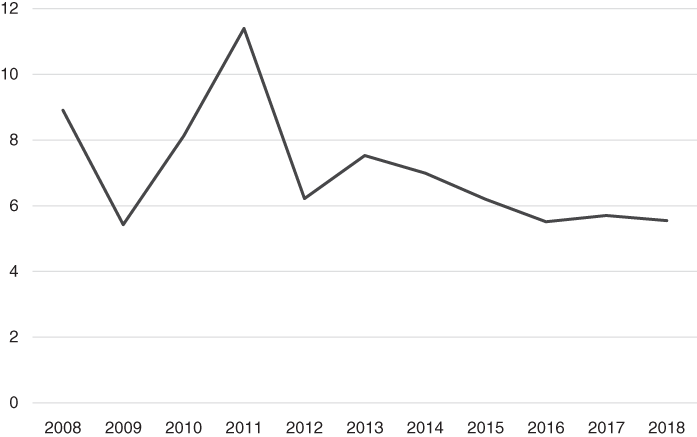
Given the intertemporal and often abstract nature of financial contracts, the financial system is also among the most sensitive sectors in an economy to the institutions of contract enforcement and property right protection. A second important area is therefore the institutional framework, which encompasses the rights of secured and unsecured creditors, the quality of court systems and efficiency of contract enforcement, and the existence and quality of collateral registries. Table 5.3 presents three indicators from the World Bank’s Doing Business database, showing the relative performance of Bangladesh compared to several other countries in the region. In most cases, Bangladesh lags behind the regional comparator countries.
| India | Pakistan | Sri Lanka | Bangladesh | |
|---|---|---|---|---|
| Registering Property Score | 43.55 (166) | 45.63 (161) | 51.87 (140) | 28.90 (184) |
| Resolving Insolvency Score | 40.84 (108) | 59.86 (53) | 45.05 (92) | 28.20 (154) |
| Enforcing Contracts Score | 41.19 (163) | 43.49 (156) | 41.16 (164) | 22.21 (189) |
Note: The figure in parenthesis indicates the ranking out of 190 countries.
The Governance Challenges in Bangladesh’s Financial Sector
The situation as described in this chapter points to a lack of both market and supervisory discipline, and regulatory capture, not only by the state-owned banks but also by domestic private banks. Bank licences seem to be granted for politically connected entrepreneurs. There is a lack of de facto independence of the Bangladesh Bank, in addition to a long-standing ‘default culture’ (both for borrowers and banks), which explains the high level of NPLs. There is effectively no resolution of failed banks, but rather regulatory forbearance and recapitalisation. Finally, there is a lack of ‘reputational agents’, that is private institutions that provide information on bank performance and thus enable market discipline – except for the print media.
In 2006, I co-authored a paper assessing the development and stability challenges of the Bangladeshi banking system that painted a very similar picture (Beck and Rahman, Reference Beck and Rahman2006). One thing I noticed was that the financial and regulatory regime of high government guarantees and limited supervisory discipline resulted in high bank fragility. Moving to a regime with a stronger emphasis on market forces implies a carefully managed transition towards a more autonomous and powerful supervisory authority, privatisation of state-owned banks, and the establishment of a bank resolution framework, before one could move towards a more market-based banking system (Figure 5.6). In the 2006 paper, I made several policy suggestions, including (i) de jure and de facto autonomy of the Bangladesh Bank supervision from the Government, and (ii) complete divestiture of the Government from nationalised commercial banks. As Hassan, Bidisha, Mahmood, and Raihan eloquently describe, there has been no progress on (ii), and there has been a further deterioration in (i).
The interaction of government guarantees and supervisory approach.
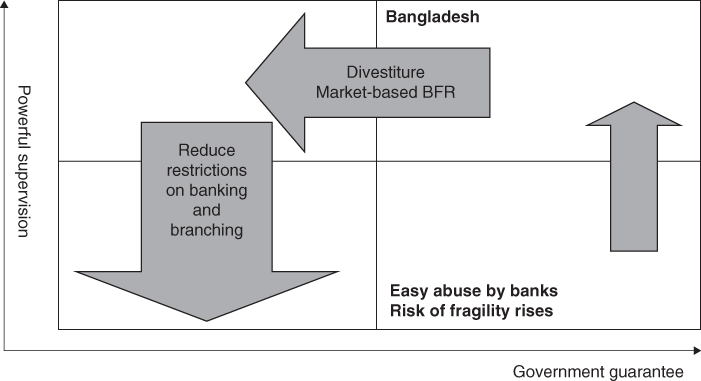
What to Do?
The governance challenges in the Bangladeshi banking system call for strong policy responses. But it is important to understand that de jure reforms might not – at least by themselves – address the governance challenges. While privatisation of state-owned banks reduces direct government ownership, it does not address governance and efficiency problems in the private banks. Evidence from other countries (such as Mexico in the 1990s) has shown that privatisation to insiders can create new frictions and fragility. While a strengthening of the de jure autonomy of the Bangladesh Bank is laudable, its de facto autonomy is endogenous to the political structure of the country. And while de jure bank governance can be strengthened by legislation, enforcement is again endogenous to the political environment. Finally, a stronger stance against large and politically connected defaulters is necessary, but hard to enforce in the current political state.
I therefore make two suggestions that, though they might not have as strong effects, do take into account political constraints. First, foreign banks are less open to political pressure and can help break the link between politicians, borrowers, and bankers, as the example of Central and Eastern Europe has shown (see, e.g. Gianetti and Ongena, Reference Gianetti and Ongena2009). Foreign banks can certainly have their shortcomings, as they often lack incentives and knowledge to reach out to the most opaque and smallest borrowers; however, evidence from Pakistan has also shown that foreign banks from geographically and culturally closer countries are less subject to such constraints (Mian, Reference Mian2006). Second, strengthening private monitors (reputational agents) is an important reform item. Such reforms can include: (i) the creation of an FCA-style institution (separate from Bangladesh Bank) that focuses on bank conduct and supervision; (ii) steps to force more disclosure by banks beyond balance sheets and income statements, giving broader insights to depositors, media, and other stakeholders on their ownership structure and business; and (iii) improvements in the quality and governance of the accounting and auditing industry in Bangladesh. The latter can also include a mandatory rotation of auditors for banks.
Bangladesh has developed from ‘history’s basket case’ (as it was referred to by Henry Kissinger) to a rapidly developing and emerging economy, with aspirations of becoming a middle-income country. The banking sector has not yet played the role in this process that it can play. The necessary reforms are clear; what is less clear is how to overcome the political constraints in order to implement them.
I Development Context
Bangladesh showed strong resilience and dynamism by rising rapidly from the ruins of a war-devasted economy in 1972 that was characterised by a high incidence of poverty (around 80%), low per capita income (less than US$ 100), and badly damaged infrastructure. In 2015, Bangladesh crossed the threshold of the World Bank–defined lower middle-income country category. In financial year (FY) 2018, per capita income stood at US$ 1,767 in current prices, the poverty rate was estimated at around 22%, and GDP growth accelerated to 7.7%.Footnote 1 Buoyed by these accomplishments, Bangladesh now aspires to achieve upper middle-income country status and eliminate extreme poverty by FY2031. The target GDP growth rate from FY2019 to FY2031 is around 9% per year (Government of Bangladesh, 2019a).
II The Public Resource Mobilisation Challenge
A macroeconomic framework has been prepared in the context of the Government’s perspective plan 2041 (PP2041).Footnote 2 The projections are built around major changes in policies and institutions. The public resource mobilisation task is particularly challenging: it seeks to raise total revenues as a share of GDP from 10% in FY2018 to 20% by FY2031 and to raise tax revenues from 8.7% to 17.4% over the same period. This amounts to a near doubling of the tax and total revenue mobilisation efforts over 12 years. The ability to achieve the tax effort target will determine the success of the total revenue mobilisation effort.
As against these ambitious tax targets, the tax performance in recent years is summarised in Figure 6.1. The tax to GDP ratio has grown modestly over the past 28 years (3 percentage points on aggregate). In more recent years (FY2010–FY2018), the tax to GDP ratio has basically stagnated, fluctuating around 9% of GDP. This is the lowest tax performance in South Asia and among the lowest in the world (Figure 6.2). Clearly, the PP2041 tax and revenue targets are overwhelmingly large in relation to the actual performance so far and present a huge policy challenge.
Trend in taxation (tax to GDP ratio) (%).

Tax performance: tax to GDP in 2017.

One major consequence of this low tax effort is the increasingly constrained fiscal space. Fixed obligations like civil service salaries, defence spending, office supplies and materials, the interest cost of the public debt, and transfers (subsidies, pensions, local government grants, and transfers to state-owned enterprises) are increasingly eating up the low level of available revenue resources (taxes and non-tax revenues), leaving little space for the development spending needed to support GDP growth and human development (Figure 6.3).
Declining fiscal space (% of total revenues).

III Main Objectives, Methodology, and Approach of the Chapter
Main objectives: The main objective of this chapter is to provide a diagnostic analysis of institutional and political economy constraints to tax reforms and tax revenue mobilisation in Bangladesh. It is particularly surprising that tax revenues as a share of GDP have virtually stagnated at a low level of 9% of GDP, at a time when the economy has been most buoyant in terms of the GDP growth rate. This chapter seeks to provide an analysis of this development puzzle, with an emphasis on the institutional dimensions.
Specifically, the objectives are:
to make a comparative assessment of the tax effort in Bangladesh vis-à-vis other countries;
to identify and evaluate the institutional constraints to tax revenue generation in Bangladesh;
to understand how political patronage affects the tax effort and impedes the implementation of tax reforms; and
to suggest ways to improve tax performance in Bangladesh.
Methodology: The international literature recognises that there are a number of reasons why tax performance on average tends to be lower for low-income countries compared with high-income countries. However, there is no standard theoretical model or approach to the analysis of institutional constraints to tax performance in developing countries.
The commonly adopted approach is to combine standard economic determinants of taxes, such as per capita income, share of non-agricultural income, and easy tax handles like imports and mining, with institutional and governance variables, such as the corruption index and estimates of the role of institutional and governance variables using econometric techniques. This approach has been formalised by Bird et al. (Reference Bird, Martinez-Vazquez and Torgler2014). They argue that the traditional approach to estimating tax effort that uses per capita income and measures of tax handles is deficient in that it only looks at the supply-side factors, while ignoring the demand-side variables. The demand factors that reflect the society’s willingness to pay must be included when carrying out a fuller analysis of the determinants of tax performance. The demand-side factors are essentially a number of institutional variables that impact on the society’s willingness to pay and to comply voluntarily with the tax laws. The institutional variables include quality of governance, country risk, regulation of entry, income inequality, and fiscal decentralisation.
This chapter follows this approach and looks at both supply- and demand-side variables in explaining the tax performance in Bangladesh. Given time and resource constraints, a full-fledged model for tax effort along the lines advocated by Bird et al., and its econometric estimation, is not possible. The analysis underlying this chapter is essentially based on a desk review of existing literature and an analysis of the Bangladesh tax database provided by the NBR and the Ministry of Finance, tax administration, and tax reforms. In looking at institutional constraints and implications for tax performance, it reviews the relevant literature and summarises the implications of the findings of relevant econometric studies for Bangladesh tax reforms and tax performance. Drawing on the findings of international experience, it seeks to relate the various institutional and administrative constraints to explain the failures in tax performance and tax reforms in Bangladesh, and the way forward.
The analysis has benefited from the author’s long-standing and deep understanding of the tax mobilisation effort and related institutions in Bangladesh, first while he was Sector Director of the Economic Management Team of the South Asia Region of the World Bank (2001–2006) and subsequently as Vice Chairman of the Policy Research Institute of Bangladesh (2009–present). In both capacities, the author has conducted policy analysis, dialogue, and discussions of tax reforms with officials of the National Board of Revenue (NBR) and the Ministry of Finance. He also has a solid understanding of various governance and institutional challenges of tax reforms in Bangladesh.
IV Tax Mobilisation Issues in Developing Countries: The Lessons from International Experiences
There is a huge literature on the analysis of tax performance in developing countries. The literature compares tax performance between developed and developing countries, and tax performance over time. It also shows how the tax policy debate and advice for developing countries has shifted over time, including the underlying economic theory and analysis. Importantly, it brings out the political economy and institutional dimensions of tax reforms that have tended to be neglected in early economic analysis and policy advice on tax mobilisation but that now occupy a dominant role in tax analysis and policy advice. Useful summaries include: Besley and Persson (Reference Besley and Persson2014); Bird et al. (Reference Bird, Martinez-Vazquez and Torgler2014); Bird (Reference Bird2012); Bird and Bahl (Reference Bird and Bahl2008); Bird and Zolt (Reference Bird and Zolt2003); Gordon and Lie (Reference Gordon and Li2005); and Tanzi and Zee (Reference Tanzi and Zee2001).
The main messages and lessons from the tax mobilisation experience of developing countries that have a bearing on the analysis of tax performance in Bangladesh include the following:
On average, the tax to GDP ratio is substantially lower for developing countries (17–18%) as compared with developed countries (33–34% of GDP).
There are wide variations in tax performance within each country group for both developing and developed countries.
While on average the tax to GDP ratio tends to rise with per capita income, this is not a linear relationship. The relationship is statistically significant only for low-income countries.
The tax structure shows that developed countries on average rely much more on personal income taxes, while developing countries rely substantially more on consumption and international trade taxes.
Over the past 50 years or so, two major changes have happened to the tax structure globally: many more countries have adopted a value-added tax (VAT), and countries have tended to lower the average tax rates on income (the so-called flattening of statutory income tax rates).
There is no theoretically determined optimal level of taxation. The size of tax collection depends on the political economy of government services and social preferences.
All taxes in practice impose a cost on the economy, both in terms of tax collection costs and economic costs generated through the effects of taxation on economic behaviour. A good tax system should seek to reduce these costs to the extent possible.
There is a growing recognition that the level and composition of taxes in any country is essentially an outcome of tax institutions and political economy, rather than determined by any theoretical model of taxation. Accordingly, tax reforms that ignore political economy and institutional factors are not likely to succeed.
V Determinants of Tax Performance in Bangladesh
A Supply-Side Variables
1 Level of Development and Tax Handles
The most fundamental issue is why the tax to GDP ratio has remained stagnant at around 9% of GDP over the past decade or so, despite rapid strides in GDP growth that have led per capita income to accelerate in current prices from US$ 800 in FY2010 to US$ 1,767 in FY2018. In constant 2010 dollars, this amounts to US$ 1,535 in FY2018, a healthy 8.5% annual growth in real per capita income. The very low tax performance of Bangladesh relative to countries at a similar per capita income level is striking (Figure 6.4), suggesting that Bangladesh is a negative outlier in the area of tax performance. This suggests that the low level of development is not the main concern but that there are other factors at play, including the Government’s tax reform efforts, tax administration, and willingness to pay.
Tax performance in comparable countries in 2017 (per capita income US$ 1,000–US$ 2,000).
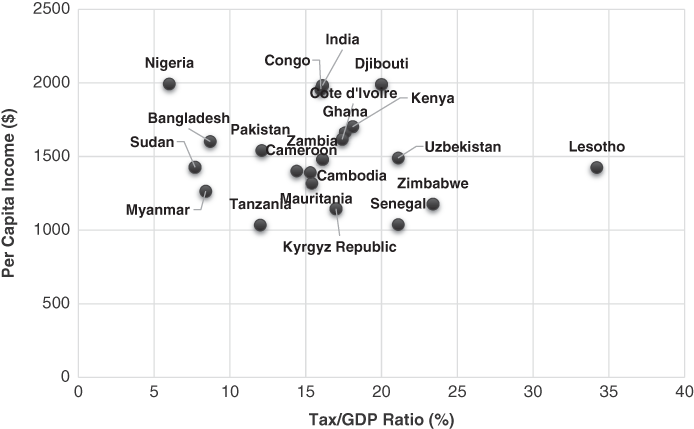
The tax performance model formalised by Bird et al. identifies several supply-side variables: per capita income; share of agriculture in GDP; size of the informal economy; access to natural resources; and share of trade in GDP. The latter two variables reflect the availability of easy tax handles.
The low per capita income relative to developed countries explains a part of the reason for the low tax to GDP ratio in Bangladesh. But, as noted, the low level of per capita income alone cannot explain the poor tax performance in Bangladesh because its tax to GDP ratio is only 50% of the average tax to GDP ratio in developing countries.
Regarding the roles played by the share of agriculture and the size of the informal economy, again they are a part of the factors that account for the low average tax ratio for Bangladesh relative to developed countries, but they do not explain the very low tax to GDP ratio for Bangladesh relative to other developing economies. Moreover, the GDP share of agriculture has fallen sharply over the years and continues to decline, while the share of the industrial sector has grown substantially. For example, between FY2013 and FY2018, the GDP share of the industrial sector grew from 29% to 34%, and the share of agriculture fell from 17% to 14%, but the tax to GDP ratio did not pick up, but instead declined from 9.5% of GDP in FY2013 to 8.7% of GDP in FY2018. Indeed, the 2018 industrial sector share in Bangladesh (34%) is substantially higher than the average for low-income countries (25%), yet the tax performance is substantially weaker than the average for low-income economies.
Concerning the role of the informal economy, unfortunately reliable estimates of its size and changes over time are not available. Nevertheless, a priori it is likely to be an important contributor to the low tax performance in general. However, it is not very likely that the share of the informal economy is substantially higher in Bangladesh than the average for low-income economies, and therefore, it is unlikely to be a reason for the very low tax performance relative to countries with similar per capita income.
2 Tax Composition and Structure
The composition of Bangladesh tax revenues is shown in Figure 6.5. The structure of taxation in Bangladesh has improved significantly over the years. The share of income and domestic production/consumption taxation has increased, while the reliance on international trade taxation has declined. The introduction of the VAT in 1991 made a major difference to both improving the tax structure and increasing the tax to GDP ratio. Thus, the increased role of domestic production/consumption taxation reflects the growing importance of the VAT in revenue generation. This is a positive development; yet the revenue yield of the VAT has been stagnant since FY2011 (Figure 6.6). When compared with the statutory VAT rate of 15%, the low yield is indicative of the low productivity of the VAT.
Bangladesh tax structure (% share in total taxes).
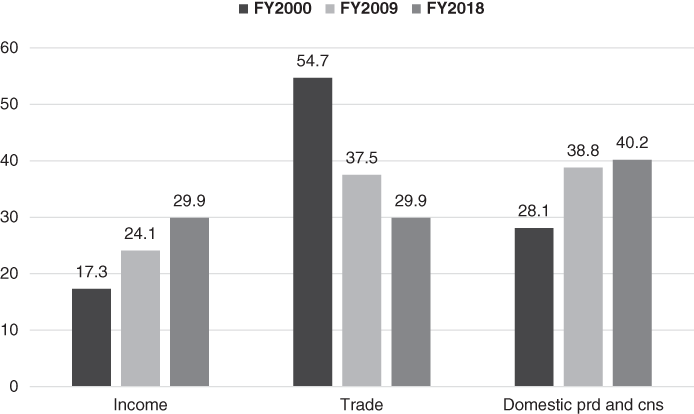
VAT revenue yield (% of GDP).
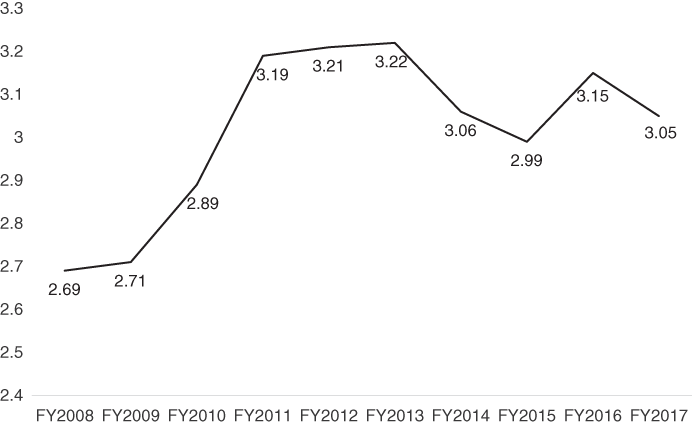
A useful way of assessing the quality of the tax structure is to compare the Bangladesh experience with other countries. Using data from the International Monetary Fund’s (IMF’s) International Financial Statistics for the years 1996–2001, Gordon and Li (Reference Gordon and Li2005) summarise the results of the international tax structure by income groups, as illustrated in Table 6.1. The income groups were selected from the World Bank classification of low-income (below US$ 745); lower middle-income (US$ 746–2,975); upper middle-income (US$ 2,979–9,205); and upper-income (greater than US$ 9,206) prevailing during 1996–2001. Although the data in the table are a bit outdated, it illustrates well the major differences in the observed tax structure by income groups, which is not likely to change much with updated data. However, the relative weakness of the Bangladesh tax structure will likely be magnified.
| GDP per capita | Tax revenue (% of GDP) | Income taxes (% of total taxes) | Corporate income taxes (% of total income taxes) | Consumption and production taxes (% of total taxes) | International trade taxes (% of total taxes) |
|---|---|---|---|---|---|
| <US$ 745 | 14.1 | 35.9 | 53.7 | 43.5 | 16.4 |
| US$ 746–2,975 | 16.7 | 31.5 | 49.1 | 51.8 | 9.3 |
| US$ 2,976–9,205 | 20.2 | 29.4 | 30.3 | 53.1 | 5.4 |
| All developing | 17.6 | 31.2 | 42.3 | 51.2 | 8.6 |
| >US$ 9,206 | 25.0 | 54.3 | 17.8 | 32.9 | 0.7 |
| Bangladesh (FY2018) | 8.7 | 29.9 | 51.0 | 40.2 | 29.9 |
Table 6.1 tells a useful story about the international experience with the modernisation of the tax structure as income grows and development proceeds. The main messages are set out in the following paragraphs.
First, the survey confirms that the tax to GDP ratio correlates positively with per capita income on average. Related to this, in order for the tax to GDP ratio to increase with income growth, the structure of taxation should be such that it responds well to income growth. In other words, the tax structure must be buoyant with respect to the expansion of economic activities, as reflected by the level of GDP.
Second, as development proceeds, the share of income taxes grows. Indeed, developed countries raise more than 50% of their revenues from income taxes. The rationale for this is based on the need to have a tax structure that meets three desirable principles of taxation: the ability to pay; equity principles of taxation; and the buoyancy argument.
Third, developed and upper middle-income countries rely much more on personal income taxes relative to corporate taxes. Thus, developed countries obtain as much as 45% of their total tax revenues from personal income taxes; corporate taxes account for less than 10% of total tax collections. The rationale here is that unduly high taxation of the corporate sector would tend to reduce investment incentives and lead to capital flight, which would hurt growth.
Finally, as development proceeds, the revenue role of international trade taxes tends to disappear. Thus, it accounts for less than 1% of total tax revenues for high-income countries and around 5% for upper middle-income countries. Even lower middle-income countries get less than 10% of their tax revenues from international trade taxes. The rationale for this is that trade taxes tend to distort resource allocation, hurting exports, and breeding inefficiency within domestic production.
Against this international evidence, the Bangladesh tax structure has many shortcomings. Bangladesh continues to rely very heavily on international trade taxes (30%), as compared with less than 9% for all developing countries. Even the low-income countries on average get only 16% of their revenues from international trade taxes, which is nearly 60% lower than in Bangladesh. This heavy reliance of Bangladesh on international trade taxes is a seriously negative policy development and indicates the distortionary effect of the tax structure.
The improvement in the performance of income taxes is a positive outcome. It is now roughly comparable with the average for low-income economies. But there are a number of major concerns. Although the share of income taxes from the corporate sector has been falling, it still accounts for more than 50% of income taxes. Corporate tax rates vary considerably by activities, with a heavy load on a few cash cows. Some sectors like mobile phone services, tobacco, and banks are required to pay hefty profit tax rates ranging from 40% to 45%. They account for most of the corporate tax yield. There are many exemptions that lower the average yield of corporate taxes.
A major issue of the tax structure is the very low yield from personal income taxes (Ahmed, Reference Ahmed2015). Very few people pay personal income taxes. Bangladesh does not have a universal income tax base, owing to exemptions of many sources of income and the very low taxation of capital gains. In addition, tax compliance is very low. The poor performance of personal income taxation is one of the primary reasons for the low tax buoyancy in Bangladesh, which has constrained the overall tax performance. Sadly, this also speaks volumes about the inequitable nature of the tax structure. Income inequality has grown substantially in Bangladesh, but the collection of personal income taxes has not increased much.
Finally, as noted, the productivity of the VAT has been stagnant, owing to many exemptions and inadequate coverage. This is yet another factor that explains the low buoyancy of the Bangladesh tax structure.
B Willingness to Pay: Demand-Side Issues
Bird et al. (Reference Bird, Martinez-Vazquez and Torgler2014) have argued convincingly that ‘a more legitimate and responsive state appears to be an essential precondition for a more adequate level of tax effort in developing countries’. They capture this effect of social and political institutions on tax performance by developing a fuller model of determinants of tax performance that includes the traditional supply-side variables as well as demand-side variables. Using cross-country data for mean values for 1990–1999 for 110 developing countries, they estimate the tax performance model (tax to GDP ratio) using a various mix of supply- and demand-side variables. The structure of the economy (measured by the GDP share of non-agriculture sectors), representing the supply side, and quality of governance (measured by the World Bank governance indicators and the International Country Risk Guide (ICRG) index), representing the role of institutions or demand-side variables, yield the most robust results. They conclude that institutions are a major determinant of tax performance.
Other econometric studies provide similar supportive evidence about the role of institutions in explaining tax performance (Ghura, Reference Ghura1998; Gupta, Reference Gupta2007; Nguyen, Reference Nguyen2015; Ricciuti et al., Reference Ricciuti, Savoia and Sen2019). Ghura (Reference Ghura1998) focuses directly on the role of corruption in explaining tax performance in African countries and finds that corruption is significantly and negatively correlated with tax performance. Using panel data over 25 years for 105 developing countries, Gupta (Reference Gupta2007) finds a negative contribution of corruption to tax performance and a positive contribution of political stability. Nguyen (Reference Nguyen2015) finds evidence that institutional quality has a significant positive impact on tax performance in low-income and lower middle-income countries. Ricciuti et al. (Reference Ricciuti, Savoia and Sen2019), in their empirical research focusing on the role of political institutions in building tax capacity, find evidence that the existence of effective constraints on the head of the government makes the tax system more accountable and transparent.
The governance challenges facing Bangladesh are well known. For example, an international ranking of corruption prepared by Transparency International puts Bangladesh at the bottom 15% of the countries ranked (149 out of 175 countries) for 2018. The World Bank governance indicators (2017) rank Bangladesh as follows: voice and accountability (bottom 30th percentile); political stability and absence of violence/terrorism (bottom 10th percentile); government effectiveness (bottom 22nd percentile); regulatory quality (bottom 21st percentile); rule of law (bottom 28th percentile); and control of corruption (bottom 19th percentile). These results suggest that there are major governance issues and challenges in Bangladesh that might serve to constrain tax performance. Drawing from the econometric evidence summarised above, it is most likely that corruption and other elements of weak governance are major factors for the low tax collection in Bangladesh.
The adverse impact of corruption on Bangladesh’s economic management is well recognised. It tends to operate through four main channels: land markets; financial markets; public procurement; and taxation. The corruption in tax administration is pervasive. This is a major factor underlying low tax compliance in all areas of taxation, which is a major constraint to tax revenue mobilisation.
The weakness on the demand side raises an important political economy issue. Are Bangladeshis unwilling to pay taxes because they do not feel that resources are used effectively? This is an empirical question that needs further research before an answer can be provided, but some preliminary observations can be made.
There is at least some degree of truth that higher tax collection is possible if citizens can see more and better public service provision in areas related to health, education, water, sanitation, and drainage. In developed countries, these services are typically provided by local government institutions. Bangladesh, on the other hand, is heavily centralised. While there are elected local government institutions, they are highly resource constrained in the absence of fiscal decentralisation (Ahmed, Reference Ahmed2017). Local government institutions collectively raise a meagre 0.16% of GDP as tax resources in Bangladesh (Ahmed, Reference Ahmed2017), as compared with an average of 6.4% of GDP in industrial countries and 2.3% of GDP in developing countries (Bahl, Linn, and Wetzel, Reference Bahl, Linn and Wetzel2013). Better services can also provide greater resource mobilisation through greater use of cost recovery policies (non-tax revenue measures). Strengthening of local government institutions and the associated fiscal decentralisation associated with more and better basic public services can certainly play a major role in increasing tax and non-tax revenues in Bangladesh.
However, there is also evidence that the demand for public services is growing in Bangladesh, and the Government has been making some efforts to respond to them. The budget making process involves considerable public consultation with various citizens groups, including business, non-governmental organisations, research and think tank institutions, and the media. This is conducted at quite a high level, involving the Finance Minister. The budget is also debated in the Parliament. The public consultation process is fairly open and considerable discussions about expenditure priorities and tax reform options are aired in these consultation process. The importance of increasing allocations for health, education, social protection, and infrastructure are raised every year. In response, the Government has done a fairly good job in keeping broad expenditure priorities focused on the development agenda. The Government has also protected total public expenditure as a share of GDP from falling despite shortfalls in revenues by running a budget deficit that is financed by foreign and domestic borrowing. This deficit has grown slightly over the past 10 years but is now capped at around 5% of GDP as a part of the Government’s self-imposed fiscal discipline.
The Government’s response to the need for tax reforms has also been positive in recent years, with as many as three reform efforts in the past eight years, but implementation has lagged behind due to political economy and administrative capacity considerations. These are discussed in detail in the next section.
The budget debate and discussions in the Parliament are less productive than they could be because the Parliament is usually dominated by the government in power. Tax issues are often raised and discussed but not in a forceful way that could bring about major changes. Additionally, the time when the budget is shared with the Parliament is less than a month before the current fiscal year ends and the new fiscal year begins. The budget is already approved by the cabinet and the prime minister, and the documents are printed. This leaves very little time and opportunity for any substantive budget debate and discussion in the Parliament. This is one area where the budgetary consultation process could be improved. One possible option is to involve the appropriate Parliamentary Committee responsible for oversight on budget and finance issues early in the process of budget making, to get timely inputs into the process. Another possible step would be for the Parliamentary Committee on budget and finance to request national researchers to prepare background papers on tax and expenditure issues and to discuss these with the committee early in the budget process. They could also seek technical assistance on the draft budget as inputs to their own review and discussions.
The Cabinet review of the draft budget could also be made more productive by requiring each Cabinet minister to make a presentation on their development targets and objectives for the year, and how adequate the proposed resource allocations are. Stronger participation by the Cabinet members in the budgetary process could be very useful in bringing out the internal tensions and the challenges posed by the revenue constraints upfront, so as to allow proper policy choices to be made, including the need for meaningfully strengthening revenue mobilisation. The Cabinet could also seek a technical briefing by NBR on the reasons for stagnant tax performance, and possible solutions.
VI Tax Reform Efforts and Implementation
Governance constraints not only impinge on citizens’ willingness to pay and contribute to the low regard for tax compliance, they also adversely affect tax reform efforts and the quality of tax administration. The tax reform experience in Bangladesh provides evidence that weak governance has been a major constraint on tax performance.
A Major Tax Reforms
A large part of the reason for the low tax performance and weak and stagnant revenue structure is the relative absence of tax reforms in Bangladesh. Tax reforms have generally taken a back seat in Bangladesh. The first and only successful major tax reform was carried out in 1991, when the VAT was introduced. This was the only tax reform that succeeded, despite considerable hiccups. The introduction of the VAT also coincided with a major reduction in trade protection, involving the removal of most quantitative restrictions and a cut in customs duties during the 1990s (Ahmed and Sattar, Reference Ahmed and Sattar2019). Since then, the tax system has been occasionally tweaked, particularly in the area of international trade taxes over the 2000–2010 period, but the underlying motivation was to reform the heavily protected trade regime often as condition for access to international aid. These second-phase reforms of the customs duties did not yield much benefit in terms of a reduction in trade protection. Indeed, once the heavily protected trade regime was brought down to more moderate levels during the first phase of trade and investment deregulation in the 1990s, trade taxes re-emerged as a major tool for revenue mobilisation based on the introduction of a complex system of regulatory and supplementary duties (Ahmed and Sattar, Reference Ahmed and Sattar2019).
The Government sought to re-engage in tax reforms in FY2011, when it announced a major Tax Modernisation Plan (NBR, 2011). This reform was a part of the FY2011 budget, although this was not converted into a law. The Government’s Sixth Five-Year Plan incorporated the main features of the Tax Modernisation Plan in articulating its macroeconomic framework and associated policy reforms. This was a fairly ambitious reform effort that sought to modernise the Bangladesh tax system, including reforms of tax laws, tax institutions, tax administration, and capacity building. The record shows little progress in its implementation: some limited progress was achieved in the computerisation of VAT administration, but overall tax administration remains as constrained as before.
A third attempt at tax reform happened in 2012, prodded by the IMF. As a part of its Extended Credit Facility agreement with the IMF, the Government adopted a new VAT reform act, called the ‘VAT and Supplementary Duty Act 2012’, which aimed at modernising and expanding the scope of the VAT. The reform promised to improve the efficiency of VAT collection and to raise substantial new revenues. However, the 2012 VAT Law remains on paper only and has not been implemented, in view of opposition from politically well-connected vested interest groups.
Finally, the new government elected in 2018 has now announced another round of tax reform in the National Budget FY2020 (Government of Bangladesh, 2019b). It has adopted the PP2041 as the long-term development vision and seeks to initiate implementation of the underlying macroeconomic and fiscal framework. In this regard, it has acknowledged the dismal tax performance in the past and seeks to change this by setting a lofty goal of increasing the tax to GDP ratio by an unprecedented 3% of GDP in one year. This massive tax target is to be achieved by focusing on the implementation of a revised version of the 2012 VAT Law and by strengthening income tax administration. Preliminary assessment of the proposed tax reforms suggests that the proposed tax reforms are inadequate and will not yield the desired revenue outcome (Ahmed, Reference Ahmed2019). There may be some marginal improvements in the tax to GDP ratio, but a substantial improvement will not be possible based on the inadequate reform proposals. The budget did not specify what institutional reforms will be undertaken to help mobilise such a massive increase in the tax to GDP ratio. Even the revised VAT 2012 proposal was not well defined in terms of which VAT rate would apply to which activities, and how it would be administered.
B Discretionary and Discriminatory Tax Treatment
Although the only successful major tax reform happened in 1991, in the context of the annual budget cycle, the tax laws/rules/regulations are invariably modified to introduce new measures or to provide exemptions or special tax treatments for activities or entities. This is most prevalent in the area of customs duties and the VAT. These annual interventions are mostly conveyed through the Statutory Regulatory Order (SRO). While it is understandable that budget management needs flexibility and reform measures are needed to increase revenues, the main issue with these annual interventions is that they are not based on proper analysis of the revenue and resource allocation effects of the interventions. More often than not, tax measures are ad hoc and based on easy tax handle considerations. For example, the annual changes in income tax measures tend to target easy handles such as tobacco, mobile telephone operators, and the banking sector. The VAT/customs duties tend to target imports. Indeed, to compensate for the revenue and protection loss from tariff reforms, a range of special supplementary duties and regulatory duties have mushroomed, which has offset the positive effects of tariff reforms on resource allocation, seriously distorted trade incentives, and hurt exports (Ahmed and Sattar, Reference Ahmed and Sattar2019). Furthermore, the reduction in the predictability of tax laws is an important constraint on the investment climate for the private sector.
Importantly, the introduction of exemptions and special tax treatment of activities/entities not only dilutes the transparency and predictability of tax policies, it substantially reduces the effectiveness of the tax base and is a major factor for lowering the revenue yields of the tax system. In most instances, these exemptions and special treatments, and often new budget measures, especially those related to trade taxes, are dictated by the political power of the beneficiaries. The potential revenue loss and adverse consequences for resource allocation (especially through the distortion of trade policy) are of no consequence. The large prevalence of discretionary and discriminatory tax interventions also creates room for corrupt practices by the staff of the NBR.
The way SROs reduce the transparency and predictability of the tax system is illustrated dramatically by a review of customs duty–related SROs issued between FY2015 and FY2019. As many as 926 SROs were introduced, each aimed at providing a special benefit to a target group. A sample from this long list of SROs is provided in Annex 6.1, to give a flavour of the kind of negotiated settlements that happen in taxation in Bangladesh. In most cases, these special treatments were allowed as a response to political lobbies by the beneficiary group. There are similar SROs related to income tax, the VAT, and regulatory/supplementary duties. The SROs are also a good illustration of the absence of systematic tax policy analysis. The SROs are mostly introduced to benefit politically well-connected groups: there is almost no concern about what this does to resource allocation or tax collection. This ad hoc approach to tax policy and tax administration is a serious problem that must be addressed in order to modernise the tax system in Bangladesh.
C Political Economy of Tax Reforms
The absence of significant tax reforms in Bangladesh despite an overall buoyant economy and the growing fiscal constraint on development is a serious problem that threatens to undermine the long-term sustainability of development progress. The half-hearted attempts with the implementation of the 2011 Tax Modernisation Plan, the inability to implement the 2012 VAT Law, and the inadequacy of the latest attempt to reform the tax system in the FY2020 budget suggest a combination of inadequacy of political will and a lack of readiness to tackle the tax challenge. The transparency and predictability of the tax system is further complicated by the introduction of new budget measures every year on an ad hoc basis along, with new exemptions and special tax treatments.
The tax literature recognises the political nature of taxation (John, Reference John2006; Brautigam et al., Reference Brautigam, Fjeldstad and Moore2008; Prichard, Reference Prichard2010; Bird et al., Reference Bird, Martinez-Vazquez and Torgler2014; Besley and Persson, Reference Besley and Persson2014; Ricciuti et al., Reference Ricciuti, Savoia and Sen2019). One important piece of research in the context of Bangladesh that has sought to analyse the tax reform impasse and the frequent use of ad hoc tax measures through SROs by applying the political economy lens is that by Hassan and Prichard (Reference Hassan and Prichard2014). Their paper argues that the prevailing tax system in Bangladesh is the outcome of a complex set of negotiations between formal and informal institutions based on micro-level incentives for each of the political actors. As a result, the tax system is highly informal, is administered manually rather than on an automated computerised basis, and involves high levels of discretion. This dysfunctional system is sustained because it serves the interests of powerful political, economic, and administrative actors. Specifically, ‘the current system delivers low and predictable tax rates to businesses, provides extensive discretion and opportunities for corruption to the tax administration, and acts as an important vehicle for political elites to raise funds and distribute patronage and economic rents’ (Hassan and Prichard, Reference Hassan and Prichard2014, p. v). Reform efforts are constrained by the need to preserve this ‘political settlement’. Reform outcomes are weak or they fail because the resultant negotiations that seeks to reconcile the interests of the various competing groups with the need for reforms cause the reforms to be either abandoned or weakened considerably. In this framework, the SROs are simply instruments for favour distribution through discretionary and discriminatory application of the tax laws and rules and regulations.
The research from Bangladesh and other international experiences support the hypothesis that tax reforms are essentially political in nature and cannot succeed without reform champions at the highest level. They also recognise the strong link between economic and political governance, state tax capacity, and revenue mobilisation. As with any major reform, there are winners and losers from tax reforms. The stakes are particularly high with tax reforms because substantial amounts of money are involved. The beneficiaries of the present tax system in Bangladesh (political elites, big business, and the NBR administration) are happy with the status quo. The influence of these powerful lobbies will need to be offset by reform champions within the political system and in the civil administration.
This political economy lens can help us understand why the 1991 VAT Law was successfully implemented while other tax reform efforts failed. The successful implementation of the 1991 VAT Law and hurdles faced with the implementation of the Tax Modernisation Plan 2011 and the 2012 VAT reform experiences are also consistent with the lessons from international experience that suggest that tax reforms cannot succeed if they are donor-driven or led by international advisers (Dom and Miller, Reference Dom and Miller2018). Tax reforms must be led by the Government, with the Finance Minister in the lead, strong support by the NBR, and solid political backing from the head of the government. It must also have strong technical foundations based on sound background research, and implementation support in terms of suitable administrative infrastructure, including ICT solutions.
The 1991 VAT reform met all of these conditions. The reform was home grown. The technical work was led by senior staff of NBR and supported by technical assistance from the IMF. Overall policy leadership was provided initially by a technocrat Finance Minister and subsequent ministers carried through the work to the implementation stage. An IMF fiscal expert of Bangladeshi origin was procured and stationed in Dhaka on a long-term basis. Most importantly, the reform had the political backing from all heads of the government involved from the design to the implementation phases.
The 2011 Tax Modernisation Plan was grounded in the recognition by the Finance Minister that the tax revenue was inadequate and needed to be increased substantially. Accordingly, the Tax Modernisation Plan targeted an increase in revenue by 4 percentage points of GDP over a four-year period (FY2011–FY2015). The Plan was home grown and developed by a reform-minded Chairman of the NBR. He had the initial support of the Finance Minister, who was enthused by the prospect of substantial gains in tax revenues. But this support was more personal than institutional. The nature of the reforms envisaged required the full support of the prime minister and the cabinet, but a broad-based discussion of the reforms with the prime minister and the cabinet did not happen. Importantly, technical preparations were inadequate. There was also absence of ownership at the NBR staff level. Most unfortunately, the champion of the NBR Modernisation Plan 2011, the NBR chairman, was replaced by a new chairman in 2013. Unlike in the case of the VAT Law 1991, where the reform momentum continued despite the change in government because of a continuity of core NBR staff who were pushing the reform, the change in NBR leadership, combined with the absence of strong support from the political leadership, caused the 2011 reforms to fail.
The VAT 2012 reform was mainly pushed by the IMF under the Extended Structural Adjustment Facility programme. Within NBR, the Member VAT Policy and Member Customs were the main champions. There was also a solid technical assistance programme to help with the design of the new law and its implementation. At the political level, the Finance Minister provided support. The initial delay was caused by the need for adequate preparatory work. Finally, when the NBR was basically ready to launch implementation in the context of the FY2018 budget, it faltered because of strong opposition from the retail-level trading community, represented by the politically powerful and well-organised Federation of Bangladesh Chambers of Commerce and Industry (FBCCI). This opposition was grounded in the reality that except for the large retail units, most retail-level traders are a part of the informal economy and are therefore out of the tax net. The introduction of the new VAT Law would require the exposure of transactions and earnings to NBR through proper record-keeping. In this way, they could be exposed to higher tax obligations and/or rent-seeking intrusions by the tax officials. The prime minister decided to postpone the implementation decision in view of the strong FBCCI opposition and advice from the prime minister’s political party about the potential downside risks to the party in the then upcoming 2018 national elections, which were scheduled for the end of December 2018.
The half-hearted attempt to reform the tax system in the FY2020 budget is largely explained by the inadequacy of understanding regarding the complexity of the tax challenge and by an absence of strategic thinking. The installation of a new government elected in 2018 and involving a new Finance Minister provided a major opportunity for Bangladesh to rethink its tax reforms. As noted, there was indeed some positive intent. But the review of the FY2020 budget document shows that this positive political intent is not backed by a well-defined reform strategy and adequate associated specific reforms of tax policies and tax administration. Most unfortunately, instead of implementing the well thought out 2012 VAT Law in its original form, and taking advantage of the administrative progress already made, the new Finance Ministry team developed a hodgepodge variant of the 2012 VAT Law that was not properly studied or analysed in terms of revenue impact and the nature of the administrative preparations that would be required. Additionally, ambitious tax targets for personal income tax yields were set that had no policy or administrative reform content beyond the idea of recruiting additional income tax collectors. This is unfortunately a reflection of the ‘policing approach’ to tax collection that has proven to be the bane of the income tax system, as further explained below. So, political willingness alone is not enough. It must be backed by sound tax policy analysis and administrative reforms to improve the tax system.
D Tax Administration Issues
1 Taxation of Personal Income
It is well known that weak tax administration can be a serious constraint to tax resource mobilisation in developing countries. An excellent summary of these issues and lessons learnt from country experiences is contained in Bird (Reference Bird2015). A particular challenge is the ability to administer efficient and progressive personal income taxation. Thus, a major difference between developing and developed countries is the much larger share of personal income taxation in total taxation. Bangladesh collects a mere 1.3% of GDP as personal income taxes (FY2018), and this ratio has grown only marginally (it was 1% of GDP in FY2010), even as per capita income more than doubled in nominal dollar terms and increased by 92% in real dollar terms over FY2010–FY2018.
In addition to numerous legal exemptions, at the heart of the personal income taxation problem is the low level of compliance. The estimated compliance rate is a mere 12% (Ahmed, Reference Ahmed2019). Owing to exemptions and low tax compliance, actual tax yield from personal income has grown only slowly, from a low yield of 0.41% of GDP in FY2000 to about 1% of GDP in FY2018. As compared to this low revenue yield, depending upon the level of income, the legal tax rates vary from 10% to 30% plus (when the so-called wealth taxes are added). The potential loss of revenue from exemptions and low compliance is illustrated in Table 6.2 under two scenarios. The first scenario considers an effective average tax rate of 10% on the income share of the top 10th percentile. This group has average income much higher than the tax exempted level of Bangladeshi Taka (BDT) 2,50,000. The second scenario is a bit more ambitious and involves an effective average tax rate of 15% on the income share of the top 10th percentile. With proper reforms of the income tax that would not require any increase in tax rates but better implementation, including a move towards the concept of a universal income tax base with minimum exemptions and an effective tax administration mechanism, the yield from personal income tax could reach 3.8% of GDP under Scenario 1 and 5.7% of GDP under Scenario 2. Compared to these personal income tax potential scenarios, the very low actual yield dramatically illustrates the very low productivity of the personal income tax system.Footnote 3
| HIES | Income share of top 10% | Effective tax rate (10%) | Potential income tax (% of GDP) | Effective tax rate (15%) | Potential income tax (% of GDP) | Actual income tax (% of GDP | Tax productivity (%) (10% av. effective rate) | Tax productivity (%) (15% av. effective rate) |
|---|---|---|---|---|---|---|---|---|
| 2000 | 38.1 | 10 | 3.8 | 15 | 5.7 | 0.41 | 10.8 | 7.2 |
| 2005 | 37.6 | 10 | 3.7 | 15 | 5.6 | 0.60 | 16.2 | 10.7 |
| 2010 | 35.9 | 10 | 3.6 | 15 | 5.4 | 0.95 | 26.4 | 17.6 |
| 2016 | 38.2 | 10 | 3.8 | 15 | 5.7 | 1.00 | 29.0 | 19.3 |
Tax evasion is particularly large at the highest levels of income. A range of factors explain this tax evasion problem, including legal tax exemptions and loopholes, political connections, corrupt practices, complexities of tax assessment and collection, inefficient tax audits, and high marginal rates of taxation. Reform efforts have focused on enlarging the tax base by bringing more taxpayers into the tax base through electronic tax IDs, annual tax fairs, and cross checks on bank accounts, utility bills, home rentals, and import transactions, etc. To improve the productivity of audits, a Large Taxpayer Unit has also been established to monitor the tax returns of large payers. These reform efforts have yielded some results. The number of registered personal income taxpayers has increased noticeably (Table 6.3), but the average nominal yield per taxpayer has been erratic, with no discernible pattern. The average return per taxpayer has fallen when accounting for inflation.
| No of tax payers (ml) | Tax collection (BDT, bl) | Average yield (BDT) | |
|---|---|---|---|
| FY2011 | 1.231 | 99 | 80,366 |
| FY2012 | 1.233 | 125 | 101,079 |
| FY2013 | 1.369 | 167 | 122,075 |
| FY2014 | 1.363 | 119 | 87,109 |
| FY2015 | 1.627 | 126 | 77,173 |
| FY2016 | 1.721 | 173 | 100,691 |
| FY2017 | 2.188 | 209 | 95,612 |
These results suggest two major concerns with the income tax mobilisation drive. First, while the effort to bring more people into the income tax net is laudable, the productivity in terms of impact on revenue yields has been small. Second, the stagnant or declining nominal yield per taxpayer suggests that tax returns are not able to capture the tax benefits of the growth of personal income at a time where the economy is highly buoyant and there is evidence of a growing concentration of personal income from HIES data. The evidence would seem to support the contentions of two populist perceptions: first, that the tax net is focused on capturing low-income taxpayers while many large-income earners remain outside the net; and second, the large-income taxpayers that enter the net end up paying low amounts through collusion with income tax collectors.
Tax evasion is an outcome of three major factors. First, according to the Labor Force Survey of 2017, some 85% of the workforce is in the informal sector and most workers are outside the tax net. Second, most of the rich elites are well connected with the government in power and are able to escape taxes, either by not filing or by sending in low returns that are not subject to audits owing to the political connection. Third, it is well known that many taxpayers are able to get away with low returns by making informal deals with tax collectors. The manual approach to tax assessment makes this process so much easier.
A serious problem with tax administration in Bangladesh is the complexity of the tax collection process and the harassment of the tax payer. Tax filing is not user-friendly, simple, or automated. One example of a bad feature of the present tax design that discourages tax filing and leads to harassment and corruption is the requirement to file a wealth statement based on balancing income and expenditure along with the tax return. Many taxpayers find this requirement onerous and it discourages them from filing taxes because of the fear that this will lead them to experience various forms of harassment. It also encroaches on citizens’ privacy. While the Government has the right to tax income, it is debatable whether citizens should be required to explain how they spend their money.
The value of this dubious requirement in terms of tax collection is negligible and on a net basis negative because it discourages tax filing. Importantly, there is a common perception that this feature creates incentives for income tax officers to harass taxpayers and extract a bribe. As an example, income tax collections and compliance are very high in the USA, where there is no such requirement to submit a wealth statement based on a matching of income and expenditure. On the negative side, in Bangladesh, the returns from personal income taxes as a share of GDP have hardly grown over the eight years from FY2010 to FY2018, despite a near doubling of real per capita income in dollar terms. It is obvious that the wealth and income expenditure statements have not helped increase revenues but have tended to support revenue leakages through non-filing and collusion between taxpayers and tax collectors.
2 Corporate Taxation
In the case of corporate taxes, similar problems exist as for income taxes. Most small enterprises are not registered and therefore are not a part of the tax net. Even for firms that are registered, the compliance rate is only 21% (Ahmed, Reference Ahmed2019). The low compliance rates reflect a combination of political power of many business houses that are well connected with the Government, and informal settlements between companies and tax officials. The corporate tax rates vary considerably by activities. There is a zero rate for many sectors or activities that are either exempted from taxes or have been given tax holidays for a number of years. Positive rates range from a low of 15% to a high of 45%. The NBR has targeted a few cash cows and slapped them with high tax rates: tobacco (45%); mobile telephone companies (40%); and banks and insurance companies (40–42.5%). Tobacco and mobile telephone companies are already heavily taxed through the excise, customs duties, and VAT instruments. Every year during the formulation of the annual budget, there is extra scrutiny to determine how much additional revenues can be extracted from these companies either through corporate taxation or by taxing their inputs. There is very little analysis to understand the implications of the existing corporate tax structure on incentives, including for foreign direct investments. Tax administration is cumbersome and time-consuming. The burdensome nature of tax filing has been identified as a major factor for the high-cost nature of doing business in Bangladesh, and as a constraint on improving the investment climate (Ahmed, Reference Ahmed2017).
An added problem is the large informal economy. Most small and micro enterprises escape the tax net because they operate outside the formal system and are not registered with the Government, either through business licences or through a tax identification number. The fear of taxation in terms of harassment is so large that small firms prefer to stay informal and forgo many benefits of government support programmes, including access to formal credit. In this regard, the tax system may work as an important deterrent to the growth of small enterprises and employment.
3 Implementation of the VAT
Problems of tax administration are also acute in the case of the VAT. The many exemptions and the inability to extend the VAT fully to the retail level, many services and to small and micro enterprises, along with evasion and tax administration inefficiencies, have sharply lowered the productivity of the VAT (Mansur et al., Reference Mansur, Yunus and Nandi2011; Ahmed, Reference Ahmed2013). Even for firms that are registered, the compliance rate is estimated at 12% (Ahmed, Reference Ahmed2019). The present VAT system is very inefficient and is characterised by low productivity. Cross-country comparisons show that this productivity is among the lowest when Bangladesh is compared with Thailand, Vietnam, Sri Lanka, Nepal, India, China, Indonesia, Philippines, and Pakistan (Mansur et al., Reference Mansur, Yunus and Nandi2011). The factors that contribute to this low productivity include multiple rates, large exemptions, tax evasion, and inefficiencies in VAT administration. These administrative inefficiencies include: cumbersome tax filing; absence of a centralised registration system leading to multiple registration; a weak and burdensome audit system; and the lack of a modern computerised VAT system (Mansur et al., Reference Mansur, Yunus and Nandi2011; Ahmed, Reference Ahmed2013).
As noted earlier, in recognition of these difficulties, and prodded by the IMF, in 2012 the Government enacted the new VAT Law. The Law simplified and modernised the VAT, along with provisions for major improvements in VAT administration, including a shift from manual to electronic filing, a voluntary approach to tax compliance, broadening of the tax base, a single registration for each taxpayer, the use of the invoice credit method for tax assessment, and a simplified VAT refund system (Ahmed, Reference Ahmed2013). Substantial technical assistance was arranged to prepare for the implementation of the new law. Between 2013 and 2017, good progress was made in preparing for the implementation. The draft budget for FY2017/FY2018 was prepared with a view to implementing the new VAT Law. But, as noted, the implementation was postponed on political grounds.
4 Implementation of Customs Duties
The implementation of taxes on international trade is more organised and better administered. Modernisation of the customs system started in 1994 with the adoption of the Automated System for Customs Data (ASYCUDA) of the United Nations Conference on Trade and Development (UNCTAD). Bangladesh has sought to follow through with the various updates of the ASYCUDA. Progress has also been made on import valuation. Several reforms have been implemented to speed up and simplify the customs clearance process, including rolling out the Authorised Economic Operator programme, initiating implementation of a National Single Window, the establishment of a National Enquiry Point, and the development of the Advance Ruling System. A new Customs Act is also being prepared. Nevertheless, many problems remain. On the revenue mobilisation side, the main problem is tax evasion based on collusive behaviour between importers and the customs staff. This is a governance challenge that permeates the tax administration. Additional issues emerge for private investment in terms of high transaction costs of doing business at ports. Despite progress in simplifying clearance procedures and valuation, the transaction costs remain high, as indicated by the World Bank’s Ease of Doling Business indicators.
5 Tax Administration Capacity
A generic problem in tax administration is low tax capacity. The NBR lacks autonomy and is run like any other government department; it is staffed by civil servants. Its primary focus is tax collection through policing and threats: there is no concept of tax service or seeking voluntary compliance through user-friendly approaches.
There is very little capacity to undertake tax policy analysis (PRI, 2013). Tax changes are made in almost all budgets. There is little analysis of the revenue and resource allocation impact of these changes. This lack of separation of tax policy and tax collection, and the absence of capacity of the NBR to implement proper tax policy and analysis, is a severe institutional constraint that has hurt fiscal policy development.
Numerous efforts to upgrade the capacity of the NBR to improve tax collection and tax policy analysis have failed owing to a lack of political and administrative support (PRI, 2013). In situations where a reform-minded NBR chairman has sought to bring about tax administration changes, this has failed because the chairman was replaced before implementation could begin. Frequent changes at the top (chairman NBR) have further reduced the ability to reform NBR.
6 Summary of Institutional Constraints: Weak State Fiscal Capacity
The picture that emerges of the taxation system of Bangladesh is of a system that is characterised by informality; negotiated settlements by elites; a highly complex, non-transparent and discretion-based system; a manually run and weak tax administration; low compliance; corrupt practices; and low accountability. The end result is a highly inefficient, corrupt, and low-yield tax system. The political economy tax literature recognises this as an indication of weak state fiscal capacity.Footnote 4 The basic argument is that the reason why rich countries have a considerably higher average tax to GDP ratio is because they have invested successively in their fiscal capacities over a long period of time. This higher fiscal capacity is reflected in much greater reliance on modern tax bases like income and VAT, as well as much better ability to enforce tax compliance. By contrast, low-income developing countries have weak state fiscal capacity that sharply reduces VAT and income tax compliance, and therefore their ability to raise adequate fiscal resources. To increase tax revenues, a low-income country will need to invest in institutions that increase the state fiscal capacity. Within developing countries, there are differences in the degree of weakness of state fiscal capacity, some being relatively stronger than others and hence having relatively better ability to mobilise fiscal revenues than others. In this framework, Bangladesh falls into the list of countries that have among the weakest state fiscal capacity.
The specific areas of capacity building required will vary from country to country, but some generic areas that could help build state fiscal capacity include: strengthening the legal framework to enforce contracts; the establishment of property rights; strengthening the rule of law; facilitating the growth of democratic institutions; growth of the financial sector; and strengthening of the tax administration. Thus, state fiscal capacity is a combination of political institutions, economic institutions, and administrative institutions. Progress in any of these three areas will help increase state fiscal capacity and contribute to increasing revenues. The development of political institutions is a tough challenge and will likely evolve over a longer period of time, but investments in economic and administrative institutions hold greater promise for progress in the medium term.
VII The Way Forward
Summarising his views on the lessons of international experience with tax reforms, noted tax expert Richard Bird writes: ‘Fifty years of experience tells us that the right game for tax researchers is not the short-term political game in which policy decisions are made. Academic researchers and outside agencies interested in fostering better sustainable tax systems in developing countries will employ their efforts and resources most usefully if they play in the right game. That game is the long-term one of building up the institutional capacity both within and outside governments to articulate relevant ideas for change, to collect and analyse relevant data, and of course to assess and criticize the effects of such changes as are made. Tax researchers, especially in developing countries themselves, can and should play an active role in all these activities’ (Bird, Reference Bird2015). While tax reforms and tax institutional capacity building are indeed long-term endeavours, the fact that Bangladesh is a negative outlier in terms of the very low tax to GDP ratio when compared with countries at similar per capita income levels suggests that there is scope for progress even in the short term, through some relatively simple tax administration improvements.
A pertinent question to ask is, if tax reforms and administration improvements did not happen in the past why would they happen now? The answer to this question lies in the fact that the awareness at the highest political level of the need for some immediate minimum tax reforms is growing in Bangladesh. This is partly due to the emergence of an increasingly constrained fiscal space that is limiting the capacity of the Government to deliver even basic services at the same time that demand for these services are growing and expectations are building up. The successful implementation of the Government’s development strategy has accelerated GDP growth and improved human development and poverty outcomes. To keep the support of the people, the Government is now aspiring to reach greater development heights. It has adopted a new development vision, called the Vision 2041, and has converted this into a new development strategy, PP2041. The vision calls for Bangladesh to secure upper middle-income status (World Bank Atlas method) by FY2031, and high-income status by FY2041. Vision 2041 was an integral part of the Government’s 2018 election manifesto.
The Government’s own macroeconomic framework for PP2041 shows that the targets to reach upper middle-income status and eliminate extreme poverty by FY2031 require a doubling of the tax to GDP ratio over the next 12 years. Also, as articulated in PP2041, the Government agrees that the main focus of tax reforms should be to raise the revenue base for income and consumption taxes, while reducing reliance on trade taxes, in order to eliminate the anti-export bias of trade protection.
To show its concern about poor revenue performance and signal its intention to follow the PP2041 fiscal path, the Government put forth an ambitious target of raising the tax to GDP ratio by 3 percentage points in the FY2020 budget. However, as noted, this ambitious tax target was not adequately backed by policy actions. The new Finance Minister was probably not fully aware of the complexities and inherent weaknesses of the tax system. Independent research by fiscal policy experts and associated public debate on the need for credible tax reforms has set the stage for some constructive discussions about what might constitute some helpful and achievable tax administration reforms over the next few years as steps towards achieving the tax targets of PP2041. These reforms are based on the lessons from international experience, as well as experience from Bangladesh. The Government is now open to greater and more meaningful consultation with independent researchers on the type of tax reforms needed to achieve the PP2041 fiscal targets. This is an important development and consistent with Richard Bird’s observation noted above concerning the positive role of independent tax research and policy debate in furthering the case for tax reforms.
A Tax Institutional Reforms
Consistent with the analysis of weak state fiscal capacity, some minimum institutional reforms are essential to see any systematic progress with tax revenue effort. These include the following:
1. Separation of tax policy from tax collection: An essential institutional reform is to separate tax policy from tax collection. Although the NBR is entrusted with both tax policy and tax collection, it de facto serves as a tax collection entity. While it has senior tax policy staff, the overwhelming focus is on tax collection. This single-minded focus on tax collection has come into serious conflict with the design of a broad-based tax policy that is consistent with revenue goals, ensures the efficiency of tax collection, and avoids adverse implications for incentives and national resource allocation. It also explains the ad hoc nature of tax policy during the annual budget cycle, where the focus of tax policy is on raising revenues to meet the budget target, without regard to the impact of the tax measure on resource allocation or efficiency. A better arrangement would be to assign the NBR the primary responsibility for collecting taxes and giving tax policy responsibility to either a special unit within the Internal Resource Division or to the Budget Division of the Ministry of Finance. The advantage of assigning this to the Budget Division is that this entity has substantial macroeconomic policy analysis capabilities. It also has the responsibility for developing the medium-term budgetary framework and the annual budgets. These provide the Budget Division with considerable knowledge and stronger capabilities to formulate tax policies than the NBR or the Internal Revenues Division.
2. Strengthening tax policy and tax collection agencies: Whatever institutional arrangements the Government may adopt, both tax policy and tax collection efforts have to be substantially strengthened through the induction of better professional staff. The Government has considerably increased civil service salaries in recent years, which has improved incentives for professional staff to apply for public service positions. The tax departments (the NBR and the tax policy unit) need a much stronger combination of professional staff with civil service staff. If needed, some additional incentives could be provided to attract fixed-term tax professional experts to the Ministry of Finance. This small investment in tax administration capacity would have a high rate of return in terms of better tax policy and revenue performance.
3. Selection and tenure of the NBR chairman: The frequency of changes of the NBR chairman has a serious negative impact on tax collection. The Government might want to delink the position from the civil service, select the chairman on a professional basis, and establish a minimum tenure of four to five years. This will strengthen the quality of tax administration leadership, de-politicise this position, and provide stability and an incentive for the chairman to take tough actions against corrupt practices.
4. Fully digitising the tax administration: Consistent with the policy of the prime minister to rapidly adopt online technology as the primary mode of transactions with the Government, full digitisation of the tax administration is of the highest priority. Some progress has been made for the customs and VAT administration, but there is a long way to go, especially for income tax administration. Full digitisation of tax administration, especially personal income taxation, will go a long way towards reducing corruption, increasing compliance, and increasing tax revenues.
5. Strengthening the budget consultation process: The Government already has a healthy consultation process involving the citizens. This should continue. However, the participation of the Cabinet and the Parliament could be strengthened considerably. The Cabinet review of the draft budget could be made more productive by requiring each Cabinet minister to make a presentation on their development targets and objectives for the year, and to discuss the adequacy of the proposed resource allocation to secure them. This process could be very useful in bringing out the internal tensions and the challenges posed by the revenue constraints upfront, so as to allow proper policy choices to be made, including the need for meaningfully strengthening revenue mobilisation. Regarding the Parliament, one possible option is to involve the appropriate Parliamentary Committee responsible for oversight of budget and finance issues early in the process of budget making, to get timely inputs into the process.
6. Promote fiscal decentralisation: Greater fiscal decentralisation could help mobilise revenues by providing a better link between service delivery and accountability. The Government has made some progress with administrative decentralisation by instituting a system of elected local government institutions. The next step is to assign clear service delivery responsibilities without overlap with competing national entities, build local government institution service delivery capacities, and institute a well thought out fiscal decentralisation system.
B Reform of the VAT
The proposed reform of the VAT leading to the VAT Law of 2012 was sound. Technical assistance to help with implementation had also progressed well. It is most unfortunate that this progress was ignored by the new government and a hodgepodge VAT reform was introduced in the FY2020 budget. As most tax experts familiar with the Bangladesh VAT system agree, the FY2020 VAT reform will likely not work. The Government is hesitant to accept this view and is bent on implementing the modifications to the VAT system it introduced in the FY2020 budget. It is hoped that the implementation experience with the VAT modifications of the FY2020 budget will provide good evidence of its limitations and the need to revert back to the provisions of the 2012 VAT Law. This hopefully can set the stage for the implementation of a solid VAT reform in the FY2021 budget.
C Reform of Income Taxation
Notwithstanding all the caveats associated with political and administrative constraints on income tax collection, it is high time that the Government made a serious effort to reform the income taxation regime, especially as it seeks to achieve upper middle-income tax status.
D Corporate Taxation
Several actions can be taken in regard to corporation taxation, including streamlining the corporate tax rate in a series of steps. As a first step, with the exception of tobacco, the maximum rate of taxation should be lowered, starting with 30% in FY2021 and 25% in FY2022. As rates come down, exemptions and tax holidays for foreign direct investment or specific sectors must be eliminated over a well-defined period, so that by and large all investors are required to pay taxes. Once the tax rates are lowered and made internationally attractive, exemptions will not be needed. Capital flight for taxation purposes will not be an issue because the investor will have to pay taxes in other countries as well.
E Personal Income Taxation
The personal income reform needs a substantial overhaul based on further research and analysis. The reform that is required is to lower the marginal and average tax rates and to increase the tax base through voluntary compliance. Bangladesh can learn the lessons from the positive experience with income taxation from other countries. These lessons include the following:
The best approach to increasing the tax base is to provide incentives for voluntary compliance. Having large marginal tax rates and putting pressure on those who pay is a recipe for disaster. It is like killing the goose that lays the golden eggs. Many taxpayers will find ways to escape the tax net by entering into collusive behaviour with the tax collectors, as presently.
The tax system must be based on the principles of universal income, self-assessment, and productive and selective audits. It must be fully digitised wherever possible, with no interface between the taxpayer and tax collector, except when subject to audits.
The tax system must be simple, with a low compliance cost. Indeed, the simpler the system and the lower the tax rates, the more likely it is that there will be voluntary compliance and the less the scope for tax harassment and corruption.
The audit system should be highly selective and productive. The objective of the audit system should be to discourage tax avoidance and not serve as an instrument of harassment or to extract a bribe. The audit system should be based on a computer-driven model developed on the basis of well-identified criteria that, if violated, would trigger an audit. The criteria must make the audit productive so that the collection cost is only a fraction of the total taxes raised through audits. It should be highly selective, with no more than 5% of returns audited systematically.
The attitude of the NBR should change from tax ‘policing and harassment’ to voluntary tax compliance based on a user-friendly and tax service approach.
Self-assessment, digitisation, and simplification of personal income tax filing with a user-friendly and service-oriented approach will vastly increase tax compliance and tax collections, as reflected in the experience of countries with good income tax collection records.
F Property Taxation
Most upper middle-income and high-income economies have a well-established system of fiscal decentralisation whereby the property taxes are assigned to local governments as the major source of tax revenues. In Bangladesh, such a political decision on fiscal decentralisation has yet to happen, although it is imminent as Bangladesh aspires to attain upper middle-income status. Indeed, the PP2041 puts considerable emphasis on the need for fiscal decentralisation. The next step is the political debate and buy-in at the top level.
In the interim, the Government should design and implement a modern property tax system that is different from the present fragmented two-part system whereby the NBR collects a wealth tax as a part of the income tax and local governments collect some nominal taxes on properties. A modern property tax that is based on the true market value of properties and evaluated and updated systematically using a computerised property ownership database is an essential element of a modern tax system. There are many models of a well-designed property tax system that can be researched and implemented in the specific political economy context of Bangladesh. Implementation can proceed in a phased manner, starting with the capital city of Dhaka and then extended to other divisional cities and finally to all urban areas.
G Reform of the Customs System
Recognising the continued high cost of customs administration and its adverse effects on trade logistics and private investment, the NBR has recently developed and adopted a new customs reform programme known as the Customs Modernisation Strategic Action Plan 2019–2022 (NBR, 2019). This is a comprehensive and ambitious endeavour that seeks to improve the efficiency of the customs system and reduce the transaction costs related to international trade. Tariff rationalisation is also an objective, although the end game of tariff rationalisation (reduction of trade protection) is less clear. Nevertheless, this is a welcome initiative and its sound implementation should be a high policy priority.
Annex 6.1 Import Duty–Related Sros Fy2015–Fy2019
| CPC | Description | Purpose | Beneficiary |
|---|---|---|---|
| 135 | Car/Micro Bus imported by industrial unit of EPZ | Special exemption for imports of cars/jeeps | EPZ industries |
| 137 | Car/Jeep imported by MP’s | Special exemption for imports of cars/jeeps | Members of Parliament (MPs) |
| 140 | Generator Assembling Plant, SRO 80/2007, CD 0% | LP gas cylinder manufacturers | LP gas manufacturers |
| 148 | AIT exempted for warehouse | Special exemption benefit | Special benefit to certain groups |
| 156 | Poultry Accessories, SRO-158/2004, CD, SD, & VAT exempted | Special benefit for poultry firms | Poultry sector |
| 157 | Textile, SRO-157/2004 (Table-I, CD, SD, VAT exempted & Table-II, CD 7.5%) | Textile machinery and parts | Textile sector |
| 159 | Leather, SRO-169/2005, CD 7.5% | Special benefit to raw materials for leather sector | Leather sector |
| 168 | AIT applicable, other duties & taxes exempted in full under Special Order | Special exemption benefit | Special benefit to certain group |
| 170 | All Taxes exempted under Authority of NBR | Special exemption benefit | Special benefit to certain group |
| 176 | Goods Imported as Defence Stores Memo 246 of 10-04-81 | Defence store | Defence forces |
| 189 | News Print, SRO-144/2007, CD 10% | News print | Newspaper industry |
| 200 | Gas Cylinder, SRO, CD 3%, SD, VAT, & ATV exempted | Gas cylinders | Gas cylinder manufacturers |
| 201 | Shipbuilding, SRO-280, CD – 5% | Ship building | Ship manufacturers |
| 205 | Tourism, SD, VAT, & ATV exempted | Tourism sector | Tourism sector |
| 208 | Fibber SRO, CD & ATV exempted | Textile raw materials | Synthetic textiles sector |
| 209 | CNG Conversion, SRO-176/2012 | CNG conversion filling station | CNG filling stations |
| 210 | SRO 236/2014, Ship Building | Ship building | Ship manufacturers |
| 220 | Capital Machinery & ATV exempted | Capital machinery | Industry establishment |
| 222 | Toys SRO-145/2015, CD 5%, VAT, ATV 0% | Toys | Toys manufacturing |
| 223 | SLK, SRO-146/15, CD 5%, RD, SD, VAT, ATV 0% | Chemicals for handlooms | Handloom manufacturers |
| 227 | BEZA Development, AIT applicable | Special exemption for BEZA imports | BEZA |
| 403 | Motor Bike, SRO-155/16, SD 20, ATV applicable | Motorcycle assembling | Motorcycle manufacture |
| 407 | Amusement Park, SRO 166/2016, CD 10%, ATV exempted | Encouraging tourism sector | Amusement parks, mainly Jamuna Group |
| 409 | SRO-148/2016, AC & Freeze manufacturing industry | Special exemption benefit to VAT-registered manufacturers | VAT-registered manufacturers |
| 601 | Only CD 7.5% – for Bashundhara City | Special exemption benefit | Bashundhara Group |
| 602 | PGC order 17 (1)/98/568, 2001 | Special exemption benefit | Power Grid Company |
| 603 | Industrial Development Leasing Company Bd Ltd., gets SRO-158 benefit | Special exemption benefit | IDLC |
Introduction
The taxation system in Bangladesh is one of the worst in the world. It has a tax to GDP ratio of approximately 9%, as compared to the developing country average of 17–18%, and has been stagnant for the last eight years, reducing the scope for development spending.
The tax system is poorly administered and corrupt, with tax officials harassing taxpayers and extracting bribes to accept low tax payments. Also, politically connected taxpayers are able to reduce their tax payments. Even the government is complicit in reducing tax revenues by the use of SROs that effectively grant extra-statutory tax concessions to favoured entities, with no analysis of their revenue effects.
Also, the compliance rate for VAT-registered businesses is estimated at only 12%, among the lowest in the world. The VAT also has low productivity, of about 3% of GDP, when the statutory rate is 15%. This probably reflects the limited coverage of the VAT, which has not yet been extended to the retail level.
The corporate tax system is very unusual, with as many as nine different tax rates (from 45% to 3%), according to KPMG’s Bangladesh Tax Profile (September 2018). Such a complex system must cause considerable administrative difficulties for businesses that produce products in different tax rate categories. As most countries have only one or two corporate tax rates, this structure suggests political favouritism for particular businesses, producing inefficiency and an uneven playing field for businesses.
Difficulties in Raising Tax Revenue
Effective taxation in low-income countries is difficult for a number of reasons:
1. A large proportion of the population is likely to be self-employed, as farmers or individual businesses. This makes them hard to identify. It also means that they are unlikely to keep accurate accounts.
2. For this reason, tax authorities often focus on businesses, which are usually easier to identify as, normally, they need some sort of business licence in order to operate.
3. In some countries (including Bangladesh), corrupt tax officials conspire with taxpayers to reduce their tax payments, with the tax reduction shared between the taxpayer and the official.
4. Some countries (including Bangladesh) have unnecessarily complex tax schedules, especially for corporate income tax, increasing the burden on tax officials and increasing the scope for corruption.
5. As Bird et al. (Reference Bird, Martinez-Vazquez and Torgler2008) have argued, ‘a more legitimate and responsive state appears to be an essential precondition for a more adequate level of tax effort in developing countries’. This argument has particular resonance for Bangladesh because its citizens generally see little in return for the taxes that they pay, with the resulting shortfall in tax revenue. It is therefore not surprising that tax compliance is so low.
Businesses
Businesses generally provide the largest contribution to tax revenue in both high-income and low-income countries. This is partly because they can usually be identified easily, partly because of the requirement for accounts to be kept, and also because they are able to report the incomes of both the employees and of the owner(s) of the business. The accounts also provide information on business purchases and sales, allowing the calculation of liability for VAT or sales taxes.
However, there is a large incentive for businesses to understate their sales and overstate their costs, in order to reduce their tax liabilities. They may reduce their reported income by failing to give receipts to the purchasers of their products, reducing their apparent income. Some countries have tried to reduce this problem by providing purchasers with an incentive for purchasers to demand receipts. For example, in Italy, it is illegal to leave a shop without a receipt for the payment they have made, and the police can demand to see the receipt when the customer leaves the shop.
In addition, there are businesses that are unregistered and that operate outside of any regulatory control.
The Self-employed
Although many self-employed people have low incomes, it is important to make sure that those on higher incomes are subject to tax. It is difficult to identify the wealthy self-employed because they have a strong interest in concealing their incomes. However, this can be done by comparing the lifestyle of the self-employed with their declared incomes. As these investigations can take considerable time and require scarce specialist knowledge, it is best to focus on those self-employed people whose lifestyles are clearly beyond what can be afforded by most rich people.
Many self-employed people attempt to hide their existence from the tax authorities completely, as evidenced by the relatively small proportion of the population that submits tax returns. One way for the tax authorities to reduce this problem is to make use of the Block Management System developed by Tanzania in 2002, and subsequently adopted by Uganda (African Tax Administration Forum, 2014). This works by identifying an area, like a city block, and systematically counting all the people who live in the block and registering them for tax, making sure that all doors are opened to prevent people from hiding. This resulted in a very substantial increase in the number of businesses registering with the tax administration. Once registered, it is much simpler for the tax authorities to follow up businesses in later years.
Corruption
In some countries, corrupt tax officials can be bribed to reduce the taxpayer’s assessments, allowing the taxpayer to reduce their tax liability. This form of corruption can be reduced by ensuring that all communications between the taxpayer and tax officials are in written form and in such a way that the taxpayer does not know the identity of the tax official who assesses the taxpayer’s liability.
Complex Tax Schedules
Most countries have corporate tax rates that are very simple, with either just one rate that applies to all business profits, or one main rate and a slightly lower rate for small businesses. However, Bangladesh has a large number of different rates of corporate income tax for different products. This makes it very difficult for businesses to calculate their corporate tax liability and provides opportunities for businesses to reduce their tax liability by misrepresenting the type of product, or products, that they produce.
It also increases the burden on tax officials, to check that the correct corporate income tax rates have been applied.
In addition, SROs are used frequently to provide special benefits to particular target groups that are politically well connected, without any concern about the revenue losses.
Improving Tax Revenues
It is very hard to improve tax compliance in a country whose tax system has been as dysfunctional as that of Bangladesh. However, Bangladesh will never progress if important improvements are not made to both tax policy and tax administration.
The main measures that should be applied are the following:
1. Increase the number of tax officials and the level of their training.
2. Prevent tax officials from having personal contact with taxpayers. All communications between the taxpayer and the tax administration should be in writing and should be sent to the tax office for processing without revealing who dealt with the case. This should reduce corruption in the tax administration.
3. Increase the penalties for corrupt tax officials.
4. Ensure all taxpayers submit a completed self-assessment tax form, as the basis for the calculation of the tax due. This includes all government officials and their relatives.
5. Ensure a sample of these self-assessment is audited, in order to verify their accuracy. If the taxpayer’s income is found to be higher than shown in the self-assessment form, penalties should be applied. The forms of government officials should be examined particularly carefully, with any irregularities reported to the legal authorities.
6. Remove the requirement for taxpayers to file a wealth statement along with their tax return. This should encourage taxpayers to file tax returns and allow them to become compliant with the tax system.
7. Ensure that SROs are only approved if their purpose is explained and their financial implications are properly calculated. All SROs should be published, including the reason for them and their financial implications. The costs of each one should be clearly stated as part of the annual financial statements of the Government.
8. The VAT administration should be modernised and computerised, to allow easy registration of traders and simple procedures for submitting tax assessments. VAT should be extended to the retail level as soon as possible.
9. The rate structure of the corporate income tax should be simplified to have one main rate. If particular products – such as tobacco products – are judged to require additional taxation, this additional taxation should be in the form of an excise duty rather than part of the corporate tax.
10. Each year, a sample of businesses should have their accounts audited, to ensure that they are reporting accurate VAT and profit figures and to ensure that they are fully reporting the wages that they pay to their employees.
11. A form of the Block Management System should be used to identify those businesses and the self-employed that operate outside the system, earning money without declaring it to the tax authorities.
I Introduction
The provision of public services is one of the most important roles played by the state, and few public services are as important as education. A well-functioning education system is not only an end in itself, as recognised by Sustainable Development Goal 4, but also a means of achieving economic development more generally. Ensuring inclusive, equitable, high-quality education and providing opportunities for lifelong learning is fundamental to generating the skilled labour on which a successful economy depends, as well as to reducing poverty and inequality. Primary education is the foundation on which the education system as a whole is built and has for some time been recognised, both in Bangladesh and internationally, as a key public policy priority.
The provision of primary education is an important institutional issue. It requires effective mechanisms for the recruitment, training, and retention of teachers; the construction and maintenance of schools and other infrastructure; the design and implementation of the curriculum; the monitoring of progress, through inspections and examinations; and the creation of a learning environment. The responsibility for overcoming these institutional challenges lies heavily with the state. An economic rationale is provided by Raihan (Reference Raihan2019b), who argues that education, as a merit good, creates positive externalities when consumed and has spill-over benefits which have a significant effect on social welfare. Externalities and spill-overs imply that markets would fail if left by themselves, and education would thus remain under-consumed. Private market prices for education services could be so high as to prevent individuals from investing in their human capital. In these contexts, governments have a crucial role in allocating resources to education.
The successful allocation of resources involves far more than merely increasing enrolments, which do not in themselves necessarily guarantee learning (Bold and Svensson, Reference Bold and Svensson2016). While Bangladesh has been successful in increasing the enrolment rate in primary schools and in reaching gender parity, a growing literature has documented that a large segment of children in Bangladesh learn little and complete their primary education without the expected reading, writing, and arithmetic skills (see World Bank, 2018; Directorate of Primary Education (DPE), 2017, 2018a; NAPE, 2018). Thus, the remarkable success in enrolment in Bangladesh has meant less progress on quality, and possibly a regress. The education system had to hire more teachers, but could not train them properly and could not pay them satisfactorily, and education infrastructure has remained poor. The point is thus that it was maybe unavoidable that quality today is not at a satisfactory level; this should obviously be the next objective, but there are many obstacles to reaching it. Therefore, rather than focusing on enrolments as an indicator of Bangladesh’s educational performance, this chapter provides a detailed investigation of the institutional challenges inherent in the system, which have led to the low-quality result observed.
To this end, this chapter starts with an analysis of the importance of the primary education sector for development in Bangladesh and discusses the trends in major outcome indicators. This chapter explores the challenges related to the coexistence of various actors in the primary education system, the inadequate allocation of resources, the lack of incentives to attract high-quality teachers, the shortage of trained teachers, the low quality of the educational infrastructure, the poor curriculum design, and the flawed examination system. This chapter further describes the institutional processes and challenges for teacher recruitment, promotion, and transfer in government primary schools (GPSs) in Bangladesh.
While delineating institutional challenges that are specific to the primary education sector, this chapter relates some of these challenges to the public sector in general in Bangladesh. Chapter 3 of this volume, using the survey data of the institutional diagnostic, highlights the poor quality of public services in Bangladesh. Faulty recruitment processes have been found to be one of the main reasons behind the poor quality of public service delivery. While the recruitment and transfer processes of teachers in GPSs are not fully representative of the processes followed in the Bangladesh Civil Service (BCS), the analysis in this chapter does illuminate more general institutional public sector challenges in Bangladesh. Finally, this chapter recommends relevant measures to overcome the institutional challenges of public spending in primary education and to improve the quality of services.
II The Importance of Education (Primary Education) for Development in Bangladesh
Education important for achieving critical development objectives, that is enhancing productivity, accelerating economic growth, reducing poverty, reducing fertility, and increasing female empowerment. Efficient investment in education can help increase levels of human capital and hence represents one of the most effective ways to reduce poverty and increase economic mobility (Bold and Svensson, Reference Bold and Svensson2016). As well as playing a key role in terms of ensuring that children acquire basic literacy and numeracy, primary education also creates a strong base for acquiring more knowledge and skills, as it gives access to higher levels of education. Using human capital theory, Psacharopoulos and Patrinos (Reference Psacharopoulos and Patrinos2004) argued that among the types of education, the returns from primary education are higher, especially in developing countries. Education acts as a catalyst in encouraging the development of modern attitudes and aspirations (Psacharopoulos and Woodhall, Reference Psacharopoulos and Woodhall1985). Raihan (Reference Raihan2019a) highlighted that, as investment in human capital formation is considered a means of improving quality of life and sustaining economic growth, education, together with health, plays a key role in human capital formation. Therefore, maintaining high levels of public spending in these two sectors, as well as ensuring a high quality of services, is very important for achieving the required level of human capital in the economy.
Studies have examined the impact of education on economic growth in Bangladesh. Islam et al. (Reference Islam, Wadud and Islam2007), using data for 1976–2003, showed the existence of bi-directional causality between education and economic growth in Bangladesh. A study by Maitra and Mukhopadhyay (Reference Maitra and Mukhopadhyay2012), with an error correction model, investigated the underlying association between public education spending and economic growth in 12 countries in Asia and the Pacific, including Bangladesh, and revealed a positive association between public education spending and gross domestic product (GDP) growth in Bangladesh. Similarly, Mallick et al. (Reference Mallick, Das and Pradhan2016) investigated the dynamics of public expenditure on education and economic growth in 14 selected Asian countries, including Bangladesh, by using balanced panel data for 1973–2012. The analysis revealed a positive and statistically significant association between public education expenditure on economic growth in all these countries. The study by Islam (Reference Islam2014), using data for the period 1973–2010, also showed a positive association between public educational expenditure and economic growth in Bangladesh, both in the short and the long term. However, except for Islam et al. (Reference Islam, Wadud and Islam2007), it is not clear what causality direction is being captured in these studies.
Education contributes to enhanced productivity; examples from Bangladesh confirm this proposition. Fernandes (Reference Fernandes2006) explored the determinants of total factor productivity for manufacturing firms in Bangladesh and found that, controlling for industry, location, and year fixed effects, total factor productivity improved with the quality of the firm’s human capital.Footnote 1 Asadullah and Rahman (Reference Asadullah and Rahman2009), using a large dataset on rice-producing households from 141 villages in Bangladesh, showed that household education significantly increased productivity in rice production and boosted potential output. The study found that an additional average year of schooling of adults in the household, and the same for the household head, increased rice production by 6.4% and 3.7%, respectively.
Empirical studies, in the context of Bangladesh, have estimated the return on primary education by reference to ‘no education’. Our estimates, using the Labour Force Survey 2016–2017 data of the Bangladesh Bureau of Statistics (2018), suggest that an individual with class 1–5 education earns 6.7% more than an individual with no education. Rahman and Al-Hasan (Reference Rahman and Al-Hasan2018), using the Labour Force Survey 2015–2016 data, showed that one additional year of schooling increases the earnings of males and females by 7.3% and 8.1%, respectively. Sen and Rahman (Reference Sen and Rahman2016), using the Labour Force Survey 2010 data, showed that the positive impact of primary education on earnings is evident in comparison to no education, and that the average monthly income for individuals with incomplete primary education is estimated to be 10% higher than for individuals with no formal education. The study by Asadullah (Reference Asadullah2006) estimated the labour market returns to education in Bangladesh using the Household Income and Expenditure Survey data for 1999–2000. The study showed that while an additional year of schooling increased labour market earnings by 7.1%, the overall return on completing primary education compared to no education was 20%. These estimates are consistent with those in Montenegro and Patrinos (Reference Montenegro and Patrinos2014) for Bangladesh, which, for 2005, were 7% per year of schooling and 24% for primary education, overall. A general conclusion can be drawn from the review of these studies: returns on complete primary education are around 20% or more, and on incomplete primary education are around 10% or slightly less.
Education is also critical for the reduction in poverty in Bangladesh (World Bank, 2018; Majumder and Biswas, Reference Majumder and Biswas2017; Khudri and Chowdhury, Reference Khudri and Chowdhury2013). The higher level of education is associated with a lower level of poverty at the household level. The Household Income and Expenditure Survey 2016 data reveals that, in 2016, the average poverty rate of households if their household heads had no education was higher than the national poverty rate of 24.3%. The poverty rates falls for a household as the household head’s level of education rises.
Education helps women’s empowerment in Bangladesh. One of the important contributing factors behind this empowerment is declining fertility. It is argued that educational attainment, especially female education, is a prime determinant of the fertility transition in many developing countries (Mahanta, Reference Mahanta2016; Islam and Nesa, Reference Islam and Nesa2009; Cochrane, Reference Cochrane1979). Bangladesh has seen fertility decline over recent decades, from as high as 6.3 in 1974 to 2.03 by 2018 (World Bank, 2020b). Islam and Nesa (Reference Islam and Nesa2009), with the help of Demographic and Health Survey data, showed that the fertility rate declined considerably with women’s education in Bangladesh. Another important factor contributing to women’s empowerment is the reduction of the gender wage gap. In Bangladesh, the large participation of girls in education has been instrumental in reducing the gender wage gap. According to Ahmed and McGillivray (Reference Ahmed and McGillivray2015), between 1999 and 2009, the gap in average wages between men and women in Bangladesh declined by 31%; a key driver of this change was the improvement in female educational qualifications. According to the ILO (2018), in 2017, the gender wage gap in Bangladesh was only 2.2%, which was the lowest in the world (against the world average of 21.2%). It should be mentioned, however, that the figures given by Ahmed and McGillivray (2015) and the ILO (2018) concern only ‘wage employees’, that is the formal sector, and therefore refer to, at most, only 15% of the labour force. The employment of young women in the readymade garments sector, paid at the minimum wage, has some effect on lowering this gender wage gap, whereas there might be many fewer young men in formal employment and not necessarily covered by a minimum wage.
In the context of this discussion, despite the fact that Bangladesh has made progress over the past decades in the average years of schooling for the 15+ aged population, the country lags behind many other comparable countries. In 2018, among the 15+ aged population, the average years of schooling in Bangladesh was 6.1, which had increased from as low as 2.8 in 1990. However, in 2018, the average years of schooling for the 15+ aged population for Vietnam, Indonesia, India, Kenya, and Ghana were 8.2, 8.0, 6.5, 6.6, and 7.2, respectively (United National Development Programme, 2019). The distribution of the 15+ aged population by level of schooling from the Barro and Lee databaseFootnote 2 suggests that the main reason for the large change in the average years of schooling is the drop in the number of people with no education. Though recent data is not available, the proportion of people without education fell from 55.6% to 31.9% in Bangladesh between 1990 and 2010. However, Vietnam was well ahead of Bangladesh even in 1990; as in 1990, 13.2% people in Vietnam were without education, and by 2010, the proportion remained at around the same percentage. Indonesia experienced a sharp drop in the proportion of people without education between 1990 and 2010 – from 43.6% to 7.5%. Between 1990 and 2010, the average years of primary schooling among the 15+ aged population in Bangladesh increased from 2.2 to 3.4 years. However, Vietnam started with a higher average, of 3.5, in 1990 and increased it further, to 4, by 2010, while Indonesia experienced a rise, from 3 to 5.1, during the same period. Most countries in East Africa (Kenya, Tanzania, Uganda, and Rwanda) also did better than Bangladesh, which in 2010 was at the same level of ‘no education’ as Kenya or Uganda were in 1990.
All these figures show that Bangladesh suffered from an initial disadvantage in contrast to many comparable countries. But the country has been trying to make up for that gap with huge efforts on school enrolment.
III The Primary Education Sector in Bangladesh: Basic Performance
Primary education in Bangladesh is dominated by the public sector (discussed in detail in Section IV.A). Therefore, the analysis of the performance of primary education sector provides us with some useful insights about the quality of service delivery in other public sector areas in Bangladesh. It is also true that that a significant advantage of the educational sector is that it is relatively easier to measure, at least for some outcomes.
Bangladesh’s population is passing through the ‘demographic dividend’ phase.Footnote 3 The concern is that the country is yet to exploit this. The economic benefit of the demographic dividend is that the population has a higher capacity to save – as the old and the young are less of a burden. Investing these extra savings in human capital formation is a good policy. Raihan (Reference Raihan and Raihan2018b) argued that for Bangladesh to make the best use of the demographic dividend, the critical policy areas should include investment in health, education, and skills development. With 9.2% of the population in the 6–10 age group, the investment to be made remains sizeable, however.
Bangladesh saw a large expansion in access to primary education in the 1990s and 2000s. During this period, this expansion was led by non-state providers, and more recently by the Government (Steer et al., Reference Steer, Rabbani and Parker2014). In 1990, just over two-thirds of its primary-aged children were enrolled in primary school, while today there is near-universal education. In 2018, while the gross enrolment rate in primary education was over 100%, the net enrolment rate was around 98% (Figure 7.1).
Net enrolment rate in primary education, 1990–2018.

The gender difference in primary schooling has been in favour of the girls since 1990 (Figure 7.1). Between 1990 and 2018, the net enrolment rate for girls in primary schools increased from 80.7% to 98.2%, while for boys, the rate increased from 69% to 97.6%. Bangladesh has been a frontrunner in increasing girls’ enrolment in primary schools. The well-timed conditional cash transfer programme has played an important role in achieving universal enrolment for girls. There are two cash transfer programmes. One was the girls’ secondary education stipend,Footnote 4 introduced in 1993, but for secondary school only. The other was the primary education stipend,Footnote 5 introduced in the early 2000s but with no gender difference. The advantage of girls over boys in primary schools in the 1990s can be linked to the secondary education girls’ stipend. The universal enrolment for girls was in practice achieved 10 years ago, while for boys, it is only today that full enrolment is close to being achieved.
Despite the progress made in the dropout rate in primary education over the past decade, in 2018, this rate was still high in Bangladesh. In 2009, the dropout rate in primary education was 45.1%, which declined to 18.6% in 2018, with boys dropping out slightly more than girls. Along with the dropout rate, the repetition rate has been another concern for primary education in Bangladesh. The repetition rate was 5.4% in 2018, which was higher than the figure for many Asian countries – less than 1% in China, India, and Vietnam in 2017 (World Bank, 2020b).
Though Bangladesh has achieved remarkable success in bringing nearly all children into primary school and ensuring gender parity, the quality of education remains a critical concern. The curriculum of its primary education system does not effectively serve the goals of human development. A significant portion of students after completing the primary education do not have the expected skills to read, write, or do basic maths. Though a large numbers of children do successfully pass the Primary Education Certificate (PEC) examinationFootnote 6 and earn a certificate, 35% of students cannot read Bangla comprehensively even after passing Grade 3 and only 25% of students achieve terminal competencies – a list of skills a student is expected to attain after completing primary education (World Bank, 2018). According to the National Academy for Primary Education (2018), only about 49% of Grade 4 students could properly read sentences from their Bangla textbooks and under 40% of students could read English textbook sentences with proper and understandable pronunciation.
Even the National Student Assessment (NSA) programme reveals that students of primary schools lack skills in Bengali and mathematics.Footnote 7 The NSA 2017 results for the Bangla language suggested that 26% of Grade 3 students performed to a level below what was expected in Grade 3. The situation was worse for the Grade 5 students, 89% of whom performed to a level below what was expected in Grade 5. In the case of mathematics, 59% of Grade 3 students performed to a level below what was expected in Grade 3, and 83% of Grade 5 students performed to a level below what was expected in Grade 5.
From this analysis, it is evident that although primary education in Bangladesh has progressed in enrolment and gender parity, performance in terms of reasonable educational achievement norms has remained unsatisfactory. There are many reasons behind the poor quality of the primary education system in Bangladesh, and these are discussed in Section IV.
IV Institutional Challenges Faced by the Primary Education Sector in Bangladesh
A number of institutional challenges that lead to poor service delivery have beset the primary education sector in Bangladesh and contributed to unsatisfactory outcomes. The major challenges can be categorised as: (i) complex coexistence of various actors; (ii) challenges related to resources; (iii) challenges related to teachers and teacher management in GPSs; and (iv) challenges related to the curriculum and teacher training.
A Complex Coexistence of Various Actors
Bangladesh has one of the largest primary education systems in the world. There are more than 134,000 primary schools; these are run by public, private, and non-governmental organisations (NGOs), and religious providers, and are overseen by a complex bureaucracy involving multiple ministries (DPE, 2018b). The primary schools in Bangladesh are managed by the MoPME and the DPE, the Ministry of Commerce (MoC), NGOs, the Ministry of Education (MoE), and other authorities (Figure 7.2).
Share of institutes by type of management authority in 2018 (%).
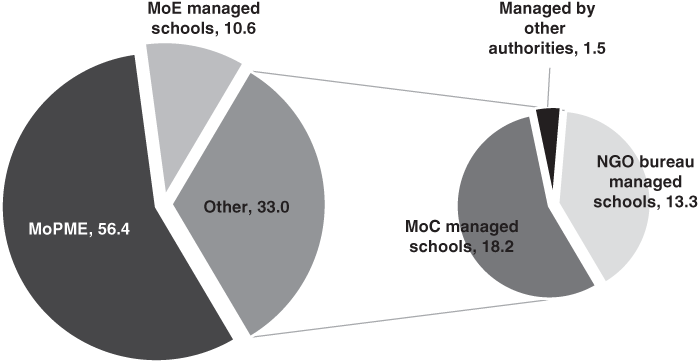
With more than a 56% share in the number of primary schools, MoPME/DPE is the dominant actor in the primary education system in Bangladesh. MoPME/DPE manages eight types of schools, of which GPS and NNPS are considered as the GPSs. The MoE is responsible for three types of formal primary schools and madrasahs. The MoC administers two types of schools and the NGO Bureau oversees two types of school. Other authorities manage non-aligned institutes (DPE, 2018b). A description of these schools is provided in Annex 7.1.
One explanation for the existence of multiple actors in the primary education system in Bangladesh might be that Bangladesh aimed to achieve universal education, reduce dropouts, improve the completion rates, and provide high-quality education in primary schools, but that attaining these targets was a challenge. Shouldering the whole responsibility alone was a difficult task for the Government. The multiplicity of primary schools helped in promoting basic formal and non-formal primary education in the country. It helped to bring more children into primary schools. For example, the engagement of NGOs in providing primary education helped the Government reach the marginalised population of the country.
In this chapter, we focus only on the government primary schools (GPSs and NNPS), run by the MoPME/DPE, which constitute more than 50% of the primary schools. The institutional structure of primary education in Bangladesh, operated by the MoPME/DPE, accommodates three major actors – central, regional, and local (Figure 7.3).
The complex coexistence of various actors in government primary education in Bangladesh.
Note: The figure shows the central, regional, and local actors in the MoPME.

Teachers’ recruitment, salary, and contributions to General Provident FundFootnote 8 and pension are conducted by the central authority. However, transfer, promotion, stipends to pupils, school building construction, reparation and reconstruction, school electricity bills or land development tax, the PEC examination, teacher training, and primary school visits are transferred from MoPME to primary schools through regional actors, that is Upazila (or Thana) Primary Education Office (UEO).Footnote 9 Nevertheless, the presence of many actors in the government primary education system in Bangladesh makes the management of the system difficult. For instance, the transfer of teachers in primary schools involves many steps and multiple actors. This makes the whole transfer process complicated and time-consuming. Further, the involvement of many actors reduces transparency and creates opportunities for rent-seeking activities, for example bribes for transferring teachers (see the discussion in Section IV.C.3). The overlapping responsibilities may contribute to the poor-quality services and the failure to attain the expected outcomes in primary education.
B Challenges Related to Resources
1 Persistent Low Public Expenditure on Primary Education
Low public expenditure on primary education in Bangladesh is a big concern. The primary education budget as a percentage of GDP has been constantly low in Bangladesh. In 2010–2011, the share of the allocation for primary education in GDP was only 1.05%; the share declined after that, and by 2018–19, stood at 0.81%. Relative to GDP, public expenditure on primary education in Bangladesh is one of the lowest in the world. The most recent data from the World Bank’s World Development Indicator shows that the average ratios of public expenditure on primary education for the South Asia, East Asia, and sub-Saharan African regions are 1.3%, 1.2%, and 1.6%, respectively. Except for Pakistan and Sri Lanka, all other South Asian countries spend a higher percentage of their public funds on primary education than Bangladesh. Even many sub-Saharan countries, for example Ethiopia, Chad, and Mali, despite having a lower per capita GDP than Bangladesh, spend a higher share of their GDP on primary education than Bangladesh.
Similarly, public expenditure per primary student as a percentage of GDP per capita in Bangladesh is also one of the lowest in the world. Average government spending per primary student, as per the most recent data from the World Bank’s World Development Indicator, was 7.5% of GDP per capita for Bangladesh. The averages for South Asia, East Asia, and sub-Saharan African regions were 10.5%, 13.8%, and 10.6%, respectively. Here too, many poorer sub-Saharan African countries outperform Bangladesh. As spending on health is also low in Bangladesh, it is the investment in human capital in Bangladesh that is very much below standard.Footnote 10
2 Insufficient Financial Incentives to Attract High-Quality Teachers
A lack of resources leads to low financial incentives, and the primary education sector in Bangladesh fails to attract competent, good-quality teachers. Low salaries and the absence of a career path development discourage young and qualified teachers from continuing their career in the primary education sector. Relative to GDP per capita, teachers in Bangladesh are much less paid than in most other developing countries, and much less even than in Pakistan. Primary school teachers are relatively better paid in Africa – the difference is significant here.Footnote 11
It is, however, somewhat surprising to observe that developed countries pay their teachers less, relative to GDP per capita, than developing countries, even compared to the poorest (Ethiopia).Footnote 12 This is not true in absolute terms, of course, and can be explained as follows. In terms of education, teachers in advanced countries do not rank very high – typically, they have the equivalent of two to three years of college. The opposite is true in poor countries, where teachers are relatively high up the education hierarchy and where so many people have no education. Thus, finding Bangladesh between the USA, France, Norway, and Austria is really an oddity.
Failure to keep young and qualified teachers in the primary education sector is considered an important challenge in Bangladesh. Historically, the basic monthly salaries for both an assistant teacher and a headmaster were low.Footnote 13 However, in February 2020, a notice was issued by the MoPME about raising the salaries of GPS teachers across the country. According to the new pay scale, the monthly basic salary for an assistant teacher will be BDT 11,000 (roughly equal to GDP per capita), though no changes were made to the pay grades of the headmasters.Footnote 14 These salaries are equivalent to salaries in jobs such as junior accountants, client officers in bank, deputy shop managers, store department managers, and marketing assistants – and these jobs attract barely competent and qualified youths.Footnote 15 The fact that a BCS officer gets a basic salary of BDT 22,000 per month, which is twice the salary of a teacher in the GPSs, helps to explain why qualified and talented people refrain from joining the primary education system in Bangladesh.
It is, however, important to note that the minimum qualifications to apply for the jobs of assistant teacher or headmaster in a GPS and those of BCS officer have some differences. Anyone with Bachelor’s degree (either a three-year or four-year degree)Footnote 16 and minimum second class or equal Cumulative Grade Points Average (CGPA)Footnote 17 from any recognised universityFootnote 18 or any equivalent degree is eligible to apply to become an assistant teacher or headmaster in a GPS. By contrast, to sit for the BCS exam, one needs to have completed at least a Bachelor’s Honours degree (a four-year degree) from any recognised university and cannot have more than one-third class equivalent final grade in the undergraduate and graduate degrees. The BCS exam is attended by over 0.2 million candidates every year and only a small fraction of the applicants having a better degree from a reputed university with better skill and knowledge (demonstrated through the selection process) are finally selected.
Looking at the diversity of primary schools (as discussed in Section IV.A), it is important to mention that teachers in the non-private, non-GPSs are paid even less than the teachers in the GPSs and their jobs are not as secure.Footnote 19 There is a growing demand for the nationalisation of all non-GPSs so that teachers in those schools also get the benefits of GPSs.Footnote 20 These teachers demand permanent jobs and enlistment in the official Monthly Pay Order (MPO) scheme. The MPO is a pay system for teachers in state-controlled public schools and government-approved institutions. In non-MPO educational institutes, teachers and employees depend on student tuition fees and many of the non-government school teachers do not receive regular salaries; therefore, the quality of education remains poor.Footnote 21
However, there are a few private schools in Dhaka and other metropolitan cities where admission fees, tuition fees, exam fees, and many other regular and irregular fees are so exorbitant that poor families cannot afford to send their children there. The quality of education in these schools is much better than that of most of the government and non-GPSs. Teachers in these schools are better trained and qualified and better paid (Uddin, Reference Uddin, Letchamanan and Dhar2017).
Teachers in the NGO-run schools are paid much less than teachers in the GPSs. However, the selection process of teachers in the NGO-run schools is very different from that in government or non-GPSs. In the BRAC Primary Schools (BPSs), one of the important criteria for selecting a new BPS site is the presence of at least one adult, preferably a woman, who lives within the community, has completed at least 10 years of education, is willing and able to teach on a part-time basis, accepts wages much lower than those paid to GPS teachers, and agrees to thoroughly follow the BPS system (see USAID, 2006).Footnote 22
Most of the teachers who continue their careers in the GPSs are graduates from sub-standard educational institutions, typically from the affiliated colleges of the National University of Bangladesh (NUB), with a very average record of academic achievement. Studies (BIDS, 2019; World Bank, 2019) found that the quality of the graduates of NUB are not up to the mark and, therefore, a good number of graduates from there are deprived of decent jobs and also face the risk of unemployment. Highlighting employers’ views, the BIDS (2019) study mentioned that the NUB graduates lagged far behind their counterparts from other public universities in competence and quality as poor educational quality and lack of practical communication skills were prevalent among NUB graduates. The BIDS study also found that absenteeism among teachers in the NUB-affiliated colleges and student politics hamper academic environment and impose a negative impact on their studies. According to the World Bank (2019), around 2 million students are enrolled in over 2,000 colleges affiliated with the NUB, which is about nine times that of the 34 public universities combined and seven times that of 95 private universities. NUB graduates account for 68% of the total students pursuing higher education in Bangladesh. Given the poor performances of the NUB graduates, the World Bank (2019) study suggested reviewing the system of affiliation of colleges to create a higher education system that is more job market-responsive and addresses the need for multi-tier certification of tertiary education entities.Footnote 23
Many GPS teachers have no subject or pedagogical training, or are demotivated and busy with private income activities (World Bank, 2013; Hossain et al., Reference Hossain, Hassan, Rahman, Ali, Islam, Hickey and Hossain2019). Many teachers leave their job within the first two years, mainly because of working conditions or low pay (ADB, 2017). Focus Group Discussions (FGD) with a group of GPS teachers also confirms that young and good-quality teachers are de-motivated and not interested in continuing teaching in the GPSs; for many of them, it a transitional job. A DPE (2017) report showed that a good number of posts in schools always remain vacant as young teachers leave frequently. In 2017, 8,564 GPSs were facing acute teacher shortages as 79 of them were running with only one teacher, 721 with only two teachers, and 7,764 with just three teachers (DPE, 2017). This has a severe impact on the quality of education in the primary schools. Therefore, a large number of people remain teaching in the primary schools who are not qualified enough or not interested in teaching.
The preceding observations suggest that a rise in teacher wages would attract better qualified candidates. If private employers are assumed to be able to infer from observable characteristics, including degrees and universities where they were obtained, the likely productivity of graduates, then candidates for teaching jobs are those that are judged to be at a lower productivity level by employers. They would even probably be hired at a wage below – or not above – the teachers’ wage if they were to stay in the private sector. If the teachers’ wage were raised, then more higher-level graduates would be candidates than it is the case today – the issue of training them as teachers remaining open, however.
It might appear that the first discrimination among people takes place in the choice of admission to a good university or the sub-standard one. However, as illustrated by the World Bank (2019) study, sub-standard colleges under the NUB enrol a large number of students from the lower socio-economic strata; therefore, the options for choosing better colleges are limited for these students.
Moreover, career progression opportunities are very limited in the primary education sector. The primary school has two types of post – assistant teacher and headmaster. To get promoted to a headmaster’s position from that of an assistant teacher, one requires to have an honours degree (a four-year Bachelor degree), at least seven years of work experience as an assistant teacher, and a Diploma in Education (DPEd) or a Bachelor of Education (BEd) degree. However, since there is no other post between assistant teacher and headmaster, many never get promoted in their entire career, and retire as assistant teachers. During the FGD, some of the participants complained that they had not been promoted to a headmaster’s position although they were eligible for this promotion. To solve this problem, the Government is considering creating the position of assistant headmaster.Footnote 24 But there has not been any progress on this front yet.
Although the salary and career path do not attract high-quality teachers, still a vast number of people apply for the jobs in the GPSs. In 2018, more than 2.4 million candidates took part in the examination for 14,096 posts, which means 170 candidates for one job. There are various reasons behind this scenario. As the economy in recent years has been going through a phase of slow job creation, there is a very high demand for government jobs. Also, these jobs are considered prestigious and secure in society. Furthermore, apart from the monthly salary, there are other incentives: teachers can earn from giving private tuition to students or having a second job. Therefore, the scarcity of jobs and the socio-economic factors mentioned above lead to a huge number of applicants for the jobs in the primary schools.
3 Persistent Poor Quality of Education-Related Infrastructure
Inadequate budget allocation and a low share of capital budget in the education budget over a long and sustained period has resulted in the poor quality of infrastructure in the primary education sector in Bangladesh. Despite the fact that each year there are thousands of requests for schools to be repaired, many of these requests are ignored due to the lack of funds. Moreover, a huge chunk of the allocated funds is wasted because of the lack of transparency.Footnote 25
Another significant challenge is the high level of student–teacher ratio. There are many primary schools where the student–teacher ratio is extremely high, which creates huge challenges for teachers in terms of giving students enough attention and guidance. According to the Primary School Quality Level 14 standard, under the Third Primary Education Development Programme, there should be maximum of 46 students per teacher in primary schools. However, this ratio is still much higher than the international standard of 30 students per teacher. In 2016, 72.3% of the GPS and 50.3% of the Newly Nationalized Primary Schools (NNPS) met the directive of 46 students per teacher, and all the remaining schools had much higher number of students per teacher (DPE, 2017).
Furthermore, the paucity of classrooms, libraries, and playgrounds is responsible for poor-quality education in primary schools. Another related issue pointed out during the FGD is that the majority of schools do not have an adequate security system or personnel, and this is one of the critical reasons for the rise in the non-attendance of students (especially girl students) in primary schools. As mentioned earlier, according to the most recent data, nearly one-fifth of students drop out from primary education; a report by UNICEFFootnote 26 pointed out that lack of safety and the high prevalence of sexual harassment and abuse in public places contributed to the dropout rate among girls from schools in Bangladesh. The same UNICEF report highlighted that schools did not have functional water and sanitation facilities responsive to gender or disability, or accommodating menstrual hygiene, which contributes significantly to the performance and attendance of girls.
The poor infrastructural aspect of the primary schools in Bangladesh can be demonstrated by looking at the average class size (pupils per class). As per the latest data, the average class size in primary school in Bangladesh is 60,Footnote 27 whereas the average for Organisation for Economic Co-operation and Development countries is 22, and the corresponding figures for China and Indonesia are 38 and 28, respectively.Footnote 28 An ADB (2017) study highlighted that many primary school teachers in Bangladesh do not get appropriate classrooms to teach their subjects (e.g. science classrooms). Teachers sometimes do not even have their own desks to store materials. Classroom facilities are often inadequate to meet students’ needs.Footnote 29
C Teacher Management in Government Primary Schools
1 Teacher Recruitment and Related Corruption
I Recruitment.
Of the total number of GPS teachers, 89% are assistant teachers and 11% are headmasters. Successful candidates are appointed to the vacant posts as per the guidelines issued by MoPME/DPE. It turns out that 60% of the vacant posts are allocated to female candidates, 20% are kept for dependents,Footnote 30 and 20% are given to male candidates.
There are distinct and lengthy procedures to recruit assistant teachers and headmasters. In GPSs, the recruitment of assistant teachers involves four steps – a recruitment circular and application screening, question preparation and a written exam, a viva voce, and final selection.Footnote 31 As mentioned earlier, candidates with a Bachelor’s degree and minimum second class or equal CGPA from any recognised university (certified by the University Grant Commission) or any equivalent degree are eligible to apply to become assistant teachers in a GPSs. The candidates, however, do not need to have any teaching degree for the recruitment. Headmasters, in contrast, are appointed either through promotion or direct recruitment. Around 65% of the new headmasters come from the promotion of in-service assistant teachers by MoPME/DPE, whereas 35% are recruited directly by the Public Service Commission, representing non-cadres of the BCS.Footnote 32
The teacher recruitment process in GPSs provides some insights into the recruitment process in other government sectors. The recruitment process for an assistant teachers in a GPS comprises a written test followed by a viva voce. Every other public sector, including the BCS, the public commercial banks, the central bank, the autonomous government organisations, etc., follows more or less the same procedure.Footnote 33 However, these are jobs at a higher level of salary and qualification and thus attract a different group of people.
II Corruption.
As mentioned earlier, the scarcity of jobs and other socio-economic factors (a government job is considered a prestigious and secure job and there is scope for earning extra through private tuition) lead to a large number of applicants for each post. This paves the way for malpractice: corruption appears in diverse forms, such as question-leaking, bribery, nepotism, favouritism, lobbying, and political influence.Footnote 34
Over the past few years, in the government primary teacher recruitment process, the most discernible form of corruption has been the leakage of questions on the written test. The occurrence of question-leaking has achieved a new dimension with the advent of the advanced technology, and the government has not been successful in stopping this prejudicial practice.Footnote 35
Another mode of corruption is bribery. The prevalence of bribery is witnessed during and after the written exam. The candidates are entangled with bribery or are deprived of their rightful employment due to their refusal to give bribes. During the FGD, the participants mentioned that there is corruption and bribery in the recruitment process but that the people who benefit usually do not discuss the details. Corrupt circles run the business by contacting all the viva examinees and demanding a bribe, which they return (to some extent) to those who fail to get through the viva.
Nepotism in the recruitment of teachers is also prevalent. According to the FGD participants, sometimes knowing someone influential helps in securing a post. Therefore, nepotism, favouritism, lobbying, and political influence play an important part in the recruitment process.
As in the primary education sector, corruption in recruitment and transfer in other public sectors is extensively visible. For example, the public health sector in Bangladesh faces numerous corrupt practices, such as bribery and political influence in recruitment, transfers and promotions of healthcare professionals (McDevitt, Reference McDevitt2015). In 2019, after a long inquiry, the Anti-Corruption Commission of Bangladesh identified 11 areas of corruption in health sector; these included recruitment, promotion, transfer, and posting.Footnote 36 Also, Paul (Reference Paul2017) observed that in Bangladesh, quotasFootnote 37 and the viva voce are the two main barriers to fair recruitment in the public services. The provision of giving too much importance to the viva voce breeds nepotism, favouritism, and bribery, and ultimately fuels corruption.
2 Complex Procedures for Teacher Promotion
The existing teacher promotion structure in GPSs is complex. It promotes discrimination and generates frustration among the teachers. Since only 65% of the vacant headmaster posts are filled by promoted teachers, many assistant teachers never have the opportunity to be promoted to headmaster. Besides, there are many examples where assistant teachers are promoted to headmaster after serving for 25–30 years. Furthermore, when teachers are promoted through departmental exams, the younger cohorts are more successful as they are more acquainted with the new syllabus. Therefore, there is no career progress for the majority of the teachers. Also, the promotion to UEOFootnote 38 from headmaster has been stopped since 1996, and UEOs have been recruited from outside. During the FGD, the participants stated that the promotion procedures are so complex in this sector that it is almost impossible for a headmaster to ever get promoted to assistant district or thana teaching officer through the normal process. There are cases of bribery, nepotism, favouritism, lobbying, and political influence in the promotion of teachers and headmasters.
3 Teacher Transfers and Related Corruption
The transfer process of teachers is complicated and involves many intermediate steps.Footnote 39 Under the existing system, teachers in primary schools can be transferred during January–March of each year. Given the availability of vacant posts, if a teacher wants to be transferred from one school to another within the same Upazila, the UEO is in charge of that. The District Education Officer does the transfer if it is in the same district. The transfer between districts within a division is done by the Divisional Deputy Director. In addition, the DPE transfers teachers from one division to another and from municipal to metropolitan areas.
This complex transfer process creates rent-seeking opportunities. Bribes are exchanged in majority transfers in metropolitan areas, which disrupts the recruitment rules. In Dhaka, the empty posts are filled via the transfer process instead of via the recruitment process. People want to provide their children with a better education and to help them lead a better life. Therefore, people are keen to be transferred to Dhaka and that is why, in some cases, they are even ready to pay bribes in order to get transferred. The participants in FGD complained that, on average, BDT 0.7 million (around US$ 8,000) needs to be given as a bribe for each transfer. In this process, teachers need to pay at every step, starting from the UEO to the office of the deputy director. Otherwise, the vacancy approval file does not move. Moreover, a candidate may have his or her application file lost if he/she refuses to pay a bribe.
Nepotism, favouritism, lobbying, and political influence are prevalent in the teachers’ transfer process. According to MoPME/DPE, in 2019, the last date of transfer of assistant teachers of the GPSs was March 31. About 20,000 applications were submitted for the transfer, of which around 12,500 applications were submitted for transfer to Dhaka. However, in 2019, the whole transfer process was heavily condemned due to the presence of unjust practices. Lobbying from many senior ministers, members of parliament, and influential individuals were apparent. In fact, the highest level officials of MoPME/DPE were in an uncomfortable position because of the lobbying from powerful persons.Footnote 40
Similar cases are found in the public health sector, too. For transfer or remaining in a privileged facility for longer period, bribing, nepotism, favouritism, lobbying, and political influence are very common (Transparency International Bangladesh, 2014). The Anti-Corruption Commission of Bangladesh also found wholesale corruption in almost every sector of the Bangladesh Land Port Authority. There was an allegation that irregularities were rife in transfer and promotion and in sending officials abroad for training; nepotism played a key role in allowing such irregularities.Footnote 41
4 Lack of Discipline and Evaluation
In the context of the government primary education sector in Bangladesh, one indicator of a lack of accountability is the frequency of teachers being absent from the school on a school day. A study by Chaudhury et al. (Reference Chaudhury, Hammer, Kremer, Mularidharan and Rogers2004) mentioned a unique survey in which the researchers made unannounced visits to some government-run primary schools and government-aided but privately run secondary schools in Bangladesh. The visits showed that the average teacher absence rate in primary schools was 15.5%; the absence rate in primary schools was highest among headmasters at 20%. Cross-sectional averages masked the extent of this problem: 23.5% of primary school teachers were absent during at least one of the two visits.
One may argue that this 2004 study is dated and that the situation has improved significantly. However, the situation has not changed and may have even worsened. The Daily Star, an English-language daily newspaper in Bangladesh, reported that while visiting a primary school in Chattogram city at around 9 am on a day in January 2019, the Anti-Corruption Commission chief found that only the acting headmaster was present in the school, while seven other teachers were absent. Due to the absence of teachers, the students were spending idle time on the school premises.Footnote 42
Another English daily newspaper – The Bangladesh Post – reported that the teachers in different primary schools in different regions remain busy in other, non-teaching activities. In haor (large bodies of water) areas, teachers remain busy harvesting in paddy fields, or in hill regions, the attendance of primary teachers decreases during the cultivation season. Apart from this, the allegation has also been raised against the primary teachers that they come to school late and only sign the attendance sheet. In some schools, it was also found that many teaches have hired teachers (called para-teachers) who provide proxy attendance for the actual teacher. Taking all those issues into consideration, the Government in July 2019 decided to introduce biometric attendance to stop these irregularities.Footnote 43 However, little progress has been made on this front so far.
D Curriculum and Teacher Training in Primary Education
1 Poorly Designed Curriculum and Faulty Examination System
The introduction of the PEC examination at the primary level since 2009 has encouraged the students to drill and memorise rather than gain a proper understanding of the material being taught. Students do not get the chance to understand the content or find any scope to create something on their own. Education experts, researchers, teachers, and guardians have questioned the value of this examination. This examination even does not contribute to improving the teaching–learning process. Manzoor Ahmed (an education expert in Bangladesh) argued that, ‘The effects of PEC have been to encourage drills and rote memorization, neglect understanding and creativity, disregard basic content of the curriculum, and discourage thinking and reasoning. Formative assessment is needed to evaluate students’ learning. In educational terms, this is more important than the summative assessment like PEC. The PEC has taken away time and effort from formative evaluation and regular teaching–learning.’Footnote 44
According to the Ministry of Education (2010), the National Curriculum and Textbook Board is in charge of changing the content of the syllabus as well as the question pattern to assess students’ creativity. However, the teachers at primary school level are not capable enough to comply with the plan. The key findingsFootnote 45 of a survey carried out by Research for Advancement of Complete Education in 2016 showed that around 55% of teachers in primary schools did not understand the creative system; more than half of 100 primary school teachers who took part in a survey were still unclear about the creative education method introduced about five years ago; about half of the teachers surveyed relied on guidebooksFootnote 46 to prepare lessons; around 92% of students used guidebooks to understand their lessons; there was a reliance on private tutors and coaching centres among learners; and the PEC exam was perceived to be the root cause of the mushroom growth of coaching centres as well as the publication of guidebooks.Footnote 47
A survey of 216 teachers by Amin and Greenwood (Reference Amin and Greenwood2018) found that teachers felt pressured by headteachers, parents, and particularly by students, to teach in ways that would lead to good marks in the examination. Teachers largely agreed that they actively prepared students for the examination, not only by arranging mock class tests but also by teaching answers to expected questions; interestingly, a majority acknowledged that their teaching style would have been different if there was no examination. Nearly 90% of the teachers agreed that reading and listening tests needed to be included in the national examination process; these are absent in the current system.
2 Shortage of Trained Primary School Teachers
The primary education sector in Bangladesh suffers from the lack of enough qualified and trained teachers; the proportion is roughly the same for man and women. According to DPE (2017), in 2016, 21% of the total GPS teachers had no professional qualification. In addition, most of the teachers are not adequately trained to adopt modern teaching methods, such as computers, in classrooms, which works as a barrier to ensure high-quality primary education (ADB, 2017). There is a serious lack of university-based teacher training programmes. Primary Teachers Training Institutes (PTIs) are the only institutions in the country that train primary school teachers. For untrained teachers serving in GPSs, NNPS, and Registered Non-GPSs, PTIs provide one-year, in-service training programmes leading to the Certificate in Education. However, there is no pre-service teacher education programme in PTIs in Bangladesh, unlike in other countries. Teachers receive training after their appointment and a placement in a school.
V Summary and Conclusion
Primary education plays an important role in development in Bangladesh. Though Bangladesh has been successful in ensuring a close-to-universal enrolment rate in primary education, poor outcomes in primary education remain a major concern. This chapter has analysed major challenges related to the poor performance of the primary education sector in Bangladesh. Further to this discussion, this chapter suggests some measures to improve the performance of the primary education sector in the country. These include: enhancing the budgetary allocation for the primary education sector; better salary and career paths for primary teachers; improving the recruitment process for primary teachers; initiatives to improve the quality of school infrastructure; initiatives to improve facilities to increase school attendance; improving the curriculum and examination system; ensuring accountability and transparency in evaluation of both teachers and learning achievement; and the harmonisation of the coexistence of various actors.
A Enhancing the Budgetary Allocation for the Primary Education Sector
As discussed earlier, the primary education budget has been historically low in Bangladesh. This budget in Bangladesh has two expenditure components: the recurrent budget and the capital budget – at present around 70% of the budget is spent on teachers’ salaries (recurrent expenditure). In proportion to GDP, Bangladesh should significantly increase the allocation to the primary education sector in line with the average allocation observed in many comparable countries. This will result in an increase in the salary of the teachers and will attract qualified and talented graduates to GPSs. Along with enhancing the budget allocation to the primary education sector, attention should also be given to ensure the effective utilisation of the budget. Also, a significant part of the additional budget should be allocated to the capital budget so that infrastructure development, essential maintenance, and repair works can be undertaken.
B Better Salary and Career Paths for Primary Teachers
It has been pointed out that the low salary and the lack of career path do not attract young and qualified teachers and discourage them from continuing their careers in the primary education sector. There was a major pay hike of government job salaries by 91–101% in December 2015, but, by both international and national standards, teacher pay remains largely unsatisfactory. This will remain the case unless further pay hikes are implemented.Footnote 48
The FGD with GPS teachers also confirmed that many talented teachers continued teaching only for 6–12 months before switching to better jobs. Moreover, career progression opportunities are very limited in the primary education sector. In this context, part of the additional budget allocation should be allocated to the higher salary and facilities for the primary school teachers so that the sector attracts qualified teachers.
The lack of promotion or progression to a higher post after some years of service is another adverse factor in the primary education system. The following new posts may be created in the primary education sector to encourage talented teachers to pursue this career: (i) senior assistant teacher (proposed); (ii) senior teacher (proposed); and (iii) assistant headmaster (proposed).Footnote 49
C Improving the Recruitment Process for Primary Teachers
As discussed earlier, the recruitment process for GPS teachers is a huge undertaking in Bangladesh. Further, as we discussed, corruption is prevalent in the recruitment process. It should be re-emphasised that high-quality teaching and effective learning at schools, among others, critically depend on the recruitment of high-quality teachers. In this context, several initiatives may be considered. First, at present, graduate degree holders from any recognised university with a minimum second division/class are allowed to apply for the post of assistant teacher. MoPME/DPE may contemplate modifying this requirement by adding teaching degrees, such as DPEd, BEd, etc. to the prerequisites list. Second, written examinations at centres that are identified with question leaks may be scrapped, which may discourage this type of malpractice. Third, currently, the written examination is the MCQ type, which to some extent is open to question leaks. Thus, the current format may be modified with 30 marks for MCQ and the rest of the marks, 50, on essay-type questions. Finally, districts may not be allowed to take a viva or interview candidates from the same districts. Rather, a different district within the same division may be given the responsibility of taking the viva and interview, or some random allocations, at the last moment, between candidates and recruitment committees can be made. This move may discourage bribes from being paid.
D Initiatives to Improve the Quality of School Infrastructure
The state of infrastructure (i.e. school building, classroom, functional water, sanitation, and security) in most of the primary schools has been reported as poor. Inadequate budget allocation and the low share of capital budget over a long and sustained period has resulted in the poor-quality infrastructure of the primary education sector in Bangladesh. It is alleged that the paucity of classrooms, libraries, and playgrounds are responsible for poor-quality education at primary schools. Therefore, there is a need to allocate part of the additional budget allocation to the improvement of the infrastructural quality of the primary education school system. The MoPME/DPE may undertake a special development project under the annual development programme for the wholesale improvement of the primary school infrastructure, with a special focus on classroom amenities, water and sanitation, and security.
E Initiatives to Improve Facilities to Increase School Attendance
MoPME/DPE is providing more than 33,000 students of 175 primary schools with cooked food. By 2023, DPE aims to provide cooked food to all the schools in the country. An internal assessment by MoPME/DPE shows that school attendance increases by up to 11% if students are provided with cooked food, whereas when supplied with only biscuits, the attendance rate increases only up to 6%.Footnote 50 MoPME/DPE also plans to provide each primary level student with BDT 2,000 for their uniform on the understanding that students with new uniforms, and nutritious and delicious food in their schools will feel more attached to their institutions. These initiatives are perhaps policies moving in the right direction. But there is uncertainty about the full implementation and sustainability of these initiatives. Thus, the attempt should be to ensure full implementation and sustainability through the allocation of sufficient resources.
F Improving the Curriculum and Examination System
Given the large gap between acquiring the certificate and actual learning, the emphasis should also be given on reforming the entire primary education system in Bangladesh. In this context, the Government should implement the National Education Policy 2010, which suggested extending primary education to Grade 8. This move will transform the exam-centric education system into a dynamic, learner-centric one. Primary level students should not be assessed through public exams; rather, they should be assessed through continuous academic performance. The Government needs to improve the classroom environment, the training of teachers, and pay more attention to co-curricular activities.
G Ensuring Accountability and Transparency in the Evaluation of Both Teachers and Learning Achievement
As discussed earlier, institutional challenges in the education system and the resultant corruption are not significantly different from those seen in other public sectors in Bangladesh. Therefore, a more accountable education system needs to be built as part of an overall accountable public service. The ways to achieve effective accountability in the primary education system include hefty penalties for bribery, establishing rules for conflict of interest and codes of conduct, delinking the administration from political influence, merit-based recruitment and career development rules, access to information, and complaint mechanisms for students and parents.
Technology may be used for assessing the accountability of the teachers. Technological advances and improved accessibility of devices such as digital cameras, tablets, and smartphones have facilitated the ability of communities to hold teachers accountable. Most use of technology focuses on reducing teacher absenteeism. However, as mentioned earlier, though the Government has considered introducing biometric attendance to reduce the absenteeism of teachers, so far there has not been any progress in this case.
A UNESCO (2017) report highlighted that in Udaipur, India, students used cameras with tamper-proof dates to photograph their teachers at the start and close of the day. Initial research suggested that this, jointly with the financial incentives provided, helped decrease absenteeism. Also, a Ugandan project to raise teacher attendance in 180 rural public primary schools distributed mobile phones equipped with software to report teacher absence to education officials. The phone monitors were headteachers or parents from the school management committee. In Pakistan, to monitor the attendance of over 210,000 education staff in 26,200 schools, biometrics – fingerprints and photos, coupled with Global Positioning System coordinates – were introduced. As at February 2017, 40,000 absent teachers and 6,000 absconders (employed but long absent) have been disciplined. India’s 2016–2017 economic survey recommended the use of biometrics to tackle teacher absenteeism in primary schools. However, overuse or improper use of technology may have negative consequences. UNESCO (2017) report also mentioned that thousands of classrooms in China were livestreamed, allowing parents and the public to monitor and comment on teaching practices and student behaviour. However, critics were concerned that continual surveillance violates teachers’ and students’ privacy rights and could negatively affect instruction.
A performance pay programme for primary school teachers can also be effective in reducing teacher absenteeism and enhancing learning achievement. Muralidharan and Sundararaman (Reference Muralidharan and Sundararaman2011) presented the results from a randomised controlled trial of a programme, which was employed in rural schools in the Indian state of Andhra Pradesh. The programme, administered by an NGO, provided teachers in government-run primary schools in rural India (Grades 1–5) with financial bonus payments of about US$ 14 for each percentage point gain in their students’ maths and language test scores. The bonuses were designed to address the interrelated problems of low teacher effort in rural India, such as pervasive absenteeism, minimal teaching activity even among many of those present (as shown in Kremer et al., Reference Kremer, Muralidharan, Chaudhury, Rogers and Hammer2005), and low student achievement, as reflected in the findings from an all-India survey of rural households that approximately half of students enrolled in Grade 5 cannot read at a Grade 2 level (as shown in Annual Status of Education Report Centre, 2014). Muralidharan and Sundararaman (Reference Muralidharan and Sundararaman2011) showed that the programme produced gains in all four subjects measured (maths, language, science, and social studies), increasing the average achievement score by between 6 and 13 percentile points in performance pay schools compared to control schools, over a two- to three-year period.
Parents and communities may also be involved in monitoring teachers’ presence in the schools. A review of the national education plans of 40 mostly low- and middle-income countries by UNESCO (2017) found an increasing role of parents and communities in teacher accountability. In the absence of clear guidelines, participatory approaches can be organised in a bottom-up manner, relying on community motivation to monitor teaching. Other forms may also be used in this regard. Representatives of local communities can visit classrooms, for instance, to ensure that teachers are present. The UNESCO (2017) study also suggests that community-led surveys concerning teachers have been used in several low-income contexts, especially in rural or disadvantaged regions.
Following these global experiences, Bangladesh may adopt a properly designed technology-powered accountability system in the primary education system. This will enhance accountability and transparency for the evaluation of both teachers and learning achievement in primary schools in Bangladesh.
H Harmonisation of the Coexistence of Various Actors
Finally, in the case of the coexistence of various actors in the primary education system in Bangladesh, there is a need to bring all schools under a single umbrella. The MoPME/DPE can create that umbrella so that many institutional challenges are addressed, and high-quality of education is ensured across all schools.
Annex 7.1 Types of Primary School in Bangladesh
Annex 7.2 The Assistant Teacher Recruitment Process
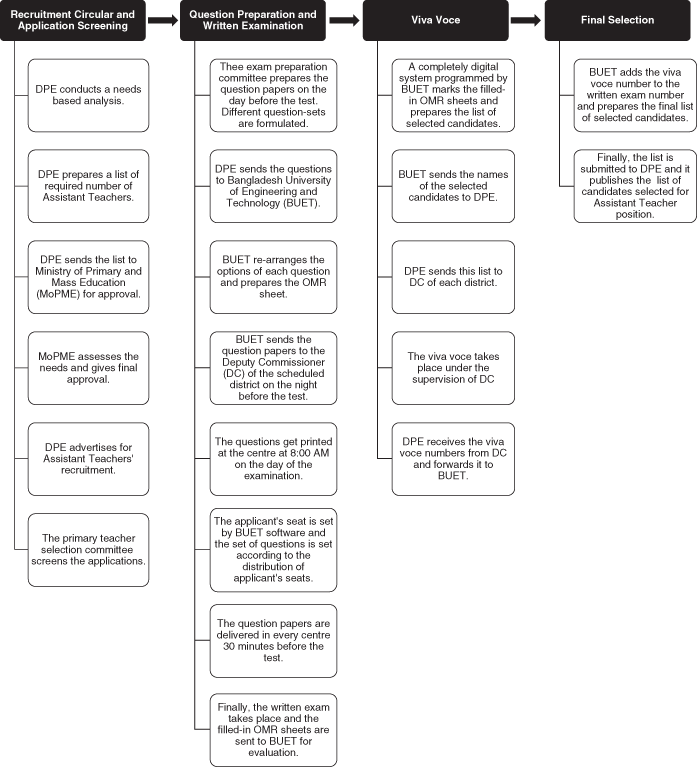
Annex 7.3 Institutional Challenges in the Assistant Teacher Recruitment Process
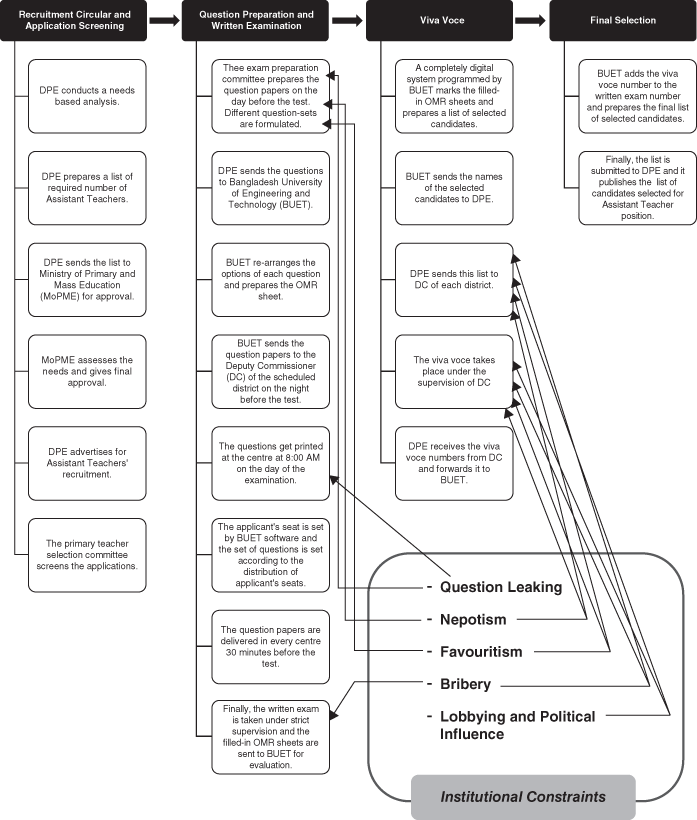
Annex 7.4 Transfer Procedure for Primary School Teachers from One Division to Another, or to the Capital City
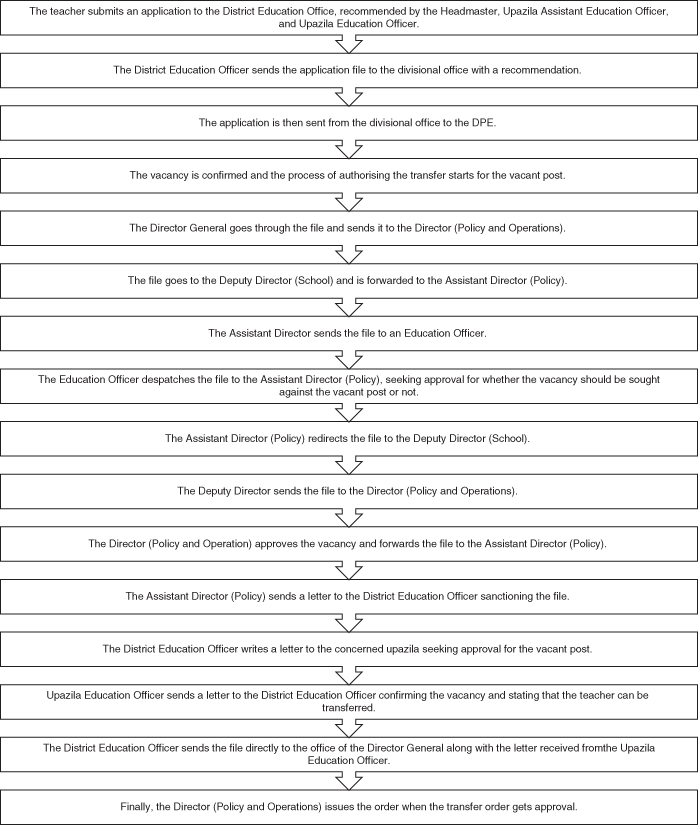
More and More Equal Education
Over the past two decades, Bangladesh achieved an unprecedented expansion in enrolment rates in basic education. As a result, the country’s average schooling attainment has exceeded the average attainment in India and Pakistan and is approaching the averages in Sri Lanka, Indonesia, and Malaysia (Figure 7.4). This achievement was a result of effective education programs sustained since the early 1990s and a growing economy.
Estimated average years of schooling, adults 25 and over, males and females, Bangladesh and other Asian countries.

The most remarkable feature of this achievement is the dramatic increase in girls’ enrolment rates and average years of schooling. This is worth noting because the large gains in women’s schooling made possible the growth of its garment industry which, in turn, fuelled the country’s recent economic growth, as noted in de Melo’s comments in this volume. The study by Heath and Mobarak (Reference Heath and Mobarak2015) documents this positive interplay between the progress in women’s education and the expansion of the garment industry. They found that young girls were more likely to be enrolled in school after garment jobs arrived, and that older girls were more likely to be employed outside the home in villages closer to garment factories. Although the growth of the garment industry spurred educational development, it was the government’s conditional cash transfer program to encourage female enrolment at the secondary level, launched in 1994,Footnote 51 that put the country firmly on the steeper path to progress. The stipend program increased girls’ years of education by 14–25%, as well as changed several life outcomes for them: girls now marry later, have fewer children, work in the formal sector more than in the agricultural or informal sector, and enjoy greater autonomy in making decisions about household purchases (Hahn, et al., Reference Hahn, Islam, Nuzhat, Smyth and Yang2018). These are long-term impacts that will yield significant spillover benefits in generations to come.
Bangladesh not only closed the gender gap in education but also narrowed the gaps between urban and rural areas and among income groups within a decade (Table 7.1). Innovative non-government and community programs, such as BRAC schools, for which Bangladesh is known, contributed to this progress.Footnote 52 In acknowledging its educational successes, the narrowing of these large disparities, especially when comparing wealth quintiles, deserves note. A previous review of the primary education sector concluded that Bangladesh’s recurrent public spending in primary education has been largely pro-poor. Public spending per child in the poorest quintile of upazilas was 30% higher than in the wealthiest quintile, although this pro-poor spending has not eliminated large disparities (Steer, Rabbani, and Parker, Reference Steer, Rabbani and Parker2014).
| Survey | Total | Residence | Wealth quintile | |||||
|---|---|---|---|---|---|---|---|---|
| Urban | Rural | Poorest (Q1) | Q2 | Q3 | Q4 | Richest (Q5) | ||
| 2014 DHS | 3.6 | 4.7 | 3.1 | 0.6 | 2.4 | 3.8 | 4.6 | 7.2 |
| 2011 DHS | 3.1 | 4.6 | 2.5 | 0 | 1.7 | 3.3 | 4.3 | 6.8 |
| 2007 DHS | 2.5 | 4.2 | 1.9 | 0 | 1.1 | 2.3 | 4 | 6.1 |
| 2004 DHS | 2.1 | 3.8 | 1.7 | 0 | 0.6 | 2.2 | 3.8 | 5.7 |
But Schooling Is Not Learning
The importance of learning, not just schooling, has been the focus of recent major education reports because of its critical contribution to economic growth and overall development (Education Commission, 2016; World Bank, 2017). When students go through school without acquiring basic knowledge and skills that they need for life and work, families, communities, and economies do not reap the potential benefits of education. In Bangladesh, as evidence cited in this chapter shows, learning outcomes have not risen apace with years of schooling. According to Asadullah and Chaudhury (Reference Asadullah and Chaudhury2015), about half of the children fail to pass a written numeracy competence test, a finding that also holds for those who had completed primary school. While there is a statistically significant and positive correlation between schooling attained and numeracy competence, this relationship is quite low. Table 7.2 compares Bangladesh with other Asian countries with respect to the quantity and quality of schooling attainment (World Bank, 2020b). Because of deficiencies in the quality of schooling measured by harmonized test scores (Altinok, Angrist, and Patrinos, Reference Altinok, Angrist and Patrinos2018), the expected schooling attainment in Bangladesh of 11.3 years is equivalent to just 6.5 learning-adjusted years. It performs better than India or Pakistan, but the distance from the other comparator countries is greater.
| Expected years of school | Harmonized test scores | Learning-adjusted years of school | |
|---|---|---|---|
| Pakistan | 8.8 | 339 | 4.8 |
| India | 10.2 | 355 | 5.8 |
| Bangladesh | 11.3 | 368 | 6.5 |
| Indonesia | 12.3 | 403 | 7.9 |
| Sri Lanka | 13.0 | 400 | 8.3 |
| Malaysia | 12.2 | 468 | 9.1 |
Improving the quality of primary education is inarguably Bangladesh’s next education challenge. This chapter argues that institutional change in four areas are needed to meet this challenge: (1) high fragmentation due to the complex coexistence of multiple actors; (2) inadequate financing resources; (3) low-quality teachers and poor teacher management in GPSs; and (4) lack of a common curriculum and teacher training.
Addressing the Fragmentation of Primary Education System
The high fragmentation of the primary education system in Bangladesh is evident. It consists of several types of primary schools under different central agencies, alongside many types of non-government schools. In addition, the public school system itself is overseen by deconcentrated administrative units, with local subdistricts (upazilas) playing a major administrative role. Nationalization of all schools, as recommended by this chapter, however, is hardly the solution to the problems that arise from high fragmentation. A diverse system of provision may be what the country needs in order to meet the diverse needs of its population, also as suggested by this chapter, and perhaps how Bangladesh was able to achieve the educational development it has today. Nationalization is likely to eliminate an important part of this diversity, in particular, the NGO and private schools that serve rural and poorer areas. Instead of nationalization, what may address the problems of fragmentation is a governance structure that is consistent with decentralized delivery and yet is led by a central agency that sets and oversees common standards of delivery, enforces regulatory guardrails across all schools, and monitors learning outcomes nationwide, all towards achieving shared goals. Even in a decentralized system that assigns responsibilities to local governments and is open to both public and private providers, the central government can – and should – have a critical role for leading a coherent national school system. This view is implied but not elaborated in this chapter’s several recommendations, including that on the harmonization of multiple actors.
One important policy and programming tool for the central government is ensuring that timely and reliable information on the whole school system is widely available and that that information is used for decision-making and management. Especially in as large a school system as Bangladesh’s, the flow of adequate school data is the key to facilitating decisions and removing implementation blockages, identifying spending gaps, and addressing workforce problems. For example, this chapter is right in calling attention to fraud and corruption in the certification, recruitment, and transfer of teachers and to the significant budgetary resources left on the table and unspent in spite of the low national expenditure allocation for education. These are indicators of the school system’s weak management and poor implementation capacity. Without adequate system-wide data, those who formulate policies and manage programs are disadvantaged by not knowing whether their spending decisions and policies are appropriate and whether those decisions affect school performance. When system information is open and shared widely, politics and vested interests are also less likely to drive policy and spending decisions. Studies have shown that robust accountability and transparency mechanisms help raise the quality of service delivery because the scope and complexity of what governments must do to achieve education goals is nearly impossible without reliable and timely data. This is a lesson that the best performing education systems have learned over time; Bangladesh could use it too in order to transform its primary education system.
Improving the Primary Education Workforce
A large part of this chapter is rightly devoted to institutional issues related to teachers. Teachers are the system’s biggest investment and also its most powerful lever for change. How teachers are trained, recruited, inducted into the profession, supported, assessed, and compensated are all relevant to improving teacher performance in any education system. This chapter describes the multi-layered, highly complex mechanism for hiring teachers, that is nonetheless vulnerable to fraud and corruption and hires teachers who do not meet quality standards. This chapter also discusses how this recruitment process can be simplified and be more transparent and efficient. One change that this chapter identifies as a disincentive for improvement in teacher performance is the lack of prospects for promotion and recommends that an additional position of assistant headmaster be created so that teachers can aspire for a promotion. This chapter also argues that teacher salaries are too low and recommends an increase in basic teacher pay. Neither recommendation by itself is likely to obtain better teacher performance, however. What is missing from this chapter is a discussion of teacher reforms that are focused on achieving good teaching and more learning. If the aim is to improve teaching quality and learning, then these lessons, to highlight just a few, from other school systems would be useful:
In recent reviews of the literature about effective teacher professional development, among the most recommended interventions are changing the pedagogy used in teacher training institutes so that it is more directed to individual levels; provide training with specific subject content rather than general theory since different subjects require different pedagogies; provide follow-up mentoring visits for new teachers and allow new teachers to practice with other teachers; support continuous learning opportunities for current teachers; and involve teachers in curriculum development (Popova, et al., Reference Popova, Evans, Breeding and Arancibia2018). Many resources are spent on teacher development programs, so a reform of these programs would raise significantly the cost-effectiveness of public spending on education.
Studies have shown that financial incentives do improve the supply of new teachers and the performance of current teachers (e.g. Duflo, Hanna and Ryan, Reference Duflo, Hanna and Ryan2012), but the design of these incentives matter. This chapter recommends increasing teacher pay. Higher salaries do not guarantee better performance, however. Indonesia’s experience with a national unconditional increase in teacher salaries in the early 2000s serves as a cautionary tale. The government was expecting a doubling of teacher salaries to improve teacher morale, motivation, and job satisfaction, thereby increasing teacher effort and ultimately student learning. After the pay increase, teachers were indeed more satisfied with their income and less likely to report financial stress, were less likely to have a second job and worked fewer hours on second jobs, but they did not score better on tests of teacher subject knowledge and did not reduce absenteeism and student learning did not improve (de Ree et al., Reference de Ree, Muralidharan, Pradhan and Rogers2015). Key lessons from other countries about how to make financial incentives more effective are summarized by Imberman (Reference Imberman2015): first, the choice of metrics and the incentive structure matters for its effectiveness; poorly designed schemes can make outcomes worse while also more costly. Second, incentives should be based on multiple outcomes, of which better student performance is one of several metrics and at least one of which should be qualitative (e.g. principal evaluation or classroom observations). Third, teachers should be rewarded for reaching certain performance targets, such as for their students performing better relative to a set of comparison students.
A teacher accountability mechanism is broader than using financial incentives for performance; it should link teacher performance also to promotion and retention outcomes. Its goal is to make teaching an attractive and rewarding profession by recognizing and rewarding high ability and good performance. Effective teacher evaluation systems share a common set of features (Kraft et al., Reference Kraft, Blazar and Hogan2018): (1) the use of multiple measures of teacher performance including test-based performance measures such as value-added measures or student growth percentiles, and a qualitative assessment such as classroom observation by school principals or senior teachers; (2) the use of evaluation ratings to inform career ladders and personnel decisions such as promotion and retention. For example, Singapore’s teacher performance appraisal process feeds into career ladders by highlighting teachers’ abilities to collaborate with each other, their emerging leadership skills, and their teaching skills as part of the regular evaluation system (NCEE, 2016). The model includes three paths that a teacher can follow: a teaching track, a leadership track, and a senior specialist track, and each of these tracks has its own career ladder. Through the teaching track, teachers can aspire first to be Senior Teachers, then they can become Lead Teachers, and then progress further to the level of Master Teachers.
Hossain et al. (Reference Hossain, Hassan, Rahman, Ali and Islam2017) warn that reforms that are related to teacher performance are difficult because teachers are politically important in Bangladesh, as they are in many other countries, so reforms that are ‘more carrot than stick’ are more likely to be acceptable, but their success depends on the inherent motivations of teachers. This is a reminder that successful teacher reforms need an astute political leader in the education system.
Increasing Resources for Education
The world of the future will require higher levels of skills and the ability of individuals to acquire new skills throughout life, to know how to adapt to changing social and environmental conditions, and to work flexibly. This is why higher school quality and better academic outcomes is the next education challenge for Bangladesh. Ensuring that the primary education system is equipped to meet that challenge will require greater resources for schools and better management of those resources. This chapter makes a good case for expanding the resources for primary education given the empirical evidence on the returns to economic development and poverty reduction of basic education in Bangladesh, the very low share of education spending to GDP of Bangladesh compared to that of comparator countries, and the poor physical condition of schools and the need for schools to provide more services to low-income students such as meals.
The increase in education expenditures must be accompanied also by a willingness of the education leaders at different levels of government to take bold measures to make those additional resources count. Wastage and leakage of resources due to fraud and corruption must be reduced, and education resources must be allocated to where they can contribute most to higher school quality. Research on other developing countries suggest some useful measures to try, but even better would be for Bangladesh to invest in more program experimentation and evaluations on how to improve quality.
I IntroductionFootnote 1
Bangladesh is one of the most densely populated countries in the world. In 2018, the country had one of the lowest land to man ratios in the world, which was estimated to be 0.08 hectares per person (World Bank, 2020b). While in recent years, the share of agricultural land in total land has been around 70% (World Bank, 2020b), there is a growing demand for land for non-agricultural activities, especially to establish new homes, roads, educational institutions, and industries. This puts immense pressure on land availability and land prices, and thus, land is now the scarcest factor of production in Bangladesh.Footnote 2
The scarcity of land and resulting high prices have important implications for the prospect of industrialisation of the country. The situation is yet more complicated due to the weak land management system, which perpetuates land-grabbing, high rent generation, and ineffective property rights. These, in turn, constrain investment opportunities, both from home and abroad. The inadequacy of land is often identified as one of the reasons for the low level of foreign direct investment (FDI) in Bangladesh.Footnote 3
The scarcity of land and consequent high prices exacerbate the challenges related to the dysfunctional land administration and management system in Bangladesh (Hossain, Reference Hossain2017). The land administration and management system in Bangladesh is age-old, inefficient, and involves a considerable degree of inefficient and corrupt practices. Also, the land transfer process is jeopardised by inadequate and flawed land records, and thus, the system fails to keep pace with the growing demand and changing landscape of the economy. Efficient land management has important implications for various development goals, such as food security and ensuring a favourable business environment for private investment, and thus undertaking necessary reform to develop a consistent and functional land administration and management system in Bangladesh will be crucial in the coming years.
All of this justifies government intervention in the land management system. The land issue is discussed extensively in the country’s Seventh Five-Year Plan, 2016–2020. The plan identifies many factors as constraints on the functioning of effective land management and administration in Bangladesh: antiquated records, complex and ineffective policies, high transaction costs, and a weak taxation policy. Hence, the plan stresses a range of institutional reforms: digitisation of records, and simplification of transactions and land registration. Additionally, the plan underscores the special economic zones (SEZs) initiative as a medium for providing access to serviced land to investors from home and abroad. However, there are many difficulties regarding land acquisition under the SEZs initiative, as such initiatives rely heavily on the existing dysfunctional land system. Without effective institutional reforms in the land administration and management system, the SEZs initiative is unlikely to realise its full potential.
Against this backdrop, this chapter analyses the importance of a well-functioning land management and administration in Bangladesh; explores the history of the policy reforms and the evolution of rules and regulations related to land administrative and management in Bangladesh; analyses institutional complexities in the current system of land management; explores how the SEZs initiative has emerged as an alternative management system and the complexities related to the acquisition of land for SEZs; and, finally, suggests areas of improvements related to land administration and management. This chapter draws on available data, interviews conducted with key informants, focus group discussions (FGDs) conducted with relevant stakeholders, and the use of relevant analytical tools to understand the institutional challenges in the land management and administration system in Bangladesh.
II Consequences of Land Scarcity and Inefficient Land Management
In recent decades, with a highly dense population, South Asian countries have been experiencing an accelerated rate of land fragmentation. Most of these countries depend on the agriculture sector for a major share of employment. Hence, land fragmentation has forced some farmers to become landless or land-poor and to lean on sharecropping or to take on agricultural day-labour as an occupation. The law of inheritance, lack of a progressive property tax, heterogeneous land quality, and an underdeveloped land market perpetuate the problems in the region (Niroula and Thapa, Reference Niroula and Thapa2005; Siddiqui, Reference Siddiqui1997). Greenland et al. (Reference Greenland, Gregory, Nye and Barbier1997) also argued that insecure land tenure alters the decision-making process of production in favour of short-term time horizons, which has a detrimental impact on investment decisions.
Like most other South Asian countries, Bangladesh faces many of the land-related institutional challenges mentioned above. Fragmentation of land in Bangladesh perpetuates inefficiency and hurts overall production in the agricultural sector (Rahman and Rahman, Reference Rahman and Rahman2009). The gravity of the fragmentation of landholding in Bangladesh is that small landholdings (less than 2.5 acres) occupy more than 84% of the total area of farm holding in Bangladesh. It is also found that functional landlessFootnote 4 households (households in which own no more than 0.5 acres of land) account for more than one-fourth of farming households in Bangladesh.
Fragmentation of landholding also has important implications for private sector investment in non-agricultural activities. Industries require large amounts of land, which is rarely available from a single owner, due to the highly fragmented ownership nature. Therefore, potential investors have to secure land from multiple owners of adjacent land who are will to sell. However, where owners are unwilling to sell, there are cases when the buyers, with the help of politically powerful groups, force them to do so.Footnote 5 This is a common practice among powerful business elites and poses a serious problem to those investors who lack ‘effective’ connections with powerful political groups.
Rapid urbanisation is a growing phenomenon in Bangladesh. Over the past four decades, the urban population in Bangladesh increased at a rate faster than the South Asian average. The share of the urban population in the total population in Bangladesh in 1980 was only around 15% (the South Asian average in 1980 was 22.3%), which increased to 36.6% in 2018 (the South Asian average in 2018 was 34%) (United Nations, 2019a). Bangladesh is fast losing arable land due to growing industrialisation and rapid encroachment of human habitats on farming areas (Khan, Reference Khan2019). A consequence of the depletion of farmland is the growing migration of landless people from rural areas to the urban areas, landing mostly in urban slums. Also, as private investors intensify exploration of the availability of land in remote areas of the countryside to set up factories, this leads to a hike in the price of agricultural land (Hossain, Reference Hossain2017).
Apart from land scarcity, administrative complexities and associated institutional challenges also appear to be acute in Bangladesh. The existing policies are inconsistent due to the outdated and complex land laws. The laws are described in such a way that they are hard to implement. Raihan et al. (Reference Raihan, Fatehin and Haque2009) argued that though various reform efforts were undertaken related to land management and administration, in many cases they were not effectively implemented. The way in which land is currently administered remains firmly rooted in practices established during the colonial era: little has changed in the post-independence era.
Raihan et al. (Reference Raihan, Fatehin and Haque2009) also highlighted that though the Pakistan and Bangladesh periods saw attempts at redistributive reforms through the establishment of land ceilings and placing land in the hands of the tiller, and returning water bodies to those who fish them, the reforms were largely circumvented by the wealthy and powerful. This was particularly true in the case of the distribution of khasFootnote 6 land among poor people. The estimated amount of total identified khas land in Bangladesh is 3.3 million acres, with 0.8 million acres of agricultural khas land, 1.7 million acres of non-agricultural khas land, and 0.8 million acres of khas waterbodies. The above-stated amount of khas suffers from underestimation (Barkat et al., Reference Barkat, Zaman and Raihan2001). A large part of the khas lands are grabbed by local elites and powerful forces who have a strong political nexus (Rahman, Reference Rahman2017).
Hossain (Reference Hossain, Hassan, Rahman, Ali and Islam2017) emphasised that corruption, administrative problems, and ancient practices of data management are the common features of the land management system in Bangladesh. Hasan (Reference Hasan2017) also labelled the land administration system in Bangladesh corrupt, inefficient, and unreliable, and emphasised that the problems of land management are acute due to the overlapping involvement of multiple government bodies in the land management system. The basic functions of land administration (record-keeping, registration, and settlement) are maintained in different offices under different ministries, and there is a lack of coordination among these organisations. Hence, the system enables multiple ownership, leads to duplicate records, creates disputes, and exacerbates land-related corruption.
There are also several institutional challenges related to land acquisition in Bangladesh. According to Atahar (Reference Atahar2013) and MJF (2015), the process of determining and implementing compensation for acquired land is arbitrarily determined and lacks transparency. Unequal land valuation, unfair compensation, and corruption are all elements of the acquisition process. The amount of monetary compensation that an individual receives is often less than the land’s actual market value. Moreover, the valuation method is not widely credited. Government officials have the monopoly power to decide location, area, and compensation rates, without consulting the owners. Using loopholes in the law, government officials determine compensation that is below the market price. In some cases, some individuals obtain a higher value by means of bribery and nepotism. According to a survey conducted by MJF, Uttaran and CARE Bangladesh, 69.5% of studied households reportedly lost land in the last 10 years, among which one-third reportedly lost land due to land-grabbing (18.9%) and acquisition (13.2%) (MJF, 2015).
Inefficient land management is not specific to Bangladesh. There are problems in all South Asian countries, as can be judged from a quick review of the literature. Wijenayake (Reference Wijenayake2015) discussed land administration in Sri Lanka, which was found to be fragmented and geographically incomplete. Due to complications and fear of failure, the Sri Lankan Government had neglected the parcel-based land information system (where parcel refers to a standard of measurement of land used in the land information system). Perera (Reference Perera2010) argued that Sri Lanka’s land registration system should enforce pragmatic strategies rather than relying only on standardised and costly approaches. Similarly, Ali and Ahmad (Reference Ali and Ahmad2016) argued that due to a diverse range of issues, ranging from economic and social, to technical, legal, political and institutional, land administration in Pakistan has huge problems. Non-conducive policies, complex legal framework, unnecessarily restrictive regulations, weak legislation, distinct administrative bodies, differential access to information, lack of standardised data and ICT infrastructure, weak coordination, etc. are barriers to efficient land administration in Pakistan and several policy reforms are needed to enhance the capacity of the institutions involved. Deininger (Reference Deininger2008) argued that land administration in India was complex and varied considerably across states at the time (2008). The integrated system, that tried to separate out different administrative bodies (e.g. registry and records or survey etc.), was not helping. Under the existing laws, the transfer of land was maintained by both the revenue department and the stamps and registration department, which increased transaction costs and created the potential for fraud. As rural areas became increasingly urbanised, the survey department’s responsibilities in relation to maintaining accurate spatial records of land ownership were often not fulfilled. This resulted in outdated map products of inferior quality, and land-related conflict. Thus, entrusting one single agency with sufficient capacity to maintain spatial records in rural and urban areas was deemed by the authors to be beneficial. Ghatak and Mookherjee (Reference Ghatak and Mookherjee2013) also studied land acquisition and compensation for industrialisation in India. The study found that compensation rules affected the decision-making process of the landowners and tenants. Depending on the amount received, they decided whether to sell to the industrial developers or to invest in specific agricultural activities. Moreover, the process of determining and implementing compensations was arbitrary and lacked transparency. A study by Ghatak et al. (Reference Ghatak, Mitra, Mookherjee and Nath2012) in 12 villages in Singur, India, showed that the majority of the people affected by land acquisition were marginal farmers and that an inability to distinguish between land qualities led to under-compensation.
III Overview of the Land Laws and Policies in Bangladesh
Most South Asian countries share similar kinds of problems regarding land administration and laws, due to the shared history of colonialism. For centuries, this geographical region was ruled by Arya, Hindu, and Muslim rulers who implemented a traditional revenue collection and land management system. Then colonialism provided the country with a predetermined land administration system. The land laws that were enforced by the representatives of a foreign nation had rent-seeking motives from the beginning. Therefore, the laws were seldom written with the marginal population in mind, were unnecessarily complex, and were overlapping. A land ceiling to curtail inequality based on land was imposed for the first time in 1950, after the colonial period ended. The 1950s was a notable decade for land rights in the region because of the Tenancy Act, which ensured the rights of sharecropper following the Tebhaga MovementFootnote 7 of 1946. However, the 1984 Ordinance Act placed a 21-acre celling on the acquisition or holding of agricultural land and invalidated benami transactionsFootnote 8 so that the land ceiling could be avoided. Table 8.1 shows the key developments in land policy and administration in Bangladesh from the pre-colonial period to the present day.
| Era | Key developments | KhasFootnote 1 land | Fiscal policy | Surveys | Civil society | Land ceiling | Administration |
|---|---|---|---|---|---|---|---|
| Pre-colonial | Indian Hindu rulers introduce first land revenue systems. C16 Sher Shah reforms made a systematic survey and measurement of the entire cultivable land + revenue assessment and collection | ||||||
| Colonial (1757–1947) | 1793: Permanent Settlement Act establishes ZamindariFootnote 2 | 1825: Bengal regulation 11 1868: Bengal Alluvion Act 1919: Government Estates Manual 1932: Bengal Crown Estates Manual | 1882: Transfer of Property Act 1908: Registration Act | 1888–1940: Cadastral Survey of Undivided Bengal creates first comprehensive record of land rights. Still accepted by contemporary courts | 1946: Tebhaga Movement | ||
| Pakistani era (1947–1971) | 1950: East Bengal State Acquisition and Tenancy Act abolishes Zamindari: land should pass to tiller | 1950: Remains largely unchanged | 1956–1962: State Acquisition Survey using Cadastral Survey as blueprint 1965 Present Revisional Survey settlement begins | 1950s to early 1970s: leftists pursue land reform agenda | 1950: Ceiling of 33.3 acres imposed for first time 1961: Raised to 125 acres by Ayub Khan | ||
| Bangladesh (1971–…) | 1972: Revised State and Tenancy Act 1984: Land Reform Ordinance legally recognises sharecropper rights | 1975: President’s Order LXI 1987: Land Reform Action Programme 1997: Agric. Khas Land Management/Settlement Policy | 1972: Tax exemption for smaller holders 1976: Land Development Tax 1992: Revised Land Development Tax 2000: Stamp duty reform | 1984: NGO role in khas land distribution | 1972: Re-established as 33.3 acres 1984: New acquisitions max. 21 acres. BenamiFootnote 3 transfers outlawed | 1972: Travel allowances end 1989: Land Appeals Board 1991: New Land Admin Manual |
1 Ibid.
2 A Zamindar in the Indian subcontinent was a feudatory under a monarch with aristocratic prerogatives and hereditary titles. The term means land owner. Typically hereditary, zamindars held enormous tracts of land and had control over their peasants, from whom they reserved the right to collect tax on behalf of imperial courts or for military purposes.
3 Ibid.
After the Independence of Bangladesh in 1971, under several political regimes, attempts were made to reform the land administration, though most of them were not properly implemented. Some of these significant initiatives are described in Box 8.1, which provides a detailed timeline of land policy and administration reforms in Bangladesh. Bangladesh has suffered from archaic colonial law and administration. Although the country has undergone some forms of land reform, efforts have been rather slow-paced and uncoordinated. One example was the re-establishment of the land ceiling in 1972, retracting Ayub Khan’sFootnote 9 extension of the ceiling to 125 acres in favour of rich and influential elites. Although the ordinance and presidential orders of 1972 attempted to redistribute khas land, more specified laws regarding khas land were introduced in 1997. The ordinance of 1984 outlawed benami transfersFootnote 10 and introduced a number of reforms related to sharecropping. However, a survey conducted in 1991 showed that 90% of the rural population were unaware of the 1984 reforms (Hossain, Reference Hossain2017). A Land Administration Manual promulgated in 1991 laid down detailed instructions regarding the inspection and supervision of unionFootnote 11 and thanaFootnote 12 land offices. This manual is still in use.
1972: A land ceiling of 33.3 acres was re-establishedFootnote 1 and various presidential orders provided for the distribution of khas land among the landless. It was expected that 2.5 million acres of excess land would be released, but in reality, there was far less. Newly formed land vested in government became a second type of khas. Exemption from land tax granted for families owning less than 8.33 acres.
1976: A variety of land-related charges were consolidated into the Land Development Tax, which covered the whole country except Chattogram Hill Tracts (CHT),Footnote 2 but deficiencies in the record system mean individual holdings cannot be checked, and switches to more heavily taxed non-agricultural uses frequently go unrecorded.
1982: The Acquisition and Requisition of Immovable Property Ordinance, 1982.
1984: The Land Reform Ordinance 1984 limited future land acquisitions to 21 acres while retaining the existing ceilings. Benami (ceiling-avoiding) transfers to family members were outlawed, but evasion was easy. Legal recognition of the rights of share-coppers was given for the first time and sharecropping was established as the only admissible form of tenancy contract.
1988: The cluster village programme resettled landless people on state land, but only 800 villages, with some 32,000 households, had been formed by 1996.
1989: Muyeed CommitteeFootnote 3 recommended that the functions of land registration (Sub-Registrar) and record (tahsil) be brought together in a single office at field level, but this was ignored.
1989: Board of Land Administration split into Land Appeals Board and Land Reforms Board to deal with the ever-increasing volume of quasi-judicial appeals.
1991: A Land Administration Manual was created for the inspection and supervision of Union and Thana land offices.
1992: Farms of 8.33–10 acres were charged at Bangladeshi Taka (BDT) 0.5 per acre, and larger holdings at BDT 2 per acre.
1997: New Agricultural Khas Land Management and Settlement Policy introduced.
1998: Total khas land was found to be 0.75 million acres (or 3% of arable land area), but the actual amount remained unclear as a result of de facto private control arising from informal local settlements.
2001: National Land Use Policy, 2001: stopping the high conversion rate of agricultural land to non-agricultural purposes; utilising agro-ecological zones to determine maximum land use efficiency; adopting measures to discourage the conversion of agricultural land for urban or development purposes; and improving the environmental sustainability of land use practices.
2010: National Economic Zone Act, 2010: Under this act, the Government may establish economic zones. The aim is to encourage rapid economic development in potential areas (including backward and underdeveloped regions of the country) through an increase in and diversification of industry, employment, production, and exports, as well as to fulfil the social and economic commitments of the state.
2017: Acquisition and Requisition of Immovable Property Act 2017.
The Government of Bangladesh has formulated various policies on land use, transfer, acquisition, and rehabilitation. Notable among them is the National Land Use Policy, which was adopted by the Government in 2001, setting guidelines for land use, land improvement, and zoning regulations. The policy was issued by the Ministry of Land, but its implementation faced difficulties as the land administration system is dependent on many ministries. Furthermore, other cross-sectoral policies were not harmonised in the policy, which also created problems in regard to its successful implementation. Though land acquisition by the Government is a regular phenomenon, detailed measures related to the compensation of the affected persons only came in the Acquisition and Requisition of Immovable Property Act 2017. While many policies and reform measures have been undertaken in Bangladesh since Independence in 1971, these measures have often been ineffective due to a lack of proper implementation.
IV Challenges in Land Administration and Management in Bangladesh
If we consider the recorded history of land usage in Indian sub-continent, the purpose of the administration system has hardly changed: it remains to secure stability in relation to the division of land between individuals, groups of individuals, or other legal entities; the collection of tax revenue; surveying property; and administration, including record-keeping, land usage planning, and land judiciary (Sida, 2008). Though the administrative system in respect of land has experienced negligible change since the colonial period, the structure of the economy in Bangladesh has changed considerably over the past two centuries. The usage of land has changed from exclusively traditional agricultural and habitual purposes to including industrial and various other non-farm purposes. Despite the structural change in the economy, the importance of allocating land for agricultural usage has not been diminished as the country is also essentially dependent on agriculture for food security and employment. Hence, a well-functioning land administration and management system is critically important for the economy.
A Institutional Structure of Land Administration
The existing structure of land administration in Bangladesh is multi-layered (see Figure 8.1). The system is paper-based and maintenance of record is done mostly manually. These records are kept in different offices, which creates duplication and a lack of coherence. The land administration system in Bangladesh is managed by multiple government authorities simultaneously. These government offices are entrusted with the transfer of land rights from one party to another in sale, lease, loan, gifts, and inheritance; control of land and property development; land use and preservation; revenue gathering from land through sales, leasing, and taxes; and resolving conflicts regarding ownership and usage of land.
Land administration and management structure in Bangladesh.
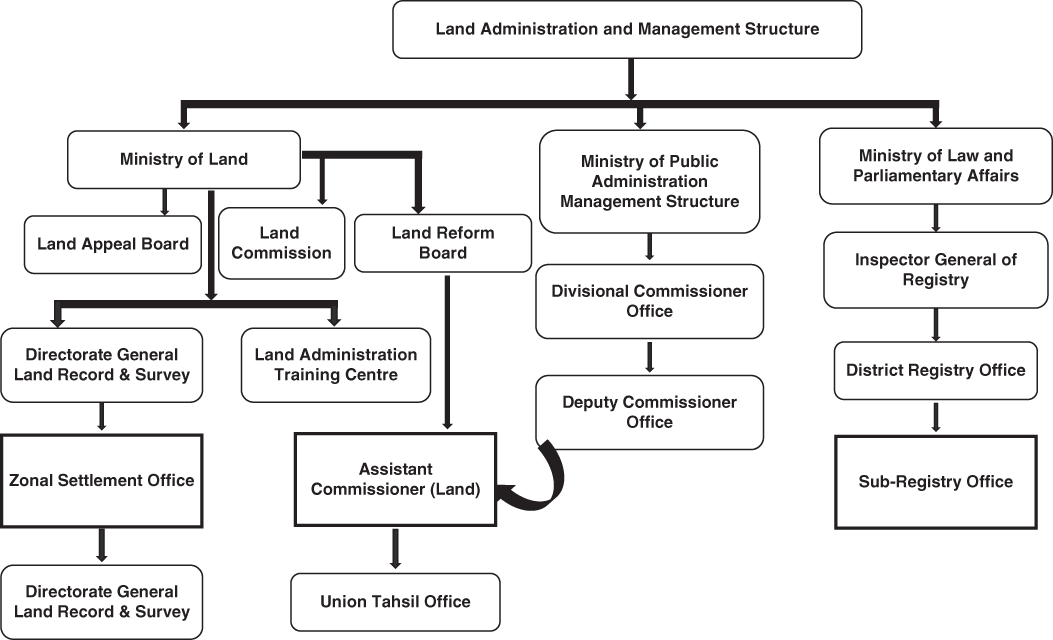
The current institutional structure of land administration in the country comprises four major bodies under two ministries: the Ministry of Land, and the Ministry of Law, Justice and Parliamentary Affairs (MoLJPA). The four major bodies that administer the land management system are the Directorate of Land Records and Surveys, the Land Reform Board, and the Land Appeals Board under the Ministry of Land, and the Department of the Land Registration System (under the MoLJPA).Footnote 13 However, the Ministry of Public Administration, formerly known as the Ministry of Establishment, is authorised to appoint an Assistant Commissioner (Land), who is the responsible authority connected to both the Ministry of Land (through the Land Reform Board) and the Ministry of Public Administration (through the Deputy Commissioner’s (DC’s) office). Other government bodies that play a minor role in administering land management are the Ministry of Forests, the Fisheries Department, the Directorate of Housing and Settlement, and the Department of Roads and Railways.
There are four core stakeholders in the land administration and management system in Bangladesh:
i. The Settlement Office: The Settlement Office generally takes on the task of updating the Record of Rights. Moreover, this office is appointed with the task of preparing, printing, and distributing the mouzaFootnote 14 and thana maps of every district, defining borders among the mouzas, thanas, and districts, and providing training to the newly recruited civil service cadres working at the field level of different directorates, as well as ministries, such as the administration, land, and forest. In addition, the determination of ownership of land is done by surveying neighbourhoods every 30 years.
ii. Assistant Commissioner (Land): Under the State Acquisition and Tenancy Act 1950, the Assistant Commission of Land authorises the transfers of land rights, except during land survey. The country is administratively differentiated in various levels, starting from unions; with a couple of unions forming a sub-district or thana or upazilaFootnote 15; a couple of thanas forming a district; a couple of districts forming a division; and eight divisions forming the whole country. The land administration follows this hierarchy in a broad sense. According to a report published by the Local Government Engineering Department, United Nations Development Programme (UNDP), and UN-Habitat (Shafi, Reference Shafi2007), land management functions through the Commissioner at the division level, the Deputy Commissioner at the district level, the Assistant Commissioner (Land) at the thana level, and the Tahsildar at the union level. Assistant Commissioner (Land), the executing authority of the Assistant Commission (Land), discharges all the activities of the upazila land office through a detailed structured administrative system comprising various levels of clerical assistants. The Assistant Commissioner (Land) has to perform multiple responsibilities regarding land, including those of Upazila RevenueFootnote 16 Officer, Upazila Settlement Officer, Circle Inspector, Revenue Circle Officer,Footnote 17 and Revenue Circle Inspector.Footnote 18
iii. Sub-Registry Office: The Sub-Registry Office is administered under MoLJPA and is appointed with the responsibility for registering lands and other properties under the Registration Act of 1908. The Sub-Registrar is the executive authority of the Registry Office and the representative of the MoLJPA at the upazilaFootnote 19 level. The Sub-Registrar registers the transfer of land through a stamped deed declaring the property value. There are 503 Registry Offices in Bangladesh, including one in every upazila, where, on average, 7,000 land transfers occur per year. These offices provide BDT 14 billion (equivalent to US$ 165 million) in tax revenue every year, which is 0.4% of total government tax revenue; this is not managed by the National Board of Revenue (Ministry of Finance, 2019).
iv. Land Survey Tribunal: The State Acquisition and Tenancy Act 1950 lays down the provisions for the Land Survey Tribunal and the Land Survey Appellate Tribunal. In case of any disputes, for example fake documents or fake mutations,Footnote 20 the affected party files a lawsuit with the Land Survey Tribunal. In consultation with the Supreme Court, the Government appoints the judge of the Land Survey Tribunal from the Joint District Judges.Footnote 21 Against a decision of the Land Survey Tribunal, an appeal can be made to the Land Survey Appellate Tribunal, which is constituted with a judge who is or has been a judge in the High Court division of the Supreme Court.
Upazila administration, which is under the jurisdiction of the Ministry of Public Administration, is primarily concerned with updating the Record of Rights in regard to mutation. Land buying or transfer of rights is directly connected to both the Sub-Registry Office and the Assistant Commission (Land) office. If any interested party enquires about the land that he/she intends to purchase by formally applying to the Sub-Registrar, he/she is granted the aforementioned information. Deeds are maintained by generating both alphabetically and plot number-wise ordered content so that information can be provided. When land transfer occurs, theoretically two parties have to agree on the price of the property and then the buyer will have to arrange the deed preparation. Next, both parties will visit the Sub-Registry Office together so that the Sub-Registrar can establish the money transfer between the two parties and collect the immovable property tax. The Sub-Registrar finally registers the transfer and forwards the record of land transfer to the Assistant Commission (Land) office, where the tahsildarFootnote 22 inspects and updates the record. Through this process, the Record of Rights, locally known as Khatiyan, is supposed to be updated. Moreover, buyers can check the Record of Rights from the Assistant Commission (Land) office to confirm the rightful owner of the property he/she intends to buy. Nonetheless, this land transfer has to be notified while the land survey is done by the settlement office. Figure 8.2 illustrates the land transfer procedure that would occur if the system worked properly.
The official process of land transfer in Bangladesh.
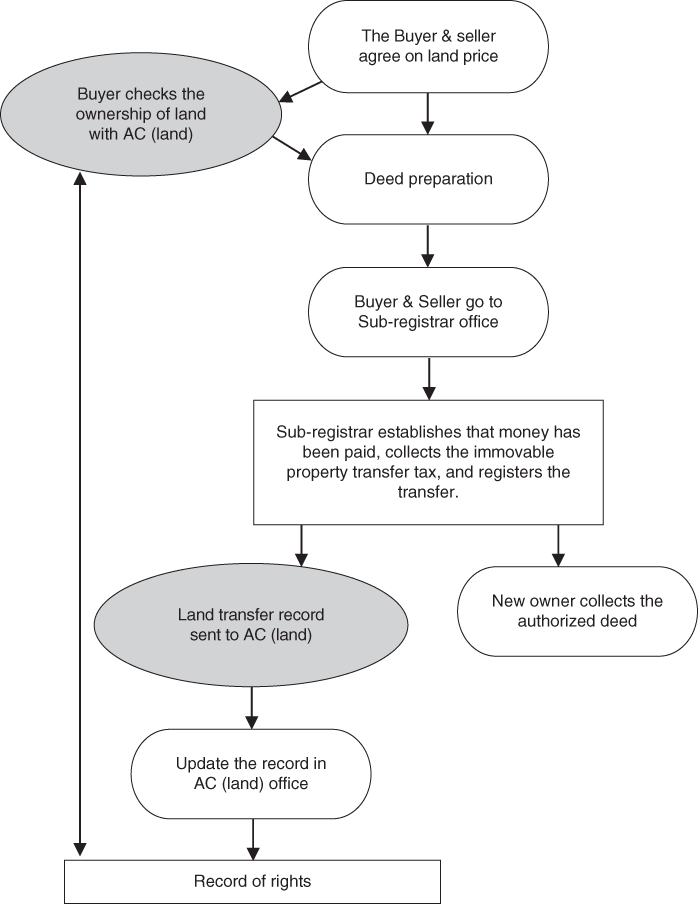
Interviews with two Sub-Registrars and two Assistant Commissioners (Land) from the Northeast and Northwest regions of the county, and FGDs with relevant stakeholders, reveal that the land transfer process often takes a detour in the steps involving the Assistant Commission (Land) office. Inherited lands are not mutated properly in most cases, due to lack of awareness among the landowners. In some cases, land mutation of sold land goes through years of red tape, ultimately reaching the DCs’ office from the upazila land office via the local tahsil office (revenue office). Often the process of the Registry Office sending the land transfer record to the Assistant Commission (Land) office takes too long, and sometimes it does not take place at all. The lack of timeliness in the process results in a lack of coherence of information between the stakeholders. Therefore, the possibility of multiple landowners existing in different government records for the same property arises, creating the opportunity for fraudulent activities and litigation. When a potential buyer attempts to check the ownership of the property, the information he/she obtains from Assistant Commission (Land) office might not be synchronised with the information in the Registry Office. The buyer can obtain information from the Assistant Commission (Land) office only, limiting his/her chance of comparing the information regarding ownership of the property. In this way, forgery and intentional multiple-selling of the same land can take place.
B Challenges Related to Land Administration
The land administration system in Bangladesh is characterised by pervasive corruption, incidents of land-grabbing by vested interest groups and influential politicians, and social tensions emanating from land-related conflicts. The land management system in Bangladesh is still based on traditional regulations, with most of the rulebooks framed during the British period. Therefore, inefficiency in the provision of legal and administrative services related to land intensifies corrupt practices in this sector. Box 8.2 sets out some examples of corruption in the land administration system in Bangladesh that have been discussed in the national media.
Case 1: The land surveyor demanded US$ 825.63 for providing a digital Record of Rights to a service seeker, with US$ 236.20 having to be paid in advance. (The Business Standard, September 2019)
Case 2: A deputy assistant officer from the union land office was caught red-handed with US$ 176.92 in bribe money. (The Business Standard, October 2019)
Case 3: One surveyor was caught with US$ 109,834.51 and documents proving incidents of bribery, with 29 other employees from the same Land Acquisition department involved. (Dhaka Times, Jugantor, Manab Zamin, Daily Janakantha, Bangla Tribune, Prothom Alo, Ittefaq, February 2020)
Case 4: A land officer from the union land office demanded five times ($59.05) the original fee ($13.82) as a bribe. (Jugantor, Dainik Amader Shomoy, Jago News24, October 2019)
Case 5: A land officer from the union land office took US$ 59 for providing a tax receipt for US$ 2.36. The bribes for the mutation of vested property amounted to US$ 1.771.52; for mutation in general, it was between US$ 240 and US$ 2,400; and for leasing it was US$ 710. The officer allegedly harassed the service seekers, threatening to delay the mutation by confiscating documents unless the bribe was paid. (Prothom Alo, June 2019)
Case 6: According to TIB, the amount of the bribe for mutations was 50–60 times the original rate. In one example, a service seeker mutated the name by paying a US$ 300 bribe. The employees, along with the middlemen, solicited bribes, according to the service seeker. 50% of the bribes went to the Sub-Registrar, and the rest was divided among other employees. (BBC Bangla, September 2019)
Case 7: A bribe for providing compensation for land acquisition: surveyors took 30% of the compensation as a commission or bribe from the afflicted owners, in exchange for providing the compensation. (Aparadh Bichitra, February 2020)
Case 8: In an upazila land office, land-related documents were ‘misplaced’ unless a bribe was paid. The rate of bribes differed depending on the service seekers’ economic situation, profession, influence, and connection to elites. In the Sub-Registry Office, the middlemen had access to the official documents to the same extent that they performed various duties, such as keeping records in the record room. (Dhaka Times, September 2019)
Case 9: The Chattogram district administration made a contract with BBC Steel Company and leased 7.1 acres of land of coastal forest despite a court order forbidding this. (The Business Standard, January 2020)
Case 10: In a period of two years, one afflicted landowner, a day labourer by profession, was subjected to 70 litigations by a local neighbour, locals with connection to political elites, and business elites. (Prothom Alo, May 2019)
Figure 8.3 provides a schematic representation of the complexities of land administration, and the respective consequences in Bangladesh. The land-related challenges occur for two main reasons: internal issues (e.g. a lack of adequate infrastructure, the analogue records system, and inconsistent human resources) and external issues (e.g. lack of coordination among the administrative entities). The subsequent sub-sections provide an analysis of these challenges.
A schematic presentation of the complexities in land administration, and their consequences.

1 Internal Administrative Issues
Internal administrative problems relating to the stakeholders, from infrastructure to analogue record-keeping, arise from the inability to modernise the system, which is a hold-over from the inherited colonial system. Key informant interviews (KIIs) with relevant stakeholders, conducted in July 2019, highlighted the following internal administrative issues.
Lack of digitisation: Both the Ministry of Land and the Ministry of Law lack necessary digitisation. However, copies of Records of Rights and mutation of names are in the process of being digitised in the Ministry of Land. The Government initiated an electronic application system for the mutation of names, or e-mutation, in 485 upazilas and 3,617 union land offices in 61 districts, barring the three hill districts in the CHT, on 1 July 2019. However, over 40% of the upazilas underperformed in the e-mutation process, and three districts from the CHT are yet to be included in the process.Footnote 23 The official reason given for this underperformance is that it has been hard for staff to adapt to the new technology. Moreover, a grievance redress system, in the form of a hotline, was initiated in 2019. However, the hotline only aims to accept complaints, it cannot guarantee the resolution of them.Footnote 24 People often find themselves paying more than required. Also, corrupt officials at land offices harass service seekers, and threaten to delay mutations by confiscating documents unless a bribe is paid. There is resistance to the digitisation of the system by vested interest groups.Footnote 25
Infrastructure: According to the present law, only the deeds from the current year are supposed to be retained in the Sub-Registry Office. Nevertheless, these offices are preserving all deeds from 1987 onwards, due to the unavailability of space in the district offices. The deeds are stored in old and damp record rooms, causing them to deteriorate. The records are vulnerable to fire or other hazards, which will turn the main document held by the owner into the only evidence available. A lack of proper duplicates or backups is causing legal complexities due to lost deeds and record books. Moreover, presently, there is a record book crisis in the Registry Offices. The Registry Offices are constrained to collect deeds without proper records due to the lack of record books. Record books (locally known as Balaam Boi) are not provided to the Registry Office for years, even after communicating repeatedly with the MoLJPA. In Dhunat upazila of Bogra district, the collection of property tax by union land offices was postponed for more than a month due to a lack of receipt books.Footnote 26 This lack of receipts stopped the land transfer process and relevant people getting loans from the banking system, since such receipts were required as legal documents to obtain bank loans secured against any property. Also, in most cases, inadequate logistics and transport facilities restrict the settlement offices from conducting their regular responsibilities, such as monitoring of land record surveys.
Human resources: There exists a lack of manpower within several posts of various departments of the land offices, constraining the required services provided to people. The currently employed manpower also has a wide skills mismatch. The settlement offices lack updated training regarding the land survey methodology (Transparency International Bangladesh, 2015). Though the participation of non-government organisations and academia in land-related policy consultations has been on the rise, the participation of the private sector in technical aspects of land management remains limited. Therefore, the precision and transparency of surveys is widely discredited after land surveys are conducted (Hossain, Reference Hossain2017). Here, the self-interest of various stakeholders prevents the system from working efficiently. For instance, the lack of necessary manpower in the Registry Offices is made up for by unofficially employed human resources, who are employed through nepotism and corruption; the latter harass the service seekers by multiplying official registration fees.Footnote 27 The author’s interview with a Sub-Register in Dhunat upazila of Bogra district suggests that, for that specific Registry Office, there are 87 copyists, with more than 100 assistants, whereas only 20 copyists were required.
2 External Administrative Issues
The second reason behind the administrative complexities can be described as the lack of coordination among the stakeholders. The administrative offices that are bestowed with the responsibility for land management work separately, with little coordination among them. The Sub-Registrar registers the land after checking the record of the settlement office and the mutation of the Assistant Commissioner (Land). Additionally, a land transfer notice is supposed to be sent to the Assistant Commissioner (Land) office If any work is registered in the registration office. However, in reality, the records are hardly ever updated due to the lack of coordination between these two offices. The mutation of land is performed by the Assistant Commissioner (Land) whenever someone submits the registered documents, regardless of whether they receive a copy from the Sub-Registry Office. Therefore, a multiplicity of documents or Records of Rights arises due to the lack of coordination inside the land administration system (Hasan, Reference Hasan2017).
Evidently, a gap exists between land management by the Ministry of Land and the registration of land by the Ministry of Law. An expert committee suggested to address this gap by developing a database, using appropriate technologies for coordination, and introducing a Certificate of Land Ownership as the sole document for registering land ownership (LANDac, 2016). However, until now, there has not been any progress on this front.
3 The Results of Administrative Complexities
Internal and external administrative complexities lead to unidentified khas land, lack of access to information, corruption, congestion of legal disputes, and multiple transfers of land.
Unidentified khas land: Since the colonial period, this region has experienced people abandoning their land due to communal riots, war, etc., which has led to the Government being assigned the abandoned land. Many areas of khas lands, khas water bodies, khas ponds, enemy property, abandoned property, as well as unused land under different government offices, are not properly identified and reported by the land administration. Around 70% of the farm households in Bangladesh have less than 1.5 acres of land, which means a large portion of these land-poor households depend on seasonal employment opportunities or sharecropping, including other tenancy arrangements, to access land for their livelihoods (Hossain, Reference Hossain2017). The aforementioned khas land, which could be used to maximise social welfare by distributing it among the landless and land-poor population, or investing in development projects, often gets misused, due to administrative complexities, such as a lack of manpower to identify and report it, fake documents submitted fraudulently to the Registry Office or Assistant Commission (Land) office, and simply grabbing of the land by influential people (Barkat, Reference Barkat2005). Obtaining and retaining khas land is a complex issue for land-poor and landless people who need it the most and who require assistance to expand their land ownership (Barkat et al., Reference Barkat, Zaman and Raihan2001). A lack of manpower, along with a lack of transport facilities, to periodically monitor land and verify the field reports after monitoring exponentially extends the volume and extent of misuse of khas land (Transparency International Bangladesh, 2015).
Lack of access to information: As Rahman and Talukder (Reference Rahman and Talukder2016) argued, administrative complexities, such as lack of digitisation, complicates the whole process of accessing the information related to land ownership. Demand to access land tenure records, land information, and land documents often produces very little results. The level of access to land data and related information by the mass of people remains low, hampering the fulfilment of the right to information. The updating and sharing of information among stakeholders is virtually ineffective due to the lack of effective coordination among government agencies. The lack of access to information perpetuates a lack of awareness among the general population. A general population who lack awareness cannot protest or demand their rights. In addition, they cannot demand a modern land administration system. Therefore, government efforts to solve the issues are often not implemented, due to people being unaware of the issues.
Corruption: Red tape in land administration causes corruption. Since citizens are mostly unaware and unable to access services without paying bribes, they end up being part of the corrupt practices. According to a nationwide survey conducted by Transparency International Bangladesh (2015), 16.6% of households resorted to the land administration, and 59% of them were victims of corruption. According to the same survey, 54.9% of the households paid a total of BDT 22.61 billion (around US$ 0.27 billion) as bribes in 2012, 1.6 times higher than the land revenue collected in 2019. According to another survey, conducted by MJF, Uttaran and CARE Bangladesh in 2015, around two-third of households (65%) did not receive the services required from land offices, or were asked for bribes, or received services late.Footnote 28 Moreover, agricultural land is often used for unplanned real estate and industrial purposes, by resorting to bribes or political influence (LANDac, 2016). As part of an overall study of the institutional diagnostics of development in Bangladesh, a survey (SANEM-EDI survey in 2019, see Chapter 3) was conducted among 355 respondents covering major stakeholders in Bangladesh. According to the survey results, almost 90% respondents indicated that land-related operations at the local community level were subject to corruption.
Congestion of legal disputes: In the absence of an effective governance system capable of resolving land-related disputes, the reliance on litigation without administrative process leads to legal disputes. The presence of a multiplicity of legal documents perpetuates disputes over land, which comprise almost two-thirds of the total legal disputes in the country, resulting in about 1.7 million pending cases as at 2014 (Transparency International Bangladesh, 2015). On average, 2.5 million new mutation-related cases are created every year.Footnote 29 Moreover, land-related disputes are dealt with by the Land Survey Tribunal, which lacks sufficient manpower to deal with the enormous congestion of legal proceedings. The SANEM-EDI Survey in 2019 found that 65% of the respondents held the view that the implementation of land laws was very poor in Bangladesh.
Multiple transfers of land, and land-grabbing: FGDs and KIIs reveal that due to the lack of coordination among the administrative entities involved in the land transfer process, the possibility of selling land multiple times arises. A buyer’s failed attempt to update the record manually in the Assistant Commission (Land) office inevitably results in a multiplicity of land-related documents and a multiplicity of ownership, causing disputes in the long run (Hasan, Reference Hasan2017). This phenomenon is common in relation to applications for compensation from the Government during the acquisition of land for development purposes, as various political opportunists and previous owners claim to be the real owners of the land. Also, wealthy and influential people encroach on public lands using false documents and obtain court decrees to confirm their ownership, often with the help of officials in the land administration and management departments (Feldman and Geisler, Reference Feldman and Geisler2011).
4 Investors’ Opinions about Land Operations
Unavailability of serviced land is a prominent investment hurdle in Bangladesh (World Bank, 2012). Investors’ opinions about land operations in Bangladesh can be ascertained from the Doing Business Index of the World Bank. Bangladesh ranked 168 out of 190 countries in the World Bank’s Doing Business Index in 2020, while India, Sri Lanka, and Pakistan ranked 63, 108, and 99, respectively. Among the Doing Business indicators, the Registering Property indicator considers four distinct areas comprising ‘number of procedures’, ‘amount of time (days)’, ‘the cost required to register a property’, and ‘quality of the land administration index’. In Bangladesh, registering property requires eight procedures (around 1.2 times more than the South Asian average), takes 264 days (more than twice as long as the South Asian average), costs 7.2% of the property value (around 1.1. times higher than the South Asian average), and the quality of the land administration index is 6.5 (around 74% of the South Asian region’s average). All of these results suggest that the performance of the land operation system in Bangladesh, as perceived by investors, is lagging behind that of its neighbouring countries.
C Dynamics of Political Power and Institutional Configurations
The complexities of land administration and management are greatly compounded by the political economy, which prevents problems from being solved. The more explicit scenario includes land-grabbing and congestion of litigation, for which politically influential groups and the beneficiary business elites are directly responsible.Footnote 30 Furthermore, in many cases, the same parties have created internal and external issues related to land administration, as already discussed.
The recruitment procedures for the land administration are beset by corruption and nepotism.Footnote 31 Due to the corrupt recruitment process, including bribing and enforcing political influence, the recruited manpower in the land administration system is mostly inefficient, unenthusiastic about the service they are required to provide, and prone to further corruption. KIIs and media reports reveal that there are unnecessary numbers of employees who are overcharging people in the Registry Offices.Footnote 32 As discussed before, while digitisation can solve some of the administrative problems, including corruption, the KIIs suggest that digitisation would decrease the number of currently employed people, and there is a resistance to such reforms from vested interests. Also, these vested interests are closely linked to the local politically influential elites, who are also the beneficiaries of the rent being generated from the corrupt practices in the land offices (Chowdhury and Panday, Reference Chowdhury and Panday2018). Due to the substantial benefit from corruption, Sub-Registrars are generally reluctant to be promoted to district-level registrars. The reasoning for this also partially lies in the lack of capacity bestowed upon a District Registrar as well.Footnote 33
The issues related to infrastructure, congestion of legal disputes, access to information, fake documents, and the manpower required to manage the whole chaotic current process can be improved by digitisation. However, despite the overwhelming consensus about the necessity of digitisation, the self-interest of various stakeholders with political influence, who are directly benefitting from the current system, prevents the system changing for the better. These interest groups of politically influential people and business elites with political connections are directly or indirectly involved in the corruption related to land tax submission procedures, land registration procedures, mutation of ownership, changing land type to acquire an unjustified price from potential industrialists and other buyers, selling water bodies to uninformed buyers, and unnecessary bureaucratic complexities.Footnote 34 According to the Minister for Land, as reported in a newspaper article, land surveys are entangled with corruption to such a degree that surveys provide millions to the people who are involved in the process, and they are ‘ruthless’.Footnote 35
While some business elites are in favour of reforms of land management, the ruling political elites are not very keen as reforms would eliminate sources of rents, including among Assistant Commission (Land) and Sub-Registrar employees, who are likely to be there because of loyalty to the ruling political elites. However, powerful business elites with strong political connections are able to bypass the system.
V Addressing Land-Related Problems Through Sezs, and the Institutional Challenges of Land Acquisition for Sezs
As discussed earlier, registering property is very difficult for new investors, especially if they lack a connection to the political elites. Moreover, the high land price causes high input costs, which bar potential investors. Identifying and acquiring suitable land is also challenging for private investors, and especially for foreign investors. At present, private investors can access land through the existing land system, which is full of institutional weaknesses, as discussed above. To solve these issues and enhance private investment, the Government created Export Processing Zones in 1983, with preferential treatment given to the labour-intensive ready-made garment sector. However, EPZs catered only to export-oriented industries. Hence, the Government initiated SEZs, through the Bangladesh Economic Zone Authority (BEZA). The SEZs offer a prospective solution, among other things, to the challenges faced by new investors in accessing land.
A SEZs in Bangladesh
SEZs are geographically delineated ‘enclaves’ in which the regulations and practices related to business and trade differ from the rest of the country, and therefore all the units located therein enjoy special privileges (Raihan, Reference Raihan2016). According to Ge (Reference Ge1999), SEZs are characterised, in general terms, ‘as a geographical area within the territory of a country where economic activities of certain kinds are promoted by a set of policy instruments that are not generally applicable to the rest of the country’. Theoretically, SEZs are supposed to accommodate both export-oriented and domestic market-oriented industries.
Under the Bangladesh Economic Zones Act, 2010, BEZA was established as the public regulatory body for implementing SEZs. Till now, BEZA has approved 88 SEZs, through its governing body, which comprises 59 government SEZs and 29 private SEZs.
BEZA has started to work on four types of SEZs: government, private, public–private partnerships, and foreign. Feasibility studies, land acquisition, area-specific social and environmental studies, and other initiatives are underway for these approved SEZs. There are plans to acquire approximately 75,000 acres of land for these SEZs. By 2030, BEZA expects to create employment for about 10 million people and to export US$ 40 billion worth of products annuallyFootnote 36 by establishing 100 economic zones nationwide.
Although BEZA plans to establish SEZs in 31 districts, most of the projects are situated within Dhaka and Chattogram region. Regardless of the authority given to BEZA, there is a need for concerted effort from all the state stakeholders to implement its plan. The SEZs require a massive amount of land acquisition, which concerns all the stakeholders of land administration. Although BEZA is supposed to ease the complications in respect of accessing land, pace has been slower than expected.Footnote 37
Among the private SEZs, so far success has been seen in the case of the Meghna Industrial Economic Zone, which is located beside the Dhaka–Chattogram highway. Situated on 110 acres of land, in February 2020, this economic zone started its operation with nine new industrial units (related to consumer products and industrial raw materials), at a cost of BDT 40,000 million (around US$ 0.5 billion).Footnote 38
B Challenges in Land Acquisition under SEZs
Land acquisition in a densely populated and land-scarce country like Bangladesh is always a complex task. Therefore, the success of the SEZs policy will depend on the way the institutional challenges in the land administration system are handled. At the same time, the tempting facilities of SEZs present the possibility of relocating firms for rent-seeking reasons (Razzaque et al., Reference Razzaque, Khondker and Eusuf2018).
Land acquisition refers to the process by which the Government forcibly acquires private land for a public purpose with or without the consent of the owner of the land, compensating the owner in exchange for the aforementioned land in an amount which can be different from the market price of the land.Footnote 39 Land acquisition is intricately connected to development blueprints envisaged by the Government of Bangladesh, such as its five-year plans, the Delta Plan, and so on. Additionally, appropriate land acquisition procedures assist in the timely execution of development projects. According to the KIIs with land owners and officials of the land office, legal owners are regularly harassed and exploited at the land offices throughout the country. Moreover, the financial compensation related to land acquisition perpetuates an overwhelming amount of corruption around the DC offices of the country. Many development projects are hindered for years due to land acquisitions and the corresponding compensation process.
In this context, the land acquisition process for SEZs required clarification in order to resolve the complex issues surrounding compensation. In this context, the Acquisition and Requisition of Immovable Property Act 2017, currently used by BEZA for land acquisition, was developed to replace the Acquisition and Requisition of Immovable Property Ordinance 1982, which in turn was descended from the Land Acquisition Act 1894, established during the colonial period. In the 2017 Act, a detailed clarification is provided of the compensation process. Although the Ordinance of 1982 prohibited the state from evicting people from their homesteads, the vagueness of the law obstructed marginal people from receiving compensation. However, the 2017 Act also needs further amendment to solve complexities at the ground level.
As the success of SEZs depends on effective land acquisition, the land acquisition process for SEZs needs to be different from the usual land acquisition processes applied for any other purposes. However, our FGDs and KIIs confirm that the land acquisition process for SEZs has not been very different from the usual process, and it suffers from several of the corrupt practices related to land administration and management mentioned in Section IV. For example, in the land acquisition process, while the last owner of the deed, whose name has been mutated and who provides revenue receipt, should be treated as the actual owner of the land, corrupt officers in land offices send the land acquisition notice to various previous owners and thereby complicate the situation. In this process, opportunists, in association with corrupt officers in the land offices, file claims for compensation for the acquisition of land. In the end, the actual owner of the land has to bribe the corrupt officers in the land office to provide the compensation.
Our FGDs and KIIs also reveal that the news of a land acquisition causes hasty construction to acquire higher compensation for the hollow land by opportunists, in order to obtain higher compensation.Footnote 40 People who do not have any connection with political elites are forced to pay bribes in order to receive compensation. However, a bribe often does not ensure the compensation. Filing for compensation can lead to encounters with influential goons and middlemen who seek to snatch away the money. The presence of intermediaries or middlemen in the land acquisition offices worsens the woes of the actual owners. Intermediaries distribute bribes to the different levels of employees in the land acquisition office.Footnote 41
One example of the aforementioned difficulties in land acquisition for SEZs is the Sreehatta Economic Zone. The presence of fake landowners, a mismatch in the price of land, and inadequate compensation angered villagers, who filed hundreds of cases in the courts, delaying the zone’s development.Footnote 42
C Sreehatta Economic Zone: An Example
Sreehatta Economic Zone is located in Moulavibazar district (Northeast of Bangladesh), which is to the east of Sylhet, west of Habiganj, north of Sunamganj, and south of Moulavibazar district. This SEZ was established on 352 acres of land in Sherpur at Sadar upazila, with a view to generating employment for 44,000 people in the Sylhet division. In March 2017, six private entities invested US$ 1.4 billion to establish their industries in this economic zone. Moreover, land development, utility supply, and lake development have already started in this zone under the supervision of BEZA. Figure 8.4 depicts the land acquisition process of SEZs under the Ordinance of 1982. Sreehatta Economic Zone acquired 240 acres of land from approximately 2,000 families and the remaining 112 acres from government khas land.
Land acquisition process.
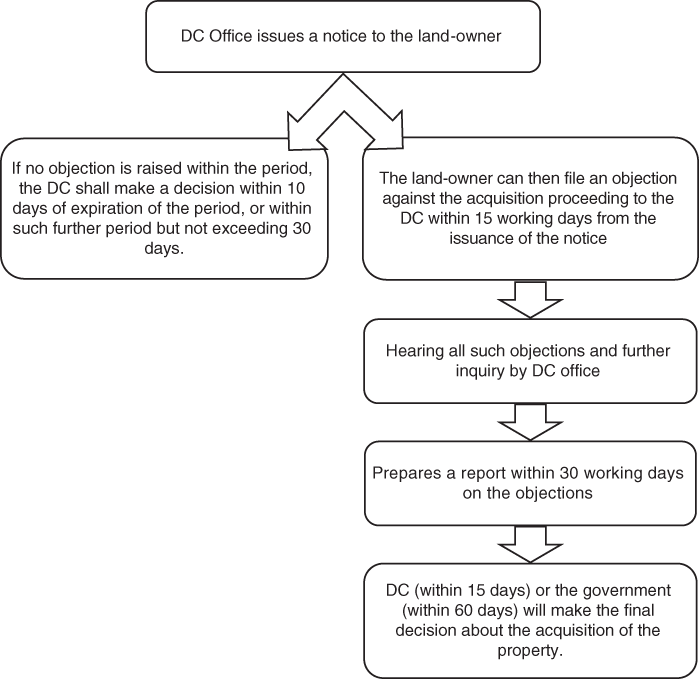
While maintaining the valuation methods described in the Ordinance of 1982, the process takes into account whether the land is used for agriculture, habitat, and so on. The overall value also depends on the details of the usage, that is the type of crop being cultivated on the land. For the Sreehatta Economic Zone, the Sub-Registrar’s office determined a market price of BDT 34,600 per decimal of Aman landFootnote 43 and BDT 66,700 per decimal of Aus land.Footnote 44 Generally, the responsible DC office requires assistance from the Housing and Public Work Division, Agriculture Division, and Forestry Division to determine the value of infrastructure, food, crops, and trees, respectively. According to the Ordinance of 1982, the affected owners should get 150% of the market price as compensation. Although in Sreehatta Economic Zone, around 85% of total compensation has been paid, it took three to four years for the amount to be paid, revealing the challenges faced by the owners. Thus, closer inspection of marginal landowners’ cases reflects the critical situation in the land acquisition process. Also, as mentioned earlier, hundreds of cases were filed in the courts related to confirming the legal ownership of the acquired land.
As mentioned earlier, the Acquisition and Requisition of Immovable Property Act 2017 replaced the Ordinance of 1982. But the late implementation of the new law prevented many people obtaining fair compensation in the case of Sreehatta Economic Zone. The landowners accused the Assistant Commission (Land) of undervaluing the land price since the then market price of agricultural land was more than the price determined by the Assistant Commission (Land). Moreover, according to the Acquisition and Requisition of Immovable Property Act 2017, if in consequence of the acquisition of the property, the affected person is compelled to change his/her residence, reasonable expenses, if any, incidental to such a change must be considered in determining compensation. However, there are allegations of violations of these provisions in the case of the compensation provided to the landowners in the case of Sreehatta Economic Zone.
We investigated the land acquisition cases of two people: E and T, who are brothers. They live in Sherpur village at Sadar upazila in Moulvibazar District. About 7.66 acres of land were acquired from them for the purpose of Sreehatta Economic Zone. Out of this 7.66 acres, 1.52 acres was agricultural land (Aman) and the remaining 6.14 acres included a homestead, pond, and plantation. The two brothers received BDT 7.81 million (after deducting taxes, including income tax) as compensation for 1.52 acres of agricultural land (Aman type), on the basis of the compensation of per decimal land was BDT 51,000 (150% of the market price determined by the Assistant Commission (land)). They also received around BDT 12.9 million as compensation for infrastructure, trees, food, and crops. However, the compensation for the 6.14 acres of homestead land is still unpaid. Since there was a legal dispute in the High Court regarding these lands, the payment was stalled by the DC’s office at the time of payment. During the valuation process, the Assistant Commissioner (Land) categorised the lands (6.14 acres) as agricultural land and accordingly the total unpaid amount was BDT 32.63 million. Since the land from the aforementioned economic zone was acquired under the old law, that is the Ordinance of 1982, the landowners (E and T) were dissatisfied with the valuation process. Therefore, as the aforementioned land was homestead type and located beside the road, they claimed further compensation and rehabilitation support. After formally complaining to BEZA, they received only indifference, and presently the situation is at an impasse.
VI Way Forward
The research underlying this chapter suggests the following measures, both at the policy and institutional levels, for the improvement of land administration and management in Bangladesh.
An efficient land survey: The land management system of Bangladesh still accepts Cadastral Survey, State Acquisition Survey, and Revisional Survey records due to a lack of updated surveys conducted in recent times. The land survey and documentation process need to be efficient and credible. The survey process requires updating in regard to survey methodology and technology, and there is a need to train relevant employees.
Digitisation of record-keeping: The analogue colonial method of record-keeping perpetuates the multiplicity of documents and corruption. The colossal infrastructure necessary to preserve the analogue record creates an array of problems in itself. Therefore, digitising the whole record-keeping documentation process is essential.
Administrative reforms: Rigorous administrative reform is a precondition for mitigating challenges regarding access to land. The current administrative system of colonial descent has to be modified, keeping the context of the country in mind. The Land Administration Manual needs to be updated, and land administration needs to be capable of handling land-related disputes. Administrative reforms can be piloted in specific offices and further extended nationwide if they succeed.
Harmonisation of different stakeholders with overlapping responsibilities: Different stakeholders with overlapping responsibilities need to be harmonised based on their functioning. The recommendation of the Muyeed CommitteeFootnote 45 to combine Land Registration (Sub-Registrar) and record (tahsil) offices into a single office at the field level needs to be implemented
Allocation of public lands: A higher degree of coordination should be achieved at the national level to allocate public land to ensure its most productive and essential use. This could be achieved through a coordination institution or body and the establishment of a public land database that would list all plots available for development by location, size, facilities, and other attributes (UNCTAD, 2013; Kathuria and Malouche, Reference Kathuria and Malouche2016).
Reform of the judicial process: The judicial process needs to be reformed to resolve the congestion of litigation. Land survey tribunals need to be reformed to resolve contemporary land–related litigation. Land survey tribunals should be composed of three members involving representation from the judiciary, settlement department, and land administration.
Building awareness: Access to land is difficult to achieve for the general population due to the lack of information regarding the land administration system and the services provided by them. The land laws need to be translated into colloquial Bangla to build awareness. Furthermore, setting up a one-stop service centre to provide information and primary guidance, coupled with digitised administration, can improve the overall land-related problems among the mass of the population.
The present land administration system in Bangladesh has been inherited from the colonial era and fails to meet the needs of the present. The archaic land management system and land laws require modernisation, and there is a need for well-functioning institutions. To increase the effectiveness and credibility of reforms, the Government should also focus on the alignment of cross-sectoral policies (National Agricultural Policy, National Rural Development Policy, National Forest Policy, and Coastal Zone Policy). Entrusting one single agency with sufficient capacity to maintain spatial records in rural and urban areas would be beneficial.
While the Government of Bangladesh has adopted the strategy of establishing SEZs to address the land-related problems facing domestic and foreign investors, the success of SEZs will require an efficient mechanism of land acquisition. While some laws and administrative procedures have already been laid out to provide assistance to SEZs, the progress made so far needs to be critically examined to achieve long-term success.
Annex 8.1 Glossary of Terms
Poorly functioning institutions undermine the functioning of land markets in many developing countries. This chapter provides a rich description of these problems in Bangladesh and offers reform suggestions. Once prominent in traditional academic literature and development policy discussions, these issues have received less attention in recent decades. This is unfortunate, as they continue to be important in low-income countries in South Asia and sub-Saharan Africa. Improper record keeping and lack of transparency undermine security of land rights, as well as transactions facilitating the transfer of land to more efficient farmers and non-agricultural uses in the process of structural transformation. In countries neighbouring Bangladesh, such as India and China, the implementation of land reforms have been shown to have significantly impacted the growth of agricultural productivity, and the evolution of inequality and poverty.
This chapter provides a detailed and informative review of these problems in the context of Bangladesh, including comparisons with other Asian countries.
The set of areas covered are divided into two main topics:
1. land policies (land redistribution, tenancy protection, and land sales) and land administration (land records, sales and transfers, and taxes);
2. land acquisition for non-agricultural purposes by government and private industry, with the related issues of compensation and SEZs.
The former topic is relevant for development within the agricultural sector, while the latter pertains to the non-agricultural sector and structural transformation from agriculture to industry and services. I discuss each of these in turn.
Rural Development
Section III describes the evolution of laws pertaining to land ceilings, redistribution, and tenancy protection in Bangladesh. Section IV focuses on problems in land administration and enforcement, with a detailed explanation of organisational structure. Various weaknesses are highlighted: the lack of digitisation of land records; poor infrastructure; human resource problems (such as lack of training and skills, and low motivation); and the overlapping jurisdictions of different divisions, resulting in lack of coordination. The discussion clearly illustrates how these weaknesses reduce land security, inhibit land transfers, and promote corruption. Data from household surveys indicate that corruption and lack of transparency are pervasive. Comparisons with neighbouring Asian countries on land registration delays and the quality of land administration shows the situation in Bangladesh to be considerably worse than in those countries.
One would like to learn more about these problems, and in particular their consequences for rural development in Bangladesh. For instance, when were the last cadastral surveys completed? For the country as a whole, how much land has been acquired under the land ceiling rules, and distributed? How many sharecroppers were registered? I am not sure if there are any statistics readily available on these, which might be compared with neighbouring countries or regions (such as West Bengal in India, which, in conjunction with Bangladesh, historically constituted a united province until the partition of 1905, engineered by the colonial British authorities). Some facts noted in passing suggest a very low extent of implementation of land reforms. For example, the progress achieved with respect to the distribution of vested land in the 1970s was far lower than expected; only 0.2% of agricultural value added was collected in the form of land taxes during the 1980s. The recommendations of the Muyeed Committee on the rationalisation of land administration were ignored. About 90% of the rural population in 1991 were unaware of their entitlements under the existing legislation.
Additional research is probably needed to create a systematic database on land reforms implemented and to answer important questions relating to the evaluation of land policies in the past as regards rural development in the Bangladeshi context. While these are probably beyond the scope of this chapter, I list some questions below, in the hope that future research efforts will be directed towards answering them. I mention in this connection the work of Abhijit Banerjee, Paul Gertler, and Maitreesh Ghatak (Journal of Political Economy, 2002), which showed a significantly higher growth of rice yields in West Bengal compared with Bangladesh during 1978–1994, ostensibly owing to substantially greater success in implementing tenancy reform laws.
(a) How did the land distribution change over time, and what role did land reform policies play? How active is the land market? Have land markets equalised or dis-equalised landownership?
(b) It appears that many of the regulations in place are intended to protect small and marginal households in the rural sector, who are poor and comprise a large fraction of the population. In evaluating the implications of existing land regulations, one therefore needs to understand whether these redistributive policies retard or enhance economic growth. Are small farms more or less productive than large farms? How much agricultural tenancy exists? What are the nature of tenancy contracts, the regulations they are subject to (e.g. crop shares or eviction rights of landlords), and the effects of such regulations? Are there increasing returns to scale in farming? To what extent do scale effects depend on differential access of small and large farmers to credit, technology, infrastructure, or marketing? How smoothly does the market for leasing or buying land function? Are there restrictions on outsiders buying land? What are the effects of land policy on migration to the urban sector?
(c) To what extent are landholdings fragmented? What are the productivity effects of fragmentation? If this is a serious problem, is there any scope for the Bangladesh government to coordinate land consolidation efforts?
(d) This chapter indicates many dimensions on which land policies are poorly implemented, owing to lack of transparency, poor land records, and low motivation of land administration officials. As in neighbouring West Bengal, only a small fraction of land collected for redistribution has actually been distributed to the poor. More details of the implementation process would throw more light on the underlying reasons. For instance, who decides on how to select beneficiaries, and on what basis? What happens to the undistributed lands: do they lie fallow or are they used in some way (if so, by whom)? If implementation has been a major problem, to what extent is this a result of weak political will, rather than weak institutions?
(e) Related to the question of political will, what are the political economy effects of land concentration? Do those with large landholdings exercise disproportionate power by virtue of their access to politicians and political parties? If so, what effects does this have on tax evasion and local government revenues, on the allocation of local infrastructure, or the implementation of land regulations? Is there scope for wider reforms of electoral processes and empowerment of local governments in Bangladesh which may improve the implementation of land policies?
(f) How important are water management problems, such as groundwater extraction, irrigation/electricity pricing, or conservation incentives? Are there serious problems of sustainability, for example encroachment on forests, and other common properties? How is the rise of the water level near the coast affecting neighbouring farming and fishing communities? What policies are being considered to help them adapt and possibly to resettle in the future?
(g) What is the potential for the development of modern export-oriented agribusiness? What restrictions currently apply on ownership of land by large firms or foreigners? Can a multinational corporation invest in agribusiness, acquire land, and operate large farms, hiring local labour? Are there restrictions on contract farming? Do land regulations constrain the growth of agribusiness? If there has been any significant agribusiness development in Bangladesh (e.g. in fishing or specific cash crops), what have their growth and distributional impacts been?
Land Acquisition for Industry and SEZs
The remainder of this chapter provides many interesting details about SEZs in Bangladesh and raises a number of important policy questions concerning land acquisition and compensation policy.
I think it is useful to distinguish between two issues here. The first concerns broader aspects of SEZ policy, which do not necessarily have anything to do with land policies per se. SEZs typically include the provision of infrastructure and subsidies, the relaxation of labour/environmental regulations, and fast-track approval on a preferential basis for large investors in manufacturing and services. The aim is to attract and stimulate investment by relaxing constraints and regulations that are pervasive in the economy. By its very nature, this creates a dual system. The authors raise concerns about differential access between small and large investors, between those oriented towards the domestic market and those oriented towards the export market, and between regions. This suggests an underlying tension between efficiency/growth objectives and equity/fairness goals that Bangladeshi policy-makers need to confront. Could it be better to focus on growth and to foster special privileges favouring large, export-oriented investors and urban centres, and then expect the resulting benefits to gradually trickle down to the rest of the economy via migration and internal trade?
The second set of issues concerns the specific problems created by poor land administration institutions, which this chapter discusses in detail. Complications owing to poor land records and lack of transparency are illustrated by this chapter’s Sreehatta Economic Zone case study. The land authorities deliberately created problems that enhanced corruption and delays, such as informing both the prior and current owners. Problems arose with market price assessment procedures, raising the question whether they should include rehabilitation costs. Some of the problems seem similar to those in West Bengal that I found in my research (in the 2012 article with Maitreesh Ghatak, Sandip Mitra, and Anusha Nath that the authors cite). Those problems arose from failure of land records to verify land quality, thinness of land markets (which makes it difficult to assess the market price for comparable properties), and undervaluation of properties owing to incentives among owners to evade stamp duty on land transfers. However, the West Bengal study did not indicate corruption in the compensation process to be as important as the authors suggest is in the case of Bangladesh. This is broadly consistent with the poorer quality of land administration in Bangladesh reported earlier in this chapter.
Before concluding, let me raise some additional questions regarding land acquisition and compensation policy for academics and policymakers in Bangladesh to consider, in the wake of the West Bengal experience:
i. Should compensation to owners of acquired properties be related to market price? How should market price be assessed? At which point of time (relative to the acquisition date) should market price be assessed? These tend to arise for the following reasons. After land is acquired and makes way for industrial or real estate development, property values tend to rise. Previous owners often claim it is unfair to let all the benefits of property appreciation accrue to the new investors. Moreover, linking the compensation amount to future appreciation would reduce the incentive for previous owners to hold out and litigate, thereby reducing delays.
ii. How should rules and procedures for government acquisition of land and provision of compensation to owners be designed? For instance, should procurement auction–based mechanisms be used to allow existing owners more autonomy? What should be the minimum proportion of owners whose assent is necessary for an acquisition to be authorized? To what extent should local governments, communities, and non-governmental organisations be involved in the acquisition process? Is there scope for flexibility regarding form of compensation (e.g. lump sum payments, shares in property within the SEZ, training/employment in SEZ firms, or indexed annuities)? Such procedures can alleviate the hardship on previous owners who tend to be displaced and lower the political resistance to land acquisition.
iii. How should tenants and workers be compensated? Their livelihoods are disrupted by land acquisition, thereby raising inequality and poverty, and threatening the political viability of the transition process. The design of rehabilitation and resettlement policies is perhaps the most critical, and most difficult, aspect of policy design and implementation. The 2011 Land Acquisition Bill passed in India mandated tribunals to listen to and adjudicate on these concerns, besides mandating high minimum compensation levels. These are widely viewed to have contributed to the post-2010 growth slowdown. This is yet another manifestation of the growth–equity trade off that each society has to confront.
I IntroductionFootnote 1
Landlessness and the resulting poverty are major development issues in Bangladesh, not only because of the scarcity of land – since Bangladesh is among the most densely populated countries on earth – but also due to the fact that land grabbing or illegal dispossession of land is frequent in Bangladesh and often results in landlessness. The institution of the judiciary has a key role to play in correcting this situation in Bangladesh. There is no denying that access to justice and the rule of law are key elements of sustainable and equitable development. Access to justice is foundational to people’s access to public services, curbing corruption, restraining the abuse of power, and establishing a social contract between people and the state (United Nations, 2019b).
In Bangladesh, there are many institutional weaknesses related to land administration and management which exacerbate the problems of illegal dispossession of land and land litigation. As land is one of the most important means of livelihood security in Bangladesh, improper and unfair litigation of land-related issues can exacerbate poverty, as well as affecting prospects for economic growth (Barkat and Roy, Reference Barkat and Roy2004).
The judiciary, by definition, has the prime role in solving land litigation issues. However, the judiciary has not been able to perform its due role with respect to land litigation in Bangladesh. A number of issues cause inordinate delay in the litigation procedure and create backlog of cases. In developing nations generally, deficiencies and institutional challenges relating to the judiciary further complicate issues related to land litigation, and thus affect economic growth and poverty (United Nations, 2019b). By contrast, where a judiciary functions effectively it can effectively mitigate irregularities and conflicts, and thus can play a critical role in ensuring economic growth and alleviating poverty.
Against this backdrop, this chapter aims to explore the current state and performance of the judiciary of Bangladesh and its possible impact on poverty and development by considering involuntary land dispossession litigation as an example. This chapter attempts to provide a narrative analysis of the process through which involuntary land dispossession takes place in the particular socio-economic and historical context of Bangladesh. Involuntary dispossession of land results in the economic outcome termed forced asset transfer. This chapter aims to examine how this outcome is influenced by the overall functioning of the judiciary in Bangladesh. Consequently, this chapter aims to scrutinise the interrelation between economic assets, human actions, and state institutions, and its possible impact on the overall trajectory of long-term development. Finally, this chapter aims to identify potential reform measures and agendas in relation to land dispossession litigation in Bangladesh.
II The Effectiveness of the Judiciary in Bangladesh: A General Assessment
A well-functioning civil justice system protects the rights of all citizens against infringement of the law by others, including by powerful parties and governments. An essential component of the rule of law is an effective and fair judicial system that ensures that the laws are respected and appropriate sanctions are taken when they are violated (Organisation for Economic Co-operation and Development (OECD), 2015). In order to understand the current state of the effectiveness of the judiciary in Bangladesh, the following subsections set out a brief account of the structure of the judiciary and the degree of its fairness, the expeditiousness of judicial procedures, and the degree of independence of the judiciary from the executive branch of government.
A An Overview of the Structure of the Judiciary
The current justice system of Bangladesh has its roots in both the traditional subcontinental justice system which was developed over centuries during the reigns of Hindu and Muslim rulers, including the Mughals, and the common law justice system introduced by the British colonial ruler in the subcontinent (Halim, Reference Halim2008). Moreover, the Constitution of the Peoples Republic of Bangladesh lays out the structure of the judiciary, and has undergone multiple amendments since independence in 1971. Among these amendments, some have greatly influenced the structure, functions, and jurisdiction of the higher and lower courts. Currently, the judiciary of Bangladesh is composed of three adjudicative bodies: the higher judiciary, the lower judiciary, and specialised tribunals. The structure of the judicial system of Bangladesh is presented in Figure 9.1.
The structure of the judicial system of Bangladesh.
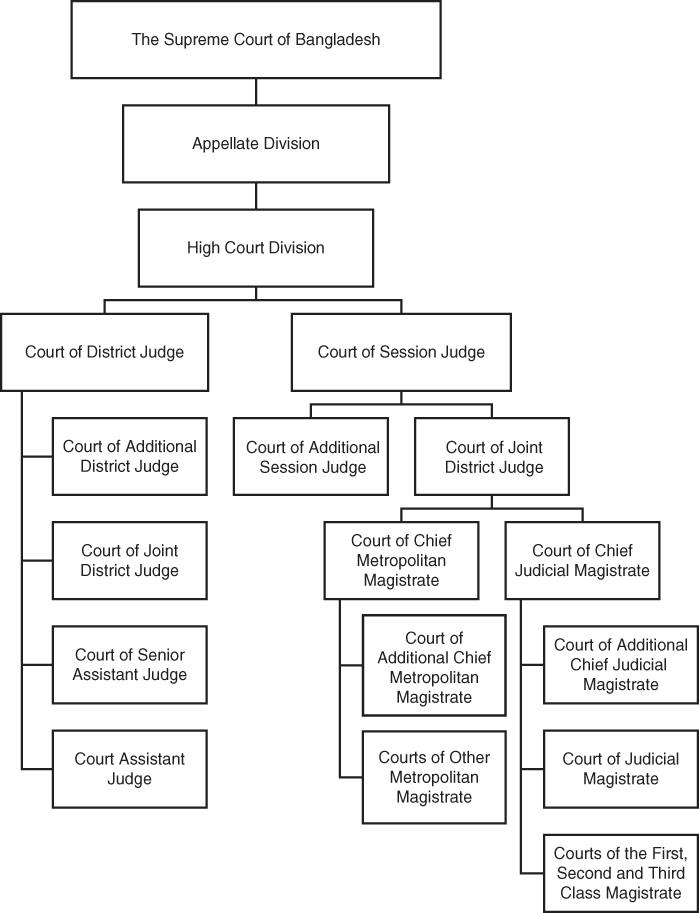
The higher judiciary refers to the Supreme Court, which consists of the Appellate Division and the High Court Division.Footnote 2 The Appellate Division is the constitutional court, with no original jurisdiction. It hears appeals against: (a) High Court Division orders, judgements, decrees, or sentences involving constitutional interpretation, capital punishment, life imprisonment, and sentences for contempt; and (b) judgements or orders of specialised tribunals, such as the Administrative Appellate Tribunal and International Crimes. The courts that are subordinate to the Supreme Court – namely, the Appellate Division and the High Court Division – were established under Article 114 of the Constitution. The Civil Courts Act 1887 directs the subordinate civil courts, and the Code of Criminal Procedure guides the courts of magistrates and sessions. In the case of civil courts, there are five grades, including: Courts of Assistant Judge, Senior Assistant Judge, Joint District Judge, Additional District Judge, and the District Judge. The District Judge heads these courts for all districts except for the three Chittagong Hill Tracts districts.Footnote 3 There are also five classes of subordinate criminal courts: the Courts of Session, Metropolitan Magistrate, Magistrate of the First Class, Magistrate of the Second Class, and the Magistrate of the Third Class. In the Court of Sessions, the District Judges are empowered to function as Session Judges. In addition, the Government of Bangladesh has enacted the Village Court Act 2006 and has taken the initiative to activate village courts at the union level (UNDP and Government of Bangladesh, 2019). However, village courts have yet to be established throughout the country. When they are, their jurisdiction will be very limited, and they will deal only with civil issues.
The Constitution of Bangladesh guarantees human rights and freedom, equality, and justice and the rule of law for all citizens (Huda, Reference Huda1997). In agreement with the Constitution, there are three basic requirements of a judicial system: fairness (which includes various dimensions); the effectiveness and the expeditiousness in the procedures; and the independence of the judges. The available evidence on various measures of the effectiveness of the judicial system in Bangladesh is discussed in the following subsections.
B Degree of Fairness of the Judiciary
Access to justice is one of the basic principles of the rule of law. If access to justice is hindered and any form of discrimination or bias persists in the process of delivering justice, this can undermine the voice and rights of the people. According to an estimate by the OECD, around 4 billion people around the world live outside the protection of the law, mostly because they are poor or marginalised within their societies. The lack of legal accountability propels local corruption and diverts resources from where they are needed the most. In addition, women are particularly affected by legal exclusion as they often face multiple forms of discrimination, violence, and sexual harassment. Thus, access to justice and fairness of the judiciary are essential to enable the basic protection of human rights (OECD-OSF, 2016).
In Bangladesh, there is a lack of well managed data regarding the various features and functioning of the judiciary. Thus, in order to capture some dimensions of the fairness of the judiciary, in the analysis in this section, three indicators are considered from the World Justice Project (WJP) Rule of Law IndexFootnote 4 (WJP, 2019): ‘people can access and afford civil justice’, ‘civil justice is free of discrimination’, and ‘civil justice is free of corruption’. It should be noted that the selected indicators are related to civil justice. This is because the main focus of this chapter is land dispossession litigation, which falls under the jurisdiction of civil courts, and this chapter principally intends to highlight the situation of civil justice when discussing the performance of the judiciary.
It should be noted that the WJP Rule of Law Index contains a number of limitations. First, the index has been constructed based on a significant proportion of subjective information given by both experts and the general public. Second, the opinions and perceptions of the individual respondents may vary to a great extent across time and geographic region. Despite these limitations, the WJP Rule of Law Index 2019 provides an opportunity to examine the relative position of Bangladesh compared to another 125 countries. Out of the total 126 countries in the index, roughly 28 can be broadly categorised as developed countries and the rest as developing countries.
The first indicator ‘people can access and afford civil justice’ measures the accessibility and affordability of civil courts, including whether people are aware of available remedies and can access and afford legal advice and representation. It also measures whether people can access the court system without incurring unreasonable fees, or facing procedural hurdles or physical and linguistic barriers. The second indicator ‘civil justice is free of discrimination’ measures whether the civil justice system discriminates in practice based on socio-economic status, gender, ethnicity, religion, national origin, sexual orientation, or gender identity. The third indicator ‘civil justice is free of corruption’ measures whether the civil justice system is free of bribery and improper influence by private interests (WJP, 2019).
Bangladesh ranks 106 among the 126 countries for the ‘people can access and afford civil justice’ indicator of the WJP 2019, with a score of 0.4498, compared to the median score of 0.5637. Likewise, for the ‘civil justice is free of discrimination’ indicator Bangladesh’s relative position is 115 among the 126 countries. Again, its score is 0.3613, relative to the median score of 0.5623. Finally, Bangladesh ranks 100 among the 126 countries for the ‘civil justice is free of corruption’ indicator, with a score of 0.3674, in comparison to the median score of 0.5224. The data show that Bangladesh’s relative performance in all of the three areas with regard to the fairness of the judiciary is in the bottom quintile or the bottom decile of a set of 126 countries.
C Expeditiousness of the Judicial Procedures
One of the fundamental aspects of the effectiveness of the judiciary is the expeditiousness of the judicial procedures. The well-known legal maxim ‘justice delayed is justice denied’ is based on the principle that if redress is not available in time and there is little hope of resolution, it may well be regarded as there being no redress at all. This principle forms the basis of the right to a speedy trial and similar rights which are meant to expedite the legal system. Thus, the expeditiousness of the judicial procedures is often considered to be a critical element for ensuring an effective justice system. If the judicial system guarantees the enforcement of rights, creditors are more likely to lend, businesses are dissuaded from opportunistic behaviour, transaction costs are reduced, and innovative businesses are more likely to invest (OECD, 2013; IMF, 2017; World Economic Forum (WEF), 2018; World Bank, 2017). The relative picture regarding the current degree of expeditiousness of the judicial procedures in Bangladesh is discussed here.
The ‘civil justice is not subject to unreasonable delay’ indicator of the WJP Rule of Law Index measures whether civil justice proceedings are conducted and judgements are produced in a timely manner without unreasonable delay. It can be observed that Bangladesh’s performance is again particularly poor for this indicator, ranking 121 out of the 126 countries in 2019, with a score of 0.1917, compared to the median score of 0.4384.
A closer examination of the primary data reveals that the case backlog is especially acute in the subordinate or district courts of the country.Footnote 5 The total civil case backlog at the end of 2018Footnote 6 was 1,321,038, and the number of total cases including new cases was 1,396,350. Among these, only 58,234 cases were resolved, which is about 24 times less than the total cases. A comparatively smaller number of cases (6,001 cases) were transferred or received a stay order from the higher courts, and also a few (1,716 cases) were resolved through Alternative Dispute Resolution (ADR). It can also be observed that the total number of civil and criminal cases has increased overtime in the High Court and Appellate Division.
A number of factors may have propelled the growth of the total number of pending cases in the higher and subordinate lower courts of Bangladesh. One of the main reasons behind the growth of pending cases in the last decade is the lack of capacity and resources in the judiciary. The total number of judges compared to the total population and number of cases is still quite low in Bangladesh. According to the annual report of the Supreme Court of Bangladesh, there were a total number of seven judges (including Chief Justices in the Appellate Division and 95 judges in the high Court) in 2018 (The Supreme Court of Bangladesh, 2019), which shows the lack of capacity of the overall system. Similarly, the total number of approved posts of judges for the lower courts was 1,655, of which 387 remained vacant until 2017 due to delays in the recruitment process (Sarkar, Reference Sarkar2017).
In addition, in Bangladesh, civil cases are generally based on documented evidence and oral evidence is only taken as a supplement to documents. The civil courts still follow the Evidence Act of 1872, the Civil Courts Act of 1887, the Code of Civil Procedure of 1908, and some other special laws that are applicable to the operation of civil cases. The common practice of examining witnesses in civil courts involves stating the whole case line by line, with the judge writing every statement out by hand. If this manual recording is not followed, then further clarification is required according to the Code of Civil Procedure 1908.Footnote 7 For this reason, the present nature of peremptory hearings consumes a considerable amount of time and the dependence on manual paperwork contributes to increasing case backlog (Tahura, Reference Tahura2015). Likewise, as mentioned earlier, along with a shortage of judges, a number of systematic problems compound the backlog problem, including poor investigation by the police, too many adjournments at courts, an absence of witness, the lack of capacity of legal professionals, a lack of coordination among different government departments, and the unwillingness of some lawyers to settle the case within a short time (Tahura and Kelly, Reference Tahura and Kelly2015; The Supreme Court of Bangladesh and UNDP, 2015; Transparency International Bangladesh, 2017; Rahman, Reference Rahman2018; The Justice Audit Team, 2018).
Moreover, political turmoil and deterioration of the rule of law over time has caused an increase in the number of cases in recent years (Sarkar, Reference Sarkar2015). Besides, according to Bangladesh Bank, the central bank of Bangladesh, more than 55,500 cases involving default loans were pending with the courts as at June 2018 (The Daily Star, 2018b). Furthermore, the Vested Property Return Act of 2013 came as an additional complicating factor as it allowed the Government to confiscate the property of individuals considered to have acted as an enemy of the state during the India–Pakistan war of 1965 (Yasmin, Reference Yasmin2016). From 2013 to 2016, the Government of Bangladesh activated special tribunals throughout the country to restore vested property. Since 2016, claims for vested property have been managed by the formal judiciary.
The upshot of the above situation is that the judicial system of Bangladesh is increasingly burdened with a backlog of cases due to various socio-economic, political, and historical factors. A lack of initiative to compel clerks, advocates, litigants, or witnesses to comply with the due codes, rules, and processes leads to inordinate delays at the different stages of the litigation procedure. However, along with the lack of any adequate initiative to improve the performance of the judiciary, institutional failures in other areas – especially with respect to land management, default loans, and the overall deterioration of rule of law – are also producing a significant growth in the backlog and the slower disposal of cases. This growing backlog and slowly disposed cases are seriously hampering the overall performance of the judiciary. This scenario especially holds in the three major business and administrative hubs of Bangladesh, namely Dhaka, Chittagong, and Khulna. As a result, individuals, businesses, and private investors are increasingly facing uncertainties and challenges. Ultimately, the low level of expeditiousness of judicial procedures in Bangladesh is a severe impediment for the overall business climate and competitiveness of the country.
D Independence from the Executive Branch of the Government
Independence of the judiciary is based on the axiom of the separation of powers: the judiciary should remain separate and independent from the executive and legislative branches of government. The independence of the judiciary depends on certain conditions like the mode of appointment of judges, security of their tenure in office, and adequate remuneration and privileges. Such independence enables the judiciary to perform its due role in the society, thus inspiring public confidence in it. The independence of civil justice thus requires a set of detailed rules and procedures to ensure that a dispute will be treated in a neutral way, without biases in favour of any party (OECD, 2015).
In Bangladesh, despite a constitutional mandate for the separation of the judiciary from the executive organs of the state, the recruitment of subordinate court judges used to be conducted by the Bangladesh Public Service Commission (Islam, Reference Islam2014). However, the government-versus-Masdar-Hossain case in 1999Footnote 8 produced a landmark judgement regarding judicial independence. Nevertheless, until 2006, the judgement remained largely unimplemented. In 2007, the caretaker government took initiatives to implement the judgement.Footnote 9 This removed the impediment to the separation of the lower judiciary from executive control and the appointment of judicial magistrates (Biswas, Reference Biswas2012). However, the ordinances of the caretaker government have not yet been fully enacted and the judiciary has yet to be completely separated from the influence of the executive branch. The Law and Justice Division of the Ministry of Law, Justice and Parliamentary Affairs has the constitutional authority to manage the appointment, transfer, resignation, and removal of the judicial officers, judges,Footnote 10 and additional judgesFootnote 11 of the Supreme Court of Bangladesh and the Attorney-General.Footnote 12 In addition, the appointment of the next senior Judge of the Appellate Division of the Supreme Court as the Chief Justice is also the responsibility of the divisionFootnote 13 (Law and Justice Division, 2019). This leaves the judiciary somewhat vulnerable to political manoeuvring and vested interests (Huda, Reference Huda2017; Islam, Reference Islam2017; The Daily Star, 2018c).
The ‘civil justice is free of improper government influence’ indicator of the WJP Rule of Law Index measures whether the civil justice system is free of improper government or political influence. Bangladesh ranked 76 out of 126 countries in 2019, with a score of 0.4412, compared to the median score of 0.4907. This shows that Bangladesh has an average level of performance in terms of judicial independence. Overall, there is still much room for improvement with regard to the complete separation of powers in Bangladesh.
An independent and strong judicial system is an essential element of a free, fair, and just society and an efficient economy. If the independence of the judiciary is undermined, it further aggravates many other issues and concerns. For example, when it comes to ensuring the legal accountability of government officials, the judiciary can exercise suo muto (by own initiative) power to uphold justice (Mollah, Reference Mollah2010).Footnote 14 Again, the judiciary can ensure checks and balances in a society through judicial activism. However, these practices will not be effective in the absence of an independent and well-functioning judiciary.
III The Effectiveness of the Judiciary in Bangladesh: The Case of Land Litigation
Understanding the effectiveness of the judiciary encompasses several dimensions. This chapter adopts land litigation in the civil courts of Bangladesh as a case study to explore the effectiveness of the judiciary. This section provides a brief account of the nature of land conflicts, the related litigation process, as well as the methodology and major findings of a qualitative appraisal of effectiveness of the judiciary with respect to land litigation in Bangladesh.
A Land Conflicts and Litigation
It should be noted that the terms land dispossession and land grabbing are sometimes used interchangeably in the Bengali language. In general, land grabbing is synonymous with large-scale land appropriation, usually by large corporations (Rudi et al., Reference Rudi, Azadi, Witlox and Lebailly2014; Semedi and Bakker, Reference Semedi and Bakker2014; Suhardiman et al., Reference Suhardiman, Giordano, Keovilignavong and Sotoukee2015; Tura, Reference Tura2018). As mentioned earlier, Bangladesh is a land-scarce country and due to extreme population pressure, large-scale land appropriation by private companies does not occur on a scale compared to some other countries of the world where land constraints are not as prominent. However, the Government sometimes acquires sizeable quantities of land for special economic zones or other similar economic activities. What appears to be the major land issue is forced or fraudulent takeovers of land of relatively small or moderate size. For this reason, the nature of land grabbing in Bangladesh may best be described as the involuntary dispossession of land. This chapter therefore centres on cases of such dispossession and looks at the effectiveness of the judiciary in resolving them.
1 Land-Related Conflicts
In local dialect, land grabbing reflects the notion of bhumi dakhal, which can be literally translated as ‘to take control of land’. In the Bangladeshi context, land grabbing means forceful dispossession. In its most basic form, land ownership is defined by the physical act of occupying a piece of land. Essentially, dakhal is an outcome of the relations between different sources of power and authority, from large landowners, local strongmen, and goons (mastaans) to influential government officials (military and civil service both), elected officials, and national politicians. Thus, grabbing or dakhal is the result of continuous negotiations between these different actors (Suykens, Reference Suykens2015).
Land grabbing or involuntary dispossession may occur for many reasons. Adnan (Reference Adnan2013) has explained that very often, when peasants are not willing to sell their piece of land due to either emotional attachment to ancestral holdings or its location specificity, involuntary dispossession or dakahl involves use of force through extra-economic and non-market mechanisms, including violence and use of state machinery. In recent years, increasing amounts of land have been taken out of agricultural production as a result of fast urbanisation and industrial expansion. These takeovers are mostly done by realtors for housing, by corporate interests for commercial use, and by the state for military or industrial use.
Feldman and Geisler (Reference Feldman and Geisler2012) examined land grabbing in Bangladesh and viewed such seizures through the lens of displacement and land encroachment. Their study examined two different but potentially interacting displacement processes. The first takes place in the char, riverine and coastal sediment regions, which are in a constant state of formation and erosion and consequently are ripe sites for contestation and power play. In this region, mainly small producers are uprooted from their rich alluvial soils. The second displacement process is observed in peri-urban areas where elites engage gangs and corrupt public servants to coerce small producers into relinquishing titles to their ever more valuable lands. Thus, there are both in situ displacements where people may remain in place or experience a prolonged multi-stage process of removal and ex situ displacements where people are brutally expelled from their homes, communities, and livelihoods.
It is evident that where landholdings are small and everyday subsistence is precarious, even a limited amount of land dispossession at the expense of those whose subsistence depends on agriculture is an engine of landlessness and chronic poverty. This situation in Bangladesh therefore highlights the role of the state, especially the role of the judiciary and its sanctions regarding involuntary land dispossession. During the fieldwork for the present study,Footnote 15 a number of sources of land-related conflicts in Bangladesh were identified. These conflicts are broadly depicted in Box 9.1.
| Types of land conflicts | Victim | Nature of land | Source of conflict |
|---|---|---|---|
| Conflict with the state/government | Private owners | Private land | Involuntary dispossession due to land acquisition for state-led development activity |
| Conflict with large companies | Government, poor individuals, indigenous community | Private land, community land, public property, or khas land, hills, rivers | Involuntary dispossession due to land acquisition for commercial activity or private gain |
| Conflict with smaller companies | Individuals/indigenous community | Private land, community land | Involuntary dispossession due to land acquisition for commercial activity or private gain |
| Conflict with elites/politicians/goons at the local level | Mostly poor individuals with less economic and socio-political influence/capital, absentee owners | Private land, community land | Involuntary dispossession due to miscalculations or mistakes in the land survey; elite capture due to loopholes in or undue misinterpretation of the existing laws or regulations |
| Conflict with neighbours and family members | Individuals | Private land | Involuntary dispossession due to miscalculations or mistakes in land surveys, fraudulent behaviour, ambiguity in inheritance procedures, and informality in inheritance distribution |
Note: The type and nature of land, victims, and sources of conflict vary based on different circumstances.
The major types of land litigation can be divided into a number of categories, including: a declaratory suit, cancellation of a deed, a partition suit, recovery of khas possession, eviction of a tenant, a money suit, a pre-emption case, pre-emption under Mohammedan law, a vested property release case, a land survey tribunals case, a mandatory injunction, an arbitration suit, succession cases, and other miscellaneous cases. If the suit valuation ranges from Bangladeshi Taka (BDT) 100,000Footnote 16 up to BDT 200,000, the jurisdiction for litigation will fall under the Court of Assistant Judge. Similarly, if the suit valuation ranges from BDT 200,001 up to BDT 400,000, it will fall under the Court of Senior Assistant Judge. Finally, if the suit valuation is BDT 400,001 and higher, the jurisdiction for litigation will fall under the Joint District Judge. Typically, land litigation in Bangladesh follows the workflow of civil litigation (see Figure 9.1 for the detailed hierarchal structure of the judicial system of Bangladesh).
2 Land Litigation in the Formal Judicial System
As suggested by Figure 9.2, the first step of any civil litigation process in Bangladesh begins with the filing of suit to the sherestadar, a court officer. The suit is then entered into the register of suits. The defendant is informed about the case and provided with a copy of the plaint, and thus summons is served. Then if the defendant appears at the court with his written statement, the court tries to mediate between the parties. If the mediation fails, the court fixes a date for a first hearing. At the first hearing, the court examines the claims of the parties and frames the issues. After that, the court announces the date for a peremptory hearing and orders the parties to submit a list of witnesses. The peremptory hearing is followed by a further hearing and presentation of the arguments. Subsequently, the court pronounces the judgement on the day of the trial or later at a fixed date. Ultimately, the court may pass an order. However, if the defendant does not appear before the court throughout the overall litigation process, then an ex-parte hearing takes place. In this case, the evidence is recorded and an ex-parte order is given. Finally, based on the argument and evidence, the court draws up the decree irrespective of the appearance or absence of the defendant at the hearings.
Procedure of land litigation in Bangladesh.

Thus, a plaintiff usually first goes to the muhuri to have an appointment with a lawyer. The lawyer then files the case and sends it to the court. The case is then recorded in the sheresta by the sherestadar and summons is issued through the nezarat by the nazir. After that the date of the hearing is usually managed by the peshkar of the court.
B A Qualitative Appraisal of Judiciary Dysfunction in Land Matters
1 Methodology
The purpose of the qualitative analysis in this chapter is to focus on the inherent political economic issues of the factors and processes underlying land dispossession litigation and their outcomes in terms of poverty and well-being in the particular social–historical instance of Bangladesh. The analysis is based on a rich variety of primary data collected through a number of detailed case studies, key informant interviews, focus group discussions, and participant observations conducted between April and July 2019. The victims of the case studies were identified with the help of local activists and the District Lawyers’ Association. References from the case studies will be made in this chapter with the help of coded names. In order to understand the political economy of land dispossession litigation, two areas of Bangladesh, which display different characteristics, were selected for the study: Anwara and Gazipur upazila. The first study area is a heavily industrialised area located near the major sea port, and the second area is situated near the densely populated capital.
Anwara upazila is located in Chattogram Division of Bangladesh. It has an area of about 164.13 square kilometres. Anwara is one of the most heavily industrialised areas of Bangladesh. It is the location of a number of companies, including: Karnaphuli Fertilizer Company Ltd, Karnaphuli Polyester Products Company Limited, Chattogram Urea Fertilizer Limited, and the Korean Export Processing Zone, which is financed by the Korean Young One Corporation. The Korean Export Processing Zone is the largest private export processing zone in the country, spanning 2,492 acres. Korean Export Processing Zone is located on the south bank of the river Karnaphuli, opposite to Chattogram International Airport and close to the country’s major sea port at Chattogram. In addition, the Government of Bangladesh is also building an underwater tunnel under the Karnaphuli River which is going to be connected to a six-lane highway. On the other hand, Gazipur Sadar upazila is located in Dhaka division. It has an area of 446.38 square kilometres. There are also a number of water bodies near Gazipur and the Sadar upazila is home to a number of historical monuments, relics, archaeological heritage sites, and national parks. Moreover, Gazipur is situated right next to the capital and city dwellers can easily plan a day trip to the location. For this reason, the area is a popular destination for tourists and recreation seekers. Furthermore, the proximity to the capital Dhaka has turned Gazipur into a hub of manufacturing and industrialisation. The Bangladesh Small and Cottage Industries Corporation (BSCIC) industrial areas in Tongi and Konabari alone host a plethora of large and medium-sized industries.
Some secondary data related to case statistics have also been collected from a variety of documentary sources and from the office of the Registrar of the Supreme Court of Bangladesh. At the same time, the study draws insights and information from a rigorous review of the relevant literature.
2 Findings
There are a number of possible causes of institutional inefficiencies in the judiciary. However, we focus here only on the causes of institutional inefficiencies in relation to involuntary land dispossession litigation. Based on the analysis of primary data, these inefficiencies can be attributed to various factors, including: the ambiguity of procedural laws; poor updating and preservation of land records; a shortage of qualified personnel and misallocation of roles; unequal access to justice; delays in procedures; and influence peddling and power asymmetries. A brief account of the causes of institutional inefficiencies in the judiciary with respect to involuntary land dispossession litigation is presented in the following subsections.
I Actors Involved in the Land Litigation Process.
The analysis of the qualitative data reveals that different actors are involved at each level of involuntary land dispossession litigation, with different interests and degrees of power or influence (Box 9.2). However, it is worth noting that the actors are connected to each other through various degrees of contest and coalition. The identified actors can be grouped in four categories: state actors, non-state actors, internal actors, and external actors.
| State actors | Non-state actors | |
|---|---|---|
| Internal actors | Police Public prosecutors Judges Sherestadar Nazir Peshkar | Muhuri Lawyers Plaintiffs Defendants |
| External actors | Union parishad chairmen and members Tehsil offices Kanungo Sub-registrars ACs Land Upazila Nirbahi Officer Deputy Commissioner (DC) offices Politicians of the ruling party (holding public office) | District Lawyers’ Associations District Bar Associations Local brokers Local influential people Local businessmen Politicians of the opposition party |
Note: The above categorisation and the position of the actors in the matrix may sometimes vary based on different contexts.
State actors refers to actors who hold positions in government offices and who have a role in land litigation in one way or other. Many of these actors do not have any direct authority over the litigation process: for example, the union parishad chairman has only informal influence over the process. Although the union parishad chairman is not directly a part of the formal litigation process, he can influence the legal support-seeking behaviour of common citizens. On the other hand, non-state actors are those who have a stake in the litigation process but have no official authority to influence the outcome of the litigation. For example, as a professional body the lawyers’ association plays an important role in identifying the appropriate lawyer for the litigation. Usually, the leader of the lawyers’ association has informal influence over the proceedings of the court as the support of the leaders of the lawyers’ association may help to speed up the litigation process.
Similarly, there are brokers active in the court area who can connect a service-seeker to an influential lawyer who might not be known to the service-seeker otherwise. These brokers are people who live on their network with court staff and lawyers. However, while monetary transactions take place between the different actors involved in the litigation process, among these payments only the court fee and lawyer’s fees are officially due, while the rest are unofficial fees. In addition, lawyers are also active in national politics and many lawyers aspire to a career in politics. These kinds of intangible interests also play a role in influencing the litigation process. Although the power and influence of the key actors in the land litigation process may vary depending on the context, a general scenario of the interplay between the interests and influence of the main actors is presented in Figure 9.3.
Influence and interest matrix of actors.
Note: The above categorisation and the position of the actors in the matrix may sometimes vary based on different contexts; ‘government officials’ in this figure refers to the formal state actors from Box 9.1 (i.e. police, prosecutors, sherestadar, etc.).
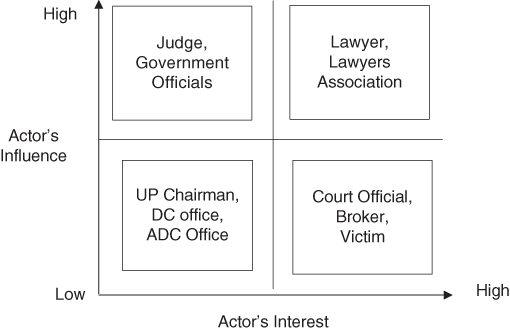
Figure 9.3 shows that the judge and other court officials have a high degree of influence over the proceedings, but they also have a low degree of interest in them because they are overburdened with cases. However, the lawyer and the lawyers’ associations have a higher interest and relatively higher influence. If they want, they can increase or decrease the speed and cost of the process. On the other hand, petty court officials like peshkar and serestadar have a high degree of interest because they are usually paid in an unofficial manner by clients for their support and services. On the other hand, they do not wield a high level of control over the litigation process: they have a facilitating role but cannot determine the outcome of that process.
II The Ambiguity of Procedural Laws.
The current structure of the judiciary also bears the historical legacy of the colonial period and is still heavily guided by the institutional traditions of the British era. For this reason, sometimes the laws, rules, and procedures regarding the civil litigation are not clearly articulated in the local language or contain inherent flaws. One senior lawyer explained during an interview that, after a number of amendments, the current law states that a defendant will receive a maximum of three chances to respond to a summons. However, the law does not clarify what will happen after the three opportunities are over. It is unclear whether the case will then become an expert judgement or an unreported right. In sum, the cumulative legacy of the past creates difficulties for the general public to effectively comprehend, access, and use the judicial system.
III Poor Updating and Preservation of Land Records.
Land management in Bangladesh is done by several government agencies, among which coordination is almost non-existent.Footnote 17 Mismatches in historical government records and personal records are a major source of institutional inefficiency as these create inconsistency regarding the identity of the landowner and the size of the landholding at stake. In the case of a land ownership transfer, the sub-registrar office registers the new deed in the book of records (balam bohi). In Anwara, there are two separate index books for accessing these balams. They are ordered according to the names and the daag or plot number. However, as these records are handwritten and manually preserved, they are prone to damages and accidents. Furthermore, the sub-registrar offices do not have access to the khatian or Record of Rights (RoR), which is managed by the AC Land office. It is therefore quite difficult for a sub-registrar to verify the information regarding the ownership, and this again contributes to creating further conflicts and backlogs. In addition, when it comes to the transfer of ancestral property, most contracts are informal in nature, which creates fertile terrain for conflicts.
IV A Shortage of Qualified Personnel and Misallocation of Roles.
There is lack of professional and well-trained civil lawyers in Bangladesh. A land litigation process requires a substantial amount of knowledge and expertise as the relevant documents contain sophisticated and complicated information. Nonetheless, the key informant interviews and focus group discussions reveal that most of the time lawyers are not adequately trained to successfully manage land litigation. In addition, the newly recruited judges and workforce in the judiciary may also not be well equipped to deal with complicated cases. As a result, hearings become lengthy, and this ultimately adds to the overall backlog. Moreover, a lack of resources and a lack of proper infrastructure are another major cause behind the huge case backlog in Bangladesh. Finally, during the fieldwork, one of the judges mentioned that people in the different administrative tiers often make wilful mistakes (e.g. misreporting and fraudulent behaviour by local people or rent seekers) and one of the main causes of land disputes in Chattogram is mistakes made during the Bangladesh Survey.Footnote 18 This judge also suggested that government officials are not doing their part, thus forcing people to file cases to obtain a correction of the mistakes made in the survey. Consequently, the judges now have to bear the extra workload involved in correcting petty mistakes.
V Unequal Access to Justice.
In recent years, the Government of Bangladesh has been acquiring land for the implementation of a number of large-scale or mega infrastructural projects. In many instances, poor and illiterate people have fallen victim to land dispossession in such cases, due to a lack of proper knowledge regarding their legal rights. On top of this, there is also a lack of adequate state-supported legal services for ordinary citizens. One of the respondents from Anwara described how about two years ago, the Government acquired a large amount of land in order to build the Karnaphuli Tunnel. As a result, around 300–400 households may have been evicted from their ancestral land. A good number of these evicted families have filed a case against the Government. However, according to the law of the acquisition of land, if a person files a case against the decision of a government acquisition, he/she cannot receive any compensation until the litigation is over. In the absence of adequate state-supported legal aid facilities, local brokers easily mislead illiterate and helpless people to file such cases and repeatedly seek to obtain various rents from both the victims and lawyers. This is due to the fact that landowners, or the victims in general, lack the proper information, and lawyers and brokers are usually more informed. As a result, lawyers and brokers exploit the lack of knowledge of the owners or victims.
VI Delayed Procedure.
According to one of the senior lawyers of the Chattogram District Bar, there are often undue delays in the issuing of notices. Nevertheless, when the date of the hearing finally arrives, it is quite common for either the plaintiff or the defendant not to be present in the court room. This unnecessarily prolongs the case time. The judge has to set another date for the hearing, and this occurs repeatedly. In this scenario, a judge can declare a one-sided verdict and stop the process. However, some respondents believe that in recent years, as judges usually want a full hearing in the presence of all parties to a case, and as these hearings are often piecemeal in nature, this again is causing a backlog and delays. A number of respondents mentioned the prevalence of numerous such dilatory tactics in the courts.
VII Influence Peddling, Fraud, and Corruption.
When asked about the main reason for the case backlog and delays in the process of land litigation, each of the key actors in the overall land administration and litigation process claimed that they are doing their part and that the other parties involved are to be blamed for the existing problems. During interviews, the local government authorities largely blamed the judges and lawyers, while one of the local judges blamed the local government authorities and lawyers. The latter mentioned that the executive influences the judiciary in a number of ways. Similarly, during the interviews, the lawyers mainly blamed the judges and also the local government officials. Behind this game of responsibility shifting, there is a complex dynamic of power and influence that affects the overall scenario of land dispossession litigation in Bangladesh.
Corruption and rent sharing is one of the propelling forces behind the overall institutional inefficiency of litigation system of Bangladesh in respect of land dispossession. Sometimes people are forcefully evicted or compelled to sell their land at an unfair price to large companies due to widespread corruption (i.e. bribery, extortion, cronyism, nepotism, patronage, etc.). During the fieldwork, one of the respondents in Anwara explained that large companies first buy small amounts of land in a scattered fashion and then they start pushing the surrounding land owners to sell their lands to them. In most cases, these big companies have established a good understanding with the local government officials and the law enforcement agency. For this reason, the local land owners are often compelled to sell their land off to them at an unfair price, and sometimes are even forcefully evicted. Local small landholders are not strong enough to go up against these big companies. They often do not report malpractices or seek any redress, out of fear.
Moreover, local government officials sometimes exercise their authority to seek undue rent. In one of the case studies,Footnote 19 Mr X, a resident of Anwara, explained that a pond that is part of his ancestral property was mistakenly recorded as khas land or government-owned land during the time of the Pakistan Survey.Footnote 20 Although his father had ownership of this pond according to the Cadastral Survey (CS),Footnote 21 he had to file a case and go through the costly litigation process to recover his claim, which took almost three years. Finally, the verdict was in his favour and he went to land office and applied for mutation. However, the upazila office disagreed to act upon the verdict and gave away the lease to another company. Mr X went to the DC and requested him to solve the matter. The DC ordered the Thana Nirbahi Officer (TNO) and AC Land to look into the matter. Even after that move, the problem was not solved, and eventually, Mr X had to go to the High Court. Up until the time of interview, he could not obtain a hearing data.
In addition, Anwara upazila is one of the most unique areas in Bangladesh from the viewpoint of social and demographic features. According to the locals, around 72% of the inhabitants are followers of the Hindu religion, while all other upazilas surrounding Anwara are Muslim-dominated. As a result, there is constant tension between the Hindus and Muslims over the ownership of land. It was also observed that women in general face greater challenges in seeking justice or redress. However, no matter which religion one follows, it is usually the poor and underprivileged segment of the society which is the victim of the worst forms of involuntary land dispossession. In one of the case studies,Footnote 22 Mr Z mentioned that once his grandfather rented part of his ancestral land to a Muslim farmer for share cropping. Later, when his grandfather became old, that farmer forcefully took over the land. Mr Z’s family went to the local authorities but failed to obtain any redress. Mr Z claimed that this is because he belongs to a religious minority in his community. Eventually his family filed a case; the case has been pending in the court for almost 12 years.
In one of the case studies from Gazipur, Mr A reported that his cousin fraudulently sold his land without his consent. When Mr A went to the shalish for redress, his cousin’s husband, who is a dominant political leader, threatened him and influenced the shalish through bribery. There were even instances of intimidation and vandalism. The local police even arrested Mr A instead of the perpetrators. He was in jail for about two months. After getting bail, he filed a case. There was a verdict five years ago which according to Mr A was distorted, and he did not appeal due to his poor economic condition.
VIII The Problem of Illegal Occupancy.
It is often the case that absentee owners or migrants face special problems regarding their land or property. The absence of the owner creates room for illegal occupancy by others. Moreover, if the owner is absent during land surveys, and if he does not claim possession, other people can provide incorrect information to the surveyor and change the ownership in the government land records. In one of the case studies,Footnote 23 Mr D from Gazipur mentioned that his father’s uncle had claimed false ownership of his property during his absence as a migrant worker. Mr D came back from abroad and filed a case, which has been pending for around two years now. Most of the time, the defendant, who is a local political leader, has not been present at the hearing. According to Mr D, money plays a vital role throughout the litigation process. From lawyer to muhuri, everyone demands money every time there is a hearing date. This scenario was repeated in a number of other case studies. Mr C from Gazipur was also a migrant worker, and in his case,Footnote 24 it was his uncle who deprived him of the proper share of his ancestral land. His case has been pending in the courts since 2010. According to Mr C, frequent transfers of judges, excessive bureaucracy in the court room, and political influence hinder a fast disposition of the cases.
Similarly, during the absence of Mr Y, a migrant worker from Anwara, a group of people claimed false possession of his property on the occasion of the Bangladesh Survey.Footnote 25 When he learned about this issue, he filed a case at the District Court and the court ordered the correcting of the mistake in the Bangladesh Survey. The opposite party in his case appealed against the verdict at the High Court. According to him, there might be some kind of collusion between the lawyers of both parties as none of them wants to end the case soon. He believes that the peshkar, lawyer, and muhuri are all informally connected and have conspired to lengthen the duration of the case.
3 What Do We Learn from the Qualitative Appraisal?
The above-mentioned institutional inefficiencies with respect to land dispossession litigation are caused by an increasing number of errors and petty issues that are repeated on a regular basis. While many of these petty issues can be resolved through effective collaboration between the actors, in reality, the land administrative bodies, judiciary, and law enforcement agencies tend to delay in resolving the issues, and even reproduce similar scenarios in some instances. This is because these issues and problems regarding land dispossession litigation generate a comparatively small amount of rent. However, this rent increases significantly when it is generated multiple times and over a long period. This creates an incentive for the major actors to reproduce the overall scenario of institutional inefficiency. For this reason, the actors may sometimes have a deliberate or spontaneous understanding among themselves to act together. The higher the number of interactions between different parties the higher the transaction costs, and thus, the accumulation of rent keeps growing. Thus, the major motivation behind keeping this inefficient system alive is the reality of huge rent generation and rent sharing across the major actors, which is the result of an auto-reproducible, strong but lower level of equilibrium. This strong equilibrium persists because none of the actors have the incentive to break it.
In this overall process, there may be rent sharing only among the actors within the judiciary, rent sharing among the actors in the judiciary and different external actors, and also rent sharing only among the external actors themselves. In the specific case of involuntary land dispossession, there can be delays in several steps of the overall litigation process. Although lawyers or defendants may sometimes attempt to create undue delay, the judges can play a major role in speeding up the hearings, and ultimately reaching a verdict within the time specified in the law. However, the proper implementation of the verdict is also important and the land administration authority here has the major influence, because local-level political leaders and law enforcement agencies usually tend to cooperate with the DC office or subsequent local government offices. Thus, it is evident that the state institutions have the major role to play in either promoting justice or prolonging institutional inefficiency in the judiciary in respect of involuntary land dispossession litigation in Bangladesh.
Nevertheless, it is imperative to note that all of these actors act within a context-specific environment and, given the reality, each individual is bound by their own circumstances. As a result, these actors are influenced by the context-specific actions of others and consciously or subconsciously iterate their process of decision-making at each stage of the overall process. Thus, it is not only the issues within the judiciary that slow the performance of the judiciary but also external factors. Since institutional inefficiency and corruption in other areas affect the overall functioning of the judiciary, the judiciary alone cannot solve these issues. A generic focus on upgrading only the capacity of the judiciary will not be sufficient to solve these issues in Bangladesh.
IV Conclusion
Institutional norms in a society are often dictated by the overarching socio-political and historic factors. The analysis in this chapter shows that the institutional inefficiency in the judiciary of Bangladesh has been an outcome of a longstanding interplay between social, historical, political, and economic factors which have accumulated over the years. In the particular case of Bangladesh, this accumulation of institutional inefficiency has created a spontaneous and auto-reproducible strong but lower level of ‘equilibrium’, with an effective mechanism of rent sharing.
Based on the analysis of the data collected during fieldwork, it is evident that the poor, illiterate, and marginalised suffer the most because of a lack of rule of law, and institutional inefficiency. In fact, they suffer twice. First, they suffer because they are the victims of land dispossession, and later they suffer again in the courts during the litigation process. The judiciary as an institution can have a profound impact on the overall well-being of the citizens of a country. As the fundamental institution to protect the principles of fundamental rights and justice, the judiciary can play a critical role in ensuring the rule of law. Nevertheless, in Bangladesh, if institutional inefficiency continues to persist in the judiciary, it can further propel poverty and marginalisation. Thus, the long-term sustainable development of Bangladesh critically depends on a well-functioning judiciary. For this reason, it is imperative to overcome institutional inefficiencies in the judiciary and to promote the rule of law.
Ultimately, overcoming institutional inefficiency in the judiciary of Bangladesh will require a lot more than the usual generic reform agendas. While there is a need for capacity building within the judiciary, a thorough review of and proper amendments to the existing laws in order to update century-long practices, and the establishment of low-cost legal services for the poor and underprivileged, these measures alone will not be enough to meet the challenges and issues in contemporary Bangladesh. The Government must take steps to ensure the separation of powers between the executive and judicial branches, in order to uphold judicial independence. At the same time, it should be kept in mind that ensuring judicial independence alone also may not be a sufficient measure for ensuring the rule of law if institutional inefficiencies persist in other areas in Bangladesh. Thus, with respect to judicial functioning regarding involuntary land dispossession, external interventions are required to break the inefficiency of the existing system. As long as the ‘equilibrium’ continues to exist, judicial reform alone will not be sufficient. In the past, there have been some failed attempts to digitise the land and court records. Even if the digitisation of court and land records will not necessarily result in the absolute removal of all forms of institutional inefficiencies in the judiciary of Bangladesh, it will surely contribute to improving its performance.
Annex 9.1 Glossary of Terms
| AC Land | Assistant Commissioner (Land) |
| ADR | Alternative Dispute Resolution |
| Balam Bohi | Book of land registration records |
| Bangladesh Survey | The Bangladesh Survey started in 1970 and is still ongoing |
| Bighas | Unit of land measurement (0.333 acres) |
| CS or Kistwar | The Cadastral Survey of undivided Bengal was the first comprehensive record of land rights in Bangladesh. It is still accepted by contemporary courts. The CS Record of Rights (RoR) was prepared under the Bengal Tenancy Act 1885. This is known as the CS. The survey started from Ramu of Cox’s Bazar upazila in 1888 and ended in 1940 |
| Char | Alluvial land or land thrown up from rivers |
| Daag | Plot number |
| DC | Deputy Commissioner |
| Kanungo | Union Land Assistant Officer |
| Khas land | Public property or government-owned land, where nobody has property rights. |
| Khatian | Cadastre or RoR containing the area and character of land (by plot or by owner) |
| Mastaan | Local goons |
| Muhuri | Assistant to a lawyer |
| Namzari | Mutation or actions of Tehsildars and Assistance Commissioners (ACs) (Land) to update records to reflect a change in ownership and physical alterations |
| Nazir | The chief of staff of the Nezarat |
| Nezarat | A central administrative office of a court dealing with a service of summons, etc. |
| Nirbahi | Executive |
| OECD | Organisation for Economic Co-operation and Development |
| Peshkar | Bench clerk/bench assistant of a court |
| Revisional Survey | The Revisional Survey took place 50 years after the CS survey |
| RoR | Record of Rights (Khatian) |
| Settlement Attestation Survey or Pakistan Survey | The Settlement Attestation or Pakistan Survey of 1956–1962 |
| Shalish | Local informal adjudication |
| Sherestadar | An administrative officer assigned to each judge who sits in a separate room called the Sheresta and can receive a plaint/suit on behalf of the court |
| Tehsil | Lowest union-level revenue unit comprising several Mouza |
| Tehsildar | Local revenue collector |
| TNO | Thana Nirbahi Officer |
| UNDP | United Nations Development Programme |
| WEF | World Economic Forum |
| WJP | World Justice Project |
Annex 9.2 Selected Case Studies
Case Study 1: Mr X lives in Raipur, Anwara. He is 76 years old. During the Pakistan Survey, part of his ancestral land, a pond, was mistakenly recorded as khas land or government property. Mr X filed a case to reclaim his possession; the case lasted for almost three years. Finally, in 1993, the verdict was in his favour. Mr X then went to the land office and applied for mutation. However, the upazila office refused to act on the verdict. Although Mr X showed them the verdict and requested them to solve the matter, they sanctioned the lease of the pond to another company. Mr X went to the DC and requested him to solve the matter. The DC ordered the TNO and AC Land to look into the matter. Even after that the problem was not solved and Mr X went to the High Court. Up to now he has been unable to obtain a hearing date. Mr X said that this has cost him around BDT 300,000, and he has to visit the court on a regular basis.
Case Study 2: Mr Y lives in Anwara. He is 47 years old. He used to live abroad as a migrant worker. A group of people claimed ownership over his homestead during the Bangladesh Survey. After learning of this, Mr Y filed a case at Patiya Court. However, according to him, the court did not check his documents thoroughly and dismissed the case. He then appealed to the District Court and received a verdict in his favour. The court gave an order regarding correcting the mistake in the Bangladesh Survey. After he completed the mutation, the opposite party in this case appealed against the verdict at the High Court. Nevertheless, once again, the verdict was in favour of Mr Y. Although Mr Y has the proper documents of ownership (land deeds, records from the Revisional Survey), the defendants are unwilling to accept the verdict. His case has been running since 2007 and until the time of the interview, Mr Y had spent around BDT 400,000 to pursue his cases. He said he managed these expenses by selling almost half of his property. The per day rate for a Supreme Court lawyer is BDT 100,000–150,000, which he feels is quite high. Mr Y believes that there is some kind of connection between both of the parties’ lawyers. Because of this informal contact, none of them wants to end the case soon: the peshkar, lawyer, and muhuri all have this informal connection, which is the main reason behind the long suit. The political power of the defendant’s lawyer is one of the major problems in his particular case.
Case Study 3: Mr Z lives in Banikpara, Anwara. He is 40 years old. His grandfather rented their ancestral land to a Muslim farmer for share cropping. When his grandfather became old, the farmer came to Mr Z’s father and told him that Mr Z’s grandfather owed him some amount of money. The farmer tried to force the family to sign a transfer of ownership of the land. Mr Z’s father then went to the District Court and filed a case. The court gave a verdict in favour of him. However, the plaintiff then went to the High Court and then to the Supreme Court and appealed against that verdict. As Mr Z’s father was very poor at that time, they could not go to the Supreme Court. As a result, the case went on for about 12 years. The current market price of the land is about BDT 600,000–700,000. Mr Z said that they have gone to the local chairman but nothing had happened. There were even incidents involving physical assault. Currently, the land is in the possession of the plaintiff party. Mr Z believes that they are suffering more because they are a religious minority in their community.
Case Study 4: Mr A is a farmer. He lives in Gazipur with his wife and four daughters. The problem started when his paternal cousin sold his land without his consent. The land includes his homestead, and its monetary value is about BDT 2,000,000. Mr A went to the shalish to solve the matter. However, according to him, the defendant influenced the shalish through a bribe. After being denied justice from the shalish, he was very disappointed and decided to file a case against his cousin. Nevertheless, before he could do so, he was threatened by his cousin’s husband, who is a dominant political leader in Gazipur. There were even instances of vandalism and although he was the victim, the local police arrested Mr A. He was in jail for about two months. After getting bail, he went to the court and filed a case. The case has been ongoing since then. There was a verdict five years ago which according to Mr A was distorted. As a result, he appealed against it. Mr. A said that from the very beginning, the opponent party influenced the case with money and power. From the local police to the court, he did not get justice anywhere. The defendant party did not only seize Mr A’s homestead: they are not even allowing him to utilise his other lands. He tried to build a house adjacent to the disputed land. After working for a few months, his brother-in-law used his political power again and demolished his hut. He is now living in a one-room house with five other members of his family. Mr A and his family have been suffering for a decade due to corruption, a lack of justice, and the effects of political influence.
Case Study 5: Mr B is the second among the six sons and two daughters of his father. He has one uncle who has a son and two daughters. They live in the village of Vanua in Gazipur Sadar. His father and uncle jointly bought 132 decimals (4 bigha) of land in 1978 from their neighbour, Mr E, who died in 2001. Mr E has five sons and a daughter. When the father and uncle of Mr B bought the land, they completed the registration and collected all the deeds associated with the land. After that they occupied the land and started to cultivate it. From that time onwards, the land has been under their possession and they provide the due taxes to the government associated with the land. However, in September 2016, the sons of Mr E filed a case in the court claiming that his father did not sell the land. From the case files, the family of Mr B came to know that before selling the land Mr E registered a portion of the land (13/14 decimals) in his son’s name. Thus, his sons filed a case claiming ownership of all of the 132 decimals of land and stated that the registration that Mr B’s family holds is not valid. Before filing the case, they did not inform Mr B’s family or any local representative. The family of Mr B had no choice but to hire a lawyer and the litigation is still ongoing. In August 2018, due to the request of Mr B’s family, the upazila AC Land investigated the land. When the AC Land came to investigate, the plaintiffs were absent because they thought that he was influenced by the defendants. Mr B thinks that the report of the AC Land will have a great influence in the verdict and hopes that the verdict will come in his favour as he has legal documents. The land associated with the case is agricultural land and the family of Mr B cultivate paddy in the land. Every year they get approximately BDT 240,000 revenue from the land. The cost of producing paddy is approximately BDT 130,000, which implies an approximate profit of BDT 110,000 per year. The current value of the land is approximately BDT 20,000,000 at the current market price. Moreover, as the land is situated in a good location (adjacent to the road), the value of the land is increasing day by day.
Case Study 6: Mr C lives in Bhanua, Gazipur. He is 47 years old and studied until Secondary School Certificate level. His father had four brothers and one step-brother and Mr C has three brothers and five sisters. There are five members in his household, including: his mother, his wife, and his two daughters. Mr C used to live in Saudi Arabia and worked as a day labourer. He came back to Bangladesh in 2010. When his father was young, his uncle convinced him to buy some land from him, around the year 1970. His father bought the land and obtained the deed; however, he did not know how to properly calculate the amount of land that he deserved. During that time, his uncle misinterpreted the total amount of land that he deserved and deprived him of the proper share of the land. However, during 1975, this same uncle demanded that Mr C’s father owed him some amount of land, and thus, the conflict between these two parties began. According to Mr C, when the two parties to the local shalish, they found out that Mr C’s uncle actually owed them around 2 bighas of land. Mr C filed a case in the District Court in 2012 and since then the case has been ongoing. Every time he visits the court, he has to pay the lawyer, peshkar, and muhuri. The fee of the lawyer is around BDT 2,000 and other costs vary from BDT 500 to BDT 1,000. The litigation process has cost him around BDT 80,000 till now. The present value of the land is about BDT 11,000,000. According to Mr C, frequent transfers of judges hinder the path to obtaining a fair verdict. Besides, an insufficient number of judges and excessive bureaucracy prolongs the litigation. He also believes that the local police and shalish are heavily influenced by a local political leader who is a patron of the defendant.
Case Study 7: Mr D lives in Vanua, Gazipur. He is 65 years old. He has two sons and a daughter. None of his children received a formal education. He went to Iraq in 1982 and worked there as a day labourer. His father was a farmer, and his grandfather had 24 acres of land. His father’s uncle claimed false ownership over his father’s property. When he came back from Iraq, he went to the shalish to solve the problem. The local chairman and member tried to solve the case. However, the opposing party did not accept the verdict and did not agree to give Mr D his land back. As a result, he went to the District Court and filed a case against them. After filing the case, the opposing party sent the police to threaten Mr D. For the past two years, he had to go to the court every now and then and most of the time the opposing party, who is a local political leader, is not present for the hearing. According to Mr D, money plays a vital role in the court process. The case has already cost him around BDT 200,000, over the last two years. From the lawyer to the muhuri, everyone demands money each time there is a date for a hearing.
There is a general consensus that the judiciary plays a key role in relation to social, political, and economic development. In particular, an effective judicial system is expected to prevent government abuse, protect property rights, and guarantee the proper enforcement of contracts. These functions should not only be performed in an impartial, independent, and consistent manner but also expeditiously enough to avoid creating costly uncertainties for claimants and defendants alike. How these objectives can be best achieved and what are the social costs of ill-performance are therefore critical development issues. Answering these questions involves the thorny question of whether and to what extent a well-functioning judiciary is a precondition of economic growth and development. To put it in another way, is it not the case that the judiciary is an institution that evolves gradually and whose effectiveness improves in the course of development? Finally, there is the important concern that arises from the presence of informal judicial authorities in most developing countries. This raises the question as to how to allocate judicial functions between the informal and the formal spheres, and how this allocation should evolve as development proceeds.
This chapter provides answers to some of the aforementioned questions and is a welcome addition to a scarce literature. It is comprised of two parts. In the first part, the authors examine the effectiveness of the formal sector of the judiciary in Bangladesh, and they use three different criteria to guide their diagnosis: the fairness of this sector, its expeditiousness, and its independence from the executive. As for the second part, it is devoted to a case study of land litigation in the same sector. Let us now look in turn at these different sections of this chapter. To begin with, the authors’ assessment of judicial fairness is based on three indicators extracted from the Rule of Law Index of the World Justice Project (2019). All of these indicators are subjective as they reflect the perceptions and opinions of the sampled individuals. While the first two measure the extent of inequality in access to the courts and in the treatment of cases, respectively, the third one tries to capture the degree of corruption and bribery of the judges. Essentially, they converge to show that Bangladesh does not fare very well along the three dimensions considered. Where it performs especially poorly (with a rank of 115 among 126 countries) is in regard to the second indicator (measuring the degree of discrimination in case treatment), for which Bangladesh nevertheless does slightly better than its two big South Asian neighbours, India (ranked 117) and Pakistan (ranked 118).
To assess the expeditiousness of the judicial procedures, the authors look at an objective measure, the backlog of pending cases. The picture that emerges here is not encouraging, as shown by the following statistics. The proportion of civil court cases resolved during the year 2018 represented less than 80% (77.3%) of the total number of cases received and filed during that year. This implies that the backlog of pending cases increased during that year. This is clearly not a new or transient phenomenon since at the end of the year 2018, about 26.5% of the total backlog of civil cases consisted of cases that had been pending for more than five years. The rise in the backlog of pending cases is confirmed if attention is paid to the total number of civil and criminal cases: apart from a short pause in 2008–2010, this statistic has increased exponentially since the early 2000s. Among the chief reasons behind this worrying situation, the authors mention the shortage of judges but also the ineffectiveness of the judicial procedures, which continue to be based on manual paperwork and even require the judges to write out by hand the statements of witnesses. Finally, it is noteworthy that case backlogs are especially large in the three administrative divisions that are economically the most prosperous.
In contrast to the above two dimensions of judicial dysfunction, no systematic data are proposed by the authors to assess the lack of independence of the judiciary from the executive. The mode of appointment of the judges, which is critical for their independence, has apparently improved since this prerogative was taken away from the Public Service Commission and actual implementation of the new mode seems to have occurred in 2007. Yet there is lingering doubt about the extent to which in actual practice the judges are appointed based on their competence and experience, rather than due to their political loyalty. In addition, the Supreme Court remains under the control of the Government since its judges are nominated by the Ministry of Law, Justice and Parliamentary Affairs, thus making them vulnerable to political manoeuvring. In a recent study on Pakistan, Mehmood and Seror (Reference Mehmood and Seror2019) argue that meddling by the executive in judicial matters does not mean that all types of judgements are biased. Decisions most liable to be influenced by such interference concern cases where resources valuable to politicians are directly or indirectly at stake (think of expropriation of private property by government agencies, for example). They thus show that the rise of religious landowning elites in Bangladesh, taken as a proxy of democratic regression, has increased the incidence of court rulings in favour of the Government for cases involving land disputes with the Government, and for cases involving violation of human rights. By contrast, no effect is detected for ordinary criminal cases, such as thefts. Moreover, democratic regression has reduced the quality of judicial decisions as measured by case delay (the difference between the year of the case decision and the filing year) and by merit, as proxied by a dummy indicating whether the decision was based on evidence rather than technical or procedural grounds.
Unfortunately, Mehmood and Seror (Reference Mehmood and Seror2019) do not have the data required to explore the influence of politicians on judicial decisions for civil cases. In a logic of patronage, one would expect civil judgements to be biased towards the clients of local politicians. Thus, Lyon (Reference Lyon2019) argues that one important reason why a Pakistani landlord may decide to engage in politics is to get a serious land conflict settled in his favour with the help of powerful politicians at the district level.
In the second part of this chapter, the authors address the issue of land litigation and the possible dysfunction of the competent courts. To this end, they use case study material rather than systematic but hard-to-obtain data. It bears emphasis that this material contains few instances of land expropriation or contested appropriation by the Government. Instead, most cases relate to conflicts between private parties.
That land conflicts are pervasive in Bangladesh is the result of two major characteristics of the country: strong population pressure on land resources and huge migration outflows. These two factors tend to go hand in hand: in the absence of significant land-saving innovations in agriculture, population pressure causes labour productivity and income to be low, thereby inducing members of farming families to seek better employment opportunities outside of the village of origin. In the case of Bangladesh, migration does not only take the form of temporary rural–urban migration inside the country but also of permanent migration to foreign countries (e.g. India, the Gulf countries). When migration is permanent, a landholder is absent for long spells of time, and this creates opportunities for local land-hungry relatives or neighbours to occupy his/her land and lay claim to it. Evidence provided in this chapter points to the importance of land disputes of this type. Inheritance supplies another frequent occasion for conflicts in contexts of acute land scarcity.
The above two types of land conflicts are quite common in countries exhibiting small land–labour ratios. Conflicts around land bequests are inherently difficult to resolve because they are very sensitive and cannot be easily governed by indisputable allocation rules, especially when the land available is short (see André and Platteau, Reference André and Platteau1998 for an account of land conflicts in pre-genocide Rwanda). But conflicts over land ownership, including fraudulent sales without the owner’s consent, are more amenable to settlement if land tenure rights have been well demarcated and certified. The question therefore arises as to why in Bangladesh many of these conflicts arise and frequently end up in formal courts. This chapter provides at least a partial answer to that question by highlighting serious shortcomings not only in the judiciary but also in the land registration system of the country. A critical flaw of the latter thus appears to consist of inadequate surveying and recording of land rights, as well as poor updating of land records. Ambiguous and even contradictory land rights are the unfortunate outcome of this situation, which is also observed in neighbouring India. At the root of it are weak coordination between different public agencies or departments, inappropriate methods of registration, a shortage of skilled personnel, and a lack of financial resources.
From the case study material used in this chapter, yet another reason emerges to explain judicial dysfunction in Bangladesh, namely the corruptibility of the judges and their susceptibility to pressures exerted by powerful claimants or defendants acting through influential politicians. Such unlawful interference in the judicial system harms growth and development not only because it causes uncertainty and inequity but also because it causes delays in obtaining a final decision after all appeal possibilities have been exhausted.
Although the policy implications of the foregoing diagnosis seem rather obvious, they are not necessarily easy to implement. This is not only because hard choices must be made by the Government but also because changes in the country’s political economy are required. Regarding the former aspect, the Government’s budget priorities must be redefined with a view to earmarking more money for both the Department of Justice and the land administration. Urgent attention must also be paid to the need to streamline both administrations so as to avoid overlapping competencies and to modernise the methods used for recording, processing, and safeguarding data (digitalisation must play an important role here). It is especially important to reduce the backlog of pending cases in the courts, whether civilian or criminal.
The latter aspect (political economy aspect) is even more delicate since it touches on the way politics interacts, or interferes, with various spheres of social and economic life. At the highest level is the desire of the executive to exert control over the highest branches of the judiciary – the Supreme Court in particular. This control aims at keeping political rivals at bay and buttressing the ruling political regime. At lower levels, as numerous examples presented in this chapter testify, judicial dysfunction assumes the form of undue interventions in judicial decisions that favour people with money and strong political connections. Being essentially exploratory, this chapter does not provide enough details for the reader to identify how precisely the mechanism of interferences operates at the level of local and district courts. But if we can go by the experience of Pakistan (see Martin, Reference Martin2016; Mohmand, Reference Mohmand2019), a patronage system anchored at the village level prevails that enables landowners connected to a political machine to secure the recognition of their perceived rights, involving bribing or intimidating judges if needed. Clearly, these institutional realities are hard to change since their transformation would involve attacking vested interests and opening up the political system. A ray of hope may nevertheless come from Pakistan: there, an important reform consisting of the appointment of judges by peers rather than the executive seems to have produced significant effects in the form of more expeditious and less skewed decisions (Mehmood and Seror, Reference Mehmood and Seror2019).
The question, raised at the start of this discussion, as to whether the effectiveness of the judiciary is mainly an endogenous outcome of development or a precondition for it must therefore receive a nuanced answer. Because a well-functioning judicial system is an important pillar of a modernising country, bold steps must be taken as early as possible to reduce its most blatant failures (think, for example, of budget increases and changes in the mode of appointing judges). This said, it must also be reckoned that some measure of dysfunction will persist until growth spillovers have reached a large number of people. Only then will people feel empowered enough to demand strong accountability of the judiciary and to publicly question the secretive patronage networks that work hard to keep judges under their control.
Finally, there is the question of the informal conflict-settlement mechanisms operating in all of the developing world, particularly in rural areas. This is a critical aspect of any diagnosis of a country’s institutional system. Given that this chapter does not contain information about these mechanisms, we are unable to address the issue of the respective roles of the informal and formal sectors of the judiciary in Bangladesh. What we can say, however, with all the necessary caution, is that acute population pressure on land resources and huge outmigration on the scale observed in Bangladesh will generally tend to erode informal land tenure arrangements and dispute settlement mechanisms. As a result, state failures in the domain of land and justice administrations are bound to cause great harm to a country confronted with these conditions (Platteau, Reference Platteau1992, Reference Platteau2000).


 Open access