





Introduction
Democratic backsliding in European Union (EU) member states represents a fundamental challenge to the legal certainty of European integration and undermines the EU’s claims to constitute a community of shared values (Bakke and Sitter Reference Bakke and Sitter2022; Kelemen Reference Kelemen2020). Yet despite the spread and deepening of rule of law (RoL) violations in a growing number of countries, EU action against such trends remains insufficient. Several studies have analysed the responses to democratic backsliding by Members of the European Parliament (MEPs), contrasting ideological with strategic reasons for them to endorse or reject initiatives targeting member states that violate democratic standards (Sedelmeier Reference Sedelmeier2017; Meijers and van der Veer Reference Meijers and van der Veer2019), highlighting the salience of party-political considerations (Kelemen Reference Kelemen2017; Herman et al. Reference Herman, Hoerner and Lacey2021) in determining MEPs’ vote choice, and pointing to growing discursive polarisation along ideological lines around the fundamental values that should guide EU action (Wunsch and Chiru Reference Wunsch and Chiru2025).
Our study investigates MEPs’ responses to democratic backsliding from a broader vantage point to explore the changing structure of political coalitions inside the European Parliament (EP) and the increasingly contested nature of European integration in the current context of democratic fragility. Scholars of legislative politics in the EU have highlighted shifting cleavages over time: consensus politics dominated the early decades of European integration and then became gradually replaced by a more traditional left-right confrontation (Kreppel and Hix Reference Kreppel and Hix2003), which, of late, has moved towards a more explicitly pro-/anti-EU cleavage (Hix et al. Reference Hix, Noury and Roland2019; Cheysson and Fraccaroli Reference Cheysson and Fraccaroli2025). Democratic backsliding represents a promising area to explore political divides in the EP as it straddles two central logics – ideological orientations and geographic origin – that have been shown to structure MEPs’ legislative behaviour.
On the one hand, opposition to EU interference in domestic matters and a broader contestation of supranational mechanisms can be expected to serve as an ideological ‘glue’ federating Eurosceptic as well as populist radical right MEPs along ideological lines to challenge EU initiatives in RoL matters (Chiru and Wunsch Reference Chiru and Wunsch2021). On the other hand, the geographic concentration of instances of democratic backsliding almost exclusively in Central and Eastern European (CEE) member states may activate national divides, notably in the form of an East–West divide that has recently gained renewed attention (Anghel Reference Anghel2020; Sedelmeier Reference Sedelmeier2024). Against this backdrop, we ask: does geography drive MEPs’ responses to democratic backsliding, with CEE representatives rallying around the flag to contest EU criticism and double standards in assessing member states’ RoL compliance? Or does ideology trump geography, with Eurosceptic and populist radical right MEPs most outspoken against EU interventions, irrespective of their geographic origin?
Our study expands upon previous efforts to analyse MEP responses to democratic backsliding in terms of its theoretical focus, scope, and methods. In theoretical terms, we place our study in the broader context of changing cleavages in the EP. Specifically, we challenge the notion that an East–West divide is the main fault line when it comes to understanding clashes around RoL issues in the EU (Anghel Reference Anghel2020, Volintiru et al. Reference Volintiru, Surubaru, Epstein and Fagan2024) by showing that the relevance of geographical origin is largely conditional on additional factors, notably one’s own experience with democratic erosion and national incumbency. There is also heterogeneity regarding ideological factors, with Eurosceptic orientations considerably more salient than membership in a populist radical right (PRR) party. In terms of scope, we draw on a considerably wider dataset than those used in previous studies. Meijers and van der Veer (Reference Meijers and van der Veer2019) base their analysis on just four roll-call votes (RCVs) as well as associated parliamentary questions and motions, while Herman et al. (Reference Herman, Hoerner and Lacey2021) study a larger number of votes but examine only MEPs of the European People’s Party (EPP). In contrast, our comprehensive dataset comprises all RCVs related to democratic backsliding across the EP’s seventh and eighth sessions (2009–2019) and includes MEPs from all party families. Finally, our approach is novel in terms of methods since it matches discursive data from plenary debates with the subsequent RCVs that followed them. To this end, we include over 900 discursive statements we extracted from debates leading up to the included votes and hand-coded them to identify the argumentative frame they employ. This approach allows us not only to study different types of legislative behaviour side by side (see Meijers and van der Veer Reference Meijers and van der Veer2019) but also to explore the relationship between and determinants of roll-call voting and MEPs’ discursive positions in the corresponding debates directly to understand how they affect each other.Footnote 1
The remainder of the article begins by situating our research question in the broader literature on cleavages at the European level and spelling out our theoretical expectations regarding the main divides that characterise MEPs’ positioning on RoL matters. We then describe our research design, data sources, and analytical strategy. The empirical section presents the results of the analysis of MEPs’ discursive interventions, compares them to the patterns of RCVs and explores the consistency of MEPs’ positioning across these two dimensions. We conclude by addressing how our findings contribute to understanding the multilevel dynamics of EU responses to democratic backsliding as well as the evolution of political competition and shifting cleavages in the EP more broadly.
Theorising political divides over democratic backsliding in MEP legislative behaviour
Democratic backsliding provides a revealing lens through which to examine the evolving political divides in the EP. While much research has mapped the shifting cleavages accompanying European integration (Hix et al. Reference Hix, Noury and Roland2019; Hooghe and Marks Reference Hooghe and Marks2018; Hutter and Schäfer Reference Hutter, Schäfer, Brack and Gürkan2020), the RoL crisis exposes how these divides materialise when the EU’s foundational values are at stake. The persistence of RoL violations in several member states has not only threatened the legal underpinnings of integration but also exposed the EU’s limited capacity to enforce compliance. As the Union’s only directly elected body, the EP has become a central arena in this confrontation. Understanding how MEPs position themselves on initiatives addressing democratic backsliding inside the Union thus carries implications for the broader resilience of EU cooperation and for the future trajectory of European integration.
Two distinct logics plausibly structure how MEPs respond to backsliding. On the one hand, ideology has become increasingly salient in EP politics: beyond party-group discipline and nationality, political orientations as well as MEPs’ stances on European integration organise conflict and may guide whether MEPs prioritise pluralist democratic norms or contest EU authority to sanction the violation of such norms. On the other hand, backsliding has an inherently geographical structure, with the vast majority of EU initiatives in this area centred on CEE member states (Ágh Reference Ágh2016; Rupnik Reference Rupnik2016, Reference Rupnik2018; Bustikova and Guasti Reference Bustikova and Guasti2017).Footnote 2 This pattern invites expectations of East–West alignment due to regional solidarity as well as sensitivity to perceived bias in EU intervention. This article explores which of these competing logics is more decisive. Does ideology trump geography, as in many other areas of EP politics? Or does the geographical concentration of backsliding mean that East–West divides remain the primary structuring force in MEPs’ responses to RoL violations?
Our first set of expectations foregrounds ideology. For one, the past two decades have seen notable changes in the EP’s ideological composition and, in particular, the rise of the PRR party family, whose representatives were able to improve their seat share considerably from the seventh to the eighth EP session. PRR parties are defined by a combination of nativism, authoritarianism, and populism (Mudde Reference Mudde2010). Their illiberal, anti-pluralist conception of democracy (Jacob Reference Jacob2025) clashes with the RoL constraints invoked by mainstream party groups and is coupled with broader regime scepticism (De Vries Reference De Vries2018) and opposition to further integration, which they perceive as diluting national identities. Perpetrators of democratic backsliding, whether PRR or notFootnote 3 , have frequently adopted the same rhetoric, leading us to expect an overlap between PRR orientation and a reluctance to support decisive EU action to criticise or sanction democratic and RoL violations in Member States. We therefore expect:
H1a: PRR MEPs are less likely to support initiatives condemning democratic backsliding than MEPs from other party families.
Our second ideology-related hypothesis concerns the broader group of Eurosceptic actors that have been challenging the pursuit and deepening of European integration ever more vocally (Hix et al. Reference Hix, Whitaker and Zapryanova2024). Spanning both the far left and the far right, Eurosceptics typically espouse a ‘monolithic opposition to supranationalism and federalism’ (Vasilopoulou Reference Vasilopoulou2013: 164), leading them to reject initiatives they deem to represent an undue interference of the EU in the domestic matters of member states. It seems plausible to expect this rejection to extend to EP attempts to sanction democratic backsliding and related RoL violations, which can be seen as particularly threatening to national sovereignty (Chiru and Wunsch Reference Chiru and Wunsch2021). While there is a partial overlap between PRR and Eurosceptic MEPs, the second group is considerably larger and driven by a distinct set of motives in its opposition to EU action that focuses on the perceived illegitimacy of EU action itself, rather than the nature of the alleged RoL violations under scrutiny. We thus hypothesise:
H1b: Eurosceptic MEPs are less likely to support initiatives condemning democratic backsliding than pro-European MEPs.
The second theoretical logic focuses on geography. Because democratic backsliding has thus far been concentrated in CEE, nationality may act as a more powerful predictor of MEP behaviour than ideology. Previous studies find some evidence that CEE origin shapes RCVs (Meijers and van der Veer Reference Meijers and van der Veer2019) and highlight attempts by the Višegrád states to coordinate their resistance at the EU level (Braun Reference Braun2020; Herman et al. Reference Herman, Hoerner and Lacey2021). Besides, CEE leaders engaged in democratic backsliding have cast EU action as biased against the region, reinforcing an East–West cleavage in perceptions of fairness and legitimacy (Wunsch Reference Wunsch2025: Chapter 5). These leaders exploit the resentment towards the alleged need to imitate the Western liberal democratic model, deemed unfit for local traditions and values, and frame this rejection as a legitimate revolt against the perpetuation of an inferior status vis-à-vis Brussels and older EU member states (Krastev and Holmes Reference Krastev and Holmes2019). With this narrative increasingly spreading across the region and being adopted by politicians belonging to different party families (Enyedi Reference Enyedi2020; Wunsch and Chiru Reference Wunsch and Chiru2025), we expect CEE MEPs to be more reluctant to condemn RoL violations than their Western European counterparts, even after taking into account the extent to which their parties adhere to PRR or Eurosceptic views. We therefore hypothesise:
H2: MEPs from CEE member states are less likely to support initiatives condemning democratic backsliding than MEPs from non-CEE member states.
Yet the impact of geography may be more complex than a simple East–West divide, leading us to formulate more nuanced hypotheses on the conditional role of geography. One important distinction concerns whether an MEP represents a Member State currently experiencing democratic erosion. Where backsliding is actively taking place, domestic leaders have clear incentives to shield themselves from EU scrutiny, and MEPs may be drawn into this defensive posture for strategic reasons. This mechanism points to a potential divide within CEE itself, between MEPs from countries directly implicated in the RoL violations addressed inside the EP and those who may feel less concerned by such debates. We hypothesise:
H2a: MEPs from CEE member states experiencing democratic erosion are less likely to support initiatives condemning democratic backsliding than MEPs from other CEE states.
A further distinction relates to incumbency at the national level. Governing parties may see EU sanctions as setting a dangerous precedent and thus resist intervention. Such calculations may be driven by a sentiment of solidarity with regional neighbours targeted by EU initiatives but can also come out of self-interest due to concerns about becoming the next target. Opposition parties, in turn, may perceive EU involvement as a potential resource to weaken domestic incumbents and therefore be more open to supporting EU intervention. At the same time, they must also weigh the risks of appearing disloyal to national interests. We therefore hypothesise:
H2b: MEPs from governing parties in CEE member states are less likely to support initiatives condemning democratic backsliding than MEPs from opposition parties in the region.
We propose to study MEPs’ responses to democratic backsliding across two different types of legislative behaviour, namely, parliamentary debates and RCVs, which are related but distinct arenas that activate different incentives. Speaking in the plenary is fundamentally about position-taking and signalling: MEPs address multiple audiences (domestic voters, party groups, allied governments) to claim credit or pre-empt blame and can deploy nuanced framing to reconcile EU-level and national considerations (Proksch and Slapin Reference Proksch and Slapin2015). By contrast, RCVs compress ambiguity, with pressure for party-group discipline, coalition management, and the ‘Council shadow’ constraining individual discretion and forcing a clear stand (Schwarz et al. Reference Schwarz, Traber and Benoit2017). As a result of these distinct incentives, we expect ideological cues to travel more consistently across arenas: PRR and Eurosceptic MEPs should be more likely to oppose EU action both in discourse and during formal voting (H1a and H1b). In turn, we anticipate geographical incentives to be more context-dependent, with MEPs therefore more likely to act differently across the two arenas: where democratic erosion is ongoing (H2a) or national incumbency raises coalition costs (H2b), MEPs may eschew participation in debates yet still vote against EU intervention. Conversely, opposition MEPs from CEE may voice support for EU action more readily than they can translate it into votes in light of party or group constraints. Accordingly, we expect stronger and cleaner ideological effects in both arenas and clearer geographic effects in roll-call behaviour than in discursive behaviour.
In sum, our theoretical approach juxtaposes two logics that may shape MEPs’ responses to RoL violations and proposes to test these across two distinct types of legislative behaviour – participation and position-taking in plenary debates as well as role-call votes. While geography provides the intuitive lens in light of the concentration of backsliding in CEE, ideological divides pitting defenders of pluralist democracy against PRR or Eurosceptic challengers may be more decisive. By also considering how specific conditions of CEE origin, namely, ongoing democratic erosion and incumbency, shape MEP behaviour, we can probe the interplay between ideology and geography. These theoretical expectations set the stage for our empirical analysis of the main drivers of MEPs’ legislative behaviour related to democratic backsliding and the RoL.
Research design and data
Our study proposes to assess how MEPs’ ideological orientations and geographic origin affect their readiness to condemn democratic backsliding inside the EU. In a first step, we undertake a separate analysis of the determinants of MEPs’ discursive statements in parliamentary debates and their vote choice in subsequent RCVs. In a second step, we match the two data sources to assess how MEPs’ voting and discursive behaviour relate to one another.
Discursive behaviour
We identified and coded individual MEP statements in all 18 plenary debates dealing with the topic of democratic backsliding throughout the period 2009–2019.Footnote 4 For the purpose of the present inquiry, the unit of analysis is the MEP in the debate. We thus aggregated each individual MEP’s coded interventions to arrive at an overall position based on a binary coding of ‘1’ if their statement(s) in a given debate condemned backsliding and supported EU intervention and ‘0’ if they denied the existence of backsliding or opposed EU action.Footnote 5
Our original data collection allows us to leverage the distinct set of speakers and non-speakers in each of the 18 debates. In a first stage, we jointly model the determinants of taking the floor in parliamentary debates on backsliding and the likelihood of discursively opposing EU intervention in these crises using a Heckman selection probit. The Heckman selection model enables us to account for whether unobserved factors that contribute to speaking or not in these debates are correlated with the unobserved factors that contribute to taking a positive or a negative position towards EU intervention in these debates (Heckman Reference Heckman1976). We included in the selection equation additional variables that might influence the opportunity of MEPs to self-select into debates but should not affect their stance on the issue: whether they are European Party Group (EPG) leader, the number of days they have been in office in the current term, and their age, as well as membership in the EP’s Committee on Civil Liberties, Justice and Home Affairs (LIBE), which could affect both the opportunity and the motivation to talk in these debates. The results show that the two processes (i.e., choosing to speak and an MEP’s stance in the debate) are not independent since the correlation, ρ, between the errors (nondeterministic components) in the two equations is significantly different from zero (Greene Reference Greene1997).
Roll-call vote analyses
In a second stage, we test our hypotheses on the determinants of MEPs’ legislative behaviour in a series of RCVs, which have been described as opportunities for position-taking (Carruba et al. Reference Carruba2006; Høyland Reference Høyland2010; Meijers and van der Veer Reference Meijers and van der Veer2019). Using the VoteWatch database, we compiled a primary dataset consisting of 17 RCVsFootnote 6 related to democratic backsliding held in the EP between 2009 and 2019, with three from the seventh term and 14 from the eighth term. The votes primarily concern resolutions expressing concern over RoL violations in specific countries or calling more generally for a greater effort to safeguard the RoL within the Union. We provide a full list of the RCVs and a summary of their topics as well as the identification details of the corresponding debates in Table A1 in the online Appendix.
We employ mixed effects binary logistic regression models to analyse the RCVs, using individual vote decisions by MEPs as the dependent variable and a range of potential determinants of vote choice, including geographic origin and ideological orientations, as independent variables. We include vote fixed effects in the models and random effects for EPGs and individual legislators. Moreover, we matched each MEP’s vote with their discursive position – including the choice to speak or not to speak – in the corresponding debate preceding the RCV to assess how the discursive behaviour relates to voting decisions.
To measure our dependent variable, we hand-coded each vote to establish which option reflected a vote in favour of condemning or sanctioning an alleged RoL violation or supporting EU engagement in this area more generally. The dependent variable is coded 1 if the MEP voted in favour of such a position and 0 if she voted against.Footnote 7 Even if previous research suggests that RCV abstentions in the EP are mostly strategic (Mühlböck and Yordanova Reference Mühlböck and Yordanova2017), we did not want to infer a position from them. We therefore excluded all abstentions from the sample, in line also with the approach adopted by two earlier studies that inform our approach (Meijers and van der Veer Reference Meijers and van der Veer2019; Herman et al. Reference Herman, Hoerner and Lacey2021). As discussed in the robustness checks section, the main findings do not change if abstentions are included in the sample and a multinomial logit is used to model the three options – abstain, vote against, or vote in favour – and their determinants.
Operationalisation of independent and control variables
For our ideology-related hypotheses, we operationalise populist radical right (H1) as a dichotomous variable indicating affiliation with one of the national parties listed in Rooduijn and colleagues’ PopuList (Rooduijn et al. Reference Rooduijn, Pirro, Halikiopoulou, Froio, Van Kessel, De Lange and Taggart2024). To measure Euroscepticism (H2), we retrieved MEPs’ national party position on EU integration on a 0–10 scale from the 2010, 2014, and 2019 rounds of the Chapel Hill Expert Survey (Bakker et al. Reference Bakker2015; Reference Bakker, Hooghe, Jolly, Marks, Polk, Rovny, Steenbergen and Vachudova2020). Finally, we operationalise CEE origin (H3) as a dummy variable depending on whether the country a given MEP represents is among the 11 CEE member states that entered the EU between 2004 and 2013. We deliberately use a broad operationalisation to probe our assumption of a generalised East–West divide on RoL matters. Democratic erosion is operationalised with the lagged yearly change in V-Dem’s Electoral Democracy Index for the MEPs’ member state (Coppedge et al. Reference Coppedge, Gerring, Knutsen, Lindberg, Teorell, Alizada and Ziblatt2021).Footnote 8 In addition to these main independent variables, we added a set of control variables and alternative measures to several of our models. As an alternative measure of ideological orientations, we included the GAL–TAN orientations of the MEP’s national parties. This measure, equally retrieved from the three corresponding rounds of the Chapel Hill Expert Survey (Bakker et al. Reference Bakker2015; Reference Bakker, Hooghe, Jolly, Marks, Polk, Rovny, Steenbergen and Vachudova2020), explicitly addresses the cultural dimension of political conflict and was shown by previous studies to influence MEPs’ voting behaviour on democratic backsliding (Meijers and van der Veer Reference Meijers and van der Veer2019; Herman et al Reference Herman, Hoerner and Lacey2021).
Since incumbency status may make MEPs reluctant to condemn democratic backsliding, given their need to cooperate with the targeted parties in intergovernmental EU-level fora, we add the Government party as another dummy indicating whether the MEP’s party was a member of the national government at the moment of the analysed RCV. We also included a dichotomous variable indicating whether the vote or debate concerned the MEP’s Own Member State. Moreover, we add a control variable to both series of analyses to include the Term in which the vote and debate took place, as it has been argued that a learning effect has taken place over time, with increasing awareness in the EP regarding the perils of democratic backsliding and its consequences for the Union (Herman et al. Reference Herman, Hoerner and Lacey2021; Wunsch and Chiru Reference Wunsch and Chiru2025).
In the sample of matched votes and debates, those MEPs who never spoke are on average significantly more likely to vote to condemn democratic backsliding than those who participated in the debates (shares of 74 per cent vs 64 per cent, respectively).Footnote 9 There is generally a high level of consistency in RCVs and positions adopted in debates, with a correlation coefficient (Pearson’s R) of 0.77.Footnote 10 The correlation coefficient increases to 0.84 once EPP MEPs are excluded, indicating the ongoing tensions within this group with respect to how best to tackle RoL issues. While we did not expect that correlation to be 1 since legislators might face different types of pressures for the two behaviours (eg more attention from national media for debate interventions than RCVs), we investigate the correlates of inconsistent behaviour across votes and debates in our empirical analysis.
Political divides and MEPs’ legislative behaviour
Our analysis aims to assess which divides structure MEPs’ legislative behaviour on initiatives related to democratic backsliding and what, in turn, these divides tell us about the ways in which democratic backsliding is affecting the structure of political conflict at the European level. In a first step, we examine MEPs’ discursive interventions during parliamentary debates related to EU responses to democratic backsliding in Member States. We then turn to analysing the determinants of voting for or against EU interventions on RoL violations in subsequent RCVs. While oral arguments allow MEPs to make more nuanced contributions to justify their positions, RCVs force MEPs to take a clear stance. At the same time, debate interventions can serve as a tool to signal solidarity or antipathy towards certain views as well as to exert persuasion towards those MEPs who are perhaps not yet decided on how to vote. We therefore examine both dimensions of legislative behaviour separately and then explore to what extent the political divides underpinning them converge.
Oral interventions on EP responses to democratic backsliding
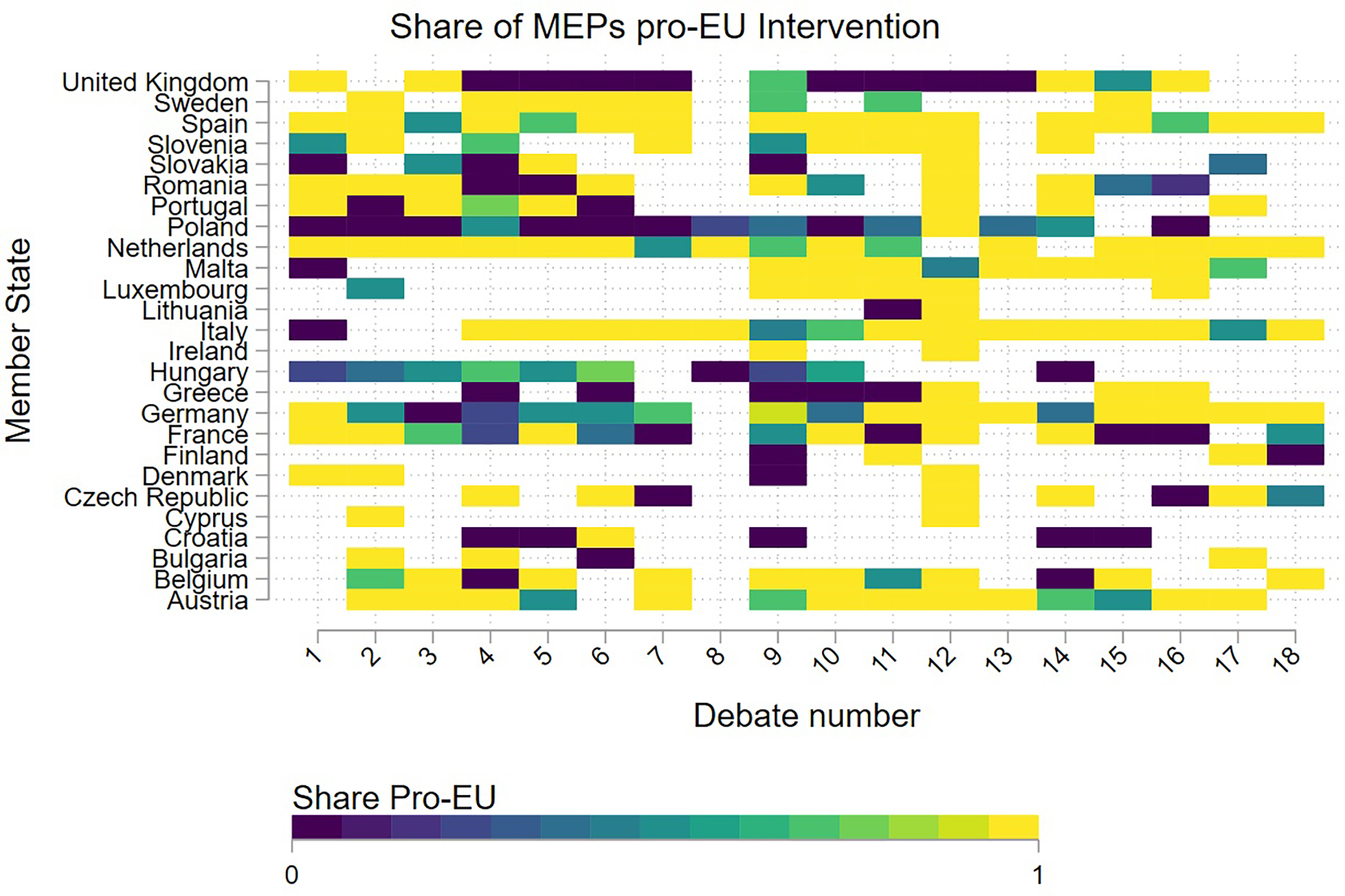
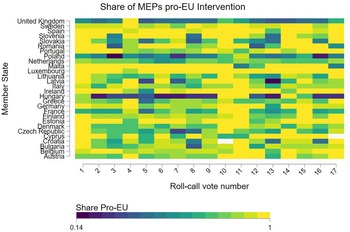
Our discourse dataset contains statements from MEPs representing a wide range of member states, with Latvia and Estonia the only two countries not represented. Figure 1 presents a heatmap of support for EU intervention in backsliding cases across national delegations and the 18 debates analysed. The figure shows that, unsurprisingly, Polish and Hungarian MEPs were particularly active in debates on RoL interventions, as were MEPs from member states who form the so-called ‘Friends of the Rule of Law Group’Footnote 11 (see also Figure A1 in the online Appendix), with their respective positions contrasting drastically. Figure 1 also shows that there is considerable variation across debates in the extent to which the discursive positions taken by MEPs from different Member States were more consensually pro/anti-intervention (indicated in yellow/purple) or more internally divided (blue/green tones).
A heatmap of position-taking in European Parliament debates on democratic backsliding. EU = European Union; MEPs = Members of the European Parliament.
Our analysis of MEPs’ discursive behaviour reports the results of the Heckman selection probit in Table 1. We ran this in two steps to be able to incorporate random effects. In a first stage, we ran a mixed effects probit model to estimate the selection equation, with random effects for EPGs and legislators. We then computed the inverse Mills ratio and included it in the outcome equation to correct for selection bias. The outcome equation was estimated using a mixed effects binary logistic regression, with random intercepts for legislators.Footnote 12 We first discuss the findings of the selection equation (i.e., speaking or not in the debate) and then those of the outcome equation (supporting or opposing EU intervention against backsliding).
Who supports EU action against backsliding in EP debates? (Heckman selection models)
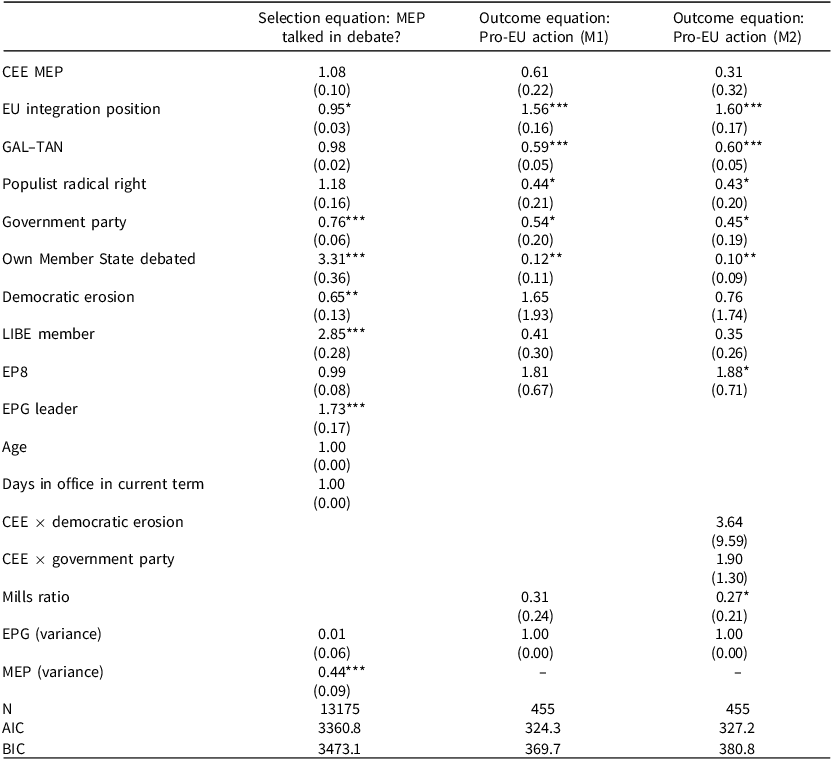
Note: Significance at *0.1 ** 0.05 *** 0.01; cell entries are exponentiated coefficients.
Which MEPs choose to speak in debates about the RoL and democratic backsliding? Examining the coefficients from the selection equation in Table 1, several patterns become apparent. When it comes to ideology, we find no significant effect for PRR orientation driving MEPs to speak up in plenary debates on democratic backsliding. Nor does our control variable GAL/TAN shape MEP’s likelihood to take the floor. However, MEPs representing more pro-European views are slightly less likely to participate in these debates than those from parties holding Eurosceptic positions. In terms of geographic determinants, CEE origin per se is not a predictor of floor-taking. Instead, and perhaps unsurprisingly, MEPs representing Member States that are the focus of the debate are almost three times more likely to intervene. They have the most to lose (or, in the case of opposition MEPs, to gain) from decisive EU intervention and are particularly eager to have their voices heard. Overall, institutional factors appear most decisive: as expected, MEPs from incumbent (non-PRR) parties shy away from taking a stance, preferring to avoid expressing their views on these controversial topics. In contrast, Members of the LIBE committee (who are likely to be more knowledgeable about these themes) are particularly active in these debates, as are EPG leaders, who generally enjoy better floor access. For this initial stage of floor-taking, issue salience and institutional factors thus appear to play a more important role than either ideological or geographic factors.
In a second step, our outcome equation estimates the likelihood that MEPs argue in favour of EU intervention. We report two models, with the second one including interaction effects for geographical origin and democratic erosion (H2a) and geographical origin and national government affiliation (H2b), respectively. In terms of ideological determinants, and as expected, PRR legislators (H1a) are significantly opposed to intervention. Nevertheless, MEPs’ broader positions towards European integration (H1b) more strongly shape their responses towards democratic backsliding in Member States, with Europhile MEPs significantly more likely to position themselves against democratic backsliding and to advocate EU action. All else equal, there is a 57 percentage-point shift in the likelihood of adopting a pro-intervention position when comparing the most Europhile (probability 0.89) to the most Eurosceptic MEPs (probability 0.32).Footnote 13
In turn, CEE origin alone (H2) does not explain discursive behaviour on the part of MEPs, nor do the interaction effects attempting to disentangle different geographical patterns depending on democratic erosion experience (H2a) and government status (H2b) reach conventional levels of statistical significance. Instead, one’s own Member State being targeted once again impacts MEPs’ behaviour and their urge to reject EU intervention in cases of democratic backsliding. In both models, incumbency at the national level is also associated with not supporting EU intervention, most likely due to the discomfort of condemning a peer Member State in the Council. Overall, our empirical findings point to MEPs’ EU integration position as well as the ‘transnational cleavage’ between GAL/TAN parties as most salient in determining their position in plenary debates related to RoL violations. In contrast, there is no visible East–West divide in these debates, with ideology clearly dominating geography when it comes to the MEP’s discursive behaviour.
Voting on EP responses to democratic backsliding
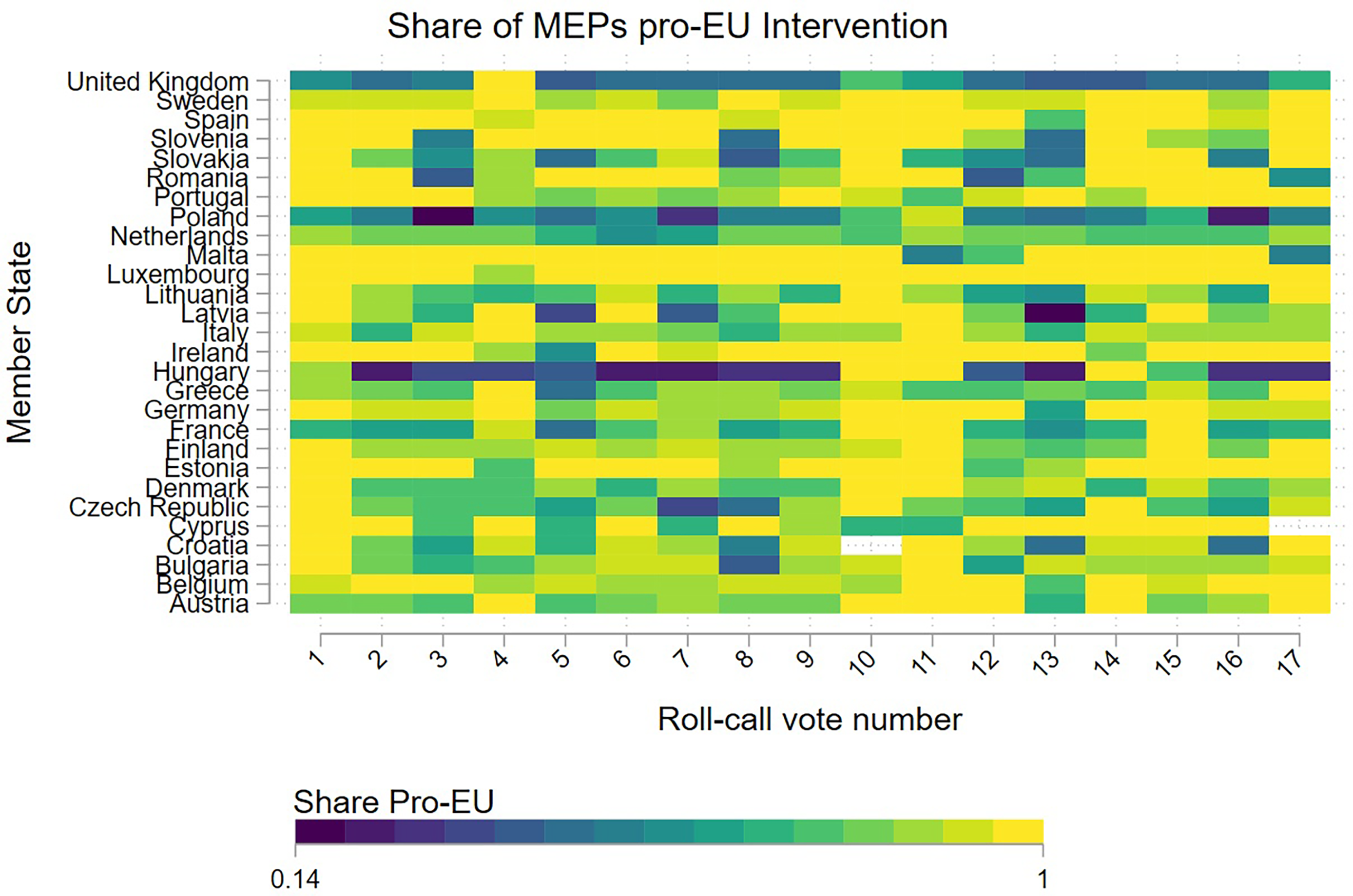
Which factors shape MEPs’ voting patterns in RCVs relating to the RoL? Figure 2 presents a heatmap of support for EU intervention in backsliding cases across national delegations and the 17 votes analysed. While debate participation is selective, as emphasised by the many empty cells in Figure 1, RCVs offer an opportunity for identifying a more comprehensive picture of positions across Member States and cases of backsliding. Taken together, Figures 1 and 2 also indicate broadly consistent behaviour for both speech-making and voting for a significant number of national delegations.
A heatmap of position-taking in European Parliament roll-call votes on democratic backsliding. EU = European Union; MEPs = Members of the European Parliament.
To explore the relevance of ideological and geographic divides shaping legislative behaviour, along with additional controls, Table 2 shows the findings from four mixed effects binary logistic regression models. The third and fourth models combine discursive and voting behaviour by incorporating two dichotomous variables regarding the position of the MEP at the debate preceding the RCV, with MEPs who did not speak in the debate as the reference category.Footnote 14 Models 2 and 4 also include two interactions: of geographical origin and experience of democratic erosion in the legislator’s Member State (H2a) and of geographical origin and belonging to a party governing at the national level (H2b).
Voting against democratic backsliding (mixed effects binary logistic regressions)
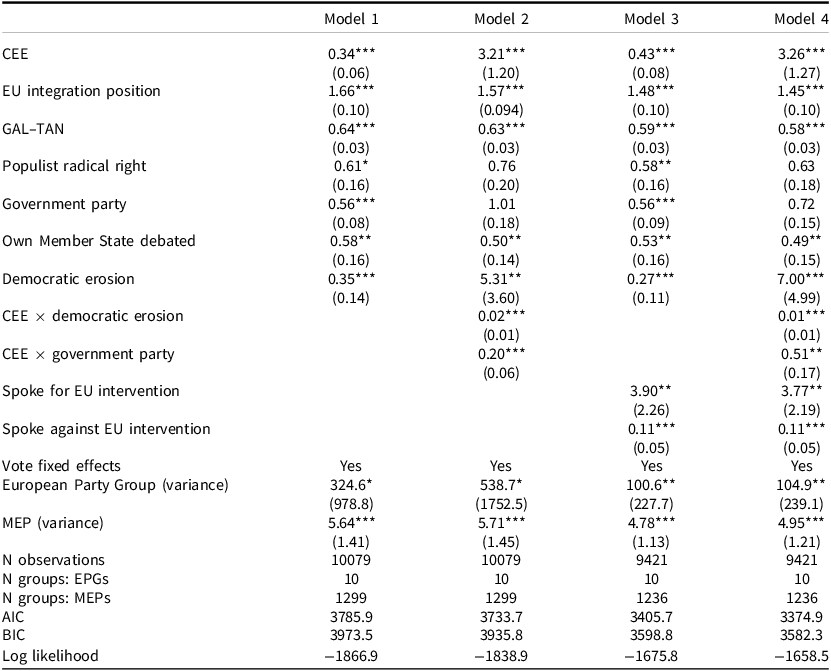
Note: Significance at * p < 0.10, ** p < 0.05, *** p < 0.01; cell entries are odds ratios; standard errors in parentheses.
With regard to ideological determinants of vote choice, PRR membership is only significantly associated with voting against EU action on democratic backsliding (H1a) in the models that do not include the interaction effects contextualising CEE membership. In contrast, we find consistent support for our hypothesis regarding the importance of MEPs’ broader EU integration position across all models (H1b). After accounting for EPG and legislator random effects (model 4), MEPs of the most Eurosceptic parties have a predicted probability of only 0.53 to vote to condemn democratic backsliding, whereas for their most Europhile counterparts, this probability amounts to 0.85. A somewhat larger effect is associated with the GAL-TAN position: a shift from holding the most GAL to the most TAN position decreases the likelihood of voting to support EU intervention on RoL violations in Member States from 0.92 to 0.45. Similar to previous findings (Meijers and van der Veer Reference Meijers and van der Veer2019; Herman et al. Reference Herman, Hoerner and Lacey2021), we confirm that MEPs affiliated to incumbent parties at the national level are significantly less likely to vote to condemn or sanction democratic violations; however, this result seems largely driven by CEE MEPs (in line with H2b).
If we examine the East–West divide alone, it appears at first sight (models 1 and 3) that CEE MEPs are somewhat less likely to vote for EU action against democratic backsliding, corroborating H2. However, as we dig into the mechanisms that might be underpinning our presumed geographic divide, this finding changes direction in models 2 and 4, signalling that the observed relationship is driven by CEE MEPs from countries that have experienced democratic erosion (H2a) as well as CEE MEPs affiliated with incumbent governments (H2b). The former group in particular is associated with a very large negative effect: all else equal, legislators from CEE countries that have experienced backsliding are roughly 50 times less likely to support EU action compared to others. In comparison, CEE legislators affiliated with national governments are only between two (model 2) and five times (model 4) less likely to back a strong European response against backsliders. Besides the relevance of Eurosceptic orientations, geographic origin, coupled with MEPs being directly concerned by democratic erosion in their own country, thus appears as the strongest predictor of MEPs’ opposition to EU intervention in RoL matters in RCVs, strongly outweighing a logic of regional solidarity between CEE incumbents that also shapes their positions in RCVs quite heavily.
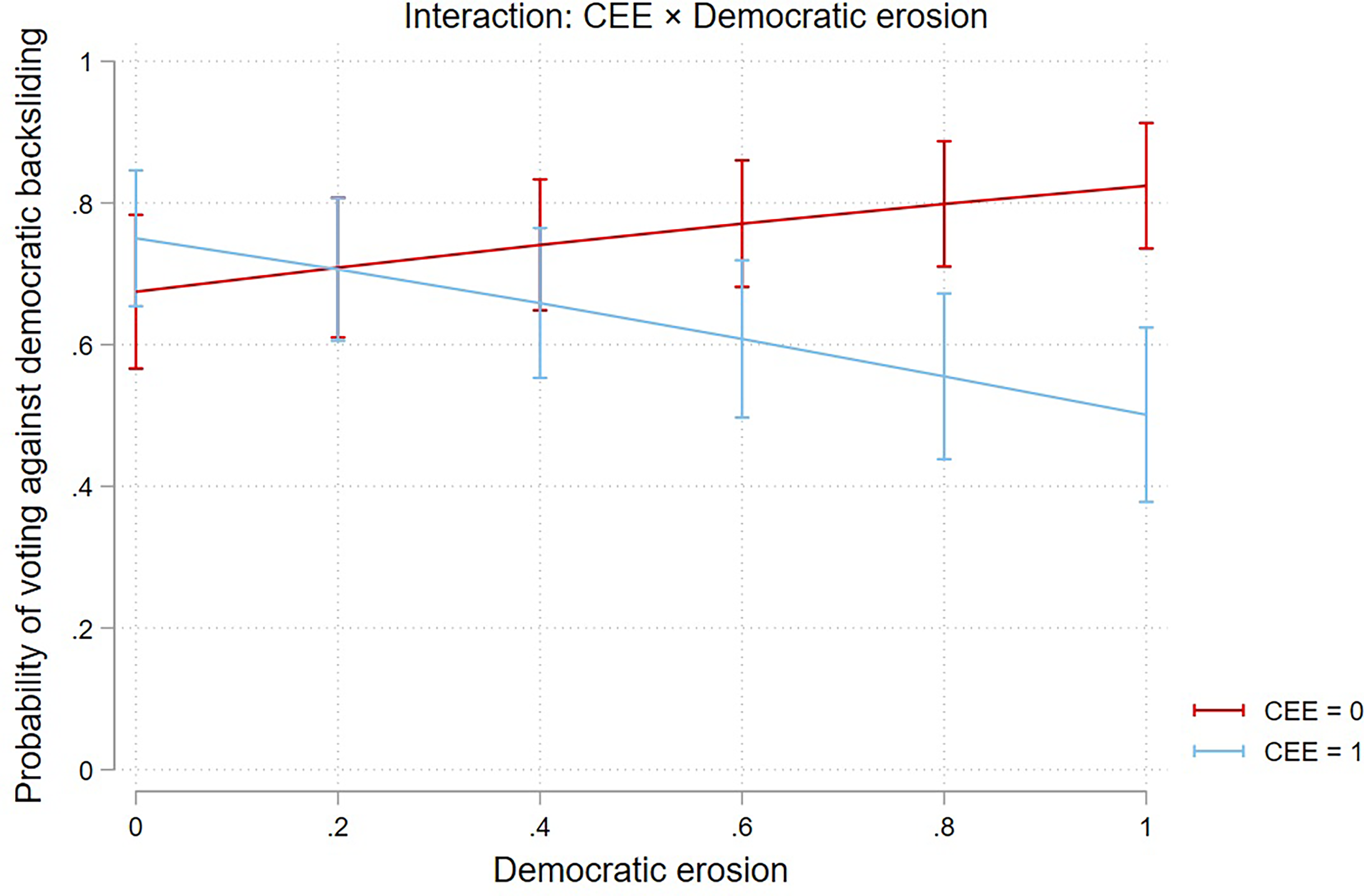
Based on model 4, Figure 3 plots the predicted probabilities associated with the interaction between geographic origin and democratic erosion (H2a). The figure illustrates that the likelihood of supporting EU intervention decreases from 0.75 to 0.50 for CEE MEPs when comparing those from Member States that suffered no democratic decline in the past year to those from countries that regressed the most. For Western European MEPs, this relationship is reversed – the same switch results in an increased probability of voting for EU action against backsliding: from 0.67 to 0.82. The results corroborate the intuition that the CEE MEPs most committed to defending the RoL and a strong role for the EU in that process generally come from Member States that have not suffered a democratic decline in recent years, such as the Baltics (see also Sedelmeier Reference Sedelmeier2024: 939).
Democratic erosion and geographic origin. CEE = Central and Eastern Europe.
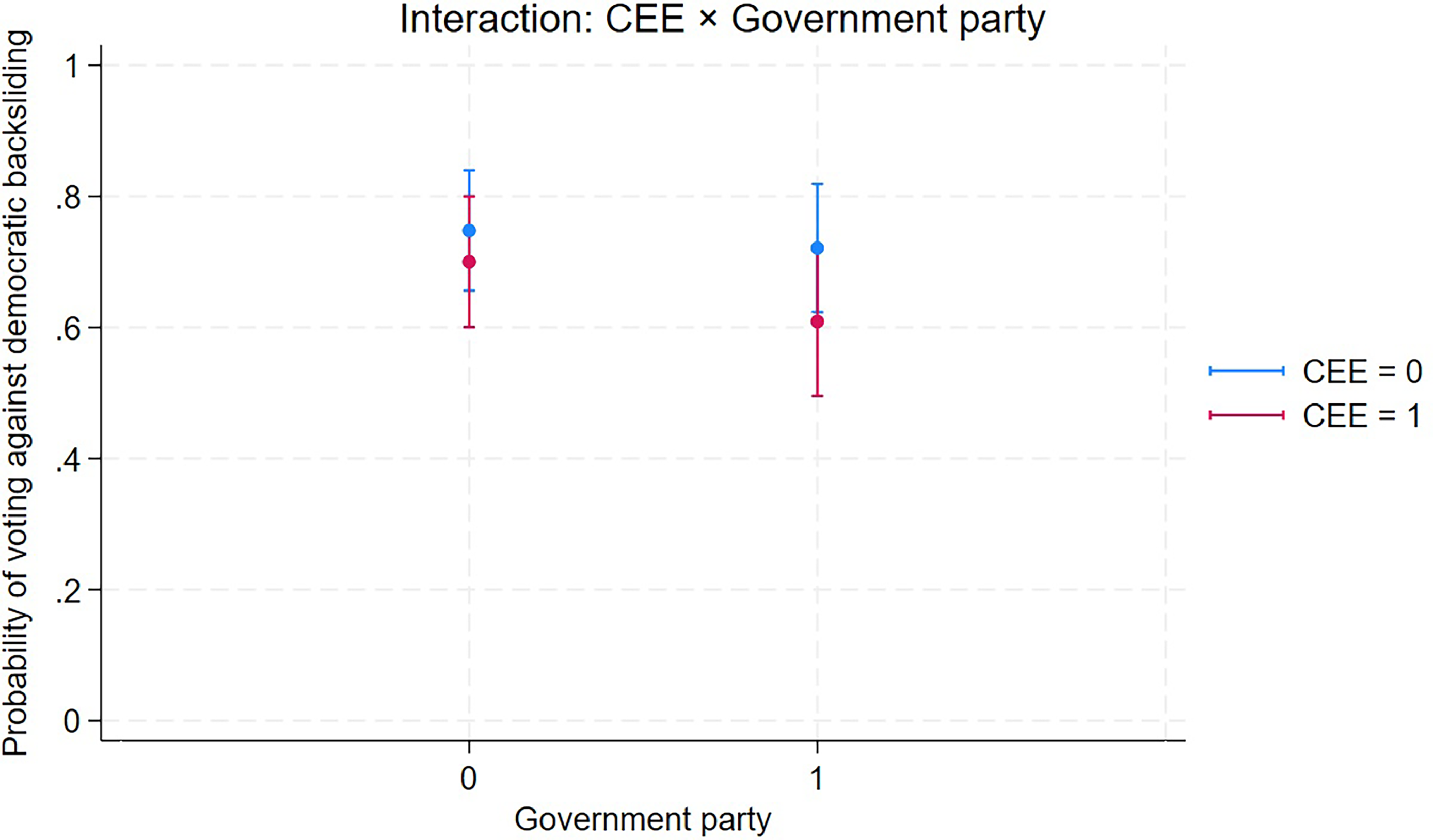
Similarly, Figure 4 plots the predicted probabilities associated with the interaction between geographic origin and belonging to a party that is governing at the national level (H2b), again based on model 4. The figure illustrates that the likelihood of supporting EU intervention decreases from 0.70 to 0.61 when comparing CEE opposition MEPs with those from governing parties, whereas for Western European legislators, the corresponding difference is minimal (0.75 for opposition MEPs vs 0.72 for government MEPs).
National government status and geographic origin. CEE = Central and Eastern Europe.
In a final step of our analysis, we match MEPs’ discursive and voting behaviour to explore how these two forms of legislative action relate to one another. A priori, we expected behaviour to be broadly consistent, although not necessarily entirely, given the distinct incentives weighing on MEPs across these two stages of the legislative process. Our data show that those MEPs who advocated for EU intervention against backsliding in the debates preceding the votes are almost four times more likely to back the same position at RCVs compared to colleagues who had not spoken (see Table 2, model 3). Mirroring this pattern, those who spoke in support of the governments accused of backsliding were nine times more likely to reject EU action compared to the non-speakers (see Table 2, model 4). These patterns indicate that MEPs who take the floor to express their views on the appropriate EU response to democratic backsliding are considerably more likely to subsequently adhere to these views in RCVs. This pattern is to be expected given the controversial nature of the topic, which implies that those MEPs participating in the debates either have a strong incentive to take a consistent position and/or hold very firm opinions on the topic.
Robustness checks
Because excluding abstentions as a strategic choice available to legislators might potentially bias our findings (Noury Reference Noury2004; Brown and Goodliffe Reference Brown and Goodliffe2017), in a first robustness check, we re-ran the models presented in Table 2 on a larger sample, with a dependent variable that differentiates between abstentions, votes in favour of EU intervention, and votes against. Thus, we used a mixed effects multinomial logit model that includes random effects for EPGs and individual legislators. The results are presented in Table A2. The main findings discussed above are robust to this replication, and the magnitude of the effects is not affected. It is also important to note that after accounting for the legislators’ debate positions (models 3 and 4), MEPs from CEE are more likely to abstain than to vote against EU action.
We also explored the correlates of inconsistent behaviour across votes and debates. Table A3 in the Appendix presents the result of a binary logistic regression, which estimates why legislators speak in favour (against) EU intervention and then vote against (in favour) of such action at the corresponding RCV. Model 2 also codes as inconsistent behaviour those cases of legislators who took a clear position during the debates but abstained at the vote. While we do not uncover any regional divide, this inconsistent behaviour is largely driven by MEPs affiliated with the national government as well as those from TAN parties and is considerably less common in the second term analysed, when MEPs’ positions on RoL matters had largely crystallised for both camps, leading to a polarisation of views (see Wunsch and Chiru Reference Wunsch and Chiru2025).
As a final robustness check, we control for authoritarian legacies in an attempt to further disentangle what might drive the often-assumed East–West divide. We operationalise this as the number of years the MEP’s country was an autocracy between 1900 and 1989, based on the Episodes of Regime Transformation dataset (Maerz et al. Reference Maerz, Edgell, Wilson, Hellmeier and Lindberg2024). With respect to the variable itself, our expectations are rather ambivalent: on the one hand, longer exposure to authoritarian regimes has been shown to reduce support for democracy both on the aggregate and at the individual levels (Pop-Eleches and Tucker Reference Pop-Eleches and Tucker2017). On the other hand, the transition to democracy might have resulted in a stigmatisation of authoritarian preferences and hence emboldened politicians who experienced the transition to stand up when democracy becomes endangered (Dinas et al. Reference Dinas, Martínez and Valentim2024). Once again, the main results are not sensitive to the inclusion of this variable, as shown in Tables A4 and A5. Substantively, authoritarian legacies are associated with a higher likelihood of speaking in RoL debates but do not appear to influence the position taken by MEPs.
Discussion and conclusion
Tackling one of the key challenges facing European integration today, this article asks whether ideology or geography best explain how MEPs respond to democratic backsliding and RoL violations in Member States. Our theoretical expectations pitted ideological divides in the form of PRR or Eurosceptic orientations against geographic divides, specifically a purported East–West divide. Using a comprehensive set of roll‑call votes related to RoL conflicts in the seventh and eighth EP sessions (2009–2019) and original hand‑coded debate data, we find that ideological divides structure behaviour more consistently than territorial origin. We show that Eurosceptic views are relevant both for MEPs’ discursive positioning and their voting behaviour, whereas PRR membership is much less clearly associated with their likelihood to support EU intervention across both stages of the legislative process. When it comes to geography, the origin of MEPs does not make a difference for their participation in debates or for the discursive positions they take once we account for the ideological orientation of their parties. Strategic motivations related to cooperation in the Council by governing parties most likely explain why government MEPs prefer to take a backseat in these situations. In contrast, geographic origin strongly predicts voting behaviour and, more specifically, a reluctance to condemn RoL violations in Member States. However, we show that this effect is strongly conditional on MEPs having experienced democratic erosion in their own country as well as on the incumbency of their party at the national level. Overall, our findings indicate that ideology clearly trumps geography when it comes to MEPs’ discursive behaviour on initiatives related to democratic backsliding and the RoL. MEPs’ ideological stances on European integration also remain highly salient for RCVs, whereas the relevance of MEPs’ geographic origin for their voting behaviour is conditioned by contextual factors. That ideological divides are even more salient for discursive behaviour than RCVs may appear somewhat counterintuitive, given that party discipline could be expected to weigh more heavily on voting decisions than on plenary statements. We explain this pattern with the strong dominance in RoL debates of MEPs from the directly affected member states who use the hemicycle to defend their governments from criticism by the EU while marginalising other CEE voices (see Figure A1). Besides, participation in plenary debates is selective, whereas RCVs contain information on all MEPs. Those who dissent from their EPG line may prefer to express such views in their voting behaviour but refrain from speaking out openly against their party line in debates.
Our findings make several original contributions. Theoretically, we clarify how MEPs’ divergent attitudes towards European integration shape their legislative behaviour when core democratic values are at stake. Rather than splitting the EU along geographic lines, conflict over backsliding travels through ideological channels: actors sceptical of supranational authority and pluralist conceptions of democracy are systematically less supportive of EU intervention in RoL matters, regardless of national origin. Geography remains relevant, but as a conditional cue that is activated where the domestic costs of endorsing EU scrutiny are highest. This is especially the case where democratic erosion is ongoing in an MEP’s own Member State, making them a likely next target of EU intervention and, to a lesser extent, among MEPs from national incumbent parties who may be more sensitive to notions of regional solidarity towards their peers in the Council. This qualification matters for debates that portray backsliding primarily as an East–West divide that drives CEE representatives to reject intervention due to concerns over bias and double standards in the EU’s responses. Instead, we uncover a layered cleavage structure in which ideology typically leads and geography amplifies divisions under specific conditions.
Methodologically, our effort to link discursive interventions to subsequent roll‑call behaviour – and modelling abstention as a strategic choice – moves beyond parallel descriptions of ‘talk’ and ‘vote’ to show how floor-taking and MEPs’ positioning in debates align with vote decisions. The high consistency across both stages of the legislative process indicates that MEPs’ positions on RoL issues are firmly entrenched, further cementing divides that are less clear-cut in areas such as EU enlargement, where sceptical public opinion drives discursive accommodation but does not shape MEPs’ voting behaviour (Wunsch and Bélanger Reference Wunsch and Bélanger2024).
More generally, our findings contribute to debates on shifting cleavages and coalition-building patterns at the European level. We confirm the relevance of a transnational cleavage structured along a cultural dimension and the opposition of pro-/anti-EU views. The considerable divide over the EU’s response to backsliding has not only hampered more resolute EU action to safeguard the RoL (Blauberger et al. Reference Blauberger, Naurin, Sedelmeier and Wunsch2025; Kelemen Reference Kelemen2025) but also appears to reflect a more widespread challenge to initiatives favouring a strengthening of supranational EU powers, for example, on refugee reallocation or irregular migration. Research on coalition-building patterns during more recent EP terms confirms the enduring relevance of this pro-/anti-EU divide despite – or even because of – the fragmentation of the Eurosceptic camp (Brack et al. Reference Brack, Costa and Marié2023; Hix et al. Reference Hix, Whitaker and Zapryanova2024; Cheysson and Fraccaroli Reference Cheysson and Fraccaroli2025).
In practical terms, this means that coalition‑building efforts inside the EP need to factor in the ideological structure of political conflict around the RoL. Concretely, enforcement strategies will be more credible if framed in ways that minimise sovereignty‑based reframing by emphasising transparent criteria, clear thresholds for intervention, and communication that highlights the cross‑regional comparability of cases. At the same time, the conditional role of geography points to productive entry points in CEE contexts: engaging opposition parties and civil society, timing interventions to reduce perceptions of partisan targeting, and combining legal instruments with political dialogue that includes domestic audiences. Because incumbents have incentives to mobilise co‑nationals and co‑partisans in the EP, initiatives to tackle democratic backsliding in Member States should anticipate and neutralise such strategies.
In sum, the widening ideological divide around the EU’s foundational values signals a durable reconfiguration of political competition in the Union. If opposition to supranational constitutionalism hardens into a standing coalition, the EU’s capacity to enforce common standards, maintain mutual trust among legal orders, and mobilise solidarity in crises will increasingly come under pressure. Conversely, normalising value contestation as just another area of political competition risks entrenching selective compliance and exporting domestic constitutional conflicts to the European level. Our analysis therefore signals the importance of treating the defence of the RoL crisis not as a mere sectoral dispute centred on a few member states but as a central axis of party competition with system-wide implications for integration, enlargement, and the credibility of the EU’s external action. Future research should therefore further explore the growing ideological opposition to the European project and the potential emergence of an alternative vision of European cooperation promoted by more Eurosceptic, sovereignty-focused actors.
Supplementary material
The supplementary material for this article can be found at https://doi.org/10.1017/S1475676526100693.
Data availability statement
The replication code and data are available on the EJPR website together with the online Appendix.
Acknowledgements
We are grateful to Michael Blauberger, Dan Kelemen, Lise Herman, Berthold Rittberger, Uli Sedelmeier, Silvana Tarlea, and three anonymous reviewers for their valuable feedback on previous versions of the paper.
Funding statement
No funding to declare.
Competing interests
No competing interest.




 Open access

