

Economic sanctions are a crucial and widely used tool of foreign policy (Drezner Reference Drezner1999, Reference Drezner2024; Felbermayr et al. Reference Felbermayr, Morgan, Syropoulos and Yotov2025; Hufbauer et al. Reference Hufbauer, Schott and Elliott1990; Morgan et al. Reference Morgan, Bapat and Kobayashi2014). Policymakers use economic sanctions in an effort to address human rights abuses, nuclear proliferation, territorial aggression or unfair economic practices. Taking the form of punitive tariffs, restrictions on financial transactions or even outright embargoes, economic sanctions are designed to impose significant costs on targeted states. A large and important body of work has documented the adverse effects of economic sanctions on humanitarian outcomes such as public health, gender equality and economic development (Drezner Reference Drezner2022).
However, economic sanctions often entail costs for sender states as well as their targets. They have the potential to disrupt established trade relationships and supply chains, and reduce potential gains from economic cooperation and interdependence. When economic interdependence is significant and trade extends to important strategic resources such as energy or food, sanctions create significant disruptions in the economic lives of citizens in target as well as sender states (Farrell and Newman Reference Farrell and Newman2019). As a result, sender governments must carefully consider the risk of public backlash as they design sanctions policies to advance their strategic interests.
This paper investigates how the design of sanctions policies affects support in a democratic sender state for costly economic sanctions against an autocratic target state in a context of significant economic interdependence. We provide evidence that public support for sanctions is generally sensitive to policy design: smart design choices can reduce the risk of public backlash against costly economic sanctions. Two key findings emerge. First, measures that are aimed at autocratic elites – such as the expropriation of their foreign-held assets – consistently increase support for economic sanctions. Second, inflicting pain on vulnerable populations in autocratic target states only increases support for sanctions when provisions are made to simultaneously target autocratic elites. In the absence of such provisions, inflicting pain on vulnerable populations reduces support for economic sanctions.
We argue that the conditional humanitarianism that characterises sanctions preferences is driven by citizens’ beliefs about the mechanics of policy change in autocracies. Citizens perceive elites to be pivotal for policy change in autocracies. Hence, inflicting pain on the broader population is only justified when policy change is a real possibility, which is itself only the case when sanctions inflict pain on the target country’s elites.
Evidence for our contentions comes from a pre-registeredFootnote 1 willingness-to-pay (WTP) survey experiment fielded with an approximately representative sample of 2,007 German citizens. We fielded our survey in a context in which debates over sanctions policy were highly salient. The Russian invasion of Ukraine prompted intense debates about German trade relationships with Russia, a major supplier of fossil fuels to the European market. We used conjoint measurement techniques to investigate the effect of various sanctions policy features on support for the policy. Support was elicited using a WTP methodology – respondents were asked to evaluate sanctions policy packages by indicating their tolerance for higher energy prices.
Our paper makes two main contributions. First, our findings extend and challenge existing work on public preferences for sanctions in democratic sender states. While previous scholarship has recognised that humanitarian considerations motivate preferences on sanctions, failure to disaggregate between policies targeting elites and those targeting the mass public has meant that the conditional nature of humanitarian considerations has remained undetected. Our paper demonstrates that democratic publics trade off effectiveness against humanitarian considerations in a more complex fashion than is recognised in existing scholarship.
The second contribution of our paper is to introduce a novel method of preference elicitation. Instead of abstract survey questions to gauge preferences for foreign policy, we elicit individuals’ WTP for sanctions in the form of higher energy costs. We use conjoint measurement techniques to estimate the effects of sanctions features on WTP. The advantages of this approach are threefold. First, conjoint measurements allow us to estimate the effect of various features of sanctions packages on public support with great statistical precision. Second, in contrast to abstract and often unspecific survey questions about support for sanctions against target states, eliciting people’s WTP emphasises the trade-offs engendered by sanctions policy. Sanctioning target countries may entail costly retaliation, and our method of preference elicitation allows respondents to think clearly about the distributive implications of sanctions policy (Rho and Tomz Reference Rho and Tomz2017). Third, our method allows us to quantify the aggregate WTP and how this quantity is affected by variations in sanctions policy. We believe these quantities to be of interest to policymakers seeking to calibrate compensation policies to offset the costs of sanction retaliation.
The rest of this paper proceeds as follows. First, we introduce the context that motivated our study. We then review existing scholarship in international relations and comparative politics that informs our theory. Next we develop our argument, before presenting our experimental design and our empirical results. We conclude by discussing policy implications and important avenues for further research.
Germany and the Russian invasion of Ukraine: the political context
On 24 February 2022, Russian military forces invaded Ukraine after several months of troop movements leading to a gradual build-up of military personnel along the countries’ shared border. Expanding the insurgency led by Russia-backed separatists in eastern provinces of Ukraine as well as the annexation of Crimea, the full-scale invasion – a pronounced violation of state sovereignty and territorial integrity – was met with condemnation from many leaders in the West. In the weeks and months that followed, additional sanctions were placed on the Russian economy. These sanctions targeted elites and corporate entities affiliated with the regime of Vladimir Putin, and imposed restrictions on trade in goods and services, financial transactions and travel.Footnote 2
To be efficacious, this broad package of sanctions led by the United States (US) and the European Union (EU) required cooperation from states with varying levels of pre-existing economic ties to Russia. By their very design, sanctions disrupt trade and reduce potential gains from economic cooperation and interdependence; in the present context, this economic disruption has been most clearly felt in European countries heavily reliant on Russian fossil fuel imports. Energy price shocks, alongside economy-wide inflation, have placed increased financial burdens on many households in Europe, placing constraints on domestic support for further international cooperation on sanctions in response to Russian aggression. Indeed, while many sanctions were passed relatively quickly, restrictions on energy imports have remained a contested matter in later rounds of EU debates on sanctions.
Resistance to further economic sanctions against Russia, motivated by fears of energy price shocks, was not limited to actors such as Hungary, which has frequently attempted to stifle European foreign policy initiatives. Rather, major players such as Germany and Italy wavered on their support for extensive economic sanctions due to fears of electoral backlash as a result of increased energy prices.Footnote 3 While then German Chancellor Olaf Scholz condemned Russian aggression in strong terms, Berlin was hesitant about providing military support to the same extent as other allies, such as the United Kingdom (UK) or Poland.Footnote 4 Fears over possible winter energy shortages and dramatic energy price increases likewise motivated recalcitrance over the initial oil embargo in April 2022.
Germany eventually agreed to curb imports of Russian fossil fuels – a stark departure from a cross-partisan foreign and energy policy consensus that had lasted half a century. Even at the height of the Cold War, and despite persistent opposition from the US, West Germany sought to import cheap fossil fuels from the Soviet Union. Between 1973 and 1993, imports of natural gas from the Soviet Union rose 25-fold, creating close connections between West German firms and Soviet energy producers.Footnote 5 The relationship deepened under the social-democratic chancellorship of Gerhard Schröder, who built extensive business ties with Russian energy companies Gazprom and Rosneft after stepping down as Chancellor in 2005. Prior to the invasion of Ukraine, two gas pipelines from Russia to Germany bypassing Eastern Europe, Nord Stream I and Nord Stream II, were completed under the Christian-democratic chancellorship of Angela Merkel (Bingener and Wehner Reference Bingener and Wehner2023).
The decoupling of Germany from Russian fossil fuel supplies has generated intense controversy in domestic political debate. Prominent members of the radical right Alternative für Deutschland (AfD) have repeatedly called for an end to all sanctions against Russia and a resumption of oil and gas imports to Germany.Footnote 6 The criticism has been echoed by other influential actors in the German political landscape, most notably Sahra Wagenknecht, founder of the economically left-wing and socially conservative Bündnis Sahra Wagenknecht (BSW). Criticism of decoupling has focused on questions of affordability and energy price rises for consumers. Wagenknecht slammed the sanctions regime for threatening millions of German citizens with ‘social decline’ due to the rising cost of living.Footnote 7
Two important scope conditions apply to our theory. First, the relationship between Germany and Russia is one of significant economic interdependence, which could readily be weaponised (Farrell and Newman Reference Farrell and Newman2019). Second, the design and implementation of sanctions were and continue to be highly salient issues in German domestic politics. The nature of the trading relationship between Russia and Germany, the latter’s dependency on cheap Russian fossil fuels, and efforts by issue entrepreneurs on the far left and far right to render energy prices salient in domestic political debate imply that citizens are well aware of the ‘pocketbook’ implications of sanction imposition.
These scope conditions may seem restrictive – our theory would not apply to preferences over sanctions against target states with economically insignificant ties to the sender state, say in the case of German sanctions against North Korea. However, our theory sheds light on the drivers of democratic public opinion in instances of great power conflict between the democratic West and large, economically significant autocratic powers such as Russia, China or Saudi Arabia. This conflict between Western democracies and what commentators have called the ‘global axis of authoritarians’Footnote 8 is arguably the most important geopolitical conflict of our time.
Existing scholarship on preferences for economic sanctions in sender countries almost exclusively studies public opinion in the US (Özdamar and Shahin Reference Özdamar and Shahin2021: 1656). While undoubtedly important, we believe that much can be learned by studying European, and in particular, German public opinion on foreign policy. Germany occupies a pivotal role within the institutions of the wider EU. As a result, domestic public opinion in Germany is important far beyond the narrow confines of German foreign policy as a key determinant of EU foreign policy more generally. The EU wields significant geopolitical influence: it is home to the third-largest economy in the world behind the US and China and the second-most traded currency behind the dollar. The outcomes of contemporary conflicts over the territorial integrity of Ukraine or the independence of Taiwan may well hinge on successful foreign policy cooperation between the US and the EU. Thus, gaining an improved understanding of foreign policy preferences in Germany should be of interest to scholars and policymakers alike.
Existing scholarship
Given their widespread use in interstate relations, economic sanctions have attracted significant scholarly interest (Drezner Reference Drezner1999, Reference Drezner2024; Felbermayr et al. Reference Felbermayr, Morgan, Syropoulos and Yotov2025; Hufbauer et al. Reference Hufbauer, Schott and Elliott1990; Morgan et al. Reference Morgan, Bapat and Kobayashi2014).
A first strand of literature has asked whether sanctions are effective in the sense that they modify target state behaviour. This scholarship has come to mixed conclusions (see Dursun Peksen Reference Peksen2019; Özdamar and Shahin Reference Özdamar and Shahin2021 for comprehensive reviews). Various factors, including the degree of multilateral cooperation in sanction imposition and characteristics of the target state, have been found to affect sanction success (Bapat et al. Reference Bapat, Heinrich, Kobayashi and Morgan2013; Bapat and Morgan Reference Bapat and Morgan2009; Dashti-Gibson et al. Reference Dashti-Gibson, Davis and Radcliff1997; Drezner Reference Drezner2000; Early and Spice Reference Early and Spice2015; Farrell and Newman Reference Farrell and Newman2019; Hufbauer et al. Reference Hufbauer, Schott and Elliott1990; Lektzian and Souva Reference Lektzian and Souva2007). In parallel, scholars have accumulated a wealth of evidence documenting that the imposition of wide-reaching sanctions often goes hand in hand with deteriorating public health, economic inequality, respect for human rights and other humanitarian outcomes in target states (Adam and Tsarsitalidou Reference Adam and Tsarsitalidou2019; Afesorgbor and Mahadevan Reference Afesorgbor and Mahadevan2016; Allen and Lektzian Reference Allen and Lektzian2013; Early and Peksen Reference Early and Peksen2015; Gutmann et al. Reference Gutmann, Neuenkirch and Neumeier2020; Reference Gutmann, Neuenkirch and Neumeier2021; Jafarey and Lahiri Reference Jafarey and Lahiri2002; Peksen Reference Peksen2009, Reference Peksen2011).
Given the well-documented importance of public opinion for the conduct of foreign policy in democracies (Baum Reference Baum2004; Dietrich Reference Dietrich2021; McLean and Wang Reference McLean and Wang2014; Ostrom and Job Reference Ostrom and Job1986; Press et al. Reference Press, Sagan and Valentino2013; Reiter and Stam Reference Reiter and Stam2002; Tomz et al. Reference Tomz, Weeks and Yarhi-Milo2020), scholars have increasingly been interested in understanding how considerations regarding effectiveness and the humanitarian consequences of sanctions shape public opinion towards foreign policy in sender states. On the one hand, scholars have shown that mass publics approach coercive foreign policy by focusing on considerations about its effectiveness in modifying the behaviour of the target country (Eichenberg Reference Eichenberg2005; Gelpi et al. Reference Gelpi, Feaver and Reifler2006; McLean and Roblyer Reference McLean and Roblyer2017; Press et al. Reference Press, Sagan and Valentino2013). Focusing on sanctions, Tobias Heinrich et al. (Reference Heinrich, Kobayashi and Peterson2017) document that democratic publics support sanctions which induce short- or long-term policy change in target states while minimising costs to the sender’s economy.
On the other hand, democratic publics have also been shown to place great importance on safeguarding human rights. Mass publics show greater support for foreign policy interventions targeted at countries that severely violate the human rights of their citizens (Agerberg and Kreft Reference Agerberg and Kreft2023; Kreps and Maxey Reference Kreps and Maxey2018; Maxey Reference Maxey2020; Tomz and Weeks Reference Tomz and Weeks2020). Martha Finnemore (Reference Finnemore2003) and Sarah Kreps and Sarah Maxey (Reference Kreps and Maxey2018) argue that in assessing foreign policy interventions, citizens’ primary motivation is to alleviate the suffering of vulnerable groups in the target state. Using experimental evidence, Michael Tomz and Jessica Weeks (Reference Tomz and Weeks2020) show that citizens in countries which are seen to respect human rights have a moral aversion to using force against other countries that uphold human rights. Humanitarian motivations have also been shown to shape public opinion on foreign aid in donor countries (Bayram and Holmes Reference Bayram and Holmes2020). Michelle Allendoerfer (Reference Allendoerfer2017) finds that public support for negative aid sanctions increases when human rights abuses are exposed. The humanitarian perspective suggests that mass publics should favour sanctions that minimise the level of economic and social disruption in the target state, in particular when such disruption affects vulnerable groups or politically disenfranchised civilians. Sanctions which apply to specific actors deemed responsible for transgressive actions – be they autocratic elites or militia leaders – are preferred to comprehensive sanctions threatening to induce collateral damage in the general population of the target state.
Finally, scholars have examined how citizens weigh perceptions about the effectiveness of foreign policy interventions against concerns about their negative humanitarian effects. Focusing on aid, Heinrich (Reference Heinrich2013) demonstrates how aid allocation decisions by donor governments are jointly determined by the value of policy concessions and audience awareness of humanitarian conditions in the recipient state, which is itself a function of media coverage. Experimental work confirms that strategic concerns about policy benefits moderate the relationship between humanitarian concerns and preferences on aid (Heinrich and Kobayashi Reference Heinrich and Kobayashi2020; Heinrich et al. Reference Heinrich, Kobayashi and Long2018; Kohno et al. Reference Kohno, Montinola, Winters and Kato2021). Other foreign policy interventions, including drone strikes (Kreps and Wallace Reference Kreps and Wallace2016; Walsh Reference Walsh2015), the use of nuclear weapons (Rathbun and Stein Reference Rathbun and Stein2020), or the shaming of human rights abuses (Terman Reference Terman2023; Terman and Byun Reference Terman and Byun2022), have been shown to follow a similar logic. The importance of humanitarian concerns, such as the sensitivity to civilian casualties in war, can be attenuated when strategic interests are emphasised.
The interplay of strategic and humanitarian considerations has received less attention in the literature on sanctions. An exception is the study by Elena McLean and Dwight Roblyer (Reference McLean and Roblyer2017), who examine how individuals form beliefs about sanction effectiveness and how beliefs about effectiveness interact with information about humanitarian harm engendered by sanctions policy, using a sample of US college students. In their framework, individuals prefer more effective to less effective sanctions, and prefer tailored to comprehensive sanctions, as tailored sanctions carry a lower humanitarian cost. They also hypothesise that effectiveness moderates the relationship between sanctions design and individual support – as effectiveness increases, the penalty for imposing comprehensive rather than tailored sanctions declines.
Our paper differs from and expands this research in a number of important ways. First, while McLean and Roblyer hypothesise that effectiveness concerns should interact with humanitarian considerations in determining public support for sanctions policy, they do not specify a clear theoretical justification for the interaction. Our theory, in contrast, as explained in the next section, explains how popular beliefs about autocratic policymaking give rise to conditional humanitarianism.
Second, McLean and Roblyer present respondents with a scenario in which a fictitious target country posing a military threat is set to be sanctioned by the US. An implicit assumption in this scenario is that sanction imposition carries no domestic costs for the US, which is very different from the scenario we study, where the relationship between the sender country (Germany) and the target country (Russia) is characterised by significant economic interdependence, and sanction imposition carries clear and direct costs for the sender publics in terms of energy price increases. McLean and Roblyer note this limitation in their conclusion, and posit that an ‘investigation of a potential trade-off of more immediate domestic pain with foreign pain would be a promising extension of [our] work’ (McLean and Roblyer Reference McLean and Roblyer2017: 248). An additional concern is that it is unclear how much highly stylised experimental scenarios, such as the one employed by McLean and Roblyer (who study US sanctions against a fictitious country ‘Erqat’), allow us to learn about behaviour in real-world conflicts (Brutger et al. Reference Brutger, Kertzer, Renshon, Tingley and Weiss2023).
Third, while McLean and Roblyer use a binary variable to measure sanction support, our measure of support for sanctions emphasises the direct cost of sanction imposition to individuals in the sender state. Our measure emphasises pocketbook consequences of sanction imposition, and has the advantage of more closely reflecting intensity in support for coercive foreign policy.
Beyond the literature on sanctions, we contribute to the broader international relations literature on humanitarianism–effectiveness trade-offs. Existing work has argued that the resolution of these trade-offs is governed by the availability of relevant information through media reporting (Heinrich Reference Heinrich2013; Heinrich et al. Reference Heinrich, Kobayashi and Long2018), moral foundations (Rathbun and Stein Reference Rathbun and Stein2020) or concerns about adherence to legal norms as communicated by international organisations (Kreps and Wallace Reference Kreps and Wallace2016). Our argument, presented in the next section, instead emphasises citizen beliefs about the mechanics of autocratic policymaking as critical to resolving trade-offs between humanitarian and effectiveness concerns.
The argument
Our argument builds on two fundamental contentions. First, rather than viewing autocracies as unitary actors, democratic publics differentiate between two actors within autocratic regimes: autocratic elites and citizens. The second contention is that when forming preferences over sanctions policy, citizens trade off two competing considerations against each other: on the one hand, sanctions are designed to extract policy concessions from target states, with the likelihood of concessions increasing with the amount of pain inflicted on the target state. On the other hand, humanitarian considerations imply that inflicting unnecessary suffering on target state populations without gaining any policy concessions should be avoided.
What determines whether humanitarian or effectiveness considerations dominate? We argue that citizen beliefs about the policymaking process in authoritarian regimes play a crucial role in shaping preferences towards sanctions. We assume that citizens in sender states generally view autocratic policymaking as elite-led, with the mass public being perceived as lacking the opportunities to exert influence on the most salient political decisions undertaken by the regime. This assumption is, we believe, uncontroversial: citizens’ views on the politics of authoritarian regimes are in line with canonical accounts of authoritarian policymaking in comparative politics (Svolik Reference Svolik2012). Unless elites can evade the imposition of sanctions, they will likely respond to sanctions by pushing for making policy concessions to the sender states.
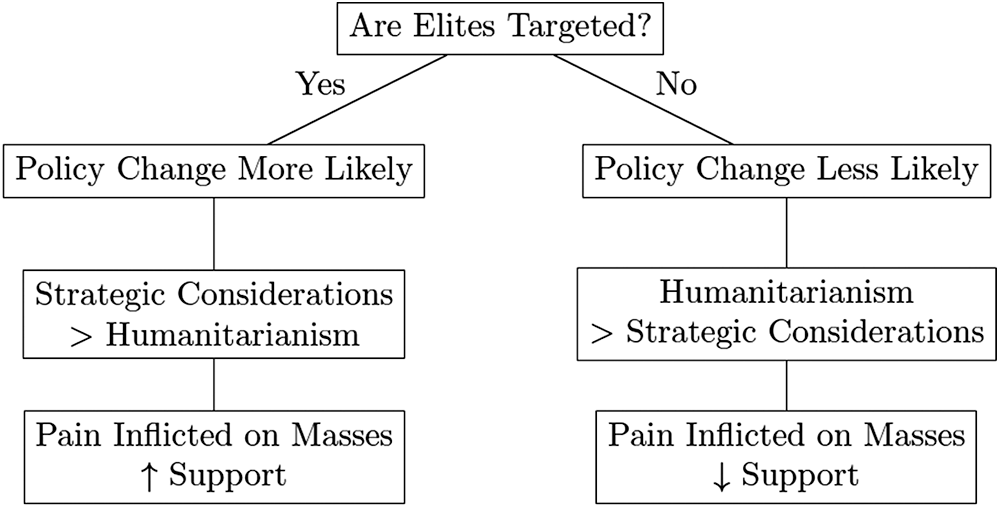
The implication is that citizens favour sanctions that are imposed on the pivotal actors in autocratic regimes (and are likely to regard these sanctions as effective), while shunning sanctions that are imposed primarily or exclusively on nonpivotal actors. If and only if autocratic elites, who are viewed as pivotal, are targeted, effectiveness considerations come to dominate humanitarian considerations. In this instance, the prospect of policy concessions from the autocratic regime justifies sanctions which inflict pain on the broader population in order to maximise pressure for policy change. If, on the other hand, autocratic elites are exempt from sanctions, citizens in the sender state view policy change in the autocratic target country as unlikely, and prioritise humanitarian over effectiveness considerations. In contrast to existing work on sanctions preferences in democratic sender countries, we thus posit that democratic publics are conditionally humanitarian. Figure 1 summarises the decision-theoretic logic of our argument.
Decision Tree for Sanctions against Autocracies with Pivotal Elites

However, as Taehee Whang (Reference Whang2011) makes clear, preferences over sanctions policy are sometimes motivated by symbolic rather than instrumental considerations. Instead of abstract considerations regarding the mechanics of autocratic policy change, citizens may form preferences on sanctions policy simply from a desire for fairness by punishing wrongdoers for their actions. In this case, they may seek to punish particular groups within Russia in a manner proportional to their responsibility for starting and supporting a military conflict.
Fairness considerations can explain why sanctions that target elites enjoy greater public support than sanctions that do not target elites, all else being equal. After all, elites are seen to be the primary culprits in autocratic policymaking. Mass publics, on the other hand, are seen as innocent bystanders; hence, imposing sanctions on them violates the norms of fair punishment.
Fairness considerations could also explain conditional humanitarianism if, on average, citizens value not just absolute but relative fairness – that is, when evaluations of the fairness of a punishment imposed on one group affect evaluations of the fairness of a punishment imposed on another. In our case, citizens may find that when elites are not punished, it would be unfair to increase punitive sanctions on the mass public. As soon as the pain inflicted on elites increases, re-establishing relative fairness in punishment demands sanctioning the mass public more severely as well.
In sum, conditional humanitarianism as an empirical pattern may be driven either by a trade-off between humanitarian and effectiveness motivations or by citizens’ concerns with the relative fairness of a punitive sanctions policy. The next section provides evidence that conditional humanitarianism does indeed characterise average sanction preferences.
Data and methods
Experimental design
To test our theoretical predictions, we conducted a conjoint WTP survey experiment. The design allows us to estimate how various sanction policy features affect support for economic sanctions against Russia in a sample of German citizens. Our design proceeds in two simple steps.
First, we elicited baseline covariates from respondents. One crucial covariate for our analysis is a self-reported measure of baseline monthly household expenditures on energy. Specifically, we asked respondents to estimate how much their household spent on heating, electricity and mobility (cars and/or public transit) per month, in euros. Respondents gave their estimate using a slider with possible values ranging from 0 to 1,000 euros.
Second, respondents were shown tables summarising possible sanctions policy packages with five attributes: (1) the magnitude of the decline in oil imports from Russia; (2) the presence or absence of provisions for expropriating the assets of Russian oligarchs (punishing autocratic elites); (3) the expected increase in unemployment in Russia (punishing autocratic masses); (4) the expected decrease in Ukrainian refugee inflows to Germany; and (5) the participation of international partners in the sanctions policy. Each of these attributes was, in turn, characterised by different levels, as shown in Table 1.Footnote 9
Sanction Policy Features and Levels: Conjoint Task

Respondents were then asked to indicate their WTP for each sanctions policy package displayed to them. We first reminded them of their reported baseline energy expenditures. We then asked respondents to indicate the maximum allowable monthly increase in energy costs such that they would still support the policy. Respondents indicated their WTP using a slider with possible values ranging from 0 to 150 euros.
In total, respondents completed six WTP tasks. For each task, all levels of each attribute were randomly assigned and the randomisation of sanctions attributes was unrestricted. To simplify the task for respondents and to maximise attention, instructions on how to complete the WTP tasks were provided in a short video.Footnote 10
Sample
We recruited subjects for our sample using the survey firm Bilendi, a platform regularly used by survey researchers in comparative politics and international relations. Our sample included 2,007 German citizensFootnote 11 over the age of 18. Non-interlocking quotas on gender, age and Land of residence were implemented to approximate representativeness. Table C.4 in the Supplementary Material provides additional descriptive information on the sample. The survey was conducted online from 14 to 28 July 2022, at a moment of intense debates about sanctions policy and uncertainty over energy prices. As specified in the pre-analysis plan, results in the paper are estimated using respondents who passed at least two of the three attention checks. We drop two respondents who provided implausible values for their baseline energy expenditure.Footnote 12 With every respondent asked to complete 6 WTP tasks, we have approximately 12,000 choices to analyse.
Estimation
The theory we develop above suggests that the support of citizens in sender states for different sanctions policy packages, measured by their WTP, will vary as a function of the extent to which policy packages inflict pain on elites and mass publics in the target state. We evaluate our prediction using conjoint measurements, estimating the causal effects of randomly induced variation in sanctions features on respondents’ support for the sanctions policy. In line with the canonical literature on the analysis of conjoint experiments, we test our predictions by estimating average marginal component effects (AMCEs) (Hainmueller et al. Reference Hainmueller, Hopkins and Yamamoto2014) and marginal means (Leeper et al. Reference Leeper, Hobolt and Tilley2020).
AMCEs are estimated as follows:Footnote 13
 \begin{align*}
wtp_{ik} & = {\theta _0} + {\theta _1}\left[ {{\text{Oligarch Assets Expropriated = Yes}}} \right]\\
& \quad + {\theta _2}\left[ {{\text{Decline in Oil Imports = --50\% }}} \right]\\
& \quad + {\theta _3}\left[ {{\text{Decline in Oil Imports = --90\% }}} \right]\\
& \quad + \ldots + {\delta _k} + \epsilon_i
\end{align*}
\begin{align*}
wtp_{ik} & = {\theta _0} + {\theta _1}\left[ {{\text{Oligarch Assets Expropriated = Yes}}} \right]\\
& \quad + {\theta _2}\left[ {{\text{Decline in Oil Imports = --50\% }}} \right]\\
& \quad + {\theta _3}\left[ {{\text{Decline in Oil Imports = --90\% }}} \right]\\
& \quad + \ldots + {\delta _k} + \epsilon_i
\end{align*} where  $i$ indexes respondents and $k \in \left\{ {1, \ldots ,6} \right\}$ indexes the six WTP tasks. The outcome variable $wt{p_{ik}}$ is regressed on an intercept ${\theta _0}$, and on a set of indicator variables with coefficients ${\theta _{1, \ldots ,8}}$ for each feature of the sanctions package excluding the reference level (see Table 1), which correspond to the AMCE estimates. We also include task fixed effects ${\delta _k}$Footnote 14 and an error term. When we investigate effect heterogeneity, interactions between relevant features are included. AMCEs are estimated using ordinary least squares with CR2 standard errors clustered at the respondent level.Footnote 15
Results
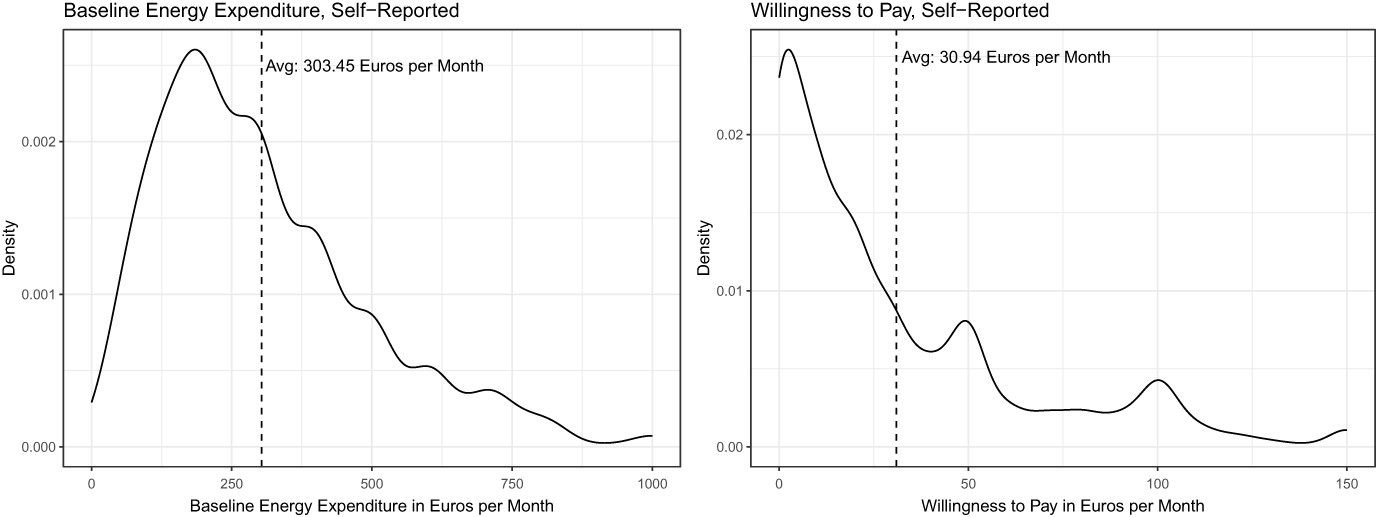
What monthly increase in energy prices are respondents willing to tolerate in return for sanctions against Russia? Figure 2 displays density plots summarising the marginal distribution of reported baseline energy expenditures (left) and reported WTP from all WTP tasks (right). On average, respondents report spending slightly more than 300 euros per month on energy. Average WTP across all tasks was just over 30 euros per month, indicating that on average, respondents were willing to accept a 10% increase in monthly energy costs in return for sanctions against Russia.Footnote 16
Density Plots for Baseline Energy Expenditure and WTP

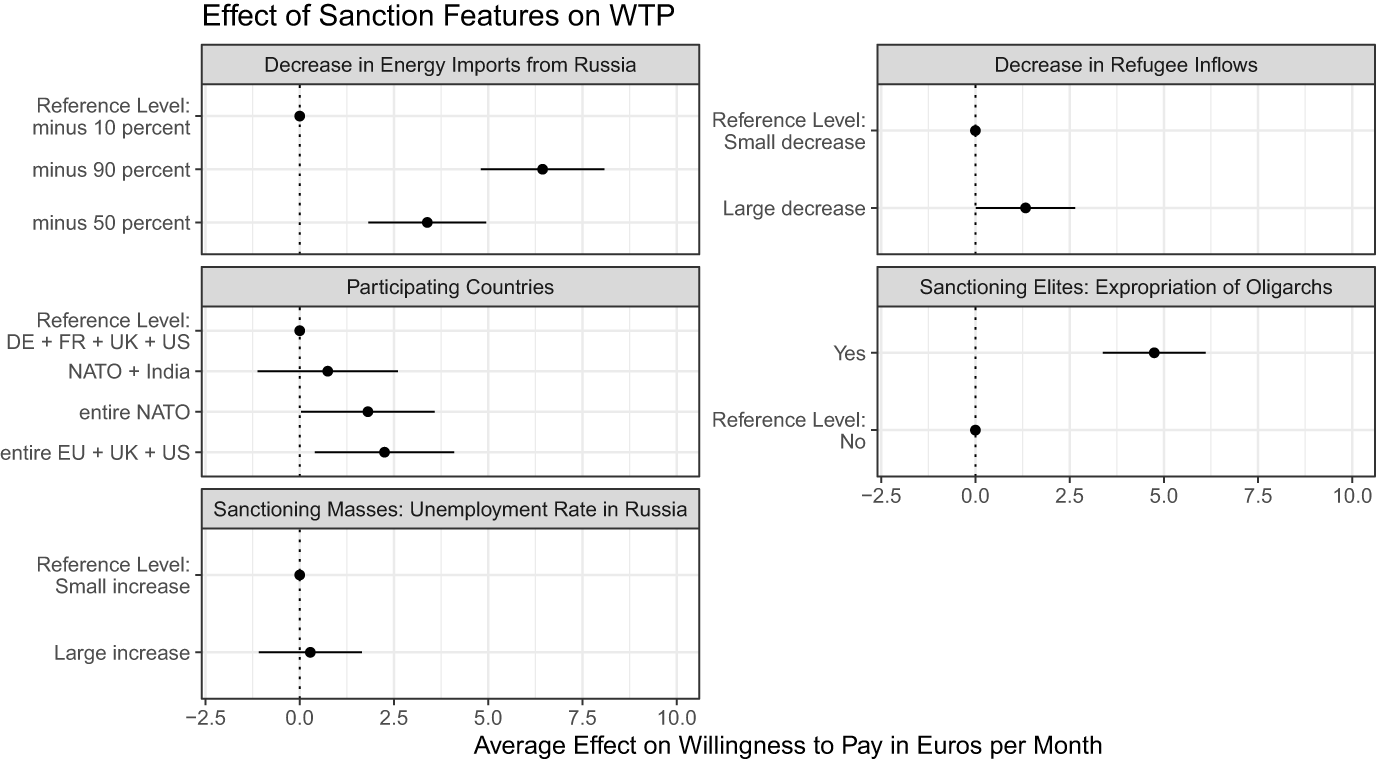
How does variation in sanctions features affect the average WTP? Figure 3 displays the AMCE estimates of sanction features on respondents’ WTP. The dots show point estimates relative to the reference level of each attribute, with the error bars indicating 95% confidence intervals.
AMCEs of Sanction Features on WTP

First, respondents are willing to pay more for sanctions packages that are more effective at reducing dependency on Russian fossil fuels. On average, respondents are willing to pay an additional 3.38 euros per month for a sanctions package which reduces fossil fuel imports by 50% rather than only 10%. A sanctions package that reduces fossil fuel imports by 90% rather than only 10% increases average WTP by more than 6 euros per month.
Second, respondents value targeting elites through measures such as the expropriation of foreign-held assets highly. On average, WTP increases by 4.74 euros per month when sanctions packages make provisions for targeting autocratic elites.
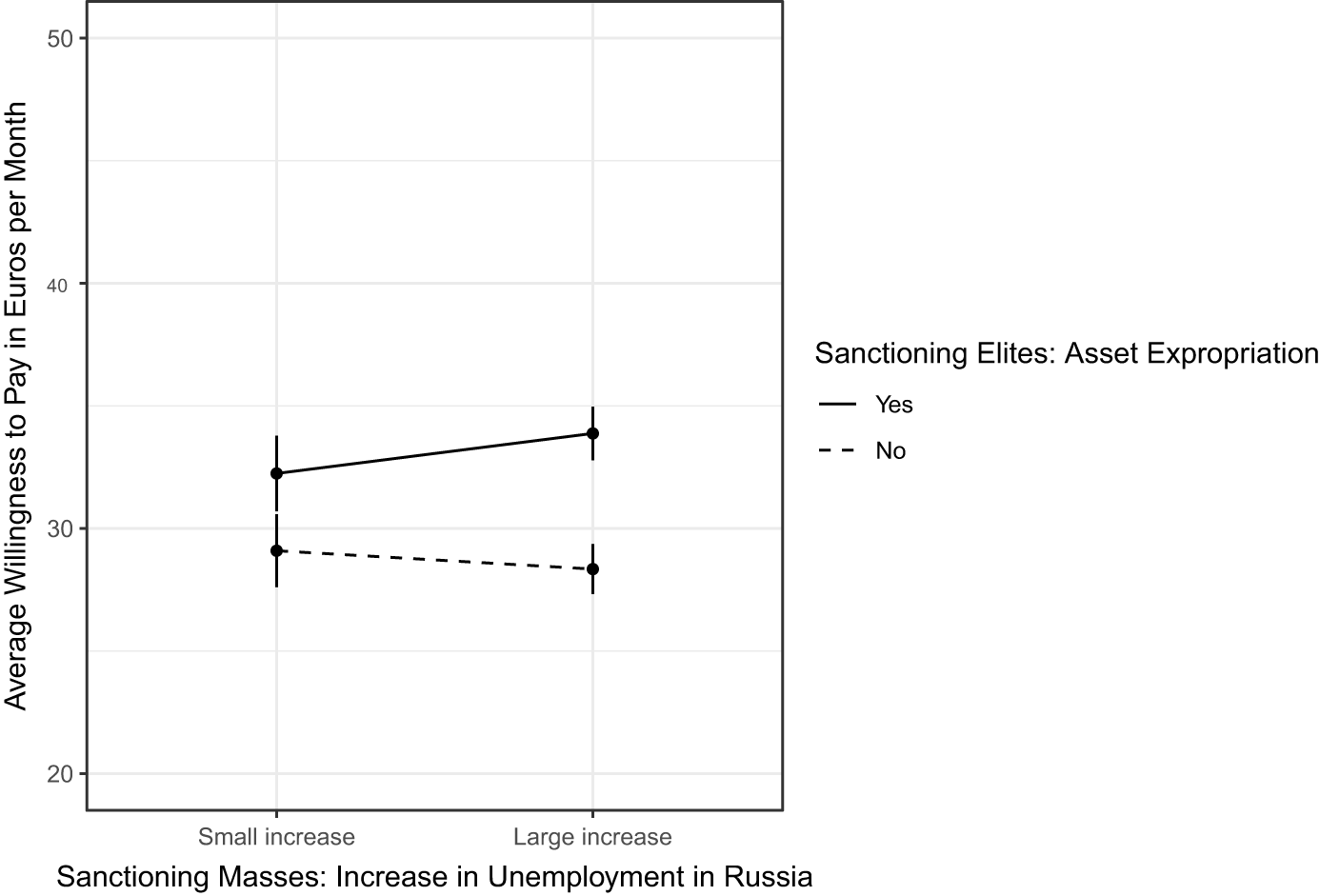
Crucially, as hypothesised, the effect of greater targeting of the general population on WTP is conditional on targeting the autocratic elites. Figure 4 displays marginal means for WTP as a function of the economic pain inflicted on the general population in the target country, proxied by its unemployment rate. To investigate whether or not the effect of targeting the general population is conditional on targeting the autocratic elite, the plot shows marginal means separately for sanctions packages which target elites (solid line) and sanctions packages which do not target elites (dashed line). The results confirm our expectations. When sanctioning parties do not make provisions for targeting elites, inflicting greater pain on the general population reduces WTP by an estimated 0.80 euros per month on average. On the other hand, when elites are targeted by sanctions, inflicting greater pain on the general population increases WTP by 1.48 euros per month on average. The estimated difference in effects of 2.28 euros per month on average is statistically significant at the 10% level.Footnote 17 German citizens are thus on average conditionally humanitarian.
Average WTP as a Function of Oligarch Expropriation and Target Country Unemployment

Anecdotal evidence supports the notion that democratic publics consider a trade-off between humanitarian and effectiveness concerns and are sensitive to the distinction between elites and the mass public in autocratic target states when reflecting on sanctions policy. In 1990, the United Nations, acting in concert with the US, imposed comprehensive economic sanctions on Iraq in response to its invasion of Kuwait. When those sanctions were found to have led to a dramatic degradation of the living standards of the broader Iraqi population, causing increases in malnutrition, child mortality and the spread of infectious diseases, public uproar forced the Clinton Administration to introduce humanitarian exemptions through the so-called Oil-for-Food Programme (Gordon Reference Gordon2010). Public backlash against the sanctions was amplified by the perception that sanctions were hitting vulnerable populations within Iraq the hardest, while the Iraqi dictator Saddam Hussein and his domestic allies were sheltered from their adverse effects. A particularly outraged observer noted that ‘sanctions haven’t exactly crippled Saddam, but they’ve put the Iraqi people through hell’.Footnote 18
In light of the Iraq experience, targeted or ‘smart’ sanctions aimed at autocratic elites have gained popularity. Even so, democratic policymakers still enact sanctions that hit broader populations in autocratic target states. Examining the evolution of recent EU sanctions regimes against Iran, Syria and Russia, scholars have shown that EU sanctions initially target autocratic elites. Subsequently, their scope is broadened to include measures that affect the general population (Meissner and Graziani Reference Meissner and Graziani2023; Moret Reference Moret2015). Our theory may explain this sequencing of sanction imposition: the initial targeting of autocratic elites serves to shore up support among the European public, which allows policymakers to later broaden the scope of coercive measures.
Scholars have noted that sanctions packages targeting the general populations in target states without making provisions for the targeting of elites have become relatively rare in recent years (Felbermayr et al. Reference Felbermayr, Morgan, Syropoulos and Yotov2025: 180–181). Yet even when sender state governments intend to target autocratic elites, those intentions may not translate successfully into policy. One concern is that targeted individuals may find ways to visibly evade sanctions. Another is that certain financial sanctions against specific individuals may be vulnerable to court challenges, as they come into conflict with the protection of property rights. For example, a high-profile ruling by the EU General Court handed down in March 2023 struck down sanctions against a family member of the now deceased Yevgeni Prigozhin, a former ally and close confidant of Vladimir Putin, over his involvement in the Russian invasion of Ukraine.Footnote 19 This ruling raised the possibility that autocratic elites may circumvent sanctions with ease by transferring assets to family members. In sum, even when sanctions are formally designed to constrain autocratic elites, publics may not perceive them to be effective when there is clear evidence of evasion.
Discussion
Our findings have implications for democratic policymakers who seek to devise effective and politically viable sanctions policies targeting autocracies, as well as for scholars interested in understanding democratic public opinion on foreign policy. Our main finding is that punishing autocratic elites is crucial to maintaining public support for sanctions. Targeting autocratic elites increases support for sanctions generally, and is especially important for maintaining support when sanctions inflict broader economic pain on the general population in target countries. We contend that this is because democratic publics are conditionally humanitarian. The prospect of autocratic policy concessions, which depends critically on sanctions targeting autocratic elites, makes democratic publics willing to inflict broad economic pain on the general population of target states despite adverse humanitarian consequences.
We believe that important conclusions follow from our findings. Most critically, autocratic elites visibly escaping sanctions because of loopholes in the sanctions regulations or through evasion enabled by third countries weakens the resolve of democratic publics to uphold costly sanctions policies. Concerns about sanctions evasion have been prominent in the context of the Russian invasion of Ukraine. Sanctions against pivotal individuals have been challenged in court, jeopardising the effective targeting of autocratic elites. Similarly, countries with important trading and financial ties to Russia have repeatedly been accused of failing to close legal loopholes which enable elites with close ties to Putin to circumvent sanctions.Footnote 20 Our findings suggest that learning about sanctions evasion by target country elites may weaken the willingness of democratic publics to uphold sanctions, in particular when sanctions are seen to inflict economic pain more broadly in the autocratic target country. The implication for policymakers is that sanctions circumvention is highly problematic. In order to maintain public support for costly sanctions policies, policymakers should work to ensure compliance with sanctions regimes and close loopholes that allow target state elites to evade sanctions.
Our findings also underscore the need for further research on the determinants of public preferences on sanctions in sender states. Sanctions are a crucial policy tool for democratic countries seeking to uphold international law in an era where democracy faces important international challenges. In particular, future scholarship should investigate how preferences for sanctions among democratic publics are affected by perceptions of popular support for autocratic policymaking. Not all autocratic policies are imposed on an apathetic and politically passive population – some may receive genuine and widespread support. How signals of popular support for autocratic policies in target countries affect public opinion in democratic sender countries, or even how perceptions of autocratic policymaking vary with the ‘type’ of autocracy (Gandhi Reference Gandhi2008; Svolik Reference Svolik2012), is a critical question that merits further scholarly inquiry.
Supplementary material
The supplementary material for this article can be found at https://doi.org/10.1017/gov.2026.10040.
Data availability
Replication data and code for the article are available on OSF at: https://osf.io/6h2eu/files.
Acknowledgements
The authors are grateful to Sarah Bush and Ricky Clark, as well as the anonymous reviewers and editors, for helpful feedback.
Disclosure statement
The authors report that there are no competing interests to declare.



 Open access

