

1. Introduction
Engineering has historically focused on developing technological solutions to meet societal needs through science, mathematics, and innovation, often evolving alongside advances in military technologies and infrastructure (Reference Herrmann, Hauschild and MativengaHerrmann et al., 2025). Traditionally, these developments have supported a paradigm of continuous economic and material growth, powered by fossil fuels (Reference Pineda, Abou-Hayt and LindeburgPineda et al., n.d.; Reference RileyRiley, 2012). While this growth has improved living standards and supported population expansion, it has also produced severe environmental consequences and deepened inequalities in the distribution of natural resources (Reference RøpkeRøpke, 2019).
The sustainability agenda calls for a radical transformation of this paradigm (Reference Randers, Rockström, Stoknes, Goluke, Collste, Cornell and DongesRanders et al., 2019; Reference Sachs, Schmidt-Traub, Mazzucato, Messner, Nakicenovic and RockströmSachs et al., 2019), requiring critical reflection on the structures that created current crises and innovative approaches to new systems, technologies, and practices (Reference Pineda, Abou-Hayt and LindeburgPineda et al., 2023). Design engineering programmes hold particular potential to educate future engineers as change agents for sustainable development (Reference CeschinCeschin, 2014). Their interdisciplinary nature -integrating natural sciences, social sciences, and design -provides precisely the foundation needed to develop solutions that can enable systemic transformation toward absolute sustainability (Reference Hauschild, Kara and RøpkeHauschild et al., 2020; Reference JørgensenJørgensen, 2012).
However, a mismatch exists between this interdisciplinary approach -which characterizes the overall profile of the programmes -and the teaching that takes place in the classical technical subjects. Despite this potential, and despite students’ growing demand to work with sustainability as a fundamental value principle, the technical core subjects remain anchored in a paradigm shaped by economic growth, efficiency, and military application as dominant objectives (Reference RileyRiley, 2012). Teaching in these subjects is therefore often based on theories, methods, and examples that no longer reflect contemporary societal challenges or the urgent need for a sustainable transformation. This raises a crucial question: how can traditional technical engineering courses be rethought and renewed to better support the development of sustainability-oriented competencies and a more holistic ideal for engineering education?
For this analysis, five Danish design and engineering programmes were selected based on the following criteria: they must all offer bachelor’s or professional bachelor’s degrees, have a focus on design, and to varying degrees identify themselves as programmes that actively engage with sustainability.
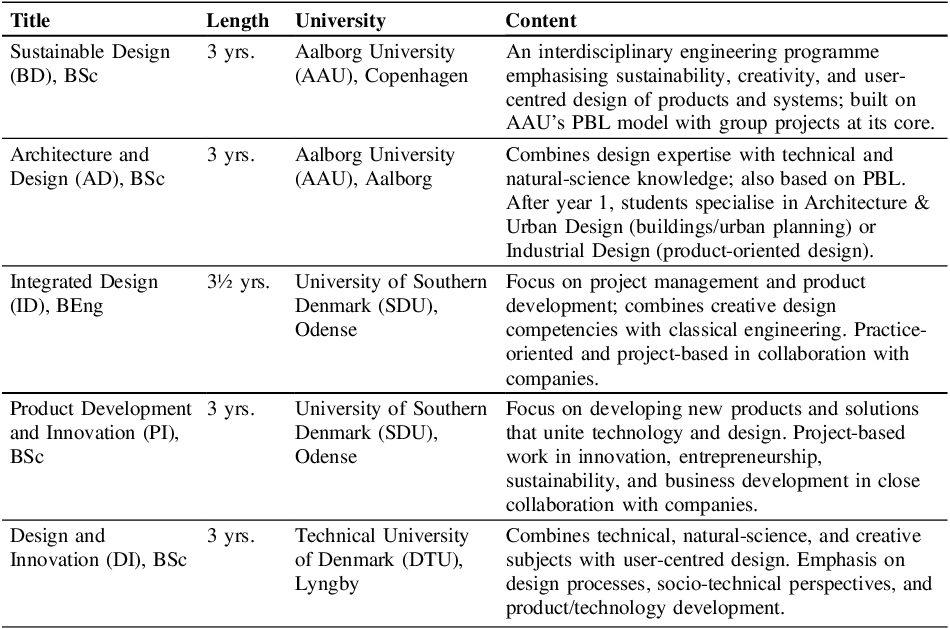
We focused on bachelor’s programmes because this is where engineering students begin to form their professional identity, which is further developed at master’s level. We argue that sustainability should be embedded early, alongside the core technical foundations established in the bachelor’s curriculum and that this is compatible with strengthening design competencies. We selected design engineering programmes because they extend beyond only problem analysis but also translating sustainability considerations into tangible material and systemic outcomes through the design of products, services, infrastructures, and systems. The selected programmes are: Sustainable Design (BSc) and Architecture and Design (BSc) -both at Aalborg University (AAU) in Copenhagen campus and Aalborg campus -as well as Integrated Design (BEng) and Product Development and Innovation (BSc) at the University of Southern Denmark (SDU), and Design and Innovation (BSc) at the Technical University of Denmark (DTU) (Table 1).
Program overview

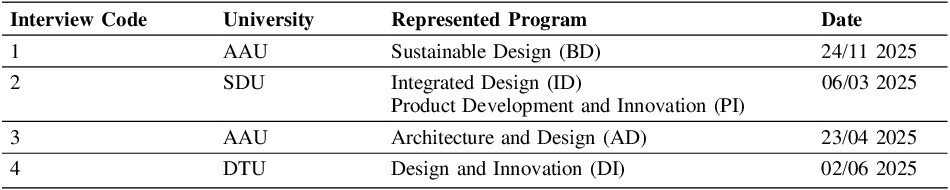
The first step was to analyse each programme’s explicit and implicit understanding of sustainability. This analysis is based on the programme’s individual curriculum and course descriptions on their websites, from which relevant points provide the foundation for interviews with key stakeholders such as teachers and program coordinators from each programme (Table 2). By supplementing the explicit written descriptions and approaches to sustainability found in the programme’s documents with the insights gained through interviews, we obtain a deeper and more realistic picture of how sustainability is understood and practised in each programme, as well as the challenges they face in this process. The interviews are summarised in the table below and will be referenced using the following interview code:
Interviews conducted and their code

Following this analysis, we examine whether this understanding of sustainability is also reflected in the technical courses. This is done through curriculum analysis and interviews with key individuals involved in the programme’s development.
Our hypothesis is that, in general, there is absent or minimal alignment between the programme’s overall understanding of sustainability and the content taught within the classical technical courses. As this assumption is confirmed, we intend to propose recommendations to foster better synergy between the programme’s understanding of sustainability and the teaching in its technical engineering courses.
2. Understanding and implementation of the concept of sustainability in Danish design engineering programmes
Across the programmes’ written descriptions, online and in their curricula, it is indicated that they interpret sustainability as a holistic concept -not merely environmental impact, but the interplay between environmental, economic, and social aspects, as in the triple bottom line (Reference ElkingtonElkington, 1998):
AAU, BD: “Sustainability in a broad sense is the focal point of the programme, which means it covers environmental, social, and economic aspects of sustainable design challenges” (aau.dk, n.d.).
AAU, AD (Skills): “Must be able to select, include, and integrate the most pertinent sustainability perspectives and building regulations in the design process, including explaining the relationships between engineering, architecture, city, technology, environment/climate, human, and society” (aau.dk , n.d.-b).
SDU, PI (Skills): “Be able to work professionally with sustainable balance from the perspectives of economy, environment, and social relations” (sdu.dk, n.d).
DTU, DI: “As an educational institution, DTU has established a charter that promises students pursuing an engineering education will be equipped to make a ‘sustainable difference.’ This charter embodies a three-pillar understanding of sustainability, emphasizing the importance of environmental, economic, and social aspects” (dtu.dk , n.d.-b).
The only programme that does not explicitly describe a tripartite understanding of sustainability in its formal descriptions is ID at SDU. However, in the interview conducted with the programme coordinator, this approach was still emphasized:
“The only place where we really articulate it is in a course called Design for Sustainability, where we try to show the diversity and complexity inherent in sustainability. The students also find it a rather ‘fluffy’ subject because we do not say: ‘Sustainability is precisely this.’ We say there are many pathways into sustainability. It’s about people, about the economy, and about the planet -i.e., CO₂ emissions, environmental pollution, and the like” (2).
This suggests that SDU likewise works from a tripartite understanding. At the same time, the quote indicates that this holistic approach can feel intangible to students, as sustainability appears as a complex concept without a single, clear definition. Another challenge with this tripartite model is expressed by the programme coordinator for BD at AAU: “Unfortunately, I don’t believe we are adequately addressing all three aspects of sustainability in our courses. While we do have a specific focus on different parts of sustainability, it varies by semester” (1). This statement indicates a desire for the programme to teach all three aspects equally, but this has proven difficult in practice. Currently at AAU, the model is to assign weight to one or two dimensions each semester. In the first semester, social sustainability is central (e.g., designing play equipment for a municipality as part of the semester project). In the second semester, the focus shifts to environmental sustainability, addressing product lifetime and involving a sustainable redesign of a technical product. In later semesters, different courses each represent one or more parts of the tripartition: Co-design (social), Sustainable Materials (environmental), Sustainable Business Models (economic and environmental), and Circular Economy and Value Chains (economic and environmental). The coordinator notes that even though practice often emphasises one or two dimensions at a time, students are encouraged to integrate all three aspects in their interdisciplinary semester projects.
According to Reference Giddings, Hopwood and O’BrienGiddings et al. (2002), a natural consequence of using a so-called ‘three-ring sector view’ like the triple bottom line model is that certain dimensions will often receive greater priority than others: “If they are seen as separate, as the model implies, different perspectives can, and often do, give greater priority to one or the other” (p. 189). In the triple bottom line model, the three dimensions appear as separate but equal spheres, which can create an illusion of balance even though they are often treated independently in practice. When attention shifts between individual dimensions rather than uniting them in an integrated analytical framework, the risk is that sustainability is understood as a set of separate themes rather than a coherent system.
Across the five programmes, there is likewise a tendency to emphasise one dimension over the others. Among the selected design engineering programmes, the environmental theme appears to dominate: students are encouraged to adopt life-cycle approaches to buildings, products, and systems, and in several programmes, courses on MEKA analysis and life-cycle assessment focus primarily on resource use and environmental impacts, sometimes touching on social aspects like labelling and working conditions. A related approach that focuses more on the economic dimension is circular economy. This understanding -which combines environmental concerns with a business-oriented logic -is explicitly included in courses for several of the programmes, including SDU, AAU, and DTU. It can therefore be said to represent a widespread understanding of sustainability in Danish design engineering education, where attention centres on environmental and resource efficiency coupled with a business perspective.
That said, the five programmes also incorporate the social dimension to varying degrees, particularly through attention to the users of the products, buildings, or systems designed. In a design and engineering context, social sustainability can be understood as developing solutions that support human well-being and social justice, for instance by promoting accessibility, usability, and the inclusion of diverse user groups in the design process. At AAU BD, the social dimension is emphasised with a design starting point that “also includes less visible aspects, like human well-being” (aau.dk, 2023). Likewise, the “social function” is highlighted as central in AAU AD, where architecture’s role in creating meaningful, quality-of-life-enhancing environments is stressed (aau.dk, n.d.-a). Both DTU DI and AAU BD also reflect this social approach by highlighting users with special needs -for example, people with disabilities -as a group students learn to design for, illustrating how social concerns, including greater equity, are incorporated (aau.dk, n.d.-b; dtu.dk,n.d.-a).
User-oriented design is a recurring theme at AAU BD, SDU ID, and SDU PI. Here, the social and environmental dimensions are linked to a deep understanding of users’ needs and experiences. The assumption is that meaningful, functional products that users find relevant and valuable are more likely to be used and kept for longer (Reference Bocken, De Pauw, Bakker and Van Der GrintenBocken et al., 2016).
Another approach to a holistic understanding of sustainability is the socio-technical perspective, emphasised in DTU DI, AAU BD, and SDU ID. Working from a socio-technical perspective means focusing on how technologies are developed and operate within socially structured systems. This perspective integrates economic, environmental, and social considerations -from ownership structures and material choices to use, meaning, and embedding in everyday practices (Reference GeelsGeels, 2005). This is stated explicitly in several programme descriptions. DTU notes, for example, that “sustainability is generally understood as an integral aspect of the socio-technical design process, emphasizing the interdependence between technologies and social actors” (dtu.dk, n.d.-a). Similarly, SDU writes that “the PDI programme places a strong focus on socio-technical transformations and systemic thinking, particularly in advancing a sustainable and circular social model. This perspective acknowledges that sustainability operates on multiple scales and must therefore be approached holistically” (sdu.dk, n.d.-a, n.d.-b). AAU BD likewise emphasises that students should achieve “an understanding of concepts and theory that can be used for socio-material analysis… and how products and technologies can be seen as socio-material entities whose properties are defined by the relations they enter into” (1).
DTU as a university -and thus the DI programme -appears to understand technology as a central driver in a sustainable transition. This is evident in programme descriptions highlighting that it “includes a principle called ‘technologies for everybody,’ emphasizing the critical role technology plays in achieving sustainability” (DTU, n.d.). This understanding contrasts with that of DTU’s Centre for Absolute Sustainability, which takes a more critical view of technology’s role. The centre states that it “cautions against unrealistic expectations of rapid technological advancement and underscores the importance of a systemic understanding of problems and solutions to support a strategic approach to sustainable transition” (DTU Centre for Absolute Sustainability, n.d.). This tension illustrates two different approaches within technical-design programmes: a technological optimism that sees innovation as the key to solutions, and a system-critical view that regards sustainable development as a complex interaction demanding new, radical technological, social, political, and structural approaches -a view familiar from sustainable transition theory and aligned with socio-technical work (Reference GeelsGeels, 2002).
Notably, in the four programmes that do not carry ‘sustainability’ in the title, sustainability increasingly appears to be treated as an implicit given rather than an explicit focus. At AAU AD, for example, the coordinator describes sustainability as more of a “rule of thumb” (3), while at DTU DI it is referred to during syllabus formulation as a “hygiene factor” (4) -an underlying condition expected to be present but not a separate focal point. Similarly, SDU notes that they no longer teach the UN Sustainable Development Goals directly, even though they remain in the curriculum (2).
3. Integration of sustainability understanding in traditional technical courses
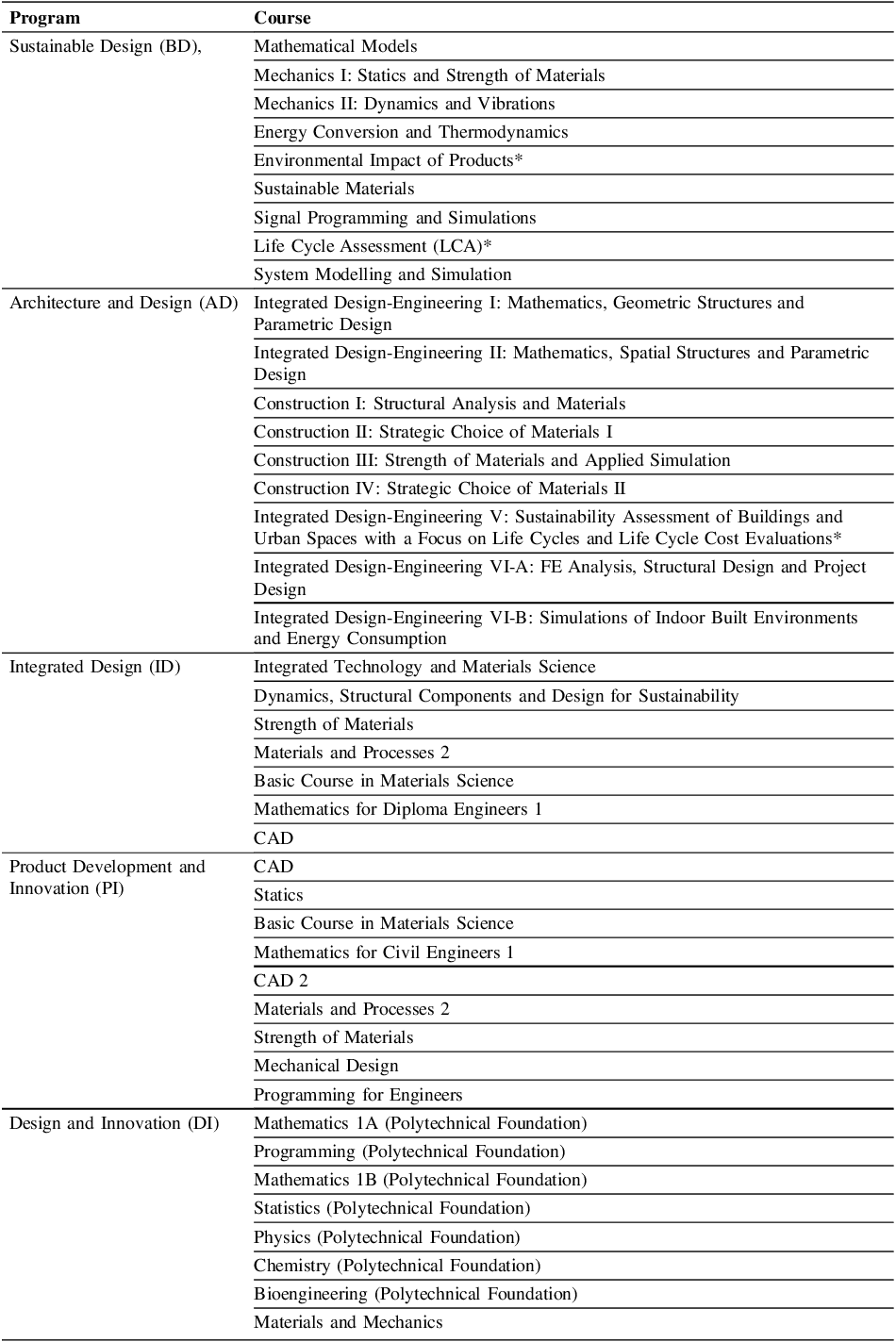
A traditional technical course or engineering science course can be defined as a foundational, discipline-specific element of engineering education that emphasizes the scientific and mathematical principles underlying engineering practice, typically taught through theoretical and analytical methods with limited contextual integration (Reference Crawley, Malmqvist, Östlund, Brodeur and EdströmCrawley et al., 2014). The complete list of identified courses is:
An overview of the courses identified as technical engineering courses in this study

The three courses marked with * are new technical courses that concentrate on environmentalimpacts, life cycle analysis, and its applications. These address environmental sustainability as a core element. These courses are outside the scope of this article.
In the interviews with programme representatives, the technical subjects -especially thermodynamics and fluid mechanics -often appear disconnected from the rest of the programme and thus from the overarching understanding of sustainability. A representative from SDU notes, “It would be a very separate course. Personally, I’d rather integrate it” (2), expressing a desire to connect the technical subjects more closely with other parts of the programme. A similar concern is raised at DTU, where the Polytechnical Foundation -a series of mandatory courses for all engineering students -has, according to one representative, “made our education look more like a standard DTU education” (4). This reflects a broader tension in engineering education: while common technical foundations promote consistency, they risk diluting programme-specific identity and weakening the interdisciplinary connections that characterise design engineering.
Thermodynamics and fluid mechanics are primarily represented in AAU BD and DTU DI (Table 3), likely reflecting these programmes’ stronger system-oriented emphasis on design and technology, where energy-related technical competencies are central. By contrast, SDU PI, SDU ID, and AAU AD appear more product- and construction-oriented, placing greater emphasis on materials and strength of materials than on energy systems. At SDU, thermodynamics has been merged into the course Dynamics, Structural Components, and Design for Sustainability, which focuses mainly on life cycle thinking, and circular economy, while the sustainability element remains relatively minor. Other subjects, such as strength of materials, mathematics, and mechanics, are still taught from a classical perspective with little explicit reference to sustainability, according to their curricula (aau.dk, n.d.-a; sdu.dk, n.d.-a, n.d.-b).
At AAU BD, the most direct link between thermodynamics and sustainability is found. In the course; Energy Transformation and Thermodynamics, students must “use energy models and thermodynamics as an element in assessing the sustainability of energy systems” (aau.dk, 2023).
At DTU DI, however, sustainability appears more as an overarching goal, but it is not explicitly integrated into the technical foundation subjects included in the university’s polytechnical foundation (mathematics, physics, chemistry, programming). These subjects are regarded primarily as technical building blocks. A representative from SDU makes a similar point, explaining that the technical subjects still reflect the programme’s original orientation toward conventional mechanical engineering (2). This historical legacy continues to shape teaching, where the subjects are seen as foundational rather than adapted to the programme’s current profile and understanding of sustainability.
In general, programmes are most successful in integrating sustainability within materials-related courses. At AAU BD, the course; Sustainable Materials teaches students to “seek out new knowledge about materials and assess its relevance in relation to problem-solving, CE requirements (circular economy), and sustainability” (aau.dk, 2023). At AAU AD, the curriculum emphasises that students should “be able to specify colours and material choices and assess the most significant environmental consequences thereof” (aau.dk, n.d.-a). In the interview with the representative from SDU (PI and ID), materials science is likewise highlighted as a central focal point for sustainability work: “We have materials science, materials and processes, where they must relate to the UN’s Sustainable Development Goals… what is sustainable plastic really -can you talk about sustainable plastic? What can be recycled in what ways?” (2). In this area, SDU better succeeds in aligning its understanding of sustainability -as defined by the SDGs and circular economy -with the technical elements of teaching.
Conversely, at DTU there is no explicit focus on sustainability in materials science; the emphasis is on the relationship between material choice, mechanical requirements, and geometric design (dtu.dk, n.d.-a). Whether sustainability is incorporated in actual teaching is unclear, but neither the study regulations nor interviews indicate this (4; dtu.dk, n.d.-a; dtu.dk, n.d.-b).
4. Reflections on the integration of sustainability and design within technical engineer courses
In summary, sustainability is only to a limited extent explicitly integrated into classical technical courses such as mathematics, statics, thermodynamics, and mechanics. AAU BD stands out by directly linking thermodynamics to the assessment of energy systems, whereas in the other programmes, sustainability is more commonly associated with materials science. Overall, the technical courses are regarded as fundamental knowledge areas in which a sustainability perspective is rarely made explicit in course descriptions or learning objectives. Consequently, sustainability within these subjects remains largely implicit, appearing primarily in individual courses and projects where technical analyses are applied to promote energy efficiency, material optimisation, and life-cycle thinking -but without connecting these practices to more traditional scientific foundations, such as thermodynamics, physics, and mechanics, or questioning the underlying paradigms of economic growth and technological centred solutions.
Whether this implicit embedding means that sustainability has become less significant is difficult to assess. One might argue that when sustainability is no longer articulated as a central concept or learning objective, it can create uncertainty among students about what sustainability concretely entails and what role it plays in future design and engineering solutions. Such a tacit approach risks diminishing students’ awareness of its importance precisely because it is treated as a given.
Based on the empirical material collected, the integration of sustainability and design in the technical courses appears minimal. This can be explained by several structural and pedagogical factors. First, in administrative terms, most technical courses are service courses provided by other departments -typically Mechanical Engineering or Energy Engineering -where the content is only marginally adjusted when offered to Design Engineering students. As a result, courses such as; Thermodynamics are conceived for other types of specialists, often focusing on large-scale systems like power plants and combustion engines. Design Engineering students working with smaller-scale or consumer products (e.g., refrigerators, heat pumps, or electronic devices and home appliances) find limited relevance in such examples, even though these products also involve thermal processes.
Furthermore, design has largely disappeared from the traditional technical curriculum, despite being a core element of engineering practice (ENAEE, n.d.). Technical courses are often reduced to solving narrowly defined, idealised problems where students calculate specific variables using equations or tables. While efficient for large-scale teaching, this approach neglects key design skills such as measurement and dimensioning, both of which are essential for linking theory to real design contexts (Reference PinedaPineda, A.F.V., 2025). At DTU, the consolidation of technical courses into large joint modules further reinforces this problem, leaving little room for contextualisation or design-driven learning.
Sustainability is even more difficult to integrate for two main reasons. First, most instructors have been educated within a paradigm that pre-dates the sustainability agenda, where engineering success was measured in terms of efficiency and productivity rather than environmental or social outcomes. Second, the reliance on well-established textbooks for reasons of pedagogy and cost-efficiency perpetuates outdated examples and unsustainable focus areas. For instance, the world’s most used thermodynamics textbook (Reference Çengel, Cimbala and GhajarÇengel et al., 2022) still includes exercises using the refrigerant R134a -now being phased out globally due to its negative environmental impact -illustrating the persistence of outdated teaching material. Although some courses have introduced short lectures or elective modules on CO₂ emissions, these additions remain marginal and are rarely connected to the core theoretical content. Consequently, sustainability often appears as a superficial add-on rather than an integrated analytical perspective.
There is, however, clear potential to address this challenge by reintroducing both design and sustainability thinking into technical education. To do so requires a shift in pedagogy -from abstract, idealised calculations to exercises that involve estimating and measuring real variables to inform design decisions. This would mean supplementing, or at times abandoning, the “safe space” of traditional textbook exercises in favour of problem-based approaches that align with the engineer’s fundamental identity as a designer and real problem-solver.
Equally important is to reaffirm in all technical courses that engineering concerns the design and improvement of systems, not merely components. Such a focus naturally aligns with a stronger conception of sustainability, understood not as three separate pillars but as the creation of technological systems where environmental, social, and economic considerations are integrated more holistically and coherently as core design values (Reference Sachs, Schmidt-Traub, Mazzucato, Messner, Nakicenovic and RockströmSachs et al., 2019; Reference Randers, Rockström, Stoknes, Goluke, Collste, Cornell and DongesRanders et al., 2019). This implies questioning the traditional simplifications accepted in engineering education and explicitly discussing the assumptions and risks involved in defining system boundaries.
Where possible, direct thematic couplings between technical and sustainability topics should be established. For example, in thermodynamics, the concepts of open and closed systems could be illustrated using Earth as a case study: Is Earth an open or closed system? Does entropy increase or decrease? Why? Similarly, CO₂ capture -an inherently thermodynamic process involving phase change -offers a meaningful, sustainability-related example that simultaneously deepens understanding of fundamental principles. Such linkages demonstrate that integrating sustainability does not dilute technical rigour; rather, it enhances it by situating core concepts within real, pressing global challenges.
Finally, bringing design and sustainability back into technical courses would strengthen the identity of engineers as agents of change working toward sustainable transformation -an updated version of the ideal of engineering in service of humanity. This pedagogical shift requires moving away from viewing idealised models such as the Carnot or Rankine cycles as ends in themselves and instead using them as analytical tools for comparing and improving real-world solutions. As Riley (2002) suggests, for students to see the relevance of a course like thermodynamics in addressing design and sustainability challenges, it is essential to teach them to engage, analyse, reflect, and change -iteratively linking technical analysis to reflection and practical application. Through such an approach, technical education can once again serve as a catalyst for creative, critical, and sustainability-oriented engineering practice.
5. Conclusion
Across the analysed design engineering programs, sustainability and design are approached in distinct ways. At AAU Architecture and Design, the curriculum places strong emphasis on materials and strength calculations, linking these technical skills to a sustainability agenda by training students to make durable and environmentally responsible choices in mainly material choice and construction work. At DTU Design and Innovation, the focus lies mainly on technology development for sustainability - on designing technologies that enable people and users to access sustainable solutions.
At SDU, the programmes Integrated Design and Product Development and Innovation adopt a product- and business-oriented approach. Here, sustainability is understood primarily in relation to innovation, resource efficiency, and material choice, often framed through a combination of business and environmental interests. In contrast, AAU Sustainable Design operates with a broader conceptualization of sustainability. In the late semesters, students engage with sustainable system design and socio-technical perspectives, which position sustainability as a more complex interaction between social, technical, and environmental systems. Similar socio-technical perspectives are also emphasized at DTU and SDU, ideally equipping students to nurture a systemic approach and conceive of design within socially structured systems that integrate economic, environmental, and social considerations.
Across all five programs, these three dimensions of sustainability -social, environmental, and economicare represented, though to varying extents. The social dimension appears primarily through a user-oriented approach in which human well-being, behaviour, and everyday practices are central design considerations. This is also reflected in projects focusing on vulnerable groups such as children or people with disabilities at DTU and AAU BD. The economic dimension at AAU BD is addressed through courses on sustainable business models and circular economy, while at SDU it appears in the integration of economic and environmental perspectives in product development. The environmental dimension is the most dominant, likely because it offers tangible, quantifiable methods-such as life-cycle assessment (LCA), MEKA-analysis, and calculations of material and energy optimization -that align closely with the analytical traditions of engineering practice. Despite efforts to integrate several dimensions of sustainability, representatives from the programs still acknowledge that they do not adequately address all three. Achieving balanced integration remains both difficult and essential. Developing robust design proposals requires moving beyond simplified interpretations of sustainability -whether this focus solely on reducing CO₂ emissions (environmental), addressing marginalised user groups (social), or developing green technologies to support economic growth (economic). Instead, sustainability must be understood as a set of interconnected and mutually dependent dimensions, where changes in one aspect inevitably affect the others. Only by acknowledging and integrating this interdependence is it possible to develop truly comprehensive and genuinely sustainable solutions.
As for the technical courses, they appear largely disconnected from the rest of the programs -and thus from their sustainability agenda. Several dynamics contribute to this disconnection. Historically, many of these courses were developed at a time when sustainability was not yet a concern, and the teaching practices have to some extent remained unchanged. Many instructors were educated in a period dominated by conventional engineering with focus on technologies -such as combustion engines and refrigeration systems -which are then sometimes reproduced in today’s lectures. Moreover, technical courses are often viewed as fundamental prerequisites for becoming an engineer. At DTU, for instance, the Polytechnical Foundation (see Section 3) -has made education more standardised and less tailored to design-specific contexts. These courses are also frequently taught in large lecture halls covering diverse cohorts of students, relying on established textbooks for cost-efficiency. Consequently, design and sustainability are rarely addressed explicitly, reinforcing a perception among students that the technical courses are irrelevant to their professional identity as design engineers with interest in sustainability. As a result, students often engage with these subjects instrumentally seeing them as hurdles to overcome rather than as valuable sources of insight for sustainable design decision-making (Reference RileyRiley’s, 2012).
To strengthen the connection between the technical courses and the programmers’ sustainability and design agendas, we proposed three actions:
-
1. Modernise teaching materials and pedagogical approaches: Update technical courses by replacing outdated textbooks and examples with contemporary sustainability challenges and technologies (e.g., renewable energy, CO₂ capture, sustainable refrigerants). Implement active and iterative learning models such as Reference RileyRiley’s (2012) Engage → Analyse → Reflect → Change, encouraging students to link technical analysis to reflection and action.
-
2. Contextualise technical learning through design-oriented examples: Adapt exercises in thermodynamics, mechanics, and related subjects to design-relevant contexts where students measure, estimate, and evaluate real variables to make informed design decisions. Teach classical models (e.g., Carnot and Rankine cycles) as analytical tools for improving real-world systems and use them to critically discuss system boundaries and sustainability implications.
-
3. Embed sustainability as a core learning outcome and professional value: Integrate sustainability competencies -such as life cycle thinking, resource efficiency, and systems understanding -into all technical courses as explicit learning objectives. Reaffirm the engineer’s professional identity as an agent of sustainable change, working toward technological systems that serve humanity and support long-term environmental and social well-being. Although life cycle is considered in separated courses in some educations, this does not mean that it should be absent from the rest of the technical courses.
In conclusion, the challenge is not merely to teach sustainability as a topic, but to embed it meaningfully within the technical and analytical foundations of engineering education. Only by bridging design, sustainability, and engineering science can programmes equip graduates with the capabilities needed to navigate the complex transitions required for a sustainable future.
Acknowledgement
This contribution is part of the project Engineering Sciences for Sustainability, funded by Poul Due Jensen Foundation (Grant No. 224700). We would also like to thank the representatives from Aalborg University, the Technical University of Denmark (DTU), and the University of Southern Denmark (SDU) for generously sharing their insights into the five programmes examined in this research.

 Open access

