


Beginning in the 1970s, “corporatism” came to be a major focus of attention in research on Latin America.Footnote 1 Analysts employed the concept to characterize a pattern of interest group politics that was monopolistic, hierarchically ordered, and structured by the state. The concept commanded great scholarly attention, as it seemed to provide a valuable analytical tool for scholars concerned with the authoritarian regimes emerging in Latin America during this period. In addition, the understanding of political relationships suggested by this concept appeared to offer a useful alternative, or at least an important supplement, to the pluralist models widely used in the US. Hence, corporatism was subject to much theoretical debate, and the concept was applied in many empirical studies.
This chapter explores the trajectory of corporatism as a concept in the Latin American field. The analysis is based on the premise that scholars should occasionally step back and take stock of the major concepts with which they work. In any area of research, new concepts may initially be embraced with great enthusiasm and, at times, with unrealistic expectations about the degree of insight they will provide. Subsequently, these concepts may be relegated to the domain of outmoded ideas, sometimes with considerable loss of learning and neglect of accumulated knowledge. In the face of this potential problem, it is useful periodically to assess both the evolution and the contributions of particular concepts.
The first two sections of this chapter focus on the body of literature that treated corporatism as a form of interest group politics. The opening section explores the overall contribution of the concept and the shared empirical understanding of corporatism that emerged. The second section considers refinements introduced in the literature. They include efforts to situate corporatism both in relation to the overarching concept, of which it may be seen as a specific type, and also in relation to parallel concepts, such as clientelism, concertation, consociationalism, pluralism, monism, and syndicalism. Attention then turns to the more fine-grained understanding that was achieved through identifying subtypes and elaborating dimensions of corporatism. Once the overall insight introduced by the concept became familiar, the further analytic contribution came, in important measure, from sharper differentiation of specific forms of corporatism as distinctive political phenomena. This section explores these further innovations, asking whether they helped to address issues of “conceptual stretching” that arose in this literature, and also whether they possibly contributed to a problem of “theoretical stretching.”
A final section discusses what may be called the normalization of the concept of corporatism and the partial erosion of corporative practices that occurred in the 1980s and 1990s in many Latin American countries, as well as seeking to draw some concluding lessons regarding the overall trajectory of this concept.
Emergence of the Concept: Corporative Forms of Interest Group Politics
The concept of corporatism began to attract wide attention in the Latin American field in the first half of the 1970s.Footnote 2 Writers such as Robert J. Alexander and Charles W. Anderson had previously made passing reference to the corporative character of state–group relations (Alexander Reference Alexander1962: 59; Anderson Reference Anderson1967: 55). Likewise, authors such as Richard M. Morse had described a Latin American tradition of hierarchical, state-centric authority relations that has much in common with some conceptions of corporatism, although Morse did not use this label (Morse Reference Morse and Hartz1964: 176). However, it was Philippe Schmitter (Reference Schmitter1971) who first placed corporatism centrally on the intellectual agenda with his book Interest Conflict and Political Change in Brazil. He explored the corporative policies toward interest groups introduced in Brazil under Getúlio Vargas in the 1930s and the early 1940s, focusing on the elaborate system that emerged for creating, structuring, subsidizing, and controlling these groups. Although the Vargas administration fell in 1945, Schmitter argued that the corporative policies of that period had “struck deeper roots” and that corporatism had become a fundamental feature of Brazilian interest politics (Schmitter Reference Schmitter1971: 127). Hence, anyone attempting to analyze the Brazilian political system needed to come to grips with this legacy.
Corporatism soon became a common theme in the Latin American field.Footnote 3 As scholars attempted to deal analytically with the authoritarian regimes that came to power in the 1960s, the concept offered a valuable new perspective for understanding the antidemocratic political relationships that were increasingly prevalent in the region. Within this framework, analysts focused attention on monopolistic, hierarchically structured patterns of interest group politics. These patterns were generally the product of a strong state role in sponsoring the formation of groups, granting them a monopoly of representation, shaping their internal organization, controlling or at least influencing their demand making, and channeling their interaction with public institutions and with one another. Through such initiatives, actors within the state sought to “harmonize” relations among groups, classes, and sectors, although this harmony often entailed a strong bias in favor of some groups and against others.
Scholars who studied group politics from the perspective of corporatism also addressed the misgivings shared by many analysts about employing a pluralist perspective, which emphasized the free competition of autonomously organized groups.Footnote 4 Periodic expressions of pluralism are unquestionably an important feature of Latin American politics: for instance, the efforts initiated “from below” to constitute or reconstitute social and political groups and to organize new efforts at protest and demand making. Yet the central role of the state in structuring group politics has been reflected in the recurring tendency over many decades for new groups and new demands to be subordinated to state-regulated networks of group representation and state-established frameworks for demand making. By calling attention to this tendency toward subordination and state regulation, the concept of corporatism yielded new insight.
Definition and Conceptualization of Corporatism
Within the literature on corporative patterns of interest group politics, a basic set of shared understandings emerged. In terms of formal definitions, the most widely cited was that of Schmitter:
Corporatism can be defined as a system of interest representation in which the constituent units are organized into a limited number of singular, compulsory, noncompetitive, hierarchically ordered and functionally differentiated categories, recognized or licensed (if not created) by the state and granted a deliberate representational monopoly within their respective categories in exchange for observing certain controls on their selection of leaders and articulation of demands and supports.
He thus pinpointed the dynamic that is the lynchpin of corporatism – “in exchange for” – and also provided a valuable checklist of accompanying attributes.
Other scholars had their own, slightly different, “checklist” definitions.Footnote 5 Notwithstanding some differences in emphasis, a rough consensus developed regarding the constellation of attributes within the sphere of group politics on which attention should focus. These attributes can be organized under three broad headings – structuring, subsidy, and control – with specific corporative provisions fitting under each: (1) the structuring of representation, involving the official recognition of groups, which were organized into well-defined functional categories and enjoyed a monopoly of representation within their respective categories; (2) the subsidy of groups, which could occur through direct state subvention and, especially in the case of labor unions, through mechanisms that provided for compulsory membership and that facilitated dues collection; and (3) state control over leadership, demand making, finances, and internal governance.Footnote 6
A broader conceptual understanding of the relationship among these three sets of attributes also emerged, an understanding that can be summarized by the idea of concepts that inherently involve “conflicting imperatives.” These concepts “entail a dynamic tension among contradictory goals, priorities, and motivations” (Gould Reference Gould1999: 439). Gould explored the role of conflicting imperatives in the concepts formulated by Max Weber, Hanna Pitkin, and several other scholars. For example, in his conceptualization of rational-legal authority, Weber was concerned with two imperatives that may well have been in conflict: the standardization of authority around rules, and the role of expertise in decision-making (443). Gould also discussed corporatism as an example of conflicting imperatives (448–52).
Looking at the analysis of corporatism by the authors under discussion here, we see that the idea of conflicting imperatives was indeed important. Stepan, in his analysis of this power relationship between groups and the state, argued that the possibility of an imbalance in this relationship was a “generic predicament” of corporatism.Footnote 7 On the one hand, power may have shifted toward the state to such a degree that corporatism was transformed into a system of state domination of groups. On the other hand, power may have shifted toward the groups to such a degree that central coordination, an essential attribute of corporatism, was either lost or was fundamentally weakened. One finds a basic tension between these two underlying components.
The source of this fundamental tension was discussed by other scholars as well. Schmitter’s definition stipulated that the advantages bestowed by both structuring and subsidy were granted “in exchange for” the acceptance of state control. This exchange could be a source of dynamic tension in the evolution of corporatism. In parallel, Ruth Berins Collier and David Collier (Reference Collier and Collier1979) maintained that corporatist political relationships entailed an interaction between “inducements” and “constraints.” Structuring and subsidy represented organizational benefits (inducements) for the groups and their leaders, in exchange for which they accepted the controls (constraints) associated with corporatism. In order for a genuine exchange to occur, the state must actively seek to control, or at least strongly influence, the groups. Yet the groups must have sufficient autonomy that their leaders had a realistic choice in accepting the initiatives of the state.
In a subsequent study focused specifically on the labor movement, the expression “dual dilemma” was used by Collier and Collier (Reference Collier and Collier1991: 783) to summarize the choices, on the part of both the state and the unions, about the form of state–labor relations. Each alternative presented both advantages and pitfalls, and hence the dilemma. On the side of the state, the dilemma was between the option of controlling the labor movement versus seeking to mobilize labor support. On the side of the labor movement, it was between cooperating with the state versus resisting such cooperation in order to maintain greater autonomy, as well as the choice between entering versus abstaining from the sphere of partisan politics.
A key further conceptual point should be added. The argument that corporatism should be treated as a well-bounded concept was virtually absent in the literature. This stands in striking contrast – for example – with the treatment of “democracy” in the literature that began to emerge in the 1980s,Footnote 8 where one finds strong concern with specifying the defining attributes that made it appropriate to consider a given case democratic. For example, a widely cited article was entitled “What democracy is … and is not” (Schmitter and Karl Reference Schmitter and Karl1991), and another article had the subtitle “Conceptualizing and measuring democracy and non-democracy” (Møller and Skaaning Reference Møller and Skaaning2010). Titles such as these were not in evidence in the corporatism literature, and the term was applied to a wide spectrum of cases that were only partially corporative.
One option here would be to view corporatism as an ideal type – or perhaps more simply a “rare type.” To reiterate the criteria used earlier, it would be a type characterized by a balance in power relations between groups and the state, and by a genuine exchange in group–state interaction. Yet in many real world cases this did not occur, and a great many – indeed, most cases – should be treated as “diminished” instances of full corporatism. This contrast between the appraisal of democracy versus corporatism certainly derives from the exceptionally positive valence of democracy in this literature, which led to strong scholarly concern with which cases received this designation. Corporatism was sometimes viewed with strong approval or disapproval, given the identification with fascism, but this did not result in a scholarly concern with establishing a threshold above which cases were designated as corporative.
These issues prove to be important in the discussion of subtypes that follows.
Shared Empirical Understanding
In conjunction with this conceptualization of corporative forms of group politics, one found in the literature a shared empirical understanding of corporatism in Latin America. Although sharply bounded definitions did not emerge, there was substantial consensus on the range of attributes that should be analyzed as components of corporatism. Obviously, further insights emerged as more research was carried out, yet a significant degree of common understanding could be identified roughly by the time of the publication in 1977 of James M. Malloy’s benchmark edited volume, Authoritarianism and Corporatism in Latin America. Key elements of this perspective are outlined here, several of which are drawn from chapters in that book.
First, although many specific corporative provisions had been found in Latin America, the literature did not presume the existence of full-blown corporative systems. No country provided for well-institutionalized mediation among labor, business, and the state at the pinnacle of the corporative system, for example in a formal corporative “chamber.” However, the region had seen unsuccessful attempts to establish such mediation, and scholars had identified some partial approximations (Stevens Reference Stevens and Malloy1977: 253). Even Brazil, with its elaborately developed corporative system, did not allow for an overarching labor confederation. Consequently, Kenneth P. Erickson described the corporative system for organized labor in Brazil as a “truncated pyramid” (Reference Erickson1977: 42),Footnote 9 and at this peak level, actors in the state sought to control worker politics not through corporative mechanisms for channeling worker organization, but through the noncorporative mechanism of preventing such organization. A quite different departure from a full corporative model was found in cases where a political party, closely linked to a corporatively organized labor movement, was banned from the political arena. This pattern was a fundamental feature of Argentine and Peruvian politics in the late 1950s and the 1960s.
Another feature that might be viewed as an element of a full-blown classical model of corporatism in Latin America was rare indeed: nonpeak organizations that combined labor and business. One of the few instances in which such organizations appeared was in Peru in the post-1968 period. The Peruvian government established “industrial communities” in which workers were to play an important role in the management of enterprises, thus creating a “classless corporative structure” (Chaplin Reference Chaplin and Chaplin1976: 19, 22). Yet the initiative failed, and this form of organization was not a significant feature of Latin American corporatism.
A second part of the shared empirical understanding involved an issue of gradations. This was the recognition among scholars that such a large set of defining attributes would not always be present in any particular instance. Schmitter’s book on Brazil was based on an extreme case. Scholars did not assume that other Latin American countries had as fully developed a corporative system as Brazil. Thus, in relation to the multi-trait definitions such as those discussed earlier, it was recognized that these traits were present to varying degrees and in different combinations. Collier and Collier suggest that this recognition helps avoid “an excessively narrow conception of corporatism as a phenomenon that is either present or absent, and views it instead as a dimension (or, potentially, a set of dimensions…) along which cases may be arrayed” (Reference Collier, Collier and Malloy1977: 493).
The experience with corporatism was heterogeneous in other respects as well. For example, specific features of corporatism could be implemented in very different ways. In the sphere of labor unions, compulsory membership and monopoly of representation were sometimes established directly. But sometimes they were established indirectly, through complex provisions that provided partial approximations of this aspect of corporatism. Further, although these provisions were typically established by law, not surprisingly, major variations emerged in actual practice (Collier and Collier Reference Collier, Collier and Malloy1977: 495, 502). Finally, at an early point scholars observed that major differences in the corporative structuring of groups sometimes emerged in different geographic regions within a given country (Oclander Reference Oclander and Ciria1972).
A third element in the shared understanding was emphasized in Guillermo O’Donnell’s analysis of the “segmentary” character of corporatism, involving its differing meaning and consequences for distinct social classes. He argued that in Latin America, the role of corporative structures in shaping worker organizations was far more direct and coercive than for business organizations (O’Donnell Reference O’Donnell and Malloy1977: 49). In addition, elaborating on an observation made earlier by Schmitter (Reference Schmitter1971: 162), O’Donnell argued that business interests could often exercise informal power both inside and outside the state to such a degree that corporative structures may have been far less constraining for them than for the working class (O’Donnell Reference O’Donnell and Malloy1977: 71, 73). Other authors in the Malloy volume, focusing on Mexico and Colombia, reached the same conclusion (Bailey Reference Bailey and Malloy1977: 282–83; Purcell and Purcell Reference Purcell, Purcell and Malloy1977: 194).
Although the corporative structuring of business politics was important in some time periods and in some countries, corporatism in Latin America was far less central to understanding business politics than worker politics. Indeed, labor law in most countries consisted, in important measure, of a complex network of provisions for structuring, subsidizing, and controlling the labor movement. In that sense, state–labor relations in Latin America had been markedly corporative for many decades (Collier and Collier Reference Collier, Collier and Malloy1977: 494–95).Footnote 10 Correspondingly, a central focus in research on corporatism was on its implications for organized labor. It seemed likely that corporatism would not have been viewed as such an important phenomenon were it not for the obvious importance of corporative provisions for the functioning of the labor movement.
Finally, along with the recognition of the incomplete character of the corporative structuring of group politics, one found the insistence that its incomplete character was to be expected. Linn Hammergren warned against confusing “the master plans of political organizers and would-be institution builders” with the reality of day-to-day politics, and she pointed to the long history in Latin America of noncompliance with the law and with mandates of the state (Hammergren Reference Hammergren1977: 444, 449). Douglas Chalmers and Alberto Ciria likewise emphasized that major changes in regime, such as those associated with the implementation of corporatism, had far less impact than is sometimes believed. Features of the national political regime and the structure of political groups, which may initially seem to be crucial attributes of a country’s politics, were often soon eroded (Chalmers Reference Chalmers and Malloy1977: 28–29; Ciria Reference Ciria1978: 211–13).
Correspondingly, a significant degree of caution was reflected in many of the early analyses of corporatism. At the time of the rapid spread of scholarly interest in this topic, for example, perhaps the most dramatic new corporative policies in the region were those of the post-1968 military government in Peru. Yet, in an analysis initially written at the height of the military reforms, Malloy insisted that “there is no guarantee that the Peruvian military will continue in the corporatist direction or that it will be successful in imposing a new system of [corporative] political economy in Peru” (Malloy Reference Malloy1974: 84).
At certain points, however, the warnings ran in the other direction, against the problem of underestimating the impact of corporatism. Schmitter referred to this problem when he observed that scholars who analyzed pluralism and democracy in Brazil between 1945 and 1964 were at times insufficiently attentive to the legacy of the corporatist experience of the 1930s and 1940s (Schmitter Reference Schmitter1971: 127–28). Whereas some scholars interpreted the post-1964 military regime in Brazil as a “fundamental restructuring of the polity” (Cardoso Reference Cardoso and Stepan1973: 142), Schmitter disagreed and saw the post-1964 experience as “restorationist,” in that it was marked by attempts to further consolidate earlier corporative structures (Schmitter Reference Schmitter and Stepan1973: 185–86).
To conclude this section, it may be argued that although Latin America had not experienced corporatism in its full-blown, classical form, corporatism was a central feature of group politics in specific sectors, time periods, and countries. The shared scholarly recognition of this centrality was essential to understanding the concept’s ongoing importance in the literature.
Refinement and Differentiation of the Concept
Looking beyond this basic formulation, a series of refinements and modifications played an important role in the evolving literature on corporatism. The following discussion focuses first on (1) shifts in the overarching concept, of which corporatism was understood to be a specific type. Next, it examines (2) insights at the level of the “root concept,” i.e., corporatism,Footnote 11 involving, for example, its relationship to concepts such as clientelism and consociationalism. Finally, attention turns (3) to subtypes of corporatism.
Shifting the Overarching Concept
Some of the innovations that emerged in discussions of corporatism concerned the overarching concept, of which corporatism is a particular type (Figure 3.1). One of these refinements arose from a clearer recognition of what is entailed in a corporative, as opposed to a pluralist, form of group politics. Schmitter (Reference Schmitter1974, 93) had initially defined corporatism as a mode of “interest representation.”
Initial version of conceptual hierarchy.
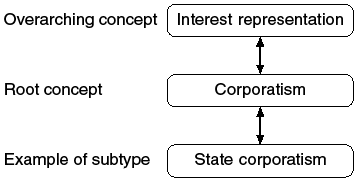
However, corporatively structured groups in Latin America did not simply represent societal actors vis-à-vis the state. Rather, they often stood in an intermediate position between society and the state. Owing to corporative structuring and subsidy, the state was involved in the formation of these groups, and in important respects the groups were controlled by the state. Schmitter suggested that, given this intermediate status of the corporatively structured groups, the generic phenomenon of which corporatism was a specific instance could be more adequately characterized as “interest intermediation” (Schmitter Reference Schmitter1977: 35–36n1) (Figure 3.2).
Shifting the overarching concept: recognizing bidirectional power relations between groups and the state.

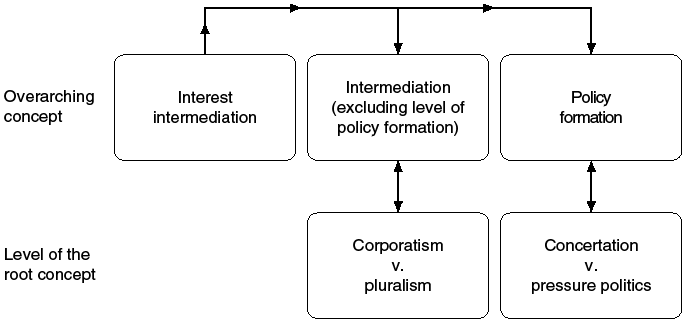
Another innovation at the level of the overarching concept derived from the increasing use in the 1980s of the term “concertation,” which partially overlapped with the standard meaning of corporatism. A characteristic definition treated concertation as “a mechanism for establishing policy alternatives, encompassing the participation of labor and capital, based on sustained cooperation between these actors and the government” (De Riz, Cavarozzi, and Feldman Reference De Riz, Cavarozzi and Feldman1987: 7).Footnote 12 Thus, concertation included the overarching process of forming social pacts and shaping public policy at the pinnacle of organized labor, organized business, and the state, which traditionally had been viewed as a central feature of corporatism. Another central feature was the organization and structuring of the groups themselves. Schmitter suggested that one option would be to use subscripts and to label the structuring of groups as “corporatism1,” and this overarching process of policy mediation as “corporatism2” (Schmitter Reference Schmitter, Lehmbruch and Schmitter1982: 262–63).
Instead, Schmitter accommodated the idea of concertation by proposing a narrower meaning of corporatism that excluded policy mediation.Footnote 13 In this more limited version, corporatism was a principal form of interest intermediation, in the more limited sense of a mode of organizing and structuring groups. An alternative form of interest intermediation was pluralism. As shown in Figure 3.3, concertation was understood as a form of policy formation, another principal form being pressure politics (Schmitter Reference Schmitter, Lehmbruch and Schmitter1982). Here again, the concept of corporatism was refined by modifying the overarching concept of which it was an instance. In this instance, the modification was accomplished by differentiating two separate hierarchies of concepts.
Differentiating the overarching concept: accommodating the concept of concertation.
Differentiating at the Level of the Root Concept
Scholars who sought to elucidate the meaning of corporatism also clarified its relationship to other “neighboring” concepts. For example, the relationship to concepts such as clientelism and consociationalism was analyzed in terms of the institutional site of exchange and accommodation, involving the varied role of individuals, groups, and parties (Table 3.1). This issue was central, for example, to the distinction between corporatism and clientelism. Robert R. Kaufman suggested that both concepts entail “relationships of domination and subordination,” but with regard to the institutional site, corporatism was a mode of authority relations among groups, whereas clientelism was a mode of authority relations among individuals. This difference in institutional site was closely associated with a difference in form. Whereas corporatism tended to be more legalistic and bureaucratic, clientelism was personalistic and often more fluid (Kaufman Reference Kaufman and Malloy1977: 113).
| Institutional Site | Concept |
|---|---|
| Individual relationships | Clientelism |
| Interest groups | Corporatism |
| Political parties | Consociationalism |
The issue of institutional site also arose in the comparison of corporatism and consociationalism. Jonathan Hartlyn argued that both are modes of conflict limitation that commonly emerged as an elite response to a perceived crisis; both sought to establish a noncompetitive process of decision-making, and “in both there is a tension between elite accords and the ability of these elites to carry along their mass following” (Hartlyn Reference Hartlyn1988: 244; see also p. 3). However, with corporatism these arrangements involved interest groups, whereas with consociationalism they commonly encompassed political parties.
A further issue concerned the relationship of corporatism to other forms of interest group politics. Schmitter proposed a typology of these relationships, in which distinctions concerning the degree of competitiveness and the locus of power played a central role (Table 3.2). Building on his own definition of corporatism quoted earlier, characterized by a noncompetitive system of groups that to varying degrees were subject to state control, Schmitter constructed a series of parallel definitions. Pluralism entailed the free and competitive formation of groups that were subject to little external control; monism referred to the noncompetitive mode in which groups were dominated by a single party or party/state;Footnote 14 and syndicalism was understood as a system of noncompetitive, unregulated, nonhierarchically organized groups characterized by autonomy and self-governance. Schmitter thus situated the debate in a much larger comparative and historical framework of alternative types of group intermediation.
| Power resides in | Competition | |
|---|---|---|
| Low | High | |
| Groups | Syndicalism | Pluralism |
| State (to varying degrees) | Corporatism | |
| Party or party/state | Monism | |
Subtypes
Another area of conceptual innovation was the creation of subtypes, and contrasts in the locus of power were again crucial here. Such contrasts were central, for example, in Schmitter’s (Reference Schmitter1974, 102–05) distinction between state and societal corporatism (see Table 3.3). Both were forms of group politics that tended to be monopolistic, and they were structurally similar in many ways. Yet the former was created and often imposed by the state and reflected state control over the corporatized groups. By contrast, societal corporatism emerged when some groups won out over others in a process of competition from below, allowing them to construct monopolistic, hierarchically structured channels of representation. Thus, some groups defeated or absorbed other groups with little or no involvement of the state.
| Labels | Author(s) | Political Relationships |
|---|---|---|
| Schmitter Lehmbruch | State imposes noncompetitive political relationships, versus noncompetitive relationships emerge as some groups win out over other groups. |
| Privatizing v. Statizing | O’Donnell | Groups penetrate and privatize a sector of the state, versus state penetrates and controls groups. |
| Inclusionary v. Exclusionary | O’Donnell; Stepan | State elite more dependent on support or acquiescence of corporatized groups, versus lesser or no dependence on their support or acquiescence. |
| Malloy Erickson | Greater state control over groups with a closed electoral arena, versus reduced state control with a competitive electoral arena. |
| Anarchic Corporatism (v. Corporatism) | O’Donnell | Power located exclusively in the corporatized groups, versus power also located in spheres that provide mediation among the groups. |
| Inducements v. Constraints | Collier and Collier | Inducements used by the state to win cooperation of groups, versus direct control over groups. |
Overall, to summarize the sharp contrast, with state corporatism the groups were “dependent and penetrated,” whereas with societal corporatism the groups were “autonomous and penetrative” (Schmitter Reference Schmitter1974: 103). The subtypes of state versus societal corporatism became a fundamental distinction in the literature, and in the field of West European studies they were paralleled by Gerhard Lehmbruch’s (Reference Lehmbruch, Schmitter and Lehmbruch1979: 53–54) distinction between authoritarian and liberal corporatism.
A somewhat different contrast was underscored in Guillermo O’Donnell’s subtypes of statizing and privatizing corporatism. Statizing corporatism entailed the penetration of groups by the state, and could therefore be understood as another term for state corporatism. In the case of privatizing corporatism, the groups penetrated the state, thereby placing certain arenas of the state and policy making under private control. The difference between O’Donnell’s conception of privatizing corporatism versus Schmitter’s conception of societal corporatism was that some groups that functioned in the framework of societal corporatism could succeed in privatizing an area of state policy in which they had a special interest, whereas others failed to do so. In this sense, privatizing corporatism was a specific outcome or type of societal corporatism. Given the dramatically different power relationships involved in statizing and privatizing corporatism, O’Donnell described corporatism as “bifrontal” (Reference O’Donnell and Malloy1977: 48, 64–77).Footnote 15
A further distinction concerning the locus of power pointed to variability in the significance of corporatism for the working class. O’Donnell had earlier defined as “inclusionary” those political systems in which leading actors within the state were more dependent on the support or acquiescence of the working class and deliberately enhanced its political power, or in which these state actors at least accommodated themselves to preexisting levels of worker mobilization and political power. This pattern contrasted with “exclusionary” systems, in which state policy was used to demobilize the working class and its organizations and to reduce its power (O’Donnell Reference O’Donnell1973: chap. 2). Stepan used this same distinction to generate subtypes of corporatism. On the one hand, the more prolabor variant of inclusionary corporatism, associated with mobilization of workers, the granting of major benefits, and increased political leverage for labor, was found, for example, in Argentina under Perón in the 1940s. On the other hand, the more antilabor variant of exclusionary corporatism, associated with the demobilization of labor and the deliberate curtailment of its political leverage, occurred under the post-1964 military government in Brazil (Stepan Reference Stepan1978, chap. 3). Again, what might superficially appear to have been similar corporative structures could have decidedly different political content.
Other scholars differentiated types of corporatism in light of the impact of an open versus closed electoral arena on the sphere of group politics. Thus, in his analysis of Brazil, Erickson (Reference Erickson1977: 2) distinguished between corporatism as a form of state–labor relations found under an authoritarian, closed electoral regime, and the “semi-corporative” pattern that characterized the Brazilian system of state–labor relations in the context of competitive electoral politics in the 1950s and 1960s. In a more general essay, Malloy (Reference Malloy and Malloy1977b: 4, 17) presented a closely related distinction between authoritarian corporatism and democratic corporatism.
Finally, O’Donnell (Reference O’Donnell1984: 18–19) proposed the subtype of “anarchic corporatism” to characterize cases, such as Argentina over many decades, where the locus of power was entirely in the corporatized groups, rather than in spheres that provided mediation among the groups. In this usage, corporatism, rather than being a system of interest “intermediation,” was a system of unmediated group power.
The analysis of underlying dimensions of inducements and constraints, noted briefly earlier, pushed the differentiation of corporatism still further. Collier and Collier suggested a new perspective for accommodating the fact that in different national contexts all the attributes identified in standard definitions of corporatism were not always present. Depending on the goals and power resources of both the policy makers who initiated corporatism and the groups toward which their policies were directed, different patterns of inducements and constraints emerged. These patterns shifted over time within the framework of an ongoing exchange, shaped by the changing goals and power capabilities of the relevant actors. This perspective underlined the interactive and changing character of corporatism. With regard to the contrast between societal and state corporatism, Collier and Collier (Reference Collier and Collier1979) found that the more prolabor variant of corporatism provided substantial inducements and more limited constraints; whereas the more antilabor variant linked the inducements to more extensive constraints.
A Further Look at the Subtypes
One of the concerns raised about the concept of corporatism was that it was used to encompass an excessively diverse range of political phenomena. To call attention to this diversity, Collier and Collier (Reference Collier, Collier and Malloy1977) entitled one of their articles “Who Does What, to Whom, and How: Toward a Comparative Analysis of Latin American Corporatism,” and in another article they raised the question of whether the concept “casts too broad a net to be useful” (Collier and Collier Reference Collier and Collier1979: 968). Parallel concerns arose outside the Latin American field as well.Footnote 16
These concerns pointed to two problems with the concept of corporatism. One problem was “conceptual stretching” (Sartori Reference Sartori1970), which arose when a concept is applied to cases that were not characterized by the full set of attributes understood as defining the concept. The second problem was that the idea of corporatism was applied so broadly that the apparent insight and analytic leverage associated with the concept were lost. This may be referred to as “theoretical stretching.” These issues will be addressed in turn.
Classical and Diminished Subtypes
This section takes a further look at subtypes as a means of exploring the issue of conceptual stretching, focusing on the distinction between “classical” and “diminished” subtypes.Footnote 17 With classical subtypes, the subtype is defined by the attributes of the root concept, plus additional attributes. Take the example of parliamentary democracy as a classical subtype in relation to the root concept of democracy. Parliamentary democracy is commonly understood as a full democracy, which has additional attributes that differentiate the subtype, involving a parliamentary form of legislative–executive relations.
With diminished subtypes, by contrast, from the set of attributes associated with the root concept, one or more are removed in defining the subtype. Hence, they are not full instances of the root concept; rather, they are diminished instances. An example is “illiberal democracy,” which would routinely be understood as having many features of democracy, yet civil liberties are attenuated.
In contrast to the concept of democracy, for which comparative researchers were strongly committed to formulating definitions that sharply bounded the concept (see earlier), with corporatism this did not occur. There was substantial agreement in the literature on a broad constellation of attributes that constituted the meaning of corporatism. However, scholars generally interpreted specific cases as being only partial approximations of this broad constellation. Given that sharp boundaries were not a central concern, analysts did not focus on which attributes were crucial to deciding whether specific cases were in fact instances of corporatism.
The distinction between state and societal corporatism provided a strong example of why these are diminished subtypes. Again, consider Schmitter’s characterization: With state corporatism, the groups were “dependent and penetrated”; with societal corporatism they were “autonomous and penetrative” (Schmitter Reference Schmitter1974: 103). For both subtypes, balance in the exchange relationship disappeared, although many elements of corporative structures definitely persisted.
Hence, these were indeed diminished subtypes, as were many of the other subtypes in this literature.
Conceptual Stretching and Theoretical Stretching
What difference did it make that many, if not all, of the subtypes of corporatism followed this diminished pattern? One important implication related to the problem of conceptual stretching. In some phases of the literature on corporatism, scholars became concerned that the concept was applied too broadly, in the sense that the full set of defining attributes of the concept were not present in the cases to which it was applied. Yet to the extent that we are dealing with diminished subtypes, the very idea of the subtype is that the cases to which it corresponds do not correspond to the root concept.Footnote 18 For example, as discussed earlier, the claim that a given case was an instance of societal corporatism was not a claim that it was fully corporative. Hence, concerns about conceptual stretching needed to be tempered by recognizing the meaning entailed in diminished subtypes.
Although diminished subtypes helped to avoid the problem of conceptual stretching, the problem of theoretical stretching might also arise. In terms of their larger theoretical significance, though not necessarily in terms of defining attributes, the diminished subtypes of corporatism could sometimes seem closer to other major concepts than to corporatism. Thus, O’Donnell’s privatizing corporatism might have less in common with the overall framework of corporatism than it did with the framework of “interest group liberalism” (Lowi Reference Lowi1969) – an expression used to characterize a pattern, within a nonpluralist system, in which one set of groups captured a given domain of public policy. Similarly, to the extent that corporatism evolved to become a system of pure constraints and virtually no inducements, it might more appropriately be understood as a system of repression, which might be seen as calling for the analytic framework of authoritarianism. Finally, a parallel issue arose in the literature on European corporatism, where it was argued that societal corporatism was more similar to pluralism than it was to other forms of corporatism (Martin Reference Martin1983: 86–102, see esp. pp. 98–102).Footnote 19
In sum, conceptual stretching was indeed sometimes avoided through the use of diminished subtypes. Yet it must be asked whether – more than occasionally – scholars were really making use of the larger framework of understanding surrounding the concept of corporatism, or whether this larger framework became less relevant to some of the subtypes.
Concluding Observations: Normalization of the Concept and Partial Erosion of Corporatism
Following the period of innovative work in the 1970s and 1980s, and carrying on into the 1990s, the Latin American field saw a decline in scholarly interest in corporatism, owing to a “normalization” of the concept, to a changing assessment of its importance, and to a partial erosion of the phenomenon itself. With regard to normalization, Clifford Geertz (Reference Geertz1973: 3) observed that after an initial phase of intellectual excitement sometimes generated by a new concept, it commonly becomes “part of our general stock of theoretical concepts.” This occurred in the case of corporatism, which as Wiarda emphasized, came to spark less scholarly excitement owing in part to the very familiarity of the concept and of the phenomena to which it referred (Reference Wiarda, Rustow and Paul Erikson1991: 41). In a few studies, the issues it raised remained a major theme.Footnote 20 In many other instances, the term was used with little or no elaboration to refer to the patterns of group politics discussed above.Footnote 21 Corporatism was treated as a familiar topic, not a subject of special analytic interest.
The concept may also have received less attention because, as noted earlier, attempts to establish structured policy mediation at the pinnacle of labor, business, and the state, which had previously been labeled as corporative, subsequently came to be called concertation, or sometimes social pacts. Such policy initiatives remained an important feature of Latin American politics; they simply had a different label.
The concept of corporatism was also less prominent in the literature because the phenomena to which it referred were in significant respects perceived as less important. For example, in the 1980s, scholars were confronted with dramatic episodes of democratization. Although some interest groups played a key role in the early phase of democratic openings, it has been argued that beyond this early phase, political parties became a far more important force in the effort to organize new forms of democratic politics. Hence, the sectors that had been among the most central in debates on corporatism came to be seen as playing a less critical political role.Footnote 22
Another aspect of the perceived decline in the importance of corporatism concerned the experience of the South American countries that had earlier generated some of the most extensive discussions of this topic. In the 1980s and early 1990s, these countries experienced a greater degree of political stability that might earlier have been hypothesized to be a potential outcome of corporatism.Footnote 23 In fact, this stability derived from other sources, including the deflation of developmental expectations that resulted from the economic crises of this period, particularly the debt crisis; the collapse of socialist models of development in other parts of the world; and the related erosion or reorientation of the political left. Further, in the countries that experienced bureaucratic authoritarianism (Argentina, Brazil, Chile, and Uruguay), an increased appreciation of democracy that grew out of the experience with authoritarian rule also played a critical role. For scholars concerned with explaining new patterns of stability and instability, these new forces, rather than corporatism, became the salient focus in the search for explanations.
Finally, basic changes had been occurring in public policies vis-à-vis interest group politics. Whereas in the 1960s and early 1970s some of the most important initiatives of national states in Latin America were conspicuously corporative, some of the most interesting subsequent initiatives were conspicuously noncorporative. One example is found in the second half of the 1980s in Peru. An important consequence of the policies of the post-1968 Velasco government had been to accelerate the erosion of traditional ties between organized labor and the Peruvian APRA Party. Subsequently, when APRA won the presidency in 1985, one political option was to employ new corporative initiatives in an attempt to regain influence in the labor movement. Yet President García’s efforts at support mobilization took a different direction, focusing to an important degree on the informal sector. This may in part have been a political response to the erosion of the formal sector within the economy and hence to the diminished political payoff of creating or renewing corporative linkages within the formal sector.
Another example was found in Chile, which prior to 1973 had a highly corporative system of labor relations. The post-1973 military government, after first dealing with the labor movement through severe repression, later pursued policies that combined less extensive repression with a more pluralistic framework for trade unions that abandoned many corporative provisions familiar from earlier Chilean labor law. In 1990, the new civilian government in Chile restored some of these provisions, but a return to the traditional Chilean system of highly corporative labor law seemed unlikely.
More broadly, Hector E. Schamis (Reference Schamis1991), in his examination of the experiences with bureaucratic authoritarianism, observed that whereas the cases in the 1960s (Brazil and Argentina) saw an important use of corporative structuring of labor, those of the 1970s (Chile, Argentina after 1976, and Uruguay) did not. It appeared that traditional corporative structures were seen by military rulers as inadequate for containing the far higher levels of popular mobilization in the 1970s, and hence labor policies were based on repression, rather than corporatism. In addition, Schamis argued that corporatism, even exclusionary state corporatism, was incompatible with the new market-oriented economic policies that call for a reduced state role in regulating the economy and social groups. Relatedly, for some proponents of the market-oriented growth strategies, state initiatives that defended the classic notion of the “right of combination” of workers were seen as interfering with the free market. Well-institutionalized labor movements, even if controlled from above, were viewed as introducing distortions in labor costs that could adversely affect economic growth (Foxley Reference Foxley1983: 193–94), and hence various forms of state protection for unions were modified and weakened.
Taking these trends together, it might be argued that Latin America’s experience with corporatism in the twentieth century would prove to have been a delimited historical episode.Footnote 24 This episode began with major periods of reform, state-building, and expansion of the state’s role in the economy that were launched, with varying timing among countries, during the first five decades of the twentieth century. Subsequent processes of liberalization and marketization were, and were intended to be, a profound break with this earlier statist tradition, and to a significant degree they were also a break with the corporative elements of this tradition.
Yet, just as the emergence of corporatism occurred with divergent timing and at a variegated pace in these countries, so its displacement by alternative patterns of state–group relations would occur in an uneven and variegated manner. Historical shifts of this magnitude rarely take place uniformly across countries, and the politics of the end of the twentieth century revolved in part around how, and how quickly, this shift was occurring. Corporative provisions remained central features of the legal structure and informal practice of group politics in Latin America. For example, despite important changes, in many countries substantial continuity was found in labor law, in the functioning of labor ministries, and in the actions of other state agencies involved in labor relations. The most striking case of the persistence of corporative relationships was certainly Mexico. In the face of repeated crises and challenges beginning in the late 1960s, and notwithstanding important shifts in the relation between the party and the labor movement, the traditional corporative features of the Mexican system remained a fundamental feature of national politics.
Further, Schmitter (Reference Schmitter1992a) argued that although interest groups might in some respects have been eclipsed during critical phases of the transition to democracy, they played a central role in influencing the kind of democracy that was established. He conceptualized democracy as being made up of five “partial regimes,” three of which – the “concertation regime,” the “pressure regime,” and the “representation regime” – were hypothesized to be critically influenced by the character of interest groups and their interaction with one another and with the state. If this hypothesis was correct, a detailed knowledge of the structure of interest intermediation, with its various corporative, noncorporative, or post-corporative features, remained critical to the larger understanding of national political regimes.
Finally, even if specific corporative provisions had been eroded in many contexts, concepts from the literature on corporatism continued to be relevant to the perennial issue of how new social groups and social movements related to the state. Whether one was concerned with workplace organizations, neighborhood associations, women’s groups, or other dimensions of associability, the interaction of these groups with the state remained crucial. The interplay between state initiatives that constituted inducements and those that imposed constraints on groups was crucial to this interaction. Likewise, the strategic choices made by the leaders of old and new groups in the face of these inducements and constraints – through which they established varying degrees and forms of involvement with, or independence from, the state – were still a central feature of group politics.
Apart from these substantive conclusions, a methodological observation may be added. It is a common lament that conceptual debates in the social sciences are confused and unproductive. By contrast, it is reasonable to conclude that the trajectory of “corporatism” encompassed serious attention to important conceptual issues, and also that analysis of this trajectory affords a good opportunity to examine these issues further. The issues include: how the idea of the concept initially crystallized; the framework of conflicting imperatives; whether scholars were centrally concerned with giving the concept sharp boundaries; innovation at different levels of conceptual hierarchies; classical versus diminished subtypes; and conceptual stretching versus theoretical stretching.
The literature on corporatism offers useful opportunities to examine such questions about concepts, which are important well beyond this specific topic.


 Open access