


The Confidential Enquiry into Maternal and Child Health (CEMACH) 2003-2005 Reference Lewis1 identified psychiatric illness as the third leading cause of maternal deaths, most commonly death by suicide. The well-known and tragic case of Dr Daksha Emson, a consultant psychiatrist with bipolar disorder who killed her 3-month-old daughter and died by suicide while suffering from puerperal psychosis, 2 highlighted another important finding. The suicide profile of childbearing women in the Confidential Enquiries Reference Lewis1,3 is different in many respects than that of other women and men. The majority of the women came from comfortable backgrounds, were in stable relationships and had partners who were in employment. Many had completed higher education and several had higher professional qualifications. Typically, their suicides were by violent means. Of the women who died by suicide, 64% had a previous history of psychiatric illness, but less than half of them had their past history correctly identified during pregnancy and only 20% had an adequate management plan put in place.
It is therefore useful to study the profile of women referred to a specialist perinatal mental health service in order to identify potential risk factors and indicate preventative interventions.
Method
The Glasgow Perinatal Mental Health Service was established in 2004 to provide in-patient mother and baby care to west Scotland (25 000 births per year) and community/maternity liaison services to the Greater Glasgow area (10 000 births per year). The service has approximately 50 admissions and several hundred community and maternity liaison referrals each year. The Greater Glasgow area includes all sociodemographic groups, but there is a high level of deprivation, unemployment and disability. The community service is provided by a small multidisciplinary team comprising psychiatric nurses, psychiatrists, a social worker and a nursery nurse.
A standardised new patient information form was devised to identify demographic information, referral sources, risk factors for postnatal mental illness, and prescribed and non-prescribed drug use in pregnancy and breastfeeding (Box 1; for full patient information form, see the online supplement).
Box 1. Patient information form
-
• Section1: Referral details
-
• Maternity hospital and consultant obstetrician
-
• Source of referral
-
• Location of assessment
-
-
• Section 2: Patient details
-
• Pregnancy status and estimated date of delivery
-
• Currently/intending to breastfeed
-
• Children less than 1 year old
-
-
• Section 3: Past psychiatric history
-
• Past psychiatric contact with GP or psychiatrist for both pregnancy and non-pregnancy-related issues
-
-
• Section 4: Substance use
-
• Details of substance use (smoking, alcohol, illicit drugs) both before and during pregnancy
-
-
• Section 5: Involvement of other professionals/services
-
• Professionals involved in care
-
-
• Section 6: ICD–10 diagnosis
-
• ICD–10 diagnosis at initial assessment
-
• ICD–10 diagnosis at discharge
-
-
• Section 7: Medication information
-
• Medication and dosage at conception/early pregnancy
-
• Medication and dosage at initial visit and subsequent visits
-
GP, general practitioner.
A time period of 1 year (1 April 2005–31 March 2006) was chosen to give a representative sample. A list of all new patients seen by the service during this period was obtained from the patient information management system database, a central computerised record of all patients, and the information on the patient information form was cross-checked against this database.
Of 277 new patients, 219 (79%) had forms with some sections incomplete. The data were audited and the information was subsequently analysed to provide a profile of patients seen by the service.
Results
Referral details
Most users were referred from maternity services (62%, 132/214) or by general practitioners (GPs) (21%, 46/214). Far fewer were referred from general psychiatric services by primary care mental health teams, social work or health visitors – in all, accounting for less than 16% of referrals in total. Most patients (75%, 151/202) were seen at the out-patient clinic, with 12% (25/202) on ante/postnatal wards. A further 11% (22/202) were seen at home for their initial assessment.
Patient characteristics
Of the patients seen, 81% (170/210) were pregnant at point of contact and 25% (49/196) had a child under 1 year. A small number of women, neither pregnant nor postnatal, were seen for pre-pregnancy counselling. Over half (54%, 95/177) intended to breastfeed.
Psychiatric history
Significantly, 59% of women (105/178) had previous non-pregnancy-related psychiatric contact; 26% (47/183) had previous psychiatric contact in relation to the perinatal period and 44% (79/181) had previous ante/postnatal contact for psychological treatment by their GP.
ICD–10 diagnosis
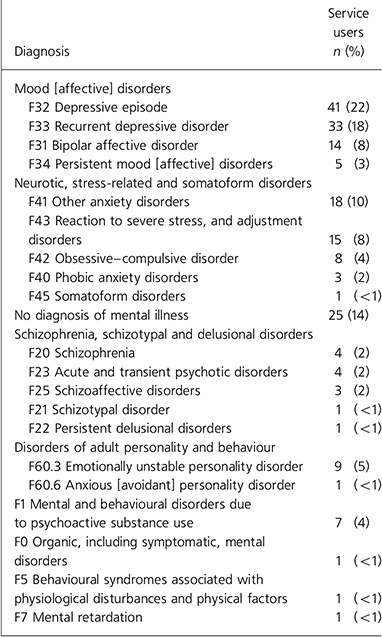
Perhaps unsurprisingly, 51% of women had an ICD–10 F3 diagnosis at initial assessment. 4 The majority had depressive disorder, but 8% had bipolar affective disorder. This was followed by F4 (25%), predominantly anxiety and adjustment disorders, and F2 (7%). Emotionally unstable personality disorder made up 5% of the total. Approximately one in seven women referred had no current mental illness (a full list of diagnoses in our sample group is given in Table 1).
ICD–10 diagnosis at initial assessment (n=183)
| Diagnosis | Service users n (%) |
|---|---|
| Mood [affective] disorders | |
| F32 Depressive episode | 41 (22) |
| F33 Recurrent depressive disorder | 33 (18) |
| F31 Bipolar affective disorder | 14 (8) |
| F34 Persistent mood [affective] disorders | 5 (3) |
| Neurotic, stress-related and somatoform disorders | |
| F41 Other anxiety disorders | 18 (10) |
| F43 Reaction to severe stress, and adjustment disorders | 15 (8) |
| F42 Obsessive—compulsive disorder | 8 (4) |
| F40 Phobic anxiety disorders | 3 (2) |
| F45 Somatoform disorders | 1 (<1) |
| No diagnosis of mental illness | 25 (14) |
| Schizophrenia, schizotypal and delusional disorders | |
| F20 Schizophrenia | 4 (2) |
| F23 Acute and transient psychotic disorders | 4 (2) |
| F25 Schizoaffective disorders | 3 (2) |
| F21 Schizotypal disorder | 1 (<1) |
| F22 Persistent delusional disorders | 1 (<1) |
| Disorders of adult personality and behaviour | |
| F60.3 Emotionally unstable personality disorder | 9 (5) |
| F60.6 Anxious [avoidant] personality disorder | 1 (<1) |
| F1 Mental and behavioural disorders due to psychoactive substance use | 7 (4) |
| F0 Organic, including symptomatic, mental disorders | 1 (<1) |
| F5 Behavioural syndromes associated with physiological disturbances and physical factors | 1 (<1) |
| F7 Mental retardation | 1 (<1) |
Substance use
With regards to smoking, there was a general increase in non-smokers during pregnancy from 64% (117/184) to 72% (126/176), but nearly a fifth continued to smoke over ten cigarettes per day. An overall reduction was also shown in alcohol consumption, with 85% (158/185) abstaining during pregnancy, although 13% (24/185) of women continued to consume up to 14 units per week. Despite the fact that the majority of women (93%, 173/187) did not use illicit drugs during pregnancy, there is some concern that 36% of those who did use them used multiple drugs. The most commonly misused drugs were cannabis (71%) and heroin (21%).
Medication
At time of conception, almost six in ten patients were on some form of medication. Around 10% discontinued medication on discovering the pregnancy. A total of 43% were on antidepressants at conception, most commonly selective serotonin reuptake inhibitors (SSRIs) (26%); 15% were taking antipsychotics and 4% anticonvulsants. The only class of medication with an increase in use between conception and initial visit (12%) was benzodiazepines.
Discussion
This study highlights many of the challenges in dealing with patients with mental illness related to childbirth. In particular, a significant proportion of women have a history of psychiatric illness, among whom are a group at particularly high risk of relapse, including 29% in our sample who have a recurrent mood disorder which places them at 1:2 to 1:3 risk of relapse. Reference Cohen, Altshuler, Harlow, Nonacs, Newport and Viguera5,Reference Robertson, Jones, Haque, Holder and Craddock6 Focusing on past psychiatric history is important in ensuring prompt and effective follow-up, prophylaxis and early intervention for women known to be at increased risk. 7-Reference Jones and Craddock9 In our study, most patients were seen during pregnancy (81%), allowing a real opportunity to identify risk factors and formulate postnatal care plans to reduce risk of relapse. This is especially pertinent as CEMACH (2003–2005) Reference Lewis1 found that 81% of deaths from psychiatric causes had a prior psychiatric history which, in a number of cases, could have been used as an indicator of high risk for postpartum relapse. Robertson et al Reference Robertson, Jones, Haque, Holder and Craddock6 showed that in a cohort of women with one episode of bipolar affective puerperal psychosis, 57% had a subsequent puerperal psychosis and 62% experienced at least one non-puerperal affective episode.
We also found that a surprisingly high proportion of women referred to the service were taking prescribed psychotropic medication at conception. There may be potential teratogenic risks with some SSRIs, Reference Bar-Oz, Einarson, Einarson, Boskovic, O'Brien and Malm10,Reference O'Keane and Marsh11 the most commonly prescribed drugs in our study. A proportion of women discontinued medication abruptly on discovering the pregnancy, placing them at risk of relapse. Both these findings highlight the importance of counselling women of childbearing age who are taking psychotropic medication about the need for adequate pregnancy planning.
Substance misuse remains a risk factor for women and requires specialist integrated care. Reference Lewis1 We found that nearly a third of women in our study continued to smoke during pregnancy, 7% used illicit drugs of which over a third used multiple drugs, and one in seven continued to consume alcohol despite published guidelines 12 stating the safest approach is abstinence or no more than two units of alcohol twice a week. Identification and appropriate management of women at high risk should be a key priority as they are typically difficult to engage, have co-existing mental health and medical problems, are prone to domestic violence and child protection procedures, and are often poor attenders for antenatal care.
Conclusions
In summary, our key findings suggest that perinatal mental health services are in a prime position to identify and intervene with women at high risk of postnatal mental illness. However, women may be missing out on adequate pre-pregnancy advice in relation to prescribed psychotropic medication.
Declaration of interest
None.
Acknowledgements
We thank staff at the Perinatal Mental Health Service, Southern General Hospital, Glasgow, for their advice and support during this study.


 Open access


eLetters
No eLetters have been published for this article.