


1 Introduction
The decoy effect, also known as the asymmetrically dominated alternative effect (Reference Huber, Payne and PutoHuber, Payne, & Puto, 1982) and as the attraction effect (Reference Mishra, Umesh and StemMishra, Umesh & Stem, 1993; Reference SimonsonSimonson, 1989), is a decision error, a violation of the normative principle of regularity (Reference LuceLuce, 1959, 1977; Reference Simonson and TverskySimonson & Tversky, 1992). Regularity prescribes that adding a dominated alternative should have no effect on choices among non-dominated alternatives within a given choice set. The decoy effect directly violates this rule. In demonstrations of the effect, two two-attribute alternatives, A and B, are presented, one superior on Attribute 1, the other on Attribute 2—for example, two alternative brands of a consumer good, one superior on quality, the other on price. Usually, attribute values are selected such that each alternative is chosen by approximately half the subjects. A third alternative, the “decoy”, is then introduced. If Alternative A is the “target”, the decoy, A’, is assigned attribute values such that it is close to but dominated by A, but not by B—for example, equal to A in quality but slightly worse on price. Normatively, since the decoy, A’, is a dominated option, it should be discarded by the decision maker, and preferences between A and B should be unchanged by its introduction. In fact, decoys do shift preferences. Choice of the dominated (decoy) option itself is rare, but its introduction reliably shifts preferences towards the dominating (target) option.
The effect appears to be robust. It has been shown for a variety of choice domains including consumer choice (Reference Huber, Payne and PutoHuber et al., 1982; Reference SimonsonSimonson, 1989; Reference Park and KimPark & Kim, 2005) and workplace decisions (Reference HighhouseHighhouse, 1996; Reference Tenbrunsel and DiekmannTenbrunsel & Diekmann, 2002); by a variety of methods including hypothetical scenarios (Reference WedellWedell, 1991), video vignettes (Reference Slaughter, Sinar and HighhouseSlaughter, Sinar, & Highhouse, 1999), and real-world purchasing decisions (Reference Doyle, O Connor, Reynolds and BottomleyDoyle, O’Connor, Reynolds, & Bottomley, 1999); and using both between-subject (Reference Huber and PutoHuber & Puto, 1983) and within-subject (Reference Pan and LehmannPan & Lehman, 1993) designs.
1.1 Explanations of the decoy effect
A number of accounts of the effect have been offered (see Reference Park and KimPark & Kim, 2005; Reference Pettibone and WedellPettibone & Wedell, 2000; Reference WedellWedell, 1991). Some argue that the introduction of the decoy changes the perceived attractiveness to the decision maker of the different attribute scores, either as a result of range-frequency mechanisms (Reference ParducciParducci, 1995), as Reference Huber, Payne and PutoHuber et al. (1982) argue, or of loss aversion (Reference Tversky and KahnemanTversky & Kahneman, 1991), an account favored by Reference Simonson and TverskySimonson and Tversky (1992) and Reference HighhouseHighhouse (1996). A second possibility is that the decoy changes the relative weights the decision maker gives to the two attributes, though Reference Pettibone and WedellPettibone and Wedell (2000) find little evidence to support this interpretation and considerable evidence against it.
A final class of explanations, and our focus in this paper, are what Reference Pettibone and WedellPettibone and Wedell (2000) refer to as emergent-value models. These authors propose:
Emergent values are based on the processing of configural information concerning the relationships among alternatives in a set that can provide additional reasons to make a choice. These additional reasons can be thought of as emergent dimensions that arise from the demands of the task or social situation. One such emergent dimension may be the need to justify a decision to others. For example, dominance is an emergent value that provides a qualitative argument for making a choice. (Reference Pettibone and WedellPettibone & Wedell, 2000, p. 304)
Similarly, Reference SimonsonSimonson (1989) argues that “a possible explanation for the attraction effect is that it reflects the impact of the added dominated alternative on the ability to justify to oneself and to others a choice of the dominating alternative” (p. 1). Several authors (e.g., Reference Malaviya and SivakumarMalaviya & Sivakumar, 2002; Reference Park and KimPark & Kim, 2005) have explored justification and decoy effects in consumer choice, and Reference Colman, Pulford and BolgerColman, Pulford, and Bolger (2007) examine related issues in the context of strategic games. All these justifiability accounts basically imagine the decision maker as indifferent between A and B, or having difficulty in making (or perhaps in articulating) the tradeoffs that would lead to a clear preference, but choosing the targeted option on the grounds that it is, at least, a clear winner (over the decoy) while the non-targeted option is not.
1.2 Influence of regret aversion and accountability on the decoy effect
We wish to examine in more detail Reference SimonsonSimonson’s (1989) phrase, above: “to justify to oneself and to others” (p. 3, italics added). As Reference Shafir, Simonson and TverskyShafir, Simonson, and Tversky (1993) argue, the search for or generation of “reasons” to justify one’s choices may lead to decision errors and preference reversals. For example, Reference ShafirShafir (1993) presented subjects with two options, one mediocre on several attributes, the other a mix of very positive and very negative attribute scores. He found that the latter option was both rejected more frequently by subjects asked to eliminate one option and chosen more frequently by those asked to select one of the two. Apparently the availability of extreme scores facilitates the generation of justificatory stories in support of either selecting or rejecting the same option. But do the same arguments serve to justify one’s choices to both internal and external audiences? Is it possible that at least some of these “reasons” are merely “shallow but nice-sounding rationales” (Reference SimonsonSimonson, 1989, p. 170) that might serve to convince an uncritical external audience but not one’s thoughtful self? In short, are justificatory arguments held to the same standards when addressed to internal and external audiences?
Tetlock and colleagues (1985, 2002; Reference Lerner and TetlockLerner & Tetlock, 1999) have explored extensively the effects on choice behavior and cognitive biases of expecting to have to justify one’s choices to an external audience. A very extensive review of work in this “accountability paradigm” concludes that the relationship between cognitive biases and accountability is complex, but that “… accountability has no effect on biases that are exclusively attributable to lack of knowledge regarding formal decision rules” (Reference Lerner and TetlockLerner & Tetlock, 1999, p. 264), a category that might well include the rule of irrelevance of dominated options. Indeed Lerner and Tetlock note that accountability demands can amplify bias. Reference SimonsonSimonson (1989) found an increased decoy effect when external accountability was required. Reference Slaughter, Bagger and LiSlaughter, Bagger, and Li (2006) found a decoy effect only when external accountability was expected. Such demonstrations, however, leave it unclear whether accountability alters “fundamental cognitive processes such as how people perceive, encode, and retrieve information” (Reference Lerner and TetlockLerner & Tetlock, 1999, p. 266).
A separate body of research addressing justification in decision making has emerged in work on decision-related regret (see Reference Connolly and ZeelenbergConnolly & Zeelenberg, 2002, for a theoretical synthesis). Initial studies in this area suggested that greater regret is expected when a poor decision outcome results from taking action rather than from inaction. For example, Reference Kahneman and TverskyKahneman and Tversky (1982) found that a financial loss resulting from changing an investment was expected to be more regrettable than an equivalent loss resulting from holding on to an existing investment. However, subsequent research suggested that the key issue was not action versus inaction, but whether or not the action or inaction was justified. Thus Reference Zeelenberg, van den Bos, van Dijk and PietersZeelenberg, Van den Boss, Van Dijk, and Pieters (2002) showed that a soccer coach who changed his team (i.e., took action) and then lost the next game would be expected to feel less regret if the team had previously been doing poorly (justifying the change) than if it had not (making the change unjustified). Similarly, Reference Seta, McElroy and SetaSeta, McElroy, and Seta (2001) replicated Reference Kahneman and TverskyKahneman and Tversky’s (1982) action effect for ordinary investors, but found that regret expectations reversed if the investors were portrayed as adventurous, entrepreneurial business types who, presumably, would find inaction hard to justify to themselves. Reference Inman and ZeelenbergInman and Zeelenberg (2002) showed that consumers’ regret over unfortunate purchase decisions was driven not by whether or not they switched products (action/inaction) but by whether or not that choice was justified (e.g., switching after a poor product experience, or repeating after positive experiences). Reference Reb and ConnollyReb and Connolly (2010) found that mothers who based their vaccination decisions for a child on a careful decision process were expected to feel less regret over a poor outcome than would mothers who made the same choices less carefully. This result echoes an earlier finding (Reference Connolly and RebConnolly & Reb, 2003) that vaccination decisions may not be biased in favor of inaction (omission bias) but instead reflect the mother’s assessment of the relative regrettability of a bad outcome resulting from the vaccine (e.g., serious side-effects) and a bad outcome resulting from the disease itself. There is thus considerable evidence that unfortunate outcomes are expected to be less regrettable when they result from well-justified than from poorly-justified decisions.
There is also good evidence for the converse effect: that anticipation of regrettable outcomes can motivate people to switch to more justifiable decision processes. Reference SimonsonSimonson (1992) found that priming thoughts of later regret led decision makers to choose a reputable but expensive product over a cheaper alternative of unknown brand. Regret priming appeared to increase search for justifications for the option chosen, and brand reputation provided the justification. Reference RebReb (2008) showed that making regret salient led subjects to improve their decision processes by searching for more information and thinking more carefully about their choices—that is, by using a more justifiable decision process. Reference Reb and ConnollyReb and Connolly (2009) showed that even quite subtle, implicit priming of regret thoughts (using a scrambled sentence task paradigm) induced subjects in a repetitive decision task to accept potentially painful feedback on unchosen options, thereby improving their task learning and subsequent decision making. Reference Kugler, Connolly and KauselKugler, Connolly, and Kausel (2009) showed that regret priming increased the frequency of individually rational choices in a two-person economic game (trust game).
There are thus good grounds to hypothesize that the two classes of justification needs—justification to others, and justification to oneself—can have opposite effects on the magnitude, and even the existence, of the decoy effect. The expectation that one is going to be evaluated by others and held accountable for one’s decisions will stimulate the search for plausible arguments supporting those decisions, and arguments favoring the targeted option (for example, “The targeted option is a winner”) may well come to mind. Having articulated the argument, simple consistency would encourage choosing that option. This process would explain how external demands to justify one’s decisions can exacerbate the decoy effect (Reference SimonsonSimonson, 1989) or actually create a decoy effect that was not found in the absence of accountability expectations (e.g., Reference Slaughter, Bagger and LiSlaughter et al., 2006). Internal demands for justification may have the opposite effect. Making salient the regret one would feel for an unjustified decision may lead subjects to invest more thought and effort in making their choices. Reference Janis and MannJanis and Mann (1977) predicted such a regret-induced shift to a “vigilant decision process”; see also Reference Huber and SeiserHuber and Seiser (2001). Such vigilance might well make clear the weakness of the rationale that “at least the targeted option is a winner”, and suppress the decoy effect.
We report two experiments here. The first examined whether regret salience, by stimulating subjects to use decision processes they can justify to themselves, can reduce the decoy effect. Because Experiment 1’s small sample size raises concerns about the robustness of the findings, the first purpose of Experiment 2 was to replicate the findings of Experiment 1. As further contributions, Experiment 2 used two different tasks (a job choice task and a candidate selection task) and included an additional condition in which external accountability demands were used to stimulate the use of decision processes that can be readily justified to others.
2 Experiment 1
2.1 Methods
2.1.1 Design, procedure, materials, and manipulations
Subjects were asked to imagine that, after an extensive job search, they had narrowed their options to three jobs. The three jobs were described as similar in every way except for two attributes: work interest (which they had rated on a 0–100 scale) and promotion possibilities (rated on 0–50 scale). Attribute values were presented in tabular form as in Table 1.
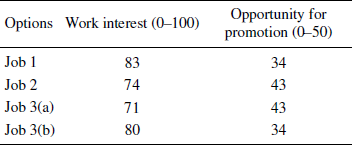
The experimental design was a 2 (Condition: Regret-Salient vs. Control) × 2 (Choice Set: Set 1 vs. Set 2) fully between-subjects factorial. Each choice set consisted of (a) a non-targeted option, (b) a targeted option, and (c) a decoy option, which was dominated by the targeted option but not by the non-targeted option. Choice Set was purely a method variable of no theoretical interest, manipulated in order to counterbalance which primary option was targeted by the decoy (the high-promotion prospect job in Set 1 or the high-interest job in Set 2; see Table 1).
We manipulated regret salience by having subjects in the regret-salient condition (n = 39) read the following paragraph before seeing the options and making their choice:
As you make your decision, keep in mind that there is no guarantee that the job you pick will be right for you. You could find yourself in a job you don’t like, regretting the decision you made and wishing you had picked one of the other jobs.
This paragraph was omitted in the control condition (n = 23).
2.1.2 Dependent variables
The primary dependent measure was the job choice indicated by the subject, coded as either the target or non-target choice. On a separate page, subjects were asked to imagine how they would feel if they had chosen each of the three options and had found it to be unsatisfactory. For each outcome, they indicated their agreement with the statements “I made a justifiable decision” and “I regret my decision” on a seven-point Likert scale (1: Completely disagree; 7: Completely agree).
2.1.3 Subjects
Sixty-two undergraduate business students, juniors and seniors at a large Southwestern U.S. university, participated in exchange for course credit. They took about 10–15 minutes to complete the task.
2.2 Results
2.2.1 Experimental effects on choice frequencies
There was a significant effect of regret salience on the percentage of subjects selecting the targeted option (see Table 2). Twenty out of 23 (87%) Control subjects chose the targeted option, but only 24 out of 39 (61.5%) of the Regret-Salient subjects did so, χ2(1, N = 62) = 4.54, Fisher’s exact test p = .04, φ2 = .07. None of the subjects chose the decoy option.
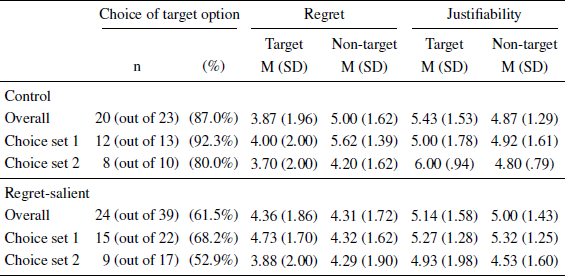
The decoy effect was significant in the Control condition (i.e., the percentage of subjects choosing the targeted option was larger than 50%), exact binomial p = .000. No significant decoy effect was found in the Regret-Salient condition, exact binomial p = .20.Footnote 1
2.2.2 Experimental effects on decision regret and decision justifiability
Similar effects were found for the measures of decision regret and decision justifiability using repeated-measures ANOVAs with imagined choice (target vs. non-target) as a within-subjects factor and Choice Set as a between-subjects factor. Asked to imagine how they would feel if they were to choose each option and found the outcome unsatisfactory, Control subjects judged choice of the targeted option to be less regrettable than choice of the non-targeted option, M = 3.87, 5.00 (SD = 1.96, 1.62), F(1, 21) = 8.10, p = .01, ηp2 = .28, and the also judged choice of the targeted option to be more justifiable, M = 5.43, 4.87 (SD = 1.53, 1.29), F(1, 21) = 5.02, p = .04, ηp2 = .19. Regret-Salient subjects, in contrast, judged targeted and non-targeted choice options that led to unsatisfactory outcomes as not significantly different on either decision regret, M = 4.36. 4.31 (SD = 1.86, 1.72), F(1, 37) = .00, p = 1.00, ηp2 = .00, or decision justifiability, M = 5.14, 5.00 (SD = 1.58, 1.43), F(1, 35) = .41, p = .53, ηp2 = .01.
Consistent with these results, an ANOVA including Condition in addition showed a significant interaction between imagined choice and Condition on decision regret, F(1, 58) = 7.14, p = .01, ηp2 = .11. However, this two-way interaction was not significant for decision justifiability, F(1, 56) = 1.22, p = .27, ηp2 = .02. Thus, even though the pattern of results for decision justifiability was consistent with subjects’ actual choices (a significant decoy effect in the Control condition, but not in the Regret-Salient condition), these results should be interpreted cautiously in light of the non-significant interaction.
2.3 Discussion
Several earlier studies (e.g., Reference Connolly and RebConnolly & Reb, 2012; Reference Inman and ZeelenbergInman & Zeelenberg, 2002; Reference Richard, de Vries and van der PligtRichard, de Vries, & van der Pligt, 1998) have shown that priming anticipated regret can reduce or eliminate a number of decision biases. The results of Experiment 1 replicated and extended these findings. Results showed a significant difference such that the decoy effect was stronger in the Control condition than in the Regret-Salient condition. Follow-up analyses found that the decoy effect was significant in the Control condition (in which 87% chose the targeted option) but not significant in the Regret-Salient condition (in which 61.5% chose the targeted option). While these results are suggestive, they should interpreted cautiously in light of the relatively small sample size as well as the unusually large percentage of subjects choosing the targeted option in the Control condition.
For Control subjects, choosing a targeted option that turned out badly was judged as better justified, and less regrettable, than choosing a disappointing non-targeted option. Regret-Salient subjects, however, judged targeted and non-targeted options as equally regrettable and equally justifiable if they were to turn out poorly. This is consistent with our proposal that regret priming leads subjects to examine their thought processes more carefully and to realize that the justification offered by the decoy is nothing more than a “shallow but nice-sounding rationale” (Reference SimonsonSimonson, 1989), thus reducing or eliminating its effect on choice. The findings for decision justifiability, however, should be interpreted with caution, as the two-way interaction between Condition and imagined choice (target vs. non-target) was not statistically significant.
Experiment 1 tentatively suggests that accountability and regret priming manipulations may influence the decoy effect in opposite directions. As noted earlier, accountability can exacerbate the effect (Reference SimonsonSimonson, 1989) or even induce it (Reference Slaughter, Bagger and LiSlaughter et al., 2006). The present study shows that regret priming might reduce or even eliminate it. However, the tasks used in these studies differ in a number of ways, including display format, task complexity and realism, professional relevance to subjects, and incentives and rewards.
A particular concern is the nature of the task itself. In Experiment 1, the task was to choose a job for oneself, a personal preference task in which only the chooser will know how well it turned out, and only he or she will reap the rewards of making a good choice or suffer the penalties of a bad one. In Reference Slaughter, Bagger and LiSlaughter et al. (2006), in contrast, the task was to act as a manager selecting a salesperson for a retail organization. This involves, centrally, a prediction of how well each candidate will perform (and, in fact, the subjects were told that the scenario was based on a real-world case and that the actual later performance of each candidate was known to the experimenters). In this task, the quality of the subject’s decision will become objectively known and visible to others, and the chosen candidate’s performance affects others, with no direct impact on the decision maker except for reputational effects. The Experiment 1 task thus involves personal preferences and payoffs, while the Slaughter et al. task involves public prediction of an objectively measurable result, with consequences primarily for others. It is plausible that this latter task itself raises subjects’ concern with justifying one’s decision to others (those affected by the candidate’s performance), over and above any external accountability demands imposed by the experimenter. This difference in task demands could account for the striking difference in findings between the two studies.
3 Experiment 2
Experiment 2 explored this possibility by examining the possible interaction among task characteristics (preference vs. prediction) and the experimental manipulation (regret priming vs. accountability priming) in influencing the decoy effect. It also included more extensive manipulation checks and process-related measures than did Experiment 1. Our expectations were:
-
1. that Control subjects would show a significant decoy effect in both tasks, replicating numerous earlier studies;
-
2. that compared to Controls, regret-primed subjects would show a reduced decoy effect or no decoy effect in both tasks, replicating Experiment 1; and
-
3. that compared to Controls, accountability-primed subjects would show no reduction in the decoy effect in either task, and a possible increase in the decoy effect in the candidate selection task, replicating the findings of Reference Slaughter, Bagger and LiSlaughter et al. (2006).
Experiment 2 examined the effects of regret salience and accountability to others on the decoy effect in two types of task: a job choice task similar to that used in Experiment 1, and a candidate selection task similar to that used by Reference Slaughter, Bagger and LiSlaughter et al. (2006).
3.1 Methods
3.1.1 Design, procedure, materials, and manipulations
The experimental design was different from Experiment 1 in that an accountability-to-others condition was added and two decision tasks were used: a personal preference task, in which subjects had to select a job for themselves, and a prediction task, in which subjects had to select a candidate for a position in an organization. The design thus was a 3 (Condition: Control vs. Regret-Salient vs. Accountability to Others) × 2 (Task: Job Choice vs. Candidate Selection) × 2 (Choice Set: Set 1 vs. Set 2) between-subjects factorial, with about 20 subjects per cell.
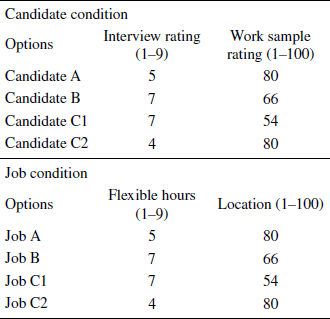
The Job Choice task used essentially the same scenario as Experiment 1. For the Candidate Selection task, subjects were asked to take on the role of a Human Resources consultant helping a company to select a new plant manager. Both tasks used identical attribute ranges and scores, taken from a candidate selection task used by Reference HighhouseHighhouse (1996, Experiment 2). Scores for the three options were presented in a table, with the non-targeted option first, the targeted option second, and the decoy third, to facilitate comparison of the target and decoy. Numerical values of the attribute scores for each task are shown in Table 3. Subjects were asked to assume that the options were similar on all other attributes.
The primary dependent measure was again the subjects’ option choice, either their preferred job (Job Choice task) or the candidate they would recommend for hiring (Candidate Selection task). After indicating their choices, subjects completed several post-decision process and manipulation questions, each presented on a separate computer screen. These measures are described in more detail in the Results section.
Subjects in the Accountability condition read a shortened version of the instructions used by Reference Slaughter, Bagger and LiSlaughter et al. (2006). In the Accountability/Job Choice condition they read:
After you have made your choice, you will be asked to write a short essay explaining the decision process you used. This essay will be read and evaluated by a graduate student. Also some of the study subjects will be contacted in a short while to be interviewed about their decision. One purpose of this study is to assess the strategies undergraduate business students like you use in making job choice decisions.
In the Accountability/Candidate Selection condition, the last phrase was replaced by “… in making candidate selection decisions”. While subjects were indeed asked to write a short essay after making the choice, this essay was not evaluated by a graduate student and no subject was later interviewed.
Subjects in the Regret-Salient/Job Choice condition read instructions similar to those of Experiment 1:
As you make your choice keep in mind that there is no guarantee that the job you choose will be the right one for you. You may discover later that you are not satisfied with the job you pick, regretting the decision you made and wishing you had picked one of the other jobs instead.
Those in the Regret-Salient/Candidate Selection condition read:
As you make your recommendation, keep in mind that there is no guarantee that the candidate you choose will be the right one for the job. You may discover later that you are not satisfied with the candidate you chose, regretting the decision you made and wishing you had picked one of the other candidates instead.
Those in the Control condition read neither of these paragraphs but went directly to choosing an option.
3.1.2 Subjects
Two hundred forty-two undergraduate business students at a large Southwestern U.S. university participated in exchange for course credit. They completed the experimental materials in individual rooms in our computer-based lab, taking about 10–15 minutes to do so.
3.2 Results
3.2.1 Manipulation checks
Accountability.
One post-decision question asked: “While you were making this decision, did you expect to have to explain how and why you made this response?” Subjects in the Accountability condition were significantly more likely to check “yes” (49%) than were those in the Regret-Salient (24%) or Control (20%) conditions, χ2(2, N = 242) = 18.93, Fisher’s exact test p = .000, φ2=.08, with no significant difference between these latter two conditions, χ2(1, N = 121) = 0.43, Fisher’s exact test p = .57 φ2 = .003. In the Candidate Selection task, 48% of Accountability subjects checked “yes”, as against 22% in the Regret-Salient condition and 20% in the Control condition, χ2(2, N =121) = 9.09, Fisher’s exact test p = .01, φ2 = .08. In the Job Choice task, the corresponding fractions were 50%, 25%, and 19%, χ2(2, N = 121) = 9.87, Fisher’s exact test p = .01, φ2 = .08. The Accountability manipulation thus appears to have been at least modestly successful in raising the subjects’ expectations that they would be required to provide an account of how and why they made the choices they did. (We were initially concerned that only about half of the Accountability subjects thought they would later be asked to explain their decisions. It may be that many of them focused on the threatened interview rather than on the written explanation. The instructions warned only that “some” of the subjects would be interviewed. Given the numbers of subjects and the logistics of setting up interviews, many subjects may well have concluded that their own risk of being called for interview was small. In addition to the manipulation check, however, evidence of the adequacy of the Accountability manipulation is found in the main analysis, where we found significant condition effects and much longer essays for the Accountable subjects than for the Control and Regret-Salient subjects.)
Regret salience.
Several post-decision questions asked the subjects to rate how much they thought about a variety of issues as they were making their decision. One question asked about the subject’s concern over “the regret I might feel as a result of my decision”. A second asked about the concern that “I might blame myself if I made a poor decision”. Responses were on five-point scales (anchored at 1: Not at all, and 5: A great deal). As in earlier studies (e.g., Reference Connolly and RebConnolly & Reb, 2003) the self-blame and regret measures were strongly correlated, r(240) = .63, p = .000, so we combined them into a single composite measure of decision regret. A two-way Condition × Task ANOVA on the composite decision regret measure showed a main effect for Condition, F(2, 236) = 5.43, p = .01, ηp2 = .04, but no main effect for Task, F(1, 236) = 0.11, p = .74, ηp2 = .00, and no Task x Condition interaction, F(2, 236) = 0.04, p = .96, ηp2 = .00. The mean score was higher (M = 3.03, SD = 1.20) in the Regret-Salient condition than in either the Accountability condition (M = 2.44, SD = 1.12) or the Control condition (M = 2.58, SD = 1.16), with no significant difference between the latter two. The Regret-Salience manipulation thus appears to have succeeded in making the possibility of decision regret and self-blame salient to the subjects.
3.2.2 Experimental effects on choice frequencies
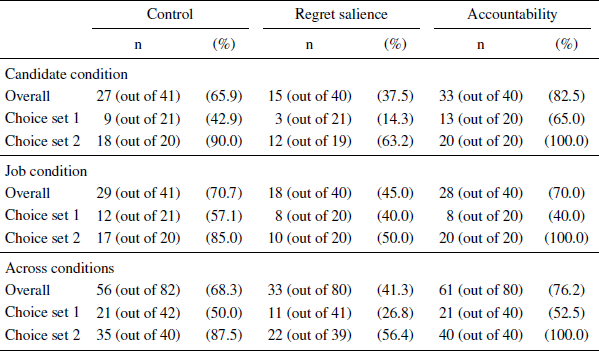
Frequencies and percentages of subjects choosing the targeted option, broken down by Condition, Task, and Choice Set, are shown in Table 4 and summarized in Figure 1. No subject in any condition chose the decoy option. Experimental condition significantly affected the percentage of target choices, χ2(2, N = 242) = 22.89, Fisher’s exact test p = .000, φ2 = .10. The targeted option was chosen significantly less often in the Regret condition (41%) than in the Control condition (68%), χ2(1, N = 162) = 11.96, Fisher’s exact test p = .001, φ2 = .08, or the Accountability condition (76%), χ2(1, N = 160) = 20.22, Fisher’s exact test p = .000, φ2 = .13. The Control and Accountability conditions did not differ significantly from each other overall, χ2(1, N = 162) = 1.28, Fisher’s exact test p = .30, φ2 = .01.
Proportion of target-option choices by experimental condition, Experiment 2.
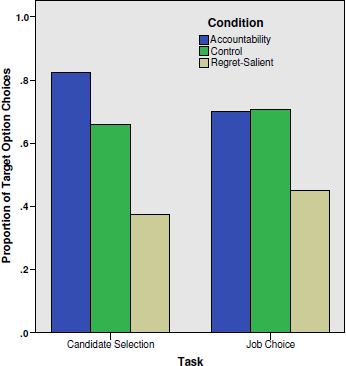
Within-condition analyses revealed a significant decoy effect in the Control condition (i.e., the percentage of subjects choosing the targeted option was larger than 50%), exact binomial p = .001, as well as in the Accountability condition, exact binomial p = .000. In contrast, no decoy effect was found in the Regret-Salient condition, where a non-significant minority (41%) chose the targeted option, exact binomial p = .15. These results suggest that the Regret-Salience manipulation was successful in eliminating the substantial decoy effect found in the Control condition for both choice tasks. The Accountability manipulation, as predicted, did not reduce the decoy effect overall. In the Job Choice task, selection of the targeted option was essentially unchanged by the Accountability manipulation, (70.7% in Control, 70.0% in Accountability condition). In the Candidate Selection task, 82.5% of subjects in the Accountability condition chose the targeted option, as against only 65.9% in the Control condition, a nonsignificant difference, χ2(1, N = 81) = 2.92, Fisher’s exact test p = .13, φ2 = .04. This is at best a weak replication of Slaughter et al.’s (2006) finding that accountability exacerbated the decoy effect in a similar task.Footnote 2 However, whether the exacerbation effect in the Candidate Selection task is real or not, the results clearly show that Accountability does nothing to reduce the decoy effect in either task. Regret Salience, in contrast, clearly does, reducing choice of the targeted option to less than 50% of the subjects’ choices.
3.2.3 Mediation of the experimental effect through justification to self and justification to others
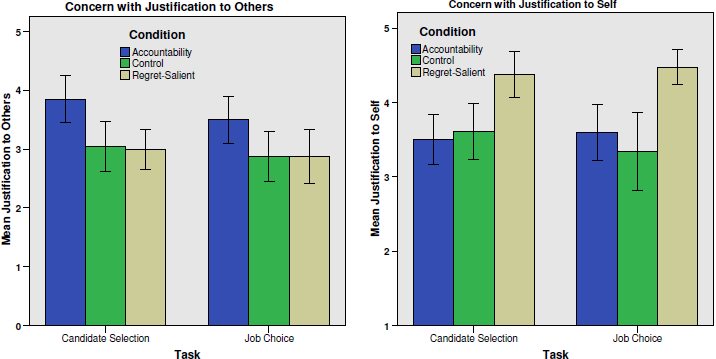
As shown in Figure 2, analyses of post-decision measures showed that concern for justification with others was particularly high in the Accountability condition, whereas concern for justification with self was particularly high in the Regret-Salient condition. These two concerns were measured as “How I could justify my choice to someone else” and “How I could justify my choice to myself” (italics in original; same 1–5 scale as described above). A two-way ANOVA (Condition x Task) showed highly significant main effects of Condition on both measures: for justification to others, F(2, 236) = 8.52, p = .000, ηp2 = .07, for justification to self, F(2, 236) = 16.23, p = .000, ηp2 = .12. Neither measure showed any significant main effect for Task or a Task × Condition interaction. Pairwise t tests showed that concern with justification to others was scored higher in the Accountability condition (M = 3.68, SD = 1.25) than in either the Regret-Salient condition (M = 2.94, SD = 1.26) or the Control condition (M = 2.96, SD = 1.34) (Accountability vs. Regret-Salient: t(158) = 3.72, p = .000, Cohen’s d = .59; Accountability vs. Control: t(160) = 3.50, p = .001, Cohen’s d = .56). Concern with justification to self was scored higher in the Regret-Salient condition (M = 4.42, SD = .87) than in either the Accountability condition (M = 3.55, SD = 1.11) or the Control condition (M = 3.48, SD = 1.45) (Regret-Salient vs. Accountability: t(158) = 5.45, p = .000, Cohen’s d = .87; Regret-Salient vs. Control: t(160) = 5.04, p = .000, Cohen’s d = .79).
Mean scores on justification to others (left) and justification to self (right) by experimental condition, Experiment 2. Error bars represent 95% confidence intervals.
These justification concerns also predicted choice of the targeted option (coded as 1, non-targeted option coded as 0). A binary logistic regression showed that concern about justification to others was associated with a higher likelihood of choosing the targeted option, B = .37, SE(B) = .11, Exp(B) = 1.44, Wald(1) = 11.25, p = .001, whereas concern about justification to self was associated with a lower likelihood of choosing the targeted option, B = −.48, SE(B) = .13, Exp(B) = .62, Wald(1) = 14.58, p = .000. Interestingly, the composite measure of regret reported above under manipulation checks did not significantly predict choice of the targeted option in a separate binary logistic regression analysis, B = −.14, SE(B) = .11, Exp(B) = .87, Wald(1) = 1.46, p = .23. The justification measures thus serve as more than additional manipulation checks for the primary experimental manipulations, and suggest that justification is a key process variable.
To further examine this possibility, we tested whether justification mediated the difference in choices between the Regret-Salient and Accountability conditions. Given that we had two potential mediators (justification to self and justification to others) and a binary dependent variable (choice of target, coded as 1, vs. non-target, coded as 0), we followed the approach described in Reference MacKinnon, Rose, Chassin, Presson and ShermanMacKinnon (2000) and Reference Reb and ConnollyPreacher and Hayes (2008) to examine multiple mediator models on binary dependent variables using a bootstrap approach. We simultaneously entered experimental condition (Regret-Salient vs. Accountability), justification to self, and justification to others into a multiple binary logistic regression.
Experimental condition (Accountability coded as 1, Regret-Salient coded as 0) continued to predict choice, B = 1.02, SE(B) = .39, Exp(B) = 2.77, Wald(1) = 6.91, p = .01. Justification to self also significantly predicted choice, with the expected negative sign, B = −.47, SE(B) = .19, Exp(B) = .63, Wald(1) = 6.08, p = .01. Justification to others almost significantly predicted choice, with the expected positive sign, B = .25, SE(B) = .14, Exp(B) = 1.28, Wald(1) = 2.92, p = .09. Further, the combined indirect, or mediational, bootstrapped effect was .60, with a bootstrapped and bias-corrected 95% confidence interval of .19 to 1.17. The specific indirect effect through justification to self was .41 (bootstrapped), with a bootstrapped and bias-corrected 95% confidence interval of .08 to .95. The specific indirect effect through justification to others was .18 (bootstrapped), with a bootstrapped and bias-corrected 95% confidence interval of −.01 to .47.
Taken together, these results suggest that concerns about justification to self and to others partially mediated the difference between choices in the Regret-Salient and Accountability conditions consistent with the hypothesized mechanism: The experimental manipulations induced a perceived need for either internal or external justification, and these concerns in turn influenced the probability of choosing the targeted option—that is, of manifesting a decoy effect. Perceived concern about internal justification reduced this probability and perceived concern about external justification increased it.
3.2.4 Analysis of written accounts of the decision process
After choosing their preferred option, subjects were asked to describe in their own words how they had gone about making this decision. These written accounts were independently coded by two raters on four items:
-
1. The number of words in each account.
-
2. Whether or not the account explicitly mentioned Option C, the decoy option.
-
3. Whether or not those mentioning Option C also explicitly noted that it was dominated by the target, Option B (i.e., tied on one attribute, worse on the other).
-
4. Whether or not the argument “I chose the option that scored better on the dimension I think most important” was explicitly made. (We attempted to code for a number of other arguments but only this one appeared more than a few times.)
The independent raters agreed on 96% or better of the codes in each category. Remaining disagreements were resolved by discussion.
To analyze description length, due to the skewed nature of the variable, we first transformed word count by taking its natural logarithm (after adding 1, in order to avoid word counts of 0 that have no logarithm). Condition significantly affected this transformed variable, F(2, 239) = 26.41, p = .000, ηp2 = .12. Pairwise comparisons showed that whereas Control (M = 2.60) and Regret-Salient (M = 2.88) account length did not significantly differ, t(160) = 1.52, p = .13, subjects in the Accountability condition (M = 3.77) wrote much more than Control subjects, t(160) = 7.25, p = .000, or Regret-Salient subjects, t(158) = 5.61, p = .000, either because they anticipated the account they might be asked to give later or thought that this was the place to provide it. These longer accounts colored other coding scores, however: The longer an account, the more likely it was to mention any decision-related matter.
Forty-one percent of Accountability subjects explicitly referred to Option C, while only 20% of those in the Control condition and 21% of those in the Regret-Salient condition did so, χ2(2, N = 242) = 11.83, Fisher’s exact test p = .004, φ2 = .05. Thirty-eight percent of Accountability subjects noted that Option C was dominated, while only 15% of Control subjects and 14% of Regret-Salient subjects did so, χ2(2) =17.02, Fisher’s exact test p = .000, φ2 = .07. Across all experimental conditions, subjects who noted the dominance relationship overwhelmingly chose the targeted option (52 of 53 = 98%), while only 98 of 189 (52%) of those not noting dominance made that choice, χ2(1) = 35.7, Fisher’s exact test p = .000, φ2 = .15. Evidently subjects who explicitly noted that the decoy, Option C, was dominated found this a compelling argument in favor of the dominating targeted option. Disproportionately more Accountability subjects noted this dominance than did those in the other two experimental conditions.
Finally, the argument that the chosen option was higher on the dimension the subject judged to be more important was made by 38% of Control subjects, 54% of Regret-Salient subjects, and 60% of Accountability subjects, χ2(2) = 8.51, Fisher’s exact test p = .02, φ2 = .04. Pairwise comparisons showed significant differences between the Accountability and Control conditions, χ2(1) = 7.98, Fisher’s exact test p = .007, and between the Regret-Salient and Control conditions, χ2(1) = 4.15, Fisher’s exact test p = .06, but not between the Accountability and Regret-Salient groups, χ2(1) = 0.64, Fisher’s exact test p = .52. In short, both Regret-Salient and Accountability subjects were more likely than Controls to make the (reasonable) justification that they chose the option higher on the more important dimension. However, while Accountability subjects also exceeded Controls in their use of the (unreasonable) “Target dominates C” argument, Regret-Salient subjects did not. Regret-Salient subjects, while sharing with Accountability subjects a felt need to justify their choices, were apparently more discriminating in selecting appropriate arguments to do so.
This process evidence, though consistent with our theoretical account, is somewhat weakened by being collected after the central decision had been made. This leaves open the possibility that subjects are merely engaging in retrospective sense-making, presenting coherent post hoc accounts of their decision process so as to be consistent with choices they had actually made on other grounds (not necessarily accessible to themselves). We judged that placing the measures earlier, before or during the decision process, would lead subjects to be unacceptably reactive, so post hoc reflections seemed the best we could do. The ratings on self- and other-justification and the reports of what arguments the subjects used are thus included here as imperfect but supportive evidence for our theoretical arguments.
3.2.5 Application of effort to the decision task
A final measure on the “what were you thinking about?” scales asked subjects the extent to which they thought “I should try hard to make the best decision I could” (1: Not at all; 5: A great deal). A two-way analysis of variance over Condition and Task showed a significant effect, F (2, 236) = 4.72, p = .02, ηp2 = .07. Pairwise comparisons showed Regret-Salient subjects scoring significantly higher than Controls on this measure (M = 4.49, 4.01; SD = .83, 1.17; t (160) = 2.98, p = .003, Cohen’s d = .47) and almost significantly above Accountability subjects (M = 4.49, 4.24; SD = .83, .92; t(158) = 1.81, p = .07, Cohen’s d = .29). The latter group did not differ significantly from Controls (M = 4.24, 4.01; SD = .92, 1.17; t (160) = 1.36, p =.18, Cohen’s d = .22). This measure suggests that Regret-Salient subjects may have exerted more cognitive effort in the task than did Control or Accountability subjects.
3.3 Discussion
Experiment 2 replicates and extends the main finding of Experiment 1: Making salient to subjects the possibility that their choices might lead to regrettable results eliminated the decoy effect. The replication included both a modified form of the personal preference task used in Experiment 1 and an external prediction task (selecting a candidate for a job in an organization, where the outcome is publically evaluated and the positive or negative consequences fall mainly on others). In both tasks the decoy effect, substantial in a control condition, was maintained by a standard accountability manipulation involving justifying one’s choice to others (and may have actually increased in the Candidate Selection task, where accountability demands were built into the task itself as well as being imposed by the experimenter). Note that this manipulation did not consistently exacerbate the decoy effect, as in previous studies (e.g., Reference Slaughter, Bagger and LiSlaughter et al., 2006). One possible explanation is that our accountability manipulation had elements of both being evaluated by others and providing reasons, which have been shown previously to have opposing consequences for the decoy effect (Reference Simonson and NowlisSimonson & Nowlis, 2000).
The decoy effect was eliminated (i.e., choice of the targeted option was below, and not significantly different from, 50%) by a regret-salience manipulation that appears to have led subjects to think about justifying their decision to themselves. Regret salience also increased the amount of thought subjects reported giving to their decisions, as compared to the Control and Accountability conditions, while reducing the use of the (fallacious) dominance argument on which the decoy effect appears to be largely based.
4 General discussion
The two experiments reported here suggest both practical techniques for the management of the decoy effect and some theoretical insight into its component mechanism. The practical implications are straightforward (assuming, tentatively, that the laboratory findings generalize to other contexts and populations). Warning decision makers that they will be asked to explain and justify their choices to an external evaluative audience maintains or exacerbates the decoy effect (Experiment 2; Reference SimonsonSimonson, 1989), and may even introduce it when it does not appear spontaneously in a control condition (Reference Slaughter, Bagger and LiSlaughter et al., 2006). This is consistent with Reference Larrick, Koehler and HarveyLarrick’s (2004) conclusion that, while accountability debiases a wide range of cognitive errors, its “…focus on justification may have the effect of exacerbating justification-based decision biases” such as reason-based choice effects (Reference Shafir, Simonson and TverskyShafir et al., 1993). In contrast, the present studies show that priming subjects to think about the regret they might experience if their choice turns out badly reduces or eliminates the decoy effect, for both personal preference and external prediction tasks. Regret priming, which has been shown to reduce or eliminate a variety of cognitive and decisional errors (Reference Connolly and RebConnolly & Reb, 2012; Reference Larrick, Koehler and HarveyLarrick, 2004), appears on the present evidence to have the same ameliorative power for the otherwise robust decoy effect.
The theoretical account we offer for the contrasting effects of accountability and regret salience turns on the difference between justifying one’s choices to others (as in accountability theory; Reference Tetlock and SannaTetlock, 1992, 2002) and justifying them to oneself (a central concern of Decision Justification Theory; see Reference Connolly and ZeelenbergConnolly & Zeelenberg, 2002). We noted earlier Reference SimonsonSimonson’s (1989) plausible suggestion that an argument that might serve to convince an external audience (for example, “I picked a winner”, the targeted option being an unambiguous “winner” over the decoy) might be expected to serve an internal audience as well. The evidence here suggests that this is not necessarily the case. Our externally accountable subjects reported directing their attention toward justifying their choice to the audience, and did so with little additional effort, but maintained or even increased the substantial decoy effect found in the control condition. Regret-salient subjects, in contrast, reported directing their thinking toward justifying their choices to themselves, and thinking harder about their decision than did control or accountable subjects. Their choices showed no evidence of the decoy effect.
These findings appear to weaken range-frequency (Reference ParducciParducci, 1995) and similar accounts of the decoy effect. Such an account (e.g., Reference Slaughter, Kausel and QuiñonesSlaughter, Kausel, & Quiñones, 2011) argues that adding a decoy, A’, to a choice between options A and B both extends the apparent range of the attribute on which A scores lower (thus making A’s score appear less extremely low) and makes high scores on the attribute on which A excels appear more frequent (perhaps emphasizing B’s shortcomings on this dimension). However, in our Experiment 2, the numerical scale scores were identical across experimental conditions, so any possible range/frequency effects would also be constant across conditions, thus offering no explanation of the between-conditions shift from a substantial decoy effect to its complete absence. It is certainly possible that range/frequency mechanisms may contribute to decoy effects in some circumstances, but it is difficult to see how they can be a necessary condition for all such effects. Loss-aversion accounts appear to face a similar difficulty.
We tentatively interpret the present studies as supporting an emergent-value account of the decoy effect, with the dominance relationship between decoy and target providing the “emergent dimension that arise[s] from the demands of the task or social situation” as proposed by Reference Pettibone and WedellPettibone and Wedell (2000, p. 304). Our extension of their account is that the persuasive effect of this emergent consideration can be undermined by a regret-priming manipulation. The decoy is effective because it offers the decision maker an argument justifying the choice of the targeted option to others (in the accountability condition) and perhaps to one’s inattentive self (in the control condition). The regret-primed decision maker, however, examines this argument more critically and finds it unconvincing, and the decoy effect disappears. This account dovetails both with the extensive earlier evidence linking anticipated regret and need for justification, and with the decision process evidence in the present experiments. To reiterate the evidence summarized in Figure 2: Only the subjects in the Accountability condition reported elevated concern about justifying their decision to others (and showed a normal or enhanced decoy effect); only those in the Regret-Salient condition reported elevated concern about justifying their decision to themselves (and showed no decoy effect). A justification mechanism accounts for both groups’ behavior, but with one group more critical than the other of the decoy argument.
Reference Tetlock and SannaTetlock (1992, 2002) succinctly summarizes his and others’ work on external audience effects under the metaphor of decision makers as “intuitive politicians”, justifying choices to an external constituency in light of their knowledge of the audience’s preferences, the information available, and a judgment of what will be persuasive. Anticipation of decision-related regret appears to trigger a more self-critical decision maker, scrupulously examining her decision process and considering justifications that might later reduce regret and self-blame should a decision turn out badly. Apparently an argument such as “I picked a winner” fails such rigorous scrutiny. The regret-primed subject thinks seriously about how she could justify her decision to herself, and sees that the decoy option will not serve this purpose. Once the decoy option is seen as irrelevant to the central decision, its effect disappears.
We noted earlier Reference Janis and MannJanis and Mann’s (1977) prediction that the anticipation of regret can encourage “vigilant decision making”—scrupulous gathering of information, canvassing of a range of options, consideration of consequences, and the like. Reference Connolly and ZeelenbergConnolly and Zeelenberg (2002) proposed in their Decision Justification Theory that regret avoidance is closely linked to such careful decision processes and later studies have supported that proposal (Reference Kugler, Connolly and KauselKugler et al., 2009; Reference RebReb, 2008; Reference Reb and ConnollyReb & Connolly, 2009, 2010). We see the present findings as further evidence of the same process: When the possibility of regret is made salient, self-justification needs can improve decision process, though other-justification demands may not. The regret-primed decision maker must justify her decisions to herself, and is less easily satisfied with “shallow but nice-sounding rationales” (Reference SimonsonSimonson, 1989, p. 170) than is the intuitive politician, who seeks only to satisfy an external audience. Satisfying oneself appears to require a higher standard of argument.


 Open access

