

Peter and Janellen had shared ideas throughout their careers, molding each other’s perspectives on the fields of brain plasticity and development. Their shared interest and distinct approaches were accurately highlighted when they were introduced to their new retirement community in the early 2000s, through the Montgomery Place newsletter.
Their professional interests overlap, and they have published joint papers. Peter is interested in the early development of the human brain, “Did you know that a baby has far more synapses than an adult? They have to be pruned.” Janellen’s field is cognitive and developmental psychology, and she is interested in how language and mathematical skills develop in children and the environmental effects on their development. Janellen says she is absorbed in her work. Peter is interested in music and in expressionist art.
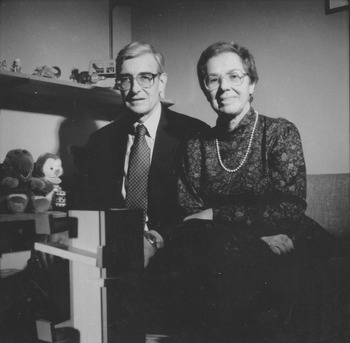
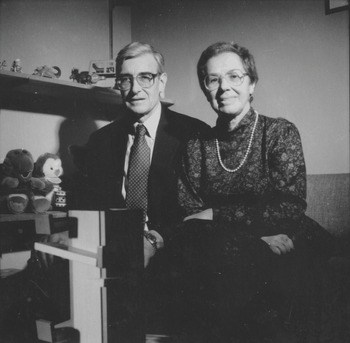
Although Peter and Janellen conversed extensively with each other about their work, they only published two manuscripts together. A 1973 paper described the first cohort of children with hyperlexia, a puzzling developmental condition associated with advanced reading skills in children who otherwise had impaired cognitive development [Reference Huttenlocher and Huttenlocher1]. A second collaborative manuscript was published in 1990, demonstrating that specific neurological tests in preschool children could predict subsequent developmental delay. It was proposed that this screening platform could be used to identify at-risk children who would benefit from early intervention programs [Reference Huttenlocher, Levine and Huttenlocher2]. An image of Peter and Janellen in Janellen’s child development laboratory was taken as part of their collaboration (Figure 16.1).
Although they did not generally publish together, Peter’s work on developmental pruning influenced Janellen’s interest in the impact of the environment on learning. As part of a set of groundbreaking studies, Janellen’s group recorded interactions between mothers and their children in Chicago and found that the language environment influenced children’s vocabulary and syntax acquisition [Reference Huttenlocher3]. The studies showed that preschool children benefit when their parents and teachers use complex sentences in their conversations with children. This type of exposure increases the child’s comprehension ability and subsequent vocabulary and use of complex sentences. In a related study, Janellen’s research group found that children’s ability to learn fluctuated depending on whether they were in school or out of school during the summer. This important work separated environment and genetic factors and provided direct evidence that environmental input affects language development. This work has been cited in studies suggesting that children would benefit from year-round schooling.
These studies by Janellen and her colleagues challenged a dogma in the field that had suggested that the organization of words into sentences, otherwise known as syntax, was developed naturally due to inborn traits that were programmed into the brain, rather than being influenced by the environment. Classic work by Noam Chomsky suggested that language is an innate ability and that children are born with a “universal grammar” that is inborn. In contrast, Janellen’s studies suggested that language and grammar are learned and influenced by the environment in which children develop. Her work indicated that young children benefit from language-rich preschool classes – indeed, studies showed that young children experience a two-fold increase in the ability to form complex sentences in these kinds of environments. Janellen’s work suggested that children need input, and benefit from it early. One concept that emerged from Janellen’s studies is that vocabulary and language acquisition are different as compared to other types of learning, like spatial learning. Or, as Susan Levine, a colleague at the University of Chicago, said in February 2022: “not everything works the same way.”
At the same time that Janellen was testing the effects of environment on child language development, Bill Greenough, a professor of psychology at the University of Illinois, provided compelling evidence showing the importance of experience and enriched environments for synapse formation in the brains of mammals, including later in life. His work showed that environmental enrichment, exercise and learning led to the development of new synapses in rodent models, further supporting the importance of environment on both learning and brain plasticity [Reference Federmeier, Kleim and Greenough4].
Susan Levine noted that “Janellen was a big ideas person and had a lot of influence because of that. Janellen understood that both innate factors (genetics) and environment influence cognitive development, but she wanted to understand more about how the environment influences language development, because you can do something about the environment.” Levine went on to say that “Janellen was a giant in the field” with a lasting impact on understanding spatial thinking and language development. Kelly Mix, a former graduate student of Janellen’s, and now a professor at the University of Maryland, commented that “Janellen would always say ‘We came for the truth.’ I learned so much from watching how she thought about things, how she tackled problems. She didn’t want the data to support what she already was thinking, but rather, reveal what was actually happening.”
Janellen was driven by research; she would spend hours at any time of the day or night scribbling on yellow lined sheets of paper – thinking, writing, refining, with glee. She was intense and focused, and loved what she did. It was hard to be a leader of your discipline and it was the determined few who did so. Susan Levine also noted that Janellen was “not political” and was not afraid to say what she thought. She was keenly critical. “Janellen made waves.” Peter was the opposite; he did not make waves; he avoided conflict or self-promotion and so, as Levine said, “he often did not get the recognition he deserved.” When Janellen or anyone else made waves Peter cringed in silence, not unlike his response to the bigwigs in science who were adept at promoting their work. While Janellen scribbled on her yellow note pads and worked, Peter often happily tinkered in his garden with his roses, strawberries, tomatoes or peach trees. Or with a self-constructed model train village or building a dollhouse for his children and grandchildren, listening to and reading about classical music or expressionist art or reading German literature or plays. He relished making a German plum or peach tart, playing the flute and writing program notes for the local youth orchestra performance. Peter’s interests were broad. Janellen’s interests were focused, although she enjoyed reading history and literature, and loved a good debate. Peter tried many different things, “and he was not into resume building.” He was interested in doing what interested him. As Susan Levine went on to say, “He was deeply interested in the development of the human brain, but he had other interests as well.” Levine pondered and ended by saying, “Peter was a renaissance man,” and then, regarding Peter more generally, “Peter’s was a story of resilience.”
Although Peter’s story was one of resilience and not making “waves,” even years after having left Nazi Germany behind he bristled at authority. Occasionally, he more than bristled. One extreme example of this was an encounter with the City of Chicago police. As Janellen told the story, on an afternoon drive through the south side of Chicago, Peter was stopped by the police for failing to come to a complete stop at a stop sign. Peter denied it and retorted, “I did not go through the stop sign.” He resisted. It escalated. Before Janellen was able to intervene, the police pulled Peter out of the car and roughly slammed him against the side of the car – and then frisked and handcuffed him. He was thrown into a police wagon; Peter, the gentle pediatric neurologist. Janellen followed the police wagon to the station, where she negotiated his release and “bailed him” out of jail. That the calm Dr. Huttenlocher had somewhat forcefully resisted authority was not denied by the doctor himself, whose face would adopt a smug air of rebellion when the story was told at his expense.
Shortly after Peter’s passing, I received the following email about a named lectureship in his honor from a scientific society focused on cognitive neuroscience, a field that bridges both Janellen’s and Peter’s work.
Dear Dr. Huttenlocher,
Our deepest sympathy on the passing of your father Dr. Peter Huttenlocher. The field has been very much stricken by his passing and we, collectively, have been discussing the importance of his pioneering contributions to the field. We are contacting you to let you know that the Scientific Program Committee of Flux: The International Congress for Integrative Developmental Cognitive Neuroscience has voted to name our Keynote Talk the “Huttenlocher Lecture” in his honor as the father of Developmental Cognitive Neuroscience. The “Huttenlocher Lecture” will be our feature plenary talk in all subsequent meetings. Our research has been significantly influenced by your father’s pioneering work as evidenced by how we all cite his work in our publications. We are humbled at the opportunity to honor his memory. We both had the honor of meeting your father and were very impressed at how humble and generous he was in interacting with us. One of us (Bea) recently presented some of his work for the Institute of Medicine at the National Academy of Sciences to instruct policy about the protracted nature of neural development so he had been very much in my mind. One of us (Brad) is a pediatric neurologist who understands your father’s tremendous contributions to that discipline as a physician, teacher, scientist, and mentor.
Best Regards,
Beatriz Luna Chair and Brad Schlaggar, Co-ChairFlux: The International Congress for Integrative Developmental Cognitive Neuroscience
A subsequent email to Janellen highlights the close relationship between Peter’s and Janellen’s research. Janellen described Mike Posner as “a brilliant and famous neuroscientist.”
Dear Janellen,
I am not sure whether or not you know but this year I had the honor of being asked to deliver the Huttenlocher lecture during the FLUX meeting in St. Louis. It is great honor for me because while I did not know Peter, I do know you and I recognize that the two of you do span all that I love about connecting cognitive and brain science in development.
I want you to know that I will be thinking about you as well as Peter in September.
Mike Posner, Professor, University of Oregon
Janellen’s long-term friend summed up Peter and Janellen’s relationship, both on the intellectual and personal level: “You walked into a storybook marriage.”