




Introduction
In January 1967, a group of mid-level West German bureaucrats from the Ministry of Agriculture, the Ministry of Development Cooperation, and the Foreign Ministry discussed the establishment of a model dairy farm in Anseong, South Korea. In a preliminary study, German agricultural scientists had discovered two advantages over projects in other developing countries. First, they assessed the high standard of Korean agriculture, with only milk production representing a major gap. And second, the climatic conditions of the project region were similar to those in Germany, so that German ‘breeding and husbandry methods for dairy cows, the form of milk production and processing and, above all, fodder production can be transferred to Korean conditions with minor modifications’.Footnote 1 The German scientists and bureaucrats had the clear ambition not only to introduce German-style dairy farming as a model but also to send German cattle and grass seeds to Korea and transform its environment long term. A closer look shows that the German bureaucrats were not the only ones with these ambitions: during the 1960s and 1970s, Australia, Canada, Denmark, Japan, New Zealand, and others—all operating within the framework of development cooperation—sent livestock, agricultural scientists, and technicians to Korea, established ‘model farms’ on-site, and fostered collaborative research on grassland and fodder. Global development politics became an arena for different countries to propagate their technoscientific systems in the ‘developing world’. While the United States and the Soviet Union dominated the Cold War as superpowers, the emergence of a broader ‘developmentalist regime’ also enabled smaller European donor countries to become active players in the Asian developing world.Footnote 2 Recent scholarship has further complicated superpower-centred narratives by highlighting forms of South-South cooperation, such as Taiwanese agricultural experts in Africa and Southeast Asia.Footnote 3 While distinct in scale and institutional context, these cases underscore that Cold War rural development was not solely orchestrated by the United States and the Soviet Union. Responding to this reorientation of the field, this article sets out two main objectives: first, to demonstrate the transnational interdependence of rural development in Cold War Korea through the example of dairy agriculture as an extension but also diversification of the American ‘green revolution’, and secondly to point out the ambiguities, complexities, and contradictions of knowledge transfer—with knowledge being broadly defined as information, expertise, and knowhow that crosses borders through books, embedded in devices, or through living bodies.Footnote 4 Focusing on Holstein cows and grass seeds, the article examines the multifaceted dimensions of introducing ‘modern’ agriculture into Korea’s rural eco-systems.
As part of his development programmes, President Park Chung Hee (1961–1979) actively promoted domestic dairy agriculture and advertised milk products as part of a Western and ‘modern’ diet. School milk programmes, private dairy companies, and agricultural and nutritional scientists fostered this trend, leading to a drastic increase in milk consumption over the following decades.Footnote 5 Korean actors oriented themselves to countries like Denmark, New Zealand, or Germany as role models for dairy agriculture due to those countries’ comparable size and climate in comparison to the United States and actively searched for ways to cooperate. For the rural population, dairy farming promised a new income, but at the same time meant further control through the government and the state-affiliated cooperative Nonghyup. Development models were not only externally imposed by the foreign advisers, but Korean scientists, bureaucrats, and farmers actively negotiated, accepted, and rejected them on-site. In historical research, rural development has so far received less attention, especially in comparison to other sectors of development.Footnote 6 Nevertheless, Cold War villages were considered for political influence and nation-building by imposing development frameworks that were seemingly ‘neutral’ from the outside. Development bureaucrats configured various approaches to the rural regions, which often dated back to the early twentieth century and colonial policies. One was ‘community development’, which aimed to reform rural structures holistically and was in many cases implemented by the state in a top-down approach with mobilization of locals, as showcased in the Korean ‘new village movement’ (saemaŭl undong).Footnote 7 Another approach can be subsumed under the term ‘agricultural development’ which focused on improving technology and infrastructure and increasing agricultural yields. Here, technical cooperation projects included cooperatives, model farms, and technical advisory groups.Footnote 8 While subfields of agricultural development, such as the ‘green revolution’, have received considerable attention in recent years, transnational dairy promotion during the Cold War as a part of rural development constitutes a new research domain.
As the research on milk discourse, (post-)colonialism and cattle, and the capitalist dairy industry underlines, there were many similarities between so-called ‘developing countries’ in Asia and beyond. Milk consumption was associated with positive—and often seemingly ‘Western’—characteristics such as physical growth and prosperity. The mechanization of milk production and the pasteurization process made milk a ‘modern’ product and the dairy sector therefore played an important role in rural development campaigns.Footnote 9 At the same time, in (former) colonies as well as borderlands, cattle served as a ‘civilizing force’, which challenged traditional livelihoods and environments on-site. Cattle and dairy agriculture transformed forests and fields into pastures, for which the farmers erected fences and acquired the newest milking technology.Footnote 10 In 1960s Korea too, the dairy sector was closely connected to ‘frontier farms’ (kaechok nongjang) and rural development campaigns to advance the mountainous regions and wastelands. Therefore, the article also engages with the human-bovine(-technology) relationship, which has received attention in ethnographic research, the history of dairy and grassland research, as well as the environmental history of the Korean mountainsides.Footnote 11 In this sense, the article reads as an extension of the concept of ‘cattle colonialism’, coined by John R. Fisher, to understand the bovine biopolitics of international and domestic experts as part of the rural development projects in Cold War South Korea.Footnote 12
While only two among many, the projects conducted by the West German government dealt especially with both the practical and scientific aspects over a longer period, together lasting almost 20 years. After the United States and Japan, West Germany was third in total financial support provided by a bilateral donor in Korea’s development period (1961–1993). Technical cooperation projects were conducted in the fields of vocational training, industry, and infrastructure, as well as social and rural development, with German Official Development Assistance (ODA) reaching $800 million in total.Footnote 13 Hence, the German-Korean dairy farm project and the grassland research project form the core of this study. Along with references to the other transnational donors, they highlight the nuanced global development discourse and practices that played out in the Korean countryside. The article draws on various multilingual documents, as well as public reports and newspaper articles. It includes testimonies of Korean and German policymakers, scientists, and farmers in public interviews, reports, or media coverage. After introducing the discourses around dairy agriculture, its legal framework, and institutions at the time, the article focuses on the transnational technical development cooperation of different donor countries with a short comparison to international non-governmental organizations and banks. In the two following sections, the article analyses the Korean-German dairy model farm in Anseong (1968–1971) and the grassland research project (1972–1985) as two specific examples of this transnational endeavour. Finally, these projects are again embedded within the transnational cooperation of the Korea-based scientist community in dairy and grassland research.
Origins and expansion of dairy and grassland farming
Even before the Park government started its promotion of the dairy industry, there were early attempts to establish one on the Korean peninsula, mostly under the aegis of foreign and colonial advisers. In 1902, a French adviser to the Chosŏn emperor imported 20 Holstein dairy cows from Japan and established a small farm in Seoul. Although this did not yield the desired results, it can be counted as the first campaign for modern dairy farming in Korea. During the colonial period, mostly Japanese settlers promoted dairy farming and played a crucial role in the establishment of dairy cooperatives such as ‘Seoul Milk’ (sŏul uyu). The farmers also organized fairs and competitions for dairy cows, which contributed to a changing image of the ideal modern cow.Footnote 14 The colonial government passed wide-ranging regulations on cow imports to control rinderpest and thereby exercised power not only over its human but also bovine colonial subjects.Footnote 15 This went hand in hand with a wider discourse on a ‘modern’ diet, including calorie consumption and protein intake, for which dairy was deemed a necessity. A collaborative effort by American missionaries, international dairy companies, and Japanese scientists promoted milk, condensed milk, and formula as healthy nutrition for child rearing through so-called ‘baby shows’ and the ‘better baby movement’. They transferred discourses of nutritional science, home economics, and Western medicine to Korea, which were closely tied to gender, as these campaigns often targeted women, as well as broader international discussions around social Darwinism.Footnote 16
During and after the Korean War, South Korea received international food aid. The packages from the Cooperative for American Relief Everywhere (CARE) and the United Nations Children’s Fund (UNICEF) Milk Feeding Programme were particularly important for the distribution of milk powder and formula in Korea, and also contributed to changing discourses around child care, hygiene, and nutritional sciences.Footnote 17 After the war, the College of Agriculture at Seoul National University (SNU) received support through a cooperation project with the University of Minnesota, including its livestock department. American advisers and Korean agriculturalists conducted collaborative research on cattle and fodder and the US International Cooperation Administration further provided equipment for pasteurization and milk bottling.Footnote 18 Both the colonial period and the 1950s therefore were stepping stones to the further development of the dairy industry; nevertheless, the overall number of domestic dairy cattle and milk production rates remained low throughout the 1950s, with only a total of 866 dairy cows and a yearly consumption of less than 100ml of milk per person in 1960.Footnote 19
Under the Park government, the policies, research, and discourses around dairy farming gained momentum. Since his military coup, Park had shown an interest in the countryside as part of his plans for economic development and rice self-sufficiency, and politically to mobilize voters. Until the early 1970s, more than half of Korea’s population resided in villages.Footnote 20 From a policy perspective, the introduction of the Dairy Farming Promotion Act (nangnong chinhŭng pŏp) in 1967 was primarily aimed at promoting the larger dairy farms rather than smallholders. This was followed by an increase in farms of large conglomerates, high-ranking military and public officials, and private university foundations as the government favoured investment in this sector. Through the 1969 Grassland Act (ch’oji pŏp), the government opened up state-owned mountainous land and allowed the purchase of larger areas of land for commercial dairy farming, which was restricted for other sectors. With this increased interest in dairy farming, the markets quickly overheated to what historian Yi Ŭnhŭi has termed the ‘livestock boom’ in the early 1970s. Park’s policies underlined this nexus of the state, conglomerate (chaebŏl) capitalism, and cattle in South Korea.Footnote 21 At this point, many of the new farm owners had no experience of dairy farming at all. The milk cows were therefore often malnourished, and milk production was not as profitable as expected, creating the need for further research and training programmes, which will be outlined below. National policy shifted again in the 1970s, when the government and state cooperative organization favoured smallholder farming. With the rising prizes for fodder, the initiatives of individual farmers, who had introduced new grass varieties and dairy techniques, proved successful.Footnote 22
The Park government also actively promoted milk consumption by connecting it closely to a healthy and modern diet, especially through the nationwide school canteen milk programmes, which started in 1970 for elementary schools with ‘140g of bread and 180ml milk for ₩ 26’ in order to ‘promote the correct understanding of nutrition and inculcate good eating habits in the daily diet’.Footnote 23 Taking a look at the numbers shows that between 1965 and 1985 per capita milk consumption rose drastically from 0.3 kg to 23.3 kg, almost parallel to the increasing production in the same period (Table 1). Already before the Second World War, nutritionists had claimed that milk products contained high-quality proteins and micronutrients, which were considered essential for infants, children, and pregnant women, so politicians in Western Europe and North America had lobbied for nationwide milk distribution to schoolchildren. Although the discourse had already enfolded in many colonies, after 1945, it was actively employed by the Food and Agriculture Organization (FAO) and UNICEF within the framework of global health and nutrition policies.Footnote 24
Korean milk production and consumption, 1965–1985Footnote 25

Table 1 Long description
The table reports Korea’s dairy sector indicators for 1965, 1970, 1975, 1980, and 1985: number of cows, number of dairy farms, total milk production in thousand tons, and milk consumption per person in kilograms. Across the period, all measures increase sharply. Cow numbers grow from 6,612 in 1965 to 390,135 in 1985, while dairy farms rise from 1,210 to 43,760. Milk production expands from 10.7 thousand tons in 1965 to 1011.1 thousand tons in 1985, with intermediate values of 51.9 in 1970, 162.9 in 1975, and 457.6 in 1980. Per-capita milk consumption increases from 0.3 kg in 1965 to 23.3 kg in 1985, moving through 1.4 kg in 1970, 4.6 kg in 1975, and 10.8 kg in 1980. The parallel rise in cows, farms, and production suggests rapid expansion of dairy capacity alongside growing domestic demand. Values are given only for five benchmark years, so changes between those points are not shown.
With its roots in the Japanese colonial period, Cold War intellectuals and scientists in Korea engaged with this discourse and connected it to ideas of catch-up development and Western modernity. Dairy agriculture combined different sectors of industries through agriculture, transportation, and the processing of milk. While Korean farming cows symbolized a traditional lifestyle and backwardness, a Nonghyup brochure published in 1974 showed Holstein dairy cows standing in an idealized ‘modern’ countryside on alpine pastures next to a highway and telephone cables, linking the topics of rural development and the dairy industry (Figure 1).Footnote 26 As implied here, dairy farming fitted neatly into the general efforts to modernize the countryside with agricultural mechanization, the introduction of newly hybridized plant species, such as tongil rice, or agricultural techniques.Footnote 27 Dairy and livestock farming were seen as more profitable for the farmers compared to traditional rice farming; it became an important keyword for developing the rural areas, especially Korea’s ‘unused wasteland’ (hwangmuji).Footnote 28 The discourse centred around one model of modern agriculture with its expansive dairy farming—Denmark. Agricultural scientists and economists regarded ‘modern agriculture’ as a key strategy that led nineteenth-century Denmark to become a developed state and favourably compared the small size of Denmark and Korea.Footnote 29 But agricultural scientists also pointed out differences in the ecological conditions of Korea and the Western countries and aimed for further localized research on livestock and grassland.Footnote 30 This illustrates the great interest in rural development beyond known models such as those of the United States or Japan, showing how Korean actors informed themselves through different channels and maintained a critical distance from one-sided approaches. A similar attitude appeared in transnational development cooperation, with a range of advisers’ opinions to choose from, as pointed out below.
Image from the Nonghyup brochure ‘How our countryside is changing’ with Holstein cows in the bottom left corner. Source: Nonghyup Report to President Park Chung Hee, ‘Uri nongch’on ŭn ŏttŏk’e tallajigo innŭn’ga?’, 15 October 1974, p. 42, Record No. EA0005620, NAK: http://theme.archives.go.kr/viewer/common/archWebViewer.do?singleData=Y&archiveEventId=0000005920.

Figure 1 Long description
The illustration depicts an aerial perspective of a modern agricultural and transport corridor. No explicit map type, legend, compass, or orientation marker is present in the image. The spatial layout moves from foreground to background as follows. In the foreground, large rectangular greenhouse structures are arranged in rows alongside open cultivated fields. Several low-rise buildings are visible near the greenhouses, suggesting agricultural processing or support facilities. Moving into the midground, a wide highway or rail corridor runs horizontally across the landscape from left to right, cutting through the patchwork of rectangular agricultural plots. The fields are arranged in a regular grid pattern, indicating organized farming. Small structures and markers are scattered across the fields. In the background, a range of steep mountains runs across the width of the scene, separating the flat agricultural plain from the coastline beyond. The coastline is visible at the upper portion of the image, with open water and several small vessels present. The overall scene communicates a planned agricultural landscape situated between a mountain range and a coastal area, connected by a central transport route. No place names, directional labels, compass rose, or scale bar are visible in the image.
Besides the research-intensive Seoul National University, other universities focused mostly on practical teaching, for example, Konkuk University renamed and expanded its College of Livestock Farming for that purpose. Research at universities coincided with trials at so-called ‘frontier farms’ in the less developed mountain regions. Although Korea had no frontiers as such, as its borderlands had remained uniform for centuries, the application of this term to the mountains also connected to anti-communist purification, increasing militarization, and national modernization policies. The Office of Rural Development (ORD), newly established in 1962 under the Korean Ministry of Agriculture, operated its own research farms in Seonghwan and Suwon with branch offices in all regions of the country, with some focusing especially on livestock farming.Footnote 31 Agricultural high schools also trained their students at so-called ‘model farms’ with their own cattle.Footnote 32 Since their development in early modern Europe and their modification in nineteenth-century North America, model farms had become an integral part of agricultural policy in (post-)colonial settings, including development projects. Most of the donor countries also used model farms to establish dairy agriculture in Korea, as will be shown below.Footnote 33
One major concern during that time was the size of the farms. While some scientists argued for group breeding on larger sized farms as ‘green factories’, others proposed small-sized farms, where neighbouring farmers would form cooperatives.Footnote 35 Korean intellectuals cited the kibbutz in Israel or cooperative models in Japan and Denmark as transnational examples for the organization of the rural.Footnote 36 As indicated before, these countries were regarded as ‘advanced agricultural nations’ with similar climatic and ecological conditions to the Korean peninsula, so their policies were critically reflected and adapted. In the light of North Korean cooperative and later collectivized agriculture, the Park government also emphasized the South’s anti-communist agenda by citing Western nations as examples. Essentially, the cooperatives could be utilized to exert further control over the farmers.Footnote 37 Although rooted in national and anti-communist campaigns, the farms in fact were linked to transnational foreign advisers, who played an important role in the spread of new scientific knowledge and practices, as will be outlined below.
Globalizing dairy and grassland farming
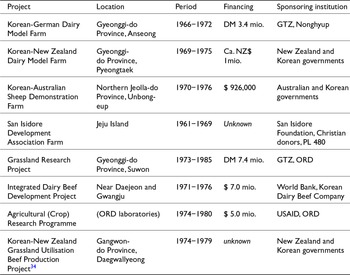
Throughout the 1960s and 1970s, multiple global actors contributed to the transfer of knowledge, technology, and cattle to the Korean countryside (Table 2). With the proclamation of the first development decade (1960–1970) by the UN, international attention towards rural development increased. At the same time, the Park government started to diversify its donor palette due to a lower American budget by forging new alliances with countries such as Japan and West Germany, who took over a greater share of technical cooperation.Footnote 38 Especially in the agricultural sector, diverse donor organizations and experts assumed a central role: the first five-year economic plan (1962–1966) aimed to import around 1,000 dairy cows to Korea every year, but this was barely achieved due to high costs. As early as 1965, the Korean government then concluded a contract with the Canadian government for the delivery of 1,600 Holstein dairy cows, worth around $1 million, as part of a financial cooperation project.Footnote 39 In a follow-up agreement from 1967, Canada also agreed to provide further technical support for crossbreeding and grassland research as well as the training of Korean farmers and the dispatch of Canadian agricultural scientists. Between 1966 and 1968 another 760 dairy cows were imported using Japanese reparation funds. International donor countries therefore first contributed to the quantitative increase of cattle in Korea. By the end of the 1970s, a total of 30,000 Holstein cows had been imported through different funding sources and became the dominant breed in the dairy sector.Footnote 40 This massive import of Holstein cows highlights the altered ideal of a ‘modern’ cow versus the local Korean cow (hanu). In 1966, the Korean Holstein Registration Association was established—and later expanded to a more general livestock registration unit—to keep accounts of the imported and domestically (cross-bred) born Holstein cows. Korean agriculturalists mentioned the milk quantity as the main reason for the continuous import and breeding of Holstein cows and seemingly favoured the foreign breed over local cows.Footnote 41 The import of Holstein cows can be considered a major paradigm shift for the Korean countryside alongside crossbred pine tree species, diesel trucks, and fertilizers.Footnote 42 Within only two decades, Holstein cows had essentially changed farming practices, veterinary care, and extension services.
Technical cooperation projects in the dairy and grassland sector

Table 2 Long description
The table lists eight technical cooperation projects related to dairy, beef, sheep, and grassland work in South Korea, giving each project’s location, time period, financing amount, and sponsoring institutions. Projects span from 1961 to 1985, with most starting in the late 1960s or 1970s. Funding varies widely: the Grassland Research Project in Suwon has the highest stated amount at 7.4 million Deutsche marks, while the Integrated Dairy Beef Development Project is listed at 7.0 million dollars and the Agricultural Crop Research Programme at 5.0 million dollars. Smaller stated budgets include 3.4 million Deutsche marks for the Korean German dairy model farm, about 1 million New Zealand dollars for the Korean New Zealand dairy model farm, and 926,000 dollars for the Korean Australian sheep demonstration farm. Two projects have financing recorded as unknown, including the San Isidore farm on Jeju Island and the Korean New Zealand grassland utilisation beef production project in Gangwon province. Sponsorship is international and mixed, involving GTZ, USAID, the World Bank, national governments, and Korean partner organizations. Comparisons across projects are limited because amounts are reported in different currencies and some entries lack funding figures.
The contract for the German-Korean dairy farm in Anseong in 1967 marked the first technical cooperation project in this sector. Possibly due to the delays in delivery by the Canadian government and the postponed start of the German-Korean project, similar agreements were concluded with the New Zealand and Australian governments during a state visit by President Park Chung Hee in August 1968. The governments agreed upon cooperation in technology transfer and training in the dairy sector. One year later, in November 1969, the government of New Zealand sent 100 Friesian cows for the bilateral model farm founded in Pyongtaek in vicinity of the German-Korean farm. Together with the Livestock Breeding Institute in Seonghwan, the three farms formed the ‘dairy triangle’ (nangnong samgakchi) in counties outside the greater Seoul area, where most dairy farms and milk processing infrastructure had been located so far.Footnote 43 The Australian government, however, focused on sheep farming: after already sending 200 Merino sheep to Jeju-do in 1962 as part of the Colombo Plan, both governments founded a model farm in Unbong, Gangwon-do, for which 2,500 Australian sheep and two Kelpie sheep dogs were shipped to Korea in June 1972.Footnote 44 All three bilateral projects utilized the model farm for the dissemination of practical knowledge to farmers in their surroundings, which underlines the important role it played in development politics at the time.
Apart from the bilateral projects, there was additional educational training by the Denmark-Korea Society for dairy farmers and agricultural scientists during the mid-1960s. According to the newspaper Chosun Ilbo, more than 40 agriculture students were able to study dairy farming for one year at Danish farms and research centres. The Danish supervisor hoped that his students would contribute to the establishment of dairy farming in rural Korea after their return.Footnote 45 Konkuk University’s College of Livestock Agriculture in particular sent students to short-term programmes in dairy farming management to partner universities in Japan and Denmark.Footnote 46 Besides, through the Minnesota Project at Seoul National University and the West German project at Korea University’s College of Agriculture, a new generation of academic researchers in livestock and food sciences was trained and further contributed to the establishment of scientific dairy farming.Footnote 47 Further exchanges also unfolded on the local level through the support of Nonghyup, for example, in the region of Anseong, to ‘create a Korean Denmark’.Footnote 48 This underlines once again the conflicting ideas around rural development that spanned different technical and educational projects, which were not only led by the United States, as the Korean actors instead actively sought transnational collaborations and chose from a variety of donors to best fit their needs.
While bilateral assistance contributed to expanding the technical expertise and therefore qualitative aspects, large-scale financial loans by international organizations contributed to the quantitative component. In 1968, the Korean government applied for a loan from the International Bank for Reconstruction and Development (IBRD) for over $9.8 million to import further dairy cows. This went hand in hand with a shift in IBRD internal policies to expand into sectors such as agriculture as part of a more comprehensive strategy against poverty in the rural areas.Footnote 49 For the feasibility study, a Japanese agricultural expert assessed the project and compared the development of Korean dairy farming with the situation in Japan in the 1950s. Consequently, a 12-member group from the Japanese International Cooperation Agency (JICA) produced a more detailed report on behalf of the IBRD in 1969. Thereafter, loans were granted under the Integrated Dairy Development Project, and the Korean government was able to import a total of 5,000 more dairy cows. In 1976, the IBRD loan was renewed and a further 4,800 dairy cows were shipped to Korea.Footnote 50 Apart from the cow imports, processing plants for baby-milk powder and milk sterilization as well as milk collection centres were built with the loans.Footnote 51 Through the IBRD loans, the Korean government was able to become more independent from individual donors. While the bilateral projects had focused mostly on farming, the loans also meant additional resources to develop technology in milk processing. Milk was in fact a complex ‘modern’ product that needed not only agricultural but also industrial and scientific expertise.
Lastly, not only the government, but also missionaries were active in the livestock farming sector. On Jeju-do, the so-called ‘pioneer farms’ around the San Isodore Development Association Farm, which was originally founded by the Irish missionary Patrick J. McGlinchey in 1961, used the lower mountainous regions of Halla-san to create pasture for cattle farming.Footnote 52 In Goesan county, Chungcheongbuk-do, American missionaries, the non-governmental organization Oxfam, and the Korean Catholic Farmers Movement provided financial support for livestock farming by setting up cooperatives.Footnote 53 On the one hand, these projects had a similar trajectory to the government projects with model farms, cattle, and grassland to ‘develop frontiers’. On the other hand, the cooperatives show a different approach to the market economy-oriented dairy farming or government-controlled cooperatives in the bilateral projects. All in all, this section shows the increasing globalization of actors in the Korean dairy and grassland sectors, who conducted their projects individually, but eventually also collaborated (see also the section Transnational cooperation and negotiations between the scientists below).
‘Happy cows’ in Anseong: The German-Korean dairy farm
The first bilateral model farm, namely the German-Korean dairy farm, dated back to the state visit of President Park to Germany in 1964.Footnote 54 The two governments had signed a protocol on economic and technical assistance in 1961, with the first bilateral projects being a vocational school in Incheon and an economic advisory group.Footnote 55 The model farm project fitted into the early German development policy of small-scale investment with an expected multiplier effect. It also followed the principles of funding a specific project based on the recipient government’s requests without including a further commitment to buy German equipment.Footnote 56 In 1966, the first expert visit took place and the dairy farm project was officially agreed upon in March 1967 during the state visit of German President Heinrich Lübke, who, as an agricultural economist and former minister of agriculture, had a personal interest in this sector.Footnote 57 Although a German consultant was sent to Korea in the same year to prepare the establishment of the farm, the official start of the project was delayed by several months due to problems in signing the contract, the illness of the German consultant, and the so-called ‘East Berlin spy ring affair’.Footnote 58 In October 1968, both sides eventually decided to resume the project and the inauguration ceremony took place a year later in the presence of President Park, various Korean ministers, the German ambassador, and an audience of locals.Footnote 59
As outlined in the introduction, the German government had an interest in supporting dairy farming as experts considered agriculture to be an important field for ‘balanced’ economic development. The expansion of ‘German’ knowledge, machines, and cattle was considered a form of soft power in the earlier development phase. From 1969 onwards the German government provided machinery and equipment for the project and sent a total of four consultants, an agricultural machinery fitter, two agricultural engineers, and a veterinarian, while the Korean government took on the construction of the buildings, purchased a large area of land in Anseong, and dispatched a farm director. In addition, 100 milk cows were shipped in from Canada in 1969 at German expense. In the preliminary discussions and project reports, the German side, including government advisers and cattle breeder associations, favoured a delivery from Germany to ‘open export markets for German cattle’. However, the long delivery time and a possible transmission of hoof-and-mouth disease (HMD) engendered strong criticism; for example, a report by an American rural adviser stated that ‘no country in the world in its right mind would consider importing cattle from that area’.Footnote 60 The Korean side, on the other hand, opposed a delivery from Japan for quality as well as economic reasons, so Canada was ultimately chosen, as Canadian Holstein cows were regarded as potent milk producers. The first cattle for the model farm was a delivery of 3,340 cows at the port of Busan in February 1969.Footnote 61 Although a newspaper article in Koreana euphemistically labelled the cattle ‘happy cows’, the over 5,000 mile trip from Canada to Korea, the two-week quarantine, and another 200 mile trip from Busan to Anseong meant significant stress for the cows. According to the German veterinarian, the transport of five cows in one box and ‘repeated on- and off-loading posed a burden’, with the result that eight of the hundred cows arrived with a disease.Footnote 62
As the name suggests, the aim of the project was to establish a model dairy farm, which would serve as a role model for the local farmers and support them in dairy farming techniques. Fields for grass, grain, maize, and cabbage were initially laid out in the allocated project area, which were cultivated twice a year for fodder production. In addition, a building complex consisting of a dairy cattle barn, residential buildings, tool sheds, and feed storage silos was constructed.Footnote 63 The advisers thus attempted to transplant an ‘imagined’ German landscape to Gyeonggi-do. On the model farm, machine milking, silage, regular weighing of the cows, milk fat determination, and ear tagging were introduced as new practices in Korea, as neither the machines required, nor the operating techniques were available at the time. The model farm therefore actively promoted a link between transnational science, technology, and livestock agriculture, which had been practised in Germany since the interwar years at academic institutions and by commercial breeders.Footnote 64 It also served as a place of training for the dairy farmers from the surrounding province of Gyeonggi-do: seminar topics included winter barn management, milk treatment, hoof care, calf rearing, and haymaking. Many new dairy farmers had to deal with veterinary problems by themselves, for example, foot rot or parasites, so the seminars provided them with practical knowledge.Footnote 65 According to one report, up to 400 farmers participated in the seminars each year. In addition, from the end of 1969, around 20 trainees per year were given ten-month courses in dairy farming. Most of them subsequently found employment on farms in the region or eventually established their own farms.Footnote 66 The German advisers gave lectures, for example, at the Agricultural College in Anseong (today Hankyong National University) on agricultural practices and dairy farming in Germany.Footnote 67 The farm, which was supported by the government of New Zealand, followed a similar approach in educating local farmers through workshops and lectures, with a total of 2,874 farmers being trained there between 1971 and 1980.Footnote 68
The project also addressed two other major issues for dairy farming: insemination and milk processing. First, the farm managers conducted trials for crossbreeding by inseminating the Holstein cows with deep-frozen ‘imported bull sperm from Germany’, which did not lead to successful pregnancies in all cases possibly because of the long transportation routes. At the same time, the German veterinarian evaluated Korean bull sperm to be of lower quality due to deficient soil fertility and considered that there was a need for a period of adaptation for the dairy cows to the Korean climate and soil.Footnote 69 This trial-and-error method shows how the cows as well as the model farm in general could not just be exported to different parts of the world as easily as imagined. It also mirrored the transformation of the farm into a clinic, with the increase of veterinary interventions in cattle breeding that had unfolded in Western Europe since the 1930s. In the long term this impacted the understanding of the bovine bodies merely as milk producers and a shift towards productivity-oriented agriculture.Footnote 70
Secondly, after the milk production, further processing and transportation to the consumers were needed. The West German government subsequently supported the development of dairies through various loans as part of its financial cooperation. The dairy projects that were set up in the Seoul area included further training and education for employees in Germany, for example, for five employees in the areas of drinking milk, powdered milk, butter, cheese, and ice cream. The project team also supported the dairy farmers in the area with the necessary equipment to store, transport, and process the milk.Footnote 71 Due to the interconnectedness of agriculture, technology, and food science in the dairy industry, supporting only the farming part was not sufficient and a more holistic approach was called for. The IBRD project’s so-called ‘integrated’ dairy development underlined a similar approach, and provided support in different areas, from cattle import to dairy processing. Thus, the bilateral project stood in the broader context of rural development and contributed to the enhancement of ‘dairy infrastructure’, for example, faster transport of fresh milk on the newly built Gyeongbu Highway.Footnote 72
In the final report, the last remaining project employee emphasized the farm’s model effect and quantitative success. In particular, livestock population and the amount of milk produced had increased significantly over the course of the project.Footnote 73 The project had a direct influence on the development of dairy farming in the Gyeonggi-do Province, which to this day is the region with the highest milk production.Footnote 74 Rather than introducing typically ‘German’ dairy practices, as the German bureaucrats and scientists had previously imagined, together with the other development projects, they contributed to a general modernization of dairy farming and introduced new technical and scientific approaches, particularly in the project region.Footnote 75 Neither the cattle, nor farm management practices could be exported that easily but needed to be adapted to the local context.
The farm was handed over to the Korean project partner Nonghyup in 1971. A follow-up report from 1973 showed that over 100 new calves were born in the meantime and milk production had increased to 4,900kg per cow. The Korean farmers now in charge planned to raise the total amount of milk-producing cattle to 200 and build another stable, as they seemingly favoured the ‘green factory’ approach mentioned above. During the 1980s, the farm was also used to demonstrate the breeding of Korean beef cattle (hanu), which underlines the interconnection of the dairy and beef industries. While the promotion of hanu had already started under the Park administration, throughout the project itself the practical focus remained on dairy, rather than beef production.Footnote 76 Although domestic beef production may have been the long-term goal, milk provided a more short-term return for smallholders and needed less investment. After different uses in the years that followed, the former farm today serves as Nonghyup’s training centre and a leisure park with the name Anseong Farmland.Footnote 77
Korean hillsides as laboratory: The grassland research project
During the grassland project, the Korean hillsides emerged as key sites for transnational scientific experiments, reflecting how environments were incorporated in the co-production of knowledge and transformed into Cold War laboratories. With the implementation of the dairy farming project, the lack of ‘sound scientific research on grasslands’ was noticed. The head of the ORD, Kim Inhwan, therefore requested support from the German government for the establishment of an experimental station for grassland farming and forage production. The ORD planned to further promote cattle production, as the officials expected a growing demand for milk and meat products over the following years. The German side also saw the continuous cooperation as an important step to achieving a more profound influence on the development of dairy (and beef) farming in Korea.Footnote 78 The Korean application coincided with drafts for the third five-year plan (1972–1976), that would, among other topics, focus on introducing improved agricultural technology. At the yearly international donor meetings, new project proposals were often connected to the Korean government’s economic plans, which might have been the decisive factor for the German side to support funding this over other projects.Footnote 79
The new project pursued three main purposes: first, to increase beef and milk production; secondly, to increase the income of farmers, that is, the rural population; and thirdly, to create ‘useful’ land in mountainous regions and thereby prevent soil erosion. Both sides planned to expand research into grassland and its use in fodder production.Footnote 80 In accordance with the official agreement from 1972, the German side initially sent two agricultural scientists, both with doctoral degrees, and two experimental technicians with expertise in grassland farming, as well as equipment for the chemical laboratory and field studies to Korea.Footnote 81 In his speech at the opening ceremony in May 1975, the German ambassador emphasized the combination of traditional livestock farming with modern science and technology within the framework of the project,Footnote 82 underlining the often complex entanglements of existing and newly introduced practices.
The project, which ran from 1973 to its provisional conclusion in 1985, can be divided into two main phases. While the first phase (1973–1979) mainly focused on basic research, the second phase (1980–1985) involved the practical application of the research results on site. After the official conclusion of the project in 1985, bilateral cooperation was continued until 1993 by a former Korean project member who had completed his doctorate in Germany.Footnote 83 German expenditure on the project amounted to DM 7.4 million, of which around 55 per cent was spent on personnel and 25 per cent on technical equipment. In addition, the German government supported seven Korean doctoral students at universities in Germany through scholarships and 17 ORD officials on short-term training programmes. Areas of this training included grassland use, fodder production, plant breeding, seed production, and fodder conservation. During the same period, the Korean government contributed up to ₩ 4.8 trillion for buildings and counterpart costs.Footnote 84
In the first phase, three research stations were set up in Suwon, on Mount Daegwallyeong, and on Jeju-do. The ODR already had test stations at a total of eight different locations across the country, of which the three mentioned were selected for the project so as to cover the most important ecological and climatic regions on the Korean peninsula.Footnote 85 The German and Korean scientists conducted joint studies at these stations to select grass varieties, which corresponded to the Korean climatic conditions with its hot, humid summers and cold winters. Grass varieties from central Europe, such as German ryegrass, meadow fescue, and cocksfoot, could not survive the cold winters. Instead, the researchers considered timothy grass, tall fescue, and birds foot trefoil as possible grass varieties.Footnote 86 Previously, Korean farmers-cum-scientists had conducted trials with a modified version of tall fescue (Kentucky 31), Korean lespedeza, and orchard grass, so the project could built on these earlier studies.Footnote 87 As argued below, Korean scientists at the time collaborated with the advisers from the transnational projects and introduced them to the ongoing research processes. After his return to Germany, grassland scientist F. Mühlschlegel obtained his doctorate at the TU Munich with a comparative study on the yield formation and feed value of two grass varieties in Korea and Germany, underlining the benefits of this transnational research collaboration for individual researchers’ careers.Footnote 88
The team also conducted a comprehensive grassland survey on the use of forest and field areas (imya) in mountainous regions.Footnote 89 The criteria considered in the study were slopes (up to 24°), plot size (greater than 5ha), remoteness from residential areas, soil conditions, and wood cover, among others. Grassland researcher Peter Weinberger and his team finally concluded that 540,000ha of the 6.57 million ha of forest and field areas were suitable for grassland development.Footnote 90 The farmers could purchase this ‘wasteland’ for a low price and develop a small dairy farm or later utilize it for other livestock, as some successful examples in the magazine Korean Dairy (hanguk nangnong) show.Footnote 91 Moreover, fertilization was a controversial part of research in the project. While one researcher emphasized the necessity of fertilizing with nitrogen, phosphorus, and potassium, as the soils on slopes had a low pH value and were poor in nutrients, another expert pointed out that the type and quantity of fertilization should be critically examined. His considerations focused not on the potential environmental problems, but on the difficulties that Korean farmers would have in carrying out such fertilization.Footnote 92 This stresses the importance of the ‘green revolution’ discourse and practices in the Korean countryside distributed through state-organized campaigns, agricultural cooperatives, and transnational development projects, which operated independently of the American-led endeavours. The Korean case reconfirms how the ‘green revolution’ can be understood as a global phenomenon, initiated by the United States, but eventually propagated by different actors around the world.Footnote 93
The project underlined an understanding of scientific research as a form of replication rather than experiments for new agricultural techniques. Thus, the second project phase mainly focused on the application of results through so-called ‘demonstration farms’. During the first phase, the German consultants realized that their research would mostly find resonance in larger farms, which did not correspond to the original goal of increasing income for the general rural population.Footnote 94 Therefore, the scientists selected small- and medium-sized farms for demonstration purposes and modified their research results to better align with the needs of the farmers. In 1978, they initially selected two farms in the counties of Hwanggye-ri, Gyeongsangnam-do, and Nae-ri, Gyeonggi-do. Over time, the number of demonstration farms increased to a total of eight, mainly at the request of the ORD to operate one in each province. In addition, demonstration plots for forage crops and demonstration fences for pasture farming were set up in other places, mostly near ORD branches, to make it easier for farmers to replicate them.Footnote 95 The experience gained in the previous project—the Anseong model farm—thus found application in other regional and ecological contexts. Here local knowledge and the diversity of social, cultural, and ecological factors were downplayed.
A detailed report for the farm in Nae-ri addressed different issues, ranging from infrastructure, to climate, land use, fodder production and animal husbandry to milk production, and calculated the cost-benefit factor. The farmer planted the grass varieties and used the fertilizers that had been selected by the Korean and German scientists. He also followed a prespecified grazing cycle with daily rotations of his nine Friesian dairy cows, which were milked twice a day. Each cow produced an average of 4,179kg milk per year and additionally calves were sold as ‘by-products’, enabling the farm to earn on average ₩ 1 million, at a time when the annual income of a blue-collar worker in the textile industry amounted to circa ₩ 250,000, making dairy farming a relatively profitable occupation at the time. As part of the project, the farmer was initially supported with machinery, fertilizer, and the construction of a silo. At the same time, he had to bear ongoing costs for labour, fertilizer, grass seeds, and the loan interest for his cattle, as well as one-off costs for a pasture fence and purchasing additional machinery, which were estimated at an annual expenditure of around ₩ 740,000, enabling him to generate a total profit of 26.5 per cent.Footnote 96 The demonstration farms not only tested the research results, but also held various training courses and seminars, similar to the bilateral model farms earlier. Brochures and information reports were distributed, for example, methods for planting the grass seeds were illustrated with small drawings or pictures.Footnote 97 The ORD had already used consultants to disseminate new techniques in dairy farming, but they were only trained as animal breeders and had little experience with grassland. After attending the workshop, they were able to advise local farmers. In total, around 50 ORD advisers received further training as part of the project, 24 pilot farms were directly or indirectly supported, and 2,000 farmers participated in seminars and training courses on dairy farming topics.Footnote 98
Opinions on the success of the demonstration farms among the German experts differed. They saw direct positive effects in the areas surrounding the demonstration farms. Korean farmers began to fertilize grassland and erect pasture fences.Footnote 99 At the same time, pasture farming was not widespread in Korea and there was an ongoing lack of practical experience and the necessary machinery and fertilizers to set up pastures. The erection of fences also required major investments, which in turn oftentimes required loans. Although the Korean government supported dairy farming, this support was not sufficient for smaller farmers and the granting of loans also caused difficulties.Footnote 100 The project could not solve the smallholders’ most pressing problems. For example, the remote mountain regions often lacked the necessary infrastructure for dairy farming and milk processing, such as insemination stations or a milk monitoring system. In many cases, it would have made more sense for smaller farmers to form cooperatives, as rural sociologist Yoo Duck-Ki pointed out in his doctoral thesis. Based on surveys, he is also rather critical of the advisory services involved in the project, as the rolling out of new technologies into existing structures often caused difficulties for farmers.Footnote 101 The grassland experts had focused on the replicability of their research results—the grass seeds and milk cows—but had instead disregarded the social structures of the rural villages.
Transnational cooperation and negotiations between the scientists
The projects were not limited to the local sites of Anseong and Suwon but were closely connected to global research through institutional and personal networks. In the words of Bruno Latour, it is therefore necessary to ‘redistribute the local’ and contextualize the two projects and their actors from a transnational perspective.Footnote 102 During the project period, close cooperation was maintained with various research institutions in Germany and Korea, including the Faculty of Agriculture at Seoul National University, the German Federal Research Centre for Agriculture (now the Thünen Institute) in Braunschweig, and the University of Hohenheim.Footnote 103 As experts and short-term consultants, various German professors, researchers, and practitioners visited Korea to give lectures or seminars, to assess and advise on the project, but also to prepare studies on Korean agricultural policy in general. In 1978, for example, three German professors prepared expert reports on the topics of smallholder farming, grassland management, and fertilization.Footnote 104
Exchanges also took place with other countries in the region, such as Japan and New Zealand. For example, Korean and German grassland experts undertook an informational trip to Hokkaido to study the seed production of forage plants.Footnote 105 The German scientists requested information from a colleague located in Japan about his experiences there, meaning the project closely monitored the situation in neighbouring countries.Footnote 106 As the German government had already carried out similar projects on fertilization methods in other countries, for example, in Brazil through liming, they suggested transferring the research results.Footnote 107 This underpins how bilateral research cooperation was a constant part of a transnational network. The Thai-German Dairy Project in Chiang Mai in particular became a successful model in the region, and it exchanged personnel and research results with other projects across Asia.Footnote 108 Examining the German dairy projects in Thailand and Korea together foregrounds the transnational circulation of development knowledge and expertise across Cold War Asia. German development actors seemingly saw knowledge not as place based, but as portable from one country to another, while cultural or social differences were subsumed under a generalized modernization paradigm.Footnote 109 This perspective complements recent work on Cold War South-South cooperation by showing how German-led projects nevertheless generated intra-Asian circuits of expertise that complicate superpower-centred models of development.
The other dairy and grassland projects in Korea also cooperated closely. For example, German and New Zealand experts planned joint training for Korean experts in New Zealand in the early 1980s, which was ultimately cancelled due to the political situation in Korea.Footnote 110 On the initiative of one FAO consultant, a Grassland Working Group was set up as early as 1972. Next to the German consultants, the project leader of the New Zealand dairy farm and the Australian sheep farm, as well as experts from the UNDP, IBRD, and FAO projects and Korean professors from the SNU Faculty of Agriculture participated. The group organized scientific conferences and field visits.Footnote 111 In 1977, the Korean Grassland and Forage Research Society (han’guk ch’ojija saryo hak’oe) was founded based on this group and continues its research activities to this day.Footnote 112 Many project-related articles also appeared in the Journal of the Korean Society of Grassland and Forage Science (han’guk ch’ojijo saryo hak’oeji), which was founded in 1978 and benefitted from this exchange, as well as the magazine Korean Dairy, which targeted local farmers. In the latter, the farmers also had the chance to interact with the scientists through experience reports and comments on their suggestions.Footnote 113
For the Korean scientists at the ORD, the projects also offered the opportunity for research experience abroad at a time when travelling was highly restricted by their government. Many of them completed training programmes in Germany. Some were also able to complete doctoral studies with the help of scholarships from the German Academic Exchange Service (DAAD) organized through the project. The short-term training programmes in Germany took place in various geographical regions (especially the foothills of the Alps, the Rhön, and the North German Plain) and were divided into three phases: theoretical introduction, visits and inspections, and evaluation.Footnote 114 The Korean officials and scientists generally rated their training in Germany as a positive experience. In an interview, Hwang Sŏkchung, a grassland researcher with a doctorate from the University of Giessen, remembers the ongoing exchanges with German colleagues after his return to the ORD in 1983.Footnote 115 Six other Korean counterparts completed a doctorate in Germany and after their return, some, like Hwang, continued to work in the ORD’s forage department, but others also moved to universities or worked in private enterprises.Footnote 116 As in the previously mentioned university cooperation projects, the international grassland initiatives, whether German, New Zealand, or Australian, contributed to the formation of a new generation of researchers.
However, the grassland research project also revealed problems in the cooperation between the transnational partners, for example, communication was hardly possible in English. The German project manager stated: ‘This may sometimes be sufficient when it comes to teaching purely technical skills. When discussing scientific issues […] this obstacle takes on serious significance.’Footnote 117 Social and cultural differences caused further problems. It was difficult for the female German lab assistant to give advice to her male Korean counterparts because of their gender bias towards female scientists.Footnote 118 Lastly, the Korean and German scientists had to negotiate the allocation of tasks, as Korean scientists oftentimes only ‘assisted’ and followed the German lead, although they had to take over the research eventually. In this context, they also referred to the problem of ‘mission consciousness’, as many scientists had the attitude that ‘the world should be built after the German model’—a mindset more and more criticized in development cooperation during the 1980s.Footnote 119 This underlined the frictions that resulted from the unequal relationship between the actors, language barriers, and cultural differences within the project, as has been outlined for other technical assistance projects in the context of Cold War knowledge transfer.Footnote 120
Conclusion
Under the Park government, dairy agriculture, grassland cultivation, and milk-product consumption in South Korea increased immensely. While the prevailing discourse at the time portrayed it as part of ‘modern agriculture’, the government fostered dairy and grassland agriculture through various policies, companies promoted dairy products, and agricultural and nutritional scientists conducted research on ‘model farms’ and in laboratories. At the same time, different development cooperation projects played an important role by providing cattle, practical knowledge, and technical equipment, from which Korean counterparts could actively choose. Under the Cold War framework, not only the superpowers such as the United States, but different small- and medium-sized donor countries of the Western bloc supported the introduction of dairy and grassland agriculture in South Korea. The Korean environment, its hillsides, and villages became much sought-after sites for these transnational and collaborative rural development and modernization efforts. With the different actors involved, rural development under the American Cold War hegemony—such as the ‘green revolution’—were further diversified, although the general ideas around scientific, mechanized, and chemical fertilizer-based agriculture remained prevalent. Cold War agriculturalists considered science and technology not as place-based but ‘portable’ and took it out of their social, cultural, and ecological context. At the same time Korean bureaucrats and scientists showed agency in choosing the knowledge, broadly understood, and deciding about its application.
Through the Korean-German dairy farm, practical know-how such as milking techniques, ear tagging, or insemination were discussed, tested, and adapted to the Korean context. On a small scale, the project trained dairy farmers in the region of Gyeonggi-do. Even though the export of German cattle and ‘German-style’ dairy farming practices was the original motivation, both sides quickly realized the difficulties this would bring and adapted it over the course of the project. Nevertheless, the two governments continued to cooperate with the grassland research project, which they considered a logical continuation due to the increasing demand for dairy and beef. While the project first and foremost focused on research, the second phase also included an application component with demonstration farms. The German and Korean scientists conducted field studies on grass varieties and an overall grassland survey. Here, too, they quickly realized that German grass varieties did not fit the climatic conditions of Korea and they had to adapt their experiments. Together with the other transnational projects, their research turned the Korean hillsides into laboratories of scientific selection and hybridization of grass varieties. Eventually, this led to the establishment of the Korean Grassland Research Society, which exists as a Cold War remnant to this day. The demonstration farms, on the other hand, focused on the training of smallholders and considered especially their economic situation, even though they could not solve related problems regarding loans or the infrastructure for milk production, which would have required a cooperative approach.
Together with the Korean actors, the transnational cooperation projects transferred not only cattle, but also co-produced practical and technological knowledge of dairy and grassland agriculture in the Korean countryside, which shaped both its environment and consumption patterns long term. The article connects to the colonial cattle discourse, showcasing its continuity during the Cold War under the framework of rural development. It also highlighted how donor countries such as Germany, Denmark, and Japan followed different trajectories of modernization in the Korean countryside. Future research could elaborate on the possible resistance against the new diet—for example, due to lactose intolerance—and the reception or rejection of the agricultural practices from the farmers’ perspective by incorporating diaries and other ego-documents.
Acknowledgements
While originally a part of my PhD research, I considerably reworked the subject for this article with new materials and a different analytical framework. The researchers at Nonghyup’s Anseong Farmland and the Korean National Institute of Animal Science fortunately provided me with additional materials. I also thank Albert L. Park, Fynn Holm, and Jaeyoung Ha for reading and commenting on earlier drafts of this article. Lastly, I am grateful for the feedback and guidance provided by the anonymous reviewers and the editors of this journal.
Competing interests
The author declares none.



 Open access

