

Introduction
Classic studies argue that democracy does a better job than autocracy in adopting redistributive policy decisions and reducing income inequality. Democracy, in fact, allows poor median voters to influence redistributive policies (Meltzer and Richard, Reference Meltzer and Richard1981; Przeworski et al., Reference Przeworski, Alvarez, Cheibub and Limongi2000) and provides all citizens with the opportunity to participate and potentially contest governmental decisions (Muller, Reference Muller1988; Acemoglu and Robinson, Reference Acemoglu and Robinson2000). In some cases, equality is even understood as an intrinsic characteristic of democracy (Coppedge et al., Reference Coppedge, Gerring, Altman, Bernhard, Fish, Hicken, Kroenig, Lindberg, McMann, Paxton, Semetko, Skaaning, Staton and Teorell2011). Nevertheless, no consistent pattern emerges from the empirical record on this topic. While some findings suggest that democracy reduces inequality (e.g. Rodrik, Reference Rodrik1999) or positively affects the well-being of individuals (e.g. Lake and Baum, Reference Lake and Baum2001), others indicate that democracy is not related to any improvements in inequality (e.g. Gradstein and Milanovic, Reference Gradstein and Milanovic2004; Acemoglu et al., Reference Acemoglu, Naidu, Restrepo and Robinson2015). Part of this inconclusiveness can be attributed to the fact that most studies on the nexus between democracy and inequality do not pay enough attention to the institutional difference in non-democratic contexts, and thus, with a few exceptions (e.g. Knutsen, Reference Knutsen2015; Cassani and Carbone, Reference Cassani and Carbone2016; Panaro, Reference Panaro2022), neglect heterogeneity among dictatorships.
Recent contributions in the literature on authoritarianism show that autocrats are not immune to redistributive pressures and that autocratic leaders also face incentives to adopt redistributive policies (Gallagher and Hanson, Reference Gallagher and Hanson2009; Knutsen and Rasmussen, Reference Knutsen and Rasmussen2018; Grünewald, Reference Grünewald2021). These works build on the assumption that autocracies are not all equal, but differ substantially in the way incumbents acquire and secure their positions in power (Hadenius and Teorell, Reference Hadenius and Teorell2007; Wahman et al., Reference Wahman, Teorell and Hadenius2013). In other words, different autocracies face different incentives to redistribute and curb inequality.
This article follows up and pushes forward this debate, adding a new lens of analysis to the study of income inequality in authoritarian regimes. Specifically, we shed light on the reasons why autocrats adopt redistributive policies and when redistributive policies effectively reduce inequality. Our argument proceeds as follows: first, we assume that autocrats' interest to adopt redistributive policies and curb income inequality depends on the redistributive pressures they face and the ability of the state to implement policy decisions aiming at reducing income inequality. Second, we argue that political institutions create a more favourable context for autocrats to adopt redistributive policies. Incumbents that acquire and maintain political power through competitive elections or with the support of a larger segment of the population face more redistributive pressures and have more incentives to curb inequality. Following this logic, we disentangle political institutions into formal (i.e. elections and party competition) and informal institutions (i.e. type and size of the ruling coalition) and classify autocracies into four regime types – monarchy, military, one-party, and multiparty – according to the presence of elections, the extent of party competition, and the type and size of the ruling coalition. We argue that elections expose the incumbents to an electoral risk, which in turn creates more incentives for them to address the well-being of citizens and tackle inequality. Hence, we expect one-party and multiparty regimes to have lower levels of income inequality than traditional monarchies and military regimes. We also assume that, among electoral autocracies, multiparty regimes have lower levels of income inequality than one-party regimes due to a more extensive party competition, which exposes incumbents to a higher risk of being overthrown. Additionally, we anticipate that the size of the ruling coalition impinges on the redistributive pressures that incumbents face. That is, autocrats ruling with the support of a bigger ruling coalition tend to pay attention to the well-being of a larger group of individuals and, consequently, have more incentives to suppress inequality. We then argue that military regimes redistribute more than monarchies due to a larger size of the ruling coalition.
Third, we contend that while formal and informal political institutions matter, they are not the only game in town that accounts for different levels of income inequality in autocracies. We posit that state capacity – defined as ‘the state's ability to accomplish its intended policy actions’ (Dincecco, Reference Dincecco2018: 2) – plays a key role in determining the effectiveness of redistributive policies in curbing inequality. Following this logic, we argue that authoritarian regimes characterized by higher levels of state capacity are associated with lower levels of inequality.
Our empirical analysis relies on a time-series cross-sectional (TSCS) dataset, which allows us to estimate the relationships among autocratic regime types, state capacity, and income inequality both over time and across countries in the world. We collect data on income inequality from the Standardized World Income Inequality Database (SWIID) Version 9.1 (Solt, Reference Solt2020). Since our focus is on policy outcomes rather than on the adoption of policy measures, we use a post-tax income inequality indicator. Therefore, we analyse the level of inequality in authoritarian regimes after redistribution. In the discussion of the results, we document a negative effect of political institutions on income inequality and elucidate the role of state capacity in determining successful policy outcomes.
Overall, our work speaks to several distinct strands of scholarship. First and most broadly, we address the literature studying the determinants of policy decisions and outcomes in authoritarian regimes. Our findings broaden the work that investigates the impact of political institutions on social policy decisions and outcomes (Bueno de Mesquita et al., Reference Bueno de Mesquita, Smith, Siverson and Morrow2003; Gandhi, Reference Gandhi2008; Teo, Reference Teo2021; Eibl, Reference Eibl2020; Pelke, Reference Pelke2020) and indicate that both formal and informal political institutions account for variations in inequality across authoritarian regimes. In doing so, we join scholars arguing that autocratic political institutions are not mere window dressing, but they shape incumbents' policy decisions and outcomes.
Second, our work speaks to the flourishing scholarship on the socioeconomic outcomes of an effective and capable state apparatus (Norris, Reference Norris2012; Rothstein et al., Reference Rothstein, Samanni and Teorell2012; Fortin-Rittberger, Reference Fortin-Rittberger2014; Seeberg, Reference Seeberg2014, Reference Seeberg2019; Hanson, Reference Hanson2015, Reference Hanson2018; D'Arcy and Nistotskaya, Reference D'Arcy and Nistotskaya2017; Asadullah and Savoia, Reference Asadullah and Savoia2018; Dincecco, Reference Dincecco2018) by showing that state capacity plays a key role in explaining different levels of income inequality in autocracies, even when controlling for political institutions. Specifically, our findings indicate that state capacity and political institutions independently account for distinct social outcomes.
This paper is organized as follows. In the first section, we build on previous research on political institutions in authoritarian regimes to elucidate on the role of formal and informal institutions in creating different incentives for autocrats to adopt redistributive policies. In the second section, we discuss the effect of state capacity in curbing inequality, while in the third section, we introduce a classification of authoritarian regime types with respect to our theoretical foundations and formulate our hypotheses. Then, we present the selected data and the empirical strategy in the fourth section. In the fifth section, we discuss the empirical findings. A concluding section sums up the results and analyses their implications for future research on inequality in authoritarian regimes.
Political institutions and income inequality
Over the past few years, comparative research on authoritarian regimes has provided extensive evidence on how political institutions affect regime stability (Gandhi and Przeworski, Reference Gandhi and Przeworski2007; Svolik, Reference Svolik2012; Wright and Escribà-Folch, Reference Wright and Escribà-Folch2012; Gandhi et al., Reference Gandhi, Noble and Svolik2020) and economic performance (Gandhi, Reference Gandhi2008; Wright, Reference Wright2008). We now know a lot about why autocrats establish institutions, such as elections and legislatures, and allow multi-party competition, as well as about their influence on political systems. Despite these advances, scant attention has been devoted to role of autocratic institutions on policy processes and outcomes (Williamson and Magaloni, Reference Williamson and Magaloni2020).
Formal institutions
According to the literature on electoral authoritarianism, some incumbents establish elections and allow multiparty competition in exchange for regime support (Schedler, Reference Schedler2006; Gandhi and Przeworski, Reference Gandhi and Przeworski2007; Gandhi, Reference Gandhi2008). These works demonstrate that elections and party competition constitute an inner characteristic of modern autocracy. Most recent contributions go even further by showing that formal political institutions also steer social policy decisions and influence inequality levels. Fails (Reference Fails2020), for instance, argues that electoral autocracies care more about citizens' well-being and are more likely than non-electoral regimes to adopt generous social assistance policies. Similarly, Teo (Reference Teo2021) posits that authoritarian regimes where the leader is selected through elections have lower levels of income inequality than closed regime types. Elections allow incumbents to acquire information about citizens' preferences and serve as a channel for citizens to express their dissent through the ballot box, instead of mobilizing against the regime (Gandhi and Przeworski, Reference Gandhi and Przeworski2007; Gandhi, Reference Gandhi2008). Hence, leaders in electoral autocracies face considerable pressure from opposition groups inside the political arena and, as a consequence, are more likely to adopt redistributive policies than leaders of non-electoral autocracies (Teo, Reference Teo2021). Additionally, both Teo (Reference Teo2021) and Pelke (Reference Pelke2020) highlight the effect of party institutionalization on socioeconomic redistribution levels. Particularly, Pelke (Reference Pelke2020) argues that party competition increases the electoral risk for the incumbent to be overthrown, and thus competitive multiparty regimes face more pressure to redistribute wealth and reduce inequality. Overall then, the aforementioned studies identify elections and parties as key determinants of policy decisions and levels of social and economic inequality in autocracies.
Informal institutions
In addition to formal institutions, authoritarian regimes extensively differ in the type and size of the coalition that support the autocrat. Some incumbents govern with the support of a large segment of individuals, while others rely on the support of a small group, such as a kin network or military junta. Built on empirical evidence and the Selectorate Theory, Bueno de Mesquita et al. (Reference Bueno de Mesquita, Smith, Siverson and Morrow2003) demonstrate that autocrats' decisions on the distribution of public and private goods depend on the size of the ruling coalition – the segment of the population that supports the leader – relative to the size of the selectorate – those who have a formal role in expressing a preference over the selection of the leader. In a political system characterized by a small winning coalition and a large selectorate, members of the winning coalitions have fewer incentives to defect and join opposition groups; thus, leaders prefer to distribute private goods over public ones. Several scholars have criticized the selectorate theory for its over-simplification (Kennedy, Reference Kennedy2009) and for being ‘a blunt tool to understand authoritarian politics’ (Gallagher and Hanson, Reference Gallagher and Hanson2015: 368). Despite these criticisms, recent works show that the type and size of the ruling coalition play an important role when studying the public–private goods mix in authoritarian contexts (Wong, Reference Wong2017; Pelke, Reference Pelke2020). Likewise, empirical studies demonstrate that autocracies in fact differ in terms of the type and size of ruling coalition. For instance, political leaders and bureaucrats that act as main policy actors in China's political system are all members of the Chinese Communist Party (Choi, Reference Choi2017), and their number is considerably higher than the number of main political actors in monarchies, such as Qatar and Bahrain, where most of the offices are taken by the Emir or King's family members (Kamrava, Reference Kamrava2009). Based on this evidence, we contend that also informal institutions – type and size of the ruling coalition – are likely to produce different incentives for dictators to adopt redistributive policies.
The role of state capacity
Thus far, we have discussed that autocracies are diverse in terms of political institutions, which in turn produce different incentives for leaders to redistribute. However, as the literature suggests, autocracies also vary in terms of the policy implementation ability of the state apparatus – in other words, state capacity (Seeberg, Reference Seeberg2014; Hanson, Reference Hanson2013, Reference Hanson2018). Specifically, cross-national empirical research shows that state capacity affects the durability of autocratic regimes (Hanson, Reference Hanson2018; Seeberg, Reference Seeberg2019), and is an important determinant of social and economic outcomes, such as economic growth (e.g. Dincecco and Katz, Reference Dincecco and Katz2016), poverty reduction (e.g. Asadullah and Savoia, Reference Asadullah and Savoia2018), welfare state spending (e.g. Rothstein et al., Reference Rothstein, Samanni and Teorell2012), and public goods provision (e.g. D'Arcy and Nistotskaya, Reference D'Arcy and Nistotskaya2017).
Hence, despite their key role in steering redistributive policy decisions, political institutions alone may not be sufficient to account for differences in regimes' social outcomes (Beramendi and Anderson, Reference Beramendi and Anderson2008; Teo, Reference Teo2021). As suggested by Norris (Reference Norris2012), more equal societies are determined by a combination of political institutions and a well-functioning state apparatus. Similarly, according to Albertus (Reference Albertus2015), ‘the ability to execute policy plays a key role in redistributive outcomes’ (p. 19).
Built on this evidence, we assume that, while formal and informal political institutions determine different redistributive pressures, income inequality also depends on the policy implementation ability of the state apparatus, namely state capacity. Thus, political institutions and state capacity need to be strengthened in parallel for effective development of human well-being.
Hypotheses
We use formal institutions – elections and party competition – and informal institutions – type and size of the ruling coalition – to classify autocracies into four regime types. Table 1 shows our classification.
Regime type classification based on formal and informal institutions

With regard to informal institutions, we divide authoritarian regimes into monarchies, military regimes, and electoral regimes. In monarchies, incumbents strongly rely on the support of family members and kin networks, which are small in terms of size. Leaders of military regimes instead are selected from the armed forces and rule with the support of officials or members of the military council. Leaders of military regimes thus need support from a larger ruling coalition than leaders of monarchies. Finally, leaders of electoral autocracies rely on the support of the members of the political party to ensure their position in power. Thus, electoral regime types are characterized by the largest ruling coalition, compared to monarchies and military regimes.
With regard to formal institutions, we divide autocracies into closed and electoral regime types according to the presence of elections. Then we further divide electoral autocracies into one-party and multiparty regimes according to the extent of party competition. In one-party regimes, all parties but one are forbidden (formally or de facto) from taking part in the elections. In these regimes, a single party dominates political competition. Multiparty regimes instead have de-jure parliamentary or presidential elections, in which some candidates are formally able to participate in the elections.
Ultimately, we posit that formal and informal political institutions create different incentives for incumbents to adopt redistributive policies and curb inequality. Incumbents in multiparty regimes govern with the support of a larger organization – such as a political party – than leaders in monarchies and military regimes. Therefore, incumbents in multiparty regimes face more pressures to redistribute than leaders in non-electoral regime types. Similar to multiparty autocracies, one-party regimes establish elections and govern with the support of members of a political party; however, in contrast to multiparty regimes, they do not allow party competition among political parties, and thus the electoral risk of being overthrown is lower than in multiparty regimes. Hence, we argue that leaders in one-party regimes have more incentives to curb inequality than leaders in monarchies and military regimes but less incentives than leaders in multiparty regimes. Finally, among non-electoral autocracies, the size of the ruling coalition is smaller in monarchies than in military regimes. Therefore, military regimes have fewer incentives to limit inequality than monarchies. Building on this logic, we elaborate the following hypotheses:
Hypothesis 1a: Multiparty regimes have lower levels of income inequality than other autocratic regimes.
Hypothesis 1b: One-party regimes have lower levels of income inequality than military regimes and monarchies but higher levels of income inequality than multiparty regimes.
Hypothesis 1c: Military regimes have lower levels of income inequality than monarchies, but higher levels of income inequality compared to one-party and multiparty regimes.
Hypothesis 1d: Monarchies have higher levels of income inequality than other autocratic regimes.
As previously discussed, the literature suggests that more equal societies are determined by a combination of political institutions and a well-functioning state apparatus (Norris, Reference Norris2012; Hanson, Reference Hanson2015). However, while some scholars argue that state capacity and political institutions work synergistically (e.g. Cronert and Hadenius, Reference Cronert and Hadenius2021), others indicate that state capacity improves health and education outcomes also in the absence of democratic institutions (e.g. Hanson, Reference Hanson2015). In the study at hand, we contend that political institutions and state capacity work independently to determine levels of income inequality. By definition, weak states lack in their ability to implement intended policies, and thus, all things being equal, countries with dysfunctional state institutions implement redistributive policies and tackle income inequality less effectively than countries with well-functioning, capable state institutions. In other words, we expect to find lower levels of inequality in regimes with higher state capacity, regardless of the type of political institutions.
Our argument builds on three important assumptions. First, the mechanisms through which political institutions and state capacity affect inequality are completely different. Political institutions create various pressures for the incumbent to address citizens' social needs, whereas state capacity reflects the state's ability to implement policy decisions effectively. If the former influences an autocrat's interest in adopting redistributive policies, the latter has a direct effect on inequality by determining the success of such policies.
Second, irrespective of the type of regime, state capacity remains a viable tool in the hands of autocrats. As Gallagher and Hanson (Reference Gallagher and Hanson2009) suggest, autocrats use both ‘carrots’ (i.e. social benefits) and ‘sticks’ (i.e. repressive measures) to deliver public goods and secure their own position in power. Repressive measures, however, are costly and not always effective (Wintrobe, Reference Wintrobe1998). Therefore, as argued by Lindvall and Teorell (Reference Lindvall and Teorell2016), ‘modern states rarely use large-scale violence’ (p. 16), but instead, prefer to use economic incentives and propaganda to govern their populations. Put differently, regardless of whether formal political institutions are set up or not, contemporary autocrats tend to rely on social benefits rather than repressive power to enhance support for the regime.
Third, if state capacity and political institutions would affect income inequality in tandem, authoritarian regime types should be systematically different from one another in terms of the level of state capacity. Nevertheless, as illustrated by the box plot in Figure 1, this is not the case. Over the last five decades, each of the four authoritarian regime types has included countries with high, low, and intermediate levels of state capacity. That is, countries with well-functioning, effective state institutions have been classified as multiparty regimes (e.g. Singapore 1972–2014), one-party regimes (e.g. Bulgaria 1972–89), military regimes (e.g. South Korea 1972–87), and monarchies (e.g. Qatar 1972–2014). Likewise, countries with dysfunctional institutions have been also classified as multiparty regimes (e.g. Somalia 2012–14), military regimes (e.g. Sierra Leone 1992–95), one-party regimes (e.g. Equatorial Guinea 1983–92), and monarchies (e.g. Ethiopia 1972–73).
State capacity in different authoritarian regime types (1972–2014).

In sum, we posit that state capacity allows incumbents to successfully implement redistributive policy decisions aimed at reducing inequality. Thus, authoritarian regimes characterized by the presence of a strong, capable state apparatus display lower levels of inequality than authoritarian regimes with a weak, dysfunctional state apparatus. Additionally, we argue that authoritarian regimes with higher levels of state capacity are better equipped to tackle income inequality, independently of regime type, because state capacity affects leadership's ability to implement policies under any kind of institutional design. Based on these arguments, the resulting hypothesis can be summed up as follows:
Hypothesis 2: The presence of a capable state apparatus reduces the level of inequality in authoritarian regimes, independently of the regime type.
Empirical analysis
Data and methods
In this section, we present the data and methods used to assess the relationships among political institutions, state capacity, and income inequality. The regression analysis is run with a TSCS dataset that includes all available country-years for countries that have been classified as autocratic according to Wahman et al.'s (Reference Wahman, Teorell and Hadenius2013) classification for more than 10 years from 1972 to 2014. This time span allows us to analyse the maximum number of common country-years available for our three main factors of interest: authoritarian regime types, state capacity, and income inequality. We argue that countries that have been autocratic for 10 years or less do not display stable autocratic political institutions, and thus are excluded from the sample. Nevertheless, to assess the robustness of our results, we also run the regression analysis with a broader ‘alternative’ sample, which includes all available country-years of countries that have been coded as autocratic at any time from 1972 to 2014. Importantly, since our study focuses only on authoritarian regimes, countries that have been classified as democracies throughout the period under investigation are excluded from the sample.
For many years, a lack of data has hindered research on social policy and income inequality in developing countries, many of which are autocracies (Forrat, Reference Forrat2012). Recently, however, comprehensive databases on inequality have been created, allowing for more robust comparative cross-national research on this topic. In the study at hand we rely on the SWIID, which is one of the most commonly used income inequality databases. The SWIID standardizes available inequality data collected from various sources and maximizes their cross-national comparability (Solt, Reference Solt2016). It covers ‘data provided by all of the major cross-national inequality databases, the national statistical offices of countries around the world, and dozens of scholarly articles’ (Solt, Reference Solt2016: 1271). Moreover, its sample covers more country-years than any other inequality database. For all these reasons, the SWIID seems to be the most appropriate database for the cross-national comparative purposes of our study.
To capture the level of income inequality in authoritarian regimes, we use the so-called ‘net-income inequality indicator’, which measures inequality after transfers and taxes. We use this variable because we are interested in levels of income inequality after redistribution. The variable ranges from 0 to 100, where a higher score indicates more income inequality, and a lower score indicates the opposite. Nonetheless, country scores are never at the two extremes, as a situation of perfect (in)equality is highly implausible.Footnote 1
To test our first hypotheses, we need to differentiate autocracies in different regime types according to the presence of formal and informal political institutions. To do so, we rely upon Wahman et al.'s Authoritarian Regime Dataset (Reference Wahman, Teorell and Hadenius2013), which classifies autocracies based on their institutional attributes, and thus, allows us to disentangle formal and informal political institutions in authoritarian regimes. In particular, we take into consideration four authoritarian regime types: monarchy, military, one-party, and multiparty. Under our theoretical framework, monarchies have the smallest ruling coalition, whereas multiparty regimes have the largest ruling coalition and the highest levels of party competition. Less frequent regime types that do not fit one of the four aforementioned categories are coded into a category named other. This category also includes countries that have been coded as democracies in certain years. We do not consider personalist regimes as a distinct regime type because personalism can be present in any type of regime and should not be considered a principal characteristic of any autocratic regime (Hadenius and Teorell, Reference Hadenius and Teorell2007).
To test our second hypothesis, we need an appropriate measure of state capacity. It is well known, however, that state capacity is not an easy concept to operationalize, because it is complex to empirically separate state capacity from a regime's organizational structures (Hanson, Reference Hanson2018). Many studies thus focus only on certain aspects of state capacity, such as the administrative dimension (Charron and Lapuente, Reference Charron and Lapuente2010), the coercive dimension (Albertus and Menaldo, Reference Albertus and Menaldo2012), or the fiscal dimension (Ricciuti et al., Reference Ricciuti, Savoia and Sen2019). To overcome this problem and take into account the multidimensionality of the concept, we use Hanson and Sigman's (Reference Hanson and Sigman2021) state capacity index. The index synthetizes 21 indicators that capture three fundamental dimensions of state capacity: administrative, extractive, and coercive capacity. In our main sample of country-years, the chosen index of state capacity ranges from −2.31 (low capacity) to 2.13 (high capacity) with a mean of −0.03 and a standard deviation of 0.73.
In addition to the dependent variable and the main predictors, our regressions take into account various potential confounding factors. First, several studies have demonstrated that economic development impinges on inequality (Persson and Tabellini, Reference Persson and Tabellini1994; Aghion et al., Reference Aghion, Caroli and García-Peñalosa1999; Barro, Reference Barro2000). Therefore, we control for GDP per capita (in constant 2010 US dollars). According to Kuznets's (Reference Kuznets1955) well-known theory, economic development has a non-linear effect on income inequality; thus, we also control for the GDP per capita squared term. Second, we control for a standard demographic variable, total population, because the sample includes countries that differ plenty in their population size, which in turn might influence the demand for state intervention and affect the results of our study. Third, many scholars have found that economic globalization influences a country's level of inequality (Krugman and Venables, Reference Krugman and Venables1995; Genschel, Reference Genschel2004). Hence, we control for trade openness, computed as the sum of imports and exports as a share of GDP. All these three control variables are collected from the World Development Indicators (World Bank, Reference World Bank2020).
Fourth, previous research has suggested that natural resource endowment affects the distribution of income in authoritarian contexts (Leamer et al., Reference Leamer, Maul, Rodriguez and Schott1999; Fum and Hodler, Reference Fum and Hodler2010; Parcero and Papyrakis, Reference Parcero and Papyrakis2016); therefore, when studying income inequality, it is reasonable to control for natural resource rents (World Bank, Reference World Bank2020), which we include in the full models. Fifth, we control for regime ideology, which is likely to affect the redistributive policy choices in a given country (see e.g. Pelke, Reference Pelke2020). We measure regime ideology as the orientation of the party of the chief executive with reference to economic policy, with an indicator taken from the Database of Political Institutions (Cruz et al., Reference Cruz, Keefer and Scartascini2021). We would expect left leaning leaders to adopt more redistributive policies than their right leaning counterparts. Sixth and last, we control for the balance of power among social classes through a measure from the Varieties of Democracy Dataset (Coppedge et al., Reference Coppedge, Gerring, Knutsen, Lindberg, Teorell, Altman, Bernhard, Fish, Glynn, Hicken, Lührmann, Marquardt, McMann, Paxton, Pemstein, Seim, Sigman, Skaaning, Staton, Cornell, Mechkova, Medzihorsky, Von Römer, Sundström, Tzelgov, Wang, Wig and Ziblatt2020). If rich people have more political power than poor people, or if poor people have no political power at all, we would expect redistributive demands to be lower than in a situation where political power is equally distributed among social classes.
Model specification
We run a series of ordinary least squares (OLS) regressions to assess the validity of our hypotheses. A major problem in using OLS regressions with TSCS data is related to temporal dynamics in the error term. As Beck and Katz (Reference Beck and Katz1995) suggest, we consider lagging the dependent variable in our models to avoid problems of serial correlation. To this end, we conduct Cumby–Huizinga tests to ensure the correct specification of the lag structure in our models. The tests suggest that serial correlation is not eliminated by adding a single lag of the dependent variable on the right-hand side of the regression equation. Instead, the inclusion of a second lag of the dependent variable drastically reduces the amount of serial correlation in the residuals, whereas other lagged-dependent variables are no longer significantly related to income inequality (see Table S1, Supplementary material). Hence, the time-series dynamics of our models seem to be best treated with two lags of the dependent variable. As a robustness test, we also estimate models with one lag and three lags of the dependent variable (Table S2, Supplementary material).
We use panel-corrected standard errors (PCSEs) in all our models to account for cross-sectional correlation and panel heteroskedasticity (Beck and Katz, Reference Beck and Katz1995). Additionally, we add time dummies to all our regression models to control for time-specific effects and to account for possible spurious correlations between the dependent variable and one or more independent variables. Our time dummies are the 1970s, 1980s, 1990s, 2000s, and 2010s. Finally, we lag all time-variant independent variables to mitigate problems related to endogeneity and reverse causality. The inclusion of lagged independent variables does not entirely exclude possible reverse causality, but it makes it improbable, given that income inequality at time t is unlikely to affect autocratic political institutions or state capacity at time t − 1.
Our regressions also control for country-specific time-invariant effects. More specifically, we add unit-level fixed effects (in all models except baseline) to control for pertinent time-invariant factors, such as democratic experience and colonial heritage. The inclusion of fixed effects has a twofold justification. First, the use of fixed effects substantially reduces the problem of omitted-variable bias. Second, the use of fixed effects is theoretically justified in our case, as according to our hypotheses, variations in political institutions and state capacity are related to variations in income inequality within countries. In fact, we do not expect that an increase in state capacity in a country located in one region leads to a decrease in income inequality in a country located in another region. Also, so-called Nickell (Reference Nickell1981) bias is unlikely to have a meaningful impact on our results because our time dimension (T = 42) is more than sufficient to minimize the amount of such bias (Beck and Katz, Reference Beck and Katz2011). For these reasons, the inclusion of fixed effects is empirically and theoretically justified. As a robustness test, however, we also specify more basic models without fixed effects.
Results and discussion
Main results
Figure 2 illustrates the levels of income inequality in our four authoritarian regime types from 1972 to 2014. Overall, it is evident that the level of inequality varies over time and across regime types. As we can see from the line plots, there are some interesting differences among the four categories. One-party regimes have had relatively low levels of inequality throughout the observed period, except for a sudden peak in the early 1990s. In multiparty regimes, the level of inequality decreased slowly from its peak years at the end of the 1970s until the early 1990s and has remained relatively stable since then. Also, the level of inequality in military regimes has been relatively stable throughout the observed period, although since 2008 the level of inequality in military regimes has decreased substantially. Finally, after a considerable plunge in the 1970s and a sudden increase in the mid-1980s, inequality in monarchies has increased steadily over the last few years. Today, monarchies are generally much more unequal than any other type of autocratic regime.
Average income inequality in authoritarian regime types (1972–2014).

Figure 3 depicts the relationship between income inequality and state capacity. The dots in the scatter plot represent the country-specific average values of income inequality and state capacity from 1972 to 2014. The scatter plot shows that when other possible confounding factors are not taken into account, our hypotheses are confirmed: income inequality and state capacity are inversely related (Pearson's r = −0.32). We can thus say that, on average, autocracies with a higher state capacity have lower levels of income inequality. Next, we will test whether this result holds true in our regression analysis, where we control for potential confounding factors such as economic development and natural resources.
Income inequality and state capacity in the world (1972–2014).
Note: Pearson's r = −0.32. Dots represent country-specific average values of income inequality and state capacity from 1972 to 2014. Only autocratic country-years are included.

Table 2 shows the relationship between income inequality and its main determinants. We develop a set of OLS regressions using multiparty regimes (models 1–3), one-party regimes (models 4–6), military regimes (models 7–9), and monarchies (models 10–12) as reference categories. Models 1, 4, 7, and 10 are baseline pooled OLS models without time dummies and unit fixed effects. They include controls only for GDP/capita, GDP/capita2, and total population. Models 2, 5, 8, and 11 add controls for trade openness, natural resource rents, regime ideology, and balance of power among socioeconomic groups, plus time dummies and unit fixed effects. Last, in models 3, 6, 9, and 12 we include state capacity as a predictor and control for all the above-mentioned factors. Importantly, the point estimates concerning autocratic regime types should be read as the relationship between a given regime type and income inequality compared to the relationship between the reference category and income inequality.
Summary of main regressions: authoritarian political institutions, state capacity, and income inequality

Note: PCSEs in parentheses; *P < 0.10, **P < 0.05, ***P < 0.01. Coefficients for country-level fixed effects, time count variables, and lagged-dependent variables estimated but not reported. Constant coefficient measured, but not reported. Maximum time-series is 1974–2015. The time period refers to dependent variable. All time-varying independent variables measured at t − 1.
By focusing on the first battery of OLS regressions with multiparty regimes as the reference category (models 1–3), we see that the coefficient estimates for one-party regimes are positively correlated with income inequality in all models, suggesting that, on average, income inequality is higher in one-party regimes than in multiparty regimes. The result is statistically significant at the 99% level of confidence in model 1 and at the 95% level in models 2 and 3. Similarly, coefficient estimates for monarchies are positive and statistically significant across models. The result is significant only at the weaker 90% level in the baseline model (model 1) but becomes stronger in magnitude and more robust in terms of statistical significance once unit fixed effects and additional controls are added. According to models 2 and 3, monarchies are more unequal than multiparty regimes at the 95% level of confidence. Conversely, all the first three models show that there is no significant difference in the level of income inequality between military and multiparty regimes.
Overall, the first battery of OLS regressions provides robust support to the argument that multiparty autocracies are more equal than one-party regimes and monarchies (hypothesis 1a). Yet, we find no significant difference in income inequality between multiparty and military regimes. To test the validity of hypotheses 1b, 1c, and 1d, we re-estimate the models with the other three authoritarian regime types – one-party regimes, military regimes, and monarchies – as the reference category.
Models 4–6 present the results of OLS regressions with one-party regimes as the reference category (hypothesis 1b). Similar to previous models, the results suggest that one-party regimes are more unequal than multiparty regimes. Nevertheless, contrary to our expectations, one-party regimes are also more unequal than military regimes. The slope coefficients for military regimes are in fact negative and statistically significant at the 95% level of confidence across all models, providing robust evidence that military regimes have lower levels of income inequality than one-party regimes. Interestingly, models 4–6 report no statistically significant difference in income inequality between one-party regimes and monarchies.
To test the validity of our third hypothesis (hypothesis 1c), we turn to models 7–9 with military regimes as the reference category. Here, we find evidence that military regimes are not different from multiparty regimes in terms of inequality, and that they have lower levels of inequality than one-party regimes, as demonstrated by the previous models. As hypothesized, military regimes have lower levels of income inequality compared to monarchies. More specifically, the slope coefficients for monarchies are positive and statistically significant at the 90% level in model 8 and at the 95% level in model 9, which includes fixed effects, the full set of controls, and state capacity.
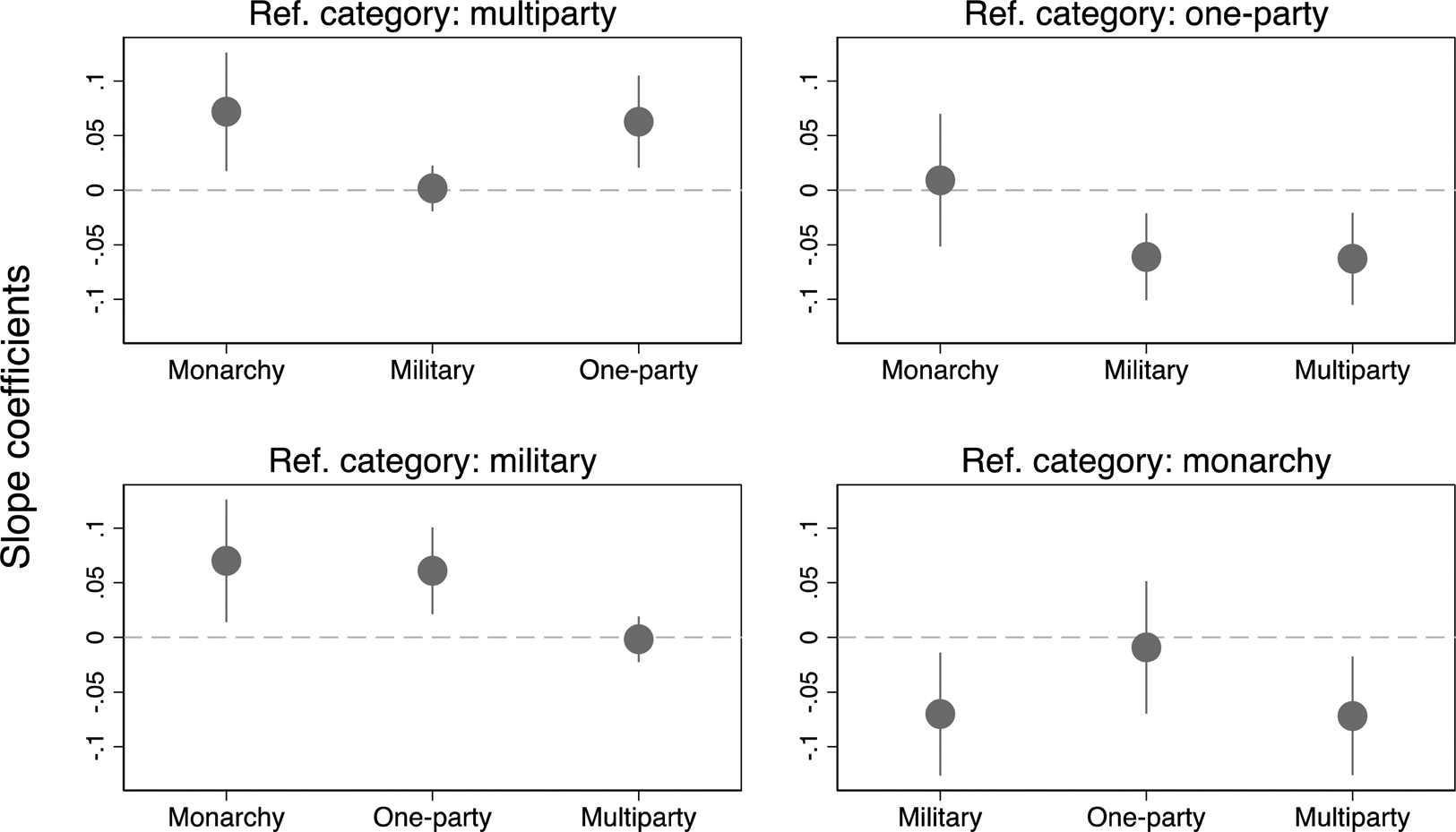
Finally, models 10–12 corroborate our argument and confirm what we already know by now: monarchies are less equal than military regimes and multiparty regimes but there is no significant difference in income inequality between monarchies and one-party regimes. Ceteris paribus, according to the full models, on average, income inequality in multiparty regimes is lower than in monarchies by around 0.07 units and lower than in one-party regimes by around 0.06 units, whereas income inequality in one-party regimes is higher than in military regimes by around 0.06 units; among non-electoral regimes, income inequality in monarchies is higher than in military regimes by around 0.07 units. The coefficient plots in Figure 4 provide a concise summary of the above results regarding the relationship between autocratic regime types and income inequality.

In models 3, 6, 9, and 12, we also assess the predictive power of state capacity on income inequality. Under our hypothesis (hypothesis 2), we expect countries with higher levels of state capacity to display lower levels of income inequality. The estimated results strongly support the hypothesized effect: all models demonstrate that state capacity is inversely related to income inequality at the highest level of confidence. On average, a one-unit increase in state capacity in a given year is related to a reduction in income inequality of around 0.05 units in the following year. Additionally, in line with our theoretical argument, the inclusion of state capacity in the regression models does not markedly reduce the magnitude of the effect of autocratic political institutions on income inequality.
At first glance, both state capacity and political institutions may seem to have modest effects on income inequality in terms of magnitude. In practice however, even a slope coefficient of 0.05 indicates an important effect, because the year-to-year variation in income inequality is minimal in most countries. In 76% of the country-years of our dataset, the overall year-to-year change in income inequality ranges between −0.2 and 0.2 and, for instance, in countries such as Albania, Lebanon, Mali, Nepal, and Senegal, year-to-year variation in income inequality never exceeds 0.2 units during the whole period of analysis. Given that both state capacity and political institutions tend to be relatively stable variables as well, we find that, on average, they have a substantial effect on income inequality.
Robustness tests
To evaluate more extensively the validity of our results, we perform a battery of robustness tests. First, we test the robustness of our results to different lags of the dependent variable. We re-run the full models with a single lag of y and with three lags of y. If anything, the results (Table S2, Supplementary material) reinforce our previously discussed findings, estimated through full models with two lags of y. These alternative estimations show convincingly that (1) multiparty regimes have lower levels of income inequality than both monarchies and one-party regimes, (2) one-party regimes have higher levels of inequality than both military regimes and multiparty autocracies, (3) military regimes have lower levels of inequality than monarchies and one-party regimes, and that (4) monarchies have higher levels of inequality than both multiparty autocracies and military regimes. Additionally, robustness tests with different lags of y provide strong support for hypothesis 2. Regardless of whether we include one, two, or three lags of the dependent variable on the right-hand side of the regression equation, state capacity is inversely related to income inequality and the result is statistically significant at the highest level. More specifically, our findings demonstrate that, even when controlling for autocratic institutions, state capacity plays a key role in reducing income inequality across authoritarian regimes.
Second, we test the robustness of our results to an alternative sample of countries. Instead of excluding countries coded as autocratic for 10 years or less from 1972 to 2014, we re-estimate the main regressions with all countries that have been autocratic at any time in our period of analysis. The interpretation of our results is not substantially altered by the ‘less conservative’ sample of countries (Table S3, Supplementary material), although some of the relevant slope coefficients are now significant at a lower level of confidence and the magnitudes of the effects of our variables of interest are slightly reduced.
Third, we test the robustness of our results to an alternative measure of state capacity. While Hanson and Sigman's (Reference Hanson and Sigman2021) index is arguably the most complete publicly available multidimensional measure of state capacity, we acknowledge that the index could be somewhat redundant with our measure of income inequality. In particular, some of its sub-components related to the extractive dimension of state capacity may overlap to a certain extent with our dependent variable. For instance, income taxes (as a % of tax revenue) is one of the sub-indicators of Hanson and Sigman's indexes but it is also intrinsically part of our income inequality measure, which captures inequality in post-tax income. Census frequency could be another sub-indicator potentially overlapping with our main measure of state capacity, because there is no doubt that successful tax collection efforts depend also on a state's ability to collect information through censuses.
For these reasons, we select an alternative measure of state capacity that is certainly not redundant with our measure of income inequality and captures a specific but important aspect of well-functioning states: the ability to enforce property rights. As argued by Fortin (Reference Fortin2010), ‘since the protection of private property is the responsibility of governments, property rights protection is a significant way to assess their capacity to perform basic tasks’ (p. 661). This alternative proxy of state capacity is collected from the Varieties of Democracy Dataset (Coppedge et al., Reference Coppedge, Gerring, Knutsen, Lindberg, Teorell, Altman, Bernhard, Fish, Glynn, Hicken, Lührmann, Marquardt, McMann, Paxton, Pemstein, Seim, Sigman, Skaaning, Staton, Cornell, Mechkova, Medzihorsky, Von Römer, Sundström, Tzelgov, Wang, Wig and Ziblatt2020) and ranges from 0 (low) to 1 (high). We re-run all the previously estimated full models with the above-discussed alternative measure of state capacity. Again, as with all the other robustness tests, the results (Table S4, Supplementary material) corroborate our main findings and show that state capacity is inversely related to income inequality also with our alternative measure. Overall, the battery of robustness tests proves that the main findings of the study at hand are robust to multiple specifications and different measures of state capacity.
Conclusions
Recent scholarship on authoritarian institutions has yielded important insights. Scholars demonstrate that elections, legislatures, and party competition influence regime survival (Gandhi and Przeworski, Reference Gandhi and Przeworski2007; Svolik, Reference Svolik2012) and economic policies, with ramification to investments and economic growth (Gandhi, Reference Gandhi2008; Wright, Reference Wright2008; Bizzarro et al., Reference Bizzarro, Gerring, Knutsen, Hicken, Bernhard, Skaaning, Coppedge and Lindberg2018). Moreover, interesting research has been conducted on the heterogeneity of social policies in authoritarian context, pinpointing the effect of these institutions on regimes' social performance (Teo, Reference Teo2021; Fails, Reference Fails2020; Pelke, Reference Pelke2020). Despite these advances, insufficient attention has been devoted to the effects of political institutions on inequality, and more broadly to the determinants of income inequality in authoritarian regimes.
Our article follows up this debate, highlighting the importance of political institutions and state capacity in determining inequality levels in autocracy. In doing so, we build on the theoretical assumption that political institutions and state capacity autonomously affect income inequality: political institutions create different incentives for autocratic leaders to adopt redistributive policies, whereas state capacity increases the likelihood of a successful implementation of such policy decisions. We then divide authoritarian regimes according to formal − elections and party competition − and informal − type and size of the ruling coalition − political institutions, and test whether authoritarian regime types display different levels of inequality.
With regard to formal institutions, multiparty autocracies – the most institutionalized authoritarian regime type in terms of elections and party competition – have lower levels of income inequality than less institutionalized autocracies, namely monarchies and one-party regimes. Moreover, among electoral autocracies, regimes with lower levels of party competition (one-party regimes) have higher levels of inequality than more competitive regime types (multiparty regimes), suggesting that, although the policy making process in authoritarian regimes is highly centralized and hierarchical (Wu, Reference Wu2020), party competition might influence autocrats' decisions over redistributive policies and their outcomes.
With regard to informal institutions instead, our analysis demonstrates that, among non-electoral autocracies, regimes with bigger coalition sizes (military regimes) have lower levels of inequality compared to regimes where the ruler governs with the support of a smaller coalition size (monarchies). This result corroborates our argument according to which the type and size of the ruling coalition influence the type of redistributive policies adopted by autocrats and the subsequent levels of income inequality. Interestingly, however, we do not find robust evidence on the difference in inequality between multiparty and military regimes. Theoretically, this result might be attributed to the specificity of military regime types, as they lack long-term programmatic view in their policy orientation (Hanson, Reference Hanson2013). Moreover, we believe that data-related issues could also play a key role in causing this unexpected result. We find that data on income inequality is not missing completely at random in our sample, but that in fact among all autocratic regime types, military regimes are the one with most missing income inequality country-years in absolute terms. This implies that military regimes are either less willing to report their data on inequality than other autocracies or are less capable of collecting and reporting inequality statistics. In view of such considerations, we call for additional data collection on policy decisions and outcomes in authoritarian context, and in particular, in military regimes.
Overall, this article can be considered as an extension of the literature on political institutions in authoritarian contexts, as it demonstrates that both formal and informal political institutions impinge on income inequality. However, our article also speaks on the thriving scholarship on the socioeconomic outcomes of state capacity. The hypothesis that state capacity is inversely related to income inequality is confirmed in all our main models and robustness tests. That is, a well-functioning and effective state apparatus is pivotal in explaining differences in inequality across autocracies. Additionally, when controlling for the presence of political institutions, regimes with higher levels of state capacity report significantly lower levels of inequality. This result indicates that the literature on authoritarian regimes should consider institutions more broadly. Elections and party competition determine redistributive outcomes, but so does state capacity, regardless of the institutional setting. It might be challenging to connect all dots to understand social policy dynamics and outcomes in autocracies, but as an increasing number of countries is shifting from democracy to autocracy (Cassani and Tomini, Reference Cassani and Tomini2019), the question of how these regimes perform in the social sphere is pivotal, not only for academic purposes, but also for understanding what makes autocracy endure.
Supplementary material
The supplementary material for this article can be found at https://doi.org/10.1017/ipo.2022.17.
Funding
The research received no grants from public, commercial, or non-profit funding agency.
Data
The replication dataset is available at http://thedata.harvard.edu/dvn/dv/ipsr-risp.
Acknowledgements
The authors are grateful to Andrea Cassani, Luca Tomini, and all the participants of the panel ‘Political regimes between performance and change’ at the 2019 Italian Political Science Association (SISP) General Conference for their extremely useful suggestions. The authors also thank two anonymous reviewers for their excellent comments.




 Open access

