




Introduction
Private speech is an observable form of self-directed speech that exists on a continuum from overt (i.e., out-loud) to covert (i.e., muttering, whispering, lip movements) forms. Vygotsky’s (1934/Reference Vygotsky1962) position on private speech being a childhood self-regulatory mechanism functionally related to cognitive performance has sparked a wealth of research into this intrapersonal verbal tool. Not surprisingly, a recent surge of research has sought to investigate private speech in children with self-regulatory challenges (Aziz, Fletcher & Bayliss, Reference Aziz, Fletcher and Bayliss2017; Corkum, Humphries, Mullane & Theriault, Reference Corkum, Humphries, Mullane and Theriault2008; Lidstone, Meins & Fernyhough, Reference Lidstone, Meins and Fernyhough2012; Winsler, Abar, Feder, Schunn & Rubio, Reference Winsler, Abar, Feder, Schunn and Rubio2007a; Winsler, Diaz, Atencio, McCarthy & Chabay, Reference Winsler, Diaz, Atencio, McCarthy and Chabay2000b). Although evidence suggests that the private speech of developmentally at-risk children is delayed in terms of its progression to inner speech, the regulatory role of private speech in this group remains contentious (Mulvihill, Carroll, Dux & Matthews, Reference Mulvihill, Carroll, Dux and Matthews2019a). In typical development, the increased use of private speech in response to task difficulty provides evidence of its functional recruitment for self-regulatory purposes (Azmitia, Reference Azmitia, Diaz and Berk1992; Beaudichon, Reference Beaudichon1973; Duncan & Pratt, Reference Duncan and Pratt1997; Fernyhough & Fradley, Reference Fernyhough and Fradley2005). Despite this, there is a lack of research that directly explores the effect of task difficulty on patterns of private speech use in developmentally at-risk individuals. In addressing this gap, we investigate the interaction between task difficulty and private speech in typically developing and developmentally at-risk preschool aged children.
The development of private speech
Private speech has been shown to be a domain general system of verbal self-regulation in childhood (Al-Namlah, Fernyhough & Meins, Reference Al-Namlah, Fernyhough and Meins2006; Lidstone, Meins & Fernyhough, Reference Lidstone, Meins and Fernyhough2011). The emergence of private speech signifies a developmental shift from externally regulated to self-regulated thinking and behavior (Winsler, Reference Winsler, Winsler, Fernyhough and Montero2009). In other words, the language that adults use to regulate child behavior (e.g., “stop and think”) becomes represented by the child as overt private speech and gradually shifts towards inner speech as a child gains increasing self-regulatory control. Indeed, the earlier emergence and internalization of private speech is associated with markers of behavioral and cognitive sophistication (Berk, Reference Berk1986; Winsler et al., Reference Winsler, Diaz, Atencio, McCarthy and Chabay2000b). Furthermore, there is evidence of increasingly task-relevant and goal-directed private speech in the preschool years (Winsler, Carlton & Barry, Reference Winsler, Carlton and Barry2000a). Task-relevant overt private speech is most likely to occur when children are operating within their zone of proximal development (Fernyhough & Fradley, Reference Fernyhough and Fradley2005). In this circumstance it is believed to support focused attention, strategy selection and task monitoring (Berk, Reference Berk1986; Berk & Spuhl, Reference Berk and Spuhl1995). Although most prominent in childhood, the incidence of private speech is not restricted to this life stage. Duncan and Cheyne (Reference Duncan and Cheyne2002) document overt private speech use in adults, particularly during moments of heightened cognitive demand. Observable trends in the form, frequency and content of private speech, while broadly maturational, may synonymously represent a shift from deployed cognitive effort towards cognitive sophistication within a task (Diaz & Berk, Reference Diaz and Berk1995).
Private speech and task difficulty
A fundamental tenet of Vygotskian theory emphasizes the dynamic interaction between features of private speech, self-regulatory efficacy and task demands (Berk & Garvin, Reference Berk and Garvin1984). Escalating levels of task difficulty are proposed to increase the demand for regulatory private speech to guide thinking and behavior. Investigations to date confirm an adaptive increase in private speech use in response to difficulty. However, this small body of research has primarily focused on typically developing children during middle childhood and probes broad markers such as the incidence of private speech use, with limited consideration for form (i.e., overt to covert) and regulatory content.
One early study investigated the effect of task difficulty on private speech in 78 children aged 5 years 6 months to 8 years as they completed a series of sequencing activities (Beaudichon, Reference Beaudichon1973). A difficulty effect was evidenced by a linear increase in the number of private speech utterances for five-year-old children only. Similarly, a sample of 40 five- to six-year-old children displayed a significant increase in the proportional use of private speech during difficult or novel sequencing and paper-folding trials compared to easy or familiar trials (Duncan & Pratt, Reference Duncan and Pratt1997). In an extension of the above research with 58 young adults, Duncan and Cheyne (Reference Duncan and Cheyne2002) identified a higher rate of private speech use on a difficult and unfamiliar computer-based task, that decreased with practice-based familiarization.
One known study that investigated the effect of task difficulty in preschool children measured the proportional use of private to social speech while 2- to 5-year-old children completed three puzzles at varying levels of difficulty (Behrend, Rosengren & Perlmutter, Reference Behrend, Rosengren and Perlmutter1989). The use of private speech was curvilinearly related to difficulty. Preschool children used proportionally more private speech while completing moderately difficult puzzles, suggesting a peak in private speech use during optimal levels of challenge. In a similar vein, Fernyhough and Fradley (Reference Fernyhough and Fradley2005) investigated the use of private speech while 45 five- and six-year-old children engaged in four incremental levels of difficulty within the Tower of London task. Extending beyond the broad marker of private speech utterances, the researchers further classified utterances into overt and covert forms of private speech (Berk, Reference Berk1986). Akin to the findings of Behrend et al. (Reference Behrend, Rosengren and Perlmutter1989), the frequency of both forms of private speech peaked during medium difficulty trials in comparison to either easy or difficult trials. There was no evidence of a shift in the predominant form of private speech used across difficulty levels.
Investigations into the effect of task difficulty on private speech content are scant. Azmitia (Reference Azmitia, Diaz and Berk1992) investigated the incidence of planning and evaluative statements across task difficulty levels in 48 six- and eight-year-old children assigned to expert and novice construction groups in accordance with pre-test performance. During the completion of an above-age level Lego® building task, experts demonstrated more evaluative and multi-step planning statements than their novice peers. Such findings suggest group differences in the recruitment of private speech content in response to difficulty. However, the limited amount of research into a task difficulty effect on private speech content limits interpretability.
As identified, investigations into difficulty effects on private speech are primarily focused on typical development during middle childhood and rarely consider the progression towards internalization nor self-regulatory content markers. Conspicuously absent from this line of investigation is the effect of task difficulty on private speech in developmentally at-risk individuals. To our knowledge there has been no direct investigation into whether this group systematically harness private speech in response to heightened task demand akin to their typically developing peers.
Private speech in atypical development
Preschool children identified as meeting early developmental risk for this study demonstrated clinical markers of difficulty for language development or attention. Early markers of language or attentional difficulties are predictive of ongoing developmental delay (Rowe, Raudenbush & Goldin-Meadow, Reference Rowe, Raudenbush and Goldin-Meadow2012; Winsler et al., Reference Winsler, Diaz, Atencio, McCarthy and Chabay2000b), educational underachievement (Brinkman et al., Reference Brinkman, Gregory, Harris, Hart, Blackmore and Janus2013; Duncan et al., Reference Duncan, Dowsett, Claessens, Magnuson, Huston, Klebanov and Japel2007), and social-emotional and employment challenges (Conti-Ramsden, Durkin, Toseeb, Botting & Pickles, Reference Conti-Ramsden, Durkin, Toseeb, Botting and Pickles2018; Moffitt et al., Reference Moffitt, Arseneault, Belsky, Dickson, Hancox, Harrington and Heckman2011).
Differential development of private speech in children with language or attention control difficulties may present a common deficit underpinning self-regulatory challenges in these groups (Mulvihill et al., Reference Mulvihill, Carroll, Dux and Matthews2019a). Despite preserved non-verbal ability, language deficits present a cognitive barrier to the development and use of private speech as a self-regulatory thinking tool. Receptive language weakness limits the comprehension of linguistically mediated caregiver scaffolding while expressive language weakness may constrain access to language for thought (Lidstone et al., Reference Lidstone, Meins and Fernyhough2012). Attentional and behavioral difficulties imply a relational barrier to the development of private speech, as parent-child interactions are negatively impacted (Danforth, Connor & Doerfler, Reference Danforth, Connor and Doerfler2016), thus limiting the quality of adult scaffolding known to promote children’s use of task directed private speech (Winsler, Diaz & Montero, Reference Winsler, Diaz and Montero1997). Notably, comorbidity exists in the childhood experience of language and attentional difficulties (Ebert & Kohnert, Reference Ebert and Kohnert2011; Geurts & Embrechts, Reference Geurts and Embrechts2008; Walsh, Scullion, Burns, MacEvilly & Brosnan, Reference Walsh, Scullion, Burns, MacEvilly and Brosnan2014), and both groups present with a common deficit in working memory (Henry, Messer & Nash, Reference Henry, Messer and Nash2012; McInnes, Humphries, Hogg-Johnson & Tannock, Reference McInnes, Humphries, Hogg-Johnson and Tannock2003). According to Baddeley’s (Reference Baddeley1992) working memory model, private and inner speech present an important mechanism for the vocal or sub-vocal rehearsal of information to prevent memory decay. Although etiological mechanisms may not yet be clear, it appears that, for children with language or attention control difficulties, a combination of environmental and cognitive factors similarly impedes the typical developmental trajectory of private speech.
For children with language or attention control difficulties, a growing body of evidence points to a maturational delay in private speech development. Across both groups it appears that children demonstrate a higher frequency of overt private speech (Lidstone et al., Reference Lidstone, Meins and Fernyhough2012; Winsler, Manfra & Diaz, Reference Winsler, Manfra and Diaz2007b) that is delayed in its progression towards internalization (Aziz et al., Reference Aziz, Fletcher and Bayliss2017; Berk & Potts, Reference Berk and Potts1991; Lidstone et al., Reference Lidstone, Meins and Fernyhough2012; Winsler, Reference Winsler1998). Children with language difficulties or attention difficulties have been found to use greater or similar amounts of spontaneous private speech to achieve similar or lesser task outcomes than their typically developing peers (Aziz et al., Reference Aziz, Fletcher and Bayliss2017; Kopecky, Chang, Klorman, Thatcher & Borgstedt, Reference Kopecky, Chang, Klorman, Thatcher and Borgstedt2005; Kuvalja, Verma & Whitebread, Reference Kuvalja, Verma and Whitebread2014; Lidstone et al., Reference Lidstone, Meins and Fernyhough2012; Winsler et al., Reference Winsler, Abar, Feder, Schunn and Rubio2007a). Not surprisingly, this has led many to question the regulatory role of spontaneous private speech in this group (Mulvihill et al., Reference Mulvihill, Carroll, Dux and Matthews2019a). However, many investigations have captured single time-point comparisons.
Longitudinal research approaches have highlighted that single time-point comparisons may fail to account for differing developmental trajectories across at-risk and typically developing children thus obscuring interpretations of private speech for regulation in at-risk groups (Berk & Potts, Reference Berk and Potts1991; Winsler et al., Reference Winsler, Carlton and Barry2000a). Although the elevated use of private speech in response to difficulty has provided long-standing evidence of its regulatory role in typical development, there has been no direct investigation of this pattern in atypical development. An examination of a regulatory response to task difficulty across groups can overcome the limitation of a single event comparison by considering the presence or absence of a systematically similar regulatory response to difficulty across groups rather than a broad level group comparison of spontaneous private speech use during a single event. A private speech regulatory response to task difficulty has been suggested for children with attention difficulties (Corkum et al., Reference Corkum, Humphries, Mullane and Theriault2008; Winsler, Reference Winsler1998), who appear to demonstrate a higher frequency of overt private speech during more difficult tasks. Nonetheless, findings to date are speculative as comparisons are made across different task types. Consequently, the presence of a regulatory response to task difficulty for developmentally at-risk preschool children remains equivocal.
The present study
The primary aim of the present study was to investigate whether developmentally at-risk 3- to 4-year-old children present a systematic regulatory private speech response to task difficulty analogous to their typically developing peers. We recorded children’s spontaneous private and social speech during a problem-solving construction task and an executive function card sort task, both containing two incremental levels of challenge.
In accordance with previous research, we expected a task difficulty effect of increased private speech use in typically developing children. Additionally, we expected at-risk children to demonstrate more frequent and less internalized private speech than their typically developing peers. It was unclear whether young children with language or attention control challenges would demonstrate a regulatory private speech response analogous to their typically developing peers. Accordingly, we sought to compare the relative pattern of response to task difficulty across markers of speech type (i.e., private, social), form (i.e., level of internalisation) and content. Should developmentally at-risk children demonstrate a similar pattern of private speech use in response to task difficulty, this will provide evidence of its regulatory role and further substantiate the hypothesis of delayed internalization over regulatory deviance. In contrast, should developmentally at-risk individuals demonstrate an absent or alternate task difficulty response, this will imply a qualitative difference in the self-regulatory function of private speech relative to typically developing children. Alongside this important question, we built upon existing research by investigating task difficulty effects beyond the incidence of private speech utterances, to also consider regulatory shifts in private speech form and content. This research aimed to provide a deeper insight into the spontaneous private speech regulatory response to task difficulty in typical and atypical development.
Method
Procedure
Information regarding the Self-Talk and Thinking in Preschool Aged Children research program was disseminated via Facebook and a blog article. An information letter was provided in response to parental expression of interest, following which parents nominated their child/ren for inclusion in the study. All sessions occurred on a time and day convenient for parents and at an optimal time in the child’s sleep-wake routine. Children attended with a parent who typically remained in the room but was asked to limit interaction with their child during testing. During private speech tasks, a GoPro Hero 4 camera was placed across from the child. The data relevant to this study was collected over four individual testing sessions completed within a two-month period, typically on a weekly basis. Each session consisted of a five-minute play interaction, followed by three 5- to 10-minute tasks inclusive of standardized assessment subtests and private speech tasks. Sessions and within session tasks were delivered in a pre-assigned randomized order. Parents completed the parent questionnaire either within or in-between sessions.
Participants
The sample comprised 77 children aged between three- and four-years (M = 46.48 months, SD = 6.75). Children with a significant visual impairment, hearing impairment, an inability to point, or who do not use English as their first language, were excluded from participation in the study. Exclusion criteria related to the administration of norm-referenced tasks in an English language format, using visual stimuli, and pointing as a primary response. Participating families resided in the Brisbane metropolitan region and surrounding areas in southeast Queensland. Household postcodes were used to determine socio-economic status according to the Australian Bureau of Statistics Socio-Economic Indexes for Areas (SEIFA). SEIFA’s ranks geographical areas from low (1st decile) to high (10th decile) according to characteristics such as employment and public resources (Australian Bureau of Statistics, 2018). The present sample was characterized by decile ranks from 1 to 10 but was biased towards socioeconomic advantage (M = 8.42, SD = 1.87). Participants included 37 females (48.1%) and 40 males (51.9%) who formed two groups according to markers of early developmental risk. Table 1 outlines the median demographic and developmental measure values for both groups. The developmentally at-risk group were identified by scores outside the normal range of functioning on norm-referenced measures of attention, expressive language and receptive language. Specifically, a standard score of 85 or lower on either the receptive or expressive language index of the Clinical Evaluation of Language Fundamentals – Preschool 2 Australia and New Zealand Edition (CELF-P2; Wiig, Secord & Semel, Reference Wiig, Secord and Semel2006) is ≥1 standard deviations below the mean and an identified clinical marker of developmental language difficulty. Likewise, a T-score of 65 or greater on the Conners Early Childhood (Conners, Reference Conners2009) Global Index is ≥1.5 standard deviations beyond the mean and indicative of early markers of psychopathology relating to attention, impulsivity and emotional lability (Conners, Reference Conners2009; Morales-Hidalgo, Hernández-Martínez, Vera, Voltas & Canals, Reference Morales-Hidalgo, Hernández-Martínez, Vera, Voltas and Canals2017). A total of 52 children scored above cut-off and met criteria for the typically developing group. A total of 18 children presented with attention difficulties, five children with language difficulties, and two children with co-morbid attention and language difficulties. A series of independent t-tests revealed no significant differences on measures of task performance, private or social speech between the seven children with language difficulty and 18 children with attention difficulty. Consequently, these 25 children formed a developmental risk group for all further analyses. The distribution of the typically developing and at-risk groups did not differ significantly across demographic variables of gender, Χ² (1, N = 77) = 2.15, p = .14, age, U = 577.5, p = .43, and socio-economic status, U = 792.5, p = .11. Similarly, there was no significant group difference in non-verbal cognition, U = 774.5, p = .18. or expressive language, U = 816.5, p = .07. As expected, significant group differences were evident on clinical measures of receptive language, U = 852, p = .03, and the self-regulation of attention, U = 68, p <.001.
Group Comparison on Demographic and Developmental Measures

* p<0.05,
*** p<0.001, SS = standard score
Private speech tasks
Two task types, a problem-solving Duplo construction task and an executive functioning card sort task, were selected to elicit spontaneous private speech. Prior to engaging in the private speech tasks, attending parents were seated at a 1.5metre distance behind their child and advised not to speak to their child during the task. On occasions where children sought parental engagement, parents were advised to engage minimally and simply encourage their child to persist with the task (e.g., “keep trying”). All parents adhered to these guidelines effectively.
Duplo task
Construction provides an engaging problem-solving task to elicit private speech in young children (Berk & Spuhl, Reference Berk and Spuhl1995; Manfra, Tyler & Winsler, Reference Manfra, Tyler and Winsler2016; Winsler, De Leon, Wallace, Carlton & Willson-Quayle, Reference Winsler, De Leon, Wallace, Carlton and Willson-Quayle2003). The Lego® Duplo Block Family House suitable for two- to five-year-old children was selected to develop a construction activity. The researchers developed Duplo tasks at two levels of difficulty. The first task, Duplo 1, required children to build a replica garden using 10 individual pieces across one height level (see Figure 1) while ignoring two distractor pieces. The second more difficult task, Duplo 2, required construction of a replica house using 15 individual pieces across two height levels (see Figure 1) while ignoring three distractor pieces.
Images of the Duplo task. From left to right: Duplo 1 garden replica, Duplo 2 house replica front view, Duplo 2 house replica top view.

Prior to each Duplo task, children were presented with a pre-built model to guide completion. Children were informed of task expectations as follows, “Here is a Duplo garden/house. We need to build one exactly the same. First, I will build it with you. Next you will do it all by yourself”. Initially children worked together with the researcher at a child-height table to create a replica using pieces that were placed to each child’s left side. Following co-completion of each construction, the item was placed aside, and children were presented with a new set of blocks, again placed to their left side. The researcher asked children to complete the same construction alone using the pre-built model as a guide. From this point the researcher distanced herself from each child and engaged in writing to encourage independent engagement in the task. When children directed a comment to the researcher she nodded and then re-engaged in writing. When children directed questions or a request for help, the researcher responded directly typically prompting the child to persist, “keep trying”. At no time were children prompted to use speech.
Performance was measured according to time on task and percentage accuracy. The beginning of each Duplo task was the point that the child touched a block in preparation for construction and the close of each task was identified by a verbal statement of completion or a clear direction of gaze to indicate completion. Accuracy was calculated as a point for the correct selection of colour, location and orientation per block (i.e., 3 possible points per block) and recorded as a percentage of total points. Each child could achieve a total of 30 points for Duplo 1 (i.e., garden structure) and 45 points for Duplo 2 (i.e., house structure).
Card sort task
The Early Years Toolbox Card Sort task (Howard & Melhuish, Reference Howard and Melhuish2016) provides a downward extension of the Wisconsin Card Sorting Task, an executive function task previously used to elicit private speech in older children (Winsler et al., Reference Winsler, Abar, Feder, Schunn and Rubio2007a). Based on the Dimensional Change Card Sort protocol (Zelazo, Reference Zelazo2006), this iPad-administered task provides a measure of cognitive flexibility in children aged three- to six-years. The application utilizes touchscreen technology for accurate response capture. In a large scale administration to 1764 Australian preschool and early primary school students, the Early Years Toolbox tasks demonstrated good reliability, convergent validity and developmental sensitivity (Howard & Melhuish, Reference Howard and Melhuish2016).
In the card sort task, children were presented with stimulus pictures that vary across dimensions of shape (i.e., rabbits and boats) and colour (i.e., red and blue). The task included three phases of incremental difficulty. Within card sort 1, six trials were sorted according to colour (i.e., pre-switch phase) and in card sort 2 a further six trials were sorted by shape (i.e., post-switch phase). Children who correctly sorted five of six cards according to each dimension proceeded to card sort 3. In this challenging phase consisting of six trials, children sort by colour when cards have a black border, and shape when cards have no border. The same stimulus was never presented more than twice in a row. Performance was calculated according to sort accuracy for each phase (i.e., number of correct sorts out of 6 per phase).
Typically, the iPad application provides automatic verbal instructions at the beginning of each phase along with pre-trial prompts. For the purpose of this task, the iPad was muted, and the researcher delivered the same verbal instruction at the beginning of each phase only. A demonstration trial and two practice trials were completed with the researcher prior to card sort 1 and 3, following which children completed test items independently. During test trials, the researcher distanced herself from the child and engaged in writing. She prompted attention to task as necessary but did not involve herself in the task. The researcher nodded in response to children’s social comments and parents were advised to do the same. The researcher responded directly but briefly to questions or requests for help followed by a prompt to reengage. At no point were children prompted to use speech.
Private speech coding
Speech utterance
Children’s speech, recorded during the private speech tasks, was transcribed by the primary researcher into discrete utterances. In accordance with recommended coding procedures (Winsler, Fernyhough, McClaren & Way, Reference Winsler, Fernyhough, McClaren and Way2005), the utterance unit transcribed from video recordings was identified by (a) a complete sentence, (b) a sentence fragment, (c) independent clause, (d) conversational turn, or (e) string of speech separated from another by a period of at least two seconds. The frequency of total utterances was calculated per participant as the average utterances used per minute (i.e., total utterances / time on task).
Private and social speech
All utterances were coded as either social or private speech, determined by means of addressee. In keeping with standard procedure (Winsler et al., Reference Winsler, Fernyhough, McClaren and Way2005) social speech was defined as speech intentionally directed towards another person as indicated by (a) direction of gaze towards a person during or within one second of the utterance, (b) use of a pronoun or name, (c) intentional or physical touch of another person, and (d) a conversational turn. Private speech utterances were identified as all other utterances not intentionally directed toward another person and exist in observable overt (out-loud) and covert (muttering, whispering, lip movements) forms (Winsler et al., Reference Winsler, Fernyhough, McClaren and Way2005). The frequency of private or social utterances was calculated per participant as the average utterances used per minute for each speech type (e.g., social utterances/time on task). All utterances were categorised as either private or social and therefore a proportional measure of private speech reflected the amount of private compared to social speech used by each participant. The proportion of private speech was calculated per participant as the total number of private speech utterances divided by the total number of utterances (i.e., private utterances/total utterances). Frequency metrics could be calculated for all partricipants, while the proportional metric could be calculated for those who used speech.
Private speech form
Private speech form was coded according to Lidstone and colleague’s (Reference Lidstone, Meins and Fernyhough2011) measure of private speech internalization. This fine-grained coding scheme captures a progression from overt (i.e., out-loud) to covert (i.e., whispers and lip movements) private speech. It accounts for dimensions of volume, voicing and intelligibility along five coding levels ranging from less to more internalized (see Table 2). Ranging from 1.0 to 5.0, the derived score reflects the participant’s mean level of internalization. A higher score reflects more internalized private speech while a lower score reflects more overt private speech. To calculate the internalization score, each private speech utterance was assigned a level score which was summed over the entire task, and then divided by the total number of private speech utterances within that task. For example, if a child used only two utterances, one classified as level 3 and another as level 4, the internalization score was 3.5 (i.e., (3 + 4)/2). Children who did not use private speech within a task could not be assigned an internalization score. Perhaps these children either did not use self-directed speech, or they harnessed non-observable inner speech.
Lidstone et al.’s (Reference Lidstone, Meins and Fernyhough2011) Five Level Internalization Coding Scheme

Private speech content
To date, profiling private speech content in atypical development has relied largely on broad level categorisations of content according to task relevance or the presence of a regulatory function. The use of these broad level coding schemes has been critiqued for its capacity to capture the regulatory mechanisms of private speech content (Mulvihill et al., Reference Mulvihill, Carroll, Dux and Matthews2019a). Guided by the sociocultural position on private speech as a self-regulatory behavior (Vygotsky, 1934/Reference Vygotsky1962), here we sought to capture self-regulatory content elicited during task engagement. Zimmerman’s cyclical phases of self-regulated learning (Zimmerman, Reference Zimmerman, Boekaerts, Pintrich and Zeidner2000; Zimmerman & Moylan, Reference Zimmerman, Moylan, Hacker, Dunlosky and Graesser2009) provides a theoretically established and empirically supported framework to capture inter-related self-regulatory behaviors. Accordingly, we adapted the model to design a pre-defined content coding scheme for the analysis of intelligible task-relevant private speech content. The adapted content coding scheme synthesises regulatory private speech content descriptors from previous coding schemes (Winsler et al., Reference Winsler, Fernyhough, McClaren and Way2005) into three self-regulatory phases that capture verbal engagement in planning, monitoring and appraisal during a task. Three phases – forethought, performance and self-reflection – provide exhaustive categories within which to profile intelligible task-relevant private speech utterances (see Table 3). The forethought phase captures utterances that indicate the task goal or plans, motivational statements of self-belief, task interest or outcome expectations. The performance phase is characterized by self-instructional utterances, verbal strategy, attention focusing statements and self-observation. The self-reflection phase includes utterances that serve to evaluate performance or capture a display of affect towards outcomes. The frequency of each content subtype was calculated per participant as the average utterances used per minute for each content type (e.g., forethought utterances/time on task).
Content Coding Scheme Adapted from Zimmerman’s (Reference Zimmerman, Boekaerts, Pintrich and Zeidner2000, 2009) Cyclical SRL model (Mulvihill, Matthews, Dux & Carroll, Reference Mulvihill, Matthews, Dux and Carroll2019b)

Measures
Private speech measures
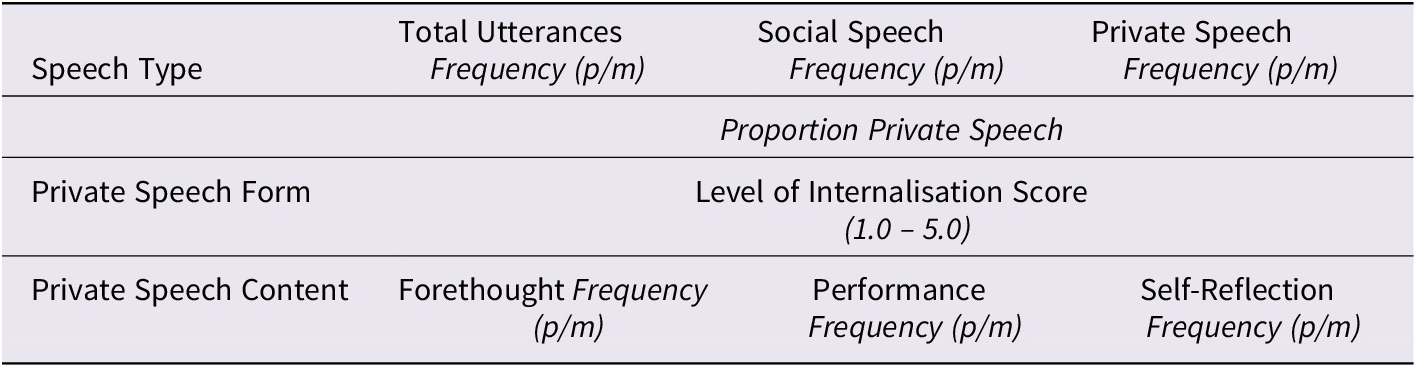
For each private speech task, the private speech internalization score and the frequency and proportion of utterances for every coded category was calculated at the child level. See table 5 for an overview of private speech measures. Frequency and proportional metrics account for variability across tasks and persons (Sawyer, Reference Sawyer2017; Winsler, Reference Winsler, Winsler, Fernyhough and Montero2009), such as time on task and individual differences in the amount of speech used. All coding from transcripts was undertaken while watching the video files. This aimed to ensure that the pragmatic intention of each utterance was clear, in particular for the social and content coding schemes. To establish inter-rater reliability, 18% of the transcripts were randomly selected and coded by a trained research assistant naïve to the hypothesis and participant group membership. Interrater reliability was calculated according to percentage agreement and Cohen’s kappa coefficient. Reliability statistics range from substantial to almost perfect agreement (Landis & Koch, Reference Landis and Koch1977). Specifically, the measured level of agreement for social and private speech distinction was 95% (Kappa = 0.82), Lidstone and colleagues’ (Reference Lidstone, Meins and Fernyhough2011) five levels of internalization system 83% (Kappa = 0.78), and the private speech self-regulatory content system 90% (Kappa = 0.81).
Cognitive and behavioral measures
Language
The CELF P2 Australia and New Zealand Edition (Wiig et al., Reference Wiig, Secord and Semel2006) provides a norm-referenced measure of language ability in children aged three- to six-years. Six subtests contribute to receptive and expressive language indices. For this study the CELF P2 provided a reliable tool for the identification of children with typically developing language skills (i.e., standard scores >85) and those with developmental language difficulties (i.e., standard core ≤85 on either the receptive or expressive language index).
Non-verbal cognition
The Leiter International Performance Scale 3rd Edition (Leiter-3; Roid, Miller, Pomplun & Koch, Reference Roid, Miller, Pomplun and Koch2013) is a reliable, norm-referenced measure of non-verbal cognitive functioning for individuals aged 3 to 75 years. Four subtests related to visualization and reasoning contribute to cognitive scales that emphasize fluid intelligence and provide a global measure of non-verbal IQ.
Parent report of behavioral and emotional functioning
The Connors Early Childhood™ (Conners, Reference Conners2009) is a reliable and norm-referenced tool for the early identification of a wide range of behavioral, emotional and developmental challenges in two- to six-year-old children. For this study, the Early Childhood Global Index™ measure provides an early indicator of symptoms relating to ADHD including restlessness, impulsivity and emotional lability (Morales-Hidalgo et al., Reference Morales-Hidalgo, Hernández-Martínez, Vera, Voltas and Canals2017). The index is informed by 10 items that rate the frequency of observed child behaviors on a four-point Likert scale from 0 (not true at all) to 3 (very much true). Standard scores are normed according to age and child’s sex whereby a T-score of ≥65 is indicative of developmental risk with more concerns than typically reported for a child of the same age and sex.
Results
Preliminary analyses
Every participant completed both Duplo tasks. A technical error, due to consistent screen tapping, prevented one child in the at-risk group from completing the iPad-administered card sort task. The card sort task utilizes phase level task performance to automate progression to the proceeding phase of difficulty. Previous research suggests that approximately 50% of typically developing 3- to 4-year-old children perseverate on post-switch phase two trials, and most four- to five-year-olds fail the challenging phase three (Zelazo, Reference Zelazo2006). While a total of 75 children (97%) progressed to card sort 2, only 36 children (47%) progressed to card sort 3, precluding an accurate investigation of difficulty effect at this level. Consequently, card sort 3 data were not included in further analyses. All study variables were examined for outliers which were defined as scores ≥3SD from the mean. Outliers were present in the social and private speech measures and varied from 0 to 4 outliers per measure. Where present, analyses were run without outliers. The reported analyses are those that excluded outliers ≥3SD from the mean.
Task difficulty
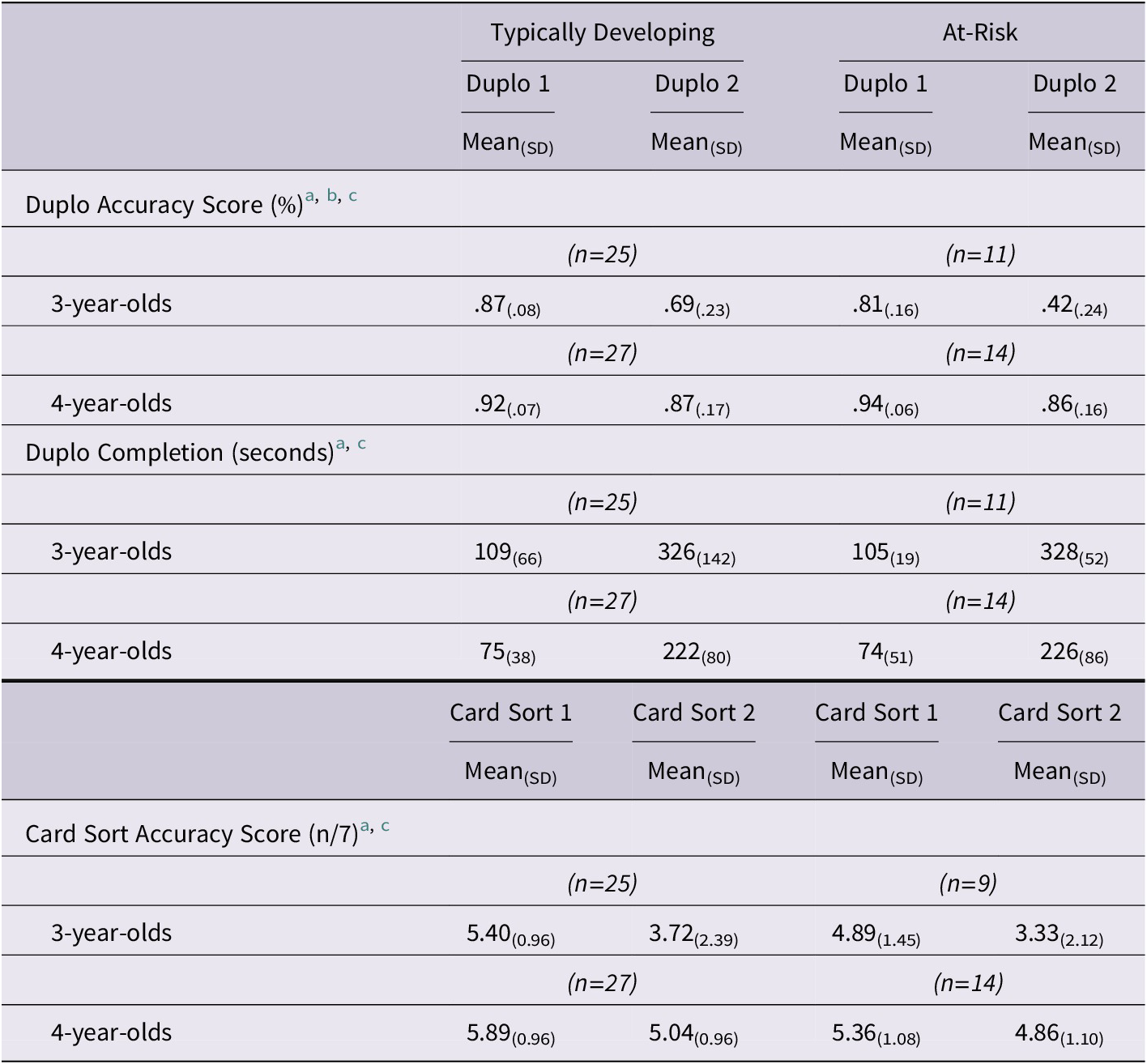
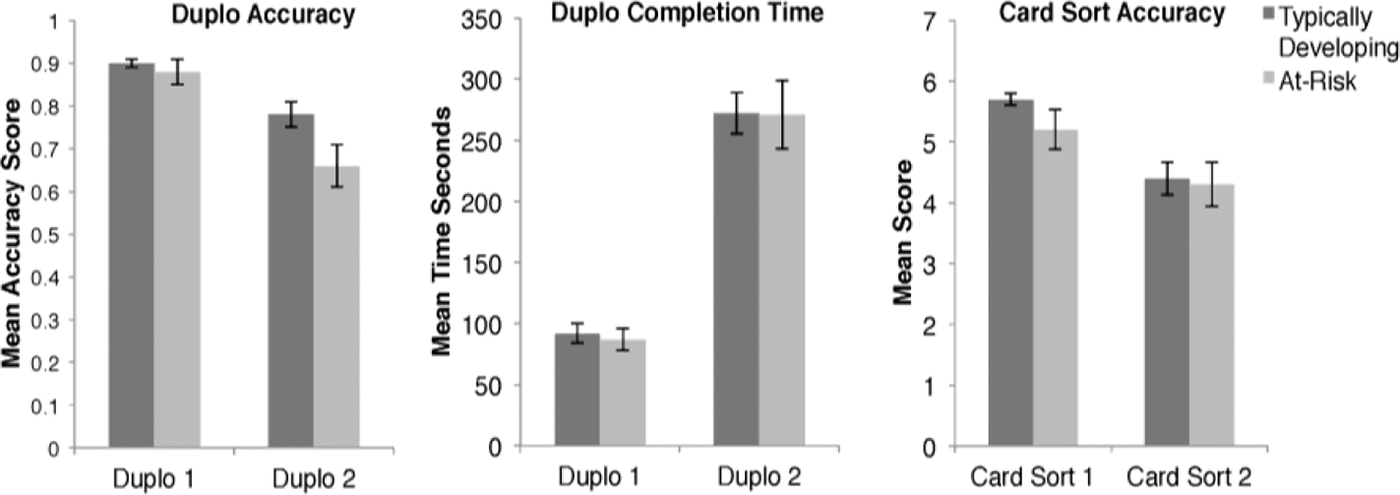
To examine the validity of incremental difficulty across task levels, along with the presence of group and age-related differences in task performance, a 2 (task level: level 1, level 2) x 2 (group: typically developing, at-risk) x 2 (age: 3 years, 4 years) mixed ANOVA was conducted for each performance measure (see Figure 2). Table 4 outlines the mean performance per age (in years) for each group across task difficulty levels. Analyses confirmed a significant main effect of task difficulty for all measures inclusive of Duplo accuracy, F(1, 73) = 77.03, p < .001, η² p = .51, Duplo time to completion, F(1, 73) = 166.27, p < .001, η² p = .70, and card sort accuracy, F(1, 71) = 19.28, p < .001, η² p = .21. Children took longer to construct Duplo 2 (M = 271 s, SD = 129 s) than Duplo 1 (M = 90 s, SD = 51 s), achieved a lower score on Duplo 2 (M = .74, SD = .25) relative to Duplo 1 (M = .89, SD = .10), and likewise a lower score on card sort 2 (M = 4.36, SD = 1.87) relative to card sort 1 (M = 5.43, SD = 1.12). There was no between subjects group effect on Duplo completion time, F(1, 73) = 0.03, p = .87, η² p = .00, nor card sort accuracy, F(1, 71) = 2.70, p = .11, η² p = .04. A significant interaction between group and task difficulty on the Duplo accuracy measure, F(1, 73) = 9.13, p = .003, η² p = .11, was qualified by a significant group difference on Duplo 2 accuracy, p = .02, but not Duplo 1 accuracy, p = .56. A between subjects effect of age was evident across all performance measures inclusive of Duplo accuracy, F(1, 73) = 38.80, p = < .001, η² p = .35, Duplo completion time, F(1, 73) = 15.42, p = < .001, η² p = .17, and card sort accuracy F(1, 71) = 15.04, p = < .001, η² p = .18. Post-hoc analyses using Bonferroni correction confirmed that 4-year-olds performed better than 3-year-olds, all p ≤ .001.
Performance measures per task difficulty level across groups and ages
a Significant task difficulty effect
b Significant task difficulty x group effect
c Significant age effect
Group comparison on measures of performance across task levels. Mean scores are presented for both typically developing and at-risk groups on Duplo accuracy, Duplo completion time and card sort accuracy. Error bars represent standard error of the mean.
Analysis overview
Analyses sought to investigate whether aspects of speech use (i.e., social, private), private speech form (i.e., overt to covert), and private speech content exhibit a regulatory response to task difficulty (see Table 5). Furthermore, we examined whether there were group differences, and importantly whether typically developing and at-risk children harnessed private speech in a systematically similar manner as a task became more difficult. The statistical procedure used in all proceeding analyses was a two-way mixed ANCOVA with task difficulty condition (easy, hard) as the repeated measure, group (typically developing, at-risk) as the between-subjects factor, age in months centred at the mean as a covariate, and the relevant private speech measure as the dependent variable. The group means and standard deviations of all dependant variables for each difficulty condition are available in the supplementary materials.
Overview of Speech Variables
Frequency and proportion of speech types
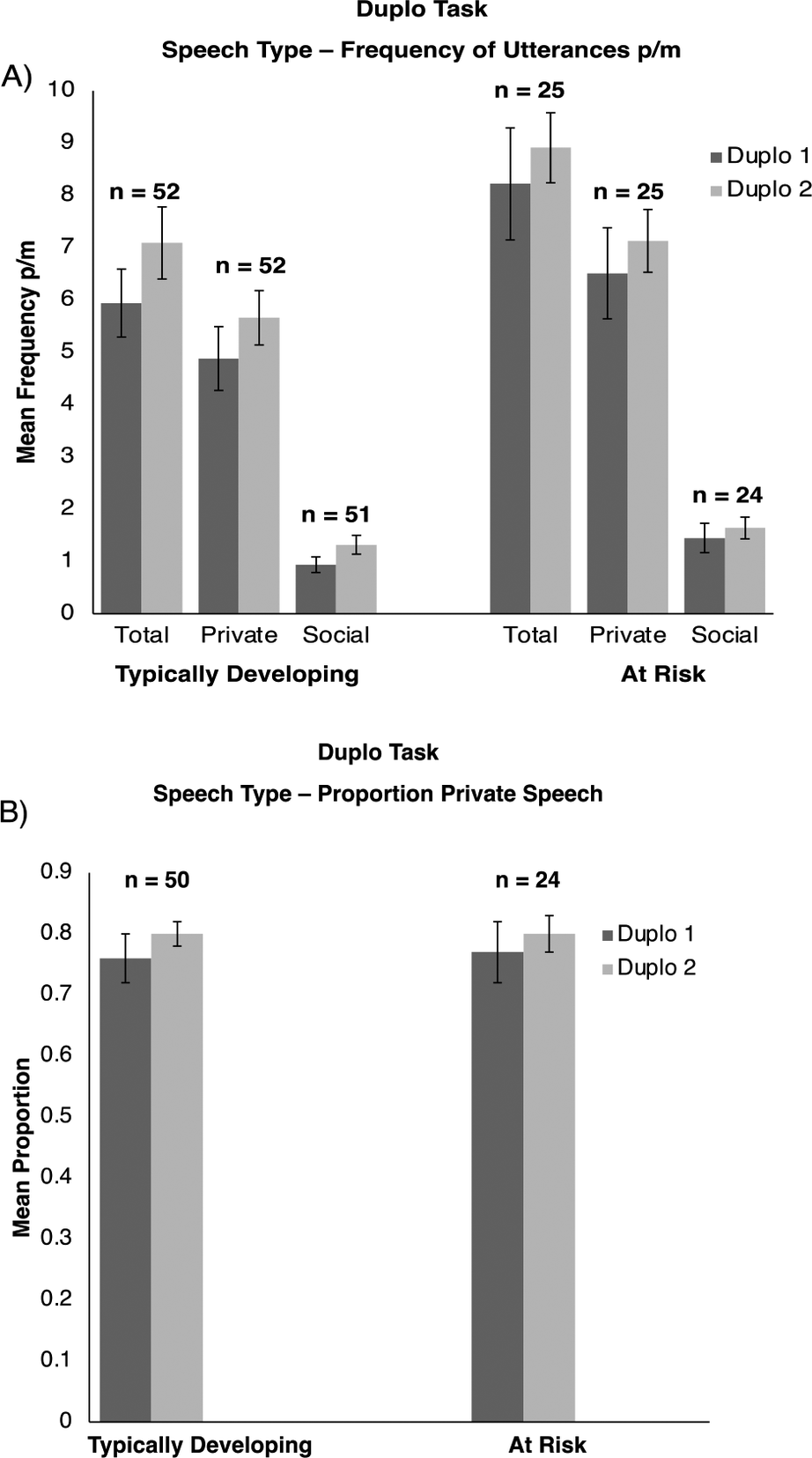
Figures 3 and 4 display the mean frequency and proportion of utterances per speech type, for each group, across easy and difficult levels on the Duplo and card sort tasks. The frequency measure was calculated for all participants who completed each task, whereas the proportion measure was calculated for participants who used at least one utterance during each task.
Task difficulty effect on speech type use across groups in the Duplo task. Mean results are presented for both typically developing (TD) and at-risk (R) groups on (A) frequency speech type in Duplo 1 and Duplo 2, (B) proportion of private speech in Duplo 1 and Duplo 2. Error bars represent standard error of the mean.
Task difficulty effect on speech type use across groups in the card sort task (A) frequency of speech type in card sort 1 and card sort 2 (B) proportion of private speech in card sort 1 and card sort 2. Error bars represent standard error of the mean.

Task difficulty
Overall, children spoke more frequently during the difficult Duplo task and used a greater frequency and proportion of social speech during the difficult card sort task.
Analyses revealed a main effect of difficulty on the frequency of utterances during Duplo construction, F(1, 74) = 4.14, p = .045, η² p = .05. Regardless of speech type, children spoke more frequently while constructing the difficult Duplo 2 replica (M = 7.69, SD = 4.06) relative to the easier Duplo 1 replica (M = 5.41, SD = 4.40). There was no main effect of difficulty on the frequency of private utterances, F(1, 74) = 2.80, p = .10, η² p = .04, and social utterances, F(1, 72) = 2.72, p = .10, η² p = .04, nor the proportion of private utterances, F(1, 71) = 0.87, p = .36, η² p = .01.
In the card sort task, the results reveal a social regulatory response as children sought more social verbal engagement in response to task challenge. A significant difficulty effect was evident for the frequency of social utterances, F(1, 70) = 8.25, p = .005, η² p = .11. As children progressed from card sort 1 to 2, they demonstrated a moderate increase in the frequency of social utterances per minute. Contrary to expectations, there was no significant difference in the frequency of private speech utterances across card sort task difficulty levels, F(1, 70) = 0.57, p = .45, η² p = .01. A task difficulty effect was evident for the proportional use of private speech, F(1, 54) = 5.26, p = .03, η² p = .09. Children demonstrated a proportional decrease in private speech and therefore a proportional increase in social speech use as they progressed from card sort 1 to 2.
Group differences
In comparison to typically developing children, the at-risk group spoke more frequently during Duplo construction. At-risk children used more frequent social and private speech utterances in the card sort tasks. Both groups demonstrated a similar speech type response to task difficulty.
During Duplo construction, a significant group effect for the frequency of total utterances, F(1, 74) = 4.27, p = .04, η² p = .06, revealed that at-risk children spoke more frequently overall (M = 8.60, SD = 3.45) than their typically developing peers (M = 6.70, SD = 4.06). The group effect for the frequency of social speech utterances, F(1, 72) = 3.81, p = .06, η² p = .05, was close to significance. There were no significant group differences for the frequency of private speech F(1, 74) = 3.00, p = .09, η² p = .04, nor the proportional use of private speech, F(1, 71) = 0.01, p = .93, η² p = >.001.
During the card sort task, a significant group effect was evident for both the frequency of social, F(1, 70) = 4.77, p = .032, η² p = .06, and private speech utterances, F(1, 70) = 4.61, p = .04, η² p = 0.06. At-risk children used social speech more frequently (M = 2.18, SD = 1.82) than typically developing children (M = 1.37, SD = 1.33). Similarly, at-risk children used more private, speech utterances per minute (M = 3.55, SD = 3.16) than their typically developing peers (M = 3.49, SD = 3.30). A group difference in the frequency of total utterances was close to significance, F(1, 72) = 3.71, p = .06, η² p = .05. There was no group effect on the card sort task for the proportion of private speech, F(1, 54) = 0.19, p = .67, η²p = .003.
Of particular interest, the response to task difficulty was similar for the at-risk and typically developing groups. During the Duplo task there was no significant group-by-condition interaction for the proportional use of private speech, F(1, 71) = 0.16, p = .70, η² p = .00, nor the frequency of total, utterances F(1, 74) = 0.10, p = .76, η² p = .00, private, utterances F(1, 74) = 0.00, p = .96, η² p = .00, and social utterances, F(1, 72) = 0.18, p = .68, η² p = .00. Similarly during the card sort task, there was no significant group-by-condition interaction for the proportional use of private speech, F(1, 54) = 0.05, p = .83, η² p = .00, nor the frequency of total, utterances F(1, 72) = 0.66, p = .42, η² p = .01, private, utterances F(1, 70) = 0.30, p = .59, η² p = .00, and social utterances, F(1, 70) = 0.44, p = .51, η² p = .01. A non-significant group-by-condition interaction across frequency and proportional measures of speech types was indicative of a comparable group response.
Task difficulty effects on private speech internalization
Figure 5 displays the mean private speech internalization score, for each group, across difficulty levels on the Duplo and card sort tasks. This coding scheme captures a progression towards private speech internalization (i.e., movement from overt to covert form), a likely marker of cognitive maturation or task competence.
Task difficulty effect on private speech internalization across groups. Mean results are presented for both typically developing (TD) and at-risk (R) groups on (A) level of internalization in Duplo 1 and Duplo 2 (B) level of internalization in card sort 1 and card sort 2. Error bars represent standard error of the mean.

Task difficulty
Children used more overt (i.e., out-loud) private speech during completion of the more difficult Duplo house replica.
A main effect of difficulty was evident on the Duplo task only. Not surprisingly, a moderate reduction in the private speech internalization score was characterized by more overt private speech features in the difficult (M = 2.29, SD = 0.97) relative to the easy (M = 2.63, SD = 1.21) Duplo task, F(1, 68) = 10.46, p = .002, η² p = .13. In line with previous research (Behrend et al., Reference Behrend, Rosengren and Perlmutter1989; Fernyhough & Fradley, Reference Fernyhough and Fradley2005), these findings suggest that children use more overt private speech while engaged in a task of higher and likely optimal difficulty.
In the card sort task, the effect of difficulty on private speech internalization did not reach significance F(1, 46) = 0.29, p = .59, η² p = .01.
Group differences
The at-risk group used less internalized private speech than typically developing peers during Duplo construction. Overall, both groups demonstrated a similar private speech response to task difficulty.
A main group effect was present on the Duplo task only F(1, 68) = 4.34, p = .041, η² p = 0.06, as children in the at-risk group attained a lower internalization score (M = 2.19, SD = 0.67), demonstrating less internalized private speech than their typically developing peers (M = 2.41, SD = 1.02). In the card sort task, group differences in the private speech internalization score did not reach significance, F (1, 46) = 3.15, p = .08, η² p = .06.
Again, the absence of a significant group-by-condition interaction for private speech internalization across both the Duplo, F(1, 68) = 0.18, p = .67, η² p = 0.00, and card sort tasks, F(1, 46) = 2.30, p = .14, η² p = .05, is indicative of a comparable regulatory response across groups.
Task difficulty effects on private speech content
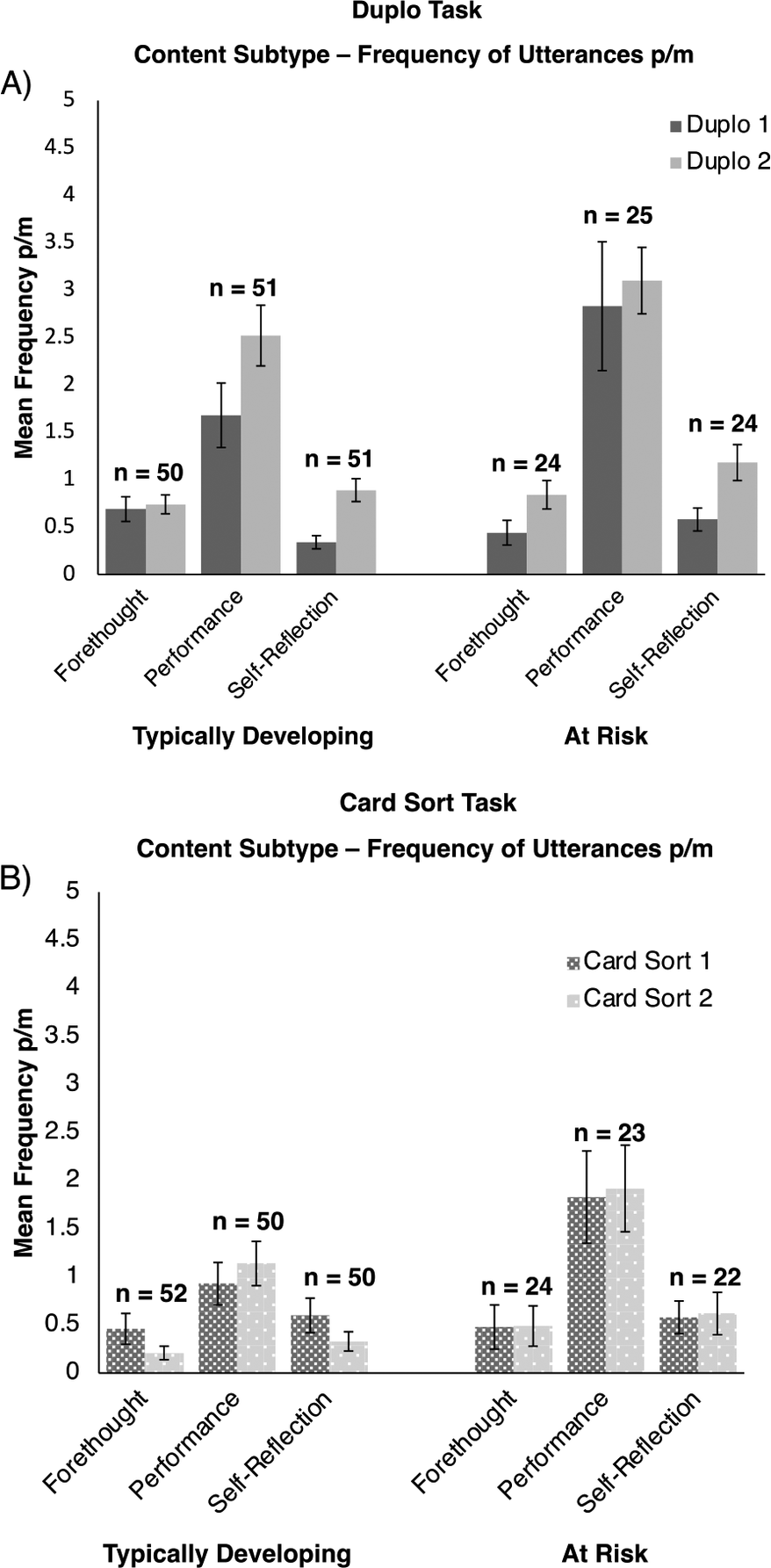
Figure 6 displays the mean frequency of task-relevant private speech content subtypes − forethought, performance, self-reflection − for each group across both tasks. As with previous private speech codes, the frequency measure is calculated for all participants who completed the task.
Task difficulty effect on private speech content subtypes across groups in the Duplo Task. Mean results are presented for both typically developing (TD) and at-risk (R) groups on the frequency of private speech content subtypes in (A) Duplo 1 and Duplo 2 and (B) card sort 1 and card sort 2. Error bars represent standard error of the mean.
Task difficulty
Children used more frequent forethought and self-reflective utterances during construction of the more difficult Duplo 2 relative to Duplo 1.
In the Duplo task, a main effect of difficulty was apparent for the frequency of forethought, F(1, 71) = 4.95, p = .03, η² p = .07, and self-reflective utterances, F(1, 72) = 30.73, p < .001, η² p = .29, Children used a higher frequency of forethought phrases that analyse the task (e.g., “first I need to put on the blue door”) or demonstrate self-motivation (e.g., “it’s gonna be easy for me”) while constructing the more difficult Duplo 2 (M = 0.81, SD = 0.80) than Duplo 1 (M = 0.77, SD = 1.29). Similarly, children engaged a markedly higher frequency of self-reflective utterances that evaluate performance (e.g., “that’s good”) or a display of affect towards task outcomes (e.g., “hurray I did it”) while constructing the more difficult Duplo 2 (M = 1.00, SD = 0.90) relative to Duplo 1 (M = 0.51, SD = 0.78). The incremental increase in task difficulty did not significantly alter the frequency of performance phase utterances, F(1, 73) = 3.21, p =.08, η² p = .04.
In the card sort task, a difficulty response was absent for the frequency of all private speech content subtypes, inclusive of forethought, F(1, 70) = 0.82, p = .37, η² p = .01, performance, F(1, 70) = 0.32, p = .58, η² p = .01, and self-reflective utterances, F(1, 70) = 0.89, p = .35, η² p = .01.
Group differences
At-risk children were found to use a higher frequency of performance utterances in the card sort task. The private speech content response to task difficulty was similar across groups.
During the Duplo task, there was no evidence of group difference for the frequency of private speech content subtypes. Analyses demonstrated no significant group effect for the frequency of forethought, F(1, 71) = 0.24, p = .63, η² p = .00, performance, F(1, 73) = 3.17, p = .08, η² p = .04, and self-reflective content subtypes, F(1, 72) = 3.06, p = .09, η² p = .04.
In the card sort task, at-risk children were found to use significantly more frequent performance utterances (M = 2.04, SD = 2.33) that are self-instructional or observational than their typically developing peers (M = 1.14, SD = 1.57), F(1, 70) = 4.65, p = .04, η² p = .06. There were no significant group differences for the frequency of forethought, F(1, 70) = 0.95, p = .33, η² p = .01, nor self-reflective type utterances, F(1, 69) = 0.34, p = .56, η² p = .005.
Notably, the absence of any significant group-by-condition interaction across all private speech content measures is indicative of group similarity in the systematic recruitment of private speech content in response to task difficulty. During the Duplo task there was no significant group-by-condition interaction for the frequency use of forethought, F(1, 71) = 2.74, p = .10, η² p = .04, performance, F(1, 73) = 0.72, p = .40, η² p = .01, and self-reflective utterances, F(1, 72) = 0.07, p = .80, η² p = .00. Likewise, during the card sort task there was no significant group-by-condition interaction for the frequency use of forethought, F(1, 70) = 0.39, p = .54, η² p = .01, performance, F(1, 70) = 0.16, p = .69, η² p = .00, and self-reflective utterances, F(1, 69) = 0.82, p = .37, η² p = .01.
Discussion
The present study sought to investigate the presence and nature of a private speech self-regulatory response to task difficulty in typically developing and at-risk preschool children. This study is the first to directly investigate a private speech response to difficulty in children with developmental challenges relating to language or attention control. The results from this study further substantiate evidence of a regulatory private speech response to task difficulty. During a more difficult task, children used more frequent utterances overall, a higher frequency and proportion of social speech, more overt private speech that is less internalized, and more frequent forethought and self-reflective statements. This research contributes to the evidence base that identifies less internalized private speech in children with language or attention control difficulties. Most importantly however, this study provides evidence that developmentally at-risk preschool children use private and social speech for self-regulation comparable to their typically developing peers. That is to say, both typically developing and at-risk preschool children demonstrated similar trends in the adaptive use of speech type, private speech form, and private speech content, when a task becomes more difficult.
Consistent with previous work (Fernyhough & Fradley, Reference Fernyhough and Fradley2005), a significantly higher frequency of all utterances was elicited while children constructed the more difficult Duplo house replica. Contrary to expectation, while there was a trend for more frequent private speech overall during difficult phases of the Duplo task, this effect was not significant. Notably, children used more frequent social utterances and demonstrated a proportional shift towards increased social speech use during the more difficult card sort 2. This suggests that a regulatory response to task difficulty is not solely intrapersonal, as children appear to seek interpersonal regulatory engagement. This finding is consistent with Vygotskian theory on the ontogenesis of private speech, which suggests a graded progression from socially mediated external regulation by significant others to internal self-regulation with cognitive mastery (Sawyer & Stetsenko, Reference Sawyer and Stetsenko2018). Although seemingly seeking social engagement under cognitive challenge, only 23% of social utterances during the difficult phase of both tasks comprised a direct request for help or task-based information. While the parameters of task design may have restricted children from explicitly seeking help, this pattern could also imply that children are either not explicitly aware of experienced challenge, do not readily engage social help-seeking, or simply disengage when the task becomes more challenging.
Private speech form is captured on a maturational continuum from overt to covert forms as it progresses towards inner speech. Aligning with research in school aged children (Fernyhough & Fradley, Reference Fernyhough and Fradley2005), preschool children demonstrated more overt private speech during construction of the difficult Duplo house replica. This emphasizes an interaction between private speech internalization and task mastery. When children shifted further from mastery to increased cognitive demand, the level of internalization score significantly decreased as children harnessed more overt private speech to regulate their engagement. Although private speech internalization is broadly considered an outcome of developmental maturation, these findings further corroborate the notion that private speech internalization also represents a regulatory marker of task based cognitive sophistication (Diaz & Berk, Reference Diaz and Berk1995; Fernyhough & Fradley, Reference Fernyhough and Fradley2005; Sawyer & Stetsenko, Reference Sawyer and Stetsenko2018).
A self-regulatory private speech content response to task difficulty has undergone limited investigation. It is plausible that shifting levels of cognitive demand may prompt associated change in the incidence of content types. For the purpose of this research, we coded on-task private speech content according to Zimmerman’s (Reference Zimmerman, Boekaerts, Pintrich and Zeidner2000, 2009) self-regulated learning model that delineates three regulatory phases during task engagement – forethought (i.e., task analysis and self-motivation), performance (i.e., self-control and self-observation) and self-reflection (i.e., self-judgement and self-reaction). Here, the task difficulty effect on the rate of self-reflective utterances was pronounced during the construction task. As children completed the challenging Duplo task, they engaged more frequent self-reflective statements, commenting on performance-based success or error and reacting to task outcomes. Additionally, children were found to recruit a moderately higher frequency of forethought phrases that analysed the task or demonstrated self-motivation as Duplo construction became more difficult. When the Duplo task became more challenging children relied to a greater extent on verbally mediated planning and self-appraisal to self-regulate their performance. Zimmerman (2013) suggests that these phases work in concert, whereby children’s self-reflections regarding task outcomes can subsequently guide forethought processes as children verbally analyse, plan and motivate themselves to prepare for the next step. The easier Duplo 1 may simply require a lesser degree of planning and appraisal.
As identified in previous research (Aziz et al., Reference Aziz, Fletcher and Bayliss2017; Winsler, Reference Winsler1998; Winsler et al., Reference Winsler, Diaz, Atencio, McCarthy and Chabay2000b), this study confirmed group differences in patterns of social and private speech use in young children with developmental challenges relating to language or attention control. In line with a proposed delayed developmental trajectory of private speech internalization (Barkley, Reference Barkley1997; Diaz & Berk, Reference Diaz and Berk1995; Lidstone et al., Reference Lidstone, Meins and Fernyhough2012; Mulvihill et al., Reference Mulvihill, Carroll, Dux and Matthews2019a), at-risk children in this study demonstrated more frequent use of utterances overall (Duplo), more frequent private and social speech (card sort) and a lower private speech internalization score (Duplo) in comparison to typically developing peers. Notably, in comparison with their typically developing peers, at-risk children also demonstrated a higher frequency of performance utterances (i.e., statements of self-observation or self-control) in the card sort task. Informed by behavioral and neurocognitive research, the self-regulated learning literature attributes these reactive learning behaviors to novice profiles, while expert and developmentally advanced learners engage a greater degree of proactive forethought (Chevalier, Martis, Curran & Munakata, Reference Chevalier, Martis, Curran and Munakata2015; Zimmerman, Reference Zimmerman2002, Zimmerman, 2013). These observations provide a compelling explanation for the at-risk group’s engagement of a more novice-like private speech content pattern.
A central aim of this investigation was to extend beyond a single event comparison and instead utilise a shift in task difficulty to determine whether the at-risk group would demonstrate a regulatory private speech response to difficulty that was comparable to typically developing children. The lack of any significant group-by-condition interaction for markers of speech type, and private speech form and content, provides evidence for a systematically similar rather than deviant group response to task difficulty. It would appear that developmentally at-risk preschool children demonstrate a regulatory private speech response to task difficulty akin to that of typically developing children. Previous research has questioned the use of private speech for regulation in developmentally at-risk children on single event comparisons due to the higher incidence of overt private speech used to achieve similar or lesser performance outcomes (see Mulvihill et al., Reference Mulvihill, Carroll, Dux and Matthews2019a for review). Rather, current findings, of an intact regulatory private speech response to task difficulty, lend support to Diaz and Berk’s (Reference Diaz and Berk1995) suggestion that limited internalization may in fact represent an adaptive regulatory response to the increased cognitive demand of language or attention control difficulty.
Limitations and future directions
Broadly, our sample predominately comprised children from a high socioeconomic background and over a narrow, defined preschool age range. Future research may seek to replicate these findings with a more diverse sample and over a larger age range.
The Duplo task elicited more utterances and revealed more fine-grained private speech responses to task difficulty than the i-Pad administered card sort task. In private speech research different task types are known to elicit different amounts and types of private speech (Frauenglass & Diaz, Reference Frauenglass and Diaz1985; Lidstone et al., Reference Lidstone, Meins and Fernyhough2011; Winsler et al., Reference Winsler, De Leon, Wallace, Carlton and Willson-Quayle2003). The differential design and presentation of both tasks could have influenced the propensity for private speech use. In contrast to the Duplo task, the automated card sort task did not afford opportunity to self-select stimuli or manipulate responses post-selection. Furthermore, unlike the Duplo task, a visual of the goal state was not present to support planning, performance monitoring, and error detection.
To examine an adaptive regulatory private speech response to difficulty the Duplo and card sort tasks comprised two incremental levels of challenge. The shift in task level offered was the same for all children. The shift in difficulty across task levels was significant for both groups as indicated by significantly lower accuracy scores in the more difficult level of each task. However, at-risk preschool children experienced a larger shift in challenge from Duplo 1 to Duplo 2 in comparison to their typically developing peers. Future research may seek to calibrate difficulty levels per participant to ensure a more standardised shift in the level of challenge experienced. Research with typically developing children has also identified an inverted U-shaped private speech response to numerous levels of task difficulty, whereby children are found to engage more frequent verbalisation at optimal levels of challenge and lower levels of verbalisation when a task is either too easy or difficult (Fernyhough & Fradley, Reference Fernyhough and Fradley2005). In our selected computerised card sort task, the automated stop rule resulted in 47% of children not progressing to phase three. This precluded our analysis of private speech at this high level of challenge where preschool children were likely functioning outside their zone of proximal development. Future research may also seek to investigate whether at-risk children demonstrate this inverted U-shaped trend on tasks that provide greater variation in levels of task difficulty.
A further limitation of this study relates to a small, heterogenous developmental risk sample that was predominately male. Our at-risk group consisted of preschool children with clinically significant language or attention control challenges. Although these subgroups did not differ significantly in their private and social speech use, a heterogenous risk sample limits the interpretability of findings. Our at-risk was also characterised by a higher proportion of male participants (63%). A higher proportion of male participants is common in research with at-risk populations as neurodevelopmental challenges are more prevalent in males than females (Eric, Reference Eric2009; Tomblin, Records, Buckwalter, Zhang, Smith & O’Brien, Reference Tomblin, Records, Buckwalter, Zhang, Smith and O’Brien1997; Willcutt, Reference Willcutt2012), thus presenting a sampling challenge.
Lastly our at-risk sample size was relatively small (N = 25), especially in the case of proportional private speech and level of internalisation analyses that involved smaller subgroups. Future research on the adaptive regulatory role of private speech in atypical development may seek to include larger and more defined samples of neurodevelopmental risk to assess whether the presented results are replicated. In particular, future research could investigate the private speech task difficulty response in young children with a diagnosis of ASD for whom the regulatory use of private speech remains even more contentious.
Conclusion
Notwithstanding its limitations, this research contributes further insights into the regulatory private speech response to increasing cognitive demand in young children. Furthermore, we address current ambiguity regarding the regulatory utility of private speech in developmentally at-risk individuals and contribute to the research base that suggests an intact regulatory private speech system in this group. Clear findings regarding the private speech response to task difficulty hold interpretive value for future research. Implications for parents and early childhood professionals include clear behavioral markers of cognitive demand in preschool children, and confirmation that overt private speech is engaged for regulatory purposes in developmentally at-risk children. It is important for parents and professionals to note that children with language or attention control difficulties may recruit more ‘out-loud’ private speech in order to maintain a similar level of task engagement to their peers. Additionally, the presence of challenge provoked social speech suggests an optimal time for scaffolding within a learning task. Findings of limited help-seeking during moments of social speech suggest the need for sensitive adult guidance to enhance awareness of challenges experienced and encourage adaptive help seeking behavior (e.g., I notice this is difficult. You can say “can you help me.”).
Acknowledgements
Aisling Mulvihill is a recipient of the Australian Government Research Training Program Scholarship. Paul E. Dux and Annemaree Carroll by the ARC-SRI Science of Learning Research Centre (SR120300015).
The authors declare that they have no known competing financial interests or personal relationships that could have appeared to influence the work reported in this paper.
Supplementary Materials
To view supplementary material for this article, please visit http://doi.org/10.1017/S0305000921000945.


 Open access

