




Introduction
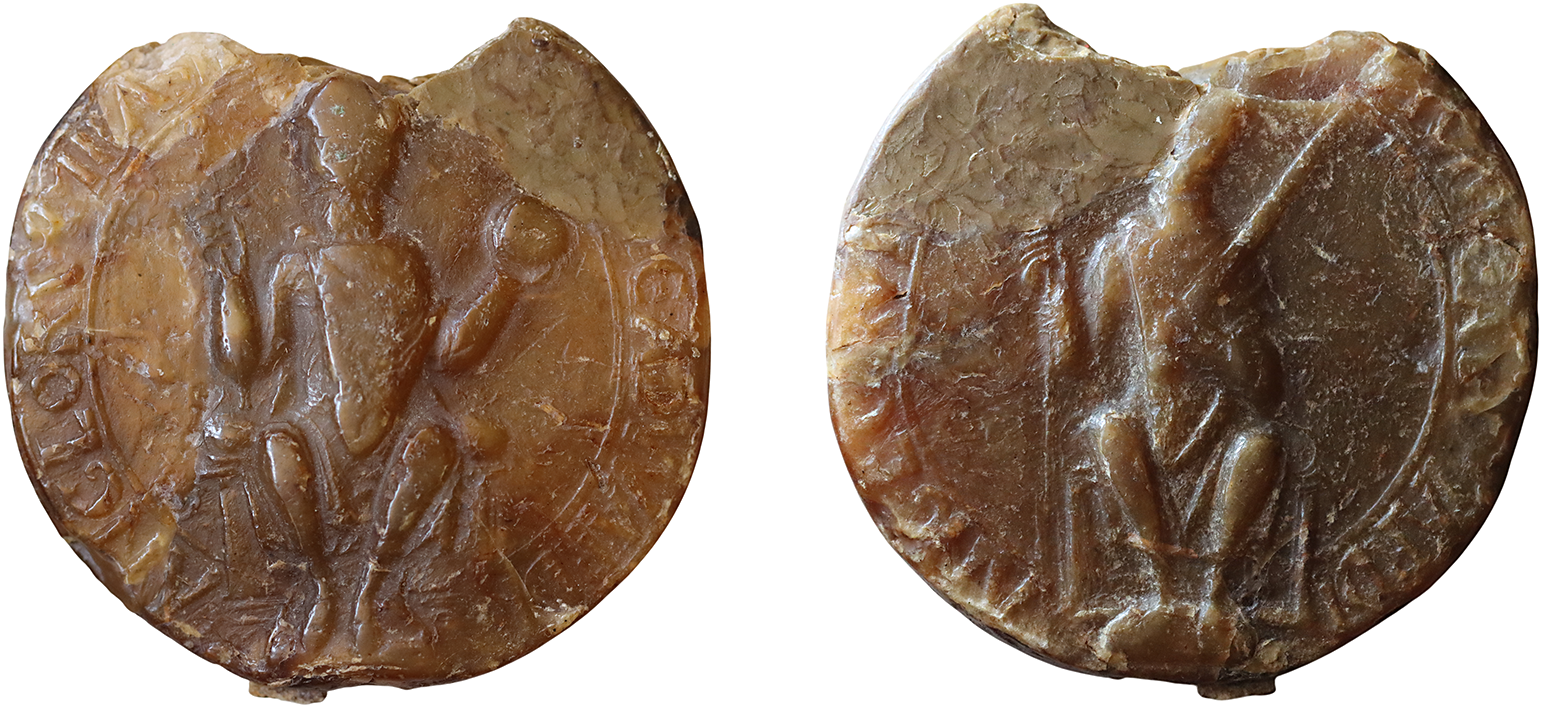
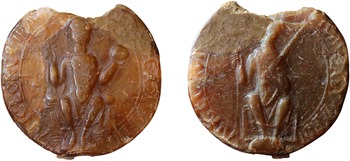
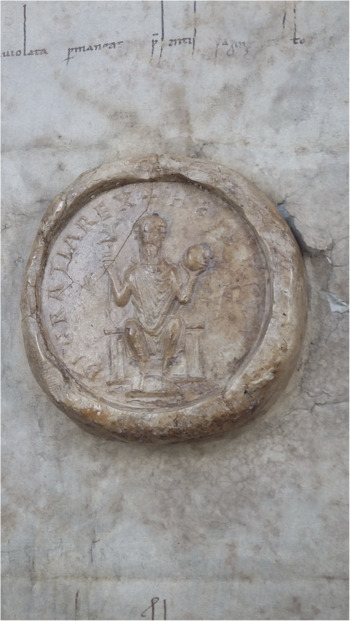
If the discovery of a new Anglo-Saxon charter has been said (with some justification) to be ‘a very rare event’,Footnote 1 rarer still is the discovery of a new royal seal. And while the rediscovery of material once known, but subsequently lost, may attract less excitement, it is potentially no less significant. The present article concerns just such a case: the Saint-Denis seal impression of Edward the Confessor (fig. 1). This was originally preserved within the rich archives of the northern Parisian monastery of Saint-Denis alongside the documents it authenticated, before making its way with these to the newly founded Archives nationales de France in the 1790s. It represents one of just three authentic impressions of the Confessor’s seal – itself the only authentic royal seal from before the Norman Conquest. It is, therefore, a most precious item, whose value is enhanced by the fact that it constitutes by far the best preserved of the three impressions. Initial news of the seal’s loss in the mid-1980s was therefore met with considerable consternation, both in Britain and abroad.Footnote 2 Its recent rediscovery within the detached seals section of the Archives nationales provides a welcome opportunity to revisit the seal, its significance and its wider documentary context.
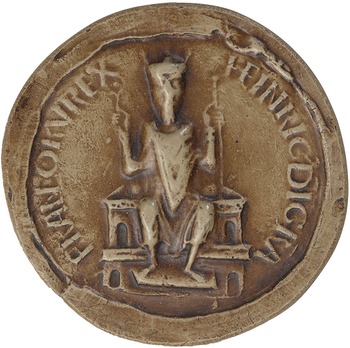
Saint-Denis Seal Impression of Edward the Confessor (1053 × 1057). © Paris, Archives nationales, Sc/x/832.
The present article first introduces the circumstances of the seal’s ‘loss’ and subsequent rediscovery (I), before surveying its iconographic debts to continental European and Byzantine seals of the period (II). This offers the foundations for a wider reconsideration of the seal’s documentary context, revisiting the evolution of the sealed writ-charter (III), before finally contextualizing this within the broader evidence for diplomatic connections and exchanges between England and mainland Europe in these years (IV).Footnote 3
I. How an Anglo-Saxon Royal Seal Was Lost and Found
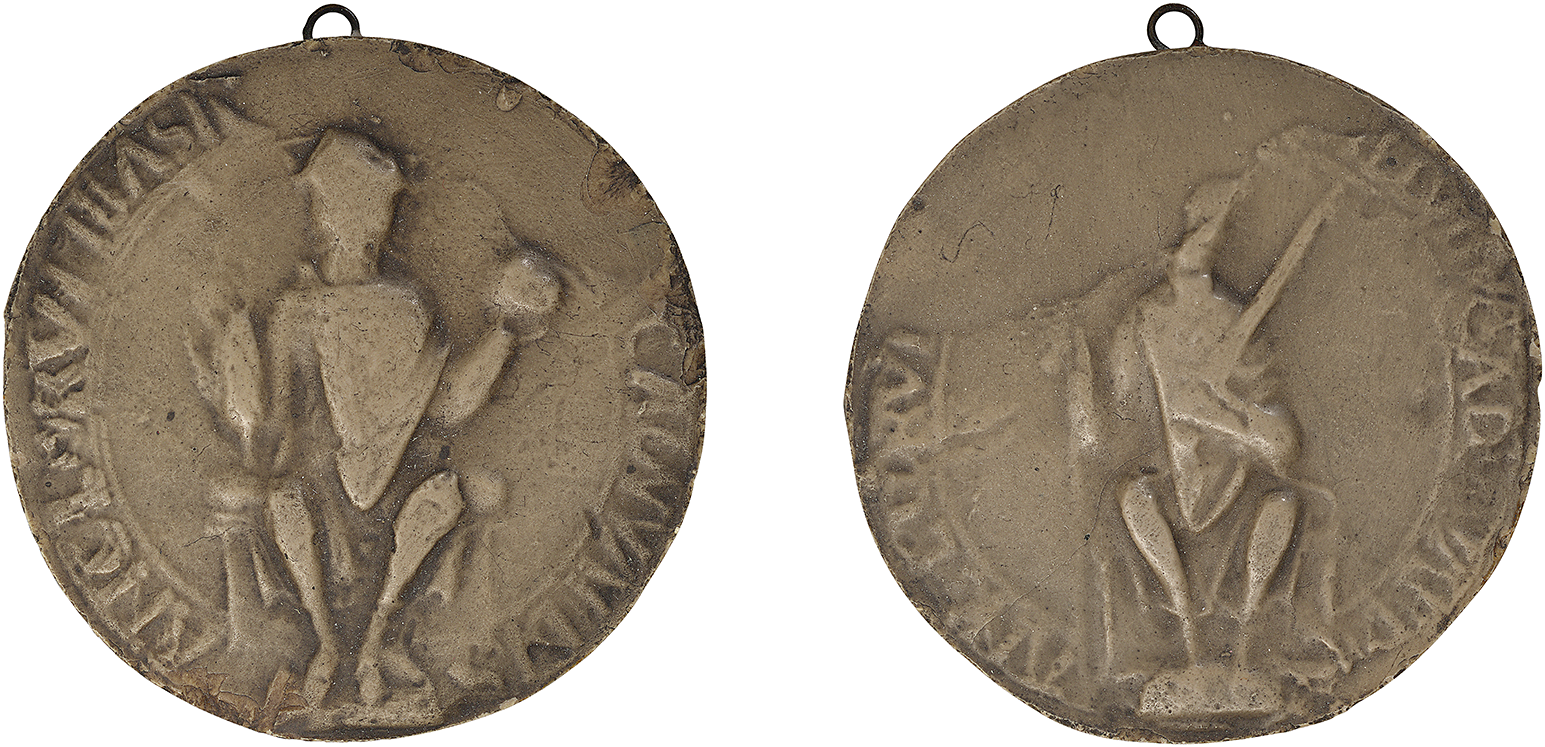
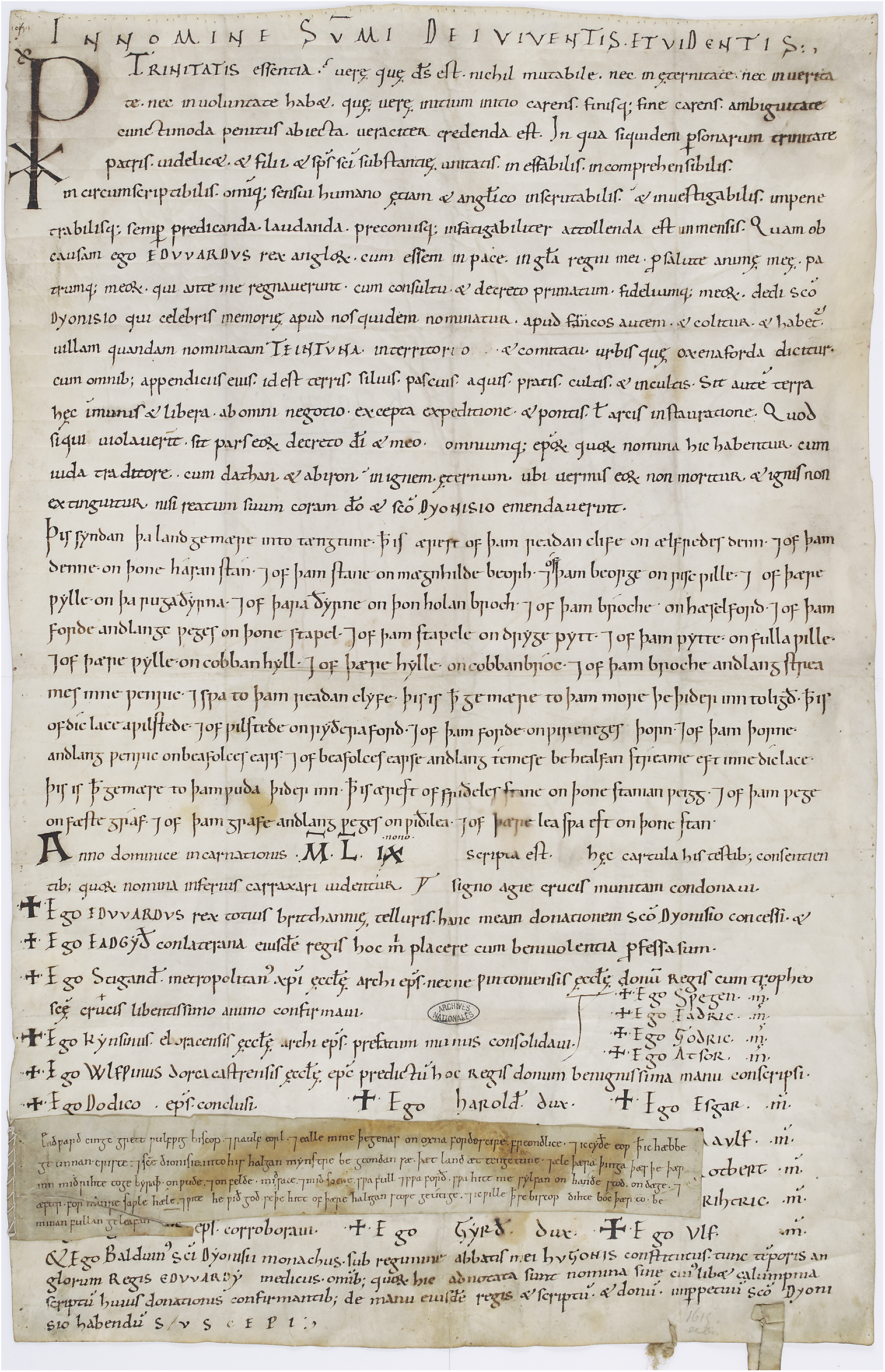
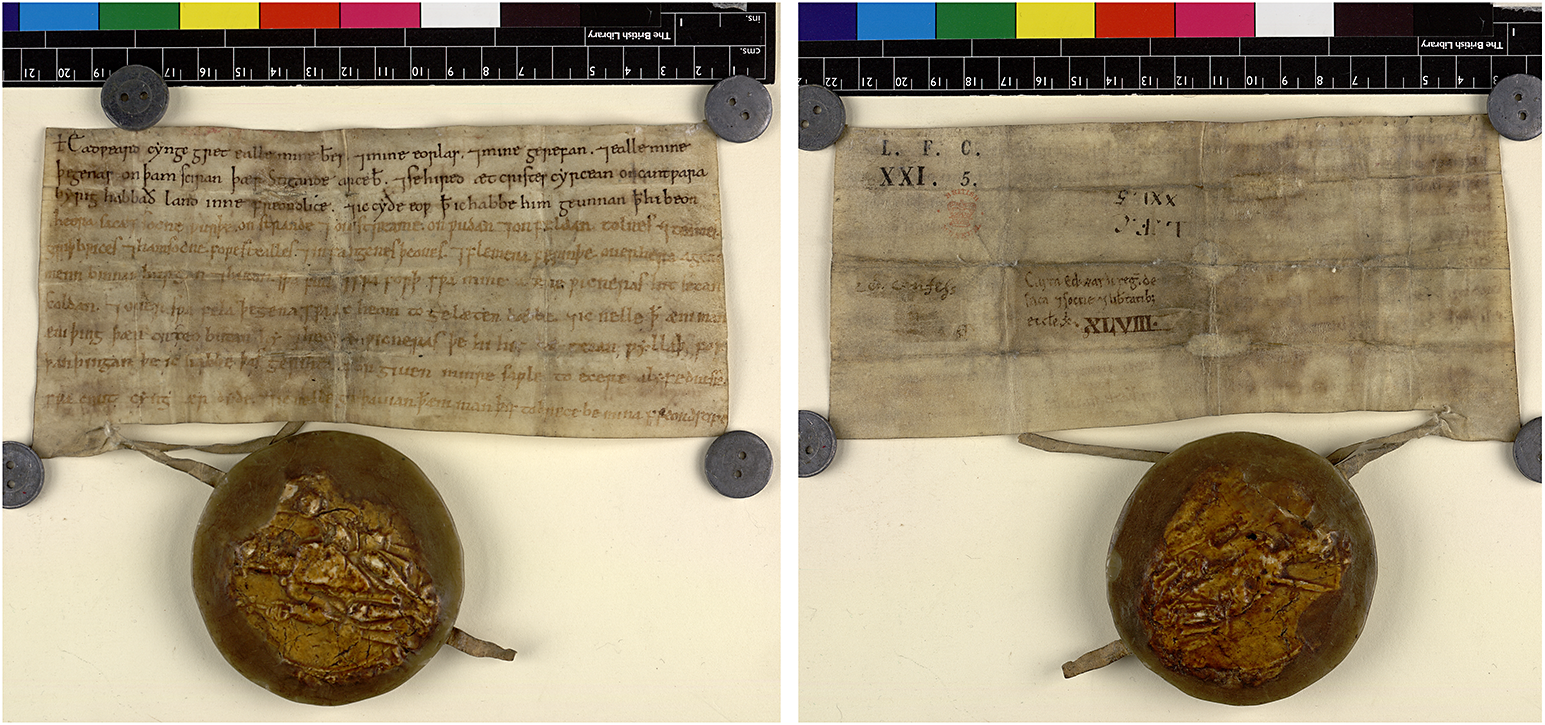
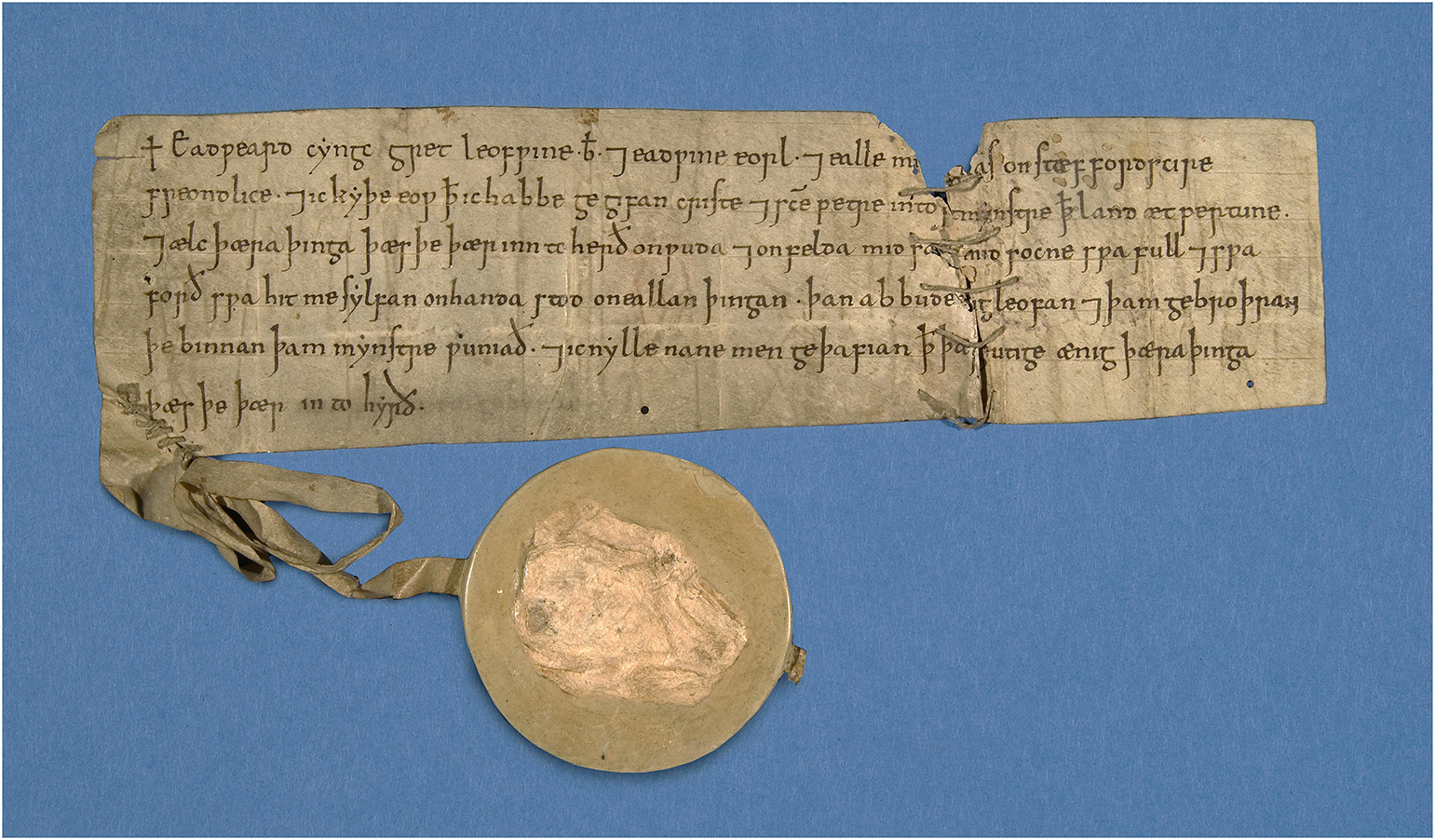
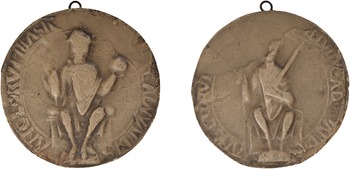
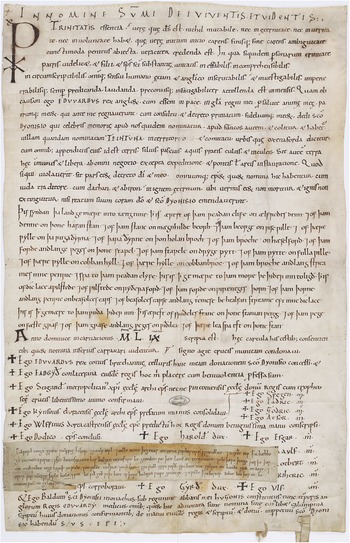
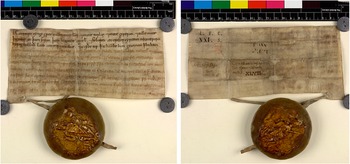
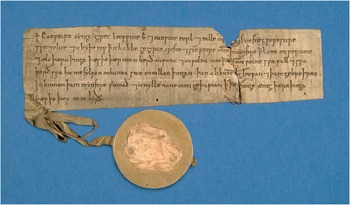
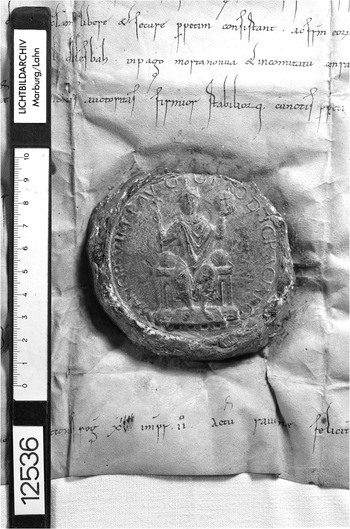
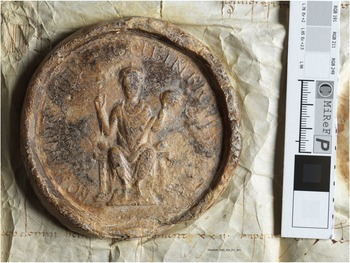
Today, eight seal impressions of Edward the Confessor (1042–66) are known, representing three distinct types. These were already published in the nineteenth century by Walter de Gray Birch and Alfred Wyon.Footnote 4 In the 1950s, Florence Harmer, T. A. M. Bishop and Pierre Chaplais demonstrated that only the so-called ‘second’ of these types was genuine: the others are forgeries, produced at Westminster Abbey in the first half of the twelfth century.Footnote 5 This authentic seal matrix is known from just three impressions, all fragmentary. Perhaps the earliest of these is attached to a Christ Church writ now held at the British Library, datable to between 1052 and 1066 (possibly towards the start of this range) (fig. 4);Footnote 6 the last is borne by a Westminster writ from between 1062 and 1066 (fig. 5).Footnote 7 The best preserved third, which was originally appended to a writ of 1053 × 1057 and latterly transferred to a diploma of 1059 concerning the donation of Taynton (Oxon.) to Saint-Denis, is held in the Archives nationales in Paris (fig. 3).Footnote 8 This latter impression, cast at the Archives nationales in 1830s (fig. 2) and repeatedly reproduced in English-language publications until 1957 (when Bishop and Chaplais noted that it had become detached from the diploma to which it had previously been appended),Footnote 9 was nonetheless described as lost from the 1980s on by Brigitte Bedos-Rezak and Simon Keynes. Both scholars based their assessment on information provided by the curator in charge of the seal collection of the Archives nationales at the time.Footnote 10 A similar response was later given to Elizabeth A. R. Brown and Thomas Waldmann.Footnote 11 Thus an English royal seal of the eleventh century – one of the oldest and most important impressions held by the French national archives, associated with a famous set of documents in favour of Saint-Denis – was thought to have inexplicably disappeared from the public collections sometime between the late 1950s and mid-1980s, without official explanation. Fortunately, this is not the case. The impression is in fact still held at the Archives nationales, located in the Sceaux détachés (detached seals) section alongside other similarly detached impressions, separated from its original document and stored in an individual box.Footnote 12
Cast of the Saint-Denis seal of Edward the Confessor (c. 1830). © Paris, Archives nationales, Sc/D/9997.
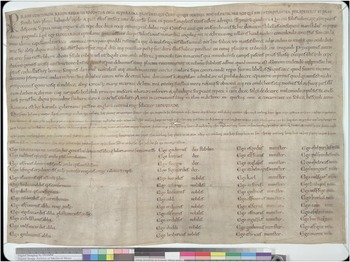
Saint-Denis Writ and Diploma of Edward the Confessor. S 1105 (1053 × 1057) and S 1028 (1059). © Paris, Archives nationales, AE/III/60 (olim K//19, no. 6).
Christ Church Writ and Seal Impression of Edward the Confessor. S 1088 (1052 × 1066). © London, British Library, Campbell Charter xxi. 5.
Westminster Writ and Seal Impression of Edward the Confessor. S 1140 (1062 × 1066). © London, Westminster Abbey, W. A. M. XII.
The Sceaux détachés contains many similar items, representing sealers of varying importance – ranging from monarchs to peasants – in differing states of preservation, from perfectly preserved impressions to unidentifiable fragments. In most cases, these seals were placed in the section without any accompanying document recording their origin. As a consequence, the date and circumstances of Edward’s seal impression entering the collection remain unknown. Several reasons may have led to an impression being placed among the Sceaux détachés. Significant seal impressions held in French departmental archives – including those of monarchs – were sometimes gathered here in times of unrest, such as during the archive evacuation plans implemented during the Second World War.Footnote 13 Such was the case, for example, with a seal of Louis the Pious (814–40), originally used to authenticate a diploma of 837 for Cormery. This was transferred to Paris on 5 July 1942, rediscovered in 2012, and only returned to the Archives départementales d’Indre-et-Loire in 2016.Footnote 14 However, Edward’s impression, which was placed among the Sceaux détachés after the war (indeed, after 1957), was most likely separated from its document for reasons of conservation, as was the case with many other seals within the collection. It is possible that the seal was moved to prevent deterioration or loss during the handling of the associated diploma, especially since the impression had already been separated from the parchment by 1957. In any case, the fact that this operation was carried out without being recorded led all specialists to believe that the seal had been lost – a misunderstanding which could have been avoided with a simple handwritten note placed alongside the original document.
If King Edward’s seal was indeed placed among the Sceaux détachés to aid its preservation, then the operation has been a success: its current condition is virtually identical to that presented in the facsimile published by Bishop and Chaplais in 1957, its last point of publication.Footnote 15 The only change is that a small amount of restoration has been undertaken to the upper right quadrant of the obverse (the upper left of the reverse), where the impression is damaged. The seals of the Sceaux détachés were often used to train up restorers in the twentieth century, which presumably explains this otherwise unrecorded round of restoration (earlier restoration prior to 1957 is described by Bishop and Chaplais). The rediscovery of the impression allows for a new edition to be offered:
Edward the Confessor. [1053 × 1057]. Paris, Archives nationales, Sceaux détachés, Sc/x/832 (cast: Sc/D9997). D. 75 mm. Thk. 5 mm. Wt. 33.1 g. Brown wax, round, pendant on a parchment tongue. Obv. The king enthroned, facing forward, crowned, holding a fleur-de-lis sceptre in his right hand and an orb in his left. Legend: [SIGILLVM] EADVVARDI ANGLORVM BASIL[EI]. Rev. The king enthroned, facing forward, crowned, holding a (bird?) sceptre in his right hand and a sword in his left. Legend: [SIGI]LLVM EADVVARDI ANGLORV[RVM BASILEI].
The date of the impression is provided by that of the writ which it originally authenticated, whence it was transferred at some point – apparently in the Middle Ages – to the diploma concerning the same grant (to which the writ itself is now stitched). It was still to be found here when Louis Douët d’Arcq inspected the document in the 1860s.Footnote 16 The writ is addressed to Bishop Wulfwig of Dorchester and Earl Ralph of Mantes at the Oxfordshire shire court, the former of whom was appointed in 1053 and the latter of whom died in 1057, providing a convenient four-year window for the document’s issuing. As the transaction in question – the grant of Taynton to Saint-Denis – was apparently associated with the donation of Deerhurst to Edward’s physician Baldwin (who had recently professed at the northern French monastery – a detail noted in the diploma), there is a strong likelihood that the document was issued after the death of Odda of Deerhurst in 1056.Footnote 17 If so, this would offer a narrower dating range of 1056 × 1057. Either way, this makes the impression the earliest securely datable one of Edward’s authentic (‘second’) seal. Its main competitor, the seal borne by the Confessor’s confirmation of rights to Stigand of Canterbury, cannot be dated more precisely than between 1052 (when Stigand first occupied the see) and 1066 (Edward’s death). The presumption has been that this writ was issued upon the occasion that Stigand was gazetted to Canterbury (or soon thereafter), since the need to confirm archiepiscopal rights would have been greatest at that moment.Footnote 18 But the situation is complicated by the fact that the writ has been rewritten at least once – and perhaps twice. As has long been appreciated, only the first three lines of the surviving single sheet can date from Edward’s reign; the remainder of the text has been erased and rewritten at some point in the late eleventh or early twelfth century. Recent multispectral imaging, however, revealed the existence of an earlier textual layer before the first three lines now extant. Since the script of this section is entirely acceptable for Edward’s reign, it may simply be that the writ was produced on re-used parchment. An earlier stage of tampering (perhaps soon after 1066?) cannot, however, be excluded, and the date of the impression therefore remains uncertain.Footnote 19
On present evidence, the only secure terminus ante quem for the introduction of the seal type is thus 1057. As we shall see, there may be grounds for thinking that a royal hanging seal was already in use in the 1040s, but if so, we cannot be sure that the same matrix was employed. By contrast, Harry Bresslau’s argument that the seal’s iconography must go back to a lost earlier matrix of Cnut faces significant obstacles.Footnote 20 Not only is there no secure evidence for sealing patent before Edward’s reign (see section III), but the seal’s iconography speaks strongly of an origin in the 1050s, finding close parallels in coinage of these years, as we shall see.Footnote 21 The similarities Bresslau noted between Edward’s seal and that of the later Danish ruler Cnut the Holy (1080–6) can, moreover, be adequately explained by later contact and exchange between the two regions, for ties between England and Denmark remained strong throughout Edward’s reign – and, indeed, beyond 1066.Footnote 22
II. A New Expression of Royal Majesty
Several innovative features have long rendered the seal of Edward the Confessor famous, both among specialists of Anglo-Saxon England and scholars of medieval European sigillography more widely. This sphragistic type represents the earliest surviving royal wax seal from England, while also constituting the oldest known example of a hanging wax seal of the ‘majesty’ type – and of a royal seal with sword – from the Latin West. These points have led scholars to consider Edward’s impressions striking manifestations of a ‘new and stronger concept of kingship’, articulated through the deliberate assemblage of multiple images and formulae of imperial legitimacy, both western and Byzantine, further enriched by the inclusion of specifically English elements.Footnote 23 It is, therefore, worth reconsidering the terms of this formal and material question, which holds significant implications for the wider development of the writ-charter.
Let us begin by addressing the most evident innovation of Edward the Confessor’s seal, namely its bifacial and hanging character, for which no precedent is known among the wax seal impressions of the Latin West before this point. This novel feature may be regarded as the fusion of two pre-existing methods of diplomatic sealing, clearly distinct from one another yet both known in England. Prior to Edward’s reign, all medieval European wax seals affixed to documents were either applied or riveted. Although less common, the technique of suspending an impression from a document by means of attachments was also known. This was reserved for bulls (bullae) – seals made of gold, silver or leadFootnote 24 – following conventions developed from an early date in Greece and within the Byzantine Empire.Footnote 25 This practice enjoyed particular popularity within the papacy, where lead bulls were employed to seal documents from the pontificate of Adeodatus I (615–18) onwards.Footnote 26 The two methods of sealing coexisted in the West among issuers harbouring imperial claims – for example, the Carolingians in the ninth century or East Frankish rulers in the later tenth and eleventh centuriesFootnote 27 – or within milieux familiar with the political language of the great empires.
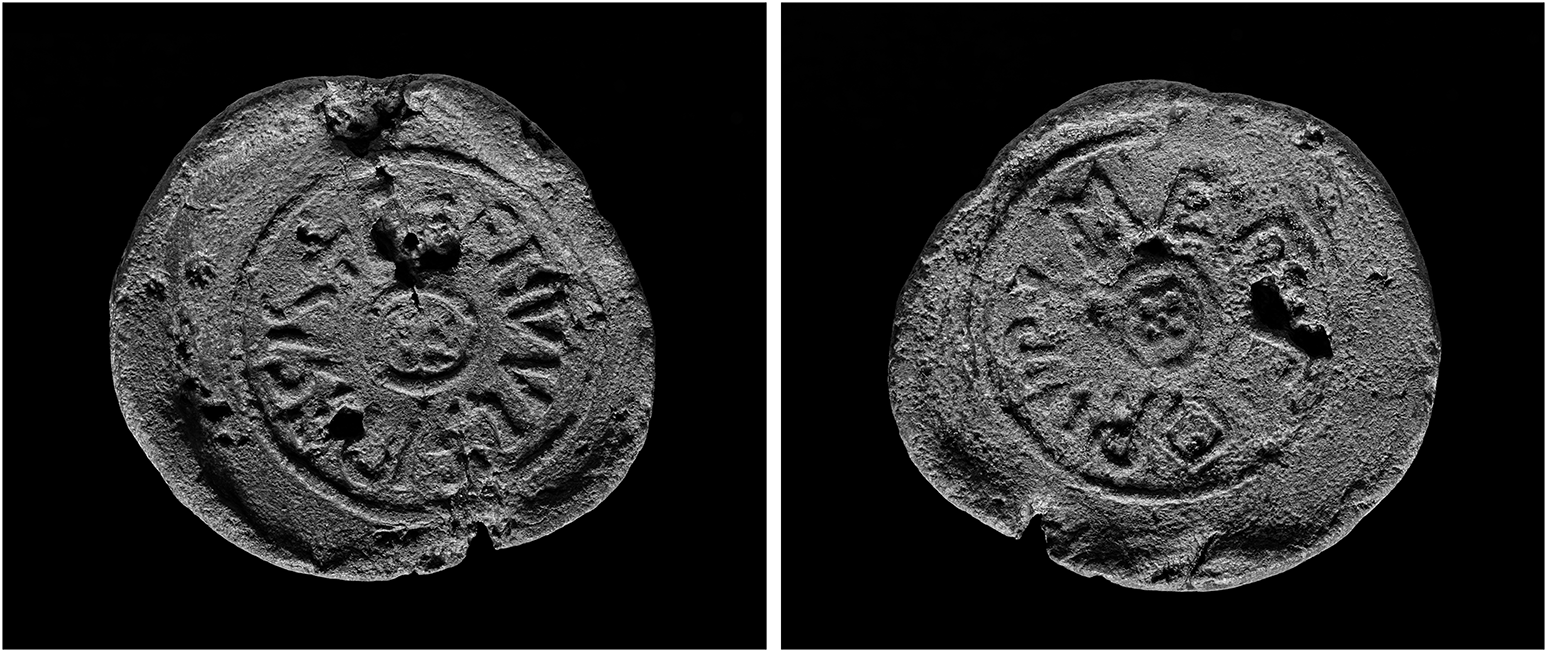
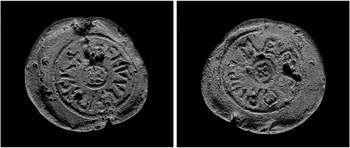
This is clearly the case in England, where the production of wax seals – attested continuously from the ninth century onwards, though not apparently for the purpose of authenticating chartersFootnote 28 – was on occasion supplemented by the issuing of lead impressions, as is demonstrated, for example, by a surviving bull of the Mercian king Coenwulf (796–821) (fig. 6).Footnote 29 Still a poorly understood phenomenon, the introduction of the lead seal to England must be explained by a dual or even triple inspiration: pontifical, western imperial, and perhaps also Byzantine. It is known, for example, both from diplomatic sources and from the discovery of bulls in archaeological contexts, that Leo III (795–816) and Paschal I (817–824) addressed sealed privileges to Coenwulf and two other Insular recipients.Footnote 30 At the same time, English rulers maintained close ties with the Carolingians, who upon occasion employed bulls themselves: on several occasions in the late eighth century, Charlemagne sent messengers bearing written documents to Mercia and Northumbria.Footnote 31 These circulations of material and personnel may have had tangible effects on Insular graphic norms. J. M. Wallace-Hadrill famously argued that Carolingian seals, themselves employing Roman intaglios, may have inspired the Romanizing numismatic production of Offa of Mercia (757–796), though subsequent work suggests that direct borrowing from antique models is more likely.Footnote 32 Finally, it is conceivable that the prior use of the lead seal was reinterpreted in Anglo-Saxon England in light of contemporary Byzantine practices, known either at first or second hand. This hypothesis, however, encounters difficulties with regard to the chronology of Byzantine seals found in Britain. With only rare exceptions – and despite other well-attested exchanges between Byzantium and England – almost all the Byzantine seals known from the region belong to the eleventh century and thus cannot directly account for Coenwulf’s adoption of the lead bull.Footnote 33
Bull of Coenwulf, king of the Mercians (796 × 821). © London, British Museum, 1847,0804.1.
In any case, both methods of sealing – the application or riveting of wax and the suspension of lead – were clearly known in England by the first half of the eleventh century, through the region’s own sigillographic production and through its contacts with western and Byzantine issuers. Familiarity with these techniques may have facilitated the invention of the hanging wax seal, which combines the properties of both, but does not in itself explain this innovation. Important in this respect is the nature of the vernacular writ-charter, which it was used to authenticate (see section III). It would seem that Edward’s seal was designed both to evoke (by its form) and to serve (through its large surface distributed over two faces) as a vehicle for several features characteristic of the sigillography of the great contemporary empires of mainland Europe and the Mediterranean. This conforms well to the wider evidence for imperial kingship in tenth- and eleventh-century England, corresponding to the distinctive form of ‘secondary imperiality’ identified by modern scholars: the appropriation of the distinctively ‘imperial’ trappings by rulers who were not strictly speaking emperors – forms of hegemonic rule also found among Iberian and Italian rulers of these years.Footnote 34
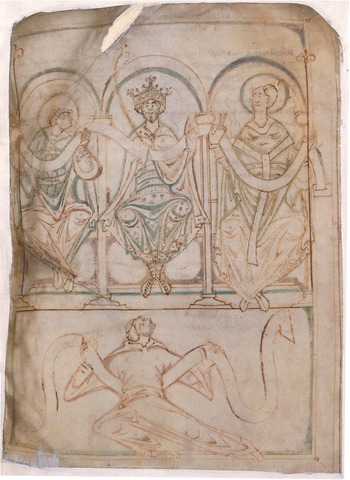
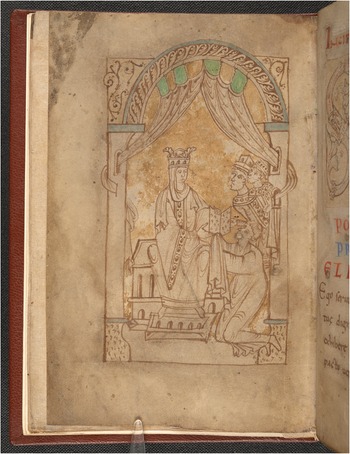
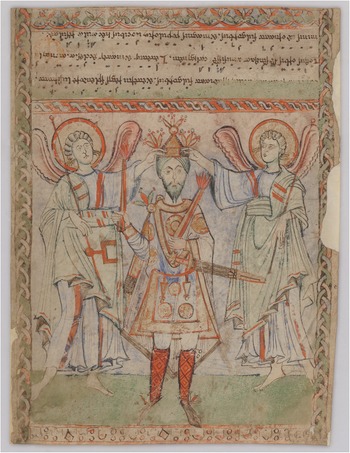
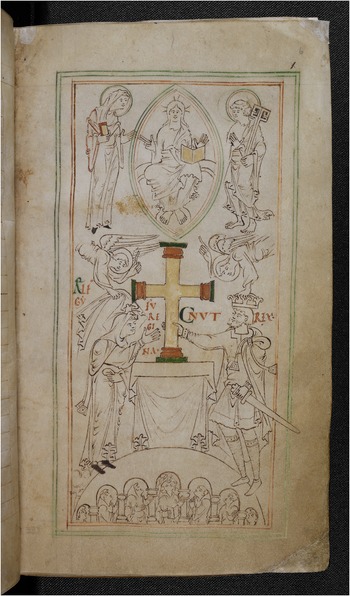
What, then, are the imperial symbols that appear on Edward’s seal? Let us begin by examining the clearest among them, which has long attracted notice. The depiction of Edward on the impression conforms to what sigillographers call a ‘seal of majesty’, depicting ‘the effigy of the sovereign seated on the throne, crowned, and holding the insignia of sovereignty […]’.Footnote 35 There is no need to dwell on this point, for Brigitte Bedos-Rezak devoted an insightful article to the subject in 1986.Footnote 36 It suffices to recall that Edward’s seal constitutes only the third known English representation of a ruler enthroned, the first being that of his grandfather Edgar, on the frontispiece of the Regularis concordia (first half of the eleventh century) (fig. 7),Footnote 37 and the second that of his mother Emma, on the frontispiece of the Encomium Emmae (1042) (fig. 8).Footnote 38 Otherwise, only Christ and biblical figures had been depicted enthroned in majesty in Anglo-Saxon artwork. This iconographic innovation, also introduced into royal coinage through the type known as the Sovereign/Eagles,Footnote 39 was interpreted by Bedos-Rezak as a laicizing evolution of English kingship at a time when the influence of churchmen over government had begun to wane. The seal allowed Edward to evoke his regality in the manner of Christ, and to legitimize his authority by presenting himself as God’s representative on earth.Footnote 40 In light of more recent work on Edward’s reign, one would be hesitant to go quite so far.Footnote 41 Edward was a man of deep piety, as his subsequent canonization attests, whose father Æthelred II (978–1016) and grandfather Edgar (957/9–75) had been leading patrons of reformed monasticism – the very circles which first popularized such ideas about of God-given kingship. To view these ideals as straightforwardly anti-clerical is therefore something of a stretch.Footnote 42 Rather, the underlying conception seems to be one of harmonious co-operation between the religious and political spheres.
Frontispiece of the Regularis concordia (first half of the eleventh century). © London, British Library, Cotton Tiberius A. iii, 2v.
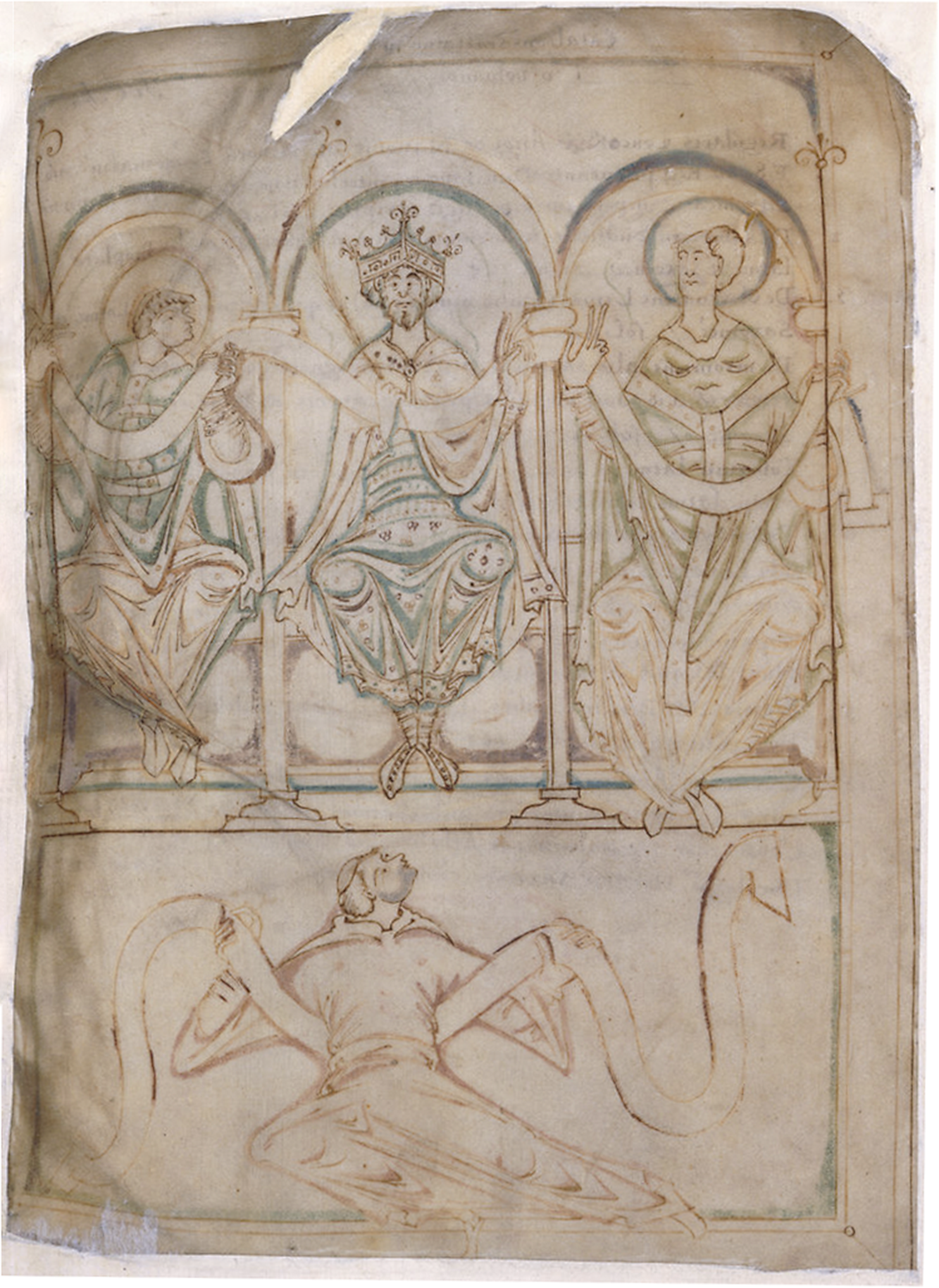
Frontispiece of the Encomium Emmae reginae (1042). © London, British Library, Add. 33241, 1v.

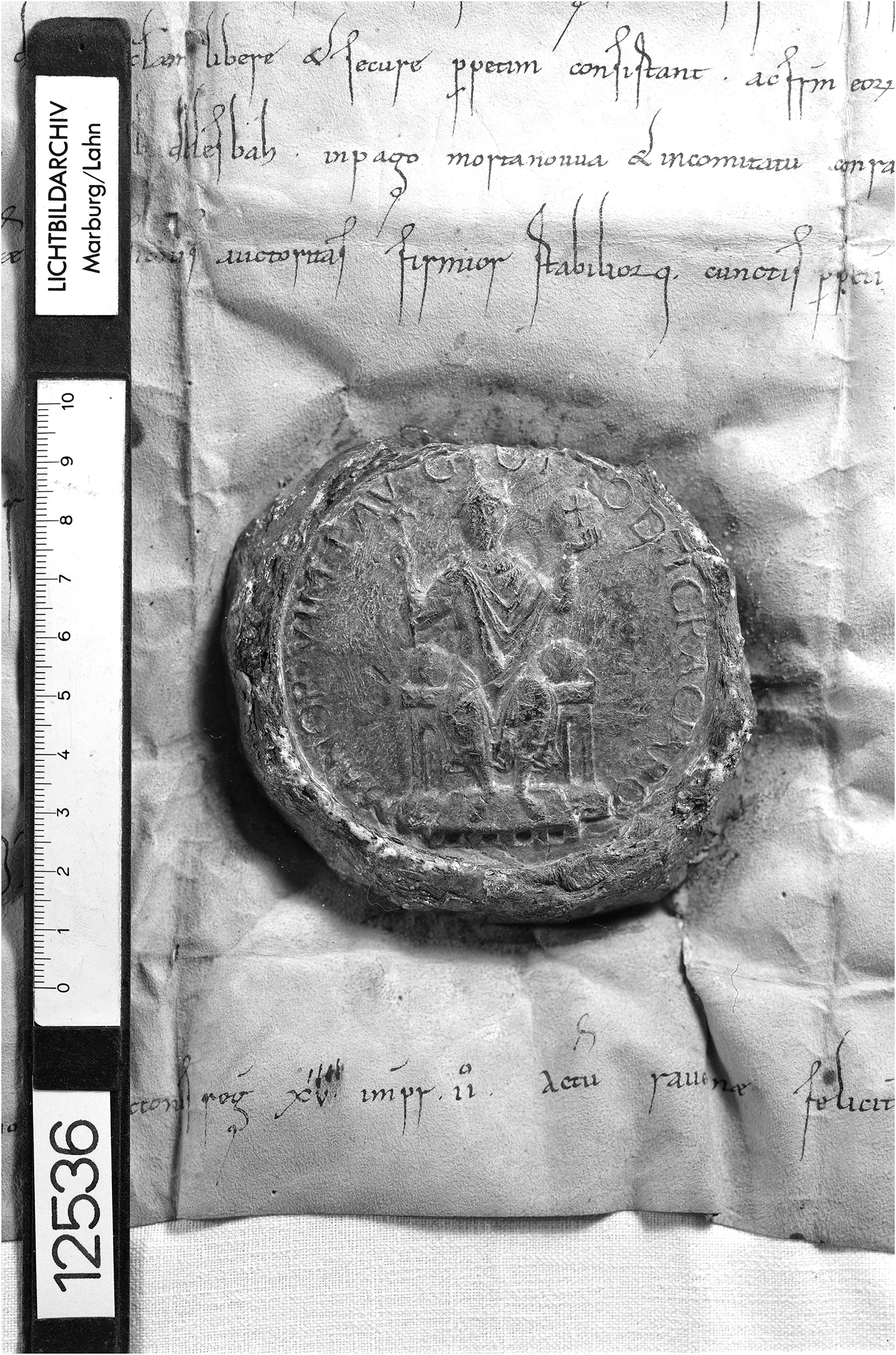
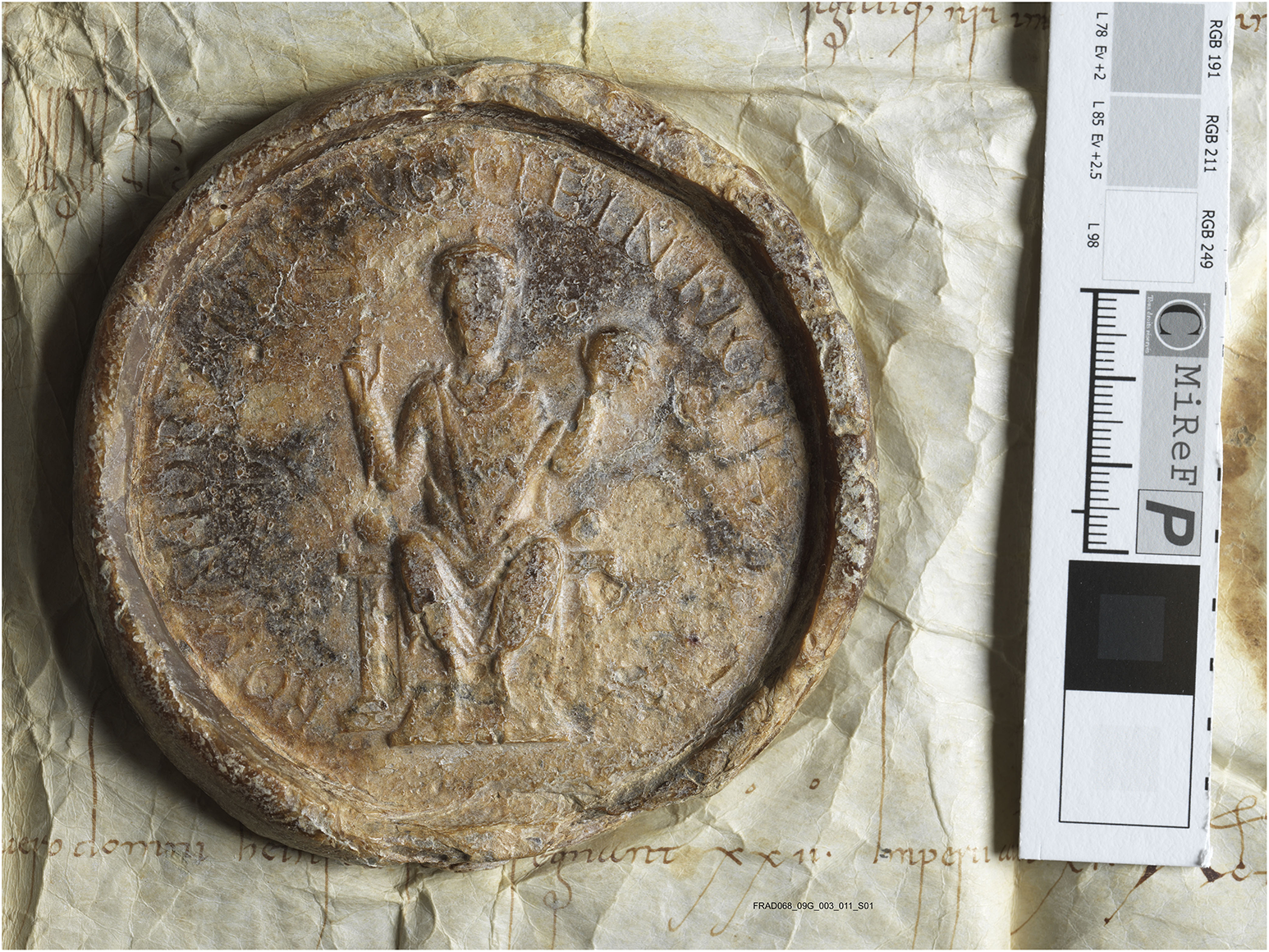
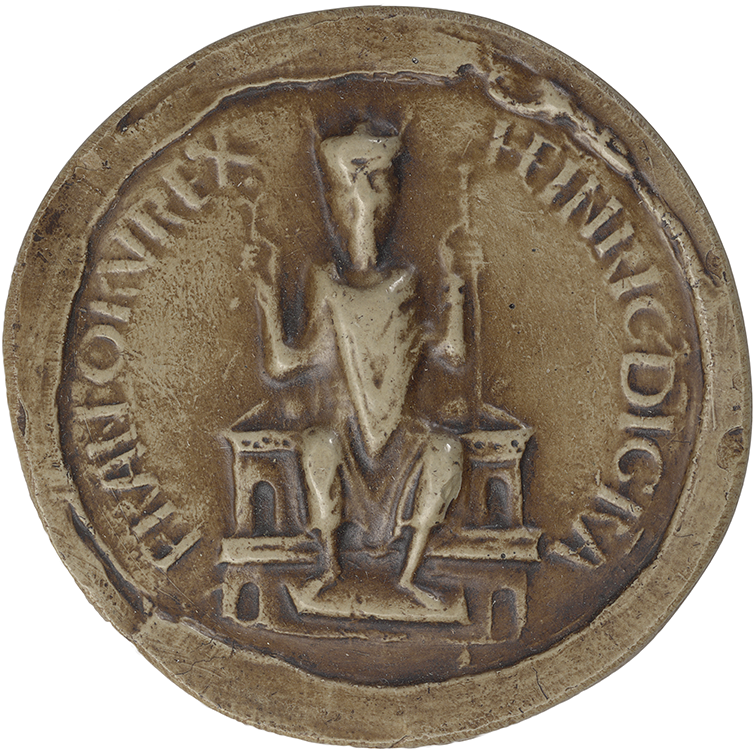
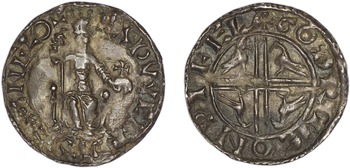
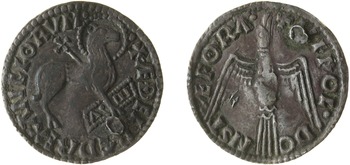
There were also continental iconographic and ideological models available. These not only fed into the English reform movements of the tenth century, but may have been known to Edward and his advisers independently. Already in the ninth century, Lothar (817/40–55) and Charles the Bald (823/40–77) had been depicted enthroned in manuscript illumination.Footnote 43 More recently, Otto III (983–1002) had appropriated these forms and transposed them into the sigillographic sphere, adopting the first known seal of majesty in the Latin West in October 997 (fig. 9).Footnote 44 Although only employed by Otto for a few months, this model subsequently met with resounding success: his successor, Henry II (1002–24), adopted it soon after his accession (fig. 10); Henry I of France (1031–1060) employed it from the first year of his reign (fig. 11); and, finally, Edward displayed it on both sides of his seal, as well as on the (possibly related) Sovereigns/Eagles coinage (fig. 12).Footnote 45 The ultimate origins of this new iconography are to be sought in the distinctive en face presentation with regalia which Otto I (936–73) had adopted following his own imperial consecration on Candlemas (2 February) 962, which had itself attracted similarly swift imitation.Footnote 46 These precedents, coupled with the presence in England of several moneyers and goldsmiths bearing continental Germanic names, have led some scholars to suggest that the model for Edward’s seal reached Britain through direct contact with the Western/East Frankish Empire. Pierre Chaplais even went so far as to propose that the matrix of Edward’s seal and the dies of his coins had been engraved by Theodoric the goldsmith, a German craftsman active in London in these years.Footnote 47
Seal of Otto III (997). © Chavannes-près-Renens, Archives cantonales vaudoises, C I b 4.
Seal of Henry II (1023). © Colmar, Archives d’Alsace – Site de Colmar, 9G3/11.
Cast of a seal of Henry I (original impression: 1035). © Paris, Archives nationales, Sc/D/32.
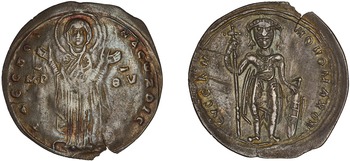
Sovereign/Eagles penny of Edward the Confessor (later 1050s). © London, British Museum, 1915,0507.2576.
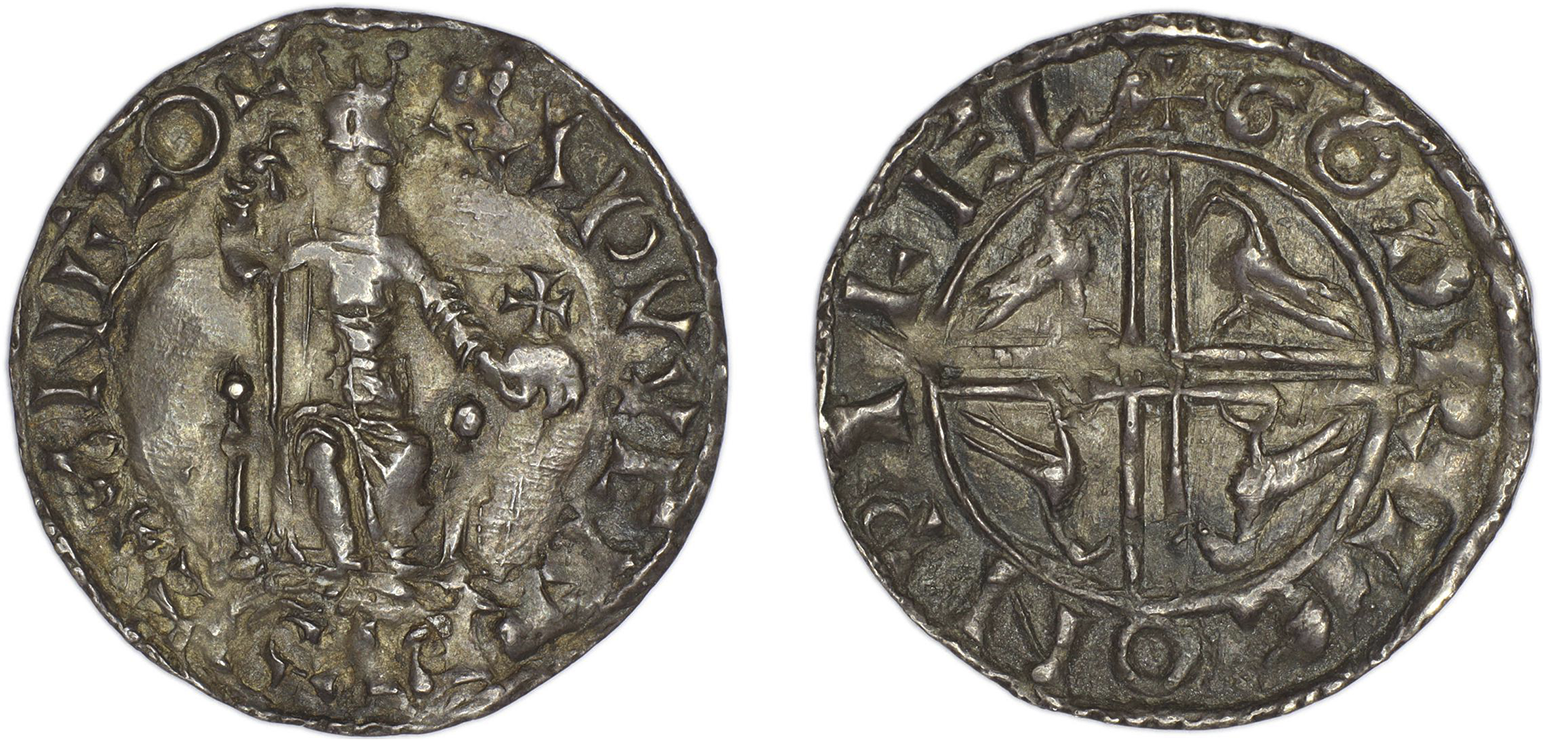
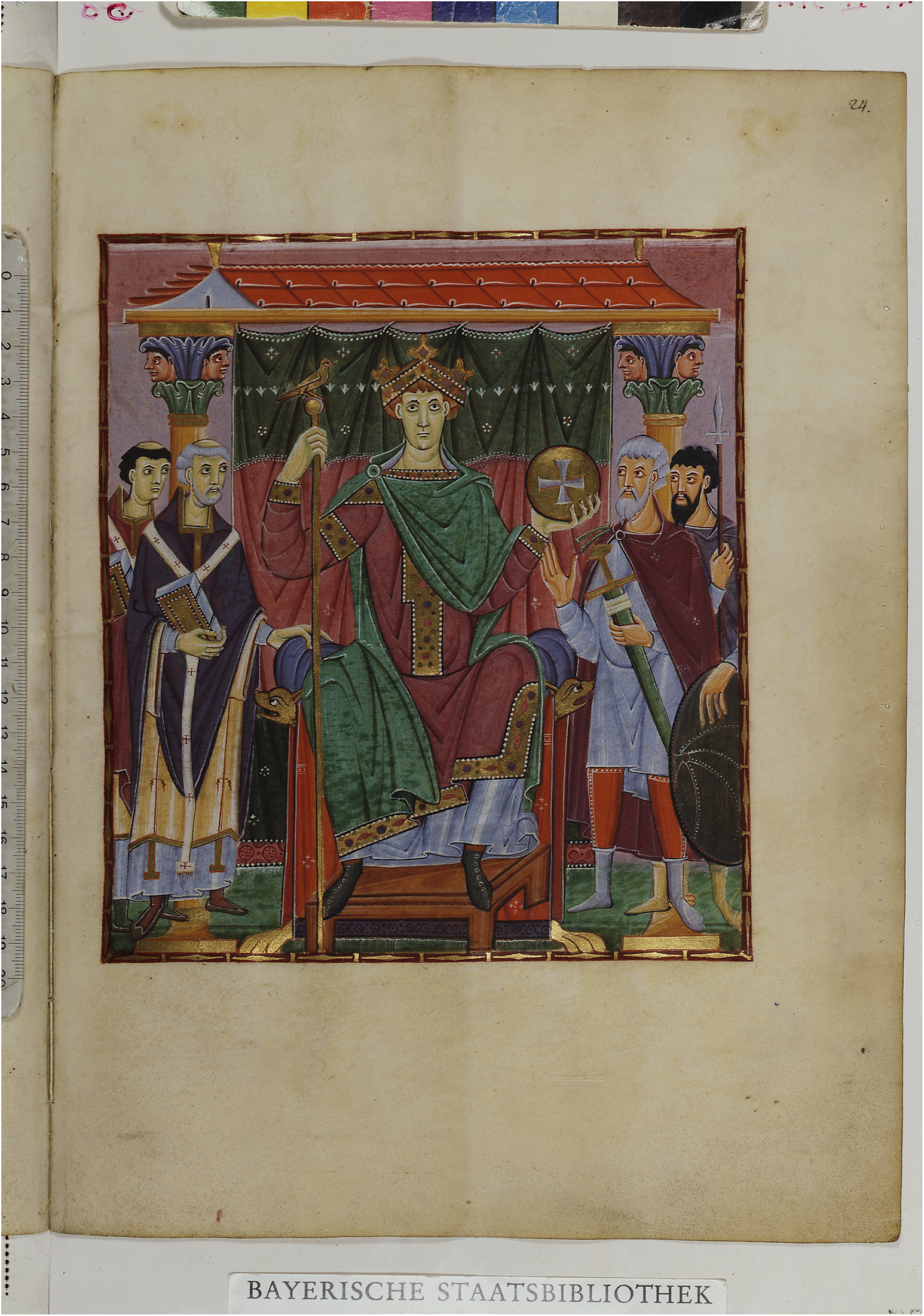
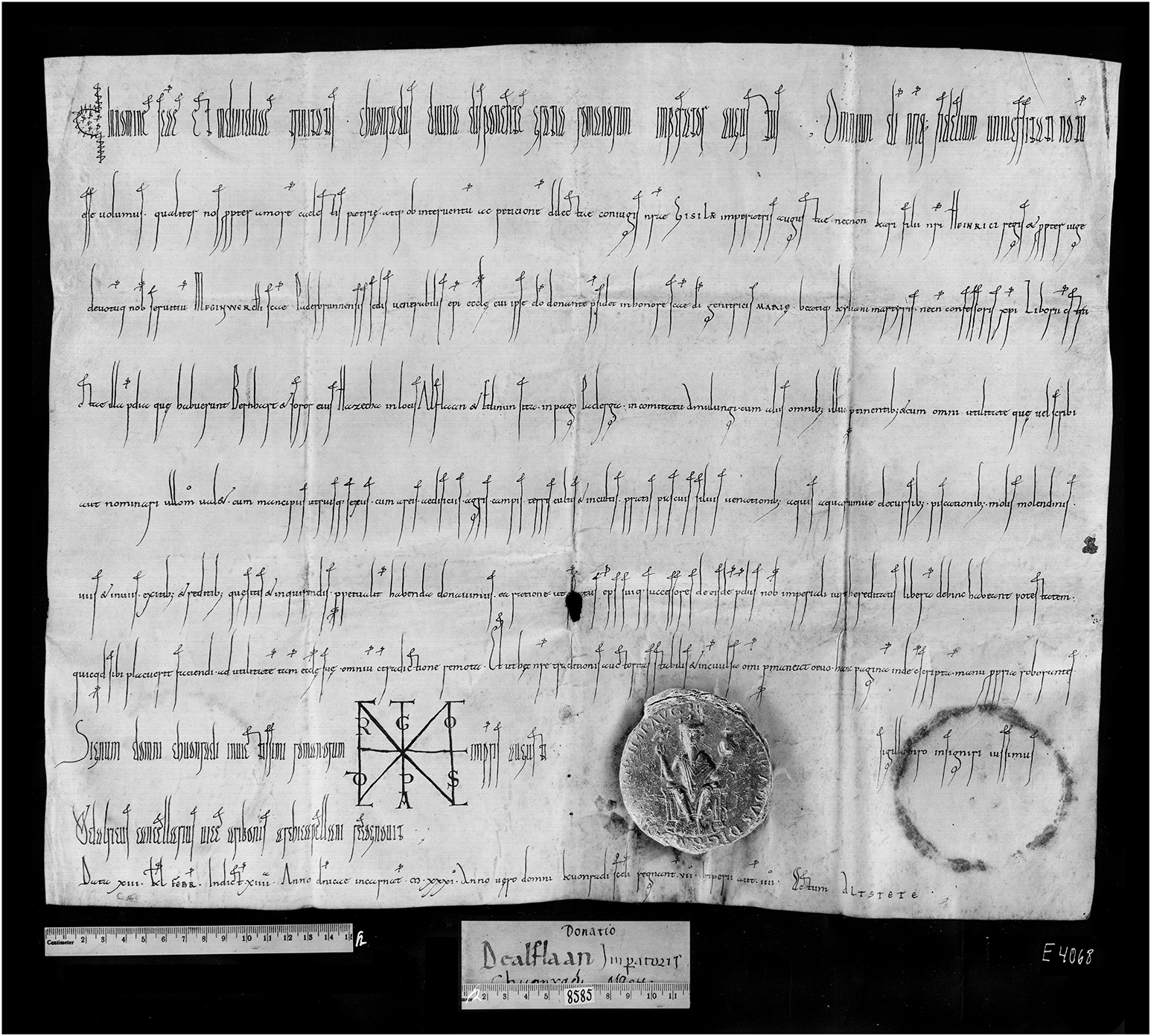
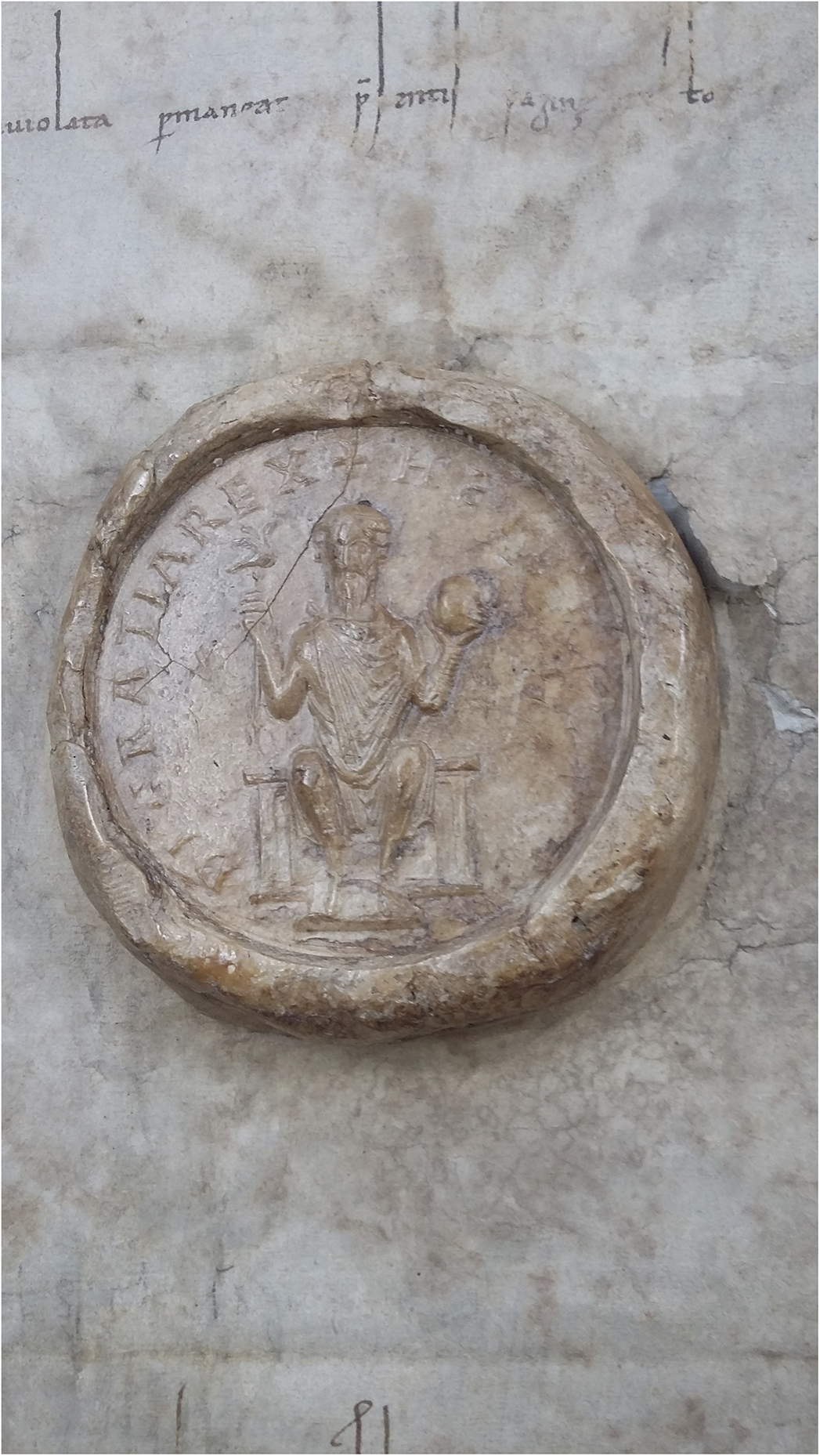
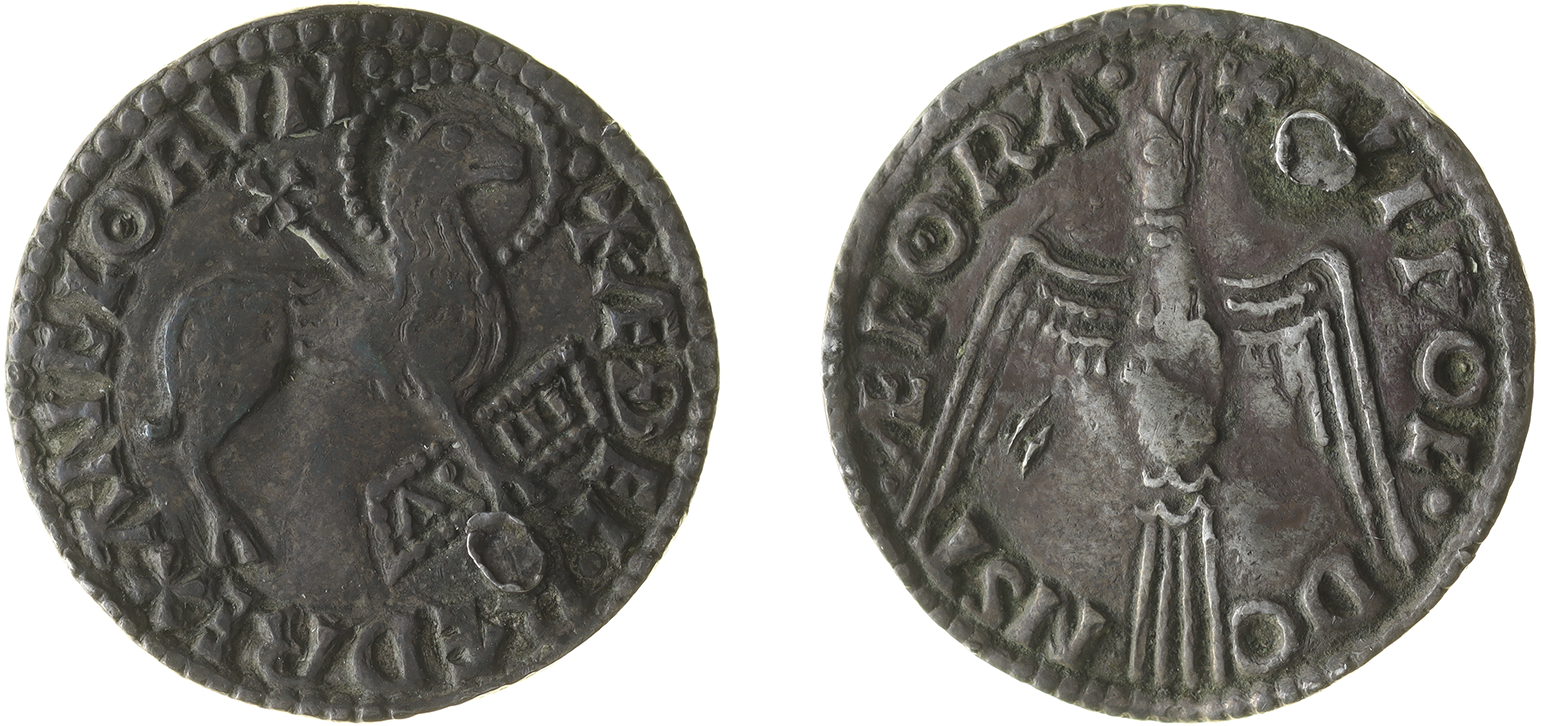
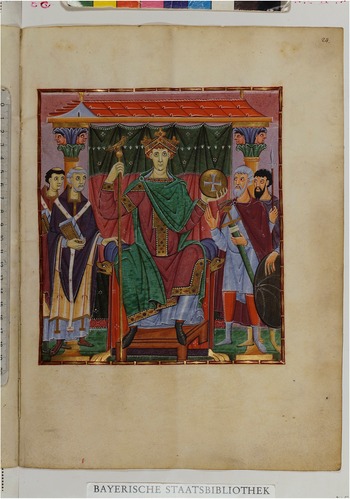
Other elements of Edward’s impression – specifically three of the four attributes borne by the king – also appear to have been borrowed from the symbolic language of power within the Western Empire. This is manifestly the case with the orb and the sceptre on the obverse. These were already present in Byzantine imperial seals from the turn of the eighth century and had been imported to the West in early 962, first finding expression on the aforementioned imperial seal of Otto I.Footnote 48 Since then, all subsequent Western emperors had employed seals in which these insignia (including a fleur-de-lis sceptre) appear.Footnote 49 The bird sceptre, which apparently features on the reverse of the Confessor’s impression, presents a similar case: it, too, was present in Byzantine sigillography before being transmitted to the West.Footnote 50 It must, however, be admitted that the identification of this latter attribute is uncertain. All of Edward’s surviving impressions are damaged in this area and the bird sceptre’s presence has been deduced on the basis of one of the later forged versions of the seal (Edward’s so-called ‘first’ seal). Where we can check the latter against the Edwardian original, however, it is a very close (if by no means perfect) imitation, so there is every reason to believe that the bird did indeed feature here.Footnote 51 The relevant iconography is also found on the contemporary Sovereign/Eagles coin type, reinforcing the case for its presence.Footnote 52 The bird sceptre itself is deeply rooted in East Frankish iconographic traditions, already appearing in the artwork of the Ottonian period: it is associated with the figure of the ruler, for instance, in a miniature of the Gospels of Otto III (c. 1000) (fig. 13).Footnote 53 It found its way onto monarchical seals under the Salians, first featuring on those of Conrad II (1024–39) (fig. 14) and Henry III (1039–56) (fig. 15), alongside the orb and the fleur-de-lis sceptre – the two other attributes also present on Edward’s impression.Footnote 54 Theo Kölzer, who recently re-examined the subject, demonstrates that the bird sceptre originally evoked antique eagles and was thus redolent of imperial status.Footnote 55 But the imagery may also have been regarded by some in England as representing a dove, and hence been endowed with a religious significance, evoking the Holy Spirit and the divine legitimacy of the ruler.Footnote 56 Indeed, before they appeared on Edward the Confessor’s Sovereign/Eagles coin type, birds – almost certainly doves – had featured on the reverse of his father’s distinctive Agnus Dei type of 1009 (fig. 16).Footnote 57 Whether such imagery might also have evoked the raven of Scandinavian myth and legend (well known in England by this point), as Bedos-Rezak also speculated, is less clear.Footnote 58 In any case, the bird sceptre performs an important function: it signifies the imperial dimension of royal power by adopting a well-known continental model closely associated with both contemporary and earlier empires.
Gospels of Otto III (c. 1000). © Munich, Bayerische Staatsbibliothek, Clm 4453, 24r.
Seal of Conrad II (1031). © Münster, Landesarchiv NRW – Abteilung Westfalen, W 701 / Urkundenselekt, KU 85.
Seal of Henry III (1040). © Saint-Julien-lès-Metz, Archives départementales de la Moselle, H880/1.
Agnus Dei Coin of Æthelred II (1009). © Stockholm, Ekonomiska museet - Kungliga myntkabinettet, 3160096.
Edward’s seal also displays at least two features which may have been drawn directly from Byzantine models without mediation through the Western Empire. The most straightforward – if also the most debatable – appears in the legend of the impression, expressed identically on each of its two faces in ‘Anglo-Saxon capitals’, the distinctive epigraphic script used on English sculpture and coinage.Footnote 59 This short Latin text simply comprises a royal style, presenting Edward in both cases as Anglorum basileus. For the modern scholar, the formula immediately evokes Byzantine imperial titulature, since βασιλεύς – literally ‘king’ in Greek – had been the official title of the Byzantine ruler since the promulgation of a Novel by Heraclius on 21 March 629.Footnote 60 The title apparently first appears on Byzantine seals during the reigns of Constans II (648–68) or Constantine IV (668–85), in the Latin form Basileus Romaion. Footnote 61 It was thereafter employed regularly on the seals of subsequent emperors, before being occasionally adopted by rulers outside Byzantium. This was notably the case in England, where the title appears for the first time under Æthelstan (924–39) and continued in use into the eleventh century, reflecting both an attraction to Graecisms and the cultivation of an imperial imaginary.Footnote 62 The word, however, never became a stable element of English royal titulature, which more often employs the terms rex (in the Latin diploma) or cyning (in the vernacular writ), while also at times featuring titles such as imperator and primicerius, whose imperial connotations are evident. That kings of the era aspired to a form of hegemonic rule, with dominion stretching over their immediate Insular neighbours, is undeniable. Whether within this context basileus represents a conscious and direct borrowing from Byzantine imperial titulature, rather than a stylistic borrowing from the writings of the influential English poet Aldhelm of Malmesbury (fl. 675–709) – which furnished the model for many charter draftsmen of these years – is less clear.Footnote 63 But even if not originally a nod to Byzantine traditions of rule, it is entirely possible that this venerable style came to be reinterpreted in such terms under Edward.
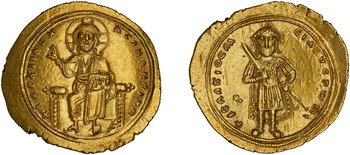
There exists one other element of Edward the Confessor’s seal which seems to have been drawn directly from Byzantine models. This detail, visible only on the reverse of the impression, is the sword held by Edward in his left hand, its blade resting on his shoulder. This attribute appears here for the first time on a western European seal. Before this, the sword had not been employed frequently in the iconography of European rulers. Shortly before Edward’s reign, it is found in an entirely exceptional manner on the belt of a monarch (probably Otto III, himself the son of the Byzantine princess Theophanu) in a painting of an Exultet roll produced in Benevento between 981 and 987 (fig. 17);Footnote 64 in England, it appears in the same form on Cnut’s belt in the famous frontispiece to the New Minster Liber Vitae, produced in 1031 (fig. 18).Footnote 65 Far more numerous iconographic parallels exist, however, in Byzantine coinage of the eleventh century, particularly in the years immediately preceding the creation of Edward’s seal. The first basileus to present himself bearing this object was Constantine IX Monomachos (1042–55), who adopted it on his miliaresia (fig. 19).Footnote 66 A few years later, it is likewise found on the histamena and tetartera of Isaac I Komnenos (1057–9) (fig. 20).Footnote 67 But there is more. Bedos-Rezak cautiously advanced the ‘tenuous hypothesis’ that the sword held by Edward on the reverse might have evoked possession of the so-called Sword of Constantine, given to Æthelstan by Hugh the Great according to William of Malmesbury.Footnote 68 Now, in Byzantium, the appearance of the sword on imperial coinage corresponds precisely to an association of this kind. For during his reign, Constantine IX Monomachos claimed possession of a fragment of the sword of Saint George, which he had set in an enkolpion (ἐγκόλπιον), that is a reliquary, inscribed with an epigram explicitly extolling the object’s contents: ‘To Your ally, O Christ, Constantinos Monomachos, bearing upon his chest a fragment of the stone, where the shroud bound Your lifeless body with myrrh, and (a fragment) of the sword of Your martyr George’ (Στέρνοις φέροντι τμῆμα, Χριστέ, τοῦ λίθου, ἐν ᾧ νεκρὸν σμύρνῃ σε σινδὼν συνδέει καὶ μάρτυρος σου τῆς σπάθης Γεωργίου Κωνσταντίνῳ σῷ συμμάχει Μονομάχῳ).Footnote 69 There can, therefore, be little doubt that coins of Byzantine rulers bearing the sword – above all, those of Constantine Monomachos, who thereby highlighted his possession of a fragment of St George’s blade – inspired the Confessor, who possessed his own enkolpion,Footnote 70 to adopt the same attribute on one face of his seal. The move offered a twofold advantage. First, it enabled the English king to adorn himself with a symbol of Byzantine imperial power, well known and widely diffused throughout the medieval world. Second, it may have allowed him to emphasize possession of the Sword of Constantine the Great, which carried an obvious imperial connotation while also being firmly anchored within the local past, for it had belonged to an emperor proclaimed in Britain in 306 and been held by English monarchs since the early tenth century.
Exultet Roll (981 × 987). © Vatican City, Biblioteca Apostolica Vaticana, Vat. lat. 9820, 18r.
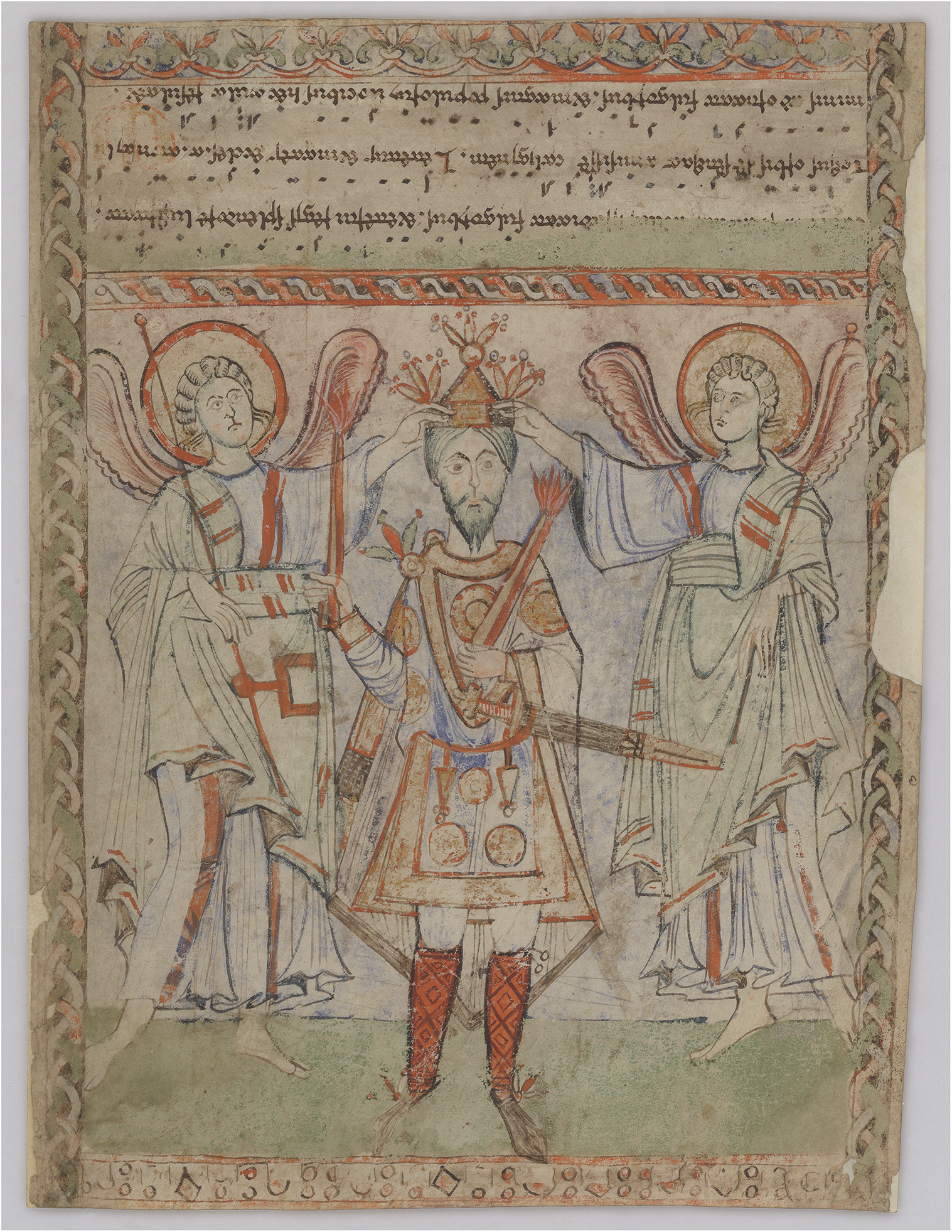
Frontispiece of the New Minster Liber Vitae (c. 1031). © London, British Library, Stowe 944, 6r.
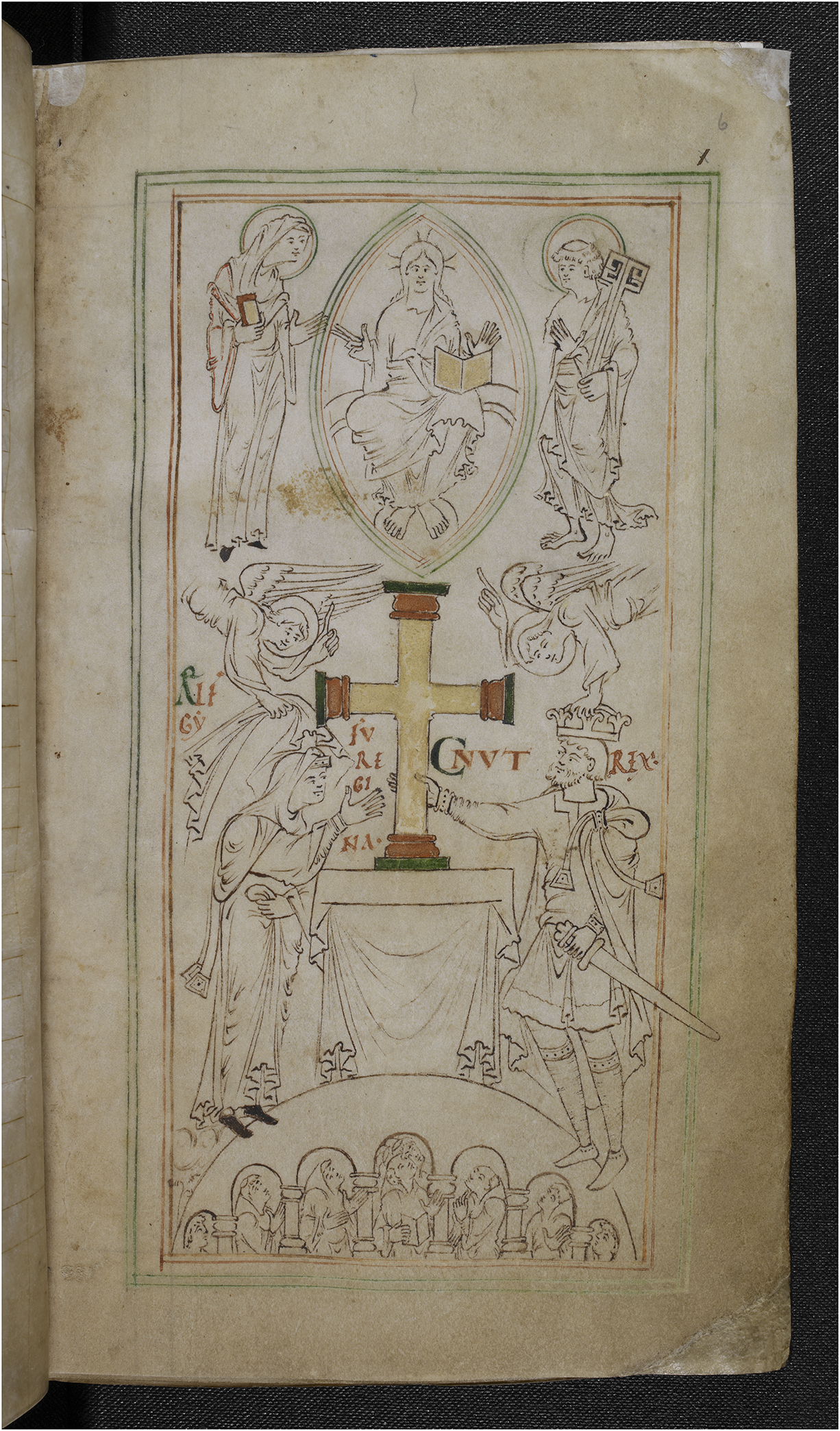
Miliaresion of Constantine IX Monomachos (1042 × 1055). © Washington, D.C., Dumbarton Oaks Research Library and Collection, W.Loan.916.
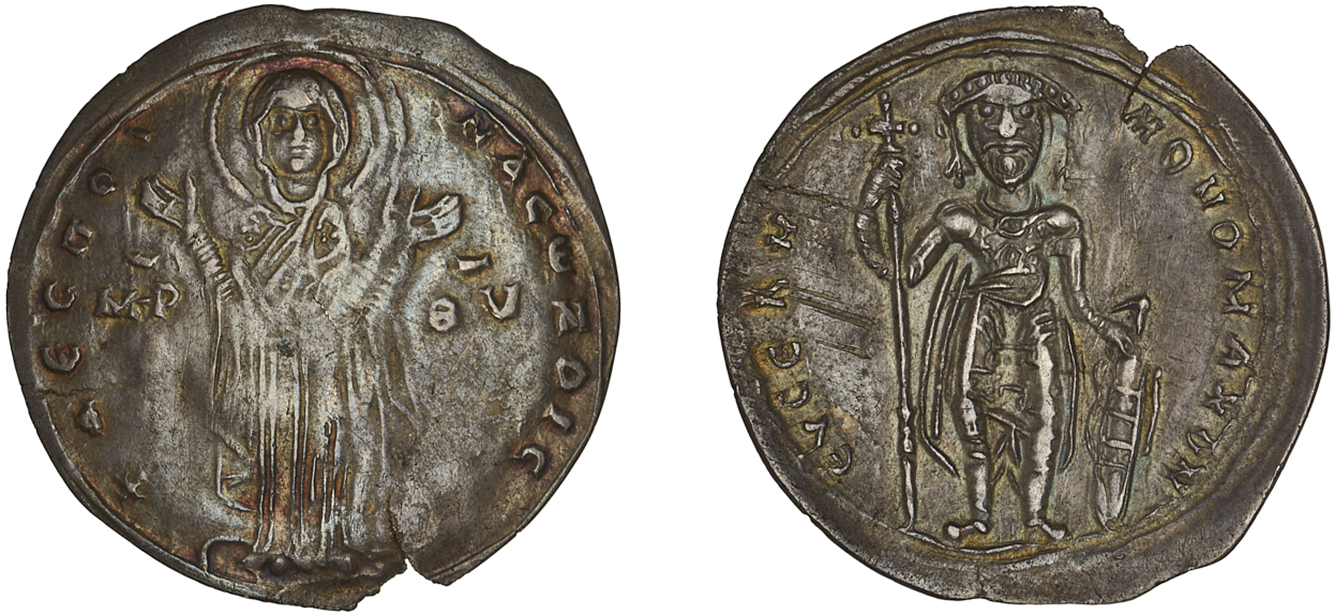
Histamenon of Isaac I Komnenos, Class II (1057 × 1059). © Washington, D.C., Dumbarton Oaks Research Library and Collection, W.Loan.564.
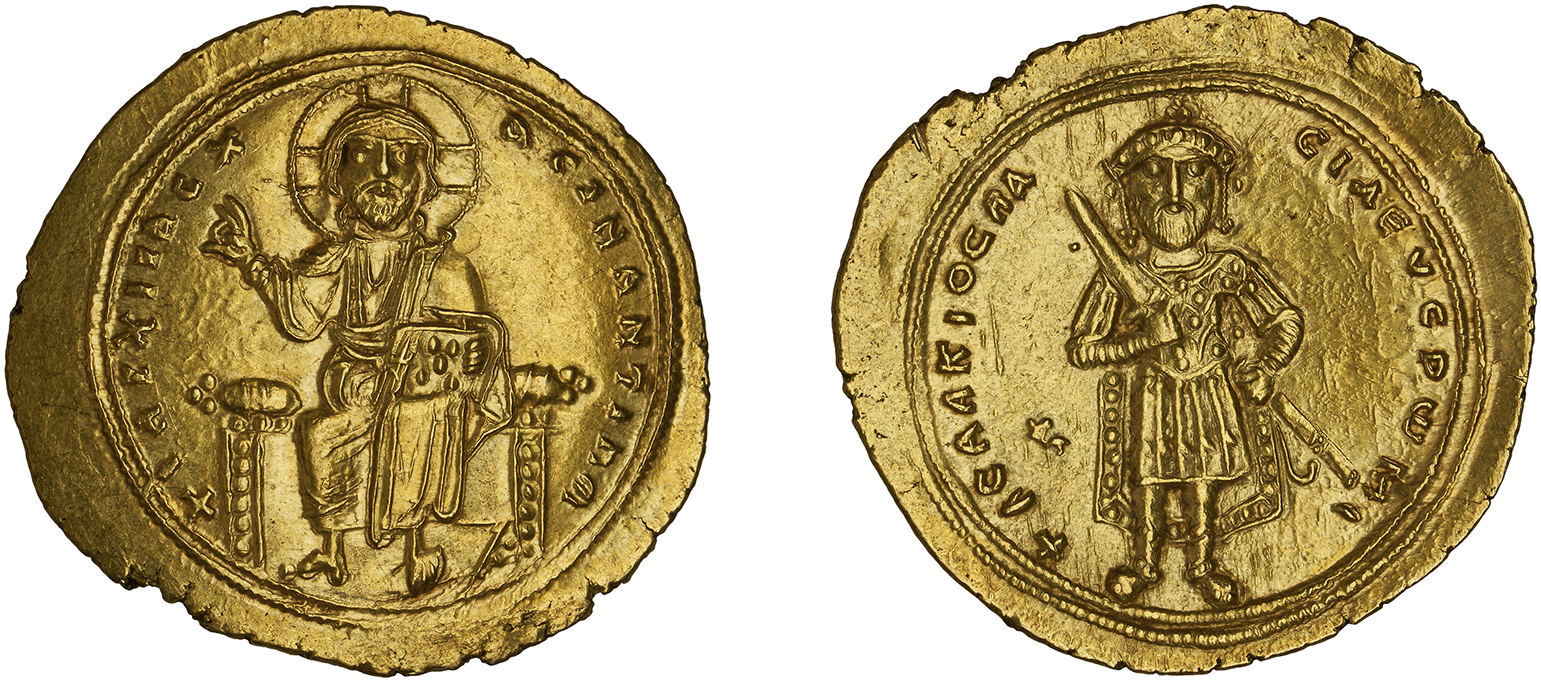
Ultimately, the iconography of Edward’s seal is rooted within the symbolic language of English royal power, which had assumed an avowedly imperial dimension from the second quarter of the tenth century. This is revealed in the adoption of several sigillographic models drawn from the East Frankish/German Empire – such as the enthroned majesty, orb and sceptres – whose first ruler to achieve imperial dignity, Otto I, had been married to an English princess (the half-sister of Æthelstan). To this mix were then added certain elements directly borrowed from Byzantine coins and bulls, including the bearing of the sword and possibly the formulation of the legend, which adopts the resonant title basileus. These images, however, were not received in merely imitative fashion, but were instead juxtaposed within a new and original composition, one capable of evoking the Insular past. Thus, the bird sceptre may have reminded viewers of the dove on the famous Agnus Dei coinage, while the sword itself recalled that of Constantine the Great. What is more, the legend describing Edward as basileus is written in native ‘Anglo-Saxon capitals’. All these features could ultimately be brought together through the invention of a new form of impression: the double-sided pendant wax seal. The creation of this original configuration, made possible by familiarity with hanging bulls, was itself the product of a profound administrative and documentary evolution, one which would culminate in the creation of the sealed writ-charter. It is to this that we must now turn.
III. The Development of the Writ-Charter
As one of the earliest surviving impressions of a royal seal from England – indeed, perhaps the earliest – Edward’s Saint-Denis seal naturally raises the question of how this new form of authentication is associated with the development of the writ-charter, the type of document which bore such impressions. For as diplomatists have long known – and some medieval observers were already awareFootnote 71 – royal diplomas of the pre-Conquest period were not sealed, in stark contrast with their continental counterparts. The reasons for this are to be sought in the origins of the English charter tradition. For while the various forms of sovereign charter attested across mainland Europe represent the direct inheritance and adaptation of late imperial documentary traditions and associated forms of authentication (including autograph subscriptions and sealing),Footnote 72 in England the break with Rome was much sharper. The eclipse of imperial rule and emergence of various ‘Anglo-Saxon’ polities over the course of the fifth and sixth centuries was accompanied here by significant religious, political and linguistic change: Roman administrative structures disappeared almost entirely; Latin and Brittonic ceded to a western Germanic vernacular (Old English); and Christianity survived only in pockets.Footnote 73 The Latin diploma was only introduced later, within the context of the Roman-sponsored missionary endeavours of the later sixth and seventh centuries – whether under Augustine of Canterbury († 604) or the reform-minded Theodore of Tarsus († 690) is uncertainFootnote 74 – to a largely illiterate and un-Latinate society, in which kings and their agents neither possessed nor necessarily understood the function of the seals employed on equivalent documents elsewhere. Under these circumstances, recourse to (non-autograph) attestations at the foot of the act, as used to authenticate non-sovereign charters elsewhere, offered a neat solution.Footnote 75 And thanks to the conservative nature of the royal diploma, whose power and authority came from precedent (in England as elsewhere), once this was established as the norm, it would remain so up until the Norman Conquest (and indeed beyond), long after seals and sealing had been introduced to England.Footnote 76
The question, then, is how and why a new form of sealed document emerged in the eleventh century – and whether it should be a coincidence that the earliest seal employed for such purposes should take its iconographic inspiration so clearly from mainland Europe, where the sealing had been used as a method of authentication since the Merovingian era. Broadly speaking, there are two schools of thought on the subject. On the one hand, Florence Harmer famously argued that the writ-charter had a long history before its earliest surviving exemplars, probably reaching back as far as the reign of Alfred the Great (871–99).Footnote 77 She has been followed here, with certain adjustments, by Simon Keynes and Albert Fenton, both of whom emphasize our dependence on a small range of archives (above all, Bury St Edmunds, Wells and Westminster) for the surviving writs of the pre-Conquest period. Since the houses in question first come to prominence in the eleventh century, the sudden emergence of the writ-charter at this point may amount to little more than a trick of the sources, occasioned by a shift in which religious centres were receiving royal patronage.Footnote 78 Keynes also notes that writs and diplomas were complementary instruments: writs were often used to inform shire courts of grants made by diploma or to authorize the production of such instruments; and in one famous case, the Confessor’s writ and diploma concerning Taynton (to which our impression was appended), we possess both documents in their original format. It is, therefore, misleading to posit a simple transition from diploma to writ in this period. By contrast, the other school of thought, represented above all by Pierre Chaplais, holds that the writ was indeed an innovation of Edward’s reign, which from the start began to eclipse the more traditional diploma. On this reading, the sudden appearance of writs across multiple (if certainly not all) archives under Edward – including the survival of at least six originals (in addition to a seventh, which only survives in heavily reworked form) – points to very real change, a change which stands in a direct causal relationship with the diminishing number of diplomas issued.Footnote 79 Chaplais has, for his part, been followed by Brigitte Bedos-Rezak, Susan Kelly and Nicholas Brooks, all of whom see the sealed writ-charter as a novelty of the mid-eleventh century.Footnote 80 The late Richard Sharpe sought to find a middle ground of sorts, building on the earlier work of Geoffrey Barraclough, who had suggested a tenth-century origin for the writ-charter.Footnote 81 Sharpe twice speculated, en passant, that the writ may have been introduced under Edgar, in connection, one imagines, with the evolution of the shire courts and shire-reeves to which it was addressed (a subject since taken up with gusto by George Molyneaux).Footnote 82 Sharpe also emphasized, like Keynes before him, the unusually restricted transmission of these early writs, which he associated with their distinctive legal value: unlike diplomas, writs required serial confirmation by the reigning monarch, a fact which explains why some houses were happy to dispense with all but the most recent of these. Bury St Edmunds, Wells and Westminster are the exceptions which prove the rule here, pointing to the kind of documentation which must once have existed in many places. It is easy to exaggerate the degree of disagreement between these schools of thought. Keynes may favour an early origin for the writ, for example, but acknowledges that sealing patent on the later model was probably an Edwardian innovation. And while Chaplais placed a strong emphasis on the novelties of Edward’s reign, he was equally cognizant of the older epistolary origins of the relevant writ formulae.
This is not the place to solve one of the great debates of pre-Conquest diplomatic. Nevertheless, there are reasons to suspect that Chaplais was broadly correct, at least insofar as the introduction of the writ is concerned. It would require stunning rates of attrition explain why we should possess over eighty such documents in Edward’s name (six or seven of which are apparent originals), against just twelve in the names of his predecessors (all preserved in copial form and all problematic to some degree). This distribution doubtless owes something to the particular circumstances of the Norman Conquest and the nature of William the Conqueror’s later claims to the English throne, which helped elevate the importance of documents associated with the Confessor.Footnote 83 There is, however, no reason why these circumstances should have benefitted the preservation of writs over diplomas, only a modest number of which survive in Edward’s name. And while Bury, Wells and Westminster may be responsible for the bulk of the surviving writ-charters of these years, they are by no means isolated: we have smaller runs of authentic writs from Canterbury (St Augustine’s), London (St Paul’s), Winchester (the Old Minster), Worcester (St Mary’s) and York (St Peter’s), among others – in all cases, only from Edward’s reign on.Footnote 84 These latter houses all preserve solid runs of diplomas from earlier years, so might have been expected to preserve at least a few writs, had they been available.
Of the twelve pre-Edwardian writs, the earliest two, in the name of Æthelred, are clearly not authentic in their present form.Footnote 85 And of the eight in Cnut’s name, only the four in favour of Christ Church, Canterbury, have solid claims to authenticity. These survive in contemporary copies in two Gospel books (the Gospels of King Cnut and the MacDurnan Gospels), in a manner which raises serious questions as to whether sealed single sheet ‘originals’ ever existed.Footnote 86 It is conceivable, as Chaplais suggested, that these simply represent local copies of oral messages.Footnote 87 More likely, it may be that such early writs (like other letters of the era) were sealed ‘close’ rather than ‘open’/patent.Footnote 88 Since opening such documents necessarily broke the accompanying seal, there would have been little value in keeping the ‘original’; and a copy in an authoritative volume such as a Gospel might be thought to carry greater weight. By contrast, the two writs in the name of Harthacnut (1040–2), both for Ramsey in the Fenlands, only survive in Latin translations of the post-Conquest period (themselves in manuscript copies of the fourteenth century). While Harmer deemed the texts substantially authentic, they hardly constitute a secure basis for generalization.Footnote 89 Such early writs are thus a far cry from what we see later. They are not, however, without interest. The sudden recording of such documents bears witness to a degree of formalization in the mechanisms of communication between monarch and shire court, a formalization perhaps already hinted at by one of the writs in Æthelred’s name, which is addressed to the local ealdormen (rather than earls), suggesting an origin for elements of this formulation in the years before Cnut (under whom ‘earl’ replaced ‘ealdorman’ as the title of choice for such office-holders).Footnote 90 Such texts may thus constitute proto-writs, letters which in their increasingly standardized and stereotyped form would soon start to be sealed patent, constituting the royal writ-charter of later fame: an instrument capable not only of communicating important messages, but also acting as lasting witness to grants and confirmations of legal rights.
In this respect, it is important to appreciate that the writ evolved out of the longstanding vernacular epistolary tradition. The Old English gewrit (whence the modern designation) can be used for any type of written instrument and is most frequently employed for letters (often in the compound form ærendgewrit). Harmer drew attention in this connection to a remark by ‘Reason’ in the Old English translation of Augustine’s Soliloquies attributed to Alfred the Great: ‘Consider now, if your lord’s letter and seal comes to you, whether you can say that you cannot recognize him by this and understand his will therein?’ (Geþenc nu: gyf ðines hlafordes ærendgewrit and hys insegel to ðe cymð, hwæðer þu mæge cweðan þæt ðu hine be ðam ongytan ne mægæ, ne hys willan þæron gecnawan ne mæge?).Footnote 91 This statement comes in a section which lacks a direct equivalent in the Latin original, so presumably reflects Alfred’s own experiences (or those of his translators) – and it was this which inspired Harmer to place the writ’s origins in an Alfredian context. As noted, in the absence of any textual evidence for such documents, these arguments are not especially persuasive. Rather, the passage would seem to speak of a well-established epistolary tradition, with which seals were closely associated. And while Chaplais suggested that the ‘ærendgewrit and … insegel’ may simply refer to the use of a loose seal impression, borne (alongside the letter) as a token of authentication, the most natural reading of the passage is that it does indeed refer to a sealed letter of some description (probably one sealed ‘close’).Footnote 92 A small but significant number of pre-Conquest seal matrixes survive, with a particular cluster in the late tenth/early eleventh centuries, offering concrete evidence that sealing was practised from at least this period – and perhaps much longer.Footnote 93 These are complemented by a growing number of textual references to seals. Thus in the early eleventh-century Antwerp-London glossaries the Latin sigillum uel bulla is rendered into the vernacular as insegel, while an anonymous tenth-century homily refers to how a wealthy man sought to keep the fruits of his land ‘enclosed with seals’ (mid insigelum) rather than sharing these with the poor and needy.Footnote 94 By the later tenth-century, we start to hear more about seals in connection with routine royal administration. In the famous Cuckhamsley chirograph (990 × 992), Æthelred is said to have sent his seal (his insegel) to a meeting of the Berkshire shire court, requesting that it settle a dispute.Footnote 95 A few years later, the same king is reported to have sent a letter (or writ?) and his seal (gewrit and his insgel) to a meeting of the Kentish shire court, again in connection with an ongoing dispute.Footnote 96 The similarities Harmer adduced between the preface to another Alfredian translation, that of Gregory the Great’s Pastoral Care, and later writ formulae, reinforces her case for a connection.Footnote 97 For, like most medieval prefaces, the latter text is framed as a letter; and it was out of this epistolary tradition that the writ-charter emerged over the course of the eleventh century, as we have seen. That Æthelred and Cnut relayed messages to their local shire courts by means of letters, is thus beyond doubt. That such messages were starting to undergo a degree of standardization in their formulation, perhaps in the wake of administrative developments of Edgar’s reign, is also inherently likely. (Certainly, Cnut’s Christ Church writs already look forward formulaically to the standardized forms of Edward’s reign.) Whether such letters were sealed patent on the later model – whether they qualify as writ-charters in the full sense of the term – remains doubtful, however.Footnote 98
There is, therefore, a strong case for treating the sudden efflorescence of the writ-charter in the reign of Edward as an innovation. As we have seen, the sealed writ did not emerge fully-fledged, Athena-like from the head of the king and his advisers. Rather, it represents the confluence of a number of important administrative and diplomatic developments of the preceding century: the formation of the shire court and introduction of the shire reeve, largely complete by the end of Edgar’s reign; the consequent need for routine communication between the monarch and these individuals and institutions; the more systematic use of letters (perhaps sealed ‘close’) for such purposes; and the resulting standardization of the relevant documentary practices (above all, the distinctive writ formulae).Footnote 99 The earliest authentic writ in Edward’s name can be dated to his first year or two on the throne (1042 × 1043); and at least eight (perhaps nine) further authentic writs are preserved from his first decade.Footnote 100 The relevant documents come from a range of archives – Bury St Edmunds, Westminster, the Old Minster, St Augustine’s and St Paul’s – and cumulatively suggest a step-change in the nature and/or perception of the writ. The natural explanation for this lies in the introduction of sealing patent. In the absence of surviving originals, we cannot exclude the possibility that the practices of Cnut’s reign (sealing ‘close’?) continued into these years, nor can we be confident that the same matrix was used as later. (In fact, it is likely that a different one was employed if so.) But all indications are that the winds of change were blowing across England’s documentary landscape. The years after 1052 see the use of writs grow further, at a time when diploma production drops off precipitously.Footnote 101 And it is in this context that the iconographic features of Edward’s surviving seal impressions, discussed earlier, find their natural home, paralleling the striking Sovereigns/Eagles coinage of the later 1050s.
One further novelty deserves comment in this connection: the nature of the writ-charter’s sealing. For though the use of a patent seal for authentication purposes is strongly suggestive of continental influence, the manner in which this is employed indicates that we are dealing with active adaptation rather than thoughtless borrowing. For as noted, in one important respect Edward’s seal differs from those of his European neighbours: it is bifacial (two-sided), intended for sealing straps of parchment cut from the bottom of the document authenticated. How this tradition came about is not entirely clear. The most tempting explanation is that it represents an evolution of earlier forms of sealing ‘close’, for which wrapping ties may have been employed.Footnote 102 The pendant seal of the early English writ may thus hark back to its origins in earlier forms of private (written) communication: routine communication between the monarch and shire courts may have made it preferable to find ways of sealing patent, such that the contents of these documents would be visible (and vouched for) for all – and for all time. In the long term, this method of authentication would become the norm across much of mainland Europe, a transition in which the cross-Channel realm of the Conqueror and his heirs would play an essential part. Sealing patent may thus have come to England from mainland Europe in the 1040s or 1050s, only to be exported back over the course of the next two centuries in the distinctive form of sealing sur simple queue. Footnote 103
IV. Wider Context
It is a pleasant coincidence, if indeed it should be coincidence at all, that our best-preserved impression of Edward’s seal should have been appended to a writ and latterly diploma in favour of Saint-Denis. For just as the seal’s nature and iconography betrays significant influence from continental Europe, so, too, do the texts of the documents issued by the Confessor – including these two.
Essential background to these exchanges is offered by the wider evidence for contact and interaction between England and mainland Europe in these years. Ties had existed between the regions since the first arrival of continental Angles and Saxons in the fifth and sixth centuries, but the first half of the eleventh century had seen these intensify significantly.Footnote 104 Æthelred’s marriage to Emma of Normandy in 1002 stands at the start of this process. This was the first time that an English monarch had taken a continental bride since the mid-ninth century, and Emma swiftly established herself as a force to be reckoned with, playing a more active part in politics than her predecessors.Footnote 105 Cnut’s conquest of England and subsequent marriage to Emma served to divide the family, as the latter’s sons with Æthelred (Edward and Alfred) found exile at the court of their uncle Richard II in Normandy, but Emma’s own star rose higher. In this connection, new avenues for European influence were opened. For Cnut enjoyed close ties to Aquitaine, Germany and the Low Countries (in addition to his native Denmark) and famously attended the imperial consecration of Conrad II in Rome in 1027.Footnote 106 In later years, he went on to wed his daughter, Gunhild, to Conrad’s son and heir, the future Henry III – contacts which may go some way towards explaining English acquaintance with East Frankish sigillographic traditions at this juncture. It is in this context that the distinctive ‘Lotharingian connection’ visible within the late Anglo-Saxon Church is to be understood. As Simon Keynes first noted, the reigns of Cnut and his successors (including Edward) witnessed the appointment of a string of Lotharingian (or Lotharingian-trained) churchmen to high office in England. These figures include Duduc, who first appears as a royal priest in 1033 and was appointed bishop of Wells shortly thereafter; Herman, who served in the household of Harthacnut, before being promoted to the episcopal seat of Sherborne in 1045; Leofric, a native Briton (perhaps a Cornishman) who was educated in Lotharingia and went on to be named bishop of Crediton and Cornwall (in plurality) in 1046 (sees subsequently unified and moved to Exeter in 1050); and Giso, a native of Saint-Trond, who succeeded his fellow countryman Duduc to Wells in 1061.Footnote 107 Under Edward, who had spent many of his formative years in Norman exile, this Lotharingian connection is unsurprisingly joined by a northern French one. Edward’s favourite churchman was famously Robert of Jumièges, a prominent Norman monk who apparently accompanied him back to England in 1041 and was appointed to the strategically significant bishopric of London shortly thereafter (1044). In early 1051, Edward used the episcopal vacancy at Canterbury to promote Robert further still, an appointment which the king only abandoned in the face of armed opposition from the Godwine clan the following year. Other prominent Norman or French churchmen at court include William, who first appears as a royal priest in 1050 and would succeed Robert to London in 1051; Baldwin, the royal physician who left the English court to become a monk of Saint-Denis (and perhaps prior of Lièpvre) in the late 1050s, only to return in 1065 as abbot of the wealthy and well-connected monastery of Bury St Edmunds; and Peter and Osbern, who attest diplomas as royal priests in the 1060s and would be appointed bishops of Lichfield and Exeter (respectively) in 1072, as part of the Conqueror’s wide-ranging reforms of the English Church.Footnote 108
These appointments were not merely a matter of recruiting capable personnel from abroad; there are a number of signs that Edward and his court were actively drawing on models of rule from mainland Europe. It has been suggested that the tradition of regular crown-wearings at Easter, Pentecost and Christmas and the closely associated celebration of royal laudes goes back to these years, reflecting lessons learned by Ealdred of York at the German and Byzantine courts.Footnote 109 In a similar vein, the sudden vogue for papal privileges in the late Anglo-Saxon Church has been interpreted as a reflection of the experiences, expectations and connections of these new continental churchmen.Footnote 110 Iconographically Edward’s seal matrix – possibly the work of a German craftsman, as we have seen – belongs in a similar context, as does the introduction of sealing patent. Perhaps most tantalizingly, there are signs that this influx of French and Lotharingian ecclesiasts had begun to influence native English documentary traditions.
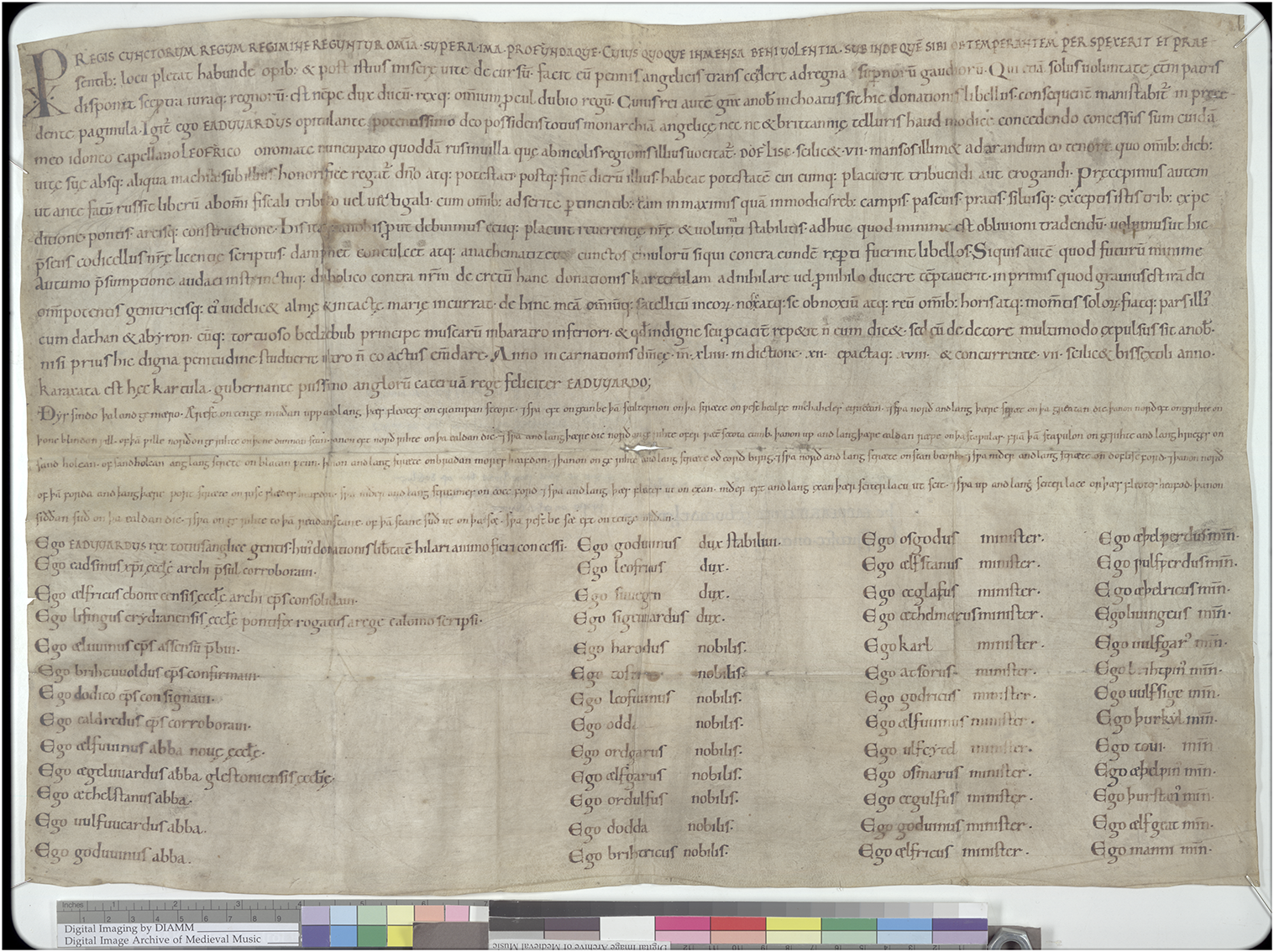
As noted, the English diploma had evolved out of the private charter traditions of mainland Europe and therefore stands somewhat athwart its continental counterparts in form and nature. Doubtless in part for this reason, there is little evidence of direct interaction between these traditions before this point: for all that rulers such as Alfred the Great and Æthelstan looked to their European neighbours, this never seems to have extended to the direct borrowing of diplomatic practices and formulae. At most, the gradual introduction of display script for the first line of the charter (first attested in 994), might be considered a nod to the Frankish tradition of using elongated script (literrae elongatae) for the opening protocol. But this approach only became standard under Cnut and Edward, by which point we may also posit a degree of Lotharingian and French influence.Footnote 111 Otherwise, the earliest indication of change comes from a diploma of 1044 in favour of Leofric, the Lotharingian-trained cleric who would be appointed bishop of Crediton and Cornwall two years later. The document in question grants Leofric Dawlish on the South Devon coast, not far from his future episcopal seat in Exeter. This indicates that Leofric may already have been a local cathedral canon; and the hand of the surviving single sheet original suggests that this is the work of a Crediton or Exeter scribe (as are most Crediton/Exeter charters of these years) (fig. 21).Footnote 112 Yet if the scribe is clearly local, it is equally evident that he has struggled to make sense of the text he is copying at a number of points. This is clearest in the sanction, where he has badly mangled a common Frankish formula (quod repetit non euindicet), rendering the phrase meaningless (quod … repetit non eum dicet). The immediately ensuing dating clause also reveals signs of continental influence in its reference to the most pious King Edward happily ruling the band of the English (gubernante piisimo Anglorum cateruam rege feliciter Eduuardo), for the use of the superlatives piissimus and serenissimus is a common feature of French, German, and Italian dating clauses, as is ending these with the adverbial phrase feliciter or feliciter amen (a short-form of the so-called apprecatio). Similarly striking is the thematic focus of the sanction. For Dathan and Abiron, who are here invoked, had not previously appeared in English sanction clauses, yet are among the most popular figures in French sanctions, often challenging Judas Iscariot for first place.Footnote 113 In short, if it was an Englishman who copied this charter, there are good reasons to believe that someone trained on the continent (Leofric himself?) was responsible for the underlying formulation.
Dawlish Charter of Edward the Confessor. S 1003 (1044). © Exeter, D.C., 2526.
Similarly interesting is the diploma of 1065 in favour of Giso’s see of Wells. While in its present form this document was probably reworked in the years following 1066 (it only survives in late medieval copies), the text may go back to an authentic document drafted by Giso himself (for whom a writ of these years survives, entrusting him with drawing up a different diploma). This would help explain the most unusual feature of the privilege: the fact that it takes the form of a pancarte (or pancarta), a diplomatic instrument popular in northern France, but not otherwise found in England. It would also explain why the original was apparently sealed – or at least, why its draftsman anticipated it being sealed (the corroboration clause refers to Edward affixing ‘the seal of my image’ [mee ymaginis … sigillum] to the document). None of Edward’s surviving originals are sealed in this fashion – nor are any pre-Conquest diplomas – so one suspects that the turn of phrase represents the fruit of post-Conquest reworking (the list of estates also shows signs of updating and ‘improvement’).Footnote 114 But as some of the Conqueror’s ‘English’ diplomas were sealed patent on the continental model – including his confirmation of the Confessor’s grant of Taynton to Saint-Denis – we cannot exclude the possibility that these practices had already made their way across the Channel under his Norman-raised predecessor (who was, after all, his own second cousin).Footnote 115 If they had, it is among the Lotharingian- and French-trained churchmen of these years that we would expect to find them – men precisely such as Giso.
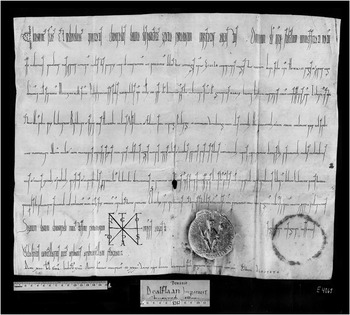
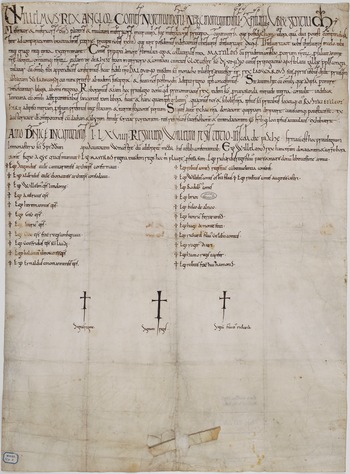
Yet the most striking evidence for continental influence on English diplomatic traditions in these years comes from the very documents associated with the seal impression in question. For as we have seen, this was once appended to the Confessor’s writ concerning the grant of Taynton to Saint-Denis, a document issued between 1053 and 1057. The immediate context for this transaction is offered by the (apparently recent) profession of Edward’s physician Baldwin at the northern French monastery (the diploma supplies the detail that Baldwin had received the document on behalf of Saint-Denis, where he had become monk). The writ itself entrusts the local diocesan bishop, Wulfwig of Dorchester, with overseeing the production of a diploma for the grant. It now survives stitched to the resulting privilege, which was itself issued in 1059, at least two years after the original writ (fig. 3).Footnote 116 Both this donation and another (of the minister at Deerhurst to Baldwin himself) were duly confirmed in the hands of Saint-Denis by the Conqueror in 1069, in a distinctive recipient-produced diploma which has been sealed patent on the French model (albeit sur simple queue) (fig. 22).Footnote 117 Yet there are already signs of French influence in the earlier two documents. As Bishop and Chaplais noted, the vernacular minuscule found in both the writ and the diploma’s boundary clause betrays signs of instability and Caroline influence, suggesting that these were not the work of native English scribes. The Caroline forms of the diploma’s main text likewise betray none of the symptoms of late standard Anglo-Caroline (Dumville’s ‘Style IV’) and would be much more at home in northern France in these years.Footnote 118 Finally, the diploma’s orientation – uniquely amongst the eighty-four or so originals from the years between Æthelstan’s accession (924) and the Norman Conquest (1066), it is presented as a carta non transversa (i.e. laid out ‘portrait’ rather than ‘landscape’) – reflects norms prevalent in France since the late ninth century.Footnote 119 The differences between the hands of the two documents indicate that we are dealing with different scribes, both of whom were presumably associates of Saint-Denis and/or Baldwin. Bishop and Chaplais were tempted to associate the hand of the writ (the earlier and less assured of the two) with Baldwin himself. But it is in the diploma that Baldwin’s own involvement in the grant is mentioned. And, indeed, Tom Licence has since identified this latter hand among the additions to a northern French medical recipe book which made its way to Bury St Edmunds in these years, apparently in connection with Baldwin’s appointment as abbot. On this basis, there is good reason to believe that this represents the abbot’s autograph.Footnote 120
Saint-Denis Diploma of William the Conqueror. Regesta, ed. Bates, no. 254 (1069). © Paris, Archives nationales, AE/III/61.
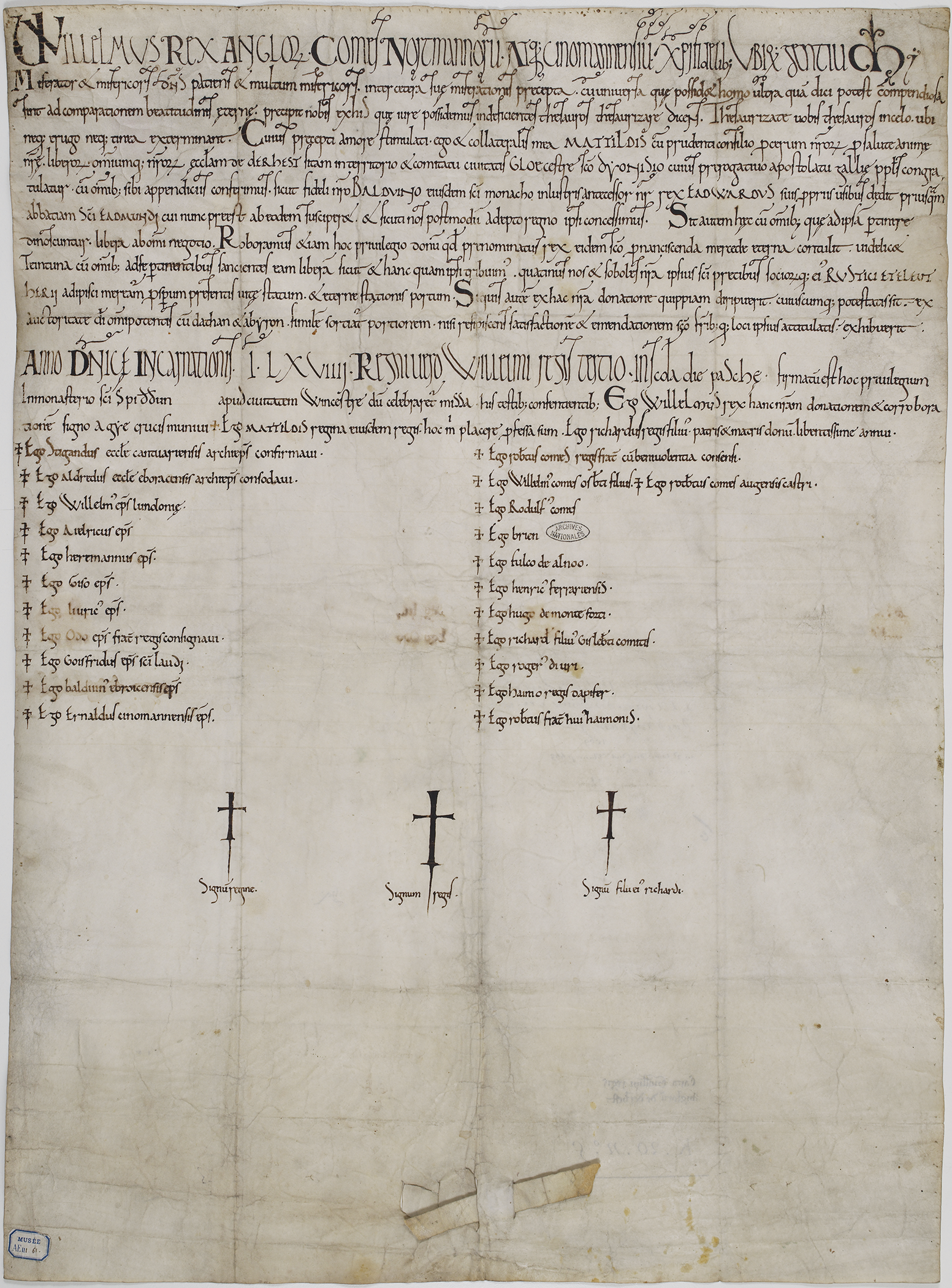
In its short, stereotyped, vernacular form, the Anglo-Saxon writ-charter left little room for external influences, so it is unsurprising that the formulation of the first of these documents does little to betray the origins of its scribe (who need not, in any case, have been its draftsman). For the diploma, however, there is reason to believe that Baldwin – who is said to have received the document on behalf of Saint-Denis – acted both as draftsman and scribe, formulating and then copying out the relevant text.Footnote 121 For though much of the document’s Latin formulation is acceptable for an English charter of the late 1050s, it contains three turns of phrase of certain or probable French origin. The first is the description of the Taynton estate lying ‘in the territory and county of the town which is called Oxford’ (in territorio et comitatu urbis que Oxenaforda dicitur). It is most unusual for an Anglo-Saxon diploma to specify where the land granted lay in this fashion – such details were supplied in the ensuing boundary clause – and the origins of such formulation are to be sought in the well-established Frankish (latterly French) tradition of noting in which county (pagus/comitatus) the rights in question lie. Also noteworthy is the use of the Latin comitatus for the vernacular scir, a usage which is otherwise associated with the years after 1066, when comes comes to replace dux as the preferred Latin title for the earl.Footnote 122 Even more telling is the appurtenance clause detailing the rights granted. This lists lands, woods, pasture, waters and meadows, before noting that these might be both ‘cultivated or uncultivated’ (cultis et incultis). While this may look like typical boilerplate, the turn of phrase is actually quite distinctive: it had been a standard feature of Frankish appurtenances since the Merovingian period, but is not otherwise found in authentic English documents before 1066.Footnote 123 Finally, the thematic focus of the sanction, which threatens malefactors with eternal fire alongside Judas Iscariot and Dathan and Abiron, may also betray an element of French influence. For with the exception of Leofric’s Dawlish diploma of 1044, whose sanction was itself heavily influenced by Frankish formulae (as we have seen), the latter two figures do not otherwise appear within the English diplomatic corpus before the Conquest.
Edward’s seal thus appears at a critical juncture in the development of English documentary traditions, when the kind of cross-Channel interchange typically associated with the years following 1066 was already in full flow. If its iconography looks primarily to the East Frankish and Byzantine realms, the documents to which it was appended remind us that northern French influences were at least as important here.
Conclusions
Edward’s seal is, therefore, a precious historical monument. Its form and iconography reveal deep debts to the sigillographic traditions of the East Frankish and Byzantine empires, indicating that Edward continued to harbour the sort of hegemonic ambitions which had characterized the reigns of his tenth-century forebears.Footnote 124 It demonstrates that the king and his advisers – many of whom hailed from northern France and the Lotharingian ‘Middle Kingdom’ – were well aware of iconographic developments in mainland Europe (and on the Bosporus) and quick to respond to these. The immediate need for a new form of seal was apparently occasioned by the evolution of the writ-charter, a documentary form which only emerges in its classic form (sealed patent and pendant) in these years. At the same time, similar signs of continental influence can be found in English diplomas, indicating a new openness to external models. Yet out of this crucible emerged something distinctive and new: the vernacular writ, sealed sur simple queue with a bifacial, wax impression – a documentary type unique to England, which would have a transformative impact on continental European diplomatic and sigillographic traditions of the twelfth and thirteenth centuries. One imagines that Edward, a man whose own life and career spanned the Channel, would have been pleased to know this.
Acknowledgements
We wish to express our thanks to Clément Blanc at the Archives nationales de France, without whom this work would have been impossible; Brigitte Bedos-Rezak, for warm encouragement and comments on a draft version of the article; and Richard Mortimer, for access to unpublished work on the forged ‘first’ seal of Edward the Confessor. Our greatest debt, however, is expressed in the dedication. It was Stephen Baxter who first put us in touch with one another and suggested that we co-write this article; we dedicate it to his memory in deepest gratitude. An oral version of these arguments was presented to the 29th British Academy Anglo-Saxon Charters Symposium in September 2025.

 Open access

