

8.1 Introduction
As a highly industrialised country with a large manufacturing sector, many parts of Germany are still reliant on coal and other traditional industries, and in 2019 the country’s per capita greenhouse gas emissions were above the EU average. However, Germany was one of the first countries in the world to take environmental and climate policy seriously; it has had a strong Green Party for several decades and has established numerous government departments and agencies to tackle environmental problems across different levels (Jänicke Reference Jänicke, Wurzel and Connelly2011). Its high-profile energy transition (Energiewende) strategy – an explicit policy to shift away from nuclear and fossil-based energy and towards renewable sources – won recognition around the world and was initially very popular domestically (von Hirschhausen Reference Auel2014).
A key factor underpinning the energy transition’s initial success was the country’s federal structure, which facilitated cooperation and buy-in from different public bodies across tiers of government (Eckersley Reference Eckersley2018b; Weidner and Mez Reference Weidner and Mez2008). This structure and the close relationships between different levels of government are the products of the country’s unique historical development and contrast markedly with other federal countries such as the USA. As this chapter will show, however, the bonds that supported this collaboration may be weakening, as the policies necessitated by the threat of climate change become more controversial, particularly in regions that are still heavily reliant on traditional industries.
The chapter sets out how Germany’s federal system and industrial interests play a key role in shaping climate and energy politics within the country, and the concomitant impact of these evolving politics on the policies of individual states (Länder) and the federation. It draws on an extensive literature search of academic studies, federal and Land government websites, grey literature and ten expert interviews with officials in the state administrations of Mecklenburg–Western Pomerania, North Rhine–Westphalia, Hamburg, Brandenburg and Baden–Wurttemberg. This research revealed notable contrasts between different parts of Germany, which led us to group the Länder according to their reliance on different energy sources (see also Eckersley et al. Reference Eckersley, Kern, Haupt and Müller2021). We set out this categorisation in Section 8.3 of the chapter and use it to highlight how different contexts at the state level shape policy processes and outputs across the federation.
Section 8.2 provides a brief overview of how climate policy in Germany has evolved over recent decades, and sets out the main challenges that the country faces in both mitigation and adaptation. We then sketch out how the formal and informal institutions associated with German federalism shape climate policymaking processes, with a specific focus on the activities of several states (Bundesländer, or just Länder) in both the west and the east of the country. This discussion will show how an increasing reluctance in some Länder to adopt a more ambitious climate and energy strategy is likely to make it difficult for the country to introduce initiatives that are sufficiently ambitious to meet its climate objectives (see also Heering and Gustavson Reference Heering and Gustavson2021; Ohlhorst et al. Reference Auel2014; Scheiner Reference Scheiner, Lhotta and Decker2017). As such, climate policy in Germany is a microcosm of the global approach to tackling these issues; the federation provides a high-level framework within which the constituent Länder operate, but the actions of individual states and municipalities reflect their own economic and political interests.
Therefore, to return to the questions set out in Chapter 1, this chapter highlights how multiple forums for policymaking within federal systems present both opportunities and challenges for ambitious climate policy. This is because federal structures enable governing units at different levels to seize the initiative and fill the void created by inaction elsewhere but may also reduce pressures on more reluctant actors to respond and thereby impede policy coordination. Relatedly, although decentralised structures empower the Länder to pursue their own policies and may help innovative ideas to diffuse horizontally between states and municipalities, these initiatives have not always complemented each other or contributed towards a coherent and effective response to climate change.
8.2 Climate Change in Germany
Germany is a highly advanced industrial economy and the third largest exporter in the world after China and the USA (World Bank 2019). Manufacturing accounts for 23 per cent of national output, and much of this sector relies on energy-intensive processes; carmakers such as Volkswagen, BMW, Audi, Mercedes-Benz, Opel and Porsche are all based in the country. In 2019, Germany’s per capita greenhouse gas (GHG) emissions of 10.4 tonnes per annum were significantly above the EU average of 8.23 (OECD Reference Börzel2019, 2020). In 2016–17 renewable sources met 13.4 per cent of energy demand across the country, although some areas are far more dependent on fossil-based fuels than others. Much of Germany’s climate strategy, including its GHG emissions reduction targets, is shaped by its membership in the European Union; however, as the bloc’s largest and most powerful member state, it also exerts significant influence over the direction of EU policy (Jänicke and Wurzel Reference Jänicke and Wurzel2019; Szuleki et al. Reference Szuleki, Fischer, Gullberg and Sartor2016).
Despite producing above-average GHG emissions, several factors led Germany to be portrayed as an energy and climate leader in the 1990s and 2000s (Kern et al. Reference Kern, Koenen, Löffelsend and Reutter2004; Scheiner Reference Scheiner, Lhotta and Decker2017; Steuwer and Hertin Reference Steuwer, Hertin, Wurzel, Andersen and Tobin2021). These included its early development of institutions such as climate and energy agencies; a strong Green Party (particularly in the west); and the Energiewende strategy that facilitated a rapid shift towards solar and wind power in many parts of the country (Weidner and Mez Reference Weidner and Mez2008). A key part of this strategy involved subsidising small-scale renewable electricity generation through feed-in-tariffs (FiTs), which led to a major increase in solar PV, wind and biomass installations (Mendonca et al. Reference Mendonça, Jacobs and Sovacool2010). The Energiewende exemplified the concept of ‘ecological modernisation’, which Germany’s federal government adopted from 1998 onwards, in order to replace higher-polluting sectors with low-carbon industries ahead of its international competitors and therefore gain a first-mover advantage (Jänicke Reference Jänicke, Wurzel and Connelly2011).
Underpinning this approach was the idea that economic growth and environmental protection were mutually reinforcing. Although there was some opposition from those southern Länder that relied heavily on nuclear power, the Energiewende was initially very popular with the German public (von Hirschhausen Reference Auel2014). Indeed, the country’s energy transition served as a model that other developed countries sought to emulate (Hennicke and Welfens Reference Hennicke and Welfens2012), to the extent that the German term began to be used in English-language debates (Beveridge and Kern Reference Beveridge and Kern2013). Germany was also one of the few developed economies to meet its commitments under the Kyoto Protocol (in its case a reduction in GHG emissions of 21 per cent between 1990 and 2012), which also suggested that its approach was successful. However, most of the country’s initial progress in reducing carbon emissions was due to the closure of outdated heavy industry and fossil-fuel power facilities in the former GDR; the country’s progress in climate mitigation slowed markedly after these ‘wall-fall’ benefits were exhausted from the late 1990s onwards (Schleich et al. Reference Schleich, Eichhammer and Boede2001). The high-level figures also mask regional variations within Germany: as Section 8.4 will show, some Länder are still highly dependent on fossil fuels.
Nonetheless, Germany has pledged to cut its GHG emissions by at least 65 per cent by 2030 and 88 per cent by 2040 (compared to the 1990 baseline), and achieve climate neutrality by 2045. Following the adoption of climate protection legislation in eight of the sixteen Länder, the federal government passed its own Climate Act in late 2019 and amended this law by introducing more stringent targets in June 2021 (Bundesregierung 2021).1 As Table 8.1 shows, the updated federal targets now exceed those set out in most Land-level legislation.
| State | Enactment | GHG emission reduction goals (base year 1990) | |||||
|---|---|---|---|---|---|---|---|
| 2020 | 2025 | 2030 | 2040 | 2045 | 2050 | ||
| North Rhine–Westphalia | 23.01.2013/01.07.2021 | 25% | 65% | 88% | Greenhouse gas neutrality | ||
| Baden–Württemberg | 17.07.2013/ 14.10.2020 | 25% | 42% | 90% | |||
| Rhineland–Palatinate | 23.07.2014 | 40% | climate neutrality minimum 90% | ||||
| Bremen | 24.03.2015 | 40% | 80–95% | ||||
| Berlin | 22.03.2016 | 40% | 60% | 85%; climate neutrality | |||
| Schleswig–Holstein | 07.03.2017 | 40% | 55% | 70% | 80–95% | ||
| Thuringia | 18.12.2018 | 60–70% | 70–80% | 80–95% | |||
| Hamburg | 20.02.2020 | (40%) | 55%; | 95%; climate neutrality | |||
| Bavaria | 13.11.2020 | 5.5 t. /cap. | below 5 t./ cap. | climate neutrality | |||
| Lower Saxony | 09.12.2020 | 55% | 80–95% | ||||
| Germany | 15.11.2019/ 25.06.2021 | 65% | 88% | climate neutrality | |||
Reflecting geographical and meteorological factors, climate change will affect different parts of Germany in different ways. In a study conducted for the Federal Environmental Agency, Buth et al. (Reference Buth, Kahlenborn and Savelsberg2015) found that it would probably have a major impact on the following:
soil quality;
biodiversity (particularly related to the spread of invasive species);
agricultural growth periods;
forests;
fish stocks;
river and flash flooding (with concomitant risks on transport, buildings, commerce and other critical infrastructures), particularly in urban centres and districts along the Elbe, Weser, Ems and the Lower Rhine rivers;
coastal erosion in northern areas caused by storm surges and sea level rise, although all of Germany’s main population centres are inland and therefore the direct risk to human habitation is lower than in many other federal countries;
glacial melt from the Alps and landslides in the far south of the country;
heatwaves and heat stress, particularly in the southwest of the country.
Overall, therefore, we can see how issues associated with climate mitigation and adaptation affect regions differently across Germany. In terms of mitigation, those Länder that are more reliant on traditional industries and fossil fuel extraction and combustion face major economic challenges in the next phase of the Energiewende, whereas the effects of climate change will be distributed asymmetrically across the country.
8.3 Climate Change and Federalism in Germany
Along with other members of the European Union (EU), climate policy in Germany is shaped to a high degree by decisions taken in Brussels, including initiatives such as the EU’s 2030 climate and energy framework (which includes binding targets for GHG emissions reductions and renewable energy generation2), its emissions trading scheme, procurement regulations and the Green Deal. For example, the European Commission’s European Climate Law included an EU-wide GHG emissions reduction target of at least 55 per cent by 2030 (compared to 1990 levels). The EU also contributes some of the resources that support policy development and implementation through its funding programmes (such as for research or regional development), institutions (such as the European Environment Agency) and initiatives (such as the Covenant of Mayors). Within this context, Member States develop their own strategies and – in federal countries like Germany at least – the constituent units work with municipalities to implement policy objectives.
8.3.1 The Division of Powers in German Federalism
Germany has a long tradition of decentralised governance with origins in the Middle Ages and did not become a unified nation-state until 1871. The country’s decentralised approach continued until the Nazis took power in 1933 and was reinstituted in the west of the country after the Second World War (Eckersley Reference Eckersley2017) – although the GDR did have a centralised and hierarchical administrative structure until unification in 1990 (Wollmann 2021). Following the end of the Cold War, structures within the ‘new’ eastern states were modelled on those in the ‘old’ western part of the country, with the result that each Land possesses the same legislative powers (Wollmann 2021), including the right to pass climate legislation.
Reflecting the period in which it was written, the post-war constitution (Grundgesetz) did not allocate legal responsibility for climate change or renewable energy to specific tiers of government. Indeed, protecting the environment was only recognised as a public function in 1994 (Erbguth and Schlacke Reference Erbguth and Schlacke2014). Furthermore, the integrated nature of German federalism means that the legal boundaries that demarcate specific powers to tiers of government are somewhat blurred compared to many other federal countries (Scheiner Reference Scheiner, Lhotta and Decker2017). It is also worth noting that municipalities do not have to take action on climate change unless the respective Land government has passed primary legislation stipulating which specific tasks they must carry out and provides them with the necessary resources.
In contrast to policy areas where the Länder have exclusive legislative powers (such as culture and education), climate policy falls under the so-called concurrent legislation principle, which prevents individual states from introducing new regulations where the federal government has already passed a law. Some environmental sectors, including nature protection, are exempt from these restrictions, but in climate policy most decisions are made in Brussels or Berlin. In many areas of climate policy (for example efficiency standards for buildings, or regulations on renewable energy), EU directives are transposed into national law and implemented by the Länder (see Table 8.2).
8.3.2 The Role of the Länder in Implementing Federal Law
The Länder governments and their administrations are also responsible for implementing most federal laws (Behnke Reference Behnke, Knüpling, Kölling, Kropp and Scheller2020). Thus, although the Länder have limited formal decision-making powers, they can decide on organisational issues, procedures and control. This is particularly important for the environmental sector (Gallata and Newig Reference Gallata and Newig2017; Newig et al. Reference Newig, Challies, Jager and Kochskämper2014), where initiatives require coordinated input from a whole host of societal actors to be effective (Wurzel et al. Reference Wurzel, Zito and Jordan2013).
Moreover, where federal legislation explicitly clarifies that the Länder can pass legislation on specific issues, they are also free to do so. Examples include the federal Climate Change Act, which allows the Länder to introduce their own climate change acts, or the federal Renewable Energy Heat Act, which requires that heating and cooling for new buildings must come partly from renewable sources (Bundesministerium für Wirtschaft und Energie 2009). Länder governments are not able to set higher standards in this area, but they are free to introduce their own regulations for older buildings – and indeed Baden–Württemberg has done so – because the federation has not (yet) introduced such legislation. Therefore, the Länder are able to be more ambitious in areas where no EU or federal legislation currently exists, or where federal legislation allows them to introduce more stringent regulations. However, the ‘concurrent legislation’ principle nonetheless restricts the ability of the Länder to legislate in many areas related to climate policy, including strategic energy and transportation systems.
Alongside spatial planning and regional development, the Länder also have jurisdiction over local government – an area which can play a key role in climate policy, due to the importance of policy coordination across tiers of governance for successful implementation (Eckersley Reference Eckersley2018b). Nonetheless, many common principles apply across Germany, and a particularly important rule ensures that Land governments have to provide municipalities with sufficient resources to engage in new policy sectors or undertake new functions. Since many Länder are reluctant to do this, action on climate change remains voluntary for local government in most of the states, which has led to some municipalities introducing more ambitious policies than others.
Recognising the often-decisive role that the availability of resources can play in shaping whether municipalities can implement and enforce climate policies effectively, the federal government has sometimes bypassed the Länder to provide significant funds directly to local authorities to help with their climate strategies. For example, since 2008 the Kommunalrichtlinie initiative has financed the development of local climate protection plans and strategies, and the Masterplan scheme provides additional funding to leading municipalities (Kern Reference Kern2019). Such schemes have ensured that municipalities in those parts of Germany with less ambitious Land or local governments have still been able to make some progress (Göpfert Reference Göpfert2014). However, the principle of ‘concurrent legislation’ means that once the federation acts to tackle a particular issue, the Länder are often unable to develop more ambitious legislation of their own.
Given that the Länder vary significantly in terms of population size and density, as well as their political and economic interests, it is perhaps unsurprising that the federation has felt the need to bypass the state level on occasions.
8.3.3 Integrated and Cooperative Federalism
Despite contrasts between different Länder, Germany is often portrayed as a classic example of ‘cooperative federalism’ (Benz Reference Benz2007; Börzel 2005; Hegele and Behnke Reference Hegele and Behnke2017): studies have found that tiers of government tend to operate in a more complementary and collaborative way than in many other federal countries, particularly the USA (Müller Reference Müller1998). This collaboration is underpinned and reinforced by various constitutional and institutionalised structures that date from the end of the Second World War (Scharpf et al. Reference Scharpf, Reissert and Schnabel1976). For example, the Länder governments are represented in the Bundesrat (the second parliamentary chamber at the federal level), which gives them significant veto power over federal legislation (see Scheiner Reference Scheiner, Lhotta and Decker2017 for an analysis of how this has shaped the federal response to climate change). Other provisions also serve to facilitate cooperation, such as the system of fiscal equalisation that ensures revenues are redistributed from wealthier to poorer states, and a system of shared taxes (Auel Reference Auel2014; Scherf Reference Scherf, Wehling and Kost2010). Bund–Länder associations (Bund–Länder Arbeitsgemeinschaften) in various policy sectors reinforce this collaborative approach, including in the climate, energy, mobility and sustainability sectors (Bundesregierung 2019; Flaskühler Reference Flaskühler and Härtel2018).
Critics argued that these ‘interlocking’ arrangements were opaque and undemocratic (because individual actors could not be held accountable for specific policy decisions), and that they resulted in a suboptimal and bureaucratic decision-making ‘trap’, because individual Länder could exert significant influence over policy and therefore decisions were taken based on the ‘lowest common denominator’ (Adelberger Reference Adelberger2001; Monstadt and Scheiner Reference Monstadt and Scheiner2014; Scharpf Reference Scharpf1988; Schultze Reference Schultze1999). In an attempt to address these problems, the federal government introduced reforms in 2006 and 2009, which aimed to clarify the roles of different tiers of government and limit the influence of the Bundesrat in federal law-making. However, although these changes did demarcate clearer responsibilities in some areas, some argued that they had little impact on the overall system (Scharpf Reference Scharpf2009; Zohlnhöfer Reference Zohlnhöfer2009).
Nonetheless, despite its collaborative policymaking culture, the German federal system does allow different Länder to adopt contrasting strategies and initiatives to try and achieve similar objectives within a common overall framework. In addition, in cases where different actors agree on policy goals, the system can help to coordinate activity and therefore result in more effective implementation (Wollmann Reference Wollmann2004a) – particularly when problems span tiers of government and policy sectors. This occurred with the Covid-19 pandemic (Bouckaert et al. Reference Bouckaert, Galli, Kuhlmann, Reiter and Van Hecke2020; Kropp and Schnabel Reference Kropp, Schnabel, Chattopadhyay, Knüpling, Chebenova, Whittington and Gonzalez2021; Kuhlmann and Franzke Reference Kuhlmann and Franzke2021) and also applies to climate change, where support for the Energiewende helped to mobilise resources and activity so that initiatives could be implemented and enforced across different levels (Eckersley Reference Eckersley2018a).
8.3.4 Energy Mixes and Climate Governance in the German Länder
Notwithstanding the similarities in each state’s legal and constitutional position, the sixteen Länder vary significantly in terms of their geographic size, population, socioeconomic make-up, energy mix and levels of greenhouse gas emissions (see Table 8.3). For example, the largest state, North Rhine–Westphalia (NRW), is almost the same geographical size as the Netherlands and has a similar population (17.9 m), whereas the smallest, Bremen, has fewer than 700,000 inhabitants. The two southernmost Länder (Bavaria and Baden–Württemberg) are notably wealthier than most other parts of Germany, particularly the East.
| State | Population (2018) | GHG emissions (2015) in mill. tons | GHG emissions/ cap. (2015) in tons | GHG emissions/ cap. (1990–2015) in % | Share of renewables in primary energy consumption (2016–17, %) |
|---|---|---|---|---|---|
| Baden–Württemberg | 11,069,533 | 76.73 | 6.9 | ‒ 22.3 | 13.0 |
| Bavaria | 13,076,721 | 90.86 | 6.9 | ‒ 24.1 | 18.2 |
| Berlin | 3,644,826 | 16.02 | 4.4 | ‒ 43.0 | 4.0 |
| Brandenburg | 2,511,917 | 62.30 | 24.8 | ‒ 26.9 | 6.1 |
| Bremen3 | 682.986 | 13.55 | 19.8 | ‒ 2.7 | 18.4 |
| Hamburg4 | 1,841,179 | 15.46 | 8.4 | +10.9 | 4.1 |
| Hesse | 6,265,809 | 40.08 | 6.4 | ‒ 26.4 | 9.8 |
| Lower Saxony | 7,982,448 | 83.99 | 10.5 | ‒ 19.7 | 19.0 |
| Mecklenburg–Western Pomerania | 1,609,675 | 15.19 | 9.4 | ‒ 18.9 | 37.0 |
| North Rhine–Westphalia | 17,932,651 | 278.85 | 15.5 | ‒ 22.3 | 4.8 |
| Rhineland–Palatinate | 4,084,844 | 31.49 | 7.7 | ‒ 42.4 | 12.7 |
| Schleswig–Holstein | 2,896,712 | 25.82 | 8.9 | ‒ 30.7 | 33.1 |
| Saarland | 990,509 | 22.12 | 22.3 | ‒ 14.4 | 4.6 |
| Saxony | 4,077,937 | 51.79 | 12.7 | ‒ 40.0 | 9.1 |
| Saxony–Anhalt | 2,208,321 | 34.35 | 15.5 | ‒ 25.0 | 18.7 |
| Thuringia | 2,143,145 | 16.64 | 7.8 | ‒ 38.9 | 24.5 |
| Germany | 83,019,200 | 858.66 | 10.4 | ‒ 28.4 | 13.4 |
Note. Bremen3and Hamburg4: see Endnotes 3 and 4.
Despite Germany’s initial progress in the Energiewende, and the federal government embracing the concept of ‘ecological modernisation’ from 1998 onwards (Jänicke Reference Jänicke, Wurzel and Connelly2011; Kern et al. Reference Kern, Baker and Eckerberg2008), some parts of Germany still rely heavily on fossil fuels. This has contributed to varying levels of ambition at the Land level, in terms of climate and energy legislation and institutions, and the resources they make available to help municipalities develop strategies and implement policy initiatives. For example, eight of the sixteen Länder had adopted climate acts that enshrined GHG reductions targets into primary legislation before the federal government took this step in late 2019. Despite this similarity, however, these laws differ in ambition (see Table 8.1).
Those Länder still relying on coal-generated electricity have been less likely to introduce such initiatives. In contrast, states that were more reliant on nuclear power prior to the Energiewende have made a more rapid and effective transition to cleaner energy and generally provide more support to municipalities to help with this shift. As of late 2021, the new SPD–Green–FDP coalition government announced that it would ‘ideally’ like to bring forward the previous coal phase-out date of 2038 to 2030 (SPD 2021), but it appeared unlikely that this target would feature in federal legislation. Notably, the Länder in which power stations that burn the hard ‘black’ and the more polluting ‘brown’ lignite coal constitute a powerful coalition within the German federal system (particularly via their representation in the Bundesrat).
Various factors are likely to have shaped these different Länder approaches to climate policy. For example, numerous studies have found that larger political–administrative units (such as big cities or big nation-states) are usually able to call upon more resources to develop and implement policy (Hoff and Strobel Reference Hoff and Strobel2013; Kern Reference Kern2019; Reckien et al. Reference Reckien, Salvia and Heidrich2018; Salvia et al. Reference Salvia, Reckien and Pietrapertosa2021). Therefore, we might expect the biggest Länder to be more active in this area. In addition, political factors probably play a role: in jurisdictions where the Green Party has significant representation or forms part of the governing coalition, governments at all levels are more likely to act on the climate (Abel Reference Abel2021; Wurster and Köhler Reference Wurster, Köhler, Hildebrandt and Wolf2016).
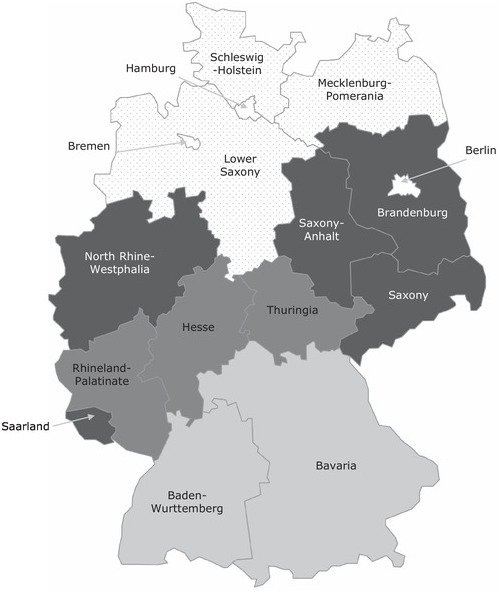
In addition, analysis of the energy base of each Land suggests that this is a key factor shaping how different Länder have tried to address the issue of climate change. Based on their relative reliance on different sources of energy, and considering the three city-states separately, we group the sixteen Länder into five categories that help to explain these contrasting approaches. Table 8.4 summarises these groupings and they are represented geographically in Figure 8.1 (see also Eckersley et al. Reference Eckersley, Kern, Haupt and Müller2021 for a more detailed breakdown of each state). In most cases, these groupings also reflect geographic and climatic factors, which themselves shape the energy resources that are available locally and the strength of certain industries in lobbying and policymaking processes.
| Coal states (coal regions in western and central Germany) | |
|---|---|
| Brandenburg; North Rhine–Westphalia; Saarland; Saxony; Saxony–Anhalt | Traditional coal states; high CO2 emissions/cap.; exporters; small renewable energy sector |
| Nuclear/solar energy states (southern states) | |
| Bavaria; Baden–Württemberg | Traditional nuclear states; relatively low CO2 emissions/cap.; growing renewable sector (particularly solar) |
| Wind energy states (northern, coastal states) | |
| Lower Saxony; Schleswig–Holstein; Mecklenburg–Western Pomerania | Traditional nuclear states; relatively low to medium CO2 emissions/cap.; growing renewable sector (particularly wind); becoming energy exporters; |
| Energy importing states (central states) | |
| Rhineland–Palatinate; Hesse; Thuringia | Dependent on energy imports; medium CO2 emissions/cap.; growing renewable sector |
| City-states | |
| Berlin; Hamburg; Bremen | Low potential for renewable energy generation; relatively low CO2 emissions/cap. due to population density; dependent on fossil fuel energy production (coal and gas) and imports |
8.3.5 Coal States
These five Bundesländer rely heavily on either hard ‘black’ coal or ‘brown’ lignite for energy production. Although they have reduced GHGs significantly since 1990, this was from a very high base. In addition, three of the coal states (Saxony, Saxony–Anhalt and Brandenburg) experienced significant industrial decline following unification in 1990, which accounts for a major proportion of their drop in emissions. North Rhine–Westphalia is the only coal state to pass a climate change act that commits it to reductions in GHG emissions. Green Party representatives in the state legislatures of Brandenburg, Saxony–Anhalt, Saarland and Saxony introduced similar legislative initiatives in their respective Land parliaments, but they were rejected by the governing majority on each occasion (Eckersley et al. Reference Eckersley, Kern, Haupt and Müller2021).
Two coal states – Brandenburg and Saxony–Anhalt – have invested heavily in wind power. Brandenburg aims to increase the share of renewables in energy generation to 32 per cent by 2030 (MWE B 2012) and Saxony–Anhalt provides a range of funding sources to support municipalities in climate policy development and implementation (MWW SA 2014). The other three coal states have been less ambitious, particularly in recent years. For example, after NRW’s Social Democratic–Green government was replaced by a centre–right coalition of Christian and Free Democrats in 2017, its progress on mitigation stalled, redirecting its investment from mitigation to adaptation (Eckersley et al. Reference Eckersley, Kern, Haupt and Müller2021; interviews with Energieagentur NRW and the NRW Environment Ministry). For its part, Saarland produces the lowest share of energy from renewable sources among the non-city-states (Statistisches Amt Saarland 2018). Saxony has introduced funding schemes for climate protection and adaptation initiatives (S SMWAV 2013), but it had still not set any specific targets for further GHG reductions by spring 2021, and its parliament rejected a Green Party proposal to introduce a climate protection act in 2018 (Abgeordnetenwatch.de 2018). As such, we can see how these Länder lag behind most of the rest of Germany in their climate policies.
8.3.6 Nuclear/Solar Energy States
Traditionally, Bavaria and Baden–Württemberg in southern Germany relied heavily on nuclear energy, which meant that they had relatively low GHG emissions per capita. However, since the Energiewende initially prioritised the phasing out of nuclear power, both faced significant challenges to bridge the gap between energy supply and demand through renewable sources, primarily solar photovoltaics. In 2018, for example, over 40 per cent of Germany’s installed solar PV capacity was in Bavaria and Baden–Württemberg (AEE 2019). Both Länder also promoted themselves as climate leaders among subnational units through ‘paradiplomacy’ (see Ralston Reference Wurzel, Zito and Jordan2013 re Bavaria), and membership of the Under2Coalition of states and regions driving climate action. Indeed, Baden–Württemberg was a founding member of this network, and its Green Party premier is one of four European co-chairs.
Bavaria claims to have established the world’s first environmental ministry in 1970 (BSUV n.d.) and has helped to fund municipal climate initiatives for many years (Bayerische Staatsregierung Reference Zohlnhöfer2009; Kern Reference Kern, Baker and Eckerberg2008). Although the Land government did not propose a Climate Protection Act until 2019, this committed Bavaria to climate neutrality by 2050 (BSUV 2020), thereby increasing competition between leading Länder in terms of environmental ambition. Bavaria has made significant progress in terms of solar PV installations, but this is largely due to private investments incentivised by feed-in tariffs introduced by the federal government and financed by energy customers up until 2017, rather than a specific Land initiative.5
Baden–Württemberg was also a forerunner in environmental protection; it established an environment ministry in 1975 and a climate protection and energy agency in 1994, and in 2013 it became the second Land to pass a Climate Protection Act, committing to a 90 per cent reduction in GHG emissions by 2050.6 Like Bavaria, it has overseen a significant expansion in renewable (particularly solar) energy generation in recent years (Diekmann et al. Reference Diekmann, Schill and Püttner et al2019). However, total GHG emissions in the state have fallen more slowly than in other parts of the country (partly due to a considerable population increase), and the Land only met its initial target of a 25 per cent reduction by 2020 due to the impact of Covid-19 on transport emissions (Statistisches Landesamt Baden–Württemberg 2021).
8.3.7 Wind States
Traditionally, Germany’s three northernmost states (Lower Saxony, Schleswig–Holstein and Mecklenburg–Western Pomerania) have relied on nuclear power and imported electricity. However, their coastal location and climatic conditions have enabled them to shift towards wind power (both on- and offshore) more easily than their inland counterparts.
In contrast to three of the other eastern Länder, Mecklenburg–Western Pomerania did not have substantial carbon-intensive industry during the GDR period and was therefore not as badly affected by the 1990s deindustrialisation or the later energy transition. Indeed, its geographical location has facilitated the creation of large green manufacturing and services sectors (Diekmann et al. Reference Diekmann, Schill and Püttner et al2019). However, parliamentary attempts by opposition representatives from the Green Party to introduce a Climate Protection Act were rejected by the ruling SPD–CDU coalition government.
More people are employed in low-carbon industries in Lower Saxony than in any other German state, and over 40 per cent of electricity generated in the Land comes from renewable sources (N MUEBK 2020). The SPD–CDU state government passed a climate protection act in 2020, which commits the Land to legally binding targets of 80–95 per cent reductions in GHG emissions and a complete transition to renewable energy by 2050 (Landtag Niedersachsen 2019). At the same time, however, Lower Saxony still provides significant subsidies for oil and natural gas and provides fewer funding opportunities for municipal climate action than some other states (Eckersley et al. Reference Eckersley, Kern, Haupt and Müller2021).
With long coastlines on both the North and Baltic Seas, Schleswig–Holstein is very well located to benefit from wind power and has been able to exploit this advantage by overseeing a major expansion in installations. Like Mecklenburg–Western Pomerania, the Land is largely rural and has little heavy industry, meaning per capita GHG emissions are relatively low. The state’s 2017 Climate Protection Act committed it to GHG reductions of 40 per cent by 2020, 55 per cent by 2030, 70 per cent by 2040 and 80–95 per cent by 2050.7 In 2019, Schleswig–Holstein and Baden–Württemberg were judged to be the two leading states in Germany for renewable energy (Diekmann et al. Reference Diekmann, Schill and Püttner et al2019).
8.3.8 Energy Importer States
Three states in southern-central Germany (Rhineland–Palatinate, Hesse and Thuringia) have small (albeit growing) renewable sectors but are largely reliant on energy imports. None of them have had large fossil fuel or nuclear sectors, and therefore the Energiewende presents them with a smaller economic and political challenge than some other states.
Hesse was one of the first Länder to adopt an active environmental policy, with a comprehensive sustainability strategy in 2008 that also covered issues of climate protection. The state also introduced GHG reduction targets of 30 per cent by 2020, 40 per cent by 2025 and 90 per cent by 2050, against the baseline year 1990 (HMUKLV 2017). In addition, Hesse has introduced a major funding scheme through which municipalities can acquire grants to finance climate-related initiatives (HMUKLV 2019). However, its government has not adopted a Climate Protection Act, and therefore its climate targets are not anchored in legislation.
Rhineland–Palatinate adopted a Climate Protection Act in 2014, which established legally binding targets to reduce GHG emissions by 40 per cent by 2020 and 90–100 per cent by 2050 against the baseline year of 1990.8 As the Land has over 2,300 municipalities, nearly all of which have fewer than 2,000 inhabitants, the Land government encourages and facilitates significant horizontal collaboration between local authorities, in order to help them access necessary resources and increase their capacity to develop and implement effective policy.
Thuringia reduced its GHG emissions by over 60 per cent between 1990 and 2020 – a larger percentage drop than in any other Land – and renewable sources (mostly wind and solar) now account for 59 per cent of electricity production within the state (TLS 2019). In 2018 it became the only Land in the former GDR to have adopted a climate protection act outside Berlin: this sets out a series of legally binding staged targets for GHG emission reductions, culminating in 80–95 per cent by 2050.9 The state also provides funding schemes for municipalities to invest in climate protection and adaptation initiatives, including applications for European Energy Award accreditation.
Despite their progress, however, these three Länder do not have the wind resources of the northern Länder, and private actors have invested less in solar power than in the southern Länder. As a result, they will probably continue to rely on energy imports for the foreseeable future and therefore have less control over the way in which this energy they consume is generated.
8.3.9 City-States
Due to being densely populated ‘city-states’, Berlin, Hamburg and Bremen face different climate challenges than the other Länder and have sought to respond to them in different ways. Berlin made substantial progress in reducing GHG emissions during the early 1990s, but still relied on fossil fuels for 90 per cent of its energy by 2016, when hard coal generated over 40 per cent of the city’s electricity (BSDETCP 2019). Given this situation, it remains unclear whether Berlin can meet its target of climate neutrality by 2050, as set out in its 2016 Energy and Climate Act. However, it has been more active in the area of adaptation than many other states, proposing a range of initiatives that aim to reduce the impact of extreme weather events – particularly heatwaves and storms – on the city’s infrastructure (SUVK 2016).
Bremen also still relies heavily on coal-fired power stations for its electricity – although its substantial steelmaking sector, which accounts for around half of the state’s GHG emissions, skews its climate-related statistics to a large extent. The state parliament did pass an energy act as early as 1991, focusing on energy conservation and efficiency, and then adopted climate protection legislation in 2015 that included GHG reduction targets of 80–95 per cent by 2050 (Eckersley et al. Reference Eckersley, Kern, Haupt and Müller2021). The Land also has an adaptation strategy (published in 2018) that seeks to address concerns about water management, heatwaves and flood risks (Freie Hansestadt Bremen Reference Flaskühler and Härtel2018).
Like the other city-states, Hamburg relies heavily on fossil fuels, particularly coal, for its energy; renewables accounted for a mere 4 per cent of consumption in 2017. Indeed, the new Moorburg coal-fired power station, which began generating electricity in 2015, has meant that the city’s GHG emissions have increased by 20 per cent in the last five years (Eckersley et al. Reference Eckersley, Kern, Haupt and Müller2021). However, Hamburg has set ambitious targets in its climate protection act: a 55 per cent reduction in CO2 emissions by 2030 (compared to 1990) and climate neutrality by 2050,10 and has also adopted a climate adaptation strategy (BFHH Reference Hoff and Strobel2013).
8.4 Discussion
Despite the existence of an elite consensus about the serious threat that climate change poses, the above illustrations show how approaches to the issue are becoming more fragmented and diverse across Germany, because some Länder want to make faster progress than others. This is driven by political, economic and geographic factors within each Land. In political terms, those Länder where the Green Party has formed part of the coalition government have normally adopted a Climate Change Act and more ambitious mitigation policies. In contrast, in those areas where the Greens have generally been in opposition, their attempts to introduce climate legislation have been stymied (Eckersley et al. Reference Eckersley, Kern, Haupt and Müller2021). Economically, a greater dependence on fossil fuels in the energy mixes of some Länder has made them more reluctant to engage in far-reaching mitigation activities (such as phasing out coal). Ultimately, these economic factors (and the powerful lobby groups that represent political and industry interests) are themselves shaped by geography: the governments of those Länder where renewable energy resources are more plentiful (such as the windy north or sunnier south) have been more enthusiastic about the energy transition than their counterparts in central Germany.
Another related issue here is the extent to which Land and municipal governments can access the resources necessary to develop and implement ambitious policies. Public institutions in wealthier cities and states often have more money to spend on policy initiatives, and their residents may also be more likely to view climate change as a priority issue (Moser and Kleinhückelkotten Reference Moser and Kleinhückelkotten2018). Leaving aside the three city-states, those Länder that have performed better on climate mitigation tend to be wealthier (see Table 8.3). Politically speaking, such factors should make it easier for governments to introduce ambitious climate policies. Access to other resources, particularly relevant knowledge and expertise, can also shape a subnational government’s climate strategy (Lerman et al. Reference Lerman, Gerstlberger, Lima and Frank2021).
As with most other federal systems, Germany’s institutional architecture enables the Länder to develop their own strategies and legislation in response to these specific circumstances, but they are restricted by the fact that policies in key sectors such as the emissions trading system, vehicle emissions standards and energy infrastructure are made at the EU or federal levels (see Table 8.2). The flexibility that they can exercise within this framework has led to examples of collaboration, policy diffusion and copying, such as with the proposing and passing of Climate Acts in many Länder, or the development of climate and energy agencies to support implementation at the regional and local levels. However, the consensual nature of German federalism means that federal policy often moves at the speed of the slowest participant. Some Länder will try to prevent federal laws from being sufficiently ambitious to bring about significant emissions reduction. For example, Land opposition to phasing out coal-fired electricity generation, as well as federal regulations on the siting of wind turbines in rural areas or the construction of north–south power lines to transmit renewable electricity, could prove significant (Eichenauer Reference Eichenauer, Radtke and Kersting2018; Neukirch Reference Neukirch2020).
Some scholars suggest that the inflexibilities and number of veto points within the federal system are the main obstacle to German climate change action (Scheiner Reference Scheiner, Lhotta and Decker2017), in line with the ‘joint decision-making trap’ argument. However, others argue that powerful lobby groups such as car manufacturing and the coal industry have managed to shape decision-making by influencing the occupants of key federal economy and transport ministries in the SPD and centre–right parties (Töller Reference Töller, Zohlnhöfer and Saalfeld2019). Both factors would seem to be important: the federal system provides industry groups with multiple venues through which they can pursue their interests and persuade policymakers to slow down progress, particularly if politicians perceive that action to protect the climate could entail electoral costs. Interestingly, however, the Green Party entered the federal government after the September 2021 elections for the first time since 2005. Since the Greens have far fewer links with the fossil fuel and automobile industries than the SPD, CDU and CSU that formed the previous federal coalition, and their presence in Land governments has resulted in more ambitious climate policies, such an eventuality could herald a major shift in Germany’s overall strategy.
Although Germany’s climate policy hitherto has been largely based on the principles of collaboration, the federal government may need to take a more balanced approach to take it to the next level. Its major climate actions have resulted from coordinated action across tiers of government, combined with support from the federal or Länder level for municipalities that may otherwise have been unable or unwilling to act. The legal framework within which the Länder operate – particularly the requirement to provide municipal governments with the necessary resources to undertake new functions – means that they do influence how climate policy is implemented within Germany. However, stronger direction from the federal government might be necessary if the country is to achieve its objective of climate neutrality by 2045 (Heering and Gustavson Reference Heering and Gustavson2021; Steuwer and Hertin Reference Steuwer, Hertin, Wurzel, Andersen and Tobin2021).
8.5 Conclusion
Thus far, Germany’s federal system has facilitated a coordinated approach to climate policymaking across and between tiers of governance, whilst also enabling the Länder to pursue their own strategies for climate mitigation and adaptation. Since there has been broad agreement on the need to take action in many key areas (such as the closure of polluting industries in the former GDR and the initial scaling up of renewable energy capacity), joint decision-making has yet not proven to be a trap in the climate and energy sectors. Indeed, there has been a degree of competition between some Länder for the unofficial title of Germany’s climate leader – although ambitions largely reflect the political and economic conditions within each Land. As a result, policy can move forward within the constituent parts of the federation in the absence of consensus, but this has meant that the Länder are travelling at different speeds. Indeed, closer analysis reveals the extent to which local context has shaped the strategies, polices and approaches to implementation in the different Länder. The availability of renewable energy resources and a Land’s existing dependence on fossil fuels has a significant effect on mitigation policy, and the extent to which a Land is vulnerable to the impact of climate change influences its adaptation approach.
In this sense, the governance of climate change in Germany is something of a microcosm of global efforts to tackle the issue: individual states adopt their own strategies within a wider institutional framework, and these approaches reflect their economic situation and political priorities. In both cases this results in a fascinating mix of different policies that reflect local and regional contexts, but which may be insufficient to achieve their objectives: Germany’s federal targets for reducing GHG emissions on the one hand, and the Paris Agreement’s pledge to keep global temperature increases below 2°C on the other. Indeed, having implemented most of the ‘low-hanging’ climate policies, Germany now needs to take more far-reaching decisions around transport and energy infrastructure to continue making progress. Given the distribution of sectoral interests within the federal government and between the Länder, it will be much more difficult to reach a political consensus on these issues. As such, we can see how the traditional ‘joint decision trap’ critique might well apply to the case of climate change once decisions become more controversial: the need to seek consensus in a bureaucratic decision-making system that involves many veto players could ultimately result in suboptimal policy. Although strong intergovernmental structures did help to coordinate and mobilise activity throughout the policy chain in the initial phases of the Energiewende, and this strengthened the hand of the state in implementing policy objectives, it has become increasingly difficult to maintain momentum. Germany’s federal system has contributed to progress slowing down, because it provides different interests with multiple venues to push their cause and veto more ambitious initiatives (Töller Reference Töller, Zohlnhöfer and Saalfeld2019). Individual states remain free to develop more far-reaching policies within the constitutional framework, but the new federal government may need to adopt a more coercive approach in order to ensure that other parts of the country do not fall too far behind. Following the approach adopted after Germany took the decision to phase out nuclear energy, both the federal government and the EU are also likely to provide substantial financial support to those Länder that will be most affected by the shift away from coal, in order to reduce the societal impact of this transition.
Overall, therefore, Germany’s experience suggests that federal systems can have beneficial effects for policy experimentation, coordination and implementation when there is a political consensus, but they may be less effective where it is difficult to reach agreement between key actors.


 Open access