


1. Introduction
Design critique is a central practice in both design education and professional work. Whether in studio reviews, project evaluations, or organizational performance assessments, critique is the primary mechanism through which designers receive formative evaluation and supervisors communicate expectations. Despite its centrality, critique is often experienced as emotionally challenging. Research in educational and organizational psychology highlights how critique can elicit stress, defensiveness, and anxiety, which may hinder learning and constructive dialogue (Reference Kluger and DeNisiKluger & DeNisi, 1996; Reference Nicol and Macfarlane-DickNicol & Macfarlane-Dick, 2006). While pedagogical strategies for giving and receiving feedback have been widely investigated, the environments in which critique takes place are typically overlooked. Critique encounters usually take place in generic meeting rooms or offices that fail to address the emotional intensity of the situation. Research to date has primarily focused on the content and communication of critique: how to phrase critique constructively, how students or employees interpret evaluative messages, and how critique practices shape learning outcomes (Reference Carless and BoudCarless & Boud, 2018). By contrast, the environments in which critique takes place have received little attention. This oversight contrasts with emerging evidence from neuroaesthetics and environmental psychology, which demonstrates how spatial and multi-sensory cues influence affect, attention, and social interaction (Reference ChatterjeeChatterjee, 2014; Reference Leder, Belke, Oeberst and AugustinLeder et al., 2004; Reference UlrichUlrich, 1991).
The lack of research on critique environments raises the following research questions:
RQ1: How can neuroaesthetic design principles be applied to the design of critique environments?
RQ2: How do participants experience the affective and social dynamics of critique when conducted in a neuroaesthetically designed environment?
Our goal is to conceptualize and investigate critique environments through the lens of neuroaesthetics, positioning them as sites where design research can make a tangible contribution. By doing so, we aim to extend the discourse on critique beyond pedagogy and communication, and to propose new directions for how design theory and methodology can engage with emotionally charged practices. In the following sections, we review related work on neuroaesthetics and feedback culture, outline the design and development of our Room for Critique, and report empirical findings from five critique meetings conducted in this environment. The contribution of this work is twofold: (1) it proposes a framework for designing critique environments, and (2) it demonstrates a methodological pathway for operationalizing neuroaesthetic principles within a research-through-design (RtD) approach (Reference FraylingFrayling, 1993; Reference Zimmerman, Forlizzi and EvensonZimmerman et al., 2007).
2. Background and related work
Critique is a cornerstone of learning and professional development but also a persistent challenge. It can improve performance while simultaneously provoking defensiveness or disengagement (Reference Kluger and DeNisiKluger & DeNisi, 1996). Effective critique is most impactful when timely, specific, and oriented toward improvement (Reference Hattie and TimperleyHattie & Timperley, 2007), yet students often report dissatisfaction with clarity, tone, and usefulness (Reference Paterson, Paterson, Jackson and WorkPaterson et al., 2020). Feedback is increasingly understood as a cognitive, affective, and relational process rather than a simple transfer of information (Reference Henderson, Ajjawi, Boud, Molloy, Henderson, Ajjawi, Boud and MolloyHenderson et al., 2019). In design education, these dynamics are amplified: critique exposes not only ideas but identities, making feedback emotionally charged (Reference Schmitt-Fumian, Tauscher and ThoringSchmitt-Fumian et al., 2025; Reference SchönSchön, 1983). Research shows that while peer dialogue can promote reassurance and equality, tutor critique is frequently perceived as stressful or judgmental (Reference McClean and HouriganMcClean & Hourigan, 2013). Recent work has revisited critique as a central yet contested practice in studio pedagogy and design education (Reference Ezennia and AgbonomeEzennia & Agbonome, 2025; Reference McDonald and MichelaMcDonald & Michela, 2019; Reference WongWong, 2011).
At the same time, work in environmental psychology shows that physical environments influence emotion, cognition, and social interaction. Restorative environments, characterized by calmness, soft fascination, and a sense of safety, support recovery from cognitive fatigue and stress (Reference Kaplan, Kaplan and RyanKaplan et al., 1998). Studies in educational settings similarly demonstrate that classroom qualities such as lighting, acoustics, and natural elements affect attention, comfort, and performance (Reference Barrett, Davies, Zhang and BarrettBarrett et al., 2015). A systematic review of creative work environments further highlights the importance of spatial factors, including ambiance, comfort, symbolic cues, perceived ownership, and spaciousness, in shaping cognitive processes and social dynamics (Reference Thoring, Mueller, Desmet and Badke-SchaubThoring et al., 2020). These findings underscore that environments are not passive backdrops but active contributors to learning and interpersonal exchange.
Neuroaesthetics provides a complementary lens for understanding how sensory cues modulate affect and cognition (Reference ChatterjeeChatterjee, 2014; Reference MallgraveMallgrave, 2010). Research across vision, sound, touch, and scent demonstrates that environmental stimuli shape arousal, emotional tone, and attentional focus. Cool colors and natural textures can support relaxation and concentration (Reference Tsunetsugu, Miyazaki and SatoTsunetsugu et al., 2005; Reference Wilms and OberfeldWilms & Oberfeld, 2018), while lavender has reliable calming effects (Reference Ludvigson and RottmanLudvigson & Rottman, 1989). Acoustic comfort enhances focus, and soft surfaces reduce perceived social tension (Reference Bulut, Öztürk, Candan, Nergi̇S and BoyacioğluBulut et al., 2022). Related design research has shown that multisensory interior spaces can elicit distinct emotional responses, with certain sensory combinations producing increased relaxation (Reference McTeague, Dreyer, Liu, Kizilkaya and ThoringMcTeague et al., 2025). Together, these findings indicate that sensory design is not incidental but integral to shaping human experience.
Despite these insights, work on critique, and feedback more broadly, rarely integrates environmental or multisensory considerations. Feedback studies focus on communication practices, while research on restorative or neuroaesthetic design is oriented toward wellbeing or creativity. What is missing is a systematic exploration of how spatial and sensory conditions shape the dynamics of critique itself. To address this gap, we designed and constructed the Room for Critique, a full-scale prototype environment that operationalizes neuroaesthetic principles for critique encounters. Using a research-through-design approach, we translated insights from sensory and spatial research into a multisensory room concept intended to influence affect, attention, and perceived hierarchy. The following section describes the resulting design rationale and features.
3. The Room for Critique (prototype description)
The Room for Critique was conceived as a full-scale prototype (3 × 2.5 m) to explore how neuroaesthetic design principles can be operationalized in critique encounters. Its design was informed by two main inputs: (1) a power-user interview with a corporate talent manager, an expert in delivering difficult feedback. The interview focused on the mental states perceived as necessary for constructive critique, particularly focused attentiveness on the giver’s side and calm openness on the receiver’s side. These insights defined the affective goal of the project. Subsequent design decisions were then informed by (2) neuroaesthetic and environmental psychology research to explore how such states might be supported through spatial and multisensory cues. The interview partner later provided reflective feedback on the completed prototype. Together, these inputs highlighted the asymmetry of critique: while the giver requires focus and concentration, the receiver benefits from calmness, reassurance, and a sense of safety. The room was therefore designed with two differentiated sides, offering distinct visual and sensory experiences tailored to these roles. The prototype takes the form of a compact enclosed space with two facing positions separated by a circular table. The critique giver’s side emphasizes focus, clarity, and minimal distraction, while the receiver’s side integrates calming and restorative elements. The room was designed to be immersive and multi-sensory, addressing vision, acoustics, touch, smell, and taste. This holistic approach aimed to modulate stress and attention, supporting more constructive dialogue.
Schematic illustration of the Room for Critique, floorplan (left) and perspective view (right)

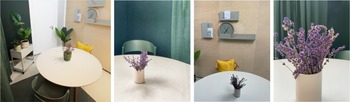
The illustrations in Figure 1 show the two-sided perspective of the room’s design. Both persons are positioned at approximately a 150-degree angle opposite each other. While the critique recipient sits closer to the door, their field of vision is dominated by the green wall and green curtain, which should give them a relaxing mental state and the feeling of not being trapped in the room. By contrast, the critique giver looks at the side of the room that is dominated by bright natural colors, wooden wall panels, some yellow accents, and two wall shelves with selected books and a wall clock. This view is supposed to enhance focus. Figure 2 shows spatial impressions of the Room for Critique prototype.
Spatial impressions of the Room for Critique. From left to right: overall room arrangement, critique recipient’s view, critique giver’s view, lavender detail

The Room for Critique was developed using a multisensory design approach informed by research in neuroarchitecture and environmental psychology (Reference Medhat Assem, Mohamed Khodeir and FathyMedhat Assem et al., 2023; Reference SpenceSpence, 2020). Each sensory modality was intentionally shaped to support calm focus, interpersonal balance, and spatial neutrality during critique interactions. The neuroaesthetic framework informing the prototype focused specifically on three mechanisms: (1) modulation of arousal through color and scent, (2) support of sustained attention through softly stimulating environments, and (3) embodied affect regulation through material and tactile cues. Rather than adopting neuroaesthetics as a general aesthetic theory, we translated empirical findings on sensory–emotional coupling into concrete spatial decisions, including the use of cool color schemes, lavender scent, acoustic softening, and natural materials.
Visual: The visual design differentiated the perspectives of giver and receiver through the composition of their respective visual fields rather than through physical zoning. From the receiver’s viewpoint, dark green surfaces conveyed calm and composure, consistent with evidence linking cool hues to lower arousal and restorative experience (Reference Wilms and OberfeldWilms & Oberfeld, 2018). The giver’s field of view incorporated brighter birch wood surfaces that provided a more alert and task-oriented appearance. Yellow accents, such as the cushion, added warmth within the overall cool palette. A natural wood-veneer wall, together with a few plants and books, introduced subtle biophilic elements without visual clutter (Reference Tsunetsugu, Miyazaki and SatoTsunetsugu et al., 2005). The window was covered with translucent foil to diffuse daylight and avoid distracting external views. Warm overhead lighting ensured even illumination without glare. These combined elements created a visually coherent atmosphere intended to support calm concentration and reciprocal engagement.
Acoustic: Soft materials and surface finishes were used to reduce reverberation and attenuate external noise, contributing to a quieter and more intimate setting. This aligns with research demonstrating that textile-based treatments can enhance acoustic comfort in small interior spaces (Reference Bulut, Öztürk, Candan, Nergi̇S and BoyacioğluBulut et al., 2022). The acoustic strategy aimed to maintain focus without isolating participants from each other.
Tactile: Tactile cues were incorporated through natural materials and surface contrasts. Muuto wooden chairs were supplemented with a colored cushion that provided both soft tactile contact and a visual cue. The wooden table with a smooth linoleum surface offered a warm and even haptic quality for writing and sketching. A wall clad in natural wood veneer added fine-grained texture and visual warmth, supporting sensory grounding consistent with findings on the emotional impact of natural interior materials (Reference Saxena, Qamruddin and DubeySaxena et al., 2023; Reference Tsunetsugu, Miyazaki and SatoTsunetsugu et al., 2005). A small stress ball was placed near the receiver’s position as an optional tool for self-regulation.
Olfactory: Lavender was selected as the sole olfactory element due to its documented calming effects on anxiety and emotional tension (Reference Ludvigson and RottmanLudvigson & Rottman, 1989; Reference SpenceSpence, 2020). A small bundle of dried lavender and a light application of lavender oil on the table surface provided a subtle, consistent scent intended to support calm attention and emotional openness.
Gustatory: Simple refreshments were provided to signal hospitality and support comfort during the critique. Water and coffee were available throughout the sessions, offering a familiar and socially neutral form of sustenance. The gesture was intended to encourage brief pauses and to reinforce the atmosphere of care and attentiveness that characterized the Room for Critique.
Layout: The spatial configuration centered on a round wooden table, with both participants positioned at equal distance and height. The approximate interpersonal distance was 80–100 cm. This arrangement avoided frontal or side-by-side orientations typical of evaluative settings and reduced positional hierarchy, echoing findings that seating geometry influences perceived equality and conversational ease (Reference Miwa and HanyuMiwa & Hanyu, 2006; Reference Thomsen, Krogh, Schnedler and LinnetThomsen et al., 2018). The layout maintained sufficient proximity for shared focus while reinforcing an atmosphere of balanced participation.
4. Methodology
4.1. Research-through-design
The project adopted RtD in which design activity functioned as a mode of inquiry rather than merely as artifact production. The prototype of the Room for Critique was conceived as a material hypothesis: spatial and sensory configurations were used to explore how affective targets (calm openness and focused attentiveness) might be translated into built form. Design decisions were iteratively developed through conceptual sketching, material testing, and spatial modelling, allowing theoretical assumptions about arousal, attention, and hierarchy to be confronted with spatial constraints. In this sense, knowledge emerged not only from post-hoc evaluation, but from the process of translating affective goals into spatial strategies and negotiating tensions between neutrality, orientation, and functionality.
4.2. Research design
The prototype was evaluated during five annual PhD progress meetings, each a formal milestone in which candidates present their work to their supervisor. These meetings naturally involve evaluative pressure, asymmetrical roles, and high emotional stakes, making them suitable for examining experiential dynamics of critique. Using the prototype room as the setting allowed us to explore how spatial and sensory design influenced participants’ affective states and perceptions without altering the content or structure of the meeting itself. The study is exploratory in nature, aiming to surface patterns and insights rather than establish generalizable effects. Five doctoral candidates participated as critique receivers, each completing one progress meeting. The same PhD supervisor (first author) acted as the critique giver in all sessions, ensuring consistency in critique style and expectations. Participation was voluntary, all participants provided informed consent, and interviews were conducted after all academic decisions had been made. We acknowledge that the dual role of the supervisor as researcher and critique giver introduces bias; this is addressed in the Limitations section.
4.3. Procedure
Each session followed a three-step structure:
(1) Pre-session assessment: Before the meeting, each critique recipient completed an emotion grid (Reference Russell, Plutchik and KellermanRussell, 1989) indicating their current emotional state along two dimensions: arousal (energy level from “high arousal” to “sleepiness”) and valence (ranging from pleasant feelings to unpleasant feelings), each rated on a 1–9 grid. Additionally, they completed a short questionnaire on their current emotional state and expectations for the meeting, consisting of six items rated on a 7-point Likert scale (1 = strongly disagree; 4 = neutral; 7 = strongly agree).
(2) Critique session: The regular progress meeting was conducted in the prototype room. No guidance about how to use the room was provided, ensuring that participants’ experiences reflected natural engagement with the space.
(3) Post-session assessment: Immediately after the session, each participant repeated the emotion grid to capture changes in affective state and completed a second questionnaire consisting of 14 items on a 7-point Likert scale. It asked about their emotional experience during the meeting, the perceived constructiveness of the interaction, and their assessment of the room’s influence across aspects such as scent, layout, colors, views, textures, and overall design. The questionnaire also included one open-ended question about which element of the room they experienced as most positive or negative.
(4) Follow-up interviews: Within one week, each recipient took part in a semi-structured interview about the room and the critique interaction (conducted by the second author of this paper, who was not involved in the critique sessions). Following the completion of all five sessions, an interview was conducted with the critique giver to gather reflections from the critique provider’s perspective.
4.4. Data collection and analysis
Emotion-grid data were analyzed descriptively, comparing pre- and post-session affective states for both giver and receivers. Interview transcripts were transcribed in full and coded thematically to identify how participants described the room’s influence on emotional tone, comfort, attention, and social dynamics during critique. Key quotes were extracted to illustrate recurring patterns and to capture the nuances of individual experiences. These qualitative insights were then compared across cases and synthesized into a thematic structure, forming the basis for the design principles presented in Section 5.
5. Findings
The empirical material from the pre-and post-session questionnaires and follow-up interviews was analyzed thematically, combining participants’ self-reported experiences with the critique giver’s observations. The findings are organized into two domains and one reflexive perspective. The affective–sensory domain addresses how color, scent, acoustics, and materiality influenced participants’ emotional states and cognitive focus. The spatial–social domain examines how the physical configuration of the room shaped perceptions of hierarchy, familiarity, and psychological safety. Finally, the critique giver’s perspective provides a complementary account of how the same spatial and sensory conditions influenced critique delivery and the dynamics of dialogue. Together, these findings illustrate how multi-sensory spatial design modulated affect, attention, and social interaction during critique encounters.
5.1. Affective–sensory domain
Multisensory Ambience and Bodily Comfort. Participants consistently referred to the Room for Critique as emotionally distinctive. Several described it as “pleasant”, “calming”, or even “like entering a spa” (P300). The combination of color, scent, and acoustic softness appeared to decrease arousal while sustaining focus. Questionnaire data supported these accounts, showing a mean decrease in arousal from 6.9 before to 4.9 after the session (ΔM = −2.0), while valence remained stable (M = 7.1, ΔM = 0). P527 emphasized that “the dark green wall was very pleasant to look at,” and that “the acoustics felt intimate,” indicating a link between sensory harmony and attentional depth. Others, however, noted overstimulation; P508 described the atmosphere as having a “cave feeling” and P579 found “the scent too strong.” Overall, the sensory composition modulated affect by reducing stress for most participants while revealing individual differences in perceptual tolerance.
Environmental Comfort and Sensory Thresholds. Comfort levels varied across participants and were closely tied to sensory sensitivity. While most described the air quality and scent as supportive, several mentioned physical or climatic discomfort. Mean ratings for color (M = 4.6) and layout (M = 4.4) were generally favorable, while scent (M = 3.6, SD = 2.1) showed the widest variation, confirming divergent olfactory responses. P210 reported that “the scent was strong but helped,” yet also that “the temperature was too cold.” P579’s remark that the seating felt “too close” points to bodily discomfort rather than emotional unease. The findings indicate that physical comfort is integral to maintaining focus and concentration, and that affective design requires adjustable parameters, such as temperature, scent intensity, and seating distance, to accommodate varying sensory thresholds.
Analog Interaction and Material Engagement. Across sessions, participants emphasized the benefits of tactile and analog interaction. P210 noted that “paper was good” and that “no screen barrier was good,” while P527 described the space as “more like a study room.” These remarks underline how sketching and paper-based interaction fostered focus and joint ideation. In contrast, digital interfaces were experienced as disruptive. When P579 “did not bring any prints,” both sides had to “sit side by side and look at her laptop,” which “felt awkward.” The overall high post-session valence (M = 7.1) supports the interpretation that analog interaction sustained positive engagement and attentional balance. The data suggest that material and embodied interaction encourage co-reflection, whereas screens can reintroduce asymmetry and cognitive distraction into the critique setting.
5.2. Spatial–social domain
While the affective–sensory themes focused on how the room modulated emotional and physiological states, the spatial–social themes address how physical arrangements influenced perceptions of hierarchy, familiarity, and trust.
Spatial Neutrality and Redistribution of Power. Two participants, P527 and P300, described the Room for Critique as neutral, referring not to aesthetic restraint but to the absence of spatial hierarchies and ownership cues. P527 stated: “There were no symbols of power—no screens, no phone facing one person… I felt more equal, more like a partner.” Similarly, P300 observed that “It feels more neutral in this space; there’s no ownership attached to any one person in the meeting.” Ratings for overall room design (M = 4.8, SD = 1.8) align with these perceptions of balance and equality. In contrast, the removal of traditional hierarchies also created moments of uncertainty. Without visual anchors such as a screen or desk, some participants reported an initial lack of structure. The findings suggest that spatial neutrality redistributed agency, turning critique into a more symmetrical exchange while reducing conventional indicators of authority.
Familiarity and Functional Legibility. While participants generally valued the novelty of the environment, two reported uncertainty about how to use the space. P579 explained that they were “not familiar with how to use this room,” noting the “lack of a screen” and absence of clear functional cues. P508 similarly stated that they “sometimes missed something to look at.” These observations reveal that the experimental setup disrupted habitual critique schemas and required adaptation to unfamiliar spatial conventions. This is reflected in the slightly lower mean rating for view and light (M = 4.0), suggesting that the absence of typical visual reference points contributed to occasional disorientation. Although this lack of familiarity encouraged reflection on critique practices, it also introduced temporary uncertainty about how critique should proceed.
Emotional Safety and Trust. Several participants highlighted the room’s ability to foster safety and constructive communication. P527 reported that “I felt very safe to say things and to do things,” and P300 described “gaining more confidence during the conversation.” Both linked these experiences to the room’s scale, round table, and absence of evaluative distance. The environment was frequently described as “intimate” and “comfortable,” supporting open and respectful dialogue. These qualitative impressions correspond with the high mean rating for perceived constructiveness (M = 6.8 on a 7-point scale) and low mean for perceived stress level (M = 2.2, SD=1.3). In contrast, P579’s comment that the seating was “too close” illustrates how excessive proximity may reduce perceived safety. The findings suggest that balanced spatial intimacy enhances trust and collaboration, while overexposure can produce mild discomfort.
5.3. The critique giver’s perspective
From the perspective of the critique giver, the Room for Critique functioned as a spatial and cognitive prompt for constructive critique. Entering a designated and labelled environment “for critique” helped to “realize the relevance and the need to be constructive”. The explicit framing of the space as a room for critique appeared to shape the giver’s mindset before the interaction began. Moreover, the spatial configuration fostered equality and informality. The “very intimate room” and the “round table” established a conversational rather than evaluative tone, “more like a casual meeting” or “café-like”. The absence of frontal orientation or symbolic power positions created a sense of being “at eye level”, reflecting the participants’ own descriptions of spatial neutrality. Material and technological conditions further influenced the interaction. Sketching on paper supported shared ideation and a constructive flow. In contrast, when one participant (P579) “did not bring any printouts”, both sides had to “sit side by side and look at her laptop”, which “felt awkward”. This situation revealed how digital interfaces can reintroduce spatial asymmetry and disrupt the otherwise balanced arrangement of the room. Environmental cues also affected attentional and emotional regulation. The “scent was very pleasant”, contributing to calmness and a more moderate tone of critique. The visible “clock in the field of view” was considered useful as a temporal reference, even though it “did not work.” Despite (or because of) this, the giver “lost track of time”, indicating an immersive engagement with the dialogue. Overall, the critique giver’s account suggests that the room’s physical and sensory ambiance supported focus, reduced hierarchical behavior, and encouraged a collaborative, reflective mode of critique.
6. Discussion
6.1. The affective and social impact of space
The aim of this study is not to assess learning outcomes, but to examine critique as a structured evaluative interaction and to understand how spatial design reshapes its affective and relational dynamics. Across the five sessions, both quantitative and qualitative data indicated that the Room for Critique altered the atmosphere and interaction style compared to conventional meeting spaces. Participants generally described the room as calming, intimate, and supportive of focus, while the absence of typical hierarchical cues contributed to a more balanced dialogue. These findings align with neuroaesthetic accounts of how multisensory environments modulate arousal and emotional balance (Reference Chatterjee and VartanianChatterjee & Vartanian, 2014) and with restorative-environment research showing that softly stimulating contexts can sustain attention (Reference KaplanKaplan, 1995). At the same time, individual differences in sensory tolerance and expectations of structure produced contrasting responses, indicating that the effects of spatial neutrality are relational rather than uniform. Quantitative results showed a clear increase in positive affect for four participants (valence increased from 7.0 pre-session to 8.5 post-session), whereas one participant (P579) reported on a rather negative experience because of the lack of computer screen and the resulting necessity to sit too close to each other and looking at her laptop (valence dropped from 7.4 pre-session to 1.5 post-session). This outlier led to the overall flat valence (M = 7.1, ΔM = 0). This case illustrates how similar design conditions can evoke divergent experiences. This pattern reflects the notion of affective atmospheres (Reference AndersonAnderson, 2009), where emotional tone emerges from the interplay of setting, expectations, and embodied perception. The negative case further suggests that the removal of familiar anchors, such as screens or frontal orientation, can disrupt cognitive schemas of interaction (Reference NormanNorman, 2013), generating disorientation even in an otherwise calming environment. Overall, the findings support the view that spatial and sensory design mediate critique as a form of situated cognition: a dynamic negotiation between environmental cues and social conventions. The room equalized sensory and hierarchical conditions, yet in doing so also removed orientation cues that typically structure critique interactions, shaping how participants navigated the dialogue. This tension became visible through the RtD process itself. While prior research indicates that spatial configuration influences perceived authority and relational balance (Reference Miwa and HanyuMiwa & Hanyu, 2006), translating this principle into spatial form revealed that removal of such hierarchies can also eliminate familiar interactional anchors. The insight emerged through prototyping and spatial negotiation, not solely through post-hoc evaluation.
6.2. Design principles for critique environments
The findings from the five critique sessions and the critique giver’s perspective highlight how the spatial and sensory qualities of critique settings influence affective state, attention, and social behavior. The following principles synthesize these insights into transferable considerations for the design of critique environments. The suggested design principles were derived directly from the empirical themes described above, translating observed spatial and sensory mechanisms into transferable design guidance.
(1) Ensure Sensory Balance. Critique spaces should regulate arousal through balanced multisensory composition. Light, colour, scent, and acoustics must combine to sustain focus without overstimulation. Intensity should be moderate and, where possible, adjustable to individual sensitivity. Sensory balance functions as affective regulation, enabling calm alertness. Examples: Use diffuse, warm lighting and matte wall colours to avoid glare; employ subtle scent diffusion with adjustable intensity; integrate sound-absorbing materials that maintain conversational clarity without full silence.
(2) Provide Adaptive Physical Comfort. Physical comfort underpins cognitive focus. Seating distance, temperature, and air quality must be adaptable to accommodate diverse thresholds. Comfortable, movable furniture and local environmental control foster sustained attention and reduce fatigue across longer sessions. Examples: Equip the space with lightweight chairs that allow repositioning; use portable fans or low-noise air filters for temperature and airflow adjustment; provide flexible table heights to support sketching or discussion.
(3) Encourage Analog Materials and Shared Focus. Tactile, analog materials support embodied reasoning and collaborative exploration. Sketching and paper-based work promote shared understanding, whereas screens can re-introduce asymmetry. Spatial layouts should prioritize common horizontal surfaces and tangible media that invite joint reflection. Examples: Provide ample paper, markers, and sticky notes for collaborative annotation; design a central table surface for sketching that can be easily photographed for digital archiving afterwards.
(4) Create Spatial Symmetry and Neutral Hierarchy. Geometry and seating arrangements should equalize participation. Circular or diagonally oriented layouts minimize dominance and foster reciprocity. Spatial symmetry promotes perceptual equality while preserving the possibility of guidance. Removing positional privilege supports a neutral distribution of authority. Examples: Use round tables that eliminate “head” positions; orient seating diagonally to avoid direct confrontation; ensure shared visibility of materials from all positions.
(5) Provide Orientation and Spatial Legibility. Critique environments require clear but non-hierarchical orientation cues. Visible clocks, labelled areas, or neutral display surfaces maintain procedural clarity without reinstating control. Legibility prevents disorientation and supports smooth transitions between presentation, dialogue, and closure. Examples: Include a small analogue clock within the field of view; label zones (e.g., “Constructive Critique”); use a whiteboard or pinboard as a shared focal plane rather than a single-direction screen.
(6) Support Psychological Safety. Emotional openness depends on a sense of safety. Moderate enclosure, balanced proximity, and consistent environmental conditions foster trust and constructive dialogue. Small gestures of hospitality, such as water or light refreshments, signal care and attentiveness, reinforcing the room’s role as a collaborative rather than evaluative space. Examples: Maintain a semi-enclosed seating area with soft boundaries (curtains or plants); provide water, tea, or small snacks to reduce tension; ensure visibility and easy access to the exit door.
6.3. Limitations and future work
This study has several limitations. The sample was small and context-specific, consisting of five PhD progress meetings with a single supervisor, and therefore offers an exploratory account rather than generalizable claims. The dual role of the first author as critique giver and researcher may have influenced interaction dynamics, despite conducting interviews only after academic decisions were finalized. In addition, the novelty of the prototype may have shaped participants’ responses, making it difficult to fully separate sensory effects from unfamiliarity. Finally, the study is interpretive rather than causal and does not claim that specific sensory features directly produce particular emotional states. Future iterations could incorporate adjustable parameters to accommodate individual sensory sensitivities and explore hybrid critique environments that integrate digital affordances without reintroducing hierarchy. The research-through-design approach may also be extended to other evaluative contexts to further examine how spatial and sensory conditions shape critique interactions.
7. Conclusions
This study examined how spatial and sensory design shape the affective and social dynamics of critique. Through the design and in-situ evaluation of the Room for Critique, we found that multisensory environments can support calm focus, reduce perceived hierarchy, and encourage more balanced dialogue, while the absence of familiar cues may create uncertainty for some users. The paper advances a dual lens for understanding critique environments, spatial neutrality, and affective design, and demonstrates how neuroaesthetic principles can be operationalized through a research-through-design process and assessed in real critique encounters. Based on these insights, we propose a set of design principles that translate empirical findings into actionable guidance for shaping critique environments. Taken together, these contributions position spatial–sensory design as an active mediator of critique, rather than a neutral backdrop, and open a new avenue for integrating environmental thinking into critique cultures.
Acknowledgements
We would like to thank Sophia Dankerl, Beatriz Santos Ferreira Monteiro, Ornella Knauer, Paula Schmidt, and Alissa Schulteß, for their support in building the full-size prototype of the Room for Critique.


 Open access

