




Introduction
“Emergency Medical Services” (EMS) means the planning, delivering services, care, and supervising emergency care by the personnel, organizations, and associations engaged in wounded persons. Reference Gienapp1 The prehospital systems were first introduced through Napoleon’s chief military physician in 1797, Reference Cone, Brice, Delbridge, Brent Myers and Bass2 and ambulances were first used for emergency transport by the Spanish forces in 1487. Reference Bass3 Usually, two types of EMS are described: the Franco-German Model (FGM) and the Anglo- American Model (AAM), providing Basic Life Support (BLS), Intermediate Life Support (ILS), and Advanced Life Support (ALS) in different settings within the capacity. Reference Page, Sbat, Vazquez and Deniz Yalzin4
Social workers have an exclusive perspective on assisting EMS providers to work in challenging situations. Reference Guillespie5 They work in diverse settings such as hospitals and they specialize in topics such as disability, elderly care, family health care, youth, and children. Reference Brahim, Mohamad, Zakaria and Sarnon-Kusenin6 It is a combination service that includes health practice, administration, policy development and implementation, economic development, referral care planning, correction and parole, and case managing. Reference Campbell and Rasmussen7 Social workers may have any or many of the following different roles: Reference Miley, O’Melia and DuBois8
-
Advocacy: Social work advocacy is a mutual interpretation of a person attempting to analytically influence decision making in a societal system. Reference Freddolino, Moxley and Hyduk9
-
Planner: To understand community needs, gaps in service, and facilitate positive social change; research strategies are used to collect data for action and transfer it to leaders. Reference Barker10
-
Educators: To help the welfare of humanity, the progress of society, people, and their surroundings, they advocate for welfare, basic needs, and social justice. Reference Rothman and Mizrahi11
-
Mediator: Social work employs theories of human behavior and social systems and interacts with their surroundings for social justice. Reference Roberts12
-
Researcher: They contribute by conducting empirical research and sharing their findings with the community; their research is related to human behavior, social environment, and services. Reference Uggerhøj13
-
Promotional Information: Social workers enhance information sharing and research alliances with other health professionals and meet community needs. Reference Kam14
-
Assessing Community Capacity: Social workers ensure proper assessment, counseling, and referral activities for health promotion in multiple settings; they ensure proper planning, modification, and implementation in the community. Reference Kam14
-
Volunteer: Social work volunteers engage in charity, relief, recreation services, family welfare association, and mental health associations in the community. Reference Ambrosino, Heffernan and Shuttlesworth15
-
Enabler: Social workers strengthen clients with information, existing knowledge, and skills; they take collective learning plans to implement educational actions. Reference Uggerhøj13
-
Outreach: Social workers alert the community about social problems, social inequalities, and advise facilities for these issues; they supply information and service accessibility. Reference Kloppenburg16
-
Organizer: A community organizer is a liaison between the needs and resources of the community, for improved community development. Reference Gitterman17
-
Trainer: Social work training plans require an assessment of needs, organizational goals, and a solid evaluation process for adult education, mindset change, and learning modes. Reference Gitterman17
-
Mental Health Practitioner: Social workers advanced relationship-based skills, and motivations for recovery can help people to make a positive, self-addressed change in the mental health career era. Reference Aviram18
Several studies explained the role of social work in the pre-EMS, during emergency, and post-EMS system separately. At the pre-EMS stage, social workers act as cultural liaisons; Reference Fusenig19 during the emergency, they act as crisis intervention with family and patients; Reference Campbell and Rasmussen20 and the post-EMS services carried out by social workers include avoiding unnecessary hospitalizations, critical illness, and follow up. Reference Bell, Davies, Walsh, Knowlman, Hefford and Kuipers21
This study aimed to synthesize the role of social work at three stages (pre-EMS, during emergency, and post-EMS emergency periods) globally. The role of social work for EMS is a well-known service all over the world, but the practice system is diverse, and community people are still unaware of the professional services of the social worker in EMS. Moreover, there are several pieces of evidence from different scholars with different perspectives, theories, contexts, and dimensions on the social work role in EMS. So, this study would synthesize and summarize the evidence in a systematic way regarding the roles of social workers in EMS for producing a unique shape on social work roles in EMS. There is no prior systematic review of this topic.
Methodology
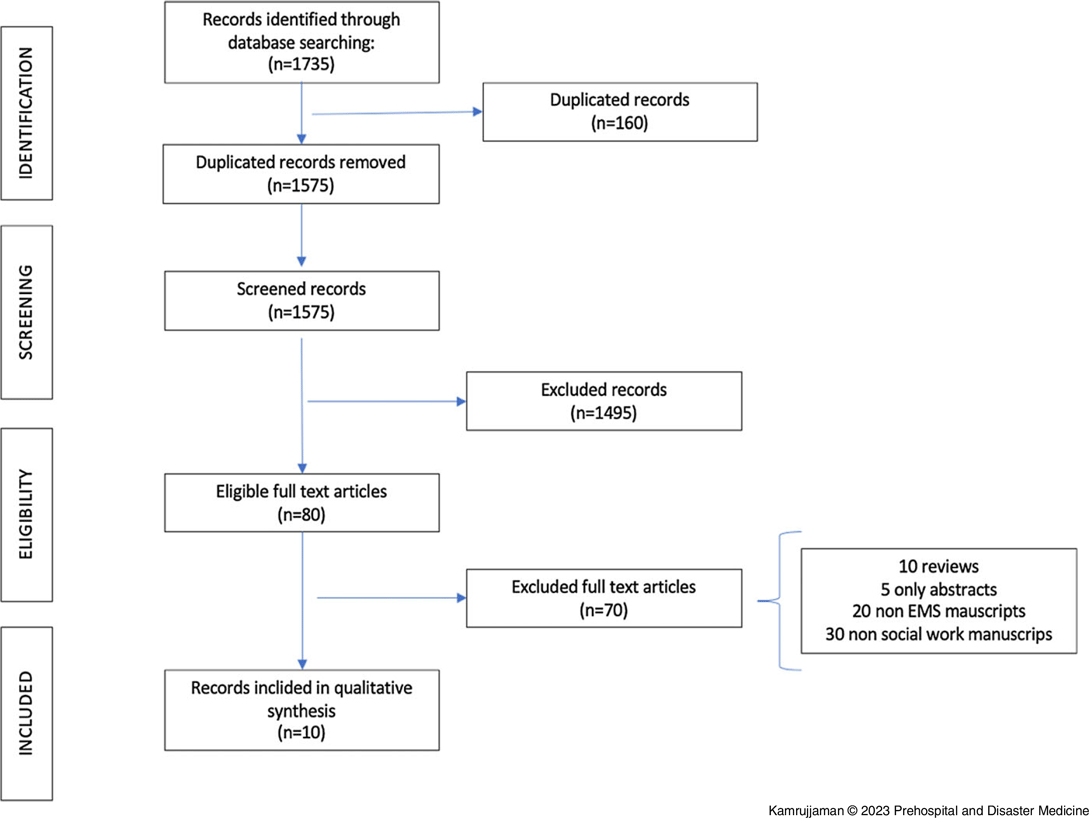
This study was a systematic review, carried out according to the Preferred Reporting Items for Systematic Reviews and Meta-Analyses (PRISMA) guidelines, as outlined in Figure 1. It was registered in PROSPERO as “The Role of Social Work for Emergency Medical Services EMS: A Systematic Review” with ID CRD42022316792 on October 24, 2022. No amendments to the information provided in the protocol have been made.
PRISMA Diagram.
Abbreviation: EMS, Emergency Medical Services.
Studies were included in the review if they were on the topic of the roles of social workers at every stage (pre-EMS, during emergency, and post-EMS) for EMS services throughout the world. Studies on social workers of any stage, sex, and age, as well as studies on any level of EMS provider, were included.
Inclusion criteria were any full-text, peer-reviewed papers published in English discussing social work roles in EMS settings. This was a descriptive study; therefore, outcomes were any described social worker role in any EMS setting. Exclusion criteria were other types of documents like empirical studies, book reviews, debate papers, editorial criticism, and critical commentaries. Four databases were used: Scopus Database (Elsevier; Amsterdam, Netherlands), Sociology Database (ProQuest; Ann Arbor, Michigan USA), Social Science Database (ProQuest), and Public Health Database (ProQuest). The keywords used were: “Social Work AND Emergency Medical Services AND Ambulance Services,” “Social Worker AND Emergency Medical Systems AND Ambulance Services,” “Social Work AND EMS,” “Social Work Role AND EMS,” “Social Work AND EMS,” and “Emergency Medical Services OR Emergency Medical Systems.” Study selection occurred in two phases: title and abstract screening, followed by full-text review. Study selection was performed by the main author, and the co-authors independently screened a random selection of the retrieved records at each phase to ensure consistency. In case of any disagreements, a resolution was reached through consultation with the whole team. Covidence software (Covidence; Melbourne, VIC, Australia) was used to facilitate the screening process.
Data Collection Process
Data extraction was performed by the main author, using a custom tool prepared in Excel (Microsoft Excel v. 16.70; Microsoft Corp.; Redmond, Washington USA). The data extraction tool was piloted using the first five studies and amended as necessary. The co-authors independently performed data extraction for a random selection of the included studies to ensure consistency. In case of any disagreements, a resolution was reached through consultation with the whole team.
For narrative synthesis of the extracted data, a thematic analysis procedure was applied. Reference Ibrahim22 The retrieved data were synthesized using thematic analysis, which is a method of grouping similar result is a particular theme. First of all, all relevant outcomes (ie, social worker roles) were collected from the included studies, stratified by stage (pre-EMS, during emergency, and post-EMS). Then, for each stage, similar roles were synthesized into single, mutually exclusive theme categories, which were the main results of the study. Therefore, derived themes were categorized and coded roles of social work, in each EMS stage, and these were used for conclusion drawing and verification. Reference Thomas and Harden23,Reference Barnett-Page and Thomas24
To assess the risk of bias for the included studies, the qualitative studies checklist for risk of bias (Critical Appraisal Skills Programme [CASP] Appraisal) was employed. 25 The validity, study results, and local context analysis of the studies were assessed.
As discussed, the main outcomes of the study were social work roles in pre-EMS, during an emergency, and post-EMS settings. Study outcomes were tabulated per included study and, following the thematic analysis, per theme. Results were descriptive and narrative in nature, hence formal assessment of heterogeneity was not possible. Heterogeneity in the study results is expected given the multitude of potential social work roles and the multitude of EMS settings. Due to the descriptive nature of the study, reporting biases and certainty in the body of evidence were not assessed.
This study was a systematic review, therefore, no ethical approval or funding was obtained.
Results
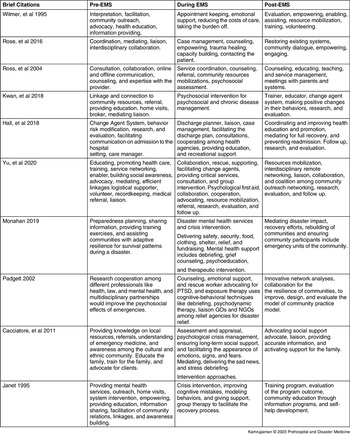
A total of 1,735 results were retrieved from the databases, reduced to 1,675 after removal of duplicates. Eighty studies were selected, and 1,495 studies were excluded based on the abstract and title screening. Of the 80, only ten studies met the inclusion criteria and were included in the study, and then were divided into six main topics (Figure 1, Table 1, and Table 2). These were all papers from selected databases, and no grey literature was considered.
Identified Main Topics

Overview of Included Articles, by Database
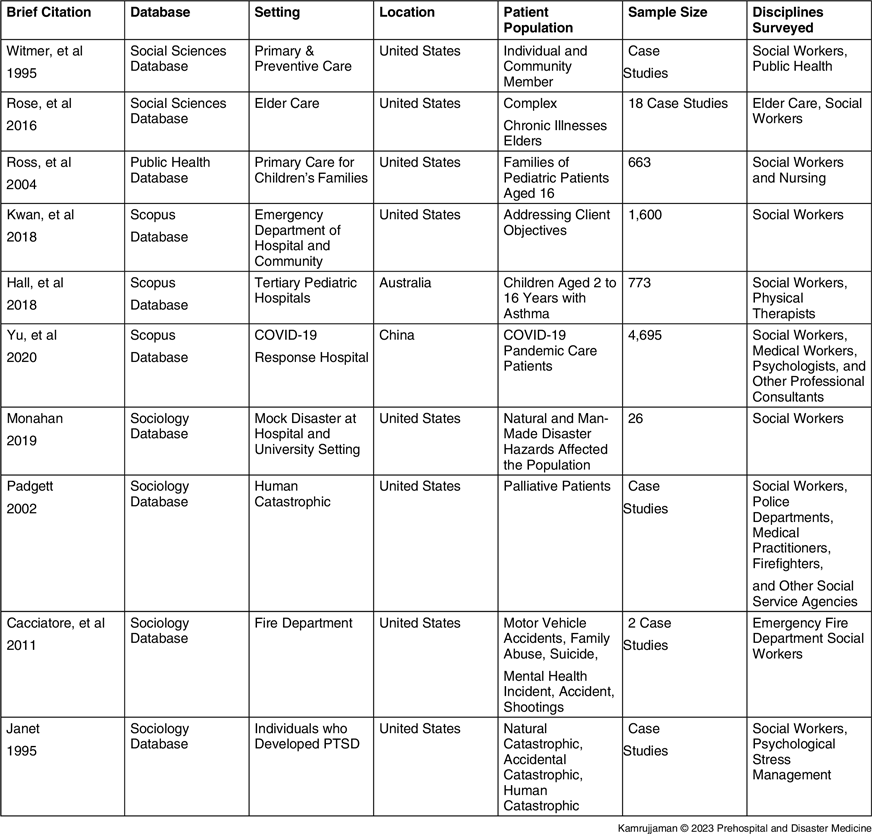
Abbreviation: PTSD, posttraumatic stress disorder.
At the “Pre-EMS” stage, social workers act as cultural liaisons, and in their roles as educators and facilitators, social workers act as effective communicators; also, where their roles are awareness building and advocacy.
At the “During-EMS” stage, they act as emergency workers with roles such as search and rescue, advocates, networking, and as emergency mental health practitioners with roles in psychosocial assessment, counseling, consultation, and referrals.
At the “Post-EMS” stage, they collaborate with other disciplines such as planners and liaisons. They also work as interdisciplinary and integrated service providers, and they also have roles as researchers, empowering community participation, research, and evaluation (Table 3).
Overview of the Role of Social Work for EMS

Abbreviations: EMS, Emergency Medical Services; PTSD, posttraumatic stress disorder; GO, government organization; NGO, nongovernmental organization.
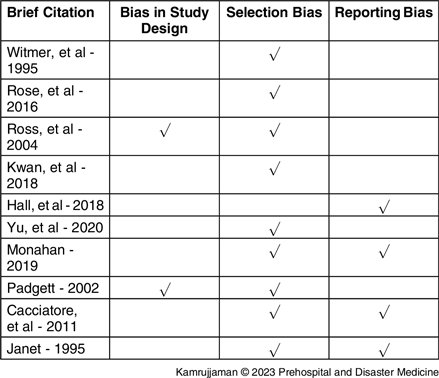
Several biases such as study design bias, selection bias, and reporting bias were identified in the included studies, and these are explained in Table 4.
Biases of the Study
The results of the synthesis of social work roles in themes, stratified by EMS stage, are narratively presented below.
Pre-EMS Stage
Educator—Social workers interpret the existing health care system and facilities, provide information, and share health care promotion in society. They also teach concepts of primary or secondary prevention of disease. Social workers also educate and train individuals, families, and the community. Reference Witmer, Seifer, Finocchio, Leslie and O’Neil26–Reference Bell31
Facilitator—Social workers facilitate community participation in the health system needs, cultural relevance, and outcomes of care. They also facilitate the expression of feelings, symptoms, and worries about diseases. Reference Witmer, Seifer, Finocchio, Leslie and O’Neil26–Reference Bell31
Awareness Building—Social workers build awareness among diverse cultural and ethnic groups in terms of the health system. They are also aware of people’s self-management habits. Reference Hall, Petsky, Chang and O’Grady28,Reference Kwan, Rockwood, Bandle, Fernald, Hamer and Capp32 Social workers are participating in disease surveillance, the promotion of healthy habits, and the implementation of well-being training programs. Reference Yu, Chen, Zheng and Zhu29–Reference Bell31
Advocacy—Social workers provide knowledge of local resources to the community. Understanding and explaining emergency medicine, working with patients, and mediating with suitable organizations. Reference Hall, Petsky, Chang and O’Grady28
During-EMS Stages
Search and Rescue—Social workers act as search and rescue team members during an emergency. They also work in service management and provide relief such as safety, shelter, food, clothing, and fund raising. Reference Yu, Chen, Zheng and Zhu29,Reference Padgett30,Reference Kwan, Rockwood, Bandle, Fernald, Hamer and Capp32,Reference Alston, Hazeleger and Hargreaves33
Advocacy—A social worker helps victims with decision making, assisting social support, liaison, providing accurate information, coordinating care from home to hospital, and activating support for their family members. Reference Yu, Chen, Zheng and Zhu29,Reference Kwan, Rockwood, Bandle, Fernald, Hamer and Capp32,Reference Alston, Hazeleger and Hargreaves33
Networking—During an emergency, social workers liaise with different agencies for disaster relief and social services. They enhance cross-disciplinary collaboration with professional, non-professional, online, offline, government, non-government, public, and private organizations for the emergency community. Reference Ross, Roberts, Campbell, Solomon and Brouhard27,Reference Yu, Chen, Zheng and Zhu29,Reference Bell31,Reference Alston, Hazeleger and Hargreaves33
Psychosocial Assessment—Social workers focus on the resolution of people’s problems through counseling, education, service coordination, follow up, consultation, and collaboration with a team. Reference Ross, Roberts, Campbell, Solomon and Brouhard27,Reference Yu, Chen, Zheng and Zhu29–Reference Bell31,Reference Alston, Hazeleger and Hargreaves33–Reference Rose, Hatzenbuehler, Gilbert, Bouchard and McGill35
Counselling—Social workers provide counseling for emotional support, advocating for posttraumatic stress disorder/PTSD. They apply cognitive-behavioral techniques, debriefing, grief counseling, and psychodynamic therapy for victims. Reference Ross, Roberts, Campbell, Solomon and Brouhard27,Reference Yu, Chen, Zheng and Zhu29–Reference Bell31,Reference Alston, Hazeleger and Hargreaves33,Reference Cacciatore, Carlson, Michaelis, Klimek and Steffan34
Consulting—Social workers organize joint regular meetings and cooperation with practitioners, mental health experts, other care teams, and society members of a patient, along with his/her family. Reference Ross, Roberts, Campbell, Solomon and Brouhard27–Reference Bell31,Reference Alston, Hazeleger and Hargreaves33–Reference Rose, Hatzenbuehler, Gilbert, Bouchard and McGill35
Referrals—After mental evaluation and diagnosis, social workers refer victims to psychological, social, and/or financial organizations. Reference Ross, Roberts, Campbell, Solomon and Brouhard27,Reference Yu, Chen, Zheng and Zhu29,Reference Cacciatore, Carlson, Michaelis, Klimek and Steffan34,Reference Rose, Hatzenbuehler, Gilbert, Bouchard and McGill35
Post-EMS Stage
Planner—Social workers create an approach of action with a transdisciplinary support worker. They meet up with patients during therapeutic visits and promote mutual dialogue to help the care team for executing the plan properly. Reference Hall, Petsky, Chang and O’Grady28,Reference Alston, Hazeleger and Hargreaves33,Reference Rose, Hatzenbuehler, Gilbert, Bouchard and McGill35
Liaison—Social workers help both patients and care providers to choose appropriate and necessary services used. They support chronic illness patients in self-management and behavior modification to avoid hospital admissions and emergency department visits. Reference Ross, Roberts, Campbell, Solomon and Brouhard27–Reference Yu, Chen, Zheng and Zhu29
Interdisciplinary and Integrated Services—Social workers also provide services in collaboration with other professionals like doctors, nurses, psychologists, and community workers. They also facilitate the patient’s basic needs from the relief agencies, emotional aid from a psychologist, treatment from a doctor, and logistic support from government/nongovernment organizations (NGOs). Reference Witmer, Seifer, Finocchio, Leslie and O’Neil26–Reference Yu, Chen, Zheng and Zhu29,Reference Kwan, Rockwood, Bandle, Fernald, Hamer and Capp32,Reference Cacciatore, Carlson, Michaelis, Klimek and Steffan34,Reference Rose, Hatzenbuehler, Gilbert, Bouchard and McGill35
Empowering Community Participation—Social workers are capable of community participation in terms of EMS. Reference Hall, Petsky, Chang and O’Grady28 They collaborate and work together with fire, health, police, and other service agencies to reduce the vulnerability of society. Reference Witmer, Seifer, Finocchio, Leslie and O’Neil26,Reference Alston, Hazeleger and Hargreaves33,Reference Cacciatore, Carlson, Michaelis, Klimek and Steffan34
Research—Social workers do research cooperation with partners in health, medicine, law, and mental health experts. They find out the effectiveness of integration in community care and evaluate the social, financial, and medical risks for the entire community. Reference Witmer, Seifer, Finocchio, Leslie and O’Neil26,Reference Hall, Petsky, Chang and O’Grady28–Reference Alston, Hazeleger and Hargreaves33
Evaluation—The social worker evaluates and analyzes the effectiveness of the health program. They promote and upgrade health outcomes and decrease the usage of resource-intensive services through regular follow up and home visits. Reference Witmer, Seifer, Finocchio, Leslie and O’Neil26–Reference Alston, Hazeleger and Hargreaves33
Discussion
The study aim was synthesizing data concerning the social work role in EMS at pre-EMS, during emergency, and post-EMS stages. The following themes were highlighted: social workers act as cultural liaisons, effective communicators, emergency workers, mental health practitioners, collaborators with other disciplines, and researchers in this study. In pre-emergency stages, social workers are playing roles as educators, communicators, advocates, and awareness builders; during an emergency, social workers act as search and rescue workers, advocates, facilitators, networking, psychosocial assessment, consultation, counseling, and referral activities; and post-emergency, a social worker plays roles as a planner, liaison, interdisciplinary collaborator, researcher, evaluator, and follow up facilitator. Social workers focus on pre-emergency stages of awareness building among the community members, and during the emergency, they focus on search, rescue, relief activities, and mental health support for the victims. At the post-emergency period, they focus on inter-organizational collaboration and research perspective. These study findings are fully supported by other authors’ findings which explained social work intervention during the emergency period. Reference Yu, Chen, Zheng and Zhu29,Reference Padgett30,Reference Alston, Hazeleger and Hargreaves33 So, this study could be a milestone for practicing social work in emergency settings. During the pre-emergency period, the roles of a social worker are vital for the community people because they can be educated, self-managed, and habituated with good behavior by the social work intervention. And it is supported by the approach that prevention is better than cure. For the during the emergency period, community people can be benefited from social work intervention by fulfilling basic human needs, mental health support, and interdisciplinary health support in the medical settings. At the post-emergency level, social workers interview and gather vital evidence about a patient and their family’s culture, background, and lifestyle habitual pattern to provide optimal care for them.
Limitations
But this study has limitations as well. Given the qualitative studies reviewed, it was difficult to accurately synthesize the literature because the thematic analysis is not as accurate as the meta-analysis. After study selection and data extraction, it was found that studies on social work practice in EMS settings were only available from the United States, Australia, and China, so the findings refer only to these countries. The rest of the world’s conditions are unknown regarding social work practice within EMS settings because no paper was found in the study, which is an added value to these findings as an important gap in this matter has been detected. These results can be interpreted only from a high-income country perspective, but EMS is for all over the world. This is a research gap that needs to be addressed. To know the depth of the social work role regarding emergency services, researchers need to individualize and separate phases of research (ie, pre-emergency, during emergency, and post-emergency stages of social worker roles for EMS). For getting the real picture of the EMS and social work practice in the community level, more action research needs to be conducted on these topics. Then it will be discovered how community people respond to emergency situations, their survival pattern, coping strategies, and social work roles. These roles are played by social workers in developing countries where social work is a recognized career. Further studies are needed to investigate the social worker roles in EMS appearing in lower- and middle-income countries’ perspectives where social work is not a full-fledged profession.
Conclusions
This is the first review initiated by the researcher to explain the complete shape of social work intervention regarding EMS. Social workers may have an important role in the different stages of EMS (pre-emergency, emergency, and post-emergency) that could be useful to complement daily EMS work from many different perspectives, so as to improve the global approach to emergency care. This study could be a milestone for social work, as well as EMS settings. These findings could be useful for policy makers to implement social work activities in EMS and could drive further research to contextualize social workers’ roles in different income settings and cultural backgrounds.
Conflicts of interest/funding
None declared. The authors have no financial or other interest that should be known by readers related to this document.




 Open access

