


Introduction
Typologies – defined here as organized systems of types – are a well-established analytic tool in the social sciences. They make crucial contributions to diverse analytic tasks: forming and refining concepts, drawing out underlying dimensions, creating categories for classification and measurement, and sorting cases.
Older, well-known typologies include Weber’s (Reference Vitols, Streeck and Yamamura1978) distinction among traditional, charismatic, and rational-legal authority; Dahl’s (Reference Fish1971) analysis of polyarchies, competitive oligarchies, inclusive hegemonies, and close hegemonies; Krasner’s (Reference Levitsky1977) discussion of makers, breakers, and takers in the formation of international regimes; and Carmines and Stimson’s (Reference Carmines and Stimson1980) distinctions among non-issue, easy-issue, hard-issue, and constrained-issue voters.
In ongoing research, typologies are used in diverse substantive areas. This includes work focused on union–government interactions (Murillo Reference Murillo2000), state responses to women’s movements (Mazur Reference Mazur2001), national political economies (Hall and Soskice Reference Hall, Soskice, Hall and Soskice2001), post-communist regimes (McFaul Reference McFaul2002), social policy (Mares Reference Mares2003), time horizons in patterns of causation (Pierson Reference Pierson, Mahoney and Rueschemeyer2003), transnational coalitions (Tarrow Reference Tarrow2005), state economic intervention (Levy Reference Levy2006), political mobilization (Dalton Reference Dalton2006), national unification (Ziblatt Reference Ziblatt2006), personalistic dictatorships (Fish Reference Fish2007), contentious politics (Tilly and Tarrow Reference Tilly and Tarrow2007), vote buying (Nichter Reference Nichter2008), and types of nation-states (Miller Reference Miller2009). An illustrative list of over one hundred typologies, covering nine subfields of political science, is presented in the appendix.
This chapter develops two arguments, the first focused on skepticism about typologies. Some critics, who base their position on what they understand to be the norms of quantitative measurement, consider typologies – and the categorical variables from which they are constructed – to be old-fashioned and unsophisticated. We show that this critique underestimates the challenges of conceptualization and measurement in quantitative work and fails to recognize that quantitative analysis is built in part on qualitative foundations. The critique also fails to consider the potential rigor and conceptual power of qualitative analysis and likewise does not acknowledge that typologies can provide new insight into underlying dimensions, thereby strengthening both quantitative and qualitative research.
A second set of arguments examines the contribution of typologies to rigorous concept formation and measurement. We offer a basic template for careful work with typologies that can advance such rigor, drawing on the ideas about categorical variables and measurement presented in the first part of the chapter. Our discussion examines errors and missed opportunities that can arise if the template is not followed, and explores how typologies can be put to work in refining concepts and measurement and also in organizing explanatory claims and causal inference.
Before we proceed with the discussion, key distinctions must be underscored regarding kinds of typologies: i.e., conceptual, descriptive, explanatory, and multidimensional versus unidimensional typologies. These are defined in Table 7.1.
a. Conceptual typologies. Given the concern here with conceptualization and measurement, this chapter focuses centrally on what may be called conceptual typologies. These explicate the meaning of a concept by mapping out its dimensions, which correspond to the rows and columns in the typology. The cells correspond to conceptual “cell types” and are defined by their position vis-à-vis the rows and columns.
b. Descriptive typologies. These could have the same rows and columns as a conceptual typology, but the cells – instead of identifying conceptual cell types – identify cases that correspond to the types. This involves either a frequency count or the actual names of cases. It thus “describes” the cases, and it can resemble a traditional numerical cross-tabulation.
c. Explanatory typologies. Here the cell types are the outcomes to be explained, and the rows and columns are the explanatory variables (Elman Reference Elman2005; Bennett and Elman Reference Bennett and Elman2006). This may involve a hypothesized explanatory relationship, or a test of that relationship based on empirical analysis.
d. Multidimensional versus unidimensional typologies. Our central focus is on multidimensional typologies, which capture multiple dimensions and are constructed by cross-tabulating two or more variables. Unidimensional typologies organized around a single variable – for example, Krasner’s makers, breakers, and takers in international regime formation – also receive some attention, and many norms for careful work with typologies apply to both.
e. Two versus three dimensions. It is easy to diagram two-dimensional typologies, yet three-dimensional typologies can also readily be depicted. For an example, see Lussier’s Table 9.4 (see Chapter 9, this volume).
Criticisms of Categorical Variables and Typologies
Typologies, and the categorical variables with which they are often constructed, have been subject to sharp criticism. Both theses critiques and our response hinge in part on issues of scale types and definitions of measurement. We therefore review and extend prior treatments of these topics.
Point of Departure: Scale Types and Measurement
A basic point of reference here is the familiar framework of nominal, ordinal, interval, and ratio scale types. We add two further types: the partial order, which has order among some but not all the categories (Davey and Priestley Reference Davey and Priestley2002: chap. 1);Footnote 1 and the absolute scale, which is an enumeration of the individuals or entities in a given category – for example, the number of voters in different electoral districts.Footnote 2
The controversy over scale types is focused on four alternative criteria for evaluating their desirability and utility. First, traditional distinctions between lower and higher levels of measurement are anchored in the idea that the latter contain a higher level of information, which is formalized in the idea of mathematical group structure.Footnote 3 This perspective provides valuable distinctions, yet closer examination reveals that the relationship between scale types is complex. For example, the meaning of higher levels of measurement depends on lower levels, as we will show later.
A second criterion is permissible statistics – that is, the statistical procedures that can and should be employed with each scale type. Higher levels of measurement were traditionally seen as amenable to a greater range of procedures, which led many scholars to consider categorical variables less useful. However, some of these earlier distinctions have broken down, and complex forms of statistical analysis are now routinely applied to nominal scales.
Third, alternative definitions of measurement are crucial in evaluating scale types. A classic, highly influential, and very narrow definition, dating back at least to the physicist N. R. Campbell (Reference Campbell1920), treats measurement as the quantification of physical properties. Measurement in this sense can be achieved with a yardstick (Michell Reference Michell1999: 121). In this framework, “measurement” corresponds to the standard understanding of ratio scale, thus privileging order, plus a unit of measurement, plus a real zero.
Alternatively, measurement has been defined as “the assignment of numerals to objects or events according to rules” (Stevens Reference Stevens1946: 677; 1975: 46–47).Footnote 4 Such assignment corresponds to standard practice with higher levels of measurement, where scores are expressed numerically and provide a true “metric.” According to this alternative definition, if each category in a nominal or ordinal scale is designated with a numeral, this also constitutes measurement. In typologies, of course, the categories are routinely designated not with numerals, but with terms that evoke the relevant concepts. In our view, the idea of measurement should not be reified, and this naming of types could also be considered measurement. The real issue is whether the differentiation along dimensions or among cases serves the goals of the researcher. We are convinced that typologies do serve these goals.
A fourth criterion concerns the cut point between qualitative and quantitative measurement. Some analysts (Vogt Reference Vogt2005: 256) consider a scale qualitative if it is organized at a nominal level, and quantitative if the level is ordinal or higher – thereby privileging whether order is present. By contrast, others (e.g., Young Reference Young1981: 357; Duncan Reference Duncan1984: 126, 135–36; Porkess Reference Porkess1991: 179) treat ordinal versus interval as the key distinction, thus focusing instead on whether categories, as opposed to a unit of measurement, are employed. An even more demanding cut point – strongly embraced by some social scientists – derives from the tradition of Campbell and requires both a unit of measurement and a real zero.
As we will see, contention over these criteria is central to debates on typologies.
The Critiques
Both some recent commentaries, and an older generation of methodologists, have sharply criticized categorical variables and typologies.Footnote 5 Yet many of these critiques reflect an outdated understanding of scale types.
Gill’s (Reference Hibbs2006: 334) mathematics textbook for political scientists states that nominal scales have the least “desirability” among levels of measurement. Similarly, the Encyclopedia of Measurement and Statistics (Salkind Reference Peterson2007: 826, 683) adopts the fairly standard line that the ratio level of measurement “provides the richest information about the traits it measures”; among the scale types, “nominal is considered the ‘weakest’ or least precise level of measurement … and one should use a more precise level of measurement whenever possible.” Teghtsoonian (Reference Teghtsoonian2002: 15106) asserts that “contemporary theorists find the nominal sale of little interest because it imposes no ordering on the measured entities.”
Some of the earlier critiques by prominent scholars are exceptionally harsh. In his seminal article, Stevens (Reference Stevens1946: 679) argues that nominal scales are “primitive.” Blalock (Reference Blalock1982: 109–10) maintains that “one of the most important roadblocks to successful conceptualization in the social sciences has been our tendency to … rely very heavily on categorical data and discussions of named categories.” He argues that scholars who work with nominal scales suffer from “conceptual laziness,” and he expresses dismay that so much attention has been given to “categorical data and classificatory schemes.” Young (Reference Young1981: 57) is similarly harsh in the opening sentence of his presidential address for the Psychometric Society, published as the lead article in Psychometrika: “Perhaps one of the main impediments to rapid progress in the development of the social, behavioral, and biological sciences is the omnipresence of qualitative data,” by which he means data involving nominal or ordinal scales. He thus groups nominal and ordinal together.
Duncan (Reference Duncan1984: 126), a pioneer in the development of path analysis and structural equation modeling, likewise rejects nominal and ordinal scales on the grounds that they are not a form of measurement, given that “the purpose of measurement is to quantify” and the goal is to establish “degrees.” He considers the argument that classifications are in any sense a type of measurement to be “obfuscatory” (135). Furthermore, Duncan argues that with many presumably ordinal scales, the demonstration of order is questionable, and if one applies a strong standard, there are many fewer meaningful ordinal scales than is often believed (136).
Skepticism about nominal scales also derives from the concern that they obscure multidimensionality and fail to produce unidimensional measures, which are seen as critical to good research. Blalock (Reference Blalock1982: 109) states that a key obstacle to adequate conceptualization is the failure to “grapple with the assessment of dimensionality” and the overreliance on categorical scales, often identified simply by proper names. Shively (Reference Shively1980: 31; also Shively Reference Shively2007: chap. 3) emphasizes that terms and concepts from ordinary language, which are routinely used in designating the categories in nominal scales, are especially likely to hide multidimensionality. Jackman (Reference Jackman1985: 169) similarly states that the variables employed in research “are supposed to be unidimensional”; and Bollen (Reference Bollen1980) and Bollen and Jackman (Reference Bollen and Jackman1985) likewise underscore the importance of arriving at unidimensionality, arguing that if multiple dimensions are hidden, then measurement is inadequate and causal inferences are misleading.
Some critics of categorical variable specifically criticize typologies as well. Duncan (Reference Duncan1984: 136), for instances, laments sociologists’ “addiction to typology.” In their widely noted book, King, Keohane, and Verba (Reference Leonard, Leonard and Marshall1994: 48, emphasis in original) are less emphatic, though still dubious: “[T]ypologies, frameworks, and all manner of classifications, are useful as temporary devices when we are collecting data.” However, these authors “encourage researchers not to organize their data this way.”
A Misleading Comparison: Rebalancing the Discussion
These critiques of typologies and lower levels of measurement arise from a misleading comparison of qualitative and quantitative methods and also from a serious misunderstanding of measurement. The discussion urgently needs to be rebalanced, based on a better grasp of the limitations of quantitative approaches to measurement, the strengths of qualitative approaches, and the fact that quantitative reasoning about measurement in part rests on qualitative foundations.
The Achilles’ Heel of Quantitative Measurement: Meeting the Assumptions
Interval and ratio scales are often considered more valuable because, in principle, they contain more information than nominal and ordinal scales. They are also seen as more amenable to achieving unidimensional measurement. However, these advantages depend on complex assumptions about the empirical relationships present in the data, assumptions that may not be valid for a given application. Political and social attributes are not always quantifiable, and there is often the temptation to treat data as if they contain information that may not be there. Of course, categorical data also depend on assumptions, but because these “lower” levels of measurement posit less complex empirical relationships, the assumptions are simpler.
Psychometricians have devoted great attention to the problem of assumptions. Michell (Reference Michell2008: 10) suggests that in his field, “the central hypothesis (that psychological attributes are quantitative) is accepted as true in the absence of supporting evidence. … Psychometricians claim to know something that they do not know and have erected barriers preserving their ignorance. This is pathological science.” Barrett (Reference Barrett2008: 79) points out that, paradoxically, maintaining the pretense of a higher level of measurement can distort – rather than enhance – the information about the real world contained in data at a lower level of measurement.
These questions about assumptions are highly salient for political science, given both the wide influence of psychometrics in political research (Poole Reference Poole, Brady and Collier2008) and the common presumption that political phenomena are indeed quantifiable.
Such questions about assumptions arise, for example, in discussions of structural equation modeling with latent variables (SEM-LV) – an analytic tool intended to establish higher levels of measurement and remove measurement error. This technique can build on ordinal or dichotomous nominal data to estimate unobserved quantitative variables.
Unfortunately, given the large number of untestable or hard-to-test assumptions that go into SEM-LV, many scholars question its contribution.Footnote 6 These assumptions include ideas about the distributions of unobservable variables, the number and dimensionality of such variables, the structure of measurement relations among the observable variables, and the causal relations among the unobservable variables.
Item response theory (IRT) emerged as an alternative to SEM-LV for creating indicators at a higher level of measurement and removing measurement error. Notwithstanding differences in emphasis and procedure, the two families of techniques have fundamentally similar assumptions (Takane and de Leeuw Reference Takane and de Leeuw1987; Reckase Reference Reckase, van der Linden and Hambleton1997; Treier and Jackman Reference Treier and Jackman2008: 205–6). Hence, IRT likewise raises concerns about assumptions in quantitative measurement.
In sum, quantitative scholars’ hopes and expectations about these tools may surpass actual accomplishments. These researchers face major challenges in meeting the critiques of quantitative measurement advanced by scholars such as Michell.
Higher Levels of Measurement Rest in Part on a Foundation of Nominal Scales
Some critiques of nominal scales imply that scholars who work with higher-level scales escape the confines of this lowest level of measurement. That is incorrect. In their effort to give conceptual meaning to higher levels of measurement, scholars routinely build on nominal dichotomies.
Establishing an absolute scale requires a nominal dichotomy to identify the specific entities counted by the scale. As noted earlier, the need for this dichotomy is illustrated by the challenge of counting the number of voters in different electoral districts. Performing such a count depends on a dichotomous understanding of which voters are in each district and which are not, and also on a dichotomy that identifies the subset of people who count as voters. This points to a pivotal observation: Working with the highest level of measurement requires the lowest level of measurement. Nominal scales are crucial here.
In seeking to establish ordinal, interval, and ratio scales, scholars sometimes simply create an indicator without careful conceptualization, and then proceed to treat the indicator as if it satisfied the corresponding level of measurement. Yet giving conceptual content to the indicator requires establishing what it means for the phenomenon being measured to be “absent”; this establishes what Goertz (Reference Goertz2006: 30–35) calls the negative pole of the concept (also see Satori 1970; Collier and Gerring Reference Douglas2009). This stands in contrast to being “present,” and as the analyst works with the entire scale, this dichotomy of present–absent provides a foundation for reasoning about “More of what?” Obviously, present–absent is a nominal dichotomy, and we thus see the interplay between the full range of values on the scale and this simple nominal distinction.
As an example, take Sniderman’s (Reference Schmitter1981) ordinal measure of government support, in which the lowest category is “disaffection.” It is essential to establish here whether disaffection is simply the absence of government support or if it includes active opposition – which is very different. Again, a dichotomous understanding of the presence or absence of support is essential to addressing this issue.
Overall, scholars do indeed sometimes follow poor measurement practices and construct “indicators” (i.e., specific procedures for scoring cases) without carrying out this conceptual work. They proceed to treat the resulting variable as if it were at one or another of these levels of measurement. Yet indicators should be constructed to measure something, and careful conceptual work is essential to establish what that something is. Nominal scales are indispensable to the reasoning required, and this key contribution is another reason why it is inappropriate to denigrate nominal scales.
Revised Norms for “Permissible Statistics”: Nominal Scales in Quantitative Analysis
A significant source of concern about nominal scales had been their presumed incompatibility with regression analysis and, more broadly, the conviction that fewer statistical tools are appropriate for nominal/typological variables than for higher-level variables.
However, this norm has in important respects been superseded. Nominal scales are now routinely used in regression analysis as independent variables – that is, with the use of dummy variables. Under the rubric of “categorical data analysis” (see, e.g., Agresti Reference Agresti2002), a broad set of tools for treating such data as the dependent variable have been developed. Among these tools, logit and probit models are particularly well known. Often these nominal scales are simple dichotomies, but multinominal scales (i.e., multicategory nominal scales) are also used. In political science and sociology, a count of articles in leading journals shows that logit and probit were little used in the 1970s and had become widespread by the 1990s – a trend that has subsequently continued.
In working with logit, probit, and dummy variables, scholars in practice often do not worry about dimensionality. When dichotomies are entered into regression analysis (e.g., party identifiers versus independents), the researcher routinely does not do a scaling analysis to test whether the dichotomy taps an underlying dimension. This seems perfectly reasonable. Even though party identification is a multifaceted and multidimensional concept, it is still valuable to learn if age cohorts differ in their party identification. In this context, the quest for unidimensionality may well be subordinated.
Other tools for quantitative causal inference also rely on nominal variables, and, here again, attention to dimensionality is often not a central concern. Matching methods, for example, attempt to estimate the causal effect in observational data of two alternative “treatments” by comparing cases drawn from two groups that are as similar as possible on a set of conditioning variables (Rubin Reference Rubin2006). These techniques essentially require that the causal variable of interest be categorical; if it is continuous, the definition of treatment groups is ambiguous and some sort of threshold or cut point (i.e., dichotomization) must be imposed.
This use of categorical independent variables echoes the best-practices design for causal inference, the randomized experiment. While experiments can use randomization to assign different values of a treatment, measured as a continuous variable, by far the more common approach in the social sciences is to employ discrete treatments based on a categorical variable. As with matching methods and the models discussed in the previous paragraph, discussions of the dimensionality of treatment assignment in experimental designs are rarely at the center of attention.
Placing Multidimensionality in Perspective
One of the earlier criticisms of typologies and nominal scales was that they often failed to address multidimensionality. Skeptics charged that, lurking behind what might appear to be clear concepts and compelling classifications, one too often finds multiple dimensions and poor measurement. These analysts saw higher levels of measurement as far more capable of achieving unidimensionality.
This critique needs to be rebalanced. First, the construction and refinement of typologies has made sophisticated contributions to addressing multidimensionality. This is “conceptual work,” and it should become clear later that carefully crafted typologies contribute decisively to this task. Hence, far from obstructing the careful treatment of dimensions, typologies can play a critical role in that endeavor.
Second, dealing with dimensions in quantitative research often proves more complicated, ambiguous, and inconclusive than was previously recognized. Jackman’s mandate (noted earlier) that “variables are supposed to be unidimensional” represents an admirable goal in many forms of analysis, yet it routinely is not achieved. This is partly because, as discussed previously, some of the most promising tools for extracting dimensions have fallen well short of their promise.
Third, unidimensionality is not a well-defined “end state” in research. It is better understood as involving a series of iterations and approximations that emerge as research proceeds. Consider standard measures of political democracy. These may include (1) free and fair elections, (2) respect for political rights and civil liberties, (3) universal suffrage, and (4) whether elected leaders to a reasonable degree possess effective power to govern (Collier and Levitsky Reference Collier and Levitsky1997: 433–34). Some scholars combine these attributes by creating simple additive measures of democracy, and others use a spectrum of alternative tools.
Yet each of these component indicators can hide multidimensionality. For example, the concept of civil liberties is certainly multidimensional, including freedom of expression – attributes that do not necessarily vary together. One component, freedom of expression, is multidimensional, given that it includes freedom of the press, freedom of broadcast media, uncensored use of the internet, and other aspects of freedom to express political views. Each of these components, in turn, is certainly multidimensional as well. Furthermore, an indicator that appears to yield unidimensional measurement for a given set of cases may not do so with additional cases. These problems involve basic ideas about the contextual specificity of measurement validity, which have received substantial acceptance in psychology.Footnote 7
The issue, therefore, is not that quantitative analysis arrives successfully at unidimensionality and qualitative analysis has great difficulty in doing so. Moving beyond multidimensionality is an issue at all levels of measurement, and for higher levels it is not necessarily resolved by complex scaling techniques. The challenge for both qualitative and quantitative measurement is to find the scope of comparison and level of aggregation – that is, the degree to which indicators are broken down into their constituent elements – best suited to the analytic goals of the study.
The Template: Concept Formation and the Structure of Typologies
We now examine the role of typologies in concept formation and develop a template for the construction of typologies. Our concern is with conceptual typologies, yet many elements of the template are also relevant to unidimensional and explanatory typologies.
Concept Formation
Conceptual typologies make a fundamental contribution to concept formation in both qualitative and quantitative research. Developing rigorous and useful concepts entails four interconnected goals:Footnote 8 (1) clarifying and refining their meaning, (2) establishing an informative and productive connection between these meanings and the terms used to designate them, (3) situating the concepts within their semantic field, that is, the constellation of related concepts and terms, and (4) identifying and refining the hierarchical relations among concepts, involving kind hierarchies.Footnote 9 Thinking in terms of kind hierarchies brings issues of conceptual structure into focus, addresses challenges such as conceptual stretching, and productively organizes our thinking as we work with established concepts and seek to create new ones.
A Five-Step Template
Building on these ideas, we now propose a template for constructing typologies. We illustrate our framework with Nichter’s (Reference Murillo2008: 20) typology of the allocation of rewards in electoral mobilization (Table 7.2), which forms part of his larger quantitative analysis of clientelism. While our template might appear straightforward, the literature in fact lacks a clear, didactic presentation of the building blocks in the template. Moreover, scholars too often limit the value of their typologies – and sometimes make serious mistakes – by failing to follow this template.
| Reward recipient inclined to vote or not vote | Party preference of recipient vis-à-vis party offering reward | |
|---|---|---|
| Favors party | Indifferent or favors opposition | |
| Vote | Rewarding loyalists | Vote buying |
| Not vote | Turnout buying | Double persuasion |
The building blocks of typologies may be understood as follows:
(1) Overarching concept: This is the concept measured by the typology. In Nichter, the overarching concept is the targeting of rewards. This concept should be made explicit and should be displayed as the title in the diagrammatic presentation of the typology. Occasionally, the title instead names the variables that are cross-tabulated (e.g., Dahl Reference Dahl1971: 7); in other cases, the matrix simply lacks a title (O’Donnell and Schmitter Reference O’Donnell and Schmitter1986: 13). It is better to state the overarching concept directly.
(2) Row and column variables: The overarching concept is disaggregated into two or more dimensions, and the categories of these dimensions establish the rows and columns in the typology. These dimensions capture the salient elements of variation in the concept, so the plausibility and coherence of the dimensions vis-à-vis the overarching concept are crucial. In Nichter, the row variable is whether the prospective recipient of the reward is inclined to vote; its component categories define the rows. The column variable is whether the prospective recipient favors the party offering the reward. It merits note that row and column variables in a typology need not be limited to nominal or ordinal scales, but may also be interval or ratio.
(3) Matrix: Cross-tabulation of the component categories of these dimensions creates a matrix, such as the familiar 2 by 2 table employed by Nichter. The challenge of creating a matrix can push scholars to better organize the typology, tighten its coherence, and think through relations among different components.
(4) Incorporating three or more dimensions: One option here is to present the familiar 2 by 2 matrix twice, once for each of the two subgroups of cases that correspond to the third dimension. See, for example, Table 9.4 in this volume, Chapter 9. Other examples are Leonard (Reference Leonard, Leonard and Rogers Marshall1982: 32–33) on decentralization and Vasquez (Reference Vasquez1993: 320) on war. Alternatively, one of the categories in a row and/or column variable may be further differentiated into subcategories. Additional dimensions can also be introduced through a branching tree diagram – as in Gunther and Diamond (Reference Gunther and Diamond2003: 8) on political parties; or as a cube, with the cell types placed at different locations in the cube. Figure 0.1 in the Introduction to this volume provides an example of a cube; see also Linz (Reference Linz, Greenstein and Polsby1975: 278) on authoritarianism.
(5) Cell types: These are the concepts and associated terms located in the cells. The cell types are “a kind of” (see footnote 10) in relation to the overarching concept measured by the typology. The conceptual meaning of these types derives from their position in relation to the row and column variables, which should provide consistent criteria for establishing the types. In Nichter’s typology, the terms in each cell nicely capture the constellation of attributes defined by the intersection of each row and column variable: rewarding loyalists, vote buying, turnout buying, and double persuasion.
Even when the typology is based on interval or ratio variables, scholars may identify cell types. These may be polar types located in the corners of the matrix, or intermediate types.Footnote 10
Sometimes the analyst does not formulate a concept that corresponds to the cell types; rather, the names of the categories in the corresponding row and column variables are simply repeated in the cell. For example, in a typology that cross-tabulates governmental capacity and regime type, the terms in the cells are “high-capacity democratic,” and so on. Here, the typology is valuable, but this potential further step in concept formation is not taken.Footnote 11
Errors and Missed Opportunities
This five-step template, combined with the clarity of the Nichter example, might lead readers to conclude that constructing conceptual typologies is easy. Yet that is certainly not the case, and failing to follow the template can lead to errors as well as to missed opportunities for improving conceptualization and measurement.
Some errors are simple – such as confusing conceptual typologies with explanatory typologies, a problem found in Tiryakian and Nevitte’s (Reference Tiryakian, Nevitte, Tiryakian and Rogowski1985: 57) analysis of nationalism. Though their stated goal is to conceptualize nationalism, their discussion suggests that this is partly a conceptual typology of nationalism, partly a conceptual typology of different combinations of nationalism and modernity, and partly an explanatory typology concerned with the causal relationship between the two concepts. Their concern with causal relations is clear from the beginning of the article, where they maintain that “cases can be cited to support the contention that nationalism is a consequence of modernity, but it can also be argued that nationalism is an antecedent prerequisite of modernity.”
Another straightforward error – confusing typologies with numerical cross-tabulations – has led to mistaken skepticism about typologies as an analytic tool. In a widely used undergraduate methodology textbook, Babbie (Reference Babbie2010: 183–85) offers a strong warning about typologies. Yet he focuses on potential error in calculating and reading the percentages in a numerical cross-tabulation. Far from pointing to a major concern about typologies, his critique reflects a failure to distinguish clearly between typologies and standard numerical cross-tabulations.
The use of nonequivalent criteria in formulating the cell types is also problematic. This error is found in the initial version of Gabriel Almond’s (Reference Bailey, Borgatta and Borgatta1956: 392–93) analysis of comparative political systems, which distinguished between “Anglo-American (including some members of the Commonwealth); the Continental European (exclusive of the Scandinavian and Low Countries), which combined some of the features of the Continental European and the Anglo-American; the preindustrial, or partially industrial, political systems outside the European-American area; and the totalitarian political systems.” These types are based on different criteria. Almond’s typology was subsequently reformulated, but the revised version also raised concerns.Footnote 12
In some instances, authors are refreshingly explicit about the problem of establishing cell types and the analytic equivalence among them. Hall and Soskice’s (Reference Hall, Soskice, Hall and Soskice2001: 8–21) typology of European political economies categorizes countries as liberal market, coordinated market, and Mediterranean. However, for the third type they comment with great caution that these cases “show some signs of institutional clustering” and that they are “sometimes described as Mediterranean” (21).Footnote 13 Similarly, Carmines and Stimson (Reference Carmines and Stimson1980: b5, p. 85), in presenting their typology of issue orientation and vote choice, express misgivings about their category of “constrained issue voters,” suggesting that the label “constrained” may have implications well beyond their intended meaning.
Other studies suffer from multiple problems. Tiryakian and Nevitte’s (Reference Tiryakian, Nevitte, Tiryakian and Rogowski1985) conceptualization of nationalism, discussed earlier, shows serious confusion in the organization and presentation of the overarching concept, the variables that establish the types, and the names for the types. It also lacks a matrix to help organize and clarify the types and dimensions.
Returning to the earlier example, problems of organization and presentation also arise in Carmines and Stimson’s (Reference Carmines and Stimson1980: 85, 87) outstanding study of issue voting. They make it clear that a typology is central to their analysis. Yet despite the care with which the overall argument is developed, the typology is not presented as an explicit matrix; the cell types are confusingly introduced in a series of steps throughout the article, rather than all together; it takes some effort to identify the dimensions from which the cell types are constructed; and although the overarching concept can be inferred fairly easily, the name for this concept should have been identified in the title of an explicit matrix. Overall, it takes some digging to uncover the building blocks in their typology.
Putting Typologies to Work 1: Conceptualization and Measurement
The goal of establishing a basic template for working with typologies – as well as discussing errors and missed opportunities – is to encourage scholars to be both more rigorous and more creative. In that spirit, we now consider two fundamental ways in which typologies can be put to work. This section addresses conceptualization and measurement; and the following section focuses on analysis of causes and effects.
Organizing Theory and Concepts
Scholars use typologies to introduce conceptual and theoretical innovations, sometimes drawing together multiple lines of investigation or traditions of analysis.
For example, the typology of “goods” in public choice theory synthesizes a complex trajectory of research. Goods are understood here as any objects or services that satisfy a human need or desire. Samuelson’s (Reference Pierson1954) classic article introduced the concept of “public good,” and later scholars have extended his ideas, adding new types such as the “club good” (Musgrave Reference Musgrave, Brown and Solow1983). With slight variations in terminology (see Mankiw Reference Mankiw1998: 221; as opposed to Ostrom, Gardner, and Walker Reference O’Donnell and Schmitter1994: 7), the idea of a good is now routinely conceptualized in two dimensions: rivalrous, according to whether consumption by another individual precludes simultaneous consumption by another individual; and excludable, according to whether the good can be extended selectively to some individuals, but not others. Cross-tabulating these two dimensions yields public, private, club, and common goods (the last also known as common-pool resources).
The joining of two analytic traditions is found in Kagan’s (Reference Kullberg and Zimmerman2001: 10) typology of “adversarial legalism.” He draws together (1) the idea of an adversarial legal system, which has long been used to characterize Anglo-American modes of legal adjudication, and (2) the traditional distinction between legalistic and informal modes of governance. He integrates these two theoretical approaches in a typology that posits four modes of policy implementation and dispute resolution: adversarial legalism, bureaucratic legalism, negotiation or mediation, and expert or political judgment.
Schmitter’s (Reference Remmer1974) analysis of interest representation bridges alternative analytic traditions while also illustrating the ongoing process of refining a typology. He connects what was then a new debate on the concept of corporatism to ongoing discussions of pluralism as well as prior understandings of monism, anarchism, and syndicalism. He shows how corporatism should be taken seriously as a specific type of interest representation that can be analyzed in a shared framework vis-à-vis these other types. Schmitter later introduces a further refinement, making it clear that the overarching concept in a typology is not necessarily static. Based on his recognition that he is conceptualizing not just a process of the representation, but a two-way interaction between groups and the state, he shifts the overarching concept from interest “representation” to interest “intermediation” (Schmitter Reference Schmitter1977: 35n1).Footnote 14
Conceptualizing and Measuring Change
Ongoing scholarly concern with mapping political transformations and empirical change is an important source of innovation in typologies. An example is the evolving conceptualization of party systems that occurred in part as a response to the historical changes in their bases of financial support. Duverger (Reference Duverger1954: 63–64) initially proposes the influential distinction between “mass” and “cadre” parties, which are distinguished – among other criteria – on the basis of financial support from a broad base of relatively modest contributions versus reliance on a small set of wealthy individual contributors. Subsequently, Kirchheimer (Reference Kirchheimer, LaPalombara and Weiner1966: 184–95) observes that in the 1960s, many European parties moved away from the organizational pattern of the mass party. They are replaced by “catch-all” parties that cultivate heterogeneous financial bases. Subsequently, Katz and Mair (Reference Katz and Mair1995: 15–16) conclude that parties have begun to turn away from financial reliance on interest groups and private individuals (whether wealthy or not), developing interparty collaboration to obtain financing directly from the state – thereby creating the “cartel” party.
The influence of political change can also be reflected in choices about dimensions in typologies. For instance, Dahl (Reference Dahl1971) maps out historical paths to modern polyarchy; hence, his dimension of inclusiveness centrally involves the suffrage, and given the historical depth of his analysis this dimension ranges from restrictive to universal. By contrast, Coppedge and Reinicke (Reference Coppedge and Reinicke1990: 55–56), focusing on data for 1985, declare polyarchy unidimensional and argue that Dahl’s dimension of inclusiveness can be dropped. As of that year, the movement to universal suffrage was nearly complete and was no longer a significant axis of differentiation among cases.Footnote 15
Free-Floating Typologies and Multiple Dimensions
Some of the most creative typologies may appear unidimensional, yet this may mask multiple dimensions and/or the dimensions may be ambiguous. These “free floating” typologies lack explicit anchoring in dimensional thinking. Such typologies may often be refined by teasing out the underlying dimensions.Footnote 16
For example, Hirschman’s (1970) “exit, voice, and loyalty” has provided a compelling framework for analyzing response to decline in different kinds of organizations – a topic inadequately conceptualized in prior economic theorizing. Yet as Hirschman (Reference Hirschman1981: 212) points out, these are not mutually exclusive categories. Voice, in the sense of protest or expression of dissatisfaction, can accompany either exit or loyalty. Hirschman’s typology can readily be modified by creating two dimensions: (1) exit versus loyalty and (2) exercise versus nonexercise of voice. This revised typology would have mutually exclusive categories, thereby responding to a standard norm for scales and typologies and making it possible to classify cases in a more revealing way.
Another example is Evans’ (Reference Hale1995) conceptualization of alternative state roles in industrial transformation. Evans presents what appears to be a nominal scale with four categories: midwifery, demiurge, husbandry, and custodian. On closer examination, however, two dimensions are present: (1) key state actors may see entrepreneurs’ ability to contribute to development as malleable or fixed, and (2) the role of the state vis-à-vis entrepreneurs may be supportive or transformative. Evans’ four original types fit nicely in the cells of this 2 by 2 typology, and the result is a more powerful conceptualization of the state’s role.
Typologies Generate Scales at Different Levels of Measurement
Typologies also refine measurement by creating categorical variables that are distinct scale types.
Nominal scale. Nichter’s (Reference Murillo2008) analysis of targeting rewards yields the cell types discussed earlier: rewarding loyalists, turnout buying, vote buying, and double persuasion. These categories are collectively exhaustive and mutually exclusive, but not ordered; they form a nominal scale.
Partial order. In Dahl’s (Reference Fish1971: chap. 1) 2 by 2 typology of political regimes, there is unambiguous order between “polyarchy” and the other three types, and also between “closed hegemony” and the other three types. Yet between the two intermediate types – competitive oligarchy and inclusive hegemony – there is no inherent order, and Dahl’s categories are a partial order.
Ordinal scale. In their analysis of issue voting, Aldrich, Sullivan, and Borgida (Reference Aldrich, Sullivan and Borgida1989: 136) tabulate (1) small- versus large-issue differences among candidates against (2) low- versus high-salience and accessibility of the issues. One cell corresponds to a low effect, while a second cell corresponds to a high effect of the opposing issues being voted on. The other two cells are given the same value: “low to some effect.” A three-category ordinal scale is thereby created.
Putting Typologies to Work II: Causes and Effects
Conceptual Typologies as Building Blocks in Explanations
Typologies likewise contribute to formulating and evaluating explanatory claims. Conceptual typologies routinely constitute the independent, intervening, and dependent variables in explanations. Political scientists take it for granted that standard quantitative variables play this role, and it is essential to see that conceptual typologies do so as well. Conceptual typologies do not thereby become explanatory typologies. Rather, they map out variation in the outcomes being explained and/or in the explanation of concern, and in contrast to an explanatory typology, the outcomes and the explanation are not placed in the same matrix.
The typology as an independent variable is illustrated by Dahl’s (Reference Fish1971: chap. 3) analysis of the long-term stability and viability of polyarchies. Here, his types of political regimes define alternative trajectories in the transition toward polyarchy. Moving from closed hegemony to polyarchy by way of competitive oligarchy is seen as most favorable to a polyarchic regime, whereas the paths through inclusive hegemony and from a closed hegemony directly to polyarchy are viewed as “more dangerous” (Dahl Reference Dahl1971: 36).
Typologies serve as the dependent and intervening variables in research on interactions between women’s social movements and the state in advanced industrial democracies. Mazur (Reference Mazur2001: 21–23) conceptualizes the dependent variable – the state response – on two dimensions: the state’s acceptance of women’s participation in the policy process and whether the state response coincides with the goals of the movement. Four types of state response emerge in the typology: no response, preemption, cooptation, and dual response. The dual response is of special interest because it constitutes the most complete achievement of the movement’s objectives, involving both “descriptive” and “substantive” representation.
A key intervening variable is a typology of “policy agency activities” in the women’s movement. These agency activities are analyzed on two dimensions: whether they successfully frame the policy debate in a gendered way and whether the goals of the movement are advocated by the particular agency. Cross-tabulating these dimensions yields four types of agency activities: symbolic, nonfeminist, marginal, and insider. The cell type of insider constitutes the most complete achievement of both advocating the movement’s goals and gendering the policy debate (Mazur Reference Mazur2001: 21–22).
Typologies in Quantitative Research
The introduction of typologies can be a valuable step in causal inference within a quantitative study. A typology can provide the conceptual starting point in a quantitative analysis, as with Nichter’s study of the targeting of rewards in electoral competition, discussed earlier. It may also delineate a subset of cases on which the researcher wishes to focus, overcome an impasse in a given study, or synthesize the findings. In other instances, researchers use quantitative analysis to assign cases to the cells in a typology.
Delineating a subset of cases. In Vasquez’s (Reference Weyland1993: 73) quantitative study of war, a typology helps to identify a subset of cases for analysis. He argues that prior research yielded inconsistent findings because researchers failed to distinguish types of war. He then identifies eight types by cross-tabulating three dimensions: (1) equal versus unequal distribution of national power among belligerent states, (2) limited versus total war, and (3) number of participants. Vasquez uses this typology to focus on a subset of cases, that is, wars of rivalry.
A typology likewise serves to identify a subset of cases in Mutz’s (Reference Montgomery, Cheema and Rondinelli2007) survey experiment on news media and perceived legitimacy of political opposition, in this case involving a four-category treatment. Subjects are shown a recorded political debate in which the content is held constant across treatments, but two factors are varied: the camera’s proximity to the speakers (close or moderate) and the civility of the speakers (civil or uncivil). One cell in the resulting 2 by 2 typology, with a close camera and uncivil speakers, is singled out for special causal attention and is conceptualized as “in-your-face” television. The typology thus frames the categorical variable on which the analysis centers.
Overcoming an impasse. Introducing a typology may also help overcome an impasse in quantitative research. Hibbs’ (Reference Karl1987: 69) study of strikes in eleven advanced industrial countries introduces a 2 by 2 matrix at a point where quantitative analysis can be pushed no further. He uses bivariate correlations to demonstrate that increases in the political power of labor-based and left parties are associated with lower levels of strikes in the decades after World War II, and he hypothesizes that the role of public sector allocation serves as an intervening factor. Hibbs argues that as labor-left parties gain political power, the locus of distributional conflict shifts from the marketplace to the arena of elections and public policy, thereby making strikes less relevant for trade unions.
Yet the multicollinearity among his variables is so high that it is not feasible to sort out these causal links, especially given the small number of cases. Hibbs then shifts from bivariate linear correlations to a 2 by 2 matrix that juxtaposes the level of state intervention in the economy and alternative goals of this intervention. For the period up to the 1970s, he analyzes cases that manifest alternative patterns corresponding to three cells in the typology: relatively high levels of strikes directed at firms and enterprises (Canada, US), high levels of strikes which serve as a form of pressure on the government (France, Italy), and a “withering away of the strike” that accompanies the displacement of conflict into the electoral arena (Denmark, Norway, Sweden). This typology allows him to push the analysis further, notwithstanding the impasse in the quantitative assessment.
Placing cases in cells with probit analysis. Carmines and Stimson’s (Reference Carmines and Stimson1980) study formulates a 2 by 2 typology of issue voting: easy issue voting, based on a deeply embedded preference on a particular issue; constrained issue voting, based on a deeply embedded preference on a second issue that further reinforces the vote choice; hard issue voting, based on a complex decision calculus involving interactions and trade-offs among issues; and non-issue voting, based more on party identification than on issue preferences. The study tests hypotheses about the relationship between political sophistication and the role of issue preferences in the vote. The authors place respondents in these four cells using probit analysis and then examine the contrasts among the types with regard to political sophistication.
Synthesizing findings. In studying the impact of foreign policy platforms on US presidential candidates’ vote share, Aldrich, Sullivan, and Borgida (Reference Aldrich, Sullivan and Borgida1989: 136) use a typology to synthesize their findings. They explore which campaign messages resonate with voters – specifically, which campaign issues are (1) “available,” in the sense that an opinion or position on a given issue is understood, and (2) “accessible,” or perceived as relevant, by voters. Although much of the article employs probit analysis to predict the victory of specific candidates, the authors seek to characterize broader types of elections in their conclusion. To do so, they introduce a 2 by 2 matrix to classify presidential elections according to whether there are small versus large differences in candidates’ foreign policy stances and according to the low versus high salience and accessibility of foreign policy issues raised in each election.
In sum, typologies thus contribute to quantitative research in diverse ways.
Conclusion
Typologies and the categorical variables with which they are constructed are thus valuable analytic tools in political and social science. However, prominent quantitative methodologists have advanced harsh criticisms of typologies. We have argued that these scholars underestimate the limitations of quantitative methods and fail to recognize the extent to which the quantitative analysis rests on qualitative reasoning.
We have mapped out a series of procedures and suggestions for using and refining typologies. For example, we proposed a five-step template that can contribute to effective work with typologies. The steps involve pinning down the overarching concept measured by the typology; forming the row and column variables; establishing the matrix that organizes the presentation of these variables; dealing with a potential third dimension; and working with the cell types in the matrix.
Overall, we have sought to demonstrate that typologies should be part of the basic tool kit of scholars who seek to do careful work with concepts and measurement.
In this chapter, I illustrate the importance of ongoing engagement with conceptual analysis when conducting research. I focus on clientelism, a phenomenon in which politicians provide material benefits to citizens in direct exchange for political support. One of the thorniest issues in clientelism is conceptualization, with scholarly disagreement about questions such as what it is exactly, what different forms exist, and how it differs from other phenomena. At the outset, it should be emphasized that excellent studies by numerous others have advanced the conceptualization of clientelism;Footnote 1 such research is not examined here. Instead, I explore how my own published work on clientelism involves several conceptual typologies, which each consider different aspects of the concept. As discussed later, these typologies clarify four key points that address challenges that faced the clientelism literature: (1) campaign handouts can be used for both persuasion and mobilization; (2) campaign handouts can also shape the composition of the electorate; (3) a key distinction exists between electoral and relational clientelism; and (4) some scholarly usage of the term “vote buying” involves conceptual stretching.
Clientelism for Mobilization
A first key challenge that faced the clientelism literature was its predominant focus on vote buying, which led studies to overlook the use of rewards for mobilization. Distinguishing whether rewards are used to influence vote choices or induce electoral participation is crucial not only for conceptual clarity but also to avoid analytic mistakes. Numerous prominent quantitative and formal studies of clientelism focus exclusively on vote buying,Footnote 2 unlike more recent research that investigates various distinct strategies. In Nichter (Reference Nichter2008), I emphasize that vote buying should not be confused with other forms of electoral clientelism, and examine how rewards can be distributed to mobilize rather than persuade citizens. To refine the concept, the article develops a conceptual typology of clientelist strategies during elections shown in Figure 8.1. As discussed in David Collier, Jody LaPorte, and Jason Seawright’s 2012 article, “Putting Typologies to Work: Concept Formation, Measurement, and Analytic Rigor,”Footnote 3 this typology has two dimensions: The row variable is whether the reward recipient is inclined to vote, and the column variable is whether the recipient favors the party offering the reward.
Strategies of clientelism during elections.

Figure 8.1 Long description
A two-by-two grid has an x-axis labeled “Political preference of recipient vis-à-vis politician offering goods”: the left column is “Favors party,” and the right column is “Indifferent or favors opposition.” The y-axis indicates the recipient’s inclination to vote: the top is “Inclined to vote,” and the bottom is “Inclined not to vote.” Within the four quadrants are labeled: top left “Rewarding loyalists,” top right “Vote buying/Abstention buying,” bottom left “Turnout buying,” and bottom right “Double persuasion.”
The clientelist strategies in each cell of Figure 8.1 target different types of individuals and induce distinct actions. The understudied strategy of turnout buying rewards unmobilized supporters for showing up at the polls. By contrast, vote buying rewards opposing (or indifferent) voters for switching their vote choices. Another clientelist strategy, abstention buying, rewards opposing (or indifferent) individuals for not voting.Footnote 4 Double persuasion distributes clientelist benefits to influence vote choices and induce electoral participation. Finally, rewarding loyalists delivers clientelist benefits to supporters who would turn out anyway. In addition to providing this typology, I conduct formal and quantitative analyses of turnout buying in Nichter (Reference Nichter2008). The article argues that Argentine survey data are more consistent with turnout buying than vote buying, though it explains that both strategies coexist.
The conceptual innovation in Figure 8.1, which increases analytic differentiation of clientelism, revealed an important avenue for further research. By refining the concept of clientelism and elaborating underlying dimensions, the typology laid the foundation for research on how the phenomenon might entail portfolios of distinct strategies. How and why might clientelist parties combine the strategies in Figure 8.1? To explore this question, I collaborated with Jordan Gans-Morse and Sebastian Mazzuca to operationalize the typology’s two dimensions – as political preferences and voting costs – and develop a formal model to analyze how parties adapt their portfolios of vote buying, turnout buying, abstention buying, and double persuasion to contextual factors (Gans-Morse, Mazzuca, and Nichter Reference Gans‐Morse, Mazzuca and Nichter2014). In addition to deriving formal predictions, we provide a graphical depiction of how many citizens are expected to be targeted with each clientelist strategy, as well as the effects of institutional factors. These axes correspond to the two dimensions of the typology discussed above. Among other findings, the article shows why introducing compulsory voting is expected to increase vote buying, and why enhanced ballot secrecy is expected to increase turnout buying and abstention buying. The typology, in other words, does quite a bit of work: It not only helps us disambiguate important concepts in the “semantic field” (Sartori Reference Sartori and Sartori1984), but it also helps to generate and structure causal predictions.
Clientelism for Shaping the Electorate
A second important challenge facing the clientelism literature was its nearly universal focus on how rewards shape the actions of the existing electorate. This depiction of the phenomenon was incomplete because it failed to capture how clientelism can also be used to shape the electorate. Indeed, my observations during empirical research suggested that the typology in Figure 8.1 required further conceptual analysis. As I conducted eighteen months of fieldwork and two surveys on clientelism in Brazil, I recognized another subtype of clientelism during elections that received scant attention in the academic literature – voter buying. Under this strategy, a politician distributes rewards to voters in other districts in exchange for transferring their electoral registration – and their vote – to the politician’s district. My collaborative work uncovered compelling qualitative evidence of this strategy, as well as survey evidence that voter buying was a common form of electoral clientelism in Northeast Brazil.Footnote 5 Voter buying does not correspond to any of the cells in Figure 8.1 because – as is common in the clientelism literature – the typology assumes that clientelist parties deliver rewards to the existing electorate (i.e., voters in a politician’s own district).
F. Daniel Hidalgo and I conducted further conceptual analysis to unpack this overlooked subtype (Hidalgo and Nichter Reference Hidalgo and Nichter2014). We contend that campaign handouts influence not only the electorate’s actions but also its composition. In order to clarify this point, we develop the conceptual typology in Figure 8.2, which introduces an important new dimension. Observe that the overarching concept (clientelist strategies during elections) and the row variable (whether the recipient is inclined to vote) are identical to Figure 8.1. However, the column variable is different: whether the recipient is registered in the politician’s district. The most common strategies discussed earlier continue to be shown in this revised typology.Footnote 6 More important, the new column variable exposes important variation in the overarching concept, thereby untangling voter buying from other forms of clientelism during elections.Footnote 7 Building on this conceptual analysis, we employ a regression discontinuity design and find that voter buying has significant effects on mayoral reelection as well as on voter registration in some Brazilian municipalities.
Strategies of clientelism during elections (with voter buying).
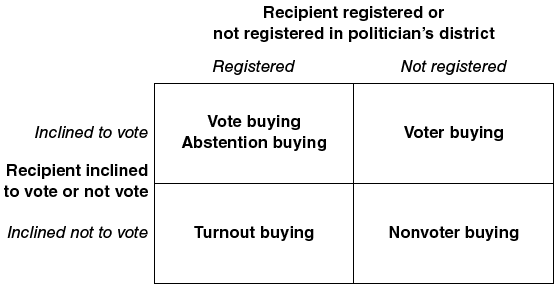
Figure 8.2 Long description
The two-by two grid x-axis categorizes voters’ registration status: “Registered” on the left and “Not registered” on the right. The y-axis distinguishes between “Inclined to vote” at the top and “Inclined not to vote” at the bottom. Within the four quadrants are labeled” top-left: “Vote buying” and “Abstention buying,” top-right: “Voter buying,” bottom-left: “Turnout buying” and bottom-right: “Nonvoter buying”
Electoral versus Relational Clientelism
A third key challenge facing the literature was that it largely focused on clientelism during electoral campaigns. Unlike traditional work on the topic, many formal and quantitative studies ignore how clientelism often involves ongoing relationships between politicians and citizens. As with voter buying, my fieldwork made it clear that many contingent exchanges extend beyond elections, thereby suggesting yet another aspect of clientelism requiring further conceptual refinement. My 2018 book develops the conceptual typology in Figure 8.3 to sharpen the distinction between electoral clientelism and what I termed “relational clientelism” (Nichter Reference Nichter2018). The upper box describes the key defining attribute of the overarching concept of clientelism: Material benefits are provided contingent on a citizen’s political support. That is, recipients promise that they will provide (or have provided) political support in exchange for goods or services. If such contingency is not present, then the provision of benefits involves not clientelism but instead another modality of distribution (such as programmatic politics or constituency service) that one might view as politics as usual. The lower box presents a second defining attribute, which differentiates between electoral and relational clientelism. This attribute pertains to the timing of benefits – more specifically, whether contingent benefits extend beyond election campaigns. Whereas benefits are provided exclusively during campaigns with electoral clientelism, they extend beyond campaigns with relational clientelism.
Strategies of clientelism (electoral versus relational clientelism).
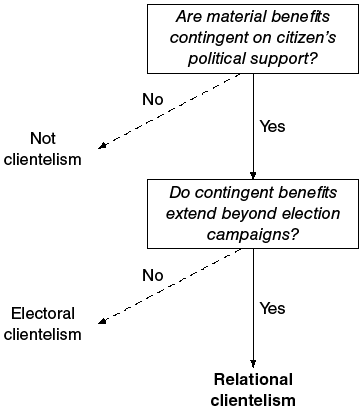
Figure 8.3 Long description
A flowchart begins with the question, “ Are material benefits contingent on citizen’s political support?”. If “No,” the outcome is “Not clientelism.” If “Yes,” it poses the question, “ Do contingent benefits extend beyond election campaigns?”. A “No” leads to “Electoral clientelism,” while a “Yes” leads to “Relational clientelism”.
The conceptual typology in Figure 8.3 proved to be foundational for quantitative and qualitative research in my 2018 book. One key reason is that by disaggregating clientelism according to the timing of benefits, the typology draws attention to the fact that the subtypes entail distinct credibility problems. With both forms of clientelism, politicians assess if a voter’s promises to provide political support are trustworthy. But unlike electoral clientelism, relational clientelism involves a dual credibility problem. Because relational clientelism involves promises of benefits beyond campaigns (i.e., after voting), citizens also assess the trustworthiness of politicians’ promises. By contrast, electoral clientelism provides all benefits during campaigns before voting, so citizens do not face the threat of opportunistic defection. Building on this conceptual insight – which emerged in the development of the typology in Figure 8.3 – I explore how and why citizens often help to alleviate this dual credibility problem, and thus play a crucial yet underappreciated role in sustaining relational clientelism. Many citizens across the world face inadequate social safety nets and are vulnerable to adverse shocks, and are thereby motivated to fortify long-term clientelist relationships as a risk-coping mechanism. Evidence suggests that citizens often use two key mechanisms to help sustain relational clientelism: they declare support to signal their own credibility, and they request benefits to screen politician credibility.
The typology in Figure 8.3 also suggests a fruitful direction for improving measurement and explanatory efforts in the field of clientelism. As with my prior work discussed earlier, the contemporary literature focuses predominantly on strategies of electoral clientelism, such as vote buying, turnout buying, abstention buying and voter buying. Yet it is possible that much of what researchers interpret to be electoral clientelism is actually relational clientelism. Researchers often measure electoral clientelism by asking survey respondents whether they received a handout during a given campaign period. But observe that in Figure 8.3 the second attribute about the timing of benefits does not imply that relational clientelism suspends benefits during electoral campaigns. As such, simply identifying the provision of a campaign handout is insufficient to determine whether the exchange constitutes electoral or relational clientelism. Instead, researchers must determine whether the provision of contingent benefits to the citizen also extends beyond campaigns. This issue is important not only for measurement but also for evaluating explanatory claims: If studies overlook the distinction between electoral and relational clientelism, serious analytical mistakes can arise. The broader point is that refining the concept of clientelism can offer both measurement and explanatory contributions.
“Vote Buying” and Conceptual Stretching
A fourth key challenge is that many studies use the term “vote buying” when referring to a broad range of phenomena, many of which do not involve clientelism at all. This practice contributes to substantial conceptual ambiguity with regard to scholarly usage of the term “vote buying.” My 2014 article (Nichter Reference Nichter2014) presents the typology in Figure 8.4 and, as discussed later, argues that some scholarly usage involves conceptual stretching (Sartori Reference Sartori1970). The conceptual typology has two dimensions referring to how researchers use the term “vote buying”: The row variable is whether selective benefits are contingent on political support, and the column variable is whether selective benefits are delivered to individual or small groups of citizens.
Common usage of “vote buying” in academic studies.
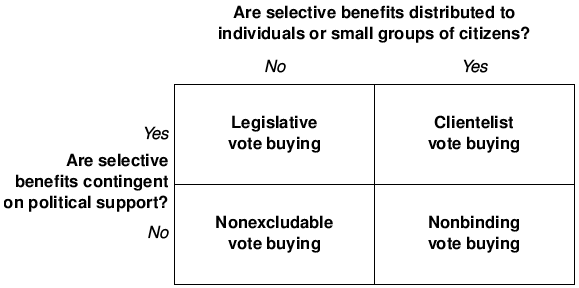
Figure 8.4 Long description
The x-axis of the 2x2 grid graph has the question “Are selective benefits distributed to individuals or small groups of citizens?”, having “No” on the left and “Yes” on the right. The y-axis presents the question “ “Are selective benefits contingent on political support?” with “Yes” at the top and “No” at the bottom”. The boxes in the graph contain “Legislative vote buying” on the top left, “Clientelist vote buying” on the top right, “Non-excludable vote buying” on the bottom left, and “Non-binding vote buying” on the bottom right.
As shown in the cells, academic usage of “vote buying” can be categorized into four subtypes: clientelist, legislative, nonexcludable, and nonbinding. Clientelist vote buying refers to the phenomenon described earlier (see discussion of Figure 8.1). A second common subtype is legislative vote buying, which similarly involves contingent benefits but provides benefits to legislators instead of citizens. Many studies investigate how vote buyers such as interest groups or politicians provide selective benefits to legislators who agree to vote for a specific bill. Such studies typically deem the exchanges to be quid pro quo: Legislators agree to support a bill in exchange for including specific benefits before voting. A third common subtype is nonexcludable vote buying, which provides local public goods to political districts in an effort to generate political support. Unlike the first two subtypes, these studies typically do not describe citizens or elites as providing political support in contingent exchange for benefits. Local public goods are nonexcludable within districts; all residents can access them even if they refuse political support. Thus, vote buying with local public goods does not involve contingency. A fourth subtype is nonbinding vote buying, which delivers benefits to individual or small groups of citizens without conditioning receipt on promises of political support. Such studies typically depict politicians as providing benefits – with or without partisan bias – in order to foster goodwill that can heighten future electoral support. While both clientelist and nonbinding vote buying target individual or small groups of citizens, only the former subtype involves quid pro quo exchanges of benefits for political support.
Building on this typology, I contend in Nichter (Reference Nichter2014) that some scholarly usage of the term “vote buying” is inappropriate. Because contingent exchange is a fundamental component of any “root definition” of vote buying, the bottom two subtypes in Figure 8.4 – nonexcludable and nonbinding vote buying – involve conceptual stretching.Footnote 8 As discussed earlier, nonexcludable vote buying lacks contingency because residents in recipient districts cannot be prevented from accessing local public goods, and nonbinding vote buying lacks contingency because it does not require recipients to promise political support in exchange for benefits. Ideally, researchers should not use the term “vote buying” when referring to either of these phenomena. Alternatively, they should be explicitly identified as “diminished subtypes” (Collier Reference Collier and Smith1995; Collier and Levitsky Reference Collier and Levitsky1997), in which the adjectives “nonexcludable” and “nonbinding” convey that an attribute of the root concept (i.e., contingency) is missing.
Discussion
Stepping back, this discussion of clientelism demonstrates that continued engagement with conceptual analysis can yield important insights and analytic leverage. Taken together, the typologies presented herein refine the overarching concept of clientelism by revealing underlying dimensions, explicating subtypes, and reducing conceptual ambiguity. Among other insights, they heighten analytical differentiation by revealing how distinct strategies of electoral clientelism can be used to persuade, mobilize, and even shape the electorate. Also of fundamental importance, the typologies distinguish between electoral clientelism (in which benefits are limited to campaigns) and relational clientelism (in which benefits extend beyond campaigns). Moreover, refined conceptualization identifies how researchers can avoid potential conceptual stretching when using the term “vote buying.” These typologies not only improve conceptual clarity but also prove to be foundational for further formal and empirical research on the topic.
Introduction
Since the dissolution of communist party systems across Eurasia from 1989 to 1991, scholars have sought to better understand communism’s political aftermath and the variation in political outcomes across the region. Dominant questions include: What are communism’s legacies? Are post-communist systems conceptually distinct from other formerly authoritarian systems? What explains the substantial divergence in contemporary political outcomes among entities that shared broad structural similarities only forty years ago? Is “post-communism” a helpful concept, or is it a relic of a colonized scholarly agenda?
Typologies can be a valuable tool to provide analytical leverage on these questions. David Collier, Jody LaPorte, and Jason Seawright (Reference Collier, LaPorte and Seawright2012) argue that typologies can be put to work to form concepts, refine measurement, explore dimensionality, and organize explanatory claims, tasks that are all necessary to advance scholarship on the most pressing questions about the former communist world.Footnote 1
Since the 1990s, scholars have attempted to classify formerly communist states into categories or “types” that characterize the political and economic institutions that have developed after the end of communist-party rule (Linz, Stepan, and Gunther Reference Linz, Stepan, Gunther, Gunther, Diamandouros and Puhle1995; Møller and Skaaning Reference Møller and Skaaning2010; Zimmerman Reference Zimmerman2014; Hale Reference Hale2015; Way and Casey Reference Way and Casey2018; Kornai Reference Kornai and Magyar2019). Regardless of the classification scheme employed, there is broad consensus among scholars of post-communist transformation about the existence of a variety of systems across Eurasia and the inadequacy of earlier typologies of political regimes to adequately describe them. Scholars investigating the region have offered new insights into underlying dimensions and overlooked assumptions about dynamic political processes. These contributions have advanced the study of democratization and regime change, shifting discussion about regime categorization and dimensionality away from attributes of democracy and toward a more robust consideration of differences among nondemocratic forms of political organization.
Nevertheless, this scholarship also exposes several missed opportunities for putting typologies to work more effectively. While scholars critique existing concepts, analyses rarely advance a complete typology comprised of mutually exclusive categories or “types” arrived at by evaluating dimensions upon which phenomena can differ in substantively meaningful ways. An absence of specification about the underlying dimensions and their potential points of intersection hinders scholars’ ability to identify points of agreement and discord among competing explanations and limits their ability to apply descriptive typologies as causal variables. Scholars of formerly communist cases frequently engage in typological thinking – the intellectual work of engaging in the building blocks of typologies without specifying the dimensions of variation that lead to distinct categorical types.
By examining several examples of typologies of communist and post-communist systems, I aim to highlight their contributions to the study of political regimes while also identifying missed opportunities where closer attention to typology building may yield greater insights for comparative politics.
Building and Identifying Typologies
Before delving into specific post-communist typologies, clarification of a few terms is necessary. There is a key distinction between descriptive and explanatory typologies. Descriptive typologies (also called conceptual typologies) seek to map out a concept’s dimensions, which correspond to the rows and columns in the typology, while explanatory typologies treat rows and columns as variables and cells as the hypothesized or confirmed outcomes of a causal process. With an explanatory typology, the author can potentially identify the cases that correspond to each cell. With this approach, the explanatory typology in effect is also empirical cross-tabulation.
Creating descriptive and explanatory typologies involves several “building blocks”: explicating the overarching concept,Footnote 2 disaggregating it into two or more dimensions that comprise the row and column variables, and cross-tabulating the dimensions in a matrix through which distinct “types” appear in the cells.
While these steps may appear straightforward, failure to carefully follow them can lead to missed opportunities for improving conceptualization and measurement. Descriptive typologies that fail to disaggregate the dimensions upon which the overarching concept’s types are based limit other scholars’ ability to apply the relevant concept as a variable in an explanatory framework. In almost all instances, selective engagement with typology building blocks coincides with inductive theory building that draws on a broad range of qualitative evidence. As part of their theory building, some scholars emphasize distinct types of an overarching concept without fully elaborating the dimensions that give rise to the distinctions. In other instances, scholars engage in the work of concept formation and categorization while simultaneously offering a rich, qualitative, empirical account but then do not take the final step of abstracting away from the empirical work to specify dimensions and categories that could be applied by scholars surveying other phenomena.
A close look at the literature reveals a common thread of selectively engaging with a typology’s building blocks, or what I will call “typological thinking.” Typological thinking – or the intellectual work of defining overarching concepts, distinguishing their boundaries, identifying underlying dimensions and the range of possible variation within them – is necessary for building typologies. However, it is possible to engage in this intellectual process without creating a complete typology or even acknowledging that these efforts at conceptualization, measurement, and categorization comprise a typology.
Typological thinking abounds in the conceptual, theoretical, and empirical work centered on the formerly communist countries of central and southern Europe and Eurasia. While some scholars call their classification schemes typologies, others who engage in typological thinking do not elaborate an explicit, complete typology. Among the variety of typologies that describe or explain post-communist phenomena, regime typologies are the most numerous, covering a range of goals and scopes. Some typologies have focused on explicating variation in communist systems (Kitschelt et al. Reference Kitschelt, Mansfeldova, Markowski and Toka1999; Breslauer Reference Breslauer2021). Others theorize underlying dimensions (and their possible empirical ranges) and identify an array of specific types of political regime (Linz and Stepan Reference Linz and Stepan1996; Møller and Skaaning Reference Møller and Skaaning2010; Zimmerman Reference Zimmerman2014). Overall, typological analysis that classifies political and economic systems regularly engages discussion about shifting the root conceptFootnote 3 to move away from a democracy-centric understanding of the dimensions of political regime (Hale Reference Hale2015).
Despite these valuable contributions, the overall utility of existing classificatory schemes for addressing the most pressing questions about post-communism has been limited. While both specified and unacknowledged typologies of post-communist outcomes offer a valuable appraisal of omitted variables in analytical frames commonly applied in comparative politics, they have seldom moved fully from critique to construction of new alternatives. Explanatory typologies that explicate a process for post-communist regime variation are rare, even though typologies of political regimes remain among the most common classificatory schemes in the post-communist literature.
In the early 1990s, several central European states had laid the pathway toward developing democracies and robust market economies, while political and economic reforms appeared stalled or nonexistent in the south and east. More than thirty years later, the diversity of outcomes remains. There is no scholarly consensus, however, about how to best conceptualize this variation and the number of distinct types that exist. Likewise, agreement over the causes of this variation remains elusive. Many empirical outcomes, from the Czech Republic’s early success at democratization to Turkmenistan’s absence of meaningful reform, had multiple plausible explanations.
While existing classificatory schemes are of limited utility in gaining traction on these questions, carefully constructed typologies could be used more effectively. Typologies can sharpen concepts, map out rival explanations, promote parsimony to elucidate complex causal sequences, and represent differences in kind. The potential opportunity of typologies to offer analytical leverage is most apparent in the debate about regime type and the causal sequences that led to such dramatic variation across the region.
In the following sections, I will highlight several existing classificatory schemes to both shed light on their contributions and identify opportunities to strengthen typology-building to maximize analytical leverage. The schemes selected for analysis are influential, well-regarded pieces of scholarship. Individually, each has made an important contribution to understanding post-communist outcomes. They are also illustrative of the broader trends present in post-communist typologies and typological thinking. The prominence of these schemes is precisely why I have selected them for critique, with the goal of demonstrating how existing concepts and theoretical approaches can be sharpened for broader impact.
Typologizing Communist Systems
The first set of typologies focuses on the communist systems themselves. After the dissolution of these systems, many scholars and analysts assumed that communist inheritances would have a uniform effect on post-communist transformation. Yet several scholars have challenged this assumption. Curiously, however, descriptive typologies of communist systems are not common. The most influential is Kitschelt et al.’s (Reference Kitschelt, Mansfeldova, Markowski and Toka1999) typology, which describes three types of communism that were present at the end of communist rule: bureaucratic-authoritarian communism, national-accommodative communism, and patrimonial communism. The authors arrived at this typology by looking at both the political and economic antecedents of communist rule and modes of communist rule. After describing these types and categorizing cases accordingly, the authors incorporate the type of communist rule as an explanatory variable responsible for post-communist regime trajectories, quality of representation, and strength of political institutions.
The significance of this typology is evident from the frequency with which it has been cited and applied in further work. In one prominent example, when establishing his concept of “patronalism,”Footnote 4 Henry E. Hale (Reference Hale2015: 60) uses information from Kitschelt et al.’s analysis to classify country cases into ordinal categories of “most patronalistic,” “moderately patronalistic,” and “least patronalistic.” Hale argues that levels of patronalism are central to understanding the descriptive contrasts among post-communist systems and their capacity for achieving certain political and economic outcomes. We thus have three categories with an ordinal ranking, and the typological thinking incorporated into Hale’s conceptualization of patronalism has shed light on the significance of informal arrangements that frequently penetrate and subvert formal institutions (Hale Reference Hale and Magyar2019).
Few analysts have attempted a comprehensive typology of communist systems. Kitschelt et al.’s typology offers a useful representation of communist systems in the years immediately prior to their dissolution. George W. Breslauer (Reference Breslauer2021) offers a classification scheme of six “patterns” of communism that emerged in the six decades following Stalin’s death, ultimately converging into three durable types: Stalinism maintained, bureaucratic Leninism, and market Leninism. Breslauer is clear that these three types are not the only models of communism that existed but rather the three that have proved most durable, as well as relevant for communism outside Europe. Breslauer links these patterns of communism to several other outcomes of interest, including the resilience of the five remaining communist states in the contemporary world.
The communist types identified by both Kitschelt et al. and Breslauer are conceptually rich and detailed. They are “ideal types” in the Weberian tradition of concept formation and, as such, offer scholars the opportunity to consider longitudinal variation in types within the same communist country case over time. Both scholarly works suggest that variation in these communist system types is causally significant for some outcomes of interest. While both Kitschelt et al. and Breslauer distill many characteristics of communist rule into more parsimonious categories, questions about the root concept remain. Kitschelt et al.’s conceptualization of communism appears thinner, focused more narrowly on the party’s relationship with the public and bureaucracy, while Breslauer’s conceptualization is broader, encompassing elites’ commitments to Marxist or national revolutionary ideals as well as their methods of economic and political management. Closer attention to the boundaries of the root concept of “communism” and its underlying dimensions would facilitate the application of typologies of former communist systems to other explanatory models. For example, these typologies might play an important role in measuring the impact of communist legacies on post-communist regime outcomes.
To provide an illustrative example of how typology building could be sharpened to strengthen analytical leverage in understanding post-communist outcomes, I have taken descriptions of characteristics from both Kitschelt et al.’s and Breslauer’s communist system types and restructured them into more parsimonious typologies. Table 9.1 is a conceptual typology elaborating the main dimensions for modes of communist rule as described by Kitschelt et al. Table 9.2 is an explanatory typology that demonstrates how pre-communist antecedents determined which communist system came into being. This modification for representing the original typology emphasizes the key dimensions upon which the types are drawn, offering a more parsimonious explication of a complex explanatory sequence for how specific communist systems emerged and operated.
| Method to induce popular compliance | Formal bureaucratization | |
|---|---|---|
| High/intermediate with low corruption | Low with high corruption | |
| Primarily repression | Bureaucratic authoritarian communism (Czech Republic, German Democratic Republic) | Patrimonial communism (Albania, Armenia, Azerbaijan, Belarus, Bulgaria, Georgia, Kazakhstan, Kyrgyzstan, Macedonia, Moldova, Romania, Russia, Tajikistan, Turkmenistan, Ukraine, Uzbekistan) |
| Primarily cooptation | National-accommodative communism (Croatia, Hungary, Slovenia) | |
Note: Derived from information presented by Kitschelt et al. (Reference Kitschelt, Mansfeldova, Markowski and Toka1999: 35–41). Kitschelt et al. identify Poland as a mixed case between the bureaucratic authoritarian and national-accommodative types and Slovakia, Latvia, Lithuania, Estonia, and Serbia as a mix of the national-accommodative and patrimonial types.
| Antecedent political regime | Antecedent political economy | |
|---|---|---|
| Industrial capitalist | Predominantly agricultural | |
| Competitive/pluralist | Bureaucratic authoritarian communism | National-accommodative communism |
| Absolutist/authoritarian | Patrimonial communism | |
Note: Derived from information presented by Kitschelt et al. (Reference Kitschelt, Mansfeldova, Markowski and Toka1999: 35–41).
In both Tables 9.1 and 9.2, I simplified Kitschelt et al.’s original articulation of the underlying dimensions that give rise to specific communist types to arrive at a two-dimensional typology. By collapsing several dimensions or values that the authors treat separately, this modification sacrifices detail. Yet, in return, it focuses attention on the primary dimensions where variation is most relevant: formal bureaucratization and the methods used by the state to induce popular compliance for Table 9.1 and antecedent political and economic systems in Table 9.2.
I have created a conceptual typology (Table 9.3) that summarizes Breslauer’s analysis. In contrast to Kitschelt et al., Breslauer does not display his types and the dimensions upon which they are based in tabular form. In reading through the empirical details across durable types, however, two primary dimensions emerge as significant sources of variation. One dimension is a communist system’s form of economic management. One standard mode is central planning, while the other is some form of (narrow or broad) marketization. The other dimension involves how political elites sought to manage political relations with society. Along this dimension, the primary variation concerns the use of coercion versus other forms of nonviolent incentives.
| Political management | Economic management | |
|---|---|---|
| Central planning | Marketization | |
| Primarily coercion/violence | Stalinism maintained (Mao’s China, Cambodia, Vietnam, Albania post-1953, North Korea) | |
| Primarily rationalization/cooptation | Bureaucratic Leninism (Brezhnev’s USSR, most East European cases 1957–85, Castro’s Cuba since 1970s) | Market Leninism (Yugoslavia and Hungary 1960s–80s; Deng’s China; Vietnam, and Laos since 1980s–90s) |
Note: Derived from information presented by Breslauer (Reference Breslauer2021: chap. 2). The countries in bold type are contemporary cases of the types as of 2021.
The intersection of these two dimensions yields the three durable modes of communist rule Breslauer identifies. No cases of systems that rely primarily on coercive political tactics attempted marketization. There remains meaningful scope for empirical variation within the categories summarized in each of these two dimensions, yet they offer a parsimonious portrayal of the primary features behind Breslauer’s three durable types.
In comparing Tables 9.1 and 9.3, one can notice similarities and differences in underlying dimensions, categories, and classification across the two descriptive typologies. Exploring these more deeply is beyond the scope of this chapter, but the exercise reveals the value of sharpening typology building for greater analytical leverage.
Post-Communist Systems of the 1990s
Discussions of post-communist outcomes and related classification schemes from the 1990s were heavily influenced by the literature on democratization in southern Europe and Latin America in the 1970s and 1980s. Consequently, scholarship of this era frequently adopted a lens of elite-led democratic transitions after the dissolution of communism. The inadequacy of this framework to account for the full range of post-communist transformation experiences broke open the study of regime change, compelling closer attention to how structures shape and constrain individual choices among both political elites and citizens (Frye Reference Frye2018; Way and Casey Reference Way and Casey2018).
An early and significant contribution to this corrective was advanced by Juan Linz and Alfred Stepan (Reference Linz and Stepan1996), who updated and expanded Linz’s classic 1975 typology of authoritarian regimes. Linz’s original typology aimed to distinguish between authoritarian and totalitarian regimes, developing these types based on variation along four underlying dimensions: degree of pluralism, ideology, mobilization, and political rule. The updated typology contained five “ideal types” of regime: democracy, authoritarianism, totalitarianism, post-totalitarianism, and sultanism. The underlying dimensions of pluralism, ideology, and mobilization remain, while political rule is replaced with the dimension of leadership. By bringing the nondemocratic regimes into direct dialogue with the features of democracy, Linz and Stepan shifted focus on regime transformation away from a teleological centering on democracy in favor of dimensions emphasizing other forms of linkage between political elites and citizens and the role of broader pluralism in public life. This approach reveals commonalities that can exist between democracies and some nondemocratic systems, such as the presence of social and economic pluralism, while also demonstrating how the dimensions vary across nondemocratic contexts. The typology offers a useful template for thinking about regime mobilization and citizen participation as existing on opposite poles on the same underlying dimension, as well as for considering the distinction between an intellectual commitment to the ideals of democracy versus the role of a guiding ideology that is used to justify political rule.
While the expanded typology offers useful analytical features, it also reveals missed opportunities to rebuild the classic typology. The root concept of Linz’s original typology was authoritarian regimes, while the expanded typology describes political regimes in general. However, the underlying dimensions in the expanded typology appear to be slightly adjusted to accommodate a comparison with democracy rather than being fully revaluated. As a result, the theoretical range of scores on these dimensions is unclear. For example, the “mobilization” dimension in the original typology comprised a more limited range as it did not include the possibility of citizen participation, while the expanded typology includes full citizen participation as one pole on this dimension, which would perhaps be more accurately labeled as “public engagement.”
Additionally, the introduction of a “post-totalitarian” type inspires new questions. Are post-totalitarian systems temporary and transitory? Is post-totalitarianism a diminished subtype of totalitarianism? If so, what is the root concept? In sum, while Linz and Stepan aimed to shift the root concept of the original Linz typology, they did so more in name than in practice, resulting in lack of clarity of the boundaries of the underlying dimensions.
Post-Communist Systems in the Twenty-first Century
In the 2000s, post-communist regime classifications evolved to acknowledge the fuzzy boundaries that appeared to exist between democracies and authoritarian regimes. Levitsky and Way’s (Reference Levitsky and Ahmad Way2010) concept of competitive authoritarianism further advanced typological thinking about post-communist regimes by extending Dahl’s (Reference Dahl2008) concept of polyarchy to make explicit the assumption of a reasonably level playing field between incumbents and opposition. While the authors do not cast their work as a typology, their theory about the rise of competitive authoritarian regimes in the early twenty-first century – nearly one-third of which were concentrated in post-communist states – can be viewed as an explanatory typology. Their explanatory argument is based on three variables: Western linkage, organizational power, and Western leverage. The combination of scores on these variables lead to the three regime outcomes of democracy, stable authoritarianism, and unstable authoritarianism.
They presented their argument as a form of arrow diagram that summarizes the three components of their explanatory claims (Figure 9.1; i.e., their original diagram). This diagram has two disadvantages. It could be mistakenly read as a kind of path diagram often used in quantitative research. Relatedly, it appears to suggest a temporal sequence, which is misleading. In Table 9.4, I have used standard ideas about diagramming typologies to create a depiction of their argument that allows scores on multiple dimensions and cases to be depicted together. It is more readable, for example, in that one can quickly identify the cells that correspond to successful and unsuccessful prediction of a democratic outcome.
Levitsky and Way’s regime outcomes.
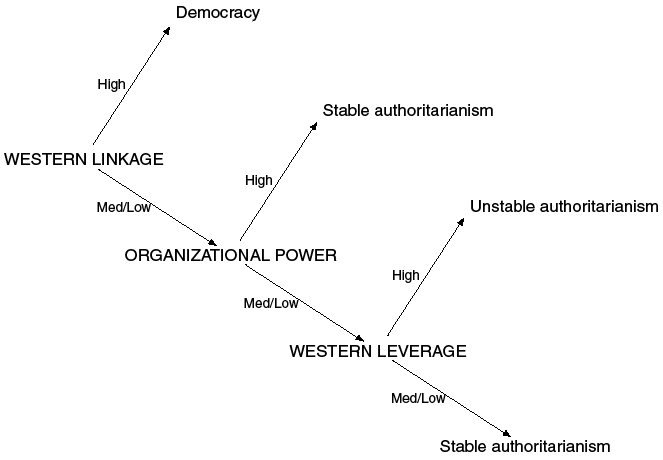
Figure 9.1 Long description
A flowchart begins with “Western linkage” that if “high” goes to “democracy” and if “med/low” goes to “organizational power. “Organizational power” if” high” leads to “ stable authoritarianism,” and if “med/low” goes “Western leverage.” “Western leverage” if “high leads to “ unstable authoritarianism,” and if “med/low” results in “stable authoritarianism.”
| Organizational power | Western leverage | |||
|---|---|---|---|---|
| Low/medium | High | |||
| Western linkage | ||||
| Low/medium | High | Low/medium | High | |
| Low/medium | Stable authoritarianism (Russia) | Democracy (no cases) | Unstable authoritarianism (Georgia, Moldova) | Democracy (Macedonia, Romania) |
| High | Stable authoritarianism (no cases) | Democracy (no cases) | Stable authoritarianism (Armenia) | Democracy (Croatia, Serbia, Slovakia) |
Note: Derived from information presented by Levitsky and Way (Reference Levitsky and Ahmad Way2010: 70–72, 341–42). Levitsky and Way note that their theory does not correctly predict the outcomes for Albania, Belarus, and Ukraine. Albania is a case where high linkage does not result in democracy; in Belarus authoritarianism is unstable when predicted to be stable; and in Ukraine, democracy results in place of unstable authoritarianism.
Levitsky and Way&presents an overview of’s argument is a compelling explanation for variation in post-communist political regimes, correctly predicting the outcome for all but three of the post-communist cases included in the sample at the time of publication. Their explanatory framework views competitive authoritarianism as an unstable or transitionary regime that will ultimately move onto a path toward democracy or some other form of authoritarianism. However, the resilience of competitive authoritarian or other forms of hybrid regimes in the post-communist region over the past decade challenges this perspective.
Other scholars have attempted to incorporate hybridity into their typologies by rethinking the underlying dimensions that make up a regime. Jørgen Møller and Svend-Erik Skaaning’s (Reference Møller and Skaaning2010) typology clarifies the property space between autocracy and democracy by examining three dimensions commonly related to democracy: free elections, freedom rights, and rule of law. Each dimension is given three possible ordinal scores of “no defects,” “moderate defects,” and “severe defects,” resulting in six distinct types: liberal democracy, polyarchy, electoral democracy, minimalist democracy, autocracy, and illiberal autocracy. William Zimmerman (Reference Zimmerman2014) examines the status of core democratic institutions and elections, status of the opposition, level of electoral uncertainty, size of the electorate, and regime goals in distinguishing between four regime types: democratic, competitive authoritarian, full authoritarian, and mobilizational.
Like the missed opportunities identified in the Linz and Stepan typology, classification schemes involving hybridity suffer from unclear articulation of the root concept and specification of the underlying dimensions that determine it. Consequently, scholars are frequently talking past each other, and few attempts to flesh out hybrid concepts (other than Levitsky and Way’s) have caught on.
Conclusion
Typologies can be put to work in two fundamental ways. The first is to use them to introduce conceptual and theoretical innovations, sometimes drawing together multiple lines of investigation or analytic traditions. The second is to map political transformations and empirical change. Typologies have been applied in both ways to categorize and explain post-communist outcomes. Both specified typologies and classificatory schemes that result from typological thinking have broken open the study of regime change to shift away from a focus on democratic transition and consolidation to consider a broader range of outcomes. Differences in both formal institutions and the informal practices that operate them have received greater scrutiny.
Nevertheless, missed opportunities to carefully consider the boundaries of concepts and their underlying dimensions have limited the analytical value of typologies for conceptualizing the relationship among rival hypotheses and formulating parsimonious explanations of post-communist political change. Closer attention to specifying the building blocks of a typology would strengthen the potential contributions of typologies for explicating the causal force of communist-era practices on post-communist outcomes. Specifically, much remains to be done on developing the root concept of “regime.” Unlike Weber’s definition of the “state,” comparativists lack the same clarity of vision regarding “regime.” While commonly understood as the rules and procedures that determine access and distribution of power, even this basic articulation begs many questions about underlying dimensions and their theoretical and empirical ranges. While categorization of communist systems and post-communist typologies may not have offered the most comprehensive and satisfying answers to the question of what comprises a regime, their missteps can help establish a clear path forward from critique to construction.

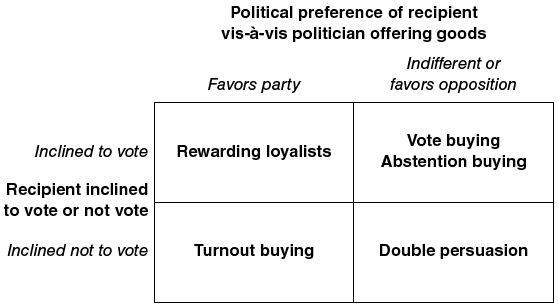
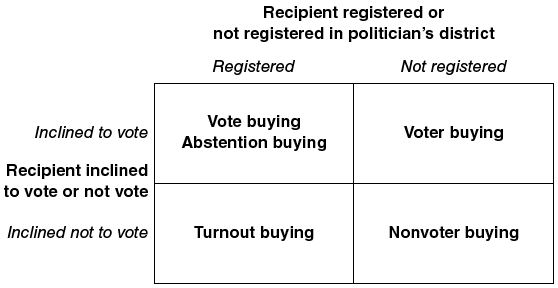
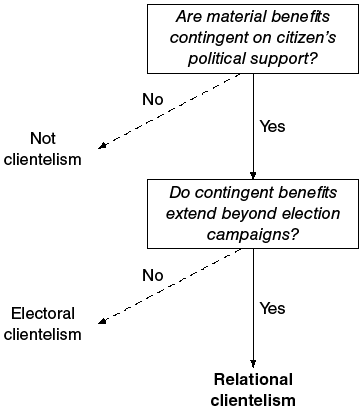
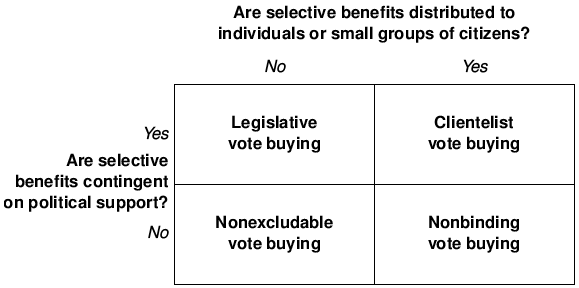
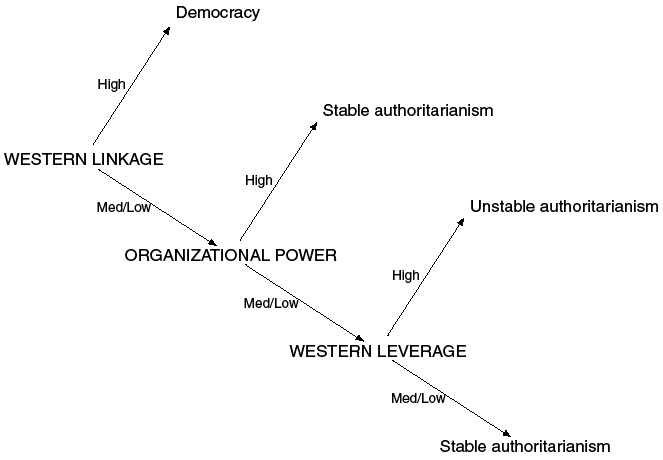

 Open access