

Introduction
The global care crisis, intensified by the COVID-19 pandemic, has renewed attention to the organisation of care and the transnational flows of labour that sustain it (De Henau and Himmelweit, Reference De Henau and Himmelweit2021). Global care chains capture how shortages of caregivers in one region generate demand that is met through the mobility of workers from another region, reshaping social reproduction across households and welfare systems (Wichterich, Reference Wichterich, Scherrer, Garcia and Wullweber2023). Feminist political economists have long examined these unequal exchanges, demonstrating how care regimes rely on intersectional hierarchies operating across national and transnational scales (Yeates, Reference Yeates2012; Lutz and Palenga-Möllenbeck, Reference Lutz and Palenga-Möllenbeck2012).
Recent advances in the digitalisation of social care have added a new layer of transformation. Recruitment apps, digital platforms, and algorithmic management systems now mediate how care is matched, monitored, and performed (Hamblin et al., Reference Hamblin, Burns and Goodlad2025). Increasingly, care work is embedded in platform work, defined as ‘any productive activity performed by persons to produce goods or provide services carried out through or on a digital platform … [where] the platform controls and/or organizes essential aspects of the activity, such as access to clients, evaluation, payment facilitation, and work allocation’ (OECD, 2023, p. 12). While much research on digital labour platforms (DLPs) has focused on transport or delivery services, the rapid rise of care platforms, digital intermediaries connecting households with paid caregivers, demands closer examination.
Care platforms act as intermediaries between care workers and care seekers through algorithmic management techniques to structure visibility and access to care labour. Welfare states influence both the prevalence and characteristics of platform work, shaping its regulatory boundaries and the risks borne by workers (Pesole et al., Reference Pesole, Urzí Brancati, Fernández-Macías, Biagi and González Vázquez2018). Recent social policy theory further suggests that formal and informal welfare should not be treated as separate spheres but as interdependent arrangements through which access to support, work, and social rights is negotiated among multiple actors and across multiple scales (Nordensvärd and Ketola, Reference Nordensvärd and Ketola2024). From this perspective, informal work, understood as income-generating activities not regulated by the state, even though a similar activity is regulated, is highly relevant to DLPs. As Dimitriadis and Coletto (Reference Dimitriadis and Coletto2024) argue, platforms can introduce work conditions resembling informality into otherwise formalised labour markets by obscuring employment relationships and shifting economic risks onto workers. Across Europe, platforms remain largely unregulated and frequently operate under generic business models or as temporary work agencies (Bonifacio and Pais, Reference Bonifacio and Pais2025). Research indicates that they function as ‘cultural entrepreneurs’, offering clients professionalism and safety through ratings and ID checks while shifting contractual risk onto workers (Ticona and Mateescu, Reference Ticona and Mateescu2018). Comparative research demonstrates that, although care platforms share features with other DLPs, the intimate and relational nature of care limits their standardisation and automation (Celebi and Kemmerling, Reference Celebi and Kemmerling2025).
Platforms interact with existing care regimes, labour regulations, and migration systems, and the institutional context matters. However, most research on care platforms focuses on the Global North, overlooking contexts such as Türkiye, where care economies are shaped by informalisation, weak regulation, and transnational mobility. According to the International Labour Organisation (ILO, 2021), migrant workers constitute nearly 5 per cent of the global labour force, with women migrants overwhelmingly concentrated in the service sector (79.9 per cent). This reflects a rising global demand for care and domestic services, and similar patterns are observed across countries such as the UK (Turnpenny and Hussein, Reference Turnpenny and Hussein2022) and Spain (Rodríguez-Modroño et al., Reference Rodríguez-Modroño, Agenjo-Calderón and López-Igual2024; Rodríguez-Modroño, Reference Rodríguez-Modroño2025). Türkiye, as one of the world’s largest migration hubs and a country with rapidly expanding care needs and a platform economy, offers a critical case for examining how platformisation interacts with welfare and migration systems at Europe’s borders. It is a major migration channel and mobility corridor into the European Union, with direct relevance to social policy debates, particularly regarding the marketisation of care and the governance of migrant care work.
The article examines how digital care platforms in Türkiye shape the gendered and racialised self-presentation strategies of care workers, particularly migrants, in their interactions with potential clients. Bridging research on migration infrastructures with emerging scholarship on platformised care, it shows how platform-mediated care work introduces new forms of intersectional exploitation and visibility politics (Rodríguez-Modroño et al., Reference Rodríguez-Modroño, Agenjo-Calderón and López-Igual2022; Ticona and Mateescu, Reference Ticona and Mateescu2018). Drawing on a novel dataset of 15,441 worker profiles across four platforms, the paper combines quantitative text analysis with digital ethnographic observations to explore how platforms govern access to care labour through verification tiers, nationality filters, and semi-structured profile fields. The analysis first explores how platform features influence workers’ visibility and hireability; second, it demonstrates how care workers strategically build their profiles and utilise gendered, racialised, and cultural cues to signal that they are ‘desirable’ caregivers; and third, it illustrates how national regimes of migration and informality mediate expected profiles and wages. While all three dimensions matter, the analysis keeps the worker strategy at the centre by examining how workers navigate platform architectures in the Turkish context.
This article makes three contributions to social policy research. First, it develops a conceptual link between the digitalisation of care and migration infrastructures. It shows how platform interfaces reorganise access to care, shift regulatory responsibility onto workers, and transform the cues of migrants’ legal status into signals of employability. Second, it places Türkiye at the centre of the analysis, showing how context-specific patterns of legal status, language skills, and cultural expectations can shape care work on platforms, emphasising a context-sensitive approach in comparative social policy. Third, by examining workers’ self-representation, it demonstrates how platforms reward or penalise gendered and racialised markers in ways that influence wages and matching outcomes. Together, these contributions position digital care platforms as emerging market intermediaries that reshape the governance of care and migrant labour in hybrid and increasingly digitalising welfare systems.
Connecting migration infrastructures with care platforms
Care work involves meeting the physical, emotional, and relational needs of others, making it simultaneously labour- and relation-intensive (Daly, Reference Daly, Ranci and Rostgaard2025). Feminist scholarship shows that care provision in the Global North depends heavily on migrant women’s labour from the Global South (Hochschild, Reference Hochschild, Hutton and Giddens2000; Kröger and Zechner, Reference Kröger and Zechner2009; Lightman, Reference Lightman2021). Comparative social policy research further demonstrates how welfare and employment regimes create distinct configurations of commodified, migrant-dependent care markets (Williams, Reference Williams2012; Shutes, Reference Shutes2012) and help situate Türkiye within a broader landscape where states increasingly rely on migrant women to fill gaps in underfunded and informal care systems (Aybars et al., Reference Aybars, Beşpınar and Kalaycıoğlu2018). While these insights anchor our approach, digitalisation shifts the scale and medium of social reproduction, as transnational care relations are increasingly mediated by platforms. Digital technologies do not simply mediate access to services but reshape how welfare is organised and delivered (Henman, Reference Henman2022).
Research on DLPs highlights recurring problems of ambiguous employment status, externalised responsibility and lack of social protection for workers (Au-Yeung et al., Reference Au-Yeung, Chan, Ming and Tsui2025; Beckmann et al., Reference Beckmann, Glanz, Hoose and Topal2026). Although migrant labour in the platform economy has received significant scholarly attention, especially in delivery and taxi sectors (Benvegnu and Kampouri, Reference Benvegnù and Kampouri2021; van Doorn et al., Reference Van Doorn, Ferrari and Graham2023), care platforms remain comparatively underexplored, with notable exceptions. These studies show that platforms often attract migrants by lowering entry barriers while externalising risk, offering quick access to work but weak protection and unstable earnings (Putzel-Kavanaugh and Benton, Reference Putzel-Kavanaugh and Benton2024; Zwysen and Piasna, Reference Zwysen and Piasna2024). In cities such as Amsterdam, Berlin, and New York, platforms operate as uneven arrival infrastructures that provide initial income generation via streamlined onboarding and peer workarounds, while reproducing precarity through individualised contracting and volatile fees (van Doorn and Vijay, Reference Van Doorn and Vijay2024, pp. 1130–1136). The marketisation of care services has compressed wages and increased flexibility, creating conditions that disproportionately draw in migrant workers willing to accept lower pay and precarious contracts (Ranci et al., Reference Ranci, Rostgaard, Lamura, Österle, Ranci and Rostgaard2025, pp. 265–266).
In platform care, these mechanisms intersect with the gendered and affective nature of care work. Care labour is feminised, intimate, and historically racialised, and is frequently supplied by migrant women positioned unequally in global and local care markets (Lutz, Reference Lutz2018; Hochschild, Reference Hochschild, Hutton and Giddens2000). Platforms are not neutral brokers. They reproduce these intersectional hierarchies through algorithmic visibility techniques. Care platforms operate as techno-capitalist fixes to growing ‘care gaps’, commodifying affective labour that resists algorithmic standardisation and offering short-term market solutions that prioritise platform logics over labour rights (Kluzik, Reference Kluzik2022). These dynamics become even sharper within global care chains. Platforms draw on a feminised and migrant workforce embedded in transnational labour regimes, extending long-standing hierarchies of social reproduction into the digital realm and leveraging technological and geopolitical inequalities to govern cross-border care provision (Rodríguez-Modroño et al., Reference Rodríguez-Modroño, Agenjo-Calderón and López-Igual2022, Reference Rodríguez-Modroño, Agenjo-Calderón and López-Igual2024). Evidence from Spain illustrates how care platforms ‘fit perfectly in an informal and devalued care sector with a large labour supply composed of migrant women from the Global South’, where algorithmic opacity deepens segmentation (Rodríguez-Modroño et al., Reference Rodríguez-Modroño, Agenjo-Calderón and López-Igual2022, p. 619).
Platform infrastructures, such as verification, rating, and payment systems, render workers hyper-visible to clients yet structurally invisible as employees, disciplining labour and redistributing risk through individualised visibility regimes (Ticona and Mateescu, Reference Ticona and Mateescu2018). The same tools that promise trust and safety also govern worker visibility and hireability. Platforms digitise matching and verification, organising how migrant care labour is vetted and employed (Ticona and Mateescu, Reference Ticona and Mateescu2018; Andersen and Spanger, Reference Andersen and Spanger2024). At the same time, loose qualification checks and open-ended listing architectures shift unpaid reputational labour and risk onto workers by making profile curation a prerequisite for visibility and matching (Korn, Reference Korn2025). Evidence from Spain documents post-2020 growth in social care where promises of professionalisation coexist with low pay, long hours, and insecurity among primarily Latin American migrant women (Martínez-Buján and Moré, Reference Martínez-Buján and Moré2024).
To explain how these dynamics are coordinated over time and across borders, we conceptualise care platforms as migration infrastructures. Digital care platforms act as infrastructural nodes within a broader migration infrastructure ecology, mediating mobility, and access to work. The scholarship on migration infrastructure defines this ecology as an ensemble of commercial (recruitment, brokerage), regulatory (state apparatuses, legal procedures), technological (communication, transport, data systems), humanitarian (NGOs, international organisations), and social (migrant networks) systems (Xiang and Lindquist, Reference Xiang and Lindquist2014). Building on this concept, Carlotta Preiss (Reference Preiss and Scholten2022) theorises digital migration infrastructures as socio-technical assemblages (actors, hardware, software) that facilitate and mediate migration.
On the macro level, welfare states shape migrant care trajectories by regulating workers’ access to and residence in host countries (van Hooren, Reference Van Hooren2012). At the micro level, households configure the terms of care work by setting expectations about availability and conduct. DLPs operate at the intersection of these two scales, functioning as infrastructural actors within urban labour markets that absorb migrant labour, govern post-arrival trajectories, and position themselves as nodal points that condition both mobility and everyday reproduction (Bayurgil et al., Reference Bayurgil, Pulignano and Kirchner2026, pp. 15–16; Andersen and Spanger, Reference Andersen and Spanger2024). Situating platforms within migration infrastructures highlights how state policies, platform companies, and household demands work together to mediate care work.
Finally, the threat of deportation is an important part of how migrants integrate into labour markets. Deportability is a legally produced condition of vulnerability in which the threat of removal disciplines migrants’ everyday life, labour, movement, and self-presentation, even when removal never actually occurs (De Genova and Peutz, Reference De Genova and Peutz2010). It induces compliance with exploitative work conditions and tolerance of labour rights violations. Scholars have documented how care work is systematically segmented along racial and gender lines, with migrant women consistently concentrated in the lowest-paid and least protected positions (Anderson, Reference Anderson2010; Parreñas, Reference Parreñas2015). Its effects are also visible on platforms. Van Doorn and Vijay (Reference Van Doorn and Vijay2024) illustrate this through the Berlin and Amsterdam cases, where platform workers without permits or tax IDs remain formally unrecognised and therefore exposed to exploitation. Andersen and Spanger (Reference Andersen and Spanger2024) demonstrate a related dynamic, showing that migrants who arrive through undocumented arrangements face significant bureaucratic obstacles when attempting to regularise their status and access platform work. At the same time, the loose enforcement of verification systems and eligibility filters allows some workers who are excluded from formal employment channels to enter platform-mediated care markets. Platforms thus have a dual character: they can open access to work for otherwise excluded migrants while also embedding precarity deeply in the everyday organisation of labour. In this way, deportability and platform-induced informality reinforce one another.
The Turkish case: a global migration hub
Türkiye constitutes a crucial case, given its large migration inflows, increasing participation of women in the labour force, and a gradually ageing society with rising care needs. The data show that Turkish society is ageing, female labour force participation is increasing, and the care gap is widening. According to the Turkish Statistical Institute (TUIK, 2024a), in 2023, there were about thirty-one children and fifteen older adults per 100 working-age people, indicating the childcare and eldercare load for the working population. A 2023 TUIK survey of around 30,000 people aged fifty-plus (TUIK, 2024b) found that 16.4 per cent of those aged sixty-five-plus needed home care, amounting to about 1.2 million people nationwide. Yet only 560,060 received cash assistance for family-based care in 2023, implying roughly half of those in need lack access to state schemes (Ministry of Family and Social Services, 2024). Based on these data, we can conservatively estimate that 50 per cent of elderly people in need of home care support lack access to state-sponsored care schemes. Considering the high levels of old-age poverty (Akkan and Şanlı, Reference Akkan, Şanlı and Rajan2023), the elderly care gap in Türkiye remains substantial.
Türkiye has long functioned as a country of destination and transit, hosting labour migrants, circular migrants, asylum seekers, and refugees through overlapping and differentiated migration regimes (İçduygu and Yükseker, Reference İçduygu and Yükseker2012). Within this setting, migrant women, particularly from the former Soviet sphere, the Caucasus, and Central Asia, have historically been incorporated into domestic and care work through informal, household-based arrangements (Akalın, Reference Akalın2007, Reference Akalın2015; Akkoyun and Dalaman, Reference Akkoyun and Dalaman2024). Since 2011, Syrians under temporary protection have entered Türkiye’s labour market through similarly unequal pathways. While Syrian men’s employment has gradually converged toward that of natives, women continue to face larger gaps, with administrative barriers, weak knowledge of labour regulations, gendered vulnerabilities, and sectoral segmentation pushing many into informal and unstable work (Badalič, Reference Badalič2023; Demirci and Kırdar, Reference Demirci and Kırdar2023). Care burdens and restricted mobility further shape Syrian women’s labour market access in ways that remain largely invisible in platform-mediated settings (Acara and Özdemir, Reference Acara and Özdemir2023). Syrian women are therefore not absent from care labour but are often incorporated through channels that platform profiles do not capture, and this is a structural invisibility that any platform-based analysis must account for.
The final reason Türkiye is a crucial case for studying digital care platforms is the widespread lack of work permits amid the country’s large migrant inflows. Of the 5.1 million foreign nationals in Türkiye, just 212,682 held work permits in 2022 (all fixed-term), about 4 per cent overall or 6.5 per cent of those of working age. Among these work permits, only 15,154 permits were in care occupations, and women held just 27.2 per cent of all permits (Ministry of Work and Social Security, 2022). These figures point to a substantial mismatch between the presence of migrant women and their access to formal labour market incorporation. Care in Türkiye is shaped by a familialised and only partially institutionalised care regime, in which migrant domestic and care work has historically been channelled through informal, insecure, and precarious arrangements (Akalın, Reference Akalın2007; Akkan, Reference Akkan2018). This is reflected in permit statistics, as women hold a smaller share of all foreign work permits, and care occupations represent only a limited proportion of total permits issued. The figures suggest that a significant share of migrant care work takes place outside formal migration channels.
Empirical strategy
This study analyses public care worker profiles from four high-traffic Turkish care platforms: evdekibakicim.com , bakicibul.net , enuygunbakici.com, and bakicibak.com.tr .Footnote 1 The relevant digital care-platform landscape in Türkiye remains limited, though it is growing. For this reason, we defined our focus narrowly and included only DLPs mainly designed for social care and domestic services. We did not include broader gig, marketplace, or classified-ad platforms that may incidentally host care-related listings but operate through different business models, interface logics, and sectoral scopes. The four selected platforms combine market relevance and cross-platform comparability with publicly accessible data. They share comparable interface elements, including biographical texts, service tags, and wage fields, and allow systematic extraction of publicly visible, non-authenticated pages. At the same time, the sample should not be read as exhaustive. Among otherwise comparable care platforms, we had to exclude one candidate (bakiciburada.com) on technical grounds because its architecture did not permit sufficiently reliable and systematic extraction of the relevant profile-level variables.
We therefore prioritised platforms that were both substantively comparable and methodologically collectable. Using the Web Scraper Chrome extension, we built site-specific sitemaps with cascading style sheets (CSS) selectors to traverse pagination and extract profile-level variables, including alias, age, gender, nationality, city, service bundle, availability, wage, and free-text bios. The resulting corpus contains 15,441 unique profiles and captures a broad snapshot of the visible supply of care labour in August 2025 at a single point in time. Following Ticona and Mateescu (Reference Ticona and Mateescu2018, p. 4395), we treat bios as instances of ‘individualised visibility’, an interface regime that signals trustworthiness while shifting liability onto workers. Accordingly, we analyse them both as indicators of platform governance and as qualitative texts through which race-gender stereotypes are articulated.
Since the platforms varied in structure and data entry formats, we designed tailored collection procedures for each. Document object model (DOM) architectures ranged from static paginated lists to infinite scroll and pop-up windows, while some fields used controlled vocabularies and others used free-text input. Required variables also differed across platforms. To address this heterogeneity, we created customised sitemaps and selectors for list and profile pages, and then aligned platform-specific labels with a shared cross-platform codebook. Comparable variables, such as work type and service category, were coded consistently, and variations in work-type terminology were harmonised through supervised mapping of Turkish terms and common misspellings. To minimise incomplete capture due to dynamic rendering, we validated the extraction through repeated test crawls and random manual audits. We also report variable-level availability by platform to distinguish interface effects from substantive labour market variation.
We transformed the collected platform data into analysable variables along two dimensions: (1) demographics and job attributes, and (2) free-text self-presentation. Demographic and job variables include gender, nationality, age, city, service category, and type of availability (live-in, full-time/daytime, or part-time/hourly). Wage information was standardised as numeric values in Turkish lira for hourly, part-time, and full-time work. To mitigate the influence of extreme values and potential input errors, we applied a 5 per cent trimming procedure to the wage expectation variable within each nationality group. This approach provides a more robust representation of central tendencies and within-group variation by reducing the effect of atypically high or low entries. All procedures were designed to meet ethical and legal standards for research using publicly available and anonymised web data. We gathered data only from public pages, implemented conservative and randomised crawl delays to minimise server load, and did not log in or bypass any access controls. We adhered to institutional ethics review, consistent with our university’s protocols (with an anticipated exemption for analysis of non-identifiable, publicly available data), and committed to additional safeguards requested during peer review, including takedown upon request.
For descriptive statistics, we merged all four datasets and examined age, gender, nationality, education, marital status, service type, and salary preferences, identifying gendered and racialised categories that structure care labour. We then applied Biterm Topic Modelling (BTM), using the BTM R package (Wijffels, Reference Wijffels2025), to detect recurrent co-occurrence patterns in the short profile descriptions, following the original BTM model developed by Yan et al. (Reference Yan, Guo, Lan and Cheng2013). Bios were normalised, tokenised, and vectorised with document-frequency filters, and K-topics were selected based on coherence and redundancy. We interpreted topics as self-presentation repertoires and linked them to labour outcomes by: (1) mapping service categories onto topic salience; (2) visualising hybrid ‘polygons’ across credentialist and affective dimensions; and (3) correlating topic weights with wage expectations and selective legal status cues (e.g. residence/work permit mentions). BTM results structure our representation analysis, support comparisons across migrant/citizen and gender/nationality groups, and anchor the wage-pricing analysis.
Alongside the computational analysis, we draw on online ethnographic observation of the platforms (Kozinets, Reference Kozinets2012). This involved close readings of a purposively selected subset of profiles and systematic observation of platform architecture, including interface design, required fields, and verification systems, to document how structural features shape worker self-presentation. Where BTM identifies patterns at scale, online ethnography contextualises how those patterns are produced, allowing us to move between aggregate findings and their interpretive meaning. Profile selection was guided by the topic clusters. We identified profiles that strongly exemplified dominant clusters (e.g. credentialism, affective care, legality cues, maternal identity, and cultural adaptation) while retaining a smaller number of edge cases to clarify ambiguous topic assignments. We also sought variation across platforms, service categories, nationality groups, and genders to avoid over-reliance on any single platform segment. This interpretive reading allowed us to examine how workers narrate skills and migration trajectories, and how gendered and racialised tropes appear in their self-descriptions, capturing rhetorical nuances and silences that aggregate analysis cannot access. Responding to methodological challenges in researching platform-mediated care (Orth and Baum, Reference Orth and Baum2024), this mixed-method design analyses platform-generated artefacts at scale while grounding them in qualitative interpretation, providing a systematic pathway into a hard-to-reach field.
Findings
Comparative features of care platforms
The four platforms offer a broad spectrum of household reproduction services, including childcare, elder and patient care, domestic work, and, in some cases, tutoring, pet care, and driving. One platform extends into health-related services, such as renting oxygen tanks or devices. This variety exceeds conventional distinctions between childcare, eldercare, and domestic work and reflects multifaceted household needs. All four operate as private employment agencies (PEAs), generating revenue through agency fees, subscription models, or both. Although PEAs require Ministry of Labour approval, regulatory oversight of platform-mediated care work remains limited and inconsistently enforced. Despite their digital format, none of the platforms deploys algorithmic management tools such as ratings, rankings, or dynamic scoring; worker profiles function largely as static listings, publicly visible but with personal details withheld.
The platforms organise intermediation through two main business models (Rodríguez-Modroño, Reference Rodríguez-Modroño2025): a digital placement agency model, in which the platform shortlists candidates for longer-term employment, and a marketplace model, in which users browse profiles or post advertisements according to their subscription level. In practice, they combine both. evdekibakicim.net offers direct agency support alongside a job-ad system through which families can post their own listings and review applicants. bakicibul.net and enuygunbakici.com also combine agency-led matching with a more self-directed, subscription-based route, but they frame this more explicitly through agency services and premium membership. bakicibak.com.tr was more distinctive in linking care-worker matching with consultancy services for workers seeking residence permits, work permits, citizenship, and document tracking.
Trust and verification are central to platform branding. For example, bakicibul.net describes itself as ‘Türkiye’s most trusted care services platform’ and highlights Civil Registry identity checks as part of its infrastructure. Workers complete verification processes, from phone or email confirmation to full ID submission, and receive badges signalling trustworthiness. However, legal work status appears to be verified only at the ID stage, meaning migrants with residence permits but without work authorisation may still complete verification and obtain trust badges. Platform signals of trustworthiness can therefore be established even where formal work authorisation is uncertain. This is a gap with direct implications for how deportability and informality operate within platform-mediated care.
Care worker profiles
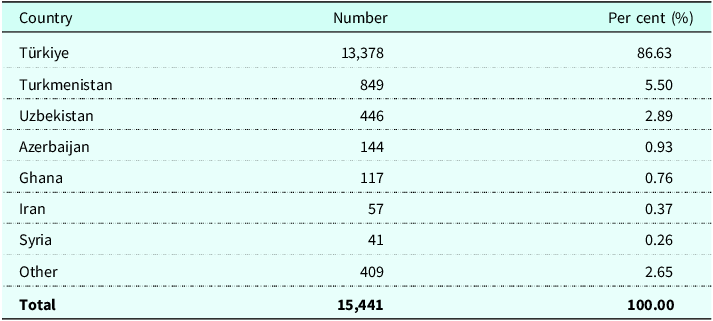
Women account for more than 95 per cent of migrant caregiver profiles across the four platforms, confirming that platform-mediated migrant care work is highly feminised. Platforms allow filtering by nationality, reflecting and reinforcing ethnonational hierarchies. Migrants represent 13.4 per cent of all profiles (2,063 of 15,441), an overrepresentation relative to their estimated 6–7 per cent share of the national population (Tahiroğlu, Reference Tahiroğlu2022), consistent with global patterns in which migrant women’s labour is disproportionately channelled into low-wage, precarious, and informal work. The strong presence of Central Asian workers likely reflects hiring practices that favour linguistic and cultural affinity.
Syrians’ low platform share (0.26 per cent) does not indicate an absence from care labour but rather an exclusion from platform-visible care labour. Language barriers, bureaucratic obstacles, and stigma likely concentrate Syrian workers in more informal and clientelist recruitment channels that platform data cannot capture. This pattern is also consistent with the broader literature highlighting the class-based integration of Syrians (Karaoğlu and Nawyn Reference Karaoğlu and Nawyn2025, p. 76) and the concentration of low-skilled workers in risky agricultural and other sectors that local workers are usually unwilling to undertake (Dedeoğlu and Bayraktar, Reference Dedeoğlu, Bayraktar, Williams, Coşkun and Kaşka2020).
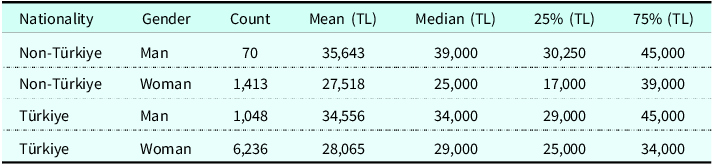
Of 13,164 profiles with wage data, 74 per cent indicate a preference for full-time roles, suggesting the market remains organised around regular work and household integration rather than gig-style flexibility. Wage expectations vary significantly by nationality and gender: migrant workers post lower and more dispersed expectations than Turkish workers, and men list higher wages than women across both groups, a pattern consistent with the racialised and gendered segmentation of care labour documented in the literature (Anderson, Reference Anderson2010; Parreñas, Reference Parreñas2015).
Non-Turkish workers cluster around a mean of 27,901 TL and a median of 25,000 TL, with a wider interquartile range (17,000–39,000 TL) than that of their Turkish counterparts.Footnote 2 This suggests downward wage pressure alongside selective upward mobility for workers with particular skills or longer settlement histories. These patterns echo European findings on racialised precarity in platformised care (Rodríguez-Modroño et al., Reference Rodríguez-Modroño, Agenjo-Calderón and López-Igual2022).
Legal status disclosures reveal a further layer of this segmentation. Among migrant profiles, 8.5 per cent mention a residence permit, only 0.5 per cent mention a work permit, and 1 per cent explicitly state they lack a residence permit. More than 90 per cent remain silent on legal status altogether, a silence that is itself analytically significant. It points to a platform environment in which workers become visible to employers without fully disclosing their legal position, lowering entry barriers while shifting compliance risk onto households and workers themselves.
Workers appear to navigate this ambiguity strategically. Migrant caregivers are more likely to mention residence permits than work permits, deploying legal residence as a trust signal while avoiding disclosures that might restrict employment options. This is illustrated by profiles that explicitly distance workers from the category ‘kaçak’ (illegal):
‘I have been in Türkiye for 5 years. I take care of parents, children, and do cleaning work…I am not kaçak; I have a residence permit. I am looking for a daytime job.Footnote 3 ’
Read through the lens of deportability, legal status functions here less as a transparent legal category than as a selective visibility resource. Profiles mentioning work permits tend to list higher and less variable wage expectations, and those mentioning residence permits report substantially higher mean wage expectations (39,739 TL) than those that do not (27,483 TL). Only 1.2 per cent of migrant profiles explicitly express a desire for a work permit, suggesting that strategic ambiguity may be more useful than full legal transparency in this segment of the care market.
These patterns place Türkiye’s care platforms within wider debates on informality and formalisation. As Schelkle and Kyriazi (Reference Schelkle and Kyriazi2025) argue regarding the European Care Strategy, top-down regularisation efforts often fail to resonate with migrant women, whose access to employment is built through informal ties. Türkiye exhibits a similar mismatch. Although a legal framework for employing migrant care workers exists on paper, low uptake of work permits and pervasive wage informality suggest that platform-mediated care continues to operate in legal grey zones. For both households and migrant workers, informality remains, while platforms formalise work to some extent.
Representation of care workers on care platforms
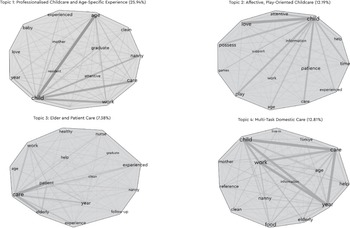
Biterm topic modelling identifies two main repertoires of self-presentation: a credentialist/professional repertoire encompassing experience, references, training, punctuality, language skills, and selective legal status cues, and an affective/relational repertoire centred on warmth, patience, cleanliness, and trust. These repertoires are not mutually exclusive; instead, they appear together. As Figure 1 illustrates, workers across social care domains craft hybrid personas that combine both in ways that vary systematically by service category. Childcare profiles emphasise pedagogy and relationality, blending educational language with motherhood. Elder and patient care stresses technical competence and recasts intimate bodily labour as quasi-clinical competence. Domestic work foregrounds multitasking and flexibility with assurances that everyday life will run smoothly.
Biterm topic modelling analysis of care worker profiles.

Figure 1. Long description
Panel A: A network graph titled Topic 1: Professionalised Childcare and Age-Specific Experience (25.94 percent) shows connections between words like experienced, age, child, care, work, and graduate. The words are arranged in a circular layout with lines indicating relationships. Panel B: A network graph titled Topic 2: Affective, Play-Oriented Childcare (12.19 percent) displays connections between words such as attentive, child, love, patience, and play. The words are arranged in a circular layout with lines indicating relationships. Panel C: A network graph titled Topic 3: Elder and Patient Care (7.38 percent) shows connections between words like healthy, nurse, patient, care, elderly, and experience. The words are arranged in a circular layout with lines indicating relationships. Panel D: A network graph titled Topic 4: Multi-Task Domestic Care (12.81 percent) displays connections between words such as child, work, care, age, and food. The words are arranged in a circular layout with lines indicating relationships.
Across domains, credential-signalling clusters combine degree claims and punctuality with selective legal status cues, while maternal-identity clusters present motherhood itself as an experiential qualification. In all cases, workers produce a hybrid persona, part professional and part affective, that the platform interface appears to reward. This hybrid persona is not simply a worker preference. It reflects the structural logic of platforms that rely on static profiles as the primary mechanism for worker self-representation and trust building. In the absence of institutional quality assurance and regulatory frameworks, workers bear the burden of constructing credibility individually, translating education or other material skills, as well as moral character or maternal identity, into signals that increase hireability.
These dynamics are most visible in patterns of cultural alignment. Cooking is a strongly gendered self-presentation strategy: of 2,927 users who mention it, 93.7 per cent are women, and migrant women do so at more than twice the rate of Turkish women (36.6 per cent vs 17.3 per cent), indicating stronger pressure to present as culturally versatile, all-in-one domestic workers. Approximately 10.6 per cent of migrant workers specifically mention ‘cooking Turkish food’. This disclosure functions less as a practical skill claim than as a signal of cultural compatibility and increased employability:
I have been in Türkiye for 1 year. I have always cared for single mothers. I cook Turkish dishes well. I can also work during the day.Footnote 4
I am very proficient in Uzbek cuisine and can cook some Turkish dishes as well. I can easily prepare unfamiliar recipes by following instructions or looking them up on YouTube.Footnote 5
In other words, migrant women are compelled to signal cultural fit through cuisine, while Turkish women are not. This illustrates how racialised hierarchies of trustworthiness are reproduced within platform architectures that present themselves as neutral matching technologies. Related disclosures reinforce this pattern: 1.5 per cent of migrant users mention marriage to Turkish citizens, and those reporting years of residence cluster around 3–10 years, which is long enough to navigate informal work, but not enough to access formal employment pathways. These disclosures position workers as integrated into the labour market as care workers but not yet entitled to formal protections.
I have been in Türkiye for 3 years. I live here with my husband; my children are back in my home country. My husband is Turkish. I speak Turkish well and can cook Turkish dishes at an intermediate level…I am currently looking for a live-in job as a house helper or elderly caregiver.Footnote 6
Language operates in a structurally similar way. Nearly all migrant profiles are written in Turkish. Not surprisingly, this reflects the economic necessity of signalling integration to predominantly Turkish-speaking employers. The rare English-language profile reveals the limits of this logic. While it may appeal to cosmopolitan households that prefer English-speaking child carers, it risks excluding the worker from mainstream demand, making language a double-edged mechanism of both distinction and marginalisation:
Hi, I’m a university graduate from Thailand. I have lived in Istanbul since 2015 (married to my Turkish husband) and am fluent in English. Due to my limited Turkish, I prefer to speak English with your kids. I’m trustable, non-smoker, patient, polite and most importantly I love kids, and kids love me :) You can be sure that I’ll make your children happy and we will spend quality time together.Footnote 7
Affective descriptors, such as titiz (meticulous), şefkatli (compassionate), and merhametli (kind-hearted), reveal a further dimension of this informal credentialing. Turkish women invoke affective terms most frequently (6.55 per cent vs 2.58 per cent of migrant women), suggesting that migrant women, facing greater market pressure, tend to foreground adaptability and professional competence rather than emotional disposition. Among men, the pattern reverses: migrant men reference affective qualities slightly more often than Turkish men (6.52 per cent vs 5.57 per cent), pointing to a strategic deployment of affective language to overcome gendered and racialised barriers to entry in a feminised care market. The following quote is an example of affective self-representation, while Table 3 summarises the use of affective terms by care workers.
I am 43 years old, married, and my husband is back in our home country. I am a mother of six children… I have been working in Türkiye for 7 years… For me, family is more important than work. I am a meticulous, organised, responsible, and positive person.Footnote 8
Country of origin

Table 1. Long description
A table titled ‘Country of origin’ with three columns: Country, Number, and Per cent (%). The table has 9 rows including a total row. Row 1: Türkiye, 13,378, 86.63 percent. Row 2: Turkmenistan, 849, 5.50 percent. Row 3: Uzbekistan, 446, 2.89 percent. Row 4: Azerbaijan, 144, 0.93 percent. Row 5: Ghana, 117, 0.76 percent. Row 6: Iran, 57, 0.37 percent. Row 7: Syria, 41, 0.26 percent. Row 8: Other, 409, 2.65 percent. Row 9: Total, 15,441, 100.00 percent.
Full-time salary expectations by gender and nationality group (5% trimmed)

Table 2. Long description
The table presents full-time salary expectations categorized by gender and nationality, with data points including count, mean, median, 25th percentile, and 75th percentile in Turkish Lira (TL). The table has four rows and six columns. Column headers are Nationality, Gender, Count, Mean (TL), Median (TL), 25% (TL), and 75% (TL). Row 1: Non-Türkiye, Man, 70, 35,643, 39,000, 30,250, 45,000. Row 2: Non-Türkiye, Woman, 1,413, 27,518, 25,000, 17,000, 39,000. Row 3: Türkiye, Man, 1,048, 34,556, 34,000, 29,000, 45,000. Row 4: Türkiye, Woman, 6,236, 28,065, 29,000, 25,000, 34,000.
Use of affective terms by care workers

Table 3. Long description
The table presents the use of affective terms by care workers, categorized by gender and country. It has three columns: Gender, Turkey, Other Countries, and Total. The rows are labeled Woman and Man, with a Total row at the bottom. Row 1: Woman, 764, 51, 815. Row 2: Man, 96, 6, 102. Row 3: Total, 860, 57, 917.
Motherhood emerges as the most revealing credential. Of 1,655 users referencing parenthood, 93 per cent are women; Turkish women constitute 83 per cent of this group, reflecting the cultural weight of ‘anne’ (mother) identity as a moralised qualification for care work in the Turkish context. That migrant women (17 per cent) similarly mobilise maternal status to align with local expectations illustrates how informal care regimes (which rely on personalised trust rather than professional certification) incentivise workers to comply with dominant gender scripts rather than assert occupational standing. Men, particularly migrant men, almost never reference fatherhood, reinforcing the near-total feminisation of care identity on these platforms and the structural invisibility of men who do enter this labour market.
Workers also deploy ethnicity, religion, and social networks as trustworthiness signals. The following quotes show workers invoking Turkic identity to counter xenophobia, foregrounding religiosity, or citing personal references as informal social proof.
I am a high school graduate…I have work experience. I speak Arabic and Turkish. I am from Syria, I am Turkmen, and I speak a little English.Footnote 9
I am a compassionate, respectful, and affectionate person. I regard your parents as if they were my own.Footnote 10
Others foreground religiosity (‘I wear a headscarf’; ‘I perform daily prayers’) or rely on references as informal social proof. These varied disclosures reveal the layered politics of visibility on care platforms, as workers selectively draw on ethnicity, religion, morality, and social networks to construct respectability and navigate an unequal, exclusionary digital labour market.
Taken together, these patterns reveal that platform-mediated care markets do not simply reflect pre-existing social inequalities. They actively (re-)organise them. The absence of formal credentialing, wage floors/levels, and regulatory oversight push workers to construct trustworthiness through identity performance, blending professional and affective credentials. Overall, platform frameworks treat care matching as a neutral market transaction, systematically externalising the costs of trust building onto the most precarious workers, while leaving unaddressed the structural conditions, such as informal care regimes or weak enforcement of PEA structures, that generate these pressures in the first place.
Conclusion
Care platforms in Türkiye operate at the intersection of marketisation, migration governance, and platformisation, reflecting wider shifts in how reproductive labour is organised and governed. Although platforms promise efficiency and visibility, they extend informality and displace compliance burdens onto workers and households. By formalising visibility rather than employment, they improve access to care while leaving existing precarities structurally intact. These precarities are not uniformly distributed. Gendered and racialised hierarchies shape wages and job access, and platform design reinforces rather than mitigates them. This is especially true for migrant women, for whom the ability to signal trustworthiness through verified profiles, Turkish language fluency, or proof of residence becomes a form of marketable care capital, while deportability operates as an everyday mechanism of labour discipline.
Workers nonetheless exercise strategic agency, deploying professional and affective credentials together to enhance their visibility and employability. Although these adaptations create real opportunities, they simultaneously reproduce the gendered and racialised expectations that structure their precarity in the first place. Furthermore, visibility on care platforms is not neutral. It is stratified by legal status, nationality, gender, and cultural capital. Workers who can signal formal authorisation or linguistic integration gain access to better-paid and more stable placements. Those who cannot are pushed toward lower-wage positions or excluded from platform-mediated work altogether. Precarity is not a by-product of these platforms but a structural feature of how care labour is governed.
The findings point to several policy priorities. First, platform-mediated care currently falls outside clear regulatory oversight, despite platforms operating as registered PEAs. Updating and enforcing a regulatory framework, along the lines of the EU Platform Work Directive, is necessary. Second, the scarcity of work permits relative to evident demand for care workers creates the conditions for informality that platforms normalise. Expanding accessible pathways to work authorisation would reduce structural vulnerability. Third, the wide wage disparities documented across nationality and gender groups point to the need for minimum wage standards and transparency requirements specific to platform-mediated care. Underlying all of these, however, is the care gap itself. As long as formal provision covers only a limited share of need, households will continue to rely on informal platform-mediated arrangements regardless of regulatory reform.
Care platforms are a key arena in which marketisation, digitalisation, and social inequality are reshaping the governance of social reproduction. Platform-based migrant care workers remain a hard-to-reach population whose working conditions and trajectories are largely invisible to researchers and policymakers alike. Future research combining platform data with fieldwork could examine how platforms and labour connect in practice and situate care platforms within wider welfare and migration systems to inform more effective policy responses.
Funding statement
This research did not receive any specific grant funding.
Competing interests
The authors declare no conflict of interest.


 Open access

