1. Introduction
Mine closure is the process of decommissioning a mine site after operations have ceased, including the removal of infrastructure and stabilisation of the pit(s), land, and tailings (Monosky & Keeling, Reference Monosky and Keeling2021). A mine is typically categorised as closed when production has ended; however, this classification can imply various states, including formally closed, informally closed or abandoned, or under care and maintenance, where operations are temporarily suspended waiting for better market conditions for improved economic viability (Measham et al., Reference Measham, Walker, Haslam Mckenzie, Kirby, Williams, D'Urso, Littleboy, Samper, Rey, Maybee, Brereton and Boggs2024). A mining project can also be considered inactive when productive activities cease, often resulting in abandonment. By 2020, mines under care and maintenance accounted for approximately 10% of global operating projects registered in the S&P database, while inactive projects represented nearly 60% of the total. In contrast, only 8% were formally listed as closed, raising concerns regarding long-term liabilities across the sector (Lèbre et al., Reference Lèbre, Owen, Stringer, Kemp and Valenta2021).
Regulations and standards for mine closure planning vary considerably across jurisdictions. Only Chile, Peru, and two Canadian provinces have established specific legislation on mine closure beyond general environmental protection and land rehabilitation requirements (Vivoda et al., Reference Vivoda, Kemp and Owen2019). In many jurisdictions, weak regulatory enforcement combined with limited penalties has led companies to leave behind significant ecological, social, and economic legacies. Furthermore, the abrupt nature of closure-related decisions, often driven by market factors, leads to poorly planned closure strategies (Lèbre et al., Reference Lèbre, Owen, Stringer, Kemp and Valenta2021). Overall, the lack of clear regulatory baselines presents complex challenges for companies, governments, and communities in mining regions (Monosky & Keeling, Reference Monosky and Keeling2021). With more than 400 mining operations projected to close globally over the next decade, including several coal mines set to close for climate mitigation reasons, the urgency of closure challenges cannot be overstated (Measham et al., Reference Measham, Walker, Haslam Mckenzie, Kirby, Williams, D'Urso, Littleboy, Samper, Rey, Maybee, Brereton and Boggs2024).
Mine closure generates multiple impacts on landscapes and communities, including physical, environmental, and social consequences. Traditionally, closure practice has mainly focused on prioritising physical and environmental impacts, in most cases, reflecting regulatory requirements (Monosky & Keeling, Reference Monosky and Keeling2021). In contrast, the socio-economic impacts of mine closure on local economies, employment, public goods delivery, and livelihoods have received much less attention across policy and practice (Fleming-Muñoz et al., Reference Fleming-Muñoz, Campbell, Ley, Arratia-Solar, Aroca, Atienza, Dogan, Ghosh, James, Kumral, Measham, Sarr, Shahbaz, Wang and Weber2024). This, in turn, presents a critical gap for mining-dependent communities to plan post-closure transition options. Stronger regulatory structures are thus needed to effectively manage the social and economic risks associated with mining legacies and to ensure that mining benefits are maximised to help plan regional development beyond closure (The World Bank, 2021). Ineffective closure planning often disrupts economic and ecological systems, exerting significant pressure on governments and local communities in mining regions to bear long-term harm (Bainton & Holcombe, Reference Bainton and Holcombe2018).
Access to water and energy services is particularly critical in supporting socio-economic transitions after mine closure. Remote mining regions face service pressures far more acutely due to limited connectivity and infrastructure constraints, resulting in reliance on mining operations for access to basic services such as water and energy (Papapostolou et al., Reference Papapostolou, Kondili, Zafirakis and Tzanes2020). As operations approach closure and regulations require mine infrastructure decommissioning, disruption to water and energy access for local communities can present a critical socio-economic challenge (Owen & Kemp, Reference Owen and Kemp2018; Vivoda et al., Reference Vivoda, Kemp and Owen2019). Unreliable or unaffordable service provision, in the presence of fragmented planning processes, can exacerbate existing vulnerabilities in remote mining regions (United Nations Development & Environment Programme, 2018).
For these reasons, scholars have encouraged considering mine closure-triggered socio-economic risks early in the mine planning and design stages (Bainton & Holcombe, Reference Bainton and Holcombe2018; Sutrisno et al., Reference Sutrisno, Lee, Suhardono and Suryawan2024). Research has also emphasised that strategies to address the socio-economic impacts of closure require coordinated efforts among stakeholders in the territory, including mining companies, governments, utility providers, and local communities (Owen & Kemp, Reference Owen and Kemp2018). To advance efforts, the International Council on Mining and Metals (ICMM) developed guidance on mine closure with recommendations for early and participatory planning. The ICMM guidance identifies opportunities for closure strategies to leverage mining assets, including water and energy infrastructure, to support local economic development. However, unclear regulations for closure and limited understanding of socio-economic challenges have impeded access to critical services in post-closure contexts (International Council on Mining and Metals, 2019).
Integrating water and energy systems is crucial to designing effective supply solutions in mine closure contexts. Planning strategies that consider local needs, capabilities, institutions, and regulations can support reliable and affordable access to interdependent energy and water services post-mining (Carvalho, Reference Carvalho2017). Nevertheless, policy fragmentation and limited coordination between water and energy governance structures have hindered integrated planning of supply systems in various contexts (De Oliveira et al., Reference De Oliveira, Bertone and Stewart2022). Robust governance and flexible regulatory and planning frameworks can support closure strategies that ensure secure access to essential services post-mining (MMSD, 2002).
To address these challenges, this article makes three key contributions. First, it analyses water and energy dynamics during mine closure to identify critical socio-economic needs post-mining. Second, it examines approaches to plan reliable and affordable access to energy and water services through a conceptual framework for integrated service planning in mine closure contexts. Third, it discusses the opportunities and limitations of planning integrated supply strategies to support socio-economic transition in mining regions. The conceptual framework proposed highlights the importance of extending conventional mine site-focused closure planning to account for local and regional dynamics. In doing so, the framework supports mine closure planning to better align with local community needs, regional water and energy system constraints, and institutional capability to navigate complex change.
2. Water and energy dynamics in mine closure contexts
The global dynamics of water and energy challenges are driven by shifts in demographic, climatic, and economic trends (Lee et al., Reference Lee, Khanal and Bakshi2021). Climatic events have impacted the vulnerability of water and energy systems by disrupting water reservoirs and energy infrastructure, and reducing water availability, while supply pressures have continued to exacerbate (IPCC, Reference Field, Barros, Stocker and Dahe2012). The mining sector is particularly intensive in its water and energy use, often leading to the degradation of local water and energy sources (Carvalho, Reference Carvalho2017). The multiple water and energy challenges in mining regions have led to unsustainable supply solutions to support local activities, which, in turn, have disrupted landscapes and livelihoods (IPCC, Reference Field, Barros, Stocker and Dahe2012).
Mining impacts on water and energy sources arise from the outset of extractive projects, generating negative consequences for local socio-economic dynamics that extend beyond mine closure (Carvalho, Reference Carvalho2017). Mine sites are often located in remote areas with limited access to infrastructure. In these territories, the intensive use of water and energy to sustain extractive activities has led to environmental degradation and depletion of water sources, impacting the security of supply for local users (Christmann, Reference Christmann2017). Over half of the industry’s energy needs are supplied by burning diesel, gas, and coal, with consequent social and environmental impacts from the emissions they produce (Maennling & Toledano, Reference Maennling and Toledano2018). Likewise, intensive use of water sources has led to resource exhaustion, thus reducing water availability to sustain local needs, while, less frequently, contamination and leaks from tailings have had dire consequences for people and the environment (Kemp et al., Reference Kemp, Bond, Franks and Cote2010).
The impacts of mining activities on water and energy systems are exacerbated by the often high climatic vulnerability of the territories where some mines operate. Changes in climatic conditions have led to more frequent and extreme climatic events, such as droughts, cyclones, and heat waves, with severe consequences for water and energy systems. While droughts directly impact water availability, heat waves increase demand for both water and energy services, and cyclones affect the security of water and energy supply infrastructure. These consequences are particularly acute in remote and arid mining territories (IPCC, Reference Field, Barros, Stocker and Dahe2012).
The mining sector’s efforts to address water and energy challenges have mainly focused on optimising consumption efficiency and reducing emissions and wastewater from operations, mostly to comply with regulatory requirements in host jurisdictions (Measham et al., Reference Measham, Walker, Haslam Mckenzie, Kirby, Williams, D'Urso, Littleboy, Samper, Rey, Maybee, Brereton and Boggs2024; Owen & Kemp, Reference Owen and Kemp2018). While these strategies have improved resource availability for mining operations, competition over local water sources remains a significant driver of conflict in remote mining territories worldwide. In fact, balancing water use for mining activities while ensuring sustained and affordable availability for local use is one of the main sustainability challenges for the industry (Kemp et al., Reference Kemp, Bond, Franks and Cote2010).
The closure of mining operations entails additional challenges for access to water and energy services in remote, climate-vulnerable territories. Mining companies often provide water and energy supply for surrounding communities, including those that existed before mining and those developed as a result of mining activity (Monosky & Keeling, Reference Monosky and Keeling2021). However, in jurisdictions where the closure of mining operations entails decommissioning related infrastructure, mine closure can affect local access to water and energy services critical to sustaining socio-economic well-being post-mining (Owen & Kemp, Reference Owen and Kemp2018).
There are cases where mining companies have developed solutions for water and energy supply post-closure, mainly driven by government negotiations and social license to operate benefits. The water system developed by Ashanti Geita mine in Tanzania is such an example. However, these solutions have typically had limited success given their poor alignment with local needs and the economic and technical requirements for their effective operation post-mining (Toledano & Roorda, Reference Toledano and Roorda2014). Infrastructure developed for local communities’ use can become a liability after closure if their needs and capabilities are not adequately considered in early planning and design (Owen & Kemp, Reference Owen and Kemp2018). Furthermore, unclear responsibilities for service provision after closure risk turning mining companies into guarantors of supply, furthering community dependence on external organisations. This welfare dependency on the mining industry can lead to a reduced interest in pursuing alternative economic strategies post-closure, deepening the challenges of economic transition for impacted communities (Sutrisno et al., Reference Sutrisno, Lee, Suhardono and Suryawan2024).
With limited regulations and standards for mine closure planning, service supply strategies to support development needs post-closure remain lacking. This underscores the pressing need for robust frameworks and clear responsibilities to guide an effective process (Owen & Kemp, Reference Owen and Kemp2018). To address these challenges, the United Nations sourcebook for sustainable mining practices promotes shared-use infrastructure for water and energy supply, encouraging access to services that can support the economic transition of mining-dependent communities after closure. The sourcebook encourages governments to participate in these efforts to bolster their capacity to provide public goods for local well-being post-mining (United Nations Development & Environment Programme, 2018). One successful example of shared-use infrastructure is the Cerro Verde mine in Peru. After consulting with local communities and government agencies, the mining company built a wastewater treatment plant to support the expansion of mining operations while ensuring local water treatment, promoting mutual benefits (Fraser, Reference Fraser2019). While a relevant example, the plan for managing water infrastructure after mine closure has not yet been defined.
Transferring shared-use infrastructure under the right supporting conditions can enable mining benefits to continue after closure (Toledano & Maennling, Reference Toledano, Maennling and Lodhia2018). The mining company Ma’aden in Saudi Arabia offers a noteworthy example of infrastructure transfer. Early planning for shared-use infrastructure, involving a partnership between the company and state-owned electricity and water providers, enabled alignment of mining and community needs, resulting in a joint power and desalination facility. The desalination plant is now owned, operated, and maintained by the state utility companies, supplying reliable services to local communities. In many cases, mining companies have transferred excess water to local users, particularly in underground wet mines that require its removal. In the US, for instance, the Resolution Cooper wet mine partnered with local irrigators to treat excess mining water for use in agricultural production, extending beyond closure (Toledano & Roorda, Reference Toledano and Roorda2014).
Overall, unclear regulations, a lack of incentives, and uncertainties around the provision of water and energy in mining territories limit the inclusion of long-term supply solutions as part of early mine closure planning (Maennling & Toledano, Reference Maennling and Toledano2018). A comprehensive understanding of resource dynamics in mine closure contexts is critical to embed solutions for post-mining energy and water supply at the earliest stage of mine closure strategy making (United Nations Development & Environment Programme, 2018).
3. Sustainable water and energy supply
Challenges to access secure water and energy services have been recognised in Sustainable Development Goals (SDGs) 6 and 7. Thus, the World Water Council recommends securing an adequate quantity and quality of water through an affordable and safe supply (World Water Council, 2021). Likewise, the World Energy Council suggests ensuring a reliable energy access to meet current and future demand through affordable services and clean energy sources (World Energy Council, 2024).
In practice, most strategies to address increasing water and energy demands have prioritised cost-efficient solutions over ensuring service quality and resource availability, thereby affecting overall supply security (Williams et al., Reference Williams, Bouzarovski and Swyngedouw2018). Siloed approaches to planning water and energy access pose additional challenges to supply security, as their complex interactions can intensify demand in one sector when demand in the other sector increases (Scott et al., Reference Scott, Pierce, Pasqualetti, Jones, Montz and Hoover2011). For example, desalination plants developed to ensure a reliable water supply in remote water-constrained regions are energy-intensive interventions. Due to the intermittency of renewable energy technologies and the high cost of battery systems, remote desalination plants often rely on polluting diesel generators (De Oliveira et al., Reference De Oliveira, Bertone and Stewart2022; Scott et al., Reference Scott, Pierce, Pasqualetti, Jones, Montz and Hoover2011). Ultimately, siloed solutions have exacerbated the challenges of providing reliable and affordable services to remote populations, often leading to overexploitation of resources and unintended inequity in service access (Hussey & Pittock, Reference Hussey and Pittock2012).
An integrated planning approach that accounts for the dynamics among systems can yield economic and environmental benefits while addressing complex access and security challenges. Scholars have argued that a systems approach to designing water and energy supply structures helps optimise resource use, thereby maintaining their quality and quantity to sustain long-term social, economic, and ecosystem needs (Lee et al., Reference Lee, Khanal and Bakshi2021; Van Dijk, Reference Van Dijk, Pittock, Hussey and Dovers2015). Furthermore, stakeholder participation in the design of these solutions can promote alignment with local needs, capabilities, and financial constraints, while collaboration between institutions responsible for resource management can support ongoing equity in resource allocation and management (Carvalho et al., Reference Carvalho, Spataru and Bleischwitz2019; Oliver & Hussey, Reference Oliver, Hussey, Pittock, Hussey and Dovers2015; Scott et al., Reference Scott, Pierce, Pasqualetti, Jones, Montz and Hoover2011). Drawing on these observations, this research proposes a comprehensive, participatory, and coordinated approach to planning water and energy access, aiming to support reliable and affordable service provision in mine closure contexts.
A critical aspect of integrated resource planning is access to robust information on the factors that condition water and energy supply and demand. A comprehensive understanding of the socio-ecological dynamics surrounding water and energy needs, and their distribution across host territories, is crucial for balancing equitable access with efficient use. Moreover, understanding the scale of challenges and the time frames involved influences the extent to which solutions can adapt to regional and local needs, including those of communities, industries, and ecological systems (Van Dijk, Reference Van Dijk, Pittock, Hussey and Dovers2015). Techno-economic limits and opportunities around supply and demand are important considerations when designing solutions tailored to the local context (De Oliveira et al., Reference De Oliveira, Bertone and Stewart2022).
Besides the factors identified above, a key barrier to the successful design and implementation of integrated energy and water supply systems has been the lack of stakeholder engagement. Participatory design involving regulators, users (communities and industry), and investors can balance environmental protection, economic development, and equitable access to resources (Scott et al., Reference Scott, Pierce, Pasqualetti, Jones, Montz and Hoover2011). Furthermore, understanding the roles and capabilities of various government agencies, which introduce diverse administrative complexities, can help navigate the challenges of operating and maintaining supply solutions after mine closure (Hussey & Pittock, Reference Hussey and Pittock2012; UN-Water, 2014). In remote communities, governments are often expected to encourage alliances and support reliable and affordable public goods such as energy and water. Multistakeholder working groups led by government agencies, such as the European Innovation Partnership on Water, as a case in point, could be a suitable configuration for integrated resource planning, both at the national and local scales (UN-Water, 2014).
Finally, isolated institutions and fragmented regulations in water and energy governance have been noted to pose significant barriers to the implementation of integrated systems (Scott et al., Reference Scott, Pierce, Pasqualetti, Jones, Montz and Hoover2011). As water is often managed at the local or basin level through multiple institutions, while energy is managed at the regional or national scale, their integration is a complex process with regard to balancing supply and demand (De Oliveira et al., Reference De Oliveira, Bertone and Stewart2022). Adequate instruments and incentives are required to encourage cross-scale coordination between institutions responsible for water and energy governance. Moreover, recognising the impacts of water policies on energy pricing and demand, and vice versa, enables the identification of pathways to integrate trade-offs into policy instruments to ensure both reliability and affordability (Scott et al., Reference Scott, Pierce, Pasqualetti, Jones, Montz and Hoover2011). Bridging institutions, such as inter-ministerial committees or independent bodies, with influence at national and regional scales, may offer a suitable architecture for co-designing resource governance schemes (Oliver & Hussey, Reference Oliver, Hussey, Pittock, Hussey and Dovers2015).
This article proposes three crucial criteria for the effective design, implementation, and management of integrated water and energy systems (see Table 1). First, a comprehensive analysis of social, ecological, economic, technical, and institutional factors around water and energy challenges to guide the design of feasible solutions. Second, stakeholder participation in decision-making to promote solutions aligned with local needs and capabilities, guiding reliable and affordable access to services. Third, strategies to support coordination for intersectoral management and governance of water and energy systems to enable effective operations in the long term.
Table 1.Criteria for integrated planning of water and energy systems
Table 1 Long description
The table presents criteria for integrated planning of water and energy systems, focusing on comprehensive analysis, stakeholder participation, and coordinated governance. It highlights challenges such as multidimensional analysis, aligning solutions with local needs, and managing fragmented regulations. Strategies to overcome these challenges include understanding local contexts, engaging stakeholders, and identifying common institutional goals. The table emphasises the importance of robust local context understanding and stakeholder engagement in designing effective solutions, while coordinated governance requires clear institutional goals and policy instruments.
4. Integrated planning of water and energy strategies in mine closure contexts
Despite being a critical stage in the mining lifecycle, mine closure has received insufficient industry and government attention. Closure processes and outcomes have remained inconsistent due to a lack of clear standards and regulations, and poor acknowledgement of the need to identify and address the full scale of socio-economic impacts from the closure of longstanding mining operations (Monosky & Keeling, Reference Monosky and Keeling2021). For remote communities facing closures, maintaining access to a reliable and affordable water and energy supply has been a particularly pressing challenge (Measham et al., Reference Measham, Walker, Haslam Mckenzie, Kirby, Williams, D'Urso, Littleboy, Samper, Rey, Maybee, Brereton and Boggs2024).
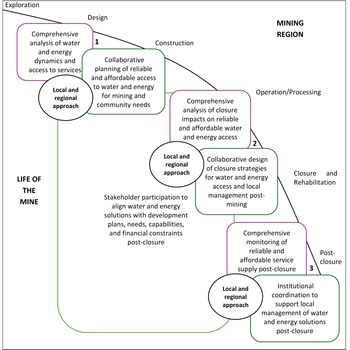
This article proposes a conceptual framework for the integrated planning of water and energy solutions after mine closure (Figure 1). The framework adopts an iterative planning approach, encouraging the integration of water and energy needs in mine closure plans through all stages of the mining lifecycle. It builds on the criteria for integrated water and energy systems outlined in Table 1 to ensure solutions align with the local context, including socio-economic and environmental dynamics, and in-house capabilities for effective post-mining operations of proposed solutions. The framework also mainstreams a focus on governance considerations that extend beyond the mine site but are necessary for developing practical solutions to address energy and water challenges in mine closure contexts.
Figure 1.Conceptual framework for integrated planning of water and energy strategies post-closure.
Figure 1 Long description
A flowchart illustrating the integrated planning of water and energy strategies throughout the mining lifecycle. It includes stages such as exploration, design, construction, operation, closure and post-closure. Key elements are: 'Comprehensive analysis of water and energy dynamics and access to services' during exploration; 'Collaborative planning of reliable and affordable access to water and energy for mining and community needs' in design; 'Comprehensive analysis of closure impacts on reliable and affordable water and energy access' during construction; 'Collaborative design of closure strategies for water and energy access and local management post-mining' in operation/processing; 'Comprehensive monitoring of reliable and affordable service supply post-closure' during closure and rehabilitation; and 'Institutional coordination to support local management of water and energy solutions post-closure' in post-closure. Each stage emphasizes a 'Local and regional approach' and stakeholder participation to align solutions with development plans, needs, capabilities and financial constraints post-closure.
Figure 1 conceptualises the integration of energy and water systems in territories facing mine closure. It entails three stages. First, a comprehensive analysis of water and energy dynamics at local and regional scales, undertaken by the mining company, to curate the technical, socio-economic, and environmental conditions that will likely influence a reliable and affordable supply of services. This process involves engagement between companies and government institutions responsible for water and energy planning to align mining company strategies and operational systems with local community needs. Second, the company analyses how mining activities may affect secure access to services throughout the life of the mine to inform effective closure strategies. The government agency responsible for mine closure engages local and regional institutions, the mining company, and affected stakeholders in the design and implementation of post-closure energy and water solutions, aligning with local plans, needs, and capabilities. The final stage focuses on institutional coordination between regional and local government agencies, the mining company, and local communities to identify and support community-managed solutions, with resource commitments to ensure effective operation and monitoring beyond closure.
4.1. Comprehensive analysis
The closure of mining operations is a significant challenge for communities and authorities, given its multidimensional implications at the local and regional scales. Mine closure planning is often considered at the end of the mining project, separately from operations, which not only leads to poor coordination but also to high costs due to an inadequate understanding of potential closure-specific impacts (Measham et al., Reference Measham, Walker, Haslam Mckenzie, Kirby, Williams, D'Urso, Littleboy, Samper, Rey, Maybee, Brereton and Boggs2024). Early and coordinated planning for closure throughout the life of the mine, as proposed in the conceptual framework, can proactively address potential legacy issues while balancing the cost-efficiency of closure solutions for mining companies. In practice, when closure teams actively collaborate with operational, financial, and social areas within the company, they can enable effective mine closure processes that adapt to both expected and unexpected changes across the business and within the territory (MMSD, 2002; Owen & Kemp, Reference Owen and Kemp2018).
Analysing place-based interactions among environmental, socio-economic, and technical dynamics is another vital step in recognising the complexity of mine closure impacts and in planning strategies to address negative consequences for communities and ecosystems. This is particularly relevant in water management, where mine closure experiences have revealed mismatches between water management at the mine site and interactions with wider watershed processes and socio-economic dynamics (Measham et al., Reference Measham, Walker, Haslam Mckenzie, Kirby, Williams, D'Urso, Littleboy, Samper, Rey, Maybee, Brereton and Boggs2024). By considering the influence of national and regional regulations on closure-related decisions, industry initiatives for water and energy supply can ensure effective operations after mine closure (International Council on Mining and Metals, 2025).
Capturing the interactions between water and energy dynamics in mining regions allows taking a novel systems-based approach to balancing resource use and guiding sustainable closure strategies for the industry. Past solutions for water and energy supply after mine closure have mainly focused on repurposing mining infrastructure for water storage and energy generation. In doing so, the vast majority of these initiatives have focused on the technical and environmental aspects with little to no consideration of local needs and capabilities necessary to sustain the management of public goods provision, such as energy and water, in post-closure scenarios (Frejowski et al., Reference Frejowski, Bondaruk and Duda2021; Winde, Reference Winde2020; Winde & Stoch, Reference Winde and Stoch2010).
Adopting a planning view that extends beyond the mine site can improve understanding of the broader socio-economic implications of mining activities, particularly in a closure context (International Council on Mining and Metals, 2019; MMSD, 2002). A compelling example of a systems approach is the Woodlawn mine in Australia, which repurposed a landfill into a bioreactor that processes 20% of Sydney’s organic waste to generate electricity, supporting the local council on waste management. Besides, the heat and compost generated from the process are recovered to support local agriculture and other economic activities post-closure. The success of this case was made possible by a robust analysis of local and regional waste management needs, mine infrastructure capacity, community concerns for a self-sustained post-mining future, and alignment with the mine’s rehabilitation commitments (Australian Government, 2016).
4.2. Collaborative design rooted in stakeholder participation
Mine closure can impact multiple stakeholder groups, including communities, service suppliers, and government agencies. Engaging all stakeholders in the design of closure strategies can yield viable solutions, share responsibilities, and promote lasting benefits, while improving mining companies’ reputation (Bainton & Holcombe, Reference Bainton and Holcombe2018). However, the lack of incentives and standards to incorporate stakeholders’ perspectives into mine closure strategies has been noted to hinder participatory processes. When engagement plans exist, they typically focus on supporting mining operations with limited scope for closure planning, as demonstrated in an analysis of mine closure plans in Canada. Yet, when participation is considered, it is often not actionable, with closure plans lacking strategies to address the socio-economic impacts of mine closure (Monosky & Keeling, Reference Monosky and Keeling2021).
Participatory closure planning requires more than consultation to ensure that stakeholders’ needs are accurately captured. Effective participation requires transparent dialogue about risks, impacts, and strategies, enabling informed decisions aligned with stakeholders’ interests. For effective closure practice, mining companies are expected to bolster closure teams’ work in line with these principles, promoting clear communication pathways and ensuring teams remain organised (Owen & Kemp, Reference Owen and Kemp2018). At the same time, with most operations lasting multiple decades, closure plans and initiatives require periodic updates to ensure changes to stakeholder representations, needs, and perceptions are incorporated in a timely, fair, and transparent manner (Sutrisno et al., Reference Sutrisno, Lee, Suhardono and Suryawan2024).
The ICMM handbook for multistakeholder approaches to support socio-economic transitions in mining regions aligns with these principles for participatory planning (International Council on Mining and Metals, 2025). Among the approaches proposed, collaborative planning between regional government institutions and mine closure consultative groups, including community organisations, has been found suitable for decision-making on access to water and energy services post-closure. Collaborative regional planning, supplemented with mine closure-focused consultation, can therefore support economic development strategies in mining territories aligned with post-closure local and regional aspirations.
As part of closure consultations, community participation can improve understanding of cultural values, needs, and capabilities for transitioning after mining, enabling service provision strategies to align with post-closure needs (Sutrisno et al., Reference Sutrisno, Lee, Suhardono and Suryawan2024). Moreover, when discussed early, opportunities may arise to co-develop schemes to transfer pre-existing mining infrastructure and operational expertise to community-managed assets, thereby strengthening local management skills (United Nations Development & Environment Programme, 2018). Governments often stand to benefit from participatory closure processes, when institutional plans for service provision can align with local needs and company strategies (Winde & Stoch, Reference Winde and Stoch2010). As a case in point, the successful economic transition to renewable energy in Germany, following the phasing out of coal mines and power plants, was underpinned by community-centred participatory decision-making processes and a supportive regulatory landscape (Measham et al., Reference Measham, Walker, Haslam Mckenzie, Kirby, Williams, D'Urso, Littleboy, Samper, Rey, Maybee, Brereton and Boggs2024).
Successful examples, although few and far between, are also present in less industrialised regions, where stakeholder cooperation has led to service solutions to address socio-economic development needs in mine-closure contexts. A noteworthy example is the case of the Bulyanhulu and Ashanti Geita mines in Tanzania, where water supply infrastructure was designed in coordination with local governments and communities to ensure sustainable and reliable water access post-mining. Yet, these cases have often given limited consideration to local capabilities to operate and maintain supply systems, leading to counterproductive solutions that create unintended harm. For example, the closure of the Mhangura mine in Zimbabwe significantly impacted water security, as communities lacked the financial and technical capacity to maintain the infrastructure left by the mining company (Toledano & Roorda, Reference Toledano and Roorda2014). These examples suggest that schemes for water and energy management in remote, less developed post-mining economies should consider factors beyond technology choices.
Efforts to strengthen organisational capability for effective management are essential, such as applying community-based resource management principles. Likewise, financial literacy through effective pricing structures that can generate revenue for operation and maintenance while enabling affordable tariffs is needed, but often overlooked, in building closure-focused collaboration and trust between mining companies, regulators, and local communities (UN-Water, 2014).
4.3. Coordinated governance
Apart from stakeholder engagement, adequate institutional capabilities and governance mechanisms are essential to guide effective closure solutions (MMSD, 2002). The World Bank developed a toolbox to guide governance frameworks for mine closure planning, which gives particular attention to the socio-economic aspects of mine closure, proposing repurposing mining facilities for energy and water supply post-mining (The World Bank, 2021). The toolbox reiterates that progressive closure planning from the early stages of the mining project can greatly reduce mine closure costs. Although useful, the tool mainly focuses on the national scale, which can be problematic, as a national perspective for planning water and energy strategies risks overlooking differences in needs, strengths, and resource use between urban and rural remote territories (Williams et al., Reference Williams, Bouzarovski and Swyngedouw2018).
Regulations and policy instruments for mine closure planning are critical to supporting communities transitioning post-mining. Specifically, agile regulatory instruments can support and incentivise water and energy systems to be core to post-closure planning, along with mechanisms to transfer infrastructure and build local capabilities for effective management after closure (The World Bank, 2021). In practice, policy and market instruments for resource planning can coordinate with closure plans to develop effective initiatives in mining territories, building complementarity between their strategies (United Nations Development & Environment Programme, 2018).
When developing interventions for institutional coordination, the scale of planning is an important concern. Coordination among entities responsible for water, energy, and mine closure planning at the national and subnational levels not only enables timely identification and effective management of interrelated challenges but also establishes clear lines of responsibility and accountability (MMSD, 2002). While mine closure is typically planned at the mine site, water management requires a watershed approach extending to local areas, and energy plans require a regional-to-national approach (Carvalho et al., Reference Carvalho, Spataru and Bleischwitz2019; Measham et al., Reference Measham, Walker, Haslam Mckenzie, Kirby, Williams, D'Urso, Littleboy, Samper, Rey, Maybee, Brereton and Boggs2024). Until a new institutional body is established to manage complex interdisciplinary functions, scholars suggest that adapting current institutions to be open to sharing information and responsibilities for collaborative planning can yield timely positive returns (Williams et al., Reference Williams, Bouzarovski and Swyngedouw2018).
Furthermore, negotiations have an important pragmatic place in closure contexts. In particular, governments are often expected to play an objective role in steering fair negotiations between mining companies, communities, and utility providers to enable effective operation schemes for water and energy infrastructure post-closure. A noteworthy example is the government’s efforts in the Democratic Republic of Congo, which facilitated private-public investments to upgrade the national electricity grid, ensuring a reliable supply for mining companies and communities. Companies, in turn, have entered into agreements with the electricity provider to deliver services at affordable prices to local communities, fostering a collaborative relationship (Toledano & Maennling, Reference Toledano, Maennling and Lodhia2018). Integrating institutions for water and energy management with flexible regulatory frameworks offers a pathway to manage trade-offs between environmental, socio-economic, and political complexities in post-mining contexts (Williams et al., Reference Williams, Bouzarovski and Swyngedouw2018). Institutional coordination broadens the scope to balance national and sub-national priorities for planning reliable and affordable supply strategies that support the development needs of communities in a post-mining future (MMSD, 2002).
5. Conclusion
Mine closure is an ongoing challenge for the mining industry, governments, and communities alike. The literature identifies significant challenges related to corporate liability, regulatory lapses, and the long-term socio-economic and ecological harm left behind for host communities to navigate. One particularly pressing issue is the potential disruption to the ongoing supply of reliable and affordable access to water and energy, two public goods necessary for effective post-mining transition planning.
This paper has argued that closure planning that entails siloed solutions for energy and water access is ineffective and, in fact, counterproductive. As such, we propose that energy and water system planning in mine closure contexts should move beyond site-level design and operation towards a more territorially embedded systems-based architecture. Our conceptualisation of this all-of-systems design is supported by a participatory and coordinated approach that incorporates stakeholder needs early in mine closure planning, which, in turn, can guide the design of effective strategies to support the socio-economic transition of communities after mine closure.
While mining companies have occasionally developed initiatives to improve community access to services, poor attention to the lack of adequate in-house technical and financial capability within the local community has hindered secure supply after closure. The conceptual framework proposed here addresses this fundamental flaw by integrating resource dynamics, stakeholder needs and capabilities, and governance requirements to mainstream integrated, adaptive thinking into closure planning. Such an approach can, in turn, support mining companies and regional planners in recognising the system-level nature of socio-economic impacts of mine closure that extend beyond the mine site, while strengthening communities’ capabilities to cope with mine closure-related pressures on energy and water access.
Building on this conceptual framework, two areas of further research are the obvious next step. The first is to ground-truth this framework and validate its relevance and applicability in mine closure contexts, particularly in remote climate-vulnerable regions. Second, a robust analysis that considers place-based ecological thresholds, resource interdependencies, and socio-economic vulnerabilities in mine-closure contexts will help establish stronger links between environmental stewardship and SDGs for the broader extractives sector.







 This is an Open Access article, distributed under the terms of the Creative Commons Attribution-NonCommercial-ShareAlike licence (http://creativecommons.org/licenses/by-nc-sa/4.0), which permits non-commercial re-use, distribution, and reproduction in any medium, provided the same Creative Commons licence is used to distribute the re-used or adapted article and the original article is properly cited. The written permission of Cambridge University Press or the rights holder(s) must be obtained prior to any commercial use.
 You have
Access
You have
Access
 Open access
1. Introduction
Mine closure is the process of decommissioning a mine site after operations have ceased, including the removal of infrastructure and stabilisation of the pit(s), land, and tailings (Monosky & Keeling, Reference Monosky and Keeling2021). A mine is typically categorised as closed when production has ended; however, this classification can imply various states, including formally closed, informally closed or abandoned, or under care and maintenance, where operations are temporarily suspended waiting for better market conditions for improved economic viability (Measham et al., Reference Measham, Walker, Haslam Mckenzie, Kirby, Williams, D'Urso, Littleboy, Samper, Rey, Maybee, Brereton and Boggs2024). A mining project can also be considered inactive when productive activities cease, often resulting in abandonment. By 2020, mines under care and maintenance accounted for approximately 10% of global operating projects registered in the S&P database, while inactive projects represented nearly 60% of the total. In contrast, only 8% were formally listed as closed, raising concerns regarding long-term liabilities across the sector (Lèbre et al., Reference Lèbre, Owen, Stringer, Kemp and Valenta2021).
Regulations and standards for mine closure planning vary considerably across jurisdictions. Only Chile, Peru, and two Canadian provinces have established specific legislation on mine closure beyond general environmental protection and land rehabilitation requirements (Vivoda et al., Reference Vivoda, Kemp and Owen2019). In many jurisdictions, weak regulatory enforcement combined with limited penalties has led companies to leave behind significant ecological, social, and economic legacies. Furthermore, the abrupt nature of closure-related decisions, often driven by market factors, leads to poorly planned closure strategies (Lèbre et al., Reference Lèbre, Owen, Stringer, Kemp and Valenta2021). Overall, the lack of clear regulatory baselines presents complex challenges for companies, governments, and communities in mining regions (Monosky & Keeling, Reference Monosky and Keeling2021). With more than 400 mining operations projected to close globally over the next decade, including several coal mines set to close for climate mitigation reasons, the urgency of closure challenges cannot be overstated (Measham et al., Reference Measham, Walker, Haslam Mckenzie, Kirby, Williams, D'Urso, Littleboy, Samper, Rey, Maybee, Brereton and Boggs2024).
Mine closure generates multiple impacts on landscapes and communities, including physical, environmental, and social consequences. Traditionally, closure practice has mainly focused on prioritising physical and environmental impacts, in most cases, reflecting regulatory requirements (Monosky & Keeling, Reference Monosky and Keeling2021). In contrast, the socio-economic impacts of mine closure on local economies, employment, public goods delivery, and livelihoods have received much less attention across policy and practice (Fleming-Muñoz et al., Reference Fleming-Muñoz, Campbell, Ley, Arratia-Solar, Aroca, Atienza, Dogan, Ghosh, James, Kumral, Measham, Sarr, Shahbaz, Wang and Weber2024). This, in turn, presents a critical gap for mining-dependent communities to plan post-closure transition options. Stronger regulatory structures are thus needed to effectively manage the social and economic risks associated with mining legacies and to ensure that mining benefits are maximised to help plan regional development beyond closure (The World Bank, 2021). Ineffective closure planning often disrupts economic and ecological systems, exerting significant pressure on governments and local communities in mining regions to bear long-term harm (Bainton & Holcombe, Reference Bainton and Holcombe2018).
Access to water and energy services is particularly critical in supporting socio-economic transitions after mine closure. Remote mining regions face service pressures far more acutely due to limited connectivity and infrastructure constraints, resulting in reliance on mining operations for access to basic services such as water and energy (Papapostolou et al., Reference Papapostolou, Kondili, Zafirakis and Tzanes2020). As operations approach closure and regulations require mine infrastructure decommissioning, disruption to water and energy access for local communities can present a critical socio-economic challenge (Owen & Kemp, Reference Owen and Kemp2018; Vivoda et al., Reference Vivoda, Kemp and Owen2019). Unreliable or unaffordable service provision, in the presence of fragmented planning processes, can exacerbate existing vulnerabilities in remote mining regions (United Nations Development & Environment Programme, 2018).
For these reasons, scholars have encouraged considering mine closure-triggered socio-economic risks early in the mine planning and design stages (Bainton & Holcombe, Reference Bainton and Holcombe2018; Sutrisno et al., Reference Sutrisno, Lee, Suhardono and Suryawan2024). Research has also emphasised that strategies to address the socio-economic impacts of closure require coordinated efforts among stakeholders in the territory, including mining companies, governments, utility providers, and local communities (Owen & Kemp, Reference Owen and Kemp2018). To advance efforts, the International Council on Mining and Metals (ICMM) developed guidance on mine closure with recommendations for early and participatory planning. The ICMM guidance identifies opportunities for closure strategies to leverage mining assets, including water and energy infrastructure, to support local economic development. However, unclear regulations for closure and limited understanding of socio-economic challenges have impeded access to critical services in post-closure contexts (International Council on Mining and Metals, 2019).
Integrating water and energy systems is crucial to designing effective supply solutions in mine closure contexts. Planning strategies that consider local needs, capabilities, institutions, and regulations can support reliable and affordable access to interdependent energy and water services post-mining (Carvalho, Reference Carvalho2017). Nevertheless, policy fragmentation and limited coordination between water and energy governance structures have hindered integrated planning of supply systems in various contexts (De Oliveira et al., Reference De Oliveira, Bertone and Stewart2022). Robust governance and flexible regulatory and planning frameworks can support closure strategies that ensure secure access to essential services post-mining (MMSD, 2002).
To address these challenges, this article makes three key contributions. First, it analyses water and energy dynamics during mine closure to identify critical socio-economic needs post-mining. Second, it examines approaches to plan reliable and affordable access to energy and water services through a conceptual framework for integrated service planning in mine closure contexts. Third, it discusses the opportunities and limitations of planning integrated supply strategies to support socio-economic transition in mining regions. The conceptual framework proposed highlights the importance of extending conventional mine site-focused closure planning to account for local and regional dynamics. In doing so, the framework supports mine closure planning to better align with local community needs, regional water and energy system constraints, and institutional capability to navigate complex change.
2. Water and energy dynamics in mine closure contexts
The global dynamics of water and energy challenges are driven by shifts in demographic, climatic, and economic trends (Lee et al., Reference Lee, Khanal and Bakshi2021). Climatic events have impacted the vulnerability of water and energy systems by disrupting water reservoirs and energy infrastructure, and reducing water availability, while supply pressures have continued to exacerbate (IPCC, Reference Field, Barros, Stocker and Dahe2012). The mining sector is particularly intensive in its water and energy use, often leading to the degradation of local water and energy sources (Carvalho, Reference Carvalho2017). The multiple water and energy challenges in mining regions have led to unsustainable supply solutions to support local activities, which, in turn, have disrupted landscapes and livelihoods (IPCC, Reference Field, Barros, Stocker and Dahe2012).
Mining impacts on water and energy sources arise from the outset of extractive projects, generating negative consequences for local socio-economic dynamics that extend beyond mine closure (Carvalho, Reference Carvalho2017). Mine sites are often located in remote areas with limited access to infrastructure. In these territories, the intensive use of water and energy to sustain extractive activities has led to environmental degradation and depletion of water sources, impacting the security of supply for local users (Christmann, Reference Christmann2017). Over half of the industry’s energy needs are supplied by burning diesel, gas, and coal, with consequent social and environmental impacts from the emissions they produce (Maennling & Toledano, Reference Maennling and Toledano2018). Likewise, intensive use of water sources has led to resource exhaustion, thus reducing water availability to sustain local needs, while, less frequently, contamination and leaks from tailings have had dire consequences for people and the environment (Kemp et al., Reference Kemp, Bond, Franks and Cote2010).
The impacts of mining activities on water and energy systems are exacerbated by the often high climatic vulnerability of the territories where some mines operate. Changes in climatic conditions have led to more frequent and extreme climatic events, such as droughts, cyclones, and heat waves, with severe consequences for water and energy systems. While droughts directly impact water availability, heat waves increase demand for both water and energy services, and cyclones affect the security of water and energy supply infrastructure. These consequences are particularly acute in remote and arid mining territories (IPCC, Reference Field, Barros, Stocker and Dahe2012).
The mining sector’s efforts to address water and energy challenges have mainly focused on optimising consumption efficiency and reducing emissions and wastewater from operations, mostly to comply with regulatory requirements in host jurisdictions (Measham et al., Reference Measham, Walker, Haslam Mckenzie, Kirby, Williams, D'Urso, Littleboy, Samper, Rey, Maybee, Brereton and Boggs2024; Owen & Kemp, Reference Owen and Kemp2018). While these strategies have improved resource availability for mining operations, competition over local water sources remains a significant driver of conflict in remote mining territories worldwide. In fact, balancing water use for mining activities while ensuring sustained and affordable availability for local use is one of the main sustainability challenges for the industry (Kemp et al., Reference Kemp, Bond, Franks and Cote2010).
The closure of mining operations entails additional challenges for access to water and energy services in remote, climate-vulnerable territories. Mining companies often provide water and energy supply for surrounding communities, including those that existed before mining and those developed as a result of mining activity (Monosky & Keeling, Reference Monosky and Keeling2021). However, in jurisdictions where the closure of mining operations entails decommissioning related infrastructure, mine closure can affect local access to water and energy services critical to sustaining socio-economic well-being post-mining (Owen & Kemp, Reference Owen and Kemp2018).
There are cases where mining companies have developed solutions for water and energy supply post-closure, mainly driven by government negotiations and social license to operate benefits. The water system developed by Ashanti Geita mine in Tanzania is such an example. However, these solutions have typically had limited success given their poor alignment with local needs and the economic and technical requirements for their effective operation post-mining (Toledano & Roorda, Reference Toledano and Roorda2014). Infrastructure developed for local communities’ use can become a liability after closure if their needs and capabilities are not adequately considered in early planning and design (Owen & Kemp, Reference Owen and Kemp2018). Furthermore, unclear responsibilities for service provision after closure risk turning mining companies into guarantors of supply, furthering community dependence on external organisations. This welfare dependency on the mining industry can lead to a reduced interest in pursuing alternative economic strategies post-closure, deepening the challenges of economic transition for impacted communities (Sutrisno et al., Reference Sutrisno, Lee, Suhardono and Suryawan2024).
With limited regulations and standards for mine closure planning, service supply strategies to support development needs post-closure remain lacking. This underscores the pressing need for robust frameworks and clear responsibilities to guide an effective process (Owen & Kemp, Reference Owen and Kemp2018). To address these challenges, the United Nations sourcebook for sustainable mining practices promotes shared-use infrastructure for water and energy supply, encouraging access to services that can support the economic transition of mining-dependent communities after closure. The sourcebook encourages governments to participate in these efforts to bolster their capacity to provide public goods for local well-being post-mining (United Nations Development & Environment Programme, 2018). One successful example of shared-use infrastructure is the Cerro Verde mine in Peru. After consulting with local communities and government agencies, the mining company built a wastewater treatment plant to support the expansion of mining operations while ensuring local water treatment, promoting mutual benefits (Fraser, Reference Fraser2019). While a relevant example, the plan for managing water infrastructure after mine closure has not yet been defined.
Transferring shared-use infrastructure under the right supporting conditions can enable mining benefits to continue after closure (Toledano & Maennling, Reference Toledano, Maennling and Lodhia2018). The mining company Ma’aden in Saudi Arabia offers a noteworthy example of infrastructure transfer. Early planning for shared-use infrastructure, involving a partnership between the company and state-owned electricity and water providers, enabled alignment of mining and community needs, resulting in a joint power and desalination facility. The desalination plant is now owned, operated, and maintained by the state utility companies, supplying reliable services to local communities. In many cases, mining companies have transferred excess water to local users, particularly in underground wet mines that require its removal. In the US, for instance, the Resolution Cooper wet mine partnered with local irrigators to treat excess mining water for use in agricultural production, extending beyond closure (Toledano & Roorda, Reference Toledano and Roorda2014).
Overall, unclear regulations, a lack of incentives, and uncertainties around the provision of water and energy in mining territories limit the inclusion of long-term supply solutions as part of early mine closure planning (Maennling & Toledano, Reference Maennling and Toledano2018). A comprehensive understanding of resource dynamics in mine closure contexts is critical to embed solutions for post-mining energy and water supply at the earliest stage of mine closure strategy making (United Nations Development & Environment Programme, 2018).
3. Sustainable water and energy supply
Challenges to access secure water and energy services have been recognised in Sustainable Development Goals (SDGs) 6 and 7. Thus, the World Water Council recommends securing an adequate quantity and quality of water through an affordable and safe supply (World Water Council, 2021). Likewise, the World Energy Council suggests ensuring a reliable energy access to meet current and future demand through affordable services and clean energy sources (World Energy Council, 2024).
In practice, most strategies to address increasing water and energy demands have prioritised cost-efficient solutions over ensuring service quality and resource availability, thereby affecting overall supply security (Williams et al., Reference Williams, Bouzarovski and Swyngedouw2018). Siloed approaches to planning water and energy access pose additional challenges to supply security, as their complex interactions can intensify demand in one sector when demand in the other sector increases (Scott et al., Reference Scott, Pierce, Pasqualetti, Jones, Montz and Hoover2011). For example, desalination plants developed to ensure a reliable water supply in remote water-constrained regions are energy-intensive interventions. Due to the intermittency of renewable energy technologies and the high cost of battery systems, remote desalination plants often rely on polluting diesel generators (De Oliveira et al., Reference De Oliveira, Bertone and Stewart2022; Scott et al., Reference Scott, Pierce, Pasqualetti, Jones, Montz and Hoover2011). Ultimately, siloed solutions have exacerbated the challenges of providing reliable and affordable services to remote populations, often leading to overexploitation of resources and unintended inequity in service access (Hussey & Pittock, Reference Hussey and Pittock2012).
An integrated planning approach that accounts for the dynamics among systems can yield economic and environmental benefits while addressing complex access and security challenges. Scholars have argued that a systems approach to designing water and energy supply structures helps optimise resource use, thereby maintaining their quality and quantity to sustain long-term social, economic, and ecosystem needs (Lee et al., Reference Lee, Khanal and Bakshi2021; Van Dijk, Reference Van Dijk, Pittock, Hussey and Dovers2015). Furthermore, stakeholder participation in the design of these solutions can promote alignment with local needs, capabilities, and financial constraints, while collaboration between institutions responsible for resource management can support ongoing equity in resource allocation and management (Carvalho et al., Reference Carvalho, Spataru and Bleischwitz2019; Oliver & Hussey, Reference Oliver, Hussey, Pittock, Hussey and Dovers2015; Scott et al., Reference Scott, Pierce, Pasqualetti, Jones, Montz and Hoover2011). Drawing on these observations, this research proposes a comprehensive, participatory, and coordinated approach to planning water and energy access, aiming to support reliable and affordable service provision in mine closure contexts.
A critical aspect of integrated resource planning is access to robust information on the factors that condition water and energy supply and demand. A comprehensive understanding of the socio-ecological dynamics surrounding water and energy needs, and their distribution across host territories, is crucial for balancing equitable access with efficient use. Moreover, understanding the scale of challenges and the time frames involved influences the extent to which solutions can adapt to regional and local needs, including those of communities, industries, and ecological systems (Van Dijk, Reference Van Dijk, Pittock, Hussey and Dovers2015). Techno-economic limits and opportunities around supply and demand are important considerations when designing solutions tailored to the local context (De Oliveira et al., Reference De Oliveira, Bertone and Stewart2022).
Besides the factors identified above, a key barrier to the successful design and implementation of integrated energy and water supply systems has been the lack of stakeholder engagement. Participatory design involving regulators, users (communities and industry), and investors can balance environmental protection, economic development, and equitable access to resources (Scott et al., Reference Scott, Pierce, Pasqualetti, Jones, Montz and Hoover2011). Furthermore, understanding the roles and capabilities of various government agencies, which introduce diverse administrative complexities, can help navigate the challenges of operating and maintaining supply solutions after mine closure (Hussey & Pittock, Reference Hussey and Pittock2012; UN-Water, 2014). In remote communities, governments are often expected to encourage alliances and support reliable and affordable public goods such as energy and water. Multistakeholder working groups led by government agencies, such as the European Innovation Partnership on Water, as a case in point, could be a suitable configuration for integrated resource planning, both at the national and local scales (UN-Water, 2014).
Finally, isolated institutions and fragmented regulations in water and energy governance have been noted to pose significant barriers to the implementation of integrated systems (Scott et al., Reference Scott, Pierce, Pasqualetti, Jones, Montz and Hoover2011). As water is often managed at the local or basin level through multiple institutions, while energy is managed at the regional or national scale, their integration is a complex process with regard to balancing supply and demand (De Oliveira et al., Reference De Oliveira, Bertone and Stewart2022). Adequate instruments and incentives are required to encourage cross-scale coordination between institutions responsible for water and energy governance. Moreover, recognising the impacts of water policies on energy pricing and demand, and vice versa, enables the identification of pathways to integrate trade-offs into policy instruments to ensure both reliability and affordability (Scott et al., Reference Scott, Pierce, Pasqualetti, Jones, Montz and Hoover2011). Bridging institutions, such as inter-ministerial committees or independent bodies, with influence at national and regional scales, may offer a suitable architecture for co-designing resource governance schemes (Oliver & Hussey, Reference Oliver, Hussey, Pittock, Hussey and Dovers2015).
This article proposes three crucial criteria for the effective design, implementation, and management of integrated water and energy systems (see Table 1). First, a comprehensive analysis of social, ecological, economic, technical, and institutional factors around water and energy challenges to guide the design of feasible solutions. Second, stakeholder participation in decision-making to promote solutions aligned with local needs and capabilities, guiding reliable and affordable access to services. Third, strategies to support coordination for intersectoral management and governance of water and energy systems to enable effective operations in the long term.
Criteria for integrated planning of water and energy systems
Table 1 Long description
The table presents criteria for integrated planning of water and energy systems, focusing on comprehensive analysis, stakeholder participation, and coordinated governance. It highlights challenges such as multidimensional analysis, aligning solutions with local needs, and managing fragmented regulations. Strategies to overcome these challenges include understanding local contexts, engaging stakeholders, and identifying common institutional goals. The table emphasises the importance of robust local context understanding and stakeholder engagement in designing effective solutions, while coordinated governance requires clear institutional goals and policy instruments.
4. Integrated planning of water and energy strategies in mine closure contexts
Despite being a critical stage in the mining lifecycle, mine closure has received insufficient industry and government attention. Closure processes and outcomes have remained inconsistent due to a lack of clear standards and regulations, and poor acknowledgement of the need to identify and address the full scale of socio-economic impacts from the closure of longstanding mining operations (Monosky & Keeling, Reference Monosky and Keeling2021). For remote communities facing closures, maintaining access to a reliable and affordable water and energy supply has been a particularly pressing challenge (Measham et al., Reference Measham, Walker, Haslam Mckenzie, Kirby, Williams, D'Urso, Littleboy, Samper, Rey, Maybee, Brereton and Boggs2024).
This article proposes a conceptual framework for the integrated planning of water and energy solutions after mine closure (Figure 1). The framework adopts an iterative planning approach, encouraging the integration of water and energy needs in mine closure plans through all stages of the mining lifecycle. It builds on the criteria for integrated water and energy systems outlined in Table 1 to ensure solutions align with the local context, including socio-economic and environmental dynamics, and in-house capabilities for effective post-mining operations of proposed solutions. The framework also mainstreams a focus on governance considerations that extend beyond the mine site but are necessary for developing practical solutions to address energy and water challenges in mine closure contexts.
Conceptual framework for integrated planning of water and energy strategies post-closure.
Figure 1 Long description
A flowchart illustrating the integrated planning of water and energy strategies throughout the mining lifecycle. It includes stages such as exploration, design, construction, operation, closure and post-closure. Key elements are: 'Comprehensive analysis of water and energy dynamics and access to services' during exploration; 'Collaborative planning of reliable and affordable access to water and energy for mining and community needs' in design; 'Comprehensive analysis of closure impacts on reliable and affordable water and energy access' during construction; 'Collaborative design of closure strategies for water and energy access and local management post-mining' in operation/processing; 'Comprehensive monitoring of reliable and affordable service supply post-closure' during closure and rehabilitation; and 'Institutional coordination to support local management of water and energy solutions post-closure' in post-closure. Each stage emphasizes a 'Local and regional approach' and stakeholder participation to align solutions with development plans, needs, capabilities and financial constraints post-closure.
Figure 1 conceptualises the integration of energy and water systems in territories facing mine closure. It entails three stages. First, a comprehensive analysis of water and energy dynamics at local and regional scales, undertaken by the mining company, to curate the technical, socio-economic, and environmental conditions that will likely influence a reliable and affordable supply of services. This process involves engagement between companies and government institutions responsible for water and energy planning to align mining company strategies and operational systems with local community needs. Second, the company analyses how mining activities may affect secure access to services throughout the life of the mine to inform effective closure strategies. The government agency responsible for mine closure engages local and regional institutions, the mining company, and affected stakeholders in the design and implementation of post-closure energy and water solutions, aligning with local plans, needs, and capabilities. The final stage focuses on institutional coordination between regional and local government agencies, the mining company, and local communities to identify and support community-managed solutions, with resource commitments to ensure effective operation and monitoring beyond closure.
4.1. Comprehensive analysis
The closure of mining operations is a significant challenge for communities and authorities, given its multidimensional implications at the local and regional scales. Mine closure planning is often considered at the end of the mining project, separately from operations, which not only leads to poor coordination but also to high costs due to an inadequate understanding of potential closure-specific impacts (Measham et al., Reference Measham, Walker, Haslam Mckenzie, Kirby, Williams, D'Urso, Littleboy, Samper, Rey, Maybee, Brereton and Boggs2024). Early and coordinated planning for closure throughout the life of the mine, as proposed in the conceptual framework, can proactively address potential legacy issues while balancing the cost-efficiency of closure solutions for mining companies. In practice, when closure teams actively collaborate with operational, financial, and social areas within the company, they can enable effective mine closure processes that adapt to both expected and unexpected changes across the business and within the territory (MMSD, 2002; Owen & Kemp, Reference Owen and Kemp2018).
Analysing place-based interactions among environmental, socio-economic, and technical dynamics is another vital step in recognising the complexity of mine closure impacts and in planning strategies to address negative consequences for communities and ecosystems. This is particularly relevant in water management, where mine closure experiences have revealed mismatches between water management at the mine site and interactions with wider watershed processes and socio-economic dynamics (Measham et al., Reference Measham, Walker, Haslam Mckenzie, Kirby, Williams, D'Urso, Littleboy, Samper, Rey, Maybee, Brereton and Boggs2024). By considering the influence of national and regional regulations on closure-related decisions, industry initiatives for water and energy supply can ensure effective operations after mine closure (International Council on Mining and Metals, 2025).
Capturing the interactions between water and energy dynamics in mining regions allows taking a novel systems-based approach to balancing resource use and guiding sustainable closure strategies for the industry. Past solutions for water and energy supply after mine closure have mainly focused on repurposing mining infrastructure for water storage and energy generation. In doing so, the vast majority of these initiatives have focused on the technical and environmental aspects with little to no consideration of local needs and capabilities necessary to sustain the management of public goods provision, such as energy and water, in post-closure scenarios (Frejowski et al., Reference Frejowski, Bondaruk and Duda2021; Winde, Reference Winde2020; Winde & Stoch, Reference Winde and Stoch2010).
Adopting a planning view that extends beyond the mine site can improve understanding of the broader socio-economic implications of mining activities, particularly in a closure context (International Council on Mining and Metals, 2019; MMSD, 2002). A compelling example of a systems approach is the Woodlawn mine in Australia, which repurposed a landfill into a bioreactor that processes 20% of Sydney’s organic waste to generate electricity, supporting the local council on waste management. Besides, the heat and compost generated from the process are recovered to support local agriculture and other economic activities post-closure. The success of this case was made possible by a robust analysis of local and regional waste management needs, mine infrastructure capacity, community concerns for a self-sustained post-mining future, and alignment with the mine’s rehabilitation commitments (Australian Government, 2016).
4.2. Collaborative design rooted in stakeholder participation
Mine closure can impact multiple stakeholder groups, including communities, service suppliers, and government agencies. Engaging all stakeholders in the design of closure strategies can yield viable solutions, share responsibilities, and promote lasting benefits, while improving mining companies’ reputation (Bainton & Holcombe, Reference Bainton and Holcombe2018). However, the lack of incentives and standards to incorporate stakeholders’ perspectives into mine closure strategies has been noted to hinder participatory processes. When engagement plans exist, they typically focus on supporting mining operations with limited scope for closure planning, as demonstrated in an analysis of mine closure plans in Canada. Yet, when participation is considered, it is often not actionable, with closure plans lacking strategies to address the socio-economic impacts of mine closure (Monosky & Keeling, Reference Monosky and Keeling2021).
Participatory closure planning requires more than consultation to ensure that stakeholders’ needs are accurately captured. Effective participation requires transparent dialogue about risks, impacts, and strategies, enabling informed decisions aligned with stakeholders’ interests. For effective closure practice, mining companies are expected to bolster closure teams’ work in line with these principles, promoting clear communication pathways and ensuring teams remain organised (Owen & Kemp, Reference Owen and Kemp2018). At the same time, with most operations lasting multiple decades, closure plans and initiatives require periodic updates to ensure changes to stakeholder representations, needs, and perceptions are incorporated in a timely, fair, and transparent manner (Sutrisno et al., Reference Sutrisno, Lee, Suhardono and Suryawan2024).
The ICMM handbook for multistakeholder approaches to support socio-economic transitions in mining regions aligns with these principles for participatory planning (International Council on Mining and Metals, 2025). Among the approaches proposed, collaborative planning between regional government institutions and mine closure consultative groups, including community organisations, has been found suitable for decision-making on access to water and energy services post-closure. Collaborative regional planning, supplemented with mine closure-focused consultation, can therefore support economic development strategies in mining territories aligned with post-closure local and regional aspirations.
As part of closure consultations, community participation can improve understanding of cultural values, needs, and capabilities for transitioning after mining, enabling service provision strategies to align with post-closure needs (Sutrisno et al., Reference Sutrisno, Lee, Suhardono and Suryawan2024). Moreover, when discussed early, opportunities may arise to co-develop schemes to transfer pre-existing mining infrastructure and operational expertise to community-managed assets, thereby strengthening local management skills (United Nations Development & Environment Programme, 2018). Governments often stand to benefit from participatory closure processes, when institutional plans for service provision can align with local needs and company strategies (Winde & Stoch, Reference Winde and Stoch2010). As a case in point, the successful economic transition to renewable energy in Germany, following the phasing out of coal mines and power plants, was underpinned by community-centred participatory decision-making processes and a supportive regulatory landscape (Measham et al., Reference Measham, Walker, Haslam Mckenzie, Kirby, Williams, D'Urso, Littleboy, Samper, Rey, Maybee, Brereton and Boggs2024).
Successful examples, although few and far between, are also present in less industrialised regions, where stakeholder cooperation has led to service solutions to address socio-economic development needs in mine-closure contexts. A noteworthy example is the case of the Bulyanhulu and Ashanti Geita mines in Tanzania, where water supply infrastructure was designed in coordination with local governments and communities to ensure sustainable and reliable water access post-mining. Yet, these cases have often given limited consideration to local capabilities to operate and maintain supply systems, leading to counterproductive solutions that create unintended harm. For example, the closure of the Mhangura mine in Zimbabwe significantly impacted water security, as communities lacked the financial and technical capacity to maintain the infrastructure left by the mining company (Toledano & Roorda, Reference Toledano and Roorda2014). These examples suggest that schemes for water and energy management in remote, less developed post-mining economies should consider factors beyond technology choices.
Efforts to strengthen organisational capability for effective management are essential, such as applying community-based resource management principles. Likewise, financial literacy through effective pricing structures that can generate revenue for operation and maintenance while enabling affordable tariffs is needed, but often overlooked, in building closure-focused collaboration and trust between mining companies, regulators, and local communities (UN-Water, 2014).
4.3. Coordinated governance
Apart from stakeholder engagement, adequate institutional capabilities and governance mechanisms are essential to guide effective closure solutions (MMSD, 2002). The World Bank developed a toolbox to guide governance frameworks for mine closure planning, which gives particular attention to the socio-economic aspects of mine closure, proposing repurposing mining facilities for energy and water supply post-mining (The World Bank, 2021). The toolbox reiterates that progressive closure planning from the early stages of the mining project can greatly reduce mine closure costs. Although useful, the tool mainly focuses on the national scale, which can be problematic, as a national perspective for planning water and energy strategies risks overlooking differences in needs, strengths, and resource use between urban and rural remote territories (Williams et al., Reference Williams, Bouzarovski and Swyngedouw2018).
Regulations and policy instruments for mine closure planning are critical to supporting communities transitioning post-mining. Specifically, agile regulatory instruments can support and incentivise water and energy systems to be core to post-closure planning, along with mechanisms to transfer infrastructure and build local capabilities for effective management after closure (The World Bank, 2021). In practice, policy and market instruments for resource planning can coordinate with closure plans to develop effective initiatives in mining territories, building complementarity between their strategies (United Nations Development & Environment Programme, 2018).
When developing interventions for institutional coordination, the scale of planning is an important concern. Coordination among entities responsible for water, energy, and mine closure planning at the national and subnational levels not only enables timely identification and effective management of interrelated challenges but also establishes clear lines of responsibility and accountability (MMSD, 2002). While mine closure is typically planned at the mine site, water management requires a watershed approach extending to local areas, and energy plans require a regional-to-national approach (Carvalho et al., Reference Carvalho, Spataru and Bleischwitz2019; Measham et al., Reference Measham, Walker, Haslam Mckenzie, Kirby, Williams, D'Urso, Littleboy, Samper, Rey, Maybee, Brereton and Boggs2024). Until a new institutional body is established to manage complex interdisciplinary functions, scholars suggest that adapting current institutions to be open to sharing information and responsibilities for collaborative planning can yield timely positive returns (Williams et al., Reference Williams, Bouzarovski and Swyngedouw2018).
Furthermore, negotiations have an important pragmatic place in closure contexts. In particular, governments are often expected to play an objective role in steering fair negotiations between mining companies, communities, and utility providers to enable effective operation schemes for water and energy infrastructure post-closure. A noteworthy example is the government’s efforts in the Democratic Republic of Congo, which facilitated private-public investments to upgrade the national electricity grid, ensuring a reliable supply for mining companies and communities. Companies, in turn, have entered into agreements with the electricity provider to deliver services at affordable prices to local communities, fostering a collaborative relationship (Toledano & Maennling, Reference Toledano, Maennling and Lodhia2018). Integrating institutions for water and energy management with flexible regulatory frameworks offers a pathway to manage trade-offs between environmental, socio-economic, and political complexities in post-mining contexts (Williams et al., Reference Williams, Bouzarovski and Swyngedouw2018). Institutional coordination broadens the scope to balance national and sub-national priorities for planning reliable and affordable supply strategies that support the development needs of communities in a post-mining future (MMSD, 2002).
5. Conclusion
Mine closure is an ongoing challenge for the mining industry, governments, and communities alike. The literature identifies significant challenges related to corporate liability, regulatory lapses, and the long-term socio-economic and ecological harm left behind for host communities to navigate. One particularly pressing issue is the potential disruption to the ongoing supply of reliable and affordable access to water and energy, two public goods necessary for effective post-mining transition planning.
This paper has argued that closure planning that entails siloed solutions for energy and water access is ineffective and, in fact, counterproductive. As such, we propose that energy and water system planning in mine closure contexts should move beyond site-level design and operation towards a more territorially embedded systems-based architecture. Our conceptualisation of this all-of-systems design is supported by a participatory and coordinated approach that incorporates stakeholder needs early in mine closure planning, which, in turn, can guide the design of effective strategies to support the socio-economic transition of communities after mine closure.
While mining companies have occasionally developed initiatives to improve community access to services, poor attention to the lack of adequate in-house technical and financial capability within the local community has hindered secure supply after closure. The conceptual framework proposed here addresses this fundamental flaw by integrating resource dynamics, stakeholder needs and capabilities, and governance requirements to mainstream integrated, adaptive thinking into closure planning. Such an approach can, in turn, support mining companies and regional planners in recognising the system-level nature of socio-economic impacts of mine closure that extend beyond the mine site, while strengthening communities’ capabilities to cope with mine closure-related pressures on energy and water access.
Building on this conceptual framework, two areas of further research are the obvious next step. The first is to ground-truth this framework and validate its relevance and applicability in mine closure contexts, particularly in remote climate-vulnerable regions. Second, a robust analysis that considers place-based ecological thresholds, resource interdependencies, and socio-economic vulnerabilities in mine-closure contexts will help establish stronger links between environmental stewardship and SDGs for the broader extractives sector.
Acknowledgements
The first author would like to acknowledge the University of Queensland and CRC Time for their scholarship support.
Author contributions
Carolina Clerc: Conceptualisation, formal analysis, investigation, methodology, project administration, visualisation, writing – original draft, writing – review and editing. Vigya Sharma: Conceptualisation, formal analysis, methodology, supervision, writing – original draft, writing – review and editing. Liliana Pagliero: Conceptualisation, formal analysis, methodology, supervision, writing – original draft, writing – review and editing. David Fleming-Muñoz: Formal analysis, supervision.
Funding statement
This research was supported by an Australian Government Research Training Program Scholarship from the University of Queensland. This research was also supported by an HDR Top Up Scholarship from the Cooperative Research Centre for Transformations in Mining Economies (CRC TiME).
Competing interests
All authors in this manuscript declare none.
Data availability
All data in this manuscript are available.