

This book tells the story of the beginnings of modern economic growth, or the sustained increase of per capita incomes together with population growth, surely one of the most important developments in world history. Part I on regional developments documents how modern economic growth first emerged in eighteenth-century Britain, and follows its spread to other parts of the world. Its origins can be traced back to earlier developments in north-west Europe, which began to break free from the Malthusian cycle of alternating periods of positive and negative growth after the arrival of the Black Death in the mid-fourteenth century. Europe thus experienced a Little Divergence as the rest of the continent continued to experience periods of shrinking as well as growing. Within Asia, there was also regional variation, with China and India experiencing negative growth during the eighteenth century while Tokugawa Japan caught up with China and then forged ahead, creating an Asian Little Divergence. Pinning down the timing of the Great Divergence between Europe and Asia in the face of such regional variation requires taking account of the richest economies in both continents, as well as the continent-wide averages, and this suggests that Asia fell behind decisively only during the eighteenth century. A further reversal of fortune also occurred in the Americas, with North America overtaking the previously richer Latin America. The United States had already made the transition to modern economic growth by the early nineteenth century, and by 1870 Japan was poised to become the first Asian economy to experience modern economic growth, following the Meiji Restoration of 1868.
Part II examines the factors governing the differential outcomes of the economies described in Part I. One approach is to focus on the proximate factors that explain the different outcomes, such as investment in physical and human capital and the development of better technology. These factors unquestionably played an important role. However, this merely raises further questions about why the economies that innovated in these areas did so, and even more puzzlingly, why the lagging economies did not follow them. This leads naturally to the consideration of more fundamental factors, which can be broken down into geography and institutions. Most historical accounts of economic growth and development discuss the importance of first nature geography, including factors such as natural resources and climate. This book is unusual in also discussing second nature geography, focusing on agglomeration economies and location near to buoyant markets, drawing on recent research in ‘new economic geography’. These agglomeration effects can help to understand how peripheral economies remain locked out of economic development. Perhaps one of the biggest changes in economic history over the last two or three decades has been the growing influence of research on institutions. Defined as the ‘rules of the game’, institutions can be seen as setting incentives for socially productive activities such as trade, investment, and innovation. Since these incentives need to be stable over time to have a significant effect on growth and are widely perceived to be difficult to change, they are also helpful in understanding differential economic performance in history.
The book thus seeks to provide an overview of the modern world economy from around 1700 to 1870, dealing with the material in such a way as to give due weight to chronology, regional balance, and coverage of the main topics. It forms part of a two-volume publication, with the second volume taking the story from 1870 to the present. It draws on the upsurge of literature on the economic history of most regions of the world that has occurred in recent years, much of it available in the English language, but also firmly grounded in national literatures written in other languages. Much of this literature has also been based on quantitative data and makes explicit use of economic analysis, but in an accessible way. The book is aimed at a wide audience of historians and social scientists.
Part I: Regional Developments
Traditionally, economic historians have seen the world as stuck in a Malthusian trap until the eighteenth century, where any short-term gain in living standards led to an increase in the population, which resulted in the temporary gains being eaten away by the expanded population (Reference ClarkClark 2007). Fluctuations in living standards could thus occur, but without any long-term trend until the Industrial Revolution of the eighteenth century broke this mould. Following its beginnings in Britain, modern economic growth spread quickly to other parts of Europe and the British offshoots in the New World (Reference LandesLandes 1969; Reference North and ThomasNorth and Thomas 1973; Reference LandesLandes 1998). On this view, the Great Divergence thus occurred largely as a result of the emergence of sustained growth in the West and continued stagnation in the rest of the world. Furthermore the breakthrough in the West is often portrayed as building upon institutional foundations laid during the early modern period, or even reaching back to the medieval period (Reference WeberWeber 1930; Reference PirennePirenne 1936).
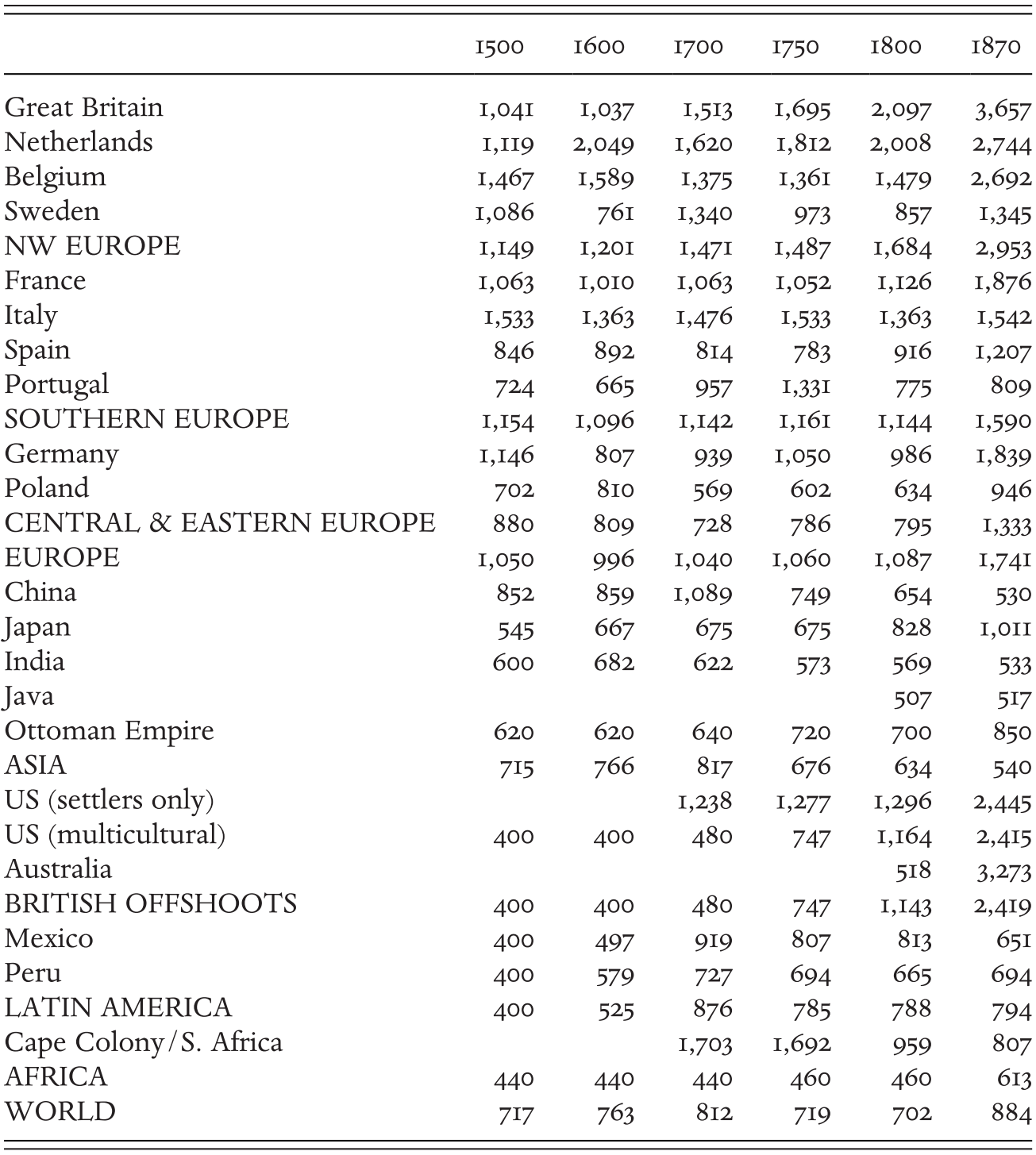
This traditional view requires some modification in the light of recent research to quantify long run trends in income within a national accounting framework. Table i.1 sets out trends in the level of average per capita income in the world economy between 1500 and 1870, as measured by per capita gross domestic product (GDP). The process of quantifying global economic performance in this way was begun by Reference MaddisonMaddison (2001), who had to rely on conjectures for many of his pre-nineteenth century estimates. Since then, much work has been done to build up a more complete picture based on hard data, although the project continues (Reference Bolt and van ZandenBolt and van Zanden 2014). Following Maddison, GDP per capita estimates for each country are presented in terms of a common currency unit, 1990 international dollars, so that they can be compared across both space and time. Although this clearly creates index number problems, it is likely that these are dwarfed by measurement errors, and the exercise should be treated as indicating broad trends rather than being correct to the second decimal point. To fix orders of magnitude, it is worth bearing in mind that in 1990 the World Bank regarded anyone existing on less than $1 per day as living in poverty. This means that the minimum GDP per capita consistent with a society being able to support itself and reproduce should be around $400, with most people living on $1 per day and a small elite who may have been much richer but had only a small impact on the average income.
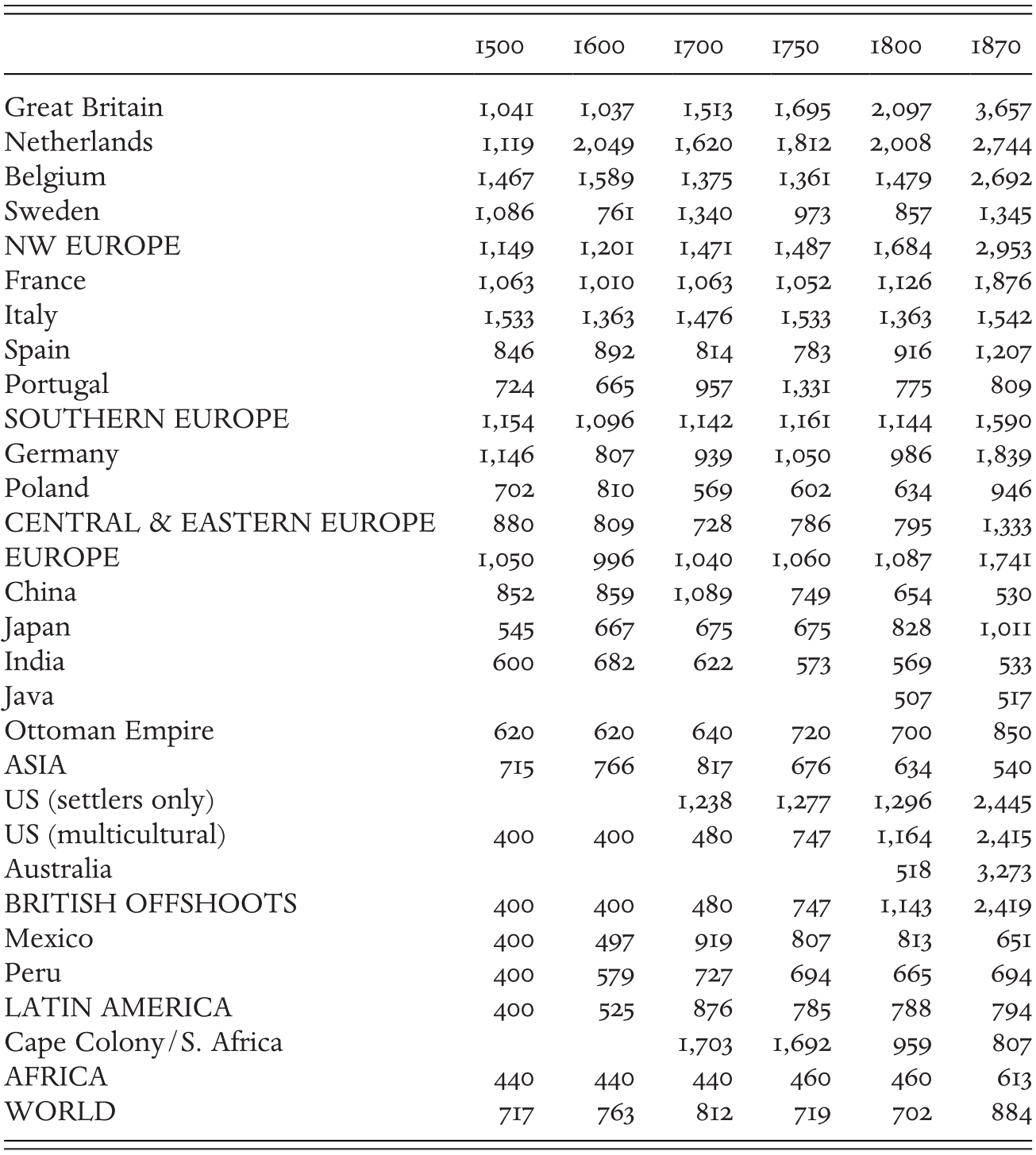
Table i.1 shows that there was no simple story of per capita incomes rising slowly from 1500 in Europe and the British offshoots and then accelerating from the eighteenth century while incomes continued to stagnate in Asia, Latin America, and Africa throughout the period. Clearly, there was not just considerable variation in outcomes between the main regions, as would be consistent with the traditional view, but also systematic variation in outcomes within regions. First, the strong upward trend in per capita income within Europe was confined to the North Sea area economies of Britain and the Low Countries (Reference van Zanden and van Leeuwenvan Zanden and van Leeuwen 2012; Reference Broadberry, Campbell, Klein, Overton and van LeeuwenBroadberry et al. 2015a). The North Sea area forged ahead of the previously richer Mediterranean economies of southern Europe, particularly Italy, in what has come to be known as the European Little Divergence, to set against the backdrop of the Great Divergence between Europe and Asia. Although less quantitative information is available for central and eastern Europe, the data that we do have for Poland suggest that the region continued to lag behind the rest of the European continent (Reference Malinowski and van ZandenMalinowski and van Zanden 2017). These trends are discussed in Chapters 1 and 2.
Second, within large parts of Asia, incomes did not just stagnate but actually trended downwards significantly. Of most significance here is the decline in Chinese GDP per capita during the Qing dynasty, but there was also a downward trend in India from the high point of the Mughal Empire under Akbar (Reference Broadberry, Custodis and GuptaBroadberry et al. 2015b; Reference Broadberry, Guan and Li2018). These trends are examined here in Chapters 4 and 5, respectively. At the same time, however, Chapter 3 shows that there was a clear upward trend in Japan, which went on to be the first non-Western economy to achieve modern economic growth after the Meiji Restoration of 1868 (Reference Bassino, Broadberry, Fukao, Gupta and TakashimaBassino et al. 2019). This reversal of fortunes between Japan and China represents an Asian Little Divergence to set alongside the European Little Divergence (Reference BroadberryBroadberry 2013). In west Asia, incomes continued to increase within the Ottoman Empire, but more slowly than in Japan (Reference PamukPamuk 2009). There is less quantitative information available for South East Asia, but for Java, where we do have data for the nineteenth century thanks to the work of Reference van Zandenvan Zanden (2012), incomes stagnated. Developments in South East Asia and the Ottoman Empire are outlined in Chapters 6 and 7, respectively.
Third, the European settlers who arrived in the New World from the sixteenth century experienced varying fortunes, with the British offshoots achieving better outcomes for living standards than the Latin American economies in the long run. However, the national accounting data suggest that until the eighteenth century Mexico and Peru outperformed the British American Colonies that later formed the United States (Reference Arroyo Abad and van ZandenArroyo Abad and van Zanden 2016). This is consistent with a third reversal of fortunes between the British offshoots and Latin America (Reference Engerman, Sokoloff and HaberEngerman and Sokoloff 1997). Before the arrival of permanent settlers from Europe in North America from the early seventeenth century and in Australia from the late eighteenth century, the lands were inhabited by tribes who are normally assumed to have lived close to subsistence income of $400 per year. It should be noted that the incomes of indigenous peoples are included in Maddison’s per capita GDP estimates for Australia, in the multicultural estimates for the United States and also in the estimates for Mexico and Peru, which therefore remained relatively low for some time after colonization until the growing settler communities outnumbered the declining native populations.Footnote 1 North America and Latin America are covered in Chapters 8 and 9, respectively, while Australia is discussed in Chapter 11.
Fourth, there are also signs of substantial regional variation in economic outcomes within Africa, as noted in Chapter 10. In addition to the data for the whole of Africa in Table i.1, we have included estimates of per capita income in South Africa, based on available data for the Cape Colony, which clearly generated high incomes for its Dutch settler population in the eighteenth century (Reference Fourie and van ZandenFourie and van Zanden 2013).Footnote 2 Furthermore, the data on African exports presented in Chapter 10 are also suggestive of substantial fluctuations in income, with significant phases of shrinking (or negative growth) as well as positive growing.
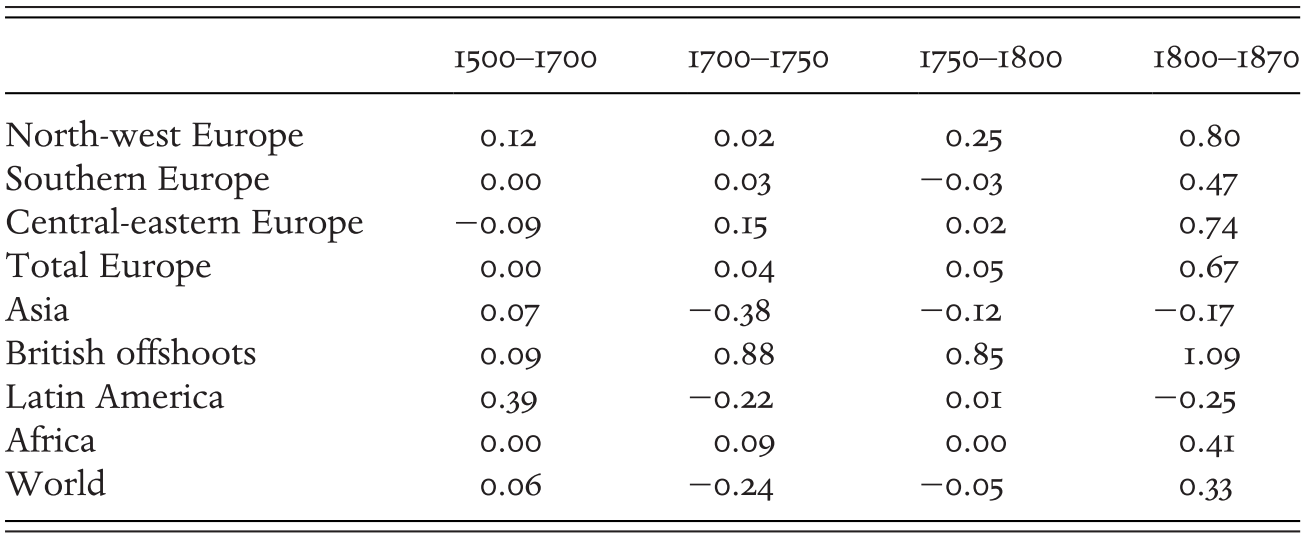
The data from Table i.1 can be used to calculate the annual growth rates of per capita GDP in Table i.2. This reveals the generally low rates of growth achieved even in the successful north-west European economies, at just 0.8 per cent in the period 1800–70. Note that the growth rate was faster in the British offshoots from the eighteenth century, but because they were starting from a lower level of per capita income, they had still not forged ahead of Great Britain by 1870. Asia experienced negative growth (or shrinking) in three out of the four periods, while Latin America also shrank in the first half of the eighteenth century and stagnated during the nineteenth century. Africa experienced the most stagnant long run economic performance, but it is likely that better data would reveal greater volatility with more significant periods of shrinking interspersed between periods of growing.
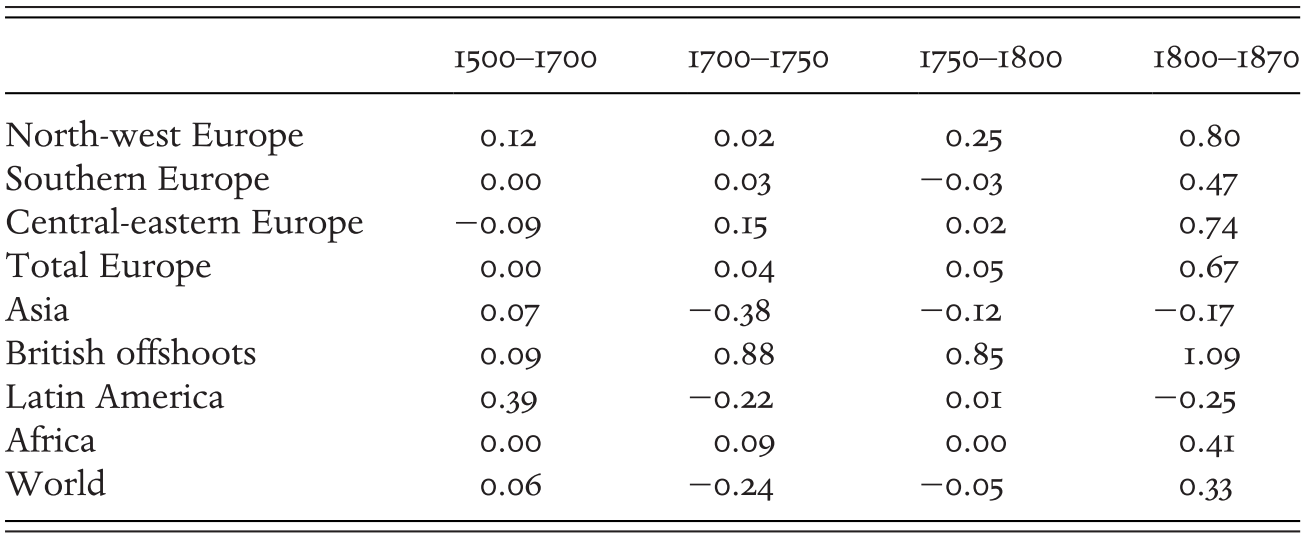
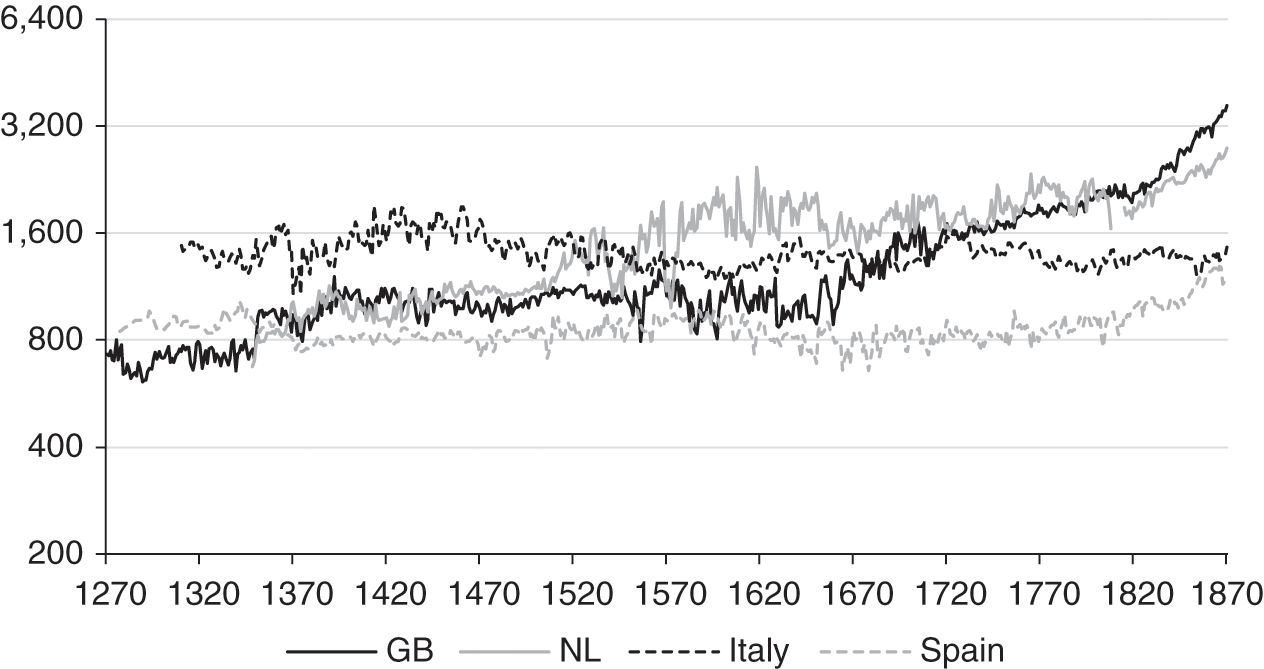
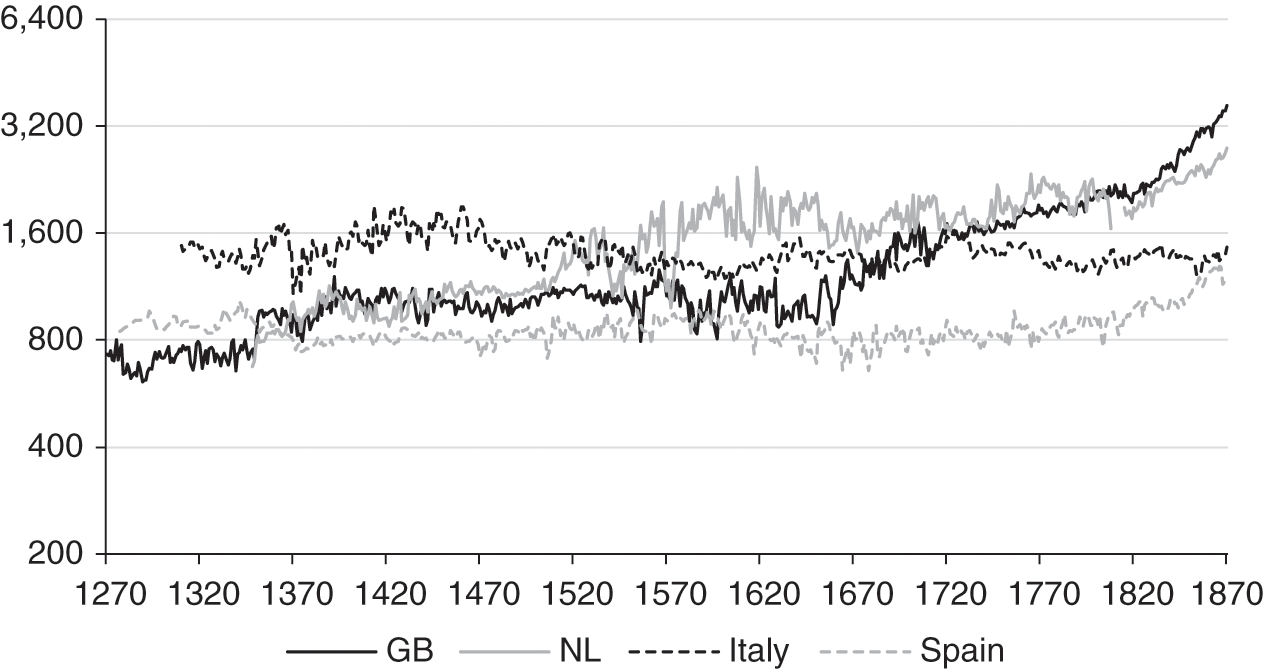
One striking feature of Table i.2 is that most regions experienced negative per capita income growth over periods of half a century or more as well as periods of positive growth. This points to an important role for changes in the extent of shrinking (or periods of negative growth) as well as positive growing. Where annual information is available back as far as the late thirteenth century, the new data reveal that what makes the difference between a successful economy with an upward trend in per capita income and an economy that stagnates over the long run lies largely on the shrinking rather than the growing side. In other words, successful North Sea area economies like Britain and the Netherlands overtook Mediterranean economies like Italy and Spain not by growing faster when they grew, but rather by shrinking more slowly when they shrank and by experiencing fewer years of shrinking (Reference Broadberry and WallisBroadberry and Wallis 2017). This can be seen in Figure i.1, which plots the annual observations of GDP per capita for these four economies between the late thirteenth and the late nineteenth centuries. Of particular importance was the fact that the gains in per capita income after the mortality crisis of the Black Death in the mid-fourteenth century were never reversed in Britain and the Netherlands as population recovered from the mid-fifteenth century.
Real GDP per capita in Britain, the Netherlands, Italy, and Spain 1270–1870 (1990 international dollars, log scale)
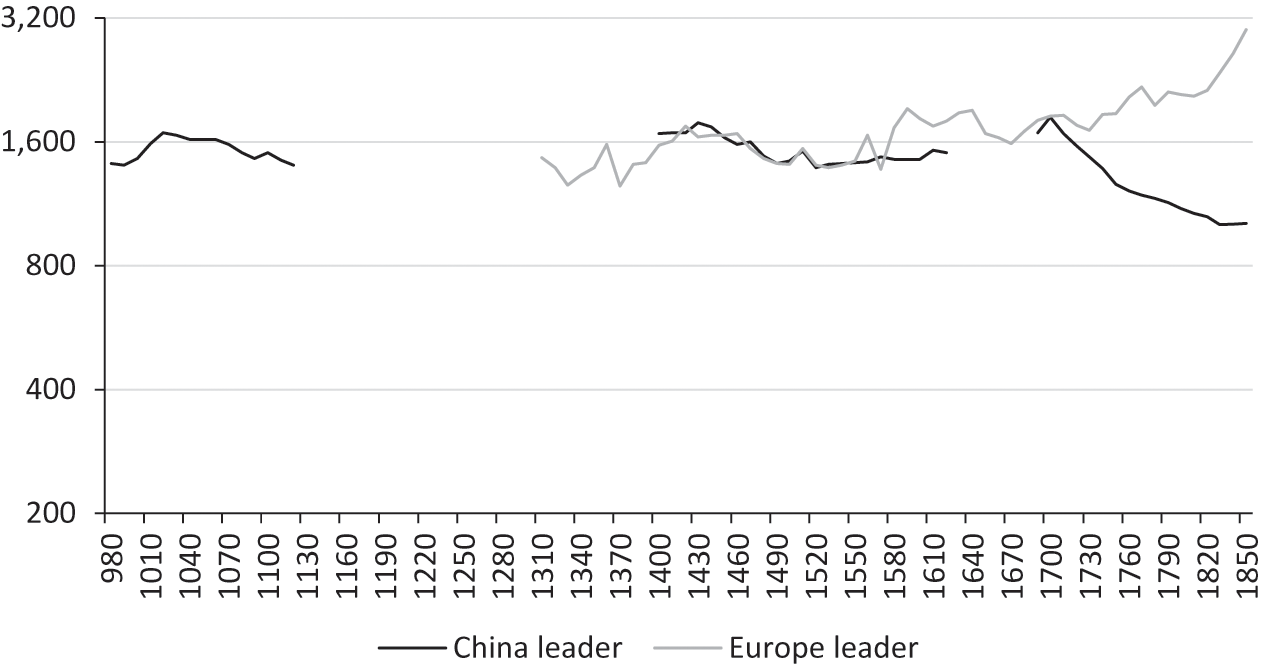
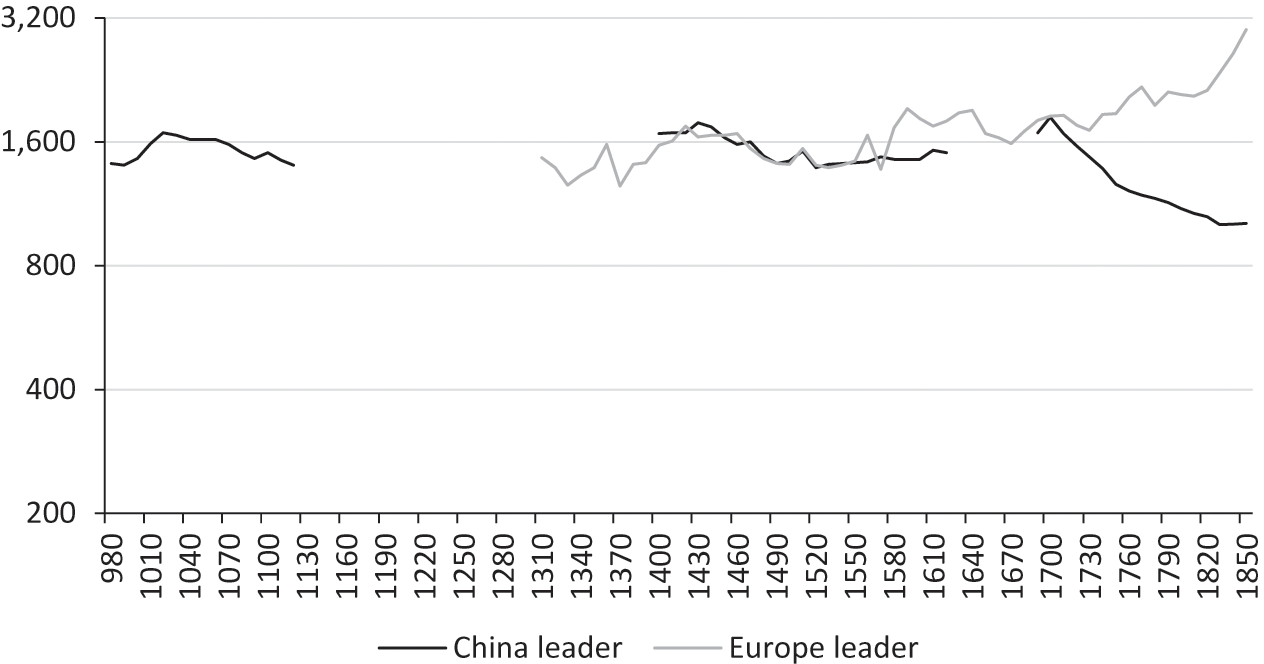
Two major issues that continue to be debated by economic historians can be addressed with the data from Table i.1: the timing of the Great Divergence and comparative living standards in the New World and the Old World before the twentieth century. The data on average incomes in Table i.1 suggest that Europe was already ahead of Asia during the early modern period, with a European advantage of around 25 per cent in 1700. However, before concluding that the Great Divergence was already under way by 1500, it is worth bearing in mind that Asia had a population four times the size of Europe’s. Reference PomeranzPomeranz (2000) claimed that Europe-Asia comparisons should be made on the basis of similarly sized units and set out to show that the leading regions of Asia, such as the Yangzi Delta in China, were on a par with the leading regions of Europe as late as 1800. Figure i.2 addresses this issue by comparing GDP per capita in the leading regions of Europe and China. The income of the European leader is based on Italy until the 1540s, followed by the Netherlands until the 1800s and then Great Britain. For China, we know that the income level in the Yangzi Delta in the 1820s was 75 per cent higher than in China as a whole (Reference van ZandenLi and van Zanden 2012). The China leader series is obtained by projecting this ratio back in time. Note that this does not require that the Yangzi Delta was always the richest region, just that there was always at least one region that was around 1.75 times the average for China as a whole. It is clear that a substantial gap opened up between the leading regions of Europe and China during the eighteenth rather than the nineteenth century. Reference PomeranzPomeranz (2011; Reference Pomeranz2017) now accepts that his early claim that the Great Divergence began only in the nineteenth century was exaggerated, and agrees that the eighteenth century was more likely, but notes that this is still a lot later than traditionally assumed.
GDP per capita in the leading regions of Europe and China, 1300–1850 (1990 international dollars)
Turning to the issue of living standards in the New World compared with Europe, Reference MaddisonMaddison’s (2010) estimates of GDP per capita for the territory of the modern United States show a continued British advantage until the late nineteenth century, and this is also reflected here in the estimates of Table i.1. This has been the subject of some controversy, with Reference Prados de la EscosuraPrados de la Escosura (2000) and Reference Ward and DevereuxWard and Devereux (2003) claiming that the United States was already ahead by the mid-nineteenth century, while Reference BroadberryBroadberry (2003) and Reference Broadberry and IrwinBroadberry and Irwin (2006) continued to support Maddison’s view. The first point to note is that the multicultural estimates include Native American Indians living at subsistence, which substantially lowers average income in the seventeenth and eighteenth centuries, and continues to have an impact during the nineteenth century, although the British advantage remains if attention is confined to the living standards of the US settlers in Table i.1. A second factor to consider is the existence of slavery, which serves as another reminder that until the 1860s the southern United States could not be considered a modern economy. Slaves accounted for 12.6 per cent of the US population in 1860 (Reference HainesHaines 2006).
Confining attention to free members of the settler population, it seems likely that for many, per capita incomes were at least as high as those in the countries from which immigrants were attracted. Indeed, Reference Allen, Murphy and SchneiderAllen et al. (2012) demonstrate higher real wages in the American colonies than in Britain all the way back to the mid-seventeenth century. Nevertheless, even here it is worth noting that although staple commodities were available in greater abundance in the New World than in Europe as a result of the easy availability of land, manufactured goods and services were much harder to come by before the late nineteenth century. In these circumstances, living standards appear higher in the New World if incomes are compared using the prices of a basket of staple commodities, but this advantage disappears as more manufactured items or services are included. A suggestive study by Reference GelosoGeloso (2015) demonstrates this for a comparison between New France (the current Canadian province of Quebec) and France during the period 1688–1760, using Reference AllenAllen’s (2009) ‘bare bones’ and ‘respectability’ baskets. Reference GelosoGeloso (2015: 99) concludes that ‘the inhabitants of New France could more easily satisfy their basic needs. However, rising beyond that point was harder. Any advantage enjoyed at the bare bones level disappears at the respectable level.’ A further point worth remembering in the US case is that warfare took its toll on two occasions, during the War of Independence (1776–83) and the Civil War (1861–65). A recent contribution by Reference Lindert and WilliamsonLindert and Williamson (2016) argues that the thirteen colonies were ahead of Britain in the eighteenth century, but fell back behind by 1800 as a result of destruction wrought during the War of Independence. Lindert and Williamson then see the United States as regaining the lead by 1850, but suffering another setback during the 1860s due to the Civil War, and then finally forging ahead permanently after 1870, as in the conventional Maddison chronology.
Although GDP per capita is widely used as a measure of living standards, it is at best an incomplete measure, and needs to be supplemented by additional information. Two important variables widely monitored are life expectancy and education, which tend to show smaller differences between nations than GDP per capita. The human development index (HDI), which combines GDP per capita with measures of life expectancy and education is sometimes used as a composite measure of the standard of living (UNDP 1990). In its standard form, however, the HDI is still subject to the shortcoming that it is based on mean values and therefore cannot say anything about the distribution of welfare across individuals. To take account of distributional issues, it is necessary to incorporate measures of inequality such as the Gini coefficient or the Atkinson inequality index. These issues are considered in Chapter 16.
Part II: Factors Governing Differential Outcomes in the Global Economy
Part II explores the factors governing differential outcomes in the various regions that are examined in Part I. An important distinction is made between the proximate and fundamental sources of growth, while a final section analyses the world economy as a system.
The Proximate Sources of Growth
Growth accounting helps us to assess whether economic growth came from the use of more factor inputs or from the more effective use of existing inputs (Reference SolowSolow 1957). In the simplest formulation, aggregate output is produced using factor inputs of capital and labour. The growth rate of output can then be related to the growth rates of the inputs of capital and labour and a residual factor representing any change in the efficiency with which the factors are used. Each factor is weighted by its relative importance in the production process, measured by its share in the costs of production. For labour this is the share of wages in the value of output, while for capital it is the share of profits. The residual factor, known as total factor productivity (TFP) is often associated with technological progress, but it can also reflect changes in organization, such as the introduction of the factory system.
Labour, which is considered in Chapter 12, has always been an important factor input. In addition to the increase in the number of workers as population grows, it is necessary to consider the quality of workers, particularly as a result of investment in human capital. More educated workers should be able to produce more output, so an increase in education should raise the growth rate, other things being equal. However, education is costly to provide, so as production becomes more complex with economic development, parents may face a choice between having a small number of well-educated children or a larger number of poorly educated children. Such considerations must inevitably impact on decisions about fertility, and are now considered by many economists to be central to understanding the demographic transition from a poor economy with high rates of fertility and mortality to a rich economy with low rates of fertility and mortality (Reference Galor, Aghion and DurlaufGalor 2005).
Capital and technology accounted for an increasing share of growth between 1700 and 1870, and are considered here in Chapter 13. The growing importance of capital reflected in turn the growing importance of fixed capital relative to working capital, while the growing importance of technological progress reflected the growth of mechanization and the use of the steam engine as a major source of power.
The Ultimate Sources of Growth
Even if we had perfect information on the proximate sources of growth, however, this would only tell us how the transition to modern economic growth occurred, rather than why it occurred. If some economies grew faster than others because of more investment or faster technological progress, we would want to know why investment and technological progress were faster in those economies. Economists divide the more fundamental underlying sources of growth into two categories: geography and institutions.
The role of geography can be analysed using the distinction between first and second nature geography. First nature geography covers natural endowments such as mineral deposits or climate, while second nature geography covers man-made factors such as access to markets and agglomeration economies. First nature geography has traditionally featured heavily in explanations of differential performance during the Industrial Revolution, with coal deposits playing an important role in the location of industry. Recently, however, a new literature has arisen, emphasizing the importance of second nature geography (Reference Krugman and VenablesKrugman and Venables 1995). The basic idea here is that exogenously given first nature geography advantages or disadvantages become amplified rather than reduced by forces of economic integration. Favourable locations with high productivity are seen as attracting people and investment, which further raises productivity. Unfavourable locations with low productivity attract fewer people and investment, thus falling further behind. Reductions in the cost of trade may thus have asymmetric effects on different regions, with industry clustering in a few favourable locations rather than being dispersed evenly around the world. Building on the approach of Reference Crafts, Venables, Bordo, Taylor and WilliamsonCrafts and Venables (2003), Chapter 14 assesses to what extent the differential outcomes in the global economy over the period 1700–1870 can be explained using this new approach.
One of the key developments in economic history in recent decades has been the systematic analysis of institutions as a fundamental determinant of economic performance. A key player in the development of this analysis was the Nobel laureate Douglass North, who defined institutions as ‘the rules of the game and the means of enforcement’ (Reference NorthNorth 1990: 3). John Wallis draws an important distinction in Chapter 15 between primary and secondary rules. Primary rules are the rules that directly govern behaviour, such as traffic laws, property laws, and criminal laws, while secondary rules are the rules that govern the formation or alteration of the primary rules. Primary rules can be seen as structuring the economic system and secondary rules the political system. Understanding the role of institutions in explaining differential outcomes in the global economy therefore requires more than considering primary institutions such as property rights, but also requires an analysis of secondary institutions such as democracy or dictatorship, and how primary and secondary rules interact. Wallis contrasts the case of British North America, where modern economic growth began in this period, with Latin America, where it did not. He also considers the case of Japan, which underwent a radical institutional change with the Meiji Restoration of 1868.
The Global Economy
The world economy can clearly be broken down into its regional components as in Part I of this volume. However, it is also helpful to think of the world economy as a global system, governing international transactions, such as international trade and migration and international finance. It is also important to stand back and assess the roles of warfare and empire. This can be useful in guarding against a tendency of earlier generations of economic historians to focus only on the effects of European developments on the rest of the world, without paying much attention to the impact of developments flowing in the opposite direction. Whilst the two-way nature of these reciprocal flows became too obvious to ignore in the second half of the twentieth century, they also need to be borne in mind when considering earlier eras.
The real flows of goods (via international trade) and labour (via migration) between 1700 and 1870 tell the story in Chapter 17 of the integration of product and factor markets in different parts of the world. There is overwhelming evidence of a greater trend towards market integration after 1820 than before, as the global economy was transformed by a host of revolutionary technologies in transportation and communications (Reference O’Rourke and WilliamsonO’Rourke and Williamson 2002). Warfare can be seen as a major barrier to integration during the eighteenth century, culminating in the disruption of the French Revolutionary and Napoleonic Wars (1792–1815), which were fought not just in Europe, but also in the Middle East, North America, the Caribbean, India, and South East Asia. After about 1820, market integration received a boost not just from declining transport costs as a result of technological progress but also from a shift in trade policy away from mercantilism towards free trade.
The international monetary system, analysed in Chapter 18, was based largely on silver and gold during the early modern period. With well-integrated bullion markets, countries were forced to coordinate legal ratios to preserve bimetallism. An important exception here was England, which was effectively on a gold standard de facto from 1717 and de jure from 1816. During the third quarter of the nineteenth century, many other nations switched away from a bimetallic standard and the gold standard emerged at the heart of the international monetary system. Early modern intercontinental trade occurred with a steady flow of silver from the Americas in the West to Asia in the East, mainly via Europe, although there were also some direct flows from the Americas to Asia via the Philippines. Commodity money was replaced by bills of exchange to transfer funds for long-distance trade and finance, with the bills of exchange market being progressively enlarged from a European system in the mid-eighteenth century to a global system by the mid-nineteenth century.
Economic historians often focus on pre-war, post-war, and interwar periods, as if warfare was some kind of anomaly and minor disruption to normal events rather than a common occurrence that could sometimes lead to major turning points in history. Yet China as well as the major European powers spent more than half the time between 1500 and 1799 at war with foreign enemies, and by 1914, as much as 84 per cent of the world was under European control, either directly or as a now independent colony dominated by Europeans. Chapter 19 therefore considers warfare and empire as a separate topic within the framework of international transactions. How did Europeans come to so dominate the world? Part of the answer must lie in the higher incomes and better technology afforded by their earlier transition to modern economic growth, which provided more resources for warfare. However, European states also raised more tax revenue per head, formed credible alliances and designed effective armies.
Although there is a minority view that sees colonizers as helping to lay the foundations for later development, empire is usually seen as bad for the people that were colonized (Reference FergusonFerguson 2003). However, one of the most controversial debates in economic history concerns the costs and benefits of empire for the colonizers. It is easy to point to large fortunes accumulated by individual merchants through colonial investments, but there were costs as well as benefits to maintaining an empire. Retrospective cost-benefit analysis suggests that the colonial powers earned a social rate of return that was below the risk-free rate (Reference Davis and HuttenbackDavis and Huttenback 1986). In other words, they would have reaped a higher rate of return by holding government bonds. Why, then, were the empires held? It is important to remember that the benefits were concentrated in the hands of a few, who were able to mobilize and influence governments, whereas the costs were spread across all taxpayers, who were less able to mobilize effectively.
Concluding Comments
This book provides an overview of the modern world economy from around 1700 to 1870, focusing on the issues of economic growth and development. We examine the beginnings of modern economic growth, giving due weight to chronology, regional balance, and coverage of the main factors governing differential outcomes in different parts of the global economy.
Part I on regional developments covers the first emergence of modern economic growth in eighteenth-century Britain, and follows its spread to other parts of the world. The forging ahead of economies making the transition to modern economic growth led to reversals of fortune within and between continents. Within Europe, the first transition to modern economic growth in Britain led to a reversal of fortunes between the North Sea area and the Mediterranean region. The drive of Japan towards modern economic growth during the Tokugawa Shogunate, combined with declining per capita incomes in Qing dynasty China, led to a reversal of fortunes within Asia. A reversal of fortunes also occurred within the Americas between North America and Latin America.
Part II on the factors governing differential outcomes covers both the proximate and ultimate sources of growth. Dealing first with the proximate factors, investment in physical and human capital and the development of better technology undoubtedly played an important role. However, they can only tell us how rather than why the transition to modern economic growth occurred. To get at the ultimate sources of growth, we need to examine the roles of geography and institutions. First nature geography has always been seen as playing a role in the location of the Industrial Revolution in Britain and its spread to other parts of the world through the location of coal. However, recent work has also highlighted the role of second nature geography through agglomeration economies and access to nearby buoyant markets. Institutions matter because they provide the incentives for socially productive activities such as trade, investment and innovation.