


Introduction
Human activities have transformed the landscape, displaced species and caused mass extinctions (Alroy Reference Alroy2001, McKee et al. Reference McKee, Sciulli, Fooce and Waite2004), and are one of the most influential factors affecting biodiversity conservation (Jenkins et al. Reference Jenkins, Pimm and Joppa2013). It is important to understand how species persist in human-altered landscapes, to aid in the conservation and management of threatened species (Norris and Harper Reference Norris and Harper2004, Jost Robinson et al. Reference Jost, Daspit and Remis2011). Vultures have interacted with humans for centuries (Mundy et al. Reference Mundy, Butchart, Ledger and Piper1992, Moleón et al. Reference Moleón, Sánchez-Zapata, Margalida, Carrete, Owen-Smith and Donázar2014). They provide a valuable ecosystem service by consuming carcasses which prevents the spread of disease, recycles nutrients, and provides a waste removal option that is both cost effective and low on carbon emissions (Dupont et al. Reference Dupont, Mihoub, Bobbé and Sarrazin2012, Ganz et al. Reference Ganz, Karaoz, Getz, Versfeld and Brodie2012, Margalida and Colomer Reference Margalida and Colomer2012, Ogada et al. Reference Ogada, Keesing and Virani2012a,Reference Ogada, Torchin, Kinnaird and Ezenwab).
Globally, 61% of vulture species are threatened with extinction and are declining mainly due to anthropogenic pressures (Ogada et al. Reference Ogada, Keesing and Virani2012a). Asia and Africa have experienced the most dramatic vulture declines in recent years (Pain et al. Reference Pain, Bowden, Cunningham, Cuthbert, Das, Gilbert, Jakati, Jhala, Khan, Naidoo, Oaks, Parry-Jones, Prakash, Rahman, Ranade, Baral, Senacha, Saravanan, Shah, Swan, Swarup, Taggart, Watson, Virani, Wolter and Green2008, Virani et al. Reference Virani, Kendall, Njoroge and Thomsett2011, Ogada et al. Reference Ogada, Keesing and Virani2012a). Vulture declines in Asia were linked to diclofenac, a non-steroidal anti-inflammatory drug (NSAID), which is highly toxic to vultures when present in carrion (Oaks et al. Reference Oaks, Gilbert, Virani, Watson, Meteyer, Rideout, Shivaprasad, Ahmed, Chaudhry, Arshad, Mahmood, Ali and Khan2004, Gilbert et al. Reference Gilbert, Watson, Virani, Oaks, Ahmed, Chaudhry, Arshad, Mahmood, Ali and Khan2006). Declines of African vulture populations are less understood because of the diversity of threats identified (Thiollay Reference Thiollay2006, Virani et al. Reference Virani, Kendall, Njoroge and Thomsett2011, Ogada et al. Reference Ogada, Keesing and Virani2012a, Monadjem et al. Reference Monadjem, Botha and Murn2013a).
It is vital to understand threats to vultures in terms of land use and local human livelihoods. Previous research in Africa focused on the human dimensions of vulture conservation in commercial farming and protected areas (Boshoff and Currie Reference Boshoff and Currie1981, Robertson and Boshoff Reference Robertson and Boshoff1986, Brown and Piper Reference Brown and Piper1988, Monadjem and Garcelon Reference Monadjem and Garcelon2005, Murn and Anderson Reference Murn and Anderson2008, Bamford et al. Reference Bamford, Monadjem, Anderson, Anthony, Borello, Bridgeford, Bridgeford, Hancock, Howells, Wakelin and Hardy2009). Relatively few studies have addressed the human dimension in communally owned farmland, despite its prevalence in Africa (Boshoff and Vernon Reference Boshoff and Vernon1980, Vernon Reference Vernon1998, Bamford et al. Reference Bamford, Diekmann, Monadjem and Mendelsohn2007, Virani et al. Reference Virani, Kendall, Njoroge and Thomsett2011). Furthermore, communal farmland in South Africa is expected to undergo rapid development in terms of electrification, urbanization, and continued human population growth (DEDEAT 2012, Sheehan and Sanderson Reference Sheehan and Sanderson2012).
The eastern part (east of 27°E) of the Eastern Cape Province, South Africa includes the communal area formerly known as the Transkei (Boshoff et al. Reference Boshoff, Piper and Michael2009). This area was one of the 10 Bantustan homelands created under segregation laws of the former apartheid government of South Africa (Kepe Reference Kepe1997). The dominant livelihood of the amaXhosa people, the ethnic majority, is a combination of subsistence agriculture, local employment, remittances from industrial sectors, and government grants (Kepe Reference Kepe1997, Shackleton et al. Reference Shackleton, Shackleton, Shackleton and Gambiza2013).
The Cape Vulture Gyps coprotheres is endemic to southern Africa and is listed as ‘Vulnerable’ by the IUCN and in the South African Red Data Book (Anderson Reference Anderson and Barnes2000, BirdLife International 2012). The global population is about 8,000–10,000 individuals and the regional population of Cape Vultures in the Eastern Cape Province is estimated at 2,000 individuals (Boshoff et al. Reference Boshoff, Piper and Michael2009, BirdLife International 2013). It is the most common vulture in the study area, with only the Bearded Gypaetus barbatus and Egyptian Neophron percnopterus Vultures overlapping rarely (Mundy et al. Reference Mundy, Butchart, Ledger and Piper1992). The majority of active Cape Vulture sites in the Eastern Cape Province are within or near (< 50 km) communal farmland on inaccessible cliffs in river gorges (Piper Reference Piper, Hockey, Dean and Ryan2005, Boshoff et al. Reference Boshoff, Piper and Michael2009).
Carrion is more readily available in communal farming areas where livestock losses are higher than commercial farming areas (Mundy et al. Reference Mundy, Butchart, Ledger and Piper1992, Vernon Reference Vernon1998, Boshoff et al. Reference Boshoff, Piper and Michael2009). Furthermore, carcasses contaminated with poison to eliminate livestock predators are scarcer on communal farmland than in commercial farming areas (Brown and Piper Reference Brown and Piper1988, Boshoff et al. Reference Boshoff, Piper and Michael2009). It is possible that poison may be too expensive for communal farmers to afford, but other social and cultural factors may influence this practice. However, how communal farmers in the former Transkei manage livestock predators is unknown (Piper and Ruddle Reference Piper and Ruddle1986).
Illegal poaching of vultures for traditional medicine is thought to be relatively high because of strong cultural traditions and limited access to Western medicine in the former Transkei (Cunningham and Zondi Reference Cunningham and Zondi1991b, Mander et al. Reference Mander, Diedericks, Ntuli, Mavundla, Williams and McKean2007). Consuming vulture parts, specifically the head/brains, is thought to give the user clairvoyant powers (Cunningham and Zondi Reference Cunningham and Zondi1991b, Mundy et al. Reference Mundy, Butchart, Ledger and Piper1992, Mander et al. Reference Mander, Diedericks, Ntuli, Mavundla, Williams and McKean2007). The sale of these parts is thought to fluctuate with major sporting events such as the World Cup (Mander et al. Reference Mander, Diedericks, Ntuli, Mavundla, Williams and McKean2007). Previous studies interviewed traditional healers and vulture part consumers, but little is known of how African people perceive vultures (Beilis and Esterhuizen Reference Beilis and Esterhuizen2005, Mander et al. Reference Mander, Diedericks, Ntuli, Mavundla, Williams and McKean2007).
Land use in the former Transkei was relatively unchanged until the elections of 1994, when social grants were provided by the government and less need was placed on subsistence agriculture (Shackleton et al. Reference Shackleton, Shackleton, Shackleton and Gambiza2013). Since the 1990s, fields have been abandoned and the population has moved toward crowded towns (Vernon Reference Vernon1998, Shackleton et al. Reference Shackleton, Shackleton, Shackleton and Gambiza2013). Despite land uses changing relatively rapidly in the former Transkei, little is known on how vulture populations have been effected (Vernon Reference Vernon1998, DEDEAT 2012).
Thus the aim of this study was to determine how communal land communities within the foraging range of the Msikaba Cape Vulture colony perceive vultures and the threats to them. Residents of highly transformed areas may not be as closely associated with the residents of low or moderately transformed areas. We expected that vultures in the former Transkei would have access to abundant livestock carcasses because of high livestock mortality, carcasses would be relatively safe from limited use of poison as predator control, and use of vulture parts in traditional medicine would be high because of strong cultural traditions (Brown and Piper Reference Brown and Piper1988, Cunningham and Zondi Reference Cunningham and Zondi1991b, Vernon Reference Vernon1998). Participants in the interviews were identified using two approaches: 1) Attending community events (n = 104) and 2) random door-to-door interviews near active Cape Vulture roosts (n = 98) (Fig. 1). In general, residents of these rural communities are more comfortable interacting in groups than individually (pers. obs.). Effort was made to engage community members at tribal and municipal meetings, church services, and after-school programmes. Since residents near active roosts are location specific, interviews were done opportunistically in those locations with individuals.
Locations of the 15 communities in which interviews were conducted in the Eastern Cape Province, South Africa. All interview locations were within the foraging range of the Msikaba Cape Vulture colony, which is situated on the southern border of the Mkambati Nature Reserve (MNR).

Methods
Study Area
The Msikaba Cape Vulture colony (31°16’S, 29°59’E; 200 m asl) is one of the largest colonies in the former Transkei, and is located in Mkambati Nature Reserve (MNR; Boshoff and Minnie Reference Boshoff and Minnie2011). It is the closest vulture colony to the ocean (2 km) in the world (Mundy et al. Reference Mundy, Butchart, Ledger and Piper1992). MNR is a provincial reserve managed by the Eastern Cape Parks and Tourism Agency (ECPTA) in collaboration with the Mkambati Land Trust (Fig. 1). The majority of the Cape Vulture nests are located on south-west facing cliffs of the Msikaba River gorge inside MNR. During the Cape Vulture breeding season (May–October), a breeding adult vulture’s daily foraging range was calculated as 40–150 km from the colony (Ruxton and Houston Reference Ruxton and Houston2002, Boshoff and Minnie Reference Boshoff and Minnie2011). Consequently interviews were conducted within this range, which covers an area of 11,310 km2.
The 15 villages surveyed were categorised into three areas: least transformed, moderately transformed, and most transformed (Vernon Reference Vernon1998, Beinart Reference Beinart, Guyot and Dellier2009). All but one of the villages (KwaMbimba) were part of the Ngquza Hill municipality. KwaMbimba is part of the Ntabankulu municipality (Fig. 1). According to the 2011 census, the population in the Ngquza Hill municipality was 278,481 and 92% of households were located on tribal land (Statistics South Africa 2011a,b). The population of the Ntabankulu municipality was 123,976 and 95% of households were located on tribal land (Statistics South Africa 2011a,b). The Ngquza Hill and Ntabankulu municipalities have unemployment rates of 52% and 51% respectively, which ranks them as the 9th and 10th (out of 234) municipalities with the highest unemployed populations in South Africa (Statistics South Africa 2011d).
Each region (least transformed, moderately transformed, and most transformed) differed in land cover. Connecting all interview locations with a Minimum Convex Polygon (MCP), there were differences in the amount of natural land cover. The heavily transformed area contained the least natural land (38%). Natural land covered 63% of the communities in the moderately transformed MCP and 81% in the least transformed area. Interestingly, the least transformed area had the smallest percentage of cultivated, degraded and plantation land cover compared to the other two regions, although this was not significant (Fig.1).
Questionnaire survey
A questionnaire covering livestock ownership, carcass management, and perceptions of Cape Vultures was drafted based on Fink (Reference Fink2009); this consisted of mainly open-ended questions (Appendix S1 in the online supplementary material). An estimate of food availability in terms of available carcasses was ascertained by livestock ownership trends in combination with livestock carcass management. Safety of the Cape Vulture’s food source was assessed by the extent of poisoned carcasses reported by participants. Perceived trends in the local vulture population were determined by comparing numbers of Cape Vultures observed over a 10-year period.
All interviews were carried out with the participation of the respondents. The survey had University of KwaZulu-Natal (UKZN) ethical clearance, which complies with the ethical standards of the relevant national and institutional committees on human experimentation and with the Helsinki Declaration of 1975, as revised in 2008 (Protocol number HSS/0947/012M). The local Traditional Authority gave their permission to conduct the research before entering the communities. Interviews were conducted from June 2012 to January 2013. The three interviewers were isiXhosa speaking undergraduate students from the School of Life Sciences, UKZN. Each interview was conducted in isiXhosa and recorded in English. Photographs of the Cape Vulture were used to aid the respondent’s identification of the species. The word for Cape Vulture is different between villages (idlanga or ixhalanga); effort was made to use the correct colloquial word.
Statistical analyses
Chi-square (χ2) tests were used to determine differences in residents’ responses in relation to land use within the vulture’s foraging range. It was expected that there would be significant differences (P-values < 0.05) in the frequency of participants’ responses across the natural land cover scale. Residents of least transformed areas were expected to answer differently from residents in more developed areas. Areas with more natural land cover may create a buffer against anthropogenic pressures facing foraging vultures. All statistics were performed in Statistica (StatSoft 2006).
Results
Demographics of respondents
A total of 202 qualitative interviews were conducted with community members within the foraging range of the Msikaba Cape Vulture colony (Table 1). Respondents varied in age with 25 (12%) 14–20 years old, 89 (44%) 21–40 years old, 67 (33%) 41–60 years old and only 21 (10%) older than 60 years. Average number of dependents per household was 5.2 ± 0.33 (SD) people. A total of 110 (54%) respondents were unemployed or earned a living through subsistence farming. The remaining 92 (46%) were employed in other sectors or were studying.
Demographics of respondents on livestock management and perceptions of Cape Vultures near the Msikaba Cape Vulture colony in the Eastern Cape Province.

Livestock ownership trends in relation to Cape Vulture numbers
A total of 123 (65%) participants perceived that local livestock ownership had decreased in the past ten years. Perceptions were dependent on land use (χ2 8 = 22.27, P = 0.004). Respondents of the moderately transformed communities perceived the greatest reductions in local livestock ownership over the past 10 years while residents of the least transformed communities perceived the smallest reductions in livestock ownership over the same period (Fig. 2).
Perceptions of local livestock ownership and vulture population trends by community members in the Eastern Cape Province, South Africa.

A similar trend was witnessed with observations of Cape Vultures (Fig. 2). Residents of the moderately transformed areas perceived the greatest reductions in the local Cape Vulture population. In contrast, the least transformed areas perceived the least reductions, but this was not significant (χ2 8 = 10.37, P = 0.24). In general, the majority of respondents (74%, n = 136) observed that local vulture populations were stable or increasing.
High livestock mortality rates because of tick-borne diseases (gall sickness and red water) were considered the main reason for declines in ownership by 62 (31%) respondents. Changes in livelihoods and traditions were reasons for a decline in livestock ownership by 42 (21%) respondents. Respondents stated that ‘youth are not interested in livestock’. Use in business transactions and food security were considered the greatest benefits of owning livestock.
Safety of carcasses for vultures
A total of 114 (56%) respondents stated they had livestock killed by predators, namely black-backed jackal Canis mesomelas. However, none of the respondents indicated that they used poisoned carcasses to kill predators. Instead, respondents would rather ‘hunt the predator with dogs’ and ‘fence livestock at night’.
Management of deceased livestock
A total of 105 (52%) respondents had livestock ‘naturally/accidentally’ die in the last five years. Arrangement of livestock carcasses was found to be random throughout different land uses, as there was no association with dead livestock and extent of transformed land cover (χ2 5 = 1.04, P = 0.96).
Of cattle that died from natural causes, 80 (40%) respondents perceived that the carcass was made available to Cape Vultures by ‘throwing it away’. Nineteen (9%) respondents stated that cattle carcasses were specifically left for Cape Vultures. If a horse or a donkey died, 98 (49%) respondents perceived that the carcass was made available to vultures. 26 (13%) respondents stated that horse and donkey carcasses were specifically left for Cape Vultures. Extent of transformed land had no effect on availability of horse or donkey carcasses (χ2 5 = 1.98, P = 0.85) or cattle carcasses (χ2 5 = 4.46, P = 0.48). Throughout all the villages, management of livestock carcasses was found to be a community decision rather than the individual farmer’s (pers. obs.).
When questioned about which animals consume livestock carcasses, 166 (82%) respondents mentioned Cape Vultures. One hundred and seventeen (58%) respondents observed vultures feeding on horses, while only 71 (35%) respondents observed vultures feeding on cattle. There was an association between respondents who observed Cape Vultures feeding on cattle or horses carcasses and extent of transformed land (χ2 5 = 12.61, P = 0.03). More cattle carcasses were reported consumed by Cape Vultures in the least transformed areas (Fig. 3). Residents of the heavily transformed land observed the smallest number of cattle carcasses consumed by Cape Vultures. The opposite trend was found with horse carcasses in relation to extent of transformed land cover.
Type of livestock carcasses consumed by Cape Vultures as reported by community members of the Eastern Cape Province, South Africa.

Community perceptions of the Cape Vulture and its threats
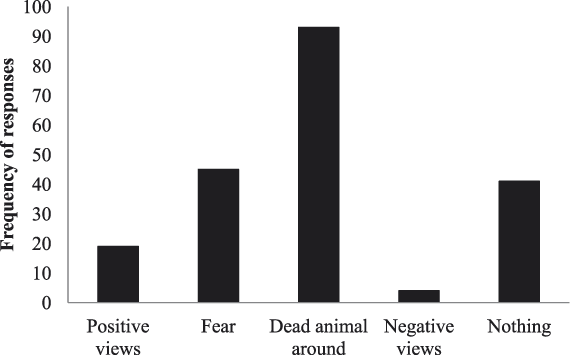
One hundred and twenty-nine (64%) respondents were afraid of Cape Vultures because of their aggressive nature while feeding. Sixty-six percent of respondents (n = 134) did not know or chose not to answer the targeted questions about threats to vultures. Only 15 (7%) respondents cited poisoning as the cause of a vulture’s death or acknowledged a poisoning incident (observation of a dead dog next to a dead horse). Vulture mortalities from electrocution and collision with power lines were cited by < 1% (n = 2).
The most cited cause for a vulture’s death was illegal poaching for traditional medicine by 62 (31%) respondents. Shooting of vultures was considered the preferred method by 74%, followed by setting traps and using dogs by 3%. None of the respondents mentioned poisoning as a method of obtaining vultures for traditional medicine. Some respondents stated that vultures were difficult to catch. Young boys were found to illegally kill vultures with rocks and slingshots. It was unclear if children were killing vultures for profit. Acknowledgment of illegal poaching of vultures was not found to be dependent on extent of transformed land (χ2 5= 5.46, P = 0.36).
Despite this pressure, 135 (67%) respondents acknowledged that vultures benefit the local community. Respondents called the vultures their ‘free municipality’ that are ‘good for pointing out dead livestock and tourism’. Positive community perceptions of vultures were not found to be associated with extent of transformed land (χ2 5 = 3.38, P = 0.64). Although negative views were held by the minority, these respondents stated that vultures ‘prevent nutrients from entering the soil, kill livestock, there is no use for them as dogs clean up, and that they are just birds.’ Forty-one (20%) respondents thought of nothing when they saw a vulture (Fig. 4).
First impressions of Cape Vultures perceived by community members of the Eastern Cape Province, South Africa.
Discussion
Livestock ownership trends and vulture observations
Our results suggest that livestock ownership in the former Transkei is perceived to have decreased over the past 10 years, coinciding with the conclusions of other studies (Vernon Reference Vernon1998, Shackleton et al. Reference Shackleton, Shackleton, Shackleton and Gambiza2013). However, this decrease is not thought to be uniform across the landscape (Ainslie Reference Ainslie2002, Ntshona and Turner Reference Ntshona, Turner and Ainslie2002, Hajdu Reference Hajdu, Guyot and Dellier2009, Vetter and Bond Reference Vetter and Bond2012). The current study found that the landscape with the least transformed land cover observed the smallest reductions in livestock ownership over the past 10 years. Since domestic livestock is considered the main food source for Cape Vultures in the former Transkei (Boshoff and Vernon Reference Boshoff and Vernon1980, Vernon Reference Vernon1998), availability of livestock may influence their populations.
Residents in the moderately transformed area perceived the greatest reductions in livestock ownership. Although land use differed between the heavily and moderately transformed areas, the moderately transformed area had the highest human density of 18.5 homesteads/km2, as calculated from 2006 aerial photographs. This area may be a remnant of one of the ‘betterment’ programs in which families were forced into planned developments (Shackleton et al. Reference Shackleton, Shackleton, Shackleton and Gambiza2013). The presence of the Holy Cross Mission church, one of the largest in the former Transkei, located in this area may have accelerated these programmes (pers. obs.). In these areas, livelihoods have changed from subsistence agriculture to social grants and wage labour which may have decreased the amount of carrion available, in addition to an anthropogenic buffer for foraging vultures (Vernon Reference Vernon1998, Hajdu Reference Hajdu, Guyot and Dellier2009, Shackleton et al. Reference Shackleton, Shackleton, Shackleton and Gambiza2013).
Safety of carcasses for vultures
The importance of non-contaminated carcasses for vulture survival has been highlighted in several studies (Chaudhry et al. Reference Chaudhry, Ogada, Malik, Virani and Giovanni2012, Prakash et al. Reference Prakash, Bishwakarma, Chaudhary, Cuthbert, Dave, Kulkarni, Kumar, Paudel, Ranade, Shringarpure and Green2012, Monadjem et al. Reference Monadjem, Wolter, Neser and Kane2013b, Margalida et al. Reference Margalida, Colomer and Oro2014). In the current study, it appears that poisoned carcasses are not a common practice in managing predators or obtaining vultures for traditional medicine. Effects of poison on vulture populations can be devastating because they often die in large groups in Africa (Brown and Piper Reference Brown and Piper1988, Mundy et al. Reference Mundy, Butchart, Ledger and Piper1992, Ogada et al. Reference Ogada, Keesing and Virani2012a, Beaver Reference Beaver2013) and Europe (Margalida Reference Margalida2012). Although 15 respondents acknowledged seeing a poisoning incident, this was lower than the to 36 (34%) commercial farmers in the Drakensberg area of South Africa who used poison (Brown and Piper Reference Brown and Piper1988).
However, due to stricter laws regarding the use of poison in addition to a reduction in small stock farming in the Drakensberg, only 14 (6%) commercial farmers near Lesotho admitted to using poison in a recent study (Hiltunen Reference Hiltunen2009). The commercial farmers who admitted to using poison responded via a postal survey, a method known to reveal few truthful answers about illegal activities (Hiltunen Reference Hiltunen2009). Although the exact number of commercial or communal farmers who use poison is difficult to obtain, it is possible that poisoned carcasses are less common in communal land than commercial farming areas.
Management of dead livestock
Tick-borne diseases (gall sickness and red water) were considered the main causes for livestock mortality in the study area. These diseases have caused livestock mortality in the former Transkei for a number of years (Villiers and Costello Reference Villiers and Costello2006, Beinart Reference Beinart, Guyot and Dellier2009). Although traditional methods exist to treat some of these diseases (Cunningham and Zondi Reference Cunningham and Zondi1991a) most subsistence farmers rely on government supplied services, which have been slack in recent years (Kepe Reference Kepe and Ainslie2002, Beinart Reference Beinart, Guyot and Dellier2009, Shackleton et al. Reference Shackleton, Shackleton, Shackleton and Gambiza2013).
A proportion of livestock that died naturally was perceived to be made available to Cape Vultures. The amount of cattle carcass available out of 9,000 regionally owned cattle (Ainslie Reference Ainslie2002) would be 168,480 kg a year in the study area, which can support 337 breeding Cape Vulture pairs, each consuming 500 kg (Mundy et al. Reference Mundy, Butchart, Ledger and Piper1992). This is higher than the previous estimate of 81,000 kg a year for all types of carrion which can support 162 Cape Vulture breeding pairs (Vernon Reference Vernon1998, Ainslie Reference Ainslie2002). Although the Msikaba Cape Vulture colony currently only supports 175 breeding pairs , factoring in the neighbouring colonies of Tembukazi (120 pairs) and Ngozi (72), which would overlap with Msikaba’s foraging range, the number of breeding pairs adds up to over 350 (Botha et al. Reference Botha, Allan, Krueger, Neethling, Neser, Pfeiffer, Ronaldson, Shaw, Webster, Uys, Wolter, van Wyk and Venter2012) .
As most Xhosa communities share meat resources (Ainslie Reference Ainslie2002), management of livestock carcasses was found to be a community decision (pers. obs.). Horse meat is not traditionally eaten in South Africa (Katz Reference Katz and Woys Weaver2003). Hence horse carcasses were ‘thrown away’ more than cattle for vultures to feed upon. A common practice with dead livestock was to move it away from homesteads to an open field, or in other terms, an ‘informal vulture restaurant’ (pers. obs.). In the Ngqwuza Hill municipality, the majority of residents (74.5%) have their own refuse dump or no rubbish disposal at all (18.4%), which suggests that discarded meat is available to vultures and other scavengers (Statistics South Africa 2011c). Despite the presence of ‘informal vulture restaurants’, communal livestock carcasses can be considered unpredictable, as there were no trends associated with dead livestock and land use.
Observations of livestock carcasses consumed by Cape Vultures differed among land uses. The least transformed area is traditional communal grazing land used since pre-colonial time by the AmaPondo people (Beinart Reference Beinart, Guyot and Dellier2009). Residents from other villages herd their cattle to the least transformed area when conditions are harsh (Beinart Reference Beinart, Guyot and Dellier2009). Cattle density is likely higher in the least transformed area because of the extent of communal grazing land. Horses may be more plentiful in transformed areas (for use in organised horse races) and are perhaps hit and killed by cars more frequently, hence more horse carcasses were observed in the heavily transformed area (pers. obs.).
Community perceptions of the Cape Vulture and its threats
In the current study, the majority of respondents (67%) stated that vultures benefited the local community. Vultures were called a ‘free municipality’ by some respondents, suggesting a beneficial relationship between the communities and the vultures. Negative views of vultures were in the minority, but probably originated from ignorance or fear rather than hatred. This is illustrated by the number of respondents who stated they think of ‘nothing’ or are ‘fearful’ when they see a vulture. In contrast, 29 (28%) South African commercial farmers who had negative views of vultures considered the birds to be harmful to their farming operations (Brown and Piper Reference Brown and Piper1988). The majority of respondents in both commercial and communal land perceived that Cape Vulture populations were stable or increasing (Brown and Piper Reference Brown and Piper1988).
Perceived threats to Cape Vultures differed from the previous study (Brown and Piper Reference Brown and Piper1988) in which the majority of commercial farmers cited poisoning, while illegal poaching of vultures was cited more by residents in communal land. Consuming vulture brains is believed to give the user clairvoyant powers in addition to relief from headaches and allergies (Cunningham and Zondi Reference Cunningham and Zondi1991b, Mundy et al. Reference Mundy, Butchart, Ledger and Piper1992, Beilis and Esterhuizen Reference Beilis and Esterhuizen2005, Mander et al. Reference Mander, Diedericks, Ntuli, Mavundla, Williams and McKean2007). The total annual sale of vulture parts for traditional medicine in eastern South Africa was estimated at $115,512 (Mander et al. Reference Mander, Diedericks, Ntuli, Mavundla, Williams and McKean2007).
It is difficult to obtain numbers of illegally killed vultures, but these were estimated at 27 vultures (all species) a year for KwaZulu-Natal, Eastern Cape, and Lesotho (Mander et al. Reference Mander, Diedericks, Ntuli, Mavundla, Williams and McKean2007). In the current study, the preferred method of obtaining vultures for traditional medicine was the use of firearms, which was much higher than the 41% of vultures harvested by shooting and 35% by poisoning reported by Mander et al. (Reference Mander, Diedericks, Ntuli, Mavundla, Williams and McKean2007). In the current study, none of the respondents mentioned that poison was used to obtain vultures for traditional medicine. As the past study focused on traditional healers and vulture part consumers, the results from this study give a general picture of how African people perceive vultures.
Two participants who resided near a small vulture roost stated they had eaten vulture meat, which has previously only been documented in West Africa with the consumption of Hooded Vultures Necrosyrtes monachus (Gbogbo and Awotwe-Pratt Reference Gbogbo and Awotwe-Pratt2008). One participant stated that people targeting vultures for traditional medicine were from the neighbouring province, KwaZulu-Natal. The participant mentioned that the ‘foreigners’ were unsuccessful due to the inaccessible location of the vultures on the cliffs.
The current study confirms that the threats facing African vulture species are diverse. Threats encountered by the Cape Vulture differ between regions in South Africa in terms of land use (communal vs. commercial farming) and ethnic group (Caucasian vs. AmaXhosa farmers). It is important to acknowledge the differences in threats across the landscape in order to develop and build upon management plans for the Cape Vulture. Although the threats are diverse, the underlying themes are transformed landscapes and direct anthropogenic pressures. It will only be through the collaboration of different stakeholders that species will survive.
Management implications
Areas with more natural land cover may create an anthropogenic buffer and carrion for foraging Cape Vultures in the former Transkei. Effort should be made to conserve natural areas and confine development to already transformed regions. Management of livestock carcasses on communal land was found to be a community decision, so educating community leaders about vulture-safe carcasses and the benefits provided by vultures to the community would be an effective conservation measure. The study suggests that illegal poaching may be more prevalent than previously estimated. Education programmes conducted in less transformed regions would be beneficial, as residents of these areas may see vultures more frequently. It is possible to expand on the communities’ existing appreciation of vultures and encourage community involvement in the conservation of the Cape Vulture.
Supplementary Material
The supplementary material for this article can be found at journals.cambridge.org/bci
Acknowledgements
L. Mboyi, W. Nkayitshana, T. Mkhize, and G. Mclean are thanked for conducting interviews. V. Maypia and N. Soshukuma of the Mkambati Nature Reserve are thanked for field assistance. Many thanks to Eastern Cape Parks and Tourism Agency (ECPTA) for accommodation while conducting interviews and Mazda Wildlife Fund for vehicle assistance. UKZN and ECPTA are also thanked for financial assistance.



