

Introduction
From the medieval warhorse (Creighton et al. Reference Creighton, Liddiard, Outram, Kanne and Ameen2025) to the lab mouse (Birke Reference Birke2003), the cattle that moulded the landscapes of the European Neolithic (McClure Reference McClure2015) to the woolly sheep prized by kings and praised by poets in Mesopotamia (ETCSL 5.3.2), increasing attention has been placed on the ways that animals have fundamentally shaped history. Yet these animals often wait in the wings, or at best get cast in bit parts, in the grand syntheses of political economic change that populate archaeologists’ bookshelves (e.g. Flannery & Marcus Reference Flannery and Marcus2012; Graeber & Wengrow Reference Graeber and Wengrow2021). More than a lacuna, the marginalization of animals in these accounts neglects a critical part of the human story. Here we show how, even when viewed through a narrowly economic lens, animals can offer new perspectives on major historical transitions. As an example, we consider how centring the roles of livestock alters our understanding of the early political history of northern Mesopotamia. While the capacity of livestock to transform northern Mesopotamian political economic systems depended upon specific social formations, species, and technological capacities, our wider argument is that livestock is a unique category of wealth that often promotes differential accumulation, catalyses economic growth, and facilitates direct appropriation.
Our analysis of the ‘animal side’ of political economic development tacks in an explicitly materialist direction, emphasising how livestock can function as special types of wealth marked by five features:
-
1. Heritability, as the (more-or-less) private property of households;
-
2. Expandability, with the ability to absorb surplus labour in a productive manner (particularly in contexts defined by limited labour and abundant land);
-
3. Instability, with livestock prone to be dramatically accumulated or catastrophically lost through coercion, raiding, disease, or natural disaster;
-
4. Flexibility, both as a mobile resource and one that can generate diverse types of wealth (meat, secondary products, transport/traction power for economic and military purposes, ‘wealth in themselves’);
-
5. Convertibility, allowing for relatively easy translation into non-livestock forms of wealth and often serving as a key linkage between subsistence and prestige good economies.
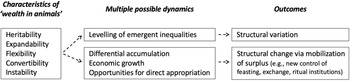
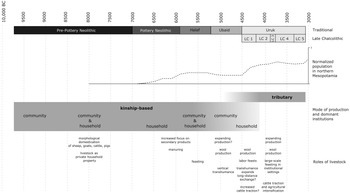
We start with the commonplace observation that livestock, defined simply as owned living animals, were key forms of wealth in many complex societies. We then consider how this ‘volatile-but-versatile’ form of wealth may have shaped political economic change. To focus our analysis on issues of value and production, we draw on the Marxist historiographical framework of Wolf (Reference Wolf1982), who distinguished between a kin-ordered mode of production and a tributary mode of production. We argue that in certain settings, the unique features of wealth in livestock, and the feedbacks that livestock production can promote within the broader political economy, can lead to differential accumulation and economic growth, precipitating the transition to a tributary mode of production (Fig. 1). The trajectory of political economic change in northern Mesopotamia, and its relation to the production of sheep, goats, cattle, and pigs, offers an exploratory case study.
‘Wealth in animals’ and the multiple trajectories of livestock political economies.

Modes of production: kin-ordered and tributary
Following a lull in usage in the 1990s and 2000s, archaeologists and historians have begun to revisit the ‘mode of production’ concept in analyses of past political economies (da Graca & Zingarelli Reference da Graca and Zingarelli2015; Haldon Reference Haldon, da Graca and Zingarelli2015; Kristiansen & Earle Reference Kristiansen, Earle, Frangipane, Poettinger and Schefold2022; Rosenswig & Cunningham Reference Rosenswig, Cunningham, Rosenswig and Cunningham2017). We see substantial value in this approach, which focuses attention on the dynamics of value, wealth, labour and exploitation. A concept initially developed by Marx and Engels ([1846] Reference Marx, Engels and Arthur1970, 42–6), a ‘mode of production’ is most simply formulated as the combination of: (1) the forces of production, consisting of the means of production (e.g. tools), subjects of production (e.g. raw materials) and labour; and (2) the relations of production, or the patterned forms of interaction between people vis-à-vis production. Such an approach brings into focus fundamental issues such as who owns and controls the means of production, how labour is organized and with what technologies, and how surplus labour (labour beyond that necessary for subsistence) is extracted and organized (Rosenswig & Cunningham Reference Rosenswig, Cunningham, Rosenswig and Cunningham2017, 4). As an analytical concept, the mode of production must be understood as existing at a higher level of abstraction than society or ‘social formation’. Modes of production are thus not descriptions of specific societies; they are ‘heuristic categories for the elucidation of the actual workings of historically attested social formations’ (Haldon Reference Haldon1993, 103).
While archaeology has maintained a long, if often implicit, conversation with the wider Marxist tradition (Patterson Reference Patterson2003), we recognize that this analytical framework will strike some as old-fashioned and even out of step with recent turns in zooarchaeology and anthropology, which have looked towards the representational and ontological dimensions of human/non-human relationships (e.g. Birch Reference Birch2018; Boyd Reference Boyd2017; Chazin 2024; Reference Chazin2025). Yet Marxian and ontological approaches need not be understood as antagonistic; indeed, they share an emphasis on relational analyses, while presenting complementary perspectives at the scale of the social formation and the individual, respectively. Moreover, the decline of Marxian frameworks in archaeological discourse had more to do with trends of theoretical consumption of the 1980s and 1990s, and the influence of the collapse of the Soviet bloc, than with any inherent theoretical limitations (see Rosenswig Reference Rosenswig2012). As a framework, the mode of production offers theoretical opportunities that have yet to be fully explored.
Following Wolf (Reference Wolf1982), we broadly speak of two dominant modes of production to describe pre-capitalist agrarian societies in the past — kin-ordered and tributary. While others have argued for a wider range of modes (Haldon Reference Haldon1993, 76–9; Kristiansen & Earle Reference Kristiansen, Earle, Frangipane, Poettinger and Schefold2022; Rosenswig & Cunningham Reference Rosenswig, Cunningham, Rosenswig and Cunningham2017), Wolf’s modes are more applicable, we argue, both to the specificities of the Mesopotamian case study and to broader comparative discussions of agrarian social formations.
A kin-ordered mode of production encompasses a diverse range of social formations captured in other schema: e.g. Service’s (Reference Service1975) archetypal ‘bands,’ ‘tribes’ and ‘simple chiefdoms’. While such societies differ in socio-political structure, their unifying feature is the relationship between people, the means of production and the allocation of surplus labour. Tools, land and animals belong to households, kinship groups, and occasionally non-kin sodalities. Membership to these (largely) kin-based institutions confers use-rights, rights of ownership and rights to the labour of others, while access to surplus is through kinship and other intimate relationships (e.g. stock friendships and godparents). Thus, ‘kinship is a particular way of establishing rights in people and thus laying claim to shares of social labour’ (Wolf Reference Wolf1982, 91). The accumulation of such ‘shares’ is what some anthropologists have called ‘wealth in people’ (Guyer Reference Guyer1993; Kusimba Reference Kusimba2020; Vansina Reference Vansina1990).
Ambitious individuals can develop wealth in people through both kin and non-kin relationships. One key type of such non-kin relationships is ‘clientship’. The materialization of such relations often takes the form of gifts, ‘loans’, or semi-regular feasts hosted by the patron. Crucially for our analysis, animals and animal products are a recurring theme in the historic and ethnographic record of clientship. The particular importance of livestock in many social formations under the kin-ordered mode of production in Eurasia and Africa led Price and Makarewicz (Reference Price and Makarewicz2024) to argue that wealth in people provides the labour and skills necessary to reproducing wealth in livestock, which can be converted back into wealth in people via gifts of animals and rights to livestock products (e.g. milk).
The relationship between wealth in people and wealth in livestock within a kin-ordered mode of production can exacerbate two contradictions that, under certain circumstances, can precipitate structural changes. The first contradiction is between the ethos of fairness and the propensities to exploitative hierarchy in the kinship group. While true social classes do not exist in kin-ordered social formations, several anthropologists have argued that elders can exploit the labour of juniors and women in class-like ways (Collier & Rosaldo Reference Collier, Rosaldo, Ortner and Whitehead1981; Meillassoux Reference Meillassoux and Seddon1978). The second contradiction concerns the fragility of ‘wealth in people’ (e.g. Vansina Reference Vansina1990, 251–3). The maintenance of such wealth requires frequent expenditures in the form of gifts, feasts and other investments. Moreover, given its relational nature tied to individuals, wealth in people creates difficulties for inheritance and distribution. The brittleness of wealth in people in the long-term can limit differential accumulation between competitive kinship groups or households. Importantly, this difficulty may tempt kinship groups/households to refocus their attention on accumulating other kinds of material wealth, especially those that can be readily translated back into wealth in people. Livestock are one such form of wealth.
Under certain conditions, a tributary mode of production can emerge from a kin-ordered mode of production. One condition is economic growth via intensification, extensification and/or specialization. Another is differential accumulation leading to class formation — ‘surplus-givers’ and ‘surplus-takers’ in the simplest formulation. With a significant portion of the increased surplus generated by economic growth siphoned off by a new dominant class as surplus-takers, differential accumulation and economic growth are intertwined processes that promote class formation. A corollary process is the deployment of this surplus to subvert the political status quo, undercutting kinship and other traditional institutions of social power and subsidizing alternative bases of authority (e.g. Rosenswig Reference Rosenswig2007). Among many possible strategies, surplus can be mobilized to fund strategic gifting and feasting, to control traditional ritual institutions and to dominate exchange networks.
The tributary mode of production refers to a range of social formations that archaeologists have referred to variously as (complex) chiefdoms, states, ancient states, empires, or complex societies (Haldon Reference Haldon1993, 75–87; Wolf Reference Wolf1982, 79–88). Kinship typically remains a powerful social institution: the kin-ordered mode of production does not so much disappear as it is overshadowed in the process of surplus extraction. Kinship groups — clans, tribes, lineages — are often incorporated into (and indeed transformed by) the tributary mode as a local organizational structure onto which tribute-taking is grafted. Yet surplus flows out of kinship groups and through extra-kinship networks. That flow relies on various forms of ‘non-economic coercion’ (Haldon Reference Haldon1993, 65), ranging from physical force to ideological control. Tribute, broadly defined, can take many forms: rent, a portion of the harvest, labour obligations, semi-regular payments, requisitions and formalized taxes. Once appropriated, surplus is mobilized in ways that reproduce class relations and support the political organization, be it hierarchical or heterarchical, that undergirds the class-based society and its ultimately exploitative relations of production.
Corcoran-Tadd et al. (Reference Corcoran-Tadd, Price and Caramanica2023) compared the political economic roles of livestock in the Inca and the Ur III empires, both operating under a tributary mode of production. While each state mobilized animal wealth in different ways, each relied on herds of livestock as mobile sources of wealth and objects of taxation. Animal husbandry and textile production using animal fibres provided new avenues for state finance and the exploitation of the labour of subject populations. State herds also helped to articulate imperial networks and animals were sacrificed in large numbers to materialize state ideological claims.
Livestock often play vital roles in surplus mobilization and the organization of labour in both kin-ordered and tributary modes of production. But how might livestock production and wealth in animals shape the transition from one mode to the other? We argue that livestock can shape the material bases for social transformation in three important ways: through differential accumulation; economic growth; and direct appropriation.
Wealth in livestock and the process of class formation
That livestock can affect class formation or tributary dynamics is not a new insight. Many have drawn attention to how people provisioned elites and urban centres with animal products (e.g. Gaastra et al. Reference Gaastra, Greenfield and Greenfield2020) and the economic growth and unequal division of wealth resulting from the so-called ‘secondary products revolution’ (Bogaard et al. Reference Bogaard, Fochesato and Bowles2019; Bogucki Reference Bogucki1993; Greenfield Reference Greenfield2010; McCorriston Reference McCorriston1997; Sherratt Reference Sherratt1983). There is also a well-trodden literature on the role of feasting in the development of hierarchical relations (Blanton & Taylor Reference Blanton and Taylor1995; deFrance Reference deFrance2009; Dietler Reference Dietler, Dietler and Hayden2001; Hayden Reference Hayden and Arnold1996). A smaller subset of archaeologists has discussed how livestock could function as ‘assets’ (Bogucki Reference Bogucki1993, 492) or ‘wealth in themselves’ (Russell Reference Russell2011, 351). But there has been little effort to weave these threads together.
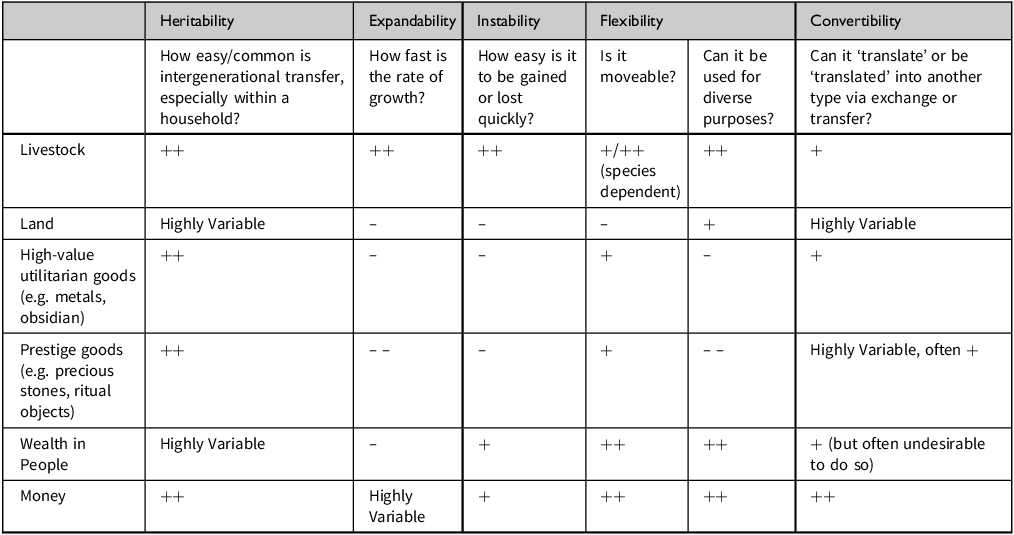
We argue that what binds these different processes — the key to grasping how livestock can figure into the transition from kin-ordered to tributary modes of production — is the kind of wealth that livestock represent. We focus on the relatively high degrees of heritability, expandability, instability, flexibility, and convertibility in comparison to other types of wealth (Table 1). These characteristics can certainly vary significantly under different modes of production; for livestock expandability, instability and flexibility typically stand more fixed, while convertibility and heritability are more contingent. Moreover, the properties of one type of wealth can depend on those of another. For example, the instability of land (e.g. seizure via enclosure) can impact the instability and expandability of wealth in livestock. However, wealth in livestock tends to score highly in these categories relative to other forms of wealth. In the specific terms of our discussion — pre-modern agrarian regimes — we argue that these characteristics can cause wealth in livestock to become particularly implicated in the processes of differential accumulation, economic growth and direct appropriation.
Five aspects of five different types of wealth. While there is significant variability within these categories depending on ecology, social formation, and mode of production, this heuristic chart highlights some of the persistent differences between major types of wealth.

Differential accumulation
Comparing ethnographic data from Africa and Eurasia, Borgerhoff Mulder and colleagues (Reference Borgerhoff Mulder, Bowles and Hertz2009) stress the heritability of livestock, especially within families. This makes this animal wealth, along with land (if it is heritable), potentially generative of inequalities over the long term, since wealth stays in particular families. It is true that in some social formations, institutions larger than families, like the Bronze Age Mesopotamian temple, can own animals. Nevertheless, livestock remain excludable and rivalrous — i.e. the private property of the institution or family. In contrast to the more varied ownership rights surrounding land under the kin-ordered mode of production, in all known ethnographic and historical cases, the ownership rights in animals approximate those of ‘classical’ private property, even if full usus, fructus and abusus rights are not uncomplicated by obligations among kin and non-kin (see discussions in Ebersbach Reference Ebersbach and Benz2010; Khazanov & Schlee Reference Khazanov, Schlee, Khazanov and Schlee2012). While we can imagine corporate or communal ownership, empirically it is households, not communities, that own, accumulate and pass on wealth in livestock.
The heritability of wealth in livestock combines with its expandability to make it particularly ripe for generating differential accumulation. While all organisms have the potential for exponential or logistic growth, the rate of reproduction for most livestock species is much faster than that of humans. Thus, in their meta-analyses of the Database of Places, Haynie et al. (Reference Haynie, Kavanagh and Jordan2021) explain the positive correlation between animal husbandry and the existence of social classes by the fact that animal herds tended both to stay within families and expand significantly within a person’s lifetime.
On the other hand, the instability of wealth in livestock limits differential accumulation in the long term. Ethnographies of pastoral societies in Africa and southwest Asia emphasize herds’ vulnerability to catastrophic loss from disease, natural disaster and theft (Bradburd Reference Bradburd1982; Salzman Reference Salzman1999; Schneider Reference Schneider1979, 204). Some ethnographies have shown that disease and drought actually exacerbate inequalities, since wealthy families can weather the losses while poorer families risk becoming permanent members of a livestock-less class (Bradburd Reference Bradburd1982; Lybbert et al. Reference Lybbert, Barrett, Desta and Layne Coppock2004). Nevertheless, the expansion of livestock production can run up against ceilings, such as environmental carrying capacity or social limits on use of collectively owned pasture (Kanne et al. Reference Kanne, Haughton and Lash2024; Salzman Reference Salzman1999, 41). Social levelling mechanisms may also oblige those rich in livestock to give more in bridewealth of more distant kin or in contributions to feasts.
The convertibility of wealth in livestock offers a means of overcoming such obstacles to accumulation in a kin-ordered mode of production. We mean convertibility in two senses: animals can transform otherwise unused vegetation, agricultural surplus and waste into meat, dairy, fibres and traction power. This quality can unite with herds’ expandability to outstrip even onerous social demands to give generously. Another way of getting around limitations to accumulation is the conversion of livestock into other kinds of wealth — ‘asset diversification’ (see e.g. Hämäläinen Reference Hämäläinen2003, 850). Whether we consider pigs in Oceania or cattle in Africa, livestock often move between multiple ‘spheres of exchange’ (Bohannon Reference Bohannan1955), converting between regimes of value otherwise held to be incommensurate. In Bohannon’s classic work on Tiv exchange, cattle served as a medium of exchange that circulated across three ranked spheres: subsistence (goats, tools), prestige (cloth, brass rods) and wealth in people (wives).
Finally, animal wealth is flexible, moveable property that can serve diverse purposes. First, large and slow-reproducing species like cattle or horses may form ‘wealth in themselves’ (Russell Reference Russell2011, 351) or ‘assets’ (Bogucki Reference Bogucki1993), even appearing to take on some of the qualities of money. But even when livestock are valued as ‘wealth in themselves’, they are, second, no less significant as a sources of wealth: meat, hides, bones and secondary products, all of which can play a role in the process of differential accumulation. Third, animal traction, by multiplying or substituting for human labour, enhanced the capacity of agricultural production and transportation, allowing those able to train and maintain these expensive means of production to accumulate larger surpluses (Bogaard et al. Reference Bogaard, Fochesato and Bowles2019; Bogucki Reference Bogucki1993).
Economic growth
Economic growth facilitates the transition from the kin-ordered to tributary mode of production because surplus is often distributed unequally and can be mobilized to subvert the political status quo. Moreover, the very means of achieving growth often relies on intensifying the exploitation of kin and clients, challenging norms of trust and fairness and sometimes resolving into new tributary relationships. Livestock production enters the picture in three ways: as ‘sinks’ for surplus labour, extensification, and by having a multiplier effect on production in other sectors.
A ‘sink’ for surplus labour
Many forms of livestock production are land-extensive and labour non-intensive when compared to agricultural production, especially with grazing/browsing livestock. But ethnographies of herders in regions with low human population densities consistently note that labour is a major limiting factor to herd growth. Should they wish to expand their flocks, household heads must seek ways of appropriating the surplus labour outside of their immediate kinship networks (see Bradburd Reference Bradburd1980; Gulliver Reference Gulliver1955; Næss Reference Næss2021). The surplus labour of poorer and especially stockless households offers one option, as documented among Kermani herders in Iran (Bradburd Reference Bradburd1980) and Aymara herders in Bolivia (Caro Reference Caro and Chang1994). Livestock production thus represents an advantageous means by which surplus-takers can employ surplus-givers with little additional investment, unlike in other types of production that often require greater outlays in tools and materials. The expandability of livestock can further stimulate demand for additional labour.
Extensification
The convertibility and expandability of wealth in livestock allows this sector of the economy to draw upon otherwise unused environmental resources. In steppic and semi-arid Eurasia and Africa, sheep, goats, horses and camels have historically enabled extensification into grasslands, while pig husbandry in Europe and Oceania enabled the productive mobilization of forests, parklands and wetlands. By increasing production through new pastureland inputs, the effect is the conversion of these marginal spaces into wealth-generating landscapes, with livestock acting like Rumpelstiltskin’s spinning wheel transforming straw into gold.
Multiplier effects
Livestock production articulates with other sectors of the economy to create a ‘multiplier effect’ on growth. The possibilities for these articulations are primarily due to the flexibility of wealth in livestock — livestock can be a means of production both to generate more livestock and a wider range of outputs, including human population growth — and their convertibility into other types of wealth. Broadly speaking, two types of industries articulate most strongly with livestock husbandry: the manufacture and recirculation of products derived from animals —e.g. milk, hides, fibres/textiles, bone tools — and the use of animal power in production or transportation. In both sectors, the accumulation of livestock can have major implications for wider labour relations, productivity, and the circulation of wealth.
Sherratt (Reference Sherratt1983) was attentive to some of the multiplier effects when he credited the ‘secondary products revolution’ with the emergence of economic specialization and urbanism in Eurasia and Africa. For Sherratt, what was ‘revolutionary’ was that the combination of new animal products facilitated economic growth through diversification (Sherratt Reference Sherratt1983, 100; see also Greenfield Reference Greenfield2010; Sabatini & Bergerbrant Reference Sabatini and Bergerbrant2020). If we accept that economic growth involves increasingly complex networks of circulation of everyday items (Hirth Reference Hirth2020; Wickham Reference Wickham2023), then the addition of new animal products (or the expansion of their availability) in increasing volumes within exchange networks can be expected to stimulate further production for exchange, and thus economic development.
Textile production provides a prime example. Because textiles often carry significant symbolic value (e.g. Kriger Reference Kriger2006), demand is elastic and can easily escalate, particularly though not exclusively from emergent elite consumers. Thus, textile production can be yet another sink for surplus labour. It can also precipitate growth in other economic sectors by stimulating demand for other types of craft production (to make textiles or exchange for them) and transportation. Woollen textile production played this role in the late medieval economic boom in Europe (Arrighi Reference Arrighi1994).
Traction power provides another set of multiplier effects on economic growth. Large bovids, camelids and equids enable both the intensification and extensification of agricultural production (through tasks including field clearing, ploughing and sowing), while also facilitating more rapid cereal processing and transportation. The increase in the productive potential of a person-hour can be dramatic (e.g. Halstead Reference Halstead2014, 42–5), freeing up surplus labour for other activities and promoting the expansion of grain surpluses. As means of transportation, draft animals enable the overland movement of larger quantities of products at lower cost than human porterage. If Hirth (Reference Hirth2020, 201) is correct that transport costs were the principal barrier to economic growth in the pre-industrial world, then livestock were transformative by, first, expanding the volume that could be traded or otherwise transferred overland and, second, enabling regional specialization. Both offered new opportunities for wealth accumulation.
Direct appropriation
Direct appropriation is the taking of wealth by violence, theft, or manipulation. In a kin-ordered mode of production, opportunities for direct appropriation within a kinship network are likely to be rare and heavily punished. But the appropriation of wealth from outside the network can be an appealing enterprise, especially raiding socially distant neighbours whose otherness places them outside of stricter normative orders. Livestock often are attractive targets of such raids, with their specific qualities of mobility (flexibility) and expandability. When regularized, such appropriations can develop into the more institutionalized forms of tribute taking that define the tributary mode of production — as argued elsewhere, livestock are particularly good to tax (Corcoran-Tadd et al. Reference Corcoran-Tadd, Price and Caramanica2023).
There are numerous examples of livestock’s place within the dynamics of predatory violence. Under Shaka, the Zulu developed a new war economy in which cattle taken in raids were redistributed to dependent chiefs, who then distributed those cattle to their clients, creating a chain of gifts-cum-political-subjectivity fuelled by violent expansion (Chanaiwa Reference Chanaiwa1980, 8–9). On the North American Plains, political economic developments among the Comanche, Blackfoot and Lakota turned upon the raiding and recirculation of horses (Hämäläinen Reference Hämäläinen2003). Meanwhile, the regular raids of Ethiopian emperors into Oromo lands, with the explicit goal of enriching the empire in livestock and enslaved people (Hassen Reference Hassen2022), show how the extraction of moveable wealth can lead to structural inequalities at the regional scale.
Case study: northern Mesopotamia
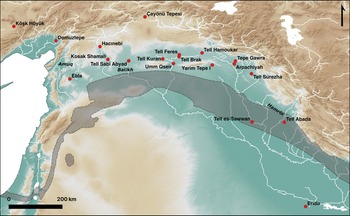
The earliest ‘centre’ of animal domestication, northern Mesopotamia offers an ideal region to examine how livestock shaped the development of the tributary mode of production. For over 10,000 years, sheep, goat, cattle, and pig husbandry featured in this ecologically diverse landscape, marked by wooded foothills, major riverways, grassland steppe and a steep precipitation gradient that creates a shifting ‘zone of uncertainty’ (Wilkinson Reference Wilkinson1994, 487) in which rainfed agriculture is supported, but vulnerable (Fig. 2). The region is also notable for its precocious socio-political evolution, with some of the world’s first cities appearing in the fourth millennium bce (Fig. 3; Ur Reference Ur2010; Frangipane Reference Frangipane2010; McMahon Reference McMahon2020; Stein Reference Stein2012). The following case study examines the role of livestock in these political economic developments, from the first Neolithic communities through the development of urbanism.
Map of northern Mesopotamia and adjoining regions, showing archaeological sites mentioned in the text and the ‘zone of uncertainty’ (modern average annual precipitation between 200 and 300 mm after Hewett et al. Reference Hewett, de Gruchy, Hill and Lawrence2022).

Northern Mesopotamian chronology (based on Akkermans & Schwartz Reference Akkermans and Schwartz2003; Hole Reference Hole2001; Ur Reference Ur2010), showing key shifts in population (total settled area after Palmisano et al. Reference Palmisano, Lawrence, De Gruchy, Bevan and Shennan2021) and livestock use.

The kin-ordered mode of production in flux (c. 9700–4500 bce)
Household and community in the kin-ordered mode of production in the Neolithic
The first agricultural societies in northern Mesopotamia raised sheep, goat, cattle and pigs and were organized in a kin-ordered mode of production. When looking at the dynamics of surplus production and mobilization, one can detect two general types of institutions. The first, the household, incorporated the domestic residential unit and immediate kin networks. Domestic structures (‘houses’) are their primary material proxy. The other was the community, understood here as the institutions, usually organized around larger kinship structures or residential groupings, which served to address various collective action problems. Concretely, these could include patrilineal/matrilineal clans, ritual societies, and meeting houses, some of which are architecturally manifested in frequently attested ‘non-domestic’ structures of the Pre-Pottery Neolithic A and B (PPNA and PPNB).
Atakuman (Reference Atakuman2014), Hodder (Reference Hodder2022) and Price and Makarewicz (Reference Price and Makarewicz2024) all detect a shift from community to household as the primary institution that mobilized surplus labour across the PPNB world. Each contends, though from different positions, that as social reproduction became enfolded within the property relations of agropastoral production, households exhibited greater self-sufficiency, undercutting the need to invest in mechanisms of community cohesion. Price and Makarewicz (Reference Price and Makarewicz2024) identify pastoralism as the key feature in this process. In their interpretation, the household supplanted the community as the predominant institution when wealth in livestock became the principal means of reproducing of wealth in people. In northern Mesopotamia, the cessation of large non-domestic buildings in the seventh millennium bce (e.g. at Çayönü Tepesi) potentially offers a material signature of these shifting relations of production (Atakuman Reference Atakuman2014).
The tension between household and community reflected structural contradictions. The desires to maintain egalitarian norms and build social cohesion through ritual ran up against the social imperatives to augment household membership, wealth and status (Atakuman Reference Atakuman2014; Hodder Reference Hodder2022). Such tensions were enduring and dialectical, leading to long-term cycling between community and household dominance in the kin-ordered mode of production.
This tension and the ensuing cycling are reflected in the diversity of political economic configurations across Neolithic Mesopotamia. Bernbeck (Reference Bernbeck1995) articulates differences between two late seventh-millennium bce cultural horizons, Hassunan and Samarran. Employing a mode of production framework and drawing on architectural layouts, he argues that Hassunan sites (e.g. Yarim Tepe I) were composed of cooperating ‘stem families’, with land held in common — what we term the community variant of the kin-ordered mode of production. This is based on the presence of apparently communal storage buildings, the relatively open layout of houses (with more than one entrance) and the use of space between houses for various activities. On the other hand, Samarran sites (e.g. Tell es-Sawwan) saw storage, cooking and pottery production all taking place within walled compounds and houses typically with single entrances, thus more clearly denoting private and public spheres. To Bernbeck (Reference Bernbeck1995), Samarran villages were composed of largely independent extended families with private ownership of land — the household variant.
While Bernbeck’s (Reference Bernbeck1995) interpretation of architectural data is open to debate, there is similar variation in the sixth millennium bce (comprising the Halaf period). Most villages were small and dispersed, with households forming the dominant social institutions. However, at sites including Tell Sabi Abyad (Burnt Village) (Akkermans & Verhoeven Reference Akkermans and Verhoeven1995), there are what appear to be public storage facilities, complete with sealings, which Frangipane (Reference Frangipane2007, 157) has interpreted as ‘a sophisticated administrative system, probably intended to control the redistribution of food stored in common by the community’. In addition to this apparently communal surplus pooling, there are hints of experiments with tributary relations, such as the Burnt House at Arpachiyah, seemingly the domicile of a wealthy family (Campbell Reference Campbell2000; Sanders Reference Sanders2020).
Feasting is frequently invoked in discussions of Neolithic southwest Asia (e.g. Dietrich et al. Reference Dietrich, Heun, Notroff, Schmidt and Zarnkow2012; Twiss Reference Twiss2008). Feasts are a way to translate surplus livestock and other foodstuffs into ‘wealth in people,’ but they can also work against such ties of dependence by emphasizing a sense of communitas (Dietler Reference Dietler, Dietler and Hayden2001; deFrance Reference deFrance2009). In other words, they can reproduce both household and community versions of the kin-ordered mode of production. Control over the narrative of a feast is often part of the drama, especially in larger ones. We can imagine such dynamics taking place at the massive feast represented by the ‘Death Pit’ at Domuztepe, c. 5575 bce (Kansa et al. Reference Kansa, Kennedy, Campbell and Carter2009; Lau et al. Reference Lau, Gordon and Knudson2021). At the smaller scale, the widespread distribution of fineware Halaf ceramics can be reasonably explained by extensive and competitive feasting between households (Nieuwenhuyse Reference Nieuwenhuyse, Córdoba, Molist, Pérez, Rbio and Martínez2008). Feasts at such smaller scales were probably easier to control discursively and likely helped reproduce the household as the keystone social institution.
We also see evidence for livestock spurring economic growth. Düring (Reference Düring2011, 122) has referred to a seventh- to sixth-millennia ‘Second Neolithic Revolution’ in which new techniques of animal exploitation enabled the extraction of storable products, namely milk and fibre (see also Nieuwenhuyse et al. Reference Nieuwenhuyse, Roffet-Salque, Evershed, Akkermans and Russell2015; Rooijakkers Reference Rooijakkers2012; Rosenstock et al. Reference Rosenstock, Ebert and Scheibner2021). Another animal product, dung, allowed intensified crop production, which is indicated by rising δ 15N values in plant and animal remains (Styring et al. Reference Styring, Charles and Fantone2017). The resulting increases in agricultural surplus coincided with, and likely facilitated, feasting, population increase (Palmisano et al. Reference Palmisano, Lawrence, De Gruchy, Bevan and Shennan2021, 12), some specialization in craft production domains (Carter et al. Reference Carter, Campbell and Gauld2003) and the expansion of obsidian exchange (Healey Reference Healey2007).
Community and economic growth in the Ubaid (Early Chalcolithic)
As the sixth millennium ended, the kin-order mode of production continued to dominate northern Mesopotamia. But especially during the Ubaid period (5200–4500 bce), cracks had begun to appear that suggest the occasional emergence of (proto-)tributary relations. On the one hand, there is little mortuary evidence for an elite stratum. On the other, survey data provide tentative evidence for structural inequality in the form of occasional two-tiered settlement hierarchies (Akkermans & Schwartz Reference Akkermans and Schwartz2003, 159; Stein Reference Stein2012, 129; Trentin Reference Trentin, Carter and Philip2010). Excavations at Tell Abada in the Hamrin Basin offer evidence that some households were pulling far ahead of their peers. Abada’s Building A was significantly larger than the surrounding houses and contained prestige items such as stone palettes and tokens, as well as many infant burials (Jasim Reference Jasim2021). One interpretation is that this house had taken on (or ‘hijacked’) some of the functions of community institutions, including the ownership of certain mortuary rituals. As it did so, it was able to mobilize surplus labour from beyond the sphere of kinship and strategically redistribute values — a prototype of the tributary mode of production.
Yet at other sites, community institutions were dominant. Monumental public structures, often called ‘temples’, were built at Eridu in the south (Safar et al. Reference Safar, Ali Mustafa and Lloyd1981) and Tepe Gawra (Level XIII) in the north (Rothman Reference Rothman and Butterlin2009). Another example comes from Tell Feres, where in level 10 (Late Ubaid) excavators found a large building with four attached pottery workshops and evidence of administration in the form of preformed clay sealings (Vallet Reference Vallet2018, 157). In the subsequent level 9 (c. 4600 BCE, Late Ubaid or Ubaid-LC 1 transitional), a ‘Grand Bâtiment’ contained a reception hall and storage areas (Vallet Reference Vallet2018). In such cases, monumental structures of a seemingly religious nature were the active sites where surplus labour was mobilized and organized for craft production. In contrast to the situation at Tell Abada, these contexts would seem to represent the nascent development of tributary relations within the community form of the kin-ordered mode of production.
There are several indications of economic growth during the Ubaid. Ceramic production underwent specialization, with people employing the slow-wheel (tournette), relying more heavily on chaff tempers and applying less surface decoration — techniques that accelerated and simplified the production process (Akkermans & Schwartz Reference Akkermans and Schwartz2003, 169–70; Kennedy Reference Kennedy2022). Meanwhile, copper artifacts, carved obsidian bowls and lapis lazuli beads offer evidence of the production of prestige goods and long-distance exchange (Stein Reference Stein2012, 130).
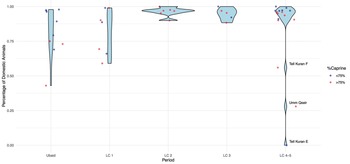
Not coincidentally, the animal economy also shows signs of transformation. First, some subregions (notably the Balikh Valley and the Amuq Plain) witnessed a marked increase in the ratio of domestic to wild taxa between the Halaf and Ubaid (Grossman & Hinman Reference Grossman and Hinman2013). Although not a regionwide pattern (Fig. 4), the evidence indicates the increasing importance of livestock in some places, potentially reflecting an expansion of herds. Additionally, isotopic (enamel δ13C and δ18O) evidence for vertically transhumant pastoralism at late sixth- to fifth-millennium bce Köşk Höyük, just northwest of northern Mesopotamia proper (Makarewicz et al. Reference Makarewicz, Arbuckle and Öztan2017), indicates specialized husbandry practices taking advantage of seasonal rainfall patterns in geographically complementary zones. Such extensification implies that sheep and goat herds were growing; it is likely that people were managing them in novel ways to supply feasts and use livestock for exchange. There are also hints that animal fibres were playing a more sizable economic role. Caprine kill-off data at some sites (e.g. Late Ubaid Kosak Shamali), suggest increased focus on wool extraction, although there is no transregional pattern in the kill-off data (Gourichon & Helmer Reference Gourichon, Helmer, Nishiaki and Matsutani2003; Price & Wolfhagen Reference Price and Wolfhagen2024), and spindle whorls consistent in size with those necessary for spinning animal fibres were recovered at some sites (Sudo Reference Sudo, Carter and Philip2010).
Violin plot of relative abundances of livestock (NISP of sheep, goats, cattle, and pigs) in faunal assemblages from northern Mesopotamia. Red dots show sites in which the proportion of caprines among domestic livestock is over 75 per cent and is taken as a proxy for specialized pastoralism. In the LC 4–5, Tell Kuran and Umm Qseir are interpreted as specialist hunting sites.

The emergence of the tributary mode of production (c. 4500–3500 bce)
Household prominence in the Late Chalcolithic 1
Compared to the Ubaid, the LC 1 generally lacks public buildings; the household again became primary locus of labour mobilization (see Fisher Reference Fisher2017, 77). At Tell Feres, the ‘Grand Bâtiment’ of level 9b–9a (Ubaid-LC 1 transitional) had by level 8 (LC 1, c. 4400 bce) become a more modest structure with two kilns (Fisher Reference Fisher2017, 78; Vallet Reference Vallet2018). The ‘temples’ at Tepe Gawra XIII (Late Ubaid) were gone by Level XII; ritual activity now took place in large houses, notably the ‘White Room’ building (Rothman Reference Rothman and Butterlin2009). These included feasting, which has been amply demonstrated across the Late Ubaid and LC 1 horizons (Kennedy Reference Kennedy and Pollock2012; Proctor et al. Reference Proctor, Smith and Stein2022). Community-wide, or extra-household, ritual institutions did not disappear. For example, excavators uncovered a ‘non-domestic’ building at Tell Surezha filled with atypical finds including butchered dog and wolf bones (Harris Reference Harris2023; Price et al. Reference Price, Fisher and Stein2021; Stein & Fisher Reference Stein and Fisher2020). But these structures were far less substantial, reflecting the general lower levels of surplus mobilization.
Yet it would be misleading to characterize the LC 1 as a ‘return to normal’. Households during the LC 1 operated within a transformed context: changes in scale, technology and opportunities for inter-regional connectivity provided an economic foundation upon which competitive households could overwhelm and ultimately subvert relations of production. At this time, population began to increase significantly (Palmisano et al. Reference Palmisano, Lawrence, De Gruchy, Bevan and Shennan2021). In the domain of craft production, which largely occurred in or near houses, technological development notably included the first clear evidence for local copper smelting within northern Mesopotamia (Caneva et al. Reference Caneva, Palumbi and Pasquino2012, 366; Fisher Reference Fisher2017, 179) and pottery production became more efficient as decoration declined. Feedback between demographic and economic growth would have produced transformative scalar pressures. As some households looked to wider networks of economic circulation and social dependence, the older mode of accumulating wealth in people through the intimate ties of kinship proved an increasingly insufficient basis for defining the relations of production. Such households turned instead to accumulating symbolic value through long-distance exchange and, especially, controlling the means of cereal and livestock production (Stein Reference Stein2012).
Food was probably the key to greater mobilization of surplus labour. The rapidly made flint-scraped ‘Coba bowls’ and ‘wide flower pots’, generally found in association with domestic structures, likely point to scaled-up consumption or redistribution activities (Baldi Reference Baldi2012; Fisher Reference Fisher2017, 59–62), possibly ‘labour feasts’ held by competing households (Fisher Reference Fisher2017, 99–101; Kennedy Reference Kennedy and Pollock2012). If so, we can sketch the evolution of corvée: the commensal logic of the feast in the Neolithic through LC 1 — the counter-gifting of labour and food — was gradually transformed into ‘rationing’ — a calculated exchange of labour time for measured quantities of food. The persistence of these ceramic forms into the LC 2 in more institutional contexts, such as the Round Building at Tepe Gawra (Rothman Reference Rothman and Butterlin2009), would support this model.
While we do not know precisely what filled Late Chalcolithic bowls, meat and dairy were likely essential ingredients for labour feasts — indeed, organic residue analysis of later bevelled rim bowls show that such ‘ration bowls’ were sometimes filled with meat (Perrucchini et al. Reference Perruchini, Glatz and Heimvik2023). As an expandable source of wealth for early elites, herds could be grown rapidly and their offtake used to supply these feasts and, later, ‘rations’. But wealth in livestock was also flexible and production goals could be switched rapidly. In addition to providing meat, sheep could supply raw materials for textiles and cattle could be trained to pull ards or carry burdens.
Indeed, wool production may have been transformative. Here it is worth invoking Sherratt’s (Reference Sherratt1983) ‘secondary products revolution’ as well as McCorriston’s (Reference McCorriston1997) influential model, which holds that wool, easier to extract in bulk than linen, meant less labour needed for household textile production, thereby creating a pool of surplus labourers (particularly low-status women). This surplus labour was mobilized, she argues, by wealthy households and emerging ‘institutions’ for expanded, exchange-oriented textile production. Some have contested the details of the hypothesis, with Joffe (Reference Joffe2022) questioning whether linen was ever a common material for clothing. Nevertheless, the core facts remain: the demand for textiles was high and elastic, the use of wool expanded the workable volume of raw materials used in production, the processing of wool into textiles was a sink for surplus labour, and textiles were used in regional and inter-regional trade to acquire other goods, thereby stimulating demand and production in other sectors.
Zooarchaeological evidence for the expansion of wool production is equivocal, hampered by small sample sizes that make analysis of kill-off profiles problematic (Price & Wolfhagen Reference Price and Wolfhagen2024). While there are occasional changes in caprine husbandry at the local level, it seems that that tributary demands for textile production did not have as great an impact of herding decisions at a regional scale as often thought. Price and Wolfhagen (Reference Price and Wolfhagen2024) frame this in terms of the resilience of the subsistence economy in the face of a developing political economy marked by spatially patchy tribute mobilization.
Artefactual datasets offer an alternative line of evidence. At Tell Surezha, for example, spinning of wool is suggested by small-sized spindle whorls and a decline in the archaeobotanical assemblage of flax (Price et al. Reference Price, Fisher and Stein2021; Proctor et al. Reference Proctor, Smith and Stein2022). At a broader scale, Schoop (Reference Schoop, Horejs and Mehofer2014, 432) examined textile production evidence across Anatolia (including part of northern Mesopotamia as defined here) and identified a major uptick in the frequency of loom weights, spindle whorls and other textile-related artifacts beginning in the latter half of the fifth millennium bce. There was also evidence of houses with multiple looms, suggesting the development of specialized workshops. The evidence thus indicates a scalar increase in textile production, even if this did not initially have a region-wide impact on kill-off practices.
Draft cattle likely played a role in expanding the scope and capacity of production and exchange in the LC 1. Pathological lesions concentrated on the distal limbs of cattle remains from Tell Surezha could indicate increased use of traction power (Price et al. Reference Price, Fisher and Stein2021) — a development that may signify the beginnings of the extensification of cereal production through plough agriculture identified in isotopic data (Styring et al. Reference Styring, Charles and Fantone2017). Those households able to maintain working cattle would have been able to expand surplus production and loan their cattle to others in exchange for labour or rent.
At the same time, the exceptional potential mobility of caprine husbandry, especially in the process of extensification, may have assisted long-distance exchange. Strong stylistic parallels between sub-regions (especially between highland and lowland regions) suggest that households of the LC 1 were able to make contacts at longer distances and perhaps in some cases control trade routes (Alden et al. Reference Alden, Minc, Buehlman-Barbeau and Stein2021; Kennedy Reference Kennedy2022). One hypothesis is that these connections could have been forged, or otherwise facilitated, by transhumant pastoralists wintering in the lowlands (Abu Jayyab Reference Abu Jayyab2019). Those households owning large flocks would have been in prime positions to take advantage of the increased traffic in exchangeable commodities.
The tributary mode of the LC 2 and 3
During the LC 2 and LC 3, the inter-household competition of the LC 1 evolved into a more obvious tributary mode of production, one in which a stratum of elites based in regional centres appropriated surplus labour from a broad section of the population using new administrative techniques. Regional stratification is indicated by appearance of major centres, including Tell Brak (50 ha in the LC 2; 130 ha in the LC 3), that were unequivocally urban in character by the LC 3 (Lawrence & Wilkinson Reference Lawrence and Wilkinson2015; Ur Reference Ur2010). New forms of stratification are also visible in burials and architecture. In the LC 2, one finds child burials accompanied by prestige goods like gold and lapis lazuli (Stein Reference Stein2012, 135–6) and secular monumental architecture, such as the Round House at Gawra (Rothman Reference Rothman and Butterlin2009) and the Basalt Threshold Building at Brak TW 20 (McMahon Reference McMahon2020, 310–11; McMahon et al. Reference McMahon, Oates and Al-Quntar2007). These structures appear to be large houses and to incorporate the general functions of households. They also show indications of storage of surplus, specialized craft production, large-scale feasting, prestige goods and administrative technology, suggesting the development of an institutional role for these effectively ‘aggrandized households’ emerging out of their control over key aspects of the economy in a period defined by a general trajectory of economic growth.
Some craft production remained independent, such as copper smelting at LC 2 Hacınebi (Stein Reference Stein2012, 136). But the elite institutions represented by the new monumental compounds were clearly able to support significant numbers of attached craft specialists and transform labour processes. Pottery production, for example, became more efficient as potters relied more on chaff temper to hasten drying (McMahon Reference McMahon2020, 312–13). Significantly, woollen textile production expanded. Zooarchaeological data indicate that larger-sized sheep appear in northern Mesopotamia in the LC 1 and LC 2, possibly a wool-producing population (Vila & Helmer Reference Vila, Helmer, Breniquet and Michel2014; see also Price & Wolfhagen Reference Price and Wolfhagen2024). Spindle-whorl size, which remained small (optimal for spinning wool), became standardized at Tell Brak, suggesting specialization of textile production (McMahon Reference McMahon2020, 302).
Brak’s trench TW sequence provides an example of the range and scale of production directly controlled by elite institutions, and the central role played by feasting in labour mobilization. In the LC 2 (TW level 20), diverse production activities were associated with a monumental building, including cooking, textile production and stone working (McMahon Reference McMahon2020, 314; Oates et al. Reference Oates, McMahon, Karsgaard, Al Quntar and Ur2007, 590). In the succeeding TW level 19 (LC 2–3), the new Red Libn Building was constructed, ‘a massive industrial building with large kilns, basins, grinding stones, and storage’ (McMahon Reference McMahon2020, 314). Excavators at Tell Brak also recovered mass-produced bowls in the LC 2 levels and a numerical tablet (suggesting administrative accounting). Finally, in the TW level 18 (LC 3), excavators found a large ‘Feasting Hall’ complete with ovens, ceramic plates and a large number of caprine and cattle remains (McMahon Reference McMahon2020, 311; Oates et al. Reference Oates, McMahon, Karsgaard, Al Quntar and Ur2007, 594–6).
Such feasts provided a means by which appropriated surplus could be transformed into political power. At the same time, feasting had a clear economic logic: by reinvesting a portion of the appropriated surplus back into the population, elites could appropriate additional units of surplus labour necessary to maintain the tributary cycle. As such, it was a powerful tool for emergent institutions within a new tributary mode of production — and one in which livestock served both as victuals and agents of traction.
To fuel feasts and feed dependents, elites and their institutions required regular supplies of animals and their products. From the perspective of the surplus-taker (and with apologies to Lévi-Strauss), livestock are good to tax, especially mobile herd animals like caprines and cattle. The emerging cities became nodes of animal movement, forming central places for the collection, processing (plucking, milking, slaughtering) and distribution of livestock. Indeed, the regular movements of sheep, goats and cattle between hinterlands and cities carved out some of the ‘hollow ways’ that radiate out from fourth- and third-millennium sites (Casana Reference Casana2013; Wilkinson Reference Wilkinson1993). As nodes of pastoralist extensification into the more arid parts of the ‘zone of uncertainty’ and the mountainous terrain to the north, cities and the elites within them could tap the riches of these pastures of plenty. At the same time, the extensification of agriculture, which increased extractable cereal surpluses (Styring et al. Reference Styring, Charles and Fantone2017), was almost certainly facilitated by ox and ard.
Figure 4 shows NISP data for domestic and wild taxa in northern Mesopotamia over time. The LC 2 coincides with the first quantitative and transregional jump in ratio of domestic to wild taxa. This shift likely reflects both a decline of hunting and (more significantly) the expansion of herds. Henceforth, domestic species truly dominate zooarchaeological assemblages (around 95 per cent), with the notable exception of hunting specialist sites like Tell Kuran (Bar-Oz et al. Reference Bar-Oz, Zeder and Hole2011). Such sites could represent new elite demands for unusual animal products (gazelle skins) or, tantalizingly, efforts to escape the tributary mode of production.
Finally, violence appears to increase around 4000 bce. Evidence includes the burning of the Round House at Tepe Gawra XIa (c. 4200 bce, LC 2), mass graves at Tell Majnuna near Brak (3800–3600 bce) and the sacking of Tell Hamoukar (c. 3500 bce) (McMahon Reference McMahon2020, 324; McMahon et al. Reference McMahon, Sołtysiak and Weber2011; Rothman Reference Rothman and Butterlin2009, 24). The increase in scale and frequency of organized inter-community violence is consistent with expectations for a tributary mode of production, with its focus on the extraction of surplus value from producers by other-than-economic means. Again, we posit that animal wealth was often a target of (or a reward for) violence; indeed, ancient texts from later periods document that livestock were frequently taken as booty in war (Corcoran-Tadd et al. Reference Corcoran-Tadd, Price and Caramanica2023, 124).
For Chalcolithic elites (as for competitive household heads in the previous Neolithic), livestock offered a significantly expandable source of wealth, a resource that could be grown relatively quickly, while also able to be converted into other values. And the flexibility of animal wealth was also surely attractive, allowing for strategic shifts between subsistence and craft production and for mobility across growing networks of social connectivity and political dependence. Apart from ‘wealth in people’, no other source of wealth in the ancient world had such versatility in so many domains. As human communities were reconfigured across northern Mesopotamia into new social formations, animal herds offered a key basis for the rapid and unequal economic growth that made the Late Chalcolithic a watershed moment in the region’s history.
Discussion and conclusion
The analytical lens offered by the ‘mode of production’ concept focuses our attention on labour and value in northern Mesopotamia. Our analysis foregrounds the tensions within modes of production, particularly those between the household and community as major institutions in the kin-ordered mode of production. This has enabled a new view of the oscillations and cyclical patterns that characterize the uneven emergence of stratified political economies in the region. In our reading, although community-oriented institutions occasionally made steps toward tribute-taking, especially in the Ubaid, it appears that tribute-taking largely derived from households, with the LC 1 representing a key turning point. By the LC 2–3, aggrandized households were at the centre of a tributary mode of production operating across northern Mesopotamia.
We place wealth in livestock at the forefront of our description of this process, without necessarily arguing they were ‘prime movers’. In fact, our analysis complicates the very notion of prime movers: we consider livestock as nodes in a network in which food production and other economic activities interacted with population growth, settlement agglomeration, landscape modification and the development of political institutions. In focusing on livestock as a unique form of wealth, we forefront how animals shaped important dynamics that ultimately changed the topology of this network in fundamental ways. In the Mesopotamian case, we argue that livestock specifically facilitated differential accumulation and had a multiplier effect on economic growth.
In the Neolithic, sheep, goats, cattle and pigs had become in many cases the most important non-human assets of households, alongside land. As private and heritable property held at the level of the household, livestock could form a focus for expansive accumulation while also affording the possibility of conversion, especially into wealth in people. Always a flexible type of wealth, wealth in livestock (particularly sheep, goats and cattle) became even more flexible with the ‘second Neolithic revolution’ (Düring Reference Düring2011), which saw the more intensive use of dung as well as some of the earliest uses of secondary products, and the succeeding ‘secondary products revolution’ (Sherratt Reference Sherratt1983), which saw the expanded use of animals for traction and wool and that appears to have kicked off in the Ubaid and LC 1. These ‘revolutions’ made livestock even more attractive, giving households the ability to accumulate wealth differentially, to sink labour into ‘profitable’ forms of production, and tempting them to appropriate livestock directly through violence.
In accounting for the emergence of a tributary mode of production evident by the LC 2, we have emphasized how wealth in livestock offered elites an ideal target for accumulation, one that enabled elites to support feasts, provision dependents, supply and control a burgeoning textile industry, engage in and dominate long-distance exchange and expand agricultural production. In doing so, elites drew upon the expandability, convertibility and flexibility of certain highly mobile species, notably sheep, goats and cattle, which also possessed the ability to convert unused grasslands in the ‘Zone of Uncertainty’ and its more arid southern margin into wealth in livestock through pastoralist extensification. It is no surprise that, when the earliest texts appeared in southern Mesopotamia in the mid-fourth millennium bce, accounting for livestock was a major topic of concern (Green Reference Green1980). Though writing appeared much later in northern Mesopotamia, a mid-third-millennium bce archive from Palace G at Ebla indicates a palatial economy heavily invested in woollen textile production. To support this industry, the palace owned tens of thousands (and possibly up to two million) head of sheep and goats (see Wilkinson et al. Reference Wilkinson, Philip and Bradbury2014, 58).
The Ebla corpus reminds us that livestock production was not just a means of differential accumulation, but also an effective stimulator of economic growth. Livestock production and its subsidiary activities, especially woollen-textile production, provided sinks for surplus labour, drawing in increasing numbers of workers and stimulating production in other sectors. Wool may be the most conspicuous in the textual record, but livestock production certainly had a wide-reaching economic impact. While we speculate that trade networks were built upon the routes of transhumant pastoralists (following Abu Jayyab Reference Abu Jayyab2019), the well-attested use of cattle to transport goods and pull ards enhanced the capacity for agricultural production, tribute mobilization and exchange.
It is worth pointing out that political authority in the tributary mode of production tended to be brittle and state power remained relatively weak even in later periods of Mesopotamian history (Grossman & Paulette Reference Grossman and Paulette2020; Richardson Reference Richardson2012). Even at Ebla’s apogee, control over livestock production was probably like Wickham’s ‘leopard spots’ description of early medieval Europe (Reference Wickham2005, 541), in which tribute extraction was confined to certain contexts in an economy otherwise operating within a kin-ordered mode of production. Indeed, two forms of livestock production, mobile pastoralism (Porter Reference Porter2012; but see Arbuckle & Hammer Reference Arbuckle and Hammer2019) and pig husbandry, may have offered ways of avoiding tributary relations. Indeed, pigs, despite being one of the most common livestock animals in Mesopotamia in the ninth–third millennia bce, appear to have escaped the gaze of elite institutions altogether (Price Reference Price2021, 62–76; Price et al. Reference Price, Grossman and Paulette2017). We can speculate that pigs’ lack of secondary products (convertibility), inability to convert grass to meat (convertibility) and lesser mobility (flexibility) made them less attractive targets of accumulation. On the other hand, their rapid rates of reproduction (expandability) and ability to subsist on household waste (convertibility) made them excellent options for small-scale, household-based production, especially in urban contexts.
These inter-species differences raise an important issue: the ways that livestock function as wealth are shaped not only by the mode of production but also by the specific biological, physiological and behavioural affordances of the animals themselves. The expandability of animal wealth, for example, is a function of reproductive capabilities, which vary widely between and within species. The instability of herds varies in accordance with drought tolerance and immune function among other bodily affordances. At the same time, these affordances themselves are subject to historical transformations, including shifts in mode of production. The development of ‘improved’ livestock breeds during the rise of capitalist agricultural systems during the eighteenth and nineteenth centuries might be the most obvious case. But animal bodies also underwent significant changes as part of the long interplay between economies and domestication processes in Mesopotamia, with the evolution of caprine hair follicles and its attendant impact on the textile industry standing out (Ryder Reference Ryder1964; Jackson et al. Reference Jackson, Maddocks and Watts2020). Especially as new types of bioarchaeological data are published, the integration of these evolving sets of animal affordances into the framework laid out in the present article promises to offer a fascinating exploration of human–animal agencies and relations.
Our hope is that this foray into the northern Mesopotamia case will inspire exploration of the ‘animal side’ of political economic trajectories in other regions. Archaeologists need to write livestock more centrally into accounts of long-term political economic development. There needs to be better integration of zooarchaeological datasets with those of architecture, ceramics, lithics and metals within an analytical framework that articulates the nexus of labour, surplus production and political power. Each world region possesses its unique blend of social formations, environmental affordances, species, human–animal relations and technological development. Yet in conducting our analysis of the role of livestock in the development of the tributary mode of production in northern Mesopotamia, we have shown how political economic trajectory of the region was clearly shaped by the tensions between the fragility of ‘wealth in animals’ and the possibilities for differential accumulation, economic growth and direct appropriation afforded by livestock — aspects generalizable to a much broader range of socio-historical contexts.
Acknowledgements
We wish to thank four anonymous reviewers for their critical and helpful feedback. We also wish to thank Sarah Semple and Dan Lawrence for their comments and insightful perspectives.

 Open access

