

WHAT DOES MANAGING COLLECTIONS MEAN?
Archaeologists with a field orientation tend to think of collections as sets of objects, but good collections management requires a broader view. An archaeological collection consists of objects plus information about them: the context in which they were found, the circumstances that triggered the discovery, the regulatory issues that applied and how they were addressed, the kinds of consultation that were conducted with interested parties (such as descendant communities), and the results of that consultation. Associated information is often as important as the objects themselves. In fact, Bell (Reference Bell2017:245) and others characterize objects as bundles of social relations that collections managers must bring to light in order to provide an understanding of the “lifeworlds” of artifacts before and after they become museum collections. Descendant communities express their relationship to collections in verbal and nonverbal ways, whereas archaeologists create their own descriptions as tools for understanding them.
Providing meaningful access to an artifact assemblage's associated body of information can be a significant challenge. A Minnesota Department of Natural Resources manager offered a valuable perspective on this problem. He pointed out that he does not actually manage natural resources; what he does is manage the ways in which people interact with the resources. It is the same with collections management. We are not managing the collections. We are managing the ways in which people create, document, interpret, analyze, and access the collections. And because we are managing people, there are, inevitably, social and political issues that need to be addressed. Collaboration, consultation, and the ability to represent multiple characterizations or interpretations offer the clearest path to a better understanding of collections and their management. We will examine the technical specifications we have developed to gather consistent documentation from a diverse community of archaeology researchers and the effect this has had on social and political relationships both inside and outside that community. Two examples will show how our data standards have been adapted for publication of collections data online.
THE TECHNICAL CHALLENGE: IMPLEMENTING A DATA STANDARD
The Minnesota Historical Society (MNHS) serves as the primary repository for archaeological collections from public land in Minnesota. Most of the collections deposited every year result from research conducted to meet the requirements of Section 106 of the National Historic Preservation Act.
In 2003, when our institution rolled out a new collections management software system (CMS), we had to decide how to get data for the collections generated by archaeology depositors into the new system. We knew depositors were creating electronic data for artifact analysis because they were sending disks full of data for curation along with the required paper documentation and artifacts. Why not tap into that process to get database-ready records for our system?
The problem was that no two data sets were constructed in the same way. Collections data need to be consistent, whereas analytical data tend to vary depending on the researcher's needs and training. The metadata schemas and terminology in each data set we received were unique in their structure and term use. Even when researchers’ data structures look the same, standards are seldom, if ever, documented. Consequently, users might not be sure of the meaning.
Museums confront the same problems that other data aggregators face—assuring that the data are well documented and, to the greatest extent possible, interoperable. In fact, the majority of collections deposited at our institution tend to be small, with limited interpretive potential for the source site. They are more valuable when they can be searched and analyzed together with other collections.
Where to Look for Standards
The collections management system used by MNHS is an object-oriented relational database from a major vendor serving the museum community. We were already capturing consistent site-, project,- and collection-level data that met museum standards and matched the basic metadata requirements set forth by the Archaeological Data Service (ADS) in the United Kingdom (UK) and the University of Chicago's OCHRE system. There have been almost no standards, however, for object-level descriptions in archaeology.
We decided that we should, as much as possible, take advantage of common practices among current depositors, an approach sometimes called “paving the cow paths.” Many depositors were already using some variation of a system developed by Emerson in 1985 when MNHS archaeologists conducted cultural resource management research for the state's Departments of Natural Resources and Transportation. Emerson helped create a dBase cataloging system that produced structured data for the MNHS collections managers and allowed staff archaeologists to carry out the artifact analysis they needed. After eighteen months of field-by-field reviews, the archaeology data structure in the new CMS closely resembled the old dBase system.
Although we worked together across departments at MNHS to establish our metadata model and build on common practices in Minnesota, we did not invite outside researchers to collaborate on the development of our model or to offer critiques of it. So, why would we have any reason to think we could get archaeologists to use our new metadata model and standards? To put it simply—because we could make them. Archaeologists who plan to work on public land in Minnesota cannot do so without a license from the Minnesota Office of the State Archaeologist and they can't get a license without a repository agreement from a qualified facility. Our institution is the primary qualified repository in the state.
Implementing a standard in this way is not ideal. We had a really big stick, and we used it (Huvila et al. Reference Huvila, Dirndorfer, Anderson, Jansen, McKenzie and Worrall2017). This approach runs the risk of alienating users who will decide to jump ship and find a facility that is easier to work with.
Although we did not seek input from researchers before the rollout, we certainly got it afterward. We listened and took this opportunity to implement changes to make the system more user-friendly. The field order was switched, and values were added to the look-up lists, but the system was not fundamentally altered. Throughout the process, we worked to keep the standard as lightweight as possible so that adoption would be relatively easy. This has, in fact, helped keep resistance to a minimum. The required data can be generated in addition to data gathered for analysis. Alternately, our system can be used instead of one that the researcher may have been using previously.
We decided it was important to provide a number of tools to help depositors create compliant data. All depositors are required to go through approximately two hours of training the first time they apply for a repository agreement with our institution. An overview of the data structure and use of descriptive terms in cataloging are among the topics covered. An MS Access database is available on the MNHS website with helpful lists of common values for the required fields. Depositors are welcome to submit spreadsheets instead if they don't need the tools built in a database. A comprehensive data dictionary defines the use of each field and includes example data. Depositors are also encouraged to ask questions frequently during data preparation and to submit sample data sets from larger collections to ensure that they are on the right track. These database-ready records are the only way we are able to track archaeology collections at the object level. The cost of mapping diverse data structures, such as the ones we received prior to the implementation of the standards in 2006, would be prohibitive.
The Artifact Recording Standard
The required metadata consists of a few pieces of administrative information, parsing protocols for provenience, a historic or cultural period designation, a flag for significant artifacts, and a count and set of descriptive terms to characterize each artifact or group of artifacts.
The artifact schema:
• Catalog Number
• Landowner
• Recovery Date
• Box Number
• Collections Method and Provenience
• Historic/Cultural Period
• Diagnostic/Nondiagnostic Flag
• Count
• Material
• Object Name
The first four elements have very straight forward data entry guidelines. The Catalog Number follows current museum standards (Buck Reference Buck, Buck and Gilmore2010:207). We use a three- or four-part number consisting of the year the number is assigned, a collection number assigned sequentially each year, and an object number (such as 2019.2.1). We allow objects to be assigned to subgroups during cataloging (usually by provenience) before the object number is assigned, resulting in a four-part number (such as 2019.2.1.1). The Landowner field identifies the public entity that owns the land on which the collecting activity took place. In the case of collections from associated private parcels, this helps us double-check that we have the proper title documentation. The Recovery Date information is intended to tie artifacts to the associated field notes. We follow the MM-DD-YYYY format typically used in the United States, but it can be converted to the more widely used DD-MM-YYYY in a data export, if needed. The Box Number field controls for artifact location when more than one box of artifacts is submitted at a time. Depositors are welcome to use any kind of designations they like (such as 1, 2, 3 … or A, B, C …) because boxes are assigned MNHS numbers once they go into storage. Linking the artifacts with their box locations in the catalog data means that the boxes can be packed (Minnesota Historical Society 2006) in the way that best suits a particular collection.
The Collection Method field is designed to allow searches of the collections data by the type of field recovery technique. For example, a researcher may choose to search only for artifacts recovered from controlled excavation contexts and eliminate surface finds. This field list was originally made up of common designations used in existing data but has the capacity to record a wide variety of meaningful recovery types. The list simply serves to standardize how common methods are recorded so as to provide a useful search tool. Additional provenience information can be recorded as needed, following parsing guidelines.
The Historic/Cultural Period field references the Minnesota State Historic Preservation Office National Register of Historic Places, “Historic Contexts” authority list for Minnesota. This helps sort the collections into broad historical or cultural groupings. Although specific to Minnesota, this data could easily be aligned with a linked open data standard such as PeriodO in the future.
The Diagnostic/Nondiagnostic flag allows archaeologists to mark the records for artifacts that they think anyone studying the collections would want to look at. This is a completely subjective designation, but it can help provide a quick way to find significant items.
The Material Type and Object Name fields represent the minimum level of object identification required to manage the collections. The biggest change for everyone was the use of a controlled vocabulary. Depositors were not able to pick just any terms to describe their collections; they had to use terms from the Getty Research Institute's Art and Architecture Thesaurus (AAT), Materials and Objects Facet. Additional description information, if provided, can characterize any aspect of the artifact. If species identifications are included in the additional data, however, we ask that they use valid terms from the Integrated Taxonomic Information System. We also provide an optional field where full text descriptions can be entered with no restrictions apart from coherence and spelling.
Controlled Vocabularies
So, why would we inflict the Getty AAT on depositors? In 2006, Tyler Bell and Harrison Eiteljorg made a strong argument for “terminological ambiguity as the critical enemy to the use of archaeological data by the archaeological community” and went on to say that it was “incumbent upon all archaeologists to work to make possible the effective interchange of data” (Bell and Eiteljorg Reference Bell and Eiteljorg2006). Their insights only served to underscore the conclusion we had already reached when reviewing our legacy data. Descriptive terms were seldom used in a consistent manner. Even when they were, the terms were rarely defined, leaving their meanings ultimately up to the interpretation of the user.
A controlled vocabulary provides semantic clarity by supplying definitions and a single authoritative version for multiple terms that refer to the same concept. The AAT was a good choice because it was one of the most widely used in the museum field. Unlike other museum vocabularies, the AAT's structure and terms are suited to describing archaeological collections. “Fragments (object portions)” is an object name, for example. Most other standards, such as nomenclature, require the user to identify the entire object, which is sometimes impossible to do for broken artifacts. Archaeology is in scope for the AAT, which seeks to cover not only art and architecture but also cultural heritage more generally.
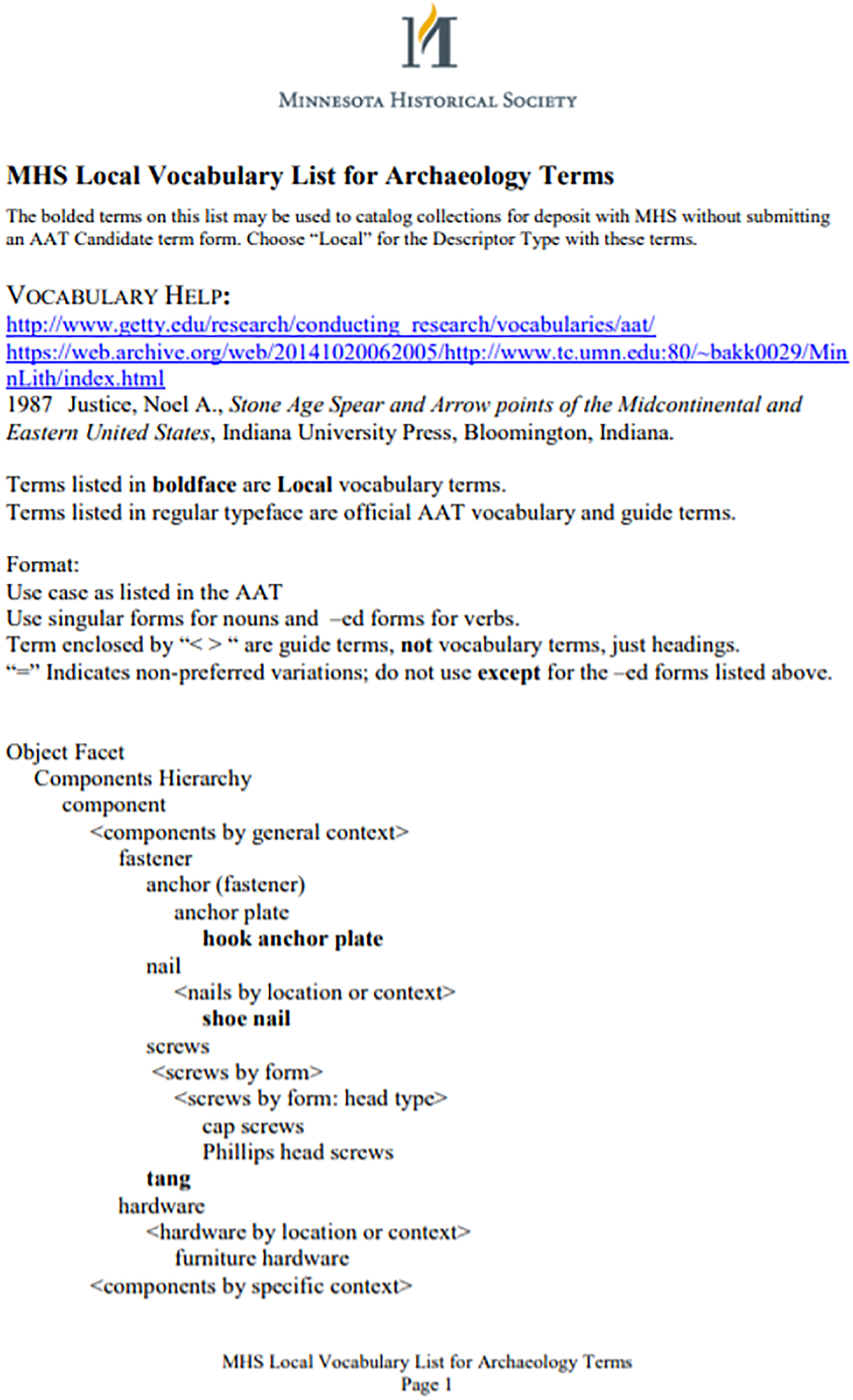
Another strength of the AAT is that it grows through user contributions. Some archaeologists (Beebe Reference Beebe2017) have noted the limited number of AAT terms related to archaeology, but there is no reason we cannot have more. If the archaeology repository community is looking for somewhere to build semantic interoperability, the AAT is a good place to start. In fact, a number of basic archaeology terms are included in the AAT because we submitted them. To cover the gaps, MNHS also provides a local vocabulary list containing terms that meet the criteria for submission to the AAT but have not yet been proposed (Figure 1). We invited depositors to submit terms they felt they needed, but to date, almost none has.
Example page from the Minnesota Historical Society local lexicon.
Data Interoperability
Data interoperability projects have begun to take advantage of the fact that the Getty published the AAT as an ontology in 2014. Structured data, such as artifact descriptions, using AAT terms can be made available online as Linked Open Data (LOD). This allows artifact records to be found as a result of searches on the AAT concepts used to describe them. The Open Context publishing platform takes advantage of LOD, and a selection of MNHS collections data has been published there using AAT concepts. For this project, we used AAT terms to index legacy data that originally had only free text descriptions. In this way, we preserved the original data while making it available in an accessible and searchable format (Kulasekaran et al. Reference Kulasekaran, Trelogan, Esteva and Johnson2014).
A project undertaken by Maureen Henninger on collections recovered from a site in Scotland used natural language processing to map selected object descriptions to the closest AAT term in order to improve data reuse by both archaeologists and the general public. She quotes Binding and Tudhope (Reference Binding and Tudhope2016:18),who noted that tools like LOD “can act as hubs in the evolving web of archaeological data” (Henninger Reference Henninger2017:23). Binding and Tudhope specifically observed that the AAT has the potential to be used as a hub for data integration. They created a vocabulary mapping tool that indexed local terms to the AAT to enable cross-repository searches (Binding and Tudhope Reference Binding and Tudhope2016). Writing on standards in 2009, Fred Limp quoted the Open Geospatial Consortium guidance on data integration:
It happens that standard data models and standard metadata schemas can be very useful even if no one follows them precisely. The standards will have an important role as “Rosetta stones” that enable users to “imperfectly” map data in a “local” data model to a common model, thus making their data “as useful as possible” to others. One-to-one mapping of data models is unworkable when there are thousands of models to map between [Limp 2009].
Efforts to map diverse and often specialized descriptions to an authoritative controlled vocabulary such as the AAT mean that we are starting to create the kind of hub-and-spoke integration model that has the potential to harmonize many disparate cataloging systems. Although MNHS depositors have not had the advantage of natural language processing tools to help them create AAT-based artifact descriptions, their extra work mastering this skill is now paying off in the possibility of improved discovery not just inside the repository but outside it as well. An advantage, which we did not foresee in 2006, was multiple-language support that the Getty added beginning in 2008, making the scope of the potential integration even larger.
Problems with Using the AAT
Although the MNHS terminology standard has vastly improved the semantic clarity and interoperability of the collections data, there are some drawbacks. The overall hierarchical structure of the AAT, while useful, can be restrictive. The hierarchy includes categories such as Associated Concepts, Physical Attributes, Styles, Agents, Activities, and Brands. We did not want to impose the implied analytical structure on our depositor's data, so we only require depositors to use the Material and Objects portion of the vocabulary structure. Beyond that, if depositors use AAT terms to characterize their collections, they are free to group them in any way they like. Because the MNHS data structure is designed to work with a variety of analytical systems, the trade-off is that we do not preserve the depositor's term categories when the data is imported to the collections management system. We can attach a file that contains the terms and analytical categories, but it will not be fully searchable in the system.
The AAT vocabulary also has enough internal flexibility that it is still possible to describe objects inconsistently. One user may characterize a ceramic sherd as “transferware” and another as “whiteware” and “transfer-printed.” This can even happen in the same dataset. Our institution does not impose a particular approach.
Kansa and Kansa point out that interoperability can come at the cost of complexity (Reference Kansa and Kansa2018:92). The limited amount of required standardized data in the MNHS system similarly limits the degree of consistent cross-collection analysis that can be done. The lack of overarching categories, such as functional or technological classes, can also make the data difficult to use. Researchers who use our data have to plow through a large number of Material and Object terms and group them into categories that they find useful or go back to copies of the data that contain the depositor's categories, if they are available.
Another problem is the learning curve for users. Brick, wire, and bone, for example, are all Material facet terms that new users struggle to match with Objects facet terms. In the case of brick and wire artifacts, they are usually fragments of a structure, such as a wall or fence, but archaeologists tend to think of these materials as objects in and of themselves. Similarly, most of our depositors think of bone as both an object and a material. Although bone is a material, the AAT classifies the terms for skeletal elements in the Objects facet. Once users understand the classification differences, however, the redundant nature of many artifact assemblages makes the process somewhat less painful because depositors need to master a limited number of terms and their applications.
In Archaeology 2.0, Kansa and colleagues note that “determining semantic standards has obvious political dimensions. Who sets the agenda and for what purpose? Which sorts of meanings are important and allowed in a given semantic standard, and which are excluded?” (Kansa et al. Reference Kansa, Kansa and Watrall2011:28). Like most authorities in the museum, archive, and library worlds, the AAT has a built-in colonial bias. This problem can be found in any system designed by Western cultures and used to describe non-Western cultures. The bias is primarily evident in the Styles and Periods facet of the hierarchy, with such terms as “Pre-Columbian.” In another instance, the MNHS substituted the term “Catlinite” with the alternate term “pipestone” to remove the reference to a colonial figure. We will discuss the use of AAT terms to describe Native American culture further in the case study below.
THE JEFFERS PETROGLYPHS SITE
At MNHS, we work with Native American communities that own the culture and, in some cases, the collections directly. Consequently, we need to provide the kind of access they want. Our institution is the steward for a site (Jeffers Petroglyphs) containing more than 5,000 individual ancient Native American petroglyphs. A conservation project conducted between 2006 and 2013 included white-light scanning of the rock face by personnel from the University of Minnesota's Evolutionary Anthropology Lab that resulted in the creation of over 2,000 3D models. The partners on this project met to discuss how the scans would be made available through our Collections Online web page. We had to figure out the best way to describe the glyphs to make them discoverable and useful to the Native community as well as the general public.
The content for Collections Online comes out of the collections management database. The initial descriptions recorded by our Native American partners and MNHS staff used a unique set of terms. These terms were indexed with the closest AAT terms and then reviewed by Native representatives and site staff. An example of the primary problem we encountered is that the AAT term for human-like forms is “anthropomorphic.” Our Dakota partner thought community members searching the online records would never find human-like figures if they had to search for the AAT term and would actually be put off by it.
Our data structure allows multiple terms to be recorded for a collection item, but in the end, we chose to record only the terms assigned by our partners (Brown and Nicholas Reference Brown and Nicholas2012:315). Adhering to standards while allowing enough flexibility to meet project goals is important. Linking to the AAT concept was considered acceptable, which we can still do, but the link would have to be entered by hand.
Sharing aspects of Native American culture and knowledge, such as the Jeffers Petroglyphs, must be a collaborative process. Consultation should determine if digital data derived from material and knowledge created by Native American people should be shared and, if so, how.
SOCIAL AND POLITICAL ISSUES SURROUNDING INDIGENOUS CULTURAL PROPERTY
Political issues in data management arise most often in the form of concerns expressed by Native American tribes (in the United States) about treatment, care, and accessibility of indigenous-related collections. Questions about the use of descriptive terminology that we faced during the Jeffers project can be seen as a facet of accessibility. These questions are political issues because federally recognized tribes are sovereign governments, and their concerns must be addressed with full consideration of that status. Even tribes that are not currently recognized by the federal government are culturally self-identified groups with a right to be involved in the treatment of their own cultural heritage.
Any museum that holds indigenous-related collections needs to consider how its data management system (or systems) addresses the concerns of cultural groups whose heritage is represented in its collections (Kreps Reference Kreps2015). Indigenous peoples have become increasingly concerned about collections of their cultural heritage and more confident of their right to insist that museums pay attention to their concerns. They are stakeholders in the management of both objects and data (see Goff et al. Reference Goff, Chapoose, Cook and Voirol2019).
At our institution, tribes have shown considerable interest in both the objects in our collections and the information connected to them. We are still grappling with how to best make that information easily accessible to appropriate tribal representatives while both maintaining data security and bearing in mind that putting information online often bends interpretation toward the dominant ontologies that structure the Web (Salmond Reference Salmond2012).
In addition to the Jeffers Petroglyphs site, our work thus far in sharing archaeological collections data has focused, for the most part, on collections excavated at Historic Fort Snelling, a military installation in Minnesota established in 1820. The majority of the roughly 160,000 objects from Fort Snelling relate to the military occupation, but there is a subset of indigenous-related objects that reflect Native presence long before the U.S. Army arrived at that location.
Initially, tribal representatives assumed that some Native American objects in the Fort Snelling collections were particularly sensitive; they thought that typical museum nomenclature was being used to obfuscate—and thereby hide—the true nature of the holdings. Based on past experience, community members assumed language was being used to control or restrict access to their cultural heritage. A lot of the concerns were alleviated by our willingness to provide physical access to the collections and to share information about them, including the full set of catalog records. Although the descriptive data for the collections may not have been ideal, it did not prove to be a significant impediment to review of the artifacts. The standard terminology also helped us retrieve the collections the tribal representatives wanted to see.
Virtually all institutions in the United States that hold indigenous-related collections have had the experience of complying with Native American Graves Protection and Repatriation Act (NAGPRA) regulations, which may result in the repatriation of certain categories of objects from museum collections to affiliated cultural groups or to cultural groups from whose aboriginal lands the items were collected. Many museums—including the MNHS—have discovered that creating the required inventories of human remains and associated funerary objects was not a simple process. When NAGPRA was enacted in 1990, the digital capabilities of most museums were limited, and the World Wide Web had just been invented. Implementation of digital data management on a broad scale was years away, and for most museums, the prospect of making huge bodies of information available via a worldwide computer network was simply unimaginable.
For museums with large holdings of indigenous-related artifacts, such as ours, the process of creating inventories was long and complex. Information was provided to tribes in hard-copy format only, making identification of potential repatriation claims equally long and complex for them. In the past two decades, the creation of digital collections records, a process that was in its infancy when NAGPRA was enacted, has facilitated the identification of objects that fall under the requirements of the law. It has also made information about holdings more accessible for tribes.
In using a collections management system at our institution, we have found ways to enhance the description of indigenous-related objects, particularly those of cultural or religious sensitivity. We are aware that many tribes feel that the scope of NAGPRA is somewhat limited. Some objects and categories of objects in our collections are now flagged by the system as being “culturally sensitive.” This classification was created to apply to objects that, strictly speaking, are not subject to NAGPRA because they do not meet the formal, bureaucratic definitions in the law, but indigenous people have indicated that they are of special concern.
Use of the “culturally sensitive” classification usually means that an object is stored in a specific location that is only accessible to designated staff and not to other staff or researchers unless permission is obtained from the appropriate tribe, usually via the Tribal Historic Preservation Office. Sometimes, special conditions apply to the manner in which the object is stored and maintained. Pipestone pipe bowls, for instance, are not stored with stems attached because this indicates that the pipes are ready to be smoked, which should not be the case until the proper ceremonies have been conducted by appropriate practitioners. Some objects important in the Mide religion must be given periodic food offerings. Images of culturally sensitive objects generally are not available on our Collections Online web page, although a description and other collections data, such as catalog number, may be shown. Similar considerations apply to other types of objects and their associated data. This has been a more-or-less successful effort to reach a balance between making collections data accessible to tribes and restricting the accessibility of sensitive information. It also takes into account the view that images of some objects should not be available to the general public.
Digital data management can allow for the decolonization of collections documentation. Examples of colonial thinking are rampant in nineteenth- and twentieth-century artifact catalogs and other collections records. As they are remade as digital data, there is an opportunity to add descriptions, update associated notes, flag Eurocentric language in old descriptions, and create more culturally appropriate and accurate records. Indexing existing collections descriptions with standards-based terminology can help make the collections easier to search and manage, but we also need to add preferred terms and descriptions from Native American partners when directed to do so.
Efforts at our institution share the goals of acknowledging and protecting indigenous knowledge rights addressed by projects such as the TK, which are traditional knowledge labels to tag digital records and images with special access and handling directions; the iPinch initiative to “facilitate fair and equitable exchanges of knowledge relating to heritage”; and the Mukurtu collections management system, which is designed to allow Indigenous peoples to create and control their own cultural heritage content in a web-based system. Because we represent a number of cultures found in Minnesota, we have not gone as far as museums around the globe dedicated to the preservation of indigenous culture and heritage, such as the Ainu Museum in Japan and the Sámi Museum-Siida in Finland. All of these have systems for managing collections that were developed in consultation with the indigenous people whose culture and heritage they present to the world.
SOCIAL DIMENSIONS OF STANDARDS IN THE ARCHAEOLOGY COMMUNITY
Data do not become concerned, offended, dismayed, scared, baffled, or angered when a new standard is implemented. The people who create, access, interpret, and analyze the data, however, can—and often do—react in precisely those ways. The sources for these reactions are varied. A lot of it may stem from the fact that throughout the history of archaeology in North America, there has been little consistency in the management of archaeological data or incentive to do so. Every research institution and university has had its own practices and often, as is the case for our institution, several different sets of practices over time. With the rise of Cultural Resource Management (CRM) archaeology, every CRM firm has developed its own set of practices. Every system has used different metadata schemas, different terms, and sometimes different spellings for the same word. Every system has had adherents who believed that theirs was the most elegant, the most logical, and the best system. Initially, few thought at all about reuse of data or accessibility across systems, beyond the simple capacity to obtain a paper copy of a report or a catalog generated within one of those unique systems. Universal access to data was not an option, let alone data interoperability. The inescapable fact, however, is that systems and practices change over time. People, on the other hand, tend to prefer stability and familiar systems.
The legacy of siloed data creation in archaeology has persisted into the digital age despite the ease of data sharing made possible by digital data. The practice of creating unique, often text-based data for specific projects means that using or reusing data takes more time and effort than most archaeologists want to invest. There has also been a long-standing reluctance in the archaeology community to share data. Marwick and Pilaar Birch note that, in fields such as archaeology, where data creation requires a significant commitment of resources, research is less likely to be shared (Marwick and Pilaar Birch Reference Marwick and Pilaar Birch2018). This means that archaeologists have less experience working with others’ data and therefore less exposure to the various types of structures and descriptions their colleagues are using. The adoption of digital tools has not meant that all archaeologists have developed a good understanding of data management (Faniel et al. Reference Faniel, Austin, Kansa, Kansa, France, Jacobs, Boytner and Yakel2018). It is hard to create good reusable data when one has little idea of the downstream concerns that could develop—such as needing to search for particular artifact attributes that are not recorded in a way that can be searched.
Unfortunately, incentives to improve data construction skills are lacking. Marwick and Pilar Birch point out that data sharing, which relies on well-structured data, is “unfunded, unrewarded, and only rarely required” (Reference Marwick and Pilaar Birch2018:15). In the absence of positive reinforcements (also known as “carrots”) for good data practices, we have seen surprisingly limited use of requirements (also known as “sticks”). Agencies with funding control, such as the National Endowment for the Humanities and the National Science Foundation, have made data availability a requirement but have not waded into setting standards for the data.
The Digital Archaeological Record (tDAR), ADS, and Open Context have helped move the ball forward by presenting models for interoperable data (Kintigh et al. Reference Kintigh, Spielmann, Brin and Candan2017). They work to educate archaeologists about data management, provide excellent documentation on standards and, perhaps most importantly, keep the discussion about standards circulating in the discipline. But in an environment where a lack of skills and incentives makes it difficult to institute standards, organizations such as MNHS resort to using “sticks” because the “carrots” afforded by data reuse take time to emerge from the gradual aggregation of compliant data that can improve research (Kansa Reference Kansa, Kansa and Watrall2011).
To complicate matters, changes will inevitably affect any standards we have put in place. Terminological changes come about because of theoretical advances, for example. The term “hafted bifaces” is now used to describe objects that a lot of archaeologists would think of as “projectile points.” If a term becomes widely adopted, data managers need to know about the change so that the older term can be linked to the new term. Description standards must to be adaptable enough to incorporate such changes in thinking into their design. Version tracking and linked data can help manage these changes.
ASSESSMENT AND CONCLUSIONS
Archaeologists have an ethical obligation to document the sites they excavate. The resulting data, including artifact descriptions, should be consistent and allow for reproducibility of analytical results. Aggregation and reuse of structured object–level data across collections, however, has been very limited in archaeology (Faniel at el. Reference Faniel, Austin, Kansa, Kansa, France, Jacobs, Boytner and Yakel2018:6; Marwick and Pilaar Birch Reference Marwick and Pilaar Birch2018:15). Because incentives are otherwise lacking for archaeologists to produce reusable, interoperable data, memory institutions such as MNHS that are dedicated to caring for collections and their associated data may be the easiest place to apply conformity (standards) requirements for compliance-related research. We believe that our use of standards points the way to not only meet management goals but also to move research possibilities forward. This not only improves the management of the collections and data but also has the potential to make data from small sites much more valuable when they can be more easily examined in a regional context.
When appropriately applied, standards such as controlled vocabularies help connect people with artifacts. Linked open data, in particular, can associate artifacts with broader contexts by connecting to searchable “linked” concepts. Implementing a standard, especially one as prescriptive as a terminology standard, will typically face pushback from anyone asked to use it. This is because it disrupts the relationship between data creators and collections by inserting a new authority between them. We argue that collections managers will benefit if they reframe their role from managers of objects to facilitators of relationships among communities concerned with museum collections. All concerned parties should be prepared to dedicate more time and resources to communication, consultation, and education than have typically been given in the past, in order to create consistent collections data that reflect their values.
Acknowledgments
No permits were required for the work described in this article. The authors would like to thank Danielle Benden and Michelle Knoll for inviting us to take part in their session at the 2018 SAA Annual Meeting. It encouraged us to really think about what we were doing with data management.
Data Availability Statement
No original data were presented in this article.


 Open access

