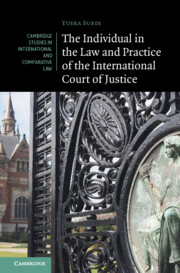


The relationship between the individual and the International Court of Justice might, prima facie, appear to be a curious choice for academic appraisal. After all, the World Court is distinguished on the international plane by its jurisdictional mandate to resolve legal disputes between states. This function of the Court may give the impression that the activities and output of the principal judicial organ of the United Nations are not of much relevance to individuals or to the protection of their rights. Yet, Yusra Suedi’s book, The Individual in the Law and Practice of the International Court of Justice, illustrates that this relationship is richer than one might expect. It commendably provides a thorough examination of several previously underexplored questions, whilst purposefully taking an original approach when it comes to questions that have already been explored in the existing literature.
As the position of the individual in international law has evolved over the past century, so has the significance and impact of the Court’s work on the rights of individuals in the context of inter-state disputes. Thus, the fact that individuals do not have locus standi before the ICJ has never been an obstacle to the consideration and, where necessary, protection of the rights of individuals by the Court. The jurisprudence of the Court examined and assessed in Yusra Suedi’s book amply illustrates this point. It testifies to the fact that the Court, despite its state-centred function, has never been oblivious to and cannot afford to ignore or neglect the famous maxim ‘hominum causa omne jus constitutum est’, that is, all law is created for the benefit of human beings.
The author could have easily demonstrated the relevance of the Court’s work to the rights of individuals through an analysis of its contribution to the development of human and people’s rights in international law, as has been done by many others. However, she chose to venture down an untrodden path. Indeed, this book offers significant new insights with respect to cases brought before the Court where the relevance of the rights of individuals might not be immediately obvious but where the Court has clearly and considerably addressed them as part of its function of interpreting and applying the law. These cases include inter-state disputes in diverse areas such as the delimitation of territorial or maritime boundaries, the protection of the environment, the interpretation of treaties, or the identification of customary international law. This innovative approach to the relevance of the Court’s work to individuals is what makes Yusra Suedi’s book particularly interesting.
This is a work of mapping and locating the scope and effect of the rules of international law. But the law is not and cannot be like a geographical location. It has to be more; it has to evolve and address the changing needs of society. This is also the case of contemporary international law. With the adoption of the UN Charter and the Universal Declaration of Human Rights, the international legal system has slowly shifted from a Westphalian state-centred model to one that recognises and serves to protect the rights of individuals. The interplay between the individual and the system of international justice has similarly evolved. Thus, in interpreting and applying the rules of international law, the effect of those rules on individuals cannot be ignored by the principal judicial organ of the United Nations, even though those rules may have originally been devised for different circumstances, such as maritime delimitation. Today’s judge must pay attention to the impact of such rules on the rights of, for example, local fisherfolk or on their traditional way of life. There is no need any more for a state to exercise diplomatic protection for such fisherfolk’s rights to be taken into consideration and thus to perpetuate the old and outdated fiction that it is the state’s rights that might have been breached and not the individual’s.
As a judge at the Court, I often have to deal with the intricate interplay between the rights of individuals and the mechanisms of international justice. I have, at times, considered that this relationship could be strengthened through the progressive development of the law by the Court. In Jurisdictional Immunities, for example, I dissented that the Court, in its consideration of the merits, limited its examination almost entirely to the general applicability of immunity to the acts committed by a state as a sovereign. In my view, this was too abstract and formalistic as compared to the real-life situation of the victims of Nazi atrocities who, for the lack of any alternative means of redress, had to submit their claims for reparation to Italian courts.
Similarly in DRC v. Uganda (Reparations), I expressed the view that
one of the inadequacies of the reparation awarded by the Court in this case flows from the overly narrow approach to reparations adopted in the Judgment and the lack of consideration of the communities, collectivities and individuals who have directly suffered as a result of the wrongful acts of Uganda through loss of life, personal injuries, destruction of private properties, conscription of child soldiers and the displacement of population. These individuals and communities have not yet recovered from the impact of the violent conflict on their lives. Their plight, therefore, deserved to be taken into account by adopting different forms of reparation that would fit their different circumstances and by clearly indicating that they were the direct addressees of these reparations.
Thus, despite the inter-state nature of the proceedings, it was possible, in my view, to envisage different forms of reparation that took into account the different categories of injury suffered by individuals and communities and to direct the reparations to them, and not to the state, in order to redress the harm caused.
This book serves as a most valuable guidepost, inviting a continued introspection into the intersectionality of two topics that have sustained great interest in international legal scholarship: the position of the individual in international law, on one hand, and the International Court of Justice, on the other. Yusra Suedi’s comprehensive legal inquiry, which invites us to contemplate this interface, could not be more timely, given the nature of many issues coming before the Court through contentious and advisory channels. Her work, through its thorough research and compelling legal analysis, pushes the frontiers of international law in the right direction. It should be warmly welcomed by academics and practitioners alike.

 Open access