





Introduction
Changes in organizations, actions, and practices within civil society have long been a focus in the social sciences (e.g., Hustinx & Meijs, Reference Hustinx and Meijs2011; Wijkström & Zimmer, Reference Wijkström and Zimmer2011; Wuthnow, Reference Wuthnow1998). One prominent perspective—that we refer to as the discourse of change—views civic engagement as undergoing transformations due to cultural shifts in society. From this standpoint, ongoing changes are often portrayed as detrimental to the vitality of civil society, with potential consequences for democracy and the social fabric as a whole (e.g., Bellah et al., Reference Bellah, Madsen, Sullivan, Swidler and Tipton1986; Putnam, Reference Putnam2000; Skocpol, Reference Skocpol2003).
The “discourse of change” surrounding volunteering has garnered significant attention in scholarly debates. While specific claims differ, researchers have suggested several key shifts: a decline in the overall scope of volunteering (e.g., Putnam, Reference Putnam2000), shifts in the types of organizations individuals prefer to engage with (e.g., Cnaan & Park, Reference Cnaan and Park2016; Dunn et al., Reference Dunn, Chambers and Hyde2016), changes in the forms of volunteering (e.g., Fladmoe et al., Reference Fladmoe, Eimhjellen, Sivesind and Arnesen2019), and transformation in the values underpinning volunteering (e.g., Hustinx & Lammertyn, Reference Hustinx and Lammertyn2003). At the same time, other perspectives on volunteering describe and analyze these developments in more nuanced ways emphasizing continuity, institutional embeddedness, and contextual variation in volunteering (e.g., Kelle et al., Reference Kelle, Simonson and Henning2024).
Against this backdrop, the purpose of this article is to use an alternative theoretical approach to the discourse of change to critically reflect on long-term empirical patterns of volunteering, rather than to empirically test the validity of existing theories on volunteering. To this end, we describe and analyze trends in volunteering in Sweden from 1992 to 2024, focusing on its scope, structure, forms, and underlying values and subsequently discuss these developments in light of arguments about change and stability in the literature.
Our analysis primarily concerns formal volunteering, defined as non-obligatory and unpaid work carried out for the benefit of individuals, organizations, or society and commonly taking place in an organized context (c.f. Dekker & Halman, Reference Dekker, Halman, Dekker and Halman2003). The empirical findings indicate that several aspects of volunteering exhibit stability rather than change. To interpret this relative stability, we draw on the theoretical perspective of the “reversed social engine” (Henriksen et al., Reference Henriksen, Strømsnes, Svedberg, Henriksen, Strømsnes and Svedberg2019) and argue that stability and resilience constitute an under-theorized but analytically important feature of civil society. However, the article does not seek to fully test this theoretical claim but rather uses it as an interpretive framework for understanding the empirical findings.
The next section examines and contextualizes key claims from the scholarly discourse on stability and change in formal volunteering, with a particular focus on Scandinavia, and outlines the proposed theoretical perspectives. The third section presents a historical backdrop of volunteering in Sweden. This is followed by a description of the data and methods used in the study. The fifth section presents the results from our empirical analysis. Finally, the findings are interpreted through the proposed theoretical perspectives on stability and change allowing us to discuss the relative resilience of volunteering in Sweden.
Theoretical framework: understanding change and stability in volunteering
One of the narratives in the literature on volunteering emphasizes that volunteering is changing, particularly with regard to its scope, organizational structure, forms of participation, and underlying value orientations (for the Scandinavian literature, see, e.g., Amnå, Reference Amnå2006; Dyhrberg Højgaard, Reference Dyhrberg Højgaard2024; Fladmoe et al., Reference Fladmoe, Eimhjellen, Sivesind and Arnesen2019; Grubb, Reference Grubb2016; Habermann, Reference Habermann2001; Henriksen & Levinsen, Reference Henriksen, Levinsen and Frederiksen2019; Lorentzen, Reference Lorentzen, Henriksen and Ibsen2001; Reference Lorentzen2004; Vogel et al., Reference Vogel, Amnå, Munck and Häll2003; Wijkström, Reference Wijkström2012; Wijkström & Einarsson, Reference Wijkström and Einarsson2006; Wollebæk et al., Reference Wollebæk, Sætrang and Fladmoe2015). This change is explained by various factors and manifested in different ways at the individual and organizational level. Nevertheless, within this “discourse of change,” the most common explanations point to individual values and broader cultural shifts.
One theoretical explanation for change in volunteering highlights the importance of individualization. A key manifestation is the rise of “episodic volunteering” (e.g., Cnaan et al., Reference Cnaan, Meijs, Brudney, Hersberger-Langloh, Okada and Abu-Rumman2022; Dunn et al., Reference Dunn, Chambers and Hyde2016; Hustinx & Meijs, Reference Hustinx and Meijs2011; Macduff, Reference Macduff2004; see Cnaan & Park, Reference Cnaan and Park2016 for a literature overview), characterized by short-term, flexible, and task-specific engagement rather than long-term commitment. This transformation is often associated with broader societal changes, particularly a shift away from traditional collective values toward greater individualization. Hustinx (Reference Hustinx2003) and Hustinx and Lammertyn (Reference Hustinx and Lammertyn2003), building on Beck’s (Reference Beck1992) notion of reflexive modernity, introduced the concept of “reflexive volunteering” to describe how voluntary engagement has become a way of expressing personal identity rather than loyalty to a collective. According to the authors, this mode of engagement reduces the likelihood of sustained involvement and may challenge the collective identity and cohesion traditionally sustained by long-term membership-based volunteering. It also reflects a normative transformation in how individuals relate to civic engagement in late-modern societies.
In addition, post-materialistic values, such as self-fulfillment and autonomy from traditional authorities, are thought to diminish the propensity of individuals to subordinate themselves to traditional organizations (Inglehart, Reference Inglehart, Dekker and Halman2003). These shifts are expected to make individual preferences and interests more salient than the resource needs of organizations. For instance, younger cohorts, often characterized as more individualistic and influenced by social media, are assumed to volunteer less and to favor more flexible, cause-driven forms of participation (Gaskin, Reference Gaskin2004).
Beyond individualization, scholars have suggested that other cultural shifts have also influenced changes in the scope, structure, and forms of volunteering. In Scandinavia, civil society has traditionally been grounded in participatory popular mass movements. However, over the past three to four decades, it has been suggested that the region has come under the influence of a “liberal civil society regime” (Anheier & Salamon, Reference Anheier, Salamon, Powell and Steinberg2006), where volunteering will increasingly take place within welfare-producing, professionalized organizations rather than in grassroots associations such as interest groups or sports clubs. This transition has in Sweden been termed “from voice to service” (Wijkström & Lundström, Reference Wijkström and Lundström2002).
Within this discourse of change, these cultural shifts are often assumed to have concrete implications for the proportion of individuals who volunteer, how much they participate, and how they relate to organizations. For example, Putnam (Reference Putnam2000) argued that the share of the population engaged in volunteering had decreased in the United States, but empirical findings from Scandinavian contexts are more mixed (Fladmoe et al., Reference Fladmoe, Eimhjellen, Sivesind and Arnesen2019; Hygum Espersen et al., Reference Hygum Espersen, Fridberg and Bastholm Andrade2025). Moreover, episodic volunteering is expected to reduce the overall number of volunteering hours (Dunn et al., Reference Dunn, Chambers and Hyde2016; Fladmoe et al., Reference Fladmoe, Sivesind and Arnesen2018). Relatedly, a generational dimension is often emphasized: younger cohorts are anticipated to volunteer less than their older peers since they are presumed to be more apolitical, affected by individualization, and influenced by social media (see Gaskin, Reference Gaskin2004). Furthermore, volunteers are expected to become more loosely connected to the organizations they support (Wollebæk et al., Reference Wollebæk, Sætrang and Fladmoe2015). This trend is reflected in declining membership rates in civil society organizations; in Sweden, for example, the proportion of the population belonging to at least one civil society organization decreased from about 90% in the 1990s to 67% in 2022 (ULF, 2022; Vogel et al., Reference Vogel, Amnå, Munck and Häll2003).
Taken together, the points outlined above align with a supply-side interpretation of volunteering trends, in which shifts in cultural values and individual preferences are seen as the primary drivers of change in the scope, structure, and forms of volunteering. However, this perspective is not uncontested. Scandinavian research also documents stability, particularly in the overall participation rate (Fladmoe et al., Reference Fladmoe, Eimhjellen, Sivesind and Arnesen2019; Hygum Espersen et al., Reference Hygum Espersen, Fridberg and Bastholm Andrade2025; Qvist et al., Reference Qvist, Folkestad, Fridberg, Lundåsen, Henriksen, Strømsnes and Svedberg2019), which calls for alternative explanations. While a supply-side framework offers valuable insights into cultural and generational trends, it is less well suited to account for the institutional and organizational conditions that enable volunteering to persist.
To account for such stability, we turn to a “demand-side” perspective, which shifts the analytical attention from individual motivations to the organizational and institutional frameworks that structure opportunities for volunteering. This perspective aligns with what has been termed the “reversed social engine” approach (Henriksen et al., Reference Henriksen, Strømsnes, Svedberg, Henriksen, Strømsnes and Svedberg2019), which emphasizes the importance of being asked or recruited by someone within an organization (Bang Carlsen & Toubøl, Reference Bang Carlsen and Toubøl2025; Wilson & Musick, Reference Wilson and Musick1997). Empirical studies show that one of the most consistent predictors of volunteering is related to organizational outreach, often through social ties or networks (Kassman, Reference Kassman, von Essen and Svedberg2022; Nesbit, Reference Nesbit2013).
The demand-side perspective is grounded in historical institutionalism, suggesting that organizational density, forms, and practices in civil society are embedded in historical legacies and broader societal institutions (Henriksen et al., Reference Henriksen, Strømsnes, Svedberg, Henriksen, Strømsnes and Svedberg2019). Thus, volunteering is not merely an outcome of individual decisions but emerges from an interaction between individual agency and organizational opportunity structures (Healy, Reference Healy2004; Lundberg & Abdelzadeh, Reference Lundberg and Abdelzadeh2024; Rotolo & Wilson, Reference Rotolo and Wilson2012). Within this framework, both change and stability are seen as outcomes, not only of cultural shifts but also of civil society organizations’ ability to adapt, recruit, and provide meaningful opportunities for participation.
Importantly, however, adopting a demand-side perspective does not reduce the importance of individual values. While individualism and expressive values may appear to reduce or change volunteering, given its collective and altruistic nature, scholars argue that volunteering can also function as a vehicle for self-expression and authenticity (von Essen, Reference von Essen2016; Wuthnow, Reference Wuthnow1991). In this sense, the individualization of values does not necessarily undermine volunteering; instead, it redefines the meaning and function of civic engagement. In other words, volunteer work can align with expressive individualism when it resonates with personal identity, purpose, or lifestyle.
In sum, while the discourse of change’ rightly draws attention to shifts in individual values, motivations, and participation patterns, it falls short in explaining stability and resilience in volunteering. Building on Henriksen et al. (Reference Henriksen, Strømsnes, Svedberg, Henriksen, Strømsnes and Svedberg2019), a demand-side perspective complements this view by highlighting the role of civil society organizations and institutional contexts in shaping who volunteers, and to what extent.
Importantly, our aim is not to justify this theoretical perspective by formally testing hypotheses. Rather, we use empirical data on volunteering in the Swedish population from 1992 to 2024 to interpret and discuss the empirical findings. We argue that this broader framework allows for a more nuanced understanding of both stability and change in the scope, structure, and forms of volunteering. Following Swedberg (Reference Swedberg2012), the present article should be viewed as an attempt to theorize and therefore part of the discovery phase of the research process; the justification phase, which requires hypothesis testing, lies beyond the scope of this study.
Swedish civil society in a Scandinavian context
This article draws on data from Sweden that should be understood within the broader Scandinavian civil society context. Sweden offers an interesting point of departure for studying stability and change in volunteering (see Henriksen et al., Reference Henriksen, Strømsnes, Svedberg, Henriksen, Strømsnes and Svedberg2019). A defining feature of the Swedish and Scandinavian civil society is its high organizational density. This density originates in long-standing institutional conditions, most notably the freedom of associations, early and sustained governmental support and the spread of popular movements across both urban and rural areas. These popular mass movements formed federations in which local organizations were connected vertically with the regional and national level and horizontally with other local organizations (Selle et al., Reference Selle, Strømsnes, Svedberg, Ibsen, Henriksen, Henriksen, Strømsnes and Svedberg2019). Such legacies continue to uphold a robust infrastructure for volunteering (Rolf, Reference Rolf, von Essen and Svedberg2022).
Equally important for the stability and change of volunteering is the interdependence between civil society and the state. As the emergence of the welfare state was a result of the popular mass movement’s political struggles for democracy and social rights, the histories of the welfare state and civil society are intertwined. In Sweden, this was particularly pronounced during the post-war years when the state and (some of the) mass popular movement organizations created a dense and effective societal infrastructure, which has been described as a corporatist arrangement (Christiansen et al., Reference Christiansen, Nørgaard, Rommetvedt, Svensson, Thesen and Öberg2010; Lundberg, Reference Lundberg2020). In the Social Democratic vision of a just society, welfare was framed as a social right, rendering volunteering for social care largely peripheral—often viewed as outdated, unscientific, and rooted in an amateurish, paternalistic form of charity. At the same time, organizations active in advocacy, recreation, sports, and culture were directly and indirectly supported, as they were expected to serve as civic arenas that fostered civic duties and enabled citizens to take an active role in democratic society (Ekström von Essen, Reference Ekström von Essen2003).
However, changes have occurred. In the 1990s, the term active membership—previously widely used in both public and academic discourse—was gradually replaced by volunteering, implying that volunteering was no longer conceptually understood as dependent on an organization but rather treated as an act of the autonomous citizen (Hvenmark, Reference Hvenmark2008; von Essen, Reference von Essen2019). This reconceptualization was a result of influence from an international academic discourse reflecting a liberal civil society regime (Trägårdh, Reference Trägårdh and von Essen2021; Wijkström, Reference Wijkström, Wijkström and Zimmer2011). Moreover, policy development including the adoption of the UK Compact (a written agreement that seeks to formally define and regulate the relationship between the state and the voluntary sector) and the 2009 bill A Policy for the Civil Society signaled a shift toward a more liberal civil society regime (Reuter et al., Reference Reuter, Wijkström and von Essen2012). In both the bill and the Compact, the previous and traditional functions of civil society organizations to engage in advocacy represent (political) interest, and offer arenas for leisure activities were enlarged by the function of providing welfare. This so-called shift from “voice to service” (Wijkström & Lundström, Reference Wijkström and Lundström2002) occurred in parallel with the deregulation of welfare in Swedish society at the beginning of the 1990s. Yet, despite political initiatives aimed at promoting welfare service provision within civil society after the deregulation of the welfare system, the expansion of welfare provision has primarily occurred in the for-profit sector rather than within civil society organizations.
Taken together, the organizational density and historically intertwined relationship between state and civil society in Sweden may provide a fertile ground for both stability and change in volunteering patterns over time.
Method and material
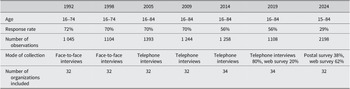
To examine the trends in volunteering in Sweden, we use data from a cross-sectional national survey on civic engagement. The survey has been conducted by scholars at the Center of Civil Society Research, Marie Cederschiöld University, on seven occasions (1992, 1998, 2005, 2009, 2014, 2019, 2024) and is based on a representative sample of the Swedish population. The time series enables us to track different dimensions of volunteering in Sweden for more than 30 years. Data collection mode has varied during the period (see Table 1 for an overview of the empirical material). The response rate declined from 72% in 1992 to 29% in 2024, remaining relatively stable around 70% until 2009, then dropping to 56% and later to 29%—a decline that coincides with a shift from face-to-face and telephone interviews to web and postal surveys, but which likely also reflects a broader trend of decreasing survey participation.
Overview of the survey samples and data collection (1992–2024)

Table 1. Long description
The table consists of seven columns representing the years 1992, 1998, 2005, 2009, 2014, 2019, and 2024.
* Age: The target age range was 16 to 74 in 1992 and 1998; 16 to 84 from 2005 to 2019; and 15 to 84 in 2024.
* Response rate: Rates remained stable at 70 to 72 percent between 1992 and 2009, dropped to 56 percent in 2014 and 2019, and reached a low of 29 percent in 2024.
* Number of observations: Values fluctuated between 1,045 and 1,393 from 1992 to 2019, then increased significantly to 2,198 in 2024.
* Mode of collection: Methods evolved from face-to-face interviews (1992 to 1998) to telephone interviews (2005 to 2014). In 2019, it was 80 percent telephone and 20 percent web. By 2024, it shifted to 38 percent postal and 62 percent web survey.
* Number of organizations included: Remained consistent at 32 for most years, with a slight increase to 34 in 2014 and 2019.
In the present study, we examine formal volunteering conducted through organizations, as well as volunteering within networks (e.g., parent networks or neighborhood networks), public sector organizations and companies; however, we do not include other forms of informal volunteering, such as caring for someone outside the household. Whether informal volunteering is stable or changing in Swedish society, and how it relates to formal volunteering, are important questions, but they lie beyond the scope of this article.
Volunteering has been measured using two parallel questions. First, respondents were asked: “In the last 12 months, have you volunteered for any of the following associations or organizations?” The item then listed 32–34 specific types of associations or organizations, and for each, respondents could answer “No,” “Yes, one,” or “Yes, many,” and indicate the average number of hours per month. We then grouped the organization types into 11 broader categories for analysis (see Appendix A).
Second, a separate but parallel question (“In the last 12 months, have you done any voluntary work or volunteered within”:) used the same response options but, instead of listing organization types, referred to three arenas outside associations: networks (e.g., parent groups, social issue networks), the public sector (e.g., fire service, police, health, and social care); and companies (e.g., riding schools, sports academies, corporate volunteering). Respondents again reported the average number of volunteer hours per month in these arenas.
We examine four dimensions of volunteering through descriptive statistics and a regression analysis. By scope, we refer to the proportion of the population engaged in voluntary work and the average number of hours per month dedicated to volunteering. By structure, we refer to the type of organizations individuals volunteer for. By form, we refer to patterns of engagement, including the intensity and regularity of volunteering as well as the extent to which volunteers are members of the organizations they serve. Finally, the value dimension is captured through attitudes toward volunteering, measured using an item from the Eurovol survey on civic engagement (Gaskin & Smith, Reference Gaskin and Smith1995). In our analysis, we place particular emphasis on age, as it allows us to make informed predictions about future developments.
Using cross-sectional survey data to measure stability and change in volunteering has some limitations. Most importantly, there is a risk of selection bias, as the characteristics of individuals who choose to respond may differ systematically from those who do not, thereby affecting the representativeness and validity of the results. As noted by Abraham et al. (Reference Abraham, Helms and Presser2009), this issue is particularly relevant when studying volunteering, since individuals who are more socially engaged—such as volunteers—are also more likely to participate in surveys. This can result in inflated estimates of volunteering and obscure actual trends over time, especially as response rates have declined.
In our study, the descriptive statistics are unweighted, as population weights are not available for the earliest survey rounds. However, for the more recent surveys (2014, 2019, and 2024), we have conducted analyses both with and without weights, and the results do not differ to a significant degree. While this does not resolve the fundamental limitations of cross-sectional data, it may reduce concerns related to sample composition. Moreover, the consistency in the survey’s methodology across the years enhances the reliability of the data for observing long-term patterns. Still, in light of Abraham et al.’s (Abraham et al., Reference Abraham, Helms and Presser2009) findings, caution is warranted when interpreting levels or changes in volunteering derived from cross-sectional surveys. As mentioned previously, the aim of this article is not to test hypotheses but rather to develop theoretical insights. As such, the analyses should be viewed as exploratory, aiming to identify patterns and generate theoretical perspectives rather than provide testable causal explanations.
Volunteering in Swedish civil society
Scope
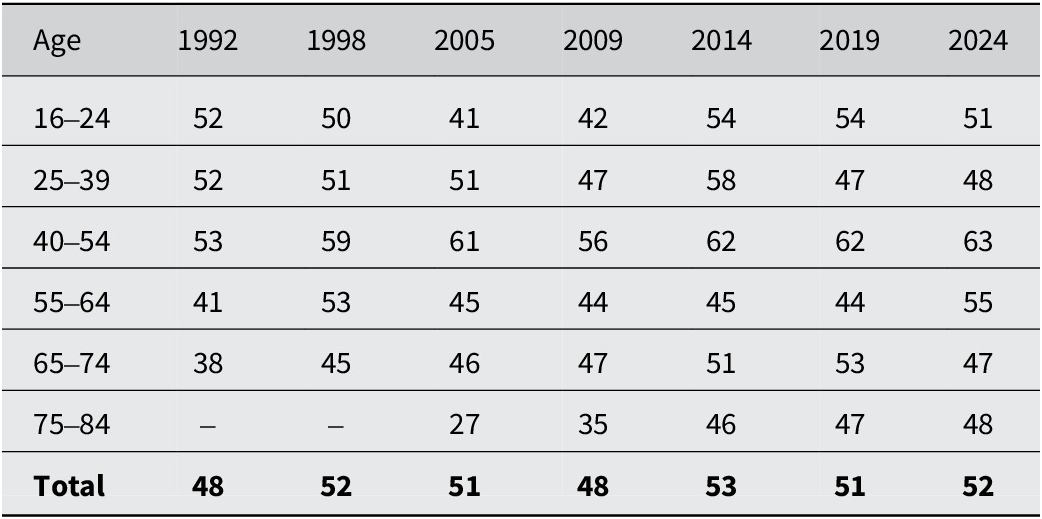
The proportion of the population engaged in volunteering at least once during the past 12 months has varied between 48 and 53% over the period (see Table 2; variation not significant, χ 2-test). This indicates that the overall level of volunteering in Swedish society has remained remarkably stable for more than three decades. To further assess whether this pattern holds when controlling for changes in population composition, we have conducted a logistic regression analysis using overall volunteering as the dependent variable (Appendix B), where we control for a range of demographic characteristics such as gender, education, country of birth, and cohabitation status. In addition, we include survey year as a set of dummy variables to account for time-specific effects. The regression shows no systematic decline in volunteering over the years, confirming the findings from the descriptive analysis.
Share of the population engaged in volunteering by age group (1992–2024)a
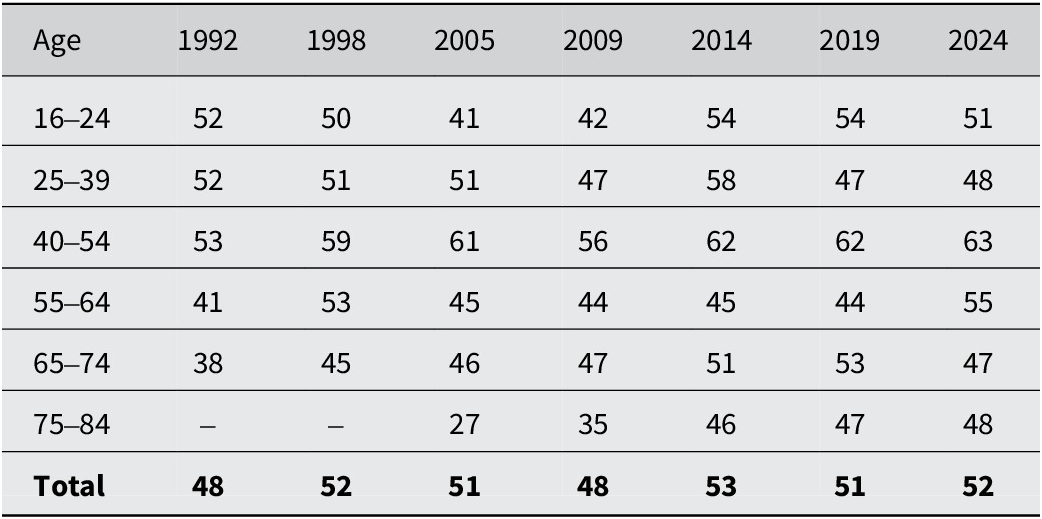
Table 2. Long description
The table consists of 7 rows and 8 columns. The columns represent the years 1992, 1998, 2005, 2009, 2014, 2019, and 2024.
* Age 16 to 24: Starts at 52 in 1992, fluctuates with a low of 41 in 2005 and a peak of 54 in 2014 and 2019, ending at 51 in 2024.
* Age 25 to 39: Starts at 52 in 1992, peaks at 58 in 2014, and ends at 48 in 2024.
* Age 40 to 54: Shows a steady increase from 53 in 1992 to 63 in 2024, with a peak of 62 in 2014 and 2019.
* Age 55 to 64: Starts at 41 in 1992, fluctuates between 44 and 45 from 2005 to 2019, and increases significantly to 55 in 2024.
* Age 65 to 74: Increases from 38 in 1992 to a peak of 53 in 2019, then drops to 47 in 2024.
* Age 75 to 84: No data for 1992 and 1998. Starts at 27 in 2005 and shows a consistent upward trend to 48 in 2024.
* Total: The overall volunteering rate remains relatively stable, starting at 48 in 1992, peaking at 53 in 2014, and ending at 52 in 2024.
Notes: All tables are based on data from the Swedish Survey on Civic Engagement, 1992–2024. See Table 1 for number of observations per year. Chi-square tests across all years indicate significant variation for the 55–64 and 75–84 age groups (p < 0.01). First–last year comparisons show significant increases between 1992 and 2024 for the 40–54 (p = 0.005), 55–64 (p = 0.003), and 65–74 (p = 0.045) age groups, as well as between 2005 and 2024 for the 75–84 age group (p < 0.001). For other age groups and the total population, changes were not statistically significant.
a The age span of respondents has increased over the years. In 1992 and 1998, the oldest individuals in the sample were 74 years old, in 2005 the upper age limit was extended to 84. As a result, we lack data on the oldest age groups in the first two survey rounds. In 2024, the minimum age of respondents was lowered to 15.
Table 2 also presents volunteering rates by age, showing that people of all ages volunteer to a similar extent, with slightly higher levels among those aged 40–54. Over time, volunteering has increased significantly among older age groups, with notable rises among those aged 40–54, 55–64, 65–74, and 75–84. For younger age groups, however, no systematic changes over time are evident, and the overall share of people who volunteer remains relatively stable despite some fluctuations in the data.
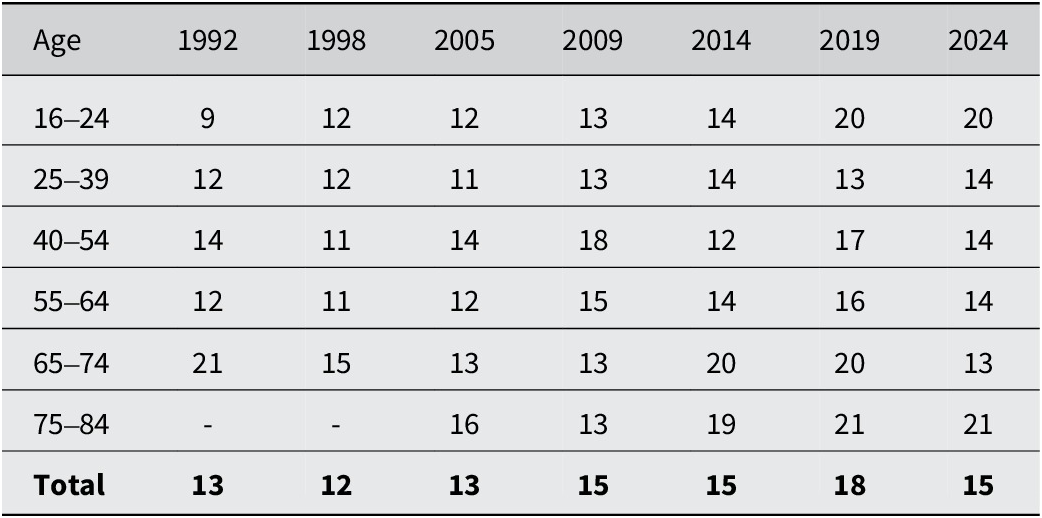
Another measure of the scope of volunteering is time dedicated to volunteer work. Table 3 shows the average number of hours of volunteering per month for all volunteers divided by age groups. The average number of hours for all age groups varied between 12 and 18 during the period. The number of hours spent on volunteer work has systematically increased in the youngest age group. In other age groups, there are variations between years, but in the longer perspective, the results indicate stability rather than change. In sum, the scope of volunteering has remained high and relatively stable in the population throughout the period.
Average monthly hours volunteered, among volunteers by age group (1992–2024)
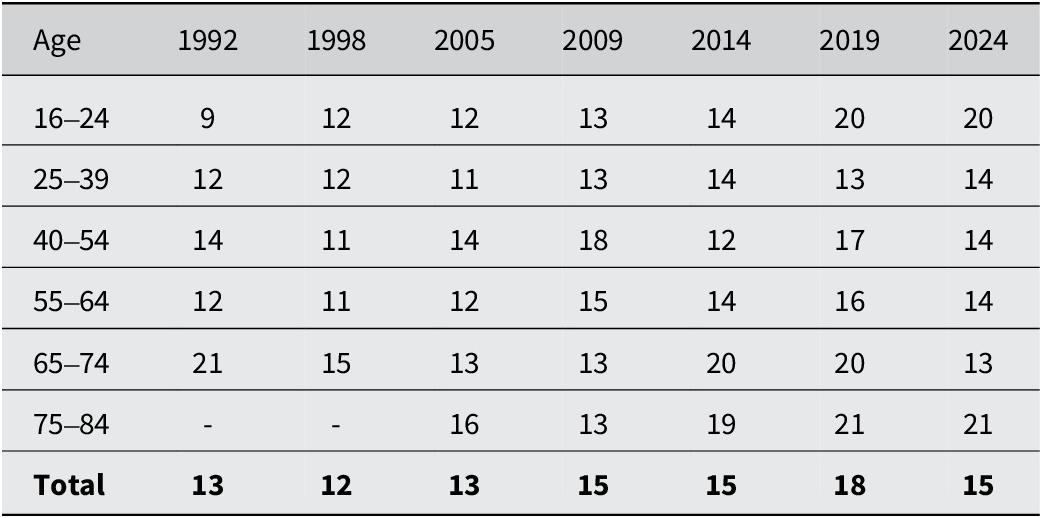
Table 3. Long description
The table tracks volunteer hours across seven time points: 1992, 1998, 2005, 2009, 2014, 2019, and 2024.
* Age 16 to 24: Shows a steady increase from 9 hours in 1992 to 20 hours in 2019 and 2024.
* Age 25 to 39: Remains relatively stable, fluctuating between 11 and 14 hours.
* Age 40 to 54: Fluctuates with a peak of 18 hours in 2009 and ending at 14 hours in 2024.
* Age 55 to 64: Stable trend between 11 and 16 hours.
* Age 65 to 74: High initial engagement at 21 hours in 1992, dipping to 13 in 2005 and 2009, peaking again at 20 in 2014 and 2019, and dropping to 13 in 2024.
* Age 75 to 84: Data begins in 2005 at 16 hours, increasing to 21 hours by 2019 and 2024.
* Total: The average for the entire population started at 13 hours in 1992, peaked at 18 hours in 2019, and settled at 15 hours in 2024.
An A N O V A test indicates significant differences over time for the 16 to 24, 40 to 54, and 65 to 74 age groups, as well as the total population, with p less than 0.05.
Notes: An ANOVA test indicates that average monthly volunteer hours differ significantly across survey years within the age groups 16–24, 40–54, and 65–74 and for the total population (p < 0.05). No statistically significant differences over time were observed for the other age groups.
Structure
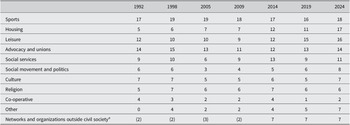
The second dimension is related to the organizational structure of volunteering. We analyze in which segment of civil society that respondents volunteer. Table 4 presents the results broken down by 11 categories of organizations, showing that organizations traditionally dominant in Swedish civil society (sport clubs, leisure organizations, interest groups, and labor unions) attracts the largest proportion of volunteers. These groups are followed by housing organizations and organizations engaged in social services for vulnerable groups in society.
Chi-square tests indicate significant changes over time for several organizational categories. However, except for housing organizations, where volunteering shows a clear long-term increase, most categories exhibit fluctuations without a consistent upward or downward trend. The increase in volunteer work for housing organizations is likely linked to the conversion of rental apartments into owner-occupied housing in Swedish cities, a trend that peaked between 2006 and 2014. Moreover, the volunteer rate for social service organizations exhibits substantial fluctuations during the period.
Share of the population volunteering by organizational category (1992–2024)

Table 4. Long description
The table tracks volunteering rates across seven survey waves (1992, 1998, 2005, 2009, 2014, 2019, 2024).
* Sports: Remained the highest category, fluctuating between 16 and 19 percent.
* Housing: Showed a significant increase from 5 percent in 1992 to 17 percent in 2024.
* Leisure: Increased from 12 percent in 1992 to 16 percent in 2024, with a dip to 9 percent in 2009.
* Advocacy and unions: Remained relatively stable, starting at 14 percent and ending at 14 percent.
* Social services: Increased from 9 percent in 1992 to 11 percent in 2024, peaking at 13 percent in 2014.
* Social movement and politics: Increased from 6 percent in 1992 to 8 percent in 2024.
* Culture: Remained stable between 5 and 7 percent.
* Religion: Remained stable between 5 and 7 percent.
* Co-operative: Decreased from 4 percent in 1992 to 2 percent in 2024.
* Other: Increased from 0 percent in 1992 to 7 percent in 2024.
* Networks and organizations outside civil society: Values before 2014 are in parentheses (2, 2, 3, 2) and stabilized at 7 percent from 2014 to 2024.
Note: Chi-square tests indicate significant changes across survey waves for Housing, Leisure, Social services, Social movement and politics, Culture, Co-operative, and Other (all p < 0.05).
a Since 1992, the surveys have included questions about volunteering in the public sector. From 2014 onwards, volunteering in networks and as part of one’s employment was also included. Therefore, percentages before 2014 are shown in parentheses.
Forms
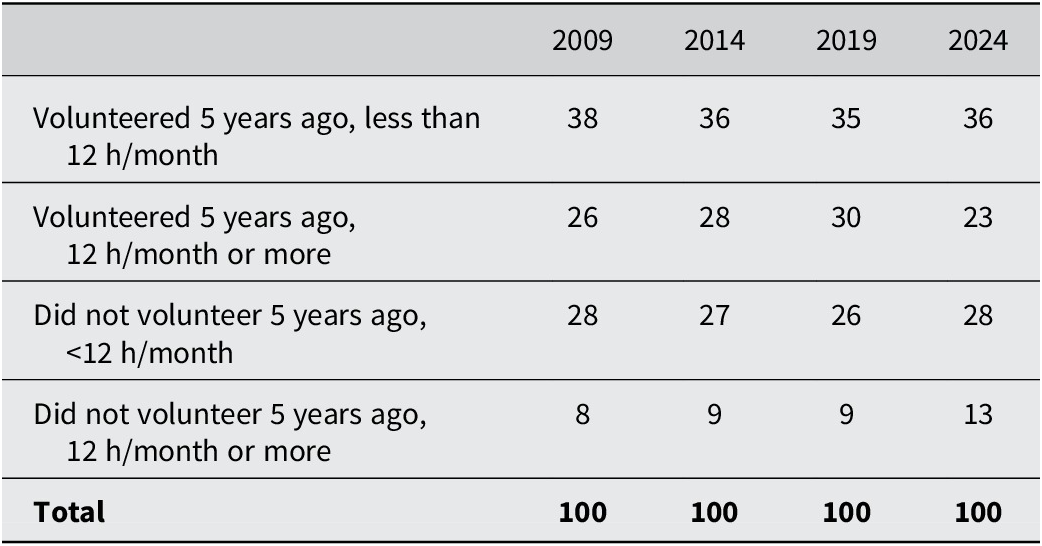
According to previous literature, the traditional core group of volunteers in civil society organizations, active for many years and doing many and regular hours of voluntary work, is expected to shrink, while the group of episodic volunteers is anticipated to grow (Fladmoe et al., Reference Fladmoe, Eimhjellen, Sivesind and Arnesen2019). By combining the length of time spent volunteering with the number of hours of volunteering per month (with a cut-off at 12 h), we have created four intensity groups of volunteering. Table 5 shows these groups for the years 2009–2024. Importantly, the question that captures the length of time spent volunteering asks whether the respondents volunteered 5 years ago, but not whether they volunteered for the entire time from then until the time of the survey. Still, having volunteered 5 years ago indicates an individual history of voluntary work. In contrast to the predictions made in previous research, our data shows that the “civic core” (those who volunteered 5 years ago and spent 12 h or more a month) shows a gradual increase from 2009 to 2019, followed by a decline in 2024.
Intensity of volunteering among volunteers (2009–2024)
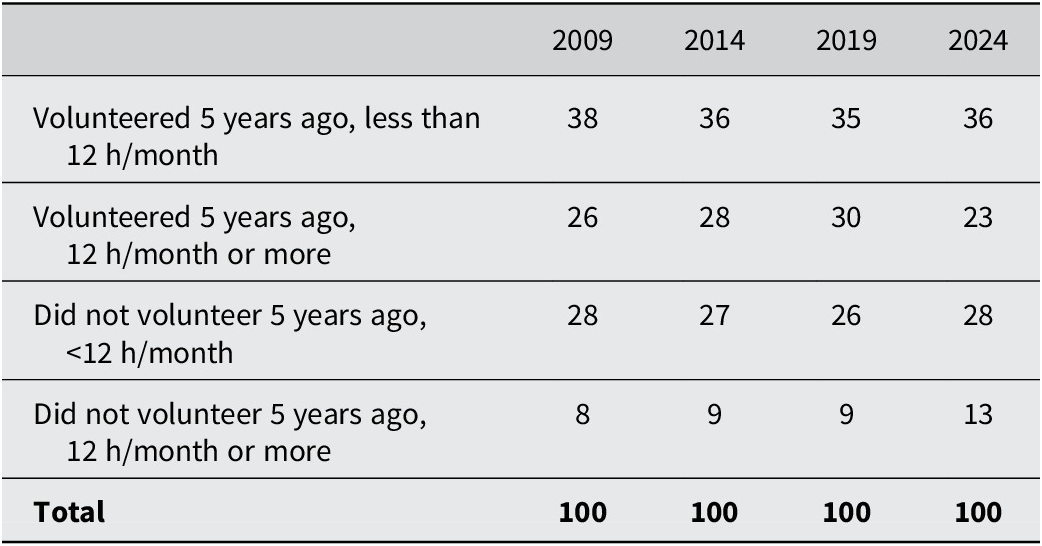
Table 5. Long description
The table consists of five columns and six rows. The columns represent the years 2009, 2014, 2019, and 2024. The rows categorize volunteers based on their activity five years prior and their current monthly hours.
* Volunteered 5 years ago, less than 12 h/month: 38 in 2009, 36 in 2014, 35 in 2019, and 36 in 2024.
* Volunteered 5 years ago, 12 h/month or more: 26 in 2009, 28 in 2014, 30 in 2019, and 23 in 2024.
* Did not volunteer 5 years ago, less than 12 h/month: 28 in 2009, 27 in 2014, 26 in 2019, and 28 in 2024.
* Did not volunteer 5 years ago, 12 h/month or more: 8 in 2009, 9 in 2014, 9 in 2019, and 13 in 2024.
* Total: 100 for all years.
Notes indicate percentages are based on volunteers only and a Chi-square test shows significant variation across waves with p less than 0.01.
Notes: Percentages are based on volunteers only. A Chi-square test indicates significant variation across survey waves in the distribution of volunteering intensity (p < 0.01).
Since 2014, we have asked respondents how their volunteer work is distributed throughout the year. While the survey options have varied over time, limiting strict comparisons, about 15% reported in 2014 and 2019 that they volunteered only on single occasions, rising to 26% in 2024. Although this finding indicates a change, most volunteers still engage in regular rather than episodic volunteering.
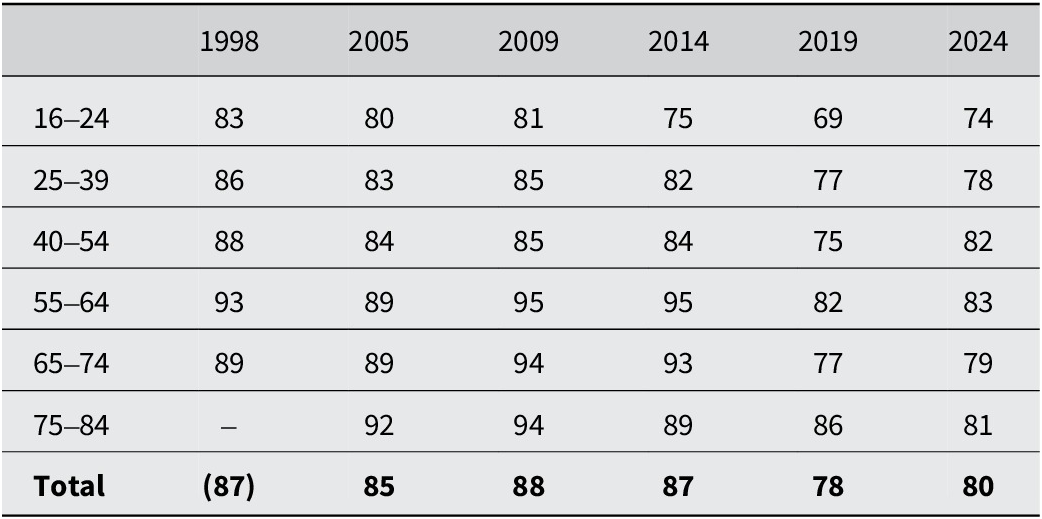
Another trend highlighted in the literature relates to the strength of the organizational affiliation of volunteers. It is assumed that the share of volunteers who are also members of the organizations they serve will gradually decrease (Papakostas, Reference Papakostas2011). Table 6 shows the proportion of volunteers who are members of the organization where they volunteer the most. The total percentage of volunteers who are also members has decreased significantly over time, from 87% in 1998 to 80% in 2024 (χ 2-test p < 0.001), and first–last year comparisons indicate significant declines in all age groups, including the youngest (χ 2-test p < 0.05 for all comparisons). We also observe that younger people are less likely to be members of the organizations they volunteer for compared to older individuals. Within the youngest age group, the proportion of respondents who are members of the organizations they serve dropped to 69% in 2019 but rose to 74% in 2024, although the overall trend for this group between 1998 and 2024 still represents a significant decline (χ 2-test p = 0.016).
Share of volunteers who are also members of the organization where they volunteer (1998–2024)
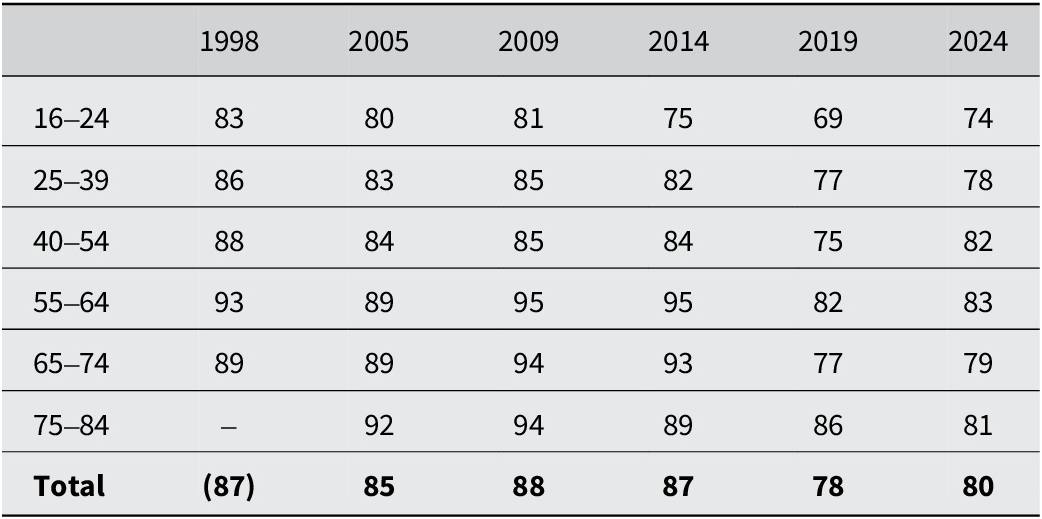
Table 6. Long description
The table presents data for six age groups and a total average across the years 1998, 2005, 2009, 2014, 2019, and 2024.
* Age 16 to 24: 83 in 1998, 80 in 2005, 81 in 2009, 75 in 2014, 69 in 2019, and 74 in 2024.
* Age 25 to 39: 86 in 1998, 83 in 2005, 85 in 2009, 82 in 2014, 77 in 2019, and 78 in 2024.
* Age 40 to 54: 88 in 1998, 84 in 2005, 85 in 2009, 84 in 2014, 75 in 2019, and 82 in 2024.
* Age 55 to 64: 93 in 1998, 89 in 2005, 95 in 2009, 95 in 2014, 82 in 2019, and 83 in 2024.
* Age 65 to 74: 89 in 1998, 89 in 2005, 94 in 2009, 93 in 2014, 77 in 2019, and 79 in 2024.
* Age 75 to 84: No data for 1998, 92 in 2005, 94 in 2009, 89 in 2014, 86 in 2019, and 81 in 2024.
* Total: 87 in 1998, 85 in 2005, 88 in 2009, 87 in 2014, 78 in 2019, and 80 in 2024.
Overall, the data shows a general decline in membership share among volunteers across all age groups when comparing the earliest available data to 2024.
Notes: Percentages are based on volunteers only. Chi-square tests across all survey waves indicate significant variation for the 55–64 and 65–74 age groups (p < 0.01) and for the total population (p < 0.001). First–last year comparisons show significant declines between 1998 and 2024 for the 16–24 (p = 0.016), 25–39 (p = 0.008), 40–54 (p = 0.023), 55–64 (p = 0.006), 65–74 (p = 0.003), and the total population (p < 0.001), as well as between 2005 and 2024 for the 75–84 age group (p = 0.009).
Values
The final dimension of the discourse on change concerns the values underpinning volunteering. As values are central to our argument, this dimension is captured though attitudes toward whether volunteering constitutes a moral responsibility for all citizens.
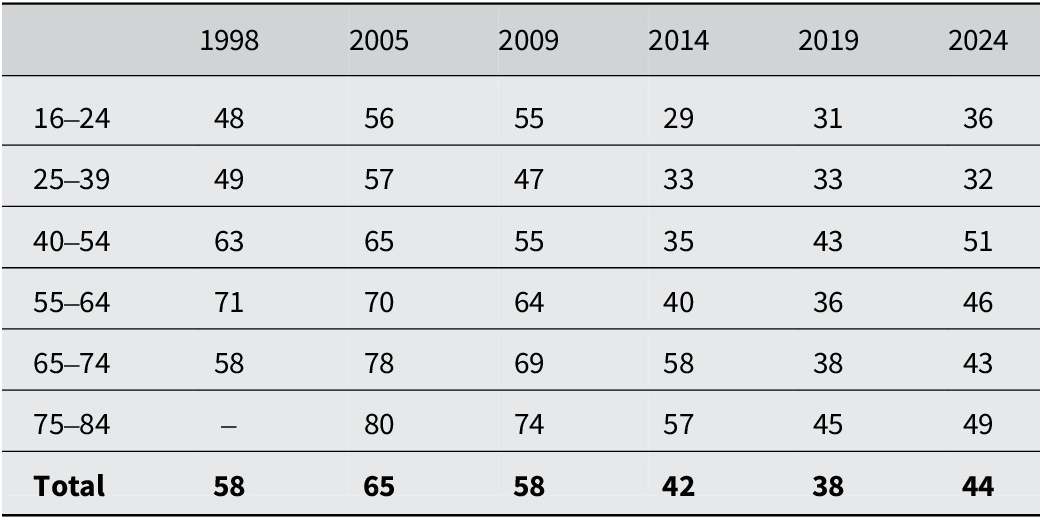
Table 7 presents the percentage of the population who agree with the statement “Everyone has a moral obligation to engage in volunteer work at some point in their lives” across survey waves from 1998 to 2024. The result reveals a change over time. In the late 1990s and mid-2000s, a majority of respondents expressed agreement with the statement, with overall levels of agreement ranging between around 58 and 65%. From 2014 onward, support declines, falling to around 40% in 2014 and remaining at a lower level in subsequent survey waves.
Share of the population agreeing that everyone has a moral obligation to engage in volunteer work (1998–2024)
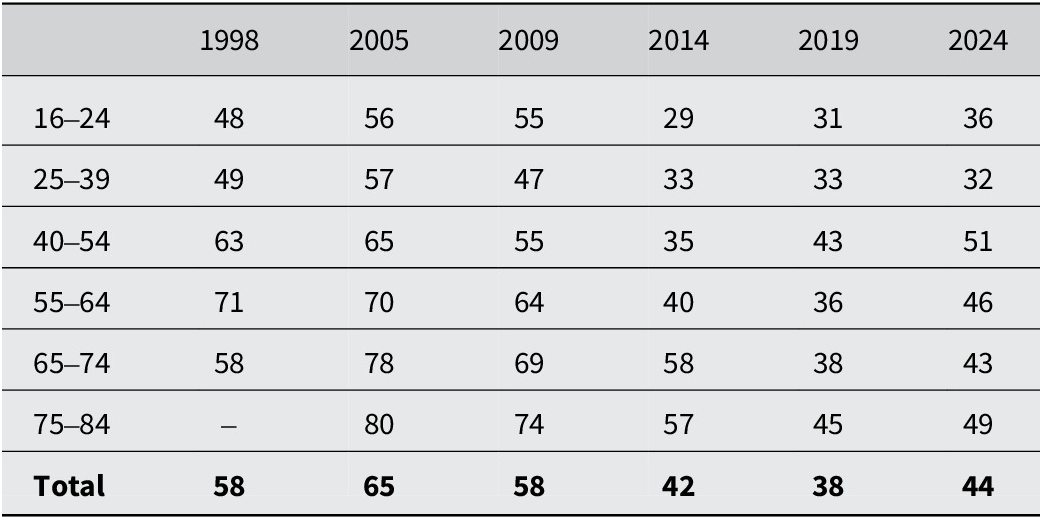
Table 7. Long description
The table tracks agreement across six age cohorts and a total average over six survey years.
* 16 to 24: Starts at 48 in 1998, peaks at 56 in 2005, then drops significantly to 29 in 2014 before rising to 36 in 2024.
* 25 to 39: Starts at 49 in 1998, peaks at 57 in 2005, and declines to a low of 32 in 2024.
* 40 to 54: Starts at 63 in 1998, peaks at 65 in 2005, drops to 35 in 2014, and recovers to 51 in 2024.
* 55 to 64: Starts at 71 in 1998, peaks at 70 in 2005, drops to 36 in 2019, and rises to 46 in 2024.
* 65 to 74: Starts at 58 in 1998, peaks at 78 in 2005, and fluctuates down to 43 in 2024.
* 75 to 84: Data begins in 2005 at 80, declining steadily to 49 in 2024.
* Total: The overall population agreement was 58 in 1998, peaked at 65 in 2005, reached a low of 38 in 2019, and ended at 44 in 2024.
Notes indicate that measurement scales changed from dichotomous to four-point ordinal after 2009, with later data points representing combined agreement categories.
Notes: Percentages are based on the total sample. To ensure comparability across survey waves, analyses are restricted to respondents expressing a clear attitudinal position. Non-substantive responses (“don’t know,” “no opinion,” refusal) are excluded. In the 1998–2009 surveys, the item was measured using a dichotomous response format. In later survey waves, the item was measured on a four-point ordinal scale. For reasons of comparability with the earlier dichotomous measure, the ordinal responses were dichotomized, coding respondents who expressed any level of agreement (response categories 3 and 4) as agreeing.
Furthermore, the age-specific patterns displayed in Table 7 show a pronounced and consistent age gradient. Older respondents are substantially more likely than younger age groups to regard volunteering as a moral duty in all survey waves. However, agreement declines over time within most age groups, suggesting that the overall trend cannot be attributed solely to generational replacement. Taken together, the findings indicate a weakening of traditional and collectively oriented norms framing volunteering as a moral obligation. This development is consistent with broader processes of value change and increasing individualization (e.g., Inglehart, Reference Inglehart, Dekker and Halman2003; Santos et al., Reference Santos, Varnum and Grossman2017; Sörbom, Reference Sörbom2002). However, given the repeated cross-sectional design, the observed age gradient may reflect a combination of cohort-related differences, life-cycle effects, and period-specific changes, rather than a uniform attitudinal shift across the population. In addition, age-related differences may partly be shaped by socialization processes, that is, individuals who have been socialized into volunteering through family, associations, or local communities may be more inclined to interpret such engagement in moral terms, whereas weaker exposure to organized voluntary activity may reduce the likelihood of perceiving volunteering as a moral obligation. However, a declining emphasis on moral duty does not necessarily imply reduced levels of volunteering but rather points to a transformation in how civic engagement is normatively understood and justified.
Discussion
The results indicate that, despite some fluctuations, the core aspects of volunteering in Swedish society have remained relatively stable between 1992 and 2024. While a few notable changes can be observed, most clearly, declining membership ties, shifts in value orientation and increased volunteering in housing organizations and among the elderly, the overall empirical pattern indicates relative stability. To interpret this pattern, the discussion draws on the demand-side perspective approach presented above and the notion of a reversed social engine, which emphasize the organizational and institutional considerations that sustain volunteering over time.
The mobilizing role of civil society organizations
To understand how stability in volunteering is reproduced over time, it is necessary to move beyond individual motivations and consider how organizations actively mobilize volunteers. From a demand-side perspective, the process of becoming a volunteer is rarely a strict individual decision based on values but is rather shaped by an interaction with a civil society organization. This interpretation is supported by survey results from the Swedish national surveys in 2014, 2019, and 2024 showing that about 75% of all volunteers had a prior relation to the organization before becoming volunteers.
These findings are in line with previous research showing that the most important factor to become a volunteer is to be asked, invited, or even compelled by someone engaged in the organization (Kassman, Reference Kassman, von Essen and Svedberg2022; Nesbit, Reference Nesbit2013; Wilson & Musick, Reference Wilson and Musick1997). Volunteering emerges as a socially embedded process rather than isolated individual decisions. From the perspective of the reversed social engine organizational efforts to mobilize and social ties constitute an important driver through which volunteering is sustained which help to explain why participation levels remain stable even during societal change.
Organizational dependency and the civic core
If recruitment and mobilization is vital for sustaining volunteering, a further question is how organizations maintain this capacity over time. Despite an increase in the number of employees within Swedish civil society since 1992, about 10% of all organizations have employees (Einarsson & Wijkström, Reference Einarsson, Wijkström and von Essen2021). This suggests that most Swedish civil society organizations are dependent on volunteers. Given that the number of organizations has remained fairly stable over time (Einarsson & Wijkström, Reference Einarsson, Wijkström and von Essen2021), it is reasonable to assume that the demand for volunteers has also remained relatively stable. From a demand-side perspective, this may help to explain why the scope of volunteering, both the share of the population involved, and the hours contributed per month, appears to have remained relatively stable over the period.
Given that most organizations lack employees, there is not only a need for volunteers in general, but also for volunteers with a long-term commitment to making regular efforts in civil society organizations. That is, organizations without employees are especially dependent on a “civic core” of volunteers to fill positions for critical functions such as elected boards, organizing activities, recruiting volunteers, representing the organizations in the local community, and other efforts demanding a long-term commitment (Jeppsson Grassman, Reference Jeppsson Grassman1997). Thus, the civic core is vital for maintaining an organizational infrastructure that functions as the demand-side central to the “reversed social engine.” As demonstrated, between 23 and 30% of all volunteers belonged to the civic core between 2009 and 2024. Elderly people and individuals with higher education are especially overrepresented in the civic core (von Essen, Reference von Essen, von Essen and Svedberg2022). This strengthens the assumption that this group is a necessary resource as they are apt for elected boards, constitute an “organizational memory” and provide professional competence and knowledge. From a demand-side perspective, the civic core constitutes a stabilizing infrastructure that enables organizations to persist and continue mobilizing volunteers over time.
Stability in organizational structure and resistance to a shift toward welfare production
A further expectation within the discourse of change is that volunteering should increasingly shift toward civil society organizations in welfare production, reflecting a transition from “voice to service” (Wijkström & Lundström, Reference Wijkström and Lundström2002). However, the Swedish case provides limited support for this claim as the structure of volunteering has remained largely anchored in recreational, cultural and interest organizations. More specifically, findings show that the structure of volunteering in Swedish civil society has remained relatively stable between 1992 and 2024, despite that Swedish society has undergone important social and political changes during this period. The share of volunteers engaged in social care is still small compared to societies characterized by a liberal civil society regime. Recreational and cultural organizations attract a large share of all volunteers. Thus, the expected shift of volunteers to civil society organizations engaged in welfare services at the expense of traditional popular movement organizations has not been confirmed.
We propose three possible explanations for why the expected change from voice to service cannot be traced in the distribution of volunteers among organizational categories. First, it is primarily in civil society organizations engaged in welfare services that the number of employees has increased, implying that they can be presumed to have a lesser need for volunteers. Second, while the deregulation of the Swedish welfare system in the early 1990s caused an expansion of welfare services produced outside the welfare state, this expansion has primarily occurred in for-profit firms rather than within civil society organizations, where the production of welfare services has been limited (Henrekson et al., Reference Henrekson, Andersson, Wijkström and Ford2020; Lundberg, Reference Lundberg2020; Trætteberg et al., Reference Trætteberg, Sivesind, Paananen and Hrafnsdóttir2023). Third, despite political initiatives encouraging the production of welfare services in civil society, the state is still perceived as responsible for welfare in Swedish society, and public opinion against a decreased welfare state remains strong (Martinsson & Andersson, Reference Martinsson and Andersson2022). Together, these factors may suggest that institutional context may constrain the extent to which volunteering is redirected toward welfare production, which reinforces the relative stability in volunteering across organizational categories.
Membership, commitment, and a reversed membership dynamic
If volunteering is sustained though organizational demand rather than formal membership alone, changes in the meaning and function of membership become analytically important. Although there was a decrease in 2019, particularly among the youngest cohort, the share of volunteers who are also members of the organizations where they volunteer remains at a high level. This finding may seem surprising given the decline in membership rates in Sweden since the 1990s (ULF, 2022; Vogel et al., Reference Vogel, Amnå, Munck and Häll2003). A plausible explanation is the loss of passive members, whereas individuals active in volunteering have remained as members.
A clear illustration is provided by the Church of Sweden, where overall membership dropped from 83% in 2000 to 55% in 2020, while active membership remained relatively stable since it is above all passive members who leave, while active members remain (Fransson et al., Reference Fransson, Bromander and von Essen2021). This shift may reflect a broader transformation in the meaning of membership from loyalty to a collective or tradition toward a model or idea where membership is connected to the importance of personal engagement rather than inherited loyalty. From a demand-side perspective, this dynamic reinforces organizational stability by retaining those individuals most essential to sustain volunteer activity.
Volunteering as an expression of individualism
Finally, the relative stability of volunteering despite declining norms of moral obligation raises the question about how individualization interacts with organizational recruitment and participation. Adopting the reversed social engine perspective does not imply that values and motives are irrelevant to individuals’ decision to volunteer. Individualism and expressive values might be expected to hamper volunteering given its nature as a form of prosocial behavior and collective action. However, previous research has demonstrated that volunteering is often perceived, or used, as an expression of authenticity and individuality (von Essen, Reference von Essen2016; Wuthnow, Reference Wuthnow1991). In addition, individuals’ political intentions are a significant explanatory factor for future political participation and civic engagement, including engagement in collective forms of action (Lundberg & Abdelzadeh, Reference Lundberg and Abdelzadeh2024). This suggests that an increasing individualism and a shift to expressive values do not automatically lead to a decrease in volunteering, on the contrary, this cultural shift could potentially strengthen the propensity to volunteer as volunteering is perceived as an expression of individualism (see also Inglehart, Reference Inglehart, Dekker and Halman2003).
Conclusion: the resilience of civil society
This article set out to critically reflect on the discourse of change in volunteering by examining long-term empirical patterns in Sweden between 1992 and 2024. Rather than testing the empirical validity of competing theories, the aim has been to use descriptive and longitudinal evidence to assess how well claims about change resonate with observed developments in the scope, structure, forms, and values underpinning volunteering. By situating the empirical findings within the broader debates on individualization, institutional change, and civic engagement, the article has strived to contribute to a more nuanced understanding of the continuity and transformation of volunteering.
The results of this article show that while some aspects of the scope, structure, and forms of volunteering in Sweden have clearly changed over time, the overall picture is characterized by a high degree of stability. We have argued that the “reversed social engine” approach, which focuses on the demand side of civil society, may provide an explanation for this stability. One possible explanation for this resilience is that civil society organizations are less dependent on contextual factors compared to organizations in other societal spheres, not least given that they have access to volunteers as an extensive and renewable resource (Salamon & Anheier, Reference Salamon and Anheier1998). However, that civil society organizations and activities in civil society are less changeable or volatile compared to organizations and activities in other societal spheres is of course a hypothesis that must be tested, as is the claim that the scope of volunteering is expected to vary with organizational density. Future studies should test them directly, ideally with comparative, over-time designs.
An additional limitation concerns the temporal scope of the data. Our analysis begins in 1992, and thus earlier developments in volunteering remain outside the empirical frame. The 1990s have sometimes been described as a comparatively apolitical period, marked by declining collective mobilization and weakened political identities (Jäger, Reference Jäger2026). If a broader decline in civic engagement occurred prior to the early 1990s, our findings would capture a phase of relative stabilization rather than the onset of transformation. In that case, the resilience identified in this study may partly reflect that earlier shifts had already taken place before systematic measurement began.
Since societies are continuously in flux, the opposite, that is, stability, is a proper scientific “phenomenon” in itself (Toulmin, Reference Toulmin1961/1981). Therefore, this article suggests a reversed research agenda where the resilience of civil society is an urgent object of academic inquiry. As our study is based on Swedish data, its arguments are limited to Swedish civil society. Further research should explore stability and change in civil societies in other countries, using a demand-side perspective to examine the interplay between organizations and individuals. Such an approach could open up new perspectives and avenues for research on the role and dynamics of civil society. Future research should also examine how patterns of informal volunteering develop over time and interact with broader societal trends. Understanding both formal and informal dimensions is essential for a more comprehensive view of continuity and change in civic engagement.
Data availability statement
The data are not publicly available due to ethical, legal, or other concerns.
Funding statement
The author(s) received no financial support for the research, authorship, and/or publication of this article.
Competing interests
The authors declare that there is no conflict of interest.
Appendix A
The organizational categories presented in Table 4 consist of the following subcategories.

Long description
The table consists of eleven rows, each defining a broad category and its associated specific organizations.
* Sports: Sports clubs and sport associations.
* Recreation: Outdoor organizations, hunting and fishing organizations, motor organizations, hobby associations, and voluntary defense organizations.
* Housing: Tenant organizations, condominium organizations, homeowner organizations, and communities.
* Advocacy and unions: Parent associations, disability organizations, patient organizations, organizations for retired persons, student organizations, unions, and shareholder organizations.
* Social services: Humanitarian organizations and organizations for social work, order societies, fraternal orders, immigrant organizations, organizations in the temperance movement, and anti-drug organizations.
* Religion: Parishes and organizations in Church of Sweden, Christian religious communities other than Church of Sweden, and non-Christian religious communities.
* Social movement and politics: Women and feminist organizations, L G B T Q organizations, environmental organizations, political parties, peace organizations, human rights organizations, and organizations for local action.
* Culture: Public education, dance, music, and theater organizations.
* Co-operative: Consumer cooperatives, cooperative preschools, and other cooperatives.
* Other organizations.
* Organizations outside civil society and networks: Public welfare organizations, corporations (corporate volunteering), and networks.
Appendix B
Logistic regression predicting volunteering (overall), all years and by survey year (1998–2024)

Long description
A complex data table with 15 columns. The first column lists Predictors, followed by pairs of columns for O R (Odds Ratio) and p (p-value) for ‘All years’, 1998, 2005, 2009, 2014, 2019, and 2024.
* Predictors and All Years data:
- (Intercept): O R 0.95, p 0.543.
- Women: O R 0.70, p less than 0.001.
- Education [Primary school]: Reference category.
- Education [High school]: O R 1.35, p less than 0.001.
- Education [University]: O R 1.98, p less than 0.001.
- Born abroad: O R 0.71, p less than 0.001.
- Cohabitation: O R 1.15, p 0.003.
- Informal support: O R 1.37, p less than 0.001.
- Trust [trust]: Reference category.
- Trust [careful]: O R 0.71, p less than 0.001.
- Trust [Do not know]: O R 0.67, p less than 0.001.
- PERIOD [2005]: O R 0.85, p 0.055.
- PERIOD [2009]: O R 0.78, p 0.004.
- PERIOD [2014]: O R 0.95, p 0.570.
- PERIOD [2019]: O R 0.80, p 0.012.
- PERIOD [2024]: O R 0.90, p 0.186.
* Yearly Trends for Education [University]: O R values are 2.18 (1998), 2.16 (2005), 1.50 (2009), 1.75 (2014), 1.93 (2019), and 2.03 (2024), all with p less than or equal to 0.010.
* Yearly Trends for Women: O R values range from 0.62 to 0.85, showing significant p-values (less than 0.05) in all years except 1998.
* Bottom rows:
- Observations: Total 7931, ranging from 1063 (2019) to 1975 (2024).
- R super 2 Tjur: Total 0.046, ranging from 0.037 (1998) to 0.072 (2005).
Note: Bold p-values indicate statistical significance at the 0.05 level.

 Open access

