

Introduction
Although the Socialist Party (Partido Socialista, PS) held on to an absolute majority government led by Prime Minister Antonio Costa, it showed considerable signs of wear and tear. Several scandals affected the government party, which undermined its image. Finally, in December, Prime Minister Costa had to resign after the Supreme Court began investigating his close collaborators’ potential traffic of influence. The President of the Republic, Marcelo Rebelo Sousa, called early elections for 10 March 2024.
Election report
Regional elections in Madeira on 24 September 2023
The electoral campaign for the Madeira regional elections took place throughout September. Madeira had been ruled since the granting of autonomy to the island archipelago by the Social Democratic Party (Partido Social Democrata, PSD), the main adversary of the Socialists. Charismatic President Alberto João Jardim retired, after 40 years, in 2015. Since then, Miguel Albuquerque has won two elections in 2015 and 2019. However, since the 2019 election, the PSD had no absolute majority and relied on the support of the conservative Democratic Social Centre-People's Party (CDS-PP).
Alongside 11 standalone parties, two electoral coalitions, “We are Madeira” (Somos Madeira, PSD+CDS-PP) and the Unitary Democratic Coalition (which comprises the Portuguese Communist Party (Partido Comunista Português, PCP) and the Ecologist Party “the Greens”-PEV), competed in the elections.
Apart from the regional Together for the People (JPP), all other parties were branches of national political groups. In 2019, just five political parties were in Parliament: PSD, CDS-PP, PS, JPP, and the PCP.
The electoral campaign focused on the negative aspects of longevity in government by the PSD, in relation to clientelism, patronage, and potential corruption. Notably, the leftwing parties PS, PCP, and Bloc of the Left (Bloco da Esquerda, BE) were keen to highlight such governance problems. On the right, the new parties, Chega (Ch) and Liberal Initiative (Iniciativa Liberal, IL) hoped to gain representation in the regional legislative assembly. Their political narrative was more one of strengthening the right-wing bloc against the left.
The leading contender was the PS under João Torres, the vice-secretary general of the party. Apart from the campaign against PSD's almost absolute rule on the island, their priority was the fight against the populist Chega, which was perceived as an extreme right-wing party (Expresso 2023c).
After the elections, the incumbent PSD also distanced itself from Chega as a potential coalition partner. Albuquerque followed the party's official policy led by the PSD leader, Luis Montenegro, which excluded any cooperation with the populist party.
Opinion polls conducted before the elections forecast a victory for the electoral coalition “We are Madeira” with 50 per cent of the vote and 24–28 seats out of 47 and a decline of the PS vote by 13 per cent, compared to 2019. Several new parties, including Chega (O Observador 2023c), were predicted to return to Parliament or have representation for the first time.
The election results led to the victory of the right-wing coalition “We are Madeira” (PSD-CDS-PP) with 43.1 per cent share of the vote and 23 seats out of 27. It did not achieve the absolute majority by one seat. However, Parliament was quite split, so the big loser was the second-placed PS with 21.3 per cent (2019: 35.8 per cent; −14.5 per cent) and 11 seats (2019: 19 seats; −7 seats). The big winner was the JPP, which was able to double its share of the vote to 11.03 per cent (2019: 5.5 per cent; +5.5 per cent) and five seats (2019: 3 seats; +2 seats). The Communists could hold on to their seat and improved their vote share slightly to 2.72 per cent (2019: 1.8 per cent; +0.92 per cent). The BE returned to the legislative assembly with 2.24 per cent (2019: 1.7 per cent; +0.54 per cent). Chega was the second major winner among the newcomers, with 8.9 per cent (2019: 0.43 per cent; +8.5 per cent) and four seats. Also, the IL and the Party of Persons, Animals, and Nature (Partido das Pessoas, Animais e Natureza, PAN) got one seat each in the legislative assembly (MAI 2024).
Although PSD and CDS-PP failed to win an absolute majority by two seats, the coalition government of both parties continued.
Cabinet report
The declining quality of government and its end
At the beginning of 2023, Prime Minister Antonio had entered his eighth year in power in his third government. His governing team was worn out throughout the year. Moreover, the quality of political personnel and their political decisions declined considerably.
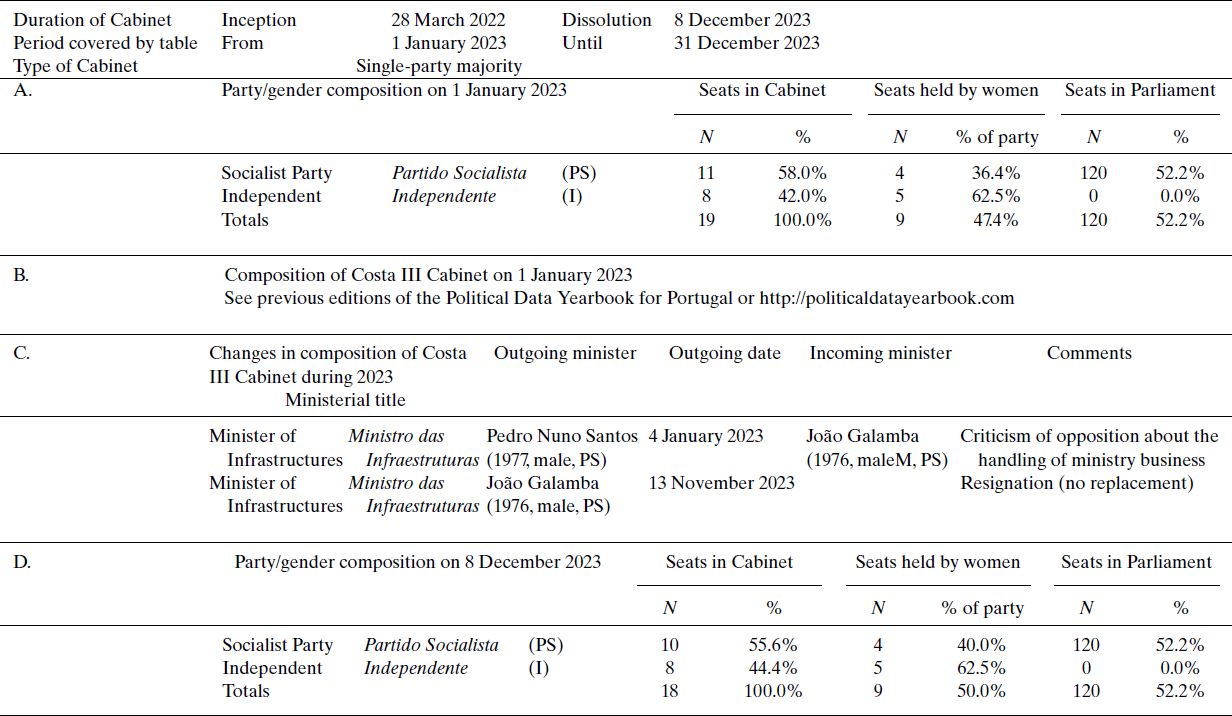
Information about the composition of the Costa III Cabinet can be found in Table 1.
Cabinet composition of Costa III in Portugal in 2023

Note: After the Prime Minister's resignation, the Cabinet remained in office until the general election of 10 March 2024 and the entry into office of the new Montenegro I Cabinet on 2 April 2024.
Source: Governo de Portugal (2024).
At the beginning of the year, Prime Minister Costa had to replace his minister for infrastructure, Pedro Nuno dos Santos, with João Galamba. Santos had to resign at the end of the year because he did not handle well the case of Secretary of State Alexandra Reis, who was previously employed as an administrator by the state-owned Portuguese national airline TAP. The public enterprise asked Reis to resign from the job and paid a negotiated settlement of €500,000. The ministry responsible for TAP was Santos, who was unaware of the process. Due to growing pressure from the other political parties, public opinion, and the Prime Minister, Santos was forced to resign. Moreover, two further secretaries of state had to resign with him, including Alexandra Reis (CNN-Portugal 2023a).
Moreover, a further problematic case emerged with the appointment of Carla Alves as State Secretary for Agriculture. Her husband was involved in a judicial fraud investigation, undermining her position. She had to resign within a day after taking office. Until January 2023, in the first nine months of the Costa government, there were 12 ministers and state secretary resignations and five reshuffles at senior and junior levels (O Público 2023b).
New Infrastructure Minister João Galamba became the central stage in two significant cases, of alleged executive misconduct leading him to resign on 13 November 2023. His position remained vacant. The first episode of alleged wrongdoing concerned Federico Pinheiro, a member of his Cabinet team, who took a computer with sensitive information home in early May. He voluntarily brought the computer back to the office. However, the Portuguese secret services also became involved, with much speculation coming about on the incident. Such an incident gave the minister a bad reputation for his ability to control his staff (O Público 2023f). The second incident of alleged corruption concerning Galamba was more serious. Portugal receives considerable European funds through the Recovery and Resilience Program (PRR), which totals about €22 billion for Portugal. The funding had to be spent by 2026, and a very complex monitoring system was in place to prevent using funds for other purposes. However, in November, it became known that the Portuguese General Attorney had begun investigating members of the government for alleged traffic of influence in a funded project related to the largest lithium mine in Europe, based in Portugal, and the building of a green hydrogen hub in the port of Sines in Alentejo. Notably, the Ministry of Infrastructure was the target of investigative searches. Minister Galamba decided to resign in order to avoid more disturbance in the government machinery.
The so-called operation “influencer” led to the resignation of Prime Minister Antonio Costa after he talked to President Marcelo Rebelo de Sousa on 7 November 2023. Five people of his government were detained in connection with potential cases of traffic of influence and corruption. At the center of the investigative searches by judiciary police was Chief of Staff Vitor Escária. The police found several envelopes with a total sum of €75,800 in the latter's office. Soon after, the head of the Supreme Court informed the President that Prime Minister Antonio Costa was also under investigation, although nothing had been found on him. His close friend and lawyer, Diogo Lacerda Machado, played a key negotiating role, acting discreetly on behalf of António Costa (Visão 2023). President Marcelo Rebelo de Sousa called early elections for 10 March 2024.
Several strikes occurred in the national health service and the education sector, mainly over pay. The perception of the deterioration of services, due to lack or insufficient funding, also undermined the government's image (see Issues in National Politics). One of the reasons for the insufficient funding of public services was the policy of “correct accounts” (contas certas) of Finance Minister Fernando Medina, who had achieved a 1.2 per cent Gross Domestic Product (GDP) government surplus and a reduction of the national debt to 99.1 per cent of GDP in his second year in office (Eurostat 2024). Between 2020 and 2023, successive finance ministers under Prime Minister Antonio Costa reduced the debt by 35.8 per cent of GDP, which was seen as a remarkable achievement (Expresso 2023d).
Parliament report
Two motions of censure against the government in January and September 2023
In 2023, there were two motions of censure against the government, mainly due to the deteriorating image and quality of executive governance.
IL submitted the first motion of censure on 29 December 2022, but it was only discussed in Parliament on 5 January 2023. The main reason was a “climate of incompetence and irresponsibility” created by the government, which clearly showed signs of dissolution and fragmentation due to so many resignations, particularly at the state secretary level as well as at the ministerial level, with Minister Pedro Nuno Santos's resignation (O Público 2022). The Socialist majority, Livre, and PCP voted against the motion (126 total votes), IL and Chega voted for it (19 votes), and PSD, BE, and PAN abstained (79 votes) (O Público 2023a).
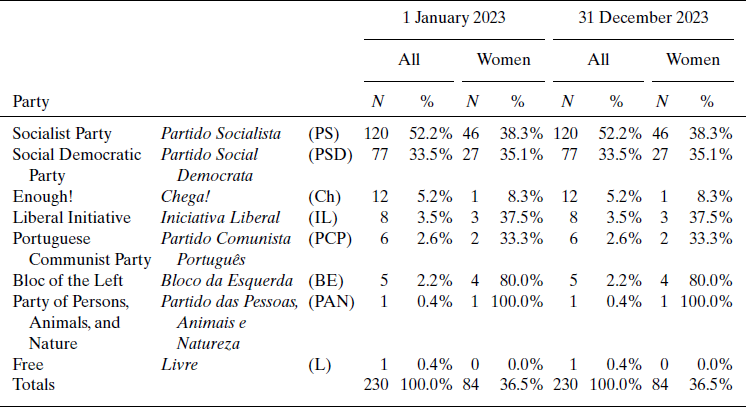
Information about party and gender composition of the Parliament can be found in Table 2.
Party and gender composition of the Parliament (Assembleia da República) in Portugal in 2023

Source: Assembleia da República (2023).
The second motion of censure of the year came from populist Chega (its second motion of censure since the beginning of legislature in 2022) and was submitted on 12 September and discussed on 19 September 2023. The motion characterized the then-executive as “the worst government ever” and criticized the deteriorating quality of government and crucial policy areas such as housing, health, justice, and education (O Observador 2023b). However, after three hours of discussion, the left parties, PS, PCP-PEV, BE, PAN, and Livre (131 total votes), joined together to reject the censure motion. Just Chega and IL (17 votes) voted for it, and the 62 MPs of PSD abstained (O Público 2023j).
The law on the decriminalization of euthanasia was finally approved on 12 May 2023
On 12 May, the controversial law on the decriminalization of euthanasia was finally approved by Parliament. It entered into force on 25 May 2023 as law 22/2023. The regulatory development of the law had still not taken place by the end of the year. For the past three legislative terms, there had been an attempt to write an adequate law to deal with what has been labeled “assisted suicide” for terminally ill people. The conservative Catholic President Marcelo Rebelo de Sousa, and the more right-wing parties PSD and Chega, had ethical and moral concerns about the law. One of the President's legislative powers is that they can send any bill for constitutional checking to the Constitutional Court. Rebelo de Sousa sent the bill twice to the Constitutional Court on constitutional grounds, so it had to be redrafted. Moreover, twice, he exercised his veto power. The promulgation of the law by President Rebelo de Sousa ended 28 years of debate and controversy on the issue. However, in the near future, some right-wing parties will likely ask the Constitutional Court to utter a ruling about the latest version of the law (CNN (Portugal), 2023c).
Committee of inquiry on Air Portugal (TAP)
Throughout the year, the Portuguese national airline Air Portugal was the target of solid parliamentary scrutiny. From 22 February to 13 July, a parliamentary committee of inquiry took place on TAP, which lasted 141 days, held 46 hearings, and solicited 558 requests from 36 different entities (Eco 2023a). It focused on whether the government interfered in the airline's governance system and why former State Secretary and then-administrator of TAP Alexandra Reis received generous compensation for leaving the airline. The committee also investigated the period before and during the pandemic. The probe led to the resignation of the immensely successful CEO Christine Ourmières–Widener and chairman Manuel Beja at the end of March. Like in many countries, including Germany, the state had to intervene in TAP during the COVID-19 pandemic and impose a quite challenging restructuring program funded by the EU, which Ourmières-Widener and Manuel Beja implemented. After two years of significant cuts in personnel and operational costs, TAP made a profit and substantially reduced its debt. At the end of the year, TAP was scheduled to be privatized before Antonio Costa resigned. A parliamentary report came out on 4 July, but the opposition was quite disappointed. Allegedly, the illicit interference of the government in the governance of TAP was either not or insufficiently investigated. Moreover, it exculpated the government from any wrongdoing, particularly in the case of former administrator Alexandra Reis. Therefore, the report was only approved with the votes of the governing PS. All the other opposition parties rejected the report (O Público 2023g, 2023h).
Negotiations for the 2024 budget
In 2023, Minister of Finance Fernando Medina tried to bring through his budget bill without making too many concessions. The majority of the government strengthened its position against the opposition parties in Parliament. The budget bill was submitted in early October and discussed until November. On 31 October, it was approved in the first reading with 120 votes in favor, all from PS, 108 against from most of the other parties, and two abstentions from PAN and Livre. However, in November, there was a real possibility that the budgetary process would halt due to the resignation of Prime Minister Costa. Despite this unexpected event, Medina, as part of the interim government, was able to bring the budget bill to its final approval on 29 November. Over 1900 amendments were submitted by the opposition parties, leading to 200 changes. Among the most significant changes was redrafting the tax brackets to consider the impact of price inflation.
Furthermore, a package of support measures for housing tenants and owners struggling with rising prices was introduced in 2023 (Dinheiro Vivo 2023). Finance Minister Medina also suggested the introduction of a special fund (it was coined the “Medina Fund”) in which all budget surpluses would be transferred to be used, when needed, for infrastructure projects. Prominent opposition leader, Luis Montenegro, wanted the surplus to be used against the national debt (Expresso 2023d: 20; O Público 2023l). The macroeconomic forecast foresaw a surplus and a further reduction of the debt.
Political party report
There were leadership changes in some parties, many as a consequence of their poor performance in the legislative elections in 2022 (Table 3).

Ps
After the resignation of Prime Minister António Costa on 7 November 2023, a leadership contest started in the PS. Two candidates came to the fore. Former Minister of Infrastructures Pedro Nuno Santos and the then-Minister of Internal Administration José Carneiro became the two leading candidates for the primaries. On 16 December, the results became known. Of the 60,000 PS members, about 60 per cent voted in the contest. Of the 39,330 votes, 62 per cent (24,080) went to Santos, and 36 per cent (14,868) to Carneiro—a third candidate, Daniel Adrião, received 1 per cent (382) (O Público 2023m). Santos became, then, the PS candidate for the forthcoming early general elections.
Il
After trendy leader João Cotrim de Figueiredo resigned on 23 October 2022, a special party conference was organized to elect a new leader on 21 and 22 January 2023. Three candidates contested the internal election: Rui Rocha, Carla Castro, and José Cardoso. Rui Rocha won the contest with a 51.7 per cent share of the vote cast by 2000 members, while Carla Castro and José Cardoso achieved 44 per cent and 4.3 per cent, respectively. Although Carla Castro congratulated the new leader, the party conference's general mood is that it remained a divided party (CNN-Portugal 2023b).
Be
After the terrible results of BE in the legislative elections 2022, coordinator Catarina Martins stepped down. Soon after that, Mariana Mortágua presented herself as Martins’ successor. Finally, on 28 May 2023, in the 13th party convention, Mortágua was elected new coordinator, achieving the support of 67.1 per cent of the 654 delegates, and her list was able to get 67 (80 per cent) of the 80 seats at the national table (Mesa Nacional), the highest body between conventions. She was able to expand the power base of the list in comparison to the former incumbent Martins. The alternative critical list lost power. The winning candidate is an economist who worked closely with the founding leader of the party, Francisco Louçã. Mortágua was regarded as adding continuity to the policies of former leader Martins (Expresso 2023b; O Público 2023d).
Issues in national politics
The absolute majority Socialist government gave considerable political stability to national politics. The economy was taking off after the pandemic crisis. While in 2022, the economy grew by 6.8 per cent after the difficult years of the pandemic, provisional data show a growth of 2.3 per cent in 2023, with annual inflation at about 5.3 per cent (European Commission 2024).
A general perception of deteriorating public services: health, education, and housing
During the year, there was a general perception of a deterioration in the quality of public services. In the health sector, there needs to be more funding to tackle a lack of personnel and pay disputes, particularly for nurses and doctors. During the year, the doctors of the National Health Service conducted several strikes protesting against the introduction of new pay systems by the government while the trade unions were still negotiating (Expresso 2023a; O Observador 2023a; O Público 2023k). The lack of enough general practitioners, so-called family doctors, was quite acute for the wider population. Therefore, the tendency was to go directly to hospital emergency services when people were ill. In 2023, the government invested substantially more in the National Health Service. The allocated funding increased from €8 to €12 billion and staff from 120,000 to 150,000. However, about 1.7 out of 10 million people had no family or house doctor. Only the future will tell if the new funding will lead to a better National Health Service (Expresso 2023g: 7).
Teachers also staged several strikes over pay throughout the year. On 14 January, between 30,000 and 100,000 people, mainly from the sector, participated in the education march to improve pay and career progression (O Público 2023c: 1–4).
Meanwhile, affordable housing has become rare across Europe. In Portugal, between 2019 and 2022, the price of housing increased by 38 per cent, while salaries increased by just 9 per cent. Moreover, the material costs of building new housing have increased considerably due to bottlenecks in global supply chains (Century 21 2023: 4; Eco 2023b).
Slow absorption and implementation of the European Union funding
As mentioned in the last issue, Portugal is one of the countries receiving considerable funding from the European Union (Magone Reference Magone2023: 424). On the one hand, it receives funding from the European Structural and Investment Funds, and on the other hand, the temporary extra funding for digitalization and a sustainable green economy through the PRR. The Common Agricultural Policy funding brings the total to more than €50 billion in extra funding between 2021 and 2027. In 2023, even more funding became available in the PRR, the sum increasing from €16.6 to €22.2 billion (an additional 33.3 per cent) (O Observador 2023d).
The government uses EU funding to finance its internal public investment program. In 2023, the government was unable or unwilling to spend all the funding in the budget. Just 86 per cent of the assigned €8.6 billion was spent, and the rest was not, contributing to the budget surplus.
One major problem was the inability to absorb all this funding within the prescribed deadlines. Several reasons account for this situation. First, there was a lack of good enough projects and a bias toward sizeable public sector infrastructures. Second, the tiny coordinating structures of the programs lacked enough qualified people. Just 60 people were working in the main coordinating structure of the PRR in Portugal. Therefore, recruiting people from outside was necessary, which might eventually create a conflict of interest. Third, the complexity of the coordinating agencies and bureaucratic bottlenecks. Last but not least, the difficulties of the European Commission to disburse so much funding in a very short period were then complicated by the disbursing of funding related to the Russian war against Ukraine (Expresso 2023f: 16-17).
End of the stalemate in the Constitutional Court
A dispute about who should assume the presidency of the Constitutional Court led to a stalemate that lasted for one year. On 26 April 2023, after marathon negotiations of 17 hours, the oldest member of the Constitutional Court, José João Abrantes, was elected president by his peers; he is known as a member of the conservative wing. Moreover, by ending the stalemate, which also involved the two major law faculties of the University of Lisbon and Coimbra, three new judges were co-opted by existing judges: Carlos Carvalho, João Carlos Loureiro, and Rui Guerra da Fonseca. A further judge, Dora Lucas Neto, was elected by the Assembly of the Republic. Overall, the balance of power between the left-wing and right-wing judges was more toward the latter (O Público 2023e).
Acknowledgments
Open access funding enabled and organized by Projekt DEAL.


 Open access

