

Background
Children exposed to armed conflict and repeated displacement face heightened risks, including violence, family separation, bereavement, multidimensional poverty, and disruption to social and protective systems. These exposures increase the likelihood of acute psychosocial distress and longer-term mental health and psychosocial challenges.Footnote 1 Sustained distress can disrupt children’s neurobiological, cognitive and social development, undermining their capacity to regulate emotions, learn, form healthy relationships and develop executive skills, with enduring effects into adolescence and adulthood.Footnote 2
At the same time, children’s experiences of crises are shaped by the social, cultural and environmental conditions in which they live. Evidence from conflict-affected settings consistently shows that children are more likely to adapt and recover when key protective systems – such as stable caregiver relationships, non-violent and responsive parenting, predictable routines, positive peer interactions and supportive community environments – remain intact or are strengthened.Footnote 3 Although emergencies place intense social and economic pressures on families and may limit caregivers’ ability to provide responsive care, family and community systems remain children’s primary sources of stability, emotional security and social connection.Footnote 4
Recognizing this interplay of risk and protection, contemporary mental health and psychosocial support (MHPSS) frameworks emphasize the socio-ecological determinants of children’s development and well-being.Footnote 5 Family-focused approaches can be mutually reinforcing, reducing caregiver distress, strengthening attachment and improving child psychosocial outcomes.Footnote 6 Yet many humanitarian interventions continue to target children or caregivers in isolation, limiting opportunities to reinforce family systems and the potential for intergenerational recovery.Footnote 7
Fourteen years of protracted crisis in Syria exemplify the scale and complexities of these challenges. The conflict has produced one of the most severe and prolonged humanitarian emergencies in recent history, with more than 600,000 deaths, over 13 million people displaced internally and across borders, and widespread destruction of essential infrastructure.Footnote 8 Children have been exposed to persistent bombardment, displacement, food insecurity, chemical warfare, bereavement and other cumulative stressors known to contribute to deep psychological distress and emotional and behavioural challenges.Footnote 9 In 2024 alone, 16.7 million people needed humanitarian assistance, including 7.5 million children.Footnote 10
These cumulative stressors intensify both exposure to traumatic events and chronic daily stressors, such as food insecurity, disrupted schooling and unsafe housing, and are consistently associated with poor mental health and psychosocial well-being among conflict-affected children and families.Footnote 11 While much of the literature has focused on Syrian children displaced across borders, however, fewer studies have examined psychosocial well-being within Syria, where insecurity and operational constraints have historically limited data collection.Footnote 12 Nonetheless, available evidence from school-, clinic- and community-based studies has consistently indicated substantial mental health needs. A school-based study in Idlib, in northwest Syria, found that nearly three quarters of children aged 4–14 years met criteria for at least one probable mental health condition, including elevated symptoms of anxiety, depression and post-traumatic stress.Footnote 13 Similar patterns have been reported in Damascus and Latakia, with 30–60% of children screening positive for post-traumatic stress disorder, depression and anxiety.Footnote 14 A large paediatric outpatient study in Damascus documented emotional or behavioural difficulties among 75% of children as young as 2–4 years, and 61% among those aged 5–17 years,Footnote 15 with higher levels of difficulty linked to exposure to violence, family loss, interrupted schooling and caregiver socio-economic strain.
Across studies, children’s psychosocial outcomes were consistently linked not only to direct exposure to violence but also to deterioration in family and community environments. Approximately 90% of Syrian children experience violent discipline, with nearly one quarter facing “severe” violent discipline at home.Footnote 16 Caregivers report high levels of fear, hopelessness and social isolation, and qualitative evidenceFootnote 17 documents extreme forms of violence against children. Research with displaced Syrian parents indicates that many caregivers perceive physical punishment as “necessary” to ensure children’s safety and compliance amidst instability and complex lived realities, reflecting the strain on nurturing caregiving during prolonged crisis.Footnote 18
Taken together, the evidence highlights the critical need for accessible, culturally grounded, family-focused MHPSS interventions that address both child and caregiver needs. Studies from Jordan, Palestine, Afghanistan, Bosnia and other humanitarian settings have demonstrated that when caregivers receive support to manage their own distress and to practice responsive and non-violent parenting, children exhibit improvements across a range of internalizing and externalizing emotional regulation, social behaviour, and broader psychosocial well-being.Footnote 19 Despite this evidence, family-inclusive approaches remain under-utilized and unevenly documented in humanitarian responses. Many evaluated programmes prioritize individual-level symptom reduction, employ short-term study designs or lack contextually appropriate assessment tools, limiting understanding of how change unfolds within families over time.Footnote 20
Within Syria, despite strong socio-cultural norms emphasizing the centrality of the family in child development, structured, scalable MHPSS programmes that engage children and caregivers in parallel to strengthen child coping and caregiver responsiveness (hereby referred to as child–caregiver joint interventions) have been historically limited.Footnote 21 Although pilot initiatives have demonstrated feasibility and demand, and caregivers have consistently expressed a strong appetite for two-generation approaches and practical support,Footnote 22 prior to the development of the Sawa and Sanadi programmes discussed below, there were no nationally implemented, intergenerational MHPSS interventions inside Syria designed with, for and alongside affected families, nor any coordinated efforts to document outcomes at scale.
Programme description
Between 2019 and 2023, UNICEF Syria and national partners, including relevant ministries and civil society partners, co-developed the Sawa (“Together”) and Sanadi (“My Rock”) programmes to address the growing need for integrated community-based intergenerational MHPSS for children aged 6–17 years and their caregivers in Syria. Grounded in trauma-informed and socio-ecological principles, the programmes utilize evidence-based and locally grounded strategies to improve child and caregiver mental health and psychosocial wellbeing.
The curricula were developed through a participatory and iterative process. UNICEF and partners reviewed existing evidence-informed MHPSS materials from Syria and international contexts, and then engaged implementing partners, caregivers, community members and relevant government institutions in multiple rounds of consultation to develop the curricula. Drawing on cognitive-behavioural and family-system theories, the approach guiding the intervention content, sequence and activities linked caregiver and child emotional regulation, relational safety and caregiver responsiveness to improvements in children’s psychosocial well-being. The programmes were subsequently endorsed by an interministerial committee in 2023 and implemented following a directive from the Prime Minister’s Office using existing community and social protection platforms across governorates, supporting institutional ownership and scalability.
The Sawa programme is designed for children and adolescents who have grown up amidst armed conflict and displacement within Syria. It uses sixteen two-hour sessions for children aged 6–9, 10–12 and 13–17, providing structured, developmentally tailored activities – such as play, art, role-play and storytelling – to help children recognize and normalize emotions, communicate with friends and family about feelings, and learn positive coping strategies such as self-regulation and help-seeking. While younger groups focus on play-based activities, the curricula for adolescents expand on these domains and integrate identity exploration, social values, problem-solving and a collaborative community improvement project. Across all groups, facilitators emphasize empathy, inclusion and non-violent conflict resolution to promote peer relationships and social connection.
Run in parallel across twelve sessions, the Sanadi programme supports caregivers by first acknowledging the strain of prolonged crises and validating and building on their existing strengths in raising children under extraordinary circumstances. The programme provides psycho-education on child development, establishing trust in the parent–child bond, managing parental stress, non-violent discipline, and responsive parenting practices, while also encouraging reflection on gender roles and caregiver self-care. Sessions combine practical skills – such as recognizing signs of distress in children or communicating calmly during conflict – with facilitated peer exchange. Caregivers discuss challenges, reflect on progress and support one another, reinforcing an environment of peer support and connection similar to that cultivated among the children.
Both programmes rely on strong group facilitation by well trained and supervised group facilitators who create welcoming and psychologically safe spaces where participants feel respected and heard. They are coached to model relational safety and co-regulation, core mechanisms through which group-based MHPSS interventions influence emotional and behavioural change.
Together, the Sawa and Sanadi programmes form an integrated, intergenerational model that strengthens children’s socio-emotional skills while enhancing the caregiving environment. Running the two programmes concurrently was intentional: as children practice regulation, communication and help-seeking, caregivers simultaneously strengthen the attunement and responsiveness needed to sustain these gains. Although groups meet separately to allow age-appropriate exploration of the curricula and validation of difficult feelings that arise in families, children and caregivers are given “homework” and are encouraged to apply what they learn within their daily family interactions, supporting the emergence of new relational patterns beyond programme spaces.
Methods
Context and programme setting
Since 2023, the Sawa and Sanadi programmes have been implemented across thirteen of Syria’s fourteen governorates. The programmes has reached 259,049 children and adolescents, and 112,098 caregivers through established community centres, child-friendly spaces and partner-operated hubs in Damascus, Rural Damascus, As-Sweida, Queneitra, Dar’a, Homs, Hama, Tartous, Latakia, Aleppo, Ar-Raqqa, Al-Hasakah and Deir-ez-Zor. This system-wide rollout provided a unique opportunity to study psychosocial outcomes in a large, heterogeneous population reached through routine government-endorsed MHPSS programme delivery.
Study design
A mixed-methods design was used to assess changes associated with participation in both programmes. This included quantitative pre-post surveys assessing shifts in knowledge, attitudes and practices (KAP) aligned with programme objectives, and qualitative “most significant change” (MSC) narratives to capture participant-defined changes not easily measured through structured items. The mixed-methods approach supported triangulation across perspectives, deepened interpretation of programme effects and allowed exploration of mechanisms of change.
Sample and sampling procedures
All children (6–17 years) and caregivers enrolled in the programmes were invited to complete a baseline KAP survey at the first or second session, and an endline KAP survey at programme completion. Participation was voluntary, and only participants who provided informed consent and assent, and completed both assessments, were included in paired analyses. Baseline and endline KAP surveys were administered as part of routine programme delivery by trained facilitators or designated enumerators.
A total of 204,064 children and adolescents completed baseline surveys between 2023 and 2025, of whom 178,399 (87.4%) had matched pre- and post-data. Similarly, 49,214 caregivers completed baseline surveys, with 39,310 (79.8%) contributing towards matched data.
Furthermore, of the 178,399 children and adolescents with matched item-level data, 176,438 (98.9%) had complete domain-level data. The analytic sample for domain-level analyses therefore included 141,955 children aged 6–12 and 34,483 adolescents aged 13–17. All 39,310 caregivers had complete domain-level data.
Qualitative sampling followed MSC methodology. Between January and August 2024, narrative submissions were collected across six operational hubs from programme participants and facilitators. Story collectors submitted narratives monthly, which were then reviewed at the partner, hub and UNICEF levels to maximize diversity in age, gender, region of origin, disability status and programme modality. From this pool, a random subsample of 302 children, adolescents and adults – either caregivers or persons known to children or adolescents – were selected for in-depth MSC interviews. Interviews were conducted in Arabic by trained facilitators and technical leads and elicited accounts of the most significant change attributed to programme participation, why this change mattered, and what enabled it.
Measures
The KAP surveys were developed collaboratively with practitioners, implementing partners and government counterparts following a review of validated instruments (e.g., PHQ-A and GAD-7). Although existing instruments provided conceptual anchors, they did not adequately capture community-defined indicators of well-being, coping, and parenting support in the Syrian context. UNICEF and partners therefore initiated a collaborative process to develop context-specific KAP tools mapped directly onto programme domains, balancing technical rigour, contextual relevance, and feasibility for large-scale implementation in complex humanitarian settings.
Draft items were identified using a review of validated tools for respective ages, cross-checked with the objectives of the intervention, and back-translated in Arabic. These items were subsequently refined through several rounds of technical consultation with UNICEF specialists, implementing partners, facilitators and relevant government institutions. The items underwent review for face validity, cultural and age appropriateness, and clarity. Wording was simplified to enhance comprehension among participants with varying literacy levels. Domains were defined a priori to align with the programme’s theory of change and curricular objectives, including emotional regulation, social connectedness, help-seeking and responsive or non-violent caregiving.
The children’s tool for ages 6–12 included thirty-five items across emotional regulation, social connectedness, help-seeking, agency and self-esteem, and functioning. The adolescent tool for ages 13–17 comprised thirty items covering the same domains, with the addition of problem-solving. The caregiver tool included thirty items relating to emotional regulation, social connectedness, help-seeking, self-care, non-violent discipline and responsive parenting. All items used a three-point Likert scale (0–2).
MSC interviews followed a standardized semi-structured guide. Interviews ranged from ten to twenty minutes and were transcribed verbatim, anonymized, and translated to English by trained staff when used in internal and external reporting.
Analytic approach
Internal consistency was assessed using Cronbach’s alpha at baseline, which can often provide the clearest indication of scale coherence as programme participants have not yet been influenced by programme content. In the absence of full psychometric validation prior to national rollout, these coefficients were interpreted as preliminary indicators of internal coherence rather than evidence of validated latent constructs. Given the high number of items per scale, coefficients were interpreted cautiously to avoid conflating true internal coherence with potential item redundancy. Paired t-tests assessed pre-post differences at item and domain levels. Standardized within-participant effect sizes (Cohen’s dz) were calculated to describe the magnitude of change. Given the ordinal response format, pre-post design and expected variability at baseline, effect sizes were interpreted as indicators of change in endorsement of programme-aligned knowledge, attitudes and practices, and not as estimates of clinical symptom reduction.
Ethical considerations
Ethical approval was provided by HML IRB (Approval No. 270ESYR20) and was obtained by the UNICEF Syria Country Office in collaboration with the Ministry of Social Affairs and Labour in August 2020. All data were anonymized at each stage, and facilitators and enumerators received training on data protection, child safeguarding, informed consent and assent, and referral protocols aligned with national standards.
Results
Participant characteristics
A total of 178,399 children and adolescents and 39,310 caregivers provided matched pre–post data for quantitative analysis (see Table 1). Children were almost evenly distributed by gender (54% girls, 45% boys), with the majority (80%) aged between 6 and 12 years. Nearly all children (95%) were enrolled in formal schooling, although small proportions were out of school or had never attended. Participants originated from all fourteen governorates, with the largest proportions being from Aleppo, Rural Damascus, Al-Hasakeh and Deir-ez-Zor – areas heavily affected by displacement, insecurity, and long-term deterioration of basic services.
Demographic characteristics of the analytical sample covered by the KAP tools

Caregivers were predominantly female (94%), with a mean age of 36.9 years (SD=11.1). This gender distribution reflects established caregiving norms in the Syrian context, where mothers and other female relatives typically assume primary responsibility for children’s daily care. To address barriers to male participation, the programme team implemented several strategies, including scheduling sessions outside standard working hours, holding activities in men’s workplaces and community spaces, and leveraging peer networks through male facilitators who encouraged fathers and other male relatives to attend. Despite these efforts, challenges in engaging male caregivers persisted during the project cycle analyzed here.
A very small subset of caregivers (<1%) were aged below 18 years, likely reflecting adolescent caregivers (e.g., older siblings in caregiving roles) or reporting anomalies typical in large datasets. Educational attainment varied substantially: while 61% had completed formal schooling, nearly one quarter had never attended school. Geographic distribution closely mirrored that of child participants, suggesting strong alignment between child and caregiver enrolment.
For the qualitative component, 302 MSC narratives were collected from adolescents and adults across six operational hubs. Storytellers were primarily female (71%) and represented diverse age groups, including adolescents (10–17 years), young adults (18–29 years) and older caregivers; 11% percent identified as persons with disabilities. These narratives provided rich contextual depth to the quantitative findings, particularly in relation to emotional regulation, communication, parenting practices, and shifts in social relationships.
Unpacking the effects of the Sawa and Sanadi programmes
Across children, adolescents and caregivers, participants consistently endorsed a higher proportion of positive KAP statements at endline compared with baseline. Internal consistency coefficients were high across all respondent groups (children α=0.924; adolescents α=0.941; caregivers α=0.916), indicating that the KAP items captured coherent constructs within each developmental group.
Interpreting the magnitude of the observed changes requires careful consideration of the nature and purpose of the KAP tools. These instruments use narrow 0–2 Likert scales and are designed to measure proximal cognitive and behavioural skills that the programmes explicitly target. They capture short-term, curriculum-aligned shifts in what participants report knowing, believing or doing, not changes in clinical symptoms or mental health diagnoses. Because participants generally began with low baseline endorsement of skills such as emotional regulation, help-seeking and non-violent discipline, observed pre-post improvements naturally translate into relatively large within-participant effect sizes (Cohen’s dz). These effect sizes should therefore be understood as indicators of increased endorsement of programme-taught competencies rather than as estimates of therapeutic efficacy. However, in combination with the qualitative insights from the MSC narratives, these findings suggest meaningful improvements in protective processes that are theoretically and empirically associated with child and caregiver mental health and psychosocial well-being in humanitarian settings and indicate strengthening of core competencies within the family socio-ecological system.
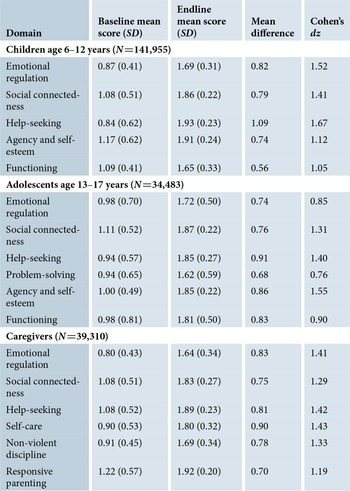
Children aged 6–12 years showed consistent shifts in self-reported understanding of attitudes towards, and behaviours related to, emotional regulation, social connectedness, agency and self-worth, help-seeking, and functioning. Across all thirty-five child KAP items, the mean score increased from 1.00 (SD=0.41) at baseline to 1.79 (SD=0.21) at endline on the 0–2 scale, reflecting an average within-child gain of 0.78 points (dz=1.64), with domain-level effect sizes ranging from dz=1.05 to dz=1.67 (see Table 2).
Pre-post changes across programme domains for children and adolescents, paired samples

Note: 0–2 response scale; higher scores=greater endorsement.
Similarly, among adolescents aged 13–17 years, mean endorsement across the thirty items increased from 1.02 (SD=0.47) to 1.84 (SD=0.21) (dz=1.53). Pre-post patterns indicated consistent shifts in self-reported socio-emotional and psychosocial competencies, including those related to personal identity, relational awareness, communication, problem-solving and community engagement (dz=0.76–1.55). Patterns were largely consistent across boys and girls.
Caregivers similarly reported significant and consistent improvements across all thematic outcome domains, including emotional regulation, social connectedness, help-seeking, self-care, non-violent parenting and responsive caregiving. Domain-level mean scores increased by 0.70–0.90 points, corresponding to large within-participant effect sizes (Cohen’s dz≈1.19–1.43). Improvements were observed across genders, with men showing slightly larger gains in help-seeking and responsive caregiving. However, apparent gender differences should be interpreted cautiously, given the very small male subsample (6.1%), which increases statistical variability.
Triangulation of quantitative and qualitative data suggests a consistent pattern in which children and caregivers report that the programme supported them in strengthening protective processes across multiple levels of the child–caregiver ecosystem. MSC narratives illustrated how participants translated programme content into everyday practices. Qualitative insights sometimes expanded beyond the domains covered in the KAP survey (e.g., peer co-regulation or facilitator influence), underscoring the value of integrating mixed methods. Taken together, these findings illustrate how programme participation translated into changes in individual socio-emotional skills, relational dynamics and everyday coping practices. These patterns lay the foundation for examining the key thematic insights in the following sections.
Theme 1: Improved emotional regulation and coping capacity
Patterns across children, adolescents and caregivers suggest that emotional regulation may function as an early, foundational mechanism of change through which subsequent improvements in relationships and coping unfold.
Across both programmes, the proportion of children and caregivers who endorsed statements related to recognizing, understanding and managing their emotions increased substantially between baseline and endline. Among children aged 6–12, average endorsement across emotional regulation items nearly doubled (from 0.87 to 1.69, dz=1.52), with adolescents showing comparable increases (from 0.98 to 1.72, dz=0.85) (see Table 2). Item-level patterns illustrate where these shifts occurred. The proportion of children who reported that they could name their feelings rose markedly, with mean scores increasing from 0.77 (SD=0.83) to 1.96 (SD=0.24) and endorsement rising from 26% to 97% (see Appendix, Table 3). Children also gave stronger endorsement at endline for items relating to understanding how thoughts and feelings are connected (from 14% to 97%), and reported that they could calm themselves when upset. Additionally, the proportion of children who reported that they did not feel persistent worry increased from 28% to 58%. Adolescents described these shifts in emotional awareness and expression:
I would get angry and agitated immediately … [but] after I started attending the sessions, I became calmer and began dealing with anger in a positive way. … I learned something very important from the sessions: that all emotions are normal, and it’s perfectly normal to feel them. (Female, 12 years, Latakia)
After several sessions, especially those focused on expressing feelings and sadness, I started to talk about what was inside me. … I realized that sadness is a natural feeling that we can experience and overcome. … After that, I gradually got better, and my life returned to normal with my family, friends and school. (Male, 12 years, Hama)
Facilitators also observed these changes in practice. One facilitator described the experience of an 11-year-old boy who had been known for aggressive behaviours and social withdrawal. After sessions focused on anger and how to manage it safely, the child began independently practising self-soothing activities – walking to the garden to calm himself, using breathing techniques, and expressing his feelings. By the end of the programme, the facilitator recollected:
I noticed a significant improvement in his behaviour; he made new friends and said he had benefited and changed. … The principal thanked us because there were no more complaints about him. (Male facilitator, Rural Damascus)
Similarly, among caregivers, endorsement of statements relating to recognizing and managing their emotions increased substantially. Average endorsement across emotional regulation items rose from 0.80 (SD=0.43) to 1.64 (SD=0.34) (dz=1.41), indicating that many caregivers became more likely to report using strategies such as pausing, stepping away or engaging in deliberate calming practices. Notably, the proportion of caregivers who endorsed using stress management techniques increased from 8% to 69%, and the proportion who endorsed deliberate anger reduction strategies rose from 25% to 94% (see Appendix, Table 4). One caregiver explained how the facilitators and sessions helped her understand the root of her anger, validate her feelings and find other outlets. She recounted a particular instance when she punished her young son by banging his head on the wall “until [the wall] cracked”. “I’m on the verge of madness”, she said; “I’ve become this terrifying monster, and this hurts me deeply.” She later recalled that prior to taking part in the programme, “[m]y neighbours were afraid of me, [and] my husband had withdrawn”, but went on to explain how the programme had changed her attitudes and behaviour:
The first session, I met new people and discovered they had problems similar to mine, and even worse. But the session that affected me the most and changed the course of my life was the fifth one. I memorized it by heart; its title was “Understanding Anger and Linking It to Parental Experiences”. I understood how pressure affects our behaviour and how to release it, and I learned everything. … Today, I am a new person. … My relationships have improved, and I can discuss things with my husband and reach solutions. As for my children, I have become their refuge and safe haven. … I no longer hit them, and I never will. (Female caregiver, 33 years, Al-Hasakeh)
In a number of instances, participants made a clear connection between the practical application of the strategies taught during the sessions and its impact on contending with parenting stress, emotional reactivity and stress management:
Most of the information in the sessions I know from my life, but I don’t know how to apply it. I used to be very nervous, but I have become calmer in speech and treatment. … I used to be hasty … and get angry … [but] now I deal with things calmly and take matters in stride. (Female caregiver, 42 years, Homs)
I was always stressed, and even my daughter started to pull away because I didn’t have time to listen to her. … Now, when I feel overwhelmed, I pause the work, visit my neighbour for coffee, or listen to music. I became calmer, closer to my daughter, and more confident. … Even the mirror started showing me a better version of myself. (Female caregiver, 31 years, Homs)
Theme 2: Strengthened peer relations, social connectedness and sense of belonging
Improvements in social connectedness were among the most pronounced psychosocial changes for both children and adolescents. Among children aged 6–12 years, domain-level social connectedness scores increased from 1.08 (SD=0.51) to 1.86 (SD=0.22) (dz=1.41), and adolescents demonstrated a comparable pattern, with scores increasing from 1.11 (SD=0.52) to 1.87 (SD=0.22) (dz=1.31). The proportion of children who reported that they had at least one close friend increased from 47% to 94%, and those who felt they were not lonely increased from 44% to 79%. Adolescents exhibited parallel patterns: the proportion of adolescents who felt they were able to rely on others rose from 51% to 94%, and those reporting at least one close friend increased from 54% to 94%. Many adolescents described the group sessions as “safe spaces” that reduced isolation, normalized shared stories and fostered new friendships:
Here, no one made me feel like a stranger; they treat you like their brother, and they encourage you to make friends and to trust them. (Male, 14 years, Tartous)
At first, I felt that they [the session group] didn’t accept my appearance, but the team helped me and my friends to accept each other, and we became friends. … After that, my self-confidence increased. … I returned to school and to my normal life, and most importantly, to something I had been deprived of, which is playing. (Female, 12 years, Hama)
Caregivers exhibited parallel improvements in their social networks and help-seeking behaviour. Domain-level social connectedness scores increased from 1.08 (SD=0.51) to 1.83 (SD=0.27) (dz=1.29), and help-seeking scores rose from 1.08 (SD=0.52) to 1.89 (SD=0.23) (dz=1.42) (see Table 2). Item-level patterns mirrored these trends: the proportion of caregivers who felt they had meaningful social time with supportive individuals increased from 15% to 72%, trust in their social network rose from 38% to 92%, and willingness to seek help if their child experienced violence increased from 25% to 82% (see Appendix, Table 4). As caregivers described, strengthened social ties played an important role in improving their psychological well-being and parenting:
I used to yell at my children all the time. Now, I sit with them, play games, and understand how their behaviour is shaped by their needs. (Female caregiver, 32 years, Al-Hasakeh)
I learned about the importance of having a supportive social network, and that maintaining good relationships with the people around me is essential for feeling psychologically at ease and happy. … It brought me joy and had a positive impact not only on me, but also on my husband and children. (Female caregiver, 25 years, Rural Damascus)
I saw many women with similar problems to my children’s, and I focused on how they dealt with their kids. I started to feel like I was changing after attending a session about developmental characteristics. … The more we understand these traits, the more positively we can deal with our children. I actually started trying to apply this information, and I felt a positive change in my relationship with my children. … That’s why my neighbours and I often sat together and talked about our problems. What mattered to me was that there was someone to help us deal with these issues. We will find a solution. (Female caregiver, 39 years, Damascus)
Theme 3: Improved relationships and increased understanding between children and their caregivers
The proportion of children who felt comfortable communicating with their caregivers improved significantly, from 27% to 86%. These shifts were reflected in domain-level help-seeking scores, which increased from 0.84 (SD=0.62) to 1.93 (SD=0.23) (dz=1.67) among children aged 6–12 years. Similar improvements were observed among adolescents: the proportion who reported that they could talk to their parents or caregivers about things that bothered them rose from 23% to 78%, alongside an increase in help-seeking domain scores from 0.94 (SD=0.57) to 1.85 (SD=0.27) (dz=1.40). At multiple points across the programme this led to an increase in referrals for protection services, as shown below.
I never used to tell my mother anything. … I don’t know why. … I was scared and embarrassed. Now I talk to her about everything, and we understand each other more. She attends the parenting sessions, and she has changed too. … She’s calmer with us and listens more. We spend more time together as a family, even my father, and I no longer stay alone in my room for long. (Female, 12 years, Tartous)
Instead of being like all the other children, happy and joyful and playing, I used to spend my time feeling shy, scared, disgusted with myself, and even having nightmares in my dreams. It was all because I used to hide what my grandfather did to me when he put me in his lap and told me not to tell anyone. When I attended the psychological support sessions, I realized how hurtful this was and that I shouldn’t stay silent. It was very difficult for me to tell my mother, but because we [discussed in] the sessions that we shouldn’t hide anything, I became strong and told my mother everything. From that time until today, I stopped going to my grandfather’s house. … My mother protected me, and when I started sleeping next to her, I felt safe, and there were no more nightmares. The worry was lifted from my chest. (Female, 11 years, location withheld)
A female facilitator from Latakia noted that a mother who initially shouted at her children “began sitting beside them, communicating calmly, and showing fewer negative emotions”. Caregivers themselves traced these changes to increased empathy, patience, and understanding of their children’s needs:
I used to hit my son all the time, and he never listened. … After the sessions, I stopped and thought: how can I refuse to break expensive glass because it’s valuable, yet hit my son every day? I started asking him why he acted that way before raising my hand, and he began to listen. (Female caregiver, 45 years, Homs)
Due to the circumstances we’ve been through because of the war, or perhaps we were taught by our parents that discipline must involve physical punishment … if your son or daughter isn’t afraid of you, they won’t be raised properly … [After the sessions] I realized that hitting isn’t the key to raising children. … Today, my situation with my family is much better. … There’s always a solution that doesn’t involve hitting. (Male caregiver, 45 years, Qamishli)
My daughter had a severe cough that lasted for weeks. … Nothing explained it. Physicians kept telling me there was no physical cause and that the problem might be emotional. While attending the parenting course, I realized that my harshness, criticism and lack of attention were affecting her. I began spending more time with her, listening and supporting her … and her cough gradually disappeared. It made me realize how easily we can hurt our children without noticing, and how often the solution lies in changing our own approach. (Female caregiver, 33 years, Rural Damascus)
Theme 4: Ripple effects in schools and communities and early markers of sustained impact
Although the strongest effects of the programmes were observed at the individual and household levels, qualitative insights captured meaningful spillovers. Children and adolescents frequently described applying conflict resolution and calming techniques with peers, contributing to fewer arguments, improved friendships and reduced bullying.
In the centre, we used to yell and argue. Now we remind each other to calm down when someone gets angry. (Male, 13 years, Tartous)
I learned from the activity of expressing feelings verbally that I should be able to express any emotion I feel, especially anger or sadness. Expressing feelings in words makes us feel more comfortable. That’s when I thought I’d try this activity with my brother. I went to him and told him that when he gets angry with me, he should be honest about his feelings and tell me what made him angry so we can talk it out. He shouldn’t hit me. If he wants something, he should say “please” or “if you don’t mind”, and I’ll do it. Since then, my brother has understood me, respected my feelings, and his treatment of me has improved. Thank you. (Female, 12 years, Qamishli)
These shifts were also noticed by other caregivers, including in schools and communities. A school principal reflected on how he used to “struggle a lot” with his students, but started noticing changes in their behaviour as they attended the sessions:
[Initially] I wasn’t convinced … and thought [the sessions] were useless. But after a few sessions, I saw some of [the students] making gifts and giving each other presents. … Loud fighting in the schoolyard subsided. … It was something strange for them, and I started asking them what had changed. They told me they were following rules to stay in the “committed” competition. … I couldn’t believe that my students were capable of such things. … It was calming, and these sessions turned out to be very beneficial. (Male school principal, 39 years, Aleppo)
Caregivers – as well as facilitators themselves – reported similar trends, with several participants noting that changes in their own behaviour influenced relatives, neighbours and broader social networks, suggesting early social diffusion of non-violent patterns.
My sister noticed that I don’t shout anymore. I told her about the sessions, and now she’s trying to do the same with her kids. (Female caregiver, 29 years, Aleppo)
After I stopped hitting my children, I explained to others why I changed. Some of them are now trying to do the same. (Female caregiver, 49 years, Homs)
Before, we used to have daily arguments and problems in the neighbourhood. No one would speak to each other except for a brief greeting, barely enough to get anything done. … After attending the sessions, we got to know each other and started meeting in the afternoons in front of the door. … Time after time, we not only reduced our anger but also started meeting more often, sitting, talking, and learning from each other more. (Female caregiver, 40 years, Deir ez-Zor)
Notably, facilitators, as community members themselves, also expressed how engaging in the programme affected their own family and community relations. For instance, one facilitator reflected:
Before I became a facilitator, I didn’t know that when a person gets angry, they can reduce their anger … without hurting themselves or those around them. All I knew was that if anyone in the family got angry … they would say hurtful things, raise their voices at each other, break things … but then I taught my siblings the “anger balloon” activity. … We agreed to write down things we like that help reduce anger. Now they apply it in their lives. … I’m not saying they’ve stopped getting angry and hurting anyone, but the number of times they get angry has decreased. (Female facilitator, 29 years, Qamishli)
Furthermore, qualitative insights indicated that changes have continued to consolidate with practice, particularly in emotion regulation and relationship repair, months after participation in the group sessions:
When I get stressed, I still use the breathing and reflection methods we practised. It helps me stay calm and patient, even months later. (Female, 12 years, Rural Damascus)
Taken together, these findings point to coherent shifts across individual, relational and early community levels that align with the programme’s socio-ecological design and suggest plausible pathways for sustaining intergenerational improvements.
Discussion
Drawing on quantitative and qualitative data available from a large, diverse sample of children, adolescents and caregivers, this mixed-methods study provides insight into how the Sawa and Sanadi programmes shaped psychosocial outcomes among participating families in Syria. The results suggest that the programmes’ influence changes through three interconnected pathways, representing shifts in programme-aligned competencies such as emotional regulation, relational communication and responsive caregiving. While the quantitative data reflect endorsement rather than clinically validated symptom scores, consistent increases across items, paired with rich qualitative narratives, suggest that many participants internalized and applied practical skills introduced in the sessions.
First, across children and caregivers, participants reported increased endorsement of knowledge, attitudes and practices related to emotional regulation, social connectedness and communication, responsive caregiving, help-seeking, and agency and self-esteem. Children and adolescents described becoming better able to identify emotions, pause before reacting and navigate peer conflict more constructively. Caregivers reported using calming and self-reflective strategies that reduced violent disciplinary approaches and enabled nurturing and responsive caregiving.
Second, the programme’s group-based process emerged as a key enabler, functioning as a therapeutic and relational catalyst. Participants frequently described the groups as safe, non-judgemental spaces where members could see the growth of others, exchange experiences and develop empathy. Moreover, facilitators’ emphasis on inclusion, validation, shared storytelling and modelling of respectful communication appears to have strengthened belonging and reduced isolation. This “micro-community” dynamic normalized children and caregivers’ experiences and reinforced positive behaviours, echoing evidence that group reflection enables people affected by conflict to make sense of distress and accelerate psychosocial recovery.Footnote 23
Third, and relatedly, emergent insights suggest that there were several instances where children and caregivers reported using the skills learned during the programme sessions beyond group interventions. Children described using calming techniques and conflict resolution strategies with peers outside the programme, while caregivers reported changes that extended to spouses, siblings, neighbours and extended family. Several described sharing strategies with other parents, suggesting early diffusion of norms around non-violent communication and emotional support. Although exploratory, these insights hint at the programmes’ potential to influence broader social cohesion and relational well-being – a direction consistent with socio-ecological models of MHPSS, which emphasize that individual change is strengthened when reinforced by family, peer and community networks. However, further research is needed to examine these community-level dynamics more systematically.Footnote 24
Taken together, these insights demonstrate how intergenerational MHPSS interventions can improve core processes linked to socio-emotional abilities and psychosocial well-being, strengthen individual coping and emotional regulation, promote positive caregiver–child and peer relations, and foster broader community cohesion and connections. When caregivers are engaged first through their own mental health and psychosocial well-being, they can develop greater emotional regulation and are more likely to use non-violent and responsive parenting practices with their children, which in turn provides children with the safety and trust needed for healthy socio-emotional development. Similarly, when children learn to identify and regulate their emotions, express their needs clearly and use constructive coping strategies, they are less likely to escalate conflict and more likely to elicit calm and empathetic responses from adults. This bidirectional pattern is well documented in family systems and attachment research,Footnote 25 and creates a reciprocal process that strengthens family relationships, reinforces prosocial norms within the household and contributes to a broader cycle of healing that extends into peer groups, schools and community spaces.
Further, while the study does not directly assess the programme’s system integration in Syria, it does offer an opportunity to reflect on the policy and systems dimensions that come into play when designing, implementing and scaling similar intergenerational programmes in complex humanitarian settings. The nationwide adoption of Sawa and Sanadi across thirteen governorates did not occur by chance; rather, it was shaped by a combination of technical bureaucrat advocacy driven by concern about the impact of prolonged conflict on family unity and children’s behaviour, followed by early personal and positive engagement with the techniques and relational strategies of the two programmes, which led to the political feasibility that supported institutional uptake. A central enabling factor was the deliberate co-design of the curricula and the measurement tools with government institutions and implementing partners from the outset. This early and consistent involvement ensured that programme content aligned with existing national priorities, making it easier for ministries and directorates to recognize the intervention as compatible with current mandates rather than as an external or duplicative initiative. Embedding the programmes within established community platforms, rather than creating parallel systems, further reinforced institutional ownership and operational sustainability.
Policy uptake was also strengthened by what several stakeholders described as technocratic championship, which involved the active engagement of mid- and high-level government officials who became internal advocates for the programme. Programme teams facilitated this by inviting these actors to “test” the materials in their own family environments. This personalized exposure to the content beyond its technical or bureaucratic framing helped shift perceptions from abstract policy to tangible, relatable practice. As officials witnessed the relevance of the skills within their own households, they became more invested in advocating for the curricula within their institutions. These relational and experiential strategies helped build trust, reduce resistance and strengthen the political will required for national scale-up. While the processes described in this paper reflect steps undertaken under the previous regime, the Sawa and Sanadi programmes have since June 2025 been fully endorsed by the current Syrian government and are now implemented nationwide across all fourteen governorates, including Idlib.
This study has several notable design and implementation strengths. First, its large, diverse national sample provides a rare opportunity to explore psychosocial outcomes among children and caregivers in a complex humanitarian context. The mixed-methods design enabled triangulation across quantitative and qualitative data, facilitating a more nuanced interpretation of change and allowing participants to surface priorities that extended beyond the scope of the measurement tools. Strong community and government ownership, from co-design of the curricula to adaptation of the measurement tools, enhanced the cultural relevance, feasibility, and sustainability of the programme, and the reliability of the tools and findings. Finally, the intergenerational and socio-ecological framing of the programmes enabled documentation of changes across individual, family and emerging community levels.
Despite these strengths, however, several methodological considerations should be noted. The use of self-reported pre-post data collected by facilitators, and without a comparison group, limits causal inference and raises the possibility of social desirability or facilitator–respondent bias. Although the KAP tool demonstrated acceptable internal consistency across several domains, it had not undergone full psychometric validation at the time of implementation. The tool was designed to capture item-level endorsement and domain averages, rather than validated latent constructs or standardized psychosocial or mental health outcomes.
Due to the scale, urgency and operational constraints of a protracted humanitarian setting, the tools prioritized feasibility, cultural relevance and alignment with programme objectives over full validation before rollout. The brief three-point response scale improved comprehension and allowed for large-scale administration, though it may have reduced sensitivity to minor changes. Therefore, findings should be viewed as indicating changes in programme-related knowledge, attitudes and practices, rather than clinical symptom changes.
The caregiver sample was overwhelmingly female, which limits the extent to which the findings can be generalized, especially to fathers or male guardians. As a result, the findings mainly reflect the experiences, perceptions and reported changes of female caregivers. While this aligns with caregiving patterns in the Syrian context, caution is warranted when applying these results to male caregivers, whose experiences, stressors and pathways of change may differ. Future research should explore strategies to increase male caregiver engagement and examine gender-specific mechanisms and outcomes within intergenerational MHPSS interventions.
Several constructs that emerged strongly in the narratives, such as peer co-regulation, facilitator influence and broader community relational shifts, were only partially represented in the KAP surveys and subsequent quantitative data. Although recent iterations of the tool introduced items on social connectedness, additional refinement and validation are still required – and currently under way – to assess these domains more robustly.
Triangulation with MSC narratives and routine field monitoring helped contextualize the quantitative findings and identify consistencies or discrepancies across data sources, but it cannot eliminate the underlying biases inherent in self-report measures. However, the convergence between reported behavioural shifts and qualitative narratives can support the plausibility of the observed patterns. Finally, while the MSC methodology provides rich insight into perceived change and mechanisms of impact, it focuses on positive stories and does not enquire about potential unintended negative effects or experiences. Future evaluations should therefore include qualitative interviews with a wider range of families and should explicitly enquire about all types of experiences, including potentially negative or unintended effects.
Conclusion
The Sawa and Sanadi programmes illustrate how intergenerational, trauma-informed, community-based MHPSS interventions can strengthen emotional regulation, relational communication and responsive caregiving among families living through armed conflict and protracted crisis. Implemented at national scale and co-designed with government partners, these programmes demonstrate the feasibility of embedding family-focused MHPSS within existing institutional platforms, a critical step toward sustainable, systems-level integration in humanitarian settings. Although the evaluation relied on self-report and a pre-post design, the convergence of quantitative improvements with rich qualitative narratives supports the plausibility of the observed changes and provides insight into the mechanisms through which these programmes foster healthier child–caregiver dynamics and early community-level shifts. Taken together, the findings point to meaningful strengthening of protective processes across the child–caregiver ecosystem.
Future research should further validate measurement tools, incorporate longitudinal and comparison-group designs, and examine the sustainability and diffusion of these relational and socio-emotional gains over time. Such work is essential to deepening our understanding of how family-centred, socio-ecological MHPSS models can be adapted, institutionalized and scaled in complex emergencies. By demonstrating that large-scale, intergenerational MHPSS programming is both feasible and impactful within a national system affected by protracted conflict, Sawa and Sanadi contribute important evidence to the global humanitarian field and offer a promising model for supporting recovery and relational well-being among crisis-affected families in Syria and beyond.
Appendix: Item-level paired pre-post means for the Sanadi and Sawa programmes
Item-level paired pre-post means (SD) for the Sawa programme (N=141,955)

† These items were negatively worded and reverse-coded, so higher disagreement with the statement was interpreted as a more positive outcome and awarded a higher score (e.g., a caregiver who responded “Never” to “I feel very angry and lose my temper” received the highest score on that item). As a result, the increases in mean scores and endorsement percentages observed for these items from baseline to endline reflect positive change.
Item-level paired pre-post means (SD) for the Sanadi programme (N=39,310)

† These items were negatively worded and reverse-coded, so higher disagreement with the statement was interpreted as a more positive outcome and awarded a higher score (e.g., a caregiver who responded “Never” to “I feel very angry and lose my temper” received the highest score on that item). As a result, the increases in mean scores and endorsement percentages observed for these items from baseline to endline reflect positive change.




 Open access

