


1. Introduction
Design is an exploratory process (Reference GeroGero, 1990; Cross, Reference Cross2006; Cross, Reference Cross2023). Designers deal with ill-structured or “wicked” problems (Reference CrossRittel & Webber, 1973; as cited in Cross, 2006) and often begin their work with incomplete information (Reference GeroGero, 1990). To navigate this landscape of incomplete information, designers must make assumptions to progress in their work. Assumptions are defined as things we accept as true without question or proof (Cambridge University Press, n.d.). While there is a difference in the layman and academic usage of the term “assumption”, in this paper we refer to assumptions as aspects of the structure of a particular thinking episode (Reference Delin, Chittleborough and DelinDelin et al. 1994). In this paper, we present early insights from a pilot study on assumption-making guided by the overarching research question: How do individuals make assumptions?
Design is a context-dependent activity. The context in which a designer works shapes the design as does the designer’s perception of the context (Reference GeroGero, 1990). As the designer’s perception changes, so does the problem understood, the constraints prioritised, and the directions thus explored. Perception, an active process of meaning-making (Reference MatherMather, 2006; Reference MayMay, 2007) is fallible since sensory inputs are often incomplete or misleading (Reference RussellRussell, 1912; Hume, Reference Hume and Mossner1739; Kant, Reference Kant, Guyer and Wood1998; Pinker, Reference Pinker2009; Meinong, Reference Meinong1983). This limitation is particularly relevant in design, where assumptions fill gaps in the perception or understanding of a design problem. Moreover, design is fundamentally a problem-finding and problem-solving activity (Reference CrossCross, 2006; Reference Singh and ChakrabartiSingh, 2019). Faced with ambiguous and incomplete information, designers rely on assumptions to simplify complexity and frame potential solutions. Therefore, investigating how assumptions are formed and utilized is critical for understanding the cognitive processes underpinning problem-solving in the context of design.
Assumptions shape the evolving interplay between context and perception, serving as critical acts of cognition in the design process. Meinong Reference Meinong(1983) defines assumptions as judgments without belief. He proposes that the absence of conviction is the core difference between an assumption and a judgment. Meinong Reference Meinong(1983) argues that precisely defining an assumption is only possible with empirical introspective data. He also states that abstracting key factors in judgments that exhibit predictable variability can enable psychologists to study assumption-making (Reference MeinongMeinong, 1983). Thus, a similar approach can be applied to understanding assumptions.
Despite philosophical and theoretical exploration (Reference MeinongMeinong, 1983; Reference EnnisEnnis, 1972, p.78), empirical research still needs to establish how assumptions are formed, maintained, and modified. Here, we attempt to address this gap by conducting an empirical investigation into assumption-making within the context of problem-solving. As Meinong Reference Meinong(1983) proposed, the process of abstraction offers a reasonable approach to studying assumptions. Built on this foundation, we have conducted a preliminary exploration using questions abstracted to simulate design problems. The constructs of bounded rationality (Reference Simon, McGuire and RadnerSimon, 1972), satisficing (Reference SimonSimon, 1956) and ill-structured problems (Reference SimonSimon, 1973) help elucidate this process by demonstrating how designers operate within informational and temporal constraints. These constructs challenge the notion of entirely rational decisions, emphasising the preference for ‘good enough’ solutions (Reference SimonSimon, 1956) over optimal ones. Given design’s iterative and uncertain nature, bounded rationality (Reference Simon, McGuire and RadnerSimon, 1972) and satisficing (Reference SimonSimon, 1956) provide a practical framework for understanding how designers manage ambiguity and progress despite incomplete information.
The objective guiding the pilot study is to investigate how individuals make assumptions while solving ill-structured problems under different time constraints. Additionally, the purpose of the pilot study is to also test whether the experimental questions give us insights into the cognitive dynamics of assumption-making.
2. Method
2.1. Study design
This pilot study used a within-subjects experimental design to investigate how participants make assumptions while solving ill-structured problems under varying temporal constraints. Each participant completed a series of tasks twice: once with a short-time constraint and once with a long-time constraint. Since real-world design scenarios demand rapid and deliberative decisions, this approach captures how cognitive processes (Reference Dole, Nokes and DritsDole, 2014) adapt to varying time constraints.
This study design, informed by bounded rationality (Reference Simon, McGuire and RadnerSimon, 1972), helps investigate how participants employ satisficing (making good enough decisions) (Reference SimonSimon, 1956) when time and information are limited. The within-subjects design was selected with two temporal conditions to control individual differences and increase sensitivity to assumption-making strategies. Presenting both time constraints to each participant ensures that the observed effects stem from temporal variations rather than between-subject variability (Reference GreenwaldGreenwald, 1976). Although statistical analyses are not conducted at this stage, they will be applied in subsequent phases to test and strengthen the ecological validity of the findings.
2.2. Participants and procedures
The pilot study sample consisted of eight participants (three females and five males) aged 23 to 29, selected through purposive sampling from the student body. The sample comprised undergraduate, postgraduate, and doctoral students and research assistants. The limited sample size aligns with established practices in pilot studies, where the primary focus is ensuring item clarity, feasibility, and procedural validity rather than achieving statistical significance (Reference Johanson and BrooksJohanson & Brooks, 2009).
The experiment was conducted in a well-lit classroom with minimal external noise. Following standard psychological procedures, participants were seated at a table with the experimenter seated to their right, at a ninety-degree angle. Wooden screens were placed in front and to the left to minimise visual distractions. The experiment was conducted at the same time of the day for all the participants to control for diurnal variation and the influence of circadian rhythms on cognitive performance. After establishing rapport, participants were given an informed consent form and a demographics form. Only non-identifying information was collected.
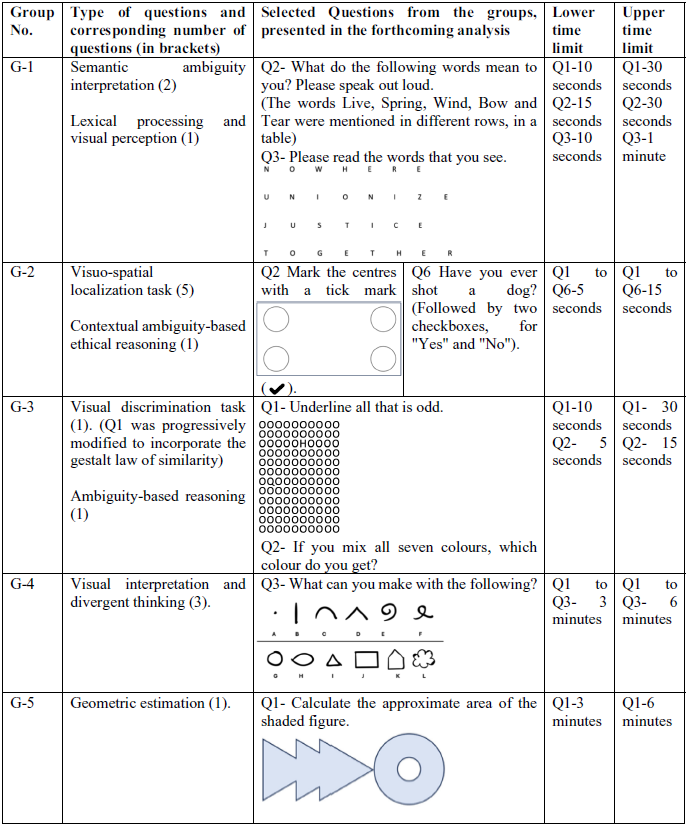
The short-form booklet was administered first, followed by a brief break, and then the long-form booklet. Participants were presented with tasks designed to assess various aspects of problem-solving abilities. The tasks were organised into five sets, each containing a different number of questions varying in complexity and time constraints, as described in Table 1. Upon completing both booklets, participants were asked probing questions to ascertain their reasoning and assumption-making processes. The experiment concluded with a debriefing session, after which the experimenter escorted the participants out of the classroom.
Classification of experimental questions.

2.2.1. Instructions
Instructions were provided once at the beginning of the experiment and then at the beginning of each set. Each set included instructions specific to the question types and requirements. Participants were encouraged to seek clarification before commencing each set. Once a set began, no further clarifications were allowed. Participants were instructed to respond honestly, as there were no right or wrong answers, only their interpretations. Tasks requiring verbal responses were marked with an icon representing a human mouth. Participants were asked to articulate their answers clearly.
The think-aloud protocol was followed in Group 1 and in the last two groups, Group 4 (concerning visual interpretation and divergent thinking) and Group 5 (concerning geometric estimation). This approach attempted to capture their real-time cognitive processes and gathered insights into task engagement (Reference Fonteyn, Kuipers and GrobeFonteyn et al., 1993). The think-aloud protocol is helpful as it mitigates biases from retrospective recall by prompting participants to verbalise their thoughts immediately (Reference Fonteyn, Kuipers and GrobeFonteyn et al., 1993). Adherence to time limits was emphasised, as time is a critical component of the experimental design. The questions were timed using the Timer RH app on MacBook. The participants were informed that the entire experiment was being recorded in audio format.
2.2.2. Short-form to long-form task sequence
In the experimental design, the short-form booklet task precedes the long-form booklet task to minimise potential learning effects and cognitive biases. Presenting the short form first makes participants’ responses more likely to reflect spontaneous, heuristic-driven reasoning. Introducing the long-form afterwards reduces the risk of contamination from deliberative strategies developed during extended problem-solving. This sequencing ensures the integrity of any baseline intuitive assumptions by capturing them before any reflective thought processes.
This design strategy aligns with established dual-process theories of cognition (Reference KahnemanKahneman, 2011), which differentiate between System 1 thinking (fast, automatic, and heuristic) and System 2 thinking (slow, effortful, and analytical). By eliciting System 1 processes initially, the experiment ensures that intuitive assumptions remain independent of more structured or deliberate cognitive strategies (Reference Dole, Nokes and DritsDole, 2014). The subsequent long-time condition facilitates a systematic exploration of how participants revise or refine their initial assumptions when more time is available.
2.2.3. Probing questions
Probing questions help elicit rich and detailed data by guiding discussions toward nuanced and otherwise overlooked areas (Reference RobinsonRobinson, 2023). Probing questions were used to clarify the assumptions underlying participants’ responses under the two temporal constraints. Most probing questions were laddered (Reference RobinsonRobinson, 2023) to progressively uncover the core of participants’ reasoning processes. For the first four participants, probing questions were asked immediately after each group. In comparison, for the remaining four participants, the probing questions were deferred until the end of the experiment to test an alternative approach, given the exploratory nature of the pilot study.
Probing questions such as “What made you respond this way?” and “What thoughts were going through your mind while answering the question?” aimed to uncover assumption-making strategies. For linguistic processing tasks, queries like “What led you to assume this meaning?” were used to investigate semantic interpretations.
2.3. Measures
An experiment must begin with the relatively simple rather than the complex (Reference PerkyPerky, 1910). Following this experimental maxim, we developed a pen and paper test in the form of an A4 size test booklet. It was printed in the landscape orientation, comprising 15 questions categorised into five groups. We created two versions of the booklet: a short form and a long form. The short form featured shorter time limits for most questions than the long form, with variations determined by the type of questions. Table 1 entails a breakdown of the groups, question types, some questions from the experiment and time limits.
3. Initial insights
3.1. Group 1
In Group 1, which focused on semantic ambiguity interpretation and lexical processing, the results from the pilot study revealed notable differences based on time constraints. In the short-form condition (5 seconds), for Question 2 (See Table 1), participants produced brief, instinctive interpretations of the words. Conversely, in the long-form condition (1 minute), participants demonstrated more deliberate reasoning, often exploring multiple interpretations or contexts. Concepts of homonymy and polysemy in information retrieval (Reference KrovetzKrovetz, 1997) support the theoretical foundation of Group 1 questions, which explore how participants resolve linguistic ambiguity in interpretation tasks. These findings may enhance the ecological validity of the experiment, as real-world problem-solving frequently involves resolving linguistic ambiguity. The variable responses observed in Group 1 tasks highlight the role of divergent thinking in generating multiple interpretations, reinforcing the importance of capturing these variations. Additionally, using the think-aloud protocol (Reference Fonteyn, Kuipers and GrobeFonteyn et al., 1993) in these tasks helped reveal participants’ real-time cognitive strategies for disambiguating words, aiding the understanding of their assumption-making processes.
After the first five iterations, Question 3, the lexical processing task was revised to incorporate the Gestalt law of similarity (Reference KoffkaKoffka, 2013). In the long-form condition, the words were read from left to right and broken down into shorter words. Participants also read words that appeared vertical and words that formed due to the proximity of the letters. This indicates that extended time allowed participants to engage in more flexible reading strategies, identifying patterns and alternate word structures beyond the initial horizontal (default) arrangement. Figure 1 illustrates the evolution of Question 3 in Group 1 and the response by Participant 8 in the long-form.
Evolution of question 3, group 1 and the response by participant 8 in the long-form

3.2. Group 2
In Group 2, the visuospatial localisation tasks provide key insights into the nature of assumption-making under different time constraints. In the short-form condition (5 seconds), participants often defaulted to identifying the centres of the most prominent shapes, such as circles, while frequently neglecting the centres of the encompassing rectangle as illustrated in Figure 2. This suggests that under time pressure participants relied on the implicit assumption that the task required identifying only the most visually salient features. Such an assumption reflects a form of selective attention where participants narrowed their focus to internal elements, potentially due to the need for rapid decision-making, aligning with bounded rationality (Reference Simon, McGuire and RadnerSimon, 1972). When participants defaulted to identifying the most visually salient features, they demonstrated satisficing behaviour—settling for “good enough” solutions within cognitive and temporal constraints. This reinforces the significance of these theoretical concepts in understanding the adaptability of assumption-making.
Responses to question 2 in group 2 by participant 5 (short-form vs. long-form) and participant 2(long-form)

In the long-form condition (15 seconds), while many participants expanded their scope to include the centres of the rectangles, some continued to focus solely on the internal shapes. This variability highlights the persistence of initial assumptions for some individuals. It suggests a sort of assumptive inertia Footnote 1 , a tendency to stick with an initial assumption, which can occur even when another opportunity and more time to revise those assumptions are presented.
This finding indicates that assumption-making in problem-solving might be influenced by time constraints and the flexibility of the individual’s cognitive strategies. Response by Participant 2 reflects a flexible cognitive strategy as seen in Figure 2. These findings highlight the dual nature of assumption-making, i.e., it can be flexible and context-sensitive for some individuals while static and resistant to change for others. The ability to revise assumptions hinges on cognitive flexibility and adaptive thinking. Recognising these differing cognitive profiles is essential for understanding how assumptions are formed, maintained, or adjusted under varying temporal constraints. Ultimately, this variability underscores the importance of understanding how initial assumptions shape responses and how these assumptions may (or may not) evolve with additional time or opportunities. This variability in assumption flexibility is critical for identifying different problem-solving profiles and will be pursued in future experiments.
The question probing contextual ambiguity reasoning (“Have you ever shot a dog?”), exhibited a notable consistency in responses across both the short-form and long-form conditions. This uniformity indicates that assumption-making may be less influenced by time constraints and more by an intrinsic cognitive framework in scenarios that appear to involve moral or ethical judgment. This consistency contrasts with the variability observed in the visuospatial tasks, further illustrating how the type of task - visual or ethical - can shape the dynamics of assumption-making.
3.3. Group 3
In Group 3, Question 1, the visual discrimination task, designed to identify anomalies within a field of uniform elements, yielded key insights. The task evolved through multiple iterations in both visual structure and task statement as shown in Figure 3. Participant 1 (short-form, 10 seconds) identified only the letter H in the initial administration. In contrast, Participant 2 (long-form, 30 seconds) identified both H and Q, suggesting that extended time allows for a more comprehensive visual search.
Evolution of question 1, group 3 with responses by participants 1,4,7 and 8

When both conditions were administered from Participant 3 onwards, similar patterns emerged: participants typically identified H in the short-form condition and both H and Q in the long-form. However, instances of assumptive inertia were observed where participants maintained their initial answer despite having more time. For example, Participant 4 identified only H in both conditions, which may have resulted from an inability to detect the Q nestled within the field of O’s.
To address this ambiguity, the task was refined for successive participants by incorporating the Gestalt law of similarity (equidistant vertical and horizontal spacing) (Reference KoffkaKoffka, 2013) and changing the task statement from “Find the odd one out” to “Underline all that is odd”. Participant 7 identified only H in both conditions. Participant 8, in a spirit to be different, underlined all the O’s in the long form. This indicates that some participants may persist with initial assumptions or could not detect the letter Q due to currently unaccounted-for factors. This also suggests the variability in cognitive flexibility and the persistence of assumptive inertia. While more explicit instructions and a more structured design reduced ambiguity, the task remained ill-structured, allowing for different interpretations of what qualifies as “odd” due to individual perception and time constraints.
The responses to the question “If you mix all seven colours, which colour do you get?” varied between white, black, and rainbow, with one participant—an architect—providing both white and black within the same condition, reflecting their knowledge of design and colour theory. This variability suggests ambiguity in interpreting the colour mixing process, influenced by whether participants considered additive or subtractive mixing. The consistency of some responses across both short and long-form conditions indicates assumptive inertia, while different answers in the two temporal conditions suggest cognitive flexibility.
3.4. Group 4
In Group 4, the visual alphabet was used to design the question on visual interpretation (Question 3), as the author (Reference GrayGray, 2010) claims that the 12 glyphs can be used to draw anything. Initially, the task statement was “What meaningful objects can you make with the following shapes?” and shape names were included under each shape. From the third iteration onward, the task statement was changed to “What can you make with the following?” After analysing responses from Participant 3, the task was revised to remove the shape names. These were replaced with the first 12 letters of the English alphabet while retaining the simplified task statement. This revision led to marked differences in participant responses as illustrated in Figure 4.
Responses to question 3, group 4 by participant 3 (short-from), participant 4 (short-form) and participant 7 (long-form)

Participant 4 took a different approach from what was observed before. They initially associated the shapes with the number of points in them and linked this to the steps in a software they used. When the pattern broke near shape E, the participant shifted to analysing the sounds of the letters, noting distinctions between smooth and sharp sounds. Participant 5 could only make use of the last four shapes. They had trouble interpreting the shapes labelled A to H, particularly when grappling with the word “make” in the task statement. Participant 6 gravitated toward developing a cryptic language in short and long-form conditions. Participant 7 drew on their mother tongue to interpret the symbols, identifying similarities to glyphs from an old script. In the long-form condition, they constructed a visual narrative by associating the shapes with building blocks and envisioning them stacked and encapsulated within a cloud. This imaginative interpretation reflected themes of construction and containment, demonstrating a divergent and holistic thought process. Participant 8 drew different things in both time conditions, emphasising an innate drive to be different in their responses.
These responses reveal that assumption-making is shaped by task clarity, guiding cues, and the individual’s cognitive and cultural context. Removing the shape names increased ambiguity, leading to more creative and personalised interpretations, but it also caused uncertainty for some participants. Depending on their cognitive flexibility and tolerance for uncertainty, participants either adapted their assumptions or displayed assumptive inertia. This emphasises the importance of thoughtful task design that balances ambiguity and structure to enable problem-solving without overwhelming participants.
3.5. Group 5
In Group 5, the participants employed different approaches, ranging from formula-based calculations to visual approximations. Group 5 had only one question, which asked the participants to calculate the approximate area of a shaded figure. The think-aloud protocol revealed the progression of thoughts, with participants articulating their evolving approach in real time.
Participant 1, who was only administered the short form, equated the triangle’s base with the circle’s diameter but could not complete the answer because they could not recall the formula for the area of an equilateral triangle. The participant initially thought the task was simple but felt rushed and overwhelmed by the irregular spaces between the triangles. Participant 2, who was only administered the long form, correctly applied the formula for the area of an equilateral triangle. However, they failed to produce a final answer despite assuming the circle’s diameter equals the triangle’s base.
Participant 3 made no calculations but visually estimated the total shaded area as four triangles. Participant 4 gave an approximate numerical answer by enclosing the triangles in a rectangle and the concentric circles in a square as illustrated in Figure 5.
The response to question 1, group 5 by participant 4 (short-form)

Participant 5 approached the problem symbolically in both forms, expressing the areas in terms of alphabets and subdividing the triangles into smaller parts. In the long form, they expanded on this approach with a comprehensive explanation but did not provide a numerical answer. Participant 6 tried to enclose the triangles in a rectangle but could not produce an answer in the short form. They built on this approach in the long form and isolated the triangles into three sub-sections. They could not give an approximate figure but completed the calculation formula. Participant 7 initially applied an incorrect formula while calculating the area. They crossed out their calculations and provided a ballpark estimate as time ran out. In the long form, they refined their method by dividing the triangles into smaller sub-triangles and successfully arrived at a numerical answer. Upon probing, they expressed relief that the task allowed for approximation, noting that breaking the shapes into more manageable parts helped them navigate the problem more effectively. Participant 8, in the long form, requested an A4 size sheet to make accurate measurements of the shaded region.
A continuum of formula-based calculation and visual approximation was seen in Group 5 responses, with some participants relying on detailed breakdowns and symbolic methods, while others opted for heuristic approaches and geometric enclosures to manage the task’s ambiguity.
3.6. Iterative design of questions
The iterative design of questions was pivotal in this pilot study, which focused on modifying tasks to capture the nuances of assumption-making in the two temporal conditions. The iterations helped to identify ambiguity in task statements and participant hesitation, allowing each question to be refined to balance clarity and ambiguity. This ensured that the tasks elicited responses while maintaining their ill-structured nature to permit diverse interpretations. Iterative design was crucial for addressing participant challenges in task comprehension. For example, in Group 4, Question 3, removing shape names increased ambiguity, encouraging lateral thinking but also increased participant uncertainty.
4. Discussion and limitations
The current pilot study explored how individuals form assumptions while solving ill-structured problems under different time constraints. Key findings indicated that assumption-making is influenced by available time, task ambiguity, and individual differences. Under short time constraints, participants primarily relied on heuristic and intuitive assumptions, whereas the long-time condition facilitated more analytical and varied responses, highlighting greater cognitive flexibility. These observations align with dual-process theories, distinguishing between intuitive (System 1) and analytical (System 2) cognitive processes (Reference KahnemanKahneman, 2011). A significant insight from the study was the identification of assumptive inertia - the tendency to hold onto initial assumptions even when given additional opportunities or extended time for revision.
A notable strength of this study was the use of the think-aloud protocol, effectively capturing real-time cognitive processes. Fonteyn et al. Reference Fonteyn, Kuipers and Grobe(1993) underscore the benefit of this method in reducing biases associated with retrospective self-reports. However, verbalising thoughts may inadvertently interfere with natural cognitive processes, as cautioned by Ericsson and Simon Reference Ericsson and Simon(1993). The reliance on think-aloud protocols may also introduce biases, as verbalized thought processes may not reflect deeper subconscious assumptions or automatic cognitive functions. Alternative non-verbal approaches such as eye-tracking, behavioural measures (e.g., response times, accuracy), physiological measures (EEG, fMRI, Galvanic Skin Response), and structured post-task questionnaires or interviews could complement verbalisation methods in future research, providing deeper insights into cognitive processes without continuous verbalisation.
Another strength was the explicit manipulation of task ambiguity, guided by the Gestalt principle of similarity (Reference KoffkaKoffka, 2013), as seen in specific tasks such as Group 1, Question 3, and Group 3, Question 1 (See Table 1). These edits demonstrated how subtle changes in task presentation influenced assumption-making. However, despite iterative refinements to balance clarity and ambiguity in the questions, some participants exhibited persistent hesitation, indicating that the tasks may not fully encapsulate the range of cognitive strategies (Reference Dole, Nokes and DritsDole, 2014) employed in real-world scenarios.
The basic categorisation of cognitive flexibility and assumptive inertia oversimplifies the nuanced interplay of cognitive strategies (Reference Dole, Nokes and DritsDole, 2014). Future research will benefit from employing richer qualitative analyses or computational modelling to capture these subtle dynamics better.
The study’s small sample limits the robustness and generalisability of the initial insights. Future studies will adopt larger and more diverse participant groups to enhance the ecological validity of the findings. Additionally, the pilot study employed abstract questions. These may overlook nuanced cognitive dynamics involved in assumption-making. While the administered questions provide a foundation for investigating assumption-making, their applicability to more complex real-world scenarios may be limited. Moreover, individual differences, influenced by cultural backgrounds and fields of education (Design or Engineering) emerged as significant factors affecting responses, highlighting the need to examine these contextual variables explicitly.
Overall, this pilot study provided initial insights into how assumptions are formed under different conditions, addressing the initial research question. Experiments in the immediate future can investigate under which conditions the identified cognitive phenomenon, assumptive inertia, holds. Future research guided by the early insights aims to develop a robust theoretical framework for assumption-making. Such a framework could significantly support designers by enhancing their ability to recognise, assess, and manage assumptions in complex problem-solving contexts.
5. Conclusion
This study explored how individuals form, maintain, and adapt assumptions when solving ill-structured problems. Through short-form and long-form tasks under varying time constraints, we identified cognitive strategies ranging from assumptive inertia, where participants hesitated to revise initial assumptions, to adaptive flexibility, where they adjusted their approach by breaking down problems into smaller parts. Future research could build on the initial insights and investigate how assumptions are refined through repeated trials, feedback loops, and sequential problem-solving tasks. The overarching goal is to create a theory that explains how assumptions are formed, maintained, and adapted and offers practical tools for navigating ambiguity and complexity in real-world contexts. Further refinement of experimental questions could help isolate specific cognitive and psychological factors influencing assumption-making.


 Open access

