

Introduction
High-temperature stress has devastating impacts on rice (Oryza sativa) productivity in many parts of the world including tropical Asia and Africa (Zhao et al., Reference Zhao, Liu, Piao, Wang, Lobell, Huang, Huang, Yao, Bassu, Ciais and Durand2017). Rising temperatures caused by global climate change will likely depress rice yields further in these areas; each degree Celsius change in average global temperature is expected to reduce rice yield by 3.2% (Sheehy et al., Reference Sheehy, Elmido, Centeno and Pablico2005; Zhao et al., Reference Zhao, Liu, Piao, Wang, Lobell, Huang, Huang, Yao, Bassu, Ciais and Durand2017). Elevated temperatures over 32 to 35°C during the flowering and anthesis periods can induce spikelet sterility in rice (Satake and Yoshida, Reference Satake and Yoshida1978; Jagadish et al., Reference Jagadish, Craufurd and Wheeler2007; Ishimaru et al., Reference Ishimaru, Hirabayashi, Ida, Takai, San-Oh, Yoshinaga, Ando, Ogawa and Kondo2010; Jagadish, Reference Jagadish2020). Heat-induced spikelet sterility resulted in rice yield reductions and empty grains in both tropical Asia in 1969 and Africa in 1978 and 1979 (Osada et al., Reference Osada, Sasiprapa, Rahong, Dhammanuvong and Chakrabndhu1973; Matsushima et al., Reference Matsushima, Ikewada, Maeda, Honda and Niki1982). However, these findings have not always been consistent in the literature, with reports that exposure to heat stress even above 38°C shortly after the anthesis had only minor effects on spikelet fertility in rice (Yoshida et al., Reference Yoshida, Satake and Mackill1981; Jagadish et al., Reference Jagadish, Craufurd and Wheeler2007), indicating that exposure to heat stress at the anthesis is indeed the major limitation for rice productivity.
Early morning hours are usually cooler than the late morning and afternoon therefore flowering in early morning hours can be a mechanism of heat stress escape. An early morning flowering (EMF) trait has been shown to be effective in escaping heat stress at anthesis (Ishimaru et al., Reference Ishimaru, Hirabayashi, Ida, Takai, San-Oh, Yoshinaga, Ando, Ogawa and Kondo2010; Julia and Dingkuhn, Reference Julia and Dingkuhn2012; Hirabayashi et al., Reference Hirabayashi, Sasaki, Kambe, Gannaban, Miras, Mendioro, Simon, Lumanglas, Fujita, Takemoto-Kuno and Takeuchi2014). EMF trait is characterized by the opening of flowers (anthesis) during the early hours of the morning, typically between 05:00 and 07:30 h, which allows the plant to avoid the detrimental effects of high temperatures later in the day. Flowering habits of rice is under genetic control, although some environmental factors such as air temperature, solar radiation and air vapour pressure deficit can also affect them (Kobayashi et al., Reference Kobayashi, Matsui, Yoshimoto and Hasegawa2010). Accessions of genus Oryza have wide variation in the time of the day of flowering 05:00 h (O. eichingeri) to 23:00 h (O. alta) (Nishiyama and Blanco, Reference Nishiyama and Blanco1980; Sheehy et al., Reference Sheehy, Elmido, Centeno and Pablico2005; Ishimaru et al., Reference Ishimaru, Hirabayashi, Kuwagata, Ogawa and Kondo2012; Bheemanahalli et al., Reference Bheemanahalli, Sathishraj, Manoharan, Sumanth, Muthurajan, Ishimaru and Jagadish2017). However, majority of the cultivated rice (O. sativa) show peak time of the day of flowering in between 10:00 and 12:00 h (Sheehy et al., Reference Sheehy, Elmido, Centeno and Pablico2005; Julia and Dingkuhn, Reference Julia and Dingkuhn2012). A promising allele for the EMF trait has been identified from wild rice species, O. officinalis, and its introgression in O. sativa cultivars Koshihikari and IR 64 resulted in ~2 h early peak flowering compared to the recurrent parents (Ishimaru et al., Reference Ishimaru, Hirabayashi, Ida, Takai, San-Oh, Yoshinaga, Ando, Ogawa and Kondo2010; Hirabayashi et al., Reference Hirabayashi, Sasaki, Kambe, Gannaban, Miras, Mendioro, Simon, Lumanglas, Fujita, Takemoto-Kuno and Takeuchi2014). The gene introduced in EMF lines developed by Ishimaru et al. (Reference Ishimaru, Hirabayashi, Ida, Takai, San-Oh, Yoshinaga, Ando, Ogawa and Kondo2010) and Hirabayashi et al. (Reference Hirabayashi, Sasaki, Kambe, Gannaban, Miras, Mendioro, Simon, Lumanglas, Fujita, Takemoto-Kuno and Takeuchi2014) is qEMF3, i.e. the gene is located on chromosome 3 by QTL analysis. The actual function of qEMF3 is still unknown.
O. glaberrima, the other cultivated rice species originated and still rarely cultivated in Africa, is known as a rich genetic source for tolerance to several abiotic stresses (Menguer et al., Reference Menguer, Sperotto and Ricachenevsky2017). It was already reported that some accessions of O. glaberrima possessed EMF compared to O. sativa long ago (IRRI, 1978; Yoshida et al., Reference Yoshida, Satake and Mackill1981). An introgression of its EMF trait to O. sativa using two O. glaberrima accessions was attempted and it was reported that the interspecific progeny exhibited one hour earlier flowering time than the O. sativa parent (Nishiyama and Blanco, Reference Nishiyama and Blanco1980). To our knowledge large-scale screening of O. glaberrima accessions for EMF trait has never been conducted. Furthermore, the diversity within O. glaberrima for the EMF trait has not been well characterized though this action is indispensable to identify superior donors that could be used in breeding for heat escape. In the present study, we characterized the entire set of O. glaberrima accessions available at the AfricaRice gene bank which maintains the largest O. glaberrima collection in the world with some O. sativa accessions to gather phenotypic data on the EMF trait. The results are summarized here to make the phenotypic information on the EMF trait of O. glaberrima widely available for rice breeders and other scholars interested in heat stress problems in rice.
Materials and methods
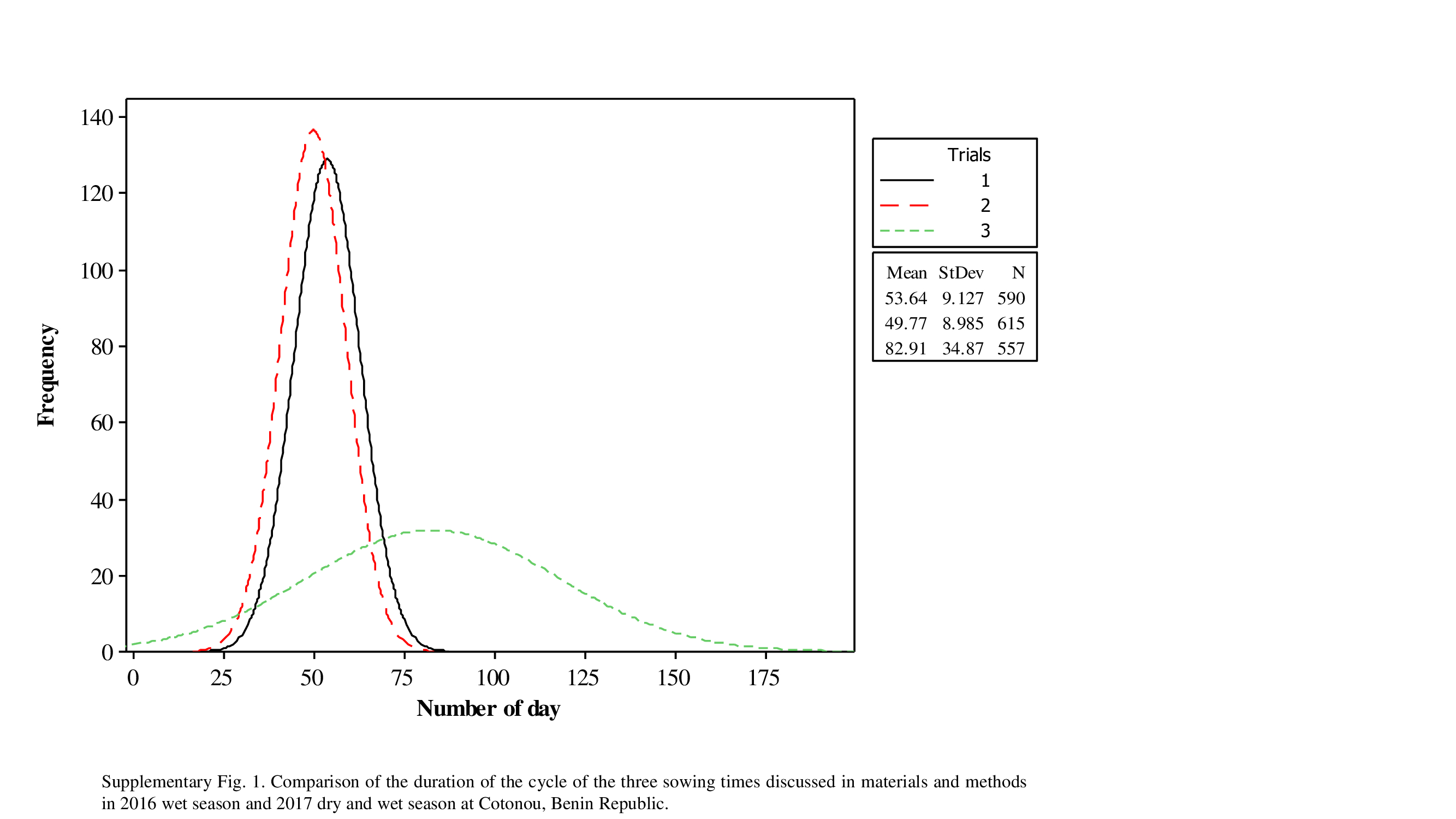
The experiments were conducted at the AfricaRice stations in Cotonou, Benin (6°28′N, 2°21′E and 51 m above sea level) and Ibadan, Nigeria (7°25′56″N, 4°00′07″E and 230 m above sea level). The soil is classified as clay sandy and acidic (pH 5.1–5.4) for Cotonou and the Ibadan soil is clay type (pH 7) (Saito and Futakuchi, Reference Saito and Futakuchi2009; Melandri et al., Reference Melandri, Sikirou, Arbelaez, Shittu, Semwal, Konaté, Maji, Ngaujah, Akintayo, Govindaraj, Shi, Agosto-Peréz, Greenberg, Atlin, Venuprasad and McCouch2021). For initial screening for the EMF trait, seeds of 2093 rice accessions – 1892 and 201 were O. glaberrima and O. sativa accessions, respectively – were obtained from AfricaRice gene bank. The 2093 accessions were divided into three groups based on flowering durations (online Supplementary Fig. S1). The three groups consisting of 700, 720 and 673 accessions were planted in 2016 dry season (DS), 2016 wet season (WS) and 2017DS, respectively. The initial screening was divided into three seasons as the number of accessions 2093 was too high to keep accuracy in phenotyping for EMF trait as described in the below paragraph. The dormancy of the seeds was broken before sowing to seed beds by treatment at 50°C for 5 d. The experiment was conducted in fully irrigated condition under the rain out shelter (ROS) in the AfricaRice-Cotonou station using augmented design (no replications). The plot size was one linear meter (one row of 1 m), with 0.20 m between hills (6 hills per plot) and 0.25 m between rows. Seeds were sown on seed beds and 21-d-old seedlings were transplanted maintaining one seedling on each hill. The trials were kept under fully irrigated condition maintaining about 5 cm standing water during the crop duration. Standard O. sativa checks used were IR 64, BRS PRIMA VERA, WAB638-1, TGS 3, TGS 25 and NERICA-L19.
Six panicles on the main culms (primary tillers) on all six hills were subject to the determination of flowering opening time. Every plot was observed daily from 05:00 to 07:30 h to notice the time of flower opening at a 30 min interval during the whole heading and flowering period of the crop each day and panicles showing flowering were tagged at each observation. All plots were also observed in late afternoon/evening 14:30 to 18:30 h to mark accessions which flowered after 07:30 h during the day, were tagged with different colour from the tags in the morning. The procedure used here was adopted from Ishimaru et al. (Reference Ishimaru, Hirabayashi, Ida, Takai, San-Oh, Yoshinaga, Ando, Ogawa and Kondo2010) with some modifications. The whole procedure is summarized in Fig. 1.
Summary of materials, methods and experimental sites used in this study to evaluate O. glaberrima and O. staiva accessions for early morning flowering (EMF) and early peak in spikelet opening time (EPSOT) traits.

The accessions selected with the EMF trait in Cotonou, Benin were further evaluated at different location, Ibadan, Nigeria during 2018DS using an alpha lattice design with two replicates. The same plot size and transplanting method was used as described earlier for initial trials done at Cotonou. In 2018DS trial at Ibadan, we identified only some accessions showed the EMF trait out of the accessions selected from initial trials conducted in Cotonou. Again, in 2018WS those selected accessions from 2018DS trial at Ibadan were phenotyped for the EMF trait in Ibadan, Nigeria using an alpha lattice design with two replicates. The same plot size and transplanting method was used as described earlier for initial trials done at Cotonou. The same protocol for observation for EMF trait was used as described above. Additionally, during 2018WS all accessions exhibiting the EMF trait were tagged with ribbon and observed again between 08:30 to 09:00 h to identify accessions with early pack spikelet opening time (EPSOT, >80% of spikelet flowered on selected panicles before 09:00 h). The criteria for EPSOT trait, i.e. whether >80% spikelet opened or not in different accessions was based on visual observations. The protocol for EPSOT was adopted from Bheemanahalli et al. (Reference Bheemanahalli, Sathishraj, Manoharan, Sumanth, Muthurajan, Ishimaru and Jagadish2017) with some modifications. The weather data for the trial in 2018WS in Ibadan was collected from weather station of international institute of tropical agriculture (IITA) Ibadan and as indicated in Fig. 2, there were intermittent rains during the heading and flowering period of the accessions reported in Table 1 and online Supplementary Tables S2 and S3.
Weather data for the entire crop duration of the 2018WS trial conducted at Ibadan station. The accessions reported in Table 1 flowered in the period indicated in the figure. The heading and flowering of these accessions coincided with intermittent rains, high relative humidity, and temperature range of 20–23°C minimum and 25–33°C maximum.

Genotypes with both early morning flowering (EMF, before 7:30 h) and early morning peak spikelet opening time (EPSOT, 80% flowering before 9:00) in 2018 wet season in Ibadan, Nigeria

Results
During the initial evaluation of the 2093 total accessions for EMF in 2016–2017 at Cotonou, Benin republic, only 1754 accessions germinated, and 339 accessions did not germinate, probably due to very strong dormancy. The accessions exhibited wide variation (33 to 196 d) in days to flowering between dry and wet seasons (online Supplementary Fig. S1). Among the 1754 germinated accessions including 1571 O. glaberrima and 201 O. sativa accessions only, 384 O. glaberrima (22%) and 50 O. sativa (25%) accessions exhibited EMF phenotype, the data obtained in the initial screening was deposited to Genesys database (https://www.genesys-pgr.org/datasets/19347324-aac6-41aa-8963-aaba0e2b1732) (online Supplementary Table S1). Among the O. sativa checks used in this screening only WAB638-1 showed EMF phenotype (Table 1).
Based on our initial screening at Cotonou the 434 accessions identified with EMF trait when further reevaluated at Ibadan in 2018 DS, we observed that only 70 accessions exhibited EMF phenotype (online Supplementary Table S2). The 70 accessions exhibiting EMF phenotype during 2018DS were reevaluated during 2018WS for both EMF and EPSOT in Ibadan. Among them only 64 accessions showed EMF phenotype but only 15 O. glaberrima accessions exhibited combined EMF and EPSOT traits (online Supplementary Table S3; Table 1). In all the trials among the checks only WAB638-1 showed EMF phenotype but not EPSOT (online Supplementary Tables S1–S3; Table 1).
The 64 accessions exhibiting EMF traits in all trials conducted in Cotonou and Ibadan during different cropping seasons of 2016, 2017 and 2018 exhibited different flower opening times in different trials (online Supplementary Tables S1–S3). However, all 64 accessions exhibited EMF trait in all trials i.e. flowered during the window of 05:00 to 07:30 h as defined in the introduction and materials and methods. The final flowering time presented in Table 1 is the average of the two replicates evaluated in WS 2018 at Ibadan.
Discussion
Our results indicate that many O. glaberrima accessions have inbuilt genetic ability to flower early in the morning to avoid heat stress effects on anther fertility under high temperature of late morning and afternoon (online Supplementary Tables; Table 1). There is no donor reported for EMF trait in the other cultivated rice species, O. sativa so far (Ishimaru et al., Reference Ishimaru, Hirabayashi, Ida, Takai, San-Oh, Yoshinaga, Ando, Ogawa and Kondo2010). However, in this study we found that the O. sativa cultivar WAB638-1 that originated from Cote d’ Ivoire poses EMF trait but not the EPSOT. It should be noted, however, that whether the identified O. glaberrima accessions with the EMF trait in this study (flowering time on the day 05:55 to 06:50 h, Table 1) have an earlier flower opening time compared to previously reported EMF lines (07:00 to 10:00 h) needs to be further investigated under field conditions in Africa. Out of 434 accessions that exhibited EMF traits in initial screening under rain our shelter (no rain effects) conditions in Cotonou only 64 accessions exhibited EMF trait across seasons and locations considering the trials at Ibadan under field conditions. In addition to the genetic potential for EMF, it is important to consider the impact of environmental factors on the expression of this trait. While we did not present specific data on the variation in flowering times across different screenings, we observed some differences (online Supplementary Tables S1–S3) that could be attributed to environmental conditions such as temperature, humidity and light intensity at the different trial locations and seasons. These variations align with previous findings, such as those by Kobayashi et al. (Reference Kobayashi, Matsui, Yoshimoto and Hasegawa2010) and Julia and Dingkuhn (Reference Julia and Dingkuhn2012), who reported that the time of day of flowering is sensitive to environmental conditions, particularly temperature. Given the potential for such variations, it is crucial for breeding programmes to consider the stability of the EMF trait under varying environmental conditions. Although the specific data were not included in this article, these observations highlight the need for further research into the environmental interactions affecting EMF, which would be beneficial for ensuring the consistent performance of EMF traits in diverse agroecological zones.
The 15 lines identified in the present study with the EMF trait combined with the EPSOT trait are potential donors identified for these flowering traits (Table 1). This is the first report on identification of EMF and EPSOT donor lines among both cultivated rice species, O. sativa and O. glaberrima. Introgression of EMF trait to O. sativa cultivar Koshihikari from wild rice species O. officinalis resulted in EMF phenotype in Koshihikari that started and completed flowering two hours earlier than Koshihikari. Hence, introgression of EMF trait to currently growing high yielding rice varieties may reduce heat-induced spikelet sterility through heat avoidance (Bheemanahalli et al., Reference Bheemanahalli, Sathishraj, Manoharan, Sumanth, Muthurajan, Ishimaru and Jagadish2017). The flowering opening time of EMF lines developed by Ishimaru et al. (Reference Ishimaru, Hirabayashi, Ida, Takai, San-Oh, Yoshinaga, Ando, Ogawa and Kondo2010) was 1.5–2 h earlier than original indica cultivars. On other hand, the fact that the flowering opening time of O. glaberrima/O. sativa hybrid was just 1 h earlier than the sativa parent (Nishiyama and Blanco, Reference Nishiyama and Blanco1980). This indicates that more extensive research on O. glaberrima accessions reported in this study may reveal genes comparable to, or even superior to, the qEMF3 gene reported by Ishimaru et al. (Reference Ishimaru, Hirabayashi, Ida, Takai, San-Oh, Yoshinaga, Ando, Ogawa and Kondo2010). Combining such genes may result in improved rice cultivars with heat escape mechanism to cope with current climate change and global warming. In fact, in a recent study, combining qEMF3 with heat tolerance QTL qHTSF4.1 resulted in enhanced spikelet fertility in rice cultivar IR 64 under heat stress in field conditions in the Philippines (Ye et al., Reference Ye, Ishimaru, Lambio, Li, Long, He, Htun, Tang and Su2022).
The prevalence of the EMF trait on O. glaberrima compared to O. sativa accessions would be attributed to their distinct origin and domestication. The two cultivated rice species are believed to have been domesticated separately and has undergone a different selection process under specific environmental conditions, including atmospheric temperatures (Khus, Reference Khus1997). The Niger river delta where O. glaberrima was supposed to be domesticated (Linares, Reference Linares2002) may have experienced higher average temperatures compared to Yangtze River basin in south of China where O. sativa was domesticated (Linares, Reference Linares2002; Atwell et al., Reference Atwell, Wang and Scafaro2014). In fact, the Niger river delta is indicated as a potential high-temperature-prone area at flowering stage of rice (Laborte et al., Reference Laborte, Nelson, Jagadish, Aunario, Sparks, Ye and Redoña2012). The high diurnal temperature variation and heat stress may have led to the selection of EMF trait in O. glaberrima as a mechanism to escape heat stress. Accessing the EMF phenotype in O. barthii, which is considered as an ancestor of O. glaberrima. and O. longistaminata can provide insights into the inheritance and evolution of the EMF trait in O. glaberrima. The same approach could be expanded to other wild rice species with AA genome indigenous in Africa such as O. lngistaminata to seek better donors of the EMF trait to improve heat stress tolerance of O. sativa. To the best of our knowledge such studies have not been conducted so far.
In conclusion, we identified 15 O. glaberrima accessions possessing high promise to improve heat stress tolerance of O. sativa. The prevalence of EMF trait in specific O. glaberrima accessions might come from environmental selection pressure to adapt to tropical Africa. Further studies on the genetic basis and evolutionary history of the EMF trait in O. glaberrima and its wild progenitors can provide valuable insights into the inheritance and potential transferability of the trait.
Supplementary material
The supplementary material for this article can be found at https://doi.org/10.1017/S1479262124000467.
Acknowledgements
This research was financially supported by Ministry of Agriculture, Forestry and Fisheries (MAFF) of Japan through Global Crop Biodiversity Trust (GCDT) grant number GS16010. The authors gratefully acknowledge Africa Rice Center gene bank (Rice Biodiversity Center for Africa) for providing seeds of O. sativa and O. glaberrima accessions used in this study.



 Open access

